Part II Stories to Tell (continued 3)
Reading edition
21. FOUR FRIENDS IN THE FIERY FURNACE
(Daniel 3)
It was a wonderful sight to see the King’s golden image which he had set up in the great plain. The King was a worshiper of images of wood and stone, and he sent forth his herald with a loud trumpet to cry aloud “To you it is commanded, O people, nations and languages, that when ye hear the sound of the instruments of music, ye shall fall down and worship the golden image that Nebuchadnezzar, the King, hath set up; and whoso falleth not down and worshippeth, shall the same hour be cast into the midst of the burning fiery furnace.” From all the country and provinces around people came to see this great image and to worship, and at the sound of the instruments of music all fell down and prayed to it, except three young men who stood upright looking before them, without bowing their heads or knees to the golden image. These were the three Hebrews, Shadrach, Meshach, and Abednego, the friends of Daniel, who must have been away on a journey at that time. When this was told to the King he was very angry and ordered them at once to worship his image or be cast into the furnace, which they saw in front of them glowing with a terrible fire. They said to the King: “Our God is able to save us from your fiery furnace, and he will save us. But if he does not, be it known unto you, O King, we will not worship the golden image you have set up, or serve your gods of gold.” The King was more angry, and ordered his strong men to make the fiery furnace seven times hotter and cast these three friends into the midst of it. But they were not afraid though they were tied with ropes and cast into the fire, which was so hot the flames leaped out and burned up the men who threw them into it. The King was sitting where he could look right into the furnace. A few moments after, he sprang up greatly astonished and cried: “Look, look; did we not cast three friends into the furnace? Lo, I see four men loose, walking in the midst of the fire, and they are not hurt, and the form of the fourth is like the Son of God!” The King ran to the mouth of the furnace, crying, “Shadrach, Meshach, Abednego, ye servants of the Most High God, come out!” And they came out of the fire, and not a hair of their heads was singed, nor were their coats scorched, nor was there even the smell of burning on them. And it all came about because these three friends were loyal to the one true God, who had sent the other Friend, “the form of the fourth,” to deliver them out of the burning fiery furnace.
22. THE MAN WHO WAS NOT AFRAID TO PRAY
(Daniel 6)
Daniel was the man who dared to stand alone in work, in worship, and in play. He could be trusted in everything. Because he was so industrious, faithful, and thoughtful, the new King promoted him to be next to him in rule over all the land. The other officers were jealous and set plans for his downfall. They persuaded the King, Darius, to sign this law: “Whosoever shall pray to any god or to man for thirty days, save to thee, O King, he shall be cast into the den of lions.” The King was delighted to think of every one in the city praying to him just as if he were a great god, so he signed this wicked law. Daniel knew what these evil men would do, but when the time came at noonday for him to pray, he went straight to his home, opened wide his windows toward his old home in Jerusalem, as he was accustomed to do, and knelt down and prayed and gave thanks to his God. That night he did the same thing. He could have waited until he was in bed where none could see him say his prayers. Or he could have left his window closed. But he was not afraid of the King or his officers. They were watching down the street, like detectives peeking from behind the corners perhaps, and when they saw Daniel pray they hurried to the King and told him. Darius loved Daniel and was sorry he had signed the law, but as the laws of that land could not be changed, he said that Daniel must die. So Daniel was brought to the great cave of the hungry, roaring lions. The cage was opened at the top and Daniel was thrown right down into the midst of the wild animals. The King was sad and said, “Daniel, your God will deliver you!” Then the King went back to his palace, but he was so sad he could not eat nor hear music. All night long he thought of Daniel, how good and useful he had been, and how cruelly treated. Early in the morning he arose, hurried to the cave, looked in, and there was Daniel—alive and well. The King cried out, “O Daniel, servant of the living God, has your God delivered you from the lions?” “Yes,” answered Daniel, “my God has sent his angel to shut the lions’ mouths, and they have not hurt me.” The King was glad. He called his servants to come and take Daniel out of the den. When he was drawn out there was found not even a scratch upon him. The King said, “Bring those mean and jealous men, who tried to kill Daniel, and cast them into the den.” So they were caught and cast into the den, and so hungry were the lions that before the men reached the floor of the den the beasts had seized them and were crunching their bones to pieces. Then the King made a new law that all in his kingdom should pray to Daniel’s God, who had delivered him out of the lions’ den, and who had given him the power to dare to stand and to pray alone.
23. THE GOLDEN SCEPTER IN THE PALACE OF THE LILY
(Book of Esther)
Once a King gave a great feast in his Palace of the Lily to all his people. They drank wine from cups of gold in the garden court of the palace which was paved with red marble and mother of pearl. On the seventh day of the feast, being drunk with wine, the King ordered his officers to bring out Queen Vashti in her royal robes that the princes and people might look at her, for she was very beautiful. She refused. So the King said she should be cast out of the Palace of the Lily, and another Queen chosen in her place—the most beautiful woman they could find. One was chosen whose name was Esther, a captive in Persia. Her father and mother were dead, and her cousin, Mordecai, had brought her up as his own daughter. He was a proud old man who always did what was right, and so he displeased many persons, among whom was Haman, the ruler next to the King. Because Mordecai would not bow down to him, Haman planned to kill the stern old man and with him all the Jews in the land. He persuaded the King to give a command that on a certain day all Jews, young and old, women and little children, should be slain. There was great distress among the Jews, but Haman was happy with the King, drinking wine and talking over his great decree. Esther did not know what had happened until she saw her cousin weeping, and then he told her that her life was in danger too, unless she went to the King and pleaded for her people. She said: “Every one knows that whoever goes before the King into the inner court, who is not called, is put to death, unless the King holds out his golden scepter, and for the last thirty days the King has not called me.”
Mordecai replied: “Do not think you will escape! No, if you fail us now, safety will come by others, but you will perish; and who knows whether you are not come to the kingdom for such a time as this?”
Then Esther said: “Go, gather together all the Jews and pray three days and three nights for me, and I will go before the King, and if I perish, I perish!” At the end of three days she put on her royal robes, went into the inner court, and stood opposite the King as he sat on his throne. When he saw her he held out his golden scepter, and said, “What is your wish, Queen Esther? Speak and you shall have it to the half of my kingdom!” She said, “May it please the King to come to-day with Haman to a banquet that I have prepared.” At the banquet the King again asked her wish, and she said, “If it please the King, come again to-morrow to a banquet with Haman.” Haman was delighted as he went home and told his wife and friends about his good fortune; but he said, “I am unhappy as long as Mordecai refuses to bow down to me!” They said, “Build a gallows, and ask the King to let Mordecai be hanged on it.” He did so. But that same night the King read in the book of golden deeds how true Mordecai had been to a former King, and he knew that this service had never been rewarded. When Haman came in the King said, “What shall be done to the man whom the King delights to honor?” Thinking it must be himself the King meant, he said: “Let royal apparel be given him and a royal horse, and a royal crown, and bid him ride through the city for the people to honor.” The King said, “Then make haste and do all this for Mordecai.” This he had to do. And when he went to the Queen’s banquet he was not happy. The King said: “What is your wish, Queen Esther? Speak and I will give it, to the half of my kingdom.” She said: “O King, let my life and my people’s life be given me; for we are sold, I and my people, to be slain and to perish.” The King said, “Who is he? where is he that dares to do so?” Esther pointed to Haman, and said, “There he is, this wicked Haman!” Haman was afraid, and pleaded with the Queen to ask the King to spare his life, but the King said, “Hang him on the gallows that he built for Mordecai.” This was done at once, and when Haman was dead Mordecai was put into his place next to the king, and all the people rejoiced. So Queen Esther, to whom the King extended the golden scepter in the Palace of the Lily, saved all her people, the Jews, that day and they lived in peace and prosperity.
VII BIBLE STORIES FROM THE NEW TESTAMENT
(Adapted for Children, Six to Twelve Years.)
1. THE FIRST CHRISTMAS DAY
(Luke 2)
One starry night, in a grassy field outside a little village, a company of shepherds were watching their sheep that were fast asleep. The men were talking together of the wonderful Saviour-King who had been so long promised to the world. Suddenly a bright light shone around them and, in a moment a beautiful angel appeared and stood near them. The shepherds were afraid and fell on their knees, while the angel said: “Fear not; for behold, I bring you good tidings of great joy, which shall be to all people. For unto you is born this day, in the City of David, a Saviour, who is Christ, the Lord.” As they listened the angel continued, “This shall be your sign; ye shall find a Babe wrapped in swaddling clothes, and lying in a manger.” Just then the light changed to a soft rose-color, and angels of white—a great multitude—filled all the sky singing the glad song, “Glory to God in the highest, and on earth peace and good will to men.” It was the sweetest song ears ever heard. Soon it ceased, the angels of white went back to heaven, and the light faded away. “Let us go at once and see this new-born child!” the shepherds said one to another. So they left their sheep in care of one shepherd and hastened to the town. There they found the little Babe in a stable, wrapped in coarse clothes and lying in a manger. By his side was Mary, his mother, and Joseph. They knelt down beside the manger, looked into the wide-open eyes of the Christ-Child, and told Mary and Joseph of the wonderful light, and of the song and sign of the angels. It was morning when the shepherds went back to their sheep, but they never tired of telling that the Christ-Child was born, and that the angels had said he should bring “peace on earth and good will to men.” That was the first Christmas Day.
2. THE WISE MEN AND THE STAR
(Matthew 2)
In other lands besides the one in which the Christ-Child was born, good men often talked together of the promise of his coming to the world. One night, in a far-away land, a wise man who liked to study the stars, was looking up into the sky, and saw a star he had never seen before. “There is the star of the Christ-Child!” he cried; “I will go and find him and take him a gift of gold!” So he mounted his camel and started. Soon he met another man riding a camel. This man said, “Where are you going?” “I have seen the star of the Christ-Child,” he said, “and I am going to find him.” “I saw the star too, and I will go with you,” said the man; “I shall give him a gift of my sweetest incense.” Soon they met a third man riding on a camel. “I too,” he said, “saw this wonderful star, and am seeking the Child-King. I have for him a gift of myrrh, my most precious perfume!” So they journeyed together—on and on—ever following the star until they came at last to the little town of Bethlehem, and the star stood shining over the little house.
“Ike! Ike!” each traveler shouted to his camel. This meant “Kneel; kneel!” The camels slowly knelt down; each man put his foot on his camel’s neck, stepped upon the ground, and went into the house, where they saw the young child and fell down and worshiped him. Then they opened their bags and gave for the Star-Child their best gifts, of gold, and frankincense, and myrrh, such as were given only to kings. Some time after they returned home to their study of the stars again, but they never forgot the star that led them to the Child-King who was born to bring to the world “peace and good will, good will and peace.”
3. WHEN JESUS WAS A BOY
(An Imaginary Sketch.)
(Luke 2: 40, 52.)
When Jesus was a boy he lived in a little country town, called Nazareth. It was a beautiful place, with little white stone houses, and little narrow streets; high green hills rising above it; many gardens full of bright flowers—roses, tulips, lilies, orchids, and wild geraniums; orchards of fig trees, olive trees, and orange trees; cooing doves and other birds flitting here and there on the housetops and among the trees; and in the center of the town there was a fountain from which water was carried by the people to their homes in large stone jars borne on the shoulder.
The house in which Jesus lived had only one room with a dirt floor. It had no window except a hole in the wall; no bedstead, no chair, no pictures, no looking-glass. The people in these poor houses ate their meals from a low bench or shelf as they sat or reclined upon the floor or upon cushions. They slept upon quilts spread on the floor at night and neatly folded up by day. The only furniture was a chest or cupboard on one side of the room, where they kept their best clothes. Near the door stood the jar of water for drinking, cooking, and cleansing.
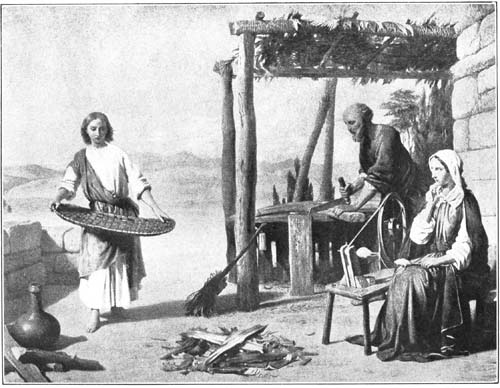
WHEN JESUS WAS A BOY
When Jesus was a boy he wore a bright, red coat with long sleeves and tied around his waist with a sash of different colors. When he was very little he wore no shoes or stockings. Later he wore little sandals. Sandals were taken off when people entered a house. Perhaps it was easier for a boy then to take off his sandals than to wipe his shoes on the door-mat as boys should do now. But these boys had to wash their feet as they came indoors, and perhaps that would be harder for a boy who doesn’t like to wash even his hands when he comes into the house now.
When Jesus was five years old he began to attend the village school with other boys. After school was over he loved to play games with the other boys around the village fountain or upon the level place on the hillside. He played “funeral” and “wedding” and many games such as boys play now. He used to climb to the top of the green hills gathering wildflowers, watching the birds, and perhaps sometimes he would chase the butterflies, but if he caught them he would never hurt them. He helped his mother feed the doves and the chickens, often laughing heartily as he saw the chicks run to hide under the mother’s wings.
Every Sabbath he went to the village synagogue, which was the same place as the day-school. He listened attentively to the minister reading and explaining the Bible. After the synagogue service all the children stayed to the Bible school. All the children sat on the dirt floor and listened to the Old Testament read and explained. Boys, like Jesus, were glad to learn a great deal of the Bible by heart and then to repeat it from memory.
Jesus’ father, Joseph, was the village carpenter. He made and repaired stools, mangers, plows, yokes, and such things for the home and farm. Jesus doubtless loved to be in the carpenter shop, helping Joseph by bringing saw and hammer, holding a board, and learning all he could. Jesus and Joseph were chums and partners, always trying to help each other. We may imagine that one day Jesus saw an Arab in the village making a tent. When Jesus got home he said, “I would like to have a tent.” So Joseph helped him, and he soon learned to smooth and sharpen the pegs, sew cloth together, and when at last the tent was finished and put out in the garden, no boy was ever happier lying under his own tent that his own hands had made, than Jesus was. One day, perhaps, Joseph took Jesus over to the lake, where they went fishing. What fun that was to Jesus, as well as the rowing and sailing and swimming in the lake! When he got home he said, “Let us make a little boat for little brother.” So they made a nice boat and gave it as a plaything to amuse his little brother.
Often his mother called, “Jesus, please get some water in the jars.” Jesus started on the minute. He never said, “Oh pshaw! ask brother!” or “I don’t want to!” or “Wait a minute!” No, Jesus went at once, and more often saw what was wanted to be done and did it without waiting to be told.
Jesus was the kind of boy that helps everybody. So everybody liked Jesus. He studied his lessons well. He always played fair with the boys. He was kind and loving and good to all. He loved everybody, and everything he did he did with his whole heart and tried to do well.
In the evening his father and mother often gathered the children together and told them the beautiful stories from the Bible—and Jesus loved especially those about Abraham and Joseph and Samuel and David and Daniel.
So when Jesus was a boy he was a real boy—a perfect boy, the best thinking, feeling, speaking, acting boy the world ever saw, just the kind of boy that God wants every boy to be, “growing in body, in mind, in soul, and in favor with God and man.”
4. WHEN JESUS WAS LOST
(Luke 2: 41-52)
One morning when Jesus lived in the little white stone house in Nazareth, his father, Joseph, said: “Jesus, you are now twelve years old. You are to go to the feast in Jerusalem with us this year.” This made Jesus very happy. He had been looking forward a long time to the day when he could go to the great city of Jerusalem that was to him the most sacred and most wonderful city in the world. So, when the morning to start came, Jesus was ready. When they started there were great throngs of people from different towns and lands going up to the feast, traveling together and crowding the roads. The women and aged men rode on donkeys, or mules, or horses, or camels. The men walked by their side, staff in hand. The boys ran on before or played by the side of the road. These great caravans of people slowly traveled together as far as they could by day and rested at night in tents or booths. The boys had tents in which they could sleep together, and Jesus was with the boys. On the fourth day, suddenly in the distance, on a hill, Jesus caught the first glimpse of the high towers and great walls of the city, and the shining roof of the temple and palaces. The people cried out, “Jerusalem! Jerusalem!” singing psalms of joy together, accompanied by music of various instruments, as they journeyed onward. Soon they reached the city. It was a new and wonderful world to Jesus, this wondrous boy of twelve years old, who had lived in the country and had never seen a large city before. He opened his eyes wide to see the crowded streets, the marble palaces, the strong towers, and then the temple courts and buildings. He saw the bright robes of the priests. He saw the smoking altars and their bleeding sacrifices of oxen and lambs and doves. He stood in front of the great blue veil of the holy of holies and wondered what was within. He knew this was his heavenly Father’s house, and he liked to be there better than anywhere else. He watched the daily sacrifice and all parts of the feast. During the seven days of the feast, Jesus walked about the streets looking at the stores, the wonderful articles for sale, the animals for sacrifice, the forts, the great gates, and other interesting things in the city, but he always liked to go back to the wonderful temple.
When the feast was over, Joseph and Mary started toward home. But as the roads were so crowded, especially toward Nazareth, with the thousands of returning pilgrims, his parents, supposing he was in the company, did not discover that he was missing until they pitched their tents at the close of their first short day’s travel. Jesus was lost. They searched everywhere and asked everybody they met, and when they could not find him they were greatly worried, fearing that King Herod might have caught him and put him to death. They hurried back to the city very early the next morning and searched everywhere for the missing boy but could learn nothing of him. At last, on the third day, they went into one of the side rooms of the temple, a room where the teachers and wise men met, and there was Jesus in the center of a group of white-bearded teachers, listening earnestly to what they said, and asking them harder questions than they had ever heard before. Mary said: “Jesus, my son, why hast thou thus dealt with us? Behold, thy father and I have sought thee sorrowing.” Jesus replied: “Mother, how is it that you sought me? Did you not think that I would be here, in my Father’s house?” While Jesus had been at the feast during those seven days he had found out what every boy and girl sooner or later must find out, what he is to do and to be in the world. But though Jesus now knew what he was to be and do, yet at once he said to the great teachers, “Good-bye,” and went back with his parents to Nazareth, a cheerful, obedient Jewish boy.
And in all that land no son was ever so thoughtful, so kind, so loving, and so helpful to his parents and to his brothers and sisters, as was this noble boy and young man, whom his neighbors knew as Jesus, the young carpenter of Nazareth.
5. WHEN JESUS LEFT HIS CARPENTER SHOP
(Mark 1: 1-11)
When Jesus was the young carpenter in Nazareth he was the best carpenter of all the land. The children, passing by, liked to peep in at the open door of his shop and see him at work with his saw or hammer, making or repairing a stool, or a chest, a manger, a plow, or a yoke. He smiled sweetly at the children and spoke kind words to them, so that the children of Nazareth loved him in return. But one day as Jesus was standing beside his bench, with the shavings at his feet and his carpenter’s tools about him, he knew that very soon he must leave that shop and go into the towns and cities where there were other things for him to mend than stools and chests and mangers and plows and yokes. At last, one evening, when the shadows lengthened, he went into his carpenter’s shop and hung up his hammer, his saw, his adz, and each of his carpenter’s tools, shut the door of his shop, said “Good-bye” to his mother and his brothers and sisters and friends in Nazareth, and early next morning started on a long walk over the hills and valleys toward the river Jordan.
A strange preacher named John, the Baptizer, had come out of the wilderness to the banks of the river Jordan, preaching that everybody should repent of his sins and prepare for the coming of God’s Son by being baptized in the river, confessing his sins. John was dressed in a rough coat made of camel’s hair, and had lived in the desert eating nothing but honey and an insect, something like a grasshopper, called a locust. But thousands of people came to listen to this strange preacher of the desert and to be baptized.
One afternoon, as a great crowd was around him, John suddenly stopped in his preaching, and looking at a man coming near, he cried, “Look, there is God’s Son!” All eyes were turned toward the quiet and gentle form of Jesus, who walked forward and said to John, “I would like to be baptized.” John drew back, and said, “Oh, no, no! You should baptize me, rather than that I should baptize you.” But when Jesus said, “It is God’s will,” John took hold of his hand and together John and Jesus slowly stepped out on the pebbly shore, and walked into the river, with every eye upon them. Standing out in the water, Jesus prayed. Then John baptized Jesus. And as Jesus came up out of the water, suddenly the sky seemed to open, and a beautiful snow-white dove flew down and rested upon the head of Jesus. Then a Voice from heaven was heard that said, “This is my beloved Son, in whom I am well pleased.”
This was the announcement that Jesus was the Son of God and the Saviour of the world. It meant that Jesus would return to the carpenter shop no more. No more would the farmer bring his plow for Jesus to repair. No more would the housemother bring her stool to Jesus to mend. In vain would the children passing by his shop look in at the open door to see his pleasant smile or hear his kind voice. The saw and the hammer and the adz were for other hands now. Jesus had entered upon his great task of mending and healing human hearts and lives, of bringing “Peace on earth, good will to men,” a task in which every one who loves him and is like him may still share a part.
6. WHEN JESUS WON HIS GREAT VICTORY
(Matthew 4: 1-11)
When Jesus was a boy and a young man in Nazareth, he was sometimes tempted to do wrong things or to do right things in a wrong way. But he had decided always to do what pleased God, his heavenly Father, and so he met every temptation to do wrong with a firm “No!” which each time won him a new victory, as it will with any one.
Immediately after his baptism in the river Jordan Jesus was tempted more than ever before because his baptism was the beginning of his public life as the Son of God and Saviour of men. Satan, the tempter, said, “I will make him do something that will not please God!” So, far off in the desert, where Jesus withdrew to plan the best way to begin his life-work, and when he had fasted for forty days and was very hungry, Satan came to Jesus in some strange form and said, “If thou art the Son of God, command that these stones become bread.” He pointed to some round, smooth stones lying near that looked very much like loaves. Jesus knew that he could command them to become bread, but he said: “No, God does not want me to use my power for myself, but for others. It is better to obey God and do right than even to get bread when one is hungry. God says in his word, ‘Man shall not live by bread alone, but by every word that comes from the mouth of God,’” So Jesus refused to do what Satan said to satisfy his hunger, and won the first inning of his great victory.
The tempter tried another plan. He seemed to take Jesus suddenly to one of the highest towers of the temple in Jerusalem where he said: “If thou art the Son of God, cast yourself down and surprise the people, for God’s word says, ‘He will give his angels charge over thee, and they shall bear thee up in their hands lest thou dash thy foot against a stone.’” Jesus knew that he could easily do this, but he said: “No, the angels of God only take care of God’s children when they do right in a right way to please him. It is written in God’s word, ‘Thou shalt not tempt the Lord thy God.’” So he refused the tempter, and won the second inning of his great victory.
The tempter tried a third time. He seemed to carry Jesus up into a very high mountain, from which he could see the whole world and all the glory of it. Satan said: “All these things will I give thee if thou wilt fall down and worship me. The Jews want a Sword-King. Become a Sword-King and lead them out to fight their enemies, and you will win, for I will help you.”
“Get thee hence, Satan,” cried Jesus immediately, “for it is written in God’s word, ‘Thou shalt worship the Lord thy God, and him only shalt thou worship.’” Jesus refused to be Satan’s Sword-King, and chose to be God’s kind of king, a Peace-King. So Jesus won the third inning of his great victory.
Then Satan left Jesus. God’s angels brought him food to sustain him and encouragement to revive him. And Jesus was stronger still to do always those things that pleased his heavenly Father, who would give him help to win other victories through life, as he had helped him to win this first great victory.
7. THE CHILDREN’S FRIEND
(Matthew 19:13-15)
One day a great crowd of men gathered about Jesus, the great Teacher. All sorts of men were there—rich men and poor men; soldiers with their swords and spears and sandals; rough fishermen, barefooted, fresh come from their boats and nets; and priests dressed in their long, white robes with colored fringes.
Suddenly, as the great Teacher was speaking, at the farther edge of the crowd a noise was heard. Some women and children were trying to get near to Jesus. These women wore red and blue dresses with handkerchiefs tied over their heads, which showed they were poor women from the little white stone houses. Some were carrying their babies, some were holding their little ones by the hand, and others were followed by large boys and girls clinging to their mothers’ skirts. All were trying to press nearer to Jesus who was talking earnestly to the people. Soon some of the close friends of Jesus noticed these women with their children, and said: “Women, do you not see how busy Jesus is? He has grown-up people to talk to, and has no time for you and your children. Take them away; carry them home where they belong!”
Jesus heard what his friends said, and cried out: “Do not send the children away. Suffer the little children to come unto me, and forbid them not, for of such is the kingdom of heaven.” There were so many of them—mothers and their children, little babies, small children, young boys, and girls! Jesus received them all. He let them all come near him. He took the babies in his arms. He laid his hands on the heads of the little children. He put his loving arms around the larger boys and girls. And he blessed them all. It may be he told them some beautiful stories, for we may be sure that the boys and girls then loved to hear stories as well as the children do to-day.
So Jesus was the friend of the children! No wonder children like to sing:
I think when I read that sweet story of old When Jesus was here among men, How he called little children as lambs to the fold, I should like to have been with them then. I wish that his hands had been placed on my head, That his arms had been thrown around me, And that I might have seen his kind look when he said, “Let the little ones come unto me.”
8. THE MAID AWAKENED
(Matthew 9:18-26)
Once there was a girl twelve years of age who lived in a beautiful country house with her father and mother, who loved her dearly. Her father was one of the chief men of that place, a ruler, the president of Synagogue College, and very rich.
One day this little girl became ill, and day by day she grew weaker and weaker, until everybody feared she would never be well again. One morning she lay very white and still with her eyes closed and scarcely breathing. Her father had left his business that day to sit by her bedside and watch her. Tears filled his eyes as he thought he must lose his darling daughter. All at once the little girl opened her eyes and seeing her father’s tears said: “Father, there’s a good man who loves children. I saw him one day in town, and he looked at me and spoke to me so kindly, I just loved him. His name is Jesus. He heals the sick. I think he would make me well.”
The father had thought of him several times, but as some of his friends didn’t want to have anything to do with him, he did not go to him. But when his daughter whispered, “Please, father, tell him I’m sick,” the father determined at once to go and get him. He hastened to the town where he was dining in a friend’s house. He fell at the feet of the great Teacher, crying out: “My little daughter is dying! Please come quickly and lay your hand on the child, and she shall live!” At once the Teacher arose and followed the father, a great crowd of people following, each person trying to get near him and to look up into his face or to hear his wonderful words. As they were on their way a poor old woman that had been ill as many years as the little girl had been on the earth, with a disease that no doctor could cure, came up quietly behind Jesus in the crowd. She thought, “If I can only touch his garment, I shall be healed.” And as soon as she put out her finger and touched the hem of his garment, she felt new life, and she was healed. “Who touched me?” said the great Teacher, turning around and looking straight at her. Then he spoke kind and comforting words to her. All this took so much time the father was worried and said, “O Sir, please hasten, or my little daughter will be dead before we get there!” But this great man was never in a hurry, having time to help everybody. They were not much farther on the way when they saw a man running toward them. It was the rich man’s servant, who said, “Thy daughter is dead. Don’t trouble the Teacher any further!” You should have seen the sorrow written on that poor father’s face. Jesus saw it and said, “Do not be afraid. Only believe in me!” When they reached the house the doors were wide open and they heard the sound of pitiful wailing and weeping, accompanied by the flutes and other instruments of mourning-minstrels, who did not feel sad, but merely did this because they were paid for it. “Why make ye this ado and weep?” said Jesus. “The maid is not dead, but she is asleep!” After Jesus had passed, these weepers laughed and mocked him, saying, “We know she is dead.”
“Come with me,” said the Teacher with the gentle voice. Then he took the father and mother of the maid and three of his friends into the room where the maid was lying so white and still and breathless. Very tenderly he bent over her body, took her small white hand in his own warm hand, and softly said, “Little maid, arise!” In a moment the rose-color came back to her pale cheeks, and she sat up in the bed, and threw her arms about her father and mother, who could scarce believe their eyes for joy. Then she sprang from the bed and walked, perfectly well. “Give the maid something to eat,” said the Teacher. Her mother quickly gave her something to eat. Soon the servants prepared a feast for the great Teacher, and the little maid sat next to him at the table, as happy and as well as she could be. And she never forgot the name of that great Friend who awakened her from her sleep of death!
9. THE BOY WITH HIS LUNCH
(John 6: 1-14)
Once there was a good boy who had a very kind-hearted mother. Early one morning he said, “Mother, I’d like to go fishing to-day.” “Yes,” said the mother, “you’ve been a good boy; take your fishing-tackle, and here’s a nice lunch for you.” She put him up five little cakes, such as he liked, in a basket. He went down to the lake and fished all the morning and way into the afternoon, and caught only two little fish, which he held over a fire that he made, until the fish were cooked brown and looked so good to eat. He was just about to eat them with his cakes, when he looked up and saw a great crowd of people a little distance away whom he had not noticed before. He wondered who they could be. So quickly putting his five little cakes and two fishes into the basket, he took it up, ran as fast as he could, and pressed his way to the front, where he saw a great and good man talking to the people so earnestly that they did not notice the boy. Soon he was listening as earnestly as any of them. When the great and good man had talked a long time and no one seemed tired, one of the men said: “I think you had better send the people home to get something to eat. If they stay much longer they will get so hungry they will faint by the way.” The good man said, “You give them something to eat!” The man laughed and said: “Why, if we bought two hundred dollars’ worth of bread and gave each person a little, there would not be enough to go around.” When the boy heard that, he said to a man he knew, “He can have my lunch if he wants.” The man said: “There’s a little lad here with five little cakes and two little fishes, and he says you can have his lunch, if you want!” “Yes,” said the good man, “let him bring it to me.” So that good boy came right up in front of the great and good man and gave him his lunch. The good man asked God to bless it. Then he asked his friends to seat the boys and girls on the green grass in rows of fifty, and the women in rows of fifty, and the men in rows of a hundred. When they were all seated, the good man took up one of the little cakes and broke off a piece, and another and another and another; but the cake did not become smaller. He kept breaking it until there was a great deal of bread. Then he took up one of the little fishes and broke off a piece, then another and another and another; but the fish did not become smaller. He kept breaking the fish until there was plenty. Then his friends passed the cakes and fish around to the boys and girls. It was the sweetest bread and fish they had ever tasted. The boy who gave up his lunch had all he could eat, so did all the women and all the men. When they had eaten all they wished, there were twelve baskets full left over. And it all came about because that good boy was willing to share his lunch with the great and good man.
10. THE DWARF IN THE MULBERRY TREE
(Luke 19: 1-10)
Once there was a very little man who was no bigger than a young boy. He was so short that some people called him a dwarf. He lived in a very large house, was very rich, and had a money-making office. But no one in the town liked Zaccheus, the dwarf, because he was not good, or kind-hearted, or honest. People said that he had cheated them out of money and done other bad things. One afternoon, as he was walking along the street, suddenly he saw in the distance a great crowd of people coming along the main road leading into the town. The people were shouting excitedly, “Jesus is coming! Jesus is coming!” “How I would like to see Jesus,” said the dwarf to himself as he ran toward the crowd and tip-toed, trying to catch a glimpse of the great Teacher’s face. But he wasn’t tall enough. He could see nothing but heads towering above him. “I know what I’ll do,” he said to himself. “I’ll climb up into that mulberry tree near my house. Then I can see him easily.” So he ran quickly and climbed up into the branches of the great tree, and waited until the crowd came close. “There he is” he said to himself; “well, if I am a dwarf, no one can see better than I this time.”
He sat there quietly while the great procession passed by—men, women, children, and Jesus in the midst. Soon Jesus stopped near the tree, looked up into its branches and cried, “Zaccheus, make haste and come down, for I want to stop at your house to-night!” Zaccheus could scarcely believe his ears. Was it possible that the good Teacher would visit him, a man so wicked, hated, and despised? How did Jesus know his name? How did he see his hiding-place in the tree? The dwarf didn’t know, but he hastened down at once and welcomed Jesus to his house. In surprise some of the people cried: “Look! Jesus is going to stay with a sinner. Does he know what a bad man this is?” Zaccheus gave Jesus the best room in his large house, and did all he could to make his visit comfortable. “Prepare the best feast for Jesus,” he said to his servants. And while they were seated at the table, Zaccheus stood before all and said to Jesus: “Master, if I have taken anything from any one wrongfully, I will give him back four times over, and one-half of what is left I will give to the poor.”
Then Jesus said to all the people: “Zaccheus, whom you have despised and hated, is one of the children of my kingdom. I came into his house to help him to be good and kind-hearted and just. I came to seek and to save the lost!”
Zaccheus, the dwarf, never forgot that afternoon when Jesus found him seated up in the mulberry tree and spent the night at his house and loved him when everybody else hated and despised him.
11. THE GOOD NEIGHBOR
(Luke 10: 25-37)
One day as Jesus, the great Teacher, was speaking, a lawyer, who really wanted to know, said, “Who is my neighbor?” and Jesus told him this beautiful story:
Once a man was journeying over a rough and lonely road. A band of robbers sprang upon him, struck him down, stole his money and clothes and left him bleeding and half dead on the road. A temple-priest happened to pass that way, and when he saw the wounded man lying there he said to himself, “No one can see what I do on this lonely road.” So he crossed over to the other side, looked at the beautiful scenery, and passed on to the temple to prayer and sacrifice, leaving the poor man uncared for, dying in the road.
A temple-singer also passed that way. When he saw the wounded man lying there he went up to him, looked carefully at his sad condition, and said to himself, “Poor man, I would help him if I were not so busy.” So he passed on to his singing in the temple, leaving the poor man uncared for, dying in the road.
Shortly afterward a Samaritan, a man who was not a Jew, came along the road. He saw the wounded man bleeding and dying, uncared for in the road, and felt sorry for him. He saw that he was a Jew and not one of his own people, but that made no difference. He went up to him, raised the suffering man, and gently poured soothing oil into his wounds, and gave him strengthening wine. Then he helped him upon his mule and walked by its side, while the man rode until they came to a small hotel, where he spent the night taking good care of him. The next morning he said to the hotel-keeper: “Take care of him until he is well. Here is some money, and if you spend more I will repay you when I come this way again.”
Jesus said to the lawyer, “Which of these three was a neighbor to the wounded man?” The lawyer said, “The man that showed mercy on him!” Jesus said: “Go, and do you be as good a neighbor to all whom you have the power to aid and to help.”
12. THE STORM-KING
(Mark 4: 35-41)
Just at sunset one beautiful evening, a little fishing-boat was sailing across a large lake. At the end of the boat Jesus, the great Teacher, was sitting watching the gold and red and purple of the sky reflected in the rippling waves. Soon the moon came up and its soft, silvery beams shone on the waves all around the boat. Then, as Jesus was very, very tired with his hard day’s work, he lay down on the seat and one of his fisher-friends brought him a leathern cushion for a pillow that he might rest easier. No sooner was Jesus fast asleep than the lake, which had looked so lovely before with its rippling waves, changed quickly and became rough and choppy, and the wind began to blow very hard. The moon went under a cloud. The wind blew fiercer and fiercer. The waves rose higher and higher. Several of the friends of Jesus had been fishermen and sailors on that lake all their lives, but they never knew such a terrible storm. The wind blew a hurricane, the waves dashed up so high that they came over the boat, and it began to fill with water. Hurrying to Jesus, who was sleeping soundly through all the wind and storm and darkness, they awoke him, crying, “Master! Master! awake, we are drowning! Save us!” Jesus awoke and heard the wild roaring of the wind and the torrents of rain and the dashing of the sea. Then he arose and said to the sea, “Peace, be still!” and the wild wind heard his voice, and ceased as a dog stops barking when he hears his master’s command, “Be still,” or as a crying child stops his sobs when his mother speaks. So the noisy sea trembled; the waves sank to rest; the moon came out again; and the lake lay still and silent. There was a great calm. Then his friends knew that Jesus was the Storm-King, and they said, “What a King is this—for he commandeth even the winds and the sea and they obey him.”
13. THE KING WITH THE BASIN AND THE TOWEL
(John 13: 1-17)
One evening Jesus and his friends were gathered together at a supper in an upper room in a house which belonged to a friend of Jesus, and which had been loaned for this special supper. Jesus and his friends had walked a long distance that day over a rough and dusty road and their feet, in the loose sandals, were sore and dusty. Near the door stood a stone pitcher filled with cool, fresh water, and also a basin and a towel, but there was no servant at the door to wash their feet when they removed their sandals and passed to their places about the table. Each of the twelve friends of Jesus was thinking which would occupy the highest seat in Jesus’ kingdom, and each wanted to have the highest place of honor at the table. No one had offered to take the basin and the towel, but rather they were even quarreling over which should recline next to Jesus at the head of the table. Jesus spoke not a word. He arose from the table, went quietly over to the water-jar, laid aside his outer cloak, tied a towel around his waist, like a servant, took up the basin, filled it with water, and began to wash his friends’ feet, one after the other, and to wipe them with the towel. Jesus was the King of heaven and earth! Jesus was Lord and Master, as well as Friend. One of them should have offered to do this. But no one thought of serving others in any such slave’s way but Jesus. So, when he had finished washing the feet of all, he put on his outer cloak again, took his place at the table, and said, “He that would be greatest of all must become the servant of all.”
14. WHEN JESUS WAS FORSAKEN
(Matthew 27: 27-66)
For three long years Jesus went about doing good, living for others—feeding the hungry, healing the sick, opening the eyes of the blind, unstopping the ears of the deaf, causing the lame to walk, raising the dead, comforting the weary-hearted, and teaching messages of love to all. At last untrue men, who did not love goodness and truth, jealous because the multitudes followed Jesus, said, “Away with him—crucify him!” And Pilate, the Roman governor, gave the sentence, “Let him be crucified!” That meant death on the cross, the cruel cross on which only the worst criminals, and those mostly slaves, were put to death for the basest crimes. So one Friday morning about nine o’clock, Jesus, carrying the heavy beam upon his shoulder, was led up the steep road to a green hill outside the city wall. There they nailed him cruelly to the cross. Jesus quietly prayed to his Father to forgive his enemies. He also prayed for one of the two thieves dying near him on another cross, that God would forgive him and bring him to heaven. He saw his mother, Mary, weeping bitterly near his cross, and said to his friend John, “Take care of my mother, and be a son to her.” Just at midday a sudden and strange darkness came over all the land. There was thunder and lightning and a great earthquake! The people around the cross listened and heard through the storm and out of the darkness this piercing cry from Jesus, “My God, my God, why hast thou forsaken me?” It seemed to Jesus that not only had all his disciples and nation forsaken him, but that God, his heavenly Father, whom he had always tried to please in everything all his life long, had hidden away his face from him and had forgotten and forsaken him. After three hours the light broke out again and Jesus said, “It is finished!” Then, “Father, into thy hands I yield my spirit.” And Jesus was dead. To make the more sure that he was dead, one of the soldiers pierced his side with a sharp spear, and from the wound water and blood came forth. And the water mingled with the blood showed that Jesus died of a broken heart for the sins of men!
That evening some friends came and tenderly took his body down from the cross and buried him in a new tomb in a garden, and rolled a great stone across the door of the tomb.
And when the stars shone out that night it was the close of the world’s blackest day, because the King of Love, who came to bring to men “peace and good will, good will and peace,” had been rejected and was dead and buried.
15. THE FIRST EASTER DAY
(John 20)
Very, early on Sunday morning, the third day after Jesus had died, some Roman soldiers were guarding the tomb where the body of Jesus lay. Just as the first faint streaks of dawn appeared, suddenly there was a noise and a shaking of the ground, as a beautiful angel came down from heaven and rolled away the great stone from the mouth of the tomb. The face of the angel was like lightning, and his garments were like snow. At the sight of the angel and the opened tomb, the Roman soldiers shook with fear and ran away as for their life. Just as they were running out of one gate of the garden, three women, friends of Jesus, were coming into the garden by another gate. They were walking slowly and sorrowfully and saying one to another, “Who will roll away the stone from the tomb?” They were bringing fresh cloths and spices to put around his body. It was still dark in the garden, with only a small streak of light in the east; but what was that bright, shining light in front of the tomb? They hurried forward and looked—the great rock had been rolled away and a strange and beautiful angel was sitting upon the stone in front of the tomb. The tomb they could see was empty. The women were trembling with fear and surprise. But the angel said: “Be not afraid, I know ye seek Jesus. He is not here. He is risen. Go, and tell his disciples that he goes before you into Galilee, and ye shall see him as he said unto you!” Full of joy the women hurried back and told the friends of Jesus that he was alive.
Another friend of Jesus came to the garden just as soon as the women had gone. Her name was Mary. She came to the tomb all alone, and when she looked into the empty tomb she saw two angels in white sitting, one at the head and the other at the foot, where the body of Jesus had lain. These angels were strong and beautiful, with garments dazzling white like the sun, but she was so sad that she hardly noticed them until one of them said, “Woman, why weepest thou?” She said, “Because they have taken away my Lord, and I know not where they have laid him.” Then she stepped back a little distance into the garden and saw a man she thought must be the gardener. He said, “Woman, why weepest thou?” She said, “Sir, if you have carried him away, tell me where you have laid him.” In a low, sweet voice the man said, “Mary.” Then she knew Jesus spoke to her, and brushing her tears away quickly, she said, “Teacher!”
So Jesus came to all his disciples, one by one, or two or three together; until at last all knew he was risen from the dead—that he was alive again.
This is the story of the first Easter Day. And this is the reason that in Russia on Easter morning, the peasant people say, “The Lord is risen!” and their friends reply, “The Lord is risen indeed!”
16. THE CRIPPLE AT THE BEAUTIFUL GATE
(Acts 3, 4)
One afternoon two friends were walking along a street in Jerusalem on their way to the evening sacrifice in the temple. At one of the entrances—the Beautiful Gate (so named because of its snow-white marble steps leading up to its great door of costly brass)—sat a poor lame man, begging. His feet and ankles were so crippled that he had never been able to walk or even to stand. His friends carried this helpless cripple and laid him every morning at this temple entrance to beg charity from those who went to pray. As soon as the man saw these two friends, Peter and John, he cried piteously, “Give charity!” Standing still and looking him quietly in the eye, the two friends said, “Look on us!” He looked up at once most expectantly. Peter said, “Silver and gold have I none, but what I have, I give thee. In the name of Jesus Christ of Nazareth, walk!” Taking him by the hand Peter lifted him up, and immediately his feet and ankle-bones became strong. The man leaped up and went into the temple with Peter and John, walking and leaping and praising God. All the people were amazed, seeing him leaping and hearing his shouts of joy as he held fast to his two friends. A great throng gathered about them in the large open court, called Solomon’s porch. Peter, seeing the throng, began to tell them about the wonderful Prince of Life, Jesus, whom they had put to death. Such preaching within the temple courts aroused the people and offended the priests, and the chief officer seized Peter and John and cast them into prison. This caused hundreds of the people to declare themselves Christians. The next morning when Peter and John were brought before the council and questioned, the officers said, “We will let you go if you will promise not to speak or teach in this name again.” They answered: “Whether it be right in the sight of God to hearken unto you, rather than unto God, judge ye; for we cannot but speak the things we have seen and heard.” So, failing to frighten them, the officers were compelled to let them go. And being let go, they returned at once to the Christian company, and told what the Jewish officers had said to them. And the cripple who had been healed at the Beautiful Gate was a happy Christian in that company, and was one of the loudest in giving true praise to God that day.
17. THE GIRL WHO KNEW SHE WAS RIGHT
(Acts 12)
Once there was a girl, possibly about sixteen years of age, who lived with her father and mother in the dreadful days of the persecution against the early Christians. One evening her mother said: “Rose, your father and I are going to a friend’s house to-night to pray. Herod, the wicked king, who killed the apostle James, John’s brother, has shut up Peter in prison for several days—and to-morrow he is going to put Peter to death. The Christians are to pray to-night for Peter’s release from prison.” “Mother,” said Rose, “I am a Christian too; let me go and pray with you.” Her mother consented. For some hours the Christians earnestly prayed; and after midnight they were still on their knees praying, when suddenly Rose, being nearer the door, heard a knock on the outside gate. She quickly arose from her knees, ran to the door and said, “Who’s there?” “It is I—I—Peter,” came a voice. Again she said, “Who is it?” “I—Peter,” came again the voice. She knew at once it was Peter’s voice, but in her joy and excitement she forgot to open the door, running back into the prayer-meeting room and crying out, “Peter is out of prison! Peter is at the door.” All arose from their knees and said, “Rose, you must be crazy to talk like that.” “No, I am not,” she said; “it is Peter!”
“Isn’t it too bad?” said one, “Herod has already killed Peter, not waiting until to-morrow; and God has sent Peter’s angel to comfort us.” “No,” cried Rose; “no, it is not Peter’s angel; it is Peter himself! I know I am right! Listen, there he is knocking again!”
All heard the knocking and went toward the gate, and there stood Peter, alive and well. “How did you get out of prison?” they exclaimed. “Hush!” said Peter, beckoning them to be quiet; “let me in, and I will tell you!” He stood just inside the gate, and this is what he said: “Last night I was in prison, knowing well that Herod intended to kill me this morning. I was guarded by sixteen soldiers, and each of my wrists was chained to a soldier, one on each side. I knew you were praying for me, and I believed that Jesus would answer your prayers. So I had no worry, but fell peacefully asleep, and in my dream I thought I saw an angel come into my cell; my chains fell off; the angel said, ‘Rise and put on your sandals and cloak and follow me,’ I followed the angel past the first and second cells and the sleeping soldiers, and when we came to the outer gate it opened of its own accord. When we were in the street the angel vanished. I thought it all a dream until I found myself really out of prison with no chains on my wrists, no soldiers guarding me, no prison-cell enclosing me. I saw then that your prayers for me were answered, and that Jesus had sent his angel and delivered me out of prison. I came here as soon as I could to tell you, but now I must go quickly to another place. Good-bye, God bless you all!”
In a few moments the gray streaks of the morning came, and it was light. The soldiers awoke and cried, “Where is Peter?” One after another echoed the cry, “What has become of Peter?” No soldier and no officer could tell, for none knew. But Rose, the Christian girl, knew that in answer to prayer Jesus had sent his angel and delivered Peter out of prison and she knew that her prayer had been answered as much as the prayers of any of the Christians, and she was glad she had been in that prayer-meeting that night!
18. THE PRISONER AND THE SHIPWRECK
(Acts 27)
“All aboard!” cried the captain of a sailing-vessel which was just loosing from the wharf to sail out to sea. There, on the deck, was a number of prisoners, guarded by soldiers. One of these prisoners was Paul, who had been seized in the temple at Jerusalem and nearly killed by a riotous mob. Forty men had secretly vowed not to eat or drink until they had killed him. The captain of the temple, being Paul’s friend, told him about the plot, and sent him in the night with a guard of soldiers to the governor’s house in a distant city. Paul said to the governor: “I want to have my case tried in Rome before the emperor, for I am a Roman citizen!” So Paul was sent as a prisoner to Rome on this sailing-vessel. Some of his friends were with him. One was “the beloved physician,” Doctor Luke, who had often traveled with him on his missionary journeys and who is the man that tells this story. Out upon the great sea the ship sailed until it came to a wharf where there was a large wheat-ship sailing to Rome. Paul and the soldiers were put on board this wheat-ship. Counting the soldiers and passengers there were two hundred and seventy-six people in all. Soon their troubles began. The wind was blowing the wrong way, so that they had to go very slowly. But at last they came to Fair Havens, where they stayed much too long, Paul thought, for the stormy season of the year had come. Paul said, “You ought to stay here for the winter.” But the captain of the soldiers only made fun of him. The weather just then seemed good, so they pulled up the anchors, hoisted the sails, and put out from Fair Havens. Hardly had they started when a terrible storm broke upon them, driving the ship far out of its course. The ship was in danger of breaking in two so that they had to throw great ropes around the ship to hold it together. Then they lowered the sails and let the vessel drift. For two weeks they were tossed and driven by the storm, not seeing the sun or stars. One night God sent to Paul an angel who said to him, “Fear not, Paul, you shall reach Rome in safety, and God will save all in the ship with you.” Early in the morning Paul said to the sailors and soldiers, “Be of good cheer, God will save you all.” They made fun of him, and the ship drifted on until in the darkness of the night they found they were near some island. They quickly threw out four anchors to save them from being dashed on the rocks, and longed for the morning! As soon as daylight came and they saw the land, some selfish sailors at the front of the boat pretending to put out some more anchors, lowered the rowboat, and were just getting ready to row away to the land, thinking only of saving themselves, when Paul saw their trick and cried out to the soldiers, “Look! except these men abide in the ship you yourselves cannot be saved!” No one made fun of Paul then, but the soldiers ran and cut away the rope of the boat and let the boat fall into the sea and drift away. After they had eaten food they threw all their wheat overboard to lighten the ship. As that did not help, they decided to run the ship upon the shore, but the bow struck the beach and the stern was broken to pieces by the fury of the waves. Some of the soldiers said, “Kill all the prisoners, lest they swim to the shore and escape.” But the captain of the soldiers, who had grown to think much of Paul, said: “No, but let each man who can swim jump overboard and swim for the shore first.” This they did, and the others, including Paul and Doctor Luke, followed on planks and other floating things from the ship. And all escaped safe to the land. So Paul, the prisoner, was right; the ship was lost, but God had saved all the two hundred and seventy-six men in the ship with him!
19. THE SLAVE WHO RAN AWAY FROM HIS MASTER
(Epistle of Paul to Philemon)
In the city of Colosse the Christians met in the large house of a kind-hearted man named Philemon. He, and his wife Apphia, and his son Archippus were so kind to the poor Christians that the people in other cities knew about the kindness of this fine Christian family in Colosse.
In those days even Christian people did not think it wrong to keep slaves to work for them. So in the home of Philemon there was a slave named Onesimus. Philemon and his wife and family were kind to Onesimus, but he was often ugly and did not like to be a slave. One day he made up his mind that he would be a slave no longer. He stole from his master some money which he put into his own pocket and ran far away to the great city of Rome. He thought he would be safe there and could do as he pleased without any one knowing who he was. He soon spent all the money he had stolen and became a tramp without money, food, work, or home. Every moment he feared lest some one should find him and take him back to his master, for he knew that a master had the right to put any slave to death for stealing money and running away. One day he was walking along a street in great sorrow wondering what to do, when suddenly he heard singing, which sounded like that which he used to hear at his master’s house. This made him more homesick than ever. He listened to the singing, wondering what it could be. Some one came out and said pleasantly, “You are welcome to come in.” He went in and saw a strange-looking little old man chained to a soldier and talking to a large group of people, who were listening eagerly as the speaker said: “I was a great sinner once. I did many things that were wrong. But Jesus saved me and made a new man of me. He can save you too.” Onesimus said to himself, “He means me. He says Jesus will save any one who is poor and lonely and miserable. That means me.”
He looked again at the preacher and heard some one call his name. Then he knew that this was Paul, the missionary, who was the friend of his master, and whose name he had so often heard Philemon mention. As soon as the sermon was ended and many of the people had gone home, Onesimus went to Paul and, full of sorrow for what he had done, told him how he had stolen money from his master and had run away. He asked Paul to pray that the runaway slave might become a Christian. Paul did so, and Onesimus became a new man too—a Christian like Paul and Philemon. Then he was very happy and said he would stay with Paul always and help him. But Paul said, “No, my son, you must go back to your master.” “Oh, no,” said Onesimus; “if I do he has a right to kill me for stealing and running away.” “Yes,” said Paul, “I know that, but you must go back.” “But what shall I say?” asked the slave. “You need not say anything. I will write a letter to Philemon and tell him to forgive you and receive you back as a Christian brother.”
Paul asked one of his friends for pen and ink and paper, and this is what he wrote:
Dear Philemon, Apphia, and Archippus: I often think of you and remember you in my prayers here in my prison in Rome. I want to ask a favor of you for my son Onesimus, who ran away from you as a slave, but now returns to you as a Christian brother. He has told me his story and is sorry. If you think of me as a friend, receive him back as you would receive me. If he has stolen anything, I will pay it for him. Love to all.
Your friend,
Paul.
The letter is a little longer than this, but you can read all of it in your own New Testament. This letter Onesimus took with him as he returned to the home of his master. Philemon treated him kindly, no longer as a slave but as a dear son. And many people say that Onesimus, the unprofitable slave, became one of the most profitable Christians in all that land, ever true to Jesus and to Paul, and to his master-friend, Philemon.
VIII GENERAL HISTORICAL STORIES
(Adapted for Children, Six to Twelve Years.)
1. HORATIUS AT THE BRIDGE
Once a great army came marching toward a bridge which led into the city of Rome across the river Tiber. “If they cross the bridge, Rome is lost!” cried the white-haired Fathers who made the laws, for the Roman soldiers were too few to meet so great an army. But brave Horatius, one of the men who guarded the bridge, stood forth and shouted, “Tear down the bridge quickly while I and the two men with me keep the enemy back!” Then with their shields before them and their long spears in their hands the three brave men stood in the road and kept back the horsemen who had been sent to take the bridge. The Romans hewed away the beams and posts and soon the bridge trembled and was ready to fall. Horatius sent back his two friends, who had no sooner reached the other side in safety than crash went the bridge, falling into the river with a great splash. Then Horatius knew that Rome was safe. With his face still toward the foe, he moved slowly backward till he stood on the river’s brink. A dart thrown by one of the soldiers struck his left eye and put it out. But, not with a curse, but a prayer on his lips, he leaped into the deep, swift stream. He had his heavy armor on, and when he sank beneath the water no one thought he would ever be seen again. But he was strong, and the best swimmer in Rome. The next minute he arose and swam to the other side amid the shower of darts and javelins from the enemy. At last when his friends pulled him up on the bank, shout after shout went up, not only from the Romans, but also from the enemy on the other bank, for they had never seen a soldier so strong and brave before.
The Romans, in gratitude, gave him as much land as he could plow around in a day, raised a statue in his honor in the public market-place, and ever after to the Roman children,
With weeping and with laughter Still was the story told, How well Horatius kept the bridge In the brave days of yore.
2. DAMON AND PYTHIAS
Once a young man who had done something that displeased the King, was dragged to prison, and the day set for his death. His home was far away. “Let me go and bid good-bye to my father and mother and friends,” he said to the King, “and I will return and die.” The King laughed and said, “Ah! ah! he wishes to save himself! He would never return!” A young man stepped forward from the crowd, and said: “O King, put me in prison until he returns. I know he will do as he has promised, for he is a man who has never broken his word. If he does not return, I will die for him.”
The King, surprised at such an offer of friendship, agreed. So Pythias went to bid his friends good-bye, and Damon was put in prison. Many days passed. By and by the day arrived for the death of Pythias, and he had not returned. Damon said, “I know something has prevented, or he would be here to keep his word. I am ready to die for him!” The jailer led him out, and was just about to put him to death, when suddenly, far away on the distant road, a cloud of dust was seen growing larger and larger. It was Pythias running, swift as the wind, to keep his promise. He told them how he had been hindered by storm and shipwreck. He thanked his friend again and again for his faith in him. And then giving himself for death into the hands of the jailer, he was led out for execution. “Stop! Stop!” cried the King, “such friends must not suffer unjustly. Pythias shall be free! And I could give all that I possess to have one such true friend!”
3. ANDROCLES AND THE LION
Once a poor slave who was treated cruelly by his master ran away into a forest and hid in a cave. Soon he heard a dreadful roar and saw a lion limping as though his foot hurt. Androcles went close to the lion and saw a sharp thorn was piercing the lion’s paw. He quickly drew the thorn out, and the lion began jumping about him like a kitten, licking the slave’s hands and feet. Androcles and the lion became warm friends and lived like brothers, sharing each other’s food until one day the slave was caught and taken back to his master; and the lion was caught and put into a large cage. In those days any slave who ran away from his master, when caught, must fight a lion kept several days without food. So when the next holiday came, Androcles was put in the great arena with thousands of people crowding its seats to see him die. When all was ready a door in the cage was opened, and out bounded the lion ready to spring upon the poor slave. With a tremendous roar the lion dashed toward him, but to the surprise of all the people, instead of hurting him, the lion crouched down at his feet like a pet dog and began to lick the slave’s hands and feet. The people cried, “O Androcles, what meaneth this?” Then Androcles put his arms around the lion’s neck and said, “O people, in the forest I pulled a thorn out of this lion’s foot, and that is why he does not hurt me now.” The people were delighted and shouted, “Androcles shall be free! Androcles shall be free!”
So Androcles and the lion were set free and lived together like brothers long afterward.
4. CORNELIA AND HER JEWELS
One bright morning in a beautiful Roman garden two brothers were playing among the flowers and trees. Cornelia, their mother, a Roman lady, called the boys into the house, saying, “A friend is to dine with us to-day, and she will show us her jewels.” After the simple meal was over a servant brought into the room a large and beautiful casket of jewels, which the rich lady showed to her friends. How eagerly the boys gazed at those sparkling jewels—pearls, rubies, sapphires, and diamonds! The younger boy whispered to his brother, “I wish our mother had beautiful jewels too!” Later, when the boys had gone out into the garden to play, the friend said, “Is it true, Cornelia, that you are so poor that you have no jewels?” “Oh, no,” answered Cornelia, “I have jewels that are far more precious than yours.” “Oh, let me see them,” said the lady; “where are they?” “If you care to see them I will bring them to you,” said Cornelia. Then, calling her boys to her side, she presented them to the lady, saying, “These are my jewels! Are they not far more precious than your gems?”
In the long after-times when Cornelia’s sons became the greatest and best men of Rome, they never forgot that day when they knew that they were their mother’s pride and joy and love, dearer far to her than the most precious jewels of the rich.
5. KING ALFRED AND THE CAKES
Long ago in England there lived a good king, whose name was Alfred. One day after a fierce battle with the Danes the English soldiers were scattered and every man had to save himself in the best way he could. King Alfred fled alone, in great haste, through the woods and swamps, coming late at night to a wood-cutter’s cottage. He was very tired and hungry, and begged the wood-cutter’s wife to give him something to eat and a place to sleep. The good woman, not knowing who he was, invited him into her hut. She was cooking some cakes and so she said: “My poor, ragged fellow, you shall have some supper if you will watch these cakes. I want to go out and milk the cow, and you must see that the cakes do not burn while I am gone.” King Alfred sat down to watch them, but as his thoughts were on his people and his plans for the next day, he forgot all about the cakes until the woman came in and saw that they were burned to a crisp. “You lazy fellow!” she cried. “How dare you let the cakes burn? See what you have done!” Some people think she even struck the king with a stick. But the king was good-natured, not caring for her angry words half so much as for the loss of the cakes. No doubt he had to go hungry to bed that night. Early the next morning soldiers loudly knocked at the door, and said, “We seek King Alfred!” Then she knew she had treated her king shamefully. Alfred was great and good enough to ask her forgiveness for burning the cakes.
Soon after that the king gathered his men together again, won a great battle, drove the Danes back to their own country, and all the rest of his days ruled his people wisely and well. But this story of King Alfred and the Cakes has never been forgotten in all the after years.
6. BRUCE AND THE SPIDER
King Robert Bruce, of Scotland, longed to see his people free from England. He had fought six fierce battles, and six times he had been defeated, and his soldiers were so scattered that each soldier was forced to flee for safety into the thick woods. King Bruce himself was hiding in a shed. He was tired and sick at heart, feeling that it was useless to try to do anything more. Just as he was thinking that he would give up, he looked up and saw a spider weaving its web from one beam to another. Six times the spider climbed up almost to the top, and each time it fell down again. As the king watched it fall the sixth time he said, “It will give up.” But no; up it climbed again the seventh time, slowly, slowly, but surely—and succeeded!
Bruce arose full of courage, saying, “I will try again!” He tried again and won! That is why brave boys and girls say to-day, “If at first you don’t succeed, try, try, try again!”
7. THE INCHCAPE BELL
More than a hundred years ago there was a great and dangerous rock called the Inchcape Rock in the North Sea. Its top was hidden just below the surface of the waves so that many vessels struck upon it and sank. A kind-hearted priest called an abbot said: “I will chain a bell to the rock, and the bell will float to and fro in the shallow water and warn the sailors of their danger.” Loud and clear this bell rang out, and the sailors blessed the abbot for his kindness. But one calm, summer day a ship with a black flag sailed that way. It belonged to Ralph the Rover, a sea-robber, and he and his ship were the terror of the sea. Ralph saw the bell and said to his boatmen, “Row me to the Inchcape Rock, and we will play a trick on the old abbot.” Being rowed to the rock he cut the warning bell from the float, and the bell sank with a gurgling sound. “The next who comes to this rock will not bless the abbot,” laughed the robber as he sailed away. Many days he sailed the seas and grew rich with the ships he plundered. At last he sailed back home, and in the storm and fog he longed for the sound of the Inchcape Bell to tell him where he was. Then his vessel struck with a fearful crash on the Inchcape Rock, and as the waves rushed in on every side the abbot’s bell, ringing far down on the bottom of the sea, seemed to say, “The next who comes to this rock will not bless the abbot.”—Adapted from Robert Southey.
8. SIR WALTER RALEIGH
One morning, Elizabeth, Queen of England, was taking her daily walk with her maids after a rain-storm that had made the streets of London very muddy. A young man named Walter Raleigh, who was dressed in a new, rich scarlet plush cloak thrown over his shoulders, saw the Queen and her maids stop at a muddy place, wondering how they could cross. Quickly this young man, Walter, forgot all about himself and thought only of the Queen, and how he could help her. He took off his coat, spread it across the muddy place, and with a graceful bow, politely begged the Queen to do him the honor of walking on it as upon a carpet. She crossed without soiling her shoes, and then turned to thank the generous and polite young man. As she walked on, she said to her maids, “Who is he?” “His name is Walter Raleigh,” they replied. Not long after the Queen invited this polite young man to her palace, where she said to him: “Walter Raleigh, I wish to reward you for your generous gallantry. You are Sir Walter Raleigh.” That made him a knight. He became the Queen’s favorite at the court, and a great man in the nation. He tried to get English people to settle in America, and he introduced two things into England, from the Indians, which the people then knew very little about—potatoes and tobacco. There is a story that one day a servant, seeing the smoke curling over his master’s head and thinking he was on fire, ran for a pail of water, which he threw into Sir Walter’s face. This put the fire out quickly, but it did not stop people smoking tobacco. Would it not have been better if Sir Walter Raleigh had left the tobacco with the Indians?
9. SIR PHILIP SIDNEY
Once there was a fierce battle in which a brave and courteous knight and soldier, named Sir Philip Sidney, was wounded while charging to the front on horseback. He reached the camp bleeding and faint with great pain and thirst. A soldier brought him some water, saying, “Here, Sir Philip, I have brought you some clear, cool water from the brook. I will raise your head so that you can drink it.” He stooped low to raise his head, and was just placing the water to his lips when Sir Philip saw a foot-soldier, who was being carried past, looking with longing eyes at the water.
The generous knight instantly pushed the cup toward the dying soldier, saying, “Give it to him. His need is greater than mine.”
Sir Philip Sidney died of this wound, when he was only thirty-two years of age. On the day of his funeral in Saint Paul’s Cathedral the rich and poor, high and low, all felt they had lost a friend, and mourned for him as the kindest, gentlest man that they had ever known. His kindness to the dying soldier has caused his name to be remembered ever since with admiration and affection, and as long as stories of noble deeds are told to future boys and girls, this story will never be forgotten.
It is thought that Shakespeare, who settled in London while all the world was talking of Sidney’s life and its heroic ending, had him in mind when he made Ophelia speak of Hamlet as
The courtier’s, scholar’s, soldier’s, eye, tongue, and sword; The expectancy and rose of the fair state, The glass of fashion and the mould of form, The observed of all observers.
10. THE BELL OF JUSTICE
Long ago in Italy a king ordered a bell hung from a tower in the market-place and called it “The Bell of Justice.” He said even if a little child suffered any wrong, he could ring the bell by pulling on the rope that was fastened to it, and the little child should receive justice. As the years passed many wrongs of the people were righted for the people who rang the bell. But at last the lower part of the rope rotted away, and a wild grape-vine was tied to lengthen it. On the hillside above the village lived a man who owned a horse that he allowed to roam on the roadside, and that he left to starve and to die in his old age, because the owner was too miserly to feed him. One day the horse wandered into the market-place, and seeing the green grape-vine, the poor creature in the keen pangs of hunger began to eat it, and in doing so rang the bell. All the people heard the ringing. It seemed to say,
Some-one-has-done-me-a-wrong! Some-one-has-done-me-a-wrong! Come-and-judge-my-case! I’ve-been-wronged!
The judges came quickly, and when they saw the miser’s horse nibbling at the vine, they said, “The dumb beast has rung the Bell of Justice, and justice he shall have.” They sent for the owner, and when he came they said: “This horse has served you well for many years. He saved your life several times. He helped you to make your wealth. So we order that one-half your money shall be set aside to provide good food, a warm stall, and good pasture for your horse the rest of his days.”
The miser hung his head, grieving to lose his gold. But the people shouted for joy at the just sentence, and the king laughed aloud:
Right well this pleaseth me, And this shall make in every Christian clime, The Bell of Justice famous for all time. —Longfellow’s “The Sicilian’s Tale,” in “Tales of a Wayside Inn.”
11. NAPOLEON AND THE DRUMMER-BOY
One day the great general, Napoleon Bonaparte, was in the camp reviewing his troops, when he saw a small boy who was less than twelve years of age.
“My boy, what are you doing here?” said Napoleon. “I belong to the army, Sire,” replied the boy. “What do you do in the army?” “I am a drummer, Sire.” “Bring your drum, then,” said the general. The boy went on the minute and brought the drum. “Now,” said the general, “sound the general.” This is the signal given in the army an hour before marching to strike tents, load wagons, and get everything ready. Immediately the boy sounded the general. Napoleon exclaimed, “Good; now beat the march.” That is the signal for infantry to take their place in the column. The boy beat the march promptly. “Now sound the advance,” said Bonaparte, and with sparkling eyes the little drummer sounded the advance, the signal for the cavalry to take its place in the column. “Good!” exclaimed the emperor again; “now for the charge!” And with eyes flashing fire the little soldier beat the charge till the very rafters of the house trembled with the vibrations of the wild, fierce notes. “Bravo!” cried Napoleon; “now beat the retreat.” Down went the sticks. The little fellow straightened up, and with manly pride said: “You must excuse me, Sire, I never learned that. Our regiment never retreated!”
“You are excused,” said the general laughing, and to the end of his life Napoleon Bonaparte spoke of the little drummer-boy who could not beat a retreat.
12. PICCIOLA
One spring day an Italian prisoner, shut up wrongfully by Napoleon in one of the dreadful dungeons of France, was permitted to walk in the prison-yard. Looking down he saw a little mound of earth between two of the stones in the pavement, and a tiny green leaf was pushing its way up out of the ground. He was just about to crush it with his foot when he noticed a soft coating over the leaf. “This coating is to keep it safe,” he said; “I must not hurt it!” So he went on with his walk. The next day he saw that instead of one little green leaf, there were two leaves, and the plant was stronger. Every morning after that he looked to see how the little plant had grown. He called it “Picciola,” which means “the little one”; and it grew larger and more beautiful. He made some ink from soot and water in order to write down the story of this little flower, which soon had thirty beautiful blossoms on its stem. But one morning he was in great grief, for he saw his flower beginning to droop. He gave it water, but the stones of the prison-yard prevented its growing. He begged the jailer to let him remove one of the stones to save the life of his little flower; but the prison rules were strict, and no stone could be removed. A new thought came to the prisoner. He would send his little story of the flower to Napoleon, the emperor, and ask him to save his plant. A little girl carried the message to him, and at last the good news came that the stones of the prison-yard could be removed so that Picciola might live. Hearing the story, Josephine, the kind-hearted wife of the emperor, said, “No good can come in keeping such a good man in prison.” So he was set free, but he never forgot that he owed his liberty not only to Josephine, but also to his little friend, Picciola.
13. THE EMPEROR AND THE BIRD’S NEST
“Look!” said a soldier; “look! a swallow has built her nest in the emperor’s tent.” The soldiers looked and saw a swallow’s nest built of clay and horse’s hair, and the swallow sitting on her eggs.
“Sure, the swallow thinks the emperor’s tent is a shed,” laughed the soldiers. The emperor, hearing his name spoken, came out from his tent. When he saw the nest, he said, “Let no hand molest the nest or hurt the bird.”