Part II Stories to Tell (continued 4)
Reading edition
So the little swallow sat there quietly, amid all the noise of cannon, hatching out her little ones, until at last the great guns had made a breach through the walls and the army had poured in to take the city. Then when the terrible fighting was ended, the soldiers began taking down their tents to go away; but when they came to the emperor’s tent, he said, “No, no! do not take down my tent, leave it standing!”
So it stood there all alone, Loosely flapping, torn and tattered, Till the brood was fledged and flown, Singing o’er those walls of stone Which the cannon-shot had shattered. —Adapted from Longfellow’s “The Emperor’s Bird’s Nest.”
14. THE SWISS PATRIOT AND THE SPEARS
Many years ago when an Austrian army was marching into Switzerland, Swiss peasants came down from the mountains with bows and arrows, scythes and pitchforks, sticks and clubs, to save their country. The Austrian soldiers were all armed with spears and shields and shining armor, and as they moved together in solid ranks, what could the poor peasants do against such foes? “We must break their ranks if we win!” cried the Swiss leader. So bowmen shot their arrows, but they glanced from the soldiers’ shields like raindrops from a roof. Others tried their scythes and pitchforks and sticks and clubs, but the lines were still unbroken. The Austrians moved steadily forward, their shields lapping over one another and their thousand spears shining in the sunlight like so many bristles. They were unafraid before the Swiss sticks and stones and scythes and arrows. “We must break their ranks or we are lost!” cried the leader again; and in a moment a poor peasant, named Arnold Winkleried, stepped out and cried: “My friends, on the side of yonder mountain I have a happy home. There my wife and my little children await my return. But they will never see me again, for this day I give my life for my country. I commit my wife and children to your care. I will break the lines, follow me.” He had nothing in his hands, neither stone nor club nor other weapon. Rushing forward toward the soldiers he gathered a number of their spears together against his breast and fell pierced through and through. But he had broken the ranks of the enemy and made way for his countrymen to win the battle and to gain their liberty. Switzerland was saved, and the Swiss patriot did not gather the spears into his own breast in vain.
15. THE EMPEROR AND THE GOOSE-BOY
One hot summer day King Maximilian, of Bavaria, was walking in the country. Stopping under a tree to rest, he took a little book from his pocket to read, but he soon fell asleep. When he awoke he started for home, and had walked a mile when he thought of the book he had left under the tree. “My boy,” he said to a barefooted lad who was tending a large flock of geese near-by, “if you will run to that oak tree at the second turning of the road and bring me the book that I left there, I will give you this gold-piece.” The boy said, “I would gladly go, but I cannot leave the geese.” “Oh, I will mind them while you are gone,” said the King. The boy laughed. “I should like to see you minding them,” he said; “why, they would run away from you in a minute.” “Only let me try,” said the King. At last the boy gave the King his whip and showed him how to crack it, and started off. The King sat on a stone and laughed at the thought of his being a goose-herd. But the geese missed the boy at once, and with a great cackling and hissing they went off, half-flying and half-running, across the field. The King ran after them, trying to crack his whip and bring them back. But they got into a garden and were feeding on the tender vegetables when the boy got back with the book. “Just as I thought,” said the boy, “I have found your book, and you have lost my geese.” The King did the best he could to help the boy drive back the geese into the field. Then he gave the boy another gold-piece. The boy thanked him and said: “You are a very good man, and a very good king; but you will have to try a long time before you are a very good goose-herd.”
16. THE EMPEROR AND THE SCHOOL CHILDREN
Frederick the Great, King of Prussia, was walking one June morning out into the country for a little rest and recreation. He came to a country schoolhouse, and asked the teacher if he might speak to the children and ask them some questions. Taking an orange from his pocket he said, “Who can tell me to what kingdom this belongs?” A brave, bright boy spoke up quickly and said, “It belongs to the vegetable kingdom, sir.” “Why?” asked the King. “It is the fruit of a plant, and all plants belong to the vegetable kingdom,” said the boy. The King was pleased. “You are right, and you shall have the orange for your answer. Catch it,” he said, tossing it to the boy. Then taking a gold coin from his pocket and holding it up, he said, “To what kingdom does this belong?” Another bright boy answered quickly, “To the mineral kingdom, sir! All metals belong to the mineral kingdom.” “That is a good answer,” said the King. “Here is the gold-piece for your answer.” The children were delighted.
“I will ask you one more question,” he said. “To what kingdom do I belong?” The bright boys were puzzled now. Some thought of saying “To the kingdom of Prussia.” Some wanted to say “To the animal kingdom.” But they were a little afraid, and all kept still. At last a tiny, blue-eyed little girl looked up into the King’s smiling face and said in her simple way, “I think you belong to the kingdom of heaven, sir.”
King Frederick’s eyes filled with tears, and he stooped down and kissed the sweet little girl, and said, “I hope I may always belong to that kingdom, my child.”
17. TOLSTOY’S DAUGHTER AND THE PEASANT BOY
One day Count Tolstoy’s little daughter, ten years old, was in front of the house playing with some peasant children of the village. In a quarrel that arose one of the boys struck the little girl with a stick on her arm, making it black and blue. She ran in the house crying, and said to her father: “That naughty boy has bruised my arm. I want you to go out and whip him.” The father took the little girl on his knee and said: “My daughter, tell me, what good would it do if I went out and beat him? Would not your arm really hurt just as much? He struck you because he was angry with you. For a few minutes he hated you. If I whip him he will hate you more than ever and hate me too, and all of us. Would it not be better to make him love us? Perhaps that would change his character for the rest of his life. I tell you what I would do if I were you. I would go to the pantry and get some of that nice raspberry jam and take it out to him, and I think he will be made to love us all, instead of hating us.”
The little girl did what her father told her. Such a spirit of love Tolstoy believed in and taught in all his writings. Were such a spirit of love shown everywhere in the world, evil would oftener be overcome by good.
18. THE WRISTS BOUND WITH THE RED THREAD
Once the English were at war with some fierce tribes of India, called the Hillsmen. The English knew they were very brave, and noticed after every battle the bravest chiefs who were killed were found with a red thread bound around their wrists, as a mark of greatest honor. One day some English soldiers, following the enemy, were marching along a narrow valley, far in the hill-country, when suddenly they came to a place where the valley was divided by a great pointed boulder. The main regiment kept to the right. A sergeant and eleven men took the left, thinking they could easily pass around the boulder and meet their companions beyond it. But in a moment the sergeant found that the boulder was an arm of the left cañon of the valley, and that they had marched into a deep gorge with no outlet except the way they came. As they looked up at the great walls they spied a number of Hillsmen who, from their hiding-places, began showering spears upon them. Just at that moment the officer in command of the other soldiers saw the danger of these men and gave the order for them to retreat. In some strange way they mistook the signal for a command to charge. At once they charged on a run up the slope, cheering as they ran. But as they were eleven against seventy, some of them were killed by spears, others were hurled backward over the precipice, and three only got to the top and fought hand to hand with the foe. When the fighting was finished two Hillsmen lay dead for every Englishman. Later in the day the English relief party arrived and gathered up their dead comrades, and they found, bound around both wrists of every one, the red thread! The Hillsmen had given to their foes the honor reserved for their own heroes.—Adapted from “How to Tell Stories to Children,” by Sara Cone Bryant.
19. “LITTLE TEN MINUTES”
When the English were at war with the Zulus in South Africa, a French prince, named Louis Napoleon, enlisted, and one morning was riding outside the camp with a small company of soldiers. All about them in the open country they saw the Zulus. One of his friends said: “Louis, we had better go back to camp. We are in great danger here. The Zulus may come upon us any minute and kill us.” “Oh, no danger,” said the Prince, “let us stay here just ten minutes more, and drink our coffee.” During that ten minutes the Zulus came upon them, and in the skirmish the Prince lost his life. When the news of his death was telegraphed to his widowed mother in London, England, she said: “That was always Louis’ way. When he was a little boy he was never ready on time. He was always saying, ‘Just ten minutes more.’ Sometimes when I called him in the morning and he was too sleepy to speak he would lift his hands and spread out his ten fingers to show that he wanted ten minutes more. I used to call him ‘Little Ten Minutes.’ Those ten minutes have lost me my boy, and my boy his life. His fault has become his fate!”
IX AMERICAN HISTORICAL STORIES
(Adapted for Children, Six to Twelve Years.)
1. HOW AMERICA WAS FOUND
Christopher Columbus was a poor sailor, who believed that the earth was round like an orange. Very few people would believe him because almost everybody living then thought that the earth was flat. Some men supposed that this big, flat earth was carried upon the back of a great elephant or on the shoulders of a large giant. As the ships of those days were small, and the sailors were superstitious and afraid of the unknown sea, few mariners had ever sailed far out upon the ocean. Should one try, they thought he would sail off the edge of the earth.
Columbus said: “Give me money to buy ships, and I will prove the earth is round by sailing around it, just as a fly can walk around an orange.” This seemed too funny for any one to believe. Even the little children pointed the finger at this sailor and called him crazy. No one would help him get ships. At last Isabella, Queen of Spain, said, “Here are my jewels! Sell them and sail your ships.” So Columbus set sail with these ships on Friday, August 3, 1492, from Spain, with one hundred and twenty persons on board. They sailed westward for many days, and the sailors became frightened at the thought of their distance from home. At last they said they would throw Columbus overboard if he did not take them back. He promised if they did not see land in three days he would return. During those three days they could plainly see signs of land. Birds came and rested on the masts; fresh-water weeds, berry-bushes, and large branches of trees floated by; and the sailors had great fun in netting crabs and other shell-fish in the seaweed. But on the last night, as Columbus with longing eyes was peering through the darkness, suddenly his heart gave a quick jump, for he saw a light in the distance that appeared too bright and low to be a star. It danced up and down as if a person carried it in his hand while running. Just at daybreak some one cried, “Land! Land!” Then a cannon from the first ship boomed across the sea, which was the signal that land was found. The sailors saw a beautiful green island. There were hundreds of men running to the shore and throwing up their arms in fear. They had never seen a ship before. Some thought they were great birds with white wings. Others thought the Great Spirit had come. Columbus put on his rich, scarlet robes, and taking the royal banner of Spain in his hands, ordered the sailors to row him in a little boat to the shore. As soon as they reached land, Columbus and his men fell on their knees, kissed the ground, and sang praise to God. Columbus thought he had reached India, so he called the copper-colored men, with their straight black hair, Indians. This is the name still given to the natives of North America.
2. HOW AMERICA WAS NAMED
Does it not seem strange that this island should be called “America,” instead of “Columbia,” when Columbus discovered it? After all he had done it would have seemed only fair to have had his name remembered in the name of the country. But many men were jealous of him, and a few years later, when he returned to the island, he was seized, bound in chains, carried to the ship, and returned at once to Spain. Isabella was dead, and King Ferdinand did nothing to help him. So Columbus, already an aged man, lived the rest of his days in poverty, and died broken-hearted. Meanwhile another sailor and traveler, named Americus Vespucius, made a voyage across the ocean. When he returned he talked much of what he had seen, and wrote several books of his travels. These books were read by some students of geography in the monastery of St. Die. When one of these scholars wrote another book describing these travels, he said the New World should be called “America” in honor of Americus Vespucius, honestly believing him to have been the first discoverer. It does not seem that Americus was guilty of making a false claim, or that he wanted to deprive Columbus of his honor. Had he not written his books of travel his memory would have faded away, as has happened to many who were mightier in deed than they were with the pen. Columbus died before the book from St. Die was published. Vespucius died six years after. Both believed that the new country was a part of the Indies. Very likely Americus never heard of Waldseemüller, the obscure geographer in the monastery of St. Die, who had, unintentionally, robbed Columbus of part of the glory of his discovery and had given the new world the name of “America” instead of “Columbia.”
3. THE MAN WHO FIRST SAILED AROUND THE WORLD
Columbus said, “Give me money to buy ships, and I will prove that the earth is round by sailing around it.” But he never did sail around the earth, after all. Nor did Americus Vespucius. This was left for another sailor, named Fernando Magellan. In 1519, twelve years after the death of Columbus, he started from Spain with a large fleet of ships, hoping to find, through this new land, a way by which he might sail around the world. He sailed directly across the Atlantic Ocean to America, looking up and down the coast for an opening to the other ocean which a sailor one day had seen. Finding no opening, he sailed down to the most southern point of South America, and after sailing around Cape Horn, he came out into the great ocean. When he saw it first it looked smiling and peaceful. So on account of its calm, sunny appearance, he named it the “Pacific,” which means “peaceful.” Sailing over the Pacific Ocean he came at last to the Indies, to India, and to Spain. Then he knew that he had sailed around the world. So what Columbus had said and believed so earnestly, Fernando Magellan proved at last to be true—the earth is round!
4. THE LOST COLONY
After Columbus discovered America many ships from Spain, France, and England sailed across the sea, bringing settlers to plant new homes here. Spain took possession of Florida; France of Canada; and England claimed all the land lying between Canada and Florida, and called it “Virginia.” The English sent over a shipload of one hundred and fifty settlers, who landed on the beautiful island of Roanoke. When their rough houses were built and the people had planted their fields and the colony seemed prosperous, Governor John White resolved to return home to report their success and to bring new provisions for them. He did not like to leave because unfriendly Indians roamed about, and besides, there was a little baby girl, his granddaughter, named Virginia (who was the first English child ever born in America), whom he did not like to leave. But the people needed provisions, and so the brave man sailed back to England. It was three years before his ship returned and he again drew near the island. Eagerly he looked up and down the shore for signs of a welcome from his people. But only the washing of the waves on the beach and the stillness and gloom of the dense forest greeted him. Not a person was to be found. His little granddaughter, her parents, and all the colonists had disappeared. The huts were deserted. Not a sound was to be heard but the cry of the birds and the moaning of the trees. On a tree were cut a few letters. Was it the name of some place to which the people had moved? Poor John White! He never found out. Heart-broken, he turned his ship back to England. Not a trace of this lost colony, not a trace of the little babe, Virginia Dare, has ever been found.
5. POCAHONTAS
Captain John Smith was a brave and wise man who came from England and settled in Virginia. One day some of his men disobeyed orders and got into a quarrel with the Indians. John Smith was taken prisoner and led into their camp. He showed them his compass, and told them how the needle always turned to the north, which so amused the Indians that, instead of killing him, they took him to their chief, Powhatan, who said, “The white man must die.” He was bound hand and foot, and an Indian was just raising his war-club to kill him, when up rushed Pocahontas, a bright Indian girl, the chief’s daughter, who threw her arms around John Smith’s neck and begged her father to spare him. Powhatan loved Pocahontas, so the prisoner was released, and even allowed to return to his own people. Pocahontas became a good friend of the white men. She was beautiful, and John Rolfe fell in love with her. After their marriage they went to England, where Pocahontas was everywhere received with great honor. The king and queen invited her to their palace, and all loved the gentle Indian princess. They intended to return to America, but Pocahontas died in England. Her little son, Thomas Rolfe, was well educated in England. When he grew up he settled in Virginia.
6. THE INDIANS’ GUNPOWDER HARVEST
At first the Indians were very kind to the white men; but after the white men began to be cruel and hard to them, they too grew hard and cruel, and nothing was too terrible for the Indians to do in revenge. They had very strange ways of carrying on their battles. They never came out and met their enemy face to face, but would skulk around behind trees in swamps or in the high grass. When the white men used guns and gunpowder, the Indians were terribly frightened, but it was not long before they themselves learned to use them. One day an old Indian chief begged some gunpowder from a white man, and ran away to his wigwam with it. The white man watched to see what he would do with it. When he reached his wigwam he called some of his friends about him, and, after a long council together, they began to plant the powder. They thought it would grow like corn and beans. Later a French trader persuaded some Indians living near the Missouri River to give him skins and furs in exchange for gunpowder, telling them it was a seed, which would grow if sown in the ground. The innocent Indians sowed all they bought, and placed a guard to protect the fields from wild beasts, going out to the field from time to time to see if the powder was growing. When they found out the trick that had been played on them they waited until the trader’s partner came to exchange more goods. Then the Indians who had been tricked into sowing gunpowder gathered, went into his tent, and each helped himself to what goods he wanted. Soon the whole stock disappeared. The Frenchman, in anger, went to the chief, who said, “Yes, you shall have justice as soon as the gunpowder harvest is gathered.” The Frenchman said, “Gunpowder grows in France, but your Missouri land is not good to produce it.”
All his arguments were in vain. The Indians said, “When the gunpowder harvest is reaped then the Frenchman shall have back his goods.”
So the French trader returned with less goods and less money than he went, finding out, when too late, that Indians, like some other men, can be deceived but once.
7. THE MAYFLOWER AND THE PILGRIMS
Over one hundred years after Columbus discovered America a little ship, the Mayflower, sailed away from England. About one hundred people came with it, who were called “Pilgrims.” They went first from England to Holland, and then left their homes across the sea to find a new home where they would be free to worship God, and rule themselves in the way they wished. The tiny Mayflower was tossed like an egg-shell on the rough waves. It took more than two months for it to cross the ocean. The storms drove it from its course, so that instead of landing farther south, as they intended, the Pilgrims landed at Plymouth. There in the little cabin on the Mayflower forty-four men signed an agreement to make good laws and obey them. A little girl was the first Pilgrim to step off the Mayflower upon the rock which is now called “Plymouth Rock.” As soon as all had landed, they gathered about that huge boulder, and kneeling down thanked God for their deliverance from the perils of the sea. Indians from behind the hilltop peeped out at the strange visitors, and then ran away, disappearing so completely that they were not seen again for a long time. Two little baby boys were born on the Mayflower. What funny names they had! One was called “Peregrine,” which means “wandering,” and the other was called “Oceanus,” because he was born on the ocean. Should you ever go to the town of Plymouth you will find, in Pilgrim Hall, the very cradle in which little Peregrine White was rocked so many years ago. And you will see “Plymouth Rock,” now carefully sheltered, near the place where the Pilgrims landed in 1620, on December 22, which day, each year, is celebrated in New England as “Forefathers’ Day.”
The breaking waves dash’d high On a stern and rock-bound coast, And the woods, against a stormy sky, Their giant branches toss’d; And the heavy night hung dark The hills and waters o’er— When a band of exiles moor’d their bark On the wild New England shore. Aye, call it holy ground, The soil where first they trod! They have left unstained what there they found— Freedom to worship God! —Felicia Hemans.
8. THE FIRST THANKSGIVING DAY
The Pilgrims lived on the Mayflower until a log house, large enough for all, was built. This was surrounded by a high, wooden barricade to keep off the Indians and wild animals. Afterward the men built a house for each of the nineteen families. How their axes rang in the winter air, as they felled the trees for lumber to build these rude houses! How nobly the wives and mothers worked in the bitter cold of their uncomfortable homes, washing, ironing, baking, brewing, pounding the corn, spinning the cloth, and making everything, singing cheerfully all the while! How bravely the boys and girls tried to bear the cold and hunger without complaining, and in all their little ways helping their parents to build up a village out of the wild woods! What a hard time they had during that long and bitter winter! Often they did not have food enough. Many Pilgrims were taken ill, and one-half of them died before spring came. One day a kind Indian, who had learned English from some fishermen on the coast, suddenly walked out of the woods, saying, “Welcome, Englishmen! Welcome, Englishmen!” The Indians showed them how to plant corn with a fish or two in each hill to fertilize it; how to build a birch-bark canoe, snow-shoes, and moccasins. The Mayflower went to England and returned with plenty of food. In the summer fine crops were gathered. So in the fall, about a year after they had arrived, the Pilgrims had food enough to last all the next winter. They were happy then and said, “Let us thank God.” So a Thanksgiving meeting was held. The Pilgrims enjoyed their good dinner of wild turkey, and invited the friendly Indians to feast with them.
This winter no famine will haunt them, No terror their thoughts will employ. In the bleak little church in the village Are gathered stern men and fair maids, Their praises are joyfully ringing And echo o’er high hills and glades. Thus passed the first day of Thanksgiving, With thanks that e’er came from the heart, And no matter how humble his station, Each person in them took his part.
9. REBECCA AND THE SNAKE
All of this country at first was covered with great forests, except the plains and river-beds. The name “Pennsylvania” means Penn’s Wood. William Penn wanted to name the land on which he settled his colony “Sylvania,” from the Latin word “sylva,” meaning wood, because it was covered with woods. But King Charles II, of England, said, “No, it shall be called ‘Penn’s Wood’—Pennsylvania.” In this great forest William Penn laid out the city of Philadelphia, or “Brotherly Love,” which he wished to make “a fair and green country town, where men might dwell together like brothers.”
Among the very first settlers sent over from England by William Penn was a little girl named Rebecca, who lived in a house that was simply a cave dug in the bank of the river. One day, as she sat at the door of the cave, eating her bowl of milk-porridge, a snake glided up to her, attracted by the odor of the warm porridge, for snakes are very fond of milk. The kind-hearted girl pitied the snake, looking up at her out of its bright eyes, as much as to say, “I’m so hungry.” “I will give thee half of my supper,” she said, and she began to divide her porridge with the snake. But the greedy creature wanted all of it. This Rebecca would not allow. “Nay, nay,” she said, “thou canst have only thy share; keep to thy part.” And although the snake poked its little head again and again into her dish, she made him withdraw it, and justly divided the porridge—a spoonful for the snake and a spoonful for herself—until every drop was gone. Then the snake glided away as silently as he had appeared. The little Quaker girl never saw him again. But she never forgot her strange visitor, and as long as she lived she had pleasure in thinking of the day when she shared her milk-porridge with a hungry snake.
10. THE BRIDE WORTH HER WEIGHT IN SILVER
The first coins used in the American Colonies were made in England and Spain, but there were so very few of them that the colonists were compelled to exchange their goods instead of receiving money. As trade increased all felt the need of some sort of money. So a money-law was passed and the kind of coin decided upon. Captain John Hull was made mint-master. The largest of these new coins had stamped upon them a picture of a pine tree, and they were called “pine-tree shillings.” Captain Hull, for his pay, received one shilling out of every twenty shillings he made, and soon he had a strong, new chest filled with pine-tree shillings. This mint-master had a daughter who was a hearty girl, healthy and plump. A young man fell in love with her, and asked the captain if she might become his wife. As he was an industrious, honest, and good young man, her father consented, saying in his good-natured way, “You will find her a rather heavy burden, I am thinking!” When the wedding-day came the mint-master was at the ceremony, dressed in a plum-colored coat, with bright silver buttons made of pine-tree shillings; and his daughter, the fair bride, looked as plump and rosy as a big red apple. After the ceremony was over, Captain Hull told his servants to bring a great pair of scales. He said, “Daughter, get into one side of the scales,” which she did. Then, pointing to a big iron chest, he said to his servants, “Draw it near the scales.” He unlocked it, raised the cover, and everybody was breathless when they saw the chest was full of bright, shining pine-tree shillings. “Lively, now, boys, pour these shillings into the other side of the scale,” he said to his servants, laughing as he saw the look of surprise on the faces of the people. Jingle, jingle went the shillings as handful after handful was thrown in until, big and plump as she was, the fair young bride was lifted from the floor.
“There, my son,” said the mint-master to the bridegroom, “take these shillings for my daughter’s sake. Treat her kindly and thank God for her. It isn’t every bride that is worth her weight in silver.”
11. EVANGELINE AND THE BURNING OF ACADIA
America grew until thirteen colonies, like those in Virginia and at Plymouth, were settled by the English, along the coast from Maine to Florida. Because they said Sebastian Cabot had discovered America, England claimed all the new country westward to the Pacific Ocean. That included almost all the country there is to-day. The claims of England led to a bitter war with France, which was carried on between the French, aided by the Indians, and the English aided by the colonists. One of the attacks of this war was made on the French settlement in Acadia, or Nova Scotia, in the north. The people of the little village of Grand Pré were peaceful, home-loving families, who refused to take part in the war on either side, and would not take the oath of allegiance to England. Because of this, the English resolved to break up this settlement and scatter its people—a heartless plan! One bright morning the English soldiers in their red coats, came to the village and, with pretended friendliness, requested the people to gather into their church to hear a message of good news. The unsuspecting villagers left their work and gathered pleasantly into the church. As soon as they were all gathered, these redcoated British soldiers seized them, and at the point of the bayonet drove them like sheep down to the shore, crowded them on board several British boats, and sailed away. Families were torn apart; wives lost their husbands; mothers lost their little children; brothers and sisters, lovers and maidens were doomed never to see each other again. The poor people uttered piteous cries, but the hard-hearted redcoats only sneered and laughed at their torture. As the ship sailed out from the harbor, the Acadians saw the soft September sky all one terrible glare of fire. Then they knew that their homes were gone, burned in the flames. This the cruel soldiers had done so that these Acadians might not try to wander back to their old homes. Seven thousand of these unhappy people were dropped here and there from the British vessels, being distributed among the Colonies that there might be no possibility of their reuniting. Longfellow tells of how Evangeline was separated from Gabriel, her lover, on their wedding-day, and how Gabriel was carried far away to the southland. Beautiful Evangeline set out on a long search for him—wandering on, and on, all her life, and at last, when she had grown old in her search, found her lover in a hospital on his dying bed, which proved so great a shock to her that she too died. The story of Evangeline’s womanly devotion is the one ray of light in all that dark and terrible tragedy of the burning of Acadia by which an entire people was blotted out, never to be restored again.
12. THE FIRST COLLEGE IN AMERICA
The people in the thirteen English Colonies soon began to call themselves Americans, one and all. Those in New England especially valued education. It was considered ridiculous to educate a girl, but there were soon nine colleges for boys. There was a printing-press in Cambridge, a public library in New York, a little manufacturing in Massachusetts, and quite a little commerce all along the coast. Most of the traveling was done on horseback, though there were some stage routes. Steam-cars and automobiles were unheard of. Next to their churches the people of New England loved their schools. The city of Boston had been settled only six years when one day the governor of Massachusetts received a letter from his sister in England, who refused to come to America because there was no college where her son could be educated. In her letter she said: “If only there were some place of learning for youths, it would make me go far nimbler to New England, if God should call me to it, than I otherwise should; and I believe a college would put no small life into the plantation.” This letter set the governor thinking and planning, and very soon he convinced those in control that a college should be established. The money was raised, and Harvard College was built. This little red, square building, that has stood in Cambridge for over two hundred years, was the first college in America.
13. THE BOSTON TEA PARTY
The thirteen colonies along the coast obeyed the laws of England, and were proud of the “Mother Land,” as they called England, until the new king, George III, made the colonists pay taxes on the goods they received from England. They felt this was wrong so long as they had no part in deciding what taxes they should pay, and had no representation in the law-making. “We are no slaves, or children! We have rights, and our rights should be respected,” they said. The king replied, “The Americans shall pay a tax only on tea.” In anger the colonists said: “We will never drink tea, if we have to pay a tax upon it. We will drink tea made of sage and raspberry leaves first.”
In Charleston the tea was taken off the ships and left in damp cellars to spoil because no one would buy it. New York and Philadelphia did not even allow the tea-ships to land; and when they sailed into Boston Harbor, the people held a great meeting in Faneuil Hall and in South Church. Samuel Adams and John Hancock, their leaders, made grand speeches. Some one cried out, “I wonder how the tea would taste with salt water?” This made everybody laugh. But that night fifty men, dressed up and painted like Indians, went out to the harbor, rowed out to the tea-ships and threw overboard three hundred and forty-two chests of tea into the sea. The next morning the tea was seen washed up on the shore. When the colonists heard of this Tea Party all were happy—but King George said, “The leaders shall die for this!” And that was the beginning of the war of the Revolution.
14. PAUL REVERE’S RIDE
One of the leaders in the Boston Tea Party, on December 16, 1773, was Paul Revere. He was a copper-plate engraver in Boston, greatly interested in the rights of the colonists. When the King of England heard how the people of Boston had treated his tea, he ordered Boston Harbor to be closed, not allowing ships to go in or out. He also forbade their holding town meetings lest they should talk and plan mischief against him, and he determined to hang the leaders of the tea-party, if he could catch them. He appointed a new governor, who at once asked the king for more soldiers, which were sent. The Boston people watched these soldiers closely, and had spies to find out all their plans. One of these spies was Paul Revere. Secretly the Americans stored guns and powder and bullets at Concord, about twenty miles from Boston. They were afraid the British would march from Boston and take these stores which were for their use in case of trouble. Samuel Adams and John Hancock had gone to Lexington because they were not safe in Boston. So the new general secretly ordered eight hundred soldiers to go and arrest these two leaders at Lexington and take the supplies from Concord. When Paul Revere learned of this plan he told a friend to watch their movements. If they started to go by land, his friend was to hang one lantern in the tower of Old North Church. If they went by boat he was to hang up two lanterns. Then Paul Revere silently rowed across the river and saddled his horse ready to start. He saw that every strap and buckle was in place, and quietly waited for the light. At last he thought he saw a spark, so he sprang into the saddle. Then he waited a little. Yes, there were two lights in the old bell-tower. They were going by sea. Off he dashed, faster and faster, over bridges and through towns, stopping at every house to cry out, “Awake, the British are coming!” A bell rang out at Lexington to help arouse the people. The “Minute Men” from all the country round came with their guns. When the British got there they found their secret was out. Just at sunrise the redcoats met the “Minute Men.” The English major cried, “Disperse!” They did not move. He then commanded his soldiers to fire. Eight were killed. Men with muskets sprang up on all sides. This was the first battle of the great Revolutionary war that made America free from England. Through all our history to the last, the American people will never forget
The hurrying hoof-beats of that steed, And the midnight message of Paul Revere.
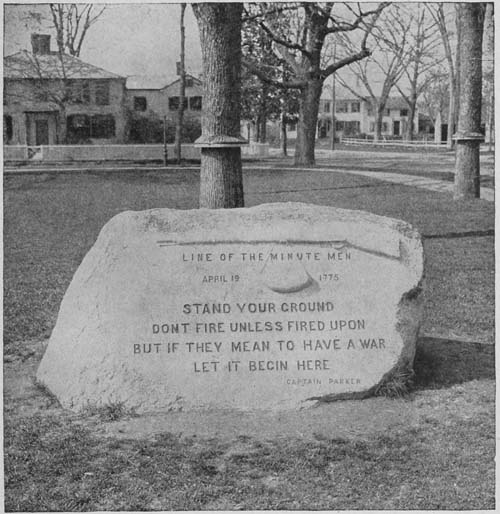
STONE MARKING THE LINE OF THE MINUTE MEN AT LEXINGTON
15. NATHAN HALE
Nathan Hale, a young man of twenty, had just graduated from Yale College, and was a school-teacher in Connecticut when the war of Independence began. At once he enlisted in the American army, saying, “Let us not lay down our arms till we have gained independence.” When General Washington moved his army from Boston to Brooklyn, Nathan Hale, early one morning, when it was darkest, rowed out with a few friends to an English supply ship and sailed it away from the man-of-war that was guarding it and brought it in safety to the American camp. For this brave deed he was promoted to become “Captain” Hale. Soon after this a call was made for a volunteer for a most dangerous service. The British held possession of the lower part of New York City, and were planning a further advance, and Washington greatly needed to know their plans. It was agreed to send a spy to get these. But who would volunteer? “I will undertake it,” said Captain Hale. He walked fifty miles up Long Island Sound, along the Connecticut shore and then rowed over to Long Island. Disguised as a traveling school-teacher, he visited all the English camps, making drawings and notes which he hid in his shoes. On his way back he was betrayed by a man who knew him, a traitor to the American cause. He was taken on board the English ship, carried back to New York and led before General Howe. The English general said: “You shall be pardoned and receive money and a fine position in the English army if you will give up the American cause.” He said, “I cannot turn against my country!” “Then you can die for her,” said the general, and sentenced him to die at daybreak. He listened to his sentence without a word, erect and fearless. At break of day the young spy, brave as a lion, faced his death without a tremor.
In City Hall Park, New York City, not far from the jail in which he was kept that last night, and as near as possible to the spot where he died, is the statue of this noble, young patriot-martyr, who in such heroic unselfishness laid down all he possessed for his country. Upon the statue you will read his last words: “I regret that I have but one life to give for my country.”
16. GENERAL REED AND THE BRIBE
General Joseph Reed was a prominent American officer in the Revolutionary war. He was a man of great influence and loyal to the interests of his country. The English officers were anxious to secure some one who would be a traitor to the American cause of liberty and who would serve them. One day Governor Johnson, one of the three Commissioners of King George III, came to Joseph Reed and whispered secretly: “I will give you fifty thousand dollars and a public office besides, under the British Government, if you will agree to promote the British interests.” General Reed replied quickly: “I am not worth purchasing; but such as I am, the King of Great Britain is not rich enough to buy me!”
No wonder that such a patriot, loyal to honor and to his country, was admired even among those who offered the bribe, while that other general, Benedict Arnold, who actually received the bribe to betray his country, has ever since been despised by Englishmen as well as by Americans.
17. THE FIRST FOURTH OF JULY
After the Battle of Lexington swift messengers rode in all directions over the land telling the tidings that the struggle for American independence was begun. The news set the people aflame with excitement. Men dropped whatever they had in hand to join the little army under George Washington, who was elected general of the American soldiers. The colonists now believed that nothing but liberty would save them. Men like Patrick Henry of Virginia said, “Give me liberty or give me death!” So, on July 4, 1776, at the State House in Philadelphia, the Declaration of Independence, prepared by Thomas Jefferson, was discussed. Above the State House where they met hung a great bell. The old bell-ringer sat there ready to ring the bell the moment the declaration was signed. His little grandson was at the foot of the stairs to tell him when to ring. The old man waited and waited. At last he heard the little boy running up the stairs, shouting, “Ring, grandpa! Ring, grandpa! Ring for liberty!” The old man took hold of the bell-rope, and the glad news of liberty rang out over the city. The bell was kept ringing for two hours. The crowds in the street shouted, “We are free!” “We are free!” Flags were waved, bonfires were lighted; parades were formed; speeches were made; and, as the news spread, the joy increased everywhere! That was the first Fourth of July.
18. WASHINGTON’S CHRISTMAS VICTORY
It was the winter of the year in which the Declaration of Independence was signed, 1776, when Washington, with his little army of three thousand patriots, beaten, and driven out of Brooklyn, out of New York, out of New Jersey, finally crossed the Delaware River, at the same hour that General Cornwallis, the most skilful of all the British leaders, with a much larger army, reached Trenton. The cold was intense. The patriots were in rags; many were barefooted, and the route was marked by their footprints of blood. Congress was fleeing in panic from Philadelphia to Baltimore. Terror spread everywhere, and many Americans hastened to put themselves under British protection. But amid all, Washington never lost his courage. Having seized all the boats along the Delaware, for many miles up and down the river, he intended to surprise the Hessian soldiers (whom the English had hired) at Trenton on Christmas night when he knew they would be sure to be spending their time in feasting and merriment. Amid a storm of sleet and snow, bitterly cold, on Christmas evening, Washington and twenty-five hundred picked men pushed their flatboats through the grinding blocks of ice, and during the night the entire force landed on the other side of the Delaware, and before the bleak, wintry morning dawned, they had surrounded Trenton. The garrison of one thousand Hessian soldiers was surprised and captured, with the loss of but four Americans. Colonel Rall, the Hessian commander, being wounded and suffering greatly, limped slowly up to where Washington was seated on his horse and handed him his sword, begging him to be merciful to the captured men. Washington gave the promise, expressing his sympathy with the wounded officer, upon whom he called after he was carried to a house and laid upon a bed, and spent some time in trying to cheer his last moments. This Battle of Trenton did what Washington intended—electrified the despairing patriots, increased enlistments, and inspired hope throughout the land. It was the turning-point of the Revolution. It was Washington’s Christmas gift to the American people.
19. THE HEROINE OF NORTH CAROLINA
One summer day when the wild red roses of North Carolina were in bloom around her door-step, Mistress Ashe stood at her opened door, and shading her eyes, saw a cloud of dust that grew larger until an English army was seen coming nearer and nearer. “Look,” cried her sister, “at the head of the column rides that braggart. Colonel Tarleton! Have you heard of the threefold oath that he registered recently on the banks of the Roanoke in Virginia?” “No, tell me in all haste,” answered Mrs. Ashe, “for they are now almost within ear-shot.” “He swore,” said the sister, “that he will plant the flag of old England on every housetop in our land; if not on the turret, then on the ashes of every building. He swore that he will carry our noble leader, General Washington, in chains to England. He swore that he will quaff a stirrup-cup (a lucky drink) to these horrid accomplishments from the Ashe punch-bowl.”
The sound of tramping deadened her voice. As the army came up General Leslie graciously asked the defenseless women for food and drink, which were brought at once and placed on the mahogany table. While they were eating and drinking, Colonel Tarleton, without hint of his oath, led the talk to the famous Ashe punch-bowl. He told General Leslie how it was old in England before the Pilgrims came; how in America it had grown thrice precious to its owner, because almost every American leader of the Revolution had quaffed delightful draughts from its crystal depths; how five officers of the Revolutionary army, all of the one name and blood of Ashe, had gathered around that bowl. And then, turning to Mrs. Ashe he said: “Mistress Ashe, since you have so amply entertained your foes, can you not add to your hospitality, I pray you, a draught from the Ashe punch-bowl?”
Mrs. Ashe ordered the punch-bowl to be filled, and rich red roses to be brought to crown it, but she trembled to think if this cunning colonel succeeded in quaffing a lucky-drink to his declared designs from that bowl, destruction indeed might await her country and its leaders. She arose from her seat at the head of the table. General Leslie and his officers arose with her. Then she said: “General Leslie, from this bowl the brave and the bravest have sipped, and to such, whether friend or foe, I give a draught from this bowl.” She then handed the General a glass of the brew, and, while he held his glass in his hand, waiting the filling of the other glasses, she took the roses from the bowl and put them in her hair, and then she turned to Colonel Tarleton: “Sir, I have heard of your threefold oath—that you have sworn to plant the flag of England on the roof of every American house or on its ruins; that you have sworn to carry our leader, Washington, in chains to the foot of your English throne; and that you have sworn to drink your stirrup-cup, before you ride forth on the accomplishment of these intents, from the Ashe punch-bowl.”
There was a moment’s silence, then she continued: “Heaven grant that our leaders in war may become our rulers in peace!” While saying this she put her slender hands about the heavy bowl, lifted it high above her head, and then dashed the punch-bowl to the floor. “Never, Colonel Tarleton,” she cried, “never from the Ashe punch-bowl shall cup be offered to the cruel foeman of my people!” The bowl was broken into a hundred pieces and the floor was sprinkled as with crimson blood. Outside the door the red roses blossomed in the sunlight, but nevermore would any of them crown rich libations in the once priceless, now shattered, punch-bowl of the Ashes of North Carolina.
20. THE HEROINE OF OHIO
In a little village in Ohio, on the banks of the Ohio River, there was a large fort called Fort Henry, which belonged to the colonists. When the Indians, who were fighting on the side of the English, attacked the village, all the men, women, and children fled to the fort. The Indians then attacked the fort, and all the men who went out to fight them were killed or taken prisoners. At last only twelve men were left in the fort to protect the women and children. When the colonists began to prepare for the second attack, they found their supply of powder almost exhausted, and without powder they knew death was near. Captain Zane called the twelve men together and said: “In my house there is a keg of powder. I do not wish to order any man to go for it, as it is a very dangerous thing to do, but I would like to have some one offer to go.” Several young men at once volunteered. “It means almost certain death,” said the captain. “I know that,” replied one young man, “but we must have the powder. To stay means death to all.” Just then the captain’s sister, Elizabeth, a girl of fourteen, stepped forward. “I will go for the powder,” she said; “you cannot spare one of the men, they are all wanted to protect the fort. If we are captured by the Indians, I shall surely be killed. So please let me go.”
At that Captain Zane said, “No! No!” But he soon saw she was right; not a man could be spared. The gate of the fort opened and the girl ran quickly out. The Indians saw her and cried in surprise, “A squaw! a squaw!” but no Indian tried to shoot her. She entered the house and found the keg of powder, but it was too heavy for her to carry, so, girllike, she emptied the powder into her apron, and started back amid the firing of the Indians, but although their arrows whistled over her head, she ran swiftly on and reached the gate in safety.
With the help of the powder the colonists were able to keep the Indians away that night. The next morning more men came and the Indians were driven away, and so the colonists of Ohio won a great victory.
The story of this fight at Fort Henry is often told, and the name of Elizabeth Zane, the brave girl who carried the apronful of powder to the men in the fort, will be remembered as long as brave deeds shall be told.
21. PUTNAM AND THE WOLF
Israel Putnam, as a boy, lived with his father on a farm in Connecticut when wolves were still there. Every winter an old mother wolf would come with a family of young wolves with her. The hunters always killed the young wolves, but could not catch the mother. One winter this old wolf killed seventy sheep and goats in one night. All the farmers started out to find her. They saw her track in the snow and after a long hunt their dogs drove her into a cave. They sent the dogs into the cave, but the wolf bit them and drove them out again. Then they put straw in the cave and set fire to it to smoke her out. It made the wolf sneeze, but she would not come out. Then Israel Putnam said, “I will go down into the cave and bring her out.” So they tied a rope to his legs and let him down into the cave. He held in his hand a burning piece of birch-bark, for he knew wild animals are afraid to face fire. He crawled along on his hands and knees in the narrow cave, holding the blazing bark, until he could see the wolf’s eyes. The wolf gave a sudden growl. Putnam jerked the rope and the men pulled him out quickly. He was badly scratched by the rocks and his clothes torn, but he got his gun and went in again. This time the wolf growled and snapped angrily, but he shot the wolf and brought her out dead. The sheep had peace after that.
22. BOONE AND HIS SWING
Daniel Boone was an early settler in Kentucky. He knew all about the woods and the ways of the animals and the Indians. Almost all the men that went with him into Kentucky were killed by the wild wolves or the savage Indians. One day when Daniel Boone was left alone in his cabin, four Indians came to kill him. He made his escape over a hill, but the Indians ran after him. He ran as fast as he could till he reached a wild grape-vine, which he saw reached to the top of a high tree, and was long enough to swing over a steep ravine. When he was a boy he had often made a swing of a wild grave-vine like this. So he quickly cut the vine off near the roots, took hold of it and swung out into the air with all his might. He was carried far out as he swung over the ravine. Then he let go, and as soon as he fell to the ground he ran away in a direction in which he knew the Indians could not find him. When the Indians came up to the place they could not find his tracks anywhere. So Daniel Boone was saved by a swing.
23. KIT CARSON AND THE BEARS
Kit Carson knew all about wild animals. He was a great hunter and a good guide to soldiers and settlers. On a march one day, as he was dragging an elk he had just shot for supper, he saw two bears running toward him. His gun was empty. He threw it down, ran as fast as he could, and reached a tree just as the bears reached him. He caught hold of a branch and swung himself up in the tree just in time. Bears know how to climb trees, and soon they were climbing up in the lower branches. Kit Carson broke off a limb, and from the highest branch, where he hung, he began clubbing the bears over the nose, their tender spot. “Whack! Whack!” The stick hurt, and the bears whined and growled with pain. First one bear and then the other tried to get at him, but each got his nose hurt. When their noses felt better they tried again. But Kit Carson pounded faster and harder than ever. One of the bears cried like a baby. Then both bears got down and went away and never came back again. They were too busy rubbing their noses.
24. THE HEROINE OF GETTYSBURG
One morning in the awful days of the Civil War the boys in blue and the boys in gray met together for their decisive battle near the little town of Gettysburg, Pa. Hearing that this town was to be the center of the battle, a neighbor ran into a little red-brick cottage and cried, “Jennie, you must remove your folks at once.” “Hush, hush!” she whispered, “there’s a little new-born baby and its mother in the next room, and they cannot be moved whatever happens.” “Why girl, the shells will crash through these brick walls as through paper!” said the man. “No matter, my sister and her babe cannot be moved, and I must stay here with mother to care for them,” replied Jennie, and the neighbor hastened sadly away.
Tramp, tramp, tramp, marched regiment after regiment in turn belonging to both sides, as they passed the little cottage, and Jennie noticed that every soldier’s eye rested eagerly on the windlass of the well in front of the little red-brick cottage, for the July sun shone hot in the sky. “They are thirsty,” said Jennie, as she filled the old oaken bucket from the well, and brought out every dipper and ladle and cup she could find for the soldiers to fill their canteens or to drink as they hurriedly tramped by. “I’m glad I did not go away,” she said; “there is something I can do here to help others.” And so she helped all she could until the troops had passed by for the battle. Later in the day the tide of the battle turned. The boys in gray reached the ridge and captured the town of Gettysburg. Then the boys in blue, on the run, retreated, moaning and groaning as they rushed past the little red-brick house, which now became the very center of the battle. Cannon, like thunder, shook the ground. Bullets, like hailstones, fell around them. Balls crashed through windows and walls as through paper, as the neighbor had said. The space around the well was strewn with the dead and dying. Hungry men begged for bread and the brave girl gave everything she had until she had not a crumb left. Then she said, “I’ll make some bread.” But scarcely were the loaves in the oven before a loud knock was heard at the door, and a soldier-boy stood there pleading, “I’m so hungry. Give me a bit of bread.” It would be three hours before the bread was baked, but biscuit would soon be ready, she thought. She quickly took up the dough and was remixing it to make biscuits, when whizz! a rifle-ball crashed through the open door, striking the girl in the breast, and she fell to the floor dead!
That night they buried Jennie Wade, with the dough still in her hands—buried her as thousands were buried, on the field of Gettysburg, without ceremony. Should you visit her grave in the little cemetery there, on her tombstone you would see these words: “Jennie Wade, died aged nineteen. She hath done what she could!”
25. HOBSON AND THE MERRIMAC
When the United States was at war with Spain in 1898, a Spanish fleet crossed the Atlantic and sailed into Santiago Bay. Commodore Schley at once sailed his squadron of ships there to prevent the escape of the Spanish fleet, and he was soon joined by Rear-admiral Sampson, who took charge of the whole American fleet. The entrance to Santiago Bay is so long and narrow, that, knowing it was full of mines and protected by forts on either side, the American Government would not allow Sampson’s fleet to try to force an entrance. So all the ships could do was to shell the forts along the coast and keep watch day and night. The Americans knew that if a storm arose and their ships should be obliged to run out to sea, the Spanish admiral would take advantage of it and run out of the harbor and possibly attack some of the ill-defended coast towns. The navy was very anxious to find a way of blocking the harbor so that the Spanish fleet could not get out. Admiral Sampson decided to run the Merrimac into the channel at night, swing it across the narrow point and sink it there, thus making a barrier which could not easily be removed. “Who will undertake this service of sinking the Merrimac?” was the question, and immediately there were far more men than could be used. Naval Constructor Hobson, with some brave volunteers, was assigned the task, which seemed in all probability to mean certain death. At three o’clock in the morning the Merrimac entered the narrow channel and steamed in under the guns of the great Morro Castle. The stillness of the night was broken by the wash of a small patrol boat approaching from the shore. The boat ran close up under the stern of the Merrimac and fired several shots, one of which carried away the rudder. In a moment the guns from the Spanish ships and forts were turned upon the Merrimac; and although torpedoes exploded all around them, and mines went off under them, Hobson coolly gave his orders. The torpedoes were touched off, and as the Merrimac sank, he and his men were swept overboard into the chilling waters. There, escaping death as by a miracle, they clung to an old raft. When the Merrimac sank the Spaniards cheered wildly, thinking they had sunk an American ship trying to steal into the harbor unseen. Many boats pushed out from the shore to examine the wreck. A Spanish launch came toward the raft. Hobson and his men agreed to capture this boat and run away. But just as she came close the heads of half a dozen Spanish soldiers peeped up and each man pointed his rifle at the heads of the Americans. “Is there any officer in that boat to receive a surrender of prisoners of war?” Hobson shouted. An old man leaned out under the awning and waved his hand. It was Admiral Cervera. The soldiers lowered their rifles, and the prisoners were helped into the launch. Hobson and his brave companions spent more than a month in Spanish prisons, but at length an exchange of prisoners made it possible for them to be returned in safety, and ever since the story of Hobson and the sinking of the Merrimac has been told as one of the most heroic deeds in the history of modern times.
26. BETSY ROSS AND THE FLAG
Americans who have lived some time in other countries say that when they see the American flag floating from the mast of a ship in a foreign land a lump rises in the throat and “the Stars and Stripes,” with its bright red, white, and blue, seems to be the most beautiful emblem in all the world. Do you know how it was first made, and why? When George Washington was leading his soldiers in the war for liberty, he felt that the new nation needed a flag. He said: “We must have a flag, one flag for all the Colonies.” Every country needs a flag to float over the homes of its people, to carry in parades, to wave on the masts of the ships at sea and in foreign harbors, and to inspire its citizens and soldiers to patriotism. At first there had been flags of all kinds among the colonists, the commonest having a rattlesnake upon it, with the motto, “Don’t tread on me,” and another, called the Union flag (with stripes as at present, and the double cross of the British flag instead of stars), was unfurled for the first time on New Year’s Day, 1776, at Cambridge. The matter of a new flag for the new people was talked over, and on June 14, 1777, by a resolution of Congress, it was decided upon. Washington, assisted by a committee, drew a picture of the flag he wanted—one with thirteen stripes to represent the thirteen States that had fought for freedom. These stripes were to be one red and one white. On a field of blue in the corner, near the staff, there were to be thirteen stars. Then, of course, those men knew they must find a woman to make the flag. The men could plan for it, but a woman must make it.
In Philadelphia there lived a young woman named Betsy Ross, who, with her husband, kept a small furniture and upholstering shop, and who did a great deal of sewing. She sewed beautifully, and had often been hired to make flags for the river-boats and other kinds of boats. One day, as she sat sewing in her shop, she heard a knock at her door. She opened it, and there stood George Washington and another gentleman. The general showed her a picture of the flag he wanted with its stripes and six-pointed stars. “No,” she said, “that will not do. The stars must be prettier than those. A correct star has only five points.” She quickly folded up a piece of paper just right and with one snip of her scissors clipped the paper, and there was a beautiful five-pointed star. Washington was greatly pleased with the star and also with the skilful fingers of Betsy Ross, and so she was given the order for the first American flag. This first flag was made the next day in the little shop, still standing at 239 Arch Street, Philadelphia, where she continued to carry on the flag business many years after the death of her husband, who was wounded during the war while guarding some military stores. Her children succeeded her in the business at her death. Since the first flag with its thirteen stripes and thirteen stars, there has been added a new star for every State admitted to the Union.
One of the first American war vessels, named the Reprisal, is said to have been the first vessel that, in 1777, carried “Old Glory” on the ocean. Ever since, whenever this American flag has floated in the air, its message has been, “America, the land of the free.” Its red sings, “Be brave”; its blue says, “Be true”; its white means, “Be pure.”
27. THE MAN WHO WROTE “AMERICA”
The beautiful hymn, “America,” our national anthem, which is loved and sung all over our land, and all over the world wherever the Stars and Stripes is honored, was composed by Dr. Samuel Francis Smith. He was born in Boston, Mass., October 21, 1808. In childhood he lived not far from the Old North Church. When he looked up at the tower in which Paul Revere hung the lantern, perhaps there came into his heart that love for his country which years afterward he put into his song. One holiday when his grandmother was coming on a visit to his home, he stood at the window, expecting she would bring him a present. When she came without a present the little fellow said solemnly, “All days are alike!” He was so obedient that when he went out to play he would ask, “How many slides may I take, mother?” And when he had taken just the number his mother told him, he would come in.
When Samuel was eight years old a pet cat belonging to one of the neighbors died, and was buried in the garden. The next morning the owners of the cat found on its grave a stick with a piece of paper fastened to it, and on the paper some verses. This was his first poem. At twelve he wrote another, and after that, many more. He went to what is now the Eliot School in North Bennett Street, Boston, where he won the gold medal. From there he went to the Boston Latin School, and there, also, he won the medal. Then to Harvard, and to the Andover Theological Seminary. He graduated from Harvard in 1829, in the class with Dr. Oliver Wendell Holmes, who sang of him in his poem, “The Boys”:
And there’s a nice youngster of excellent pith, Fate tried to conceal him by calling him Smith, But he shouted a song for the Brave and the Free, Just read on his medal, “My Country, of Thee.”
Doctor Holmes wrote further: “The name of Dr. Samuel F. Smith will be honored by every school child in the land when I have been forgotten one hundred years. He wrote ‘My Country.’ If he had said ‘Our Country,’ the hymn would not have been remembered, but that ‘My’ was a master-stroke. Every one who sings it at once feels a personal ownership in his native land.”
During the senior year at Andover Seminary, in 1832, W. C. Woodridge, a friend of young Smith, brought from Germany a book of patriotic songs and said, “Please make me a poetical translation.” As this young senior and poet was turning over the leaves of the song-book he came across the air of an easy patriotic tune which pleased him. As he was translating “God Save the King,” taken with the words, he thought how fine it would be to have an American patriotic anthem. Under the impulse of the moment he picked up a scrap of waste paper and his quill pen and began to write, and in half an hour the four verses of the poem, “America,” were written as they stand to-day. Later his friend Lowell Mason saw the poem, liked it, and put it into his music-book, and it has floated around the world. Doctor Smith said he heard it sung above the earth, on Pike’s Peak, and under the earth, in the Cave of the Winds, and on the earth in a great many lands. It was first sung publicly at a Sunday-school celebration, in the Park Street Church, Boston, and since, in days of peace and prosperity, through the crisis of the Civil War, and on almost all public occasions, it has gradually won recognition as our national anthem, without the ceremonial of adoption in any historic sense. Public-school teachers find it most helpful in awakening a love for the new country among the mixed races of child immigrants who must be molded into patriotic American citizens. In association with Lowell Mason, Doctor Smith wrote the first song-book for boys and girls ever published in the United States. It is remarkable that the national anthems of America, of England, and of Prussia should have the same tune. Henry Carey is often credited with this tune. The English, however, did not invent it. The Germans got it from the Norsemen, who had heard it sung by Finns, who got it from Huns, who brought it from Asia. Something like it was sung by the Jews in the first temple, and it may have come from the Egyptians. It is a solemn and majestic strain, suitable to some of the Psalms of David:
Our fathers’ God! to thee, Author of liberty! To thee we sing: Long may our land be bright With freedom’s holy light, Protect us by thy might, Great God, our King!
X HEROES OF PEACE
(Adapted for Children, Nine to Fourteen Years.)
1. THE BOY HERO OF HOLLAND
Once there was a good boy who had a kind-hearted mother. One afternoon she said: “Here, Peter, are some cakes I want you to take to the poor old blind man who is very ill, and who lives a mile and a half away from town. If you go quickly and do not stop to play, you will be home before it is dark.” Peter took the cakes to the poor old blind man, who said, “You are a kind-hearted boy; thank your mother for me.” Light-hearted because he had made the blind man happy, Peter was walking home when suddenly he noticed a little stream of water trickling through the great bank on the side of the road. This was in Holland, where much of the land is below the level of the sea, and where dikes are built by the people to keep back the sea. Every boy in Holland knows the danger of even a small leak in the dike. Peter understood at once that this tiny stream would soon make a large hole and the whole city would be flooded. In a moment he saw what he must do. He climbed down the side of the dike and thrust his chubby little hand and finger into the tiny hole and stopped the flowing of the water. Then he cried out for help, but no one heard him; no one came to help. It grew dark, and cold; he was hungry; his arm ached and it began to grow stiff and numb. He shouted again: “O mother! mother!” But his mother thought Peter must be spending the night with the blind man, and did not know of his danger. Peter thought how warm and cozy all at home were sleeping in their beds, and he said to himself, “I will not let them be drowned!” So that good boy stayed there all night long, holding back the water. Early next morning, a minister on his way to visit the sick, heard a groan, saw the boy, and called out to him, “What is the matter, my boy? Are you hurt? Why are you sitting there?” When Peter told him what he had done, the minister said, “I will hold my hand there while you run quickly to the town and get help.” Very soon men came and repaired the leak in the dike, but all knew that Peter, by his courage and faithfulness, had saved the town of Haarlem that night.
2. THE GERMAN PATRIOT AND THE BARLEY-FIELDS
Once there was a terrible battle in Germany, and thousands of soldiers were scattered over the country. A captain who had many men and horses to feed was told by his colonel to get food from the farmers near-by. The captain walked for some time through the broad valley, and at last knocked at the door of a small cottage. A man, old and lame and leaning on a stick, opened the door. “Good morning,” said the captain. “Will you please show me a field where my soldiers can cut grain for our army? We cannot pay for it.” The old man led the soldiers through the valley for about a mile, when they saw a field of rich barley waving in the breeze.
“That is just what we want,” said the captain. “No, not yet,” said the old man; “follow me a little farther.” After some time they came to a second field of barley. The soldiers got off their horses, cut the grain, tied the sheaves, and rode away with them. Then the captain said to the old man, “Why did you make us come so far? The first field of barley was better than this one.” “That is true, sir,” answered the old man, “but it was not mine!”—Adapted from “Ethics for Children” by E. L. Cabot.
3. THE JAPANESE AND THE EARTHQUAKE
Once in far-away Japan there lived a rich man who owned a large ranch—not of alfalfa, or wheat, or other grain—but of rice. One afternoon he stood looking over his large fields of rice, saying, “What a rich man this great harvest makes me!” Suddenly he felt an earthquake and saw that the waves of the sea were running away from the land and rolling far out. He knew that it would only be a little while before the waves would return in a great flood, which would overflow the little strip of land along the seashore, in the valley below the high plain on which his ranch was situated, and all the people in the little village would be drowned. It was a holiday and the people in their merrymaking and fun and laughter had not noticed the earthquake. The rich man cried to his servants, “Bring torches! make haste! set fire to the rice!” Then he and his servants set on fire stack after stack of the rice. In a moment the flames and smoke rose high, the big bell from the village pealed the fire-signal, and all the boys and girls and men and women ran up the hill as fast as they could to see the fire, and to try to save the rice-crop of the rich man. When they saw him setting fire to his rice, they shouted, “Look, he is mad; he is setting fire to his rice.” “Look!” shouted the old man. They looked and saw the raging and surging waves of the sea come rolling in. They looked again a few moments later and saw nothing but the straw which had been the thatched roofs of their homes tossing on the waters and their whole village blotted out by the sea. “That is why I set fire to my rice,” said the old Japanese. “If I had not done that you would have all been drowned in those waves!” He stood among them almost as poor as any of them, but he had the consciousness that by the sacrifice of his fortune he had saved four hundred lives that day.—Adapted from “Gleanings in Buddha-fields,” by L. Hearn.
4. THE RUSSIAN SERVANT
One cold winter day long ago a Russian nobleman and his wife were traveling across the plains of Russia in a sleigh drawn by six horses, and their two servants on horseback were riding beside them. Suddenly they heard the howling of a great pack of wolves that had been driven by cold and hunger from the mountains. The nobleman at once ordered one of the servants to ride on faster to the town and bring them other horses while he drove those he had more swiftly. The wolves came nearer and nearer. The other servant begged his master to allow him to loose his horse for the wolves to devour, hoping in this way to save time. But as soon as the servant sprang into the sleigh the frightened horse was torn into a thousand pieces by the fierce wolves, and they were back again more bloodthirsty than before. While the servant fought them off from the back of the sleigh the nobleman cut loose one after another of the horses, until he had but two left. Then the servant said, “I will spring among them and that will give you time to escape!” “No! no!” cried the nobleman. “See the lights of the city in the distance. We are almost safe!” But the wolves were again upon them and there seemed no other way, so the servant sprang from the sleigh, fought and drove back the wolves as far as he could to save all the time possible, but at last he was overcome by their great numbers and was devoured. A few moments later the Russian nobleman and his wife, with the two horses and the sleigh, passed in through the gate of the city in safety, conscious that they had been saved only by the great self-sacrifice of their faithful servant. For a long time after travelers on that road saw a cross, which the nobleman had erected on the spot where his servant had given up his life, and on the cross were these words: “Greater love hath no man than this, that a man lay down his life for his friends.”
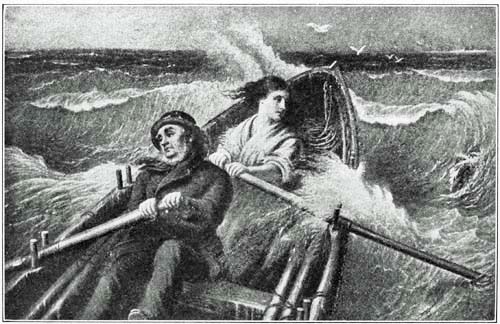
GRACE, PULLING AT ONE OAR, AND HER FATHER AT THE OTHER
5. GRACE DARLING
Once there was a terrible storm at sea, and a steamship was dashed upon the rocks and split in two. One-half of the ship was washed away, and those of the passengers who were still alive, were clinging to the other half upon the low rocks, lashed by the angry waves. About a mile away in a lighthouse a brave girl, named Grace Darling, the daughter of the lighthouse-keeper, heard, above the noise of the winds and waves, the screams and cries of the drowning men, and when daylight dawned she could see the wreck and the men clinging to the masts. “Let us go out in the lifeboat and save them?” she cried. But her father, who knew the danger in such a storm, replied, “It is of no use. We can never reach them!” “We can never stay here and see them die, father,” Grace said; “let us try to save them.” So the heavy lighthouse boat was launched, and with Grace pulling at one oar, and her father at the other, they reached the wreck and rescued, one by one, the worn-out men, whom they rowed safely to the lighthouse. Then Grace became as tender a nurse as she had been brave as a sailor, for she cared most kindly for the shipwrecked men until the storm ceased and they were strong enough to go to their own homes. The heroism of this young woman became known everywhere. Thousands sang her praises. Artists visited the lighthouse to take her portrait. Three thousand dollars were subscribed and presented to her. Distinguished people sent her letters of gratitude. But through all such praise Grace Darling remained as modest as she was brave, saying, “I did not suppose I had done anything worthy of so much notice.” When a few years afterward she died, over her grave, in a little churchyard by the sea, not far from the lighthouse, a monument was raised in her honor, where it stands to-day. It is a marble statue of a woman lying at rest with a boat’s oar held fast in her right hand.
6. THE SURVEYOR AND THE LITTLE BOY
One spring day, a young surveyor, eighteen years of age, was eating his dinner with some companions in a forest in Virginia. Suddenly the sylvan stillness was startled by the piercing shrieks of a woman. The young surveyor sprang to his feet and leaped to the woman’s side. “My boy! My boy! Oh, my darling boy is drowning and they will not let me rescue him,” screamed the frantic mother as she tried to escape from the men who held her from springing into the rapids. “No, we will not let her go,” cried the men, “for she would be instantly killed on the sharp rocks and could not rescue her boy!” “Why does not one of you rescue him then?” said the manly fellow of eighteen. “We are not ready to die yet,” the men replied. “O sir, won’t you do something?” cried the mother to the young surveyor. For an instant he stood measuring the rocks and the whirling rapids with his eye, and then, throwing off his coat, he plunged into the roaring torrent where he had caught sight of the drowning boy. With stout heart and steady hand he struggled against the seething waters which each moment threatened to engulf him or dash him to pieces against the sharp-pointed rocks. Just as they thought both would go over the falls the young engineer clutched the little fellow and swam with him to the shore. Then, amid the praises of those who had witnessed his heroism, mingled with the gratitude of the overjoyed mother, he placed the unconscious but saved little boy in her arms. “God will reward you, young man,” said the mother; “God will reward you some day for your heroism, and many will praise you for what you have done this day!” And so it was; for this young surveyor who saved the little boy was George Washington.
7. ABRAHAM LINCOLN AND THE PIG
One day as Abraham Lincoln was riding along a country road on horseback, in company with some friends, he saw a pig stuck fast in a deep place filled with mud, struggling to keep from going in deeper. The poor pig was squealing in terror, and the comical sight filled the friends with laughter and delight. After Lincoln had ridden on a little distance, he turned back his horse, saying, “Gentlemen, excuse me a few moments,” and rode back as fast as he could to the place where the poor creature was, got down from his horse, and drew the pig out of the mud. When he rejoined his companions they asked, “Why did you go back?” He told them what he had done, adding, “I couldn’t sleep well to-night, if I hadn’t done that thing.”
8. GLADSTONE AND THE STREET-SWEEPER
The minister of a church in London was called one day to see a street-sweeper in his parish who was ill. Asking him if any one had been to see him, to the surprise of the minister, the sweeper replied, “Yes, Mr. Gladstone came to see me.”
“Which Mr. Gladstone?” asked the minister.
“Mr. Gladstone, he told me his name was,” replied the poor sick boy.
“But how came he to see you?” said the minister.
“Well,” answered the boy, “he always had a nice word for me when he passed my crossing, and when I was not there he missed me. He asked my mate, who had taken my place, where I was, and when he heard I was ill he asked for my address, and he put it down on paper. So he called to see me.”
“And what did he do?” asked the minister.
“He brought me some nice oranges,” answered the boy, “and then he read to me some Bible and prayed, and it was so good!”
To a man like Gladstone, living humbly, simply, and sincerely, it is as important and as interesting a deed to do a kindness to a poor street-sweeper, and to comfort his heart with sympathy and love, as to form a cabinet to govern the English Empire. In such service the words of George Herbert have their full realization:
A servant with this clause Makes drudgery divine; Who sweeps a room as for Thy laws, Makes that and th’ action fine.
9. GARIBALDI AND THE LOST LAMB
One evening, in the year 1861, as General Joseph Garibaldi, the Italian patriot, fighting to make his beloved Italy free, united, and happy, was going to his headquarters, he met a Sardinian shepherd lamenting the loss of a lamb out of his flock. The great-hearted general at once returned to camp and announced to his officers his intention of scouring the mountains in search of the missing sheep. His soldiers, inspired by his tenderness on the field of peace as they had been by his valor on the field of battle, at once organized a grand expedition. Lanterns were brought and old officers of many a campaign started off full of enthusiasm to hunt for the lost lamb. But no lamb was found, and the soldiers returned to their beds in the camp. The next morning the servant of General Garibaldi found him in bed fast asleep. When he was awakened the general rubbed his eyes. And so did the servant, when he saw the old warrior bring the lost lamb from under the covering where it had been kept warm, and request him to carry it back in safety to the shepherd.
The man who had endured hardship and persecution, cold and hunger, nakedness and exile to make his native land free, had thought it a worthy task to keep up his search throughout the long night for the lost sheep until he had found it.
10. HOVENDEN AND THE LITTLE BOY
Thomas Hovenden, the artist, who painted “Breaking the Home Ties,” “Jerusalem, the Golden,” and “John Brown” which were exhibited at the World’s Fair in Chicago, was one day standing in a railway depot just as an engine was dashing into the station. He saw just in front of the iron-horse some mother’s darling little boy, and instantly, without a moment’s hesitation, he dropped his satchel and sprang in front of the engine. He snatched the little boy in his arms, only to be crushed and ground beneath the wheels of the conscienceless monster.
Great as are the exhibitions of his artistic genius in the paintings he has left us to admire, Thomas Hovenden never made a more wonderful picture in his life. Such a picture of unselfishness, heroism, and Christlike abandon to save a child, is a picture to be admired in heaven—a picture worthy to hang in the palace of God.
11. THE BOY AND THE TRAIN
Kenneth Oliver, a boy of eleven years of age, who lived in Tampico, Ill., returning home from school one afternoon, saw a little girl only seven years old playing on the railroad track. Suddenly he noticed a heavy freight-train coming on, at full speed, drawn by two great engines. The little girl did not see or hear the train, and was playing on, entirely unconscious of her danger. The boy quickly ran to the track, took hold of the child, and dragged her to one side of the rails, but he missed his footing, and the boy and girl rolled down the embankment together just as the train dashed past. It was not an instant too soon, for the edge of the pilot-beam struck the girl, bruising her, and missed killing the boy by an inch. The boy thought nothing of his danger. The tumble down the bank into the ditch seemed like a joke to the two children, although they felt the effects of their somersaults for some time afterward. The little girl’s mother, full of gratitude, told what this boy hero had done; all the country round soon sang his praises; and not long after he received a medal and two thousand dollars from the Carnegie Hero Fund Commission. It had always been his wish to go to college. This enabled him to get his wish, for the money was enough to pay for his education.
12. THE BOY AND THE MAD DOG
One day in the town of Weser, in Germany, a boy was playing with his little sister, four years old. Suddenly the boy saw rushing down the hill a mad dog followed by men, trying to stop it. In a moment the boy saw that the dog was running directly toward his little sister. Not thinking for a moment of his own danger, or escape, this brave boy in a flash threw off his coat, wrapped it around his arm, and boldly faced the fierce dog. Holding out his arm, shielded by the coat, the boy turned the dog’s attention to himself, so that the wild beast jumped at him and worried him until the men came up and killed the dog. The men said, “Why did you not run away from the dog? You could easily have done it.” “Yes,” answered the boy, “but if I had he would have attacked my sister. I thought I would let the dog tear my coat instead of her!”
13. THE GIRL AND HER RED PETTICOAT
Jennie Clark, a little girl only eleven years old, who lived in Ohio, was walking along a railroad track one hot summer afternoon when she noticed that a wooden bridge over a deep ravine was on fire, evidently caught from a spark from an engine. She knew that in a few moments an excursion train to the World’s Fair was due to pass over the bridge. As quick as a flash the little heroine snatched off her red petticoat, and ran swiftly up the track toward the approaching train, waving her red petticoat as a danger-signal. The engineer saw the warning and stopped the train in time to save the lives of the passengers. Among the hundreds of passengers who were saved were a number of Frenchmen who, on their return to France, told this story of the brave little American girl who had saved the train. The story reached the ears of President Carnot, who, after communicating with President McKinley, bestowed upon her the Cross of the Legion of Honor. This young girl of Ohio, who so courageously gave herself in such heroic service, was the youngest person in the world to wear the Cross of the Legion of Honor, France’s highest award for heroic service in time of war and peace!
14. THE NEWSBOY OF GARY
Billy Rough was a crippled newsboy who owned a news-stand on a busy street corner in Gary, Ind. But, though a cripple, Billy was such a cheerful soul that he did far more than sell newspapers. He gave away sunshine. He knew his customers and was interested in all their affairs. As he handed them their papers he asked, with neighborly cheerfulness, about their welfare. If the crippled boy had troubles himself, no one ever knew of them. He was far more anxious to help others bear their burdens than to add to them by any tales of his own woes. One day he read in the newspaper of a young girl who had been terribly burned as the result of a motorcycle accident. The doctors said her life could only be saved by grafting some one else’s skin upon the burned flesh. Billy Rough said to himself: “I’m only a poor cripple. My life is not of much account. I will offer my skin.” He was told that amputation would be necessary and very dangerous. He said: “If it will save the girl, take it off. I’ll save money. I’ll only have to buy one shoe. The leg is of no use to me. Maybe it’ll help her. I’d like to be of some use to some one.” He saved her life, but lost his own, for soon after the grafting, he died, saying: “I’m glad I done it. Yes, I’m going, but I was some good in the world after all.” The Mayor of Gary, impressed with this heroic self-sacrifice, issued a proclamation announcing that contributions for a memorial would be received. Nine hundred dollars, which had been sent in for his use before he died, were turned over to the memorial committee. A statue in Jefferson Park, a bronze tablet in the building where his news-stand stood, and an endowed room in the Gary Hospital where he lay before his death, all testify that the name of Billy Rough, the crippled newsboy and hero of Gary, will have an enduring place in the annals of American heroes.