Volume 3 — THE ASPECT OF LONDON.
Reading edition
HIPPOLYTE TAINE.
[Taine’s “English Literature” has in itself added a new work to the world’s best literature of far more value than many of those with which it deals. In his “Notes on England” he gives us thoughtful impressions of the country itself, from which we select his pen-picture of the great city on the Thames. The picture is not an inspiring one. He could not avoid comparing in his mind this fog-haunted capital with the brighter aspect of his native Paris.]
Sunday in London in the rain; the shops are shut, the streets are almost deserted; the aspect is that of an immense and a well-ordered cemetery. The few passers-by under their umbrellas in the desert of squares and streets have the look of uneasy spirits who have risen from their graves; it is appalling.
I had no conception of such a spectacle, which is said to be frequent in London. The rain is small, compact, pitiless; looking at it, one can see no reason why it should not continue to the end of all things. One’s feet churn water; there is water everywhere,—filthy water impregnated with an odor of soot. A yellow, dense fog fills the air, sweeps down to the ground; at thirty paces a house, a steamboat appear as spots upon blotting-paper. After an hour’s walk in the Strand especially, and in the rest of the city, one has the spleen; one meditates suicide. The lofty lines of fronts are of sombre brick, the exudations being incrusted with fog and soot. Monotony and silence; yet inscriptions on metal or marble speak and tell of the absent master, as in a large manufactory of bone-black closed on account of a death.
A frightful thing is the huge palace in the Strand which is called Somerset House. Massive and heavy piece of architecture, of which the hollows are inked, the porticoes blackened with soot, where, in the cavity of the empty court, is a sham fountain without water, pools of water on the pavement, long rows of closed windows,—what can they possibly do in these catacombs?
It seems as if the livid and sooty fog had even befouled the verdure of the parks. But what most offends the eye are the colonnades, peristyles, Grecian ornaments, mouldings, and wreaths of the houses all bathed in soot. Poor antique architecture, what is it doing in such a climate? The flutings and columns in front of the British Museum are begrimed as if liquid mud had been poured over them. St. Paul’s—a kind of Pantheon—has two ranges of columns: the lower range is entirely black; the upper range, recently scraped, is still white, but the white is offensive: coal-smoke has already plastered it with its leprosy.
These spots are melancholy, being the decay of the stone. And these nude statues in memory of Greece! Wellington as a fighting hero, naked under the dripping trees of the park! That hideous Nelson, stuck on his column with a coil of rope in the form of a pig-tail, like a rat impaled on the top of a pole! Every form, every classical idea, is contrary to nature here. A swamp like this is a place of exile for the ark of antiquity. When the Romans disembarked here they must have thought themselves in Homer’s hell, in the land of the Cimmerians. The vast space which, in the south, stretches between the earth and the sky, cannot be discovered by the eye; there is no air; there is nothing but liquid fog; in this pale smoke objects are but fading phantoms. Nature has the look of a bad drawing in charcoal, which some one has rubbed with his sleeve.
I have just spent half an hour on Waterloo Bridge. The Houses of Parliament, blurred and indistinct, appear in the distance but a wretched pile of scaffolding; nothing is discernible, and, more particularly, nothing is living, except a few steamboats skimming along the river, black, smoky, unwearied insects. A Greek watching their passengers embarking and disembarking would have thought of the Styx. He would have found that to exist here was not to live; in fact, life here is different from what it is in his country; the ideal has altered with the climate. The mind quits the without to retire within itself, and there creates a world. Here one must have a comfortable and well-ordered home, clubs, societies, plenty of business, many religious and moral preoccupations; above all, instead of abandoning one’s self to the influence of exterior impressions, it is necessary to extrude all the sad promptings of unfriendly Nature, and fill up the great void wherein melancholy and tedium would take up their abode.
[After this gloomy image of a rainy London, and a description of the Sunday church services, the writer proceeds in a more complimentary vein.]
The population numbers three millions and a quarter; that makes twelve cities like Marseilles, ten cities like Lyons, two cities like Paris, put together; but words upon paper are no substitutes for the sensation of the eyes. It is necessary to take a cab several days in succession, and proceed straight on towards the south, the north, the east, and the west, during a whole morning, as far as the uncertain limits where houses grow scanty and the country begins.
Enormous, enormous,—this the word which always recurs. Moreover, all is rich and well ordered; consequently they must think us neglected and poor. Paris is mediocre compared with these squares, these crescents, these circles and rows of monumental buildings of massive stone, with porticoes, with sculptured fronts, these spacious streets. There are sixty of them as vast as the Rue de la Paix. Assuredly Napoleon III. demolished and rebuilt Paris only because he had lived in London. In the Strand, in Piccadilly, in Regent Street, in the neighborhood of London Bridge, in twenty places, there is a bustling crowd, a surging traffic, an amount of obstruction which our busiest and most frequented boulevard cannot parallel. Everything is on a large scale here: the clubs are palaces; the hotels are monuments; the river is an arm of the sea; the cabs go twice as fast; the boatmen and the omnibus conductors condense a sentence into a word; words and gestures are economized; actions and time are turned to the utmost possible account; the human being produces and expends twice as much as among us.
BANK OF ENGLAND
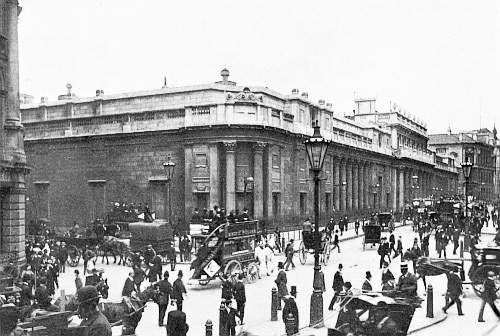
From London Bridge to Hampton Court are eight miles,—that is, nearly three leagues of buildings. After the streets and quarters erected together, as one piece, by wholesale, like a hive after a model, come the countless pleasure retreats, cottages surrounded with verdure and trees in all styles,—Gothic, Grecian, Byzantine, Italian, of the Middle Age, or the Revival, with every mixture and every shade of style,—generally in lines, or clusters of five, ten, twenty of the same sort, apparently the handiwork of the same builder, like so many specimens of the same vase or the same bronze. They deal in houses as we deal in Parisian articles. What a multitude of well-to-do, comfortable, and rich existences! One divines accumulated gains, a wealthy and spending middle class quite different from ours, so pinched, so straitened. The most humble, in brown brick, are pretty by dint of tidiness; the windows sparkle like mirrors; there is nearly always a green and flowery patch; the front is covered with ivy, honeysuckle, and nasturtiums.
The entire circumference of Hyde Park is covered with houses of this sort, but finer, and those in the midst of London retain a country look. Each stands detached in its square of turf and shrubs, has two stories in the most perfect order and condition, a portico, a bell for the tradespeople, a bell for the visitors, a basement for the kitchen and the servants, with a flight of steps for the service; very few mouldings and ornaments; no outside sun-shutters; large, clear windows which let in plenty of light; flowers on the sills and at the portico; stables in a mews apart, in order that their odors and sight might be kept at a distance; all the external surface covered with white, shining, and varnished stucco; not a speck of mud or dust; the trees, the turf, the flowers, the servants, prepared as if for an exhibition of prize products.
How well one can picture the inhabitant after seeing his shell! In the first place, it is the Teuton who loves nature, and who needs a reminder of the country; next, it is the Englishman who wishes to be by himself on his staircase as in his room, who could not endure the promiscuous existence of our huge Parisian cages, and who, even in London, plans his house as a small castle, independent and enclosed. Besides, he is simple, and does not desire external display; on the other hand, he is exacting in the matter of condition and comfort, and separates his life from that of his inferiors. The number of such houses at the Westend is astonishing. The rent is nearly five hundred pounds; from five to seven servants are kept; the master expends from twelve to twenty-four hundred pounds a year. There are ten of these fortunes and these lives in England to every one in France.
The impression is the same when visiting the parks; the taste, the area are quite different from what is the case among us. St. James’s Park is a genuine piece of country, and of English country; huge old trees, real meadows, a large pond peopled with ducks and water-fowl; cows and sheep, in an enclosed space, fed on the grass, which is always fresh. There are even sheep in the narrow green border that surrounds Westminster Abbey; these people love the country in their hearts. It is sufficient to read their literature from Chaucer to Shakespeare, from Thomson to Wordsworth and Shelley, to find proofs of this. What a contrast to the Tuileries, the Champs-Elysées, the Luxembourg! As a rule, the French garden, that of Louis XIV., is a room or gallery in the open air, wherein to walk and converse in company; in the English garden, such as they have invented and propagated, one is better alone; the eyes and the mind converse with natural things. We have arranged a park on this model in the Bois de Boulogne; but we have committed the blunder of placing therein a group of rocks and waterfalls; the artifice is discovered at a glance, and offends; English eyes would have felt it.
[A description of Regent’s Park follows, with some words on the English love of out-door exercise. Piccadilly and Hyde Park are next mentioned.]
Hyde Park is the largest of them all, with its small rivulet, its wide greensward, its sheep, its shady walks, resembling a pleasure park suddenly transported to the centre of a capital. About two o’clock the principal alley is a riding-ground; there are ten times more gentlemen and twenty times more ladies on horseback than in the Bois de Boulogne on its most frequented days; little girls and boys of eight ride on ponies by the side of their father; I have seen ample and worthy matrons trolling along. This is one of the luxuries. Add to it that of having servants. For instance, a family of three persons which I visited keeps seven servants and three horses. The mother and daughter gallop in the park daily; they often pay visits on horseback; they economize in other things,—in theatre-going, for example; they go but seldom to the theatre, and when they do it is to a box which has been presented to them. This vigorous exercise appears indispensable for health; young girls and ladies come here even when it rains....
From five to seven o’clock is the review of ladies’ dresses. Beauty and ornamentation abound, but taste is wanting. The colors are outrageously crude and the forms ungraceful; crinolines too distended and badly distended, in geometrical cones or bunched, green flounces, embroideries, flowered dresses, quantities of floating gauze, packets of falling or frizzed hair; crowning this display tiny embroidered and imperceptible bonnets. The bonnets are too much adorned; the hair, too shiny, presses closely on the temples; the small mantle or casaque falls formless to the lower part of the back, the petticoat expands prodigiously, and all the scaffolding badly joined, badly arranged, variegated and labored, cries and protests with all its gaudy and overdone colors. In the sunshine, especially, at Hampton Court the day before yesterday, among the shopkeepers’ wives, the absurdity was at its height; there were many violet dresses, one being of a wild violet clasped round the waist with a golden band, which would have made a painter cry out. I said to a lady, “The toilette is more showy among you than in France.” “But my dresses come from Paris!” I carefully refrained from replying, “But you selected them.”
Excepting only the highest class, they apparel themselves as fancy dictates. One imagines healthy bodies, well-built, beautiful at times; but they must be imagined. The physiognomy is often pure, but also often sheepish. Many are simple babies, new waxen dolls, with glass eyes, which appear entirely empty of ideas. Other faces have become ruddy, and turned to raw beefsteak. There is a fund of folly or of brutality in this inert flesh,—too white, or too red. Some are ugly and grotesque in the extreme; with heron’s feet, stork’s necks, always having the large front of white teeth, the projecting jaws of carnivora. As compensation, others are beautiful in the extreme. They have angelic faces; their eyes, of pale periwinkle, are softly deep; their complexion is that of a flower, or an infant; their smile is divine. One of these days, about ten o’clock in the morning, near Hyde Park Corner, I was rooted to the spot motionless with admiration at the sight of two young ladies; the one was sixteen, the other eighteen years old. They were in rustling dresses of white tulle amid a cloud of muslin; tall, slender, agile, their shape as perfect as their face, of incomparable freshness, resembling those marvellous flowers seen in select exhibitions, the whiteness of the lily or orchis; in addition to all that, gayety, innocence, a superabundance of unalloyed sap and infantine expression, of laughter, and the mien of birds; the earth did not support them.
Many of the horsewomen are charming, so simple and so serious, without a trace of coquetry; they come here not to be seen, but to take the air; their manner is frank without pretension; their shake of the hand quite loyal, almost masculine; no frippery in their attire; the small black vest, tightened at the waist, moulds a fine shape and healthy form; to my mind, the first duty of a young lady is to be in good health. They manage their horses with complete ease and assurance.
Sometimes the father or brother stops and talks business or politics with a friend; the ladies listen and thus habituate themselves to serious topics. These fathers and brothers, too, are a pleasant sight; expressive and resolute faces, which bear, or have borne, the burden of life; less exhausted than among us, less ready to smile and to execute the tricks of politeness, but calmer and more staid, and who often excite in the onlooker a vague impression of respect, of esteem at least, and often of trust. Perhaps this is because I am instructed as to their condition; yet it seems to me that mistake is difficult; whether nobles, members of Parliament, landed proprietors, their manners and their physiognomies are those of men accustomed to authority, and who have wielded it.