Volume 3 — IRELAND AND ITS CAPITAL.
Reading edition
MATTHEW WOODS, M. D.
[Among recent books of travel few have attained more immediate and flattering success than Dr. Woods’s “Rambles of a Physician,” the racy story of a run through Ireland, Britain, and the continent of Europe. The author has keen powers of observation and fluency in description, and has put on record much that other travellers fail to mention. We give his résumé of his run through Ireland and his telling description of what he saw in the people’s quarter of Dublin.]
I have been strolling at leisure through the streets, and find myself at the end of the long twilight perplexed instead of pleased by what I have seen. Why is it so difficult to get at the truth about Ireland? Why is it that, when a man begins to talk about even its beauty, he exaggerates it beyond recognition, and that the very few who do give the plain facts are not believed? Why do I read in a little book that I have just found on the parlor table, and which explains the origin of the name “Emerald Isle,” the following words, paraphrased from a popular history: “The name Emerald Isle is generally supposed to have been derived from the evergreen appearance of her shores, whereas it really originated from the ring which was set with the words ‘Optimo Smaragdo,’ and which Pope Adrian sent to King Henry IV. as the instrument of his investiture with the dominion of the land.” Now, the truth is, Ireland’s shores are not “evergreen;” not green at all, but brown and barren, with occasional patches of bright yellow when the prussach’s in bloom, and bronze when the blossoms fall.
From Queenstown to Cork there is, I admit, a refreshing verdure, especially attractive because of the monotony of the recently-crossed sea, and the houses, too, in this strip, are enveloped in flowers; but this is not because they are in Ireland, but is rather due to their being occupied by English or Scotch or their descendants, who sing thus “the Lord’s song in a strange land.” Yet from Cork to Killarney, by the Prince of Wales route, you rarely see a bit of verdure; not a flower by the roadside, nor in a window, nor the slightest attempt at the beautification of a home, or to make the best of little. For part of the way not a green field, nor a tree, nor a shrub, nor a weed, nor a blade of grass, nor the song of a bird, nor the hum of an insect,—nothing, absolutely, but brown, barren desolation, associated with a sort of solitude that but intensifies the gloom. Occasionally a narrow belt of potatoes encircling a cabin, always built without mortar, as there is no sand in Ireland, is the only relief from the depressing waste until you reach Glengariff, where you find the English idea again, which has covered the barren rocks with flowers and fruit, comfortable homes and waving grain, the contrast, indeed, making the most taciturn eloquent in praise. From Glengariff to Killarney the same sterile desolation. Miles and miles without a bit of pleasant vegetation to rest the weary eyes. The district suggesting rather some of the dismal places described by Dante or Virgil, Ariosto, Tasso, or Milton, as the abode of souls condemned, rather than districts occupied by living men.
CUSTOM-HOUSE, DUBLIN, IRELAND
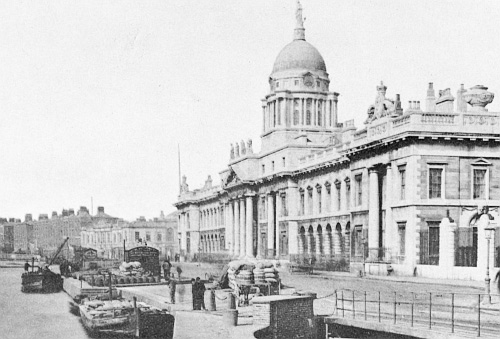
After passing through these regions of perpetual misery and despair, these birdless and treeless wastes, you get to regard any little bit of green as a godsend. You have, perhaps, closed your eyes to shut out the depressing melancholy of the apparently anathematized place; you cannot shut out all thoughts of the wretched and benighted men that relentless fate seems to have anchored on these more relentless shores. You have for some time past been ascending the side of a whin-spangled mountain; having reached the summit, the vehicle stops,—you look abroad, and behold the Islands of the Blest, Civitas Solis, Utopia, the New Atlantis, Paradise, what you will; otherwise, Killarney is at your feet, and you feel
“Like stout Cortez when, with eagle eyes, He stared at the Pacific,—and all his men Looked at each other with a wild surmise,— Silent, upon a peak in Darien.”
It was here that, when we sought O’Holleron [an enthusiastic Irish patriot of the party], who had suddenly disappeared, we found him with bent head, tears running down his cheeks, and sobbing. You descend from this Pisgah to the lakes, and remain for a few days, until you have exhausted your collection of exclamations, and have repeated them again in writing to your friends, when you proceed.
From here to the Liffey the country is not so brown as the region through which you have passed, but still unattractive in the extreme. It is not green, but greenish, with most of the small fields, as is the mode here, enclosed within thick walls of stone, built without mortar, and void of vegetation. Farms small (average size about six acres), tumble-down houses, no inspiring legends nor traditions, intellects dead, no past, present, nor future, nothing but the same dreary lament, in which everything participates,—the emigrant, landlord, tenant; the very clouds weep over it; hardly ever cease. At every cluster of houses, at a crossroad, the number of bare-limbed women, wearing but two garments, one of them a petticoat, coming only below the knees, makes you think of Gros’s remark, that “Irishwomen have a dispensation from the pope to wear the thick end of their legs downward.”...
Visitors here find the country so ludicrously, or rather so mournfully, different from what they have been taught to expect—the Isle of Saints; the Emerald Isle; “the land of chaste women and brave men;” the hospitable land; “a kind-hearted people;” “a people of sobriety and industry,” are some of the epithets used—that, unless sickened into silence by the humiliating reality, they think of what they have read and heard as a joke, and, to keep the tears back, joke too; and this I believe is the origin of many of the hilarious things written about Ireland.
You might think the birth of the Duke of Wellington and Oliver Goldsmith here would have raised this part of the island above the commonplace, as that of Burns did Ayr; of Shakespeare, Stratford; of Gray and Penn, Stoke Poges; of Goethe, Frankfort; or of Emerson, a few white houses upon a New England plain; but no, there are no memorials in this district at all, except the scant fragments left by the old pagan and semi-christianized natives before the land was the home of thriftlessness and whiskey. The picture is the saddest of all the sad pictures of modern retrogression, with no prospect of the advent of a mind capable of suggesting the proper remedy.
[Certainly one cannot but say, after this depressing picture by one “to the manner born,” that Ireland needs regenerating. We give next his impressions of Dublin, which are no more enlivening in tone.]
But about Dublin. What of it? It is certainly a place of handsome municipal buildings, and others, too, built in an imposing manner, and yet all there is architecturally great in the whole city you see at a glance, the moment you cross O’Connell’s Bridge. The first view, therefore, is impressive in the extreme; the buildings magnificent, splendidly proportioned, symmetrical. You can see them all at once, and are delighted; but penetrate those vistas, and behold them,—a suit of sixteenth-century mail for man and horse on Sancho Panza and his mule, or a gracefully painted window that shuts off an ugly view,—all that you see at the first glance is all that there is.
To be sure, there are many churches,—perhaps one hundred,—including Methodists, Moravians, Friends, Baptists, Unitarians, Presbyterians, Jews, besides those belonging to the two religious bodies most numerous here,—the Churches of Ireland and Rome; some of them of great beauty; ostentatious, to be sure, as if they were competing with each other in display; and yet with all this the city has none of those pleasant surprises that you expect in old towns, and that you find even with us [in America], and more so, I judge, in towns on the Continent; that is to say, narrow, clean streets opening into wide courts, having buildings with carved fronts and pillars, and the like, or sudden bends in a street, where the commonplace becomes magnificence. There is nothing of this in Dublin,—no curious doors or windows, no “jutty frieze” nor “coign of vantage.” Very often an attempt at grandeur, but marred by defective details. The interiors, too, as far as I could penetrate, indicating more the desire for elegance than the capacity,—gay-colored window-shades, but torn; door- and window-curtains, but faded; window-boxes, broken and hanging askew, with flowers withering, either from the smoky atmosphere or neglect; everything black from coal-dust, and no flowers at all. No wonder Moore wrote so touchingly about the last rose of summer.
Plants, to my sorrow, were not in abundance. I searched the grounds of Trinity and everywhere else in vain for a rose or anything else that bloomed, and feel, therefore, as if Tom Moore’s rose must have been the last of its race; but what Dublin lacks in flowers it makes up in taverns. Myriads—to quote again from Adam Clarke—of groggeries and distilleries; one of these so large that it looks as if the muddy river that runs through the city was dug there merely to carry its barges of stout to people at the other end. It appears also here, like home, as if these same gentry, who become rich on the drunkenness of the people, were rather important factors in municipal affairs. One of these, Guinness,—I feel, though, like apologizing for mentioning his name in connection with liquor-dealers, as his commodity is stout,—however, is the philanthropist of Dublin, the restorer of St. Patrick’s, the supporter of missionaries, the insurer of all his employés’ lives, etc., and not only has a monument here by Foley, but was also knighted during the present reign. You remember Dickens,—“The nobility can brew, but they can’t bake.”
The streets are ornamented with many good statues, including Goldsmith, Moore, Burke, Grattan, Stokes, Lords Carlisle, Corrigan, Eglinton, Smith O’Brien, and others; but the University, the gift of that friend of learning, Queen Elizabeth, is perhaps the chief glory of the town; while “the Liberties,” a portion of which I explored to-day, is probably her greatest disgrace. From the lanes and alleys that penetrate this malodorous district emerge the most curious race, I would judge, that has ever been found in a civilized town. Here you find illustrations in abundance, not only of the “philosophy of clothes,” but of the comedy and tragedy as well; this tendency to wear other people’s garments being one of the characteristics of the tribe, and the city being very liberal in the matter of supplying them with shops where they may procure their wares.
In Cork the chief articles of petit commerce are cast-off clothing and “bits of mate,” especially tails of things piled up on stalls, the clothing spread on the streets; while in Dublin it is second-hand clothing and bones, sold in mouldy dens,—“bone warehouses,”—twelve feet wide, yawning like Elijah’s cave after the ravens had been doing the generous thing by him for months. In turning a corner, a fellow, standing on his knees (stumps) near one of these, accosted me, asking for money to help pay for a pair of cork legs, his own blown off in a dynamite “experiment.” Why not Dublin legs? I thought. “He needed but five shillings more,” he said; “they were already made, but the thief of a maker would not let him have them until he had paid every penny.” Looking up into my face in a sort of confidential aside, he added, “True enough, sir; he’s giving them to me at cost.”
In the act of contributing to the needed balance, a young lady of perhaps thirty-five autumns, and dressed in a crape hat, linen duster, split down the back, and who had heard the pitiful story of the descendant of Simon Tappertit, approached and said, “Don’t give him a ha’penny, sir; he has one pair of legs in pawn already; and he has two wives and nine children that beg for him besides. If you have anything to spare, give it to me, sir; I’m an orphan.”
What could not Herr Diogenes Teufelsdröckh say about such a pandemonium of rags as are to be found here? “Happy he who can look through the clothes of man into the man.” No difficulty here in being happy, if holes can help you. You are among a colony of savages, as much in conceit with their parti-colored wardrobe as a Mohawk with his beads. Everything, from the “goodly Babylonish garments—the mantles of Shinar, from Assyrian looms,” down to the cast-off tarpaulin of discharged or disgraced tars, are on the backs of the denizens of the Liberties. No one is wearing the clothes made for him. The unexpected is the most common. One fellow had on the cast-off coat of a policeman, too small to reach across his naked body, with a pair of trousers with scarlet stripes, billowing down to the uppers of his soleless shoes. Another bare-footed man had nothing on but an ulster; another, daintily picking his way across the street to one of the rag and bone shops that are as thick here as leaves in Vallombrosa, and between his trousers and short-waisted coat, with long tails, was a yawning gulf of dark flesh, that a crimson sash tried in vain to conceal. Another had on an overcoat with but one sleeve; a hole in the back large enough for him to thrust his head through; fastened down the front by having bits of the coat pulled through the buttonholes, and kept from slipping back by butchers’ skewers.
Knee-breeches, red coats, cocked and battered stove-pipe hats, swallow-tailed coats, costumes of every clime, together with the official garments of the army in rags, are found here on the backs of scoundrels that look as if they would run from a bit of soap as if it were the plague,—if, indeed, they would run from anything. The women, like the men, indescribable. The saddest part of it, the children; scores of half-naked little souls, swarming around and looking as if all they ever had to eat they picked up in the streets; have nothing of childhood about them but its seriousness; children that have never been combed or washed; boys having nothing on but the trousers of men, the waistband tied about their necks, their arms thrust through the pocket-holes, and the legs rolled up like the coat-sleeves of “the Artful Dodger.” One little fellow wore a swallow-tailed coat and stockings, nothing else; the strange thing about it, they are not aware how curious they look; but the ladies! the very exuberance of grotesque finery they exhibit silences my modest pen....
P.S.—You know that it is a custom among the subjects of England to conclude all public meetings, especially of a secular nature, by singing “God save the Queen.” The only exception to this rule, I believe, are the Irish Nationalists; they don’t want God to do anything of the sort, and have consequently substituted for the National Anthem a song entitled “God save Ireland,” which they sing in season and out of season. You can always tell the politics of a district by the number of fiddlers, prima donnas, tin whistle and jews-harp performers that play this new vent for patriotism.
À propos of this, in coming home this evening I read on a great sign, at the door of a dingy little drug-shop near the Liberties, the following combination of enterprise and patriotism (which struck me as being odd, and which, for your amusement, I transcribed, punctuation points and all):
“Prepared Castor Oil a penny a dose! God Save Ireland? Epsom salts 4 doses for a half-penny! God Save Ireland? Seidlitz Powder 6 pence a box! God Save Ireland?”
and so on, all the way to the bottom, until God had saved Ireland, I think, some fifteen or sixteen times, but always after a powerful physic; the last line of the placard was,—
“Home Rule Forever! God Save Ireland?”