Volume 3 — ENGLISH RURAL SCENERY.
Reading edition
SARAH B. WISTER.
[For a country rich in its verdant beauty and perfect in its grooming, England is unsurpassed. While containing little of the grand, it has much of the charming, and is abundantly calculated to rest the eyes of the sight-weary traveller. We append an enthusiastic description of this garden-land from an American visitor.]
When we got into the country we grudged the time we had spent in London. The true English landscape has a great and peculiar charm until the stranger learns its secret and wearies of its sameness. Never shall I forget the journey from Southampton to London on the day we landed. Something must be allowed for the delight of eyes that had been looking over endless ridges of sea-waves to the blank horizon for so long; but what a blushing, smiling land it was that greeted them! The verdure was the first thing that struck us,—very different from ours. There is more blue and less yellow in it, resting and refreshing the eyes with a cooler, deeper tone; the trees are denser in foliage too, and fuller in form; the whole scene had a boskiness and boweriness due to innumerable hedges, orchards, shrubberies, and plantations. Woodland, strictly speaking, there was none,—only here and there little triangular bits, not an acre in extent, for game-covers, or lines of tall feathery elms with bushy heads along the hedgerows, clipped close that they might not shut out the scanty sunshine from the farmer’s field. The hawthorn was covered with its pink-and-white blossoms, May as they call it; acres of the gently-rolling country were crimson with Dutch clover; the laburnum, a small, graceful tree, was full of drooping strings of delicate yellow flowers; the banks were ablaze with scarlet poppies and golden broom.
Low-arched stone bridges spanned small brimming streams; quaint old gate-ways opened into shady avenues; thatched cottages, beautiful ancient parish churches with gray towers, pretty, quiet hamlets peeped out from the luxuriant leafiness; comfortable, solid, old-fashioned farmhouses reigned among their outbuildings and orchards; in the distance were grand country-places, scarcely visible in the depths of their stately parks; and, what raised our enthusiasm to the utmost, we passed a beautiful Gothic ruin half hidden in ivy. Everything looked trim and orderly; not an inch of ground wasted; all turned to account for use or beauty; little vegetable-gardens on the slopes of the railway-embankments and along the edges of the track; little flower-gardens on both sides the station-houses, and roses and honeysuckle trained over their porches.
This is the genuine, characteristic English scenery, and it is found in perfection in Warwickshire. About Leamington, thanks to the contiguity of several large estates, parts of the country are heavily wooded, and a deep rural seclusion pervades the whole neighborhood. We were there in July: the earlier flowers were gone, but in the green embowered lanes the banks were rich with purple foxgloves; pale, shadowy bramble-roses were blossoming in the hedges, over which climbed woodbine and a pure white convolvulus; the gaudy poppies still held their own, as they do, though with thinner ranks, to the end of the season; and the splendid gorse spread over the uncultivated hill-sides like yellow flame. Many birds make their home here. We came too late for the nightingales, and it was elsewhere that we heard a cuckoo once or twice in a distant thicket, for it is silent after June; but larks warbled in mid-air, and thrushes filled the lanes with their liquid notes, besides a host of little unknown birds who sang their simple song very sweetly all day.
One of the finest country-seats in the county was originally a Cistercian abbey, founded in the reign of Henry II.: a noble gate-way of that period, half shrouded in ivy, still remains, but nothing more except fragments of the cloisters embedded in the main building, which is partly Elizabethan, but chiefly in Queen Anne’s style. Uninteresting and tasteless as the latter is, it produces more effect by its solid mass and unbroken façade than Tudor gables or castellated towers. Within are great lofty square rooms, a fine hall and staircase,—all on a scale which with us would be seen only in a public building,—and a whole series of family portraits, priests, knights, courtiers, and dames, by all the famous painters from Henry VIII.’s time to Queen Victoria’s.
CANTERBURY CATHEDRAL FROM THE NORTHWEST
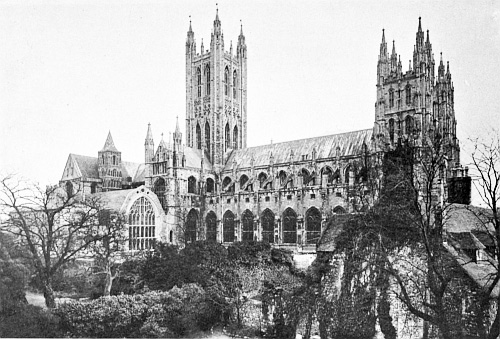
The gardens of this place are beautiful, but most artificial-looking, the shorn grass and geometrical flower-beds producing the effect of a worsted pattern; stone steps, balustrades, fountains, statues, urns, vases, and clipped hedges and shrubbery giving them a formal and stately air in keeping with the house itself: not a blade of grass, not a leaf, not a pebble, is out of place. From these one passes into the park, where for miles the undulations of the land form a succession of lovely knolls and dells shaded by magnificent oaks, imperial trees, and groves of lindens and chestnuts hardly less grand, while underfoot all is fern and soft turf. Herds of dappled deer browse beneath these lordly trees or come down to drink at the Avon, a slow little stream which winds through the sylvan glades. Since then I have seen a number of great places, some of them finer than this, but with its legends and associations it is not a bad type of them all. It was the first I saw, and will always be first in my recollection.
Besides the beauty of that region, it is full of interest. There are the romantic ruins of Kenilworth; there are Warwick Castle (partly burnt) and Warwick town, with Leicester’s Hospital, and St. Mary’s Church, and the Beauchamp Chapel, one of the gems of ecclesiology, with stained-glass windows five hundred years old, and splendid tombs with effigies in brass and alabaster. There is Coventry with all its traditions, from the Lady Godiva to Mary Queen of Scots. The procession of the Lady Godiva still takes place every few years. Last summer there was a celebration: the lady engaged to perform the part of “the woman of a thousand summers old” was not forthcoming in time, and some other eligible female was caught up, clapped on horseback and sent forth: at the same moment the first one arrived, and the consequence was a lawsuit.
Stratford-on-Avon, too, belongs to this part of the country,—a little old-world town, where the bust of Shakespeare looks down upon you from every coign of vantage. Mysterious being! who sprang from impenetrable obscurity in that quiet village to light the beacon of an immortal fame, and sink back into the uncertain shades of his native place until he rests definitely in the beautiful parish church, so still among its trees, with the Avon laving the wall of the church-yard.
Anne Hathaway’s cottage remains in good preservation, a picturesque object among the fields; Lucys still live at Charlecote; but too many people have written of these things,—nobody better than Geoffrey Crayon, whose sketch I read over as we waited for luncheon at the Red Horse Inn in the little room called Washington Irving’s parlor. Something ought to be said about that luncheon, which, when good, is the best of English meals, dinner as a rule being too heavy and monotonous. On a table-cloth of the traditional whiteness of all napery which is written about, were set out a lordly cold round of beef, a jug of home-brewed ale, a substantial loaf of home-made bread, a smaller one of simple cake, a currant-pie, a rich country cheese, and a pitcher of thick cream. There were three of us: we ate as much as we liked, and paid seven shillings, less than two dollars, but I do not give either the bill of fare or the bill of costs as a sample of ordinary luck.
We saw nothing in England proper prettier than the shady lanes and green foot-paths of Warwickshire. The view from Harrow Hill and the country around Malvern are greatly admired, but they are exceedingly tame, merely an extent of rather flat land seen from an insignificant height, without water, too patchy to have breadth, which is the strong point of flat scenery; there are no stretches of field or forest-land; it is all broken up like a checkerboard by hedgerows and high-roads. We thought the Fen country roads more striking: it has been reclaimed, and is now a fine agricultural district. The eye ranges over wide expanses of cultivation: great plains of pale green bean-vines and yellow grain, alternating with the rich brown of the peat soil, whose pungent odor fills the air, stretch away to the horizon, unbroken save by now and then a row of Lombardy poplars or a line of low willows; the ditches by which the land is drained and divided are marked by long lines of brighter green, and full of graceful waving marsh-grass; and at long intervals a broad, straight, shining path of water takes its way to the sea. Here and there a solitary windmill reminds one of Holland, but it is altogether finer than Holland. With all the teeming fertility there is something which recalls the original desolation: it is very sparsely settled; one seldom sees a house, and then it is not clustered about with outbuildings, but stands up alone against the horizon, and makes one think of Mariana’s moated grange. In the midst of these flats rises the majestic tower of Ely, seen for many a mile.
We passed from this into a wild waste in Norfolk, whose sandy hillocks were clad in purple heath and green fern, with an occasional pine wood, dark and mysterious-looking, for in England even the pine is not the scrubby, scraggy tree of our barrens. This country has a picturesque, original character of its own, and is somewhat thinly settled too, but among the heaths and pines we saw more beautiful ruined churches than in any district south of the Tweed. The unfailing ivy is there, but it does not grow with over-luxuriance, as it does elsewhere in England, making a lovely covering for an ugly building or an unsightly stump, but sometimes muffling and hiding the beauties of finer architecture, and disguising delicate Gothic outlines like a thick hood.
[Our traveller follows this description of scenery with an account of what she saw in the great cathedrals of England, including Westminster, Winchester, Worcester, and Gloucester. Her description of these is too extended for our space.]
Besides these, we saw Chester, Peterboro’, York Minster, Wells, Ely, Canterbury: for the first three I cared less than for the others, though Peterboro’ is very fine, especially the west front, which is a miracle of richness and proportion; and York is grand from its size and the harmony which reigns throughout, all the additions and restorations having been made in such perfect accordance with the original design that it looks as if it were the work of the same century. Besides the fine monuments, there are superb stained-glass windows, one very old, and called the “Five Sisters,” said to have been the gift of five maiden ladies, each of whom bestowed a compartment designed from her own embroidery; for which vide “Nicholas Nickleby.” We went down into the crypt to see the remains of the old Norman church and some fragments of a Saxon one, most ancient of all: there, among those venerable, those sacred stones, was a steam-engine, contrived to blow the huge bellows of the organ; and there were the gas-pipes by which the cathedral is now lighted: a number of jets were flaring in the vaults; the steam-engine blew and heaved in a horrible manner; there were heaps of coal lying between the grand broken Norman pillars; the light and smell of gas pervaded the whole place. It was like the cellar of a manufactory, and we went up-stairs with outraged sensibilities. Ely is glorious within and without; Wells is the loveliest of cathedrals; Canterbury is Canterbury.
Besides cathedrals, almost every parish in England has at least one beautiful church. The most interesting of them to us was the Holy Sepulchre at Cambridge. It belonged to the Knights Templars, and is circular, like most of their churches, in imitation of our Saviour’s tomb at Jerusalem. It is very small, very low, very massive, with short round pillars, round arches, decorated only with the simple, effective zigzag moulding peculiar to the early Norman style; corbels running down from the domical vaulted roof (still recalling Moslem architecture), and ending in strange faces, military yet melancholy in expression,—probably portraits of the knights by whom it was founded in the year of our Lord 1101. The Temple Church in London is much larger and handsomer, but not nearly so curious and striking.
Almost all the old churches in England suffer exceedingly either from the defect of the stone of which they are built or the action of the atmosphere upon it: they look honeycombed, worm-eaten; their tracery is obliterated, their mullions are wasted as if by wear and tear. The interiors, protected from the weather, fare best, but even the cloisters, which are open on one side, are often in a ruinous condition, and the stone peels and crumbles under the touch like rusty iron. Chester Cathedral is an extreme instance: its dilapidation amounts to disfigurement. It is one of the least imposing and interesting, yet for an American just landed it is a profound revelation; and as Chester is close to Liverpool, one cannot do better than stop there for a day.
The old city is full of quaint characteristics, too well known to need description here. One of the gates is called by the odd title of the Pepper-gate. In the sixteenth century there was a mayor named Pepper, who had a young daughter in her middle teens. One evening, as she was playing ball with her companions near this gate, an impetuous youth rushed in, snatched her up, and carried her off through it. The mayor caused the gate to be closed, which gave rise to the saying, “When the daughter is stolen shut the Pepper-gate.” Chester is the only city in England which has preserved the entire circuit of its walls: the town has spread far beyond them in every direction, except where they are washed by the Dee, but they form an unbroken round, and are used as a public walk, from which one looks into many a queer corner. Following its course, one comes upon a small turret rising from the battlements, on which is the inscription, “From this tower, on September 27, 1645, King Charles saw his army defeated at Rowton Moor.” How much of anguish and doom lies in those few words! No doubt Sir Walter Scott is much to blame, but he can hardly be held answerable for all the sentiment with which we trace the footsteps of the Stuarts, dogged by fanatical hatred and murderous revenge, upheld by adventurous, daring, romantic loyalty and chivalrous self-devotion.