FREEDOM OF MORGAN BROTHERHOOD.
Reading edition
I take my opinion of freedom from Dr. Samuel Johnson, and that is good enough for me. Dr. Johnson said that freedom was "to go to bed when you wish, to get up when you like, to eat and drink whatever you choose, to say whatever occurs to you at the moment, and to earn your living as best you may."
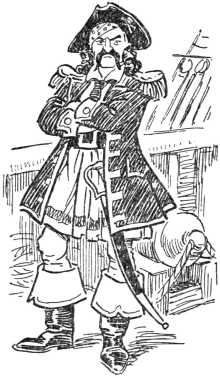
"I talk of Buccaneer Morgan."
The Lord Mayor has hoped that he will prove to be a member of the Tredegar family. The name of Morgan is a splendid name. You can, with that name, get your pedigree from wherever you like. Whenever I talk of bishops, I remember to speak of Bishop Morgan. If I speak to a football player, I talk of Buccaneer Morgan, and so it goes on in any subject you wish. I do not care—even if there is a great murder—a Morgan is sure to be in it! I do not wish to detract from the Lord Mayor's desire to be in the pedigree, but, at all events, we can all belong to a Morgan Brotherhood.
Reply to toast of "Our Guest," at City Hall, Cardiff, October 25th, 1909.
When the agitation for the new Technical Institute was going on, I daresay most of you heard all sorts of objections to it on the ground of expense and of there being no necessity for an institute of this description. Some of the agitators went back to Solomon. They said, "Solomon was the wisest man who ever lived, and he has told us that 'He who increaseth knowledge increaseth sorrow.' So why," said they, "do you want to have more knowledge?" Another objector said, "A little knowledge is a dangerous thing," and then somebody else said, "Of the making of books there is no end," and "Much study is a weariness of the flesh."
All those old sayings were trotted out, but there was the other side to bring before you. There was the dear old lady who was so proud of her son—he was a kind of artist—that she thought he would become a second Gainsborough. He got on very well, as she thought, and one day, meeting his professor, she said, "Oh, Professor, do you think my son will ever learn to draw?" and he replied, "Yes, madam, if you harness him to a wagon." Happily, Newport went the right way, and built what I fancy is quite one of the most up-to-date technical institutions in the country.
Technical Institute Prize Distribution, Newport, December 21st, 1910.
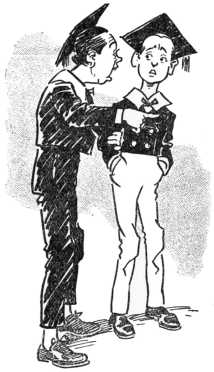
"He was what they called 'a devil of a chap to jaw.'"
It is very difficult to address a mixed school of boys and girls. You require totally different things for boys and girls. A learned gentleman was once asked his ideal of a girl, and he replied, "Most like a boy." Asked his ideal of a boy, he replied, "Only a human boy who dislikes learning anything." I was a human boy myself once, about 70 years ago, and I hated learning anything except running about and making myself disagreeable to everyone. My experience of girls is that girls want to learn when a boy doesn't. A girl is nearly always anxious to learn, whilst a boy only wants to amuse himself.
A great M.P. gave an address about education a week or so ago, and said our system was all wrong, that facts were no use, and that thinking was what they wanted. I totally disagree with him. Facts are wanted, for it is from facts you get on to thinking. One examiner was much amused by the notion of a boy who said that what struck him most was the toughness of wood, the wetness of water, and the magnificent soapiness of soap. That boy was going to get on; he was thinking more about facts than anything else.
Another great school question is with regard to punishment, whether it is good to order a boy or girl to write out a certain number of lines or learn so many lines of poetry. A well known gentleman of the world, politically and otherwise, when at school was what they called "a devil of a chap to jaw." That was the expression of a fellow pupil. He was constantly in the playground jawing, and they sentenced him to run around the ground five times when he spoke for more than three minutes. That was supposed to cure him, but it did not. He speaks now more than anyone in the House of Commons.
Pontywaun School Prize Distribution, March 17th, 1911.