PART III.
Reading edition
SPRING-NOTES IN NAVARRE. BY ALFRED CRAWHALL CHAPMAN.
The breeding-season in Navarre, owing probably to the high mean altitude of that province, appears to be relatively later than in other districts of similar latitude. In mid-April (1891) at St. Jean de Luz and Irun, we luxuriated in warm sunshine and the shade of leafy trees; but at Alsasua, on the afternoon of the 15th, we found ourselves transported to a region as cold and bleak as Northumbria, while at Pamplona, though the sun shone gratefully, his warmth was marred by a biting wind.
A parched-looking, sterile country separates the capital of Navarre from Burguete, a small village on the Spanish slope of the Pyrenees just under the Roncesvalles Pass, whither we were bound. Outside Pamplona, a single polyglot, or icterine warbler was observed, together with the following other species:—redstarts, tree-pipits, woodchats, ortolans, goldfinch, linnets, yellow-hammers, and chaffinches; and on the road to Burguete were added:—griffon vultures—doubtless from Yrurzun—Bonelli's eagle, red kites, one marsh-harrier, hoopoes, black redstarts, white wagtails, bluethroat (white-spotted form), robin, willow-wren, swallow, ring-ouzel, stonechat, wheatear, calandra lark, buzzard, kestrel, and grey partridge.
At Burguete, between April 17th and 21st, of raptores observed, with the exception of occasional kites, the buzzard was the commonest hawk, and already had eggs. Tawny owls had feathered young, but, beyond house-martins breeding in the crags, no other species appeared to have commenced to nest. In the beech woods around Burguete six species of tits were common, viz., the oxeye, blue, cole, marsh, long-tailed and crested. The last-named has a pretty rippling note, quite unique in its way. Nuthatches were numerous and clamorous, and green woodpeckers (? sp.) were noted. Amongst the box-scrub, fire-crests were common, with dippers and sandpipers on the streams; while, scattered about in the woods and hills, we came across wryneck, wren, white and yellow wagtails, pied and spotted flycatchers, turtle-and stock-doves, serin, gold-and bull-finches and carrion-crow. Above the Roncesvalles convent on April 20th, in a grey mist and drizzling rain, numbers of golden orioles, tree-pipits, skylarks, swallows, stock-doves and other common birds were picking their way northwards on migration; and a single spectacled warbler was obtained. This species has very active, sprightly movements, and a robin-like gait when hopping on the ground.
On April 21st we journeyed, viâ Orbaiceta, to a forest-guard's house in the great Iraty forest, observing en route grey wagtails and choughs, Egyptian vultures and ravens, the latter nesting. The change from the beech woods of Burguete to the endless spruce-fir forests of Iraty proved disappointing. Doubtless Picus martius breeds here, for we saw woodpeckers' holes which, from their size, could belong to no other species; but not a sight either of this bird or of the nutcracker rewarded our careful search. Bonelli's warbler, with its rather shrill, monosyllabic note, abounded wherever the nature of the ground suited its habits, but had not yet paired; nor could we ascertain that any other species were yet breeding. The hedge-sparrow here was of a noticeably paler cast of plumage than at home—perhaps explained by the altitude; while at Burguete, the chaffinches were visibly brighter in colour, and we also detected a striking difference in the song of yellow-hammer and some other species, as compared with English birds—possibly the mysterious beginnings of evolution. On the way back to Burguete, a sedge-warbler and a lovely specimen of the wall-creeper—the only one we saw—were obtained.
During our six days' absence, a considerable influx of migrants had occurred at Burguete, as evidenced by increased numbers of pied flycatchers (mostly males), woodchats and black redstarts. Blue-headed wagtails (M. neglecta) were running on the grass about the horses' feet, and, though the bird has been given specific rank, reminded me strongly of M. cinereocapilla, which I knew well in Lapland in 1884. During a two hours' ramble before breakfast on April 25th, just before leaving for home, the following were observed:—sparrow-hawk, a pair of snipe, magpies and jays, one heron, a pale blue harrier and a golden eagle.
Our short experience in Navarre is conspicuous more for what we did not see than for what we did. Extensive forests, thickly-grown, without underwood, and in a mountainous region, are not favourable to bird-life. Such places lack rabbits for the raptores, and are deficient in insect-food for the warblers and other small species, while the absence of marshy ground explains that of aquatic birds. April is, however,—at any rate in such seasons as that of 1891—quite a month too early for ornithological research in Navarre.
SUPPLEMENTAL NOTES ON BIRDS. (SOUTHERN SPAIN.)
The following remarks relate to certain species which have come under our observation in Spain, but which have not been included in the text:—
Black-winged Kite (Elanus cæruleus, Desfont).—Rare: a pair observed near San Lucar in April. The male fell to a long shot, but rose again and escaped.
Sparrow-hawk (Gavilan).—Most numerous in winter, but some remain to breed.
Merlin (Esmerejon).—In winter only.
Lesser Kestrel (Primilla).—One of the commonest birds in spring and summer, nesting in swarms in the towns, on churches, &c., and on the ruined Moorish watch-towers.
Osprey (Aguila pescadora).—Frequently observed on Guadalquivir and other large rivers: breeds.
White Owl (Lechuza).—Abundant and resident.
Brown Owl.—Scarce in south: one shot in December.
Long-eared Owl (Bujo).—Rare in Andalucia: the young have been obtained near Granada. More plentiful in Castile and Biscay.
Short-eared Owl (Carabo).—In winter: often very numerous. While partridge-shooting on the plains, we have noticed five or six on wing at once. Asio capensis we have not met with.
Kingfisher (Martin pescador).—Most numerous in winter: especially so in Portugal.
Wryneck (Torce-cuello).—In wooded sierras—March.
Mistle-Thrush (Charla).—Chiefly in winter, but breeds in higher sierras; have seen eggs taken near Tangier.
Dipper (Pechi-blanco, Tordo de agua).—Resident on mountain-streams, but relatively scarce in the south.
Hedge-Sparrow.—In garden at Jerez in January.
Wren (Ratilla).—Common and resident; nests in sierras in March.
Fire-crest.—In pine-woods; resident.
Tree-Creeper (Trepaironcos).—Resident; nests in the wooded sierras in April. It is also known as Arañero, i.e., "spider-catcher," a name it shares with the Wall-Creeper, which species we have not observed.
Nuthatch.—Common in Castile and the north, but not observed in Andalucia except in Sierra Nevada. This species is also known as trepaironcos.
Crested Tit (Capuchino).—Observed in the mountain forests of Castile. Resident and common near Gibraltar.
Sand-Martin.—Breeds on Guadalquivir—April.
Woodlark.—In winter only; leaves in April. Not common. Our familiar Skylarks and Titlarks swarm in winter in Spain, but leave the south in March. The Calandra, Crested, and Short-toed Larks, with the Corn-Bunting, are among the most abundant of Spanish birds at all seasons.
Rock-Bunting (Emberiza cia, Linn.).—Common in sierras, where it nests in April near clearings and cultivated patches.
White Wagtail.—Arrives in swarms in September, remaining till March. The pied wagtail we have not identified.
Grey Wagtail.—Common in winter, and some nest on the mountain streams, even in Andalucia.
Serin.—This, with the goldfinch and three following species, the stonechats, bee-eaters, rufous, and black-headed warblers and nightingales, is among the commonest and most characteristic birds of Southern Spain.
Linnet (Camacho).
Greenfinch (Verdon).
Chaffinch (Pinzon).—All common; most so in winter.
Rock-Sparrow (Gorrion montés).—Common in the sierras, where it breeds in holes in May.
Lesser Redpole.—Rare and irregular; in severe winters only. Many in garden at Jerez in January, 1888.
Siskin (Lugano).—Irregular; in winter only. Several obtained in garden, March 15, 1891.
Rook.—Occasional flocks in winter.
Carrion Crow.—Rare; found a nest with five eggs, Sierra de las Cabras, March 23rd. B. is sure he has seen C. corniz when shooting in winter.[80]
Sandwich Tern.—Obtained on Guadalete in March and April on passage.
Gannets and Skuas.—Observed in Straits and Bay of Trafalgar in winter and early spring.
Red-throated Diver.—Several shot in winter.
Shearwaters.—In Straits: observed in hundreds off Málaga in March.
Stormy Petrels.—Common on the coast, and probably breeds on some of the rocky islands.
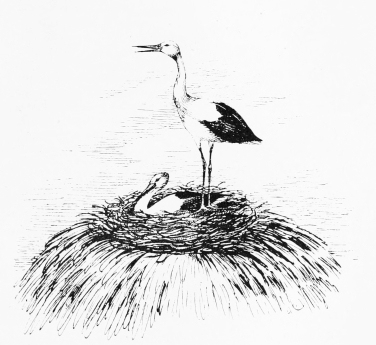
STORK'S NEST ON STRAW-STACK.