Part 2 — CHAPTER IX. AMONG THE FLAMINGOES. NOTES ON THEIR HAUNTS AND HABITS, AND THE DISCOVERY OF THEIR "INCUNABULA."
Reading edition
Though Flamingoes are found in many of the countries bordering on the Mediterranean, and their rosy battalions are familiar to Eastern travellers through Egypt and the Suez Canal, yet their mode of nesting, and especially the manner in which birds of so singular a form could dispose of their extremely long legs while incubating, has remained an unsettled question. Till within the last decade, in default of more recent observations, sundry ancient fables have passed current. Dampier described the nests of flamingoes seen by him two hundred years ago—in September, 1683—on one of the Cape de Verde Islands, as being high conical mounds of mud upon which the female sat astride ("Voyages," i., pp. 70, 71); and for two centuries this cavalier position has been accepted as history, no further observations having been made, though flamingoes have nested irregularly in various parts of Europe—even in France (in the marshy Camargue, the delta of the Rhone), and in Southern Spain.
In the latter country several efforts have been made by naturalists to obtain more precise knowledge of the breeding habits of the flamingo, especially by Lord Lilford and Mr. Howard Saunders, but, from various causes, without definite results. "The heat on those plains in June, when the flamingoes are said to nest," wrote the latter, "is something tropical, and it is no joke to wander for days over a district as large as our 'Eastern Counties,' on the chance of stumbling upon a colony of flamingoes somewhere or other." The element of chance, however, is a potent factor, and it eventually fell to the writer's lot to discover that for which other and better naturalists had sought in vain. The following is a narrative of our explorations in the marisma in the spring of 1883:—
The first encounter with flamingoes that year had a somewhat ludicrous result: after riding all day across the wastes, we had arrived towards sunset within sight of our quarters for the night, when a herd of these birds was observed feeding in a reed-girt creek. They seemed unusually favourably placed for a stalk—for these wary fowl seldom approach within shot of the slightest covert; but on reaching the outermost rushes, the pack was seen to be at a hopeless range, and rose immediately on my appearance. To my surprise, a "treble A" wire-cartridge nevertheless dropped four—three falling direct to the shot, and a fourth "towering" and falling dead a little further out. One tall fellow was only winged, and seeing that he was walking right away from me, and getting into deeper water, Felipe took my horse and rode round to cut him out. Meanwhile the short twilight was over, and darkness overtook us some distance out in the dreary marisma. In the gloom I mistook the bearings, and only, after splashing about for a time that seemed eternal, managed to reach the shore, laden with three huge birds, wet through, hungry, and hopelessly lost. For a mile or two I struggled on through thorn and tangled brushwood, till at last, coming suddenly upon a herd of sleeping beasts—bulls, for all I could tell—I gave it up, and decided to weather out the night in the jungle, with the sand for a couch, and a flamingo for a pillow. Great was the relief, about midnight, to hear a distant shot; I responded with a fusillade, and shortly afterwards B——, with Felipe, and Trujillo's mighty frame loomed through the darkness, and the duress was at an end.
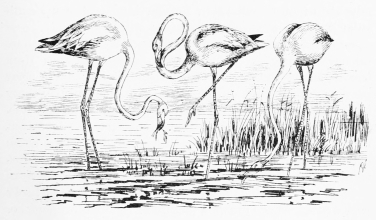
FLAMINGOES ON FEED.
During the month of April we searched the marisma systematically for the breeding-places of the flamingoes: but though we explored a large area, riding many leagues in all directions from our base through mud and water, varying from a few inches to three or even four feet in depth, yet we could see, at this season, no sign of nests. Flamingoes there were in plenty, together with ducks, divers, waders, and many kinds of aquatic birds already described: but the water was still too deep—the mud-flats and new-born islets not sufficiently dried for purposes of nidification, and as far as we could see the only species which had actually commenced to lay were the purple herons, coots, Kentish plovers, peewits, and some others.
Of the flamingoes themselves we secured several more lovely specimens; during two mornings devoted to shooting them, we bagged eight, six adults in rich rosy plumage, and two immature. Flamingoes are always shy and watchful birds, and their great height gives them a commanding view of threatening dangers: but there are degrees in intensity of wildness, and despite the unquestionable difficulty of flamingo-shooting, we would certainly not place these long-necked birds in the first rank among impracticable wild-fowl. Wild geese, for example, many of the duck-tribe, and nearly all the larger raptores far exceed them in incessant vigilance and downright astuteness. Flamingoes, however, will not, as a rule, permit of approach by the ordinary Spanish method of the stalking-horse, or cabresto: while the treacherous pony is still two gunshots away, the warning croak of the sentries is given, and at once the whole herd start to walk away, opening out their ranks as they move off. The method we found most effective to secure them was by partially surrounding a herd with a line of mounted men, who rode far out beyond them and then drove them over our two guns, each concealed behind his horse and crouching knee-deep in water. Of all the dirty work that wild-fowling in its many forms necessitates, this flamingo-driving takes the palm. It is mud-larking pure and simple, man, horse, and gun alike encased in a clinging argillaceous covering like the street-Arab amphibians below London Bridge.
It is a fine sight to see a big flight of flamingoes, say five hundred, coming well in to the gun—entrando bien á la escopeta! The whole sky is streaked with columns of strange forms, and the still air resounds with the babel of discordant croaks and cries. How wondrously they marshal those long uniform files, bird behind bird without break or confusion, and how precisely do those thousand black wing-points beat in rapid regular unison! Flamingoes are not "hard" birds: their feathers being loose and open, and the extremely long necks a specially vulnerable part, they may be brought down from a considerable height even with small shot. One evening, while collecting specimens of small birds on the open marsh, the writer killed a pretty right-and-left at flamingoes with No 6. Happening to see them on the wing a long way off, I lay down flat among the low samphire-scrub and presently had them (five) right overhead. Both these birds fell stone-dead. On another occasion, many years before, at the Veta Lengua, our four barrels, each loaded with nine treble-nesting slugs, brought down three fine flamingoes from a herd rising at upwards of 180 measured paces. But having obtained specimens, we did not further molest these singular birds.
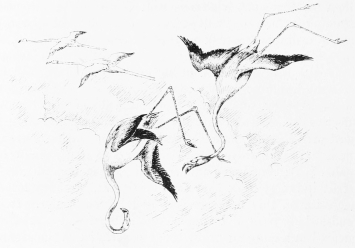
A RIGHT-AND-LEFT AT FLAMINGOES.
Flamingoes were not the sole attraction: the desolate region around abounded with wild life, furred and feathered, and many a pleasant bye-day was put in among the "vermin." One morning we rode out to some distant thickets where a neighbouring herdsman—half peasant, half poacher—complained that a family of lynxes were working havoc among his kids. Our friend, a man of square iron-knit frame, with the eyes and claws of an eagle, rode before us, no less than eleven wire-haired podencos (hunting-dogs) made fast to his saddle-bow by cords of twisted esparto. The first thicket tried held a lynx, which, disturbed by the podencos, bolted at speed right between us and rolled over with a dose of "treble A" about her lugs. From this one small mancha the dogs put out, besides the lynx, several partridge and rabbits, a Montagu's harrier, and a pair of mallards! This lynx was a female, a full-grown and handsome example of Felis pardina, much infested (as are most of the scrub-haunting animals) with ticks, especially about the head: but it was not much more than half the size of an enormous male which we subsequently found. Unluckily, half our pack were then wasting their energies on a big boar, which, after trotting close up to where the writer stood, turned back with a valedictory grunt and disappeared. The rest of the pack had meanwhile driven the lynx to the outside of the thicket, where we had already viewed him and regarded his fate as sealed; when, with sudden fury, the big cat turned on his foes, and scattering the podencos with some tremendous fore-arm blows, made good his escape to the fastnesses of the Algaida de la Pez.
SPANISH LYNX.
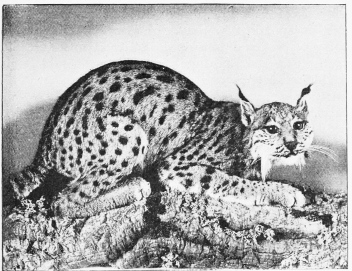
Some years afterwards the writer killed a magnificent male lynx, one of the largest and most beautifully marked we have ever seen, at this mancha—probably the same beast.
These scrub-clad plains abounded with tall grey foxes (Vulpes melanogaster) and mongoose (Herpestes widdringtoni), with genets, badgers, and wild-cats, of all of which we shot specimens. Three wild-cats we bagged by moonlight, from screens placed to command an open glade where rabbits are wont to pursue nocturnal gambols. Waiting in ambush beneath the star-strewn heavens, in the silent brilliance of the southern night, no sound save the churring of nightjars, or the whistle of stone-curlew, broke the stillness: bats and small owls flicker in uncertain flight against the dark sky, and across the glade rabbits glide like phantoms: presently a larger shadow announces their deadly enemy, the Gato montés. Two of these wild-cats were males, large and powerful brutes, weighing 9½ and 10¼ lbs. respectively, and tinged with warm chestnut colours beneath. The big lynx we could not weigh, being beyond the limit of the spring-balance. He probably reached near half a hundredweight. But we must return to our flamingoes.
During the month of April, as already mentioned, all efforts to discover their breeding-places proved futile. It was clearly too early in the season, and the writer now lost nearly a week through a smart attack of ague, brought on by constant splashing about in comparatively cold water with a fierce sun always beating down on one's head. In May, however, we had better luck. Further to the eastward flamingoes had always been most numerous, and once or twice we observed signs, early in May, that looked like the first rude beginnings of architecture. We have already described the archipelago of islets that lay far towards the eastern shore, and on which we had found the rare gulls, and such a variety of waders and other aquatic birds breeding (p. 93), together with the immense numbers of flamingoes that lined the horizon. We must now return to those bird-islets, to the scene where we broke off at the end of Chapter VII on the afternoon of the 9th of May.
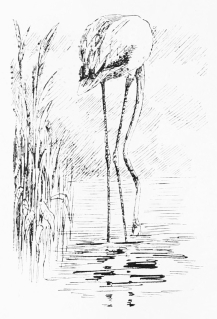
A TOILET IN THE WILDERNESS.
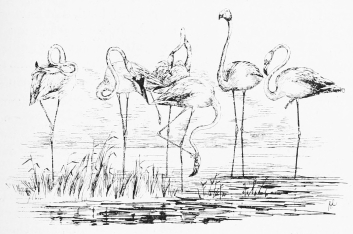
As there stated, the immense aggregations of flamingoes in those middle marismas, surrounded the horizon in an almost unbroken line. But, on examining the different herds narrowly with the binocular, there was an obvious dissimilarity in the appearance of certain groups. One or two in particular seemed so much denser than the others: the narrow white line appeared at least three times as thick, and in the centre looked as if the birds were literally piled upon each other. Felipe suggested that these birds must be at their pajeréra, or breeding-place, and after a long wet ride we found this was so. The water was very deep, the bottom clinging mud: at intervals, for a hundred yards or so, the laboured plunging of the mule was exchanged for an easier, gliding motion—he was swimming. The change was a welcome relief to man and beast: the sensation of sitting a swimming animal is not unpleasant, but it will give some idea of the labours undergone in these aquatic rides in the marismas in May, 1883, if we add that a fine mule, a powerful beast worth £60, succumbed to the effects of the fortnight's work.
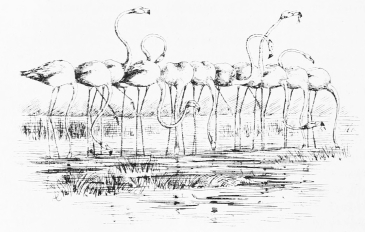
On a nearer approach, the cause of the peculiar appearance of the herd from a distance became clearly discernible. Many of the birds were sitting down on a low mud-island. Some were standing upon it: and others again were standing in the water. Thus the different elevations of their bodies formed what had appeared a triple or quadruple line.
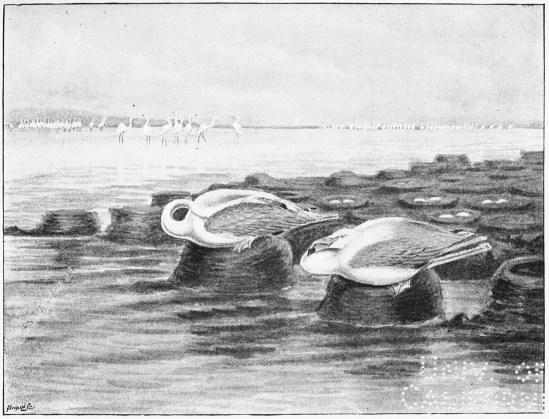
On reaching the spot we found a perfect mass of nests. The low, flat, mud plateau was crowded with them as thickly as its space permitted. These nests had little or no height above the flat surface of mud—some were raised an inch or two, a few might be five or six inches in height; but the majority were merely circular bulwarks of mud barely raised above the general level, and having the impression of the bird's legs distinctly marked upon them. The general aspect of the plateau was not unlike a large table covered with plates. In the centre was a deep hole full of muddy water, which, from the gouged appearance of its sides, appeared to be used as a reservoir for nest-making materials.
Scattered all round this main colony were numerous single nests, rising out of the water and evidently built up from the bottom. Here and there two or three of these were joined together—"semi-detached," so to speak: these separate nests stood six or eight inches above water-level, and as the depth was rather over a foot, the total height of the nests would be some two feet or thereabouts, and their width across the hollow top some fifteen inches. None of these nests as yet contained any eggs, and though I returned to the pajaréra on the latest day I was in its neighbourhood (May 11th) they still remained empty. On both occasions many hundreds of flamingoes were sitting on the nests, and on the 11th we had a good view of them at close quarters. Linked arm-in-arm with Felipe, and crouching low on the water to look as little human as possible, we approached within some seventy yards before their sentries showed signs of alarm: and at that distance, with the glass, observed the sitting birds as distinctly as one need wish. The long red legs doubled under their bodies, the knees projecting as far as, or beyond the tail, and their graceful necks neatly curled away among their back-feathers like a sitting swan, with the heads resting on their breasts—all these points were unmistakable. Indeed, as regards the disposition of their legs, it is hardly necessary to point out that in the great majority of cases (the nests being hardly raised above the level of the mud) no other position was possible—to sit astride on a flat surface is out of the question.
FLAMINGOES AND NESTS.
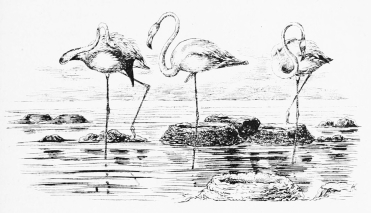
Still none of the crowded nests contained a single egg. How strange it is that the flamingo, a bird which never seems happy unless half-way up to his knees in water, should so long delay the period of incubation: for, long before eggs could be laid and hatched in these nests and the young reared, the full summer-heats of June and July would have set in, the water would have entirely disappeared, and the flamingoes would be left stranded in the midst of a scorching desert of dry, sun-baked mud.
Being unable myself to return to the marisma, I sent Felipe back there on the 26th of May, when he obtained eggs—long, white and chalky, some specimens extremely rough. Two is the number laid in each nest. In 1872 the writer obtained eggs taken on May 24th, which is therefore, probably, about the average date of laying. Owing to the late period at which incubation takes place, we have not had an opportunity of examining the young flamingoes when newly-hatched, or of endeavouring to solve the biological problems which appear to cluster round their adolescent anatomy. In June and July, 1872, the writer spent some time in the marisma, but unfortunately was not aware, at that time, of the interest attaching to these points.
According to native accounts, very few young flamingoes are ever reared in Spain. Though in wet seasons eggs are laid in thousands (they are sold by boatloads in the neighbouring villages), yet few, if any, of the young Spanish flamingoes reach maturity—possibly by reason of their lateness in nesting, and the rapid changes in the state of the water in the marisma.
In the spring of 1891, after an exceptionally severe winter in Spain, and with comparatively little water in the marisma, flamingoes were remarkably scarce, and we believe that none bred in Andalucia that year.
Since the author's description of the nesting habits of the flamingo first appeared in the Ibis (January, 1884), its accuracy has been corroborated by independent observations made on the West Indian island of Abaco by His Excellency (now Sir) H. H. Blake, when Governor of the Bahamas. The value of the corroboration is enhanced by the fact that the above-named gentleman was unaware at the time he wrote that the long-vexed question had already, three years previously, been solved: and his graphic description in the Nineteenth Century for December, 1887, is, as regards facts, almost identical with the present writer's account of a similar scene narrated in the Ibis for January, 1884.
Plate XVIII. FLAMINGOES ON THEIR NESTS. Page 112.
One other point before we leave the flamingo and its haunts. We have seen it stated that the brilliant colours of the flamingo do but reflect the brilliancy of its environment—that these bright colours have been acquired through the æsthetic tastes of the bird and by "selective preference"; then, proceeding to enlarge on a "fascinating theory," its expounder goes on from particular to general, and to demonstrate that this Darwinian principle is generally operative in ornithic coloration. Whether birds in general have or have not æsthetic tastes in the matter of coloration or ornament, we are not prepared to say: but to our less imaginative minds it is a question whether there exists in nature a shred of real evidence in support of such a hypothesis. The flamingo truly has a brilliant plumage, but never a brilliant environment. No one who has been intimately acquainted with these birds in their haunts could have conceived such a sentiment; for anything less brilliant than the bleak and tawny monotony which characterizes the chosen homes of the flamingo it would be impossible to imagine. The flamingo itself, indeed, is the one solitary speck of pure bright colour amidst the broad leagues of mud and muddy water which it so conspicuously ornaments. Other birds are there, it is true, but to them the same remark applies. They, also, are as bright, pure and conspicuously different from their environment as are the flamingoes. What more exquisite examples of bright, spotless beauty amidst strongly contrasted surroundings than the stilts and avocets, the lovely southern herons, egrets and spoonbills, the gulls and marsh-terns? These are but a handful of examples fatal to such a theory, and they could easily be multiplied indefinitely.
That many brilliant bird-forms affect brilliant surroundings, that the fauna of the cold and colourless north in general lacks the gorgeous hues of certain denizens of the tropics, or, again, that many creatures possess hues assimilated to the general tone of their destined haunts—all these are facts which we readily recognize. But are such facts much more than coincidences? Or is it wise to deduce any binding rules or axiom therefrom? As regards protective assimilation in colour, that is quite a different thing: its advantages are self-evident, and its application more or less universal throughout the animal-world, but it is hardly to the point. Protective coloration we recognize and understand—it is an every-day phenomenon—but æsthetic tastes in colour we utterly reject.
The composition of the human mind is undoubtedly speculative: and to those of deep thought, as distinguished from others the bent of whose energies tends rather towards action, the temptation to theorize—to venture on the dangerous regions of inference and deduction—appears irresistible. The contemplative thinker formulates theories the apparent beauty of which fascinate his imagination. Collateral evidence which seems to substantiate, is, in general, not difficult to find—that of a negative or prejudicial character is not sought. Then with a mind unconsciously biassed in favour of a preconceived idea, it may happen that probabilities are mistaken for facts, evidence for proof: and thus a new hypothesis is duly launched, based on ten, fifty, or a hundred adduced circumstances, the whole of which may be merely coincidences, and exceptions to the rule if applied to the millions of unadduced cases, and perhaps, even in relation to the particular examples cited, of no direct bearing in the sense in which it is sought to apply them.
As an example of the class of theories alluded to, we have read that the colours of the sea-gull tribe are dark above and light below in order, on the one hand, that they may escape the searching scrutiny of the eagle soaring above, and, on the other, avoid alarming their finny prey beneath. If there was anything in this idea, it would, at least, be a hard case for those sea-birds not so coloured, and it should be added that of the birds which are so coloured several species take three or four years to attain adult dress. How do they survive those earlier years? But a very slight acquaintance with the subjects in life shows that there is actually nothing in it. Lying in one's gunning-punt, the whitest-breasted gulls, as viewed from below against the lightest of cloud backgrounds, are seen as clearly as if the bird's colour was actually black. Every detail of form and movement is clearly distinguishable—the clean-cut wings and tail, legs pressed close up under the latter, the pointed head turning from side to side as it searches the waters. Its colour makes no difference, and is no factor at all. Then from high above, from the heights of a sea-cliff, what man of even moderate vision cannot distinguish with equal ease the movements of the black-backed gull from those of the pale herring-gull and paler tern? And both eagles and surface-swimming fish are infinitely keener of vision than the sharpest-eyed of our kind.
These remarks are penned from no love of argument, nor inspired by invidious motive, but simply with a view to get at facts and thereby advance the interests of science: that is, of true knowledge.