"The Cruise of the "Snowbird" Crew in the "Arrandoon"" (continued 6)
Reading edition
“Ay, ay, sir,” said the man at the wheel.
In a few hours the wind got more aft, and so, heading now for more southern climes, away went the Canny Scotia, with stun’sails up. I cannot say that she bounded over the waters like a thing of life. No; but she looked as happy and frisky as a plough-horse on a gala day, that has just been taken home from the miry fields, fed and groomed, and dressed with ribbons and started off in a light spring-van with a load of laughing children.
But eastwards and north steamed the Arrandoon. Indeed, she tried to do all the northing she could, with just as little easting as possible. She passed islands innumerable; islands that we fail to see in the chart, owing, no doubt, to the fact that they are usually covered entirely with ice and snow, and would be taken for immense icebergs. But this was a singularly open year, and there was no mistaking solid rocky land for floating ice.
The bearings of all these were carefully put down in the charts—I say charts, because not only the captain and mate, but our young heroes as well, took the daily reckoning, and kept a log, though I am bound in the interests of truth to say that Ralph very often did not write up his log for days and days, and then he impudently “fudged” it from Rory’s.
“Are you done with my log?” Rory would sometimes modestly inquire of Ralph as he sat at the table busily “fudging.”
“Not yet, youngster,” Ralph would reply; “there, you go away and amuse yourself with your fiddle till I’m done with it, unless you specially want your ears pulled.”
McBain landed at many of these islands, and hoisted beacons on them. These beacons were simply spare spars, with bunches of light wood lashed to their top ends, so that at some little distance they looked like tall brooms. He hoisted one on the highest peak of every island that lay in his route.
They came at length to what seemed the very northernmost and most easterly of these islands, and on this McBain determined to land provisions and store them. It would tend to lighten the ship; and “on the return voyage,” said the captain, “if so be that Providence shall protect and spare us, they will be a welcome sight.”
This done, the voyage was continued, and the sea becoming clearer of ice towards the west, the course was altered to almost due north.
The wind drawing round more to the south, the fires were banked, and the vessel put under easy sail. The water all round looked black and deep; but, with all the caution of your true sailor, McBain had two men constantly in the chains to heave the lead, with a watch continually in the crow’s-nest to give warning of any sudden change in the colour of the water. More than once such a change was observed, the surface becoming of a yellowish ashen hue away ahead of them. Then the main or fore yard was hauled aback, and a boat despatched to investigate, and it was found that the strange appearance was caused by myriads of tiny shrimplets, what the northern sailor calls “whale’s food.” Whether this be whale food or not I cannot say for certain, but several times our heroes fell in with a shoal of bottle-noses, disporting themselves among these curious ashen-hued streams.
This formed a temptation too great to resist, for the oil would do instead of fuel when they wintered away up in the extreme north. So boats were lowered—not two but four, for these brutes are as wild as the winds and more wily than any old fox. No less than four were “bagged,” as Rory called it. They were not large, but the blubber obtained from them was quite sufficient to fill one large tank. The best of it was, that Ralph—big, “plethoric” (another of Rory’s pretty words), Saxon Ralph, made quite a hero of himself by manfully guiding his boat towards a floundering monster that was threatening destruction to the third whaler, which was fast to her, and skilfully spearing her at the very nick of time.
Rory was in the same boat, and drenched in blood from head to heels though both of them were, he must needs get up and shake his “baby brother” by the hand.
“Oh, sure!” said Rory, with tears in his eyes, “it’s myself that is proud of the English race, after all. They haven’t the fire of the Gael; but only just awaken them!—Dear Ray, you’re a broth of a boy, entirely.”
“What do you think,” said McBain, one morning just after breakfast—“what do you think, Rory, I’m going to make to-day?”
“Sure, I don’t know,” said Rory, all interest.
“Why, fenders,” said McBain.
“Fenders?” ejaculated Rory, with wider eyes. “Fenders? troth it’ll be fire-irons you’ll be making next, sir; but what do you want with fenders?”
“You don’t take,” said Ralph. “It is fenders to throw overboard when the ice is too obtrusive, isn’t it, sir?”
“That’s it,” said the captain, laughing. “Sometimes the bergs may be a bit too pressing with their attentions, and then I’ll hang these over. That’s it.”
It took nearly a fortnight to complete the manufacture of these fenders or trusses, for each of them was some twelve feet long by three in diameter composed of compressed straw and shielded by knitted ropework.
To the captain’s foresight in making these fenders, they several times owed the safety of their gallant ship during the winter that followed.
A whole month passed away. The sun now set every night, and the still, long day began to get sensibly shorter.
The progress northward was hindered by dense white fogs, which at times hugged the ship so closely that, standing by the bowsprit, you could not see the jibboom-end. The vessel, as Sandy McFlail expressed it, seemed enveloped in huge sheets of wet lint. Then the fog would lift partially off and away—in other words, it seemed to retire and station itself at some distance, with the ice looming through it in the most magical way. At these times the ship would be stopped, and our heroes were allowed to take boat exercise around the Arrandoon, with strict injunctions not to go beyond a certain distance of the vessel. Their laughing and talking and singing never failed to bring up a seal or two, or a round-eyed wondering walrus, or an inquisitive bladder-nose, but the appearance of these animals, as they loomed gigantic through the fog, was sometimes awful in the extreme. When a malley or gull came sweeping down towards them it looked as big as the fabulous Roc that carried away Sinbad the Sailor, and Rory would throw himself in the bottom of the boat and pretend to be in a terrible fright.
(The optical illusions caused among the ice by these fogs are well and humorously described in a book just to hand called “The Voyage of the Vega” (Macmillan and Co). I myself wrote on the same subject thirteen years ago, in a series of articles on Greenland North.)
“Oh! Ray, boy, look at the Roc,” he would cry. “I’m come for, sure enough. Do catch hold of me, big brother. Don’t let the great baste carry me off. Sure, he’ll fly up to the moon with me, as the eagle did with Daniel O’Rourke.”
I think the fog must have caused delusions in sound as well as sight, else why the following.
They were pulling gently about, one day, in the first whaler, when, borne along on the slight breeze that was blowing, came a sound as of happy children engaged at play. The merry laughter and the occasional excited scream or shout were most distinctly audible.
“Whatever can it be?” cried Allan, looking very serious, his somewhat superstitious nature for a moment gaining the ascendency.
“Sure,” said Rory, “you needn’t pull so long a face, old man; it’s only the childer just got out of school.”
The “childer” in this instance were birds.
“It’s much clearer to-day,” said Stevenson, one morning, as he made his usual report. “We can see the clouds, and they’re all on the scud. I expect we’ll have wind soon, sir.”
“Very well, Mr Stevenson,” was the reply, “be ready for it, you know; have the fires lit and banked, and then stand by to get the ice-anchors and fenders on board,” (the ship was fast to a berg).
“There is a line of ice to the westward, sir, about a quarter of a mile off, and clear water all between.”
“Thank you, Mr Stevenson.”
But Stevenson did not retire. He stopped, hesitatingly.
“You’ve something to ask me, I think?” said McBain.
“I’ve something to tell you,” replied the mate, with a kind of a forced laugh. “I dare say you will think me a fool for my pains, but as sure as you gentlemen are sitting there at breakfast this morning, about five bells in the middle watch I saw—and every man Jack of us saw—”
“Saw what?” said McBain. “Sit down, man; you are looking positively scared.”
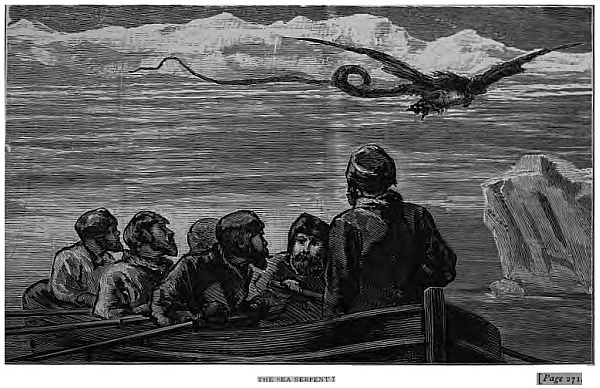
“We saw—the great Sea-Serpent!”
(What is herein related really occurred as described. I myself was a witness to the event, being then in medical charge of the barque Xanthus, recently burned at sea.)
McBain did not attempt to laugh him out of his story, but he made him describe over and over again what he had seen; then he called the watch, and examined them verbally man by man, and found they all told the self-same tale, talking soberly, earnestly, and truthfully, as men do who feel they are stating facts.
The terrible monster they averred came from the northwards, and was distinctly visible for nearly a minute, passing between the ship and the ice-line which Stevenson had mentioned. They described his length, which could not have been less than seventy or eighty yards, the undulations of his body as he swept along on the surface of the water, the elevated head, the mane and—some added—the awful glaring eyes.
It did not come on to blow as the mate predicted, so the ship made no move from her position, but all day long there was but little else talked about, either fore or aft, save the visit of the great sea-serpent, and as night drew on the stories told around the galley fire would have been listened to with interest by any one at all fond of the mysterious and awful.
“I mean,” said Rory, as he retired, “to turn out as soon as it is light, and watch; the brute is sure to return. I’ve told Peter to call me.”
“So shall I,” said Allan and the doctor.
“So shall I,” said Ralph.
“Well, boys,” said McBain, “I’ll keep you company.”
When they went on deck, about four bells in the middle watch, they were not surprised to find all hands on deck, eagerly gazing towards the spot where they had seen “the manèd monster of the deep,”—as poet Rory termed him—disappear.
It was a cold, dull cheerless morning; the sun was up but his beams were sadly shorn—they failed to pierce the thick canopy of clouds and mist that overspread the sky, and brought the horizon within a quarter of a mile of them. They could, however, easily see the ice-line—long and low and white.
A whole hour passed, and McBain at all events was thinking of going below, when suddenly came a shout from the men around the forecastle.
“Look! look! Oh! look! Yonder he rips! There he goes!”
Gazing in the direction indicated, the hearts of more than one of our heroes seemed to stand still with a strange, mysterious fear, for there, rushing over the surface of the dark water, the undulated body well-defined against the white ice-edge, was—what else could it be?—the great sea-serpent!
“I can see his mane and head and eyes,” cried Rory. “Oh! it is too dreadful.”
Then a shout from the masthead,—
“He is coming this way.”
It was true. The manèd monster had altered his course, and was bearing straight down upon the Arrandoon.
No one moved from his position, but there were pale, frightened faces and starting eyes; and though the men uttered no cry, a strange, frightened moan arose, a fearful quavering “Oh-h-h?”—a sound that once heard is never to be forgotten. Next moment, the great sea-serpent, with a wild and unearthly scream, bore down upon the devoted ship, then suddenly resolved itself into a long flight of sea-birds (Arctic divers)!
So there you have a true story of the great sea-serpent, but I am utterly at a loss to describe to you the jollity and fun and laughing that ensued, as soon as the ridiculous mistake was discovered.
And nothing would suit Ted Wilson but getting up on the top of the bowsprit and shouting,—
“Men of the Arrandoon, bold sailors all, three cheers for the great sea-serpent. Hip! hip! hip! Hurrah!!!”
Down below dived Ralph, followed by all the others. “Peter! Peter! Peter!” he cried.
“Ay, ay, sir,” from Peter.
“Peter, I’m precious hungry.”
“And so am I,” said everybody.
Peter wasn’t long in laying the cloth and bringing out the cold meat and the pickles, and it wasn’t long either before Freezing Powders brought hot coffee. Oh! didn’t they do justice to the good things, too!
“I dare say,” said the doctor, “this is our breakfast.”
“Ridiculous!” cried Ralph, “ridiculous! It’s only a late supper, doctor. We’ll have breakfast just the same.”
“A vera judeecious arrangement,” said Sandy.
Chapter Thirty.
Land Ho! The Isle of Desolation—The Last Blink of Sunshine—The Aurora Borealis—Strange Adventure with a Bear.
“Well, Magnus,” said Captain McBain one day to his old friend, “what think you of our prospects of gaining the North Pole, or your mysterious island of Alba?”
Magnus was seated at the table in the captain’s own room, with an old yellow, much-worn chart spread out before him, the only other person in the cabin, save these two, being Rory, who, with his chin resting on his hands and his elbows on the table, was listening with great interest to the conversation.
“Think of it?” replied the weird wee man, looking up and glaring at McBain through his fierce grey eyebrows. “Think of it, sir? Why we are nearly as far north now as we were in 1843. We’ll reach the Isle of Alba, sir, if—”
“If what, good Magnus?” asked McBain, as the old man paused. “If what?”
“If that be all you want,” answered Magnus.
“Nay, nay, my faithful friend,” cried the captain, “that isn’t all. We want to reach the Pole, to plant the British flag thereon, and return safely to our native shores again.”
“So you will, so you will,” said Magnus, “if—”
“What, another ‘if,’ Magnus?” said McBain. “What does this new ‘if’ refer to?”
“If,” continued Magnus, “Providence gives us just such another autumn as that we have had this year. If not—”
“Well, Magnus, well?”
“We will leave our bones to lie among the eternal snows until the last trump shall sound.”
After a pause, during which McBain seemed in deep and earnest thought.
“Magnus,” he said, “my brave boys and I have determined to push on as far as ever we can. We have counted all the chances, we mean to do our utmost, and we leave the rest to Providence.”
Allan had entered while he was speaking, and he said, as the captain finished,—
“Whatever a man dares he can do.”
“Brave words, my foster-son,” replied McBain, grasping Allan’s hand, “and the spirit of these words gained for the English nation the victory in a thousand fights.”
“Besides, you know,” added Rory, looking unusually serious, “it is sure to come right in the end.”
The Arrandoon, wonderful to relate, had now gained the extreme altitude of 86 degrees north latitude, and although winter was rapidly approaching, the sea was still a comparatively open one. Nor was the cold very intense; the frosts that had fled away during the short Arctic summer had not yet returned. The sea between the bergs and floes was everywhere calm; they had passed beyond the region of fogs, and, it would almost seem, beyond the storm regions as well, for the air was windless.
So on they steamed steadily though slowly, never relaxing their vigilance; so careful, indeed, in this respect was McBain, that the man in the chains as well as the “nest hand” were changed every hour, and only old and tried sailors were permitted to go on duty on these posts.
“Land ahead!” was the shout one day from the nest. The day, be it remembered, was now barely an hour long.
“Land ahead on the port bow!”
“What does it look like, Mr Stevenson?” cried the captain.
The mate had run up at the first hail.
“I can just see the tops of a few hills, sir,” was the reply, “towering high over the icebergs.”
The Arrandoon bore away for this strange land. In three hours’ time they were lying off one of the dreariest and most desolate-looking islands it has ever been the lot of mariners to behold. It looked like an island of some worn-out planet, whose internal fires have gone for ever out, from which life has long since fled, which possesses no future save the everlasting night of silence and death.
Some slight repairs were required in the engine-room, so the Arrandoon lay here for a week.
“To think,” said McBain, as he stood on the bridge one day with our heroes, “that in the far-distant past that lonely isle of gloom was once clad in all the bright colour of tropical vegetation, with wild beasts roaming in its jungles and forests, and wild birds filling its groves with music,—an island of sunshine, flowers, and beauty! And now behold it.”
An expedition was got up to explore the isle, and to climb its highest peak to make observations.
McBain himself accompanied it, so did Allan, Rory, and Seth. It was no easy task, climbing that snowy cone by the light of stars and Aurora. But they gained the summit ere the short, short day broke.
To the north and west they saw land and mountains, stretching away and away as far as eye could follow them. To the east and north water studded with ugly icebergs that looked as if they had broken away from the shores of the western land.
“But what is that in the middle of yonder ice-floe to the south and west?” cried Rory.
“As I live,” exclaimed McBain, as he eyed the object through the glass, “it is a ship of some kind, evidently deserted; and it is quite as evident that we are not the only explorers that have reached as far north as this island.”
The mystery was explained next day, and a sad story brought to light. McBain and party landed on the floe and walked towards the derelict. She was sloop-rigged, with sails all clewed, and her hull half hidden in snow. After a deal of difficulty they succeeded in opening one of the companion hatches, and making their way down below.
No less than five unburied corpses lay huddled together in the little cabin. From their surroundings it was plain they had been walrus-hunters, and it was not difficult to perceive that the poor fellows had died from cold and hunger many, many years before.
Frozen in, too far up in this northern sea, they had been unable to regain the open water, and so had miserably perished.
Next day they returned and laid the mortal remains of these unfortunate men in graves in the snow, and even Rory was much more silent and thoughtful than usual as they returned to the ship.
Was it not possible that they might meet with a similar fate? The poor fellows they had just buried had doubtless possessed many home ties; their wives and mothers had waited and wished a weary time, till at long last the heart had grown sick with hope deferred, and maybe the grave had long since closed over them.
Such were some of Rory’s thoughts, but after dinner McBain “brought him up with a round turn,” as he phrased it.
“Rory,” he cried, “go and play to us. Freezing Powders, you young rascal, bring that cockatoo of yours up on the table and make us laugh.”
Rory brightened up and got hold of his fiddle; and “All right, sah,” cried Freezing Powders. “I bring de old cockatoo plenty quick. Come along, Cockie, you catchee my arm and pull yourse’f up. Dat’s it.”
“Come on,” cried Cockie, hopping on the table and at once commencing to waltz and polka round. “Come on; play up, play up.”
A queer bird was Cockie. He cared for nobody except his master and Rory. Rory he loved solely on account of the fiddle, but his affection for Freezing Powders was very genuine. When his master was glad, so was Cockie; when the little nigger boy felt tired, and threw himself down beside the cage to rest, then Cockie would open his cage door and back tail foremost under the boy’s arm, heaving as he did so a deep, delighted sigh, as much as to say, “Oh, what joy it is to nestle in here?”
Cockie was not a pretty bird; his bill was worn and all twisted awry, and his eyes looked terribly old-fashioned, and the blue, wrinkled skin around them gave him quite an antediluvian look. He was white in colour—or, more correctly speaking, he had been white once; but time, that steals the roses from the softest cheeks, had long since toned him down to a kind of yellow lilac, so he did not look a very respectable bird on the whole.
“You ought to wash him,” McBain said, one day. “Wash him, sah?” said Freezing Powders; “is dat de ’xpression you make use of, sah? Bless you, sah! I have tried dat plenty much often; I have tried to wash myself, too. No good in eeder case, sah; I ’ssure you I speak de truf.”
“Come on I come on?” cried Cockie. “Play up! play up! La de lal, de lal, de lal!”
And round spun the bird, keeping time to the merry air, and every now and then giving a “whoop?” such as could only be emitted by Cockie himself, a Connemara Irishman, or a Cuscarora Indian.
But this is a remarkable thing, Cockie danced and whirled in one direction till he found his head getting light, then he reversed the action, and whirled round the other way!
(This description of the wonderful bird is in no way overdrawn.)
It really seemed as if he would tire Rory out. “Lal de dal!” he sung: “our days are short—whoop!—our lives are merry—lal de dal, de dal, de whoop!”
But Rory changed his tactics; he began to play The Last Rose of Summer, leaning down towards the table. Cockie stopped at once, and backed, tail foremost, in under the musician’s hands, crouching down with a sigh to listen.
But Rory went off again into the Sprig of Shillelagh, and off went Cockie, too, dancing more madly than ever with a small flag in his mouth that Freezing Powders had handed him. Then he stopped at last, and walked about gasping, pitching penholders and pencils in all directions.
“Here’s a pretty to-do!” he said; and when somebody laughed, Cockie simply shrieked with laughter till he had everybody joining him and holding their sides, and feeling sore all over. Verily, Cockie was a cure! No wonder his master loved him.
In a few days the Arrandoon left the desolate island, which Rory had named “Walrus Isle.”
Everybody was on deck as the vessel slowly steamed away.
Most of the land was already shrouded in gloom, only in the far distance a tall mountain cone was all ablaze with a crimson glory, borrowed from the last blink of sunshine. Yes, the god of day had sunk to rest, and they would bask no more in his cheering beams for many a long and weary month to come.
“Give us a bass, Ray, old boy!” cried Rory; “and you, doctor, a tenor.”
And he started,—
“Shades of evening, close not o’er us, Leave our lonely bark awhile, Morn, alas! will not restore us Yonder dim and distant isle.”
Ah, reader! what a glorious thing music is; I tell you, honestly and truthfully, that I do not believe I could have come through half the trials and troubles and griefs and worries I have had in life, if I had not at times been able to seek solace and comfort from my old cremona.
Our heroes thought at first they would greatly miss the light of the sun, but they soon got quite used to the strange electric light emitted by the splendid Aurora, combined with that which gleamed more steadily downwards from the brilliant stars. These stars were seen to best advantage in the south; they seemed very large and very near, and whether it was the reflection of the Aurora, or whether it was real, I never could tell, but they seemed to shine with differently coloured lights. There were pure white stars, mostly low on the horizon; there were crimson and green changing stars, and yellow and rose-coloured changing stars, and some of a pale-golden hue, the soft light of which was inexpressibly lovely. But any effort of mine to paint in words the extreme beauty of the heavens on clear nights would prove but a painful failure, so I leave it alone. The chief bow of the Aurora is, I may just mention, composed apparently of spears of ever-changing rainbow-coloured light continually falling back into masses and phalanxes, and anon advancing and clashing, as it were. While walking on the ice-fields, if you listen, you can hear a strange whispering, hissing sound emitted from these clashing, mixing spears. The following letters, whispered rapidly, give some faint idea of this mysterious sound,—
“Ush-sh-sh-sh-sh-sh-sh.”
You can also produce a somewhat similar noise by rubbing your fingers swiftly backwards and forwards on a sheet of paper.
But indeed the whole firmament, when the sky was clear, was precisely as Rory described it—“one beautiful poem.”
Many bears were now seen, and nearly all that were seen were killed. They were enormously large and fierce, foolishly fierce indeed, for they seldom thought of taking to flight.
There were unicorns (narwhals) in the sea in scores, and walruses on the flat ice by the dozen. It was after these latter that Master Bruin came prowling.
A nice juicy walrus-steak a Greenland bear will tell you is the best thing in the world for keeping the cold out.
Old trapper Seth had strange ways of hunting at times. One example must suffice.
Our heroes had been out after a walrus which they had succeeded in killing. A bear or two had been seen an hour or two before that, evidently on the prowl, and probably very hungry. Now, nothing will fetch these kings of the northern ice more surely than the scent of blood.
“Young gentlemen,” said Seth, “there’s a b’ar about somewheres, and I reckon he ain’t far off either. Now, we’ll just whip this old walrus out o’ his skin, and Seth will creep in, and you’ll see what you’ll see.”
He was very busy with his knife as he spoke, and in a few minutes the crang was got out and thrown into the water, the head being left on. Into the skin crept the trapper, lying down at full length with his rifle close by his side, and by his directions away pulled the boat.
It was not two hundred yards off, when up out of the sea scrambled a huge bear.
“Hullo,” says Bruin, shaking himself like a dozen great Newfoundland dogs rolled into one—“hullo! they’ve killed the wallie and left him. Now won’t I have a blow-out just?” and he licked his great chops in anticipation.
“Dear me?” continued Bruin, as the walrus turned right round and confronted him; “why, they haven’t quite killed you! Never mind, wallie, I’ll put you out of pain, and I’ll do it ever so gently. Then I’ll just have one leetle bite out of your loin, you know.”
“I guess you won’t this journey,” said Seth, bringing his rifle into position as the bear prepared to spring. “I reckon it’ll be the other way on, and b’ar’s steak ain’t to be sneezed at when it’s nicely cooked.”
Bang!
It was very soon over with that poor bear; he never even changed the position into which he had thrown himself, but lay there dead, with his great head on his paws like a gigantic dog asleep.
Chapter Thirty One.
A Council—Preparing for Winter Quarters—The Isle of Alba and its Mammoth Caves—Magnus’s Tale—At his Boy’s Grave.
The word “canny” is often applied to Scotchmen in a somewhat disparaging sense by those who do not know the meaning of the word, nor the true character of the people on whom they choose to fix the epithet. The word is derived from “can,” signifying knowledge, ability, skill, etc, and probably a corruption of the Gaelic “caen” (head). The Scotch are pre-eminently a thinking nation, and, as a rule, they are individually skilful in their undertakings; they like to look before they leap, they like to know what they have to do before they begin, but having begun, they work or fight with all their life and power. It was “canniness” that won for Robert Bruce the Battle of Bannockburn, it was the canniness of Prince Charles Stuart that enabled him to defeat Sir John Cope at the Battle of Dunbar. There is no nation in the world possesses more “can” than the Scotch, although they are pretty well matched by the Germans. Prince Bismarck is the canniest man of the century.
”À Berlin! À Berlin!” was the somewhat childish cry of the volatile Gaul, when war broke out betwixt his sturdy neighbour and him.
Yes, fair France, go to Berlin if you choose, only first and foremost you have to overthrow—what? Oh! only one man. A very old one, too. Yonder he is, in that tent in the corner of a field, seated at a table, quietly solving, one would almost think, a chess problem. And so it is, but he is playing the game with living men, and every move he makes is carefully studied. That old man in the tent, to which the wires converge from the field of battle, is General von Moltke, the best soldier that the world has ever known since the days of Bonaparte and Wellington, and the canniest.
But the word “canny” never implies over-frugality or meanness, and I believe my readers will go a long way through the world, without meeting a Scotchman who would not gladly share the last sixpence he had in the world to benefit a friend.
Our Captain McBain was canny in the true sense of the word, and it was this canniness of his that induced him to call his officers, and every one who could think and give an opinion, into the saloon two days after the events described in the last chapter.
After making a short speech, in which he stated his own ideas freely, he called upon them to express theirs.
“If,” he concluded, “you think we have gone far enough north with the ship, here, or near here, we will anchor; if you think we ought to push on, I will take that barrier of ice to the north-east, and push and bore and forge and blast my way for many miles farther, and it may be we will strike the open water around the Pole, if such open water exists.”
“We are now,” said Stevenson, after consulting for a short time with the second mate, with Magnus, and De Vere the aeronaut—“we are now nearly 88 degrees north and 76 degrees west from the meridian; the season has been a wonderful one, but will we have an open summer to find our way back again if we push on farther?”
“No,” cried old Magnus, with some vehemence; “no, such seasons as these come but once in ten years.”
“I see how the land lies,” said McBain, smiling, “and I am glad that we are all of the same way of thinking. Well, gentlemen, this decides me; we shall winter where we are.”
“Hurrah!” cried Stevenson; “we wouldn’t have gone contrary to your wishes for the world, captain, but I’m sure we will be all delighted to go into winter quarters.”
After this the Arrandoon was kept away more to the west, where the water was clearer of bergs, and where mountainous land was seen to lie.
They steamed along this land or shore for many miles, although lighted only by the bright silvery stars and the gleaming Aurora. They came at length to a small landlocked bay or gulf, entirely filled with flat ice. The ship was stopped, and all hands ordered away to a clear a passage by means of ice-saws and torpedoes. After many hours of hard work this was successfully accomplished, and the vessel was warped in till she lay close under the lee of the braeland, that rose steeply up from the surface of the sea. Those braes were to the north and west of them, and would help to shelter the ship from at least one of the coldest winds.
“Well, boys,” said McBain that day as they sat down to dinner, and he spoke more cheerfully than he had done since the departure of the Scotia,—“well, boys, here we are safe and snug in winter quarters. How do you like the prospect of living here for three months without ever catching a blink of the sun?”
“I for one don’t mind it a bit,” said Allan. “It’ll do us all good; but won’t we be glad to see the jolly visage of old Sol again, when he peeps over the hills to see whether we are dead or alive!”
“I’m sure,” said Rory, “that I will enjoy the fun immensely.”
“What fun?” asked Ralph.
“Why, the new sensation,” replied Rory; “a winter at the Pole.”
“You’re not quite there yet,” said Ralph; “but as for me, I think I’ll enjoy it too, though of course winter in London would be more lively. Why, what is that green-looking stuff in those glasses, doctor?”
“That’s your dram,” said Sandy.
“Why it’s lime-juice,” cried Rory, tasting his glass and making a face.
“So it is,” said Ralph. “Where are the sugar-plums, doctor?”
“Yes,” cried Rory; “where are the plums? Oh!” he continued, “I have it—a drop of Silas Grig’s green ginger, steward, quick.”
And every day throughout the winter, when our heroes swallowed their dose of lime-juice, they were allowed a tiny drop of green ginger to put away the taste, and as they sipped it, they never failed to think and talk of honest Silas.
And lime-juice was served out by the surgeon to all hands. They knew well it was to keep scurvy at bay, so they quietly took their dose and said nothing.
The sea remained open for about a week longer, and scores of bears were bagged. (These animals are said to bury themselves in the snow during winter, and sleep soundly for two or three months. This, however, is doubtful.) This seemed, indeed, to be the autumn home of the King of the Ice. Then the winter began to close in in earnest, and all saving the noonday twilight deserted them. The sky, however, remained clear and starry, and many wonderful meteors were seen almost nightly shooting across the firmament, and for a time lighting up the strange and desolate scene with a brightness like the noon of day. The Aurora was clearer and more dazzling after the frost came, so that as far as light was concerned the sun was not so much missed.
On going on deck one morning our heroes were astonished to find a light gleaming down upon them from the maintop, of such dazzling whiteness that they were fain, for the moment, to press their hands against their eyes.
It was an electric candle, means for erecting which McBain had provided himself with before leaving the Clyde. So successful was he with his experiment that the sea of ice on the one hand, and the braeland on the other, seemed enshrouded in gloom. Rory gazed in ecstasy, then he must needs walk up to McBain and shake him enthusiastically by the hand, laughing as he remarked,—
“’Deed, indeed, captain, you’re a wonderful man. Whatever made you think of this? What a glorious surprise. Have you any more in store for us? Really! sir, I don’t know what your boys would do without you at all at all.”
Thus spoke impulsive young Rory, as McBain laughingly returned his hand-shake, while high overhead the new light eclipsed the radiance of the brightest stars. But what is that strange, mournful cry that is heard among the hills far up above them? It comes nearer and still more near, and then out from the gloom swoops a gigantic bird. Attracted by the light, it has come from afar, and now keeps wheeling round and round it. Previously there had not been a bird visible for many days, but now, curious to relate, they come in hundreds, and even alight close by the ship to feed on the refuse that has been thrown overboard.
“It is strange, isn’t it, sir?” said Rory.
“It is, indeed,” replied McBain, adding, after a pause, “Rory, boy, I’ve got an idea.”
“Well,” said Rory, “I know before you mention it that it is a good one.”
“Ah! but,” said McBain, “I’m not going to mention it yet awhile.”
“I vill vager,” said the aeronaut, who stood beside them, gazing upwards at the bright light and the circling birds—“I vill vager my big balloon dat de same idea has struck me myself.”
“Whisper,” said the captain.
The aeronaut did so, and McBain burst out laughing.
“How funny!” he remarked; “but you are perfectly right, De Vere; only keep it dark for a bit.”
“Oh yes,” said De Vere, laughing in turn; “very dark; as dark as—”
“Hush?” cried McBain, clapping a hand on his mouth.
“How tantalising!” said Rory.
“You’ll know all about it in good time,” McBain said; “and now, boys, we’ve got to prepare for winter in right good earnest. Duty before pleasure, you know. Now here is what I propose.”
What he did propose was set about without loss of time. Little Ap was summoned aft.
“Can you build barrows?” asked McBain.
Little Ap took an immense pinch of snuff before he replied.
“I have built many a boat,” he said, “but never a barrow. But look, you see, with the help of the cooper and the carpenters I can build barrows by the dozen. Yes, yes, sir.”
“Bravo, Ap!” cried McBain; “then set about it at once, for we are all going to turn navvies. We are going,” he added, “to excavate a cave half-way up that brae yonder on the starboard quarter. It will be big enough, Ap, to hold the whole ship’s crew, officers and all. It will be a glorious shelter from the cold, and it will—”
“Stop,” cried Sandy McFlail. “Beg your pardon, sir, but let me finish the sentence: it will give the men employment and keep sickness away.”
“That’s it, my worthy surgeon,” said McBain.
“Bravo!” said Sandy. “I look upon that now as—”
Sandy paused and reddened a little.
“As a vera judeecious arrangement,” said Rory, laughing. “Out with it, Sandy, man.”
Rory edged off towards the door of the saloon as he spoke; the doctor kicked over his chair and made a dart after him, but Rory had fled. Hardly, however, was the surgeon re-seated ere his tormentor keeked in again.
“Eh! mon, Sandy McFlail,” he cried; “you’ll want to take a lot more salt in your porridge, mon, before ye can catch Rory Elphinston.”
On the hillside, fifty feet above the sea level, they commenced operations, and in a fortnight’s time the cave was almost completed; and not only that, but a beautiful staircase leading up to it. The soil was not hard after the outer crust was tapped, although some veins of quartz were alighted upon which required to be blasted. Several times they came across the trunks of huge trees that seemed to have been scorched by fire, the remains, doubtless, of the primeval forest that had once clad these hills with a sea of living green. Nor were bones wanting; some of immense size were turned up and carefully preserved.
Rory made a careful study of the remains of the animal and vegetable life which were found, and the result of this was his painting two pictures representing the Past and Present of the strange land where their vessel now lay. The one represented the Arrandoon lying under bare poles and yards in the ice-locked bay, with the wild mountainous land beyond, peak rising o’er peak, and crag o’er crag, all clad in the garments of eternal winter, and asleep in the uncertain light of the countless stars and the radiant Aurora. But the other picture! Who but Rory—who but an artist-poet could have painted that? There are the same formations of hill and dale, the same towering peaks and bold bluffs, but neither ice nor snow is there; the glens and valleys are clad in waving forests; flowers and ferns are there; lichens, crimson and white, creep and hang over the brown rocks; happy birds are in the sky; bright-winged butterflies seem flitting in the noonday sunshine, and strange animals of monstrous size are basking on the sea-shore.
Rory’s pictures were admired by all hands, but the artist had his private view to begin with, and, among others like privileged, aft came weird old Magnus. First he was shown the picture of the Past.
He gazed at it long and earnestly, muttering to himself, “Strange, strange, strange.”
But no sooner was the companion picture placed before him, than he started from the chair on which he had been sitting.
“I was right! I was right?” he cried. “Oh! bless you, boy Rory; bless you, Captain McBain. This—this is the Isle of Alba. Yonder are the dear hills. I thought I could not be mistaken, and not far off are the mammoth caves. I can guide you, gentlemen, to the place where lies wealth untold. This is the happiest day of old Magnus’s life.”
“Sit down, Magnus,” said McBain, kindly; “sit down, my old sea-dad. Gentlemen, gather round us; Magnus has something to tell us I know. Magnus,” he continued, taking the old man’s thin and withered hand in his, “I have often thought you knew more about this Isle of Alba than you cared to tell. What is the mystery? You have spoken so often about these mammoth caves. How know you there is wealth of ivory lying there?”
“I have no story to relate,” said Magnus, talking apparently to himself; “only a sad reminiscence of a voyage I took years and years ago to these same dreary latitudes. I had a son with me, a son I loved for his dead mother’s sake and his own. I commanded a sloop—’twas but a sloop—and we sailed away from Norwegian shores in search of the ivory mines. We reached this very island. The year was an open one, just like this; myself and my brave fellows found ivory in abundance; in such abundance that our sloop would not carry a thousandth part of it, for, gentlemen, in ages long gone by, this island and those around it were the homes of the mammoth and the mastodon. We collected all the ivory and placed it in one cave. How I used to gloat over my treasure! It was all for my boy. He would be the richest man in Northern Europe. My boy, my dear boy, with his mother’s eyes! I had only to go back to Norway with my sloop and charter a large vessel, and return to the Isle of Alba for my buried treasure.”
Here poor old Magnus threw his body forward and covered his face with his skinny hands, and the tears welled through his fingers, while his whole form was convulsed with sobs.
“My boy—died!” was all he could utter. “He sleeps yonder—yonder at the cave’s mouth. Yonder—yonder. To-morrow I will guide you to the cave, and we will see my boy.”
The old man seemed wandering a little.
“I would sleep now,” he added. “To-morrow—to-morrow.”
There was a strange light in Magnus’s eye next day when he joined the search party on deck, and a strange flush on his cheek that seemed to bode no good.
“I’ll see my boy,” he kept repeating to himself, as he led the way on shore. “I’ll see my boy.”
He walked so fast that his younger companions could hardly keep pace with him.
Along the shore and upwards through a glen, round hills and rocks, by many a devious path, he led them on and on, till they stood at last at the foot of a tall perpendicular cliff, with, close beside it, a spar or flagstaff.
They knew now that Magnus had not been raving, that they were no old man’s dream, these mammoth caves, but a glorious reality.
“Quick, quick,” cried Magnus, pointing to a spot at the foot of the spar. “Clear away the snow.”
Our heroes were hardly prepared for the sight that met their eyes, as soon as Magnus had been obeyed, for there, encased in a block of crystal ice, lay the form of a youth of probably sixteen summers, dressed in the blue uniform of a Norwegian sailor, with long fair hair floating over his shoulders. Time had wrought no change on the face; this lad, though buried for twenty years, seemed even now only in a gentle slumber, from which a word or touch might awake him.
“My boy! my boy!” was the cry of the old man, as he knelt beside the grave, kissed the cold ice, and bedewed it with his tears. “Look up, look up; ’tis your father that is bending over you. But no, no, no; he’ll never speak nor smile again. Oh! my boy, my boy!”
Rory was in tears, and not he alone, for the roughest sailor that stood beside the grave could not witness the grief of that old man unmoved.
McBain stepped forward and placed his hand kindly on his shoulder.
Magnus turned his streaming eyes just once upwards to his captain’s face, then he gave vent to one long, sobbing sigh, threw out his arms, and dropped.
Magnus was no more.
They made his grave close to that of his boy’s, and there, side by side, these twain will sleep till the sea gives up its dead.
Chapter Thirty Two.
The Terrible Snowstorm—Something Like an Aquarium—The Mammoth Caves and their Startling Treasures—The Journey Polewards—Collapse of the Balloon—“God Save The Queen.”
Four long months have passed away since poor old Magnus dropped dead on the grave of his son. The sun has once more appeared above the horizon, bringing joy to the hearts of the officers and crew of the Arrandoon. Despite every effort to keep their spirits up, the past winter has been a weary one. Had the stars always shone, had the glorious Aurora always flickered above them, it might have been different; but shortly after the cave was finished and furnished, divided into compartments, and made comfortable with chairs and sofas, and carpets and skins, a terrible storm came on them from the north-west. Never had our young heroes, never had McBain himself, known such cold, or such fierce winds and depth of snow. For three whole weeks did this Arctic storm rage, and during this time it would have been certain death for any one to have ventured ten yards from the mouth of the cavern.
But the wind fell at last, the clouds dispersed, and once more the goodly stars shone forth, and the bright Aurora. Then they ventured to creep out from their friendly shelter. The Arctic night seemed now as bright as day; they could hardly believe that the sun was not hidden behind some of those quartz-like clouds, that were still banked up on the south-eastern horizon. But where was the ship? where was their lordly Arrandoon? For a moment it seemed as if the ice had opened and swallowed her up. They rubbed their wondering eyes and looked again. Three silver streaks glimmering against the dark blue of the sky represented her topmasts; all the rest of her was buried beneath the snow.
And as far as they could see seaward it was all a waste of smooth dazzling white, with here and there only the points and peaks of the icebergs appearing above it.
As soon as the snow had sunk, which it soon did many feet, McBain had got his crew ready to start for the mammoth mines. The weather had continued fine, only there were whole weeks during which the wind blew so cuttingly fierce that no work or walking either could be attempted.
The troglodytes—an expression of Rory’s—were, therefore, a good deal confined to their cave, and it was well for them then that they had books to read and the wherewithal to amuse themselves in many other ways. The following is a remark that Rory had made to Ralph and Allan one day, after nearly three months of the winter had passed away.
“Which of you troglodytes is going with me to-morrow to see the sun rise?”
“Not I, thanks,” said Ralph. “Pass the ham, old man; that bit of bear-steak was a treat.”
“I’ll go,” said Allan.
“Hurrah!” cried Rory. “It is you that’s the brave boy after all. We’ll have friend Seth, too, and the dogs. It’s the first time they’ve been out; it will do us all good.”
This sledging-party had been a merry one, but they were obliged to leave the dogs at the foot of the mountain, and climb, as best they could, to the top, where, sure enough, they were soon rewarded by a glimpse, just one thrilling glimpse, of the king of day. They could not refrain from shouting aloud with joy. They shouted and cheered, and though, well-nigh three miles from the cave, the troglodytes there heard it, so intense was the silence, and gave them back shout for shout and cheer for cheer.
They had seen something, though, from the hill-top that had very much astonished them. In the centre of this curious island, and entirely surrounded by mountains, was a lake of open water, as black as ink it looked in contrast with the snow-clad braeland around it, and right in the centre thereof played an enormous geyser, or natural fountain. It was evidently of volcanic origin.
The days got longer and longer, and in five months from the time they had entered the cave day and night were about equal.
But I must not omit telling you of the strange experiment that had suggested itself to McBain while gazing upwards at the birds—lured from afar—circling round the electric light. It was nothing more nor less than that of paying a visit, by means of a diving-bell and the electric light, to the denizens of the deep—the creatures that lived in the ocean under the ice.
Everything was got ready under the supervision of the aeronaut, ably assisted by the carpenter and crew and little Ap. The bell itself was an immense one, and most carefully constructed to float or sink at will. Inside it was quite as comfortable as the room in the lift of some of our large hotels.
Ralph seldom went far out of his way in search of adventure, but this new and wonderful experiment seemed to possess an irresistible charm even for him.
As for Rory, he was, as Sandy McFlail said, “half daft” over the idea.
McBain was most careful in seeing that everything was in working order; and the bell was sunk and re-sunk empty a dozen times in the water before he would allow any one to venture down in it. The snow had been previously cleared away all from and around the ship, and an immense ice-hole made for the purpose of conducting the experiment.
When all seemed safe, and it was found that the bell, sunk to a depth of forty feet, was acted on by no current, but rose straight to the surface of the ice-hole when wanted, then the captain himself and De Vere ventured down. They remained beneath for fully twenty minutes—and anxious minutes they were to those on the surface; then the signal to hoist was given, and presently up bobbed the bell, and was raised to the level by the derrick, when out stepped De Vere and McBain.
“Smiling all over, sure!” said Rory, “and looking as clean and sweet and pretty as if they’d just popped out of a band-box.”
The diving-bell was called “the band-box” after this.
But it was after dark that the real experiment was to take place.
“Troth!” said Rory at dinner that day, “will you fellows never have done eating? It’s myself that is longing to get away down to the bottom of the sea.”
The four of them entered the band-box—Allan, Ralph, the doctor, and Rory; then they were slowly lowered down—down—down amid a darkness that could be felt. But presently a green glimmer of light shone in through the strong window of the bell; they could see each other’s faces. The light got stronger and stronger as the electric ball came nearer and nearer, till at last it stopped stationary about twelve yards from their window, making the sea all round, beneath, and above it as bright as noon.
“Yonder is the stage, boys,” cried Rory; “but where are the performers?”
They had not long to wait for these. Fish, first of the smaller kinds, came sailing round the light; presently these fled in all directions, and a monster shark took up the room. He soon had company, for dozens of others came floating around, and not sharks only, but creatures of more hideous forms than anything even Rory could have imagined in his wildest dreams.
“Oh!” cried the young poet, “if Gustave Doré were only here to see this terrible sight!”
“It beats,” said Sandy, “the Brighton Aquarium all to pieces. Oh?” he screamed, shrinking into a corner of the band-box, as a huge hammer-headed shark sidled up to the window, crooked his awful eyes, and stared in. “Oh, Rory, man, signal quick! I want to get up out o’ here. No more divin’-bells for me, lad.”
For nearly six weeks it became the regular custom to visit this submarine vivarium every night after dinner.
“It was just as good,” Ralph and Allan said, “as going to a show.”
“And a deal better,” added Rory. Even the mates and the crew begged for a peep at the wonders displayed in the depths of the illuminated sea.
“Well,” said Ted Wilson, when he ascended after his first view, “I’m a sadder and a wiser man, and I’ll dream of what I’ve seen this night as long as ever I live.”
They found the mouth of the mammoth cave, near which lay all that was mortal of poor old Magnus and his son, after days and days of digging; but when at long last they succeeded in forcing an entrance, one glance around them proved that they had indeed fallen upon riches and wealth untold. Those vast tusks and teeth of the mighty monsters of an age long past and gone were of the purest ivory, more white and hard than any they had ever seen before.
“Why, sure,” said Rory, “the cave of Aladdin was nothing to this!”
“The next thing, gentlemen,” said the captain, “is to transport our treasure to the good ship Arrandoon. Seth, old friend, your dogs will be wanted now in good earnest.”
“I reckon,” replied Seth, “they’re all ready, sir, and just mad enough to eat each other’s collars, ’cause they don’t get anything to do.”
What a change it was to have sunshine and a comparative degree of warmth again. Rough and toilsome enough was the road between the ship and the mammoth cave, but the snow was crisp and hard. The dogs were wild with delight, and so were our heroes, and so hard did everybody work all day that no one thought any more about the diving-bell and the denizens of the deep. After dinner they needed rest. Rory took his boat, or canoe, with him once or twice, and, all alone, he embarked on the volcanic lake and paddled round the geyser.
In three weeks from the day they had found the entrance to the cave they had transported all the ivory to the Arrandoon. They were now what Silas would have called a “bumper ship.” If they should succeed in regaining their own country, Rory would be able to live all his days in peace and comfort, independent of the whims of his Irish tenantry, and Allan—ah, yes, poor Allan!—began to dream of home now. Already, in imagination, he saw Glentruim a fair and smiling valley, every acre of it tilled, comfortable cottages sending their blue smoke heavenwards from the green birchen woods, a new and beautiful church, and the castle restored, himself once more resuming his rights of chief of his clan, and his dear mother and sister honoured and respected by all.
“I’ll roast an ox whole, boys!” he cried, one evening, jumping up from the sofa in the snuggery, where he had been lying thinking and dreaming of the future. “A whole ox; nothing less!”
Rory and Ralph burst out laughing.
“A vera judeecious arrangement!” cried Sandy. “But where will ye get the ox? I’m getting tired o’ bear-beef, and wouldn’t mind a slice out of a juicy stot’s rump.”
“Oh, dear!” said Allan, smiling; “I forgot you hadn’t been following the train of my thoughts. I was back again in Arrandoon.”
“Hurrah!” cried Rory. “Gather round the fire, boys; sit in, captain; sit in, Sandy; let us talk about home and what we all will do when we get there.”
Little, little did they know then the hardships that were in store for them.
Summer had fairly set in, but as yet there were not the slightest signs of the ice breaking up. Several balloon flights were made, the aeronaut always making most careful calculations for days before starting, and generally succeeding in catching a favourable time.
Then the principal adventure of the whole cruise was undertaken—a great sledging journey towards the Pole itself.
The sledges, specially prepared for the purpose, were got out and carefully loaded with everything that would be found necessary.
For a time the Arrandoon was to be left with but a few hands, or “ship-keepers,” as they are called, on her.
The great snowstorm of the previous winter McBain judged, and rightly too, would be in favour of the expedition; it smoothed the roughness of the ice, and made sledging even pleasurable. De Vere had two sledges, devoted to carrying his balloon and the means wherewith to inflate it.
Ted Wilson was left in charge of the ship, with little Ap, the cook, and carpenter’s crew, to say nothing of little Freezing Powders and Cockie.
“If you do find the North Pole,” cried Ted Wilson, as a parting salutation to one of his companions, “do fair Johnick, Bill, fair Johnick—bring us a bit.”
I have to tell of no terrible hardships or sufferings experienced by our heroes during this memorable sledge journey. They accomplished on an average about twelve miles a day, or seventy miles a week, and they invariably rested on the Sabbath, merely taking exercise on that day to keep up the warmth of their bodies.
They suffered but little from the cold, but it must be remembered that by this time they had become thoroughly inured to the rigours of the Arctic regions. It was easy to keep warm trudging along over the snow, and helping to drag the sledge by day.
The dogs they found were a great acquisition. Under the wise and judicious management of Trapper Seth they were most tractable, and their strength seemed something marvellous. They were fat and sleek, and comfortable-looking, too, and had entirely lost the gaunt, hungry, wolfish appearance they presented when Captain Cobb first sent them on board. Well did they work for, and richly did they deserve, the four Spratts’ biscuits given to each of them daily; that, followed by a mouthful of snow, was all they cared for and all they needed to make them the happiest of the happy.
A short halt was made for luncheon every noon, and at six o’clock they stopped for the night, and dinner was cooked. This was Seth’s duty, and, considering the limited means at his command, he succeeded wonderfully. The tent was erected over a large pit in the snow, the sledges being drawn up to protect it against the prevailing wind. But of this there was but little.
After dinner they gathered around a great spirit-lamp stove, wrapped in skins and blankets, and generally talked themselves to sleep. But Seth always slept with the dogs.
“I like to curl up,” he explained, “with the animiles. They keeps me warm, they do; and, gentlemen, Seth’s bones ain’t quite so young as they used to be.”
For weeks our heroes journeyed on towards the Pole, but they came to the end of what McBain called the snowfields at last, and all farther progress by sledge was practically at an end. Before them stretched away to the utmost limits of the horizon The Sea of Ancient Ice, a chaos of boulders, over which it would take a week at least to drag the sledges even a distance of ten miles, Now came the balloon to the rescue, but who were to go in it? Its car would, big as it was, contain but four. The four were finally selected; they were McBain, the aeronaut himself, Allan, and Rory.
Upwards mounted the great balloon, upwards but sailing southwards; yet well had De Vere counted his chances. Ballast was thrown out, and they rose into the air with inconceivable rapidity, and McBain soon perceived that the direction had now changed, and that the balloon was going rapidly northwards.
To those left behind on the snowfields the time dragged on very slowly indeed, and when four-and-twenty hours had gone by, and still there was no sign of the return of the aeronauts, Ralph’s anxiety knew no bounds. He seemed to spend most of his time on the top of a large iceberg, gazing northwards and skywards in hopes of catching a glimpse of the balloon. But all in vain, and so passed six-and-thirty hours, and so passed forty-eight and fifty. Something must have happened. Grief began to weigh like lead on poor Ralph’s heart. A hundred times in an hour he reproached himself for not having gone in the balloon instead of Rory. He was strong, Rory was not, and if anything had happened to his more than brother, he felt he could never forget it and never forgive himself. Despair was slowly taking the place of grief; he was walking up and down rapidly on the snow, for he could not rest,—he had taken neither food nor sleep since the balloon departed,—when there was a shout from the man on the outlook.
“Something black on the northern horizon, sir, but no signs of the balloon.”
“Hurrah?” cried Ralph. “Now, men, to the rescue. Let us go and meet them, and help them over this sea of boulders.”
In three hours more McBain and party were back in camp, safe and sound, terribly tired, but able to tell all their story.
“We’ve planted the dear old flag as far north as we could get,” said McBain, “and left it there.”
“Ay,” said Rory, “and kissed and blessed it a hundred times over.”
“And but for the accident to the balloon, which we were obliged to abandon, we would have been back long ere now.”
“But we have not seen de open sea around de Pole,” said De Vere.
“No,” said McBain; “there is no such sea; that is all a myth; only the sea of ancient ice, and land, with tall, cone-shaped mountains on it, evidently the remains of extinct volcanoes. Oh! it was a dreary, dreary scene. No signs of life, never a bird or bear, and a silence like the silence of death.”
“It was on one of those hills,” added Rory, “we planted the flag—‘the flag that braved a thousand years the battle and the breeze.’ It was a glorious moment, dear Ralph, when we saw that bit of bunting unfurled. How Allan and myself wished you’d been with us. It was so funny, too, because, you see, there was no north, no east, and no west; everything was south of us. The whole world lay down beneath us, as it were, all to the south’ard, and we could walk round the world, so to speak, a dozen times in a minute.”
“Yes, it is curious,” replied Ralph, musing in silence for a moment. Then he stretched out his hand and grasped Rory’s. He did not speak. There was no need, Rory knew well what he meant.
“Now, boys and men,” cried the captain, “we have to return thanks to Him who has safely guided us through all perils into these distant regions, and pray that He may permit us to return in safety to our native land. Let us pray.”
A more heartfelt prayer than that of those hardy sailors probably never ascended on high. Afterwards a psalm was sung, to a beautiful old melody, and this closed the service; but next morning, ere they started to return to the Arrandoon, another spar was erected on the top of the biggest and highest iceberg. On this the English colours were nailed, and around it the crew assembled, and cheer after cheer rent the air, and, as Sandy McFlail afterwards observed, hats and bonnets were pitched on high, till they positively darkened the air, like a flock o’ craws.
Then “Give us a good bass and tenor, boys,” cried Rory, and he burst into the grand old National Anthem,—
“God save our Gracious Queen, Long may Victoria reign, God save the Queen.”
Chapter Thirty Three.
Another Winter at the Pole—Christmas Day—The Curtain rises on the Last Act—Sickness—Death—Despair.
The summer was far advanced before Captain McBain and his crew returned to where their vessel lay off the island of Alba. They had fully expected to see some signs of the ice breaking up, so as to allow them to get clear and bear up for home, but the chance of this taking place seemed as far off as ever. If the truth must be told, the captain had counted upon a break-up of the sea of ice shortly after midsummer at the very latest. But midsummer went past, the sun each midnight began to decline nearer and nearer to the northern horizon, and it already seemed sadly probable that another winter would have to be passed in these desolate regions. McBain could not help recalling the words of old Magnus, “Open seasons do not come oftener than once in ten years.” If this indeed were true, then he, his boys and his crew, were doomed to sufferings more terrible than tongue could tell or pen relate—sufferings from which there could be no escape save through the jaws of death. Provisions would hardly last throughout another winter, and until the ice broke up and they were again free, there could be no chance of getting those that had been stored on the northernmost isle of Spitzbergen.
The sky remained clear and hard, and McBain soon began to think he would give all he possessed in life for the sight of one little cloud not bigger than a man’s hand. But that cloud never came, and the sun commenced to set and the summer waned away. The captain kept his sorrow very much to himself; at all events he tried to talk cheerfully and hopefully when in the company of any of our young heroes; but they could mark a change, and well they knew the cause.
The ice-hole was opened, but, strange to say, although they captured sharks and other great fish innumerable, neither seal nor walrus ever showed head above the water.
Bears were pretty numerous on the ice, and now McBain gave orders to preserve not only the skins but even the flesh of those monsters. It was cut in pieces and buried in the ice and snow, well up the braeland near to the mouth of the cave, in which they had found shelter during all the dark months of the former winter.
The fact that no seals appeared at the ice-hole proved beyond a doubt that the open water was very far indeed to the southward of them.
How they had rejoiced to see the sun rise for the first time in the previous spring; how their hearts sank now to see him set!
“Boys,” said McBain one day, after he had remained silent for some time, as if in deep thought—“boys, I fear we won’t get out of this place for many months to come. How do you like the prospect?”
He smiled as he spoke; but they could see the smile was a simulated one.
“Never mind,” said Ralph and Allan; “we’ll keep our hearts up, never fear; don’t you be unhappy on our account.”
“I’ll try not to be,” said McBain, “and I’m sure I shall not be so on my own.”
“Besides, captain dear,” added Rory, “it’s sure to come right in the end.”
McBain laid his hand on boy Rory’s head, and smiled somewhat sadly.
“You’re always hopeful, Rory,” he said. “We must pray that your words may come true.”
And, indeed, besides waiting with a hopeful trust in that all-seeing Providence who had never yet deserted them in their direst need, there was little now to be done.
As the days got shorter and shorter, and escape from another winter’s imprisonment seemed impossible, the crew of the Arrandoon was set to work overhauling stores. It was found that with strict economy the provisions would last until spring, but, with the addition of the flesh of sharks and bears, for a month or two longer. It was determined, therefore, that the men should not be put upon short allowance, for semi-starvation—McBain was doctor enough to know—only opened the door for disease to step in, in the shape perhaps of that scourge called scurvy, or even the black death itself.
When the sun at last sank to rise no more for three long months, so far from letting down their hearts, or losing hope, the officers and crew of our gallant ship once more settled down to their “old winter ways,” as Seth called them. They betook themselves to the cave in the hillside, which, for sake of giving the men exercise, McBain had made double the size, the mould taken therefrom and the rocks being used to erect a terrace near the entrance. This was surrounded by a balustrade or bulwark, with a flagstaff erected at one end, and on this was unfurled the Union Jack. Watches were kept, and meals cooked and served, with as much regularity as if they had been at sea, while the evenings were devoted to reading, music, and story-telling round the many great fires that were lighted to keep the cave warm.
Where, it may be asked, did the fuel come from? Certainly not from the ship. The coals were most carefully stored, and retained for future service; but tons on tons of great pine-logs were dug from the hill-sides. And glorious fires they made, too. It was, as Rory said, raking up the ashes of a long-past age to find fuel for a new one.
Once more the electric light was got under way, and twice a week at least the diving-bell was sunk. This was a source of amusement that never failed to give pleasure; but so intense was the frost at times that it was a matter of no small difficulty to break the ice on the water.
The captain was untiring in his efforts to keep his men employed, and in as happy a frame of mind as circumstances would admit of.
There was no snowstorm this winter, and very seldom any wind; the sky was nearly always clear, and the stars and Aurora brighter than ever they had seen them.
Christmas—the second they had spent together since leaving the Clyde—passed pleasantly enough, though there was no boisterous merriment. Songs and story-telling were in far greater request than dancing. Never, perhaps, was Rory in better spirits for solo-playing. He appeared to know intuitively the class of music the listeners would delight in, and his rendering of some of the old Scottish airs seemed simply to hold them spell-bound. As the wild, weird, plaintive notes of the violin, touched by the master fingers of the young poet, fell on their ears, they were no longer ice-bound in the dreary regions of the pole. It was no longer winter; it was no longer night. They were home once more in their native land; home in dear auld Scotland. The sun was shining brightly in the summer sky, the purple of the heather was on the moorland, the glens and valleys were green, and the music of merle and mavis, mingling with the soft croodle of the amorous cushat, resounded from the groves. No wonder that a few sighs were heard when Rory ceased to play; he had touched a chord in their inmost hearts, and for the time being had rendered them inexpressibly happy.
It is well to let the curtain fall here for a short time; it rises again on the first scene of the last act of this Arctic drama of ours.
Three months have elapsed since that Christmas evening in the cave when we beheld the crew of the Arrandoon listening with happy, hopeful, upturned faces to the sweet music that Rory discoursed from his darling instrument. Only three months, but what a change has come over the prospects of sill on board that seemingly doomed ship! Often and often had our heroes been face to face with death in storms and tempests at sea, in fighting with wild beasts, and even with wild men, but never before had they met the grim king of terrors in the form he now assumed. For several weeks the men had been falling ill, and dying one by one, and already no less than nine graves had been dug and filled under the snow on the mountain’s side.
The disease, whatever it was, resisted all kinds of treatment, and, indeed, though the symptoms in every case were similar at the commencement, no two men died in precisely the same way. At first there was an intense longing for home; this would be succeeded in a few days by loss of all appetite, by distaste for food or exertion of any kind, and by fits of extreme melancholy and depression. The doctor did his best. Alas! there are diseases against which all the might of medical skill is unavailing.
Brandy and other stimulants were tried; but these only kept the deadly ailment at bay for a very short time; it returned with double force, and poor sufferers were doubly prostrated in consequence.
There was no bodily pain, except from a strange hollow cough that in all cases accompanied the complaint, but there was rapid emaciation, hot, burning brow, and hands and feet that scorched like fire, and while some fell into a kind of gentle slumber from which they awoke no more in this world, others died from sheer debility, the mind being clear to the last—nay, even brighter as they neared the bourne from which no traveller ever returns.
As the time went on—the days were now getting long again, for spring had returned—matters got even worse. It was strange, too, that the very best and brightest of the crew were the first to be attacked and to die. I do not think there was a dry eye in the ship when the little procession wound its way round the hillside bearing in its unpretending coffin the mortal remains of poor Ted Wilson. All this long cruise he had been the life and soul of the whole crew. No wonder that the words of the beautiful old song Tom Bowling rose to the mind of more than one of the crew of the Arrandoon when Ted was laid to rest:
“His form was of the manliest beauty, His heart was warm and soft, Faithful below he did his duty, And now he’s gone aloft.”
Just one week after the burial of Ted Wilson, De Vere, the French aeronaut, was attacked, and in three days’ time he was dead. He had never been really well since the journey to the vicinity of the Pole, and the loss of his great balloon was one which he never seemed to be able to get over. He was quite an enthusiast in his profession, and, as he remarked to McBain one day, “I have mooch grief for de loss of my balloon. I had give myself over to de thoughts of mooch pleasant voyaging away up in de regions of de upper air. I s’all soar not again until I reach England.”
It was sad to hear him, as he lay half delirious on the bed of his last illness, muttering, muttering to himself and constantly talking about the home far away in sunny France that he would never see again. Either the doctor or one or other of our young heroes was constantly in the cabin with him. About an hour before his demise he sent for Ralph.
“I vould not,” he said, “send for Rory nor for Allan, dey vill both follow me soon. Oh I do not you look sad, Ralph, dere is nothing but joy vere ve are going. Nothing but joy, and sunshine, and happiness.”
He took a locket from his breast. It contained the portrait of a grey-haired mother.
“Bury dis locket in my grave,” he said.
He took two rings from off his thin white fingers.
“For my sister and my mother,” he said.
He never spoke again, but died with those dear names on his lips.
Ralph showed himself a very hero in these sad times of trouble and death. He was here, there, and everywhere, by night and by day; assisting the surgeon and helping Seth to attend upon the wants of the sick and dying; and many a pillow he soothed, and many a word of comfort he gave to those who needed it. The true Saxon character was now beautifully exemplified in our English hero. He possessed that noble courage which never makes itself uselessly obtrusive, which fritters not itself away on trifles, and which seems at most times to lie dormant or latent, but is ever ready to show forth and burn most brightly in the hour of direst need.
Sorrows seldom come singly, and one day Stevenson, in making his usual morning report, had the sad tidings to add that cask after cask of provisions had been opened and found bad, utterly useless for human food.
McBain got up from his chair and accompanied the mate on deck.
“I would not,” he said, “express, in words what I feel, Mr Stevenson, before our boys; but this, indeed, is terrible tidings.”
“It can only hasten the end,” said Stevenson.
“You think, then, that that end is inevitable?”
“Inevitable,” said Stevenson, solemnly but emphatically. “We are doomed to perish here among this ice. There can be no rescue for us but through the grave.”
“We are in the hands of a merciful and an all-powerful Providence, Mr Stevenson,” said McBain; “we must trust, and wait, and hope, and do our duty.”
“That we will, sir, at all events,” said the mate; “but see, sir, what is that yonder?”
He pointed, as he spoke, skywards, and there, just a little way above the highest mountain-tops, was a cloud. It kept increasing almost momentarily, and got darker and darker. Both watched it until the sun itself was overcast, then the mate ran below to look at the glass. It was “tumbling” down.
For three days a gale and storm, accompanied with soft, half-wet snow, raged. Then terrible noises and reports were heard all over the pack of ice seaward, and the grinding and din that never fails to announce the break-up of the sea of ice.
“Heaven has not forgotten us,” cried McBain, hopefully; “this change will assuredly check the sickness, and perhaps in a week’s time we will be sailing southwards through the blue, open sea, bound for our native shores.”
McBain was right; the hopes raised in the hearts of the men did check the progress of the sickness. When at last the wind fell, they were glad to see that the clouds still remained, and that there were no signs of the frost coming on again.
The pieces of ice, too, were loose, and all hands were set to work to warp the ship southwards through the bergs. The work was hard, and the progress made scarcely a mile a day at first. But they were men working for their lives, with new-born hope in their hearts, so they heeded not the fatigue, and after a fortnight’s toil they found the water so much more open that by going ahead at full speed in every clear space, a fair day’s distance was got over. For a week more they strove and struggled onwards; the men, however, were getting weaker and weaker for want of sufficient food. How great was their joy, then, when one morning the island was sighted on which McBain had left the store of provisions!
Boats were sent away as soon as they came within a mile of the place.
Sad, indeed, was the news with which Stevenson, who was in charge, returned. The bears had made an attack on the buried stores. They had clawed the great cask open, and had devoured or destroyed everything.
Hope itself now seemed for a time to fly from all on board. With a crew weak from want, and with fearful ice to work their way through, what chance was there that they would ever succeed in reaching the open water, or in proceeding on their homeward voyage even as far as the island of Jan Mayen, or until they should fall in with and obtain relief from some friendly ship? They were far to the northward of the sealing grounds, and just as far to the east. McBain, however, determined still to do his utmost, and, though on short allowance, to try to forge ahead. For one week more they toiled and struggled onwards, then came the frost again and all chance of proceeding was at an end.
It was no wonder that sickness returned. No wonder that McBain himself, and Allan and Rory, began to feel dejected, listless, weary, and ill.
Then came a day when the doctor and Ralph sat down alone to eat their meagre and hurried breakfast.
“What prospects?” said Ralph.
“Moribund!” was all the doctor said just then.
Presently he added—
“There, in the corner, lies poor wee Freezing Powders, and, my dear Ralph, one hour will see it all over with him. The captain and Allan and Rory can hardly last much longer.”
“God help us, then,” said Ralph, wringing his hands, and giving way to a momentary anguish.
The unhappy negro boy was stretched, to all appearance lifeless, close by the side of his favourite’s cage.
Despite his own grief, Ralph could not help feeling for that poor bird. His distress was painful to witness. If his great round eyes could have run over with tears, I am sure they would have done so. I have said before that Cockie was not a pretty bird, but somehow his very ugliness made Ralph pity him now all the more. Nor was the grief of the bird any the less sad to see because it was exhibited in a kind of half ludicrous way. He was not a moment at rest, but he seemed really not to know what he was doing, and his anxious eye was hardly ever withdrawn from the face of the dying boy:—jumping up and down from his perch to his seed-tin and back again, grabbing great mouthfuls of hemp, which he never even broke or tried to swallow, and blowing great sighs over his thick blue tongue. And the occasional sentence, too, the bird every now and then began but never finished,—
“Here’s a—”
“Did you—”
“Come—”
All spoke of the anguish in poor Cockie’s breast.
A faint moaning was heard in the adjoining cabin, and Ralph hurried away from the table, and Sandy was left alone.
Chapter Thirty Four.
A Sailor’s Cottage—The Telegram—“Something’s in the Wind”—The Good Yacht “Polar Star”—Hope for the Wanderers.
A cottage on a cliff. A cliff whose black, beetling sides rose sheer up out of the water three hundred feet and over; a cliff around which sea-birds whirled in dizzy flight; a cliff in which the cormorant had her home; a cliff against which all the might of the German Ocean had dashed and chafed and foamed for ages. Some fifty yards back from the edge of this cliff the cottage was built, of hard blue granite, with sturdy bay windows—a cottage that seemed as independent of any storm that could blow as the cliff itself was. In front was a neat wee garden, with nicely gravelled walks and edging of box, and all round it a natty railing painted an emerald green. At the back of the cottage were more gravelled walks and more flower garden, with a summer-house and a smooth lawn, from the centre of which rose a tall ship’s mast by way of flagstaff, with ratlines and rigging and stays and top complete.
Not far off was a pigeon-house on a pole, and not far from that still another pole surmounted by a weather-vane, and two little wooden blue-jackets, that whenever the wind blew, went whirling round and round, clashing swords and engaging in a kind of fanatic duel, which seemed terribly real and terribly deadly for the time being.
It was a morning in early spring, and up and down the walk behind the cottage stepped a sturdy, weather-beaten old sailor, with hair and beard of iron-grey, and a face as red as the newest brick that ever was fashioned.
He stood for a moment gazing upwards at the strutting fantails.
“Curr-a-coo—curr-a-coo,” said the pigeons.
“Curr-a-coo—curr-a-coo,” replied the sailor. “I dare say you’re very happy, and I’m sure you think the sun was made for you and you only. Ah! my bonnie birdies, you don’t know what the world is doing. You don’t—hullo?”
“Yes, my dear, you may say hullo,” said a cheerful little woman, with a bright, pleasant face, walking up to him, and placing an arm in his. “Didn’t you hear me tapping on the pane for you?”
“Not I, little wife, not I,” said Silas Grig. “I’ve been thinking, lass, thinking—”
“Well, then,” interrupted his wife, “don’t you think any more; you’ve made your hair all white with thinking. Just come in and have breakfast. That haddock smells delicious, and I’ve made some nice toast, and tried the new tea. Come, Silas, come.”
Away went the two together, he with his arm around her waist, looking as happy, the pair of them, as though their united ages didn’t make a deal over a hundred.
“Come next month,” said Silas, as soon as he had finished his first cup of tea—“come next month, little wife, it will just be two years since I first met the Arrandoon. Heigho?”
“You needn’t sigh, Silas,” his wife remarked. “They may return. Wonders never cease.”
“Return?” repeated Silas, with a broken-hearted kind of a laugh, “Nay, nay, nay, we’ll meet them no more in this world. Poor Rory! He was my favourite. Dear boy, I think I see him yet, with his fair, laughing face, and that rogue of an eye of his.”
Rat-tat.
Silas started.
“The postman?” he said; “no, it can’t be. That’s right, little woman, run to the door and see. What! a telegram for me!”
Silas took the missive, and turned it over and over in his hand half a dozen times at least.
“Why, my dear, who can it be from?” he asked with a puzzled look, “and what can it be about? Can you guess, little wife? Eh? can you?”
“If I were you, Silas,” said his wife, quietly, “I’d open it and see.”
“Dear me! to be sure,” cried Silas. “I didn’t think of that. Why, I declare,” he continued, as soon as he had read it, “it is from Arrandoon Castle, and the poor widow, Allan’s mother, wants to see me at once. I’m off, little woman, at once. Get out my best things. The blue pilots, you know. Quick, little woman—quick! Bear a hand! Hurrah!”
Silas Grig didn’t finish that second cup of tea. He was dressed in less than ten minutes, had kissed his wife, and was hurrying away to the station. Indeed, Silas had never in his life felt in such a hurry before.
“It’ll be like my luck,” he muttered, “if I miss this train.”
But he did not miss it, and it was a fast one, too, a flying train, that every day went tearing along through Scotland, and was warranted to land him at Inverness six hours after he first stepped on board.
No sooner was Silas seated than he pulled out the telegram again, and read it over and over at least a dozen times. Then he looked at the back of it, as if it were just possible that some further information might be found there. Then he read the address, and as he could not get anything more out of it he folded it up and replaced it in his pocket, merely remarking, “I’ll vow something’s in the wind.”
Silas had bought a newspaper. He had meant to read; he tried to read as hard as ever he had tried to do anything, but it was all in vain. His mind was in too great a ferment, so he threw down the paper and devoted himself to gazing out of the window at the glorious panorama that was passing before him; but if anybody else had been in the same compartment, he or she would have heard this ancient mariner frequently muttering to himself, and the burden of all his remarks was, “Something’s in the wind, I’m sure of that!”
A fast train? A flying train? Yes, a deal too much so, many would have thought, but she could not fly a bit too fast for Silas. Yet how she did rattle and rush and roar along the lines, to be sure! The din she made only deepening for a moment as she dived under a bridge or brushed past a wayside station, too insignificant by far to waste a thought upon! Now she passes a country village, with rows of trim-built cottages and tidy gardens, with lines for clothes to dry, and fences where children hang or perch and wave their caps at the flying train. Now she shaves past rows of platelayers, who stand at attention or extend their grimy arms like signal yards, while a blue-coated jack-in-a-box waves a white flag from his window to show that all is safe. Now she ploughs through some larger junction, over a whole field of rails that seems to run in every conceivable direction; but she makes her way in safety in a whirl of dust, and next she shrieks as she plunges into the darkness of a long, dreary tunnel. Ah! but she is out again into the glare of the day, and again the telegraph posts go popping past as fast as one could wink. Five miles now on a stretch of level country as straight as crow could fly, through fields and woods and past thriving farms, with far beyond on the horizon hills, hills, hills.
’Tis spring-time, spring changing into summer, summer coming six good weeks before its time. Look, Silas, look! crimson flowers are already peeping red through the greenery of cornfields, drowsy-looking cows are wading knee-deep in grass and buttercups, the braelands are snowed over with the gowan’s bloom. Birds are singing in meadow and copse, the yellow furze is blossoming on heathy moorlands. Great black spruces raise their tall heads skywards, and their every branch is tipped with a tassel of tender green; rowan-trees seem studded with roses of a pearly hue, and the feathery larches are hung round with a fringe-work of darkest crimson. Is it not glorious, Silas? is it not all beautiful? Did ever you see a sky more blue before, or cloudlets more fleecy and light?
“I’ll stake my word,” replies Silas, “that something’s in the wind.”
Wilder scenery now, dark, frowning mountains, lonely glens, heathlands, highlands, cañons, and tarns, then a long and fertile flat, every sod of which marks a Scottish warrior’s grave.
Inverness at last!
“Boat gone, is it?” cried Silas. “Like my luck. But why didn’t she wait for the train? Tell me that, eh?”
“Yes, sir; dare say I could, sir.” This from an ostler in answer to another query of friend Silas. “Five-and-twenty mile, sir. I’ve just the horse that’ll suit. Three hours to a tick, sir, rough though the road is, sir. I’ll be ready in twenty minutes. Thank’ee, sir, much obliged. Now then, Donald, bustle about, will you? Get out the bay mare. Look sharp, gentleman’s only got five minutes to feed.”
“It can’t be Captain Grig already,” said Mrs McGregor.
“And yet who else can it be?” said Helen Edith.
“I’ll run out and see,” said Ralph’s father, who had been spending some weeks at the castle.
“Ha! welcome, honest Silas Grig,” he cried, rushing up and literally receiving Silas with open arms as he jumped from the high-wheeled dogcart. “A thousand welcomes. Well, I do declare you haven’t let the grass grow under your feet. How your horse steams! Take him round, driver, and see to his comfort, then go to the kitchen and see to your own. Old Janet is there. Now, Silas,” continued Mr Leigh, “before you go to talk to the ladies, I’ll tell you what we have arranged. We have thought well over all you said when you were here in the autumn, and I’ve chartered a German Arctic cruiser, and we’re going to put you in command. She is lying at Peterhead, everything ready, crew and all, stores and all. Our prayers will follow you, dear Captain Grig, and if you find our poor boys, or even bring us tidings of their fate, we will be ever grateful. Nay, nay, but ‘grateful’ poorly expresses my meaning. We will—”
“Not another word,” cried Silas, “not one single word more, sir, or as sure as my name is Silas Grig I’ll clap my fingers in my ears.”