"The Cruise of the "Snowbird" Crew in the "Arrandoon"" (continued 2)
Reading edition
Although the streamlets were all frozen, although ice was afloat in the bay, and a grey and leaden sky overhead, our boys were not sorry to land and have a look around. To say that they were hospitably received would be hardly doing the Faroese justice, for hospitality really seems a part and parcel of the people’s religion. The viands they placed before them were well cooked, but curious, to say the least of it. Steak of young whale, stew of young seal’s liver, roast guillemot and baked auk; these may sound queer as dinner dishes, but as they were cooked by the ancient Faroese gentleman who entertained our heroes at his house, each and all of them were brave eating.
Couldn’t they stop a month? this gentleman, who looked like a true descendant of some ancient viking, asked McBain. Well then, a fortnight? well, surely one short week?
But, “Nay, nay, nay,” the captain answered, kindly and smilingly, to all his entreaties; they must hurry on to the far north ere spring and summer came.
The Faroese could give them no clue to the mystery that shrouded the previous night. They had never heard of either wreckers or pirates in these peaceful islands.
“But,” said the old viking, “we are willing to turn out to a man; we are one thousand inhabitants in all—including the women; but even they will go; and we have ten brave, real soldiers in the fort, they too will go, and we will make search, and if we find them we will hang them on—on—” the old man hesitated.
“On the nearest tree,” suggested Rory with a mischievous smile.
The viking laughed grimly at the joke.
“Well,” he said, “we will hang them anyhow, trees or no trees.”
But McBain could not be induced to deviate from his set purpose, and bidding these simple folk a friendly farewell, they steamed once more out of the bay, passed many a strange, fantastic island, passed rocks pierced with caves, and bird-haunted, and so, with the vessel’s prow pointing to the northward and west, they left the Faroes far behind them.
Tremendous seas rolled in from the broad Atlantic all that night and all next day, little wind though, and no broken water. In the evening, in the dog-watch, the waves seemed to increase in size; they were miles long, mountains high; when down in the trough of the sea you had to look up to their crests as you would to the summer’s sun at noontide. Indeed, those waves made the brave ship Arrandoon look wondrous small.
McBain, somewhat to Stevenson’s astonishment, made the man at the wheel steer directly north.
“We’re out of our course, sir,” said the mate.
“Pardon me for a minute or two,” replied the captain, half apologetically, “we are now broadside on to these seas, I just want to test her stability.”
“Well, everything is pretty fast, sir,” said the mate, quietly; “but if the ship goes on her beam-ends don’t blame me.”
“Perhaps, Mr Stevenson, there wouldn’t be much time to blame any one; but I can trust my ship, I think. Wo! my beauty.”
The beauty didn’t seem a bit inclined to “wo!” however. She positively rolled her ports under, and Rory confessed that the doldrums were nothing to this.
Presently up comes Rory from below.
“Och! captain dear,” he says, “my gun-case has burst my fiddle-case, and I’m not sure that the fiddle herself is safe, the darling.”
Next up comes Stevenson. “Please captain,” he says, “the steward says his crockery is all going to smithereens, and the cook can’t keep the fire in the galley range, and Freezing Powders has broken the tureen and spilt the soup, and—”
“Enough, enough,” cried McBain, laughing; “take charge, mate, and do as you like with her, I’m satisfied.”
So down below dived the captain, the ship’s head was once more turned north-west, and a bit of canvas clapped on to steady her.
Chapter Seven.
Sandie McFlail, M.D.—“Wha Wouldna’ be a Sea-Bird?”—The Girl Tells Her Strange Adventures—Nightfall on the Sea.
There is one member of the mess whom I have not yet introduced, but a very worthy member he is, our youthful doctor. Poor fellow! never before had he been to sea, and so he suffered accordingly. Oh! right bravely had he tried to keep up for all that. He was the boldest mariner afloat while coming down the Clyde; he disappeared as the ship began to round the stormy Mull. He appeared again for a short time at Oban, but vanished when the anchor was weighed. At Lerwick, where they called in to take old Magnus Bolt on board, and ship a dozen stalwart Shetlanders, the doctor was once more seen on deck; and it was currently reported that when the vessel lay helpless on the reef, a ghostly form bearing a strong resemblance to the bold surgeon was seen flitting about in the darkness, and a quavering voice was heard to put this solemn question more than once, “Any danger, men? Men, are we in danger?” This was the last that had been seen of the medico; but Rory found a slate in the dispensary, into which sanctum, by the way, he had no right to pop even his nose. He brought this slate aft, the young rascal, and read what was written thereon to Allan and Ralph, from which it was quite evident that Sandie McFlail, M.D., of Aberdeen, had made a most intrepid attempt to keep a diary. The entries were short, and ran somewhat thus:—
“February 9th.—Dropped away from the Broomielaw and steamed down the beautiful Clyde. Charming day, though cold, and the hills on each side the river clothed in virgin snow. Felt sad and sorrowful at leaving my native land. I wonder will ever we return, or will the great sea swallow us up? Would rather it didn’t. I wonder if she will think of me and pray for her mariner bold when the wind blows high at night, when the cold rain beats against the window-panes of her little cot, and the storm spirit roars around the old chimneys. I feel a sailor already all over, and I tread the decks with pride.
“Feb. 10th.—At sea. The ocean getting rough. Passed some seagulls.
“Feb. 11th.—Sea rougher. Passed a ship.
“Feb. 12th.—Sea still rough. Passed some seaweed.
“Feb. 13th.—Sea mountains high. Passed—”
“And here,” says Rory, “the diary breaks off all of a sudden like; and all of a sudden the entries close; so, really, there is no saying what the doctor passed on the 13th. But just about this time, the mate tells me, he was seen leaning languidly over the side, so—”
“Ho, ho!” cried McBain, close at his ear. The captain had entered the saloon unperceived by boy Rory, and had been standing behind him all the time he was reading. Ralph and Allan saw him well enough, but they, of course, said nothing, although they could not refrain from laughing.
“Ho, ho, Rory, my boy!” says McBain; “ho, ho, boy Rory! so you’re fairly caught?”
“And indeed then,” says Rory, jumping up and looking as guilty as any schoolboy, “I didn’t know you were there at all at all.”
“Of that I am perfectly sure,” McBain says, laughing, “else you wouldn’t have been reading the poor doctor’s private diary. What shall we do with him, Ralph? What shall he be done to, Allan?”
“Oh!” said Ralph, mischievously; “send him to the masthead for a couple of hours. Into the foretop, mind, where he’ll get plenty of air about him.”
“No,” said Allan, grinning; “give him a seat for three hours on the end of the bowsprit. Of course, Captain McBain, you’ll let him have a bottle of hot water at his feet, and a blanket or two about him. He is only a little one, you know.”
“But now that I think of it,” said McBain, “you are all the same, boys; there isn’t one of you a whit better than the other.”
“Sure and you’re right, captain,” Rory put in, “for if I was reading, they were listening, most intently, too.”
“Well then, boys, I’ll tell you how you can make amends to the honest doctor. Off you go, the three of you, and see if you can’t rouse him out. Get him to come on deck and breathe the fresh air. He’ll soon get round.”
And off our three heroes went, joyfully, on their mission of mercy.
They found the worthy doctor in bed in his cabin, and forthwith set about kindly but firmly rousing him out. They had even brought Freezing Powders with them, to carry a pint of moselle.
“I feel vera limp,” said Sandie, as soon as he got dressed, “vera limp indeed. Well, as you say, the moselle may do me good, but I’m a teetotaler as a rule.”
“We never touch any wine,” said Ralph, “nor care to; but this, my dear doctor, is medicine.”
Sandie confessed himself better immediately when he got on deck. With Allan on one side of him and big Ralph on the other, he was marched up and down the deck for half an hour and more.
“Man! gentlemen!” he remarked, “I thought I could walk finely, but I’m just now for a’ the world like a silly drunken body.”
“We were just the same,” said Allan, “when we came first to sea—couldn’t walk a bit; but we soon got our sea-legs, and we’ve never lost them yet.”
The doctor was struck with wonder at the might and majesty of the waves, and also at the multitude of birds that were everywhere about and around them. Kittiwakes, solons, gulls, guillemots, auks, and puffins, they whirled and wheeled around the ship in hundreds, screaming and shrieking and laughing. They floated on the water, they swam on its surface, and dived down into its dark depths, and no fear had they of human beings, nor of the steamer itself.
“How happy they all seem!” said Rory; “if I was one of the lower animals, as we call them, sure there is nothing in the wide world I’d like better to be than a sea-bird.”
“True for you,” said Allan; “it’s a wild, free life they lead.”
“And they seem to have no care,” said the doctor. “Their meat is bound to their heads; at any rate, they never have far to go to seek it. When tired they can rest; when rested they can fly again. Then look at the warm and beautiful coats they wear. There is no wetting them to the skin; the water glides off o’ them like the rain from a duck’s back. Then think o’ the pleasure o’ possessin’ a pair o’ wings that can cleave the air like an arrow from a bowstring; that in a few short days, independent o’ wind or waves or weather, can carry them from the cauld north far, far awa’ to the saft and sunny south. Wha wouldna’ be a sea-bird?”
“Yes,” reiterated Rory, stopping in front of the doctor; “as you say, doctor, ‘Wha wouldna’ be a sea-bird?’ But pardon me, sir, for in you I recognise a kindred spirit, a lover of nature, a lover of the beautiful. You and I will be friends, doctor—fast friends. There, shake hands.”
“As for Ralph and Allan,” he added, with a mischievous grin, “’deed in troth, doctor dear, there isn’t a bit of poetry in their nature, and they would any day far sooner see a couple of eider ducks roasted and flanked with apple sauce, than the same wildly beautiful birds happy and alive and afloat on the dark, heaving breast of the ocean. It’s the truth I’m telling ye, doctor. D’ye play at all? Have you any favourite instrument?”
“Weel, sir,” the doctor replied, “I canna say that I’m vera much o’ a musician, but I just can manage to toot a wee bit on the flute.”
“And I’ve no doubt,” said Rory, “that you ‘toot’ well, too.”
The conversation never slackened for a couple of hours, and so well did the doctor feel, that of his own free will he volunteered joining them at dinner in the saloon. McBain was as much surprised as delighted when he came below to dine, and found that their new messmate, Sandie McFlail, had at long last put in an appearance at table.
The swell on the sea was much less next morning; the wind had slightly increased, and more sail had been spread, so that the ship was moderately steady. The rugged coast and strange, fantastic rocks of the outlying islands of Iceland were in sight, and, half-buried in misty clouds, the distant mountains could be dimly descried.
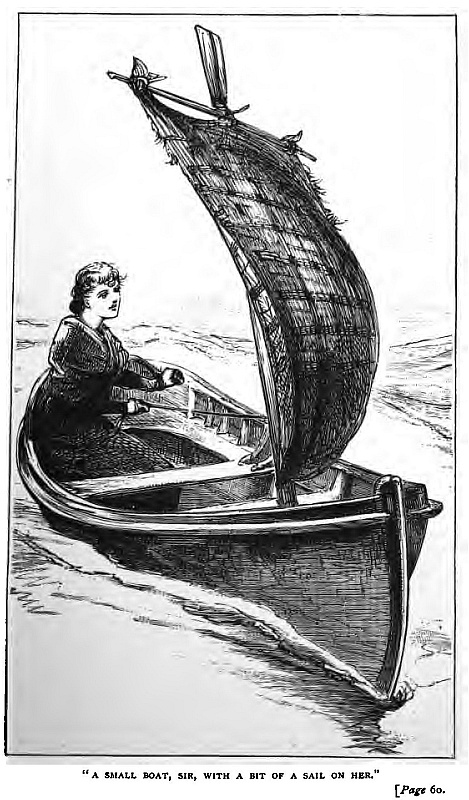
“Yonder,” said the mate, advancing towards Captain McBain, glass in hand,—“yonder is a small boat, sir, with a bit of a sail on her; she has just rounded the needle rocks, and seems standing in for the mainland.”
“Well,” said the captain, “let us overhaul her, anyhow. There can be no harm in that, and it may secure us a fresh fish or two for dinner.”
In less than an hour the Arrandoon had come up with this strange sail, which at first sight had seemed a mere speck on the ocean, seen at one moment and hidden the next behind some mountain roller. The surprise of our heroes may be better imagined than described, to find afloat in this cockle-shell of a boat, with an oar shipped as a mast and a tartan plaid as a main-sail, none other than the heroine of the wreckers’ reef. Seeing that she was in the power of the big ship, she made no further attempt to get away, but, dropping her sail, she seized the oars, paddled quietly and coolly alongside, and next moment stood on the quarter-deck, with bowed head and modest mien, before Captain McBain.
The captain took her kindly by the hand, smiling as he said, “Do not be afraid, my girl; consider yourself among friends—among those, indeed, who would do anything in their power to serve you, even if they were not already deeply in your debt, and deeply grateful.”
“Ah!” she said, mournfully, “my warning came all too late to save you. But, praised be God! you are safe now, and not in the power of those terrible men, who would have spared not a single life of those the waves did not engulf.”
“But tell us,” continued McBain, “all about it—all about yourself. There is some strange mystery about the matter, which we would fain have solved. But stay—not here, and not yet. You must be very tired and weary; you must first have rest and refreshment, after which you can tell us your tale. Stevenson, see the little boat hauled up; and, doctor, I place this young lady under your care; to-night I hope to land her safely in Reikjavik; meanwhile my cabin is at her disposal.”
“Come, lassie,” said the good surgeon, laconically, leading the way down the companion.
Merely dropping a queenly curtsey to McBain and our young heroes, she followed the doctor without a word.
Peter the steward placed before her the most tempting viands in the ship, yet she seemed to have but little appetite.
“I am tired,” she said at length, “I fain would rest. Long weary weeks of sorrow have been mine. But they are past and gone at last.”
Then she retired, this strange ocean waif and stray, and so the day wore gradually to a close, and they saw no more of her until the sun, fierce, fiery, and red, began to disappear behind the distant snow-clad hills; then they found her once more in their midst.
She had gathered the folds of her plaid around her, her long yellow hair still floated over her shoulders, and her dreamy blue eyes were shyly raised to McBain’s face as she began to speak.
“I owe you some explanation,” she said. “My strange conduct must appear almost inexplicable to you. My appearance among you two nights ago was intended to save you from the destruction that awaited you—from the destruction that had been prepared for you by the Danish wreckers.”
“Sir,” she continued, after a pause, “I am myself a Dane. My father was parish minister in the little village of Elmdene. Alas! I fear he is now no more. Afflictions gathered and thickened around us in our once happy little home, and the only way we could see out of them was to leave our native land and cross the ocean. In America we have many friends who had kindly offered us an asylum, until happier days should come again. Our vessel was a brig, our crew all told only twenty hands, and we, my brother, father, and myself—for mother has long since gone up beyond—were the only passengers.
“All went well until we were off the northern Shetlands, when at the dark, starry hour of midnight our ship was boarded and carried by pirates. Every one in the ship was put to the sword, saving my father and myself. My poor dear brave brother was slain before my eyes, but he died as the Danes die—with his face to the foe. My father was promised his life if he would perform the ceremony of marriage between myself and the pirate captain, who is a Russian, a daring, fearless fellow, but a strange compound of superstition and vice—a man who will go to prayers before scuttling a ship! The object of this pirate was to seize your vessel; he would have met and fought you at sea, but the easier plan for him was to try to wreck you. Fortune seemed to favour this bold design of his. The lights placed on shore, to represent a vessel of large size, were part and parcel of his vile scheme. But the darkness of the night enabled me to escape and come towards you. Then I feared to return; but, alas! alas! I now tremble lest my dear father has had to pay the penalty of my rashness with his life.”
(The story of the pirate is founded on fact.)
“But the ship—this pirate?” said McBain. “We sailed around the island next day but saw no signs of him?”
“Then,” said the girl, “he must have escaped in the darkness, immediately after discovering the entire failure of his scheme.”
“And whither were you bound for when we overtook you, my poor girl?” asked McBain.
“At Reikjavik,” she replied, “I have an uncle, a minister. He it was who taught me all I know, while he was still at home in Elmdene—taught me among other things the beautiful language of your country, which I speak, but speak so indifferently.”
“Can this be,” said McBain, “the self-same pirate that attacked the Snowbird?”
“The very same thought,” answered Ralph, “was passing through my own mind.”
“And yet how strange that a pirate should, cruise in these far northern seas?”
“She has less chance of being caught, at all events,” Allan said.
“Ha?” exclaimed McBain, with a kind of grim, exultant laugh, “if she comes across the Arrandoon, that chance will indeed be a small one. She’ll find us a different kind of a craft from the Snowbird.”
The vessel was now heading directly for the south-east coast of Iceland. Somewhere in there, though at present hidden by points of land and rocky islets, lay the capital of Iceland, which they hoped to reach ere midnight.
A more lovely land and seascape than that which was now stretched out before them, it would indeed be difficult to conceive. The sun had gone down behind the western end of a long line of snow-clad mountains, serrated, jagged, and peaked, but their tops were all rose-tipped with his parting beams. Above them the sky was clear, with just one speck of crimson cloud; the lower land between was bathed in a purple mist, through which the ice-bound rocks could dimly be discerned, while the mantle of night had already been spread over the ocean.
It was “nightfall on the sea.”
Chapter Eight.
A Gale from the Mountains—Daybreak in Iceland—The Great Balloon Ascent—Rory’s Yarn—The Snow-Cloud—The Pirate is Seen.
A whole week has elapsed since the events transpired which I have related in last chapter,—a week most interestingly if not always quite pleasantly spent. The Arrandoon is lying before the quaint, fantastical old town of Reikjavik, surrounded almost in every direction by mountains bold and wild, the peaked summits and even the sides of which are now covered with ice and snow. For spring has not yet arrived to unrivet stern winter’s chains, to swell the rivers into roaring torrents, and finally to carpet the earth with beauty. The streams are still frozen, the bay in which the good ship lies at her anchors twain, is filled with broken pancake-ice, which makes communication with the shore by means of boat a matter of no little difficulty, for oars have to be had inboard or used as pressing poles, and boat-hooks are in constant requisition.
Winter it is, and the country all around might be called dreary, were it not for the ever-varying shades of colour that, as the sun shines out, or anon hides his head behind a cloud, spread themselves over hill and dale and rugged glen. Oh! the splendour of those sunrises and sunsets, the rose tints, the purples, the emerald greens and cool greys, that blaze and blend, grow faint and fade as they chase each other among mountains and ravines! What a poor morsel of steel my pen feels as I attempt to describe them! Yet have they a beauty peculiarly their own,—a beauty which never can be forgotten by those whose eyes have once rested thereon.
The fair-haired Danish girl has been landed, and for a time has found shelter and peace in the humble home of her uncle the clergyman. Our heroes have been on shore studying the manners and customs of the primitive but hospitable people they find themselves among.
Several city worthies have been off to see the ship and to dine. But to-night our heroes are all by themselves in the saloon. Dinner is finished, nuts and fruit and fragrant coffee are on the table, at the head of which sits the captain, on his right the doctor and Ralph, on his left Allan and Rory. Freezing Powders, neatly dressed, is hovering near, and Peter, the steward, is not far off, while the cockatoo is busy as usual, helping himself to tremendous billfuls of hemp-seed, but nevertheless putting in his oar every minute, with a “Well, duckie?” or a long-drawn “Dea-ah me!”
I cannot say that all is peace, though, beyond the wooden walls of the Arrandoon, for a storm is raging with almost hurricane violence, sweeping down from the hills with ever-varying force, and threatening to tear the vessel from her anchorage. Steam is up, the screw revolves, and it taxes all the engineer’s skill to keep up to the anchors so as to avert the strain from them.
But our boys are used to danger by this time, and there is hardly a moment’s lull in the conversation. Even Sandie McFlail, M.D. o’ Aberdeen, has already forgotten all the horrors of mal-de-mer; he even believes he has found his sea-legs, and feels all over as good a sailor as anybody.
“Reikjavik?” says Ralph; “isn’t it a queer break-jaw kind of a name. It puts one in mind of a mouthful of exceedingly tough beefsteak.”
“A gastronomic simile,” says Rory; “though maybe neither poetical nor elegant, sure, but truly Saxon.”
“Ah! weel,” the doctor says, in his quiet, thoughtful, canny way, “I dinna know now. Some o’ the vera best poetry of all ages bears reference to the pleesures o’ the table. Witness Horace’s Odes, for instance.”
“Hear! hear!” from Allan; and “Horace was a brick!” from honest English Ralph; but Rory murmurs “Moore?”
“But,” continues the doctor, “to my ear there is nothing vera harsh in the language that these islanders speak. They pronounce the ‘ch’ hard, like the Scotch; their ‘j’s’ soft, like the Spanish; and turn their ‘w’s’ into ‘v’s.’ They pronounce church—kurk; and the ‘j’ is a ‘y,’ or next thing to it. ‘Reik’ or ‘reyk’ means smoke, you know, as it is in Scotch ‘reek;’ and ‘wik,’ or ‘wich,’ or ‘vik’ means a bay, as in the English ‘Woolwich,’ ‘Sandwich,’ etc, so that Reikjavik is simply ‘the bay of smoke,’ or ‘the smoking bay;’ but whether with reference to the smoke that hangs over the town, or the spray that rises mistlike from the seething billows when the wind blows, I cannot say—probably the former; and it is worthy of note, gentlemen, that some savage races far, far away from here—the aborigines of Australia, for example—designate towns by the term ‘the big smoke.’”
“How profoundly erudite you are, doctor!” says Rory. “Now, wouldn’t it have been much better for your heirs and assigns and the world at large, if you had accepted a Professorship of Antiquity in the University of Aberdeen, instead of coming away with us, to cool the toes of you at the North Pole, and maybe leave your bones to bleach beneath the Aurora Borealis, eh?”
“Ha! there I have you,” cries Sandie, smiling good-humouredly, for by this time he was quite used to Rory’s bantering ways,—“there I have you, boy Rory; and it is with the profoundest awe and respect for everything sacred, that I remind you that the Aurora Borealis never bleached any bones; and those poor unfortunates who, in their devotion for science, have wandered towards the mystery land around the Pole, and there laid down their lives, will never, never moulder into dust, but, entombed in the green, salt ice, with the virgin snow as their winding-sheet, their bodies will rest in peace, and rest intact until the trumpet sounds.”
There was a lull in the conversation at this point, but no lull in the storm; the waves dashed wildly over the ship, the wind roared through the rigging, the brave vessel quivered from stem to stern, as if in constant fear she might be hurled from the protection afforded by anchor and cable, and cast helpless upon the rock-bound shore.
A lull, broken presently by a deep sigh from Freezing Powders.
“Well, duckie?” said Polly, in sympathising tones.
“Well, Freezing Powders,” said McBain, “and pray what are you sighing about?”
“What for I sigh?” repeated Freezing Powders. “Am you not afraid you’se’f, sah! You not hear de wild winds roar, and de wave make too much bobbery? ’Tis a’most enuff, sah, to make a gem’lam turn pale, sah!”
“Ha! ha?” laughed Rory; “really, it’ll take a mighty big storm, Freezing Powders, to make you turn pale. But, doctor,” he continued, “what say you to some music?”
“If you’ll play,” said the surgeon, “I’ll toot.”
And so the concert was begun; and the shriek of the storm spirit was drowned in mirth and melody, or, as the doctor, quoting Burns, expressed it,—
“The storm without might roar and rustle, They didna mind the storm a whustle.”
But after this night of storm and tempest, what a wonderful morning it was! The sun shot up amidst the encrimsoned mountain peaks, and shone brightly down from a sky of cloudless blue. The snow was everywhere dazzling in its whiteness, and there was not a sigh of wind to raise so much as a ripple on the waters of the bay, from which every bit of ice had been blown far to sea. Wild birds screamed with joy as they wheeled in hundreds around the ship, while out in the bay a shoal of porpoises were disporting themselves, leaping high in air from out of the sparkling waters, and shrieking—or, as the doctor called it, “whustling”—for very joy.
Every one on board the Arrandoon was early astir—up, indeed, before the sun himself—for there were to be great doings on shore to-day. The first great experimental balloon ascent and flight was about to be made. Every one on shore was early astir, too; in fact, the greatest excitement prevailed, and on the table-land to the right of, and some little distance from, the town, from which the balloon was to ascend, the people had assembled from an early hour, even the ladies of Reikjavik turning out dressed in their gayest attire, no small proportion of which consisted of fur and feathers.
The aeronaut was a professional, Monsieur De Vere by name. McBain had gone all the way to Paris especially to engage his services. Nor had he hired him at random, for this canny captain of ours had not only satisfied himself that De Vere was in a scientific point of view a clever man, but he had accompanied him in several ascents, and could thus vouch for his being a really practical aeronaut.
Who would go with De Vere in this first great trip over the regions of perpetual snow? The doctor stepped forward as a volunteer, and by his side was Rory. Perhaps Allan and Ralph were rather lazy for any such aerial exploit; anyhow, they were content to stay at home.
“We’ll look on, you know,” said Ralph, “as long as we can see you; and when you return—that is, if ever you do return—you can tell us all about it.”
When all was ready the ropes were cast loose, and, with a ringing cheer from the assembled multitude, up arose the mighty balloon, straight as arrow from bow, into the blue, sunny sky. Like the eagle that soars from the peak of Benrinnes, she seemed to seek the very sun itself.
Rory and the surgeon, who had never been in a balloon before—nor even, for the matter of that, down in a coalpit—at first hardly relished their sudden elevation, but they soon got used to it.
Not the slightest motion was there; Rory could hardly credit the fact that he was moving, and when at last he did muster up sufficient courage to peep earthwards over the side of the car.
“Oh, look, doctor dear!” he cried; “sure, look for yourself; the world is moving away from us altogether!”
And this was precisely the sensation they experienced. Both the doctor and Rory were inclined to clutch nervously and tremulously the sides of the car in the first part of their ascent; but though the former was not much of a sailor, somewhat to his surprise he experienced none of those giddy feelings common to the landsman when gazing from an immense height. He could look beneath him and around him, and enjoy to the full the strange bird’s-eye landscape and seascape that every moment seemed to broaden and widen, until a great portion of the northern island, with its mountains, its lakes, its frozen torrents, its gulfs and bays and islands, and the great blue southern ocean, even to the far-off Faroe Isles, lay like a beautifully portrayed map beneath their feet. The grandeur of the scene kept them silent for long minutes; it impressed them, it awed them. It did more than even this, for it caused them to feel their own littleness, and the might of the Majesty that made the world.
De Vere himself seldom vouchsafed a single glance landwards; he seemed to busy himself wholly and solely with the many strange instruments with which he was surrounded. He was hardly a moment idle. The intense cold, that soon began to benumb the senses of Sandie, seemed to have no deterrent effect on his efforts.
“I must confess I do fell sleepy,” said the worthy medico, “and I meant to assist you, Mr De Vere.”
“Here,” cried the scientist, pouring something out of a phial, and handing it to him, “drink that quick.”
“I feel double the individual,” cried Sandie, brightly, as soon as he had swallowed the draught.
“Come,” said Rory, “come, monsieur, I want to feel double the individual, too.”
“No, no, sir,” said De Vere, smiling, “an Irishman no want etherism; you are already—pardon me—too ethereal.”
Sandie was gazing skywards.
“It is the moon,”—he was saying—“I ken her horn, She’s blinkin’ in the lift sae hie; She smiles, the jade! to wile us hame, But, ’deed, I doubt, she’ll wait a wee.”
“Happy thought!” cried Rory; “let us go to the moon.”
“No,” laughed the doctor; “nobody ever got that length yet.”
“Oh, you forget, Mr Surgeon,” said Rory,—“you forget entirely all about Danny O’Rourke.”
“Tell us, then, Rory.”
“Troth, then,” began Rory, in his richest brogue, “it was just like this same. Danny was a dacint boy enough, who lived entoirely alone with Biddy his wife, and the pig, close to a big bog in old Oireland. Sitting on a stone in the midst of this bog was Danny, one foine summer’s evening, when who should fly down but an aigle. ‘Foine noight,’ says the aigle. ‘The same to you,’ says Danny, ‘and many of them.’ ‘But,’ says the aigle, ‘don’t you see that it is sinking you are?’ ‘Och! sure,’ cries Danny, ‘and so it is. I’ll be swallowed up in the bog, and poor Biddy and the pig will nivir set eyes on me again. Och! och! what’ll I do?’ ‘Git on to me back, troth,’ says the aigle, ‘and I’ll fly you sthraight to your Biddy’s door.’ ‘And the blessings av the O’Rourkes be wid ye thin,’ says Danny, putting his arms round the aigle’s neck, ‘for you are the sinsible bird, and whatever I’d have done widout ye, ne’er a bit o’ me knows. But isn’t it high enough you are now, aroon? Yonder is my cottage just down there.’ For,” continued Rory, “you must know that by this time the aigle had mounted fully a mile high with poor Danny. ‘Be quiet wid ye,’ says the aigle, ‘or I’ll shake ye off me back entoirely. Don’t ye remember robbing my nest last year? I do. And it’s niver a cottage you’ll ever see again, nor Biddy, nor the pig either. It’s right up to the moon I’m flying wid ye.’ ‘What!’ cries Danny, ‘to that bit av a thing like a raping-hook? Och! and och! what’ll become av me at all at all?’ But the moon got bigger the nearer they came to it, and they found it a dacint size enough when they got there entirely. ‘Catch a howld av the end av the raping-hook,’ says the aigle, ‘or by this and by that I’ll shake ye off me shoulder.’ And so poor Danny had no ho’ but just to do as he was told, and away flew the aigle and left him. While he was wondering what he should do now, a stern voice behind him says, ‘Let go—let go the end of the raping-hook, and be off wid ye back to your own counthry.’ ‘It’s hardly civil av you,’ says Danny, ‘to ask me sich a thing. Sure it is few ever come to call on you anyhow.’ ‘Let go,’ thundered the man o’ the moon; and he gave Danny just one kick, and off went the poor boy flying into the air. ‘It’s killed I’ll be,’ says he to himself, ‘killed entoirely wid the fall, and what’ll become o’ me wife Biddy and the pig is more’n I can tell.’ But he fell, and he fell, and he fell, and he never seemed to stop falling, till plump he alights right in the middle o’ the sea, and there he lay on the broad back av him, till a big lump av a whale came and splashed him all over wid his tail. But sure enough the sea was only his bed, and the big whale turned out to be Biddy herself, with the watering-pot, telling him to get up, for a lazy ould boy, and feed the pig, and troth it was nothing but a dream after all.
“But where in the name of wonder are we now?” he continued, gazing around.
It was a very natural question. It had got suddenly dark. They were enveloped in a snow-cloud. The brave balloon seemed to struggle through it.
Ballast was thrown over, and up and out into the sunshine she rose again, but what a change had come over her appearance—every rope and length of her and the car itself and our bold aeronauts were covered white with virgin snow.
“Monsieurs,” said De Vere, “this is more than I bargained for. We must descend. You see she has lost all life. De lofely soul dat was in de balloon seems to have gone. We will descend.”
Indeed the huge balloon was already moving slowly earthwards, and in a minute more they were again passing through the snow-cloud. Once clear of this a breeze sprang up, or, to speak more correctly, they entered a current of air, that carried them directly inland for many miles. Tired of this direction, the valve was opened, out roared the gas, and the descent became more rapid, until the wind ceased to blow—they were beneath the adverse current. More ballast was thrown out, and her “way” was stopped.
But see, what aileth our hero, boy Rory? For some minutes he has been gazing southwards over the sea, so intensely indeed that his looks almost frighten the honest doctor.
“The glass, the glass,” he hisses, holding round his hand, but not taking his glance for a moment off the southern horizon.
The glass is handed to him, he adjusts it to his eye, and takes one long, fixed look; and when he turns once more towards the doctor his face is radiant with joy and excitement.
“It is she,” he cried, “it is she, it is she!”
The doctor really looked scared.
“Man!” he said, “are ye takin’ leave o’ your wuts? There, tak’ a hold o’ my hand and dinna try to frighten folk. There’s never a ‘she’ near ye.”
“It is she, I tell you,” cried Rory again; “take the glass and look in under the land yonder, and heading for Stromsoe. It is the pirate herself,—the pirate we fought in the Snowbird. Hurrah! hurrah!”
Chapter Nine.
Mount Hekla—The Great Geyser—A Narrow Escape—The Search for the Pirate—McBain’s Little “Ruse de Guerre”—The Battle Begun.
“That puts quite another complexion on the matter,” said Dr Sandy McFlail, with a sigh of relief, when Rory explained to him that he had spied the pirate, “quite another complexion, though, for the time bein’ ye glowered sae like a warlock that I did think ye had lost your reason; so give me the glass, and I’ll e’en take a look at her mysel’.
“Eh! sirs,” he continued, with the telescope at his eye, “but she is a big ship, and a bonnie ship. But, Rory boy, just catch a hold o’ my coat-tails, and I’ll feel more secure like. I wouldn’t wish to go heels o’er head out o’ the car. A fine big ship indeed—square-rigged forward and schooner-rigged aft; a vera judeecious arrangement.”
“Now,” cried Rory, “the sooner we are landed on old mother earth the better. Bend on to the valve halyards, De Vere. Down with her.”
“Sirs! sirs!” cried the doctor, in great alarm; “pray don’t be rash. Be judeecious, gentlemen, be judeecious.”
De Vere looked from one to the other, then laughed aloud. He was amused at the impetuosity of the Irishman and at the canniness of the Scot.
A very pleasant little man was this De Vere to look at, black as to hair and moustache, dark as to eyes; thoughtful-looking as a rule were these eyes, yet oft lit up with fun. He never spoke much, perhaps he cogitated the more; he seldom made a joke himself, but he had a high appreciation of humour in others. Taking him all and all he gave you the impression of one who would be little likely to lose his presence of mind in a time of danger.
“Gentlemen,” he said, quietly, “you will leave the descent in my hands, if you please. We are now, by my calculation, some ninety miles from the city of Reikjavik. You see beneat’ you wild mountains, ice-bound plains, frozen lakes, rivers and waterfalls, deep ravines and gorges, but no sign of smoke, no life. Shall I make my descent here? Shall I pull vat Monsieur Rory call de valve halyard? Shall I land in de regions of desolation?”
“Dinna think o’t,” cried Sandy. “Never mind Rory; he is only a laddie.”
“It’s yourself that’s complimentary,” quoth Rory.
“Ah! ver’ well,” said De Vere; “I will go on, for since you have been gazing on de ship, de current have change, and we once more get nearer home.”
An hour went slowly by. Both the doctor and Rory were gazing at the far-off mountain, Hekla, that lay to the south and east, though distant many miles. The vast hill looked a king among the other mountains; a king, but a dead king, being still and quiet in the sunshine, enrobed in a shroud of snow.
Sandy was doubly engaged—he was talking musingly, and aloud; but at the same time he was doing ample justice to the venison pie that lay so confidingly on his knee, for Sandy was a bit of a philosopher in his own quiet way.
“Mount Hekla,” he was saying; “is it any wonder that these Norsemen, these superstitious sons of the ancient Vikings, look upon it as the entrance-gate to the terrible abode of fire and brimstone, gloom and woe, where are confined the souls of the unhappy dead? Hekla, round thy snow-capped summit the thunders never cease to roll—”
“Hark,” said Rory, holding up his hand; “talk about thunder, list to that.”
Both leant over the car and looked earthwards. What could it mean, that low, deep, long-continued thunderpeal? Was a storm raging beneath them? Yes, but not of the kind they at first imagined. For see, from where yonder hill starts abruptly from the glen, rise immense clouds of silvery white, and roll slowly adown the valley. The balloon hangs suspended right above the great geyser, which is now in full eruption.
“It is as I thought,” said De Vere; “let us descend a little way;” and he opened the valve as he spoke.
The balloon made a downward rush as he did so, as if she meant to plunge herself and all her occupants into the very midst of the boiling cauldron. The steam from the geyser had almost reached their feet; the car thrilled beneath them, while the never-ceasing thunder pealed louder and louder.
“My conscience!” roared honest Sandy, losing all control over himself; “we’ll be boiled alive like so many partans!”
(Partans: Scottish, crabs.)
De Vere coolly threw overboard a bag or two of sand, and the balloon mounted again like a skylark. And not too soon either, for, awful, to relate, in his sudden terror Sandy had made a grab at the valve-rope, as if to check her downward speed. Had not Rory speedily pulled him back, the consequences would have been too dreadful to think of.
De Vere only laughed; but he held up one finger by way of admonishing the doctor as he said, “Neever catch hold of de reins ven anoder man is driving.”
“But,” said Rory, “didn’t you go a trifle too near that time, Mister de Vere?”
“A leetle,” said the Frenchman, coolly. “It was noding.”
“Ach! sure no,” says Rory; “it was nothing at all; and yet, Mister de Vere, it isn’t the pleasantest thing in the world to imagine yourself being played at pitch and toss with on the top of a mighty geyser, for all the world like a nut-gall on the top of a twopenny fountain!”
Sandy resumed the dissection of his venison pie. He would have a long entry for his diary to-night, he thought.
Luck does not always attend the aeronaut, albeit fortune favours the brave, and the current of air that was carrying the balloonists so merrily back to Reikjavik, ceased entirely when they were still within ten miles of that quaint wee place. It was determined, therefore, to make a descent. Happily, they were over a glen. Close by the sea and around the bay were many small farms, and so adroitly did De Vere manage to attach an anchor to the roof of an old barn, that descent was easy in the extreme.
Perhaps the happiest man in the universe at the moment Sandy McFlail’s feet touched mother earth again was Sandy himself. “Man!” he cried to Rory, rubbing his hands and laughing with glee, “I thought gettin’ out meant a broken leg at the vera least, and I haven’t even bled my nose.”
There was some commotion, I can tell you, among the feathered inmates of the barnyard when the balloonists popped down among them; as for the farm folks, they had shut themselves up in the dwelling-house. The geese were particularly noisy. Geese, reader, always remind me of those people we call sceptics: they are sure to gabble their loudest at things they can’t understand.
But convinced at last that the aeronauts were neither evil spirits nor inhabitants of the moon, the good farmer made them heartily welcome at his fireside, and assisted them to pack, so that, by the aid of men and ponies, they found themselves late that evening safely on board the Arrandoon; and right glad were their comrades to see them again, you may be sure, and to listen to a narration by Rory of all their adventures, interlarded by Sandy’s queer, dry remarks, which only served to render it all the more funny.
But before they sat down to the ample supper that Peter had prepared for them, Rory reported to the captain his great discovery.
McBain’s eyes sparkled like live coals as he heard of it, but he said little. He sent quietly for the engineer and the mate. “How soon,” he asked the former, “can you get up steam?”
“In an hour, sir—easy.”
“That will do,” said the captain. “Mr Stevenson, when will the moon rise?”
“She is rising now, sir.”
“All right, Mr Stevenson. Have all ready to weigh anchor in two hours’ time.”
“Ay, ay, sir!”
The engineer still lingered. “I could get up steam in twenty minutes,” he said; “those American hams, sir—”
“Oh, bother the hams?” said the captain, laughing. “No, no; we may be glad of those yet when frozen in at the Pole. Bear-and-ham pie, engineer; how will that eat, eh?” and he bowed him kindly out.
By two bells in the middle watch the good ship Arrandoon was off the needle rocks of the Portland Huck. They stood up out of the water like tall sheeted ghosts, with the moonlight and starlight shimmering from their shoulders. The sea was calm, with only a gentle heave on it; and there were but a few snowy clouds in the sky skirting the southern horizon, so the vessel ploughed along as beautifully as any sailor could wish, with a steady, contented throb of engine and gride of screw, leaving in her wake a long silvery line for the moonbeams to dance in. Save the noise of the ship’s working there was not another sound to be heard, only occasionally a gull would float past overhead emitting a strange and mournful cry. What makes the sea-birds, I have wondered, sometimes leave the rocks at the midnight hour, and go skimming alone through the darkling air, emitting that weird and plaintive wail of theirs? It is a wail that goes directly to one’s heart, and you cannot help thinking they must be bereaved ones mourning for their dead.
Our heroes walked long on deck that night, talking quietly, as became the hour, of the prospects of their having a brush with the pirate. But they got weary at last, and turned in. Next morning they found the decks wet and slippery, more clouds in the sky, a fair beam wind blowing, and a trifle of canvas displayed.
After breakfast McBain called all hands aft. In calm, dispassionate language he told them the story of the poor girl who had risked her life on their account, of her murdered brother and captive father, and of the pirate he was about to try to find and capture. Then he paused; and as he did so every one of the crew turned eyes on Ted Wilson, who strode forward.
“Captain,” said Ted, firmly, “we didn’t sign articles to fight, did we, mates?”
“No,” from all hands.
“But,” continued Ted, “for such a captain as you be, and in such a cause, we will fight, every man Jack of us, as long as the saucy Arrandoon has a timber above the water. Am I right, mates?”
A ringing cheer was all the reply, and Ted retired.
Now, reader, were I a landsman novelist I would very likely here make my captain give the orders to “splice the main-brace,” but I’m a sailor, and I tell you this, boys, that British seamen never yet needed Dutch courage to make them do their duty.
Captain McBain only waved a hand and said, “Pipe down.”
An hour afterwards the crow’s-nest was rigged and hoisted at the main-truck, and either the mate or the captain was in it off and on the whole day. But no pirate appeared that day nor the next. In the evening, however, some fishermen boarded the Arrandoon, and reported having seen a large barque, answering to the description of the suspected craft, that same morning lying at anchor off Suddersoe, with boats passing to and fro ’twixt ship and shore.
“It is my precious opinion, captain,” said old Magnus Bolt, “that this craft does a bit o’ smuggling ’tween here and Shetland.”
“And it is my precious opinion, my dear Magnus,” said McBain, “that the rascal doesn’t care what he does so long as he lands the cash.”
The Arrandoon was now kept away for the island named by the honest fishermen. Not straight, however; McBain gave it a wide berth, and passed it far to the west, and held on his course until many miles to the southward. In the morning it was “bout ship” and stand away north and by east again. They sighted the island about seven bells in the morning watch. Suddenly there was a hail from the crow’s-nest. It was the captain’s voice.
“Come up here, Magnus Bolt, if your old bones will let you, and see what you shall see.”
Magnus sprang up the rigging somewhat after the fashion of an antiquated monkey, but with an agility no one would have given him credit for.
“It is she!” he shouted, after he had had a look through the long glass in towards the iron-bound shores of the islands; “it is she! it is she! Ha! ha! ha!” and he positively danced and chuckled with delight.
“You’ll fight? you’ll fight?” he gasped. “Rather,” replied McBain; “but we’ll run first. She shall fire the first shot, and, Magnus, you shall fire the second.”
Half an hour afterwards, when our heroes came on deck to have their morning look around, they stared at each other in blank astonishment. The Arrandoon looked as if she had just come out of a tornado and had been dreadfully handled. The foretop-gallant mast was down, the jibboom inboard, the screw was hoisted up, the funnel itself had been unshipped and was lashed to the deck, and the flag was flying at half-mast, as if the vessel were in distress, or had death on board.
Now let me, with one touch of the fairy wand the storyteller wields, waft my readers on board the pirate herself. Fear not, for we will stay there but a brief space of time indeed. The tall and by no means unprepossessing form of the captain, armed cap-à-pie, is leaning against the rudder-wheel, one spoke of which he holds. His mate is by his side, glass in hand, examining the Arrandoon, now only a few miles off.
“Ha! ha!” says the latter; “it is the same big craft we tried to strand; and she’s had dirty weather, too—foretop-gallant mast and jibboom both gone. She is flying a signal of distress.”
“Distress? Eh? Ha! ha! ha?” laughed the pirate. “Isn’t it funny? She’ll have more of it; won’t she, matie mine?”
The mate laughed and commenced to sing—
“‘Won’t you walk into my parlour?’ Said the spider to the fly?”
“She’s evidently a whaler, crow’s-nest and all,” he said.
“Well,” said the captain, “we’ll w(h)ale her;” and he laughed at his own stupid joke.
“I say there, old lantern-jaws,” he bawled down the companion.
“I reckon,” said a Yankee voice, “you alludes to this child.”
“I do,” cried the captain; “and look ye here. We are going to fight and so forth. If we’re like to be bested, scupper the old man at once. D’ye hear?”
“Well, I guess I ain’t deaf.”
“Very well, then. Obey, or a short shrift yours will be.”
“Why, captain,” said the mate, “she knows us. She has put about, and is bearing away to the nor’-nor’-west.”
“Then hands up-anchor,” cried his superior. “Crowd all sail; she can’t escape us in her crippled condition.”
“Ah! captain,” the mate remarked, “had you taken my advice and given that pretty but sly minx the sack, ere she gave you the slip, that whaler would have been ours before now.”
“Silence,” roared the captain. “On that subject I will not hear a word. She shall be mine yet—or her father dies.”
With the exception of the few sentences bawled down the companion, all this was said in Danish, and my translation is a free one.
And so the chase commenced, and seawards before the pirate, in an apparently crippled condition, staggered the Arrandoon.
“How far do you intend to bring her out?” asked Allan.
“Ten miles clear of these islands, anyhow,” replied McBain, “then she won’t be able to play any pranks with us. Boys,” continued McBain, a few minutes afterwards, “I’m going to write letters—home.”
There was nothing very unusual in the tone of his voice as he spoke these words, but there was a meaning in them, nevertheless, that was perfectly understood by our young heroes. They were not long, then, before they were each and all of them seated by the saloon table, inditing, it might or might not be, the last communications to the loved ones at home they ever would pen. They were performing a duty—a sad one, perhaps, but still a duty; they were about to fight in a good cause, doubtless, but the result of the battle was uncertain. The Maelsturm, for that was the name of the pirate, was better—or rather, I should say, more copiously—manned than the Arrandoon, and though not so large a ship, she had more guns; her crew too fought with halters round their necks, and would therefore doubtless fight to the bitter end. The only advantage—and it was a great one—possessed by the Arrandoon was steam power. Hours went by, and the chase was still kept up. It was six bells in the forenoon watch, and the Maelsturm was hardly a mile astern. Our men had already had dinner, and were all in readiness—waiting, when, borne towards them over the wind-rippled waters from the pirate ship, came the quick, sharp rattle of a kettledrum. One roll, two rolls, three.
“At last,” said McBain, “they are beating to quarters.”
A puff of smoke from the bow of the pirate, the roar of a gun, and almost immediately after a round shot ricocheted past the quarter of the Arrandoon.
The battle was begun.
Chapter Ten.
“Down with the Red Flag and up with the Black!”—Victory—An Old Acquaintance—Hie, for the North.
If the crew of the Arrandoon needed any stimulus to fight the pirate, beyond the short speech that their captain had made them, it certainly was given them when the order was issued on board the latter craft, “Down with the red flag and up with the black!” and the broad, white-crossed ensign of merchant Denmark gave place to the hideous skull and cross-bones flown by sea marauders of all nations. She had rounded, too, in order to fire her broadside guns, or this would hardly have been visible. Perhaps the pirates imagined it would strike sudden fear into the hearts of those they had elected to consider their foes. Hatred and loathing it certainly inspired, but as to fear—well, in the matter of scaring, British sailors are perhaps the most unsatisfactory class of beings in the world.
For the next quarter of an hour the doings on board the Arrandoon, as seen from the pirate’s poop, must have considerably astonished—not to say puzzled—the officers of that ship, for in that short space of time what had appeared to be a sadly disabled vessel in distress, had hoisted a funnel, lowered a screw, and, while sail was being taken in, moved slowly away beyond reach of her guns. Not for long was she gone, however. She rounded almost on her own length; then, bows on, back she came, black and grim, athirst for vengeance. But the pirate was no coward, and broadside after broadside was poured into the advancing ship, without eliciting a single shot save one.
This was the shot—the second shot—that McBain had promised Magnus. It went roaring through the air, crashed through the Maelsturm’s bulwarks midships, and smashed a boat to flinders.
Magnus Bolt, or “Green,” as he was better known, old as he was, was by far the best shot in the ship. He and Mitchell, the mate, a man of eagle eye and firm of nerve, were the gunners proper, and fired every gun in the fight that followed the second shot. If it were a starboard broadside they were there; if a port, they but crossed the deck to take deadly aim and fire it.
“Remember, gunners,” cried McBain, “we’ve got to take that ship, and not to sink her; so waste not a shot between wind and water?”
On came the vessels, bow to bow, as arrow might meet arrow, and when within two hundred yards of each other, the Maelsturm heading north and west, the Arrandoon going full speed south and east, the pirate delivered her broadside, and immediately luffed up and commenced firing with her bow guns. She could get no nearer the wind, however. To go on the other tack would be but to hasten the inevitable.
“Hard a port! Ease her a little! Steady as you go!” were the orders from the quarter-deck of the Arrandoon. “Small-arm men to fire wherever head or hand is visible.”
Now the Arrandoon delivers her broadside as she again comes parallel with the Maelsturm, whose sails are all a-shiver. This just by way of confusing her a little. There is worse to come, for the order is now given to double-shot the port Dalgrens with canister. Away steams the Arrandoon, and round goes the Maelsturm. Ah! well he knows what the foe intends, but he will try to outmanoeuvre her if he can. But see! the Arrandoon is round again; there will be no escaping her this time. Fire your bow guns, Mr Pirate; fire your broadside, you cannot elicit a reply.
“Sta’board!” cries the captain; “starboard?” he signals, with his calm, uplifted arm. “Starboard still! steady now!” Then, in a voice of thunder, as they rounded the port quarter of the pirate, and, in spite of all good handling, got momentarily broadside on to her stem, “Stand to your guns—Fire!”
When the Arrandoon forged ahead clear of the smoke, it was evident from the confusion on board the Maelsturm, and the dishevelment of running and standing rigging, that the havoc on her decks must have been terrible. She was not beaten, though, as a gun from her broadside soon told.
“We’ll end this,” said the captain to Rory, by his side, who had constituted himself clerk, and was coolly taking notes in the very thick of the fight, while shot roared through the ship’s rigging and sides, men fell on all hands, and splinters filled the air. “We’ll end it in the good old fashion, Rory. Stand by to grapple with ice-anchors! Prepare to board!” Now Allan and Ralph, who had been below assisting the surgeon, heard that word of command, and, just as the sides of the two ships had grated together, after firing their last broadsides, they were both, sword in hand, by their captain’s side.
McBain and our heroes were the very first to leap on to the blood-slippery decks of the pirate. The crew of that doomed ship fought for a time like furies—for a time, but only for a time. In less than five minutes every pirate on board was either disarmed or driven below, and the Maelsturm was the prize of the gallant Arrandoon, and her captain himself lay bound on the quarter-deck.
But the commander of this pirate ship was the very last man on board of her to yield. Even when the battle was virtually ended, as fiercely as a lion at bay he fought on his own quarter-deck, McBain himself being his antagonist. The latter could have shot him down had he been so minded, but he was not the man to take a mean advantage of a foe. The pirate was taller than McBain, but not so well built nor so muscular. They were thus pretty well matched, and as they fought, round and round the quarter-deck, a more beautiful display of swordsmanship was perhaps never witnessed. Once the pirate tripped and fell, McBain lowered his weapon until he had regained his feet, then swords clashed again and sparks flew. But see, the captain of the Arrandoon clasps his claymore double-handed; he uses it hatchet fashion almost. He looks in his brawny might as if he could fell trees. The pirate cannot withstand the shock of the terrible onslaught, but he makes up in agility what he lacks in strength. He is borne backward and backward round the companion, McBain “showering his blows like wintry rain;” and now at last victory is his, the pirate’s sword flies into flinders, our captain drops his claymore and springs empty-handed on his adversary, and next moment dashes him to the deck, where he lies stunned and bleeding, and before he can recover consciousness he is bound and helpless.
Ralph, Allan, and Rory, none of whom, as providence so willed it, are wounded, and who had been silent spectators of the duel, now crowd around their captain, and shake his willing hand.
“Heaven,” says McBain, “has given the enemy into our hands, boys, but there is now much to be done. Let us buckle to it without a moment’s delay. The wounded are to be seen to, both our own and the pirate’s, the decks cleared, and everything made shipshape, and, if all goes well, we’ll anchor with our prize to-morrow at Reikjavik.”
“And the clergyman, captain, the clergyman, the poor girl’s father?” exclaimed Rory.
“Ay, ay, boy Rory,” said McBain; “he is doubtless on the vessel. We will proceed at once to search for him.”
If fiends ever laugh, reader, it must be with some such sound as that which now proceeded from the larynx of the pirate captain; if fiends ever smile, it must be with the same sardonic expression that now spread itself over his features. All eyes were instantly turned towards him. He had raised himself to the sitting position.
“Ha! ha! ha!” he chuckled, while, manacled though his wrists were, he drew his right forefinger rapidly across his throat, uttering, as he did so, these words, “Your padre; ha! ha! dead—dead—dead.”
His listeners were horrified. What McBain’s reply would have been none can say. It was not needed, for at that very moment, ere the exultant grin had vanished from the wretch’s face, there sprang on deck from the companion a figure, tall and gaunt, clad from top to toe in skins. He knelt on the deck in front of the pirate, the better to confront him.
With forefinger raised, “he held him with his glittering eye,” while he addressed him as follows:
“Look here, Mister Pirate, I was going to use strong language, but I won’t, though I guess and calculate mild words are wasted on sich as you. The parson ain’t dead; ne’er a hair on his reverend head. Ye thought I’d scupper him, didn’t you, soon’s the ship was taken? Ye thought this child was your slave, didn’t ye? Ha! ha! though, he has rounded on ye at last, and if that bit of black rag weren’t enough to hang you and your wretched crew of cutthroats, here in front o’ ye kneels one witness o’ your dirty deeds, and the other will be on deck in a minute in the person o’ the parson you thought dead. How d’ye like it, eh?” and the speaker once more stood erect, and confronted our heroes.
“Seth!” they ejaculated, in one voice.
“Seth! by all that is marvellous!” said McBain, clutching the old man by the right hand, while Rory seized his left, and Allan and Ralph got hold of an arm each.
“Ah! gentlemen,” said honest Seth—and there was positively a tear in his eye as he spoke—“it’s on occasions like these that one wishes he had four hands,—a hand for every friend. Yes, I reckon it is Seth himself, and nary a one else. You may well say wonders will never cease. You may well ask me how on earth I came here. It war Providence, gentlemen, and nuthin’ else, that I knows on. It war Providence sent that cut-throat skipper to the land where you left me on the Snowbird, though I didn’t think so at the time, when they burned and pillaged my hut and killed poor old Plunkett, nor when they carried me a prisoner on board the Maelsturm. They meant to scupper old Seth. They did talk o’ bilin’ his old bones in whale oil, but they soon found out he could heal a hole in a hide as well as make one, and so, gentlemen, I’ve been surgeon-in-chief to this craft for nine months and over. Yes, it war Providence and nuthin’ else, and I knew it war as soon as I saw your ship heave in sight, the day they guessed they’d wreck ye. The parson’s daughter, poor little Dunette, war on board then. I sent her to save ye; and when I heard your voice, Captain McBain, on the reef, I felt sure it war Providence then, and I kind o’ prayed in my rough way that He might spare ye. Shake hands, gentlemen, again. Bother these old eyes o’ mine; they will keep watering.”
And Seth drew his sleeve rapidly across his face as he spoke.
Rory was a proud—boy, ahem! well, man, then, if you will have it so, when that same afternoon he was put on board the Maelsturm, as captain of her, with a picked crew from the Arrandoon, and with orders to make all sail for Reikjavik. McBain’s last words to him were these,—
“Keep your weather eye lifting, Captain Roderick Elphinston. Clap two sentries on those ruffianly prisoners of yours, and let your men sleep with their cutlasses by their sides and their revolvers under their heads.”
“Ay, ay, sir!” said Rory.
Rory allowed his crew to sleep, but he himself paced the deck all the livelong night. Occasionally he could see the lights of the Arrandoon far on ahead; but towards morning the weather got thick and somewhat squally, and at daylight the Maelsturm seemed alone on the ocean. Sail was taken in, but the ship kept her course, and just in the even-glome Rory ran into the Bay of Reikjavik, and dropped anchor, and shortly after a boat came off from the Arrandoon with both Allan and Ralph in it, to congratulate the boy-captain on the success of his, first voyage as skipper-commandant.
Next day both the pirate vessel and her captor were show-ships for the people—all the élite and beauty of Reikjavik crowded off from the shore in dozens to see them. The dilapidated condition of the Maelsturm, her broken bulwarks, rent rigging, and shivered spars, showed how fierce the fight had been. Nor were evidences of the struggle wanting on board the Arrandoon, albeit the men had been hard at work all the day making good repairs.
The dead were buried at sea; the wounded were mostly sent on shore. Five poor fellows belonging to McBain’s ship would never fight again, and many more were placed for a time hors de combat.
As to the prisoners, they were transferred to a French ship that lay at Reikjavik, and that in the course of a week sailed with them for Denmark. Seth and the officers of the Arrandoon made and signed depositions; and in addition to this, as evidence against the pirates, the old clergyman and his daughter Dunette, now joyfully reunited, went along with the Frenchman, while, with a crew from shore, the Maelsturm left some days after. The black flag had never been lowered, nor was it until the day the pirate captain and many of his crew expiated their long list of crimes on the scaffold at the Holms of Copenhagen.
Poor Dunette, the tears fell unheeded from her sad blue eyes as she bade farewell to our heroes on the deck of the Arrandoon. She did not say good-bye to the surgeon, however—at least not there. He had begged for a boat, and accompanied her on board the vessel in which she was to sail. Have they a secret, we wonder? Is it possible that our quiet surgeon has won the heart of this beautiful fair-haired Danish maiden? These are questions we must not seek answer to now, but time may tell.
Not until the pirate ship had left the bay, and the wounded were so far convalescent as to be brought once more on board, did the old peace and quiet settle down upon the good ship Arrandoon. And now once more all was bustle and stir; in a day or two they would start for the far north, and bid adieu to civilisation—a long but not, they hoped, a last adieu.
The very evening before they sailed, a farewell party was given on board the Arrandoon. The decks were tented over with canvas lined with flags, and the whole scene was gay and festive in the extreme. Poetic Rory could not have believed that there was so much female youth and loveliness in this primitive little town of Reikjavik. No wonder that day was dawning in the east ere the last boat of laughing and merry guests left for the shore.
Many and many a time afterwards, when surrounded by dangers innumerable, when beset in ice, when engulfed in darkness and storm, in the mysterious regions of the Pole, did they look back with pleasure to that last happy night spent in the bay of Reikjavik.
But see, it is twelve o’clock by the sun. Flags are floating gaily on the fort, on the little church tower, and on every eminence in or near the town, and the beach and snow-clad rocks are lined with an excited crowd. Hands and handkerchiefs are waved, and with the farewell cheers the far-off hills resound. Then our brave fellows man the rigging and waft them back cheer for cheer, as the noble vessel cleaves the waters of the bay, and stands away for the Northern Ocean.
Chapter Eleven.
The Voyage Resumed—A Pleasant Evening—“Those Rushing Winds”—The “Arrandoon” Grows Saucy—The Doctor Spread-Eagled—A School of Whales.
Ere the day had worn to a close, before the sun went down in a golden haze, leaving one long line of crimson cloud, as earnest of a bright to-morrow, the Arrandoon, steaming twelve knots to the hour, was once more far away at sea, and the rugged mountains of Iceland could hardly be descried. As night fell a breeze sprang up, and as there was little doubt it would freshen ere long—for it blew from the east-south-east, and the glass had slightly gone down, with the mercury still concave at top—Captain McBain gave orders for the fires to be banked, and as much canvas spread as she could comfortably carry.
“Just make her snug, you know, Mr Stevenson,” said McBain, “for the night will be dark, and we may have more wind before the middle watch.”
“And troth,” said Rory to his companions, “if the ship is to be made snug, I don’t see why we shouldn’t make ourselves snug for the night too.”
Ralph was gazing down through the skylight at the brilliantly-lighted saloon, where Peter, with the aid of the assistant-steward and Freezing Powders, was busy laying the cloth for dinner.
“I’ve just come from forward,” replied Ralph, in raptures, “where I’ve been sniffing the roast beef and the boiled potatoes; and now just look below, Rory,—look how Peter’s face beams with intelligent delight; see how radiant Freezing Powders is; behold how merrily the flames dance on that fire of fires in the stove, and how the coloured crystal shimmers, and the bright silver shines on that cloth of spotless snow! Yes, Rory, you’re right, boy—let us make ourselves snug for the night. So down we go, and dress our smartest—for, mind, boys, there is going to be company to-night.”
Yes, there was going to be company; five were all that as a rule sat down to table in the grand saloon, but to-night the covers were laid for five more, namely Stevenson, Seth, old Magnus, and Ap, and last, though not least, De Vere, the French aeronaut.
The cook of the Arrandoon had been chosen specially by Ralph himself. Need I say, then, that he was an artist? and to-night he had done his best to outshine himself, and, I think, succeeded. I think, too, that when Peter went forward, some time after the great joints had been put on the table, and told him that everything was going on “as merrily as marriage bells,” and that the gentlemen were loud in their praises of Ralph’s cook, that that cook was about the happiest man in the ship. Peter had not exaggerated a bit either, for everything did go off well at this little dinner-party. It would have done your heart good to have seen the beaming countenances of little Ap, old man Magnus, and honest trapper Seth; and to have noticed how often they passed their plates for another help would have made you open your eyes with wonder—that is, if you never had been to Greenland; but had you made the voyage North Polewards even once, you would have known that of all countries in the world that is just the place to give man or boy a healthy appetite.
When the cloth was removed and dessert placed upon the table they seemed happier than ever, if that were possible, and smiles and jokes and jocund yarns ere the order of the evening. After every good story the cockatoo helped himself to an immense mouthful of hemp-seed, and cried,—
“Dea-ah me! Well, well, but go on, go on—next.”
And as to Freezing Powders, he was so amazed at many things he heard, that more than a dozen times in one hour he had to refresh himself by standing on his head in a corner of the saloon.
“Well, well, well!” said McBain, taking the advantage of a mere momentary lull in this feast of reason and flow of soul, “and what a strange mixture of nationalities we are, to be sure! Here is our bold, quiet Ralph, English to the spine—”
“And I,” said Rory, “I’m Oirish to the chine.”
“That you are,” assented McBain; “and Allan and myself here are Scotch; and if you look farther along the table there is Wales represented in the form of cool, calculating, mathematical Ap; Shetland in the shape of our brave gunner Magnus; France in the form of friend De Vere; and the mightiest republic in the world in Seth’s six feet and odd inches; to say nothing of Africa standing on its head beside Polly’s cage. Freezing Powders, you young rascal, drop on to your other end; don’t you see you’re making Polly believe the world is upside down? look at her hanging by the feet with her head down!”
“Dat cockatoo not a fool, sah,” said Freezing Powders; “he know putty well what he am about, sah!”
“D’ye know,” said Ralph, looking smilingly towards Seth, “it is quite like old times to see Seth once more in the midst of us?”
“And oh!” said Seth, rubbing his hands, while a modest smile stole over his wiry face, “mebbe this old trapper ain’t a bit pleased to meet ye all again. Gentlemen, Seth and civilisation hain’t been ’cquaintances very long; skins seem to suit this child better’n the fine toggery ye’ve rigged him out in. But ye’ve made him feel a deal younger, and he guesses and calculates he may die ’pectable yet.”
I fear it was pretty far into the middle watch ere our friends parted and betook themselves to their berths. Two bells had gone—“the wee short hoor ayont the twal”—when McBain rose from the table, this being a signal for general good-nights.
“I’m going part of the way home with you, old man,” he said to Magnus, and with his arm placed kindly over his shoulder he left the saloon with the brave wee Shetlander. “Two turns on the deck, Magnus,” he continued, “and then you can turn in. And so, you say, in all your experience—and it has been very vast, hasn’t it, my friend?”
“That it has, sir,” replied Magnus. “I may say I was born in these seas, for the first thing I remember—when our ship went down under us in the pack north of Jan Mayen—is my father, bless him! putting me in a carpetbag for safety, to carry me on to the ice with him. Yes, sir, yes.”
“And in all your experience,” McBain went on, “you don’t remember a season likely to have been more favourable for our expedition to the North Pole than the present?”
“I don’t, sir—I don’t,” said little Magnus, “Look, see, sir, the frost has been extreme all over the north. In the Arctic regions the ice has been all of a heap like. It isn’t yet loosened. We haven’t met a berg yet. Funny, ain’t it, sir?—queer, isn’t it, cap’n?”
“It is strange,” said McBain; “and from this what do you anticipate?”
“Anticipate isn’t the word, cap’n,” cried Magnus, fixing McBain by the right arm, stopping his way, and emphasising his words with wildfire glints from his warlock eyes. “Anticipate?—bah! cap’n—bah! I’m old enough to be your grandfather. Ask me rather what I augur? And I answer this, I augur a glorious summer. Ice loosened before May-Day. Fierce heat south of England, and consequently rarefaction of the atmosphere, and rushing winds from the far north to fill up the heated vacuum—rushing winds to trundle the icebergs south before them—rushing winds to split the packs, and rend the floes, and open up a passage for this brave ship to the far-off Isle of Alba.”
“Bless you, Magnus! Give us your hand, my old sea-dad. You always gave me comfort, even when I was a boy in the wilds of Spitzbergen. You taught me to splice, and reef, and steer. Bless you, Magnus! I couldn’t have sailed without you.”
“But stay, my son, stay,” continued this weird little man, holding up a warning finger; “those rushing winds—”
“Yes, Magnus?”
“They will bring danger on their wings.”
“I’ll welcome it, Magnus,” laughed McBain.
“Those rushing winds will tear down on us, hurricane-high, tempest-strong. The great bergs, impelled by force of wind and might of wave, will dash each other to atoms.”
“All the better for us, Daddy Magnus,” said the captain.
“Were your voice as loud as cannon’s roar you will be as one dumb amid the turmoil.”
“Then I’ll steer by signs,” said McBain.
“Should our ship escape destruction, we will be enveloped by fogs, encircled by a darkness that will be felt.”
“Then we’ll heave-to and wait till they evaporate. But there, my good Magnus, you see I’m not afraid of anything. I’d be unworthy of such a sea-dad as you if I were; so no more tragic airs, please. Thou mindest me, old Magnus, of the scene between Lochiel and the Wizard.
“‘Lochiel, Lochiel, beware of the day When the Lowlands shall meet you in battle array,’
“says the Wizard, and so on and so forth.
“‘False wizard, avaunt!’ replies Lochiel, and all the rest of it, you know. But, beloved Magnus, I don’t say ‘avaunt!’ to you. But just see how the cold spray is dashing inboard. So, not to put too poetic a point on it, I simply say, ‘Go down below, old man, and don’t get wet, else your joints will ache in the morning with the rheumatiz.’”
The morning broke beautifully fine and clear, the reefs were shaken out of the topsails, topgallant-sails and royals were set, and, indeed, all the square cloth she could carry, and away went the Arrandoon before the wind, as happy, to all appearance, as the malleys and gulls that seemed to play at hide-and-seek with her, behind the comb-crested seas of olive-green.
Ralph and Allan, arm-in-arm, were marching rapidly up and down one side of the quarter-deck, Rory and McFlail on the other, and ever and anon a merry laugh from some one of them rang out bright and joyously on the fresh frosty air.
Towards noon stunsails were set, and the Arrandoon looked more like a sea-bird than ever; she even seemed to sing to herself—so thought Rory and so thought the doctor—as she went nodding and curtseying along over the waves, with now a bend to starboard, and now a lean to port; now lowering her bows till the seas ahead looked mountains high, and anon giving a dip waterwards till her waist was wet with the seething spray, and her lower stunsail-booms seemed to tickle the very breast of old mother ocean.
The wind was increasing, and there were times when our boys had to pause in their walk and grapple the mizzen rigging, laughing at each other as they did so.
“Wo ho, my beauty?” said McBain. “Mr Mitchell, I daresay we must take in sail.”
“I’m afraid so, sir,” replies Mitchell; “but—” and here he eyes the bellowing canvas—“it do seem a pity, sir, don’t it?”
But here “my beauty” gives a vicious plunge forwards, elevating herself aft like a kicking mare, and shipping tons of water over her bows.
“I don’t want to be wicked,” the ship seems to say, “and I don’t want to lose a spar, though I could kick one off as easy as a daddy-longlegs gets rid of a limb; but if you don’t ease me a bit I’ll—”
A bigger and more decided plunge into the sea, followed by a rising of her jibboom zenithwards, and the water comes roaring aft in one great bore, which seeks exit by the quarter-deck scupper-holes, and goes tumbling down the companion ladder, to the indignation of Peter and the disgust of Freezing Powders, who is standing on his head in an attitude of contemplation, and ships a green sea down his nostrils. Our heroes leap in time on to the top of the skylight, and there sit grinning delightedly as the waters go roaring past them, and floating thereon evidence enough that the men had been preparing dinner when Neptune boarded them, for yonder float potatoes and turnips and cabbages, to say nothing of a leg of Highland mutton and a six-pound piece of bacon.
“Hands, shorten sail!”
But next day—so changeable is a sailor’s life—the wind had all got bottled up again or gone back to its cave; the sea was smooth as glass, and steam was up, but the sky was still clear, and the sun undimmed by the slightest haze.
Just before lunch came the first signs that ice was not far ahead. The Arrandoon encountered a great “stream,” as it is called, of deep, snowy slush—I do not know what else to call it. It stretched away eastwards to westwards, as far as the eye from the crow’s-nest could reach, and it was probably nine or ten miles wide. It lessened the good ship’s way considerably, you may be sure. Her bows clove through it with a brushing sound; her screw revolved in it with a noise like dead leaves stirred by autumn winds.
“Losh!” cried Sandy, the surgeon, looking curiously overboard, “what’s this noo? Wonders will never cease!”
“Och, sure!” replied Rory, mischievously, “you know well enough what it is; it’s only speaking for speaking’s sake you are.”
“The ne’er a bone o’ ma knows, I do assure ye,” said Sandy.
“Well, doctor dear,” said Rory, “it is simply the belt, or zone, that geographers call the ‘Arctic circle.’”
But Sandy looked at him with a pitying smile. “Man—Rory?” he said, “I’m no’ so sea-green as you tak me to be. I’ve a right good mind to pu’ your lugs. Young men, sir, dinna enter Aberdeen University stirks and come out cuddies?”
“Mon!” cried Rory, imitating Sandy’s brogue, “if ye want to pu’ my lugs you’ll hae to catch me first;” and off he went round the deck, with the doctor after him. But Ralph caught him, if Sandy couldn’t, and handed him over to justice.
“Now,” cried the surgeon, catching him by the ear, “whistle, and I’ll let you free.”
It is no easy matter to whistle when you want to laugh, but when Rory at long last did manage to emit a labial note that passed muster as a whistle, the doctor was as good as his word, and Rory was free.
Luncheon was barely finished, when down from the crow’s-nest rang the welcome hail, “Ice ahead!”
Our heroes rushed on deck, McBain was there before them, and when they stepped on to the “lid” of the ship, as Sandy once called the deck, they found the captain half-way up to the nest.
There wasn’t a bit of ice to be seen from the deck.
“Hurrah for the foretop?” cried Rory, laying hold of a stay. “Who’s coming?”
“I will!” cried Allan.
“I’m going below to finish lunch,” said Ralph.
“I’ll be safer on deck, I think,” said the canny doctor.
But when Rory on the foretop struck an attitude of wonderment, and pointing away ahead, exclaimed, in rapture, “Oh, boys, what a scene is here!” the doctor thought he would give anything for a peep, so he summoned up his courage and began to ascend the rigging, slowly, and with about as much grace in his actions as a mud turtle would exhibit under the like circumstances.
Allan roared, “Good doctor! good! Bravo, old man! Heave round like a brick! Don’t look down.”
Rory was in a fit of merriment, and trying to stifle himself with his handkerchief. Suddenly down dropped that handkerchief; and this was just the signal four active lads were waiting for. Up they sprang like monkeys behind the surgeon, who had hardly reached the lubber-hole. Alas! the good medico didn’t reach it that day, for before you could have said “cutlass” he was seized, hand and foot, and lashed to the rigging, Saint Andrew’s-cross fashion.
The surgeon of the Arrandoon was spread-eagled, and Rory, the wicked boy! had his revenge.
“My conscience!” cried Sandy; “what next, I wonder?”
“It’s a vera judeecious arrangement,” sung Rory from the top.
But the men were not hard on the worthy doctor, and the promise of several ounces of nigger-head procured him his freedom, and he soon regained the deck, a sadder and a wiser man.
They were quickly among the ice—not bergs, mind you, only a stream of bits and pieces, of every shape and form, some like sheep and some like swans, and some like great white oxen. Here was a piece like a milking-pail; here was a lump like a hay-cock; yonder a gondola; yonder a boat; and yonder a couch on which the Naiades might recline and float, or Ino slumber.
It was Rory who made the last remark.
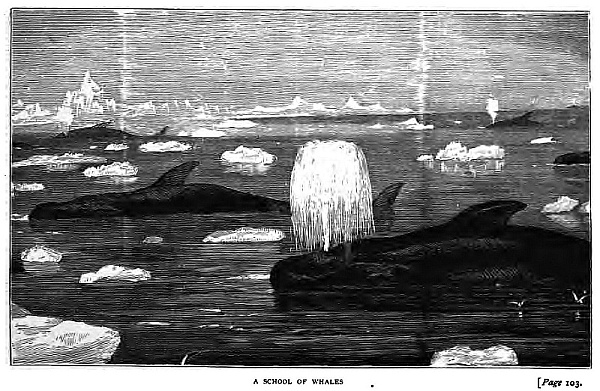
“And by this and by that!” he exclaimed, “there is a Naiad on it now! or it’s Ino herself, by all that’s amusing!”
“Away, second whaler!”—this from McBain. “Get your rifle, boy Rory, and jump on board and fetch that seal!”
Down rattled the boat from the davits, Rory in the bows; the next moment she was off, and tearing through the glazed water as fast as sturdy arms could row. The seal took one look up to see what was coming. Rory’s rifle rang out sharp and clear in the frosty air, and the poor seal never lifted head again.
The ship was by this time a goodly mile ahead, but there she stopped; then she went ahead again, rounded, and came back full speed to meet the boat, for they on board could see a danger that Rory couldn’t—couldn’t, did I say? Ah! but he soon did, and, with the roar of a maelstrom, down they came upon him—an enormous school of whales!
The men lay on their oars thunderstruck. The sea around them seemed alive with the mighty monsters. How they plunged and ploughed and snorted and blew! The sea became roughened, as if a fierce wind was blowing over it; pieces of ice as large as boats were caught on the backs or tails of these brutes and pitched aside as one might a football.
It occurred to Rory to fire at some of them.
“Stay, stay!” roared the coxswain; “if you love your life, sir, and care for ours, fire not. You may never have seen a whale angry—I have. Fire not, I beseech you!”
It was a strange danger to have encountered, and Rory and his boat-mates were not sorry when it passed, and they once more stood in safety on the deck of the Arrandoon.
But Rory soon regained his equanimity.
“Five hundred whales!” he cried; “and they were all mine, Ralph, ’cause I found them! Sure, they were worth a million of money?”
“So you’ve been a millionaire, Rory?” said McBain. “Yes, worse luck!” said Rory, in a voice of comic sadness, “a millionaire for a minute!”
Chapter Twelve.
The Isle of Jan Mayen—Retrospection—The Sea of Ice—The Deserted Village—Carried off by a Bear—Dancing for Dear Life.
What a tiny speck it looks in the map, that island of Jan Mayen, all by itself, right in the centre of the great Arctic Ocean. Of volcanic origin it undoubtedly is—every mountain, rock, and hill in it—and there is ample evidence that from yonder gigantic cone, that rises, like a mighty sugar-loaf or the Tower of Babel itself, to a height of 6,000 feet sheer into the blue and cloudless sky, at one time smoke and flames must oftentimes have burst, and showers of stones and ashes, and streams of molten lava.
I have gazed on it by night, and my imagination has carried me back, and back, and back, through the long-distant past, and I have tried to fancy the sublimity of the scene during an eruption.
The time is early spring. The long, dark winter has passed away; the cold-looking, rayless sun rises now, but skirts hurriedly across a small disc of southern sky, then speedily sinks to rest again, as though he shuddered to gaze upon scenery so bleak and desolate. The island of Jan Mayen, with its ridgy hills and its one mighty mountain, is clad in dazzling robes of virgin snow. Its rocky and precipitous shores rise not up, as yet, from the dark waters that in summer time wash round them, but from the sea of ice itself. As far as eye can reach, or north or south, or east or west, stretches this immeasurable ocean of ice. All flat and all snow-clad is it, like the wildest and loneliest of Highland moorlands in winter, and its very flatness gives it an air of greater lonesomeness, which the solitary hummocks here and there but tend to heighten. And through the short and dreary day one solitary cloud has rested like a pall on the summit of the mountain. But it is midnight now: in the deep blue of the sky big, bright stars are shining, that look like moons of molten silver, and seem far nearer than they do in southern climes. In the north the radiant bow of the Aurora is spread out, its transverse beams glancing and glistering, spears of light, that dance and glide and shimmer, changing their colours every moment from green to blue or red, from pale-yellow to the brightest of crimson.
And the silence that reigns over all this field of ice is one that travellers have often experienced, often been impressed and awed by, but never yet found words to describe.
Silence did I say? Yes! but listen! Subterranean thunders suddenly break it—thunders coming evidently from the bosom of the great mountain yonder, thunders that shake and crack and rend the very ice on which you stand, causing the bergs to grind and shriek like monsters in agony. The great cloud pall has risen higher and spread itself out, and now hangs horizontally over half the island, black and threatening, its blackness lit up ever and anon with flashes of lightning, sheet and forked, while, peal after peal, the thunder now rolls almost without intermission.
And onward and onward rolls the cloud athwart the sky, blotting out the starlight—blotting out the beautiful Aurora—till the sea of ice for leagues around is canopied in darkness. But behold, over the mountain-top the cloud gets lighter in colour, for immense volumes of steam, solid sheets of water, and pieces of ice tons in weight, are being belched forth, or hurtled into the air with a continued noise that drowns the awful rhythm of the thunder itself. Then flames follow, shooting up into the sky many hundreds of feet, lighting up the scene with a lurid glare, while down the snow-clad sides of the great cone streams of fiery lava rush in fury, crimson, blue, or green. And gigantic rocks are precipitated into the air—rocks so large that, as they fall upon the ice miles distant from the burning crater, they smash the heaviest floes, and sink through into the sea. Great stones, too, are incessantly emitted, like balls of fire, that burst in the air, and keep up a sound like that of the loudest artillery.
The sun will rise in due course, but his beams cannot penetrate the veil of saturnine darkness that envelops the sea of ice. And the fire will rage, the thunders will roll, and showers of stones and ashes fall for days, ay, mayhap for weeks or months, ere the mighty convulsion ceases, and silence once more reigns in and around this island of Jan Mayen.
Towards this lonely isle of the ocean the Arrandoon had been beating and pushing her way for days; and she now lay, with clewed sails and banked fires, among the flat but heavy bergs not five miles from it. There was no water in sight, for the iceless ocean had been left far, far astern, and the ship was now to all intents and purposes beset. Yet the ice was loose; it was not welded together by the fingers of King Frost, and if it remained so, the difficulty of getting out into the clear water again would be by no means insurmountable.