"The Cruise of the "Snowbird" Crew in the "Arrandoon"" (continued 3)
Reading edition
Our heroes, the doctor included, were all on deck, dressed to kill, in caps of fur with ear lapels, coats of frieze with pockets innumerable, with boots that reached over the knees, and each was armed with a rifle and seal-club, with revolver in belt and short sheath-knife dangling from the left side.
“And so,” said the doctor, “this is the mighty sea of ice that I’ve heard so much about! Man! boys! I’m no so vera muckle struck with it. It is not unlike my father’s peat moss in the dreary depths of winter. Where are the lofty pinnacled bergs I expected to see, the rocks and towers of ice, the green glistening gables, and the tall spires, like a hundred cathedrals dang into one?”
“Ah!” said McBain, laughing, “just bide a wee, doctor lad, till we go farther north, and if you don’t see ice that will outdo your every dream of romance, I’m neither Scot nor sailor.
“But what is this?” continued the captain. “Who in the name of all that is marvellous have we here?”
“I ’spects I’se Freezin’ Powders, sah,” was the reply of the little negro boy. “Leastways I hopes I is.” Here the urchin touched his cap. “Freezin’ Powders, at your service, sah—your under-steward and butler, sah?”
“Well, my under-steward and butler,” said McBain; “but whoever could have expected to see you rigged out in this fashion—pilot suit, fur cap, boots, and all complete? Why, who dressed you, my little Freezin’ Powders?”
“De minor ole gem’lam,” replied the boy; “but don’t dey fit, sah? Don’t dey become dis chile? Look heah, sah!” and Freezing Powders went strutting up and down the quarter-deck, as proud as a pouter pigeon; and finished off by presenting arms with his seal-club in front of his good-natured captain.
“Well,” said McBain, much amused, “you are a comical customer. By ‘the minor ole gem’lam’ I suppose you mean honest Magnus? But your English is peculiar, youngster.”
“My English is puffuk, sah!” replied the boy; “but lo! sah! suppose I not have dis suit of close, I freeze, sah! I no longer be Freezin’ Powders, ’cause I freeze all up into one lump, sah! Now, sah, I can go on shoh wid de oder officers.”
“Ho! ho!” laughed McBain; “the other officers. It’s come to that, has it? But,” he added, turning to Allan and Rory, “you’ll look after the lad, won’t you?”
“That will we,” said both in a breath.
Here are the names of those who went on shore in Jan Mayen on this memorable day—Allan, Ralph, Rory, Seth, and the doctor, with three club-armed retainers, and lastly, Freezing Powders himself.
They were a merry band. You could have heard them laughing and talking when they were miles away from the ship. They had to leap from one piece of ice to another; but as the bergs were from forty to fifty feet square—thus affording them a good run for their leaps—and as the pieces were pretty closely packed, jumping was no great hardship. When now and then they came to a bit of water that required a tolerable spring to get over, tall Ralph vaulted first, then brawny-chested Allan pitched Freezing Powders after him, whom Ralph caught as easily as if he had been a cricket-ball.
They landed on the island in a kind of bay, where the land sloped down to the snow-clad beach. Not far from the sea they were much surprised to find the ruins of huts that had been. No smoke issued therefrom now, but there was ample proof that roaring fires had once burned in each hut. They were partly underground, and though built of wood and sealskins they were thatched and fortified with snow. The largest cot of all was in the centre, and entering this they found a key to the seeming mystery, for here were evidences of civilisation. Pots and pans stood on the empty hearth; a chair or two, a truckle bed, a deal table and a book-cupboard, formed the furniture, and to cap all a written document was found, which informed them that this village had been the encampment for the summer months of a party of American walrus-hunters, the captain of which had aided science by making innumerable observations of a meteorological and scientific nature.
“I reckon,” said Seth, “there ain’t many parts o’ the world where my enterprising countrymen hain’t shown their noses.”
“All honour to them for that same,” said Rory; “and troth, there isn’t a mightier nation on the face of the earth bar the kingdom of Ireland.”
“Now, look here,” said Allan, “this wee chap, Freezing Powders, will be far too tired if he goes with us; and here, by good luck, is a frozen ham in this enterprising Yankee’s cupboard. I move we light a fire, hang it over it, and leave the little black butler as cook till we come back.”
“Bravo!” said Ralph. “Allan, you’re a brick. You won’t be afraid, will you, Freezing Powders?”
“I stop and do de cookin’, plenty quick,” answered the boy, briskly. “Freezin’ Powders never was afraid of nuffin in his life.”
So the fire was lighted—there was fuel enough in the hut to keep it going for a month; then, leaving the boy to watch the ham, away went our explorers, upwards and onwards, through the ruggedest glens imaginable; winding round rocks and hills of ice and snow, they soon lost sight of the primitive village, the distant ship, and the sea of ice itself. They wandered on and on for miles, pausing often to allow Rory to make a sketch of some more than usually wild and fantastic group of ice-clad rocks or charming bit of scenery; but wherever they went, or whichever way they turned, there loomed the great mountain cone of Jan Mayen above them.
The scene was everywhere silent and desolate in the extreme, for not a breath of wind was blowing, not a cloud was in the sky, and no sign of life was there to greet them, not even a solitary gull or snowbird.
It wanted two good hours to sunset when they once more returned to the deserted village, eager to test the flavour of the Yankee’s ham, for walking on the snow had given them the appetite of healthy hunters.
Their astonishment as well as horror may be imagined when, on entering the hut, they found a scene of utter confusion. The fire still burned, it is true, and yonder hung the ham; but the table and chairs were overturned, and the contents of even the rude bookcase scattered about the floor.
And Freezing Powders was gone!
He had been carried off by a bear. Of this there was plenty of testimony, if only in the huge footprints of the monster, which he had left in the snow. Not very distinct were they, however, for the surface of the snow was crisp and hard. But Seth was equal to the occasion, and at once—walking in a bee line, the trapper leading—they set out to track the bear, if possible, to his lair. The footprints led them southwards and west, through a region far more wild than that which they had already traversed.
For a whole hour they walked in silence, until they found themselves at the top of a ravine, the rocks of which joined to form a sort of triangle. Half-roofed over was this triangle with a balcony of frozen snow, from which descended immense icicles, on which the roof leant, forming a kind of verandah.
Seth paused, and pointed upwards. “The b’ar is yonder!” he whispered. “Stay here; the old trapper’s feet are moccasined, he won’t be heard. Gentlemen, Seth means to have that b’ar, or he won’t come back alive!”
So leaving his companions, onwards, all alone, steals Seth. A bear itself could not have crept more silently, more cautiously along than the trapper does.
Those left behind waited in a fever of almost breathless suspense. The doctor stretched out his arm and took gentle hold of Rory’s wrist. His pulse was over a hundred; so was the doctor’s own, and he could easily hear his heart beat.
How slowly old Seth seems to move. He is on hands and knees now, and many a listening pause he makes. Now he has reached the edge of the icy verandah, and peers carefully over. The bear is there, undoubtedly, for, see, he gives one anxious glance at his rifle—it is a double-barrelled bone-crusher.
Crang-r-r-r! goes the rifle, and every rock in the island seems to re-echo the sound. The reverberation has not ceased, however, when there mingles with it a roar—a blood-curdling roar—that seems to shake the very ground. “Wah-o-ah! waugh! waugh! wah-o?” and a great pale-yellow bear springs from the cave, then falls, quivering and bleeding, on his side in the snow.
Our heroes rush up now.
“Any more of them?” cries Rory.
“Wall, I guess not,” said the old trapper. “Yonder lies the master; I’ve given him a sickener; and the missus ain’t at home. But there is suthin’ black in thar, though!”
“Why,” cried Allan, “I declare it is Freezing Powders himself!” and out into the bright light stalked the poor nigger boy, staring wildly round about, and seemingly in a dream.
“Ah, gem’lams!” he said, slowly, “so you have come at last! What a drefful, drefful fright dis poor chile have got! ’Spect I’ll nebber get ober it; nebber no more!”
“Come along,” said Ralph. “Get on top of my shoulder. That’s the style! You can tell us all about it when we reach the village.”
“Now,” cried Allan, “look alive, lads, and whip old Bruin out of his skin, and bring along his jacket and paws!”
When they did get back to the hut, and poor Freezing Powders had warmed himself and discussed a huge slice of broiled ham and a captain’s biscuit, the boy got quite cheery again, and proceeded to relate his terrible adventure.
“You see, gem’lams,” he said, “soon as ebber you leave me I begin for to watch de ham, and turn he round and round plenty much, and make de fire blaze like bobbery. Mebbe one whole hour pass away. De flames dey crack, and de ham he frizzle. Den all to once I hear somebody snuff-snuffing like, and I look round plenty quick, and dere was—oh! dat great big awful bear—bigger dan a gator (alligator). Didn’t I scream and run jus’! And de bear he knock down de chairs and de tables, and den he catchee me in his mouf, all de same I one small mouse and he one big cat. You see, gem’lam, he smell de ham. ‘Dat bery nice,’ he tink, ‘but de nigga boy better.’ So he take dis chile. He nebber have take one nigga boy before dis, praps. Den he run off wid me ober de mountains. He no put one tooth in me all de time. When he come to de cave he put me down and snuff me. Den he say to himself, ‘I want some fun; I make play wid dis nigga boy befoh I gobbles ’im up.’ So he make me run wid his big foot, and when I run away den he catchee me again, and he keep me run away plenty time, till I so tired I ready to drop. (Greenland bears have been known to play this cat-and-mouse game with seals before devouring them.) All de same, I not want to be gobble up too soon, gem’lams, so I make all de fun I can. I stand on my head, and I run on my four feet. I jump and I kick, and I dance, and I sing to de tune ob—
“‘Plenty quick, nigga boy, Plenty fast you run, De bear will nebber gobble you up So long’s you make de fun.’
“Den de big, ugly yellow bear he berry much tickled, and he tink to hisself, ‘Well,’ he tink, ‘’pon my word and honah! I nebber see nuffin like dis before—not in all my born days! I not eat dis nigga boy up till my mudder come home.’ And all de time I make dance and sing—
“‘Quicker, quicker, nigga boy, Faster, faster go, Amoosin’ ob de ole bear, Among de Ahtic snow. “‘Jing-a-ring, a-ring-a-ring, Sich somersaults I frow, In all his life dis nigger chile Ne’er danced like dis befoh.’
“But now, gem’lams, I notice dat de bear he begin to make winkee-winkee wid both his two eyes. Den I dance all de same, but I begin to sing more slow and plaintive, gem’lams—
“‘Oh! I’m dreaming ’bout my mudder dear Dat I leave on Afric’s shoh, And de little hut among de woods Dat I ne’er shall see no moh. “‘Sierra-lee-le-ohney, Sierra-lee-leon, Ah! who will feed de cockatoo When I is dead and gone?’
“Dat song fix de yellow bear, gem’lams. He no winkee no more now; he sleep sound and fast, wid his big head on his big paws. Den I sing one oder verse, and I sleep, too, and I not hear nuffin more until de rifles make de bobbery and de yellow bear begin to cough.”
“Bravo!” cried Ralph, when Freezing Powders had finished his story. “Now, Allan, lad, cut us all another slice of that glorious ham, and let us be moving.”
“Yes,” said Allan. “Here goes, then, for night is falling already, and the captain will be longing to hear of our adventures.”
Chapter Thirteen.
More about Freezing Powders—“Perseverando”—Dining in the Sky—The Descent of the Crater.
A black man in a barrel of treacle is said by some to be emblematical of happiness. So situated, a black man without doubt enjoys a deal of bliss, but I question very much if it equals the joy poor Freezing Powders felt when he found himself once more safe on board the Arrandoon, and cuddled down in a corner with his old cockatoo. (It may be as well to state here that neither the negro boy nor the cockatoo is a character drawn at random; both had their counterparts in real life.) What a long story he had to tell the bird, to be sure!—what a “terrible tale,” I might call it!
As usual, when greatly engrossed in listening, the bird was busily engaged helping himself to enormous mouthfuls of hemp-seed, spilling more than he swallowed, cocking his head, and gazing at his little black master, with many an interjectional and wondering “Oh!” and many a long-drawn “De-ah me!” just as if he understood every word the boy said, and fully appreciated the dangers he had come through.
“Well, duckie?” said the bird, fondly, when Freezing Powders had concluded.
“Oh! der ain’t no moh to tell, cockie,” said the boy; “but I ’ssure you, when I see dat big yellow bear wid his big red mouf, I tink I not hab much longer to lib in dis world, cockie—I ’ssure you I tink so.”
Freezing Powders was the hero for one evening at all events. McBain made him recite his story and sing his daft, wild songs more than once, and the very innocence of the poor boy heightened the general effect. He was a favourite all over the ship from that day forth. Everybody in a manner petted him, and yet it was impossible to spoil him, for he took the petting as a matter of course, but always kept his place. His duties were multifarious, though light—he cleaned the silver and shined the boots, and helped to lay the cloth and wait at table. He went by different names in different parts of the ship. Ralph called him his cup-bearer, because he brought that young gentleman’s matutinal coffee, without which our English hero would not have left his cabin for the world. Freezing Powders was message-boy betwixt steward and cook, and bore the viands triumphantly along the deck, so the steward called him “Mustard and Cress,” and the cook “Young Shallots,” while Ted Wilson dubbed him “Boss of the Soup Tureen;” but the boy was entirely indifferent as to what he was called.
“Make your games, gem’lams,” he would say; “don’t be afraid to ’ffend dis chile. He nebber get angry I ’ssure you.”
When Freezing Powders had nothing in his hand his method of progression forward was at times somewhat peculiar. He went cart-wheel fashion, rolling over and over so quickly that you could hardly see him, he seemed a mist of legs, or something like the figure you see on a Manx penny.
At other times “the doctor,” as the cook was invariably called by the crew, would pop up his head out of the fore-hatch and bawl out,—
“Pass young Shallots forward here.”
“Ay, ay, doctor,” the men would answer. “Shalots! Shalots! Shalots!”
Then Freezing Powder’s curly head would beam up out of the saloon companion.
“Stand by, men!” the sailor who captured him would cry; and the men would form themselves into a line along the deck about three yards apart, and Freezing Powders would be pitched from one to the other as if he had been a ball of spun-yarn, until he finally fell into the friendly arms of the cook.
About a week after the bear adventure De Vere, the aeronaut, was breakfasting in the saloon, as he always did when there was anything “grand in the wind,” as Rory styled the situation.
“Dat is von thing I admire very mooch,” said the Frenchman, pointing to a beautifully-framed design that hung in a conspicuous part of the saloon bulkhead.
“Ah,” said Allan, laughing, “that was an idea of dear foolish boy Rory. He brought it as a gift to me last Christmas. The coral comes from the Indian Ocean; Rory gathered it himself; the whole design is his.”
“It’s a vera judeecious arrangement,” said Sandy McFlail, admiringly.
The arrangement, as the doctor called it, was simple enough. Three pieces of coral, in the shape of a rose, a thistle, and shamrock, encased—nay, I may say enshrined—in a beautiful casket of crystal and gilded ebony. There was the milk-white rose of England and the blood-red thistle of Scotland side by side, and fondly twining around them the shamrock of old Ireland—all in black.
Here was the motto underneath them—
“Perseverando.”
“There is nothing like perseverance,” said Allan. “The little coral insect thereby builds islands, ay, and founds continents, destined to be stages on which will be worked out or fought out the histories of nations yet unborn. ‘Perseverando!’ it is a grand and bold motto, and I love it.”
The Frenchman had been standing before the casket; he now turned quickly round to Allan and held out his hand.
“You are a bold man,” he said; “you will come with me to-day in de balloon?”
“I will,” said Allan.
“We vill soar far above yonder mountain,” continued De Vere; “we vill descend into the crater. We vill do vat mortal man has neever done before. Perseverando! Do you fear?”
“Fear?” said Allan; “no! I fear nothing under the sun. Whate’er a man dares he can do.”
“Bravely spoken,” cried the Frenchman. “Perseverando! I have room for two more.”
“Perseverando!” says Rory. “Perseverando for ever! Hoorah! I’m one of you, boys.”
Ralph was lying on the sofa, reading a book. But he doubled down a leaf, got up, and stretched himself.
“Here,” he said, quietly, “you fellows mustn’t have all the fun; I’ll go toe, just to see fair play. But, I say,” he added, after a moment’s pause, “I don’t suppose there will be any refreshment-stalls down there—eh?”
“No, that there won’t,” cried Allan. “Hi! Peter, pack a basket for four.”
“Ay, ay, sir?” said Peter.
“And, I say, Peter—” This from Ralph.
“Yes, sir,” said the steward, pausing in the doorway.
“Enough for twenty,” said Ralph. “That’s all, Peter.”
“Thank’ee, sir,” said Peter, laughing; “I’ll see to that, sir.”
It was some time before De Vere succeeded in gaining Captain McBain’s consent to the embarkation of his boys on this wild and strange adventure, but he was talked over at last.
“It is all for the good of science, I suppose,” he said, half doubtfully, as he shook hands with our heroes before they took their places in the car. “God keep you, boys. I’m not at all sure I’ll ever see one of you again.”
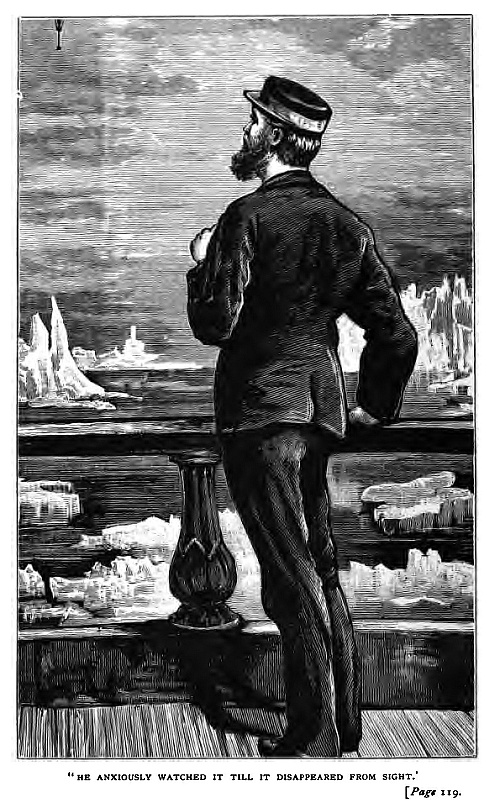
The ropes were let go, and upwards into the clear air rose the mighty balloon.
“Here’s a lark,” said Allan.
“A skylark,” said Rory. “Let us sing, boys—let us sing as we soar, ‘Rule Britannia, Britannia rules the waves.’”
Standing on the quarter-deck, and gazing upwards, McBain heard the voices growing fainter and fainter, and saw the balloon lessening and lessening, till the song could no longer be heard, and the balloon itself was but a tiny speck in the heaven’s blue. Then he went down below, and busied himself all day with calculations. He didn’t want to think.
Meanwhile, how fared it with our boys? Here they were, all together, embarked upon as strange an expedition as it has ever probably been the lot of any youth or youths to try the chance of. Yet I do not think that anything approaching to fear found place in the hearts of one of them. The situation was novel in the extreme. With a slow and steady but imperceptible motion—for she was weightily ballasted—the “Perseverando,” as they had named the balloon, was mounting skywards. There was not the slightest air or wind, nor the tiniest of clouds to be seen anywhere, and down beneath and around them was spread out a panorama, which but to gaze upon held them spell-bound.
There was the island itself, with its rugged hills looking now so strangely flattened and so grotesquely contorted; to the west and to the north lay the white and boundless sea of ice, but far to the eastward and south was the ocean itself, looking dark as night in contrast with the solid ice.
But see, yonder, where the ice joins the water, and just a little way from its edge, lie stately ships—two, three, five in all can be counted, and their sails are all clewed; and those innumerable black ticks on the snow, what can they be but seals, and men sealing?
“Don’t you long to join them?” said Allan, addressing his companions.
“I don’t,” replied Rory; “in spite of the cold I feel a strange, dreamy kind of happiness all over heart and brain. Troth! I feel as if I had breakfasted on lotus-leaves.”
“And I,” said Ralph, “feel as I hadn’t breakfasted on anything in particular. Let us see what Peter has done up for us.”
And he stretched out his hand as he spoke towards a basket.
“Ah?” cried the Frenchman, “not dat basket; dat is my Bagdads—my pigeons, my letter-carriers! You see, gentlemen, I have come prepared to combat eevery deeficulty.”
“So I see,” said Ralph, coolly undoing the other basket; “what an appetite the fresh air gives a fellow, to be sure!”
“Indeed,” says Rory, archly, “it is never very far from home you’ve got to go for that same, big brother Ralph. But it’s hardly fair, after all, to try to eat the Bagdads.”
“Remember one thing, though,” replied Ralph; “if it should occur to me suddenly that you want your ears pulled you cannot run away to save yourself.”
“Indeed,” said Rory, “I don’t think that the frost has left any ears at all on me worth pulling, or worth speaking about either.”
“Ha?” cried Allan, “that reminds me; I’ve got those face mufflers. There! I’ll show you how to put one on. The fur side goes inside—thus; now I have a hole to breathe through, and a couple of holes for vision.”
“And a pretty guy you look!”
“Oh! bother the looks,” responded Ralph, “let us all be guys. Give us a mask, old man.”
They did feel more comfortable now that they had the masks on, and could gaze about them without the risk of being frozen.
The cold was intense; it was bitter.
“I’d beat my feet to keep them warm,” said Rory, “if I didn’t think I’d beat the bottom of the car out. Then we’d all go fluttering down like so many kittywakes, and it’s Captain McBain himself that would be astounded to see us back so soon.”
“Gentlemen,” said the Frenchman, “we are right over the mouth of the crater. I shall now make descent, with your permission. Then it vill not be so cold.”
“And is it inside the volcano,” cries Rory, “you’d be taking us to warm us? Down into the crater, to toast our toes at Vulcan’s own fireside? Sure, Captain De Vere, it is splicing the main-brace you’re after, for you want to give us all a drop of the craytur.”
“Oh!—oh!” this from Ralph. “Oh! Rory—oh! how can you make so vile a pun? In such a situation, too!”
The gentlest of breezes was carrying the balloon almost imperceptibly towards the north and west; meanwhile De Vere was permitting a gradual escape of gas, and the Perseverando sunk gradually towards the mountain-top, the mouth of which seemed to yawn to swallow them up. There was a terrible earnestness about this daring aeronaut’s face that awed even Rory into silence.
“Stand by,” he whispered; for in the dread silence even a whisper could be heard,—“stand by, Allan, to throw that bag of ballast over the moment I say the word.”
Viewing it from the sea of ice, no one could calculate how large is the extent of the crater on the top of that mighty mountain cone. It is perfectly circular, and five hundred yards at least in circumference, but it is deeper, far and away, than any volcanic crater into which it has ever been my fortune to peer. Even when the great balloon began to alight in its centre the gulf below seemed bottomless. The Perseverando appeared to be sinking down—down—down into the blackness of darkness. To the perceptions of our heroes, who peered fearfully over the car and gazed below, the gulf was rising towards them and swallowing them up.
I do not think I am detracting in the slightest from their character for bravery, when I say that the hearts of Ralph, Rory, and Allan, at all events, felt as if standing still, so terrible was the feeling of dread of some unknown danger that crept over them. As for De Vere, he was a fatalist of the newest French school, and a man that carried his life in his hand. He never attempted, it is true, any feat which he deemed all but impossible to perform; but, having embarked on an enterprise, he would go through with it, or he cared not to live.
Strange though it may appear, it is just men like this that fortune favours. Probably because the wish to continue to exist is not uppermost in their minds, the wish and the hope to achieve success is the paramount feeling.
Still slowly, very slowly, sunk the balloon, as if unwilling to leave her aerial home. And now a faint shade of light begins to mingle with the darkness beneath them; they are near the bottom of the crater at last.
“Stand by once again,” whispers De Vere, “to throw that anchor over as soon as I tell you.”
A moment of awful suspense.
“Now! now!” hisses De Vere.
Two anchors quit the car at the same time—one thrown by the aeronaut himself, one by Allan, and the ropes are speedily made fast. The balloon gives an upward plunge, the cables tighten, then all is still!
“Ha! ha! she is fast!” cried De Vere, now for the first time showing a little excitement. “Oh, she is a beauty! she has behave most lofely! Look up, gentlemen!—look up!—behold the mighty walls of blue ice that surround us!—behold the circle of blue sky dat over-canopies us!—look, the stars are shining!”
“Can it be night so soon?” exclaimed Allan, in alarm.
“Nay, nay, gentlemen,” said the enthusiastic Frenchman, “be easy of your minds. It is not night in the vorld outside, but here it is alvays night; up yonder the stars shine alvays, alvays, when de clouds are absent. And shine dey vill until de crack of doom. Now gaze around you. See, the darkness already begins to vanish, and you can see the vast and mighty cavern into which I have brought you. If my judgment serves me, it extends for miles around beneath de mountain. There!—you begin to perceive the gigantic stalactites that seem to support the roof!”
“Ralph,” cried Rory, seizing his friend by the hand, “do you remember, years and years ago, while we all sat round the fire in the tartan parlour of Arrandoon Castle, wishing we might be able to do something that no one, man or boy, had ever done before?”
“I do—I do,” answered Ralph.
“Descend with me here, then,” continued Rory, “and let us explore the cavern. Only a little, little way, captain,” he pleaded, seeing that De Vere shook his head in strong dissent.
“You know not vat you do ask,” said De Vere, solemnly. “Here are caves within caves, one cavern but hides a thousand more; besides, there are, maybe, and doubtless are, crevasses in de floor of dis awful crater, into which you may tumble, neever, neever to be seen again. Pray do not think of risking a danger so vast.”
The day wore slowly to a close; many and many an anxious look did McBain take skywards, in hopes of seeing the returning balloon. But the sun set, tipping the distant hills with brightest crimson, twilight died away in the west, and one by one shone out the stars, till night and darkness and silence reigned over all the sea of ice.
He went below at last. His feelings may be better imagined then described. He tried to make himself believe that nothing had occurred, and that the balloon had safely descended in some snow-clad valley, and that morning would bring good tidings. But for all this he could not for the life of him banish a dread, cold feeling that something terrible had occurred, the very novelty of which made it all the more appalling to think of. Presently the mate entered the saloon.
“What cheer, Stevenson! Any tidings?”
“A pigeon, sir,” replied the mate, handing the bird into the captain’s grasp.
McBain’s hands shook as he had never remembered them shake before, as he undid the tiny missive from the pigeon’s leg.
It ran briefly thus:—
“We are detained here in the crater all night. Do not be alarmed. To-morrow will, please Providence, see us safely home.”
Chapter Fourteen.
Anxious Hours—Exploration of the Mountain Cavern—The Cave of the King of Ice, and Ghouls of a Thousand Winters—Transformation Scenes—Snowblind—Lost.
It would be difficult to say which was most to be pitied, McBain on board the Arrandoon, passing long hours of inconceivable anxiety, or our other heroes, left to spend the drear, cold night in the awful depths of that Arctic crater.
It was with light hearts that Ralph and Rory descended from the car of the Perseverando and commenced their perilous exploration of the vast and dimly-lighted cavern; but heavy hearts were left behind them, and hardly had they disappeared in the gloom ere the Frenchman exclaimed to Allan, “I greatly fear dat I have done wrong. Your two friends are big wid impulse; if anydings happen to them dere vill be for me no more peace in dis world.”
Allan was silent.
But when hours passed away and there were no signs of their returning, when gloaming itself began to fall around them, and the stars at the crater’s mouth assumed a brighter hue, Allan’s anxiety knew no bounds, and he proposed to De Vere to go in search of his friends.
“Ah! if dat vere indeed possible!” was the reply.
“And why not?” said Allan.
“For many reasons: de balloon vill even now hardly bear de strain on her anchors; de loss of even your veight vould require such delicate manipulation on my part, dat I fear I could not successfully vork in such small space. Alas! ve must vait. But there yet is hope.”
Meanwhile it behoves us to follow Ralph and Rory. They had faithfully promised De Vere they would go but a short distance from the car, and that promise they had meant to redeem. They found that the ground sloped downwards from the mouth of the crater, but there was no want of light, as yet at least, and thus not the slightest danger of being unable to find their way back, for were there not their footsteps in the snow to guide them? So onward they strolled, cheerfully enough, arm-in-arm, like brothers, and that was precisely how they felt towards each other.
The road—if I may say “road” where there was no road—was rough enough in all conscience, and at times it was difficult for them to prevent stumbling over a boulder.
“I wonder,” said Rory, “how long these boulders have lain here, and I wonder what is beneath us principally, and what those vast stalactite pillars are formed of.”
“‘Bide a wee,’ as the doctor says,” replied Ralph; “don’t hurry me with too many questions, and don’t forget that though I am ever so much bigger and stronger than you, I don’t think I am half so wise. But the boulders may have lain here for ages: those ghostly-looking pillars are doubtless ice-clad rocks, partly formed through the agency of fire, partly by water. I think we stand principally on rocks and on ice, with, far, far down beneath us, fire.”
“Dear, dear!” said Rory, talking very seriously, and with the perfect English he always used when speaking earnestly; “what a strange, mysterious place we are in! Do you know, Ralph, I am half afraid to go much farther.”
“Silly boy!” said his companion, “how thoroughly Irish you are at heart—joy, tears, sunshine and fun, but, deep under all, a smouldering superstition.”
“Just like the fires,” added Rory, “that roll so far beneath us. But you know, Ray,”—in their most affectionate and friendly moods Ralph had come to be “Ray” to Rory, and Rory “Row” to Ralph—“you know, Ray, that the silence and gloom of this eerie place are enough to make any one superstitious—any one, that is, whose soul isn’t solid matter-of-fact.”
“Well, it is silent. But I say, Row—”
“Well, Ray?”
“Suppose we try to break it with a song? I daresay they have never heard much singing down here.”
“Who?” cried Rory, staring fearfully into the darkness.
“Oh!” said Ralph, carelessly, “I didn’t mean any one in particular. Come, what shall we sing—‘The wearing o’ the green’?”
“No, Ray, no; that were far too melancholic, though I grant it is a lovely melody.”
“Well, something Scotch, and stirring. The echoes of this cavern must be wonderful.”
They were, indeed; and when Rory started off into that world-known but ever-popular song, “Auld lang syne,” and Ralph chimed with deep and sonorous bass, the effect was really grand and beautiful, for a thousand voices seemed to fill the cavern. They heard the song even in the car of the balloon, and it caused Allan to remark, smilingly, for they had not yet been long gone, “Ralph and boy Rory seem to be enjoying themselves; but I trust they won’t be long away.”
Rory was quite lively again ere he reached the words—
“And we’ll tak’ a richt good-willy waught For auld lang syne.”
He burst out laughing. “Indeed, indeed! there is no wonder I laugh,” he said; “fancy the notion of taking a ‘good-willy waught’ in a place like this! And now,” he added, “for a bit of a sketch.”
“Don’t be long in nibbing it in, then.”
Rory was seated on a boulder now, tracing on his page the outlines of those strange, weird pillars that hands of man had never raised nor human eyes gazed upon before. So the silence once more became irksome, and the time seemed long to Ralph, but Rory had finished at last.
Then the two companions, after journeying on somewhat farther, began to awaken the echoes by various shouts; and voices, some coming from a long distance, repeated clearly the last words.
“Let us frighten those ghouls down there by rolling down boulders,” said Rory.
“Come on, then,” said Ralph; “I’ve often played at that game.”
They had ten minutes of this work. It was evident this hill within a hill, this crater’s point, was of depth illimitable from the distant hissing noises which the broken boulders finally emitted.
“It’s a regular whispering gallery,” said Rory.
“It is, Row. But do let us get back. See, there is already barely light enough to reveal our footsteps.”
“Ah! but, my boy,” said Rory, “the nearer the car we walk the more light we’ll have. And I have just one more surprise for you. You see this little bag?”
“Yes. What is in it—sandwiches?”
“Nay, my Saxon friend! but Bengal fires. Now witness the effects of the grand illumination of the Cave of the King of Ice by us, his two ghouls of a thousand winters!”
The scene, under weird blue lights, pale green or crimson, was really magical. All the transformation scenes ever they had witnessed dwindled into insignificance compared to it.
“I shall remember this to my dying day?” Rory exclaimed.
“And I too!” cried Ralph, entranced.
“Now the finale?” said the artist; “it’ll beat all the others! This white light of mine will eclipse the glory of the rest as the morning sun does that of moonlight! It will burn quite a long time, too; I made it last night on purpose.”
It was a Bengal fire of dazzling splendour that now was lit, and our heroes themselves were astonished.
“It beats the ‘Arabian Nights’!” cried Rory. “Look, look!” he continued, waving it gently to and fro, “the stalactites seem to dance and move towards us from out the gloom arrayed in robes of transplendent white. Yonder comes the King of Ice himself to bid us welcome.”
“Put it out! put it out!” murmured Ralph, with his hand on his brow.
It presently burned out, but lo! the change!—total darkness!
Rory and Ralph were snowblind!
“Oh, boy Rory!” said Ralph, “that brilliant of yours has sealed our fate. It will be hours ere our eyes can be restored, and long before then the darkness of night will have enshrouded us. We are lost!”
“Let us not lose each other, at all events,” said Rory, feeling for his friend’s arm, and linking it in his own.
“You think we are lost; dear Ralph, I have more hopes. Something within me tells me that we were never meant to end our days in the awful darkness of this terrible cavern. Pass the night here it is certain we must, but to-morrow will bring daylight, and daylight safety, for be assured Allan and De Vere will not leave us, unless—”
Here the hope-giver paused.
“Unless,” added Ralph—“for I know what you would say—an accident should be imminent—unless they must leave. A balloon needs strange management.”
“Even then they will return to seek us by morning light. Do you know what, Ray?” he continued, “our adventures have been too foolhardy. Providence has punished us, but He will not utterly desert us.”
“Hope springs eternal in the human breast.”
The lamp of hope was flickering—had, indeed, burned out—in Ralph’s heart, but his friend’s words rekindled it. Perhaps Rory’s true character never shone more clearly out than it did now, for, while trying to cheer his more than friend, he fully appreciated the desperateness of the situation, and had but little hope left in him, except his extreme trust in the goodness of a higher Power.
“Could we not,” said Ralph, “all snowblind as we are, try to grope our way upwards?”
“No, no, no!” cried Rory; “success in that way is all but impossible; and, remember, we have but the trail of our footprints to guide us even by day.”
Something of the ludicrous invariably mixes itself up with the most tragic affairs of this world. I have seen the truth of this in the chamber of death itself, in storms at sea, and in scenes where men grappled each other in deadly strife. And it is well it should be so, else would the troubles of this world oftentimes swamp reason itself. The attempts of Rory to keep his companion in cheer, partook of the nature of the ludicrous, as did the attempts of both of them to keep warm.
So hours elapsed, and sometimes sitting, sometimes standing and beating feet and hands for circulation’s sake, and doing much talking, but never daring to leave the spot, at last says Rory, “Hullo, Ray! joy of joys! I’ve found a lucifer!”
Almost at the same moment he lit it. They could see each other’s faces—see a watch, and notice it was nearly midnight. They had regained sight! Joy and hope were at once restored.
“Troth!” said Rory, resuming his brogue, “it’s myself could be a baby for once and cry. Now what do ye say to try to sleep? We’ll lie close together, you know, and it’s warm we’ll be in a jiffey?”
So down they lay, and, after ten long shivering minutes, heat came back to their frozen bodies. They had not been talking all this time; it is but right to say they were better engaged.
With warmth came le gaiété—to Rory, at least.
“Have you wound your watch, Ray?”
“No, Row? and I wouldn’t move for the world!”
After a pause, “Ray,” says Row.
“Yes, Row?” says Ray.
“You always said you liked a big bed-room, Ray, and, troth, you’ve got one for once!”
“How I envy you your spirits,” answers Ray.
“Don’t talk about spirits,” says Row, “and frighten a poor boy. I’ve covered up my head, and I wouldn’t look up for the world. I’m going to repeat myself to sleep. Good night.”
“Good night,” asks Ray, “but how do you do it?”
“Psalms, Ray,” Row replies. “I know them all. I’ll be out of here in a moment.
“‘He makes me down to lie by pastures green, He leadeth me the quiet waters by.’
“Isn’t that pretty, Ray?”
“Very, Row, but ‘pastures green’ and ‘quiet waters’ aren’t much in my way. Repeat me to sleep, Rory boy, and I promise you I won’t pull your ears again for a month.”
“Well, I’ll try,” says Row. “Are your eyes shut?”
“To be sure. A likely thing I’d have them open, isn’t it?”
“Then we’re both going to a ball in old England.”
“Glorious,” says Ray. “I’m there already.”
Then in slow, monotonous, but pleasing tones, Row goes on. He describes the brilliant festive scene, the warmth, the light, the beauty and the music, and the dances, and last but not least the supper table. It is at this point that our Saxon hero gives sundry nasal indications that this strange species of mesmerism had taken due effect, so Row leaves him at the supper table, and goes back to his “pastures green” and “quiet waters,” and soon they both are sound enough. Let us leave them there; no need to watch them. Remember what Lover says in his beautiful song,—
“O! watch ye well by daylight, For angels watch at night.”
Poor McBain! Worn out with watching, he had sunk at last to sleep in his chair.
And day broke slowly on the sea of ice. The snow-clad crater’s peak was the first to welcome glorious aurora with a rosy blush, which stole gradually downwards till it settled on the jagged mountain tips. Then bears began to yawn and stretch themselves, the sly Arctic foxes crept forth from snow-banks, and birds in their thousands—brightest of all the snowbird—came wheeling around the Arrandoon to snatch an early breakfast ere they wended their way westward to fields of blood and phocal carnage.
And their screaming awoke McBain.
He was speedily on deck.
Yonder was the Perseverando slowly descending.
During all the long cruise of the Arrandoon nobody referred to the adventure at the crater of Jan Mayen without a feeling akin to sadness and contrition, for all felt that something had been done which ought not to have been done—there had been, as McBain called it, “a tempting of Providence.”
“Well, well, well,” cried the skipper of the Canny Scotia—and he seemed to be in anything but a sweet temper. “Just like my luck. I do declare, mate, if I’d been born a hatter everybody else would have been born without heads. Here have I been struggling away for years against fortune, always trying to get a good voyage to support a small wife and a big family, and now that luck seems to have all turned in our favour, two glorious patches of seals on the ice yonder, a hard frost, and the ice beautifully red with blood, and no ship near us, then you, mate, come down from the crow’s-nest with that confoundedly long face of yours, for which you ought to have been smothered at birth—”
“I can’t help my face, sir,” cried the mate, bristling up like a bantam cock.
“Silence!” roared the burly skipper. “Silence! when you talk to your captain. You, I say, you come and report a big steamer in sight to help us at the banquet.”
The mate scratched his head, taking his hat off for the purpose.
“Did I make the ship?” he asked with naïve innocence.
“Pooh!” the skipper cried; and next moment he was scrambling up the rigging with all the elegance, grace, and speed of a mud turtle.
He was in a better humour when he returned.
“I say, matie,” he said, “yonder chap ain’t a sealer; too dandy, and not boats enough. No, she is one of they spectioneering kind o’ chaps as goes a prowling around lookin’ for the North Pole. Ha! ha! ha! Come below, matie, and we’ll have a glass together. She ain’t the kind o’ lady to interfere with our blubber-hunting.”
The mate was mollified. His face was soaped, and he shone.
Chapter Fifteen.
The “Arrandoon” Anchors to the “Floe”—The Visit to the “Canny Scotia”—Silas Grig—A Sad Scene—Rory Relieves His Feelings—Strangers Coming from the Far West.
Seeing the skipper of the Canny Scotia and his mate come below together smiling, the steward readily guessed what they wanted, so he was not dilatory in producing the rum-bottle and two tumblers. Then the skipper pushed the former towards the mate, and said,—
“Help yourself, matie.”
And the mate dutifully and respectfully pushed it back again, saying,—
“After you, sir.”
This palaver finished, they both half-filled their tumblers with the ruby intoxicant, added thereto a modicum of boiling coffee from the urn that simmered on top of the stove, then, with a preliminary nod towards each other, emptied their glasses at a gulp. After this, gasping for breath, they beamed on each other with a newly-found friendliness.
“Have another,” said the skipper.
They had another, then went on deck.
After ten minutes of attentive gazing at the Arrandoon, “Well,” said the skipper, “I do call that a bit o’ pretty steering; if it ain’t, my name isn’t Silas Grig.”
“But there’s a deal o’ palaver about it, don’t you think so, sir?” remarked the mate.
“Granted, granted,” assented Silas; “granted, matie.”
The cause of their admiration was the way in which the Arrandoon was brought alongside the great ice-floe. She didn’t come stem on—as if she meant to flatten, her bows—and then swing round. Not she. She approached the ice with a beautiful sweep, describing nearly half a circle, then, broadside on to the ice, she neared it and neared it. Next over went the fenders; the steam roared from the pipe upwards into the blue air, like driven snow, then dissolved itself like the ghost of the white lady; the ship was stopped, away went the ice-anchors, the vessel was fast.
And no noise about it either. There may not be much seamanship now-a-days, but I tell you, boys, it takes a clever man to manage a big steamer prettily and well.
The Arrandoon was not two hundred yards from the Canny Scotia. Now round go the davits on the port quarter, outward swings the boat, men and officers spring nimbly into her, blocks rattle, and down goes the first whaler, reaching the water with a flop, but not a plash, and with keel as even and straight as a ruled line.
“I say, matie,” said Silas Grig, in some surprise, “if that boat ain’t coming straight away here, I hope I may never chew cheese again.”
So far as that was concerned, if Silas chose, he would at least have the chance of chewing cheese again, for the Arrandoon’s boat came rippling along towards them with a steady cluck-el-tee cluck-el-tee, which spoke well for the men at the oars.
“Well,” continued Silas, who, rough nut though he was, always meant well enough, “let us do the civil, matie; tell the steward to fill the rum-bottle, and pitch ’em a rope.”
The rope came in very handy; but there was no need for the rum; even in Greenland men can live without it—the officers of the Arrandoon had found that out.
McBain, with Allan and Rory,—the latter, by the way, seemed to have registered a vow to go everywhere and see everything,—stood on the quarter-deck of the Canny Scotia, the skipper of which craft was in front of him, a comical look of admiration on his round brick-coloured countenance, and his two hands deep in the pockets of his powerful pilot coat.
“Ay, sir! ay!” he was saying; “well, I must say ye do surprise me.”
He put such an emphasis on the “me” that one would have thought that to surprise Silas Grig was something to be quite boastful of ever after.
“All the way to the North Pole? Well, well; but d’ye think you’ll find it?”
“We mean to,” said Rory, boldly.
“Perseverando!” said Allan.
“The Perseverance!” cried the skipper. “I know the ship, a Peterheader. Last time I saw her she had got in the nips, and was lying keel up on the ice, yards and rigging all awry of course; and, bother her, I hope she’ll lie there till Silas Grig gets a voyage (a cargo), then when the Scotia is full ship, the Perseverance can get down off the shelf, and cabbage all the rest. Them’s my sentiments. But come below, gentlemen, come below; there is room enough in the cabin of the old Scotia for every man Jack o’ ye. Come below.”
Silas was right. There was room, but not much to spare, and, squeezed in between Allan and McBain, poor Rory was hardly visible, and could only reach the table with one hand.
The cabin of this Greenlandman can be described with a stroke of the pen, so to speak. It was square and not very lofty—a tall man required to duck when under a beam; the beams were painted white, the bulkheads and cabin doors—four in number—were grey picked out with green. One-half at least of the available space was occupied by the table; close around it were cushioned lockers; the only other furniture was the captain’s big chair and a few camp-stools, a big square stove with a roaring fire, and a big square urn fixed on top thereof, which contained coffee, had never been empty all the voyage, and would not be till the end thereof. I suppose a bucket of water could hardly be called furniture, but there it stood close to the side of the stove, and the concentric rings of ice inside it showed the difficulty everybody must experience who chose to quench his thirst in the most natural way possible.
Above, in the hollow of the skylight, hung a big compass, and several enormously long sealer’s telescopes.
“No rum, gentlemen?” said Silas; “well, you do astonish me; but you’ll taste my wife’s green ginger wine, and drink her health?”
“That we will,” replied McBain, “and maybe finish a bottle.”
“And welcome to ten,” said Silas; “and the bun, steward, bring the bun. That’s the style! My wife isn’t much to look at, gentlemen, but, for a bun or o’ drop o’ green ginger, I’ll back her against the whole world.”
After our heroes had done justice to the bun, and pledged the skipper’s good lady in the green ginger, that gentleman must needs eye them again and again, with as much curiosity as if they had been some new and wonderful zoological specimens, that he had by chance captured.
“All the way to the North Pole!” he muttered. “Well, well, but that does get over Silas.”
Rory could not help laughing.
“Funny old stick,” said Silas, joining in his merriment, “ain’t I?”
He did look all that and more, with his two elbows on the table, and his knuckles supporting his chin, for his face was as round as a full moon orient, and just the colour of a new flower-pot; then he laughed more with one side of his face than the other, his eyes were nowhere in the folds of his face, and his nose hardly worth mentioning.
After the laugh, beginning with Rory, had spread fairly round the table, everybody felt relieved.
“I’m only a plain, honest blubber-hunter, gentlemen,” said Silas Grig, apologetically, “with a large family and—and a small wife—but—but you do surprise me. There?”
(It is but fair to say that, as a rule, captains of Greenlandmen are far more refined in manner than poor Silas.)
But when McBain informed him that the Arrandoon would lay alongside him for a week or more, and help him to secure a voyage, and wouldn’t ship a single skin herself, Silas was more surprised than ever. Indeed, until this day I could not tell you what would have happened to Silas, had the mate not been providentially beside him to vent his feelings upon. On that unfortunate officer’s back he brought down his great shoulder-of-mutton fist with a force that made him jump, and his breath to come and go as if he had just been popped under a shower-bath.
“Luck’s come,” he cried. “Hey? hey?”
And every “hey?” represented a dig in the mate’s ribs with the skipper’s thumb of iron.
“Told ye it would, hey? Didn’t I? hey?”
“What’ll the old woman say, hey? Hey, boys? Hey, matie? Hey? Hey?”
“You gentlemen,” said Silas, alter his feelings had calmed down a trifle, “are all for sport, and Silas has to make a voyage. But you’ll have sport, gentlemen, that ye will. My men are sealing now. They’re among the young seals. It has been nothing but flay, flay, flay, for the last two rounds of the sun, and there isn’t such a very long night now, is there? And you saw the blood?”
Saw the blood, reader! Indeed, our heroes had. Where was it that that blood was not? All the beautiful snow was encrimsoned with it on the distant field of ice, where the men were carrying on their ghastly work. It was as if a great battle had been fought there, and the dead crangs lay in dozens and hundreds. A crang means a carcass. Is the adjective “dead,” then, not unnecessary? What else can a carcass or crang be but “dead”? Nay, but listen: let me whisper a truth in your ear, and I know your brave young blood will boil when I tell you: I’ve known our men, Englishmen and Scotchmen, flense the lambs while still alive.
From the field of slaughter the skins were being dragged to the ship by men with ropes, so there were streaks of red all the way to the ship, and all the vessel’s starboard side was smeared with blood. Indeed, I do not wish to harrow the feelings of my readers, and I shall but describe a few of the cruelties of sealing—no, on second thoughts, I will not even do that, because I know well you will believe me when I tell you these cruelties are very great, and believing this, if ever you have an opportunity of voting for a bill or signing a petition to get poor Greenland seals fair play, I know you will.
Silas Grig and our heroes took a walk to the field of unequal strife, and Rory and Allan, to whom all they saw was very new, were not a little horrified as well as disgusted.
“This,” said McBain, “is the young-sealing. We are not going to assist you in this; we are sportsmen, not butchers, Captain Grig?”
Silas grasped McBain’s hand. “Your feelings do you credit, sir,” he said—“they do. But I have feelings, too. Yes, a weather-beaten old stick like me has feelings! But I’m sent out here to make a voyage, and what can I do? I’ve a small wife and a large family; and my owners, too, would sack me if I didn’t bring the skins. I say,” he added, after a pause, “you know my mate?”
“Yes,” said McBain.
“Well,” said Silas, “you wouldn’t, imagine that a fellow with such an ugly chunk o’ a figure-head as that had feelings, eh? But he has, though; and during all this young-sealing business we both of us just drowns our feelings in the rum-bottle. Fact, sir! and old Silas scorns a lie. But, gentlemen, when all this wicked work is over, when we are away north from here, among the old seals, and when we can look at that sun again without seeing blood, then my matie and I banishes Black-Jack (the gallon measure from which rum is served is so called) and sticks to coffee and arrowroot; that we do!”
They had turned their backs on the by no means inviting scene, and were walking towards the Canny Scotia as Silas spoke.
“But,” said the Greenland mariner, “come and dine with the old man to-morrow. The last of the young seals will be on board by then, and we’ll have had a wash down; we’ll be clean and tidy like. Then hurrah for the old seals! That’s sport, if you like!—that’s fair play.”
“Ah!” said McBain, “your heart is in the right place, I can see that. I wish there were more like you. Do you seal on Sunday? Many do.”
Silas looked solemn. “I knows they do,” he said, “but Silas hasn’t done so yet, and he prays he never may be tempted to.”
“Captain Grig, we’ll come and dine with you, and we expect you to pay us the same compliment another day.”
“I daresay you fellows are glad to get home?” said Ralph, rising from the sofa and throwing down the volume he had been dreaming over.
“Not a bit of it!” said Rory and Allan, both in one breath; and Rory added, “You don’t know what a funny ship a real Greenlandman is! I declare you’ve lost a treat!”
“Does it smell badly?” asked Ralph, with a slight curl of his upper lip.
“Never a taste!” says Rory; “she’s as sweet as cowslips or clover, or newly-made hay; and the bun was beautiful!”
“The what?” said Ralph.
“Don’t tell him?” cried Allan; “don’t tell him!”
“And the green ginger!” said Rory, smacking his lips. “Ah, yes! the green ginger,” said Allan; “I never tasted anything like that in all my born days!”
“Hi, you, Freezing Powders!” cried Rory, “take my coat and out-o’-doors gear. D’ye hear? Look sharp?”
“I’m coming, sah; and coming plenty quick!”
“De-ah me!” from Cockie.
“Now bring my fiddle, you young rascal, into my cabin;” for Rory, reader, had that young-sealing scene on his brain, and he would not be happy till he had played it away. And a wild, weird lilt it was, too, that he did bring forth. Extempore, did you ask? Certainly, for he played as he thought and felt; all his soul seemed to enter the cremona, and to well forth again from the beautiful instrument, now in tones of plaintive sorrow, now in notes of wrath; and then it stopped all at once abruptly. That was Rory’s way; he had pitched fiddle and bow on the bed, and presently he returned to the saloon.
“Are you better?” inquired Allan. Rory only gave a little laugh, and sat down to read. It had taken McBain nearly a fortnight to get clear away from the Isle of Jan Mayen, for the frost had set in sharp and hard, and the great ice-saws had to be worked, and the aid of dynamite called in to blast the pieces. They were now some ten miles to the north and east of the island, but, so far as he knew on the day of his visit to the Scotia, he had bidden it farewell for ever.
It had not been for the mere sake of sport or adventure he had called in there, he had another reason. Old Magnus, before the sailing—ay, or even the building—of the Arrandoon, had heard that the island was inhabited by a party of wandering Eskimos. Wherever Eskimos were McBain had thought there must be dogs, and that was just what was wanting to complete the expedition—a kennel of sleigh-dogs. But, as we have seen, the Eskimo encampment was deserted, so McBain had to leave it disappointed. But, as it turned out, it was only temporarily deserted after all, and on the very day on which they had arranged to dine with Skipper Grig, two daring men, chiefs of a tribe of Eskimos, drawn in a rude sledge, were making their way towards the island. Their team consisted of over a dozen half-wild dogs, harnessed with ropes of skin and untanned leather. They seemed to fly across the sea of ice. Hardly could you see the dogs for the powdery snow that rose in clouds around them. Well might they hurry, for clouds were banking up in the west, a low wind came moaning over the dreary plain, and a storm was brewing, and if it burst upon them ere they reached the still distant island, then—
Chapter Sixteen.
Silas Grig’s Dinner-Party—A New Member of the Malacopterygii—The Storm on the Sea of Ice—Break-up of the Main Pack—Roughing it at Sea.
While those two chiefs of the Eskimo Indians were hurrying their team of dogs across the sea of ice eastwards, ever eastwards, with the clouds rising behind them, with the wind whispering and moaning around them, and sometimes raising the powdery snow in little angry eddies, that almost hid the plunging dogs from their view, honest Silas Grig, though somewhat uneasy in his mind as to what kind of weather was brewing, busied himself nevertheless in preparing what he considered a splendid dinner for his coming guests.
“But,” he said to his mate, “it will just be like my luck, you know, if it comes on to blow big guns, and we’ve got to leave good cheer and put out to sea.”
“Ah! sir,” said the mate, “don’t forget luck has turned, you know.”
“Ha! ha! ha!” laughed Silas, “really, matie, I had a’most forgotten.”
And away forward he hurried, to see how the men were getting on scrubbing decks and cleaning brass-work, and how the cook was getting on with that mighty sirloin of beef. He took many a ran forward as the day advanced, often pausing, though, to give an uneasy glance windward, and at the sun, not yet hidden by the rising clouds. And often as he did so he shook his head and made some remark to his mate.
“I tell ye, matie,” he said once, “I don’t quite like the looks o’ ’t. Those clouds ain’t natural this time o’ the year, and don’t you see the spots in the sun? Why, he is holed through and through like an old Dutch cheese. Something’s brewin’. But, talking of brewin’, I wonder how the soup is getting on?” (In Greenland these sunspots are quite easily seen by the naked eye.)
Silas’s face was more the colour of a new flower-pot than ever, when McBain and our three heroes came alongside in their dashing gig, with its beautiful paint and varnish, snow-white oars, flag trailing astern, and rudder-ribbons, all complete.
Rory was steering, and he brought her alongside with a regular admiral’s sweep.
“Why, she’s going away past us!” cried Silas; “no, she ain’t. It is the bow-and-bow business the young ’un’s after.”
“In bow?” cried Rory. “Way enough—oars!”
These were the only three orders Rory needed to give to his men. There was no shouting of “Easy sta’board!” or “Easy port!” as when a lubber is coxswain.
Next moment they were all on deck, shaking hands with the skipper and his mate. The latter remained on deck; he didn’t care for the company of “quality;” besides, he had to loosen sails, and have all ready to get in anchors at a minute’s notice and put out to sea.
The skipper of the Canny Scotia had contrived another seat at table, so there was no such thing as crowding, and the dinner passed off entirely to his satisfaction. The pea-soup was excellent, neither too thick nor too thin, and the sippets done to a turn. Then came what Silas called the whitebait.
“Which is only my fun, gentlemen,” he observed, “seeing that they are bigger than sprats. Where do I get them? Hey? Why, turn up a piece of pancake-ice, and there they be sticking in the clear in hundreds, like bees in a honeycomb, and nothing out but their bits of tails.”
“It is curious,” said Rory. “How do they bore the holes, I wonder?”
“That, young gentleman,” replied Silas, “I can’t say, never having seen them at work. Maybe they melt the ice with their noses; they can’t make the holes with their teeth, their bows are too blunt and humble like. Perhaps, after all, they find the holes ready-made, and just go in for warmth. Queer, ain’t it?”
“I believe,” said Rory, “they belong to the natural order Malacopterygii.”
“The what?” cried Ralph; “but, pray, Row, don’t repeat the word. Think of the small bones; and McFlail isn’t here, you know.”
“Of which,” continued Rory, “the Clupeidae” (Ralph groaned) “form one of the families, belonging to which are the herring, the sardine, the whitebait, and sprat.”
“They may be sprats, or they may be young sperm-whales, for anything I care,” said Ralph; “but I do know they are jolly good eating. Captain Grig, may I trouble you again?”
With the pudding came the green ginger, that Ralph was so anxious to taste.
“The peculiarity of that pudding, gentlemen, is this,” said Silas—“eaten hot it is a pudding, eaten cold it is a bun. The peculiarity of the green—”
What more he meant to have said will never be known, for at that moment the Canny Scotia gave an angry cant to leeward, and away—extemporised seat and all—went the skipper down upon the sta’board bulkheads; the coalscuttle, the water-bucket, and the big armchair followed suit, and there was consequently some little confusion, and a speedy break-up of the dinner-party.
McBain’s boat was called away, for the ship had slipped her ice-anchors, and was drifting seaward, with the wind roaring wildly through rigging and cordage. The gale had come upon them as sudden as a thunderclap. Good-byes were hastily said, and away pulled the gig. She was in the lee of the ice and partly sheltered, otherwise they never would have regained the Arrandoon. As it was, the men were almost exhausted when they got alongside.
Her anchors were well fast, and her cables were strong; there was little fear of dragging for some time, so the order was given to at once get up steam, and that, too, with all speed, for the force of the wind seemed to increase almost momentarily. On the Arrandoon’s decks you could scarcely have seen anything, for the snow blew blindingly from off the ice; there was little to be heard either, for the shrill, harsh whistling of the wind. Men flitted hither and thither like uneasy ghosts, making things snug, and battening down the principal hatches; on the bridge, dimly descried, was McBain, speaking-trumpet under arm, and beside him Stevenson.
Down below, from fore to aft, everybody was engaged. In the stoke-hole they were busy, and making goodly use of the American hams; in the engine-room the engineers were looking well to their gear, with bits of greasy “pob” in their hands, humming songs as they gave a rub here and a nib there, though to what end or purpose I couldn’t tell you, but evidently on the best of terms with themselves and their beautiful engine. The doctor was busy stowing his bottles away, and the steward was making the pantry shipshape, and our heroes themselves were stowing away all loose gear in their cabins. Presently they entered the saloon again, where was Freezing Powders making the cockatoo’s cage fast with a morsel of lanyard.
“Here’s a pretty to-do!” the bird was saying, half choking on a billful of hemp. “Call the steward!—call the steward!—call the steward!”
“You jus’ console yourse’f,” said the boy, “and don’t take sich big mou’fuls o’ hemp. Mind, you’ll be sea-sick p’esently.”
“De-ah me!”
“Yes, ye will—dreffully sea-sick. Den you wants to call de steward plenty quick.”
One ice-anchor came on board; the other—the bow—was cut adrift as the ship’s stern swung round seaward. Almost at the same moment an explosion was heard close alongside, as if one of the boilers had burst. The great berg to which they had been anchored had parted company with the floe, and was evidently bent on going to sea along with the Arrandoon.
Once they were a little way clear of the ice they could look about them, the snow no longer blowing over the vessel. The scene was peculiar, and such as can only be viewed in Greenland under like circumstances.
The whole field of ice, as far as it was visible, was a smother of whirling drift; the lofty cone of Jan Mayen, which though miles to the south’ard and west, had been so well-defined an object against the blue of the sky, was now blurred and indistinct, and the grey, driving clouds every now and again quite hid the top of it from view. All along the edge of the pack the snow was being blown seaward like smoke, or like the white spray on the rocks where billows break. The eastern horizon was a chaos of dark, shifting billows, as tall as houses, and foam-tipped; but near by the ice, although the wind blew already with the force of a gale, and the surface of the water was churned into froth, there was not a wave bigger than you would see on a farmer’s mill-pond.
What a pity it seemed to leave this comparatively smooth water and steam away out into the centre of yonder mighty conflict ’twixt wind and wave. But well every one on board knew that to remain where they were was but to court destruction, for the noise that proceeded from the ice-fields told them the pack was breaking up. Ay, and bergs were already forging ahead of them, and surrounding them. Ere they were a mile from the floes they found this out, and the danger from the floating masses of ice was very real indeed. Every minute the pieces were hurtled with all the force of the waves against the sturdy vessel’s weather-side, threatening to stave her; nor could McBain, who never left the bridge until the vessel was well out to sea, avoid at times stemming the bergs that appeared ahead of him. For often two would present themselves at one time, and one must be stemmed—the smaller of the twain; for to have come in collision bow on, would have meant foundering.
But at length the danger was past as far as the ice was concerned, though now the seas were mountains high, and of Titanic force; so after an hour or two the Arrandoon lay to, and having seen the lights all properly placed, and extra hands put on the look-out—having, in fact, done everything a sailor could do for the safety of his ship, McBain came down below.
In shining oil-skins and dripping sou’-wester, he looked like some queer sea-monster that had just been caught and hauled on board.
He looked a trifle more human, however, when the steward had marched off with his outer garments.
“Is she snug?” asked Allan.
“Ay, lads, as snug as she is likely to be to-night,” replied McBain; “but she doesn’t like it, I can tell you, and the gale seems increasing to hurricane force. How is the glass, Rory?”
“Not so very low,” said Rory; “not under twenty-nine degrees.”
“But concave at the top?”
“Yes, sir.”
“Well, well,” said McBain, “content yourselves, boys, for I think we’ll have days of it. I for one don’t want to see much more of the ice while this blow lasts. But what a splendid fire you have! Steward, mind you put on the guard last thing to-night.”
“Why the guard?” asked Rory.
“Because,” explained McBain, “I feel certain that many a good ship has been burned at sea by the fire falling out of the grate; a wave or a piece of ice hits her on the bows, the fire flies out of the stove, no one is below, and so, and so—”
“Yes,” said Ralph, “that is very likely, and pray don’t let us speak of anything very dreadful to-night. List! how the wind roars, to be sure! But to change the subject—Peter.”
“Ay, ay, sir.”
“Is supper ready?”
“Very nearly, sir.”
“Well, tell Seth to come, and Magnus.”
“Ho! ho!” said McBain, “that’s it, is it?”
“What a comfort on a night like this,” Allan remarked, “it is to be shipmates with two such fellows as Ray and Row, the epicure and the poet—the one to cater for the corporeal, the other for the mental man.”
The ship was pitching angrily, dipping her bows deep down under the solid seas and raising them quickly again, but not neglecting to ship tons of water every time, which found its way aft, so that down in the saloon they could hear it washing about overhead and pouring past the ports into the sea.
“Steady, sir, steady,” cried Magnus, entering the saloon. He was speaking to Seth, who had preceded him. He didn’t walk in, he came in head first, and was now lying all his length on the saloon floor.
But Rory and Allan lifted him tenderly up again and seated him on the couch, amid such remarks as, “No bones broken, I do hope,” “Gently does it, Seth, old man,” “Have you really left your sea-legs forward?” “Call the steward,” the last remark being the cockatoo’s.
“I reckon,” said the old trapper, rubbing his elbows and knees, “there ain’t any bones given way this time, but that same is more chance than good management.”
After supper—which was of Ralph’s own choosing, I need not say more—a general adjournment was made to the after-cabin, or snuggery, and here every one adopted attitudes of comfort around the blazing stove, in easy-chairs, on sofas, or on rugs and skins on the deck; there they sat, or lounged, or lay. The elders had their pipes, the youngsters coffee. But with the pitching and rolling of the ship it was not very easy either to sit, or lounge, or lie, nor was it advisable to leave the coffee in the cup for any length of time; nevertheless everybody was happy, for wondrous little care had they on their minds. Oh! how wild and tempestuous the night was, and how madly the seas leapt and tossed around them! But they had a ship they could trust, and, better by far, a Power above them which they had learned to put confidence in.
Seth, to-night, was in what Ralph called fine form. His stories of adventure, told in his dry, droll, inimitable way, were irresistible. De Vere’s face never once lacked a smile on it; he loved to listen though he could not talk.
Old Magnus also had some queer tales to tell, his relation of them affording Seth breathing space. Several times during the evening Rory played, and the doctor tooted, as he called it.
Thus merrily and pleasantly sped the time—every one doing his best to amuse his neighbours—until eight bells rang out, then all retired.
It is on such a night as this that the soundest sleep visits the pillow of your thorough sailor—the roar of the wind overhead, the rocking of the ship, and the sound of the waves close by the ear, all conduce to sweetest slumber.
There was little if any improvement in the weather next day, nor for several days; but cold and stormy though it was, to be on the bridge, holding on—figuratively speaking—by the eyelids, was a glorious treat for our sailor heroes. The masts bent like fishing-rods beneath the force of the gale. At times the good ship heeled until her yard-ends ploughed the waves, and if a sea struck her then, the spray leapt higher than the main-truck, and the green water made a clean breach over her. On the second day the clouds were all blown away, but the wind retained its force, and the waves their power and magnitude. Every wave threatened to come inboard, and about one out of ten did. Those that didn’t went singing astern, or got in under the Arrandoon, and tossed her all they could. The frost was intense, and in some way or other, I think, accounted for the strange singing noise emitted by those waves that went past without breaking. But it was when one great sea followed swiftly on the heels of another that the good ship suffered most, because she would probably be down by the head when she received salute number two. It was thus she had her bulwarks smashed, and one good boat rent into matchwood and cast away.
It was no easy task to reach the bridge, nor to rush therefrom and regain the saloon companion. You had to watch the seas, and were generally pretty safe if you made use of arms and legs just after one or two big waves had done their worst; but Allan once, and Rory three times, were washed into the scuppers, and more bruised than they cared to own. Ralph seldom came on deck, and the doctor just once got his head above the companion; for this piece of daring he received a sea in the teeth, which he declared nearly cut his head off. He went down below to change his clothes, and never came up again.
On the third day, in the dog-watch, the wind fell, and the sea went down considerably. Had the gale blown from the east, the sea would have been in no such hurry to go down, but it had continued all the time to blow steadily from off the ice. What a strange sight the Arrandoon now presented! She was a ship of glass and snow. Funnel, masts, and rigging were, or seemed to be, composed of frosted crystal. The funnel, Rory declared, looked like a stalactite from “the cave of a thousand winters.” Her bows were lumbered with ice feet thick, and from stem to stern there was no more liveliness in the good Arrandoon than there is in a Dutch collier.
As soon as the wind fell a man was sent up aloft, and the order was given,—
“All hands clear ship of ice.”
But hark! there is a shout from the crow’s-nest.
“Large ship down to leeward, sir, apparently in distress.”
Chapter Seventeen.
The Storm—The “Canny Scotia” in Distress—Rum, Mutiny, Anarchy, and Death—Saved—Adventure with a She-Bear—Capture of the Young.
Has it not been said that the greatest pleasure on earth is felt on the sudden surcease of severe pain? I am inclined, though, to doubt the truth of this statement, and I think that nothing can equal the feeling of quiet, calm joy that is instilled into the heart on the instant one is plucked from the jaws of impending death. When the King of Terrors comes speedily, while the blood is up and the heart beating high, as he does to those who fall in the field of battle, his approach does not seem anything like so terrible as when he lags in his march towards his victim. One needs to have a hope that leads his thoughts beyond this world, to be brave and calm at such a moment.
When the Canny Scotia slipped her ice-anchors and was driven out to sea, to encounter all the fury of the gale that had so suddenly sprung up, she had not the advantages of the Arrandoon. She had no steam power, nor was she so well manned. She could therefore only scud under bare poles, or lie to with about as much canvas spread as would make a mason’s apron.
Silas didn’t mean to be caught napping, however, and, as quickly as he could, he got the tarpaulins down over the hatches, took in all spare canvas, and did all he could for the best. Alas! the best was bad. The Scotia made fearful weather, and twenty-four hours after it had come on to blow, she had not a topmast standing, two of her best boats had been carried away, her bulwarks looked like a badly-built farmer’s paling, and, worse than all, she was stove amidships on the weather-side and under the water-line. When this last disaster was reported to Silas Grig, he called all hands to “make good repairs,” and stem the flow of the water, which was rushing inboard like a mill-stream through the ugly hole in the vessel’s side. Had it been calm weather, this might have been done effectually enough, but, under the circumstances, it was simply an impossibility. Everything was done, however, that could be done, but still the seas poured in at every lurch to windward.
Then it was “All hands to the pumps.” The men worked in relays, and cheerily, too, and for a time the water was sent overboard faster than it came in, albeit there were times when the green seas poured over the ship like mountain cataracts. But after some hours, either through the men flagging, or from the hole in the ship’s side getting larger, the water in the hold began to gain rapidly on them.
“Bring up black-jack!” cried the skipper to the steward, “and we’ll splice the main-brace.”
“Now hurrah! lads!” he exclaimed, addressing the men after a liberal allowance of rum had been handed round. “Hurrah! heave round again. The storm has about spent itself and the sea is going down. We can keep her afloat if we try. Hurrah then, hurrah!”
“Hurrah!” echoed the men in response, and, flushed with artificial strength, they once more set themselves with redoubled energy to keep the water under. There was no danger now from ice. The piece that had wrought them so much mischief was about the last they had seen. So for a time all went well, and if the water did not decrease it certainly did not rise. An hour went by, then a deputation came aft to beg for more rum, and the fate of this vessel, like that of many another lost at sea, seemed sealed by the awful drink curse.
“It’s hardly judicious,” said Silas to his mate, “but I suppose they must have it.”
Ah! Silas Grig, it was not judicious to serve them with the first allowance. When hard work is over and finished, and men are worn out and tired, then is the time, if ever, to splice the main-brace; but when work has to be done that needs clear heads, and when danger is all around a ship, the farther away the rum is the better.
They had it, though, and presently they were singing as they pumped—singing, but not working half so hard as before. Then even the singing itself ceased; they were getting tired and drowsy, and yet another allowance of rum was asked and granted.
The water rose higher in the hold.
When the men heard this report they would work no more. With one accord they desisted from their labours, and a deputation of the boldest found their way aft.
“It is no use, Captain Silas Grig,” they said, addressing their skipper; “the ship is going down, and we mean to die jolly. Bring up the rum.”
“This is mutiny,” cried the captain, pulling out a revolver. “I’ll shoot the first man dead that dares go down that cabin staircase.”
“Captain,” said one of the men, stepping forward, “will you let me speak to you? I’ve nothing but friendly feelings towards you.”
“Well,” replied the skipper, “what have you to say?”
“This,” said the man; “let us have no murder. Put up your shooting-irons. It is all in vain. The men will have rum. Hark! d’ye hear that?”
“I heard a knocking below,” said the skipper. “What does it mean?”
Before the man could reply there was a wild shout from the half-deck.
“It means,” replied the man, “that the men have broken through the cabin bulkheads and supplied themselves.”
“Then Heaven help us!” said poor bewildered Silas.
He staggered to the seat beside the skylight and sat down, holding on by the brass glass-guards.
A moment after the mate joined him.
“You haven’t been drinking, matie,” said Silas, glancing gloomily upwards, “have you?”
“No, sir, nor the second mate, nor the steward, nor the spectioneer,” was the mate’s reply. “Give us your hand, sir. We’ve had words together often; let us forgive each other now. God bless you, sir, and if die together we must, we won’t die like pigs, at all events.”
There was anarchy forward, anarchy and wild revelry, and cruel brawls and fighting, but the five men aft stuck together, and tried to comfort each other, though there was hardly a hope in their hearts that their vessel would be saved. A long evening wore away, a kind of semi-darkness settled over the sea, but this short night soon gave place once more to-day. Then down forward all was quiet; the revellers were sleeping the stertorous sleep of the drunkard.
But the wind had fallen considerably, and the seas had gone down; the broken waves no longer sung in the frosty air, but the ship rolled like a half-dead thing in the trough of the sea. She was water-logged.
With infinite difficulty the mates, with the steward’s assistance, stretched more canvas, while the captain took the helm. She heeled over to it, and looked as if she hardly cared to right again. But this brought the hole in her side into view. Then they got heavy blankets up, and, working as they had never worked before, they managed in an hour and a half to staunch the leak from the outside.
Hope began to rise in their hearts, and, at the bidding of the skipper, the steward went below and brought up a large tin of preserved soup.
“Ah! men,” said poor Silas, “this is better than all the rum in the world.”
And it was, for it gave them strength and heart. They went away down below next to the galley and half-deck, and tried to rouse some of the men. They found five of them stark and stiff, and from the others came nothing but groans and oaths.
So they went to the pumps themselves, and worked away for hours for dear life itself.
Oh! what a joyful sight it was for them when, in answer to their signal of distress, they saw the good ship Arrandoon coming steaming down towards them.
Then the grim raven Death, who had been hovering over the seemingly doomed ship, flapped his ragged wings and flew slowly away.
They were saved!
Oil was pumped upon the water between the Arrandoon and Scotia, to round off the curling, comb-like peaks of the waves, and a boat was lowered from the steamer and sent to the assistance of the distressed vessel.
The ship was pumped out, and next day, the weather becoming once more fine, she was towed towards the island of Jan Mayen, and made fast to a floe. She was next heeled over and the repairs completed. The Arrandoon spared them a few spars, and plenty of willing hands to hoist them, so that in a few days the Greenland sealer was as strong as ever.
Silas Grig was a very happy man now. The unfortunate wretches who had flown to meet their fate were sunk in the dark waters of the sea of ice, but this rough but kindly-hearted skipper never let one upbraiding word escape him towards his men, and the men knew they were forgiven, and liked their skipper none the less for his extreme forbearance.
“Do you know what I have done?” said Silas to McBain.
“You have forgiven your men, haven’t you?” replied McBain.
“Ay, that I have,” said Silas, “but I have staved every cask of rum on board, and black-jack is thrown overboard.”
All along the west coast or shore of the island of Jan Mayen our heroes, on their re-arrival there, found that the water was comparatively clear, the bergs having been driven away out to sea on the wings of the wind, so that by breaking the light bay ice the boats could approach quite close to the snow-clad cliffs.
Our three boys—for boys we must continue to call them for the sake of the days of “auld lang syne”—were glad to set foot on shore again, and with them went old Seth and the doctor. Freezing Powders was also invited, but his reply was, “No, sah! thank you all de same. But only dis chile not want anoder bad winter wid a yellow bear!”
“‘Adventure’ you mean, don’t you?” said Rory.
“Dat is him, sah!” replied the boy. “I not want no more dancin’ for de dear life.”
“But the yellow bear was killed, Freezing Powders,” persisted Allan.
“But him’s moder not killed,” said the lad, with round, open eyes. “You seem to hab ’tirely forgotten dat, sah; and p’raps de moder is much worse dan de son.”
So they went without him. Well armed were they, and provisioned for a day at all events.
Somewhat to their surprise, they found smoke issuing from the once deserted huts, while a whole pack of dogs started up from where they had been lying and attempted to bar their progress. But the same two hardy chiefs of the Eskimos whom we last saw speeding along over the sea of ice, with the snow-wind roaring around them, came forth, quieted the dogs, and bade them kindly welcome.
In their broken English they told them the tale of their adventurous journey across the pack from the far-off western land of Greenland, and of the narrow escape they had had from the violence of the sudden storm.
Then they led the way, not into one of the small huts, but into the large central one.
“We are making him fit and warm and good,” they explained, “for our big ’Melican masta. He come directly. To-day we see his boat not far off—a two-stick boat, with plenty mooch sail.”
The “two-stick boat” which the chiefs referred to was a saucy little Yankee yacht, that on this very morning was cruising off the island.
Our heroes spent several hours in the hut, seated by the blazing logs, listening delightedly to a description of the strange country these chiefs called their home—a country that few white men have ever yet visited, and where certainly none have ever wintered.
But I cannot repeat all the strangers told them about the manners and customs of their countrymen, the dress of the men and women, their fishing and hunting exploits, their fierce though petty wars with other tribes, and the wonderful life they lead throughout the summer and during the long, drear, sunless season of winter.
“Ah!” said Rory, with a bit of a sigh, “I do like to hear these men talk about their wild land in the Far West. We must come again and make them tell us a deal more. I’ve half a mind to set out with them when they return, and live among them for some months. I say, Ray, wouldn’t it be glorious to go surging over the ice-fields drawn by a hundred fleet-footed hounds?”
“Drawn by a hundred hounds!” cried Allan, laughing. “Draw it mild, Rory.”
“Well,” said Rory, “more or less, you know.”
“Besides,” Ralph put in, “these are not hounds, Rory; there is more of the wolf about them than the hound.”
“Och, botheration?” replied Rory; “you’re too particular. But if I went with these men, and dwelt among their tribes for a time, then I’d go to press when I came back to old England.”
“A book of adventure?” said Allan.
“Ah, yes!” said Rory; “a book, if you please, but not dry-as-dust prose, my boys! I’d write an epic poem.”
Talking thus, away they went on an exploring expedition, Rory riding the high horse, building any number of castles in the air, and giving the reins to his wonderful imagination.
“I reckon, Mr Rory,” said Seth, “that you’d make the fortune of any publisher that liked to take you up. You try New York, I guess that’d suit you; and, if you like, you shall write the life of old trapper Seth.”
“Glorious!” cried Rory; “‘A Life in the Forests of the Far West.’ Hurrah! I’ll do it! You wait a bit. Look, look! What is that?”
“It’s a white fox,” said Seth, bowling the animal over before the others had time to draw a bead on it.
But that white fox, with a few loons, and five guillemots—which, by the way, when skinned, are excellent eating—were all they bagged that day.
McBain and Stevenson had better luck though, they had seen a gigantic bear prowling around among the rough ice beneath the cliffs, and had called away a boat and gone after it.
“O! sah!” cried Freezing Powders, running up to McBain as he was going over the side. “Don’t go, sah! I can see de yellow bear’s moder and two piccaninnies on de ice. She is one berry bad woman. She make you dance to please de piccaninnies, den she gobble your head off. Don’t you go, sah! You not look nice widout a head. Dat am my impression, sah.”
There was nothing of the sensational about McBain’s adventure with the bear, but something of the sad. The captain of the Arrandoon was not the man to take the life of even a bear while in company of her young ones, but he well knew how terrible and how bloodthirsty such an animal is, and how cunning in her ferocity. He shuddered as he thought of Allan or Rory heedlessly passing the cave or crevasse in the rocks where she lay concealed, and being pounced upon and dragged in to be torn limb from limb. So he determined she must die.
Once landed, they almost immediately sighted her, and gave chase. Alone she might have escaped; but in dread terror the young ones leapt on her back and thus hampered her movements. (She-bears with young ones are easily got up to and killed on this account.) She then turned fiercely at bay, coming swiftly on to the attack, bent upon a fearful vengeance if she could only accomplish it.