"The Cruise of the "Snowbird" Crew in the "Arrandoon"" (continued 5)
Reading edition
Luncheon was on the table, and our friends were seated around it, all looking happy and hungry. Rory would have liked to have asked Silas Grig right straight away about the expedition against the sharks but for one thing—he didn’t like to appear too inquisitive; and, for another, he was not quite sure even now that it was not one of Ralph’s pretty jokes. But when everybody had been served, when weather and future prospects, the state of the thermometer and height of the barometer, had been discussed, Rory found he could not contain himself any longer.
“What are you going to be doing after lunch?” he asked Silas, pointedly.
“Aha, boy Rory!” was the reply; “we’ll have such sport as you never saw the likes o’ before!”
Rory now began to see there really was no joke about the matter; and Ralph, who was sitting next to him, pinched him for his doubt and misbelief. The two young men could read each other’s thoughts like books.
“Do you mean to say you are going to catch sharks in earnest, you know?” asked Rory.
“Well,” said Silas, with a bit of a laugh, “I’m going to have as good a try at it as ever I had. And as for catching ’em in earnest, I’m thinking it won’t be fun—for the sharks!”
“It is the Scymnus borealis, isn’t it?” said Dr Sandy McFlail, “belongin’, if my memory serves me, to the natural family Squalidae—a powerful brute, and a vera dangerous, too.”
“You may call him the Aurora borealis if you like, doctor,” said Silas; “and as for his family connections I know nought, but I daresay he comes from a jolly bad stock.”
“Natural history books,” said Allan, “don’t speak of their being so very numerous.”
“Natural history books!” reiterated Silas, with some warmth of disdain. “What do they know? what can they teach a man? Write a complete history of all the creatures that move about on God’s fair earth, that fly in His air or swim in His sea, and you’d fill Saint Paul’s with books from top to bottom—from the mighty cellars beneath to the golden cross itself. No, take my advice, boy Rory; if you want to study nature, put little faith in books. The classification is handy, say you? Yes, doctor; and I’ve seen a stripling fresh from college look as proud as a two-year-old peacock because he could spin you off the Greek names of a few specimens in the British Museum, though he couldn’t have told you the ways and habits of any one of them to save him from having his leave stopped. There is only one way, gentlemen, to study natural history; you must go to the great book of Nature itself—ay, and be content, and thankful, too, if, during even a long lifetime, you are able to learn the contents of even a single page of it.”
Rory, and the doctor, too, looked at Silas with a kind of new-born admiration; there was more in this man, with his weather-beaten, flower-pot-coloured face, than they had had any idea of.
“If I had time, gentlemen,” Silas added, “I could tell you some queer stories about sharks. ‘I reckon,’ as poor old Cobb used to say, that some o’ them would raise your hair a bit, too!”
“And what kind of a monster is this Greenland shark?” asked Allan.
“No more a monster,” said Silas, “than I am. God made us both, and we have each some end to fulfil in life. But if you want me to tell you something about him, I’ll confess to you I love the animal about as much as I do an alligator. He comes prowling around the icebergs when we are sealing to see what he can pick up in the shape of a dead or wounded seal, a chunk o’ blubber, or a man’s leg. He is neither dainty nor particular, he has the appetite of a healthy ostrich, and about as much conscience as a coal-carter’s horse. He is as wary as a five-season fox, and when he pays your ship a visit when out at sea, he looks as humble and unsophisticated as a bull trout. He’ll take whatever you like to throw him, though—anything, in fact, from a cow’s-heel to the cabin boy—and he’ll swallow a red-hot brick rather than go away with an empty stomach. But when he comes around the ice at old-sealing time he doesn’t come alone, he brings his father and mother with him, and his uncles and aunts, and apparently all his natural family, as the doctor calls it. And fine fun they have, though they don’t agree particularly well even en famille. I’ve seen five of them on to one seal crang, and there was little interchange of courtesies, I can tell you. He’s not a brave fish, the Greenland shark, big and all as he is. If you fall into the water among a score of them your best plan is to keep cool and kick. Yes, gentlemen, by keeping cool and kicking plenty I’ve known more than one man escape without a bite. The getting out is the worst, though, for as long as you splash they keep at a distance and look on; they don’t quite know what to make of you; but as soon as you get a hold of the end of the rope, and are being drawn out, look sharp, that’s all, or it will be ‘Snap!’ and you will be minus one leg before you can wink, and thankful you may be it isn’t two. A mighty tough skin has the Greenland shark,” continued Silas; “I’ve played upon the back of one for over half an hour with a Colt’s revolver, and it just seemed to tickle him—nothing more. I don’t think sharks have much natural affection, and they are no respecters of persons. I do believe they would just as soon dine off little Freezing Powders here as they would off a leg of McBain.”
“Oh, oh, Massa Silas!” cried Freezing Powders, “don’t talk like dat; you makes my flesh all creep like nuffin’ at all!”
“They are slow in their movements, aren’t they?” said the doctor.
“Ay!” said Silas, “when they get everything their own way; but they are fierce, revengeful, and terrible in their wrath. An angry shark will bite a bit out of your boat, collar an oar, or do anything to spite you, though it generally ends in his having his own head split in the long run.”
(Silas Grig’s description of the Greenland shark is a pretty correct one, so far as my own experience goes.—G.S.)
“The men are all ready, sir,” said Stevenson, entering the cabin at that moment, “to go over the side, sir.”
“Thank you,” said the captain; “send them on to the ice, then, for a general skylark till we come up.”
When the officers did come up they found all the men on the ice, and a pretty row they were having. They were running, racing, jumping high leap and low leap, boxing, and fencing with single-sticks, quarter-staves, and foils; and last but not least, a party were dancing the wild and exciting reels of Scotland, with Peter playing to them just as loudly as he knew how to, although his eyes seemed starting from his head, and his face was as red as a dorking’s comb in laying season.
Then it was “Hurrah for the ice-hole!” and “Hurrah for the sharks!”
Silas did not take very long to get his party—his fishing-party, as he called it—into working order. He evidently meant business, and expected it, too. He had seven or eight long lines, to each of which was attached a piece of chain and an immense shark-hook. These were baited with pieces of blubber; the men were armed with long knives and clubs. So sure was Silas Grig of capturing a big haul of these sea-fiends, the Greenland sharks, that he had a large fire of wood lighted on the ice at some little distance, and over it, suspended by a kind of shears, hung an immense cauldron. In this it was intended to boil the livers of the sharks in order to extract the oil, which is the most valuable part of the animal.
Until tempted by huge pieces of seal-flesh hardly a shark showed fin; but when once their appetites were wetted then—!
I cannot, nor will I attempt to describe this battle with the sharks, although such a fight I have been eyewitness to. Sometimes as many as two were hauled out at once; it required the united strength of fifteen or twenty men to land them. Then came the struggle on the ice, the clubbing, the axing, and the death, during which many a man bit the snow, though none were grievously wounded. Before the sun pointed to midnight, between thirty and forty immense sharks had been captured, and the oil from their livers weighed nearly a ton.
Poor Rory—to whom all the best of the fun and all the worst misfortunes seemed always to fall—had a terrible adventure during the battle. Carried away by his enthusiasm, with club in hand, he was engaging one of the largest sharks landed. The brute bent himself suddenly, then as suddenly straightened himself out, and away went boy Rory, like an arrow from a cross-bow, alighting in the very centre of the pool. For a moment every one was struck dumb with horror!
But Rory himself never lost his presence of mind. He remembered what Silas had said about splashing and kicking to keep the sharks at bay. Splash? I should think he did splash, and kick, too; indeed, kicking is hardly any name for his antics. He made a wheel of himself in the water. He seemed all arms and legs, and as for his head, it was just as often up as down, and vice versâ; and all the while he was issuing orders to those on the bank—a word or two at a time, whenever his head happened to be uppermost, so that in the midst of the splashing and spluttering his speech ran like this:
“Stand by”—(splutter, splutter)—“you fellows”—(splash, splash)—“up there”—(splutter) “to pull quick”—(splash)—“as soon as!”—(splutter, splutter)—“catch the rope.”—(splash, splash)—“Now lads, now!”—(splutter, splutter, splash, splash, splutter, splutter, splash).
“Hurrah!” he cried, when he found himself on the ice. “Hurrah! boys. Cheer, boys, cheer. Safe to bank! Hurrah! and both my legs as sound as a bell, and never a toe missing from any single one of the two o’ them. Hurrah! Sure it’s myself’ll be Queen o’ the May to-morrow. Hurrah!”
Yes, reader, the very next day was May-day, and on that day there are such doings on Greenland ships as you never see in England.
Chapter Twenty Four.
May-Day in the Arctic Regions.
May-day! May-day in England! Surely, even to the minds of the youngest among us, these words bring some pleasant recollections.
“Ah! but,” I think I hear you complain, “the May-days are not now what they were in the good old times; not the May-days we read of in books; not the May-days of merrie England. Where are the may-poles, with their circles of rosy-cheeked children dancing gleesomely around them? Where are the revels? Where are the games? Where is the little maiden persistent, who plagued her mother so lest she should forget to wake and call her early—
“‘Because I’m to be Queen o’ the May, mother, I’m to be Queen o’ the May?’
“And echo answers, ‘Where?’”
These things, maiden included, have passed away; they have fled like the fairies before the shriek of engine and rattle of railway wheels.
But May-day in England! Why, there is some pleasure and some joy left in it even yet. Summer comes with it, or promises it will soon be on the wing. Already in the meadows the cattle wade knee-deep in dewy grass, and cull sweet cowslips and daisies. A balmier air breathes over the land; the rising sun is rosy with hope; the lark springs from his nest among the tender corn, and mounts higher to sing than he has ever done before; flowers are blooming on every brae; the mossy banks are redolent of wild thyme; roses begin to peep coyly out in the hedgerows, and butterflies spread their wings, as a sailor spreads a sail, and go fluttering away through the gladsome sunshine. And yonder—why, yonder is a little maiden, and a very pretty one, too, though she isn’t going to be Queen o’ the May. No, but she is tripping along towards the glade, where the pink-blossomed hawthorn grows, and the yellow scented furze. She is going to—
Bathe her sweet face in May-morn dew, To make her look lovely all the year through.
She glances shyly around her, hoping that no one sees her. You and I, dear reader, are far too manly to stand and stare so.
Hey! presto! and the scene is changed.
May-day! May-day in Greenland! An illimitable ocean of ice, stretching away on all sides towards every point of the compass from where those ships are lying beset. It looks like some measureless wold covered with the snows of midwinter. It is early morning, though the sun shines brightly in a sky of cloudless blue, and, save for the footfall of the solitary watchman who paces the deck of the Arrandoon, there is not a sound to be heard, the stillness everywhere is as the stillness of death. An hour or two goes slowly by, then the watchman approaches the great bell that hangs amidships.
Dong-dong! dong-dong! dong-dong! dong-dong! Eight bells. The men spring up from hatch and companion-way, and soon the decks are crowded and the crew are busy enough. They have discussed their breakfast long ago, and have since been hard at work on the May-day garland, which they now proceed to hoist on high, ’twixt fore and main masts. That garland is quite a work of art, and a very gay one, too. Not a man in the ship that has not contributed a few ribbons to aid in decorating it. Those ribbons had been kept for this special purpose, and were the last loving gifts of sisters, wives, or sweethearts ere the vessel set sail for the sea of ice. But there is more to be done than hoisting the garland. The ship has to be dressed, and when this is finished, with her flags all floating around her, she will look as beautiful as a bride on her marriage morning.
None the worse for the ducking and fright of the previous day, Rory was first up on this particular May-day, and tubbed and dressed long before either Allan or Ralph was awake.
“Get up, Ray!” cried Rory, entering his friend’s cabin.
“Ray, Ray, Ray!”
The last “Ray” was shouted.
“Hullo! hullo!” cried Ray. “Oh! it’s you, is it, Row? Is breakfast all ready, old man?”
“Ray, arise, you lazy dog!” continued Row, shaking him by the shoulder. “This is May-morning, Ray, and I’m to be Queen of the May, my boy, I’m to be Queen of the May!”
At half-past eight our heroes, Captain McBain included, went on deck in a body, and this was the time for the crew to cluster up the rigging, man the yards, and give voice to a ringing cheer; nay, not one cheer only, but three times three; and hardly had the sound died away ere it was taken up and re-echoed back by the crew of the Canny Scotia. It seemed that Captain Cobb’s cockle-shell was not to be left out of the fun either, for the crew of even that tiny craft must man the rigging and cheer, though after the lusty roar that had gone up from the other ships, their voices sounded like that of a chicken learning to crow.
After this, while the men went to work to rig a great platform on the upper deck, Peter, arrayed in fullest Highland costume, played pibroch after pibroch, and wild march after wild march, as he went strutting up and down the quarter-deck.
The decks were cleared of everything that could be removed, and a great tent erected from mizen to foremast; when this was lined with flags there was but little light, but lamps in clusters were hung here and there, and a stove was brought up to give heat, so that the whole place was as gay as could be, and comfortable as well.
At one end of the tent a platform was erected. There the piano was placed all handy, and Rory’s fiddle and the doctor’s flute, as well as several armchairs and a kind of a throne, the use of which will soon be seen. On the stage at one side was an immense tub nearly filled with cold, icy water; two steps led up to it, and on the edge thereof was a revolving chair. Very comfortable it looked indeed, but, on touching a spring, backwards it went, and whoever might be sitting on it had the benefit of a beautiful bath. My readers already guess what this is for. Yes, for May-day in Greenland is not only a day of fun and frolic, but the self-same kind of performance takes place as on southern ships while crossing the line.
The day itself was dedicated to games on the ice, for not until towards evening would the real fun begin. The seals had a rest to-day, and so had the sharks; even the terrible zugaena wasn’t once thought of, and Bruin himself might sit on one end licking his chops and looking on, so long as he kept at a respectful distance. The games were both Scotch and English, a happy medley in which all hands joined. The morning saw cricket and football matches in full swing, the afternoon golf—and golf played on hummocky ice is golf—and hockey. Peter was the band, and right well he played; but when, tired of march quadrille, or pibroch, he burst into a Highland reel, and the crews began to dance—well, the scene on the snow grew exciting indeed. It was grotesque enough, too, in all conscience, for everybody, without exception, was dressed in fancy costume.
No wonder, too, that Cockie, whom his master had brought on deck to look down on them from the bulwarks, lost all control of himself, and shouted, “Go on—go on—keep it up—keep it up.” Then when Cockie began to throw his head back and shriek with laughter, the men couldn’t resist it any longer; they joined in that laugh, and laughed till sides ached and eyes ran water, and many had to roll in the snow to prevent catastrophes. But the louder the men laughed, all the louder laughed Cockie, till Freezing Powders was obliged to run below with him at last.
“Oh!” said his master, as he restored the cage to its corner, “I tell you all day, Cockie, you eat too much hemp. It’s drefful, Cockie, to hear you laugh like all dat.”
Suddenly from the bows of the Arrandoon a big gun is fired, and the revel stops. Then comes a hail from the crow’s-nest,—
“Below there?”
“Ay, ay!” roared McBain.
“A procession coming along over the snow, sir, towards the ship.”
A consultation was at once held, and it was resolved to march forth to meet them.
“It is Neptune, I know,” said McBain, “for a snowbird this morning brought me a note to say he’d dine with us.”
It wasn’t long before our friends came in sight of the royal party. It was Neptune, sure enough, trident and all, both his trident and he looking as large as life.—He was drawn along in a sledge by a party of naiads, and Amazon jades they looked. On one side of him walked his wife, on the other the Cock o’ the North, while behind him came the barber carrying an immense razor and a bucket of lather. Silas Grig, I may as well mention, played Neptune, and Seth his wife—and a taller, skinnier, bristlier old lady you couldn’t have imagined; and her attempts to act the lady of fashion, and her airs and graces, were really funny. The Cock o’ the North was Ted Wilson. He was dressed in feathers from top to toe, with an immense bill, comb, and wattles, and acted his part well. He was introduced by Neptune as—
“One who ne’er has been to school, But keeps us fat—in fact, our fool; A fool, forsooth, yet full of wit As he can stand, or lie, or sit.”
After the usual introduction, salaams, and courtesies, Neptune made his speech in doggerel verse, with many an interruption both from his wife and his fool, telling how “his name was Neptune”—“though it might be Norval,” added the Cock o’ the North. How—
“From east to west, from pole to pole, Where’er waves break or waters roll, My empire is—” His Wife—“And you belong to me.” Cock o’ the North.—“All hail, great monarch of the sea!” Neptune—“The clouds pay tribute, and streams and rills Come singing from the distant hills.” His Wife.—“Do stop, my dear; you’re not a poet, And never were—” Neptune.—“Good sooth, I know it. But now lead on, our blood feels cold, For truth to tell, we’re getting old. We and our wife have seen much service, Besides—the dear old thing is nervous, So to the ship lead on, I say, We’d see some fun on this auspicious day. My younger sons I fain would bless ’em.” His Barber.—“And I can shave.” His Wife (rapturously).—“And I can kiss ’em.”
The six poor lads who were to be operated on, and whose only fault was that they had never before crossed the line, trembled in their prison as they heard the big guns thunder forth, announcing the arrival of King Neptune. They trembled more when, dressed in white, they were led forth, a pair at a time, and seated blindfolded on the chair of the terrible tub, and duly shaved and blessed and kissed; but they trembled most when the bolt was drawn, and they tumbled head foremost into the icy water; but when, about twenty minutes thereafter, they were seen seated in a row in dry, warm clothing, you would not have known them for the same boys. Their faces were beaming with smiles, and each one busied himself discussing a huge basin of savoury sea-pie. They were not trembling then at all.
At the dinner which followed, Neptune took the head of the table, with his wife on his right and McBain himself as vice-president. The dinner was good even for the Arrandoon, and that is saying a deal. In size, in odour, and beauty of rotundity, the plum-pudding that two stalwart men carried in and placed in front of Neptune, was something to remember for ever and a day. Size? Why, Neptune could have served it out with his trident. Ay! and everybody had two helps, and looked all the healthier and happier after them.
Our three chief heroes were in fine form, Rory in one of his funniest, happiest moods. And why not? Had not he dubbed himself Queen o’ the May? Yes, and well he sustained the part.
I am not sure how Neptune managed to possess himself of so many bottles of Silas Grig’s green ginger, but there they were, and they went all round the table, and even the men of the crew seemed to prefer it to rum. The toasts given by the men were not a few, and all did honour to the manliness of their hearts. The songs sung ere the table was cleared were all well worth listening to, though some were ballads of extreme length.
Neptune was full of anecdotes of his life and adventures, and his wife also had a good deal to say about hers, which caused many a peal of laughter to rattle round the table.
Some of the men recited pieces of their own composition. Here is one by the crew’s pet, Ted Wilson to wit:
The Ghost of the Cochin-Shanghai. ’Tis a tale of the Greenland ocean, A tale of the Northern seas, Of a ship that sailed from her native land On the wings of a favouring breeze; Her skipper as brave a seaman As ever set sail before, Her crew all told as true and bold As ever yet left the shore. And never a ship was better “found,” She couldn’t be better, I know, With beef in the rigging and porkers to kill, And tanks filled with water below; And turkeys to fatten, and ducklings and geese, And the best Spanish pullets to lay; But the pride of the ship, and the pet of the mess, Was a Brahma cock, Cochin-Shanghai. And every day when the watches were called, This cock crew so cheery O! With a shrill cock-a-lee, and a hoarse cock-a-lo, And a long cock-a-leerie O! But still as the grave was the brave bird at night, For well did he know what was best; Yes, well the cock knew that most of the crew Were weary and wanted their rest But one awful night he awoke in a fright, Then wasn’t it dreary O! To hear him crow, with a hoarse cock-a-lo, And a shrill cock-a-leerie O! Oh! Then out of bed scrambled the men in a mass, “We cannot get sleep,” they all cried; “May we never reach dock till we silence that cock, We’ll never have peace till the villain is fried.” All dressed as they were in the garments of night, Though the decks were deep covered with snow, They chased the cock round, with wild yell and bound, But they never got near him—no. And wherever he flew, still the bold Cochin crew, With a shrill cock-a-lee, and a hoarse cock-a-lo, And a long cock-a-leerie O! Now far up aloft defiant he stands, Like an eagle in eerie O! Till a sea-boot at last, knocked him down from the mast, And he sunk in the ocean below. But the saddest part of the story is this: He hadn’t quite finished his crow, He’d got just as far as the hoarse cock-a-lo But failed at the leerie O! Oh-h! And that ship is still sailing, they say, on the sea, Though ’tis hundreds of years ago; Till they silence that cock they’ll ne’er reach a dock, Nor lay down their burden of woe; For out on the boom, till the crack of doom, The ghost of the Cochin will crow, With his shrill cock-a-lee, and his hoarse cock-a-lo, But never the leerie O! No! They tell me at times that the ship may be seen Straggling on o’er the billows o’ blue, That the hardest of hearts would melt like the snow, To witness the grief of that crew, As they eye the cold waves, and long for their graves, Looking so weary O! Will he never have done with that weird cock-a-lo, As get to the leerie O! Oh-h!
Dinner discussed, the fun commenced. In the first place, there were sailors’ dances, and the floor was kept pretty well filled one way or another. But certainly the dances of the evening were the barber’s “break-down,” Rory’s “Irish jig,” and the doctor’s “Hielan fling.” They were solos, of course, and the barber was the first to take the floor; and oh! the shuffling and the double-shuffling, and the tripleing and double-tripleing of that wonderful hornpipe! No wonder he was cheered, and encored, and cheered again. Then came Rory, dressed in natty knickerbockers and carrying a shillelah! nobody could say at times which end of him was uppermost, or whether he did not just as often strike his seemingly adamantine head with his heels as with his shillelah. Lastly came Sandy McFlail in Highland costume, and being a countryman of my own, I must be modestly mum on the performance, only, towards the end of the “fling,” you saw before you such a mist of waving arms and legs and plaid-ends, that you could not have been sure it was Sandy at all, and not an octopus.
But hark! there comes a shriek from the pack, so loud that it drowns the sounds of music and merriment. Men grow suddenly serious. Again they hear it, and there is a perceptible movement—a kind of thrill under their feet. It is the wail that never fails to give the first announcement of the breaking up of the sea of ice.
Chapter Twenty Five.
Breaking Up of the Great Ice Pack—In the Nips—The “Canny Scotia” on her Beam-Ends—Staving of the “Arrandoon.”
In the very midst of joy and pleasure in this so-called weary world, we are oftentimes very nigh to grief and pain.
See yonder Swiss village by the foot of the mountain, how peacefully it is sleeping in the moonlight; not a sound is to be heard save the occasional crowing of a wakeful cock, or the voice of watch-dog baying the moon. The inhabitants have gone to bed hours and hours ago, and their dreams, if they dream at all, are assuredly not dreams of danger. But hark to that terrible noise far overhead. Is it thunder? Yes, the thunder of a mighty avalanche. Nearer and nearer it rolls, till it reaches the devoted village, then all is desolation and woe.
See yet another village, far away in sunny Africa; its little huts nestle around the banyan-tree, the tall cocoa-palm, and the wide-spreading mango. They are a quiet, inoffensive race who inhabit that village. They live south of the line, far away from treacherous Somali Indians or wild Magulla men; they never even dreamt of war or bloodshed. They certainly do not dream of it now.
“The babe lies in its mother’s arms, The wife’s head pillowed on the husband’s breast.”
Suddenly there is a shout, and when they awake—oh! horror! their huts are all in flames, the Arab slavers are on them, and—I would not harrow your young feelings by describing the scenes that follow.
But a ship—and this is coming nearer home—may be sailing over a rippling sea, with the most pleasant of breezes filling her sails, no land in sight, and every one, fore and aft, as happy as the birds on an early morning in summer, when all at once she rasps, and strikes—strikes on a rock, the very existence of which was never even suspected before. In half an hour perhaps that vessel has gone down, and those that are saved are afloat in open boats, the breeze freshening every moment, the wavetops breaking into cold spray, night coming on, and dark, threatening clouds banking up on the windward horizon.
When the first wail arose from the pack that announced the breaking up of the sea of ice, a silence of nearly a minute fell on the sailors assembled at the entertainment. Music stopped, dancing ceased, and every one listened. The sound was repeated, and multiplied, and the ship quivered and half reeled.
McBain knew the advantage of remaining calm and retaining his presence of mind in danger. Because he was a true sailor. He was not like the sailor captains you read of in penny dreadfuls—half coal-heaver, half Herzegovinian bandit.
“Odd, isn’t it?” he muttered, as he stroked his beard and smiled; then in a louder voice he gave his orders.
“Men,” he said, “we’ll have some work to do before morning—get ready. The ice is breaking up. Pipe down, boatswain. Mr Stevenson, see to the clearing away of all this hamper.”
Then, followed by Rory and the doctor, he got away out into the daylight.
The ships were all safe enough as yet, and there was only perceptible the gentlest heaving motion in the pack. Sufficient was it, however, to break up the bay ice between the bergs, and this with a series of loud reports, which could be heard in every direction. McBain looked overboard somewhat anxiously; the broken pieces of bay ice were getting ploughed up against the ship’s side with a noise that is indescribable, not so much from its extreme loudness as from its peculiarity; it was a strange mixture of a hundred different noises, a wailing, complaining, shrieking, grinding noise, mingled with a series of sharp, irregular reports.
“It is like nothing earthly,” said Rory, “that ever I heard before; and when I close my eyes for a brace of seconds, I could imagine that down on the pack there two hundred tom-cats had lain down to die, that twenty Highland bag-pipers—twenty Peters—were playing pibrochs of lament, and that just forenenst them a squad of militia-men was firing a feu-de-joie, and that neither the militia-men nor the pipers either were as self-contained as they should be on so solemn an occasion.”
The doctor was musing; he was thinking how happy he had been half an hour ago, and now—heigho; it was just possible he would never get back to Iceland again, never see his blue-eyed Danish maiden more.
“Pleasures,” he cried, “pleasures, Captain McBain—”
“Yes,” said McBain, “pleasures—”
“Pleasures,” continued the doctor,—
“‘Are like poppies shed, You seize the flower, the bloom is fled.’
“I’ll gang doon below. Bed is the best place.”
“Perhaps,” said McBain, smiling, “but not the safest. Mind, the ship is in the nips, and a berg might go through her at any moment. There is the merest possibility of your being killed in your bed. That’s all; but that won’t keep you on deck.”
Mischievous Rory was doing ridiculous attitudes close behind the worthy surgeon.
“What?” cried Sandy, in his broadest accent. “That not keep me on deck! Man, the merest possibility of such a cawtawstrophy would keep me on deck for a month.”
“A vera judeecious arrangement,” hissed Rory in his ear, for which he was chased round the deck, and had his own ears well pulled next minute. The doctor had him by the ear when Allan and Ralph appeared on the scene.
“Hullo!” they laughed, “Rory got in for it again.”
“Whustle,” cried Sandy.
“I only said ‘a vera—’” began Rory.
“Whustle, will ye?” cried the doctor.
“I can’t ‘whustle,’” laughed Rory. But he had to “whustle,” and then he was free.
“It’s going to be a tough squeeze,” said Silas to McBain.
“Yes; and, worse luck, the swell has set in from the east,” answered the captain.
“I’m off to the Canny Scotia; good morning.”
“One minute, Captain Grig; we promised to hoist up Cobb’s cockle-shell. Lend us a hand with your fellows, will you?”
“Ay, wi’ right good will,” said Silas.
There were plenty of spars on board the Arrandoon big enough to rig shears, and these were sent overboard without delay, with ropes and everything else required.
The men of the Arrandoon, assisted by those of the Canny Scotia, worked with a readiness and will worthy even of our gallant Royal Engineers. A shears was soon rigged, and a winch got up. On a spar fastened along the cockle-shell’s deck the purchase was made, and, under the superintendence of brave little Ap, the work began.
For a long time the “shell” refused to budge, so heavily did the ice press around her; the spar on her deck started though, several times. “Worse luck,” thought little Ap. He had the spar re-fastened. Tried again. The same result followed. Then little Ap considered, taking “mighty” big pinches of snuff the while.
“We won’t do like that,” he said to himself, “because, look you see, the purchase is too much on the perpendicular. Yes, yes.”
Then he had the spar elevated a couple of yards, and fastened between the masts, which he had strengthened by lashing extra spars to them. The result of this was soon apparent. The hawsers tightened, the little yacht moved, even the pressure of the ice under her helped to lift her as soon as she began to heel over, and, in half an hour afterwards, the cockle-shell lay in a very ignominious position indeed—beam-ends on the ice.
“Bravo!” cried Silas, when the men had finished their cheering. “Bravo! what would long Cobb say now? what would he say? Ha! ha! ha!”
Silas Grig laughed and chuckled till his face grew redder than ever, but he would not have been quite so gay, I think, had he known what was so soon to happen to his own ship.
Stevenson touched McBain on the shoulder.
“The ice presses heavy on the rudder, sir.”
“Then unship it,” said McBain.
“And I’ll unship mine,” said Silas.
Unshipping rudders is a kind of drill that few save Greenland sailors ever learn, but it is very useful at times, nevertheless.
In another hour the rudders of the two ships were hoisted and laid on the bergs. So that was one danger past.
But others were soon to follow, for the swell under the ice increased, the bergs all around them rolled higher and higher. The noise from the pack was terrific, as the pieces met and clashed and ground their slippery sides together. In an hour or two the bay ice had been either ground to slush, or piled in packs on top of the bergs, so that the bergs had freedom to fight, as it were. Alas! for the two ships that happened to be between the combatants. Their position was, indeed, far from an enviable one. Hardly had an hour elapsed ere the ice-harbours McBain and Silas had prided themselves in, were wrecked and disintegrated. They were then, in some measure, at the mercy of the enemy, that pressed them closely on every quarter. The Canny Scotia was the worst off—she lay between two of the biggest bergs in the pack. McBain came to his assistance with torpedoes. He might as well have tried to blow them to pieces with a child’s pop-gun. Better, in fact, for he would have had the same sport with less trouble and expense, and the result would have been equally gratifying.
For once poor Silas lost his equanimity. He actually wrung his hands in grief when he saw the terrible position of his vessel.
“My poor shippie,” he said. “Heaven help us! I was building castles in the air. But she is doomed! My bonnie ship is doomed.”
At the same time he wisely determined not to be idle, so provisions and valuables were got on shore, and all the men’s clothes and belongings.
As nothing more could be done, Silas grew more contented. “It was just his luck,” he said, “just his luck.”
Long hours of anxiety to every one went slowly past, and still the swell kept up, and the bergs lifted and fell and swung on the unseen billows, and ground viciously against the great sides of the Arrandoon. Now the Canny Scotia was somewhat Dutchified in her build—not as to bows but as to bottom. She was not a clipper by any manner of means, and her build saved her. The ice actually ground her up out of the water till she lay with her beam-ends on the ice, and her keel completely exposed.
(As did the P—e, of Peterhead, once for weeks. The men lived on the ice alongside, expecting the vessel to sink as soon as the ice opened. The captain, however, would not desert his ship, but slept on board, his mattress lying on the ship’s side. The author’s ship was beset some miles off at the same time.)
But the Arrandoon had no such build. The ice caught under her forefoot, and she was lifted twelve feet out of the water. No wonder McBain and our heroes were anxious. The former never went below during all the ten hours or more that the squeeze lasted. But the swells gradually lessened, and finally ceased. The Arrandoon regained her position, and lost her list, but there lay the Canny Scotia, a pitiable sight to see, like some giant overthrown, silent yet suffering.
When the pumps of the Arrandoon had been tried, and it was found that there was no extra water in her, McBain felt glad indeed, and thanked God from his inmost heart for their safe deliverance from this great peril. He could now turn his attention to consoling his friend Silas. After dinner that day, said McBain,—
“Your cabin is all ready, Captain Grig, for of course you will sleep with us now.”
But Silas arose silently and calmly.
“I needn’t say,” he replied, “how much I feel your manifold acts of kindness, but Silas Grig won’t desert his ship. His bed is on the Canny Scotia.”
“But, my dear fellow,” insisted McBain, “the ice may open in an hour, and your good ship go down.”
“Then,” said Silas, “I go with her, and it will be for you to tell my owners and my little wife—heaven keep her!—that Skipper Grig stuck to his ship to the last.”
What could McBain say, what argument adduce, to prevent this rough old tar from risking his life in what he considered a matter of duty? Nothing! and so he was dumb.
Then away went Silas home, as he called it, to his ship. He lowered himself down by a rope, clambered over the doorway of the cabin, took one glance at the chaos around, then walked tenderly over the bulkhead, and so literally down to his bed. He found the mattress and bed-clothes had fallen against the side, and so there this good man, this true sailor, laid him down and slept the sleep of the just.
But the Scotia did not go to the bottom; she lay there for a whole week, defying all attempts to move her, Silas sleeping on board every night, the only soul in her, and his crew remaining on the Arrandoon. At the end of that time the ice opened more; then the prostrate giant seemed to begin to show signs of returning life. She swayed slightly, and looked as if she longed once more to feel the embrace of her native element; seeing which, scientific assistance was given her. Suddenly she sprang up as does a fallen horse, and hardly had the men time to seek safety on the neighbouring bergs, when she took the water—relaunched herself—with a violence that sent the spray flying in every direction with the force of a cataract. It would have been well had the wetting the crew received been the only harm done.
It was not, for the bergs moved asunder with tremendous force. One struck the Arrandoon in her weakest part—amidships, under the water-line. She was stove, the timbers bent inwards and cracked, and the bunks alongside the seat of accident were dashed into matchwood. Poor old Duncan Gibb, who was lying in one of these bunks with an almost united fracture of one of his limbs, had the leg broken over again.
“Never mind, Duncan,” said the surgeon, consolingly, “I didn’t make a vera pretty job of it last time. I’ll make it as straight as a dart this turn!”
“Vera weel, sir; and so be it,” was poor contented Duncan’s reply, as he smiled in his agony.
“Dear me, now!” said Silas, some time afterwards; “I could simply cry—make a big baby of myself and cry. It would be crying for joy and grief, you know—joy that my old shippie should show so much pluck as to right herself like a race-horse, and grief to think she should go and stave the Arrandoon. The ungrateful old jade!”
“Never mind,” said McBain, cheerfully, “Ap and the carpenters will soon put the Arrandoon all right. We will shift the ballast, throw her over to starboard, and repair her, and the place will be, like Duncan’s leg, stronger than ever.”
It did not take very long to right Captain Cobb’s cockle-shell, and all the vessels being now in position again, and the ice opening, it might have been as well to have got steam up at once, and felt the way to the open water. McBain decided to make good repairs first; it was just as easy to list the ship among the ice as out of it, and probably less dangerous. Besides, the water kept pouring in, and the beautiful arrangement of blankets and hammock-cloths which Ap had devised, hardly sufficed to keep it out.—This decision of the captain nearly cost the life of two of our best-loved heroes, and poor old Seth as well. But their adventure demands a chapter, or part of one at least, to itself.
Chapter Twenty Six.
An Adventure on the Pack—Separated from the Ship—Despair—The Dream of Home—Under Way Once More.
Nothing in the shape of adventure came amiss to Rory. He was always ready for any kind of “fun,” as he called every kind of excitement. Such a thing as fear I do not believe Rory ever felt, and, as for failing in anything he undertook, he never even dreamt of such a thing. He had often proposed escapades and wild adventures to his companions at which they hung fire. Rory’s line of argument was very simple and unsophisticated. It may be summed up in three sentences—first, “Sure we’ve only to try and we’re bound to do it.” If that did not convince Allan or Ralph, he brought up his first-class reserve, “Let us try, anyhow;” and if that failed, his second reserve, “It’s bound to come right in the end.” Had Rory been seized by a lion or tiger, and borne away to the bush, those very words would have risen to his lips to bring him solace, “It’s bound to come right in the end.”
The few days’ delay that succeeded the accident to the Arrandoon, while she had to be listed over, and things were made as uncomfortable as they always are when a ship is lying on an uneven keel, threw Rory back upon his books for enjoyment. That and writing verses, and, fiddle in hand composing music to his own words, enabled him to pass the day with some degree of comfort; but when Mr Stevenson one morning, on giving his usual report at breakfast-time, happened to say,—
“Ice rather more open to-day, sir; a slight breeze from the west, and about a foot of rise and fall among the bergs; two or three bears about a mile to leeward, and a few seals,” then Rory jumped up.
“Will you go, Allan,” he cried, “and bag a bear? Ralph hasn’t done breakfast.”
“Bide a wee, young gentleman,” said McBain, smiling. “I really imagined I was master of the ship.”
“I beg your pardon, Captain McBain,” said Rory, at once; and with all becoming gravity he saluted, and continued, “Please, sir, may I go on shore?”
“Certainly not,” was the reply; and the captain added, “No, boy, no. We value even Rory, for all the trouble he gives us, more than many bears.”
Rory got hold of his fiddle, and his feelings found vent in music. But no sooner had McBain retired to his cabin than Rory threw down his much beloved instrument and jumped up.
“Bide a wee; I’ll manage,” he cried.
“Doctor,” he added, disarranging all the medico’s hair with his hand—Sandy’s legs were under the mahogany, so he could not speedily retaliate—“Sandy, mon, I’ll manage. It’ll be a vera judeecious arrangement.”
Then he was off, and presently back, all smiles and rejoicing:
“Come on, Allan, dear boy,” he cried. “We’re going, both of us, and Seth and one man, and we’re going to carry a plank to help us across the ice. Finish your breakfast, baby Ralph. I wouldn’t disturb myself for the world if I were you.”
“I don’t mean to,” said Ralph, helping himself to more toast and marmalade.
“What are you grinning at now?” asked Rory of the surgeon.
“To think,” said Sandy, laughing outright, “that our poor little boy Rory couldn’t be trusted on the ice without Seth and a plank. Ha, ha, ha! my conscience!”
“Doctor,” said Rory.
“Well?” said the doctor.
“Whustle,” cried Rory, making a face.
“I’ll whustle ye,” said Sandy, springing up. But Rory was off.
On the wiry shoulders of Seth the plank was borne as easily as if it had been only an oar; the man carried the rope and sealing clubs. The plank did them good service, for whenever the space between two bergs was too wide for a safe leap it was laid down, and over they went. They thus made good progress.
There was a little motion among the ice, but nothing to signify. The pieces approached each other gradually until within a certain distance. Then was the time to leap, and at once, too, without fear and hesitation. If you did hesitate, and made up your mind to leap a moment after, you might fail to reach the next berg, and this meant a ducking at the very least. But a ducking of this kind is no joke, as the writer of these lines knows from experience. You strip off your clothes to wring out the superabundance of water, and by the time you put them on again, your upper garments, at all events, are frozen harder than parchment. You have to construe the verb salto (Salto—I leap, or jump) from beginning to end before you feel on good terms with yourself again. But falling into the sea between two bergs may not end with a mere ducking. A man may be sucked by the current under the ice, or he may instantly fall a prey to that great greedy monster, the Greenland shark. Well the brute loves to devour a half-dead seal, but a man is caviare to his maw. Again, if you are not speedily rescued, the bergs may come slowly together and grind you to pulp. But our heroes escaped scot-free. So did the bears which they had come to shoot.
“It is provoking!” said Rory. “Let us follow them a mile or so, at all events.”
They did, and came in sight of one—an immensely great brute of a Bruin—who, after stopping about a minute to study them, set off again shambling over the bergs. Then he paused, and then started off once more; and this he did many times, but he never permitted them to get within shot.
All this time the signal of recall was floating at the masthead of the Arrandoon, but they never saw it. They began to notice at last, though, that the bergs were wider apart, so they wisely determined to give up the chase and return.
Return? Yes, it is only a little word—hardly a simpler one to be found in the whole English vocabulary, whether to speak or to spell; and yet it is a word that has baffled thousands. It is a word that we should never forget when entering upon any undertaking in which there is danger to either ourselves or others. It is a word great generals keep well in view; probably it was just that word “return” which prevented the great Napoleon from landing half a million of men on our shores with the view of conquering the country. The man of ambition was afraid he might find a difficulty in getting his Frenchmen back, and that Englishmen would not be over kind to them.
Rory and his party could see the flag of recall now, and they could see also the broad black fan being waved from the crow’s-nest to expedite their movements. So they made all the haste in their power. There was no leaping now, the plank had to be laid across the chasms constantly. But at last they succeeded in getting just half-way to the ship, when, to their horror, they discovered that all further advance was a sheer impossibility! A lane of open water effectually barred their progress. It was already a hundred yards wide at least, and it was broadening every minute. South and by west, as far as eye could reach, stretched this canal, and north-west as well. They were drifting away on a loose portion of the pack, leaving their ship behind them.
Their feelings were certainly not to be envied. They knew the whole extent of their danger, and dared not depreciate it. It was coming on to blow; already the face of that black lane of water was covered with angry little ripples. If the wind increased to a gale, the chances of regaining their vessel were small indeed; more likely they would be blown out to sea, as men have often been under similar circumstances, and so perish miserably on the berg on which they stood. To be sure, they were to leeward, and the Arrandoon was a steamer; there was some consolation in that, but it was damped, on the other hand, by the recollection that, though a steamer, she was a partially disabled one. It would take hours before she could readjust her ballast and temporarily make good her leak, and hours longer ere she could force and forge her way to the lane of water, through the mile of heavy bergs that intervened. Meanwhile, what might not happen?
Both Rory and Allan were by this time good ice-men, and had there been but a piece of ice big enough to bear their weight, and nothing more, they could have embarked thereon and ferried themselves across, using as paddles the butt-ends of their rifles. But there was nothing of the sort; the bay ice had all been ground up; there was nothing save the great green-sided, snow-topped bergs. And so they could only wait and hope for the best.
“It’ll all come right in the end,” said Rory.
He said this many times; but as the weary hours went by, and the lane widened and widened, till, from being a lane, it looked a Jake, the little sentence that had always brought him comfort before seemed trite to even Rory himself.
The increasing motion of the berg on which they stood did not serve to reassure them, and the cold they had, from their forced inactivity, to endure, would have damped the boldest spirits. For a time they managed to keep warm by walking or running about the berg, but afterwards movement itself became painful, so that they had but little heart to take exercise.
The whole hull of the Arrandoon was hidden from their view behind the hummocky ice, and thus they could not tell what was going on on deck, but they could see no smoke arising from the funnel, and this but served further to dishearten them.
Even gazing at those lanes of water that so often open up in the very midst of a field of ice, is apt to stir up strange thoughts in one’s mind, especially if one be, like Rory, of a somewhat poetical and romantic disposition. The very blackness of the water impresses you; its depth causes a feeling akin to awe; you know, as if by instinct, that it is deep—terribly, eeriesomely deep. It lies smiling in the sunshine as to surface, but all is the blackness of darkness below. Up here it is all day; down there, all night. The surface of the water seems to divide two worlds—a seen and an unseen, a known and an unknown and mysterious—life and death!
Tired at last of roaming like caged bears up and down the berg, one by one they seated themselves on the sunny side of a small hummock. They huddled together for warmth, but they did not care to talk much. Their very souls seemed heavy, their bodies seemed numbed and frozen, but their heads were hot, and they felt very drowsy, yet bit their lips and tongues lest they might fall into that strange slumber from which it is said men wake no more.
They talked not at all. The last words were spoken by Seth. Rory remembered them.
“I’m old,” he was muttering; “my time’s a kind o’ up; but it do seem hard on these younkers. Guess I’d give the best puma’s skin ever I killed, just to see Rory safe. Guess I’d—”
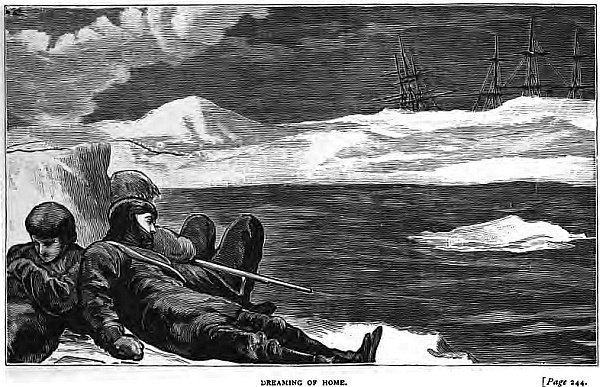
Rory’s eyes were closed, he heard no more. He was dreaming. Dreaming of what? you ask me. I answer, in the words of Lover,—
“Ask of the sailor youth, when far His light barque bounds o’er ocean’s foam What charms him most when evening star Smiles o’er the wave? To dream of home.”
Yes, Rory was dreaming of home. All the home he knew, poor lad! He was in the Castle of Arrandoon. Seeing, but all unseen, he stood in the cosy tartan parlour where he had spent so many happy hours. A bright fire was burning in the grate, the curtains were drawn, in her easy-chair sat Allan’s mother with her work on her lap, the great deerhound lay on the hearthrug asleep, and Helen Edith was bending over her harp. How boy Rory longed to rush forward and take her by the hand! But even in his partial sleep he knew this was but a dream, and he feared to move lest he might break the sweet spell. But languor, pain, and cold, all were forgotten while the vision lasted.
But list! a horn seems to sound beyond the castle moat. Rory, in his dream, wonders that Helen hears it not; then the boy starts to his feet on the snow. The vision has fled, and the sound of the horn resolves itself into the shout,—
“Ahoy—oy—hoy! Ahoy! hoy!”
Every one is on his feet at the same time, though both Allan and Rory stagger and fall again. But, behold! a boat comes dancing down the lane of water towards them, and a minute after they are all safe on board.
The labour of getting that boat over the ice had been tremendous. It had been a labour of love, however, and the men had worked cheerily and boldly, and never flinched a moment, until it was safely launched in the open water and our heroes were in it.
The Arrandoon, the men told them, had got up steam, and in a couple of hours at most she would reach the water. Meanwhile they, by the captain’s orders, were to land on the other side, and make themselves as comfortable as possible until her arrival.
Rory and Allan were quite themselves again now, and so, too, was honest Seth,—
“Though, blame me,” said he, “if I didn’t think this old trapper’s time had come. Not that that’d matter a sight, but I did feel for you youngsters, blame me if I didn’t;” and he dashed his coat-sleeve rapidly across his face as he spoke.
And now a fire was built and coffee made, and Stevenson then opened the Norwegian chest—a wonderful contrivance, in which a dinner may be kept hot for four-and-twenty hours, and even partially cooked. Up arose the savoury steam of a glorious Irish stew.
“How mindful of the captain?” said Allan.
“It was Ralph that sent the dinner,” said Stevenson, “and he sent with it his compliments to Rory.”
“Bless his old heart,” cried Rory. “I don’t think I’ll ever chaff him again about the gourmandising propensities of the Saxon race.”
“And the doctor,” continued the mate, “sent you some blankets, Mr Rory. There they are, sir; and he told me to give you this note, if I found you alive.”
The note was in the Scottish dialect, and ran as follows:—
“My conscience, Rory! some folks pay dear for their whustle. But keep up your heart, ma wee laddie. It’s a vera judeecious arrangement.”
In a few days more the Arrandoon had made good her repairs, and as the western wind had freshened, and was blowing what would have been a ten-knot breeze in the open sea, the steamer got up steam and the sailing-ship canvas, and together they took the loose ice, and made their way slowly to the eastward. The bergs, though some distance asunder, were still sufficiently near to considerably impede their way, and, for fear of accident, the Arrandoon took the cockle-shell, as she was always called now, in tow.
For many days the ships went steadily eastward, which proved to them how extensive the pack had been. Sometimes they came upon large tracts of open water, many miles in extent, and across this they sailed merrily and speedily enough, considering that neither of the vessels had as yet shipped her rudder. This they had determined not to do until they were well clear of the very heavy ice, or until the swell went down. So they were steered entirely by boats pulling ahead of them.
Open water at last, and the cockle-shell bids the big ships adieu, spreads her white sails to the breeze, and, swanlike, goes sailing away for the distant isle of Jan Mayen. Ay, and the big ships themselves must now very soon part company, the Scotia to bear up for the green shores of our native land, the Arrandoon for regions as yet unknown.
Chapter Twenty Seven.
Working along the Pack Edge—Among the Seals again—A Bumper Ship—Adventures on the Ice—Ted Wilson’s Promotion.
The Arrandoon was steaming slowly along the pack edge, wind still westerly, the Canny Scotia, with all canvas exposed, a mile or more to leeward of her. Both were heading in the same direction, north and by east, for McBain and our heroes had determined not to desert Silas until he really had what he called a voyage—in other words, a full ship.
“We can spare the time, you know,” the captain had said to Ralph; “a fortnight, will do it, and I dare say Rory here doesn’t object to a little more sport before going away to the far north.”
“That I don’t,” Rory had replied.
“If we fall among the old seals, a fortnight will do it.”
“Ay,” Allan had said, “and won’t old Silas be happy!”
“Yes,” from McBain; “and, after all, to be able to give happiness to others is certainly one of the greatest pleasures in this world.”
Dear reader, just a word parenthetically. I am so sure that what McBain said is true, that I earnestly advise you to try the experiment suggested by his words, for great is the reward, even in this world, of those who can conquer self and endeavour to bring joy to others.
The Arrandoon steamed along the pack edge, but it must not be supposed that this was a straight line, or anything like it. Indeed it was very much like any ordinary coastline, for here was a bay and yonder a cape, and yonder again, where the ice is heavier, a bold promontory. But Greenlandmen call a bay a “bight,” and a cape they call a “point-end.” Let us adopt their nomenclature.
The Canny Scotia, then, avoided these point-ends; she kept well out to sea, well away from the pack, for there was not over-much wind, and Silas Grig had no wish to be beset again. But the Arrandoon, on the other hand, steamed, as I have said, in a straight line. She scorned to double a point, but went steadily on her course, ploughing her way through the bergs. There was one advantage in this: she could the more easily discover the seals, for in the month of May these animals, having done their duty by their young, commence their return journey to the north, the polar regions being their home par excellence. They are in no hurry getting back, however. They like to enjoy themselves, and usually for every one day’s progress they make, they lie two or three on the ice. The capes, or point-ends, are favourite positions with them, and on the bergs they may be seen lying in scores, nor if the sun be shining with any degree of strength are they at all easily disturbed. It is their summer, and they try to make the best of it. Hark now to that shout from the crow’s-nest of the Arrandoon.
“A large patch of seals in sight, sir.”
Our heroes pause in their walk, and gaze upwards; from the deck nothing is visible to windward save the great ice-pack.
“Where away?” cries Stevenson.
“On the weather bow, sir, and a good mile in through the pack.”
“What do you think, sir?” says Stevenson, addressing his commander. “Shall we risk taking the ice again?”
“Risk, Stevenson?” is the reply. “Why, man, yes; we’ll risk anything to do old Silas a good turn. We’ll risk more yet, mate, before the ship’s head is turned homewards.”
Then the ship is stopped, and signals are made to Silas, who instantly changes his course, and, after a vast deal of tacking and half-tacking, bears down upon them, and being nearly alongside, gets his main-yard aback, and presently lowers a boat and comes on board the Arrandoon.
Our heroes crowd around him.
“Why,” they say, “you are a perfect stranger; it is a whole week since we’ve seen you.”
“Ay,” says Silas, “and a whole week without seeing a seal—isn’t it astonishing?”
“Ah! but they’re in sight now,” says McBain. “I’m going to take the ice, and I’ll tow you in, and if you’re not a bumper ship before a week, then this isn’t the Arrandoon, that’s all.”
Silas is all smiles; he rubs his hands, and finally laughs outright, then he claps his hand on his leg, and,—
“I was sure of it,” says Silas, “soon as ever I saw your signal. ‘Matie,’ says I, ‘yonder is a signal from the Arrandoon. I’m wanted on board; seals is in sight, ye maybe sure. Matie,’ says I, ‘luck’s turned again;’ and with that I gives him such a dig in the ribs that he nearly jumped out of the nest.”
“Make the signal to the Scotia, Stevenson,” says McBain, “to clew up, and to get all ready for being taken in tow. Come below, Captain Grig, lunch is on the table.”
Fairly seated at the table, honest Silas rubbed his hands again and looked with a delighted smile at each of his friends in turn. There was a bluff heartiness about this old sailor which was very taking.
“I declare,” he said, “I feel just like a schoolboy home for a holiday?”
Rory and Silas were specially friendly.
“Rory, lad,” he remarked, after a pause, “we won’t be long together now.”
“No,” replied Rory; “and it isn’t sorry I am, but really downright sad at the thoughts of your going away and leaving us. I say, though—happy thought!—send Stevenson home with your ship and you stay with us in place of him.”
Silas laughed. “What would my owners say, boy? and what about my little wife, eh?”
“Ah! true,” said Rory; “I had forgotten.” Then, after a pause, he added, more heartily, “But we’ll meet again, won’t we?”
“Please God!” said Silas, reverently. “I think,” Rory added, “I would know your house among a thousand, you have told me so much about it—the blue-grey walls, the bay windows, the garden, with its roses and—and—”
“The green paling,” Silas put in. “Ah, yes! the green paling, to be sure; how could I have forgotten that? Well, I’ll come and see you; and won’t you bring out the green ginger that day, Silas!”
“And the bun,” added Silas. “And the bun,” repeated Rory after him. “And won’t my little wife make you welcome, too! you may bet your fiddle on that!”
Then these two sworn friends grasped hands over the table, and the conversation dropped for a time.
But there perhaps never was a much happier Greenland skipper than Silas Grig, when he found his ship lying secure among the ice, with thousands on thousands of old seals all around him. The weather continued extremely fine for a whole week. The little wind there had been, died all away, and the sun shone more warmly and brightly than it had done since the Arrandoon came to the country. The seals were so cosy that they really did not seem to mind being shot, and those that were scared off one piece of ice almost immediately scrambled on to another. “Fire away!” they seemed to say; “we are so numerous that we really won’t miss a few of us. Only don’t disturb us more than you can help.”
So the seals hugged the ice, basking in the bright sunshine, either sleeping soundly or gazing dreamily around them with their splendid eyes, or scratching their woolly ribs with their flippers for want of something to do.
And bang, bang, bang! went the rifles; they never seemed to cease from the noon of night until mid-day, nor from mid-day until the noon of night again.
The draggers of skins went in pairs for safety, and thus many a poor fellow who tumbled into the sea between the bergs, escaped with a ducking when otherwise he would have lost his life.
Ralph—long-legged, brawny-chested Saxon Ralph—was among “the ducked,” as Rory called the unfortunates. He came to a space of water which was too wide even for him. He would not be beaten, though, so he pitched his rifle over first by way of beginning the battle. Then he thought, by swinging his heavy cartridge-bag by its shoulder-strap the weight would help to carry him over. He called this jumping from a tangent. It was a miserable failure. But the best of the fun—so Rory said, though it could not have been fun to Ralph—was this: when he found himself floundering in the water he let go the bag of cartridges, which at once began to sink, but in sinking caught his heel, and pulled him for the moment under water. Poor Ralph! his feelings may be better imagined than described.
“I made sure a shark had me!” he said, quietly, when by the help of his friend Rory, he had been brought safely to bank.
It was not very often that Ralph had a mishap of any kind, but, having come to grief in this way, it was not likely that Rory would throw away so good a chance of chaffing him.
He suddenly burst out laughing at luncheon that day, at a time when nobody was speaking, and when apparently there was nothing at all to laugh about.
“What now, Rory? what now, boy?” said McBain, with a smile of anticipation.
“Oh!” cried Rory, “if you had only seen my big English brother’s face when he thought the shark had him!”
“Was it funny?” said Allan, egging him on.
“Funny!” said Rory. “Och I now, funny is no name for it. You should have seen the eyes of him!—and his jaw fall!—and that big chin of his. You know, Englishmen have a lot of chin, and—”
“And Irishmen have a lot of cheek,” cried Ralph. “Just wait till I get you on deck, Row boy.”
“I’d make him whustle,” suggested the doctor.
“Troth,” Rory went on, “it was very nearly the death o’ me. And to see him kick and flounder! Sure I’d pity the shark that got one between the eyes from your foot, baby Ralph.”
“Well,” said Ralph, “it was nearly the death of me, anyhow, having to take off all my clothes and wring them on top of the snow.”
“Oh! but,” continued Rory, assuming seriousness, and addressing McBain, “you ought to have seen Ralph just then, sir. That was the time to see my baby brother to advantage. Neptune is nobody to him. Troth, Ray, if you’d lived in the good old times, it’s a gladiator they’d have made of you entirely.”
Here came a low derisive laugh from Cockie’s cage, and Ralph pitched a crust of bread at the bird, and shook his fingers at Rory.
But Rory kept out of Ralph’s way for a whole hour after this, and by that time the storm had blown clean away, so Rory was safe.
Allan had his turn next day. The danger in walking on the ice was chiefly owing to the fact that the edges of many of the bergs had been undermined by the waves and the recent swell, so that they were apt to break off and precipitate the unwary pedestrian into the water.
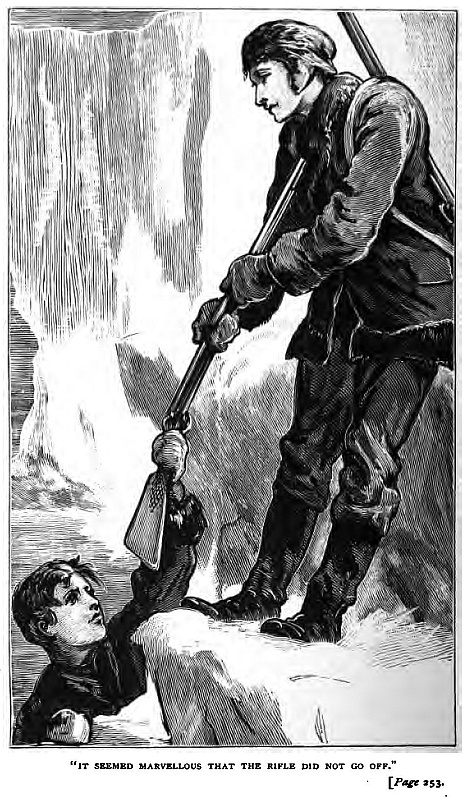
Here is Allan’s little adventure, and it makes one shudder to think how nearly it led him to being an actor in a terrible tragedy. He was trudging on after the seals with rifle at full cock, for he expected a shot almost immediately, when, as he was about to leap, the snowy edge of the berg gave way, and down he went. Instinctively he held his rifle out to his friend, who grasped it with both hands, the muzzle against his breast, and thus pulled him out. It seemed marvellous that the rifle did not go off.
(Both these adventures are sketched from the life.)
When safe to bank, and when he noticed the manner in which he had been helped out, poor Allan felt sick, there is no other name for it.
“Oh, Ralph, Ralph!” he said, clutching his friend by the shoulder to keep himself from falling, “what if I had killed you?”
When told of the incident that evening after dinner, McBain, after a momentary silence, said quietly,—
“I’m not sorry such a thing should have happened, boys; it ought to teach you caution; and it teaches us all that there is Some One in whose hands we are; Some One to look after us even in moments of extremest peril.”
But I think Allan loved Ralph even better after this.
Two weeks’ constant sealing; two weeks during which the crews of the Arrandoon and Canny Scotia never sat down to a regular meal, and never lay down for two consecutive hours of repose, only eating when hungry and sleeping when they could no longer keep moving; two weeks during which nobody knew what o’clock it was at any particular time, or which was east or west, or whether it were day or night. Two weeks, then the seals on the ice disappeared as if by magic, for the frost was coming.
“Let them go,” said Silas, shaking McBain warmly by the hand. “Thanks to you, sir, I’m a bumper ship. Why, man, I’m full to the hatches. Low freeboard and all that sort of thing. Plimsoll wouldn’t pass us out of any British harbour. But, with fair weather and God’s help, sir, we’ll get safely home.”
“And now,” McBain replied, “there isn’t a moment to lose. We must get out of here, Captain Grig, or the frost will serve us a trick as it did before.”
With some difficulty the ships were got about and headed once more for the open sea.
None too soon, though, for there came again that strange, ethereal blue into the sky, which, from their experiences of the last black frost, they had learned to dread. The thermometer sank, and sank, and sank, till far down below zero.
The Arrandoon took her “chummy ship” in tow.
“Go ahead at full speed,” was the order.
No, none too soon, for in two hours’ time the great steam-hammer had to be set to work to break the newly-formed bay ice at the bows of the Arrandoon, and fifty men were sent over the side to help her on. With iron-shod pikes they smashed the ice, with long poles they pushed the bergs, singing merrily as they worked, working merrily as they sang, laughing, joking, stamping, shouting, and cheering as ever and anon the great ship made another spurt, and tore along for fifty or a hundred yards. Handicapped though she was by having the Scotia in tow, the Arrandoon fought the ice as if she had been some mighty giant, and every minute the distance between her and the open water became less, till at last it could be seen even from the quarter-deck. But the frost seemed to grow momentarily more intense, and the bay- ce stronger and harder between the bergs. Never mind, that only stimulated the men to greater exertions. It was a battle for freedom, and they meant to win. With well-meaning though ridiculous doggerel, Ted Wilson led the music,—
“Work and keep warm, boys; heave and keep hot, Jack Frost thinks he’s clever; we’ll show him he’s not. Beyond is the sea, boys; Let us fight and get free, boys; One thing will keep boiling, and that is the pot. With a heave O! Push and she’ll go. To work and to fight is the bold sailor’s lot. Heave O—O—O! “Go fetch me the lubber who won’t bear a hand, We’ll feed him on blubber, we’ll stuff him with sand. But yonder our ships, boys, Ere they get in the nips, boys, We’ll wrestle and work, as long’s we can stand, Then cheerily has it, men, Heave O—O—O! Merrily has it, men, Off we go, O—O—O!”
Yes, reader, and away they went, and in one more hour they were clear of the ice, the Arrandoon had cast the Scotia off, and banked her fires, for, together with her consort, she was to sail, not steam, down to the island of Jan Mayen, where they were to take on board the sleigh-dogs, and bid farewell to Captain Cobb, the bold Yankee astronomer.—There was but little wind, but they made the most of what there was. Silas dined on board that day, as usual. They were determined to have as much of the worthy old sailor as they could. But before dinner one good action was performed by McBain in Captain Grig’s presence. First he called all hands, and ordered them aft; then he asked Ted Wilson to step forward, and addressed him briefly as follows:
“Mr Wilson, I find I can do with another mate, and I appoint you to the post.”
Ted was a little taken aback; a brighter light came into his eyes; he muttered something—thanks, I suppose—but the men’s cheering drowned his voice. Then our heroes shook hands with him all around, and McBain gave the order,—
“Pipe down.”
But as soon as Ted Wilson returned to his shipmates they shouldered him, and carried him high and dry right away forward, and so down below.
Chapter Twenty Eight.
A Wonderful Yankee—“Making Off” Skins—Preparing to “Bear up”—The Summer Home of the Giant Walrus—The Ships Part.
In two days the ships sighted the island of Jan Mayen. As they neared it, they found the ice so closely packed around the shore that all approach even by boats was out of the question, so the sails were clewed, the ice-anchors got out, and both ships made fast to the floe.
It was not long ere Captain Cobb was on board the Arrandoon, to welcome our heroes back to “his island of Jan Mayen.”
He was profuse in his thanks for what he called the clever kindness of Captain McBain, in saving his little yacht from a fatal accident among the ice; and, of course, they would do him the honour to come on shore and dine with him. He would take it as downright “mean” if they did not.
There was no resisting such an appeal as this, so, leaving their ships in charge of their respective mates, both McBain and Silas, in company with our heroes—Sandy McFlail, Seth, and all—they trudged off over the snowy bergs to take dinner in the hut of the bold Yankee astronomer. Very unprepossessing, indeed, was the building to behold from the outside, but no sooner had they entered, than they opened their eyes wide with astonishment.
When our young friends had visited it before, the hut looked neither more nor less than a big hall, or rather barn. But now—why, here were all the luxuries of civilised life. The place was divided into ante-room, saloon, and bed-chamber, and each apartment seemed more comfortable than another. The walls of the saloon were covered with rich tapestry, the floor with a soft thick carpet. There were couches and easy-chairs and skins galore, and books and musical instruments. A great stove, of American pattern, burned in the centre, giving out warmth and making the room look doubly cheerful, and overhead swung an immense lamp, which shed a soft, effulgent light everywhere, so that one did not miss the windows, of which the hut was minus. At one end of this apartment was a dining-table, as well laid and as prettily arranged as if it stood in the dining-hall of a club-room in Pall Mall, and beside the table were two sable waiters clad in white.
Captain Cobb seemed to thoroughly enjoy the looks of bewilderment and wonder exhibited on the faces of his guests.
“Why,” said McBain at last, “pardon me, but you Yankees are about the most wonderful people on the face of the earth.”
“Waal,” said the Yankee, “I guess we like our little comforts, and don’t see any harm in having them.”
“So long’s we deserve them,” put in Seth, who, at that moment, really felt very proud of being a Yankee.
“Bravo! old man,” cried his countryman; “let us shake your hand.”
“And now, gentlemen,” he continued, “sit in. I reckon the keen air and the walk have given ye all an appetite.”
Soups, fish, entries, joints—why I do not know what there was not in the bill-of-fare. It was a banquet fit for a king.
“I can’t make out how you manage it,” said McBain. “Do you keep a djin?”
Cobb laughed and summoned the cook. If he was not a djin, he was just as ugly. Four feet high—not an inch more—with long arms, black skin, flat face, and no nose at all worth mentioning. He was dressed as a chef, however, and very polite, for at a motion from his master, he salaamed very prettily and retired.
At dessert the host produced a zither, and, accompanying himself on this beautiful instrument, sang to them. He drawled while talking, but he sang most sweetly, and with a taste and feeling that quite charmed Rory, and held Silas and the doctor spell-bound. He was indeed a wonderful Yankee.
“Do you know,” said Rory, “I feel for all the world like being in an enchanted cave? Do sing again, if only one song.”
It is needless to add that our friends spent the evening most enjoyably. It was a red-letter night, and one they often looked back to with pleasure, and talked about as they lay around their snuggery fire, during the long dreary time they spent in the regions round the Pole.
“I’m glad, anyhow,” said Captain Cobb, as he bade them good-bye on the snow-clad beach, “that I’ve made it a kind o’ pleasant for ye. Don’t forget to call as you come back, and if Cobb be here, why, Cobb will bid you welcome. Farewell.”
By eight bells in next morning watch everything was ready for a start. The dogs—twelve in number—were got on board and duly kennelled, and the old trapper was installed as whipper-in.
“But I guess,” said Seth, “there won’t be much whipping-in in the play. Trapper Seth is one of those rare old birds who know the difference between a dog and a door-knocker. Yes, Seth knows that there’s more in a good bed and a biscuit, with a kind word whenever it is needed, than there is in all the cruel whips in existence.”
The kennelling for the poor animals was got up under the supervision of Ap and Seth himself. It was built on what the trapper called “scientific principles.”
There was a yard or ran in common for the whole pack; but the large, roomy sleeping compartment had a bench, on which all twelve dogs could sleep or lie at once, yet nevertheless it was divided by boards about a foot high into six divisions. This was to prevent the dogs all tumbling into a heap when the ship rolled. The bedding was straw and shavings; of the former commodity McBain had not forgotten to lay in a plentiful supply before leaving Scotland. There was, besides, a whole tankful of Spratts’ biscuits, so that what with these and the ship’s scraps, it did not seem at all likely that the dogs would go hungry to bed for some time to come.
Seth was now much happier on board than ever he had been, because he had duties to perform and an office to fill, humble though it might be.
At half-past eight Silas came on board the Arrandoon to breakfast. Allan and Rory were tramping rapidly up and down the deck to keep themselves warm, for, though the wind was blowing west-south-west, it was bitterly cold, and the “barber” was blowing. The barber is a name given to a light vapoury mist that, when the frost is intense and the wind in pertain directions, is seen rising off the sea in Greenland. I have called it a mist, but it in reality partakes more of the nature of steam, being due to the circumstance of the air being ever so much colder than the surface of the water.
Oh! but it is a cold steam—a bitter, biting, killing steam. Woe be to the man who exposes his ears to it, or who does not keep constantly rubbing his nose when walking or sailing in it, for want of precaution in this respect may result in the loss of ears or nose, and both appendages are useful, not to say ornamental.
“Good morning,” cried Silas, jumping down on to the deck.
“The top of the morning to you, friend Silas,” said Rory; “how do you feel after your blow-out at Captain Cobb’s?”
“Fust-rate,” said Silas—“just fust-rate; but where is Ralph and the captain?”
“Ralph!” said Rory; “why, I don’t suppose there is a bit of him to be seen yet, except the extreme tip of his nose and maybe a morsel of his Saxon chin; and as for the captain, he is busy in his cabin. Breakfast all ready, is it, Peter? Thank you, Peter, we’re coming down in a jiffy.”
Just as they entered the saloon by one door, McBain came in by another.
“Ah! good morning, Captain Grig,” he cried, extending his hand. “Sit down. Peter, the coffee. And now,” he continued, “what think you of the prospect? It isn’t exactly a fair wind for you to bear up, is it?”
“The wind would do,” said Silas; “but I’m hardly what you might call tidy enough to bear up yet. It’ll take us a week to make off our skins, and a day more to clean up. I’d like to go home not only a bumper ship, but a clean and wholesome sweet ship.”
“Well, then,” McBain said, “here is what I’ll do for you.”
“But you’ve done so much already,” put in Silas, “that really—”
“Nonsense, man,” cried McBain, interrupting him; “why, it has been all fun to us. But I was going to say that instead of lying here for a week, you had better sail north with us, Spitzbergen way, and my men will help you to make off and tidy up. Who knows but that after that you may get a fair wind to carry you right away south into summer weather in little over a week?”
“Bless your heart!” said Silas; “the suggestion is a grand one. I close with your offer at once. You see, sir, we Greenlandmen generally return to harbour all dirty, outside anyhow, with our sides scraped clean o’ paint, and our masts and spars as black as a collier’s.”
“You shan’t, though,” said McBain. “We’ll spend a bucket or two of paint over him, won’t we, boys?”
“That will we,” said Ralph and Allan, both in one breath.
“And I’ll tell you what I’ll do,” added Rory.
“Something nice, I’m certain,” said Silas.
“I’ll paint and gild that Highland lassie of yours that you have for a figure-head.”
“Glorious! glorious!” cried Silas Grig.
“Why, my own wife won’t know the ship. And, poor wee body! she’ll be down there looking anxiously enough out to sea when she hears I’m in the offing. Oh, it will be glorious! Won’t my matie be pleased when he hears about it!”
“I say, though,” said Rory, “I’ll change the pattern of your Highland lassie’s tartan. She came to the country a Gordon, she shall return a McGregor.”
“Or a McFlail,” suggested Sandy.
“Ha! ha! ha!” This was an impudent, derisive laugh from Cockie’s cage, which made everybody else laugh, and caused Sandy to turn red in the face.
After breakfast the ice-anchors were cast off and got on board, and sail set. The Arrandoon led, keeping well clear of the ice, and taking a course of north-east and by north. When well off the ice, and everything working free and easy, McBain called all hands, and ordered the men to lay aft.
“Men,” he said, “you all signed articles to complete the voyage with me to the Polar regions and back. Most of you knew, as you put your names to the paper, what you were about, because you had been here before, but some of you didn’t. Now I am by no means short-handed, and if any of you thinks he has had enough of it already, and would like to return to his country, step forward and say so now, and I’ll make arrangements with Captain Grig for your passage back.”
Not a man stirred.
“I will take it as a favour,” continued the captain, “if any one who has any doubts on his mind will come forward now. I want only willing hands with me.”
“We are willing, we are willing hands,” the men shouted.
“Beg your pardon, sir,” said bold Ted Wilson, stepping forward, “but I know the crew well. I’m sure they all feel thankful for your kind offer, but ne’er a man Jack o’ them would go back, if you offered to pay him for doing so.”
The captain bowed and thanked Ted, and the men gave one hearty cheer and retired.
Once fairly at sea, McBain sent two whalers on board the Scotia, their crews rigged out in working dress, and making off was at once commenced.
Upright boards were made fast here and there along the decks; the skins, with their two or three inches of blubber attached, were handed up from below, and the men set to work in this way—they stood at one side of the board and spread the skin in front of them on the other; then they leant over, and first cutting off all useless pieces of flesh, etc, they next cleaned the blubber from off the skin. This was by other hands cut into pieces about a foot square, carried away, and sent below to be deposited in the tanks. Other workmen removed the cleaned skins. These were dashed over with rough salt, rolled tightly and separately up, and cast into tanks by themselves. This latter duty devolved upon the mates, and old Silas himself stood, with book in hand, “taking tally,” that is, counting the number of skins as they were passed one by one below. The refuse, or “orra bits,” as Scotch sailors call them, were thrown overboard by bucketfuls, and over these thousands of screaming gulls fought on the surface of the water, and scores of sharks immediately beneath.
It was a busy scene, and one that can only be witnessed in Greenland north.
In three days all the skins were made off and stowed away. All this time the men had been as merry as sheep-shearers, and only on the last day did Silas splice the main-brace, even then diluting the rum with warm coffee.
Then came the cleaning up, and scouring of decks below and above, and white-washing and mast-scraping. After this McBain sent his painters on board, and in less than four-and-twenty hours she looked like a new ship.
And Rory was busy below on the ’tween decks. The Highland lassie had been unshipped, and taken below for him to paint and gild. Rory, mind you, did not wish it to be unshipped. He would have preferred being swung overboard. There would have been more fun in it, he said. But Silas would not hear of such a thing. The cold, he feared, would benumb him so that he might drop off into the sea, to the infinite joy and satisfaction of a gang of unprincipled sharks that kept up with the ship, but to the everlasting sorrow of him, Captain Silas Grig.
When the ship was all painted, and the masts scraped and varnished, and the Highland lassie—brightly arrayed in gold and McGregor tartan—re-shipped, why then, I do not think a prouder or happier man than Silas Grig ever trod a quarter-deck.
The day after this everybody on the Arrandoon was busy, busy, busy writing letters for home.
They were thus engaged, when a shout came from the crow’s-nest,—
“Heavy ice ahead!”
It was the ice-bound shores of the southernmost islands of Spitzbergen they had sighted. They passed between several of these, and grandly beautiful they looked, with their fantastically-shaped sides glittering green and blue and white in the sunshine. These islands seemed to be the northern home or summer retreat of the great bladder-nosed seal and the giant walrus. They basked on the smaller bergs that floated around them, while hundreds of strange sea-birds nodded half asleep on the snow-clad rocks.
It was here where the two ships parted, the Canny Scotia bearing up for the sunny south, the Arrandoon clewing sails and lighting fires to steam away to The Unknown Land.
There were tears in poor Rory’s eyes as he shook hands with Silas, and he could not trust himself to say much. Indeed, there was little said on either hand, but the farewell wishes were none the less heartfelt for all that. There is always somewhat of humour mixed up with the sad in life. It was not wanting on this occasion. Silas had brought a servant with him when he came to say adieu. This servant carried with him a mysterious-looking box. It was all he could do to lift it. Seeing McBain look inquiringly at it,—
“It’s just a drop of green ginger,” said Silas. “When you tap it, boys, when far away from here, you won’t forget Silas, I know. I won’t forget you, anyhow,” he continued; “and look here, boys, if a prayer from such a rough old salt as I am availeth, then Heaven will send you safely home again, and the first to welcome you will be Silas Grig. Good-bye, God be wi’ ye.”
“Good-bye, God be wi’ ye.”
Chapter Twenty Nine.
Northward Ho!—Hoisting Beacons—The White Fog—The Great Sea-Serpent.
“Good-bye, and God be with you.”
It was a prayer as heartfelt and fervent as ever fell from the lips of an honest sailor.
The Arrandoon steamed away, and soon was hidden from view behind a lofty iceberg, and all that Silas Grig, as he stood on his own quarter-deck, could now hear, was the sad and mournful wail of Peter’s bagpipes. Peter was playing that wild and plaintive melody which has drawn tears from so many eyes when our brave Highland regiments were departing for some far-off seat of wax, to be—
“Borne on rough seas to a far-distant shore, Maybe to return to Lochaber no more.”
“Heigho! matie,” sighed Silas, talking to his chief officer and giving orders all in one breath, “I don’t think we’ll—haul aft the jib-sheet—ever see them again. I don’t think they can—take a pull on the main-brace—ever get back from among that fearful—luff a little, lad, luff—ice, matie. And the poor boys, if any one had told Silas he could have loved them as much as he does in so short a time, he would have laughed in his face. Come below, matie, and we’ll have a drop o’ green ginger. Keep her close, Mortimer, but don’t let her shiver.”