Chapter III · THE ARTIST IN PRACTICE
Reading edition
I—THE EARLY MISCELLANEOUS WORKS
According to Wagner's own account, he sketched tragedies in his childhood, and worked out one that was a sort of blend of Hamlet and King Lear; and, inspired by Beethoven's Egmont, he soon desired to adorn this grand tragedy with music of his own. A brief study of Logier's Method of Thorough-Bass did not provide him with the needed technique, though, convinced that he was born to be a musician, he wrote a sonata, a quartet and an aria in secret. In his sixteenth year he placed himself under a teacher, who, however, could do nothing with him in the excessively febrile state in which he then was. His nervous excitement culminated in a round of the usual student excesses; and having calmed down again he set himself to study composition in earnest with Weinlig, the cantor of the Thomas School. Six months' work sufficed to satisfy Weinlig that his pupil was now competent to stand on his own legs. It is at this time (1831) that he produces the compositions that are the earliest we now possess of his.
At present he has apparently no inclination towards opera. The raw works of his adolescence had all been instrumental; among them was the Overture in B flat major (1830) that was performed in the Leipzig Theatre, and in which the drum-beat every four bars ended by moving the audience to uncontrollable merriment. It is not till the summer of 1832 that he plans a first opera. Die Hochzeit; he writes the text, but composes no more than a fragment of the music. Meanwhile he produces, as the result of Weinlig's schooling, a number of works more or less in the conventional style. The pianoforte sonata in B flat major that was published by Breitkopf & Härtel as the composer's Op. 1 is dedicated to Weinlig, under whose eye the work was written. His teacher had evidently seen the need for curbing the exuberance of the boy's undisciplined mind. He made him write simply, in the set forms, and with regard to the clarities of the pure vocal style. For this first sonata, Wagner tells us, Weinlig induced him to take an early sonata by Pleyel as a model; the whole work was to be shaped on "strictly harmonic and thematic lines." Wagner himself never thought much of it. But if it is no more than an imitation of the current sonata style, it is an unmistakably capable imitation. Weinlig was right; he had given his pupil independence. In all these youthful works, indeed, we are struck by the unquestioning self-confidence of the manner, and by the boyish vigour that animates them. As a reward for his docility in the matter of the sonata he was allowed by Weinlig to compose a pianoforte fantasia in F sharp minor. He treated this, he says, in a more informal style. It is really a quite powerful work for a boy of eighteen. It defines a mood, and maintains it with singular persistence; it expresses something truly felt; it comes from the brooding absorption of spirit that was afterwards to produce the Faust Overture. It is liberally sown with recitative passages that suggest some knowledge of Bach (the Chromatic Fantasia or the G minor Fantasia for the organ), or of Beethoven (pianoforte sonata in A flat. Op. 110, &c.). The manner and feeling of the adagio suggest the slow movement of Beethoven's fifth symphony, the later ornamentation of the main melodic idea being quite in the style of that movement. Altogether the Fantasia is by no means a work to be despised; it is the one composition of Wagner's of this period in which we catch a decided note of promise for the future.
The Polonaise in D major for four hands (1831) is more in the conventional manner, but quite interesting, and as original as we can expect from the average young composer of eighteen. The A major sonata (Op. 4, 1831) flows on in the glib, confident way that is characteristic of all his early instrumental works, and has many good points. The weakest movement is the third—a rather amateurish fugue. There is some expression in the slow movement, and a general freedom of style everywhere except in the fugue. The idiom as a whole is that of the early Beethoven, but occasionally the writing suggests a boy who knew something of Weber and of the later Beethoven, though his invention and his technique were as yet equal only to imitating the simpler models.
For its day the Symphony in C major (1832) is a very capable piece of student work; the interest slackens very considerably in the finale, but the other movements are handled with the customary young-Wagnerian vigour and confidence. In spite of the ease and the cleverness of it, however, we can rarely feel that it is anything more than a piece of competent school work, though there is undeniable thoughtfulness in the andante.
The work of the next five years varies in quality and purpose in a most puzzling way. In 1832 he writes the King Enzio Overture, under the influence, as he tells us in Mein Leben, of Beethoven. It is plainly modelled on the dramatic overture of the Egmont and Coriolan type—a type that Mendelssohn, in the Ruy Blas and elsewhere, afterwards cultivated, without however adding anything to it. The young Wagner has a thorough grasp of the form. The Overture is concise and well balanced; all the details are clearly seen in relation to the dominant idea. The thematic invention is good, the themes being not only expressive in themselves but capable of bearing the weight of a certain amount of dramatic development. Yet after writing this fine Overture, that really may point without presumption to Beethoven as its parent, he was capable of producing in 1836 the shapeless and frothy Polonia Overture, which is the oddest mixture of a pseudo-Polish idiom and the cheap, assertive melody of Rienzi. Here and there it gives us a foretaste of his later power of climax-building, but on the whole it is a feeble and amorphous work. The Rule, Britannia Overture (1836) is hardly any better; it is a long-winded and pointless dissertation on our patriotic song, the original tune being by far the best thing in it. The Columbus Overture of the preceding year is rather better. Its style is a curious blend of Beethoven, Rienzi, and the Italian opera; it is oddly anticipatory of Liszt in its repetitions and its make-believe development: but the work has a sort of strength. It is evidently the outcome of a vision clearly seen, and translated into as good music as Wagner's powers at that time permitted.
Meanwhile in 1832—the same year as the King Enzio Overture and the C major symphony—he had written Seven Compositions to Goethe's Faust—"The soldiers' song," the "Peasants under the linden," "The song of the rat," "The song of the flea," Mephistopheles' song ("Was machst du mir vor Liebchens Tür"), Margaret's song ("Meine Ruh' ist hin"), and a "melodrama" to accompany the recitation of Margaret's prayer to the Virgin.[396] Almost all of these have individuality, the least notable being Mephistopheles' song. The soldiers' song is breezy, with one or two crudities in the vocal part-writing. The "Bauern unter der Linde" is fresh and gay; the rat and flea songs are fairly humorous; it is rather curious that Wagner's rat song should begin with the full scale of D major in descending motion, while that of Berlioz commences with the same scale in ascent. Margaret's song is quite good, though it moves a little stiffly, and has neither the ardour of Schubert's setting nor the perfect mating of idea and expression that we find in that masterpiece. Wagner, indeed, developed very slowly. For a long time his genius could only move heavily: there was no swiftness in him, either of idea or of form,—no consuming heat. The melodrama is expressive, and the reiterated syncopations are effective. Wagner probably chose the melodrama form, rather than a purely lyrical setting of the words, because he felt that the former gave the dramatist in him more scope.
In 1832-33 the dramatic impulse became very strong in him. He had written the Hochzeit fragment and Die Feen by the end of 1833, and between 1834 and 1836 he finished the Liebesverbot. Already he had a technique equal to the expression of all the dramatic thinking of which he was capable at that time. How dexterous his hand had become is shown incidentally in the aria he added to Marschner's Vampyr in 1833,—a very vigorous and finished piece of work. There is the same skill in the "Romance of Max" that he added to the Singspiel Marie, Max and Michel (1837). There is piquancy in the scoring of the latter, and the vocal part has a rhythmic variety that we do not often find in Tannhäuser and Lohengrin. Apparently the only non-dramatic work he wrote at this time was the New Year Cantata, which is one of the freshest and most pleasing works of his youth. It consists of an overture and four other movements; the chorus takes part in the second and fourth of these, but in the latter the vocal parts are merely sketched in, and the words are lacking. In the slow opening section of the overture he introduces in the violas and 'cellos, with excellent effect, the theme of the andante of his C major symphony; it is apparently intended to symbolise the sadness of the departing year. It is impossible not to be captivated by the sincerity and the transparent simplicity of this little work.
During 1838 and 1839 his time was fully taken up with his theatrical duties at Königsberg and Riga, the composition of Rienzi, and the working out of other dramatic ideas; so that from 1837 to 1840 what may be called the occasional compositions are few in number. With the exception of the aria for Marie, Max and Michel, and the Faust compositions, his vocal works had so far all been settings of words of his own. Between 1837 and 1844 the texts of almost all his songs and choral works were by other people. At Riga, in 1837, he set a poem by Harald von Brackel in praise of the Czar Nicholas, for soprano or tenor solo, chorus, and orchestra. The piece is appropriately broad and massive, and imposing enough in mere volume; but it is impossible to believe that Wagner's heart was in a work of this kind.
Of much more interest is Der Tannenbaum, a setting of a poem by Scheuerlein (end of 1838). The song is expressive, though the effect lies more in the general colour, the harmony, and the pictorial realisation of the scene—the brooding tree, the river, and the boy are all differentiated—than in any particularly striking quality in the melody. The vocal line has more flexibility than is usual with the young Wagner. In July 1839 he entered upon his Paris adventure. For a while he eagerly pursues his fortune among the theatrical directors; then, as his hopes fail him and need gnaws at his heart, he produces a number of vocal works that he trusts may appeal to the French singers and the French public. Some of these are pot-boilers pure and simple, the writing of which must have been gall and bitterness to the young composer who had begun to realise the wonderful music there was in him. The lowest depth is touched in the vaudeville chorus, La Descente de la Courtille (1840)—a frank prostitution of his genius to the most superficial French taste of the time. Almost as bad is the song, Les adieux de Marie Stuart. A bar or two here and there bears the signature of the true Wagner—he cannot quite keep his real self out of it; but on the whole the song is a desperate, pitiful attempt to manufacture something in the conventional French and Italian operatic idiom of the day. Wagner's tongue must have been in his cheek when he penned such passages as these:
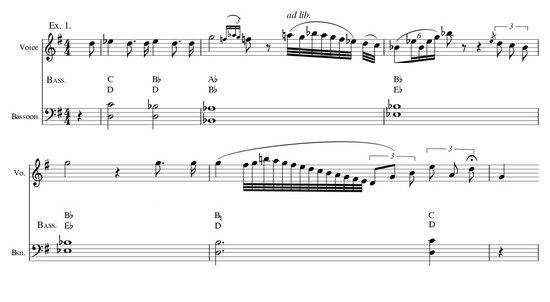
Ex. 1
[PDF] [MusicXML] Audio content is not currently supported on your device.
Je n'ai désiré d'être reine que pour régner sur les Français, que pour régner sur les Français.
To the same period and the same catchpenny mood belongs the Aria of Orovisto that he wrote in the hope that Lablache would sing it in Bellini's Norma. It is an amusingly absurd but skilful imitation of all the tricks-of-the-trade of the Italian opera of the 'thirties.
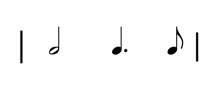
Other works of this time are more sincere, and most of them have a decided charm. The Albumblatt in E major, written for his friend Kietz, is a simple but engaging piece, with a touch or two of melodic commonplace—the occasional insertion, for example, of a triplet group in a duple-time phrase. The little work is curiously like the Lohengrin of seven years later in general texture, in melodic and harmonic build, and in the peculiar white light in which it is bathed. The songs to French words, written at Paris in 1839-40, vary greatly in quality. The Tout n'est qu'images fugitives never descends to the depth of banality reached in the Marie Stuart, but the effort to be ingratiatingly French is plainly evident. The Dors, mon enfant, Mignonne, and Attente are all charming; he thinks of the French style and the French public no more than is necessary to lighten the heaviness of his native German manner, and the results are sometimes surprising, particularly in the matter of rhythm. For many years to come, as he admits in a well-known letter to Uhlig, he was obsessed by a vocal rhythm of this type:
[PDF] [MusicXML] Audio content is not currently supported on your device.
—a type upon which hundreds of phrases in the Flying Dutchman, Tannhäuser, and Lohengrin are constructed. The best of these French songs have a rhythmic freedom and flexibility that he rarely attained in his later operas. Look, for example, at the following delightfully elastic vocal line from Attente:
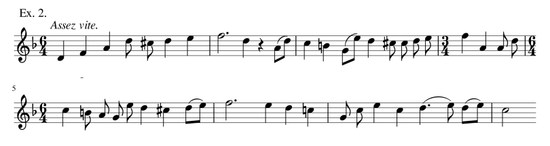
Ex. 2
[PDF] [MusicXML] Audio content is not currently supported on your device.
Cicogne, aux vieilles tours fidèle, ô vole et monte à tire d'aile de l'église à la citadelle, du haut clocher, du haut clocher au grand donjon.
It has always been evident that the rhythmic sameness of the earlier operas was mainly due to the monotonously regular recurrence of accents in the German verse he wrote at that time. These French songs make it clear—as, by the way, does the aria for Marie, Max and Michel—that when a more varied metrical scheme was given him his music spontaneously varied with it. One cannot help feeling that in some ways it is a pity he did not meet with more success at Paris—that he was not allowed, in fact, to write some large work with the deliberate intention of appealing to the French taste by an exploitation of the styles and the formulas the Parisian public loved most. Such a work would not have represented the real Wagner, and in the end would probably have been negligible; but it would have given a much needed lightness and elasticity to his imagination, without harming him in any way. He would have benefited by such an experience as emphatically as Handel and Mozart benefited by their experiences with Italian opera. As it was, a certain slowness and ponderousness remain characteristic of Wagner to the end of his days. This inability to concentrate rapidly is instructively shown in his French setting of Heine's Les deux Grenadiers (1839-40). In general expressiveness the song need not fear comparison with Schumann's: perhaps Wagner's treatment of the "Marseillaise" at the end is even better. But the work has nothing of Schumann's terseness, ease, and lyric spontaneity; the whole thing moves a little stiff-jointedly.
The Paris period is a curious one in Wagner's artistic history. He wrote some very good songs, and one or two deplorable things like the Marie Stuart and La Descente de la Courtille; at the same time he was finishing Rienzi and working at the Flying Dutchman, and the Faust Overture assumed its first form. In April 1842 he settled at Dresden. Between then and 1848 he composed Tannhäuser and Lohengrin, and conceived the first idea of the Ring and other works. During this period he wrote no songs or pianoforte pieces: the occasional compositions are all choral works, which is sufficiently accounted for by the fact that Wagner had a good male-voice choir at his disposal. The most considerable of these works is The Love Feast of the Apostles (1843). Towards the end it has a touch of the melodic commonplace that Wagner found it so hard to avoid at this time; but the earlier choral portions are impressive in their simplicity and sincerity, and the whole thing is admirably stage-managed, so to speak. The effect of the voices from on high, and of the first entry of the orchestra at the descent of the Spirit, must have been very striking in the Dresden church.
The other choral works of this period are on a smaller scale. For the unveiling of a memorial to King Friedrich August I Wagner wrote in 1843 a Weihegruss for male voices and brass orchestra, to words by Otto Hohlfeld. The choral portion of this work was published in 1906; the whole version is now published in Breitkopf & Härtel's Gesamtausgabe, and shows how indispensable is the orchestral part—the long-held vocal notes, for example, being helped out by trumpet, trombone, and horn fanfares, and the whole thing gaining enormously in richness by the discreet occasional entries of the brass. The general style of this work, as of the Greeting of Friedrich August the Beloved by his Faithful Subjects (August 1844), is that of the Tannhäuser-Lohengrin epoch; some passages in the Greeting, indeed, are extraordinarily reminiscent of the "Hall of song" chorus. For the re-interment of Weber's remains at Dresden, in December 1844, Wagner wrote a four-part male chorus that again recalls the operatic works of this time. It is the most expressive of Wagner's works of this class, but on the whole a little disappointing; his heart was so thoroughly with Weber that one would have thought the occasion would have wrung some music of the first class out of him.
II—THE EARLIEST OPERAS
Wagner worked out the drama of his first opera, Die Hochzeit ("The Wedding"), in 1833, but his sister Rosalie's antipathy to the gory and gruesome subject turned him against the work after he had written only some thirty or forty pages of the score—an Introduction, chorus and septet. The style has little individuality, though the chorus of female voices is not without charm. The septet, however, is an excellent piece of work for a boy of nineteen,—lucid, freely written, and with a certain amount of dramatic differentiation in some of the vocal parts.
His first complete opera, Die Feen (The Fairies), was written during his stay at Würzburg in 1833. The story, which may be read in Mein Leben or any of the biographies of Wagner, has long lost any interest it may once have possessed. In psychology and in structure alike the drama is very primitive. The magic element in it is fit only for the nursery, though it has to be observed that here we have for the first time that notion of "redemption" that plays so large a part in Wagner's thinking to the very end of his life. The construction is formal and cumbersome: the two chief lovers have as a foil two subordinate lovers, while set off against these is a third pair, who provide a sort of comic interest; the whole past, present and future are explained in recitatives; everybody of any importance has his aria or his share in a concerted piece, and each Act ends with an imposing ensemble. The stage apparatus is romantic to the last degree. The music, however, is decidedly interesting. The third Act, in spite of a few strokes that get home, is much inferior to the other two, for which the fact that it was written in a month may be answerable. But the first two Acts and the overture are full of striking things. There is no question as to the thorough competence of Wagner's technique at this time: everything flows with the utmost ease and clearness from his pen. The opera has indeed a poise of manner and a unity of style that we do not find in some of the more mature works of his first period. In the Flying Dutchman, for example, there is a good deal of almost hobbledehoy awkwardness,—a sort of cubbish clumsiness, though any discerning observer could have seen even in those days that this was a cub of a leonine breed, that would some day swallow up most of the other animals in the menagerie. There is nothing of this cubbishness, this stumbling over his own good intentions, in The Fairies. Such as the ideas are,—and of course they never rise to anything like the height of the best things in the Flying Dutchman—they are expressed without effort, in an idiom and with a technique precisely congruous with them. Aria, duet, ensemble, dramatic contrast, dramatic transition,—the young composer is equal to whatever problem may be set him. The musical style as a whole reminds us of Weber and Marschner, but there is plenty of unmistakable Wagner in it. We are constantly meeting with progressions, turns of phrase, and devices that have been made familiar to us by the later operas. How like a score of melodies in Tannhäuser and Lohengrin is the following, for example—

No. 1.
[PDF] [MusicXML] Audio content is not currently supported on your device.
When he wants to work up the excitement at the entry of Arindal he does it precisely in the way he whips up our interest in the coming of the hero in the second Act of Tristan and Isolde—by a series of breathless reiterations of the same figure—
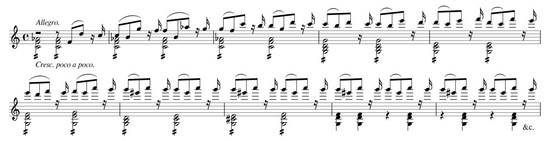
No. 2.
[PDF] [MusicXML] Audio content is not currently supported on your device.
When he has joy to express, he does so by means of the same ascending, bubbling phrases that he uses in the duet between Tannhäuser and Elisabeth (vocal score, p. 157, &c.) [397]—
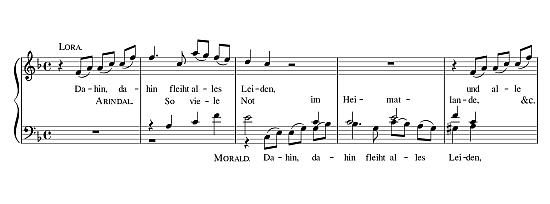
No. 3.
[PDF] [MusicXML] Audio content is not currently supported on your device.
LORA: Dahin, dahin flieht alles Leiden, und alle ARINDAL: So viele Not im Heimatlande, &c. MORALD: Dahin, dahin flieht alles Leiden,
And although the duet between Drolla and her lover Gernot is subcomic in intention, their manner of rushing into each other's arms is precisely that of Tristan and Isolde—
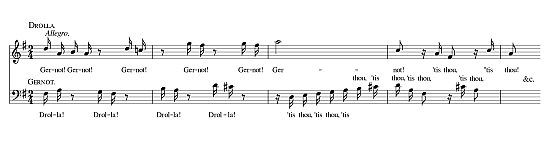
No. 4.
[PDF] [MusicXML] Audio content is not currently supported on your device.
DROLLA: Gernot! Gernot! Gernot! Gernot! Gernot! Gernot! 'tis thou, 'tis thou!
GERNOT: Drolla! Drolla! Drolla! Drolla! 'tis thou, 'tis thou, 'tis thou, 'tis thou, 'tis thou, 'tis thou, &c.
The style is frequently mature beyond the composer's actual years,—the admirable finish to the scene between Arindal and the others, for example (full score, p. 111), where the vocal themes are taken up by the orchestra and played out in a beautifully managed diminuendo; or the perfect little picture of the fairy garden at the commencement of the first Act (I question whether so imaginatively conceived and skilfully coloured a garden scene is to be found anywhere in previous or contemporary opera); or the expressive scoring of Ada's cavatina (full score, pp. 114 ff.); or the septet at the end of the first Act; or the fine management of the chorus of beaten warriors at the beginning of the second Act, with the reiterated calls in the bass horn and trumpet; or the fine Schwung of the trio between Lora, Arindal and Morald (pp. 219 ff.); or the big aria of Ada in the second Act (pp. 251 ff.); or the charming theme that is used when the children are introduced. The born musical dramatist is seen in the variety of expression he can command even at this age; and one is struck by the first signs of the faculty that is so noticeable in the later Wagner,—that of always having something in reserve when a new and cumulative effect is needed. The larger the canvas to be covered, as in the final ensembles, the more resource does he show himself to possess. There is a good deal in The Fairies that is quite boyish,—much that is conventional, many things to provoke a smile. But it is equally certain that there was not another young man in Europe capable of writing such a work at that time. The overture, which was written a few days before the last touches were put to the third Act, is excellently handled throughout; the invention never flags, the technique never fails; it is his best work of this order until we come to the overture to the Flying Dutchman,—finer in idea, closer in texture, and surer in touch than the King Enzio Overture of 1832, and far beyond the Columbus, the Polonia, or the Rule Britannia. Altogether one imagines that, in spite of the old-fashioned quality of the libretto of The Fairies, one could listen to a stage performance of the opera with at least as much interest as to Rienzi. It was given for the first time in Munich under Hermann Levi in 1888, and between then and 1895 it ran to over fifty performances.
As we have seen, Das Liebesverbot ("The Ban on Love") was a product of the wild days of 1834-5, when he had momentarily turned against sobriety both in life and in art. In framing his libretto he passed over everything in Shakespeare's Measure for Measure that had a touch of moral gravity in it: he transports the action from Vienna to Sicily, brings the strait-laced viceroy Friedrich into the same focus as the other amorists, and makes the whole play an attack on "puritanical hypocrisy" and a laudation of "unrestrained physicalism." In the music he does his best to forget that "German style" in which, as he says, Die Feen had been written, and copies to the best of his ability the more sparkling style of the lighter Italian and French opera. The work is in two Acts,—the only opera of Wagner's in this form—and in its structure follows the ordinary pattern of the day. Occasionally the spoken word takes the place of recitative.
In 1866 Wagner gave the score of the opera to King Ludwig, prefacing it with a stanza in which he spoke of it as a sin of his youth, for which he hoped to find pardon in his protector's grace. Apparently he always adopted this depreciatory attitude towards the work in later life. Glasenapp tells us that Wagner liked the overture to Das Liebesverbot better than that to Die Feen, but thought the rest of Das Liebesverbot "horrible," except the "Salve regina cœli."[398] A perusal of the score, however, will convince most people that he underrated the interest and the value of it. It almost invariably fails when it aims at expressing serious feeling; but the gay and humorous scenes are admirable, and the youthful gusto of the whole thing is irresistible. The general idiom may be a borrowed one, but for the most part Wagner uses it very skilfully, making at least as good a show with it as the ordinary French or Italian opera writer of the time. He has every trick of the trade at his finger-tips, every recipe for froth and foam and sparkle. He is as expert as any of them at lashing up the interest by the device of repeating a piquant figure a score of times: this, for example, from the overture—
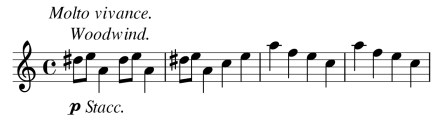
No. 5
[PDF] [MusicXML] Audio content is not currently supported on your device.
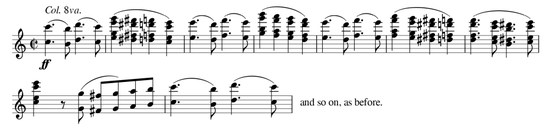
It is given first of all mainly to the strings, with a little harmonic thickening in bassoons and horns. Then, as the melody goes an octave higher in the strings, it is doubled in the oboes and clarinets, with added harmonic enrichment in the wood-wind and brass. At the next repeat—an octave higher again—the melody is given out by piccolo, flutes, oboes, clarinets and violins in octaves, while trombones are added to the harmony. All the while the tone is growing louder and louder, with a crescendo roll in the tympani. One has to listen, whether one wants to or not; and it is impossible to keep the blood from tingling under the whip. The whole overture is very effective in this noisy, rather empty way; there is much use of castagnets, tambourine, triangle and cymbals. The general style of the writing may be gathered from a couple of examples—
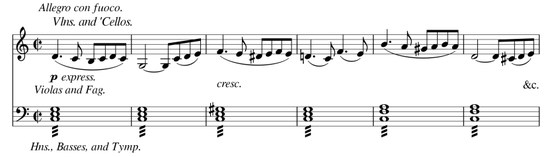
No. 6.
[PDF] [MusicXML] Audio content is not currently supported on your device.
No. 7.
[PDF] [MusicXML] Audio content is not currently supported on your device.
either of which will serve to show the gulf that separates Das Liebesverbot from Die Feen.
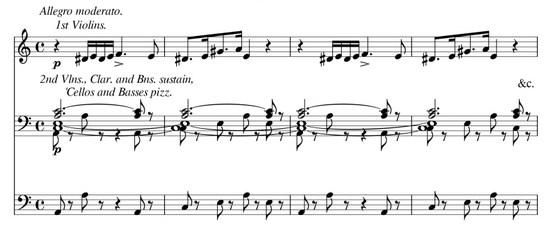
The opening scene is very animated, the chorus of the people being full of entrain; the whole manner is thoroughly Italian, the orchestra chattering away more or less irrelevantly, and the voices interjecting their remarks in a facile, half-melodic sort of way. How careless Wagner was with regard to deeper musical characterisation may be seen from the theme that accompanies the entry of Claudio,—one of those typical Italian operatic themes of which we can never be quite sure whether they are meant to be tragic or comic, though here it is apparently meant to be serious—
No. 8.
[PDF] [MusicXML] Audio content is not currently supported on your device.
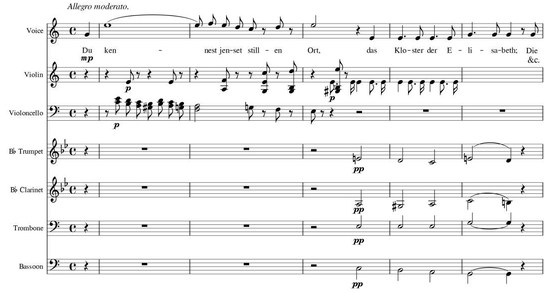
Nor in any other work but this would Wagner have accompanied with so irresponsible a theme the appeal of Claudio (sentenced to death) to his friend Luzio to seek the aid of Isabella—
No. 9.
[PDF] [MusicXML] Audio content is not currently supported on your device.
Du kennest jenen stillen Ort, das Kloster der Elisabeth; Die &c.
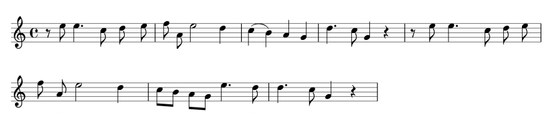
The melody runs a thoroughly Italian course—
No. 10.
[PDF] [MusicXML] Audio content is not currently supported on your device.
O eile Freund, zu ihr dahin, o eile zu ihr dahin, sprich sie für mich um Hülfe an, sprich sie um Hülfe für mich an.
with liberal opportunities for the tenor to poise himself on a high note and deploy his resonance—
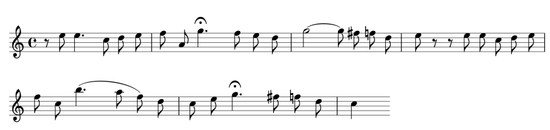
No. 11.
[PDF] [MusicXML] Audio content is not currently supported on your device.
Bewege sie, dass sie verzeih', dann bau' ich ganz auf ihren Muth. Bewege sie, dass sie verzeih',... dann bau' ich ganz auf ihren Muth.
The chorus that follows is also quite in the Italian stage style, the excitement being worked up according to the established recipes; and of course the purely musical stream flows on without the least regard to dramatic sense, Luzio saying every other minute "I hasten, friend," but without the slightest intention of hastening till the chorus is finished. But, as almost always happens even when Wagner is trying to be least like himself, a characteristic little touch cannot be prevented from stealing in: after the voices have ceased, the long-drawn theme of Claudio sings on in the 'cellos, set against the noisy chattering of the wood-wind and brass. It makes a most effective ending to the scene.
In the third scene appears a theme that was afterwards expanded and put to splendid use in Tannhäuser. Here the nuns sing it behind the scenes to the words "Salve regina cœli."
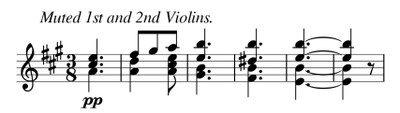
No. 12.
[PDF] [MusicXML] Audio content is not currently supported on your device.
The florid duet between the two novices, Mariana and Isabella, is thoroughly Italian. Again one sees, by comparison of this music with any of that of Die Feen, how determined Wagner was to write down to the comprehension of the Italian-opera public: he evidently has his eye on the singers and the audience rather than on the psychology of the characters or the atmosphere of the scene. But in the admirable duologue that follows between Luzio and Isabella, the touch is again that of the born musical dramatist. It is all irresistibly animated; the music is psychologically characteristic, the blend of passion and irresponsibility in Luzio being particularly well suggested; and there are some striking pieces of orchestral colour.
The court scene,—the mock trial in which Brighella, the viceroy's servant, poses as the judge—is carried through excellently, with an abundance of light Italian-opera humour; the roguishly knowing theme to which Brighella sings his passion for the pretty Dorella may be taken as typical—

No. 13.
[PDF] [MusicXML] Audio content is not currently supported on your device.
Dieses kleine Schelmenauge macht mich wahrlich ganz verwirrt.
There are one or two happy instances of the tentative employment of the leading-motive system. The theme representative of Friedrich and his law against love (No. 18 below), for example, is parodied in this way when Brighella begins to try Pontio—

No. 14.
[PDF] [MusicXML] Audio content is not currently supported on your device.
and when Friedrich enters and asks Brighella what has been going on, the latter replies apologetically and evasively to the accompaniment of the previous theme of the mock court, the orchestra, quite in the later Wagnerian manner, being more truthful than he—
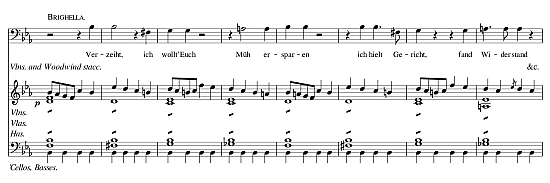
No. 15.
[PDF] [MusicXML] Audio content is not currently supported on your device.
BRIGHELLA: Verzeiht, ich wollt' Euch Müh ersparen, ich hielt Gericht, fand Widerstand &c.
Isabella's aria of intercession to Friedrich is rather poor, but the subsequent excitement is cleverly worked up, and there is some dramatic characterisation in the commanding phrases that are given to the viceroy. The finale is excellent: it has amazing fire, is full of quick resource, and, like the finales in Die Feen, shows how much reserve Wagner had to draw upon when an extra effort was required.
In the opening scene of the second Act,—the garden of the prison in which Claudio is awaiting death—we have another employment of the leit-motive, the oboe giving out softly the theme to which Claudio had previously urged Luzio to implore the help of Isabella, but now with appropriately altered harmonies—
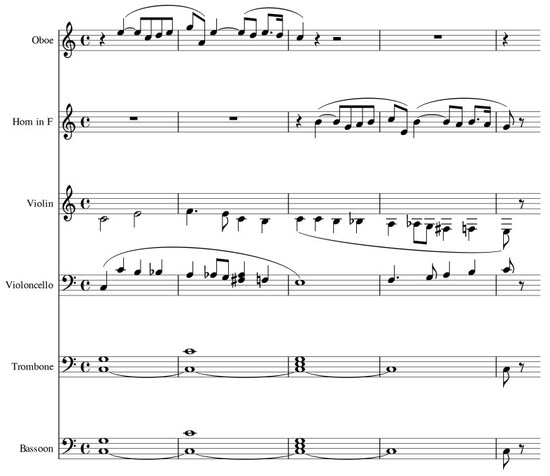
No. 16.
[PDF] [MusicXML] Audio content is not currently supported on your device.
The orchestral prelude to the scene is expressive, Wagner putting off his Italian mask for the moment and speaking in his natural voice: the sense of gloom and impending tragedy is very well conveyed—
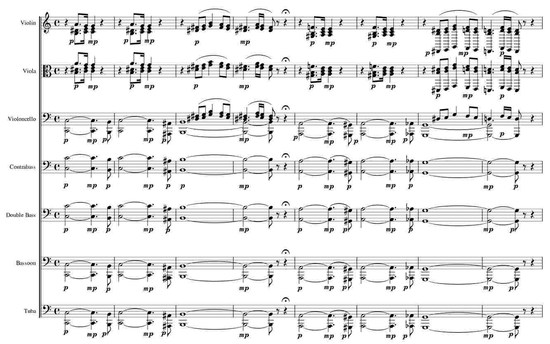
No. 17.
[PDF] [MusicXML] Audio content is not currently supported on your device.
But the strains in which Claudio addresses Isabella are again conventional: it was not easy at this time for Wagner to find original accents for grief and passion. He is best all through in scenes of humour, of comedy, of raillery. There is a charming, sunny trio later between Luzio, Isabella and Dorella; the whole of this scene, in fact, is one of the happiest in the opera. Friedrich's soliloquy in his room has a good deal of strength in it, an impressive effect being made by the frequent recurrence in the orchestra of the motive that symbolises the sternness of the attitude he has taken up towards the people's pleasures—
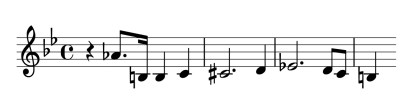
No. 18.
[PDF] [MusicXML] Audio content is not currently supported on your device.
When he utters the words
"Doch als mir Isabella die Erdenliebe erschloss, Da schmolz das Eis in tausend Liebesthränen."
("But when Isabella revealed earthly love to me, the ice was melted into a thousand tears of love"), the orchestra completes his thought with a reminiscence of the theme of Isabella's enchantment of him in the court (see No. 7, from the overture)—

No. 19.
[PDF] [MusicXML] Audio content is not currently supported on your device.
O war Dein Herz denn stets verschlossen, drang Liebe nie in Deine Brust?
The finale to the second Act is as admirably animated as its predecessor; Luzio's carnival song, the dance, and the chorus have a truly southern warmth in them; and there is a lively quartet between Isabella, Dorella, Luzio and Brighella.
Altogether Das Liebesverbot, like Die Feen, is a work upon which Wagnerian criticism will always look with an affectionate eye. If it contains much that Wagner did right to decline to take seriously in later life, there is also much in it that is eloquent of the coming dramatist in music,—a surprising quickness of apprehension, a faculty for big picture-building, and above all an irresistible ardour. Like all Wagner's music of this time, the score anticipates many of the mannerisms of the later operas. It is unusually generous with the typical Wagnerian "turn"; at one point what must be a rather comic effect in performance is made by a series of these turns being executed in octaves by piccolo, flutes, oboes, clarinets, bassoons, violins and 'cellos—
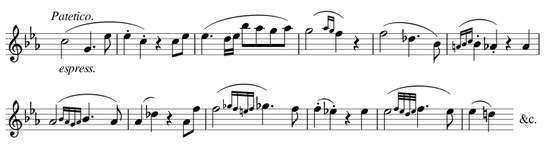
No. 20.
[PDF] [MusicXML] Audio content is not currently supported on your device.
The later Wagnerian method of accumulating excitement, which we have seen anticipated in Die Feen, is employed also in Das Liebesverbot, as in the following passage, which, like the one previously quoted, gives us a decided foretaste of the meeting of Tristan and Isolde—

No. 21.
[PDF] [MusicXML] Audio content is not currently supported on your device.
And if for nothing else Das Liebesverbot would be interesting for its use of the leit-motive. There was virtually none of it in Die Feen.
III.—THE OPERAS OF THE SECOND PERIOD
Rienzi will always be something of a puzzle to the student. Wagner's own accounts of it in later years show that he too was a little uncertain as to the reasons for its obvious defects. He had tired of his life among little theatrical people in minor provincial towns, so he deliberately planned Rienzi on an elephantine scale in order that it might be impossible except in one of the larger opera houses. He had "grand opera" in his mind throughout, he tells us; he intended not merely to imitate the showiest works of this genre but to surpass them in prodigality. Yet to suppose, he adds, that this was all that was in his mind would be to do him an injustice. He was "really inspired" by the subject, and especially by the character of Rienzi. First and foremost he had Rienzi in view, grand opera being only a secondary consideration; yet grand opera was "only the spectacles through which he saw the subject." He always saw it, he goes on to say, on its own merits, and never aimed consciously at merely musical effects; yet he could never see the material except in terms of the merely musical effects,—the arias, choruses, finales, processions, and so on,—of grand opera. "Thus on the one hand I was always influenced by my subject in working out the details of the work, while on the other hand I governed my subject entirely in accordance with the 'grand opera' form that was in my mind." It is pretty evident that he found it as difficult to come to any settled conclusion with regard to Rienzi as we do. There is truth in the view that many of the banalities of it are due to his having the Paris opera and the Paris public in view. But we have only to study the score in conjunction with those of Die Feen and Das Liebesverbot to see that many of these same banalities are the logical outcome of his cast of mind and his musical attainments at that epoch, and would certainly have appeared in his music even if the idea of Paris had never occurred to him.
To put it familiarly, the youthful Wagner had been obviously shaping for some years for a bad attack of musical measles; he had to get it out of his system, and Rienzi was the illness that enabled him to do so. To me it is the least satisfactory of all his works—far less enjoyable than Die Feen or Das Liebesverbot. One can forgive the eager young-mannishness of these very youthful works: but at twenty-six or twenty-seven one expects a composer to show more indubitable signs of originality. The commonplace of Rienzi is different from that of the preceding operas; it is almost an offensive commonplace; the outlines of the objectionable phrases have all been thickened and the body of them puffed out till they positively irritate us by their grossness and fatuousness. It is astounding how few phrases there are in all these six hundred pages[399] that really seize upon us: we could easily count them all on the fingers of one hand. On its harmonic side the opera gives us a strange impression of pretentious poverty. All through Rienzi Wagner's mind seems to be struggling to fight its way through vapour and murk to the light. His dramatic intentions are evident enough, but he can rarely realise them. It is in vain that he exploits all the formulas for dramatic expression as they were understood at that time—diminished sevenths for horror, syncopations for agitation, and all the rest of it; in vain that he languishes or threatens, warbles unctuously or declaims aggressively, lets loose his noisy orchestra and piles up massive choral effects; they all fail to move us because there is hardly ever any bite in the phrases themselves. The obvious faults of the work are due not so much to technical inexperience or limitations of vocabulary as to a sheer failure of the imagination; with the possible exception of Rienzi himself, not one of the characters has been seen with vividness enough to wring a really characteristic musical symbol out of the composer. No one lives except Rienzi; and he, as far as his music is concerned, is little more than half alive. Any critically-minded contemporary friend of Wagner's who happened to know all his work up to that time might have been pardoned for thinking, on the basis of Rienzi, that the composer was deteriorating, that on the whole his imagination had hardly grown at all during the past couple of years, and that none of the earlier defects of style had been corrected, while half a dozen new ones had been added—an intolerable prolixity, a tendency to rely on elephantine effects to the neglect of finely wrought detail, and to trust to stage mechanism to eke out the weaknesses of his musical invention. The only improvement on the earlier Wagner that the friend would have been able to observe in Rienzi would be that in spite of all its absurdities and infelicities, its commonness and elephantiasis, there is a new strength in the work. It is a strength clumsily used; the youthful hobbledehoy's limbs have hardened without his acquiring much more command over them than he had before, the boyish voice has gained in volume without much improvement in quality: but the general signs of muscular growth are unmistakable. Crude as the overture is, no one can deny its rampant, horse-power vigour. But the final convincing proof that though Wagner's voice was abnormally energetic in Rienzi his imagination was virtually at a standstill is the fact that the opera has no colour, no atmosphere of its own. Every other work of Wagner has. In Die Feen, as Mr. Runciman acutely points out, there is a strange new feeling for light; in the Flying Dutchman we are always conscious of the sea, in Tannhäuser of a world of sensuous heat set over against a world of moral coolness and rather anæmic aspiration, in Lohengrin of the gleaming river and the tenuous air of Monsalvat. Rienzi conveys no pictorial or atmospheric suggestions of any kind.
But the opera was only a reculer pour mieux sauter. He needed a text that should be more purely musical in its essence than this; and when he found it, in the Flying Dutchman—the idea of which came to him shortly after he had commenced work on Rienzi—his genius took its first decisive leap forward. For some years he had been strangely undecided as to a suitable subject for an opera. He had experimented, and was still to experiment, in several fields. In 1836 he had turned König's novel Die hohe Braut into a libretto, making quite a good romantic opera in four acts out of it.[400] (It was afterwards set by Joseph Kittl, in 1853, under the title of Bianca und Giuseppe, oder die Franzosen vor Nizza.) In 1837 he made a comic opera out of a story in the Arabian Nights, entitling it Die glückliche Bärenfamilie, oder Männerlist grösser als Frauenlist ("The Happy Bear Family, or Woman outwitted by Man"). This is a delightfully vivacious little libretto, which might well be set by some modern composer. Wagner wrote some fragments of the music for it, but quickly became disgusted with the style, and turned his back on the piece. In Paris in 1841 he made a preliminary prose sketch for a libretto on a gloomy and rather striking subject of Hoffmann's, Die Bergwerke zu Falun ("The Mines of Falun"), which one is sorry he did not set to music, for it has colour and a certain individuality: he would probably have made more of it than he did of Rienzi. But perhaps he felt that the sombre vein he would have had to pursue in Die Bergwerke zu Falun had been worked out to the full extent of which he was capable in the Flying Dutchman. In the same winter of 1842 he made a first sketch of Die Sarazenin ("The Saracen Woman"), expanding it in Dresden two years later.[401]
It was after all a sound instinct, no doubt, that made him concentrate on the Flying Dutchman and let the other schemes drop, for the Flying Dutchman gave him just what Rienzi did not—a concentrated dramatic theme, and one with a very individual atmosphere. Had his dramatic and musical technique been more advanced than they were at that time he would probably have condensed the story still further. He saw clearly enough that the whole essence of the legend—or at any rate the whole of the musical essence of it—lay in the Dutchman and Senta, and that all the rest was mere scaffolding or trimming. "I condensed the material into a single Act, being chiefly moved to do this by the subject itself, since in this way I could compress it into the simple dramatic interaction of the principal characters, and ignore the musical accessories that had now become repellent to me."[402] But his musical faculties, which developed with a strange slowness, were still lagging a good deal behind his dramatic perceptions; and the result is that to us to-day there seem to be a good many superfluous "musical accessories" in the Flying Dutchman, owing to the fact that Wagner has not been able to give real musical life to such characters as Daland and Erik. He himself has described for us very lucidly in A Communication to My Friends the diverging impulses in him that gave the Flying Dutchman its present only partly satisfactory form. He was wholly possessed by his subject, saw that it was necessary to allow it to dictate its own musical form and method of treatment, and honestly thought that he had let it do so; but the traditional operatic form was more potent within him than he imagined at the time. As in Rienzi, aria, duet, trio and the other established forms somehow "found their way into" the opera without his consciously willing them.
Still the structure of the Flying Dutchman is a great advance on that of Rienzi: what was really happening was that the musician in Wagner was beginning to see that the whole drama must be musical drama, the poet not being allowed to insert anything that was inconsistent with the spirit of music. He himself persisted in putting it the other way,—that the poet in him gradually took over the guidance of the musician. But we can see now that he misread his own evolution. The poet in him undoubtedly outgrew, bit by bit, the musical forms that had become stereotyped in the opera of the day; but the poet's growth only became possible when the musician, beginning to feel his own strength, gave the poet more and more imperative orders to shape his "stuff" in a form that would afford the musician the freest course. Wagner in later years insisted that after he had elaborated Senta's ballad in the second Act, he found that he had unconsciously hit upon the thematic kernel of the whole, and that this thematic idea then spread itself naturally over the whole drama like a network. That is not true if we take his words literally, for of course a good deal of the thematic material of the Flying Dutchman has no affiliation with Senta's ballad. But in the broad sense, and with regard more to his intentions than his achievements, we can see that he was right. The whole drama really emanates from Senta; the Dutchman himself, as Mr. Runciman puts it, is merely Senta's opportunity personified; the remaining characters are only there to make the before and after of the central episode clear. With more experience and a surer technique he could have cut away more of the excrescences of the libretto and concentrated the action still further, making it yet more purely musical, as he did with Tristan. But for the day he did marvellously well. With the Flying Dutchman was born the modern musical drama.
There is no mistaking the intensity and certainty of his vision now. He no longer describes his characters from the outside: they are within him, making their own language and using him as their unconscious instrument. The portrait painter and the pictorial artist in him are both coming to maturity. The Dutchman and Senta are both drawn completely in the round; we feel, for the first time with any of Wagner's characters, that we might meet them any day and that they would be solid to the touch. Even Daland and Erik, though not as real as the other two—for Wagner had not yet the art of breathing life into every one of his subordinate characters—have a certain substantiality. And roaring and whistling and surging round them all is the sea,—not so much the mere background of the drama as the element that has given it birth. Stylistically and technically the new work is leagues beyond Rienzi. There is still something of the old melodic mannerism—which, indeed, he was not to lose for many years yet—but in many of the melodies there is a new leap, a new swing, a new articulation; harmonically the work is richer; it often attains a rhythmic freedom beyond anything that Wagner had been capable of before; he is learning to concentrate his expression, and to beat out pregnant little figures that limn a character or depict a natural force once for all; there is a new psychological as well as a musical logic, binding the whole scheme together and working up from the beginning to the end in one steady crescendo. Wherever the score is tested, it shows something not to be met with hitherto either in Wagner's previous work or in that of his contemporaries. His imagination is at last unlocked.
After this he develops steadily and rapidly until a fresh check is given him, it being borne in upon him that neither his imagination nor his technique is equal to the creation of the new world that he feels stirring vaguely within him. But for a time all goes well. The Flying Dutchman had been finished in the winter of 1841. Tannhäuser was fully ready by April 1845, and Lohengrin by March 1848—just after he had completed his thirty-fifth year. In these seven years he exhausted all the possibilities of the style he had made his own; after Lohengrin he instinctively feels that he is at the end of the one path and the beginning of a new one, though where this is to lead him he has as yet no inkling. Both the later operas represent a gradual clarification and intensification of the style he had tentatively used in the Flying Dutchman. The breach with the older opera is even yet not complete; disguise the conventional features of it as he will, they are still recognisable; aria and duet and ensemble are still there, though they merge almost imperceptibly into each other. But if Tannhäuser and Lohengrin are in large part still the old opera, they are the old opera transfigured. The musical web spreads itself more and more broadly over the whole poetic material. Recitative virtually disappears; the text still retains a number of non-emotional moments for which no really lyrical equivalent can be found, but what would have been recitative naked and unashamed in Rienzi is now almost fully-clothed song—the address of the Landgrave to the Knights in the Hall of Song scene is an excellent illustration. The choral writing attains an unaccustomed breadth and sonority, and at the same time the chorus becomes a more efficient psychological instrument. The harmonic tissue becomes fuller. The melodic line becomes more and more expressive and sensitive. The orchestration begins to give a distinctive colour to both personages and scenes. A very ardent and penetrating imagination, the imagination of the born dramatist, seeing all his characters as creatures of flesh and blood, is now playing upon the material offered to the musician by the poet. Each scene suggests by its colouring its own indoor or outdoor setting, the hour of the day, the time of the year; yet each opera as a whole has a different light and is set in a different atmosphere from the others. The Wagner of this period reaches the supreme height of his powers in Lohengrin; and as one watches that diaphanous and finely-spun melodic web unfold itself, one is almost tempted for the moment to regret that the dæmon within him drove him on so relentlessly to another style. No one, of course, can be anything but thankful that Wagner evolved the splendid symphonic-operatic style of the second half of his life—the most serviceable operatic instrument that any musician has yet hit upon. But the more purely lyrical style of Lohengrin is so exquisitely satisfying in itself that one would have been grateful had he turned back to it for a moment in later days, when his melodic invention was in its fullest glory. The main burden of the expression, in the later work, shifts more and more to the side of the orchestra. In Lohengrin the voice is still the statue and the orchestra the pedestal. The whole work is the product of that equipoise of all the faculties that is often observable in composers at the end of their second period, a serenity resting upon their music that it never wins again in the more troubled after-years, when the soul is more at war with itself, and the lips can hardly find language for the pregnant images that crowd to them.
But vast as the imaginative growth had been from Rienzi to Lohengrin, it seems almost like a mere marking time in comparison with the subsequent development. Most instructive in this respect are the alterations Wagner made in his earlier works in later life. The Flying Dutchman ends with the destruction of the Dutchman's ship as Senta leaps into the sea. The stage directions in the first edition run thus: "In the glow of the setting sun the glorified forms of the Dutchman and Senta are seen rising above the wreck, clasped in each other's arms, soaring heavenward"; and the final page of the opera in its original form consisted of the "Redemption" motive followed by the motive of the Dutchman, the opera ending with the latter. When Wagner revised the work some years later, he was conscious of the abruptness and inconclusiveness of this ending. His pictorial imagination saw the transfigured forms of Senta and the Dutchman more vividly, and the more luminous vision found expression in the great stroke of genius with which the opera as we now have it ends. The thundering theme of the Dutchman no longer has the last word; the fortissimo swell of the full orchestra suddenly breaks, and in a slower tempo there steals out in the soft, pure tones of the wood-wind and harps the theme of "Redemption" in the form it first assumes in Senta's ballad, but with an unexpected heavenward ascent in the violins at the finish—

No. 22.
[PDF] [MusicXML] Audio content is not currently supported on your device.
The effect is precisely as if the clouds had parted, and the figures of the Dutchman and Senta were seen soaring aloft in their purified and transfigured form.[403]
As the first version of the Faust Overture (1840) has not been published, it is impossible to compare it with the version we now have, which was made in 1855; but we may be certain that the comparison would prove as interesting as that between the earlier and the later versions of the Flying Dutchman finale. But the new Venusberg music that he wrote for the Paris production of Tannhäuser (1861) shows as emphatically as the altered Flying Dutchman ending how immeasurably greater than all his development from Die Feen to Lohengrin was the development from Lohengrin to Tristan—for it was in the Tristan period that he made this wonderful addition to Tannhäuser, the effect of which is to make the remainder of the score seem almost cold in comparison, a pale moon against a fiery sun. Had Wagner died after Lohengrin he would still have been the greatest operatic composer of his time. But the work of the later years is so stupendous in every respect, imaginative, inventive, and technical, that even Lohengrin seems hardly to be the product of the same mind.
IV.—THE MATURE ARTIST
1
The years 1848 and 1849 saw the climax of a great crisis both in Wagner's life and his art; it had been developing for two or three years before, and its reverberations did not wholly die away for some years after. All his life and his work at this time were, as I have already said, simply a violent purgation of the spirit—a nightmare agony from which he woke with a cry of relief. He shakes off the theatre, and faces the world on a new footing as a man. And in silence, unknown to everybody and almost to himself, he develops into a new musician. For the moment his mind is a jumble of art, ethics, politics and sociology. But as usual his artistic instincts guide him surely in the end. After many gropings in this direction and that, he settles down to the Ring drama, which he first of all plans, in 1848, in the form of a three-act opera with the title of Siegfried's Death. He falters a little even then, being obsessed by two other subjects, Jesus of Nazareth and Friedrich Barbarossa; but finally he rejects them both, the greater adaptability of the Siegfried drama for music being intuitively evident to him. The next twenty-six years are to be taken up with the working out of this gigantic theme, with Tristan and the Meistersinger as a kind of diversion in the middle of it; then comes the quiet end with Parsifal. I do not propose to discuss the philosophical—or pseudo-philosophical—ideas of any of these works. It is only as a musician that Wagner will live, and to a musician the particular philosophy or philosophies that he preached in the Ring and Tristan and Parsifal are matters of very small concern. Wagner himself was always inclined to over-estimate the importance of his own philosophising, and his vehement garrulity has betrayed both partisans and opponents into taking him too seriously as a thinker. Had he not left us his voluminous prose works and letters, indeed, we should never have suspected the hundredth part of the portentous meanings that he and his disciples read into his operatic libretti. To those who still see profound metaphysical revelations in the later works it may be well to point out that Wagner saw revelations equally inspired and inspiring in the earlier ones, which no one takes with excessive seriousness to-day on their dramatic side. The philosophising all smacks too much, for our taste, of the sentimental Germany of the mid-nineteenth century. For Wagner, Senta is "the quintessence of Woman [das Weib überhaupt], yet the still to-be-sought-for, the longed-for, the dreamed-of, the infinitely womanly Woman—let me out with it in one word: the Woman of the Future."[404] Tannhäuser was "the spirit of the whole Ghibelline race for every age, comprehended in a single, definite, infinitely moving form; but at the same time a human being right down to our own day, right into the heart of an artist full of life's longing."[405] "Lohengrin sought the woman who should have faith in him; who should not ask who he was and whence he came, but should love him as he was, and because he was what he appeared to himself to be. He sought the woman to whom he should not have to explain or justify himself, but who would love him unconditionally. Therefore he had to conceal his higher nature, for only in the non-revealing of this higher—or more correctly heightened—essence could he find surety that he was not wondered at for this alone, or humbly worshipped as something incomprehensible,—whereas his longing was not for wonder or adoration, but for the only thing that could redeem him from his loneliness and still his yearning—for Love, for being loved, for being understood through Love.... The character and the situation of this Lohengrin I now recognise with the clearest conviction as the type of the only really tragic material, of the tragic element of our modern life; of the same significance, indeed, for the Present as was the Antigone, in another relation, for the life of the Greek state.... Elsa is the unconscious, the un-volitional, into which Lohengrin's conscious, volitional being yearns to be redeemed; but that yearning is itself the unconscious, un-volitional in Lohengrin, through which he feels himself akin in being to Elsa. Through the capacity of this 'unconscious consciousness' as I myself experienced it in common with Lohengrin, the nature of Woman ... became more and more intimately revealed to me ... that true Womanhood that should bring to me and all the world redemption, after man's egoism, even in its noblest form, had voluntarily broken itself before her. Elsa, the Woman ... made me a full-fledged revolutionary. She was the spirit of the folk, for redemption by whom I too, as artist-man, was yearning."[406]
This seems all very remote from us now; one wonders how any one, even Wagner himself, could ever have taken these operatic puppets with such appalling seriousness. The Ring stands a little nearer to us; but no longer can we follow Wagner in his philosophising even there. For Wagner Siegfried was "the human being in the most natural and gayest fulness of his physical manifestation.... It was Elsa who had taught me to discover this man: to me he was the male-embodied [der männlich-verkörperte] spirit of the eternal and only involuntarily creative force [Geist der ewig und einzig zeugenden Unwillkür], of the doer of true deeds, of Man in the fulness of his most native strength and his most undoubted love-worthiness."[407] We can hardly regard Siegfried in that light to-day. As we meet with him in the libretto he is, as Mr. Runciman says, rather an objectionable young person; we cannot quite reconcile ourselves to his ingratitude and his super-athletic fatuousness; he reminds us too much of Anatole France's description of the burly, bullet-headed general in Les Dieux ont Soif—the sparrow's brain in the ox's skull. As we see him on the stage he is, under the best conditions, slightly ridiculous, a sort of overgrown Boy Scout. It is only in his music that he is so magnificently alive, so sure of our sympathy. Sensible musicians, indeed, do not trouble very much in these days about the metaphysics or the esoteric implications of the Wagnerian dramas. Wotan must stand or fall by his own dramatic grandeur and by the quality of the music that is given to him to sing, not by the degree of success with which he illustrates a particular theory of the Will. Tristan is none the better for all its Schopenhauerisms, natural or acquired; we may be thankful that it is none the worse for them.
Wagner's philosophical stock, indeed, was never a very large one. The "problems" of his operas are generally problems of his own personality and circumstances. His art, like his life, is all unconscious egoism. His problems are always to be the world's problems, his needs the world's needs. Women obsessed him in art as in life: they kindled fiery passion in man, or they "redeemed" him from passion, or they set a sorrow's crown of sorrows on his head by failing to redeem him. Passion, redemption, renunciation—these are the three dominant motives of Wagner's work; and wherever we look in that work we find himself. Indulgence—revulsion; hope—frustration; passion—renunciation; these are the antitheses that are constantly confronting us. In the Flying Dutchman, Vanderdecken-Wagner is redeemed by the woman who loves and trusts him unto death. Tannhäuser-Wagner fluctuates between the temptress and the saint. Lohengrin-Wagner seeks in vain the woman who shall love him unquestioningly. Wieland the Smith, the hero of a libretto he sketched in 1849, is again Wagner, lamed by life, but healed at last by another "redeeming" woman. Wotan-Wagner, finding the world going another way than his, wills his own destruction and that of the world. Tristan-Wagner finds love insatiable, and death the only end of all our loving. Sachs-Wagner renounces love. Parsifal-Wagner finds salvation in flight from sensual love. Always there is this oscillation between desire and the slaying of desire, between hope for the world and despair for the world. In 1848, in an hour of physical and mental joy in life, he conceives a blithe and exuberant Siegfried, the super-man of the future, striding joyously and victoriously through life. But the revulsion comes almost in a moment. He realises his solitariness as man and artist. "I was irresistibly driven to write something that should communicate this grievous consciousness of mine in an intelligible form to the life of the present. Just as with my Siegfried the strength of my yearning had borne me to the primal fount of the eternal purely-human; so now, when I found this yearning could never be stilled by modern life, and realised once again that redemption was to be had only in flight from this life, in escaping from its claims upon me by self-destruction, I came to the primal fount of every modern rendering of this situation—to the Man Jesus of Nazareth." Like Jesus, confronted with the materialism of the world, he longs for death, and reads a similar longing into all humanity.
So the oscillation goes on to the very end of his days. There is no need, no reason, to discuss the "philosophy" of such a mind. He is no philosopher: he is simply a tortured human soul and a magnificent musical instrument. All that concerns us to-day is the quality of the music that was wrung from the instrument under the torture.
2
The most astounding fact in all Wagner's career was probably the writing of Siegfried's Death in 1848. That drama is practically identical with the present Götterdämmerung; and we can only stand amazed at the audacity of the conception, the imaginative power the work displays, the artistic growth it reveals since Lohengrin was written, and the total breach it indicates with the whole of the operatic art of his time. But Siegfried's Death was impossible in the idiom of Lohengrin; and Wagner must have known this intuitively. This is no doubt the real reason for his writing no music for six years, from the completion of Lohengrin in August 1847 to the commencement of work on the Rhinegold at the end of 1853. His artistic instincts always led him infallibly, no matter what confusion might reign in the rest of his thinking. He conceives the idea of the Meistersinger, for instance, in 1845, just after finishing Tannhäuser. But a wise and kindly fate intervenes and turns him aside from the project. He was not ripe for the Meistersinger, either poetically or musically, as we can see not only by a comparison of his later musical style with that of Tannhäuser, but by comparing the sketch of the drama that he wrote in 1845 with the revised drafts of 1861. It was his original intention, again, to introduce Parsifal into the third Act of Tristan; but his purely artistic instincts were too sound to permit him to adhere to that plan. How unripe he was in 1848 for a setting of Siegfried's Death hardly needs demonstration now. The swift and infallibly telling strokes with which he has drawn Hagen and Gutrune in the Götterdämmerung, for example, were utterly beyond him then; it took twenty years' evolution before he could attain to that luminousness and penetration of vision, that rapidity and certainty of touch. So much, again, of the tragic atmosphere in which the Götterdämmerung is enveloped comes from the subtle harmonic idiom that Wagner had evolved by that time, that it is hard to imagine the extent of his probable failure had he persisted in setting the text to music in 1848. The lyrical style of Lohengrin, the leisurely spun tissue of that lovely work, were neither drastic enough, close enough, nor elastic enough for Siegfried's Death. And of this he must have had a dim consciousness.
So he puts the musical part of his task on one side for six years, broods continually over the subject, finds it growing within him, and at last shapes it into not one opera but four. When he begins work upon the music of the Rhinegold he is a new being. His imagination has developed to an extent that is without a parallel in the case of any other musician. The characters and the milieu of the Rhinegold are themselves evidence of the audacious sweep of his vision: he undertakes to re-create in music gods and men and giants, creatures of the waters and creatures of the bowels of the earth; the music has to flood the scene now with water, now with fire, with the murky vapours of the underworld and the serene air of the heights over against Valhalla. Never before had any composer dreamed of an opera so rich in all varieties of emotion, of action, of atmosphere. The practice he had in the Rhinegold developed his powers still further: in the Valkyrie the painting grows surer and surer, the imagination sweeps on to conceptions beyond anything that any musician before him would have thought possible: in Siegfried there is an absolute exultation of style; the music seems to dance and cry aloud out of pure joy in its own strength and beauty. His melody has already become terser and more suggestive in the Rhinegold, and has lost much of its earlier rhythmic formality. His harmonic range, while narrow enough compared with that of Tristan and the Götterdämmerung, has yet developed greatly. He dares anything in pursuit of his ideal of finding in his music the full and perfect counterpart of the characters and the scenes; that endless E flat chord at the commencement of the Rhinegold prelude is an innovation the audacity of which we can hardly estimate to-day.
It has been objected that the melody of the Rhinegold is on the miniature side, and that the score has little of the grand surge and sweep of the later operas. It may be so, but the style of the music seems admirably suited to the broad and simple outlines of this drama and the relatively simple psychology of the beings who take part in it,—beings who are now taking only the first step along the path that is to lead them all into such tragic complications. But in any case Wagner was obeying a sound instinct when he abandoned the broader style of Lohengrin in favour of the seemingly shorter-breathed style of the Rhinegold. It was the consequence of his intuition that his new dramatic ideas demanded a new musical form; we have to remember that everything he says on this topic in Opera and Drama is the outcome of his reflection upon Siegfried's Death and the best manner of its setting. The older forms of opera being inapplicable here, he had to devise a new method of unifying his vast design. He found the solution of his problem in an application to opera of the symphonic web-weaving of Beethoven; but for this he needed short and extremely plastic motives. That as yet he cannot weave these motives, and the episodical matter between them, into so continuous a tissue as that of the later works is only natural; to expect him to have done so would be as unreasonable as to expect the texture of Beethoven's second symphony to be as closely woven as that of his fifth. But Wagner knew he had a wonderful new instrument in his grasp, and he did well to learn the full use of it by cautious practice.
3
The leit-motive, of course, is not Wagner's invention. Other operatic composers had tentatively handled the device before him; and in his own day Schumann had seen the possibilities of such a method being applied to the song. In his Frühlingsfahrt, for example, the joyous major melody that accompanies the bright youths on their first setting out in life changes to the clouded minor as the poet tells of the ruin that came upon one of them; and everyone knows the sadly expressive effect of the winding up of the Woman's Life and Love cycle with a reminiscence of the melody of the opening song. The device of reminiscence in poetic or dramatic music is indeed so obviously a natural one that we can only wonder that the pre-Wagnerian composers did not make more use of it. But Wagner did more than employ it as a sort of index or label; he turned it into the seminal principle of musical form for perhaps three-fourths of the music of our time. He made it not merely a dramatic but a symphonic-dramatic instrument. He had experimented with the device from his youth, but until now without perceiving its symphonic possibilities. We have seen him carrying forward a significant theme from one scene to another in Das Liebesverbot. In Rienzi there is very little real use of the leit-motive. He will adopt a characteristic orchestral figure for a person or a situation at the commencement of a scene or "number," and play with it all through that particular set piece; but it is very rarely that he will remind us of a previous situation by importing the theme that symbolises it into a later situation. He does this, for example, with the "Oath" motive, which first accompanies Rienzi's story of his own vow to avenge his murdered brother (vocal score, pp. 77, 78), and is afterwards employed to accompany Colonna's threat of vengeance if Rienzi dooms him and his fellow conspirators to death (p. 266), Rienzi's rejection of Adriano's plea for mercy (p. 337), and finally Adriano's own resolve to be avenged upon Rienzi (p. 416). In the Flying Dutchman the tissue is largely unified by typical themes, which, however, are as a rule merely repeated without substantial modification, though now and then a motive is melodically transformed to suggest a psychological variation, as when the "Redemption" theme from Senta's ballad—
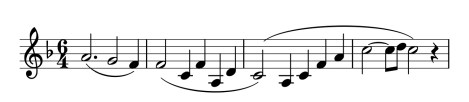
No. 23.
[PDF] [MusicXML] Audio content is not currently supported on your device.
afterwards becomes the motive of "Love unto death"—

No. 24.
[PDF] [MusicXML] Audio content is not currently supported on your device.
In Tannhäuser there is a good deal of recurrent material—the Bacchanale and the Pilgrims' Chorus, for instance—but the leit-motive can hardly be said to be used at all in the later sense. Lohengrin is strewn with leit-motives that are marvels of characterisation; but here too they recur in their original form time after time. For the most part they merely label the character: they do not change as he changes, nor do they spread themselves over the score with the persistence of the motives of the later works.
4
The leit-motive in the Ring is quite another matter. Most of the motives in the earlier operas were vocal in origin, and their relatively great length—which makes them as a rule unsuitable for a flexible symphonic treatment—is the direct consequence of the length of Wagner's poetic lines at that time. In Rienzi, for example, the motive of Rienzi's prayer, the "Sancto spirito cavaliere" motive, the "Freedom" motive, the motive of the "Messengers of Peace," and others, are all of this type. In the Flying Dutchman the motive of "Longing for death," the two "Redemption" motives, the "Daland" motive, the "Festivity" motive, the "Rejoicing" motive, the "Longing for redemption" motive, and several others, are all vocal melodies in the first place; of the same kind are the motives of "Repentance," of "Love's magic," of "Love's renunciation" and others in Tannhäuser; and in Lohengrin, the "Grail" motive, the "Farewell" motive, the "Elsa's prayer" motive, the "Knight of the Grail" motive, the "Warning" motive, the "Doubt" motive, and others. All of these are fully developed, self-existent melodies, not germ-figures destined for the weaving of a quasi-symphonic web. And though some of the less important motives in the early operas are short, they were not made so with any intention of using them plastically. The first things that strike us in connection with the motives of the Ring are their general shortness, their very plastic nature, and the sense they convey of not having been conceived primarily in a vocal form. It is true that some of them are vocal in origin, but that fact does not stare us so aggressively in the face as it does in the previous works; while the lines of the Ring are themselves so short that even when a phrase is modelled on one or two of them it never spreads itself out so extensively as the typical phrases of the Flying Dutchman, Tannhäuser and Lohengrin do. This at first sight seems to imply that the poetic form of the Ring exercised a powerful influence on the musical form. It is permissible for us to-day to invert that proposition. Wagner, writing in 1851, maintained that he had discarded the older form of verse, with its long lines and its terminal rhymes, because of his conviction that this was too conventional a garment to throw over the sturdy limbs of Siegfried, the untutored child of nature, and that he was therefore led to adapt the Stabreim of the Folk. Consistently with the theory I have already advanced in these pages, I prefer to believe—guided, as of course Wagner himself could not be guided at that time, by the evidence of the function the music performs in his later works—that the new orchestral musician that was coming to birth within him felt the necessity of shorter and more plastic germ-themes, and instinctively urged the poet to cast his material into a form that would place no obstacle in the musician's way. But explain it as we will, the fact remains that now he is coming to maturity his leit-motives are on the whole both more concentrated and more purely instrumental than they had been hitherto; as I have said, even when they come to us in the first place from the mouths of the characters, they assume quite naturally the quality of instrumental themes in the subsequent course of the opera, whereas a purely orchestral rendering of the themes of Tannhäuser and Lohengrin can never disguise their vocal origin. It is comparatively rarely that the Ring motives extend beyond two bars, or at the most three. The "Servitude" motive is virtually only one bar in length; so are the "Rhine Maidens' song," the "Smithing" motive, and the "Reflection" motive; the "Waves" motive, the "Ring" motive, the "Valhalla" motive, the "Might of youth " motive, the "Twilight" motive, the "Norns" motive, the "Dusk of the gods" motive, are all comprised within a couple of bars; several others run to three bars, and only one or two run to four.
In this respect, as in some others, the Meistersinger stands in a class apart from the other works of Wagner's maturity. It is the most purely vocal of all his later works, in the sense that while the orchestral tissue is superbly full and unceasing in its flow, the voice parts have an independence that is rare in the later Wagner. The style is in a way almost a reversion to that of Lohengrin, allowance being made, of course, for the more symphonic nature of the orchestral portion, and the more continuous nature of the whole. The Meistersinger is full of "set" pieces—arias, duets, trios, a quintet, choruses, ensembles, and so on. The necessity for all these lay in the nature of the subject; and Wagner, at that time at the very height of his powers, has so cunningly mortised all the components of the opera that not a join is observable anywhere. A superficial glance at a table of the Meistersinger motives would be enough to convince us, without any knowledge of the opera, that a great many of the themes have had a vocal origin, either solo or choral. Others owe their length to the fact that Wagner is painting masses rather than individuals; only a fairly extended theme could depict, for instance, the sturdy, pompous old Meistersingers and their stately processions. Where he is not following a vocal line or painting with broad sweeps of the brush, and is free to invent motives for purely orchestral use, he generally throws them into the same concise form as those of the Ring—the "Wooing" motive, for example—
No. 25.
[PDF] [MusicXML] Audio content is not currently supported on your device.
which, by reason of its brevity, is one of the most plastic motives in the score. But as a whole the Meistersinger lives in a different world from the Ring or Tristan. There is no great fateful principle running through it, that can be symbolised in a short orchestral figure and flashed across the picture at any desired moment, after the manner of the "Curse" or the "Hagen" motive in the Ring, or the "Death" motive in Tristan. The people in the Meistersinger carry hardly any shadows about with them. Their natures are mostly ingenuous, transparent, unsubtle: such as we see them on the stage at any given moment, such are they to themselves and others in every hour of their lives. It was natural then that they should take upon themselves more of the burden of the drama than the characters of the Ring as a whole,—for these are only instruments in the hand of a fate that is best symbolised by the ever-present orchestra—and that the instrumental voices should co-operate joyously with them, rather than dog them and lie in wait for them, as in the Ring, with symbols of reminiscence and foreboding. That the whole essence of the Meistersinger lies in its simple human characterisation and simple story-telling is shown again by Wagner's reverting in the Prelude to the pot-pourri feuilleton form of the Tannhäuser overture,—a form he never used again after 1845, except here.
5
As he proceeds with the Ring his leit-motives in general become more and more concentrated. Now and then he will employ a fairly extended theme, but never without a good psychological reason. One of the longest motives in the whole tetralogy is that of the "Volsung race." Its length is justified by the duty it has to perform: to concentrate the nobility and the suffering of that race into a chord or two would be beyond the powers of any musician; none but Wagner, indeed, could have expressed such an infinity of elevated grief within the compass of seven or eight bars. Some of the other motives are astounding in their brevity and eloquence. Not till after his work on the Rhinegold had unsealed his imagination and perfected his technique could he have hoped to hit off the wild, half-animal energy of the Valkyries in some four or five notes that are merely the expansion of a single chord, or have dared to trust to what is virtually only a series of syncopations to symbolise Alberich's work of destruction (the Vernichtungsarbeit motive). Never before could he have written anything so eloquent of death as the "Announcement of death" motive in the Valkyrie. In Siegfried, though the number of new motives is comparatively small, the same process of concentration is observable. The god-like nature and the stately gait of the Wanderer are suggested to us in three or four notes. And in the Götterdämmerung the concentration is amazing. In that stupendous work he is, in my opinion, at the very summit of his powers. He never wastes a note now: every new stroke he deals is incredibly swift, direct and telling. Absolutely sure of himself, he dispenses with a prelude—for the few bars of orchestral writing before the voices enter can hardly be called one—and trusts to the colour of a mere couple of chords to tune the audience's imagination to the atmosphere of the opening scene. One short characteristic figure suffices for the motive of Hagen, and nowhere in the whole of Wagner's or anyone else's work is a figure of two notes used so multifariously and with such far-reaching suggestion. It is evident that he now feels the harmonic instrument to be the most serviceable and flexible of all; and hundreds of his most overpowering effects in the Götterdämmerung are achieved by harmonic invention or harmonic transformation. The grisliness of the Hagen theme comes in large part—putting aside the question of orchestral colour—from the sort of dour, irreconcilable element it seems to introduce into certain chords,—though in reality the harmony has nothing essentially far-fetched in it—as in that tremendous passage near the end of the first Act of the Götterdämmerung—
No. 26.
[PDF] [MusicXML] Audio content is not currently supported on your device.
Hagen!
The new themes, too, rely for a great deal of their poignancy upon some subtle and fleeting taste of sweetness or some swift suggestion of darkness and mystery in the harmony, as in the exquisite motive that is associated with the wedding of Gutrune—
No. 27.
[PDF] [MusicXML] Audio content is not currently supported on your device.
or in the motive of "Magic deceit"—
No. 28.
[PDF] [MusicXML] Audio content is not currently supported on your device.
while others make their effect by means of the utmost concentration of melodic meaning, like the "Blood-brotherhood" motive, or by an epigrammatic condensation of rhythm, like the "Oath of fidelity" motive, which only Wagner could have invented, and which no other composer but Beethoven would have dared to use if it had been offered to him—
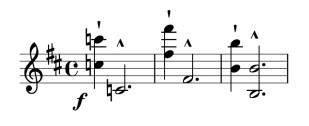
No. 29.
[PDF] [MusicXML] Audio content is not currently supported on your device.
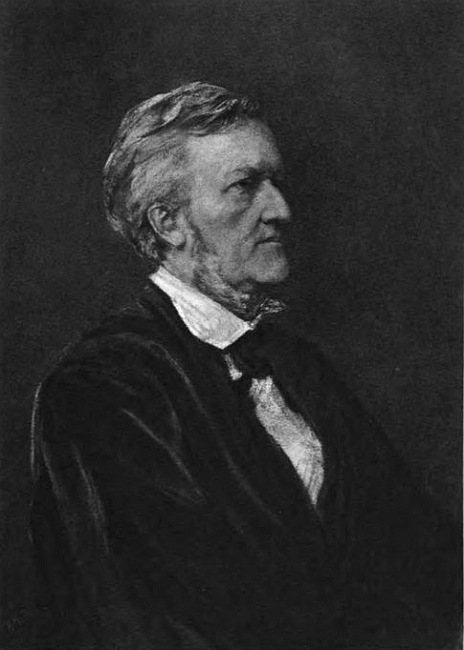
Bruckmann
RICHARD WAGNER.
From the painting by H. Herkomer at Bayreuth.
It is on harmonic alteration that he chiefly relies again, in the latter stages of the Ring, to suggest the fateful gloom that is gradually closing in upon the drama; much of the tense and tragic atmosphere of the Götterdämmerung comes from this clouding of the simpler texture of the motives of the earlier operas. One of the most remarkable instances of this is his treatment of the "Servitude" motive, that is generally associated with Alberich. In the Rhinegold it appears in a variety of simple forms, such as this—
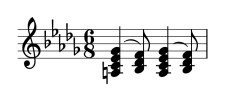
No. 30.
[PDF] [MusicXML] Audio content is not currently supported on your device.
and this—
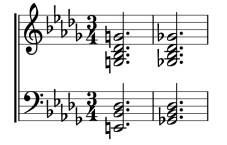
No. 31.
[PDF] [MusicXML] Audio content is not currently supported on your device.
In the Götterdämmerung a sense of almost intolerable strain, of a great tragedy sweeping to its inevitable end, is conveyed by various subtilisations of the harmony, of which the following may stand as a type—
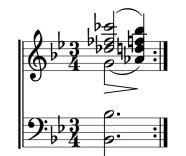
No. 32.
[PDF] [MusicXML] Audio content is not currently supported on your device.
When Siegfried appears on Brynhilde's rock, disguised as Gunther, the theme of the latter is metamorphosed from—
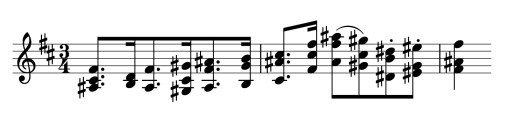
No. 33.
[PDF] [MusicXML] Audio content is not currently supported on your device.
into—
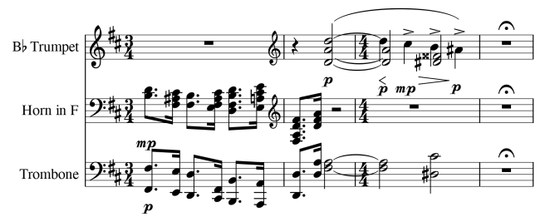
No. 34.
[PDF] [MusicXML] Audio content is not currently supported on your device.
Here everything is exquisitely calculated,—the harmonic alteration, the orchestral colouring (the soft mysterious tones of trumpet and trombones), the interrupted ending, and the long fateful silence that follows.
When Alberich, in his colloquy with Hagen at the commencement of the second Act of the Götterdämmerung, looks forward to the approaching destruction of the gods, the "Valhalla" motive becomes altered from the familiar—
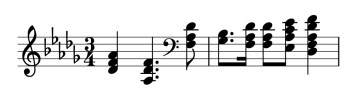
No. 35.
[PDF] [MusicXML] Audio content is not currently supported on your device.
to—
No. 36.
[PDF] [MusicXML] Audio content is not currently supported on your device.
Many other illustrations might be given of this harmonic intensification of themes.
6
It has to be admitted, however, that Wagner's use of the leit-motive presents some singularities, and is at times open to criticism. He undoubtedly introduces the motives more frequently than they are really needed; there is no necessity, for example, for the "Siegfried's horn" motive to be sounded at almost every appearance of Siegfried or every mention of his name. Debussy has made merry over this superfluity of reference, comparing it to a lunatic presenting his card to you in person. But we can easily forgive Wagner this little excess of zeal. He was doing something absolutely new for his time. He had a gigantic mass of material to unify, and this incessant recurrence of significant themes seemed to him the only way to do it. He could not foresee how familiar the operas and their motives would be to the whole musical world half a century later. In any case this peculiarity of his style can be passed over with a mere mention. Of more importance is his habit of making many of the motives so much alike that a certain amount of confusion is set up even in the minds of those who know the operas well. The "Servitude" motive, for example, is so like the opening of the Rhine Maidens' song that everyone goes astray over the two themes now and then in the first stages of his acquaintance with the Ring. Still more confusing is his habit of taking a motive that at first has only a particular meaning, and making it express a general concept, the result being that we frequently associate it with the wrong character. His mind was curiously like Bach's in this respect, that having fixed upon a figure that seemed to him an adequate symbol for an action, a person, an animal, or a material object, he would use it for all future phenomena of the same kind. But Bach's procedure is rather more logical, for his typical themes have as a rule a pictorial or semi-pictorial character, and so they can be applied without incongruity to a number of pictures of the same general order. A phrase that symbolises waves, for example, in one work may be legitimately employed to symbolise waves in another, for the theme itself is so constructed as to suggest the motion of waves: at least that is the intention. But Wagner necessarily has to find musical symbols for all kinds of things in his operas for which it is quite impossible to discover an unmistakable, self-explanatory musical equivalent. The symbol has therefore to be an arbitrary one; it has no claim to pictorial veracity, but we agree to accept it because it fulfils a useful musical purpose. The "Fire" motive conveys a real suggestion of fire; the Rhinegold prelude has certain qualities that make us willing to associate it with a mighty rolling river. But the "Ring" motive does not convey the slightest suggestion of a ring, nor has the "Gold" motive any resemblance to gold.
Wagner runs, then, a risk of being misunderstood, or not understood at all, when he takes an arbitrary symbol which we are willing to concede him in one case, and applies it to another. It would tax all the ingenuity of the thorough-going Wagnerian to justify, for instance, in the scene of the Norns in the Götterdämmerung, the employment of the "Sleep" motive that is inevitably associated in our minds with Wotan's parting from Brynhilde at the end of the Valkyrie. When Brynhilde is taking leave of Siegfried, in the second scene of the Götterdämmerung, and giving him Grane as a perpetual reminder of herself, the orchestra accompanies his words with the "Love" motive from the duet between Siegmund and Sieglinde in the first act of the Valkyrie. So profound has been the impression we have received from it there that it is impossible for us to associate it with any other pair of lovers; and we cannot help wondering what Siegmund and Sieglinde have to do with Siegfried and Brynhilde and Grane. When Hagen describes the coming of Siegfried down the Rhine, it is quite right that the orchestra should give out the typical Siegfried theme, but quite wrong, surely, that this theme should be combined with that of the Rhine Maidens from the Rhinegold. The intention presumably is that from the Rhine Maidens we are to infer the Rhine;[408] but the musical intelligence does not like having to diverge into deductive reasoning of this kind. Anyone who has learnt to associate the theme with the Rhine Maidens will naturally suppose either that they are to appear in person or that some allusion is to be made to them, neither of which things happens. The "Treaty" motive of the Rhinegold, again, has become so firmly associated in our minds with the agreement between Wotan and the giants that we involuntarily think of them when we hear it again in the orchestra during the swearing of Blood-brotherhood by Siegfried and Gunther (Götterdämmerung, vocal score, p. 92).
One of the most curious uses of the leit-motive is to be found in Siegfried (V. S. p. 35). Siegfried, pouring contempt on the idea that Mime can be his father, is telling him how he once saw the reflection of his own face in the brook:
Unlike unto thee there did I seem: as like as a toad to a glittering fish.
There is excellent reason for accompanying the third line with the "Smithing" motive that so often characterises Mime; but what reason can there be for accompanying the fourth line with the "Waves" motive from the prelude to the Rhinegold? As it is not in the Rhine but in a brook that Siegmund has seen his reflection, the motive here can only be taken as symbolising not the waves of a particular and already familiar river—a procedure for which there might be some excuse—but waves in general, which is quite illegitimate. Wagner goes too far, as Bach used to go too far, in importing into the line a pictorial allusion that is not already there, and that we can only put there by an effort. For Bach also was in the habit of making his music argue, as it were, from one external fact to another. We can permit this within certain limits, but both Bach and Wagner sometimes go beyond all limits. When Bach has to set to music a stanza in which the faithful are spoken of as Christ's sheep (Beglückte Herde, Jesu Schafe, in the cantata Du Hirte Israel) he obviously aims at creating a pastoral atmosphere by the use of the oboes; and our imagination here is quite willing to accept the naïf translation of the religious idea into a pictorial image. But when Bach, possessed by the image of Jesus calling His disciples to be fishers of men (in the cantata Siehe, ich will viel Fischer aussenden), makes use of a motive of a type that he always employs to symbolise waves, we can only say, with all respect, that we had rather he did not ask us to deduce the necessity of waves from the fact that there are fish. So with this passage from Siegfried: we should be quite satisfied with the mere comparison between the toad and the fish; to lay it down with such portentous gravity that where there are fish there must necessarily be water is to reduce pictorialism to an absurdity.