Chapter II · THE ARTIST IN THEORY (continued 2)
Reading edition
Mozart, again, was so entirely a musician that his work throws the clearest light on the relations of musician and poet; and we find him unable to write at his best where the poem was flat and meaningless. He could not write music for Tito like that of Don Giovanni, or for Cosi fan tutte like that of Figaro. He, the most absolute of all musicians, would long ago have solved the operatic problem had he met the proper poet. This poet he was never fortunate enough to meet: all his "poets" did was to give him a medley of arias, duets, and ensembles to set to music. But the flood of beauty and expression which Mozart poured into opera was too great for that narrow bed; the stream overflowed into wider and freer channels, until it became a mighty sea in the symphonies of Beethoven.
The aria was a degeneration of the folk-song, in which poetry and music had been spontaneously one. The operatic aria was the music of the folk-song, arbitrarily wrested from the words, and made to serve the indolent pleasure of the man of luxury. In course of time people forgot that a word-stave should by rights go with the melody. It was Rossini who took this artificial flower, drenched it with manufactured perfume, and gave it the semblance of life. Rossini saw that the life-blood of ordinary opera was melody—"naked, ear-tickling, absolute-melodic melody." Spontini erred in imagining the "dramatic tendency" to be the essence of opera: the real essence, as Rossini showed, and as the future history of opera proves, was simply absolute melody.
Earnest composers, however, while by no means denying the claims of melody, held that Rossini's melody was cheap and superficial, and endeavoured to derive theirs more directly from the fountains of expression of the Folk. This was the course taken by Weber, who gave opera-aria the deep and genuine feeling of the folk-song; though the flower, thus torn from its native meadow, could not thrive in the salons of modern luxury and artificiality. And Weber, no less than Rossini, made his melody the main factor of opera, though of course it was far worthier and more honest than the melody of the Italian composer. Weber directed and constrained the poet of Der Freischütz as emphatically as Rossini did the poet of Tancredi. And Weber's failure proves afresh the assertion that instead of the drama being taken up into the being of music, music must be taken up into the drama.
Weber's success in harking back to the Folk was envied by the composers of other nationalities, and a number of operas were produced which tried to proceed on similar lines—such as Masaniello and William Tell. The Folk, in fact, was exploited, but its real inspiration could not, from the very nature of the case, be embodied in opera. In the epic and the drama the Folk celebrated the deeds of the Hero, and in true drama the action and the character are recognised as necessary; but under the influence of the modern State, dramatic characters lose their personality and become mere masks. This was particularly the case in opera, where the folk-song has degenerated into the aria, and the Folk itself has become the Mass, the Chorus. "Historic" opera became the fashion, and even Religion was dragged upon the stage, as in the operas of Meyerbeer. But the outlandishness thus imported into opera led in its turn to worse degeneration: and the "historic" mania became "hysteric" mania—in other words, Neo-romanticism.
Up to this time, every influence that had shaped the course of opera had come from the domain of absolute music alone. After Rossini, operatic melody was varied by the introduction of instrumental melody. People had not perceived that instrumental music was also unfruitful, by reason of its not expressing the purely-human in the form of definite, individual feelings.
"That the expression of an absolutely definite and clearly-understandable individual Content was in truth impossible in this language that was capable only of generalised emotional expression, could not be demonstrated until the coming of that instrumental composer in whom the longing to express such a Content became the burning, consuming motive-force of all artistic conception."
It was the function of Beethoven to show what music can do if it confines itself to its true sphere, that of expression. In his later works, Beethoven, having his mind filled with a definite content, burst the bounds of many of the old absolute forms, and stammered through tentative new ones. Future symphonists followed him from this point, without seeing what it was in Beethoven that made him act in this way; they consequently misapplied his forms, copying the externals only. Hence the vogue of programme music, of which the great representative is Berlioz. Then there came an influx of the wealth of instrumental music (developed independently of vocal music) into operatic melody. This is modern characteristic, of which Meyerbeer, the cosmopolitan Jew, is the great exploiter, and which differs from that of Gluck and Mozart in that the poet is infinitely more degraded, and absolute melody more exalted. This held good even in Paris, where the poet had hitherto always had some rights; but now Meyerbeer forced Scribe, his librettist, to run wherever he chose to drive him. The secret of his music is "Effect without Cause." Yet even Meyerbeer wrote fine music where he allowed the poet to guide him—as in parts of the great love-scene in the fourth act of Les Huguenots.
To sum up, then, Music has tried to be the drama, and the attempt has ended in impotence. The only salvation for it lies in sensible co-operation with the poet. This may be seen by a glance at the nature of our present music. The most perfect expression of the inner being of music is melody; it is to harmony and rhythm what the external side of the organism is to the internal. Now the Folk's melodies were a revelation of the nature of things. Christianity, however, with its anxiety to lay bare the soul, found itself face to face not with life but death; and the Folk-song, the indivorcible union of poetry and music, almost died out. In the ages of human mechanism the longing of things was to produce the real man, which man "was really none other than Melody, i.e. the moment of most definite, most convincing manifestation of Music's actual, living organism." The struggle of Beethoven's great works is the struggle of mechanism to become a man, an organism, uttering itself in melody. Thus while other composers merely took melody, ready-made, from the mouth of the Folk, and applied it to their own purposes, Beethoven's melody was the spontaneous effort of Music's inner organism to find expression. But it is only in the verbal outburst of the Ninth Symphony that Beethoven brings melody to true life; music was sterile until fertilised by the poet. The error had always been that operatic melody, coming as it did from the Folk-song, ran on certain rhythmical and structural lines, beyond which the musician could not stray; so that melody had no chance to be born spontaneously out of poetry, for the poet had simply to adapt his words to the one invariable musical scaffolding. "Every musical organism is by its nature a womanly; it is merely a bearer, not a begetter; the begetting force lies outside it, and without fecundation by this force it cannot bear." In the Choral Symphony Beethoven had to call in the poet to fertilise absolute music; and the folly of the latter is seen in its attempts not only to bear but also to beget. "Music is a woman," whose nature is to surrender in love. Who now is to be the Man to whom this surrender is to be made? Let us look at the Poet.
II. When Lessing tries to mark out the boundaries of poetry and painting in the Laocöon, he has in his eye merely descriptive, literary poetry, not "the dramatic art-work brought immediately into view by physical performance." Now the literary poem is an artificial art, appealing to the imagination instead of to the senses. All the egoistically severed arts, indeed, appeal only to the force of imagination. They "merely suggest; an actual presentation would be possible to them only if they could address themselves to the totality of man's artistic receptivity, communicate with his entire perceptive organism, instead of merely his faculty of imagination; for the real art-work only comes into being when it passes from imagination into actuality, i.e. physical presentation." There should be no arts, there should be one veritable Art. It is an error to look upon Drama as merely a branch of literature; although it is true that our drama is no more true Drama than a single musical instrument is an orchestra.
The modern drama has a two-fold origin—in Romance, and in the Greek drama; the flower of the former being Shakespeare—of the latter, Racine. Our dramatic literature hovers undecidedly between these two extremes. The romance was not the portrayal of the complete man; this only became possible in drama, which actualised life, presented it visibly to the senses. Shakespeare "condensed the narrative romance into the drama"—made it, that is, suitable for stage representation. The great characteristic of his art was that human actions did not come before us merely in descriptive poetry, but by the actors addressing themselves directly to the actual eye, and the poet had to narrow down the diversity of the old Folk-stage to suit the scenic and other demands of the theatre. The action and the characters had to be made more definite, more individual, more circumstantial, in order to give the spectators the impression of an artistic whole. The appeal, in short, was no longer to fancy but to sense, the only domain left to fancy being the imagining the scene itself—for the stage-craft of those days fell short of actually representing reality. This mixture of fancy and sense-presentation in the drama was the source of endless future confusion in dramatic art; the giving-up to fancy of the representation of the scene left an open door in drama through which romance and history might pass in and out at pleasure.
In the French drama, outward unity of scene determined the whole structure of the play, diminishing the part played by action, and increasing the function of "mere delivery of speeches." For the same reason, the French dramatists could not choose for representation the romance, with its bewildering multiplicity of incident; they had to fall back on the already condensed plots which they found in Greek mythology. Instead of dealing with his own people's life, then, as Shakespeare had tried to do, the French tragedian merely imitated the finished Greek drama. This unnatural, artificial world was reproduced in French opera, and most saliently in the French opera of Gluck.
"Opera was thus the premature bloom on an unripe fruit grown from an unnatural,[350] artificial soil. The outer form, with which the Italian and French drama began, must be attained by the new drama by organic evolution from within, on the path of the Shakespearean drama; then first will ripen, also, the natural fruit of musical drama."
German dramatic art found itself between the Shakespearean play on the one side and the scenic Southern opera on the other—between the appeal to hearing, aided slightly by fancy in the representation of the scene, and the appeal to the eye alone. There were two final courses open: either, as Tieck suggested, to act Shakespeare with no more scenery than was employed in Shakespeare's own theatre, or to represent each change of scene in the plays—that is, employ the gigantic apparatus of scenic opera.
The result to the modern poet was perplexity and disillusion. The play was neither literature—as it was when men merely read it, allowing their imagination to represent the scene—nor actual, visualised drama. Hence the poet either wrote plays simply to be read, not acted, or, if he wrote for the stage, he employed the reflective type of drama, the modern origin of which may be traced to the pseudo-antique drama, constructed according to Aristotle's rules of unity. These results and tendencies are exhibited in Goethe and Schiller. Goethe, after various experiments, found his full expression in Faust, which makes no pretence of stage-representation, and is therefore really neither romance nor drama. Faust is "the point of separation between the mediæval romance ... and the real dramatic matter of the future." Schiller was always perplexed by the contradiction between history and drama. The whole dilemma is this. On the one side are romance and history, with all their multiplicity of character and action: on the other is the ideal dramatic form, presenting a simple, definite action and real moving characters visibly to the eye; and a compromise has to be effected between these two. The plain truth is "that we have no drama, and can have no drama; that our literary-drama is as far removed from the genuine drama as the pianoforte from the symphonic song of human voices; that in the modern drama we can arrive at the production of poetry only by the most calculated devices of literary mechanism, just as on the pianoforte we only arrive at the production of music by means of the most complicated devices of technical mechanism—that is to say, a soulless poetry, a toneless music." With this drama true music can have nothing to do.
Man, conceiving the external world, is impelled to reproduce his conceptions in art in a mode that shall be intelligible to others. This has only once been done thoroughly—in the expression of the Greek world-view in the Greek drama. The material of this drama was the myth—the Folk's mode of condensation of the phenomena of life—"the poem of a life-view in common." The Christian myth was concerned with death where the Greek had been concerned with life. It could therefore be painted or described, but not represented in drama. The Germanic myth, like the Greek, was in its essence a religious intuition, a life-view in common; but Christianity laid hold of it and dispersed it into fragments of fable and legend—the Romance of the Middle Ages. What the artist had to do was to find Man under all this débris. Now whereas the drama selects an action from a mass of actions, and limits the surroundings to just so much as will illuminate and justify this action, the romance has to enter circumstantially and at great length into the surrounding circumstances, in order to make the action and the character artistically convincing. The drama goes from within outwards, the romance from without inwards: the drama lays bare the organism of mankind, the romance shows us merely the mechanism of history; the art-procedure in drama is organic, in romance merely mechanical; the drama gives us the man, the romance the citizen; the drama exhibits the fullness of human nature, the romance the penury of the State. In the evolution that has gone on since the Middle Ages, Burgher-society has come uppermost; but it offers nothing to romance but unloveliness. Everything in life is being disintegrated past the capacity of art to reunite it; the poet's art has turned to politics, and until we have no more politics the poet cannot come to light again. As Napoleon said, the rôle of Fate in the ancient world is filled in the modern by politics; and this is what we shall have to comprehend before we can discover the true content and form of drama.
Now the myth is true for all time, and its content forever inexhaustible. Understanding it well, we see in it "an intelligible picture of the whole history of mankind, from the beginnings of society to the necessary downfall of the State." The political State lives on the vices of society; salvation and art are only to be found in the free, purely-human individual. The essence of the State is caprice, of the free individual, necessity. It is then essential for us to annul the State and create afresh the free individual. The poet who tried to portray this individual found that he was face to face with him only as he had been shaped by the State; he could not then portray him, but only imagine him; could only represent him to thought, not to feeling. Our drama, in consequence, has been forced to make its appeal to the understanding instead of the feeling. Out of the mass of man's modern surroundings the poet has to reconstruct the individual, and present him to feeling, to sense, instead of to understanding. But this the poet cannot do; he can only address the understanding, and that through the organ of understanding "abstract and conditioned word-speech." "The course to be taken by the drama of the future will be a return from understanding to feeling, in so far as we advance from the mentally-conceived individuality to an actual individuality." By the annihilation of the State, society will realise its purely-human essence, and determine the free individual. And it is only in the most perfect art-work, the drama, that the poet's insight into life can find complete expression, because this drama will address not the understanding, but the feeling, through the senses. It will present the poet's view of life physically to the eye; it will be a true emotionalisation of the intellect. It must present things to us in such a manner that we cannot help realising their necessity. This can only be done by avoiding the by-paths of the intellect, and by appealing directly to the feeling. The action, then, must be so chosen as to make this appeal instinctively. Now an historic action, or one "which can only be justified from the standpoint of the State," is only representable to the understanding, not to the feeling; that is, by its very multiplicity and lack of warmth it cannot be seized definitely and quickly by the senses, but needs the combining function of thought. The true dramatic "action" must be seen at once to be the essential centre of the periphery of circumstance. Man and nature, as cognised by the understanding, are split up into fragments; it is the feeling that grasps the organic unity of things, and it is from this point outwards that the true drama must work. In other words, it must be generated from the myth.
Up to a certain point the intellect can work in the selection of material, and express itself through its own organ, word-speech; but for the full realisation of the action and the motives to the feeling, the organ of feeling—tone-speech—has to be called in. "Tone-speech is the beginning and end of word-speech, as the feeling is beginning and end of the understanding, as myth is beginning and end of history, as lyric is beginning and end of poetry." The lyric "holds within itself all the germs of the essential art of poetry, which in the end can only be the justification of the lyric; and the work that accomplishes this justification is nothing but the highest human art-work, the complete drama."
The primal organ of utterance of the inner man is tone-speech, the fundamental nature of which may be seen by removing the consonants from our word-speech. The latter is the result of the addition of prefixes and suffixes to the open sound, as distinguishing and delimiting signs of objects. In this way speech-roots were formed from the primal melody of tone-speech. In alliteration, or Stabreim, speech, by combining these roots according to similarity and kinship, "made equally plain to the feeling both the impression of the object and its corresponding expression, through an increased strengthening of that expression"; showed, that is, the unity in multiplicity of the object. Stabreim's similarity of syllabic sounds brings a collective image to the feeling. The Stabreim and the word-verse were fundamentally conditioned by that melody which is the expression of primal human feeling, because the breathing-conditions of man's organism determined the duration and segmentation of the utterance. When poetry developed along the line of the understanding instead of that of the feeling, word-speech became dissociated from its sister, tone-speech; and having lost the instinctive sense of this bond, it tried to find "another bond of union with the melodic breathing-pauses." This was done in the end-rhyme, which was the sign that the natural bond of tone-speech and word-speech in the Stabreim had been forgotten. This line of degeneration ended in "the dreary turmoil of prose"; and the separation from the feeling was complete. We now go upon convention instead of upon conviction. We cannot properly express our emotions in our present language, for it allows us to speak only to the understanding, not to the feeling; which is why the feeling "has tried to escape from absolute intellectual-speech into absolute tone-speech—our music of to-day."
The poet, then, cannot realise his aim in modern speech, because he cannot speak directly to the feeling. Yet he must not simply work out his drama on the lines of the understanding, and then try to add expression to it by means of music. This was the error of opera. The emotional expression itself must also be governed by the poetical aim. "A tone-speech to be struck-into from the outset is therefore the organ of expression by means of which the poet must make himself intelligible by turning from the understanding to the feeling, and for this purpose he has to take his stand upon a soil on which he can have intercourse with feeling alone." We must go back, in fact, to the primal melodic faculty, to which is given the expression of the purely-human; the drama must utter itself in a form that shall be the marriage of understanding and feeling, of word-speech and tone-speech.
III. Until now the poet has tried in two ways to attune the organ of the understanding—word-speech—to an emotional expression which would find its way to the feeling; through rhyme and through melody. It was a mistake to try to import the rhythms of Greek verse into modern poetry, for these rhythms were conditioned by the gestures of the dance, and the dislocation of the speaking-accents was atoned for by melody. Our modern languages not being adapted to this ruling into longs and shorts, Greek prosody is impossible for us. Our iambic verse, for example, hobbles along mechanically, "putting grievous constraint upon the live accent of speech for the sake of this monotonous rhythm." "Longs" become "shorts," and "shorts" become "longs," simply to get the requisite number of feet into the line. On the other hand, where, as among the Romanic peoples, this kind of rhythm is not in vogue, the end-rhyme has been imported into poetry, and has become indispensable. The whole line is built up with reference to this end-rhyme, as the up-stroke to the down-stroke. The result is that the attention of the ear is only momentarily won, and the poet does not reach the feeling, for all he does is to make understanding speak to understanding.
We have seen that word-speech and melody have travelled along divergent lines of development, and now neither can be properly applied to the other. Even where, as in Gluck's music, the composer tries to find a bond of union in the speaking-accent of the word-speech, his selection of this mere rhetorical accent leads to a disintegration of the rest of the line as poetry; it becomes dissolved into prose, and the melody itself becomes merely musical prose. The usual course is for the melody to do what it likes with the verse; to dislocate its rhythm, ignore its accents, and drown its end-rhyme, according to its own pleasure. The poet ought really "so to employ the speaking accent as the only determinative 'moment' for his verse, that in its symmetrical return it should clearly define a wholesome rhythm, as necessary to the verse itself as to the melody." Instead of this, we find on the one hand that many of Goethe's verses are declared too beautiful to be set to music, while on the other hand Mendelssohn writes Songs without Words.
We shall have to deal with speech as we dealt with action and the content of the drama. Just as we took away from the action all that was extraneous and accidental; just as we took away from the content all that savoured of the State or of history, in order to reach simply the purely-human; so we must "cut away from the verbal expression all that springs from and answers to these disfigurements of the purely-human and emotionally necessary," so that only the purely-human core shall remain. Thus we shall arrive "at the natural basis of rhythm in the spoken verse, as revealed in the liftings and lowerings of the accent," which in turn can only find full expression when intensified into musical rhythm. The strong and weak accents must correspond to the "good" and "bad" halves of the musical bar. We must reach back through the understanding and its organ to "the sensuous substance of our roots of speech"; we must breathe the breath of life into the defunct organism of speech. This breath is music. The roots of words were brought into being by the Folk's primal emotional stress; the essence of these roots is the open vowel sound, which finds its fullest sensuous uplifting in music; while the function of the consonants is to determine the general expression to a particular one. The Stabreim indicates to the feeling the unity of sensation underlying the roots—shows their emotional kinship. It appeals, as it were, to the "eye" of hearing, while the vowel is addressed to the "ear" of hearing. And as a man only reveals himself fully to us by addressing both eye and ear at once, so "the communicating-organ of the inner man only completely convinces our hearing when it addresses itself with equal persuasiveness to both 'eye and ear' of this hearing. But this is possible only in word-tone-speech. Poet and musician have hitherto each addressed no more than half the man: the poet turned towards this hearing's eye alone, the musician only to its ear." The musician will take the vowel-sounds of the poet, and display their fundamental kinship by giving them their full emotional value by means of musical tone. Here then the word-poet ends, and the tone-poet begins. The melody of the musician is "the redemption of the endlessly-conditioned poetic thought into a deep-felt consciousness of the highest emotional freedom." This was the melody that rose from Beethoven's Ninth Symphony to the light of day.
When Beethoven wrote the simple melody with which he accompanies the "Freude, schöner Götterfunken," he was writing as an absolute musician. This melody "did not arise out of the poem of Schiller, but rather was invented outside the word-verse and merely spread above it." But in the "Seid umschlungen, Millionen," and the "Ahnest du den Schöpfer, Welt?" he obeys the dictates of the poetic aim, and the broadening of the key-kinship leads the feeling back to the purely-human.
The kinship of feeling which the poet can only approximately express by Stabreim, the musician can bring to full expression by key-modulation. Take, for example, the line "Liebe giebt Lust zum Leben." The one emotion being expressed throughout, the musician would keep in one key. When setting "Die Liebe bringt Lust und Leid," however, the change of feeling at the end of the line would be expressed by a modulation; while if this line were followed by "Doch in ihr Weh auch webt sie Wonnen,"[351] at the webt a modulation would be effected back into the original key. It is from this poetico-musical "period" that the true art-work, the perfected drama, must take its rise.
Melody is the horizontal surface of harmony; and in harmony "the ear ... obtains an entire fulfilling—and thus a satisfying—of its capacity for sensuous impression, and consequently can devote itself with the necessary composure to the apt emotional expression of the melody." But harmony in absolute music has existed solely for and in itself: whereas the melody ought to be conditioned by the speaking-verse, and the concurrent harmony be used for making this obvious to the feeling.
In the drama of the future there must be no characters whose only function is to swell the harmonic volume of sound; there must only be such characters as are essential in themselves to the plot. The chorus, then, "as hitherto employed in opera, ... will have to disappear from our drama." Neither the chorus nor the main characters "are to be used by the poet as a musical symphonic tone-body for making the underlying harmonic conditions of the melody perceptible." The musician, however, possesses an organ which can make plain the harmony and characterise the melody in a far superior way to that of the vocal mass. This organ is the orchestra, which is an immense aid in the realisation of the poetic aim. Until now the error has consisted in writing absolute melody in opera—melody, that is, which was conditioned by the orchestra itself, not by the word-verse, and which was therefore only "vocal" melody in the sense that it was given to the voice. It ought really to come from "an announcement of the purely emotional content of the verse, through a dissolution of the vowel into the musical tone"; the verse melody in this way becoming the mediator and bond of union between word-speech and tone-speech, the offspring of the marriage of poetry and music.
The great value of the orchestra is its power of uttering the unspeakable, i.e. that which is unutterable through the organ of the understanding. It may do this in three ways—by its organic alliance with gesture, by bringing up the remembrance of an emotion, when the singer is not giving voice to it, and by giving a foreboding of moods as yet unspoken.
All the constituents of drama have now been enumerated. It only remains to consider how they are to be knit together into a single form corresponding to the single substance. Just as the poet obtained his action by compressing all the motives into an easily comprehended content, so, for the realisation of this action, must he proceed with the composition on the same principles. The expression, like the action, must be free from the accidental, the contingent, the superfluous.
We approach the drama in a mood of expectancy, that is ministered to by the orchestra in its quality of a producer of foreboding—although this preliminary utterance of the orchestra must by no means be interpreted to mean the ordinary "overture." This expectancy is afterwards satisfied by the word-speech of the performer, lifted into the higher emotional sphere of tone-speech. The unity of content in the drama must be made evident in a unity of artistic expression; that is, the expression "must convey to the feeling the most comprehensive aim of the poetic understanding." Wherever the word-speech approaches the language of ordinary life—the organ of understanding—the orchestra must keep the expression still on the higher plane, by means of its faculty of conveying foreboding or remembrance. Yet it must assume this function not through the mere caprice of the musician, but in obedience only to the poet's aim. Unity of content and unity of expression must go hand in hand. These melodic moments of the orchestra will take their rise only from the weightiest motives of the drama, which are the pillars of the edifice. In this way a binding principle of musical form may be obtained which springs directly from the poetic aim, and far surpasses the arbitrary, merely musical form of the old opera, which was loose, uncentralised, and inorganic.
Finally let us ask, "Has the poet to restrict himself in presence of the musician, and the musician in presence of the poet?" The answer is that they ought not to restrict each other, but raise each other to higher potency, in order thus to generate the true drama. If both the poet's aim and the musician's expression are visible, the necessary inspiration of each by each has not been effected. We must not be reminded of either aim or expression, "but the content must instinctively take possession of us as a human action fully justified to our feeling." In every moment of the musician's expression the poetic aim must be contained; and this poetic aim must always find complete realisation in the musician's expression. Whereas Voltaire said, "When a thing is too silly to be said, one sings it," we now may say "What is not worth being sung is not worth the poet's pains to tell."
There is no need to assume that poet and musician must necessarily be one person. Only in the present egoistic relations of these two—who are types of the egoism of the modern State—does it seem necessary for one man to become the unit of creation.
Three nations—the Italian, French and German—have contributed to the evolution of opera; but the German language alone "still coheres directly and unmistakably with its roots," and therefore is alone adapted for the new art-work. But the practice of singing operas with German words merely translated from the French or Italian, and therefore not coinciding in meaning and accent with the music, has mis educated and demoralised German singers. In the new drama, the melody will always be conditioned by the word-verse, and singers must learn to render it intelligently, bringing out not merely the melodic sequence but the verbal sense of the melody. And gesture must be employed with intelligent understanding, in order to make the orchestral moments of foreboding and remembrance[352] in their turn intelligible. But the primary condition for this new drama is a new public, that shall look at it seriously, as at an organism; a public that wants an art-work, not a mere evening's distraction. We are less fortunate than the older artists, whose audience, whatever its social faults may have been, had at least delicacy and high breeding; whereas we are ruled by the vulgar and ignorant Philistine, the characteristic product of our commercial civilisation. Yet even under the débris of modern life the artist can see the primal source of things, can reach to the human being, to whom the future belongs.
XI
It will be seen from this summary that Wagner, though now mainly occupied with purely æsthetic ideas, was still unable to refrain from mixing these up with political and other considerations that were quite alien to them. He still believes in the "Folk" as "always ... the fructifying source of all art."[353] He is still angry—almost comically angry at times—with the richer classes, who, in the Wagnerian philosophy of that period, are always to the Folk what the aristocratic villain of the melodrama is to the poor but virtuous hero. He might have forgiven Meyerbeer for writing bad music; but he could never forgive him for being a banker. The State too is still the most persistent of bees in his bonnet. He solemnly assures us that the reason for the decline in dramatic character-drawing since Shakespeare is "the influence of the State, with its perpetual tendency to make everything uniform, and to suppress, with more and more deadly power, the might of free personality."[354] This wicked "political State," indeed, "lives entirely on the vices of Society, the virtues of which are the product of the human individuality exclusively.... The State is the oppressor of Society, in proportion as the latter turns its vicious side to the individual"; though it is a comfort to know that "the downfall of the State" is "necessary."[355]
And he is as insensitive as ever to the appeal of the other arts. All the arts except drama "merely indicate." The "only real kind of art" is the drama, because there the thing portrayed is not left to the imagination, but is presented bodily to the eye. So blind is he to the characteristic essence and charm of painting and sculpture—for painters and sculptors—that he can speak of the new drama as not only "uniting within itself all the features of plastic art," but even "carrying these to higher perfections otherwise unattainable." A "literary poem" is merely a "miserable shadow" of the real art-work.[356] In one of his letters to Uhlig he goes even further than this, actually laying it down that "plastic art must cease entirely in the future."[357] The poor practitioners of these "egoistically severed arts" are majestically swept aside: "only a true artist,—an artistic man, in fact, can understand this matter; but no other, even though he has the best will in the world to do so. Who, for instance, amongst our art-egoistic handicraft-copying, can comprehend the natural attitude of plastic art to the direct, purely-human art? I altogether set aside what a statue sculptor or a historical painter would say to this."[358]
In the Communication to my Friends, that followed Opera and Drama at an interval of a few months, he once more insists on the impossibility of the dissevered arts continuing to exist after the way to the one true art has been pointed out. "Together with the historico-political subject I also of necessity rejected that dramatic art-reform in which alone it could have been embodied; for I recognised that this form had only issued from that subject, and by it alone could be justified, and that it was utterly incapable of convincingly communicating to the feeling the purely human subject that alone I had in my eye; and therefore, with the disappearance of the historico-political subject there must necessarily also vanish, in the future, the spoken play [die Schauspielform], as inadequate for the novel subject, unwieldy and defective."[359]
Everywhere, as usual with him, he not only sees everything from his own angle, but is quite incapable of understanding how anyone else can have a different view-point. Just as he had nothing of the painter's or sculptor's feeling for painting or sculpture, so he had little of the poet's feeling for poetry. Apparently all that he assimilated from poetry was the idea; the characteristic charm of poetry,—the subtle interlacement or inter blending of idea and expression—did not exist for him. To what may be called the poetic atmosphere or aroma of words he was quite insensitive. For the poet the bare idea is next to nothing: the value of the idea, for him as for us, lies in the imaginative heat it engenders, the imaginative odours it diffuses. It is doubtful, indeed, whether there is anything either original or striking in nine poetical ideas out of ten; the poet's traffic must of necessity be for the most part with sentiments that, taken in themselves, have been the merest commonplaces for thousands of years. What difference is there, purely in idea, between "we are here to-day and gone to-morrow" and Shakespeare's
"We are such stuff As dreams are made on; and our little life Is rounded with a sleep"?
Shakespeare's magic is in the phrasing,—not, be it remembered, a merely extraneous, artificial grace added to the idea, a mere clothing that can be put on or off it at will, but a subtle interaction and mutual enkindlement of idea and expression. For the musician that enkindlement comes from the adding of music to the words: the music does for the idea what the style does for it in the case of the poet,—raises it to a higher emotional power, gives it colour, odour, incandescence, wings. Brynhilde comes to tell Siegfried that he must die. The mere announcement of the fact is next to nothing; the infinities and the solemn silences only gather about it when the orchestra gives out the wonderful theme.
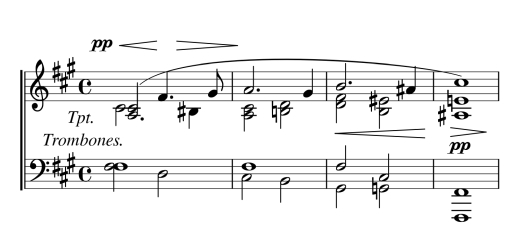
[PDF] [MusicXML] Audio content is not currently supported on your device.
The pure poet, working in his own material alone, would give us this sense of illimitable sadness by the infusion into the mere idea of some remote, unanalysable wizardry of words and rhythms, as in Clough's
"Ah, that I were far away from the crowd and the streets of the city, Under the vine-trellis laid, O my beloved, with thee!"
or Arnold's
"Hear it from thy broad lucent Arno-vale (For there thine earth-forgetting eyelids keep The morningless and unawakening sleep Under the flowery oleanders pale)."
Wagner was blind to this super-intellectual quality in words because for him that quality was most naturally added to them by music. Speech was with him always "the organ of the intellect"; our modern speech was "utterly feelingless": the poet cannot communicate feeling because "articulate language" is capable only of "description and indication."[360] He himself was strictly speaking hardly a poet at all: he was simply a writer of words for music,—words to which the music had to add the emotional beauty that the genuine poet would have conveyed by speech alone. We are therefore not in the least surprised to learn that Wagner first of all wrote his "poems" in prose, which he then turned into rhyme or rhythm at his leisure. We possess, in Wieland the Smith,[361] an intended operatic libretto of his that never got past the prose stage. Having decided not to set it to music himself, he offered it to Liszt. "The poem," he writes to the Princess Wittgenstein, "is fully worked out; nothing remains to be done [sic] but the simple versification, which any tolerably skilful verse-maker could do. Liszt will easily find one. In the most important places I have written the verses myself."[362]
Hence all this elaborate analysis of vowels and consonant sounds is quite beside the mark. He imagines "the feeling" of a word to reside in the "root-syllable" of it,—"which was invented or discovered by the primitive emotional need of humanity" (die aus der Nothwendigkeit des ursprünglichsten Empfindungszwanges des Menschen erfunden oder gefunden ward). And the fountain of that emotional force in the root is the vowel sound, which is "the inner feeling incarnate" (das verkörperte innere Gefühl).[363] Portentous attributes are also given to the consonants, and the initial consonant is pronounced to be of more significance than the terminal. Most of this is merely fantastic. Words, especially in the hands of a poet, are not simply clothed vowel sounds; they are entities with a marvellous life of their own. The appeal of Keats's
"The same that ofttimes hath Charmed magic casements, opening on the foam Of perilous seas in faery lands forlorn,"
has nothing whatever to do with vowels and consonants: we no more think of these than we think of vibration numbers when we listen to a succession of musical harmonies. The beauty of the lines is in the totality and the rareness of the imaginative picture they flash upon our vision; and to attempt to explain the secret of this in terms of vowels and consonants is as futile as to try to explain a flower by its physical particles.
XII
One is sometimes amazed, in reading Opera and Drama, at the persistence with which Wagner pursues the obvious, hunting it down, as Oscar Wilde said of James Payn, with the enthusiasm of a short-sighted detective. He is almost as elaborately absurd over his vowels and consonants as M. Jourdain. The explanation is to be sought partly in the tendency to long-windedness, the passion for pursuing every idea to the death, that was always characteristic of him,—it derived ultimately from the inexorably logical nature of his mind,—and partly from the fact that he had a very stupid public and a very stupid set of artists to educate. Opera and Drama has been made both more lucid and somewhat obvious for us to-day by Wagner's own operas. If there is less need to-day to labour certain points as he does, it is because they are now such universally accepted truths that it is hard for us to imagine a time when people needed to have them driven into them at the point of a pen. Here and there his letters give us an inkling of the difficulties with which he had to contend. Few people in the middle of the nineteenth century, apparently, had any idea of real drama in opera.[364] Even the singers,—with the exception of a born genius here and there like Schröder-Devrient,—had little notion that their parts consisted of anything but so many words to be sung as brilliantly as possible. In one of his letters to Liszt, Wagner describes his horror at seeing, in the Dresden opera house, the Tannhäuser, in the "Hall of Song" scene, shouting his declaration of unholy love for Venus straight into the face of the chaste Elisabeth!—and this in spite of the composer having taken particular care to have all directions copied in full in the separate vocal parts. "What result was possible but that the public should be confused and not know in the least what to make of it? Indeed, I discovered in Dresden that the public became acquainted with the dramatic contents of the opera only by reading the text-book; that is, they only came to understand the performance by abstracting their minds from the actual performance and filling-in from their own imagination."[365] And as he hints, if these things could be done in a first-class opera house like Dresden, what hair-raising horrors must go on in the smaller theatres?
A good deal of Opera and Drama, then, took its rise in the immediate circumstances of the German operatic life of the early nineteenth century, and has no particular validity for the world in general to-day.[366] Other portions of it relate only or mainly to the Ring. For all his insistence on the necessity of alliterative verse (Stabreim), he virtually discarded it when he had finished with the Ring. The Meistersingers is written throughout in rhymed verse. In Tristan he employs in turn alliteration, rhyme, and unrhymed verse; Parsifal fluctuates between a sort of vers libre that is often as near as possible to prose, and a rhymed stanza-form for the more pronouncedly lyric portions. Opera and Drama, in fact, was in large part the reduction to theory of the principles of structures that were slowly taking shape within him as he pondered on the Siegfried legend. As with all great artistic creators, each subject was seen so vividly, took such complete possession of him, that it unconsciously made for itself its own inevitable form. He himself knew that it was in the Ring that the theories of Opera and Drama had their origin. "Even now," he writes to Uhlig, "must I learn that I should not have discovered the most important conditions for the conformation of the drama of the future had I not, as artist, lighted quite unconsciously upon them in my Siegfried."[367] And working backwards, as it were, from the completed work as we have it now, it is easy enough to see how the subject led him of itself to a new theory of opera. He had a gigantic saga to condense into the dimensions of a normal stage action; the most drastic economy of words was therefore necessary. As the burden of the emotional expression was to be undertaken by the music, the purely verbal portion would have to be reduced to the barest essentials consistent with making the conduct of the drama and the motives of the characters clear. And as every word had to be vital to the drama, and the musical phrase was to fit the verbal phrase as if the two had been predestined for each other from the beginning of time, each line, short as it might be, had to be packed with accents as salient as those of the music itself. This condition seemed to be most perfectly fulfilled in Stabreim, because there the vowel or consonant that gave definition to the word was thrown into the highest possible relief at the very moment of the incidence of the musical accent. The following quotations from the Valkyrie will make this clear:
A

[PDF] MusicXML] Audio content is not currently supported on your device.
Die Betrog'ne lass auch zertreten. Let them trample on the betrayed one.
B

[PDF] MusicXML] Audio content is not currently supported on your device.
Dass mit Zwang ich halte, was dir nicht haftet. That by force I hold what denies thee homage.
C

[PDF] [MusicXML] Audio content is not currently supported on your device.
Wer bist du, sag', die so schön und ernst mir erscheint? Who art thou, say, who dost stand so beauteous and stern?
It was therefore, as usual, the musician in him controlling the poet, although he always strenuously denied this, and indeed his complaint against the old-time opera was that the poet was held in servitude to the musician. In each case the poet was the serf, but the terms of slavery were different. In the older opera he had to work within the limits of a set scheme that gave him little or no scope for character-drawing or for the natural evolution of a great dramatic action. In the Wagnerian opera the poet was indeed allowed to make his portion of the work worthy and consistent, but he was permitted no further scope than was consistent with the necessities of the music. If it be true that Wagner restored the poet to liberty by making the drama the end and the music the means, it was only in the sense that he first of all made the drama of the dimensions and the pattern that music required. Beyond these dimensions, away from that pattern, it could not be allowed to go.
That the musician in Wagner ruled the poet is plain enough to us now, but it was always denied by Wagner himself. In the Communication to my Friends, that elucidates so gratefully for us so many dark passages in Opera and Drama, he is persistently blind to the fact that is obvious enough to everyone else. As far as Rienzi, he tells us, he had taken his operatic subjects from ready-made stories, while with the Flying Dutchman he struck out a new path, framing his own libretto out of the simple unpolished outlines of a folk-saga. "Henceforward," he goes on to say, "with regard to all my dramatic works I was in the first instance Poet, and only in the complete working out of the poem did I become once more Musician. Only," he rather naïvely continues, "I was a poet who was conscious in advance of the power of musical expression for the working out of his poems."[368] Quite so: when a subject took possession of him he would see it all in terms of musical expression and development; and unconsciously the poem would be so planned as to provide the needful framework, and no more, for the musical emotion. Later on, after arguing that music is the emotional expression per se, but that it can only ally itself with words that contain the possibility of emotion, he once more lets us see that it was the musician in him that determined his choice of subject and the manner of its treatment. "What I perceived, I now looked at solely with the eyes of music [nur aus dem Geiste der Musik]; though not," he rightly points out, "that music whose formal rules might still have embarrassed my expression, but the music that was complete within me, and in which I could express myself as in a mother tongue."[369] Granting that the musical world from the centre of which he wished to pour himself out upon poetry was not that of the stereotyped operatic composer, the fact remains that it was from the centre of music itself that the outpouring was to come. And we may further grant that "it was precisely by the facility of musical expression" he had acquired that "he became a poet." What had happened in the interval between Rienzi and the Flying Dutchman, and still more in the interval between the Flying Dutchman and the Ring, was that his musical sense had so enormously expanded that it was now capable of weaving a continuous emotional tissue of its own,—a tissue, however, that required the framework of poetry to make it definite. He was right; it was of the musician in him that the poet was born. And it was the musician insisting on the dramatic "stuff" being reduced to its pure essentials that led him to reject the wide-spreading romance and history, and to seize upon the myth, in which a human content was presented in the simplest possible form.
XIII
The musician, then, being at the basis of all his æsthetics, all his theories of opera and drama, the question arises, what sort of a musician was he? He was the spiritual son of Beethoven; a remoter ancestor was Bach. This is the cardinal fact in the psychology of Wagner; and it will need to be examined in all its bearings.
Wagner was one of those dynamically charged personalities after whose passing the world can never be the same as it was before he came—one of the tiny group of men to whom it is given to bestride an old world and a new, but to sunder them by a gulf that becomes ever more and more impassable; one of the very few who are able so to fill the veins of a whole civilisation with a new principle of vitality that the tingle of it is felt not only by the rarer but by the commonest spirits—some new principle from which, whether a man likes it or not, he will find it impossible to escape. Wagner is probably the only figure in the whole history of music of whom this can be said. Bach created no such upheaval. He counts for next to nothing in the music of his own day and that of the two generations that followed him. He did not make a new world in music: rather had a new world to be made before men's eyes were competent to take the measure of that towering stature, or men's hearts quick enough with life to respond to the profound humanism of that great soul. We were not fit for Bach until Beethoven and Wagner—and Wagner, perhaps, even more than Beethoven—made us so. Beethoven, again, had it not been for Wagner, would probably not have meant as much to us as he does now, or become the fertilising force he is in modern music; and even that fertilisation is effected through Wagner's work rather than along lines in continuation of Beethoven's own. If anyone doubts this, let him ask himself what new spirit of enduring vitality and power of propagation has come out of the classical symphony pure and simple. Not Brahms, assuredly, great as he is: "arrested development" is written large upon the forms and the ideas of all the music that has come out of Brahms's symphonies as clearly as upon those symphonies themselves. So far as modern instrumental music has developed in humanity of utterance or in breadth of structure, it is from assimilating from Beethoven, through Wagner, just the urgent poetic spirit that Brahms passed by in Beethoven,—the spirit of which Beethoven was himself only dimly conscious, but which Wagner from the beginning saw to be inherent in him, and which he distilled from the general tissue of Beethoven's work and used in a new form for magical results of his own. The only explosive force in music at all comparable in general to Wagner was Monteverdi. But Monteverdi came a couple of hundred years too soon. The world was not ready for him—it is hardly a paradox to say that he was not ready for himself—and his explosion mostly spent itself in a desert. Wagner had first-rate luck in this as in everything else in his life that really mattered to him as an artist; not only had he the right dynamic spark within him, but he was born into an atmosphere made electrically ready by the passionate soul's cry of Beethoven. The explosion came—a cataclysmic upheaval, leading to a new geological formation, as it were, in music, new geographical delimitations, a new fauna and flora.
He had access to Beethoven's heart: and from the blood in Beethoven's veins he won the strength both for his own new expression and his new freedom of form. It is one of the things we should be constantly thanking Providence for that the natural man in him insisted on making its own world in its own way. Busoni, in his suggestive Entwurf einer neuen Aesthetik der Tonkunst, has remarked upon the curious formalism of most music, even the greatest. Here is an art fortunate enough to be free from all material factors: it is, as Busoni says, simply "sounding air," and is therefore presumably capable of a freedom of handling that should be the despair of workers in the other arts. Perfect freedom has yet to come; looked at from the heights, even giants like Bach and Beethoven and Mozart are seen to be loaded with chains of their own and their fellows' forging, and to be performing the same timid evolutions again and again in one small corner of a field, while glorious leagues of unexplored country unroll themselves all around them. Bach and Beethoven enriched music by a sort of intensive culture of an inherited estate. Wagner was really the first to leap the fences and break down the gates and send his ploughshare deep into the bowels of a new earth. Almost from his earliest years he had an instinctive sense of the great force of emotional liberation that was struggling for an outlet in Beethoven's music. He was probably the only man in Europe to be aware of it and its tremendous significance for the future. There were plenty of men who felt the greatness of Beethoven; but not one of them, apparently, saw him as Wagner did. It is evident that people like Mendelssohn and Robert and Clara Schumann, for example, with whom he talked much in the 'forties, had no inkling that out of the spume of this eager, restless mind the future of music was to be born. To them his far-darting talk about Beethoven was apparently no more than the interesting speculations of a clever but slightly eccentric visionary. From the first he fastened upon the seminal essence of Beethoven's later work—the attempt of a great soul, hampered somewhat by a transmitted form, to pour out an endless fund of quasi-dramatic emotion in music. The problem that lay before Wagner was how to release this fund of emotion, to give it wings that would carry it over the whole field of human life, to give it a new and more wonderful articulation. After years of struggling he found his way to the light. It was one of the extremely lucky "throws" of nature—a throw she will probably not achieve again for generations—that within the musician who had this unique vision of a music infinitely human and perfectly free there was a dramatist capable of providing the definite framework upon which the indefinite musical emotion could be woven into firm, coherent shapes. His theory that purely instrumental music had shot its last bolt with Beethoven, and that the choral ending to the Ninth Symphony is the unconscious, instinctive cry of the musician for the redemption of music by poetry, is the soundest of æsthetics if we do not take it too literally. Music did need this fertilisation by poetry if it was to win a new procreative power. Agreeable music has been made, and will continue to be made, by the passionless, disinterested weaving for its own sake of beautiful strands of tone. But great music must go deeper than this, and the deeper it goes the closer it comes to the heart; and our name for the necessities of the heart is poetry.
XIV
Having thus summarised the attitude of Wagner to Beethoven and to poetic music in general, let us proceed to fill in the details of the theory, allowing Wagner, wherever possible, to speak for himself.
He has set forth his views upon Beethoven with the greatest positiveness in his letters to Uhlig, and much more lucidly there than in Opera and Drama.[370] He saw in Beethoven's music the struggle to express a definite poetic idea in an abstract form that necessarily made the communication of the nature of the idea itself impossible. He always protested against the current fashion of performing Beethoven's symphonies as if they were nothing more than agreeable or exciting musical patterns. They were tone poems, and could mean nothing to the hearer unless the poetry at the core of them was made clear. "The essence of the great works of Beethoven," he writes to Uhlig, "is that they are only in the last place Music, but contain in the first place a poetic subject. Or shall we be told that this subject is only taken from music itself? Would not this be like saying that the poet takes his subject from speech, and the painter his from colour? The musical conductor who sees in one of Beethoven's tone-works nothing but the music, is exactly like a reciter who should hold only by the language of a poem, or the explainer of a picture who could not get beyond its colour. This, however, is the case with our conductors, even in the best instances—for many do not even so much as understand the music; they understand the key, the themes, the working of the parts, the instrumentation, and so on, and think that with these they understand the whole of the content of the tone-work."[371] And again: "The characteristic of the great compositions of Beethoven is that they are veritable poems, in which it is sought to bring a real subject to representation. The obstacle to their comprehension lies in the difficulty of finding with certainty the subject that is represented. Beethoven was completely possessed by a subject: his most significant tone pictures are indebted almost solely to the individuality of the subject that filled him; the consciousness of this made it seem to him superfluous to indicate his subject otherwise than in the tone picture itself. Just as our literary poets really address themselves only to other literary poets, so Beethoven, in these works, involuntarily addressed himself only to tone poets. The absolute musician, that is to say the manipulator of absolute music, could not understand Beethoven, because this absolute musician fastens only on the 'How,' and not the 'What.' The layman, on the other hand, could but be completely confused by these tone pictures, and at best only receive pleasure from that which to the tone poet was merely the material means of expression."[372]
Wagner recognised, however, the difficulty of grasping a poetic subject that had not been revealed by the composer, and held that it could only be divined by a poetic musician of the same kind. "If no special poetic subject is expressed in the tone speech, it may undoubtedly pass as easily understandable; for there can here be no question of real understanding. If, however, the expression of the tone speech is conditioned by a poetic subject, this speech at once becomes the most incomprehensible of all, unless the poetic subject be at the same time defined by some other means of expression than those of absolute music.
"The poetic subject of a tone piece by Beethoven is thus only to be divined by a tone poet; for, as I remarked before, Beethoven involuntarily appealed only to such, to those who were of like feelings, like culture, aye, well-nigh like capability with himself. Only a man like this can make these compositions intelligible to the laity, and above all by making the subject of the tone poem clear both to the executants and to the audience, and thus making good an involuntary error in the technique of the tone poet, who omitted this indication. Any other sort of performance of one of Beethoven's veritable tone poems, however technically perfect it may be, must remain incomprehensible in proportion as the understanding is not facilitated in the way I have suggested."[373]
This indeed, he held, was Beethoven's error—an error forced upon him by the conditions of his time—that he should endeavour to make his music truly human without giving the hearer the clue to the emotions upon which it was based. Beethoven's mistake, he says, in one of the happiest and most famous of his analogies, was the same as that of Columbus, who, though merely trying to find the way to the India that was already known, actually discovered thereby a new world.[374] His vain effort to "achieve the artistically necessary in the artistically impossible" has, however, revealed to the modern world the infinitely expressive capacity of music. But though it is only by being fertilised by poetry that music can attain to the full expression of the truly human, Wagner, as was to be expected from one who allowed so little liberty to the imagination in art, was against this fertilisation taking the form of programme music. The poetic content must be communicated immediately and visibly to the hearer by presentation on the stage. In all this, of course, he was once more merely expressing an individual bias, and one that is not in the least binding upon musicians in general. When the musician, he tells us, tries to paint by means of the orchestra alone, what he produces is neither music nor a painting.[375] He failed to perceive not only that instrumental music offers numberless instances of quite successful tone painting, but that a good deal of the pictorialism of his own music has to justify itself by means of the imagination alone. Every time the Feuerzauber, for example, is played in the concert room the imagination supplies, quite successfully, the spectacle of the flames; and even in the theatre it is left to the imagination to picture to itself the waves of the Rhine in the opening scene of the Rhinegold, for while the wave music is going on from the commencement the curtain does not rise until the 126th bar. There is no need to elaborate the point. Hundreds of composers, from Bach to the present day, have "painted" in music time without number without the assistance of a stage setting, the subject of the painting being quite sufficiently indicated either by the words of the poem,—the spinning-wheel in Schubert's Gretchen am Spinnrade, for example,—or by means of an explanatory note or title, as with the modern symphonic poem.
Without pursuing this side issue further now, let us follow up the more essential lines of the Wagnerian theory. We have seen him first of all frame his dramatic action in such a way that while making itself fully intelligible to the spectator it supplies the music with endless opportunities for the outpouring of feeling. Romance and "historical" drama have both been rejected because of their containing so much that, according to Wagner, appeals less to the feeling than to the intellect. It was in the myth that he found the condensation he desired. Upon the myth the composer was to pour out the full flood of his emotion. The form and quality of the musical utterance are to be determined by the poem. Lyrism must no longer be imposed upon the drama from without, as in the older opera, but must grow out of the drama as a necessary consequence. It follows that neither the chorus nor any of the characters is to be employed purely for the purposes of concerted music. In the orchestra the musician has at his disposal an instrument of unlimited expressiveness. The orchestra, as Wagner says, has a capacity of its own for speech. In the Beethoven symphony this capacity was developed to such a height as to urge the orchestra to make the vain attempt to deliver a message which from its very nature it was impossible for it to deliver clearly. That message, however, can be précisé by the Word: and the true function of the orchestra is to announce what cannot be conveyed by speech.[376] Its specific meaning can be still further précisé by means of gesture—not the ordinary gesture of the older opera, which derived solely from the dance pantomime, but gesture that is the visible counterpart of the auditory sensation communicated by the orchestra. The range of this kind of gesture is as wide as human emotion itself. Moreover, the orchestra can carry on the action even after speech and gesture have ceased; it can use themes in such a way as to create presentiment, and it can recall the past. The orchestra in fact, is to the drama of the future what the chorus was to the Greek drama,—a totalised individuality apart from, yet intimately bound up with, the separate individualities on the stage. The musical expression will vary in intensity according to the intensity of the situations. The form of the music drama will therefore be a unified one, but one containing the possibility of an infinite variety of expressions; but it will not be permissible to introduce any expression for the mere sake of musical effect; everything must grow spontaneously out of the emotions and situations presented by the poet. The drama can be thoroughly unified by the employment of salient "leading motives";[377] whereas the older opera had no unity at all, but was a mere conglomeration of arias, duets, ensembles, and so on.[378]
XV
It must be clear to almost every reader, after this exposition of Wagner's own views upon music in general and dramatic music in particular, that, paradoxical as it may seem, he was under a life-long illusion as to the nature of his own genius and the origin and significance of his reforms. So far from the poet in him shaping and controlling the musician, it was the musician who led the poet where he would have him go; so far from drama being with him the end and the music the means, it was music that was more than ever the end, to which the drama only served as means; and so far from Wagner being first and last a dramatist, the whole significance of his work lay precisely in the fact that he was a great symphonist. This last conclusion too may seem a paradox; but on a broad survey it will, I think, be seen to be true. It was not for nothing that Wagner always claimed descent from Beethoven rather than from even the greatest of opera writers, such as Gluck and Mozart and Weber. His instinct was a sound one; it was Beethoven's work that he was really carrying on. The whole of his productivity is given us, in essence, in the later stages of the Ring, in Tristan, and in the Meistersinger. It was to achieve such an expression, such a tissue, as this that he had been labouring and experimenting and thinking for nearly thirty years; and what are these works, seen with the historical eye of the twentieth century, but stupendous symphonies for orchestra and voices? He himself always proudly pointed to Tristan as the supremely successful realisation of all his theories as to the expressive capacity and the formal possibilities of music. Very well; Tristan is of all his works the most symphonic, the one that least needs the apparatus of the stage, the one in which the actors could most easily be dispensed with for long stretches of time with the minimum of loss.
I have already pointed out that he was probably the only musician in Europe in the 'thirties and 'forties with an intuition of all that the achievements of the later Beethoven meant for music.[379] All through Wagner's theoretical writings runs the same simile of music as a vast sea, on which Beethoven alone had so far been able to trust himself with any freedom. While the other composers of his day—and indeed of a later day, as the case of Brahms shows—had little idea beyond cruising in Beethoven's track with more or less varied merchandise, Wagner even as a boy saw the infinite wonders that were awaiting the first mariner who should have the courage to leave the shelter of the great bay and adventure out into the unknown main. He knew all that Beethoven had added to German music, the new emotions he had poured into it, the new logic of form with which he had endowed it. He knew also that as much could still be superadded to Beethoven as Beethoven had added to Mozart and Haydn; and the story of his evolution, both as dramatist and musician, is the story of this gradual extension of the borders of the Beethoven territory.
He had in abundance what has hitherto been almost the exclusive possession of the German school of music,—the sense of a far-sweeping logic of form. He had the rigorous, clean-cutting intellect that instinctively makes straight for what is the very essence of form—the spontaneous shaping of an idea, by itself, for itself, into the lines and colours most natural to it. "Swords without blades" was his contemptuous description of the empty rules of "form" that they sell in schools and text-books, much as the chemist sells the dried leaves of flowers. The true artist, he says, is always creating forms without knowing it.[380] His problem was to find the new form that should be as valid for what he had to say as Beethoven's form was for him. No such form was then in existence. In this respect he was far less fortunate than any of his great predecessors or successors; each of them had found his work all the easier in that he began with an inherited form, of opera or of instrumental music, which he simply exploited or expanded according to his necessities. Wagner's glance round upon the music of his day showed him that there was no form that he could take up and patch or hammer into a serviceable instrument. The symphony was not, nor is it yet, a truly logical form. Its divisions, the number of its divisions, the order of its divisions, are all in large part arbitrary and conventional. Within each of the frames made by these divisions it had to submit itself to a more or less formalistic method of procedure that was often at variance with the very nature of the idea. Even Beethoven, giant as he was, could not quite burst the bonds of custom and prescription. Wagner's favourite illustration of the clash that sometimes occurred between the traditional form and a new artistic purpose was the repeat in the Leonora No. 3 Overture. The controlling influence in the evolution of symphonic form had been the dance; the business of music had primarily been to make what variable play it could with certain given thematic figures. But bit by bit there had stolen into instrumental music the desire for more than this—the desire to follow out in tone not the changing aspects of a theme alone but the vicissitudes of a dramatic idea; and composers had long felt that the logic of the latter must be something other than the logic of the former, though as yet they did not quite know how to attain the structure they wanted. The purely thematic working-out aimed mostly at alternation: the dramatic working-out must depend mostly on psychological development. "It is obvious," says Wagner, "that in the conflict of a dramatic idea with [symphonic] form, there must at once arise the necessity of either sacrificing the development (the idea) to the alternation (the form), or the latter to the former.... I once held up Gluck's Overture to Iphigenia in Aulis as a model, because the master, with the surest feeling for the nature of the problem we are now considering, had here so happily understood that he must open his drama with an alternation of moods and their antitheses, in keeping with the overture form, instead of with a development impossible in that form. That the great masters who came after him, however, felt themselves circumscribed by this, we may clearly see in Beethoven's overtures; the composer knew the infinitely richer delineations of which his music was capable; he felt equal to carrying out the idea of development; and nowhere do we realise this more distinctly than in the great Leonora Overture. But anyone with eyes can see precisely in this overture how prejudicial to Beethoven the retention of the transmitted form was bound to be; for who that is capable of understanding such a work will not agree with me that its weakness consists in the repetition of the first part after the middle section, whereby the idea of the work is marred almost to the point of making it unintelligible; and that the more as in all the other parts, and especially at the end, Beethoven is obviously governed simply by the dramatic development? But whoever is intelligent and unprejudiced enough to see this must also admit that this mishap could only have been avoided by forswearing the repetition altogether—which, however, would mean the abrogation of the overture form, i.e. the original symphonic dance form with its mere play of motives (nur motivirte), and the first step towards the shaping of a new form."[381]
XVI
Beethoven, in fact, had brought a new spirit into the symphony and the overture without being able to discover a new and inevitable form in which this spirit could express itself. Wagner from his earliest years must have felt that he too had a dim perception of a new world of expression, if only he could discover the form for it. That form clearly did not exist in the symphony even as Beethoven had left it, for Wagner's vision was ready to take a bolder poetic flight even than Beethoven's, and it would have been as sadly hampered by the more freely symphonic but still largely formal method of Beethoven as the latter had been by the traditions of form he had taken over from his predecessors. It was still more useless for Wagner to seek the new logic of form in the other great art-genre of his day—the opera—for here illogic reigned supreme. The opera not only did not achieve the unity it professed to aim at; it did not even let either of its two great and ever warring constituents tyrannise effectively over the other. Instead, each merely lamed the other; the average opera was neither a good play spoiled by music, nor good music spoiled by a play, but merely a bad play and formless music adding each to the other's foolishness. How hopelessly impotent the current opera was to furnish a form that should be adequate for all that a modern musician might have to say was shown by the practice of Beethoven: the greatest musical brain of its epoch turned in anger and disappointment and disgust from the opera after one experiment with it, and concentrated more and more on the symphonic forms, endeavouring to make these more expansive and more flexible.
A hundred composers and theorists had for a century past realised the insufficiency of the opera. Gluck's manifestos are known to every student. More than a generation after Gluck the same problems were still being discussed in virtually the same terms and with the same results. Theory was evidently a long way ahead of practice; but even theory failed because it missed just the one seminal thing that it was Wagner's function to bring to light. The excellencies and the final limitations of the theory of the time are best seen in a rather remarkable work—Ignaz Franz Mosel's Versuch einer Aesthetik des dramatischen Tonsatzes ("Attempt at an Æsthetic of the Musical Drama")—that, curiously enough, was published in the year of Wagner's birth.[382] Much in this book might have been written by Gluck; some of it might even have been written by Wagner himself. Mosel expresses more clearly perhaps than any previous writer that conception of the unified art-work upon which Wagner so strongly insisted. For Mosel the ideal opera is a combination, on practically equal terms, of poetry, music, acting, singing and the art of the stage; the plastic arts, however, play a smaller part in his theory than they do in Wagner's. He regards the drama as the basis of opera. He sees, as Wagner did, that the rules of procedure of pure music are not applicable in their entirety to the dramatic stage. Like Wagner, again, he holds that complicated subjects, founded on intrigue or political action, are unsuitable for opera. Music being a purely emotional art, addressing itself more to the heart than the head, the best subject is that that gives full play to the emotional power of tone. The best subjects are the mythological ones. The poet must so shape his text that it is "thoroughly musical, that is, not only containing nothing that is outside the possibility of musical expression, but also nothing to which music cannot give a heightened beauty and a strengthened effect." The verse should be of such a kind that the composer's melody can spring naturally out of it. As a rule one syllable should be set to one note only. The melody must rise or fall precisely at the point where a good declaimer of the verses who is not musical would make them do so. Mosel sees that dramatic music frequently demands a different method of structure from that of pure music; as he puts it, the so-called musical period of two, four or eight-bar melodies can often be departed from with advantage. The style of the music as a whole must vary with the quality of the poetic subject; and not only must the general nature of the theme be reproduced in music, but also the physical, moral or conventional character of each person; and this adaptability of style to subject must be preserved in the orchestra as well as in the voice. The overture, having for its subject the preparation of the hearer for what is to come, must bear the same character as that which is dominant in the opera itself. There must be as little distinction as possible between recitative and aria. Form and expression must always follow the feeling. And so on and so on.
This was the sole result of a hundred years of keen theory and ardent practice. The form of opera remained virtually what it always had been; the most that anyone could suggest was a rationalising of the form here and there, the ridding it of some excrescence or absurdity. And so, in all probability, it would have remained for another hundred years, had not Wagner come with the conception that the old form itself was not worth tinkering with, but must be cast aside, and a new one made, not out of Mozart, not out of Gluck, not, indeed, out of any opera whatever, but out of the instrumental music of Beethoven. And this, I repeat, was a marvellous perception for one man out of all Europe's music-making millions to have.
His own accounts of the dawning of this idea upon him betray a fundamental inconsistency. On the one hand he is always stoutly asserting that he only found his way to the new music at the impulse and under the guidance of the poet. On the other hand it is clearer to us than it was to him that the poet in him was allowed to co-operate with the musician only in much the same way that he is allowed to co-operate in the symphonic poem. The musician, that is to say, feels a vague desire to express certain emotions of love, of pity, of terror, of aspiration; and he calls in the poet to supply him with a framework that shall be able to give consistency to his emotions and make the sequence of them intelligible to his hearers. Wagner, in his analysis of his own psychological processes, inverted the real relations of them, misled by the fact that as a musician he developed much later than as a poet—the obvious reason for this being that in poetry he had not, as in music, to make a new instrument, a new vocabulary and a new technique for himself. But even from his own account it is evident that the new ideal of music drama arose in him through the convergence of two great impressions—the acting and singing of Schröder-Devrient, and the later symphonies and quartets of Beethoven. He was amazed to find how much Schröder-Devrient could do in the way of dramatic expression with the poor puppets and absurd situations of the Italian opera stage. "I said to myself, what an incomparable work must that be, that in all its parts should be worthy of the histrionic talent of such an artist, and still more, of a body of artists like her." Then, he says, he got the idea of what could be done with the operatic genre "by turning the whole rich stream of German music, that Beethoven had swelled to the full, into the bed of the musical drama."[383]
And the essence of Beethoven's achievement, as he saw, was that not only had all the earlier formalism become inevitable form, but that form itself was dissolved in the idea; the Beethoven symphony becomes in the end simply a continuous flood of meaningful melody. "For it is surprising," he says, "that this method of procedure, developed in the field of instrumental music, should have been employed to some degree in mixed choral and orchestral music, but as yet never properly in opera.... Yet the possibility must exist of obtaining in the dramatic poem itself a poetic counterpart to the symphonic form, which, while it completely fills this copious form, should at the same time correspond to the inmost laws of dramatic form."[384]
The real ancestry of Wagner the opera writer is then clear enough; it is not an operatic but a symphonic ancestry. I therefore cannot wholly agree with Dr. Guido Adler that "as an opera composer Wagner stands in the frame of Renaissance art and culture. His fundamental aims coincide more or less with those of the founders of this culture epoch in general and of the representatives of the High Renaissance in the musical drama in particular.... The founders of the opera created the stilo rappresentativo, in which the musical expression was to follow the representation and the action as closely as possible.... The true theatre style proceeds historically from Peri, Monteverde and Cavalli to Wagner and Verdi. These are the representatives of emotionalism in music, of that fundamental æsthetic principle that recognises expression as the sole or main essence of music." [385] Resemblances between Wagner and the Renaissance founders of the opera there certainly are; but in comparison with the basic difference between him and them the resemblances are superficial. That basic difference is that while their reforms were born of the desire to model music upon and control it by speech, [386] Wagner's reform was born of the conception that the most copious and eloquent of musical instruments is the orchestra, to the emotions of which the voices, by means of words, can give direction and precision. Wagner's true lineage is that of instrumental music, the symphony and the symphonic poem. He is not the child either of the stage or of the song; the instrumental musician in him simply enters into an alliance with these for purposes of his own.
XVII
Of this he was more than half conscious himself; and it was always clear to him that as he was in the great line of instrumental succession, and that what he was doing was to extend still further the expressive range of instrumental, endlessly melodic music, it might be urged against him that the logical outcome of all his theory and his practice was not the opera but the symphonic poem or the programme symphony. But against that conclusion he always strenuously protested in advance. Something he saw there must be to make definite to the hearer the indefinite emotion of the music alone. He knew that the classical symphony was a work of composite origin, one movement of it—the Minuet or Scherzo,—still maintaining almost unchanged its dance-like character, while in the others the composer aimed more and more at emotional expression. But the musician was hampered here by the fact that the expression of emotion could not rise above a certain intensity without bursting the symphonic mould, and indeed prompting in the hearer a question as to the source of that emotion. There was, as Wagner says, "a certain fear of overstepping the bounds of musical expression, and especially of pitching the passionate, tragic tendency too high, for that would arouse feelings and expectations that would awake in the hearer the disquieting question of 'Why,'—which the musician himself could not answer satisfactorily."[387] But Wagner would not admit that this something might be a mere programme. "Not a programme, which rather provokes than silences the troublesome question of 'Why,' can therefore express the meaning of the symphony, but only the scenically-represented dramatic action itself."[388] With the liberation of musical expression from the stereotyped images set before it in the ordinary musical verse, and with the liberation of musical technique effected by the breaking down of the old operatic conventions of form, the power of music could be extended indefinitely. The poet would discover that "melodic form is capable of endlessly richer development than had previously been possible in the symphony itself, and, with a presentiment of this development, he will already project the poetical conception with perfect freedom. Thus where even the symphonist timidly reached back to the original dance-form—never daring, even for his expression, wholly to pass the boundaries that kept him in communication with this form—the poet will now cry to him: 'Throw yourself fearlessly into the full stream of the sea of music: hand in hand with me you can never lose touch with what is most comprehensible to all mankind; for through me you always stand on the ground of the dramatic action, and this action, in the moment of its representation on the stage, is the most immediately intelligible of all poems. Stretch your melody boldly out, that it may pour through the whole work like an endless flood: in it say what I leave unsaid, since only you can say it, and in silence I will utter all, since it is I who lead you by the hand."[389]
Here he is expressing only a personal bias. His own imagination was somewhat timid; it preferred the seen to the unseen, and he was consequently quite unable to take up the point of view of people to whom a thing mentally conceived is as impressive as, or even more impressive than, the same thing set bodily before their eyes. Had he had any inkling of this, he would not have brought so many animals upon the scene. The most striking instance of his inability to trust to the spectator's imagination is his vacillation over the ending of Tannhäuser. In the first version of the final scene, the last attempt of Venus to win back her old lover was shown only as a struggle in the mind of the frenzied Tannhäuser, with a red glow in the direction of the distant Hörselberg to make the cause of the madness clear. The death of Elisabeth was merely divined by the intuition of Wolfram, while the sound of far-off bells and the faint light of torches on the Wartburg gave the spectator the hint he needed for the full comprehension of the scene. Wagner was uncomfortable until he had made everything visible that had formerly been left to the imagination; Venus had to appear in person to Tannhäuser, and the bier of Elisabeth had to be carried across the stage. It would have been better, in this and in many other cases, had he reposed more faith in the imagination of his audience. But his theory and his practice were often inconsistent in this as in so many other cases. We have seen him objecting, à propos of Berlioz's Romeo and Juliet, to music that required an explanation outside itself to make it clear. But several of his own orchestral pieces are unintelligible without a verbal explanation or its equivalent. Who could make anything of the prelude to the third Act of Tannhäuser, for example, in the absence of such an explanation? It cannot even be said that the dramatic play of the motives is clear to anyone who has listened carefully to the opera, for the theme of Tannhäuser's pilgrimage, that is of such importance in the prelude, does not occur till the third Act; during the prelude to that Act the hearer who is listening to it for the first time is ignorant not merely of its meaning but of its very existence. How, again, can the audience be expected to know, the first time they hear it, that the opening theme of the prelude to the third Act of the Meistersinger symbolises Sachs's renunciation of Eva? The theme has appeared in the second Act as an orchestral counterpoint during one of the stanzas of the cobbling song. Even supposing the hearer to have any notion on that occasion that the theme is more than an ordinary counterpoint—that it has a psychological significance—how is he to know what this significance is; and how is he to read this meaning into it when he hears it at the commencement of the third Act? It all has to be made clear to him by a prose explanation, as Wagner himself recognised when he wrote his explanatory programme note upon the prelude. In the light of this and other instances that could be cited, how can Wagner consistently deny to other composers the right to call in the aid of verbal explanations for their symphonic poems or programme symphonies?
XVIII
There are as many contradictions between Wagner's theory and practice, indeed, as between his life and his art. Without attempting the impossible task of trying to reconcile them all, let us cast a rapid glance over the main features of his practice, which are far more important than his theory. From every side we are driven to the conclusion that the dominating force in him was the instrumental musician who was born to continue Beethoven's work in another sphere. As his powers developed, his music becomes more symphonic,[390] and he intuitively shapes his poems so as to allow the freest possible play to the symphonic succession and interweaving of themes. The characters serve to make the course of the story clear, and to give precision to the emotions that are being expressed by the orchestra. He saw in Beethoven's later works a colossal effort to make music free. Logic of some kind there must be in every piece of music. This logic depends fundamentally upon showing the inter-relation of each part of the music by the recurrence of significant themes; and broadly speaking there are only two ways of achieving this—by way of pattern or by way of poetry. At bottom all form, all logic, in music, in fiction, in drama, in architecture, in sculpture, is one in object and process; a coherent whole has to be made out of parts, and the parts have to justify their existence by showing themselves indispensable to the whole. Pattern form and poetic form embrace between them every mode of structure of which music is capable. Sometimes a piece of music leans markedly to the one or the other; but in the vast majority of cases the actual form is a union of the two, or a compromise between them. It was a compromise of this kind that Wagner detected in some of the greatest works of Beethoven; the form that had been evolved mainly with reference to pattern was being applied, with only partial success, to music the prime impulse of which was poetic—however vague this poetry might be, however incapable of expression in words. But while pattern form pure and simple tells its own story and is its own justification, poetic form needs to be explained and justified by the poetic idea that is at the root of it. Go beyond Beethoven, says Wagner, in the expression of poetic emotion, and your form will become so free that the hearer will no longer be able to see it in terms of the old pattern logic, and the music will seem to him formless and incoherent. You can only win the full freedom you need for the expression of definite as distinguished from indefinite emotion by telling the hearer the nature and the source of this emotion. As Wagner put it, poetic music in pattern form always prompts the question "Why?" The symphonic-poem writer answers with his programme: Wagner answered with the characters and the action of the programme set visibly before us on a stage. There is no such fundamental æsthetic difference between the two methods as Wagner imagined; the differences are only in detail.[391]