Chapter I · THE MAN
Reading edition
I
From the autobiography and the letters to Apel we can get an excellent idea of what he was in his boyhood. He came of a family of rather more than average ability. As a child he was nervous, excitable and imaginative, impatient of control either at home or in school, but quick enough to assimilate life and knowledge in his own way. It is clear, both from what he says in Mein Leben and from scattered hints in that book and in his letters, that he was occasionally a source of great anxiety to his relations. Already he had a bias towards the theatre, which would be increased by his frequent association with actors and singers.[44] For a time he haunted the smaller gambling dens of Leipzig—even going so far on one occasion as to stake his mother's pension—entered into the usual students' follies and dissipations, and generally must have seemed to the ordinary eye as complete a young wastrel as could be imagined. He himself tells us: "I bore, as if in a state of complete stupor, even the contempt of my sister Rosalie, who, like my mother, hardly vouchsafed a glance at the incomprehensible young profligate (Wüstling), whose pale and troubled face they only rarely saw."[45] He picks up the rudiments of a general and of a musical education. Then he knocks about from one small theatrical troupe to another, his character inevitably coarsening and relaxing in the process. He was at this time extraordinarily sensitive to his environment; and as this was as a rule of an intellectually superficial kind, he came to take the average actor's or singer's superficial view of life and art. And as from his boyhood he was hopelessly incapable of managing his financial affairs with any prudence, and soon acquired that habit of borrowing from friends and eluding tradespeople that clung to him for the greater part of his life, the iron was not long in entering into his soul. So rich a nature as his could of course afford to waste itself extravagantly, and in the end no doubt his art was all the better for his having eaten so freely of the tree of the knowledge of good and evil; but to the relations and companions who cared for him in those early years he must often have seemed to be wasting himself beyond all power of recovery. His life until long past his fiftieth year resembles a ship steering with incredible recklessness among every sort of shoal and rock. More than once it looked as if the vessel would founder; only a unique combination of courage and determination and extraordinary good fortune managed to keep it afloat and bring it finally into haven.
II
The best picture of him in his adolescent years is given in the correspondence with Theodor Apel, the friend of 1832-1836. There we have in epitome the whole Wagner of the later years, with his imprudence in all the practical affairs of life, the irrepressible vitality that enabled him to recover so quickly after each of the many crises he went through,[46] his extravagance, his incurable tendency to run up debts with tradesmen and to borrow money from his friends, his Micawberish confidence in the speedy turning of his luck. It is evident that at an early stage of their friendship he had drawn upon the purse of Apel, who had the dangerous gift—for a friend of Wagner's—of riches. But the young Micawber has no doubts as to the future. In October 1834 he is quite convinced that he is going to have a great success with Die Feen, which will lead to a still greater success for Das Liebesverbot; he will make a lot of money, and he and Apel will go and enjoy themselves in Italy for a year or two. This desirable consummation is to come about in the spring of 1836. In Italy he will write some Italian operas, and then they will go to France, where he will write a French opera; and so on. [47] We have some indication of the depth of the draughts he was then taking of the physical joy of life in a letter of 6th June 1835, in which he tells Apel to "enjoy and be merry." "I have now resolved," he says, "to be a complete Epicurean with regard to my art: nothing for posterity, but everything for the present and the moment."[48]
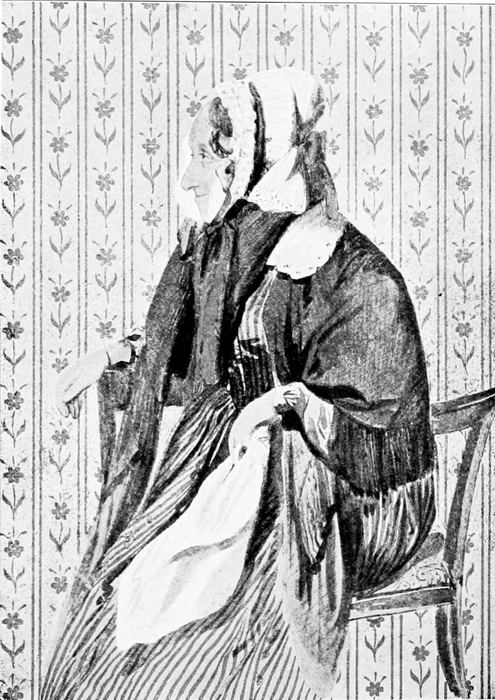
WAGNER'S MOTHER.
But soon there comes an emotional crisis of the kind that occurred so frequently in Wagner's life. The tearful, almost hysterical, letter to Apel of 21st August 1835 is a remarkable document. Wagner seems to have got heavily into debt, to have done all sorts of foolish things, and to have vexed and saddened his friends and relations. Even Apel appears to have been for a while estranged from him. Wagner beats his breast in agony. He has been mad; the promised happiness of youth has fled from him; but he will make a brighter future for himself. Note already, in this letter, the passion for self-revelation and self-dramatisation that is evident in so much of his later correspondence. He was not a dramatist, said Nietzsche once: he merely loved the word drama. He certainly loved the words repentance and morality.
"I have sinned. Yet not so! Does a man sin when he is mad? I have fallen out with my family, and must regard our relations as at an end.... Till now I have managed my life very badly. Dearest, I was not wicked, I was mad; that is the only expression I can find for my conduct—it was a conventional madness (ein konventioneller Wahnsinn). I see now only too well that money is not a chimera, not a despicable, worthless thing of no importance; I have formed the conviction that money is as much alive as the society in which we are placed. I was mad, I say, for I did not understand myself and my relation to the world. I knew that I had no surely-founded foothold and support at all, and yet I acted like one insane, went beyond my circumstances in every respect, and with the ignorance and inexperience of a man who has never any solid title to money; no one, not even a rich man, throws away money as I did. The result was a whirlpool of perplexity and misery, the entanglements of which I cannot contemplate without dismay. I cannot reckon up the details; it is unheard of and inexplicable into what an abyss I have fallen. Your enormous and incessant efforts to rescue me from it only made me more daring, and made me put my trust in a blind something of which, indeed, I could give no clear account to myself, but that blinded my eyes more and more completely. My life in Leipzig, the pitiable position I had there, were intolerable burdens; I was driven into so-called independent displays of strength; I broke out into extravagances which, combined with the still lasting consequences of my earlier follies, completely estranged my family from me, and at last brought about a rupture with all my surroundings." He is sure, however, that he has now learned wisdom. Then comes a passage of a type that we often meet with in his letters. "I cannot, however, go back to Magdeburg[49] until I have got rid of the burden of a debt of 400 thalers. So I stand—I am forsaken by, and separated from, everyone, everyone on whom I might otherwise reckon, and accompanied only by the painful anxiety of my mother. She can give me nothing. You are the only one left to whom I can appeal"; and so on, and so on, in the customary professional borrower's style.
A few months later there is a similar wail. He has recovered his elasticity of spirit; he is working incredibly hard not only at his conducting but at the composition of his new opera. "I am now at the focal point of my talent; I do everything easily, and am pleased with it," he writes to Apel on 27th December 1835. In another three weeks the repentant sinner who had been so eloquent about having learned wisdom is once more distracted at the thought of his debts. "I must have money," he tells Apel, "if I am not to go mad."[50]
III
We can visualise him in these early years as a creature of the strangest contradictions—charming enough with those he liked, supercilious and insulting to people he disliked, and always liable to some fit of the nerves that would make him unaccountably irritable, perverse, tactless, and ready to wound even friends; generous with his help where his sympathies were engaged, and with a fine code of honour for many of the relationships of life, but a sad lack of delicacy and even of honour with regard to money matters. The full extent of his borrowings and his debts, even at this early period of his life, will never be known; but one feels a sort of terror at the hints as to the total of them that are given here and there in Mein Leben and his letters. It is easier to explain than to justify his conduct in this regard. He was never too well paid, and he had an ineradicable artistic inclination towards certain of the good things of life that only money can buy. His incurable optimism, too, was always painting the future the rosiest of rose-pinks. One can understand his habit of borrowing, and even sympathise with him to some extent; what one finds it harder to explain or to condone is his evident callousness towards his creditors, especially his tradesmen, some of whom had to wait ten years or more for their money, and then only obtained it with much difficulty.
A man who, for all his fine qualities, had two or three grave defects of character of this kind, was likely to make as many enemies as friends—perhaps more. The worshipping official type of biographer paints for us a sort of ineffable angel of a Wagner, always in the right, always misunderstood and traduced. The untruthfulness of the portrait is evident to the most casual readers of the letters and the autobiography. Wagner's now notorious laxity of principle with respect to money matters must have been common knowledge in the small provincial towns in which he lived, and must have done a good deal to make him distrusted and disliked. In addition, his frequent irascibility and rudeness must have made many enemies for him. In Mein Leben—more candid and more critical in this respect than his incense-bearers—he makes several confessions on this score. His outbursts can no doubt be mostly explained by the irritability of his temperament and its swift transitions of mood, by his frequently bad health, or by the action of wine. But it is one thing to make allowances for a man's failings of temper or manners half a century or so after the event; it is another to make allowances at the time. We smile now at the stories that are told of Beethoven's grossness and ill-breeding; but had we experienced the effect of these at first-hand we should certainly have voted him an impossible person to live with. Wagner was undoubtedly very trying to live with at times. In Mein Leben he occasionally gives us a glimpse of himself in his least likeable moods. In 1834 he visits Prague, where he meets again some people whose acquaintance he had made on a previous visit there—the daughters of the recently deceased Count Pachta. With one or both of these girls the ever-amorous young man had apparently been in love. "My behaviour," he says, "was wild and arrogant; in this way the bitter feelings with which I had formerly taken leave of this circle now found expression in a capricious passion for revenge." He does nothing but indulge in the maddest pranks. "They could not understand this astounding change in me; there was no longer in me any of the old love of intimacy, the mania for instructing, the zeal for converting,[51] that they had previously found so annoying. But at the same time no one could get a sensible word out of me, and the ladies, who were now disposed to discuss many things seriously, got no answer from me but the wildest buffoonery."[52]
Every now and then, in his account of the misunderstandings with Minna, he confesses to the coarseness of his language when he was angry, the "raging vehemence" of his insults, the "unrestrained violence" of his speech and behaviour. Nietzsche has given us a hint of what Wagner could be in a mood of this kind.[53] In Dresden especially, in the years of his conductorship (1842-49), he appears to have made many enemies, particularly among the critics. These gentlemen were, of course, generally wrong as against Wagner in matters of art. But though musical critics are frequently stupid, they are not, as a rule, all stupid in the same way. It is possible, as many of the modern Wagnerians have shown, to be as stupid in approbation of Wagner as anyone could be in disapprobation of him. So that when we find the critics—in Dresden, for example—so uniformly opposed to Wagner, it is a fair supposition that there was more behind their words than mere disapproval of his art or his theories. They apparently pursued him with unusual rancor. Even in the absence of evidence, we should be entitled to assume that when a man becomes the object of such general and unrelenting hostility in his own town, it implies some defects in his own character as well as in those of his assailants. Evidence is not lacking that this was so. Wagner, we all know, loved most those who agreed with him, and had no use at all for men of opposite ways of thinking.[54] His constant craving for love in life had its counterpart in his desire to be approved and believed in as an artist. In Mein Leben he is always praising someone or other for his devotion to him, and speaking coolly or angrily of others for their indifference to his concerns. Alwine Frommann is "faithfully devoted" to him; he speaks of Bülow's "warm and heart-felt devotion"; the Laussots, the Ritters, Uhlig, and others are all lauded for their "devotion," their "fidelity." He speaks well of Meyerbeer so long as he believes his interests are being furthered by him, and turns on him and makes sundry unproved and unprovable charges against him when he thinks his aid is withdrawn. One does not censure him for this: rational criticism aims less at giving or withholding marks for conduct than at understanding the complexities of human nature. One merely notes the idiosyncrasy, not unsympathetically, and tries to see how it worked in the actualities of life. A nature of this kind was constitutionally incapable of taking criticism philosophically; the critic's sin would not be against the artist so much as against the art. And granting that many of his critics were not very intelligent men, it is clear that part at least of their enmity towards him was the result of his own tactless attitude towards them. "Though I was anxious to be obliging with everyone, yet I always felt an unconquerable aversion to showing special consideration towards any man because he was a critic. In the course of time I carried this to the point of almost studied rudeness, as a consequence of which I was my whole life long the victim of unheard-of persecution from the press."[55] It seems probable that his studiously unconciliatory manners brought him more ill-will than was ever necessary.
That the mere lack of intelligence of some of these critics was not the reason for his rudeness to them is shown by the warmth of his welcome to critics no more intelligent who happened to be with him instead of against him. A certain Gaillard, of Berlin, happened to have written an "entirely favorable" criticism of the Flying Dutchman. "Although," he naïvely says, "I had already of necessity accustomed myself to be indifferent as to the attitude of the critics, this particular article impressed me greatly, and I invited the unknown writer to Dresden to hear the first performance of Tannhäuser." The young man comes to Dresden, and Wagner is distressed to find that he is threatened with consumption. "I saw from his knowledge and capabilities that he would never attain to any great influence; but his sincerity of soul and the receptivity of his intelligence filled me with genuine regard for the poor man." He dies in a few years, "having never swerved from his fidelity to and thoughtfulness for me, even in the most trying circumstances."[56] In other words, he was that very common product, an enthusiastic admirer possessed of only limited intelligence; but his "fidelity" was sufficient to make Wagner tolerate and even like him. It looks as if the "systematic rudeness" was not for "the critics," but only for the critics who disagreed with Wagner.
How badly he could behave when irritated by the press was shown by his incessant insinuations against the honesty of the London critics during and after his conducting of the Philharmonic Concerts in 1855. There is no proof forthcoming of their being bribed to oppose him. Mr. Ashton Ellis, who has gone thoroughly into the newspaper history of that period, and who will not be suspected of any desire to smooth matters over for Wagner's antagonists, gives it as his opinion that "James Davison bears the character of an unimpeachably honest 'gentleman.'" But Wagner could never imagine any other motive for opposing him except (1) that the opponent was paid to do so, or (2) that he was either a Jew or under the orders of the Jews.[57] In a letter to Otto Wesendonck of 5th April he vents his rancour against Davison and Chorley, and recklessly charges them with being corrupt: "they are paid to keep me down, and thus they earn their daily bread."[58] He throws out a hint to the same effect in Mein Leben.
IV
Of his irritability and tactlessness we have several instances, some of them given us by himself. Take, for example, Meissner's account of the supper that Wagner gave to Laube[59] after the performance at Dresden of the latter's play, the Karlsschüler. There were a number of people present, and the usual compliments passed. Meanwhile, however, "Wagner had been fidgeting about on his chair for some time, and finally he threw out the question: Whether, in order to put a Schiller into a play, one ought not to have something of Schiller's genius oneself? The question was first of all couched in general terms; some compromised, some disagreed. Then Wagner proceeded to a more positive criticism of the piece that had been produced: it was merely a well-constructed comedy of intrigue in the style of Scribe, with several very piquant scenes, and did not at all solve the problem of how to write a drama the hero of which was the most ideal poet of the German race. Not till the ice-bucket appeared with its champagne did he cease; and everything was to be put right again by a congratulatory toast. But nothing now could put matters right; people emptied their glasses, and dispersed all out of tune. I myself went off with Laube, and wandered about for some time with the dejected man in the dark, quiet streets by the river."[60] Mr. Ellis, in translating this passage, has to admit that "however exaggerated, there is a grain of truth in the little tale,[61] for Pecht also informs us: 'After the performance Wagner gave Laube a feast, at which he congratulated the poet very intelligently and to the point, but, to the minds of us enthusiasts, by far too insufficiently, the consciousness of his own superiority seeming to dominate it all.' Whichever account we accept," Mr. Ellis goes on to say, "it was awkward for the guest of the evening, and scarcely more palatable because, as Meissner himself adds, 'Perhaps Wagner was right.' He had no intention of wounding his guest,[62] but he does appear to have had the unfortunate habit of thinking aloud; and his standards were so far above the heads of his company that his thoughts were bound to bruise when suddenly let fall on them." Plain people would probably sum it up in much simpler terms—that Wagner had been unnecessarily tactless and rude to a guest.
I have already cited Wagner's own confession of similar tactlessness and ill-breeding towards Count Pachta's daughters in Prague in 1834. He makes a similar confession with regard to his conduct to a certain Professor Osenbrück, whom he met at a party in Zürich about 1851. "I remember that I made a special exhibition of the immoderate excitement that was characteristic of me at that time, in a discussion with Professor Osenbrück. All through supper I irritated him with my obstinate paradoxes till he had such an absolute horror of me that for ever afterwards he anxiously avoided meeting me."[63]
The Hornstein episode in Zürich gave us an example of the bad manners into which his excited nerves sometimes betrayed him. In Mein Leben he frequently confesses that his irritability was very trying to his friends; and in 1858 he congratulated himself on now being able to argue with them without getting excited as of old.[64] Whether the improvement was permanent or not we cannot say; but certainly his temper stood in need of a curb. In March 1856, he says, "My illness and the strain of work [on the Valkyrie] had reduced me to a state of unusual irritability. I remember the extreme ill humour with which I greeted our friends the Wesendoncks when they paid me a sort of congratulatory visit on the evening of my completion of the full score. I expressed myself with such extraordinary bitterness on this way of showing sympathy with my work that the poor distressed visitors departed at once in the utmost dismay; and it afterwards cost me many difficult explanations to atone for the mortification I had caused them."[65]
How tactless and lacking in ordinary courtesy he could be even where his temper was not on edge, was shown by his conduct to Gounod in Paris in the Tannhäuser time of 1861. "With Gounod alone did I preserve friendly relations. I was told that everywhere in society he championed my cause with enthusiasm; he is said to have remarked: 'Que Dieu me donne une pareille chute!' To requite him for this I gave him a full score of Tristan,—for his conduct was all the more gratifying to me in that no consideration of friendship had been able to induce me to hear his Faust."[66]
Sufficient has been said to show that he must have been an exceedingly difficult person to get on with at times, and that of the many enemies he made, some of them must have had quite good reasons for disliking him.
As one studies him, indeed, the innocent, long-suffering angel of the sentimental biographers disappears from our view, and is replaced by a less perfect but more complex and more humanly interesting figure. Again let me repeat that we are not taking sides against him any more than for him, but simply showing him as he was. That he had some serious intellectual and moral defects, that he could at times be selfish and quarrelsome and unjust, can be disputed by no one who reads him with an open mind. The trouble was that with his immovable belief in himself it was impossible for him ever to doubt that he was wholly in the right. A tragedy of some sort is never far from the homes of men of this type. Wagner's greatest tragedy was Minna; and it will be as well to consider the history of his relationship with her in detail, some recent documents having thrown new light upon the old perplexing problem.
V
Minna has always been the subject of contumelious and sometimes venomous remarks from the simpler-minded Wagnerians, especially those who have apparently taken their cue from Villa Wahnfried. Their quick and easy way with the problem has been to assume, as usual, that Wagner was in all things the just man made perfect; his marriage with a woman who was his intellectual inferior was a mistake, but his conduct was always that of an affectionate husband and an honourable gentleman,—his patience and forbearance, indeed, with such a thorn in his side being nothing less than angelic. The Wagnerians detest poor Minna even more than they detest Meyerbeer or Nietzsche. The climax of comic pettishness was reached a few years ago in Mr. Ashton Ellis's remark that for the offence of flicking a pellet of bread on to a manuscript that Wagner was reading to a young friend she should have been put in a cab and taken to the nearest station, railway or police.[67] Fortunately even the Wagnerians are not always so comical as this; but by way of doing justice to the memory of Wagner, they have showered their contempt or their hatred in abundance upon poor Minna's head. How grievously the recollection of the old unhappy days rankled in Wagner's memory is shown by the meanness of some of his revelations about her in Mein Leben. The fires of fate, when he dictated these reminiscences, seemed to have scorched rather than warmed him; he had learned many things from life, but neither delicacy nor magnanimity. Nor, one regrets to say, was Cosima, vastly as we must admire the power of her remarkable personality, the woman to impose these virtues upon him. One can recall nothing in literary history quite so unpleasant in its moral shabbiness as this spectacle of the second wife taking down from her husband's dictation the most damaging details he can remember of the conduct of his first wife,—both of them knowing that in the circumstances under which these reminiscences would be published it was impossible for either Minna or her friends to state her case for her as she herself must have seen it. And all the world knows that this second wife, when Wagner fell in love with her, was herself wedded to another man, who divorced her on the 18th July 1869; that their son Siegfried was born on 6th June 1869, and that she and Wagner were married on 25th August 1870.[68] Plain people, used to putting things in plain language, would say that this virtuous gentleman, who was so severe a censor of Minna's matrimonial conduct, first of all stole the affections of a friend's wife—or at any rate accepted them when they were offered to him[69]—and afterwards lived in adultery with her, to the anger of her father and many of Wagner's best friends.[70] It strikes one, then, as rather a mean thing for a couple of people with a far from immaculate record of their own to be laying their heads together, day after day, to commit to paper, for the benefit of the world half a century or so later, a record of the failings of a poor creature who was no worse than either of them,—and a record, of course, coloured throughout by their own prejudices. The disproportion between what Richard tells us about Cosima and Frau Wesendonck and what he tells us about Minna, and the vast difference in candour in his treatment of these episodes, is very remarkable in a book of which the sole value is supposed to reside in its "unadorned veracity." Of course in telling the story of how you took your second wife from a friend, and deceived him day by day, the fact that the lady herself happens to be your amanuensis rather militates against "unadorned veracity"; but Wagner and Cosima might have reflected on this simple fact, and stayed their eager hands a little when dissecting the first wife. People so vitreously housed should be the last to commence stone-throwing.
Minnaphobia seems to be traditional in the circles that have chosen to regard Wagner as peculiarly their own. Apparently no tittle-tattle about her is too absurd for them to believe. Let us take, in illustration, the portentous case—that really deserves to become historic—of Mr. Ashton Ellis and the little dog Fips. Wagner and Minna were both animal lovers, and were virtually never without a dog or a bird. These beloved animals, as Wagner more than once tells us, counted for much in their childless home. Fips had been a present from Frau Wesendonck. He died somewhat suddenly and inexplicably in June 1861, during the sojourn of Wagner and Minna in Paris. Apparently a legend has grown up in certain quarters that as the dog was Frau Wesendonck's present to Wagner, Minna poisoned it to gratify her hatred and jealousy of that lady and of Wagner. Mr. Ellis, at any rate, propounded this theory in his English edition of the letters to Mathilde Wesendonck. Wagner's account of the death of the dog may here be quoted in Mr. Ellis's own translation:
"At the last there even died the little dog that you once sent me from your sick bed; mysteriously suddenly! It is presumed he had been struck by a cart wheel in the street, injuring one of the little pet's internal organs. After five hours passed without a moan, quite gently and affectionately, but with progressive weakness, he silently expired (June 23)."[71]
Mr. Ellis, in some "valedictory remarks" at the end of the volume, asks why only fourteen of Frau Wesendonck's letters to Wagner have been preserved, and of course finds the explanation in the wickedness of Minna. "Looked at from whichever side [sic], I am forced to the conclusion that Minna destroyed the whole bundle just before laudanuming Mathilde's living present, Fips—a doing to death so plainly hinted page 273."[72]
The reader is now invited to turn once more to the above citation from Wagner's letter, and to discover, if he can, where this "laudanuming" of Fips is "so plainly hinted." We know that Minna used to take laudanum to alleviate her heart trouble, but where in the letter is the barest suggestion on Wagner's part of her having made away with Fips by means of that poison? It is safe to say that this theory that Mr. Ellis believes to be "so plainly hinted," would never have occurred to a single reader of the letter if it had not been put into his head by Mr. Ellis.[73] Apart from this, it is interesting to see that Mein Leben (which was published seven years after the Wesendonck letters) gives no support to this wild charge. But though there is not a hint in Mein Leben of an insinuation against Minna in connection with the dog's death, there is a curious discrepancy between the account given there (English edition, p. 781; German edition, p. 765), and that in Wagner's letter of July 12, 1861. In the latter, as we have seen, he says that "it is presumed he had been struck by a cart-wheel in the street." There is not the barest hint here of the barest suspicion of poisoning. Mr. Ellis conjectures that the vermütlich ("it is presumed") is really vermeintlich ("allegedly") in the manuscript of the letter. It is a wild conjecture, but let us accept it. It at least makes it clear that Minna had "alleged" that the dog had been struck by a cart-wheel, and that Wagner accepted the statement. But in the autobiography we get this surprising sentence: "According to Minna's account, we could only think that the dog had swallowed some virulent poison spread in the street." On Wagner's own showing, this had not been "Minna's account"; and for a true version of that account one would rather trust a letter written within a few days of the event than an autobiography written some seven or eight years later. Does it not look as if the laudanuming legend had grown up in the interval, among people who made detestation and denigration of Minna a fundamental article of the Wagnerian faith? But there is a further mystery to be solved. "Though he" (Fips) "showed no marks of external injury," says the autobiography, "he was breathing so convulsively that we concluded his lungs must be seriously damaged." Why in the name of common sense should he show any marks of outward injury, or should anyone look for such marks, if it was suspected that the dog had been poisoned? The curious thing is that if we omit the sentence in the autobiography, quoted above, about the "virulent poison," the account there agrees with that of the letter of July 12, 1861, in attributing the accident to some external injury received in the street. It looks as if the "poison" theory had been spatchcocked into the paragraph later on, without its being observed how it clashed with the context. In any case it is satisfactory to see that not only is there not a hint even in Wagner's later and fuller account of any suspicion of Minna having caused the dog's death, but it is clear that she was as grieved about it as he was. "In his first frantic pangs after the accident,"[74] says Wagner, "he had bitten Minna violently in the mouth, so that I had sent for a doctor immediately, who, however, soon reassured us as to her not having been bitten by a mad dog."[75] The dog could not have bitten Minna in the mouth unless she had had her face very near his, probably against it, caressing and comforting it; and one leaves it to common sense to decide whether a woman who had been brutal enough to poison a dog out of hatred of her husband and another woman would have been foolish enough to put her face near the teeth of the writhing animal. And, by the way, would laudanum have brought on "frantic pangs"? Is it not pretty clear that the laudanum has only been suggested because it is known that Minna became addicted to that drug as her heart disease developed?
It only needs to be added that although Fips had been given to Richard and Minna by Frau Wesendonck, it had always been Minna's dog rather than Wagner's. "A special bond of understanding," he says, "had been formed between them [Minna and Mathilde] by the gift from the Wesendoncks of a very friendly little dog to be the successor of my good Peps. He was such a sweet and ingratiating animal that it very soon gained the tender affection of my wife: I too was always much attached to him. This time I left the choice of a name to my wife, and she invented—apparently as a pendant to the name Peps—the name Fips, which I was willing he should have. But he was always in reality my wife's friend, for ... on the whole I never again established with them [i.e. any later animals] the intimate relations I had had with Peps [a previous dog] and Papo [a parrot]."[76]
On examination, then, of this theory that Frau Wesendonck had given Wagner a dog, which dog Minna had poisoned in her fury against the pair, it turns out (1) that the dog had always been Minna's pet rather than Wagner's; (2) that while no reason is given for her suddenly becoming inflamed with hatred against it, Wagner himself makes it clear that she was distressed at its dying; (3) that Wagner's account of the affair in his letters (written from two to nineteen days after the event) agrees with that in Mein Leben (not written till some years after), with the exception of that one sentence, in the latter, as to Minna having said that the dog had swallowed poison in the street; (4) that this sentence obviously makes nonsense of the remainder of the account in Mein Leben; (5) that the inference is (a) that the poisoning theory was an after-thought on Wagner's or some one else's part; and (b) that the "plain hinting" of Minna's guilt that Mr. Ellis sees in the letter of July 12, 1861, but that no other living being can see there, was not suggested to him at all by that letter, but that he is indebted to some other source for it.[77]
VI
The publication of Mein Leben, the Wesendonck letters, and the letters to Minna have made it possible to see both Wagner and Minna more in the round than we could do a few years ago. Not that any number of documents would ever bring reason into the writings of the more extreme Minnaphobes; their method in the future, as in the past, will no doubt be to insist that the composer was in every relation of his life as near impeccable as mortal man could be, and that Minna was very bad or very mad or a blend of both,—to belittle all the evidence that does not square with the demigod theory of Wagner, to sneer at the character and the intellectual attainments of everyone who seems to be a witness for the other side, and to declare effusively that the kind of evidence that does square with the demigod theory is "worth a hundred times" the testimony that does not.[78] It may soothe these good people—who always become infuriated at the mildest refusal to see Wagner through their spectacles—if we assure them that to believe that Minna was not so black as she is generally painted is not at all to hold that Wagner was an unmitigated villain. As a rule unmitigated villains exist only in fiction; the tragedies of married life among real human beings generally come not from deliberate and conscious turpitude on one side or the other, but from the mere friction of two quite normal characters who happen to be ill-adapted to each other in a few more or less trifling respects. Wagner was certainly no villain of the melodramatic sort. He could be kind enough to Minna at times; he certainly—when away from her—felt the acutest pity for her as well as for himself; and he could no more be consciously and intentionally cruel to her than to any other suffering creature. Yet an unprejudiced reader of the records can hardly doubt that he was often cruel unconsciously and unintentionally. It was Minna's misfortune to be the greatest obstacle to the realisation of himself along certain lines. Everyone who has studied Wagner knows how impossible it was for him to tolerate frustration anywhere. There probably never was a man so honest with himself in most ways. His art absorbed the whole of his nature. He knew what he wanted to do, and what he needed in order to do it; and for him to need a thing and to insist on having it were mental processes hardly separable from each other. At certain periods of his life it became an imperative necessity for him to win from other women the spiritual fervour, the idealistic glow, that were denied him at home. He once found what he wanted in Frau Wesendonck. To reach her he swept aside with calm indifference both his own wife and Frau Wesendonck's husband. With the blindness of perfect honesty, he could not see how Minna could regard the Mathilde Wesendonck affair from any other standpoint than his own. It seemed unreasonable of Minna to make such a pother over the matter after he had so carefully and fully explained to her that his relations with Mathilde were purely ideal. Why could not his wife keep home for him and be happy in administering to his physical comfort, and leave his intellectual and emotional appetites free to satisfy themselves where they would? As an abstract logical proposition the theorem had a good deal in its favour. It broke down through Minna declining to be thrilled by the beauty or the abstract logic of it. She saw herself simply as the wife neglected for another woman; it did not pacify her in the least to be told that so far as Wagner was concerned this other woman was an ideal rather than a reality,—that he sought her society less for what she was in herself than for something in the finest soul of him that came into being only when he talked to her. The average wife is not consoled for her husband's obvious preference of another woman by the assurance that his passion for the latter is free from any physical implications.[79] That is simply equivalent to telling the wife, in a roundabout way, that she has not intelligence enough to be his spiritual companion. It may be quite true that she has not; but the average wife is not likely to be pleased at being told so. Minna was an average wife, and she no doubt strongly objected to what could only appear to her as a criticism and a slight. Wagner had to choose between her feelings and his own satisfaction. He chose the latter, as he always did in these cases. His letters to her place it beyond dispute that his heart bled for her in her misery; but the demon within him forbade him to terminate the acquaintanceship that was the cause of her misery. To have done that would have hindered the one thing in the universe that seemed to him to be worth any sacrifice to further,—the development of his personality and his art to their very richest possibilities.
This, I venture to think, is a fair statement of the case as it must have looked to any impartial friend of the pair in the later 'fifties and 'sixties who tried to do justice to the psychology of both of them. I would suggest, though, that there were hitherto unsuspected reasons for Minna's unrelenting bitterness towards her husband throughout the Wesendonck affair. Unfortunately we do not possess her letters to him; but from many of Wagner's letters to her in the 'fifties and 'sixties we can see that she was for ever expressing suspicions of him—suspicions which he combats at great length and with all the epistolary skill he can command. Was there anything at the root of this attitude of Minna's towards him beyond a merely suspicious and jealous nature? Had she anything concrete to go upon? I think we can show that she had. The key to a good deal of the trouble, I imagine, is to be found in the Madame Laussot affair. And in that affair I am afraid we cannot acquit Wagner of a certain amount of disingenuousness both towards Minna and towards us.
VII
He was always much more fond of women than of men, having seemingly found the former more sympathetic not only to his art but to himself. His great desire, as a thousand passages in his letters and his prose works show, was for love that knew no bounds in the way of trust and self-surrender. In his immediate circle he probably had more experiences of this kind among the women than among the men; the women probably had a subconscious quasi-maternal sympathy for the sufferings of the little man, and would no doubt be more likely to overlook the angularities of his everyday character—if indeed, which is doubtful, he showed those angularities as openly to them as he did to his male friends. The story of his life is studded with the names of devoted women, from the Minna of the earliest days to the Cosima of the latest. Madame Laussot never attained the sanctification of some of the later women who played a part in Wagner's life, for the episode in which she figures was brief, and the end of it was of a kind that admits of no going back; but for a while she certainly loomed larger in his thoughts than has hitherto been suspected.[80]
Jessie Laussot was a young Englishwoman who had married a wine merchant,—Eugène Laussot—of Bordeaux, in which town the pair lived with Jessie's mother, Mrs. Taylor, the widow of an English lawyer. Jessie was introduced to Wagner in Dresden, by Karl Ritter, in 1848. Wagner's first account of the meeting is rather vague, but vague in that peculiar way that suggests to the careful student of him that he is deliberately saying less than he might. The young girl had shyly expressed her admiration for him "in a way," he says, "I had never experienced before." "It was with a strange, and, in its way, quite a new sensation," he goes on to say, "that I parted from this young friend; for the first time since my meeting with Alwine Frommann and Werder, in the Flying Dutchman days, I experienced again that sympathetic tone that came as it were out of an old familiar past, but never reached me from my immediate surroundings."[81] Knowing his susceptibility to feminine sympathy, we may probably assume that Madame Laussot counted for slightly more to him just then than he cared to put into words some twenty years later.
In Zürich, whither he fled after the political troubles of 1849, he received a letter from her in which she "assured him of her continued sympathy in kind and affecting terms."[82] (She was a friend, by the way, of Frau Julie Ritter, who gave Wagner as liberal financial assistance as she could, both now and later.) Early in 1850 he goes to Paris with the half hope of getting an opera produced there. He is very depressed, and has a longing to escape to the East where, he says, "I could live out my life in some sort of humanly-worthy fashion, without any concern with this modern world."[83] While in this mood he receives an invitation from Madame Laussot to spend a little time in her house. He accepts, and goes to Bordeaux on the 16th March, where he is received "in a very friendly and flattering manner." He learns that the Ritters have been corresponding about him with the Laussots, and that there is a scheme on foot under which Mrs. Taylor, who is well-to-do, is to join with Frau Ritter in settling three thousand francs a year upon him.[84] In the explanations that ensue from his side, he divines that Jessie is the only one who thoroughly understands him. An entente is established between them.[85] "I soon discovered," he says, "the gulf which separated myself, as well as her, from her mother and her husband. While that handsome young man was attending to his business for the greater part of the day, and the mother's deafness generally excluded her from most of our conversations, our animated exchange of ideas upon many important matters soon led to great confidence between us."[86] She was evidently intelligent and cultivated, a good musician and an accomplished pianist. He read her his poem of Siegfrieds Tod and his sketch of Wieland der Schmied, and they discussed these and other topics connected with his art. "It was inevitable," he goes on to say with the crude frankness into which he sometimes falls in Mein Leben,[87] "that we should soon feel the people around us irksome to us in our conversations."
The visit lasts three weeks or so, at the end of which time Minna, like a prudent and anxious wife, insists on his returning to Paris in order to pursue his plans for a rehabilitation of the shattered finance of the home.[88] He evidently does not like her letter. At the same time he reads in the papers that his friends Röckel, Bakunin and Heubner had been sentenced to death for their part in the Dresden rising. Out of tune with the world, he determines, he says, to break with every one and everything. He will give Minna half of the income his friends intended to settle on him, and with the other half go to Greece or Asia Minor, to forget and be forgotten. He communicates this plan to Jessie, who, dissatisfied with her own life, is disposed to seek a similar salvation for herself. "This resolve expressed itself in hints and a brief word thrown out now and then. Without clearly knowing what this would lead to, and without having come to any arrangement, I left Bordeaux towards the end of April, more agitated than calmed, full of regret and anxiety. I went to Paris in a sort of stupor, quite uncertain what to do next."[89]
Wagner now begins to be a little disingenuous, and we catch a glimpse or two of him as the "actor" that Nietzsche said he was. The facts and the dates must be carefully borne in mind. Wagner says[90] that he went to Bordeaux in the 16th March and that he stayed there more than three weeks.[91] That would make the date of his departure about the 7th April. In a letter of 17th April to Minna he speaks of having been "a fortnight again" in Paris,—which would make the date of his return about the 3rd. The precise date is of no importance; it is sufficient that it was somewhere between the 3rd and the 7th April.[92]
In this letter of the 17th April he refers to Minna's letter as having caused "an irremediable" dissonance between them, and he gives, at great length, the whole story of their married life, the thesis, of course, being that he had always been the loving and she the loveless and uncomprehending one. The plaidoyer is needlessly elaborate, and raises the suspicion that it was ultimately intended for more eyes than those of Minna; it reads like a plea to posterity to see him as he saw himself. But it is plainly insincere in part. "Your letters to Bordeaux," he says, "have startled me violently out of a last beautiful illusion about ourselves. I believed I had won you at last; I fancied I saw you softening before the might of true love,—and then realised with terrible grief, more deeply than ever, the inescapable certainty that we belonged to each other no more. I could bear it no longer after that: I could not talk to any one: I wanted to go away at once—to you: I left my friends in haste and hurried to Paris, thence to go with all speed back to Zürich. I have been here again a fortnight: my old nerve-trouble got hold of me: like an incubus it lies on me: I must shake it off,—I must, for my sake,—and yours." How little truth there was in his remark that "I wished to go away at once—to you; I left my friends in haste," &c., can be seen now from his own account in Mein Leben. He plainly left Bordeaux with his head full of the scheme for going to Greece or Asia Minor with Madame Laussot. Of this scheme he of course does not breathe a word to Minna; the consummate, self-deluding actor tries to persuade her that it was to her his injured heart turned first.
Let us now take up the narrative again in Mein Leben. After his return to Paris, he says, "I was at length obliged to reply to my wife's urgent communication. I wrote her a copious letter, recapitulating in a friendly but frank way the whole story of our life together, and explaining that I had firmly resolved to release her from any immediate participation in my lot, since I was quite incapable of ordering this in a way that would meet with her approval. She should always have half of whatever money I might have; she must fall in with this, and accept it as fact that the occasion had now arisen for parting from me again, as she had said she would do on our first meeting in Switzerland. I brought myself to the point of breaking with her completely."
He then writes to Jessie telling her what he had done, though, in view of his lack of means, he is unable to give her any definite information as to his plans for his "complete flight from the world." He receives from her the positive assurance that she had determined to take the same step as himself; she asks to be taken under his protection when she has completely freed herself. "Much alarmed," he tells her that it is one thing for a man in his woeful difficulties to resolve on flight, and another thing for a young woman in outwardly happy circumstances to do so, for reasons which probably no one but he would understand. This does not frighten her: she calmly tells him that her flight will be quietly effected,—she will first of all pay a visit to her friends the Ritters in Dresden. Wagner is so upset by all this that he has to seek solitude at Montmorency, near Paris, in the middle of April.[93]
Now of all that I have italicised in the last paragraph but one, there is not a word in his letter of the 17th April to Minna. The only passage resembling it is the final sentence of the letter: "Can I hope to attain that [i.e. to make her happy] by living with you?—Impossible." It may be thought that, writing his reminiscences of the affair twenty years or more after, his memory had played him false, and that he imagined he had written to Minna what he no doubt intended to say. But this explanation is negated by his next letter to her, dated 4th May, in which he says, "I cannot help writing to you once more before going far away from you. It has remained unknown to me—as indeed I could have wished—how you received the decisive step on my part which I announced to you in my last letter. As you have long familiarised yourself with the thought of living apart from me, and so regaining your independence, I presume and hope that you were, if perhaps surprised, at any rate not alarmed by my decision."
Clearly then he had announced, in the letter of 17th April, his intention of leaving Minna. We may be sure that with his usual tendency to copiousness he must have occupied considerable space in doing so. What has become of this passage? Why is it not included in the printed edition of the letters? If it has been intentionally omitted why has not someone conceived it to be his editorial duty to advise the reader of the fact?[94] In any case the omission of the passage does not strengthen our already tottering confidence in the integrity of such Wagnerian records as have come from Wahnfried.[95]
There is certainly something inaccurate in the sequence of events as given in Mein Leben.[96] We have seen that, apparently on the 17th April, he wrote to Minna announcing his intention of leaving her. A few sentences after the narration of this part of the episode in Mein Leben, he says that he left Paris to seek repose from his worries in Montmorency, "about the middle of April." We are left to infer that in these few days the events happened that are narrated in the sentences in Mein Leben describing his alarm at Jessie's reply. He fixes this date, both for himself and for us, by the fact that while resting at Montmorency he looks over the score of Lohengrin and decides to send it to Liszt, with a request that his friend shall produce it at Weimar. "Now that I had also got rid of this score I felt as free as a bird, and a Diogenes-like unconcern as to what might happen took possession of me. I even invited Kietz to visit me in Montmorency and share the joys of my retreat."
It is quite true that this happened "about the middle of April." We have the actual letter to Liszt; it is dated the 21st April. But this same letter makes it clear that the project of flight to the East is still in his mind:
"Decisive events have just happened in my life: the last fetters have fallen from me that bound me to a world in which I should shortly have had to go under, not only spiritually but physically. Through the endless constraint imposed upon me by those nearest to me,[97] my health is gone, my nerves are shattered. Now I must live almost entirely for my recovery. My livelihood is provided for; you shall hear from me from time to time."[98]
Though there is here no specific mention of the East, there can be little doubt that he is referring to his projected flight from Europe. It is hard to explain otherwise the remark as to the last fetters that bound him to the world having fallen from him, or his promise that Liszt should hear from him from time to time; and there would be no truth in his remark that his livelihood was provided for in his new habitat, except in the sense that Madame Laussot's purse was at his disposal.[99] Moreover he writes to Liszt some two months and a half later, when the whole affair had blown over, "When we meet again I shall have much to tell you: for the present only this much, as regards my immediate past, that my contemplated voyage to Greece has been knocked on the head. There were too many impediments (Bedenken), all of which I could not surmount. I should have preferred to have gone out of the world altogether. Well, you shall hear later."[100]
It is evident, then, that Wagner, whether by accident or design, has got the sequence wrong in Mein Leben. He makes it appear as if he had worried during the first week or two of April over Madame Laussot's plan for leaving Europe with him, that he had sought retirement in Montmorency about the middle of April, and that there the burden had quickly been shifted from his mind. He says no more about Madame Laussot and her scheme, but tells us that while in a "state of complacency" in Montmorency with Kietz he is startled by the news that Minna had come to Paris to look him up. Now the letter of 21st April to Liszt suggests a doubt as to the absolute correctness of all this; and that doubt is turned into certainty by Wagner's letter to Minna of the 4th May, in which he definitely announces his intention of leaving her: "The news I have to give you to-day gave me a special reason for writing to you again, since I have a feeling that it may soften for you all the possible bitterness of our separation. I am on the point of setting off to Marseilles, whence I shall go at once in an English ship to Malta, and thence to Greece and Asia Minor. I have always felt, and most strongly of all of late, the need of getting out of this mere life of books and ideas, that consumes me, and once more looking round me in the world. For the present the modern world is closed behind me, for I hate it and want nothing more to do either with it or what is nowadays called 'art.' Germany can only become a field of stimulus to me again when all its conditions shall be utterly changed.... So of late my longing has been again directed to distant travel, so as to get quite away for a time from our present-day conditions, and restore myself bodily and mentally by a change of sight and sound in other climes."
Not a word, it will be observed, of Madame Laussot's accompanying him! He has simply felt, as any man might feel, the need of a change of scene.
He continues thus: "In these last decisive days, then, I conceived the plan of going to Greece and the East, and am lucky enough to find the means for carrying out this scheme placed at my disposal from London. For in London I have gained a new protector,—one of the most eminent English lawyers, who knows my works and will give me his support in return for the original manuscript of everything I may write."
Even Mr. Ellis, writing before the publication of Mein Leben, was constrained to conjecture, in a footnote to this letter, that this "new protector" in London "strongly resembles a myth." Let us eschew more forcible language, and be content to call it a myth. Mein Leben puts it beyond dispute that the financier of the expedition was Madame Laussot.[101]
Wagner's account of the affair so far is, I venture to say, coloured by his desire, twenty years later, to minimise the seriousness of the whole affair. But the story of his disingenuousness or his inaccuracy is even yet not complete.
By his own account he now does a rather shabby thing. He apparently dreads meeting Minna; so he "bilks" the lady. He leaves Montmorency, goes to Paris, and instructs Kietz to tell Minna that he knew nothing more of her husband than that he had left the capital. The ruse succeeds. Wagner flies to Villeneuve, on the Lake of Geneva, where he puts up at the Hôtel Byron. There, in a little while, he is joined by Karl Ritter. He has not been long settled down at Villeneuve, however, before the Laussot affair begins to take on a very unpleasant tinge. Jessie had apparently told her mother, the mother had told the husband, and the husband had expressed the intention of putting a bullet through Wagner at the first convenient opportunity. Wagner writes to Laussot "trying to make him see matters in their true light," but at the same time declaring, with characteristic impudence, that he "could not understand how a man could bring himself to keep a woman with him by force when she did not want to have anything to do with him." He is on his way to Bordeaux, he says, where he is at M. Laussot's service. He also writes to Jessie, advising her to be "calm and self-possessed." In three days he is at Bordeaux: he sends word to M. Laussot at nine o'clock in the morning. No reply is vouchsafed; but late in the afternoon he is summoned to the police station. He is requested to leave the town, ostensibly because his passport is not in order, but in reality, as the authorities admit, because they have had a communication from the Laussots. He obtains a respite of a couple of days, which he uses to indite a letter to Jessie, "in which I told her exactly what had occurred, and said that my contempt for the conduct of her husband, who had exposed his wife's honour by a denunciation to the police, was so great that I would have nothing more to do with her until she had released herself from this shameful situation."[102]
The Laussots had left Bordeaux when he arrived; so he obtains admission to the flat,[103] goes from room to room till he comes to Jessie's boudoir, places his letter in her work-basket, and returns. Still no reply is vouchsafed, and he makes his way back to Switzerland in quite a cheery frame of mind, evidently sure of having acted impeccably all through this affair.
In this, as in so many other episodes of Wagner's life, we have unfortunately only his version of what happened. He calls just the witnesses he wants, elicits just the evidence that suits him, and then complacently gives the verdict in his own favour. To the outsider it looks as if he had been extremely foolish with Madame Laussot and extremely arrogant with her husband; and we may reasonably suppose that if they could tell the story from their side they could make the case rather worse for Wagner than he has done for himself. The real facts will perhaps never be known: I say "the real facts," for no one who has studied the autobiography carefully, with a knowledge of such cases as those of Hornstein, Lachner, Hanslick, the Wesendoncks, and others, can believe that Wagner's account of the affair gives us the whole truth and nothing but the truth. But letting that pass, we may now observe how once more the story in Mein Leben fails to square with the evidence obtainable elsewhere.
That Madame Laussot had become disillusioned concerning him is plain from his own further account. One day Karl Ritter receives a letter from her which he hesitates to show to Wagner. The latter tears it out of his hand, and finds that "she had written to say she felt obliged to let my friend know that she had become sufficiently enlightened about me to make it necessary for her to drop my acquaintance." Her mother and her husband had taken steps to break off all correspondence between her and Wagner; he gracefully refers to them now as "the two conspirators," and charges them with "calumniating" him. "Mrs. Taylor had written to my wife complaining of 'my intention to commit adultery,' expressing her sympathy with her, and offering her support; poor Minna, who now suddenly thought she had found a hitherto unsuspected reason for my resolve to live apart from her, in turn complained to Mrs. Taylor." There has been, in fact, "a curious misunderstanding" of a joking remark of his. He is very indignant over it all, but chiefly at the way Minna had been treated! While he was himself indifferent as to what the others might think of him, he accepted Karl Ritter's offer to go to Zürich and set Minna's mind at rest with a proper explanation.[104]
This looks plausible enough, but I am afraid there is a touch of fiction in it. Let us look at a letter from Wagner to Minna of nine years later:
"Neither can I blame you for giving me that dear Bordeaux to smell at in return, especially as you have kept a secret from me, the hearing of which really astounds me. So someone wrote you at the time, that I went that second time to Bordeaux to abduct a young wife from her husband?? Now let me assure you on my honour and most sacred conscience that such a shameless lie and calumny was never yet invented against any man. If it would conduce to your honour and peace of mind, I should be quite ready to give you the exact details of the whole of the episode, and you would then find that I doubtless acted very stupidly at that time, but certainly not evilly to any one."[105]
I do not see what meaning we can attach to this except that for nine years Wagner had been unaware that Minna knew as much as she actually did of the Bordeaux affair. The revelation evidently comes as a complete surprise to him. We can take it as certain that, as he says in Mein Leben, Mrs. Taylor had really written to Minna, telling her what had happened. But the letter of 1859 makes it appear as if Minna had kept the secret to herself all these years. The only conclusion we can come to, then, is either that Wagner was in error in saying he had deputed Karl Ritter to explain matters to Minna, or that he had told Karl rather less than the full truth. This may seem a bold conclusion to draw, but I do not see what other is possible from the evidence. The remark in the letter—"so someone wrote to you at the time," &c.—squares with the account given in Mein Leben. But the rest of the letter seems to indicate that till that moment he had no idea of there having been such a letter. We seem forced to conclude either that Wagner's memory was playing him false, or that his desire to make the world see the facts as he would have preferred them to have been had militated somewhat against strict accuracy—as it did in the Hornstein and other cases.
And now we have, I think, the explanation, or partial explanation, of a good deal of Minna's jealous suspicion in the 'fifties and 'sixties, especially as regards Frau Wesendonck. Knowing of Wagner's relations with Madame Laussot, knowing also that he had kept these relations a secret from her both when he was writing to her at the time and in the years that followed, knowing at first-hand, too, as well as we know now through Mein Leben and the letters, her husband's ineradicable tendency to prendre son bien où il le trouvait, we can understand her frequent uneasiness of mind. If we are to be fair to her we must get away from the historical standpoint, from which all that is seen is the great musician blundering through life and sacrificing everybody and everything in order to consummate his art; we must look at it also from the standpoint of Minna and the moment, putting the genius out of the question and taking it purely as a case of any husband and any wife. And when this is done, though we may still regret the tragedy of their union and admit that Minna was not the best wife possible for such a man as he—that she had, indeed, almost as many faults as a wife as Wagner had as a husband—we shall at all events refuse to join in the venomous outcry of the extreme Wagner partisans against her.[106]
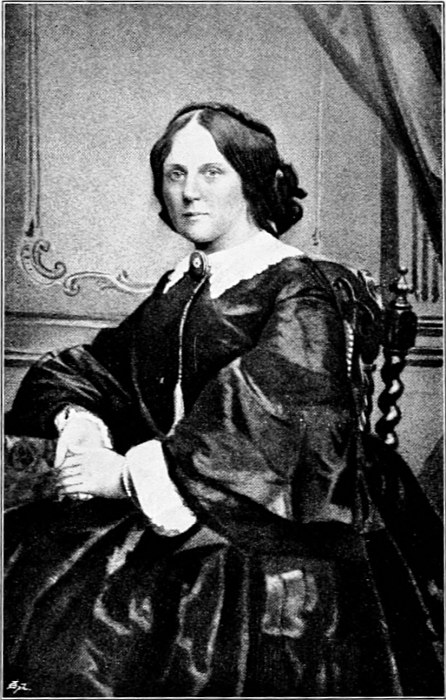
MINNA WAGNER.
VIII
That Minna was as much sinned against as sinning will hardly be disputed by any unprejudiced reader of Mein Leben and Wagner's correspondence. Let us throw as rapid a glance as possible over the various stages of their union.
Wagner himself sings the praises of the earlier Minna frequently enough. The picture we first get of her is that of a pretty bourgeoise, of no great intellectual capacity, but modest, sensible and sympathetic. On the other hand, several of Wagner's self-revelations show him in his youth as the harum-scarum one might expect a genius of his dynamic temperament to be—not vicious, perhaps, in the style of more stupid men, but keen for pleasure, and anxious to taste every vintage that life could offer him. His early life probably differed from that of tens of thousands of highly-strung young artists only in the degree of ardour with which he pursued his will-o'-the-wisps, and his quite abnormal imprudence in the affairs of daily life—financial affairs in particular. Throughout his career the protection, the solace, the domestic care of a woman were necessities to him. We may believe him when he says that he was the most home-loving of men; home and a devoted woman were haven and anchorage for him.[107] His longing for this haven would always be increased by the despair into which his vivacious nature, so keen for pleasure, was for ever bringing him. His early twenties were undoubtedly a very critical time for him mentally and morally. The debt-acquiring habit was already firmly rooted in him, and we get hints here and there of a certain hectic quality in his views of sex. In the Autobiographical Sketch (1842) he tells us how, under the impulse of these ideas, he dealt with Shakespeare's Measure for Measure in the act of metamorphosing it into his own Das Liebesverbot:
"Everything around me seemed to be in a state of ferment, and it seemed to me the most natural thing to give myself up to this fermentation. During a lovely summer's journey amongst the Bohemian watering places I drafted the plan of a new opera, Das Liebesverbot; I took the matter for it from Shakespeare's Measure for Measure, only with this difference, that I deprived it of its prevailing seriousness and cast it in the mould of Das junge Europa: free and uncloaked [offene] sensualism [Sinnlichkeit] won the victory, purely by its own strength, over Puritanical hypocrisy."[108]
In this mood even the froth of the lighter French and Italian operas became a pleasure to him:
"The fantastic dissoluteness of German student-life, after some violent excesses (nach heftiger Ausschweifung) had soon become distasteful to me: Woman had begun to be a reality for me.[109] The longing which could nowhere still itself in life found ideal nurture in the reading of Heinse's Ardinghello, as also the works of Heine and other members of the then 'Young-German' school of literature. The effect of the impressions thus received found utterance in my actual life in the only way in which Nature can express herself under the pressure of the moral bigotry of our social system."[110]
His own commentary on the libretto of Das Liebesverbot is that it expressed a change in his moral nature of which he was fully conscious at the time:
"If one compares this subject with that of Die Feen, it becomes evident that there was a possibility of my developing along two diametrically opposite lines: confronting the religious (heilige) earnestness of my original sensibilities was a pert inclination to the wild frothing of the senses (zu wildem sinnlichem Ungestüme), to a defiant cheerfulness that seemed utterly at variance with the earlier mood. This becomes quite obvious to myself when I compare the musical working-out of these two operas.... The music to Das Liebesverbot had played its part in shaping both the matter and the manner; and this music was only the reflex of the influence of modern French and (as concerns the melody) even Italian opera upon my receptive faculties in their then state of violent physical excitation."
His libretto and his music were the reflection of his life:
"My path led me first of all straight to frivolity in my artistic views; this coincides with the epoch of my first practical experience as theatrical musical director. The rehearsing and conducting of the loose-jointed French operas that were then the mode, the knowingness and smartness (Protzige) of their orchestral effects, often filled me with childish delight when I could set the stuff going right and left from my conductor's desk. In life, which from this time consisted in the motley life of the theatre, I sought in distraction the satisfaction of an impulse which showed itself in more immediate things as sensualism (Genusssucht), and in music as a flickering, tingling unrest."[111]
Mein Leben shows him as he must have been in the Magdeburg days, ardent, passionate, variable, lacking in self-control, eager for the joys of life, and in danger of being sucked down into the maelstrom of the minor theatrical world. His own version of the outcome of all this—in the Mittheilung an meine Freunde—runs thus:
"The modern retribution for modern levity, however, soon visited me. I was in love; married in impetuous haste; under the unpleasant impressions of a moneyless home harassed myself and others; and so fell into the misery whose nature it is to bring thousands upon thousands to the ground."[112]
One may be allowed to surmise, however, that his marriage was at the time a godsend to him: it probably steadied him at a critical moment and saved him from greater spiritual damage. His picture of Minna as she appeared to him at their first meeting must be given in his own words:
"Her appearance and bearing formed the most striking contrast to all the unpleasant impressions of the theatre which I had received on this fateful morning. The young actress looked very charming and fresh: I was struck by the remarkable seemliness (Bemessenheit) and grave assurance of her movements and her behaviour, which lent an agreeable and engaging dignity to the affability of her expression."[113] Her "unaffected sobriety of character and her dainty neatness" did something to reconcile him to the vulgar and superficial theatrical world in which his lot had been cast. She was exceedingly kind to the nervous and maladif young conductor, yet all that she did for him was done "with a friendly calm and composure that had something almost motherly about it, without a suspicion of frivolity or heartlessness."[114]
After a few weeks or months of acquaintance, in which he had showed a decided liking for her society, Minna begins to be more distant with him—apparently because there is a more serious lover in the field. "I now experienced for the first time," he says, "the cares and pains of a lover's jealousy." For a time they are estranged; but early in 1835 they return to their former friendly footing. And now we get the first symptom of that egoism in his attitude towards her that was afterwards to be so fruitful in misfortune. Though he was not her accepted lover, he jealously objected to her receiving the attentions of other men—of whom there were plenty always dancing attendance on the pretty, engaging girl. He protests with "bitterness and quarrelsome temper" against her receiving other men's attentions, though he admits that "thanks to her grave and decorous behaviour, her reputation was unimpaired"; and while she remained as calm and sensible as ever, he cubbishly vents his rage in pretended dissipation, which had the effect of "filling her with the sincerest pity and anxiety" for him.
He gives a New Year's party to the opera company, which is evidently meant to be a lively affair, and asks Minna to it; everyone doubts whether she will come. She accepts, however, "with perfect ingenuousness." As the evening wears on and the liquor circulates—punch succeeding champagne—"all the shackles of petty conventionality were thrown off," and the conduct of the theatrical ladies and gentlemen drifted into what Wagner calls "universal amiability." One can imagine the scene.[115] Throughout it all Minna acts with a simplicity, modesty and dignity that win Wagner's praise.
So far she appears much the more decent and likeable human being of the two. Wagner's further account of her increases our respect for her:
"From that time onward my relations with Minna were of an intimately friendly kind. I do not believe that she ever felt for me an affection that came near passion—the genuine feeling of love—or indeed that she was capable of such a thing; I can only describe her feeling for me as one of heart-felt good-will, the most fervent wish for my success and well-being, the kindest sympathy and a genuine delight in my gifts, which often filled her with astonishment. All this became at last part and parcel of her ordinary existence (welches alles ihr endlich zu einer steten und behäglichen Gewohnheit wurde)."[116]
The fact that, feeling no genuine passion for him, she should have been so kind to him as she was, and should have been willing to unite her life with his, simply increases our respect for her. To her he was simply a young wastrel of talent, who needed the care and protection of a sensible woman. She "mothered" him, as other women were destined to do in the course of his wild and wasteful life.
Then comes the—to Wagner—discreditable episode,[117] too long for narration here, that makes them avowed lovers. Still there is apparently nothing more on her side than kindliness and sympathy, while Wagner is madly in love. He shrinks from marriage in view of the difficulty and uncertainty of his position, while Minna too "declared that she was more anxious to see these [their finances] improved than for us to be married." But soon Minna leaves him to join a theatrical company in Berlin. This precipitates matters. "In passionate unrest I wrote to her urging her to return, and, in order to move her not to separate her fate from mine, spoke formally of an early marriage." He appears also to have threatened, in the same letter, that if she did not return he would "take to drink and go to the devil as rapidly as possible."[118]
He persuades the Magdeburg theatre authorities to renew her engagement, and sets off "in the depth of an awful winter's night" to meet her on her return, greets her "joyously, with tears from his heart," and leads her back "in triumph to her cosy Magdeburg home, that had become so dear to me."[119]
It is evident, however, that in Mein Leben he is not telling the reader the whole of the facts. Certain passages in the contemporary letters to Apel make it clear that in at any rate the latter part of the Magdeburg period he and Minna were husband and wife in everything but legal form. On 27th October 1835 he writes thus to Apel: "Don't get too many fancies in your head with regard to Minna. I leave everything to fate. She loves me,[120] and her love means a great deal to me now: she is now my central point; she gives me consistency and warmth: I cannot give her up. I only know that you, dear Theodor, do not yet know the sweetness of such a relationship; it has nothing common, unworthy or enervating in it; our epicureanism is pure and strong—not a miserable illicit liaison;—we love each other, and believe in each other, and the rest we leave to fate;—this you do not know, and only with an actress can one live thus; this superiority to the bourgeoise can only be found where the whole field is fantastic caprice and poetic licence."[121]
Das Liebesverbot is given and fails; his career as musical director in Magdeburg is terminated, and hungry creditors, seeing the end of all his hopes and perhaps theirs, begin legal proceedings against him. Every time he came home he found a summons nailed to the door. "And now Minna, with her truly comforting assurance and steadfastness in all circumstances, proved the greatest possible support to me."[122] She gets an engagement in Königsberg, whither he follows her. Then he begins to doubt her. He is uneasy as to one Schwabe, who is "passionately interested" in her. He afterwards learned that the pair had already been friendly; though he adds that he could not regard her relation with Schwabe as an infidelity to himself, since she had rejected the former in his favour. But he was made uneasy by the reflection that the episode had been concealed from him, and by the suspicion that Minna's comfortable circumstances were in part due to the friendship of this man. In fact, he, Wagner, the butterfly amorist, was jealous like any common person; and the desire grew upon him to hasten the marriage with Minna in order that he might find peace and quiet—a refuge from the storms of the miserable theatrical world in which his lot had been cast.
In Königsberg he obtains an appointment as conductor: and now we behold him drifting, like his own gods in the Ring, headlong to destruction. His reason warns him of the folly of a union with Minna, but his impulses drive him irresistibly into it:
"Minna made no objection, and all my past endeavours and resolutions seemed to show that, for my part, I was anxious for nothing so much as to enter into this haven of rest. Notwithstanding this, strange enough things were going on at this time in my inmost being. I had become sufficiently acquainted with Minna's life and character to be able to see, as clearly as this important step required, the great differences between our two natures, if only besides this perception I had had the needed ripeness of mind."[123] But blind lover as he had been, he goes into marriage with his eyes open:
"The peculiar power she exercised over me had no source in the ideal side of things, to which I had always been so susceptible; on the contrary she attracted me by the soberness and solidity of her character, which, in my wide wanderings in search of an ideal goal, gave me the needed support and completion."[124]
Always me! me! me! He used Minna as he used everyone else, as an instrument for his own happiness and comfort. And as he was the more intellectual of the two, and saw clearly the fatal differences of character between them,[125] one can only regard the unfortunate consequences of his marriage as an avengement of his own egoism and jealousy. On her part, though she "made no objection" to the marriage, she was plainly not anxious for it; she never seems to have concealed the fact that her feeling for him was mainly one of sympathy. He learns that her friendship with Schwabe had been more intimate than he had suspected:
"It ended in a very violent scene between us; it established the type of all the later similar scenes. I had gone too far in my outbursts, treating as if I had some real right over her, a woman who was not tied to me by any sort of passionate love, but who had yielded to my importunities only out of kindness, and who, in the deepest sense, did not belong to me at all. To reduce me to utter confusion, Minna had only to remind me that from a worldly point of view she had refused really good offers, and had yielded out of sympathy and devotion to the impetuosity of a penniless and uncomfortable (übel versorgt) man, whose talent had not yet been proved to the satisfaction of the world. I did myself most harm by the raving violence of my speech, by which she was so deeply wounded that as soon as I became conscious of my extravagance I always had to appease her injured feelings by admitting my injustice and begging her forgiveness. So this, like all similar scenes in the future, ended, outwardly, in her favour. But peace was undermined for ever, and by frequent repetition of these affairs, Minna's character underwent a notable change. Just as in later times she was perplexed by the (to her) more and more incomprehensible nature of my conception of art and its relationships, which gave her a passionate uncertainty as to her judgments upon everything connected with it, so now she became increasingly confused by my opinion—so different to hers—with regard to delicacy in moral matters; this confusion—as in general there was so much freedom in my opinions which she could not understand or approve—gave to her easy-going temperament a passionateness that was originally foreign to it."[126]
The "delicacy in moral matters" is good. Minna would probably have said that she considered it neither moral nor delicate to run away without paying your tradespeople and to sponge, and make your wife sponge, upon your friends. She was a bourgeoise, but at any rate she had the normal bourgeois scrupulosity in matters like these, in which Wagner's moral sense was anything but delicate. Posterity will refuse to credit him with moral delicacy of any kind. His failings in this respect were a source of sorrow to the friends who loved him most. Cornelius, for example, who adored him, sums him up thus in his Diary under date 3rd February 1863:
"Wagner! That is a leading chapter! Ah! I may not speak at large upon that subject. I say in a word: His morality is weak and without any true basis. His whole course of life, along with his egoistic bent, has ensnared him in ethical labyrinths. He makes use of people for himself alone, without having any real feeling towards them, without even paying them the tribute of pure piety. Within himself he has been too much bent on making his mental greatness cover all his moral weaknesses; and I am afraid that posterity will be more critical (die Nachwelt nimmt es genauer)."[127]
Yes, posterity sees the sharp division between the artistic greatness and the moral littleness of the man even more clearly than his contemporaries did; and it has learned to distrust the plausibility of his accounts of himself and others, and to distrust them most when they are most plausible. If only Minna could have survived to read Mein Leben, and to have given her own version of why the pair drifted so widely apart in the Dresden days—why she, who had borne untold sufferings for him in Paris, should in the course of four or five years have lost all respect for him and all belief in him!
So the breach widened between them. "The really painful feature of our later life together was the fact that owing to this passionateness of hers I lost the last support that Minna's peculiar nature had hitherto afforded me. At the time I was filled only with a dim foreboding of the fateful consequences of my marrying Minna. Her pleasant and soothing qualities still had such a salutary effect on me, that with the levity natural to me, as well as the obstinacy with which I met all attempts at dissuasion, I silenced the inner voice that prophesied dark disaster."[128]
Who, after that, will lay the blame wholly on Minna? He urges her into a marriage for which she has no great desire, forces her to abandon the career that had maintained her in decent comfort, hitches her to his fiery and erratic chariot and drags her through misery and privation unspeakable, quarrels with her from time to time and insults her with the "raving violence" of his speech.[129]
IX
In the end they marry. Wagner was twenty-three and a half, Minna twenty-seven. At the altar, he says, he had the clearest of visions of his life being dragged in different directions by two cross-currents; but he accounts for the levity with which he chased away these thoughts by the "really heart-felt affection" he had for this "truly exceptional girl," who "gave herself so unhesitatingly to a young man without any means of support."
Almost immediately after the marriage, whatever little idyll there had been in it is shattered. In a few months new financial troubles have accumulated. Minna cannot resign herself to them so easily as he does. The less he is able to provide for the necessities of the household, the more does she feel compelled to take upon herself the duty of supplying them. This she does, to his "unbearable shame," by "making the most of her personal popularity." He was unable to bring her to see the matter from his point of view; and as usual, all attempts at an understanding were frustrated, as he admits, by the bitterness and violence of his words and manner.[130] What he means by "making the most of her personal popularity" it is not easy to say. On the surface it suggests infidelity to Wagner; but a letter of his to Minna of 18th May 1859 makes this hypothesis more than doubtful. Ultimately there appears on the scene one Dietrich, a rich merchant, of whom Wagner is obviously jealous. On the 31st May 1837 Minna leaves her home while Wagner is at the theatre. She has fled to Dresden, Dietrich accompanying her a small part of the way. Wagner half-recognises that she has done no more than flee from a desperate situation, and he reproaches himself for being the cause of her despair. He finds her on the 3rd June under her parents' roof in Dresden; there she confesses that she regarded herself as badly treated by him, and thought him "blind and deaf" to the misery of her position.
Matters grow brighter for a time, but Dietrich turns up once more, and Minna again disappears with him. In time she writes Wagner "a most affecting letter," in which she confesses her infidelity, but pleads that she had been driven to it by despair. She has been deceived in the character of her seducer; now, again in despair, ill and wretched, she begs Wagner's forgiveness, and assures him that she has only now become truly conscious of her love for him. He writes back, taking on himself the chief blame, and declares that there should never again be any mention between them of what happened,—a pledge, he says, which he can pride himself on having carried out to the letter.
He was unquestionably generous on this occasion;[131] no doubt his conscience told him that he himself was largely answerable for the distracted state of Minna's mind. Her flight was no romantic love affair, but the mere willingness to accept any outstretched hand that would help her to escape from her husband and the disillusionment the marriage with him had brought her.
His own view of their early married life is further given in two later letters to Minna. They are both instructive. We have to bear in mind, in reading them, his inveterate tendency to dramatise and idealise himself, and his actor's gift of plausible expression. Making the necessary deductions on this account, the story in the letters agrees with that told here. He brings passion to the marriage, Minna brings merely sympathy,—which only makes her sacrifice of herself the more remarkable. Both letters are much too long for quotation here, and extracts can give only an imperfect idea of them. They must be read in full. In the first letter, written, as we have already seen, as a sort of farewell to her before going to the East with Madame Laussot, he paints the picture of their early married life as he saw it,—he all pure, unquestioning love, she possessed merely with an ideal of duty. "It was duty that bade you bear with me all the troubles we endured in Paris." (It apparently did not strike him that it must have been a remarkable sense of duty—hardly distinguishable in its effects from love—that made his wife endure such torments for his sake.) The cue of the more inflexible of the Wagner partisans has always been that Minna was incapable of appreciating her husband's genius. She may not have been able to follow the later flights of it; how many even of his musical contemporaries could, for that matter? But there is evidence enough that whatever doubts she may have had about him as a man, she had a sincere admiration for his gifts as a composer. After the Wesendonck catastrophe in 1858, when Minna was living apart from her husband in Dresden, and had no reason to be particularly well-disposed towards him, she wrote to a friend: "Lohengrin was at last given on the 6th of this month, at the Court Theatre in Dresden, for the first time. I am very fond of this opera.... I have often to refresh and strengthen myself with Richard's works, or else I could not write to him in a friendly tone. He certainly has in me an ardent worshipper of his earlier works. I have a feeling as if I had created them with him, for during that time I looked after him and took all the household cares on my own shoulders alone. How different it has been during the last few years of our union!"[132] And in the grievous Paris days we find her writing to Apel for help for her husband, and declaring her willingness to bear her weary burdens cheerfully in order that his genius might have a chance of coming into its own. "What to do now is at the moment a chaos to me; but even if I had the means of leaving Paris, I would never leave Richard in this position, for I know he has not fallen into it through levity, but the noblest and most natural aspiration of an artist has brought him where unfortunately every man perhaps must come without special help." And the poor woman, whose great desire in life is to live with bourgeois honesty, is reduced to making a piteous appeal to Apel to rescue her husband by a further loan of money. The same cry is wrung from her in a letter of three weeks later. "I am perhaps better fitted than Richard to plead with you to make a sacrifice on his behalf, as I speak for another rather than for myself. I can put myself in the same category as you, for I too have brought him sacrifices; I have given up my own peaceful, independent lot in order to bind myself to his, for it seems to be appointed that only through the most violent storms and trials will he reach his goal. Therefore I am fulfilling now a holy duty; perhaps, indeed, I sacrifice myself in writing to you again [for money, after Apel's declared unwillingness to give any more]. You say in your letter to Richard that it is impossible for you to do more for him than you have done. That you have given this much shows your good and noble will; and I must believe, since you assure me it is so, that without overstepping your usual expenses it is impossible for you to make a greater sacrifice for him. Let me, however, without any desire to boast, tell you what I did as a girl for my brother, who perhaps in certain relationships stood less closely to me than Richard to you. He was to have studied in Leipzig, but my parents could not support him; so I undertook to do so, at a time when, owing to the wretched state of the finances of the theatre, I had not even four groschen for my dinner. I pawned my ear-rings and such things—which were often indispensable to me at the theatre—sent the money to my brother for his studies, and kept for myself only three pfennigs for a bit of bread which I ate for my dinner while out walking, having pretended to the hotel people that I was invited out to dinner somewhere. Now should it be only the poor and needy to make sacrifices of this kind?... In Richard there is a fine talent to be rescued, that will be brought nigh to ruin, for already he has nearly lost heart, and if that happens his higher destiny is lost...."[133]