Chapter III · THE ARTIST IN PRACTICE (continued 2)
Reading edition
There is no lack of examples of this process of illegitimate inference and illegitimate association. After Mime has answered the first of the Wanderer's three questions, the latter congratulates him in this wise (Siegfried, vocal score, p. 74):
Right well the name of the race dost thou know: sly, thou rascal, thou seemest!
—to the same phrase that is often used in the Rhinegold to suggest the trickiness of Loge in particular, but also, apparently, to suggest deceit in general. It accompanies, for example, Fafner's remark to Fasolt, à propos of the attempt of Wotan to evade the promised payment for Valhalla—
My trusty brother, seest thou, fool, his deceit?
(V. S. 89, 90); and again the words in which Wotan tries to calm the apprehensions of Fricka—
Where simple strength serves, of none ask I assistance: but to force the hate of foes to help me, needs such craft and deceit as Loge the artful employs.
(V. S. 82, 83). That is to say, a purely arbitrary musical figure is to be taken as symbolising not merely the slyness of a particular person, but slyness in the abstract—a length to which we must decline to go with Wagner.
And as with his waves and his moral qualities, so with his animals; they too are both particular and universal. When Alberich, at the urging of Loge, turns himself into a serpent (Rhinegold, p. 182), it is to the accompaniment of a motive that is itself admirably pictorial. But in Siegfried, (p. 7, etc.), and the Götterdämmerung (p. 34, etc.), the same motive is always used to characterise Fafner, after he has turned himself into a dragon. One need not enlarge upon the confusion this is bound to create.
We are willing again, to accept the "Swan" motive in Lohengrin as a purely conventional symbol; but the same motive strikes rather oddly on our ears when it is used to particularise the swan in Parsifal. If in Lohengrin it typifies that particular swan, it is obviously not right to employ it for a totally different bird in another opera; for there is nothing in the outline of the theme that can be said to bear the remotest resemblance to a swan in the way that an arpeggio theme may be said to resemble waves, or a crepitating theme to suggest fire. Again, Wagner only confuses us when he uses the motive that accompanies Kundry's ride in the first scene of Parsifal to accompany Parsifal's description of the horsemen he had once seen in the wood:
And once upon the fringe of the wood, on glorious creatures mounted, men all glittering went by me; fain had I been like them: with laughter they swept on their way. And then I ran, but never again I saw them; through deserts wide I wandered, o'er hill and dale; oft fell the night, then followed day: etc.
(vocal score, p. 54); afterwards to accompany Kundry's account of the death of Herzeleide:
As I rode by I saw her dying, and, Fool, she sent thee her greeting;
(V. S. p. 57); after that, again, to accompany Kundry as she hastens to the spring in the wood to get water for the fainting Parsifal (V. S. p. 58); after that to describe the rush of Klingsor's warriors to the ramparts (V. S. p. 120); after that to accompany the thronging of the Flower Maidens to the scene (V. S. p. 156); again to give point to Parsifal's words:
And I, the fool, the coward, to deeds of boyish wildness hither fled—
(V. S. p. 203); and to accompany—for what reason it is difficult to say—Kundry's threat that she will call the spear against Parsifal if he continues to repulse her (V. S. p. 222); and finally, as an accompaniment to her last words to Parsifal:
For fleddest thou from here, and foundest all the ways of the world, the one that thou seek'st, that path thy foot shall find never;
(V. S. p. 225). No ingenuity can justify the employment of the same motive for so many different purposes. As a matter of fact, after we have once become conscious of it as accompanying Kundry's ride in the first scene of the opera, it is inevitable that we should associate it with her at each subsequent recurrence of it.
Another peculiarity of Wagner's use of the leit-motive may be noted; once or twice he gives a meaning to a theme in the later stages of the Ring that we cannot be sure of it possessing at first. The most striking instance of this is the "Reflection" motive. In Siegfried it is exclusively employed in connection with Mime, and the manner of its employment leaves no room for doubt that the commentators are right in giving it this title. The prelude to Siegfried commences with it; it is used there to suggest to us Mime pondering over the problem of the forging of the sword. It frequently recurs with the same significance in the scene that follows. It is used again all through the scene of questions and answers between the Wanderer and Mime, to suggest the dwarf putting his considering cap on after or during each of the Wanderer's posers. Yet on its first appearance in the Rhinegold (vocal score, p. 151) there is nothing whatever to indicate that the theme is to be taken as symbolical of reflection. It accompanies Mime's plaint to Wotan and Loge—
What help for me? I must obey the commands of my brother, who holds me bondsman to him.
By evil craft fashioned Alberich from the ravished Rhinegold a yellow ring: etc.
(Vocal score, p. 151.) From the words one would be a priori inclined to associate the music with Alberich rather than with Mime; and as it is not employed again in the Rhinegold, the meaning we are suddenly asked to attach to it at the opening of Siegfried seems a little far-fetched.
7
Wagner was not long in realising that however thrilling the timbre of the human voice may be, and useful as it is for making clear the course of the action and the sentiments of the characters, the orchestra is the most powerful and most resourceful of all the instruments at the disposal of the operatic composer. More and more the main current of his thinking goes into this. In the Rhinegold the orchestral texture is by no means continuous; frequently it merely punctuates or supports the vocal declamation by means of a detached chord or two, much in the way that it used to sustain the older recitative. As the Ring proceeds, pages of this kind become rarer: the orchestra thrusts itself more and more to the centre of the picture. It would be impossible to make the tissue of the Rhinegold intelligible without the voices: but the orchestral part of the Götterdämmerung would flow on with hardly a break if the vocal part were omitted; so also would large sections of Tristan and the Meistersinger. It was inevitable that under these circumstances the vocal writing should occasionally become a little perfunctory. It is frequently said that the balance between the vocal and orchestral parts is most perfectly maintained in Tristan; but the most cursory examination of the score shows that even there Wagner could not always find, or would not take the trouble to find, a vocal line of equal melodic interest with that of the orchestra, in the opening scene, for instance, it is transparently clear that the really expressive voice is the orchestra, and that the vocal parts have been inserted, sometimes rather carelessly and unskilfully, after the orchestral tissue has been completed. The vocal writing in Tristan falls into four main categories. The first is that to which I have already referred; wholly absorbed in the orchestral working out of a theme, Wagner seems to pay the minimum of attention to the vocal line, which sometimes has as little real relevance to the music as a whole as if it had been added by another person. As a specimen of this kind of writing we may cite the music to the words of Brangaene at the commencement of the opera—
Bluish strips are stretching along the west; swiftly the ship sails to the shore: if restful the sea by eve we shall readily set foot on land.
(Vocal score, pp. 7, 8.)
To the second category belong passages in which the voice is frankly in the forefront of the picture and the orchestra is merely a background—as in the colloquy between Tristan and Brangaene (vocal score, pp. 18 ff.), or in the music to Isolde's words shortly after the beginning of the second Act—
BRANGAENE. I still hear the sound of horns. ISOLDE.No sound of horns were so sweet; yon fountain's soft murmuring current moves so quietly hence; if horns yet brayed how could I hear that?
(Vocal score, pp. 90, 91.)
To the third category belong the passages in which the voice simply sings the same melody as the orchestra, as on p. 177 of the vocal score ("Thy kingdom thou art showing," etc.); and to the fourth, those in which it sings a real counterpoint to the orchestra—not a mere piece of padding like the passage I have cited from pp. 7, 8 of the score, but a vocal line of genuine melodic interest—as in a good deal of the scene of the third Act through which there runs the melancholy cor anglais melody.
Tristan, in fact, in spite of the splendour of its orchestral polyphony, by no means exhibits Wagner's symphonic powers in their full evolution. The most wonderful of his works in this respect is the Götterdämmerung, the stupendous strength of which is beyond words and almost beyond belief. The world had not seen a musical brain working at such tremendous and long-sustained pressure since the days when the B minor Mass and the "Matthew Passion" were written; and even those masterpieces have not the continuity of texture of the Götterdämmerung, nor do they show so giant a hand at its work of unification. Turn almost where you will, the course of the drama is told with absolute clearness in the orchestra itself. Yet in spite of his concentrating so largely on the orchestra, the vocal parts have an extraordinary aptness; it would be hard to find a passage in the score as perfunctory as some that might be quoted from Tristan. The voice, it is true, is often used simply as another counterpoint among those of the orchestra; but as a counterpoint it generally has a dramatic appositeness and a melodic beauty of its own.
In Parsifal this tendency to make the orchestra the principal dramatic speaker goes so far that very frequently the vocal writing is thoroughly bad. Some writers have attributed this to a decline of mental power in Wagner's old age. I do not think that this is the correct explanation. I can see no general decadence of musical invention in the music of Parsifal: I am willing to believe that the peculiar emotional and intellectual world of the opera makes no appeal to many people; but the style as a whole is as admirably suited to that world as the styles of Tristan and the Meistersinger are to their respective subjects, and I for one see no failure of inspiration except in some of the choral writing in the first Act, where there is occasionally an undeniable touch of commonplace. Part of the admitted colourlessness of some of the vocal passages is to be accounted for, I think, by the utterly unmusical quality of the words. The defect is not in Wagner the musician but in Wagner the poet, who has forgotten for the moment several of the principles he had laid down in his prose works and put into successful practice in the six great operas of his prime. The text of Parsifal contains a large amount of quite unmusical matter, especially at the commencement. Many of the lines have evidently not roused the slightest interest in the composer. He knew that the orchestral part was alive, and always developing the emotional possibilities of the situation; and when he comes to an obviously impossible verbal patch,—necessary for the telling of the story, but containing no stimulus for the musician—he simply refuses to waste time or trouble upon it. Take as an example one of the very worst passages for the voice in the whole opera—the words of Parsifal just before the beginning of the transformation music in the first Act—
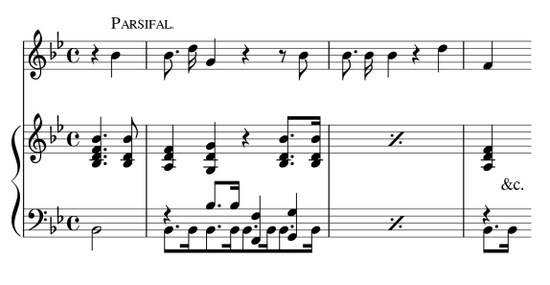
No. 37.
[PDF] [MusicXML] Audio content is not currently supported on your device.
PARSIFAL. I hardly stir, and yet I move apace.
Granting that the words are unfit for music, it is incredible that Wagner could not have found a more interesting musical outline for them than this, if it had occurred to him to try. But I take it that he would not try, or saw no necessity for trying; his mind was wholly bent on working out his orchestral picture, which, after all, is the only thing that really matters here as in so many other places. In other passages, such as the long recital of Kundry to Parsifal commencing "I saw the babe upon its mother's breast" (vocal score, p. 187), the orchestral part is a sort of small symphonic movement in itself, in which the voice mostly sings the same melody as the orchestra. Where it does not do this in the symphonic passages the vocal writing again becomes a trifle careless, as in the Good Friday music. The self-contained completeness of the orchestral part here is conclusively shown by its perfect adaptation to the concert room; and I take it that, feeling that virtually all he had to say had been said by the orchestra, Wagner worked out the mood of the scene with complete satisfaction to himself in that medium, and then added the vocal part as best he could—sometimes quite well, sometimes by no means well. He had largely given up, indeed, thinking simultaneously in terms of both voice and orchestra, as in the best parts of Tristan, the Meistersinger and the Götterdämmerung. Those who will may put this down to a decline of his musical powers. To me it seems more probable that as a musician he came to rely more and more on his most eloquent instrument, the orchestra. It may even be that his carelessness with regard to the text of Parsifal, his inclusion of a number of episodes that he must have known were essentially foreign to his own ideal of music, can be accounted for by his belief that he could rely on the expressiveness and the continuity of the orchestral web to see him through all the inevitable difficulties. As one looks at the score of Parsifal one can readily understand his desire to try his hand at a symphony in the last years of his life.
8
It is open to doubt, indeed, whether Wagner ever attained the homogeneity of form that was his ideal. His most homogeneous work is probably Lohengrin; after his developing imagination and technique had made him dissatisfied with the style of that opera, and pointed him on to more difficult achievements, he does indeed paint pictures of magnificent scope and exquisite fineness of detail, but he hardly attains the perfect balance of all the factors and the perfect consistency of style that make Lohengrin flow so smoothly. The reason, I think, is that while he was urged on to this reform and that by the logical quality of his mind, he was never quite logical enough—which is only another way of saying that even the greatest minds cannot create a new form of their own in art. All they can do is to add something to the structure they have inherited from their predecessors, and pass the transformed product on to their successors as something to be transformed still further. An ideal like that of Wagner—to create an art form that should be musical through and through, a continuous, endlessly varied web of melody,—is realisable in instrumental music pure and simple, but hardly in connection with the stage. Concentrate the dramatic action as he would, so as to provide the musician with a framework that should be musical in every fibre, the poet was still compelled to retain a certain amount of non-musical matter in order to tell his story clearly to the audience. The concision of Tristan is wonderful; but even in the first Act of Tristan there are verse-passages the pedestrian quality of which the composer has not been able to disguise. The style of all his later works fluctuates in character because he is divided between a desire to keep the actors in the forefront and the necessity for relegating them to the background in order to give the orchestra an absolutely free course. We feel with Wagner, as we do with certain others of the most fertile minds in art—with Goethe, with Leonardo, with Hokusai—that one human life-time was too pitifully short for the realisation of everything of which the great brain was capable; that the body broke down while the mind was still capable of adding to its store of knowledge and feeling. All Wagner's greatest works, regarded from the standpoint of the twentieth century, are hardly more than magnificent attempts to find a compromise between drama and music. At times the compromise worked admirably; at others there is perceptible friction. His dilemma was the one that has confronted every composer of opera since the day when opera was invented. Poetry and music are not the loving sisters that the fancy of the literary man would make them out to be; they are rival goddesses, very jealous and intolerant of each other. The poet, in proportion as his work is genuine, faultless poetry, has no need of the musician. Music is cruel, ravenous, selfish, overbearing with poetry; it deprives it, for its own ends, of almost everything that makes it poetry, altering its verbal values, disregarding its rhymes, substituting another rhythm for that of the poet. It has no need of anything but the poetic idea, and to get at that kernel it ruthlessly tears away all the delicacies of tissue that enclose it. Wagner himself, however much he might theorise about poetry, was never a poet; he was simply a versifier who wrote words for music, sometimes admirably adapted for this purpose, sometimes exceedingly ill adapted. In Tristan, which he himself regarded as the one of all his poems that was best suited for music, what he writes is generally not poetry at all. Who would give that title to lines that scorn all grace of rhythm, all variety of cadence, all the magic that comes of the perfect fusion of speech and expression: lines like those of the final page, for example:
Heller schallend mich umwallend, sind es Wellen sanfter Lüfte? Sind es Wogen wonniger Düfte? Wie sie schwellen mich umrauschen, soll ich atmen, soll ich lauschen? Soll ich schlürfen, untertauchen? Süss in Düften mich verhauchen? In dem wogenden Schwall, in dem tönenden Schall, in des Welt-Atems wehendem All,— ertrinken,— versinken,— unbewusst,— höchste Lust!
or those at the meeting of Tristan and Isolde in the second Act—
TRISTAN. Isolde! Geliebte! ISOLDE. Tristan! Geliebter! Bist du mein? TRISTAN. Hab' ich dich wieder? ISOLDE. Darf ich dich fassen? TRISTAN. Kann ich mir trauen? ISOLDE. Endlich! Endlich! TRISTAN. An meine Brust! ISOLDE. Fühl' ich dich wirklich? TRISTAN.Seh' ich dich selber? ISOLDE. Dies deine Augen? TRISTAN. Dies dein Mund? ISOLDE. Hier deine Hand? TRISTAN. Hier dein Herz? ISOLDE. Bin ich's? Bist du's? Halt' ich dich fest? TRISTAN. Bin ich's? Bist du's? Ist es kein Trug? BOTH. Ist es kein Traum? O Wonne der Seele, o süsse, hehrste, kühnste, schönste, seligste Lust! TRISTAN. Ohne Gleiche! ISOLDE. Überreiche! TRISTAN. Überselig! ISOLDE. Ewig!
If this telegraphic style, as Emil Ludwig calls it, is poetry, then we shall have to give that word a meaning it has never yet had.
But if the Tristan order of verse is not poetry, it is magnificently adapted to the needs of the symphonic musician. It is unobtrusive; it is pliant; it serves to préciser the musical emotion without fettering the orchestral composer either melodically or rhythmically. Compare now with the previous extracts one or two from Parsifal—
Denn ihm, da wilder Feinde List und Macht des reinen Glaubens Reich bedrohten, ihm neigten sich in heilig ernster Nacht dereinst des Heilands sel'ge Boten:
(To him, when 'gainst the savage foeman's might this realm of faith he had defended, oh wonder rare! in solemn, holy night from heaven the Saviour's messengers descended)
Des eig'nen sündigen Blutes Gewell' in wahnsinniger Flucht muss mir zurück dann fliessen, in die Welt der Sündensucht mit wilder Scheu sich ergiessen: von neuem sprengt es das Tor, daraus es nun strömt hervor, hier durch die Wunde, der seinen gleich, geschlagen von desselben Speeres Streich, der dort dem Erlöser die Wunde stach, aus der mit blut'gen Tränen der Göttliche weint' ob der Menschheit Schmach in Mitleid's heiligem Sehnen,— und aus der nun mir, an heiligster Stelle, dem Pfleger göttlichster Güter, des Erlösungsbalsams Hüter, das heisse Sündenblut entquillt, ewig erneut aus des Sehnens Quelle, das, ach! keine Büssung je mir stillt!
(In maddest tumult, by sin defiled, my blood back on itself doth turn and rage within me; to the world where sin is lord in frenzied fear is it surging; again it forces the door, in torrents it poureth forth, here through the spear-wound, alike to His, and dealt me by the self-same deadly spear that once the Redeemer pierced with pain, and, tears of blood outpouring, the Holy One wept for the shame of man, in pity's god-like yearning,— and from this my wound, the Grail's own chosen, the holy relics' guardian, of redemption's balm the warder, the sinful fiery flood wells forth, ever renewed from the fount of longing that, ah! never penance more may still!)
So hofft sein sündenreu'ger Hüter, da er nicht sterben kann, wann je er ihn erschaut, sein Ende zu erzwingen, und mit dem Leben seine Qual zu enden.
(Thus hopes its sin-repentant guardian, since he can perish not while on it he doth gaze, by force to draw death to him, and with his life to end his cruel torment.)
How incredibly careless is the construction here—the long, involved sentences, the parentheses, the separation of substantive and verb by several lines! It is this absence of poetic concentration that makes Parsifal a trifle langweilig at times; for no matter how expressive Wagner may make the orchestral music, he cannot quite reconcile us to the frequent flatness of the vocal writing and the difficulty we often have in getting the sense, or even the grammatical construction, of the words. That Wagner at the end of his life could put together a text like Parsifal after having made the poems of Tristan and the Ring is not in the least a proof of mental collapse, but only of the almost insuperable difficulties in the way of finding a perfect compromise between music and dramatic poetry. He was fortunate enough, in the case of Tristan, to hit upon a subject that was comparatively easy to concentrate. Two duties, it must be remembered, an operatic poem has to perform: it has to provide the composer with opportunities for emotional expression, and it has to make a story clear to the spectator. The ideal text would be that in which the action was implicit in the emotion, that is to say, one in which there was no need for any explanation, through the mouth of this or that actor, of events that were happening off the stage or that had occurred before the drama began. It is when the composer has to interrupt his purely emotional outpouring in order to allow the poet to become explanatory that he realises the difficulty of making his opera musical throughout. Even in Tristan Wagner could not wholly dispense with a certain amount of explanation, in the first act, of the events in Ireland and Cornwall that have led up to the situation in which Tristan and Isolde now find themselves. The music in consequence halts decidedly at times; all the art of the composer cannot disguise the fact that he is momentarily being held up by the exigencies of the stage poet. In the Ring, as it was first drafted, Wagner was faced with the same problem, but he solved it in another way. Siegfried's Death was to be merely the climax of a long sequence of tragic events. Without some knowledge of these events, however, the spectator would be unable to understand the final tragedy. So Wagner resorted to the device of making the characters themselves recapitulate the earlier stages of the story, in much the same way that Isolde, in the first act of Tristan, tells Brangaene—for the benefit of the audience, of course—all about the coming of Tristan to Ireland, his slaying of Morold, her nursing of the wounded Cornish hero, his wooing her as bride for King Marke, and so on. In the opening scene of Siegfried's Death the Norns tell each other—again for the benefit of the audience—how Alberich ravished the gold from the Rhine, made a ring from it, and enslaved the Nibelung race; how the ring was stolen, and Alberich himself became a thrall; how the giants built Valhalla for the gods, and, denied their promised reward, got possession of the ring that the gods had stolen from Alberich; how there was born a free hero, destined to redeem the gods from their bondage; how Siegfried slew the dragon and wakened Brynhilde from her sleep. Having made all this clear in an introductory scene, Wagner raises the curtain upon Siegfried and Brynhilde. Later, Hagen tells Gunther,—all for the sake of the audience—how Wotan begot the Volsung race; how the twin-born Volsung pair Siegmund and Sieglinde had for son the mighty hero, Siegfried, who "closed the ravenous maw" of the dragon with his "conquering sword." In the next scene Siegfried explains to the audience—viâ Hagen and Gunther—how he came into possession of the tarnhelm and the ring, whereupon Hagen describes the virtues of the former. In the third scene the Valkyries[409] fly to the solitary Brynhilde and learn of her awakening by Siegfried, and of the intervention of Wotan in the combat between Siegmund and Hunding. In the first scene of the second Act Alberich tells Hagen how he won the gold and forged the ring, and compelled Mime to make the tarnhelm for him; how the ring was ravished from him by the gods and given to the giants; how one of the latter guarded it in the form of a dragon; how Siegfried slew the latter and Mime. In the second scene of the third Act Siegfried tells the Gibichungs—the audience overhearing—how Mime tended the dying Sieglinde in the wood, saved her child, and brought him up to his own craft of smith; how he (Siegfried) forged his father's sword anew and did the dragon to death; how the bird warned him of Mime's plot against his life, told him of the powers of the ring and tarnhelm, and sent him to rouse Brynhilde from her sleep on the fire-girt rock.
Wagner must have felt the clumsiness of this method of constant explanation, and anticipated that it would impede the free flow of his music; while in any case the audience would probably still not be quite clear as to certain points. So, as all the world knows, he first of all prefixed to Siegfried's Death another drama—The Young Siegfried—designed to put the bearing of all the stages of the action beyond the possibility of misunderstanding. But again the fear haunts him that there may still be some things insufficiently accounted for; so even The Young Siegfried has to have a certain number of pages of explanation. The fact of Siegfried being there at all has to be explained by Mime, as well as the further facts of the death of Siegmund in battle and the perishing of Sieglinde in giving birth to Siegfried. In the next scene, almost the whole story of what afterwards became the Rhinegold and the Valkyrie is told afresh in the competition of questions and answers between the Wanderer and Mime. In the first scene of the third Act, we have the completion of the story of the Valkyrie given to the audience in the dialogue between the Wanderer and Erda—how the earth-goddess bore a daughter, Brynhilde, to Wotan, how she flouted the god's will, and for punishment was doomed to sleep on the fiery fell. Not content with all this, Wagner afterwards stages, in a third opera, the Valkyrie, the whole of the action that has been told and told again in Siegfried and the Götterdämmerung, from the love of Siegmund and Sieglinde down to the punishment of Brynhilde. Even here he has to find room for explanations; in the first scene of the second Act Wotan tells the audience—viâ Brynhilde—the whole story of the rape of the gold by Alberich and all the events that followed from it. Finally Wagner comes to the conclusion that the whole action, from its beginning in the depths of the Rhine, had better be put visibly upon the stage; and so the Rhinegold, the story of which has been already told more than once, is prefixed to the Valkyrie. But in spite of his having shown everything so completely that nothing remains to be explained by word of mouth, he still retains all the explanations he had inserted in the three other dramas of the tetralogy. No doubt he was aware of their superfluity, but shrank, as he might well do, from the enormous task of reconstructing the whole work yet again. He may have argued, too, that as each of the operas would have to stand by itself on the particular occasion of its performance, it would be no disadvantage to have the events of the preceding evening fully explained, even at the cost of some otherwise needless repetition.
I have not gone over this long familiar ground merely to tell again a thrice-told tale, but to bring into higher relief the fundamental difficulty of the musical dramatist who is working along the Wagnerian lines—the difficulty of taking up the whole of the poet's work into the being of music, when the poet, in order to leave no room for misunderstanding on the part of the audience of the reason for the visible actions and the audible sentiments of the actors, has to pad out his poem with a certain amount of matter that is explanatory of the past rather than emotional in the present. So desperate a device as the visible representation in three or four evenings of every stage of a dramatic action was obviously not to be resorted to again. It was equally impossible to reduce the story of Parsifal to the highly concentrated form into which he had managed to cast Tristan. So he had to do what it had been his first impulse to do in the Ring—elucidate the visible action of the moment by a narrative of all that had happened before the action, or that particular stage of the action, began, and trust to the orchestra to maintain the musical interest by means of the interplay of leit-motives. Hence the lumbering stage technique of the first Act of Parsifal, and the raison d'être for the endless garrulity of Gurnemanz. That venerable worthy is not a character; he is merely a walking and talking guide book; he stands outside the real drama, somewhat in the style of the compère in a revue; and the proof of his almost complete nullity is that Wagner has been utterly unable to characterise him musically. Every other character in his operas—even the minor personages, such as Kurvenal and David and Gutrune—exists for us as a definite personality, someone drawn in the round in music as effectively as a painter or sculptor could have shown him forth. But even Wagner has been unable to invent a single phrase that shall be characteristic of Gurnemanz and Gurnemanz alone. He is the one Wagnerian character who simply does not exist for musicians. As far as his music is concerned he has neither mental characteristics nor bodily form; we remember him solely for his interminable talk.
9
If Wagner failed in his struggle with the musical-dramatic form, it was the failure of a Titan in a struggle that only a Titan would have ventured upon. Form and the perfection of form are simple enough matters for the smaller musical intelligences, for whom form means merely a symmetrical mould to be filled. It is for the greater minds that the problem of form is always a torture, for their ideas are perpetually outgrowing the mould. In sheer fertility of idea Wagner was probably the greatest musician the world has ever seen. It was of the very essence of his work that there should be no repetition either of mood or of procedure. Without, indeed, making the necessarily futile attempt to decide which is per se the finer order of musical mind, the dramatic or the symphonic, it may be confidently said that to a dramatist—or at all events a dramatist like Wagner—there is permitted no such easy returning upon his own tracks, no half-mechanical manipulation of the same order of ideas time after time, as is possible to the worker in the stereotyped instrumental forms. Great as is the inventive power of a Bach, a Beethoven or a Brahms, it cannot be denied that much of their work is simply a varied exploitation of a relatively small number of formulas,—that a very small amount of thematic invention can be made to go a very long way under the guidance of an established pattern. Nor, broadly speaking, is the same intensity of imagination, or the same scope of imagination, required to invent a hundred ordinary fugal or symphonic themes as to find a hundred themes that are the veritable musical counterparts of as many human beings. The family resemblance between "subjects" that is permitted to a Bach or a Beethoven is not permitted to a Wagner: the dramatist's work must be a perpetual re-creation—and a definite, unmistakable re-creation—of the life around him in all its multiformity. In this sense Wagner is without an equal among composers; never has there been a brain so apt at limning character and suggesting the milieu in music. We can speak of the Wagnerian imagination as we can speak of the Shakespearean imagination; Wagner's is the only imagination in music that can be compared with Shakespeare's in dramatic fertility and comprehensiveness. It pours itself over the whole surface of a work, into every nook and cranny of it. It is a vast mind, infinite in its sympathies, protean in its creative power. For sheer drastic incisiveness of theme he has not his equal in all music; each vision instinctively, without an effort, finds its own inevitable utterance. In the works of his great period every motive has a physiognomy as distinct from all others as the face of any human being is distinct from all other faces. The motives are unforgettable once we have heard them. They depict their subject once for all: who to-day, enormously as the apparatus of musical expression has developed since Wagner's time, would dare to try to find better symbols than those he has invented for the tarnhelm, the fire, the Rhine, the sword, the dragon, the potion that brings oblivion to Siegfried; or for any of the men and women of the operas—for Wotan, for Siegfried, for Mime, for the "reine Thor," for Herzeleide, for Hagen, for Gutrune, for Brynhilde, and for a dozen others? To hear any of these themes to-day, after a generation or more of daily familiarity with them, is like looking at a medallion of a hundred years ago in which not a point of the outline or a single plane of the relief has been blurred, nor a single grain of its first sharp milling been lost. They are what they are because they combine in the fullest measure and in impeccable proportion the two great preservatives of all artistic work,—a luminous personal vision and consummate style.
10
In the operas of his prime, every one of his characters is musically alive, down to the smallest. Tristan is not more real to us than Kurvenal, nor Walther more real than David, nor Brynhilde than Gutrune. His fiery imagination saw over the whole field of the drama with the same intensity. In this respect, as in so many others, not one of his successors can compare with him. Strauss, for instance, has always failed to give reality to any but the leading characters of his operas. His Faninal in the Rosenkavalier is decidedly not alive, nor is his Chrysothemis in Elektra. There is not a single truly characteristic phrase by which the musician can recall the former to his memory in the way that he can recall David or Kurvenal or Mime; the only piece of music by which he can recall Chrysothemis is an atrocious rag-time waltz that he would prefer to forget. Strauss's minor characters are known to us through the poem rather than the music; while Wagner's minor characters are clear-cut personalities to thousands of opera-goers who have never read the poem. And like the true dramatist, Wagner has no moral prejudices; for the time being he puts himself into the skin of each of his characters and looks at the world solely through his eyes. Nowhere is the author to be detected in the work, just as Shakespeare is nowhere to be detected in his; each of the characters sees the world from his own standpoint, and while he is talking we are for the moment bound to see the world precisely as he sees it. In any one else's hands Alberich would have been a mere conventional villain of melodrama. As Wagner draws him he is as real as Iago,—an enemy of the light and all that live in the light, but their enemy by reason of the very nature of his being, following his own instincts with perfect naturalness and perfect consistency. So it comes about that we invariably believe in Alberich and the justice of his cause when he is speaking for himself; nowhere is he a mere foil or relief to characters with whom we may have more moral sympathy. No one can fail to be moved, for instance, by his appeal to Hagen in the second Act of the Götterdämmerung—the genuine heart-hunger of this, repulsive gnome, lusting for power with all the passion and all the sincerity of his narrow soul. How vast and terrible a force of evil, again, is Hagen, but at the same time how natural, how inevitable. Even Mime is always right from Mime's point of view: the spectator can for the moment no more turn against him than against Alberich.
It is one of the mysteries of human psychology, indeed, how the mind that could be so incurably egoistic in the ordinary affairs of life, so incapable of seeing people as they really were, and not merely as they were in relation to the gratification or frustration of his own desires, should be capable of such universal sympathy in his artistic creation. The crowning wonder of Wagner's artistic psychology is his treatment of Beckmesser. We have seen what a deadly and unreasoning hatred he had for Hanslick, and that it was Hanslick he had in view in the later poetical drafts of the character. Yet in the opera, though Beckmesser is made appropriately ridiculous, he is handled almost throughout without a touch of the malice one might have expected when one knows that the character is meant as a satire upon a detested enemy. I say "almost throughout," for it has always seemed to me that there is just a shade of unnecessary harshness in Sachs's words after Beckmesser has left the house with the manuscript of Walther's song in his pocket:
A heart more base I never have known, Ere long he'll be paid for his spite: Though men cast reason down from its throne They cannot deny it quite: Some day the net is spread before them: In it they fall, and we triumph o'er them.
Beckmesser, for all his wiles, has not hitherto struck us as being base (boshaft). We laugh at him, but we love him, as we love all the fools and rogues of pure comedy. I fancy I can detect in this passage the last angry flash of the eye and the snap of the jaw as Wagner thought of Hanslick. But apart from this little lapse it is wonderful with what detachment the composer has been able to see his personal enemy. The artist in him was too strong, too infallible, to permit of his fouling the ideal world of his art with any breath from the bitter, muddy world of real life. Mr. Bernard Shaw is of the opinion that Strauss, in Ein Heldenleben, gives "an orchestral caricature of his enemies which comes much closer home than Wagner's mediævally disguised Beckmesser." I hardly think the musical world as a whole will agree with Mr. Shaw. The "Adversaries" section of Ein Heldenleben always strikes me as a mere outburst of rather stupid bad temper: the humour is as ill-conditioned as the psychology is crude and the expression commonplace. We have long since ceased to bestow on it the compliment of even as much thin laughter as we gave it when it was quite new. It is bad art for this reason if for no other,—that the petty, snappy hero shown in this section is inconsistent with the sort of super-man who figures in the rest of the work; who can believe that the hero of the noble ending, set high above earth and all its littlenesses, is the same individual as the small bundle of wounded vanity and irritated nerves whose reply to his critics takes the form of putting out his tongue and "talking back" like a street urchin? Wagner's caricature is at once deeper, truer, kindlier, more universal and more enduring. He could be little enough in his life: in his art the gods took care that he should never be anything but magnanimity itself.
And if there has never been a brain in music that saw so deeply into the springs of character, there has never been a musical brain with such a grasp of a drama as a whole. It was the mighty, tireless synthetic engine that we meet with only some score of times, perhaps, in the whole history of human thought,—in two or three great military commanders, a few great architects, and half-a-dozen philosophers. It is becoming more and more evident each year that since his death there has been no single composer of anything like his bigness, no single composer capable of work at once so new and so coherently wrought. His was the last truly great mind to find expression in music. That statement is not at all inconsistent with the admission that modern composers have said many hundreds of things that Wagner could never have thought of: I simply mean that the brains of Strauss and Debussy or any two others put together would not equal Wagner's in range, in depth, in staying power. There has not been a musician since his time who can "think in continents" as he did. The more we study him, indeed, the more wonderful do this sweep of vision and tenacity of hold become to us. There is nothing in all other men's music comparable to Wagner's feat of keeping the vast scheme of the Ring in his head for more than a quarter of a century, and actually laying it aside completely for eleven years during that time, without relaxing his grip for a moment upon the smallest limb of the great drama. It is in virtue of this fiery and unceasing play of the imagination and this stupendous synthetic power that he takes his place among the half-dozen most comprehensive minds that have ever worked in art.
In music there are only two brains—those of Bach and Beethoven—to compare with his in breadth of span. Say what we will about the repetitions and the longueurs of the Ring, there is nothing in all music, and very little else in any other art, to compare with that wonderful work for combined scope and concentration of design. Wagner had in abundance the rarest of all artistic gifts,—the faculty, as a great critic has put it, of seeing the last line in the first, of never losing sight of the whole through all the tangle of detail. One might almost say that no other modern brain except Napoleon's and Herbert Spencer's has been able to keep all the minutiæ of a gigantic problem so unfailingly within the one sphere of vision. Wagner forgot nothing in his work: at any stage of it he could summon up at a moment's notice not only any figure he wanted, in all its natural warmth of life, but the very atmosphere that surrounded it, the very mood it induced in others. To me one of the most marvellous instances of this has always been the passage in Waltraute's recital in the third scene of the Götterdämmerung, in which, in the midst of that extraordinary picture of the frustrated Wotan brooding among the joyless gods in Valhalla, she speaks of the god remembering his favourite and banished child:
Then soft grew his look: He remembered, Brynhilde, thee!
It is a far cry at this stage from the parting of the god and his daughter in the Valkyrie; but at the mere mention of it there wells up in Wagner, after twelve years or more, all the emotion of the wonderful union between them, and the gloomy, careworn music melts for a bar or two into a tear-compelling tenderness. Another magnificent illustration of this gift of his of looking before and after may be had in the third Act of the Meistersinger, just after the greeting of Sachs by the populace of Nuremberg. That reception is surely the most overwhelming thing of its kind the earth has ever seen or heard; it has always been a mystery to me how any merely human singer can find a voice in which to respond to it. But it is precisely here that we realise the subtlety of Wagner's conception of Sachs, the profoundly imaginative way in which he saw him, and his ever-present sense of the fundamentals of the character through apparently the most distracting vicissitudes. Any other operatic librettist and composer, after that million-throated outburst, would have set a strutting Sachs on his feet, smilingly and condescendingly accepting the homage of the multitude. Wagner makes his Sachs realise nothing but his own unworthiness and the sense of something hollow and fleeting in all this vociferation; and there is hardly an effect in all music to compare for subtlety, for poetry, for the profundity of its humanity, with the instantaneous melting of the crimson and purple strains of the folk into the quiet grey theme of Sachs' sorrow in the strings. It was the only possible outlet from what any other sincere composer would have instinctively felt to be an emotional impasse; and it was only Wagner who could have found the outlet. He is great in many ways, but in no way greater than in this faculty of keeping the burning vision of the moment always in touch with those that have passed and those that are to come; in all contemporary music there is not to be found a brain with a third of his power in this respect. In the latest operas of Strauss, strewn with fine things as they are, there is no such unity of style, no such ardour of conception, no such unrelaxing hold upon every character in every phase of it; and of course no purely orchestral work can compare with even a single opera of Wagner's for combined sweep of design and closeness of texture.
11
The clarity and unity of Wagner's vision are evident again in the pictorial element that plays so large a part in his works. He was often pictorial without intending it, and was himself probably unconscious of many of the effects of light, colour, and atmosphere that delight us in his music. Mr. Runciman has done well to insist upon the gift, exhibited as early as Die Feen, for not only visualising a scene or a character for us but giving it us in its natural tints. We have happily got past the day when old-fashioned theorists used to lay it down that "pure" music was "concerned with nothing but itself," and that whoever made it concern itself with appearances of the visible world was at the best no more than half a musician. As I have argued in an earlier chapter of this book, we cannot parcel off the human consciousness into psychology-tight bulkheads in this way. The various faculties are always crossing over into each other's territories for a moment, and coming back with spoils that they refuse to surrender for the rest of their days. The theorists have always been telling us that music cannot "paint." The composers, knowing much more about the matter than the theorists, have always gone on painting to their heart's content,—Bach, for example, being incorrigibly realistic. The three minds with the most pronounced bias towards tone-painting were probably those of Bach, Schubert (in his songs), and Wagner. But between the musician-painters there are as many differences of vision and of manner as there are between "pure" musicians or "pure" painters; and Wagner, in this regard as in every other, brought certain new elements into music, and still stands in a class by himself.
The curious thing about him is that while no other man's music gives us such an impression of being bound up at almost every point with the visible world in which we live and move, actual realism of the ordinary kind is comparatively rare with him, and it is certainly the least important factor in this impression. Now and again, of course, he does "paint" the concrete in the realistic way made familiar to us by the modern symphonic poem-writers. But this way is not at all a new way. The music of Schubert and that of Bach, as has been said, is full of realism of this order,—Schubert's spinning-wheel and Bach's serpents, to give merely two well-known instances. To this category belong Wagner's Rhine, and his fire music, and the whinnying of the Valkyries' horses. But there is really not much realism of that sort in Wagner's music. He objected to it in Berlioz and others unless there was a very good reason for it, and never employed it himself except where it complied with the dual condition of being thoroughly justified by the scene and unquestionably within the scope of musical expression. Wagner does comparatively little tone-painting of the purely realistic kind, but of course he does it always with superb certainty, profiting by a hundred years of evolution of technique since Bach, and by the gorgeous instrument that the modern orchestra places at his disposal.
A subtler sort of pictorialism,—subtler because it is unpremeditated and unconscious,—is that to which Mr. Runciman has drawn attention. No one except Hugo Wolf has ever approached Wagner in the capacity for bathing each scene, each character, in a light and an atmosphere of its own. (Wolf's achievements in this line were of course on a much smaller scale than Wagner's, but some of them are hardly less wonderful if we take into consideration the limitations of the black-and-white medium in which he worked.) This is surely one of the most baffling mysteries in music,—how the same few dozen tones and colours can be made to suggest such differently coloured aspects of the visible world, a world, we must remember, from which music is utterly cut off by the very nature of its medium. But whatever the explanation, the fact is indubitable; though it is a comparatively new thing in music, and indeed would not be possible without our modern developments of harmony, colour and technique. It is virtually unknown in pre-Wagnerian music. I do not mean that no previous composer ever gave a specially appropriate tint to a particular scene. That was frequently done; but it was done more or less by a convention, by the use of instruments having a particular association in the minds of the audience, as when the oboe or the cor anglais would be used for suggesting a pastoral scene, or the horns,—as in the beautiful passage at the commencement of the Freischütz overture—for suggesting a wood. The Wagnerian and Wolfian method to which I am now referring is something quite different from this. The term "method," indeed, is inappropriate, for it is impossible to reduce it to any rules or to trace the secret of its effect, as we can in the two other general instances I have cited. It is possible to say that the cold, bare effect of Wolf's Das verlassene Mägdlein comes from the peculiar harmonies he uses, and the pitch at which they are used,—just as the pastoral effect of the "Scène aux champs" in Berlioz's Symphonie fantastique comes from the use of the cor anglais. But the difference is this,—that you can standardise, as it were, the pastoral effects of the oboe or the cor anglais, whereas you cannot standardise the effects of Das verlassene Mägdlein. Even in the hands of a fifth-rate composer the oboe may be made to suggest a shepherd: but give Wolf's harmonies to a second-rate musician and tell him to "paint" with them as Wolf has done, and he will soon realise that the "painting" is really not separable from the music as a whole, even though we may be able to say analytically that it is due to one factor more than another. The truth is that the scene has been perceived with such intensity of vision by the composer that, unknown to him, and without any volition on his part, the vision has made its own idiom for itself, incarnated itself in lines and colours that are expressive of it and it alone.
It is this subtle faculty that is always unconsciously operative in Wagner. It first comes to light in Die Feen. It gave parts of the Flying Dutchman their strange salt tang. It makes the peculiar white light of Lohengrin. And after that opera, when Wagner had attained full command of his powers, it did astounding things for him. There is a different light, a different air, in each of the four dramas of the Ring; and this broad difference between any two of the four is maintained in spite of there being minor differences of colour between the various scenes of each of them. How mysterious and infallible this faculty is in its workings is best seen from the fact that when Wagner took up the second half of Siegfried, in 1869, after having suspended work upon it in 1857, he did what no other musician before him or since could have done—spontaneously, unconsciously reverted to the idiom of twelve years before. Between those two dates he had travelled an incredibly long path as a musician; he had written Tristan and the Meistersinger, two works with as many differences of idiom between themselves as there are between either of them and the Ring. Yet the wonderful brain could sweep itself clear of all the new impressions that had fed it during those twelve years, and, though the new acquisitions of technique of course remained, he thinks himself back in a flash to the very centre of the souls of the Ring characters and the very colour and temperature of the scenes he had parted from so long ago.
This is the pictorial instinct of Wagner seen in its totality. In its detail it is equally marvellous. Each scene is so bathed in its own appropriate light and colour, and strewn with its own peculiar shadows, that the music itself, apart from the scenic setting, is eloquent of the place and the hour of the action. In Wagner's music, as in Wolf's, one is conscious not only of the locality and the person and the race: one can almost tell the time of day. Music like that at the awakening of Brynhilde would go with nothing but a mountain height in blinding sunlight. Hunding is not physically darker to the eye than he is to the ear in that marvellous tuba motive that accompanies his first entry in the Valkyrie. The gait of Siegfried's music is as rapid as Mime's; but the differing stature of the two men is unmistakable from the music alone. One might multiply instances by the hundred of effects of realistic differentiation obtained not merely by orchestral colour, but by something subtly inter wrought into the very texture of the music. (The Hunding theme, for example, is "black" and sinister even on the pianoforte.) It is just this faculty of seeing everything with the most precise of painter's eyes, and then finding the infallibly right musical correlative of it, that enables Wagner to achieve such variety among pictures that are in essence the same. How many and how different woodlands there are in his music, how many degrees of sunlight, how many shades and qualities of darkness! The storm that maddens Mime after the exit of Siegfried is a very different storm from the one through which Siegmund rushes to the house of Hunding. What other man could have written two Rhine-Maidens' trios like those in the Rhinegold and the Götterdämmerung, each so liquid, so mobile, so sweet with the primal innocence of the world, and therefore so alike in many respects, yet so absolutely different?
So it comes about that without any tone-painting in the ordinary acceptation of the word, Wagner succeeds in bringing the visible universe before our eyes in a way and to an extent that no other musician has done. Of tone-painting pure and simple there is practically none in Tristan. Wagner is here concerned solely with a man and woman; yet how actual he makes every scene in which they move, and this without a single realistic stroke. In the garden scene he uses none of the conventional musical recipes—there is no obvious rustling of leaves, no sighing of the breeze, no purling of the brooks,—yet how the magic of the garden and of the hour steals through us and intoxicates us! How hot and dry the air has become in the third Act,—as dry to us as to the parched tongue of the wounded man alone on the castle walls, with the mid-day sun turning the blue sea beyond to a vibrating, blinding haze. And—to me the most wonderful of all—how sinister is the atmosphere he creates through virtually the whole of the Götterdämmerung; how, though indeed it is mostly set in the daylight, one feels that here among these Gibichungs, with gaunt, grim Hagen for weaver of the web of fate, the very earth has lost the radiant smile it had in Siegfried's forest and on Brynhilde's mountain top. The sun no longer warms, the Rhine no longer laughs and glints and gladdens. And finally, how exquisitely adapted is the melodic and harmonic idiom of Parsifal,—so smoothly flowing, so full of melting and caressing tenderness,—to that static world from which, with the purging from it of so much human passion, so much even of the ordinary physical energy of humanity too has gone. For this, as for everything else, he found the right, the only musical equivalent, without seeking for it. His visions painted themselves.
12
Even the best of Wagnerians to-day become a little impatient at the occasional longueurs in his operas. Not merely does he plan them on a scale that makes it almost impossible to give some of them in their entirety under ordinary conditions, but he sometimes lapses into a prolixity that is regrettable or maddening according to the frame of mind we happen to be in at the moment. Most of his prolixity is to be accounted for by that bad text-construction to which I have drawn attention. Music, let it be said again and again, is primarily an emotional art, and the less it has to do with mere dramatic explanation the better. We can never tire of Wotan pouring out his heart in loving farewell to his child; but we can hear Wotan tell the long story of his financial and matrimonial troubles once too often. We could listen as often to Kundry's story of Herzeleide as to the slow movement of the Ninth Symphony or the "Kleine Nacht-Musik" of Mozart; but wild horses would not drag us to the theatre to listen to old Gurnemanz's too-often-told tale of Amfortas and Klingsor, and how the sacred spear was lost. Yet though the poet Wagner is generally answerable for the occasional tedious quarters-of-an-hour in the operas, the musician Wagner is not wholly free from blame. He never managed to get quite rid of the slow-footedness that was characteristic of his music from the first; to the very end he sometimes takes rather longer to drive his points home than is absolutely necessary; and in these more rapid and impatient days that goes against him sorely. He is often reproached with rhythmical monotony. There is some truth in the charge, which as a whole he himself would probably not have taken the trouble to repel. There is a passage in one of his letters in which he recognises that his music is not so rhythmical as it might be, but he holds that some lack of rhythmical variety is inseparable from an ideal of dramatic music such as his. As I have attempted to show, he relied much more on harmonic effect than on rhythm, the latter being more peculiarly the instrument of the symphonic composer, while harmonic change is more suited to depict the varying aspects of a dramatic action. But against the comparative regularity of his rhythms is to be set his sense of style. He had an intuitive knowledge of how and when to break up a melodic line that was in danger of becoming too uniform. One of the simplest illustrations of this may be seen in the Parsifal Prelude (vocal score, p. 5, lines 1 and 2); just at the moment when we are beginning to suspect that the theme of "Faith" has been repeated quite often enough and to dread the further repetition that has already got under weigh, he alters the signature from 6/4 to 9/4, and gives a new rhetorical turn to the familiar melody. In Wotan's Abschied, again, we are unconscious of the uniformity of the rhythm in phrase after phrase, so consummate is the art with which the interest is always being transferred from one part of the combined vocal and orchestral tissue to another, and so beautifully planned is not only each section in itself but what may be called the exposition and development and cadence of the whole scene. Wagner could afford to dispense with the smaller rhythmical manœuvring of individual musical phrases; he had the much greater faculty of endowing long scenes and even whole operas with a vast dramatic rhythm of their own. Hundreds of smaller composers can give this page or that of their music a rhythmic piquancy that Wagner could never have attained on the same small scale; but not one of them could achieve such a rhythm as that of the second Act of Tristan, with its slow, steady, imperceptible transition from night and its rapture to daylight and its cruel disillusioning glare.
Wagner's prolixity, again, is not the flabby dulness of a mind that is merely maundering on and on from sheer incompetence to get to grips with the essentials of an emotion, but the over-copiousness of an inexhaustibly rich brain. And if this quality of his has its occasional bad side, we do well to remember that it is accountable also for some of his most gigantic achievements in expression. Were it not for the endless inventive power and the never-failing sense of beauty in it, a work like Tristan, that never pauses till the last drop of bitter-sweet juice has been squeezed out of the theme, would be hardly bearable. Like Bach, Wagner could never conceive any emotion without intensifying it to the utmost. The barest hint of joy in one of Bach's texts will set him carolling like a lark; the barest hint of mortality will bedim his music with all the tears of all the universe for its dead. Wagner has the same insatiable hunger for expression. In Tristan in particular every emotion is developed to its furthest limit of poignancy. The passion of love becomes almost delirium; when Tristan, in the third Act, sings of the thirst caused by his wound, our very mouths, our very bones, seem dried as if by some burning sirocco blowing from the desert; when the sick man praises Kurvenal for his devotion it is a cosmic pæan to friendship that he sings. In hundreds of other cases it is not by elaboration of speech that he makes his overwhelming effect, but by a sort of volcanic concentration. Mingled rage and grief and despair have never found such colossal expression anywhere, in any art, as in those few bars given to the frustrated and maddened Wotan after Fricka has foiled his plan for the protection of Siegmund in the fight (the Valkyrie, vocal score, pp. 118, 119). Pathos will never find more touching accents than those of Brynhilde in her last great scene with Wotan (Valkyrie, pp. 292, 293); few things in all music convey such a sense of tears as the strange salt tones of the oboe and cor anglais here. For concentrated fury there is nothing to compare with the outburst of the bound and impotent Alberich as he dismisses the Nibelungs who have witnessed his shame (the Rhinegold, pp. 199-201); technically this is one of the most effective crescendi in all Wagner's works. His imagination always takes fire at a single touch, a single suggestion, and there is no staying it until the fire has burnt itself completely out. In the Siegfried Idyl he has only to think of the child whose coming meant so much to him, and all the fountains of human tenderness are unsealed; this is not an individual father musing over his child's cradle, but all nature crooning a song of love for its little ones. It is this intensification of every emotion he has to express that makes each of his characters, like Shakespeare's, seem the epitome of that particular phase of human nature. Tristan and Isolde are the world's most passionate and most tragic lovers: the opera is the very quintessence of the egoism of sexual love. So with a score of other characters. The last word—for our own day at any rate—in god-like majesty has been uttered in Wotan; the last word of womanly gentleness and sweetness in Eva and Gutrune; the last word of tragic womanhood in Sieglinde; the last word of superb womanhood in Brynhilde; the last word of mellow and kindly middle age in Hans Sachs; the last word of scheming feebleness in Mime; the last word of elemental savagery in the Valkyries; the last word of youthful irresponsibility in the Meistersinger apprentices; the last word of human grimness in Hagen; the last word of dog-like devotion in Kurvenal. The character-drawing is endless in its variety and infallible in its touch.
13
Parsifal stands in a class apart from all the other works of Wagner. Its characterisation is not individual but symbolic; Amfortas and Parsifal and Kundry and Klingsor are not men and women whom we might meet any day in the flesh, but simply types of human aspiration or failure. We have outgrown the mental world of the work; the religious symbolism of it, quâ religious symbolism, leaves many of us unimpressed; yet the basic emotional stuff of it all is enduring, and we must not allow ourselves to be set against the opera because the forms in which Wagner has embodied a durable philosophy are themselves of a time instead of all time. Evidently the symphonist in him was at this stage overpowering the dramatist. The symphonist can safely deal with types or abstractions; the dramatist can only deal with individuals. Wagner has made the blunder of trying to translate the most delicate, the most esoteric perceptions into the language of the theatre, of setting symbols upon the stage. The force of a poetic symbol lies wholly in the imagination: as soon as a dramatist or a painter tries to set it visibly before us, the free flight of the imagination is curbed by the physical obviousness, the physical limitations, of the figure that is put before the eye; the universal cannot be perceived for the particular. Wagner's root idea in Parsifal was to show us, in Kundry, a living symbol of the dual nature of woman, half-angel and half-beast, in turns sensual and repentant, the destroyer and the saviour of man. But it is precisely symbols of this kind, cutting down to the obscurest depths of human psychology, that cannot retain their vast suggestiveness after they have been narrowed down to the personality of a single actor. We no longer see the eternal and infernal womanly; it is only a German prima-donna, stout of build and heavy of movement, that we see upon the stage. So with Parsifal himself. Mr. Huneker has called him "that formidable imbecile." So might we style St. Francis of Assisi, or the Buddha, or any other of the simple wise ones of the world, if we persist in looking at them through unsympathetic and unimaginative eyes. The conception of Parsifal is fine enough in itself—an unstained soul made divinely wise by its very simplicity, its love, its pity. But a character of this kind should be left to the imagination, or to music to suggest to the imagination: it is impossible to realise it behind the footlights in the person of an actor. A Parsifal is a figure for the quiet of one's chamber, not for a crowded theatre lying the other side of the box office. Hundreds of people must have felt, as I have done for twenty years, that a good deal of Parsifal affects us more deeply at home than it ever does in the theatre, the loss of the orchestral colour being more than made up for by the gain in imaginative intensity. And the difficulty of making such a character vital and credible upon the stage is increased when he is made the centre of a quasi-religious ritual that has long ceased to have a meaning for many people.
But in spite of it all, Parsifal is a masterpiece. The story of it seems to arouse a violent antipathy in some people, who apparently regard it as an immoral work. The pleasant little game of Parsifal-baiting began with Nietzsche, who said that he despised everyone who did not regard the opera as an outrage on morals.
Like most philosophers, Nietzsche had the charming failing of imagining that the only right way for the world to go was his way. He was singularly taken with that notion of his of the super-man—a mythical and unidentifiable mammal about which we have never been able to get any definite information, either from Nietzsche or from any of his disciples. Now Nietzsche found this ideal of his in Siegfried, and he loathed Parsifal because it preached the negation of life, the denial of the Will to Power. Later writers, like Mr. Runciman and Mr. Huneker, who are not, I think, Nietzscheans, agree with him in seeing something peculiarly weak in the philosophy—to call it by that name—of Parsifal. They see in the opera not merely moral weakness but moral nastiness. I remember one of the simpler adherents of this theory telling me, in awe-stricken tones, that this "sexless" opera was the resort of a set of men who were mixed up in a German scandal of a few years ago that sent its unwholesome odour through the civilised world: and he obviously thought that this discredited Wagner's Parsifal, whereas it struck me as being very like asking us to give up having breakfast because Dr. Crippen and Charles Peace liked bacon and eggs.
Nor can any moral flabbiness, I think, be discovered in Parsifal except by people who make the mistake of thinking that the "philosophy" of any musical work matters very much. Mr. Runciman detests Parsifal and calls him a perfect idiot—that epithet being Mr. Runciman's playful intensification of Wagner's "pure [i.e. stainless] fool"—"fool" being unfortunately the only monosyllable we have in English for the translation of "Thor." But even supposing Parsifal were an idiot—which I dispute—would it greatly matter? Mr. Runciman has launched his full battery against the Siegfried of Wagner's poem—a swaggering, quarrelsome, ungrateful young noodle; but, as Mr. Runciman's own eloquent description of the opera shows, the Siegfried of Wagner's music is a vastly more interesting and sympathetic person than the Siegfried of Wagner's verse. Similarly, even if I could think, when reading the libretto, that Parsifal is an idiot, I could never think so when listening to the music. The truth is that a good many of Wagner's characters and dramatic motives seem rather foolish to us nowadays. For my part I do not know or care whether or how Parsifal is to "redeem" the world. The word redemption has no meaning for me in the sense in which Wagner and the theologians use it. I can believe that redemption is a concrete reality in the pawnbroking business; but if any one tells me that men's souls are to be bought and sold, or lost and found again, without any volition of their own, I can only say that all this conveys about as much to my intelligence as talk about a quadrilateral triangle would do. But to appreciate a work of art it is not in the least necessary to subscribe to its author's philosophical or religious opinions; a rationalist can be as deeply thrilled by the Matthew Passion as any Christian can be. The "thesis" of a work of art is the one thing in it that does not concern us as artists. Who is to decide between rival philosophies or sociologies? Personally I believe that one philosophy is just as good as another, and worse, as the Irishman would say; but if an artist chooses to set forward a character as the embodiment of some philosophy that possesses him at the moment, I am willing to listen to him so long as he can talk interestingly about it, without my wishing either to subscribe to the philosophy or to dissent from it. Mr. Runciman thinks there is something frightful in the thesis—let us call it that—of Parsifal. I do not see anything frightful in it. I do not believe in it as the only rule of life; but then I do not believe—in that sense—in Senta's "redemption" of the Dutchman, or Elisabeth's "redemption" of Tannhäuser, or that Lohengrin was right in withholding his name from Elsa and then going off in a huff when she asked for it. But all these fantastic motives, in which I have no belief, no more affect my appreciation of the operas than my disbelief in ghosts affects my appreciation of Hamlet. I do not want any of my friends to be like Parsifal, Amfortas, or Klingsor—especially Klingsor: but neither do I want any of them to be like Lohengrin or Elsa or Senta or the Flying Dutchman. A real world run on the lines of Parsifal would probably drive normal men mad in a month: but then who could live in a world in which Senta-sentimental maidens insisted on jumping into the sea to "redeem" master mariners, taking no account of the able seamen and the stokers and the stewards, who, from anything I can gather to the contrary in the text of the Flying Dutchman, all go to Davy Jones's locker in a state of pure damnation what time the captain and the girl ascend to glory? No, we had better leave alone the question of what the world would be like if we were to try to model it on Parsifal. We know very well that nothing of the sort will ever happen, just as we know that Little Red Riding Hood's wolf will not gobble up little Phyllis on her way to the High School next week, or the door of the safe fly open when the burglar says "Sesame." These be but fairy tales. We can still sleep in our beds o' nights: and we can still go to Parsifal without either having our morals corrupted or feeling that we are encouraging race suicide.
I listen to Parsifal, then—and I imagine most other people do the same—as I would to any other outpouring of a great man's spirit on a world of ideas that fascinated him for the moment, and without any more impulse to translate it all into terms of reality than when I am listening to the Flying Dutchman or Lohengrin. The opera is in no sense the work of an exhausted old man. It has been alleged that the plot is "the work of Wagner's tired-out old age." But Parsifal was sketched as early as 1857, worked out in detail in 1864 (when Wagner was only fifty-one), and turned into verse in 1877. Further, the central ideas of the drama are to be found both in the sketches of Jesus of Nazareth (1848) and The Victors (1856); while in 1855 it was Wagner's intention to bring Parsifal on the stage in the final scene of Tristan, opposing him, as a symbol of renunciation, to Tristan as a symbol of passion. At almost any time of Wagner's life, indeed, he might have written a Parsifal. All his life through he fluctuated between intense eroticism and an equally intense revulsion from the erotic. One may say, in truth, that such a man had to write a Parsifal before he died. "Il est à remarquer, mon fils," says the excellent Abbé Coignard in Anatole France's La Rôtisserie de la Reine Pédauque, "que les plus grands saints sont des pénitents, et, comme le repentir se proportionne à la faute, c'est dans les plus grands pêcheurs que se trouve l'étoffe des plus grands saints. La matière première de la sainteté est la concupiscence, l'incontinence, toutes les impuretés de la chair et de l'esprit. Il importe seulement, après avoir amassé cette matière, de la travailler selon l'art théologique et de la modeler, pour ainsi dire, en figure de pénitence, ce qui est l'affaire de quelques années, de quelques jours et parfois d'un seul instant, comme il se voit dans le cas de la contrition parfaite."
In the great book of sex there are many chapters, and Parsifal is simply the last of them for some people. For others it is a chapter that they turn to again and again in moments of revulsion from the illusions of passion. Wagner's insight was clear enough: the Parsifals are no more denials of the Life-Force than the Tristans are; they are simply another phase of the Life-Force. When we disengage the central idea of Parsifal from its rather unskilful operatic setting, the work is simply an artist's dream of an ideally innocent world, purged of the lust, the hatred, the cruelty that deface the world we live and groan in. This is the world the music paints for us—
"Summers of the snakeless meadow, unlaborious earth and oarless sea";
and the cumbrous, old-fashioned stage framework upon which the drama is constructed means no more to me than a clumsily-drafted programme to a great symphonic poem,—it detracts no more from my musical enjoyment than that would do. The music itself, apart from a few commonplaces in the first Act, is marvellous. It is indeed an old man's music, but only in the sense that it opens windows for us upon regions of the soul to which only the old and emotionally wise have access. Swinburne somewhere speaks of Blake's face having the look of being lit up from the inside. I see a similar luminous transfiguration in the later portraits of Wagner[410]—they have the look of a man who has penetrated to the great underlying simplicities of things; and I find in the music of Parsifal the same subtle, searching simplicity, the same almost unearthly illumination. Nowhere does the great master seem to me more truly powerful than in these quiet strains, whose suggestiveness, as is the case with the last Italian songs of Hugo Wolf, is inexplicably out of proportion to the quiet economy of their tissue. To the last the wonderful brain kept growing. He makes a new musical idiom, a new texture, for Parsifal as he had done for every other of his works; above all a harmonic language of incomparable subtlety, a gliding, melting chromaticism that searches us through and through. It is from this novel chromaticism—a very different one from that of Tristan—that the harmony of César Franck has come, and all the modern harmony that builds upon Franck.
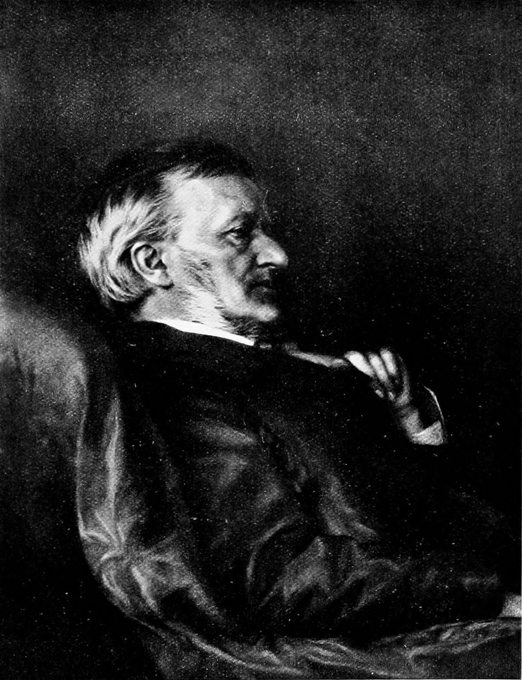
WAGNER: THE LAST PHOTOGRAPH.
14
Wagner saw his own work as a transmutation and amplification of the speech of Beethoven—infinitely changeful, but controlled in every bar by a never-sleeping sense of the organic unity of the whole; but it is clear to us now that many features in his work derive from Bach, or are a re-discovery of certain principles of form that Bach affected. It is from Bach, rather than from Beethoven, that such things as the Tristan Prelude come, with their incessant evolution of new life out of a single thematic germ, and their adoption of a conical form of slow ascent to a climax and descent from it, in place of the square symphonic form of return and re-start. In Bach, again, will be found the basis both of Wagner's realism and of the Wagnerian system of allusive "motives." The towering greatness of Wagner is nowhere more strikingly shown than in the failure of all his successors to handle his form—or, indeed, any other—with anything like the same power, freedom and consistency; both the opera and symphonic music are waiting for someone big enough to build afresh upon the foundations Wagner has laid, and with the materials he has left. At present the most that any of his successors can do is to fit a few of the more manageable of the stones together, with a deplorable quantity of waste and confusion all around and in between. Salome and the Rosenkavalier may be taken as instructive examples. There is not a living man big enough to occupy more than a room or two at a time of the vast house that Wagner reared about him. It is true that in certain details—in the furnishing and decoration of one or two of the rooms, let us say—modern music has gone beyond him. Strauss's orchestration has an eloquence—not merely a colour, but a soul and a voice—of which Wagner probably never suspected the possibility. Strauss, Wolf, and others have shaken off the rhythmic fetters that sometimes hampered the movement both of Wagner's poetry and of his music. Wolf and Strauss have shown us the possibilities of what may be called a prose style in music—a more continuous and less formal style than that of verse, with the rhythmic joints and pivots more skilfully concealed. Superb examples of it are to be found in the later scene between Octavian and the Princess in the first Act of the Rosenkavalier, and in the great trio in the third Act. Wagner, it is safe to say, would have flatly pronounced it impossible to make rhythmic music of a piece of frank prose like the latter, in which there is not a suspicion of a pretext for any of the staple rhythmic formulas.
But though the Wagnerian apparatus has been improved upon at these and other points—Strauss, for example, has subtilised the employment of the leit-motive—no one has been great enough to manipulate the apparatus as a whole with anything like Wagner's power, scope and freedom, and opera is still waiting for its new redeemer. Even an anti-Wagnerian work like Pelleas and Melisande is, in a sense, a tribute to the Titan: the very sharpness and thoroughness of its recoil from everything that hints at Wagner is an admission of the impossibility of continuing his work on its own lines. And after all, Pelleas and Melisande is only a beautiful and wonderful tour de force—a sort of glorified musical mule, without pride of ancestry or hope of posterity. Its idiom is too small for the expression of great things; we might as well try to build a city out of nothing but mother-of-pearl and opals.
Like Bach and like Beethoven, Wagner closes a period, and exhausts a form. And as with Bach and Beethoven to-day, it is indirectly rather than directly that his best influence is being exerted; there is no room for imitation of him, but his speech and his vision are eternal stimuli to our imaginations. It is inevitable that in some quarters a reaction should have set in against his music and his influence. He has been too overpowering a force. His music has been performed with such fatal frequency that the merest amateur can hardly remain unconscious of the weak points in it; and for a whole generation he made all but the very strongest minds among composers a mere shadow and echo of himself. Music, as was only to be expected, has now gone beyond him in certain respects, and the erstwhile anarch is now one of the greatest of the forces that conservatism claims for its own. The French and some of the Russians have revolted against what is less a Wagnerian than a German domination of all European music. A number of our very newest young men are delightfully contemptuous of him: every puny whipster now raises his little hand to deal the reeling colossus another blow. But the colossus will easily right himself. There are moments when one is tempted to say that he and Bach and Beethoven have expressed between them almost all that is essentially original and great in the music of the last two centuries. When a composer is so mighty of body as this, he can well afford to lose a drop or two of blood on his pilgrimage through the ages.
"In music, as in nature," says Vincent d'Indy, "there are mountains and valleys; there are artists of genius who raise their art to such heights that the herd of second-rank creators, unable to breathe in these altitudes, is forced to descend again to more temperate levels (which, however, are often sown with charming flowers), until the eruption of a new genius heaves up a new mountain peak.
"Such were Bach, Haydn, Beethoven and César Franck in the symphonic order; and in the dramatic order, Palestrina, Monteverdi, Rameau, Gluck and Wagner. At the present moment we are descending the slope created by the Wagnerian upheaval, and we are hastening gently towards the hopeful presage of a new summit. But all our drama—even that of the composers who most energetically deny the imputation—comes from the spring which rises at the feet of the titanic Wagner.
"Richard Wagner still casts his great shadow over all our musico-dramatic production. But it is certain that the latent work that is going on in the souls of creative artists is to favour the ascent towards a distant height, of which we cannot yet foresee either the glaciers or the precipices."
His work, in truth, will flower afresh some day in some great composer who will sum up in himself, as Wagner did, all the finest impulses of the music of his day,—who will have absorbed the essential, durable part of the spirit of his predecessors, and who will have at his command an idiom, a vocabulary and a technique competent to express every variety of human emotion. But we may hazard the conjecture that the new flowering will be in instrumental music rather than in the opera. It seems to be a law of musical evolution that at the end of a period of crisis the seminal force that has exhausted itself in one genre passes over to, and finds a new life in, a wholly different genre. Beethoven left no real successors in the classical symphony,—for great as Schumann and Brahms are, they are in this field no more than epigones of Beethoven. It is in the Wagnerian opera that the new expressive, half-poetic power of Beethoven's music finds its further logical development. All the opera writers that have followed in Wagner's tracks—Strauss included—are to Wagner simply what Brahms was to Beethoven. As Beethoven fertilised not the symphony but the music-drama, so Wagner has fertilised not the music-drama but poetic instrumental music,—the innumerable symphonic poems and programme symphonies of the last fifty years. The idea of the new form may have been Liszt's as much as Wagner's, or even more; but Liszt's music was not rich enough to do the full work of fertilisation. Now, apparently, we are nearing the end of a period of transition. Already there are signs that the formal programme was little more than a crutch for poetic music in the days of its hesitating growth. Composers are beginning to master the art of suggesting the dramatic inner conflicts of the soul without needing to rely on any outer apparatus of suggestion. We are probably developing towards a form of symphonic music that shall be to the art of its own day what the Beethoven symphony of the middle period was to the art of his time,—a musical drama-without-words, and perfectly lucid without words. When the new instrumental music has assimilated all the finest spirit and mastered the full harmonic and rhythmic vocabulary and the best technique of the new day, some future Wagner will perhaps turn the mighty stream into a fresh dramatic channel, the nature of which it is almost impossible to anticipate. So the great series of cross-cycles will no doubt go on and on, into a day when dramatic music shall no more resemble Wagner's than Wagner's music resembles that of Palestrina. In that distant day he may be no more to mankind than Monteverdi is to us; but music will still be something different from what it would have been had he never been born; and of only some half-dozen composers in the whole history of the art can that be said.
FOOTNOTES: