ZADIG; OR FATE. (continued 2)
Reading edition
XIII.(1)
THE DANCE.
Arriving in due time at the island of Serendib, Zadig's merits were at once recognized, and he was popularly regarded as an extraordinary man. He became the friend of the wise and learned, the arbitrator of disputes, and the advisor of the small number of those who were willing to take advice. He was duly presented to the king, who was pleased with his affability, and soon chose him for his friend. But this royal favor caused Zadig to tremble; for he well remembered the misfortunes which the kindness of king Moabdar had formerly brought upon him. "I please the king," said he; "shall I not therefore be lost?" Still he could not refuse the king's friendship, for it must be confessed that Nabussan, king of Serendib, son of Nassanab, son of Nabassun, son of Sanbusna, was one of the most amiable princes in Asia.
But this good prince was always flattered, deceived, and robbed. It was a contest who should most pillage the royal treasury. The example set by the receiver-general of Serendib was universally followed by the inferior officers.
This the king knew. He had often changed his treasurers, but had never been able to change the established custom of dividing the revenues into two unequal parts, of which the smaller came to his majesty, and the larger to his officers.
This custom Nabussan explained to Zadig. "You, whose knowledge embraces so many subjects," said he, "can you not tell me how to select a treasurer who will not rob me?" "Assuredly," said Zadig; "I know a sure method for finding you a man who will keep his hands clean."
The king was charmed, and asked, while he embraced him, how this was to be done.
"You have only," said Zadig, "to cause all those who apply for the office of treasurer to dance. He who dances the lightest will surely prove to be the most honest man."
"You jest," said the king. "A strange way, certainly, of choosing a receiver of my revenues. What! do you pretend that he who cuts the neatest caper will be the most just and skillful financier?"
"I will not answer," returned Zadig, "for his being the most skillful, but I assure you he will be the most honest."
Zadig spoke with so much confidence that the king imagined he had some supernatural test for selecting honest financiers.
"I do not like the supernatural," said Zadig: "people and books dealing in prodigies have always displeased me. If your majesty will permit me to make the test, you will be convinced it is the easiest and simplest thing possible."
Nabussan consented, and was more astonished to hear that the test was simple, than if it had been claimed as a miracle.
"Leave all the details to me," said Zadig: "You will gain more by this trial than you imagine."
The same day he made proclamation in the king's name, that all candidates for the office of receiver-in-chief of the revenues of his gracious majesty Nabussan, son of Nussanab, must present themselves in dresses of light silk, on the first day of the month of the crocodile, in the king's anti-chamber. The candidates came, accordingly, to the number of sixty-four. Musicians were placed in an adjoining room, and all was prepared for the dance. As the door of the saloon was closed, it was necessary, in order to enter it, to pass through a small gallery which was slightly darkened. An usher directed each candidate in succession through this obscure passage, in which he was left alone for some moments. The king, being aware of the plan, had temptingly spread out in this gallery many of his choicest treasures. When all the candidates were assembled in the saloon, the king ordered the band to play and the dance to begin. Never had dancers performed more unwillingly or with less grace. Their heads were down, their backs bent, their hands pressed to their sides.
"What rascals!" murmured Zadig.
One alone danced with grace and agility,—his head up, his look assured, his body erect, his arms free, his motions natural.
"Ah, the honest man, the excellent man!" cried Zadig.
The king embraced this upright dancer, appointed him treasurer, and punished all the others with the utmost justice, for each one had, while passing through the gallery, filled his pockets till he could hardly walk. His majesty was distressed at this exhibition of dishonesty, and regretted that among these sixty-four dancers there should be sixty-three thieves. This dark gallery was then named the Corridor of Temptation.
In Persia these sixty-three lords would have been impaled; in other countries a chamber of justice would have consumed in costs three times the money stolen, replacing nothing in the king's coffers; in yet another kingdom they would have been honorably acquitted, and the light dancer disgraced; in Serendib they were only sentenced to add to the public treasure, for Nabussan was very indulgent.
He was also very grateful, and willingly gave Zadig a larger sum than any treasurer had ever stolen from the revenue. This wealth Zadig used to send a courier to Babylon to learn the fate of queen Astarte. His voice trembled when directing the courier. His blood seemed to stagnate in his veins. His heart almost ceased to beat. His eyes were suffused with tears.
XIII.(2)
BLUE EYES.
After the courier had gone, Zadig returned to the palace; and forgetting that he was not in his own room, almost unconsciously uttered the word LOVE.
"Ah! love," exclaimed the king, "that is indeed the cause of my unhappiness. You have divined what it is that causes me pain. You are indeed a great man. I hope you will assist me in my search for a woman, perfect in all respects, and of whose affection I may feel assured. You have proved your ability for this service by selecting for me an honest financier, and I have entire confidence in your success."
Zadig, having recovered his composure, promised to serve the king in love as he had in finance, although the task seemed to him far more difficult.
"The body and the heart," said the king.
At these words Zadig could not refrain from interrupting his majesty: "You show good taste," said he, "by not saying the mind and the heart; for we hear nothing but these words in the talk of Babylon. We see nothing but books which treat of the heart and mind, written by people who have neither the one nor the other: but pardon me, sire, and deign to continue."
"I have in my palace," said the king, "one hundred women who are all called charming, graceful, beautiful, affectionate even, or pretending to be so when in my company; but I have too often realized that it is to the king of Serendib they pay court, and that they care very little for Nabussan. This pretended affection does not satisfy my desires. I would find a consort that loves me for myself, and who would willingly be all my own. For such a treasure I would joyfully barter the hundred beauties whose forced smiles afford me no delight. Let us see if out of these hundred queens you can select one true woman to bless me with her love."
Zadig replied to him as he had previously done in regard to the finances: "Sire, allow me to make the attempt, and permit me to again use the treasure formerly displayed in the Corridor of Temptation. I will render you a faithful account."
The king willingly acceded to this request, and permitted Zadig to do as he desired. He first chose thirty-three of the ugliest little hunchbacks that could be procured in Serendib, then thirty-three of the handsomest pages to be found, and, lastly, thirty-three bonzes, (priests), the most eloquent and robust he could select. He gave them all liberty to enter the king's private apartments in the palace, and secure a partner if they so desired. Each little hunchback had four thousand gold pieces given to him: and on the first day each had secured a companion. The pages, who had nothing to give but themselves, did not succeed in many cases until the end of two or three days. The priests had still more trouble in obtaining partners, but, finally, thirty-three devotees joined their fortunes with these pious suitors. The king, through the blinds which opened into his apartments, saw all these trials, and was astounded. Of these hundred women, ninety-nine discarded his protection. There still remained one, however, still quite young, with whom his majesty had never conversed. They sent to her one, two, three hunchbacks, who displayed before her twenty thousand pieces of gold. She still remained firm, and could not refrain from laughing at the idea of these cripples, that wealth could change their appearance. They then presented before her the two most beautiful pages. She said she thought the king was still more beautiful. They attacked her with the most eloquent of the priests, and afterward with the most audacious. She found the first a prattler, and could not perceive any merit in the second.
"The heart," said she, "is everything. I will never yield to the hunchbacks' gold, the pages' vanity, or the pompous prattle of the priests. I love only Nabussan, son of Nussanab, and I will wait until he condescends to love me in return."
The king was transported with joy, astonishment, and love. He took back all the money that had brought success to the hunchbacks, and made a present of it the beautiful Falide, which was the name of this charming lady. He gave her his heart, which she amply deserved, for never were glances from female eyes more brilliant than her own, nor the charms of youthful beauty more enchanting. Envy, it is true, asserted that she courtesied awkwardly; but candor compels the admission that she danced like the fairies, acted like the graces, sang like the sirens, and that she was in truth the very embodiment of intelligence and virtue. Nabussan loved and adored her; but, alas! she had BLUE EYES, and this apparently trivial fact was the cause of the gravest misfortunes.
There was an old law in Serendib forbidding the kings to marry those to whom the Greeks applied the word Βοῶπις. [1] A high-priest had established this law thousands of years ago. He had anathematized blue eyes in order that he might secure for himself the hand of the king's favorite. The various orders of the empire now remonstrated with Nabussan for disregarding this organic law and loving the beautiful Falide. They publicly asserted that the last days of the kingdom had arrived—that this act of royal love was the height of sacrilege—that all nature was threatened with a sinister ending—and all because Nabussan, son of Nussanab, loved two magnificent blue eyes. The cripples, the capitalists, the bonzes and the brunettes filled the kingdom with their complaints.
The barbarians of the northern provinces profited by the general discontent. They invaded the territory of the good Nabussan and demanded a tribute from his subjects. The priests, who possessed half the revenues of the state, contented themselves with raising their hands to heaven, and refused to put them in their coffers to aid the king. They chanted beautiful prayers, and left the state a prey to the invaders.
"Oh! my dear Zadig," sadly cried Nabussan, "can you not rescue me from this impending danger?"
"Very willingly," replied Zadig: "you shall have for your defence as much money from the priests as you may desire. Leave, I pray you, without guard the property of the bonzes, and defend only your own possessions."
Nabussan wisely followed this advice. The priests became alarmed, threw themselves at his feet and implored his protection. The king replied with agreeable music, and chanted forth prayers and invocations to heaven with much sweetness and melody; finally, the priests reluctantly contributed the money, and the king brought the war to a happy termination.
Thus Zadig by his sensible advice and judicious services drew upon himself the enmity of the most powerful parties in the state. The bonzes and the brunettes swore to destroy him; the capitalists and the cripples did not spare him. They caused the good Nabussan to suspect him. "Services rendered often remain in the anti-chamber, and distrust enters into the cabinet." So said Zoroaster. Every day there were fresh accusations: the first is repelled; the second is lightly thought of; the third wounds; the fourth kills.
Zadig was dismayed, and having now satisfactorily arranged Setoc's affairs, he only thought of leaving the island in safety.
"But where shall I go?" said he. "If I remain in Serendib the priests will doubtless have me impaled; in Egypt I would probably be enslaved, burnt, according to all appearances, in Arabia; strangled in Babylon. However, I must learn what has become of Queen Astarte, and will go on and see what sad fate destiny has still in store for me."
XIV.
THE ROBBER.
Arriving on the frontiers which divide Arabia Petræa from Syria, he passed by a very strong castle from which a party of armed Arabians sallied forth. They instantly surrounded him and cried:
"All thou hast belongs to us, and thy person is the property of our master."
Zadig replied by drawing his sword; his servant, who was a man of courage, did the same. They killed the first Arabians that presumed to lay hands on them; and though the number was redoubled, they were not dismayed, but resolved to perish in the conflict. Two men defended themselves against a multitude; but such combat could not last long, the master of the castle, whose name was Arbogad, having observed from a window the prodigies of valor performed by Zadig, conceived a high esteem for this heroic stranger. He descended in haste, and went in person to call off his men and deliver the two travelers.
"All that passes over my lands," said he, "belongs to me, as well as what I find upon the lands of others; but thou seemest to be a man of such undaunted courage, that I will exempt thee from the common law."
He then conducted him to his castle, ordering his men to treat him well; and in the evening Arbogad supped with Zadig. The lord of the castle was one of those Arabians who are commonly called robbers; but he now and then performed some good actions amidst a multitude of bad ones. He robbed with a furious rapacity, and granted favors with great generosity. He was intrepid in action; affable in company; a debauchee at table, but gay in his debauchery; and particularly remarkable for his frank and open behavior. He was highly pleased with Zadig, whose lively conversation lengthened the repast. At last Arbogad said to him:
"I advise thee to enroll thy name in my catalogue. Thou canst not do better. This is not a bad trade, and thou mayest one day become what I am at present."
"May I take the liberty of asking thee," said Zadig, "how long thou hast followed this noble profession?"
"From my most tender youth," replied the lord, "I was servant to a petty, good-natured Arabian, but could not endure the hardships of my situation. I was vexed to find that fate had given me no share of the earth which equally belongs to all men. I imparted the cause of my uneasiness to an old Arabian, who said to me:
"'My son, do not despair; there was once a grain of sand that lamented that it was no more than a neglected atom in the deserts; at the end of a few years it became a diamond, and it is now the brightest ornament in the crown of the king of the Indies.'
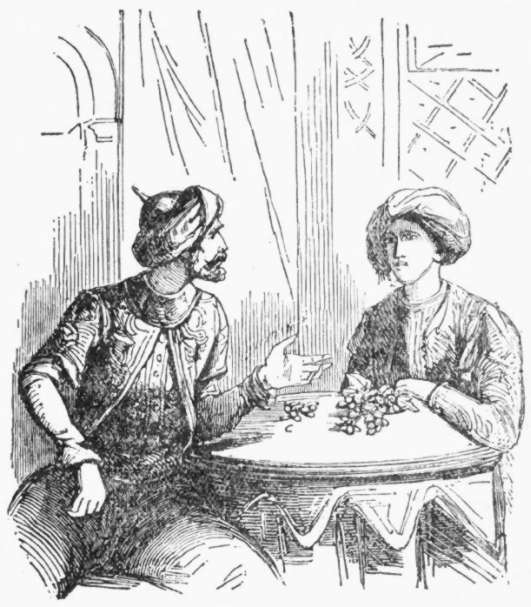
Zadig and the brigand.—"I advise thee to enroll thy name in my catalogue. Thou canst not do better," said the robber, "This is not a bad trade, and thou mayest one day become what I am at present."
"This discourse made a deep impression on my mind. I was the grain of sand, and I resolved to become the diamond. I began by stealing two horses. I soon got a party of companions. I put myself in a condition to rob small caravans; and thus, by degrees, I destroyed the difference which had formerly subsisted between me and other men. I had my share of the good things of this world; and was even recompensed with usury for the hardships I had suffered. I was greatly respected, and became the captain of a band of robbers. I seized this castle by force. The satrap of Syria had a mind to dispossess me of it; but I was too rich to have any thing to fear. I gave the satrap a handsome present, by which means I preserved my castle, and increased my possessions. He even appointed me treasurer of the tributes which Arabia Petræa pays to the king of kings. I perform my office of receiver with great punctuality; but take the freedom to dispense with that of paymaster.
"The grand Desterham of Babylon sent hither a petty satrap in the name of king Moabdar, to have me strangled. This man arrived with his orders. I was apprised of all. I caused to be strangled in his presence the four persons he had brought with him to draw the noose; after which I asked him how much his commission of strangling me might be worth. He replied, that his fees would amount to above three hundred pieces of gold. I then convinced him that he might gain more by staying with me. I made him an inferior robber; and he is now one of my best and richest officers. If thou wilt take my advice, thy success may be equal to his. Never was there a better season for plunder, since king Moabdar is killed, and all Babylon thrown into confusion."
"Moabdar killed!" said Zadig, "and what has become of queen Astarte?"
"I know not," replied Arbogad. "All I know is, that Moabdar lost his senses and was killed; that Babylon is a scene of disorder and bloodshed; that all the empire is desolated; that there are some fine strokes to be made yet; and that, for my own part, I have struck some that are admirable."
"But the queen," said Zadig; "for heaven's sake, knowest thou nothing of the queen's fate?"
"Yes," replied he, "I have heard something of a prince of Plircania. If she was not killed in the tumult, she is probably one of his concubines. But I am much fonder of booty than news. I have taken several women in my excursions, but I keep none of them. I sell them at a high price when they are beautiful, without enquiring who they are. In commodities of this kind rank makes no difference, and a queen that is ugly will never find a merchant. Perhaps I may have sold queen Astarte; perhaps she is dead; but, be it as it will, it is of little consequence to me, and I should imagine of as little to thee."
So saying, he drank a large draught, which threw all his ideas into such confusion that Zadig could obtain no farther information.
Zadig remained for some time without speech, sense, or motion. Arbogad continued drinking, constantly repeated that he was the happiest man in the world; and exhorted Zadig to put himself in the same condition. At last the soporiferous fume of the wine lulled him into a gentle repose. Zadig passed the night in the most violent perturbation.
"What," said he, "did the king lose his senses? and is he killed? I cannot help lamenting his fate. The empire is rent in pieces: and this robber is happy. O fortune! O destiny! A robber is happy, and the most beautiful of nature's works hath perhaps perished in a barbarous manner, or lives in a state worse than death. O Astarte! what has become of thee?"
At day break, he questioned all those he met in the castle; but they were all busy and he received no answer. During the night they had made a new capture, and they were now employed in dividing the spoil. All he could obtain in this hurry and confusion was an opportunity of departing, which he immediately embraced, plunged deeper than ever in the most gloomy and mournful reflections.
Zadig proceeded on his journey with a mind full of disquiet and perplexity, and wholly employed on the unhappy Astarte on the king of Babylon, on his faithful friend Cador, on the happy robber Arbogad, on that capricious woman whom the Babylonians had seized on the frontiers of Egypt. In a word, on all the misfortunes and disappointments he had hitherto suffered.
XV.
THE FISHERMAN.
At few leagues distance from Arbogad's castle he came to the banks of a small river, still deploring his fate, and considering himself as the most wretched of mankind. He saw a fisherman lying on the bank of the river, scarcely holding in his weak and feeble hand a net which he seemed ready to drop, and lifting up his eyes to heaven.
"I am certainly," said the fisherman, "the most unhappy man in the world. I was universally allowed to be the most famous dealer in cream-cheese in Babylon, and yet I am ruined. I had the most handsome wife that any man in my situation could have; and by her I have been betrayed. I had still left a paltry house, and that I have seen pillaged and destroyed. At last I took refuge in this cottage, where I have no other resource than fishing, and yet I cannot catch a single fish. Oh, my net! no more will I throw thee into the water; I will throw myself in thy place."
So saying, he arose and advanced forward, in the attitude of a man ready to throw himself into the river, and thus to finish his life.
"What," said Zadig, "are there men as wretched as I?"
His eagerness to save the fisherman's life was as sudden as this reflection. He runs to him, stops him, and speaks to him with a tender and compassionate air. It is commonly supposed that we are less miserable when we have companions in our misery. This, according to Zoroaster, does not proceed from malice, but necessity. We feel ourselves insensibly drawn to an unhappy person as to one like ourselves. The joy of the happy would be an insult; but two men in distress are like two slender trees, which, mutually supporting each other, fortify themselves against the tempest.
"Why," said Zadig to the fisherman, "dost thou sink under thy misfortunes?"
"Because," replied he, "I see no means of relief. I was the most considerable man in the village of Derlback, near Babylon, and with the assistance of my wife I made the best cream-cheese in the empire. Queen Astarte, and the famous minister, Zadig, were extremely fond of them. I had sent them six hundred cheeses, and one day went to the city to receive my money; but, on my arrival at Babylon, was informed that the queen and Zadig had disappeared. I ran to the house of Lord Zadig, whom I had never seen; and found there the inferior officers of the grand Desterham, who being furnished with a royal license, were plundering it with great loyalty and order. From thence I flew to the queen's kitchen, some of the lords of which told me that the queen was dead; some said she was in prison; and others pretended that she had made her escape; but they all agreed in assuring me that I would not be paid for my cheese. I went with my wife to the house of Lord Orcan, who was one of my customers, and begged his protection in my present distress. He granted it to my wife, but refused it to me. She was whiter than the cream-cheeses that began my misfortune, and the lustre of the Tyrian purple was not more bright than the carnation which animated this whiteness. For this reason Orcan detained her, and drove me from his house. In my despair I wrote a letter to my dear wife. She said to the bearer, 'Ha, ha! I know the writer of this a little. I have heard his name mentioned. They say he I makes excellent cream-cheeses. Desire him to send me some and he shall be paid.'
"In my distress I resolved to apply to justice. I had still six ounces of gold remaining. I was obliged to give two to the lawyer whom I consulted, two to the procurator who undertook my cause, and two to the secretary of the first judge. When all this was done, my business was not begun; and I had already expended more money than my cheese and my wife were worth. I returned to my own village, with an intention to sell my house, in order to enable me to recover my wife.
"My house was well worth sixty ounces of gold; but as my neighbors saw that I was poor and obliged to sell it, the first to whom I applied offered me thirty ounces, the second twenty, and the third ten. Bad as these offers were, I was so blind that I was going to strike a bargain, when a prince of Hircania came to Babylon, and ravaged all in his way. My house was first sacked and then burned.
"Having thus lost my money, my wife, and my house, I retired into this country, where thou now seest me. I have endeavored to gain a subsistence by fishing; but the fish make a mock of thee as well as the men. I catch none; I die with hunger; and had it not been for thee, august comforter, I should have perished in the river."
The fisherman was not allowed to give this long account without interruption; at every moment, Zadig, moved and transported, said:
"What! knowest thou nothing of the queen's fate?"
"No my lord," replied the fisherman; "but I know that neither the queen nor Zadig have paid me for my cream-cheeses; that I have lost my wife, and am now reduced to despair."
"I flatter myself," said Zadig, "that thou wilt not lose all thy money. I have heard of this Zadig; he is an honest man; and if he return to Babylon, as he expects, he will give thee more than he owes thee. But with regard to thy wife, who is not so honest, I advise thee not to seek to recover her. Believe me, go to Babylon; I shall be there before thee, because I am on horseback, and thou art on foot. Apply to the illustrious Cador. Tell him thou hast met his friend. Wait for me at his house. Go, perhaps thou wilt not always be unhappy.
"O powerful Oromazes!" continued he, "thou employest me to comfort this man. Whom wilt thou employ to give me consolation?"
So saying, he gave the fisherman half the money he had brought from Arabia. The fisherman, struck with surprise and ravished with joy, kissed the feet of the friend of Cador, and said:
"Thou art surely an angel sent from heaven to save me!" Meanwhile Zadig continued to make fresh inquiries and to shed tears. "What! my lord," cried the fisherman, "and art thou then so unhappy, thou who bestowest favors?"
"A hundred times more unhappy than thee," replied Zadig.
"But how is it possible," said the good man, "that the giver can be more wretched than the receiver?"
"Because," replied Zadig, "thy greatest misery arose from poverty, and mine is seated in the heart."
"Did Orcan take thy wife from thee?" said the fisherman.
This word recalled to Zadig's mind the whole of his adventures. He repeated the catalogue of his misfortunes, beginning with the queen's bitch and ending with his arrival at the castle of the robber Arbogad.
"Ah!" said he to the fisherman, "Orcan deserves to be punished: but it is commonly such men as those that are the favorites of fortune. However, go thou to the house of Lord Cador, and there await my arrival."
They then parted: the fisherman walked, thanking heaven for the happiness of his condition; and Zadig rode, accusing fortune for the hardness of his lot.
XVI.
THE BASILISK.
Arriving in a beautiful meadow, he there saw several women, who were searching for something with great application. He took the liberty to approach one of them, and to ask if he might have the honor to assist them in their search.
"Take care that thou dost not," replied the Syrian. "What we are searching for can be touched only by women."
"Strange," said Zadig. "May I presume to ask thee what it is that women only are permitted to touch?"
"It is a basilisk," said she.
"A basilisk, madam! and for what purpose, pray, dost thou seek for a basilisk?"
"It is for our lord and master, Ogul, whose castle thou seest on the bank of that river, at the end of that meadow. We are his most humble slaves. The lord Ogul is sick. His physician hath ordered him to eat a basilisk, stewed in rose-water; and as it is a very rare animal, and can only be taken by women, the lord Ogul hath promised to choose for his well-beloved wife the woman that shall bring him a basilisk. Let me go on in my search; for thou seest what I shall lose if I am forestalled by my companions."
The basilisk.
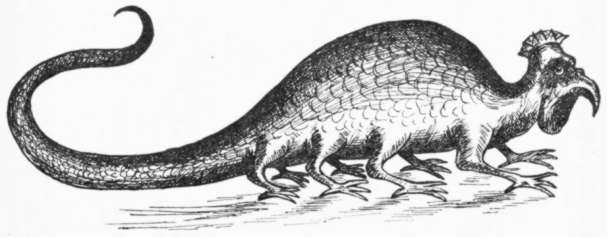
THE BASILISK, OR COCKATRICE.
The Basilisk, called "Cockatrice" in "holy writ," was first described by certain ancient historians of unquestioned imaginative ability, but of very doubtful veracity; and they have also enriched the popular mythology with minute descriptions of the Phoenix, the Griffin, the Centaur, the Chimera, the Unicorn, and many other fanciful and mythical creations.
The learned and pious naturalist, Charles Owen, D.D., of London, England, (from whose celebrated Essay Towards a Natural History of Serpents, published in 1742, the preceding engraving has been copied), tells us that "the Basilisk is a serpent of the Draconick line—the property of Africa; that in shape it resembles a cock, the tail excepted; that the Egyptians say it springs from the egg of the bird Ibis, and others, from eggs of a cock; that it is gross in body, of fiery eyes and sharp head, on which it wears a crest like a cock's comb; that it has the honor to be styled Regulus by the Latins—the little king of serpents; that it is terrible to them, and its voice puts them to flight, that, as tradition adds, its eyes and breath are killing; that dreadful things are attributed to it by the poets; and that, according to Pliny, the venom of the Basilisk is said to be so exalted, that if it bites a staff 'twill kill the person that makes use of it; but this," continues the reverend doctor of divinity, "is tradition without a voucher."
The "inspired" prophet Isaiah, whose writings are venerated by both Jews and Christians, and whose prophetic utterances have so long been discussed with more zeal than discretion by the sectarians, tells us, (Isaiah xiv. 29), that "Out of the serpent's root shall come forth a Cockatrice, and his fruit shall be a fiery, flying serpent." This somewhat incoherent prediction has never been satisfactorily explained by the learned commentators who are specially educated in our colleges for solving theological enigmas, and who have failed to show, to the confusion of scientists and the admiration of a believing world, how a Cockatrice may emerge from a "serpent's root," and why a Cockatrice's "fiery and flying fruit" should have formed a theme for prophetic inspiration.—E.
Zadig discovers Queen Astarte.--"In her hand she held a small rod with which she was tracing characters on the fine sand that lay between the turf and the brook."
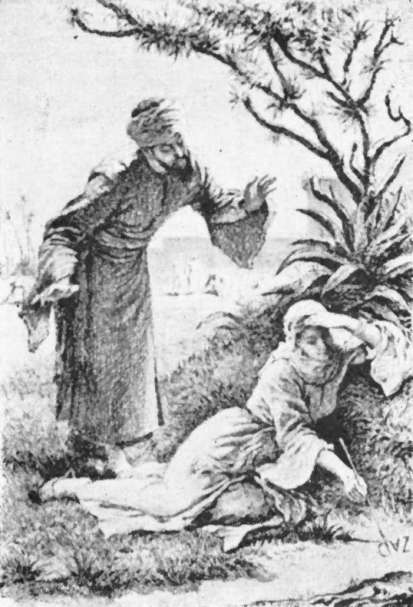
Zadig left her and the other Assyrians to search for their basilisk, and continued his journey through the meadow; when coming to the brink of a small rivulet, he found a lady lying on the grass, and who was not searching for any thing. Her person seemed majestic; but her face was covered with a veil. She was inclined toward the rivulet, and profound sighs proceeded from her bosom. In her hand she held a small rod with which she was tracing characters on the fine sand that lay between the turf and the brook.
Zadig had the curiosity to examine what this woman was writing. He drew near. He saw the letter Z, then an A; he was astonished: then appeared a D; he started. But never was surprise equal to his, when he saw the two last letters of his name. He stood for some time immovable. At last breaking silence with a faltering voice:
"Oh! generous lady!" pardon a stranger, an unfortunate man, for presuming to ask thee by what surprising adventure I here find the name of Zadig traced out by thy divine hand?'
At this voice and these words, the lady lifted up the veil with a trembling hand, looked at Zadig, sent forth a cry of tenderness, surprise, and joy, and sinking under the various emotions which at once assaulted her soul fell speechless into his arms. It was Astarte herself; it was the queen of Babylon; it was she whom Zadig adored, and whom he had reproached himself for adoring; it was she whose misfortunes he had so deeply lamented, and for whose fate he had been so anxiously concerned. He was for a moment deprived of the use of his senses, when he had fixed his eyes on those of Astarte, which now began to open again with a languor mixed with confusion and tenderness:
"O ye immortal powers!" cried he, "who preside over the fates of weak mortals; do ye indeed restore Astarte to me? At what a time, in what a place, and in what a condition do I again behold her?"
He fell on his knees before Astarte, and laid his face in the dust at her feet. The queen of Babylon raised him up, and made him sit by her side on the brink of the rivulet. She frequently wiped her eyes, from which the tears continued to flow afresh. She twenty times resumed her discourse, which her sighs as often interrupted. She asked by what strange accident they were brought together, and suddenly prevented his answer by other questions. She waived the account of her own misfortunes, and desired to be informed of those of Zadig. At last, both of them having a little composed the tumult of their souls, Zadig acquainted her in a few words by what adventure he was brought into that meadow.
"But, O unhappy and respectable queen! by what means do I find thee in this lonely place, clothed in the habit of a slave, and accompanied by other female slaves, who are searching for a basilisk, which, by order of the physician, is to be stewed in rose-water?"
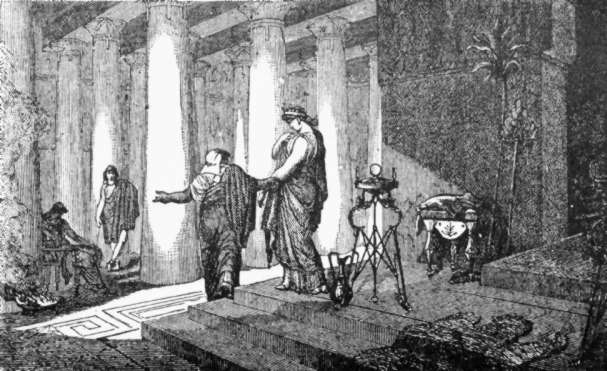
"While they are searching for their basilisk," said the fair Astarte, "I will inform thee of all I have suffered, for which heaven has sufficiently recompensed me, by restoring thee to my sight. Thou knowest that the king, my husband, was vexed to see thee, the most amiable of mankind; and that for this reason he one night resolved to strangle thee and poison me. Thou knowest how heaven permitted my little mute to inform me of the orders of his sublime majesty. Hardly had the faithful Cador obliged thee to depart, in obedience to my command, when he ventured to enter my apartment at midnight by a secret passage. He carried me off, and conducted me to the temple of Oromazes, where the magi, his brother, shut me up in that huge statue, whose base reaches to the foundation of the temple, and whose top rises to the summit of the dome. I was there buried in a manner; but was served by the magi, and supplied with all the necessaries of life. At break of day his majesty's apothecary entered my chamber with a potion composed of a mixture of henbane, opium, hemlock, black hellebore, and aconite; and another officer went to thine with a bowstring of blue silk. Neither of us were to be found. Cador, the better to deceive the king, pretended to come and accuse us both. He said that thou hadst taken the road to the Indies, and I that to Memphis; on which the king's guards were immediately dispatched in pursuit of us both.
Cador concealing Astarte in the temple of Oromazes.
"The couriers who pursured me did not know me. I had hardly ever shown my face to any but thee, and to thee only in the presence and by the order of my husband. They conducted themselves in the pursuit by the description that had been given of my person. On the frontiers of Egypt they met with a woman of the same stature with me, and possessed perhaps of greater charms. She was weeping and wandering. They made no doubt but that this woman was the queen of Babylon, and accordingly brought her to Moabdar. Their mistake at first threw the king into a violent passion; but having viewed this woman more attentively, he found her extremely handsome, and was comforted. She was called Missouf. I have since been informed that this name in the Egyptian language signifies the capricious fair one. She was so in reality; but she had as much cunning as caprice. She pleased Moabdar, and gained such an ascendency over him as to make him choose her for his wife. Her character then began to appear in its true colors. She gave herself up, without scruple, to all the freaks of a wanton imagination. She would have obliged the chief of the magi, who was old and gouty, to dance before her; and on his refusal, she persecuted him with the most unrelenting cruelty. She ordered her master of the horse to make her a pie of sweetmeats. In vain did he represent that he was not a pastry-cook. He was obliged to make it, and lost his place because it was baked a little too hard. The post of master of the horse she gave to her dwarf, and that of Chancellor to her page. In this manner did she govern Babylon. Every body regretted the loss of me. The king, who till the moment of his resolving to poison me and strangle thee had been a tolerably good kind of man, seemed now to have drowned all his virtues in his immoderate fondness for this capricious fair one. He came to the temple on the great day of the feast held in honor of the sacred fire. I saw him implore the gods in behalf of Missouf, at the feet of the statue in which I was inclosed. I raised my voice; I cried out:
"'The gods reject the prayers of a king who is now become a tyrant, and who attempted to murder a reasonable wife, in order to marry a woman remarkable for nothing but her folly and extravagance.'
"At these words Moabdar was confounded and his head became disordered. The oracle I had pronounced, and the tyranny of Missouf, conspired to deprive him of his judgment, and in a few days his reason entirely forsook him.
"His madness, which seemed to be the judgment of heaven, was the signal for a revolt. The people rose, and ran to arms; and Babylon, which had been so long immersed in idleness and effeminacy, became the theatre of a bloody civil war. I was taken from the heart of my statue and placed at the head of a party. Cador flew to Memphis to bring thee back to Babylon. The prince of Hircania, informed of these fatal events, returned with his army and made a third party in Chaldea. He attacked the king, who fled before him with his capricious Egyptian. Moabdar died pierced with wounds. Missouf fell into the hands of the conqueror. I myself had the misfortune to be taken by a party of Hircanians, who conducted me to their prince's tent, at the very moment that Missouf was brought before him. Thou wilt doubtless be pleased to hear that the prince thought me more beautiful than the Egyptian; but thou wilt be sorry to be informed that he designed me for his seraglio. He told me, with a blunt and resolute air, that as soon as he had finished a military expedition, which he was just going to undertake, he would come to me. Judge how great must have been my grief. My ties with Moabdar were already dissolved; I might have been the wife of Zadig; and I was fallen into the hands of a barbarian. I answered him with all the pride which my high rank and noble sentiment could inspire. I had always heard it affirmed that heaven stamped on persons of my condition a mark of grandeur, which, with a single word or glance, could reduce to the lowliness of the most profound respect those rash and forward persons who presume to deviate from the rules of politeness. I spoke like a queen, but was treated like a maid-servant. The Hircanian, without even deigning to speak to me, told his black eunuch that I was impertinent, but that he thought me handsome. He ordered him to take care of me and to put me under the regimen of favorites, that, so my complexion being improved, I might be the more worthy of his favors when he should be at leisure to honor me with them. I told him, that, rather than submit to his desires, I would put an end to my life. He replied with a smile, that women, he believed, were not so blood-thirsty, and that he was accustomed to such violent expressions; and then left me with the air of a man who had just put another parrot into his aviary. What a state for the first queen in the universe, and, what is more, for a heart devoted to Zadig!"
At these words Zadig threw himself at her feet, and bathed them with his tears. Astarte raised him with great tenderness, and thus continued her story:
"I now saw myself in the power of a barbarian, and rival to the foolish woman with whom I was conned. She gave me an account of her adventures in Egypt. From the description she gave of your person, from the time, from the dromedary on which you were mounted, and from every other circumstance, I inferred that Zadig was the man who had fought for her. I doubted not but that you were at Memphis, and therefore resolved to repair thither. 'Beautiful Missouf,' said I, 'thou art more handsome than I, and will please the prince of Hircania much better. Assist me in contriving the means of my escape. Thou wilt then reign alone. Thou wilt at once make me happy and rid thyself of a rival.'
"Missouf concerted with me the means of my flight; and I departed secretly with a female slave. As I approached the frontiers of Arabia, a famous robber, named Arbogad, seized me and sold me to some merchants who brought me to this castle where ford Ogul resides. He bought me without knowing who I was. He is a voluptuary, ambitious of nothing but good living, and thinks that God sent him into the world for no other purpose than to sit at table. He is so extremely corpulent, that he is always in danger of suffocation. His physician, who has but little credit with him when he has a good digestion, governs him with a despotic sway when he has eaten too much. He has persuaded him that a basilisk stewed in rose-water will effect a complete cure. The ford Ogul hath promised his hand to the female slave that brings him a basilisk. Thou seest that I leave them to vie with each other in meriting this honor; and never was I less desirous of finding the basilisk than since heaven hath restored thee to my sight."
This account was succeeded by a long conversation between Astarte and Zadig, consisting of every thing that their long suppressed sentiments, their great sufferings, and their mutual love, could inspire into hearts the most noble and tender, and the genii who preside over love carried their words to the sphere of Venus.
The women returned to Ogul without having found the basilisk. Zadig was introduced to this mighty lord, and spoke to him in the following terms:
"May immortal health descend from heaven to bless all thy days! I am a physician. At the first report of thy indisposition I flew to thy castle, and have now brought thee a basilisk stewed in rose-water. Not that I pretend to marry thee. All I ask is the liberty of a Babylonian slave, who hath been in thy possession for a few days; and, if I should not be so happy as to cure thee, magnificent Lord Ogul, I consent to remain a slave in her place."
The proposal was accepted. Astarte set out for Babylon with Zadig's servant, promising, immediately upon her arrival, to send a courier to inform him of all that had happened. Their parting was as tender as their meeting. The moment of meeting, and that of parting are the two greatest epochs of life as sayeth the great book of Zend. Zadig loved the queen with as much ardor as he professed; and the queen loved Zadig more than she thought proper to acknowledge.
Meanwhile Zadig spoke thus to Ogul:
"My lord, my basilisk is not to be eaten; all its virtues must enter through thy pores. I have inclosed it in a little ball, blown up and covered with a fine skin. Thou must strike this ball with all thy might, and I must strike it back for a considerable time; and by observing this regimen for a few days, thou wilt see the effects of my art."
The first day Ogul was out of breath, and thought he should have died with fatigue. The second, he was less fatigued, and slept better. In eight days he recovered all the strength, all the health, all the agility and cheerfulness of his most agreeable years.
"Thou hast played at ball, and hast been temperate," said Zadig. "Know that there is no such thing in nature as a basilisk; that temperance and exercise are the two great preservatives of health; and that the art of reconciling intemperance and health is as chimerical as the philosopher's stone, judicial astrology, or the theology of the magi."
Ogul's first physician observing how dangerous this man might prove to the medical art, formed a design, in conjunction with the apothecary, to send Zadig to search for a basilisk in the other world. Thus, after having suffered such a long train of calamities on account of his good actions, he was now upon the point of losing his life for curing a gluttonous lord. He was invited to an excellent dinner, and was to have been poisoned in the second course; but, during the first, he happily received a courier from the fair Astarte.
"When one is beloved by a beautiful woman," says the great Zoroaster, "he hath always the good fortune to extricate himself out of every kind of difficulty and danger."
XVII.
THE COMBATS.
The queen was received at Babylon with all those transports of joy which are ever felt on the return of a beautiful princess who hath been involved in calamities. Babylon was now in greater tranquillity. The prince of Hircania had been killed in battle. The victorious Babylonians declared that the queen should marry the man whom they should choose for their sovereign. They were resolved that the first place in the world, that of being husband to Astarte and king of Babylon, should not depend on cabals and intrigues. They swore to acknowledge for king the man who, upon trial, should be found to be possessed of the greatest valor and the greatest wisdom. Accordingly, at the distance of a few leagues from the city, a spacious place was marked out for the list, surrounded with magnificent amphitheatres. Thither the combatants were to repair in complete armor. Each of them had a separate apartment behind the amphitheatres, where they were neither to be seen nor known by any one. Each was to encounter four knights; and those that were so happy as to conquer four, were then to engage with one another: so that he who remained the last master of the field, would be proclaimed conqueror at the games. Four days after he was to return to the same place, and to explain the enigmas proposed by the magi. If he did not explain the enigmas, he was not king; and the running at the lances was to begin afresh, till a man should be found who was conqueror in both these combats; for they were absolutely determined to have a king possessed of the greatest wisdom and the most invincible courage. The queen was all the while to be strictly guarded. She was only allowed to be present at the games, and even there she was to be covered with a veil; but was not allowed to speak to any of the competitors, that so they might neither receive favor, nor suffer injustice.
These particulars Astarte communicated to her lover, hoping that, in order to obtain her, he would show himself possessed of greater courage and wisdom than any other person.
Zadig set out on his journey, beseeching Venus to fortify his courage and enlighten his understanding. He arrived on the banks of the Euphrates on the eve of this great day. He caused his device to be inscribed among those of the combatants, concealing his face and his name, as the law ordained; and then went to repose himself in the apartment that fell to him by lot. His friend, Cador, who after the fruitless search he had made for him in Egypt, had now returned to Babylon, sent to his tent a complete suit of armor, which was a present from the queen; as also from himself, one of the finest horses in Persia. Zadig presently perceived that these presents were sent by Astarte; and from thence his courage derived fresh strength, and his love the most animating hopes.
Next day, the queen being seated under a canopy of jewels, and the amphitheatres filled with all the gentlemen and ladies of rank in Babylon, the combatants appeared in the circus. Each of them came and laid his device at the feet of the grand magi. They drew their devices by lot; and that of Zadig was the last. The first who advanced was a certain lord, named Itobad, very rich and very vain, but possessed of little courage, of less address, and scarcely of any judgment at all. His servants had persuaded him that such a man as he ought to be king. He had said in reply, "Such a man as I ought to reign;" and thus they had armed him cap-a-pie. He wore an armor of gold enameled with green, a plume of green feathers, and a lance adorned with green ribbons. It was instantly perceived by the manner in which Itobad managed his horse, that it was not for such a man as him that heaven reserved the sceptre of Babylon. The first knight that ran against him threw him out of his saddle: the second laid him flat on his horse's buttocks, with his legs in the air, and his arms extended. Itobad recovered himself, but with so bad a grace, that the whole amphitheatre burst out a laughing. The third knight disdained to make use of his lance; but, making a pass at him, took him by the right leg, and wheeling him half round, laid him prostrate on the sand. The squires of the games ran to him laughing, and replaced him in his saddle. The fourth combatant took him by the left leg, and tumbled him down on the other side. He was conducted back with scornful shouts to his tent, where, according to the law, he was to pass the night; and as he limped along with great difficulty, he said: "What an adventure for such a man as I!"
The combats.
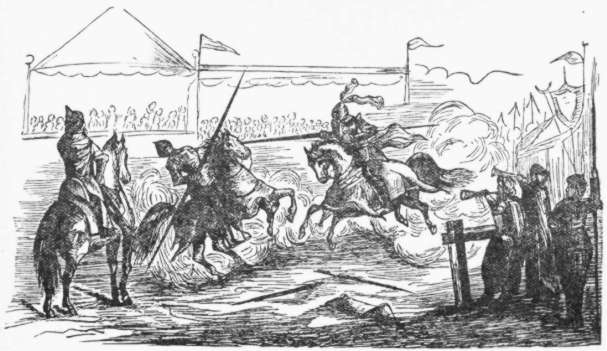
The other knights acquitted themselves with greater ability and success. Some of them conquered two combatants; a few of them vanquished three; but none but prince of Otamus conquered four. At last Zadig fought in his turn. He successively threw four knights off their saddles with all the grace imaginable. It then remained to be seen who should be conqueror, of Otamus or Zadig. The arms of the first were gold and blue, with a plume of the same color; those of the last were white. The wishes of all the spectators were divided between the knight in blue and the knight in white. The queen, whose heart was in a violent palpitation, offered prayers to heaven for the success of the white color.
The two champions made their passes and vaults with so much agility, they mutually gave and received such dexterous blows with their lances, and sat so firmly in their saddles, that every body but the queen wished there might be two kings in Babylon. At length, their horses being tired and their lances broken, Zadig had recourse to this stratagem: He passed behind the blue prince; springs upon the buttocks of his horse; seizes him by the middle; throws him on the earth; places himself in the saddle, and wheels around Otamus as he lay extended on the ground. All the amphitheatre cried out, "Victory to the white knight!" Otamus rises in a violent passion, and draws his sword; Zadig leaps from his horse with his sabre in his hand. Both of them are now on the ground, engaged in a new combat, where strength and agility triumph by turns. The plumes of their helmets, the studs of their bracelets, and the rings of their armor are driven to a great distance by the violence of a thousand furious blows. They strike with the point and the edge; to the right, to the left; on the head, on the breast; they retreat; they advance; they measure swords; they close; they seize each other; they bend like serpents; they attack like lions; and the fire every moment flashes from their blows. At last Zadig, having recovered his spirits, stops; makes a feint; leaps upon Otamus; throws him on the ground and disarms him; and Otamus cries out:
"It is thou alone, O white knight, that oughtest to reign over Babylon!"
The queen was now at the height of her joy. The knight in blue armor, and the knight in white, were conducted each to his own apartment, as well as all the others, according to the intention of the law. Mutes came to wait upon them, and to serve them at table. It may be easily supposed that the queen's little mute waited upon Zadig. They were then left to themselves to enjoy the sweets of repose till next morning, at which time the conqueror was to bring his device to the grand magi, to compare it with that which he had left, and make himself known.
Zadig, though deeply in love, was so much fatigued that he could not help sleeping. Itobad, who lay near him, never closed his eyes. He arose in the night, entered his apartment, took the white arms and the device of Zadig, and put his green armor in their place. At break of day, he went boldly to the grand magi, to declare that so great a man as he was conqueror. This was little expected; however, he was proclaimed while Zadig was still asleep. Astarte, surprised and filled with despair, returned to Babylon. The amphitheatre was almost empty when Zadig awoke; he sought for his arms but could find none but the green armor. With this he was obliged to cover himself, having nothing else near him. Astonished and enraged, he put it on in a furious passion and advanced in this equipage.
The people that still remained in the amphitheatre and the circus received him with hoofs and hisses. They surrounded him, and insulted him to his face. Never did man suffer such cruel mortifications. He lost his patience; with his sabre he dispersed such of the populace as dared to affront him; but he knew not what course to take. He could not see the queen; he could not claim the white armor she had sent him without exposing her; and thus, while she was plunged in grief, he was filled with fury and distraction. He walked on the banks of the Euphrates, fully persuaded that his star had destined him to inevitable misery; and revolving in his mind all his misfortunes, from the adventure of the woman who hated one-eyed men, to that of his armor:
"This," said he, "is the consequence of my having slept too long. Had I slept less, I should now have been king of Babylon, and in possession of Astarte. Knowledge, virtue, and courage, have hitherto served only to make me miserable."
He then let fall some secret murmurings against providence, and was tempted to believe that the world was governed by a cruel destiny, which oppressed the good, and prospered knights in green armor.
XVIII.
THE HERMIT.
One of Zadig's greatest mortifications was his being obliged to wear that green armor which had exposed him to such contumelious treatment. A merchant happening to pass by, he sold it to him for a trifle, and bought a gown and a long bonnet. In this garb he proceeded along the banks of the Euphrates, filled with despair, and secretly accusing providence, which thus continued to persecute him with unremitting severity.
While he was thus sauntering along, he met a hermit whose white and venerable beard hung down to his girdle. He held a book in his hand, which he read with great attention. Zadig stopped, and made him a profound obeisance. The hermit returned the compliment with such a noble and engaging air, that Zadig had the curiosity to enter into conversation with him. He asked him what book it was that he had been reading.
"It is the book of destinies," said the hermit. "Wouldst thou choose to look into it?"
He put the book into the hands of Zadig, who, thoroughly versed as he was in several languages, could not decipher a single character of it. This only redoubled his curiosity.
"Thou seemest," said the good father, "to be in great distress."
"Alas!" replied Zadig, "I have but too much reason."
"If thou wilt permit me to accompany thee," resumed the old man, "perhaps I may be of some service to thee. I have often poured the balm of consolation into the bleeding heart of the unhappy."
Zadig felt himself inspired with respect for the dignity, the beard, and the book of the hermit. He found, in the course of the conversation, that he was possessed of superior degrees of knowledge. The hermit talked of fate, of justice, of morals, of the chief good, of human weakness, and of virtue and vice, with such a spirited and moving eloquence, that Zadig felt himself drawn toward him by an irresistible charm. He earnestly entreated the favor of his company till their return to Babylon.
"I ask the same favor of thee," said the old man. "Swear to me by Oromazes that, whatever I do, thou wilt not leave me for some days."
Zadig swore, and they set out together. In the evening the two travelers arrived at a superb castle. The hermit entreated a hospitable reception for himself and the young man who accompanied him. The porter, whom one might have mistaken for a great lord, introduced them with a kind of disdainful civility. He presented them to a principal domestic, who showed them his master's magnificent apartments. They were admitted to the lower end of the table, without being honored with the least mark of regard by the lord of the castle; but they were served, like the rest, with delicacy and profusion. They were then presented, in a golden basin adorned with emeralds and rubies, with water to wash their hands. At last they were conducted to bed in a beautiful apartment; and in the morning a domestic brought each of them a piece of gold, after which they took their leave and departed.
"The master of the house," said Zadig, as they were proceeding on the journey, "appears to be a generous man, though somewhat too proud. He nobly performs the duties of hospitality."
At that instant he observed that a kind of large pocket, which the hermit had, was filled and distended; and upon looking more narrowly, he found that it contained the golden basin adorned with precious stones, which the hermit had stolen. He durst not then take any notice of it; but he was filled with a strange surprise.
About noon the hermit came to the door of a paltry house, inhabited by a rich miser, and begged the favor of an hospitable reception for a few hours. An old servant, in a tattered garb, received them with a blunt and rude air, and led them into the stable, where he gave them some rotten olives, sour wine, and mouldy bread. The hermit ate and drank with as much seeming satisfaction as he had done the evening before, and then addressing himself to the old servant who watched them both to prevent them stealing anything, and had rudely pressed them to depart, he gave him the two pieces of gold he had received in the morning, and thanked him for his great civility.
"Pray," added he, "allow me to speak to thy master."
The servant, filled with astonishment, introduced the two travelers.
"Magnificent lord!" said the hermit, "I cannot but return thee my most humble thanks for the noble manner in which thou hast entertained us. Be pleased to accept of this golden basin as a small mark of my gratitude."
The miser started, and was ready to fall backwards; but the hermit, without giving him time to recover from his surprise, instantly departed with his young fellow traveler.
"Father," said Zadig, "what is the meaning of all this? Thou seemest to me to be entirely different from other men. Thou stealest a golden basin adorned with precious stones, from a lord who received thee magnificently, and givest it to a miser who treats thee with indignity."
"Son," replied the old man, "this magnificent lord, who receives strangers only from vanity and ostentation, will hereby be rendered more wise; and the miser will learn to practice the duties of hospitality. Be surprised at nothing, but follow me."
Zadig knew not as yet whether he was in company with the most foolish or the most prudent of mankind' but the hermit spoke with such an ascendency that Zadig, who was moreover bound by his oath, could not refuse to follow him.
In the evening they arrived at a house built with equal elegance and simplicity, where nothing savored either of prodigality or avarice. The master of it was a philosopher who had retired from the world, and who cultivated in peace the study of virtue and wisdom, without any of that rigid and morose severity so commonly found in men of his character. He had chosen to build this fine house in which he received strangers with a generosity free from ostentation. He went himself to meet the two travelers, whom he led into a commodious apartment, and desired them to repose themselves. Soon after he came and invited them to a decent and well ordered repast, during which he spoke with great judgment of the last revolutions in Babylon. He seemed to be strongly attached to the queen, and wished that Zadig had appeared in the lists to contend for the crown.
"But the people," added he, "do not deserve to have such a king as Zadig."
Zadig blushed and felt his griefs redoubled. They agreed, in the course of the conversation, that the things of this world did not always answer the wishes of the wise. The hermit maintained that the ways of providence were inscrutable; and that men were in the wrong to judge of a whole, of which they understood but the smallest part. They talked of the passions.
"Ah," said Zadig, "how fatal are their effects!"
"They are the winds," replied the hermit, "that swell the sails of the ship; it is true, they sometimes sink her, but without them she could not sail at all. The bile makes us sick and choleric but without the bile we could not live. Everything in this world is dangerous, and yet everything in it is necessary."
The conversation turned on pleasure; and the hermit proved that it was a present bestowed by the deity.
"For," said he, "man cannot either give himself sensations or ideas: he receives all; and pain and pleasure proceed from a foreign cause as well as his being."
Zadig was surprised to see a man who had been guilty of such extravagant actions, capable of reasoning with so much judgment and propriety. At last, after a conversation equally entertaining and instructive, the host led back his two guests to their apartment, blessing heaven for having sent him two men possessed of so much wisdom and virtue. He offered them money with such an easy and noble air that it could not possibly give any offence. The hermit refused it, and said that he must now take his leave of him, as he proposed to set out for Babylon in the morning before it was light. Their parting was tender. Zadig especially felt himself filled with esteem and affection for a man of such an amiable character.
When he and the hermit were alone in their apartment they spent a long time in praising their host. At break of day the old man awakened his companion.
"We must now depart," said he; "but while all the family are still asleep, I will leave this man a mark of my esteem and affection."
So saying he took a candle and set fire to the house. Zadig, struck with horror, cried aloud, and endeavored to hinder him from committing such a barbarous action; but the hermit drew him away by a superior force, and the house was soon in flames. The hermit, who, with his companion, was already at a considerable distance, looked back to the conflagration with great tranquillity.
"Thanks be to God," said he, "the house of my dear host is entirely destroyed! Happy man!"
At these words Zadig was at once tempted to burst out in laughing, to reproach the reverend father, to beat him, and to run away. But he did none of all these; for still subdued by the powerful ascendancy of the hermit, he followed him, in spite of himself, to the next stage.
This was at the house of a charitable and virtuous widow, who had a nephew fourteen years of age, a handsome and promising youth, and her only hope. She performed the honors of the house as well us she could. Next day, she ordered her nephew to accompany the strangers to a bridge, which being lately broken down, was become extremely dangerous in passing. The young man walked before them with great alacrity. As they were crossing the bridge, the hermit said to the youth:
"Come, I must show my gratitude to thy aunt."
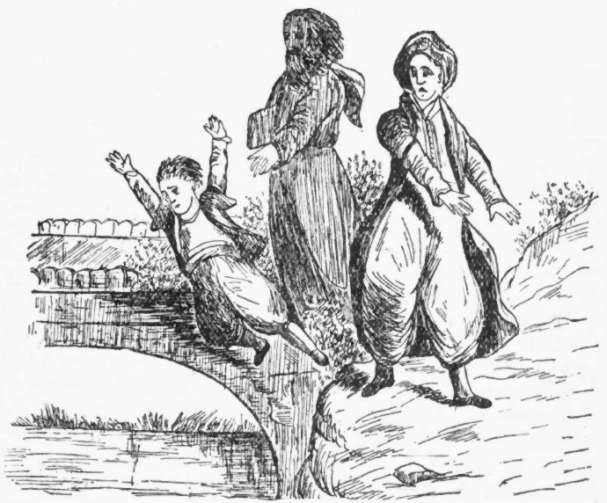
He then took him by the hair, and plunged him into the river. The boy sank, appeared again on the surface of the water, and was swallowed up by the current.
"O monster! O thou most wicked of mankind!" cried Zadig.
"Thou promised to behave with greater patience," said the hermit, interrupting him. "Know, that under the ruins of that house which providence hath set on fire, the master hath found an immense treasure I know, that this young man, whose life providence hath shortened, would have assassinated his aunt in the space of a year, and thee in that of two."
"Who told thee so, barbarian?" cried Zadig, "and though thou hadst read this event in thy book of destinies, art thou permitted to drown a youth who never did thee any harm?"
While the Babylonian was thus exclaiming, he observed that the old man had no longer a beard, and that his countenance assumed the features and complexion of youth. The hermit's habit disappeared, and four beautiful wings covered a majestic body resplendent with light.
"O sent of heaven! O divine angel!" cried Zadig, humbly prostrating himself on the ground, "Hast thou then descended from the empyrean to teach a weak mortal to submit to the eternal decrees of providence?"
"Men," said the angel Jesrad, "judge of all without knowing any thing; and, of all men, thou best deservest to be enlightened."
Zadig begged to be permitted to speak:
"I distrust myself," said he, "but may I presume to ask the favor of thee to clear up one doubt that still remains in my mind. Would it not have been better to have corrected this youth, and made him virtuous, than to have drowned him?"
The hermit.
The poem, called The Hermit, by Thomas Parnell, D.D., expresses views in regard to providence similar to those of Voltaire. The same thoughts may also be found in the Divine Dialogues of Henry Moore. Indeed this "tale to prose-men known to verse-men fam'd," has been used by many authors. Pope says "the story was written originally in Spanish;" Goldsmith, in his Life of Parnell, intimates that it was originally of Arabian invention, while, in fact, it seems to bear internal evidence of Persian or Hindoo origin.—E.
"Had he become virtuous," replied Jesrad, "and enjoyed a longer life, it would have been his fate to have been assassinated himself, together with the wife he would have married, and the child he would have had by her."
"But why," said Zadig, "is it necessary that there should be crimes and misfortunes, and that these misfortunes should fall on the good?"
"The wicked," replied Jesrad, "are always unhappy. They serve to prove and try the small number of the just that are scattered through the earth; and there is no evil that is not productive of some good."
"But," said Zadig, "suppose there was nothing but good and no evil at all."
"Then," replied Jesrad, "this earth would be another earth: the chain of events would be ranged in another order and directed by wisdom. But this other order, which would be perfect, can exist only in the eternal abode of the Supreme Being, to which no evil can approach. The Deity hath created millions of worlds, among which there is not one that resembles another. This immense variety is the effect of his immense power. There are not two leaves among the trees of the earth, nor two globes in the unlimited expanse of heaven, that are exactly similar; and all that thou seest on the little atom in which thou art born, ought to be, in its proper time and place, according to the immutable decrees of him who comprehends all. Men think that this child, who hath just perished, is fallen into the water by chance; and that it is by the same chance that this house is burned. But there is no such thing as chance. All is either a trial, or a punishment, or a reward, or a foresight. Remember the fisherman, who thought himself the most wretched of mankind. Oromazes sent thee to change his fate. Cease then, frail mortal, to dispute against what thou oughtest to adore."
"But," said Zadig—
As he pronounced the word "But," the angel took his flight toward the tenth sphere. Zadig on his knees adored providence, and submitted. The angel cried to him from on high:
"Direct thy course toward Babylon."
XIX.
THE ENIGMAS.
Zadig, entranced as it were, and like a man about whose head the thunder had burst, walked at random. He entered Babylon on the very day when those who had fought at the tournaments were assembled in the grand vestibule of the palace to explain the enigmas, and to answer the questions of the grand magi. All the knights were already present, except the knight in green armor. As soon as Zadig appeared in the city, the people crowded around him; every eye was fixed on him, every mouth blessed him, and every heart wished him the empire. The envious man saw him pass; he frowned and turned aside. The people conducted him to the place where the assembly was held. The queen, when informed of his arrival, became a prey to the most violent agitations of hope and fear. She was filled with anxiety and apprehension. She could not comprehend why Zadig was without arms, nor why Itobad wore the white armor.
When the knights who had fought were directed to appear in the assembly, Zadig said. "I have fought as well as the other knights, but another here wears my arms; and while I wait for the honor of proving the truth of my assertion, I demand the liberty of presenting myself to explain the enigmas."
The question was put to vote, and his reputation for probity was so well established, that they admitted him without scruple.
The first question proposed by the grand magi, was: "What, of all things in the world, is the longest and the shortest, the swiftest and the slowest, the most divisible and the most extended, the most neglected and the most regretted, without which nothing can be done, which devours all that is little, and enlivens all that is great?"
Itobad was to speak. He replied, that so great a man as he did not understand enigmas; and that it was sufficient for him to have conquered by his strength and valor. Some said that the meaning of the enigma was fortune; some, the earth; and others, the light. Zadig said that it was time.
"Nothing," added he, "is longer, since it is the measure of eternity. Nothing is shorter, since it is insufficient for the accomplishment of our projects. Nothing more slow to him that expects, nothing more rapid to him that enjoys. In greatness it extends to infinity, in smallness it is infinitely divisible. All men neglect it, all regret the loss of it; nothing can be done without it. It consigns to oblivion whatever is unworthy of being transmitted to posterity, and it immortalizes such actions as are truly great."
The assembly acknowledged that Zadig was in the right.
The next question was: "What is the thing which we receive without thanks, which we enjoy without knowing how, and which we lose without perceiving it?"
Every one gave his own explanation. Zadig alone guessed that it was life; and he explained all the other enigmas with the same facility. Itobad always said that nothing was more easy, and that he could have answered them with the same readiness, had he chosen to have given himself the trouble. Questions were then proposed on justice, on the sovereign good, and on the art of government. Zadig's answers were judged to be the most solid, and the people exclaimed:
"What a pity it is, that so great a genius should be so bad a knight!"
"Illustrious lords," said Zadig, "I have had the honor of conquering in the tournaments. It is to me that the white armor belongs. Lord Itobad took possession of it during my sleep. He probably thought it would fit him better than the green. I am now ready to prove in your presence, with my gown and sword, against all that beautiful white armor which he took from me, that it is I who have had the honor of conquering the brave of Otamus."
Itobad accepted the challenge with the greatest confidence. He never doubted but that, armed as he was with a helmet, a cuirass, and brassarts, he would obtain an easy victory over a champion in a cap and a night-gown. Zadig drew his sword, saluting the queen, who looked at him with a mixture of fear and joy. Itobad drew his, without saluting any one. He rushed upon Zadig, like a man who had nothing to fear; he was ready to cleave him in two. Zadig knew how to ward off his blows, by opposing the strongest part of his sword to the weakest of that of his adversary, in such a manner that Itobad's sword was broken. Upon which Zadig, seizing his enemy by the waist, threw him on the ground; and fixing the point of his sword at the extremity of his breast-plate, exclaimed: "Suffer thyself to be disarmed, or thou art a dead man."
Itobad greatly surprised at the disgrace that happened to such a man as he, was obliged to yield to Zadig, who took from him with great composure, his magnificent helmet, his superb cuirass, his fine brassarts, his shining cuisses; clothed himself with them, and in this dress ran to throw himself at the feet of Astarte. Cador easily proved that the armor belonged to Zadig. He was acknowledged king by the unanimous consent of the whole nation, and especially by that of Astarte, who, after so many calamities, now tasted the exquisite pleasure of seeing her lover worthy, in the eyes of the world, to be her husband. Itobad went home to be called lord in his own house. Zadig was king, and was happy. He recollected what the angel Jesrad had said to him. He even remembered the grain of sand that became a diamond. He sent in search of the robber Arbogad, to whom he gave an honorable post in his army, promising to advance him to the first dignities, if he behaved like a true warrior; and threatening to hang him, if he followed the profession of a robber.
Setoc, with the fair Almona, was called from the heart of Arabia, and placed at the head of the commerce of Babylon. Cador was preferred and distinguished according to his great services. He was the friend of the king; and the king was then the only monarch on earth that had a friend. The little mute was not forgotten. A fine house was given to the fisherman; and Orcan was condemned to pay him a large sum of money, and to restore him his wife; but the fisherman, who had now become wise, took only the money.
The beautiful Semira could not be comforted for having believed that Zadig would be blind of an eye; nor did Azora cease to lament her attempt to cut off his nose: their griefs, however, he softened by his presents. The capricious beauty, Missouf, was left unnoticed. The envious man died of rage and shame. The empire enjoyed peace, glory, and plenty. This was the happiest age of the earth. It was governed by love and justice. The people blessed Zadig, and Zadig blessed heaven.