PRINCESS OF BABYLON
Reading edition
The Phœnix [1]
I.
ROYAL CONTEST FOR THE HAND OF FORMOSANTA.
The aged Belus, king of Babylon, thought himself the first man upon earth; for all his courtiers told him so, and his historians proved it. We know that his palace and his park, situated at a few parafangs from Babylon, extended between the Euphrates and the Tigris, which washed those enchanted banks. His vast house, three thousand feet in front, almost reached the clouds. The platform was surrounded with a balustrade of white marble, fifty feet high, which supported colossal statues of all the kings and great men of the empire. This platform, composed of two rows of bricks, covered with a thick surface of lead from one extremity to the other, bore twelve feet of earth; and upon the earth were raised groves of olive, orange, citron, palm, cocoa, and cinnamon trees, and stock gillyflowers, which formed alleys that the rays of the sun could not penetrate.
The waters of the Euphrates running, by the assistance of pumps, in a hundred canals, formed cascades of six thousand feet in length in the park, and a hundred thousand jets d'eau, whose height was scarce perceptible. They afterward flowed into the Euphrates, from whence they came. The gardens of Semiramis, which astonished Asia several ages after, were only a feeble imitation of these ancient prodigies, for in the time of Semiramis, every thing began to degenerate amongst men and women.
But what was more admirable in Babylon, and eclipsed every thing else, was the only daughter of the king, named Formosanta. It was from her pictures and statues, that in succeeding times Praxiteles sculptured his Aphrodita, and the Venus of Medicis. Heavens! what a difference between the original and the copies! so that king Belus was prouder of his daughter than of his kingdom. She was eighteen years old. It was necessary she should have a husband worthy of her; but where was he to be found? An ancient oracle had ordained, that Formosanta could not belong to any but him who could bend the bow of Nimrod.
This Nimrod, "a mighty hunter before the Lord," (Gen. x:9), had left a bow seventeen Babylonian feet in length, made of ebony, harder than the iron of mount Caucasus, which is wrought in the forges of Derbent; and no mortal since Nimrod could bend this astonishing bow.
It was again said, "that the arm which should bend this bow would kill the most terrible and ferocious lion that should be let loose in the Circus of Babylon." This was not all. The bender of the bow, and the conquerer of the lion, should overthow all his rivals; but he was above all things to be very sagacious, the most magnificent and most virtuous of men, and possess the greatest curiosity in the whole universe.
Three kings appeared, who were bold enough to claim Formosanta. Pharaoh of Egypt, the Shah of India, and the great Khan of the Scythians. Belus appointed the day and place of combat, which was to be at the extremity of his park, in the vast expanse surrounded by the joint waters of the Euphrates and the Tigris. Round the lists a marble amphitheatre was erected, which might contain five hundred thousand spectators. Opposite the amphitheatre was placed the king's throne. He was to appear with Formosanta, accompanied by the whole court; and on the right and left between the throne and the amphitheatre, there were other thrones and seats for the three kings, and for all the other sovereigns who were desirous to be present at this august ceremony.
The king of Egypt arrived the first, mounted upon the bull Apis, and holding in his hand the cithern of Isis. He was followed by two thousand priests, clad in linen vestments whiter than snow, two thousand eunuchs, two thousand magicians, and two thousand warriors.
The king of India came soon after in a car drawn by twelve elephants. He had a train still more numerous and more brilliant than Pharaoh of Egypt.
The last who appeared was the king of the Scythians. He had none with him but chosen warriors, armed with bows and arrows. He was mounted upon a superb tiger, which he had tamed, and which was as tall as any of the finest Persian horses. The majestic and important mien of this king effaced the appearance of his rivals; his naked arms, as nervous as they were white, seemed already to bend the bow of Nimrod.
These three lovers immediately prostrated themselves before Belus and Formosanta. The king of Egypt presented the princess with two of the finest crocodiles of the Nile, two sea horses, two zebras, two Egyptian rats, and two mummies, with the books of the great Hermes, which he judged to be the scarcest things upon earth.
The king of India offered her a hundred elephants, each bearing a wooden gilt tower, and laid at her feet the vedam, written by the hand of Xaca himself.
The king of the Scythians, who could neither write nor read, presented a hundred warlike horses with black fox skin housings.
The princess appeared with a downcast look before her lovers, and reclined herself with such a grace as was at once modest and noble.
Belus ordered the kings to be conducted to the thrones that were prepared for them. "Would I had three daughters," said he to them, "I should make six people this day happy!" He then made the competitors cast lots which should try Nimrod's bow first. Their names inscribed were put into a golden casque. That of the Egyptian king came out first, then the name of the King of India appeared. The king of Scythia, viewing the bow and his rivals, did not complain at being the third.
Whilst these brilliant trials were preparing, twenty thousand pages and twenty thousand youthful maidens distributed, without any disorder, refreshments to the spectators between the rows of seats. Every one acknowledged that the gods had instituted kings for no other cause than every day to give festivals, upon condition they should be diversified—that life is too short for any other purpose—that lawsuits, intrigues, wars, the altercations of theologists, which consume human life, are horrible and absurd—that man is born only for happiness that he would not passionately and incessantly pursue pleasure, were he not designed for it—that the essence of human nature is to enjoy ourselves, and all the rest is folly. This excellent moral was never controverted but by facts.
Whilst preparations were making for determining the fate of Formosanta, a young stranger, mounted upon an unicorn, accompanied by his valet, mounted on a like animal, and bearing upon his hand a large bird, appeared at the barrier. The guards were surprised to observe in this equipage, a figure that had an air of divinity. He had, as hath been since related, the face of Adonis upon the body of Hercules; it was majesty accompanied by the graces. His black eye-brows and flowing fair tresses, wore a mixture of beauty unknown at Babylon, and charmed all observers. The whole amphitheatre rose up, the better to view the stranger. All the ladies of the court viewed him with looks of astonishment. Formosanta herself, who had hitherto kept her eyes fixed upon the ground, raised them and blushed. The three kings turned pale. The spectators, in comparing Formosanta with the stranger, cried out, "There is no other in the world, but this young man, who can be so handsome as the princess."
The ushers, struck with astonishment, asked him if he was a king? The stranger replied, that he had not that honor, but that he had come from a distant country, excited by curiosity, to see if there were any king worthy of Formosanta. He was introduced into the first row of the amphitheatre, with his valet, his two unicorns, and his bird. He saluted, with great respect, Belus, his daughter, the three kings, and all the assembly. He then took his seat, not without blushing. His two unicorns lay down at his feet; his bird perched upon his shoulder; and his valet, who carried a little bag, placed himself by his side.
The trials began. The bow of Nimrod was taken out of its golden case. The first master of the ceremonies, followed by fifty pages, and preceded by twenty trumpets, presented it to the king of Egypt, who made his priests bless it; and supporting it upon the head of the bull Apis, he did not question his gaining this first victory. He dismounted, and came into the middle of the circus. He tries, exerts all his strength, and makes such ridiculous contortions, that the whole amphitheatre re-echoes with laughter, and Formosanta herself could not help smiling.
His high almoner approached him:
"Let your majesty give up this idle honor, which depends entirely upon the nerves and muscles. You will triumph in every thing else. You will conquer the lion, as you are possessed of the favor of Osiris. The Princess of Babylon is to belong to the prince who is most sagacious, and you have solved enigmas. She is to wed the most virtuous: you are such, as you have been educated by the priests of Egypt. The most generous is to marry her, and you have presented her with two of the handsomest crocodiles, and two of the finest rats in all the Delta. You are possessed of the bull Apis, and the books of Hermes, which are the scarcest things in the universe. No one can hope to dispute Formosanta with you."
"You are in the right," said the King of Egypt, and resumed his throne.
The bow was then put in the hands of the king of India. It blistered his hands for a fortnight; but he consoled himself in presuming that the Scythian King would not be more fortunate than himself.
The Scythian handled the bow in his turn. He united skill with strength. The bow seemed to have some elasticity in his hands. He bent it a little, but he could not bring it near a curve. The spectators, who had been prejudiced in his favor by his agreeable aspect, lamented his ill success, and concluded that the beautiful princess would never be married.
The unknown youth leaped into the arena and addressing himself to the king of Scythia said:
"Your majesty need not be surprised at not having entirely succeeded. These ebony bows are made in my country. There is a peculiar method in using them. Your merit is greater in having bent it, than if I were to curve it."
He then took an arrow and placing it upon the string, bent the bow of Nimrod, and shot the arrow beyond the gates. A million hands at once applauded the prodigy. Babylon re-echoed with acclamations; and all the ladies agreed it was fortunate for so handsome a youth to be so strong.
He then took out of his pocket a small ivory tablet, wrote upon it with a golden pencil, fixed the tablet to the bow, and then presented it to the princess with such a grace as charmed every spectator. He then modestly returned to his place between his bird and his valet. All Babylon was in astonishment; the three kings were confounded, whilst the stranger did not seem to pay the least attention to what had happened.
Formosanta was still more surprised to read upon the ivory tablet, tied to the bow, these lines, written in the best Chaldean:
L'arc de Nembrod est celui de la guerre; L'arc de l'amour est celui du bonheur; Vous le portez. Par vous ce Dieu vainqueur Est devenu le maitre de la terre. Trois Rois puissants, trois rivaux aujourd'hui, Osent pretendre a l'honneur de vous plaire. Je ne sais pas qui votre cœur prefere, Mais l'univers sera jaloux de lui. [The bow of Nimrod is that of war; The bow of love is that of happiness Which you possess. Through you this conquering God Has become master of the earth. Three powerful kings,—three rivals now, Dare aspire to the honor of pleasing you. I know not whom your heart may prefer, But the universe will be jealous of him.]
This little madrigal did not displease the princess; but it was criticised by some of the lords of the ancient court, who said that, in former times, Belus would have been compared to the sun, and Formosanta to the moon; his neck to a tower, and her breast to a bushel of wheat. They said the stranger had no sort of imagination, and that he had lost sight of the rules of true poetry, but all the ladies thought the verses very gallant. They were astonished that a man who handled a bow so well should have so much wit. The lady of honor to the princess said to her:
"Madam, what great talents are here entirely lost? What benefit will this young man derive from his wit, and his skill with Nimrod's bow?"
"Being admired!" said Formosanta.
"Ah!" said the lady, "one more madrigal, and he might well be beloved."
The king of Babylon, having consulted his sages, declared that though none of these kings could bend the bow of Nimrod, yet, nevertheless, his daughter was to be married, and that she should belong to him who could conquer the great lion, which was purposely kept in training in his great menagerie.
The king of Egypt, upon whose education all the wisdom of Egypt had been exhausted, judged it very ridiculous to expose a king to the ferocity of wild beasts in order to be married. He acknowledged that he considered the possession of Formosanta of inestimable value; but he believed that if the lion should strangle him, he could never wed this fair Babylonian. The king of India held similar views to the king of Egypt. They both concluded that the king of Babylon was laughing at them, and that they should send for armies to punish him—that they had many subjects who would think themselves highly honored to die in the service of their masters, without it costing them a single hair of their sacred heads,—that they could easily dethrone the king of Babylon, and then they would draw lots for the fair Formosanta.
This agreement being made, the two kings sent each an express into his respective country, with orders to assemble three hundred thousand men to carry off Formosanta.
However, the king of Scythia descended alone into the arena, scimitar in hand. He was not distractedly enamored with Formosanta's charms. Glory till then had been his only passion, and it had led him to Babylon. He was willing to show that if the kings of India and Egypt were so prudent as not to tilt with lions, he was courageous enough not to decline the combat, and he would repair the honor of diadems. His uncommon valor would not even allow him to avail himself of the assistance of his tiger. He advanced singly, slightly armed with a shell casque ornamented with gold, and shaded with three horses' tails as white as snow.
One of the most enormous and ferocious lions that fed upon the Antilibanian mountains was let loose upon him. His tremendous paws appeared capable of tearing the three kings to pieces at once, and his gullet to devour them. The two proud champions fled with the utmost precipitancy and in the most rapid manner to each other. The courageous Scythian plunged his sword into the lion's mouth; but the point meeting with one of those thick teeth that nothing can penetrate, was broken; and the monster of the woods, more furious from his wound, had already impressed his fearful claws into the monarch's sides.
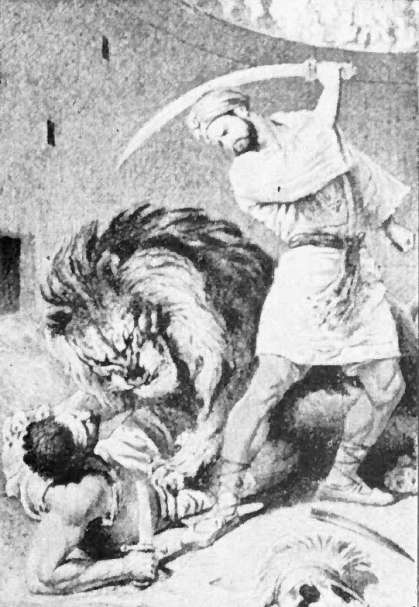
The unknown youth, touched with the peril of so brave a prince, leaped into the arena swift as lightning, and cut off the lion's head with as much dexterity as we have lately seen, in our carousals, youthful knights knock off the heads of black images.
Then drawing out a small box, he presented it to the Scythian king, saying to him.
"Your majesty will here find the genuine dittany, which grows in my country. Your glorious wounds will be healed in a moment. Accident alone prevented your triumph over the lion. Your valor is not the less to be admired."
The Scythian king, animated more with gratitude than jealousy, thanked his benefactor; and, after having tenderly embraced him, returned to his seat to apply the dittany to his wounds.
The stranger gave the lion's head to his valet, who, having washed it at the great fountain which was beneath the amphitheatre, and drained all the blood, took an iron instrument out of his little bag, with which having drawn the lion's forty teeth, he supplied their place with forty diamonds of equal size.
His master, with his usual modesty, returned to his place; he gave the lion's head to his bird:—"Beauteous bird," said he, "carry this small homage, and lay it at the feet of Formosanta."
"The unknown youth, touched with the peril of so brave a prince, leaped into the arena swift as lightning, and cut off the lion's head."
The bird winged its way with the dreadful triumph in one of its talons, and presented it to the princess; bending with humility his neck, and crouching before her. The sparkling diamonds dazzled the eyes of every beholder. Such magnificence was unknown even in superb Babylon. The emerald, the topaz, the sapphire, and the pyrope, were as yet considered as the most precious ornaments. Belus and the whole court were struck with admiration. The bird which presented this present surprised them still more. It was of the size of an eagle, but its eyes were as soft and tender as those of the eagle are fierce and threatening. Its bill was rose color, and seemed somewhat to resemble Formosanta's handsome mouth. Its neck represented all the colors of Iris, but still more striking and brilliant. Gold, in a thousand shades, glittered upon its plumage. Its feet resembled a mixture of silver and purple. And the tails of those beautiful birds, which have since drawn Juno's car, did not equal the splendor of this incomparable bird.
The attention, curiosity, astonishment, and ecstasy of the whole court were divided between the jewels and the bird. It had perched upon the balustrade between Belus and his daughter Formosanta. She petted it, caressed it, and kissed it. It seemed to receive her attentions with a mixture of pleasure and respect. When the princess gave the bird a kiss, it returned the embrace, and then looked upon her with languishing eyes. She gave it biscuits and pistachios, which it received in its purple-silvered claw, and carried to its bill with inexpressible grace.
Belus, who had attentively considered the diamonds, concluded that scarce any one of his provinces could repay so valuable a present. He ordered that more magnificent gifts should be prepared for the stranger than those destined for the three monarchs, "This young man," said he, "is doubtless son to the emperor of China; or of that part of the world called Europe, which I have heard spoken of; or of Africa, which is said to be in the vicinity of the kingdom of Egypt."
He immediately sent his first equerry to compliment the stranger, and ask him whether he was himself the sovereign, or son to the sovereign of one of those empires; and why, being possessed of such surprising treasures, he had come with nothing but his valet and a little bag?
Whilst the equerry advanced toward the amphitheatre to execute his commission, another valet arrived upon an unicorn. This valet, addressing himself to the young man, said. "Ormar, your father is approaching the end of his life: I am come to acquaint you with it."
The stranger raised his eyes to heaven, whilst tears streamed from them, and answered only by saying, "Let us depart."
The equerry, after having paid Belus's compliments to the conqueror of the lion, to the giver of the forty diamonds, and to the master of the beautiful bird, asked the valet, "Of what kingdom was the father of this young hero sovereign?"
The valet replied:
"His father is an old shepherd, who is much beloved in his district."
During this conversation, the stranger had already mounted his unicorn. He said to the equerry:
"My lord, vouchsafe to prostrate me at the feet of King Belus and his daughter. I must entreat her to take particular care of the bird I leave with her, as it is a nonpareil like herself."
In uttering these last words he set off, and flew like lightning. The two valets followed him, and in an instant he was out of sight.
Formosanta could not refrain from shrieking. The bird, turning toward the amphitheatre where his master had been seated, seemed greatly afflicted to find him gone; then viewing steadfastly the princess, and gently rubbing her beautiful hand with his bill, he seemed to devote himself to her service.
Belus, more astonished than ever, hearing that this very extraordinary young man was the son of a shepherd, could not believe it. He dispatched messengers after him; but they soon returned with the information, that the three unicorns, upon which these men were mounted, could not be overtaken; and that, according to the rate they went, they must go a hundred leagues a day.
Every one reasoned upon this strange adventure, and wearied themselves with conjectures. How can the son of a shepherd make a present of forty large diamonds? How comes it that he is mounted upon an unicorn? This bewildered them, and Formosanta, whilst she caressed her bird, was sunk into a profound reverie.
II.
THE KING OF BABYLON CONVENES HIS COUNCIL, AND CONSULTS THE ORACLE.
Princess Aldea, Formosanta's cousin-german, who was very well shaped, and almost as handsome as the King's daughter, said to her:
"Cousin, I know not whether this demi-god be the son of a shepherd, but methinks he has fulfilled all the conditions stipulated for your marriage. He has bent Nimrod's bow; he has conquered the lion; he has a good share of sense, having written for you extempore a very pretty madrigal. After having presented you with forty large diamonds, you cannot deny that he is the most generous of men. In his bird he possessed the most curious thing upon earth. His virtue cannot be equaled, since he departed without hesitation as soon as he learned his father was ill, though he might have remained and enjoyed the pleasure of your society. The oracle is fulfilled in every particular, except that wherein he is to overcome his rivals. But he has done more; he has saved the life of the only competitor he had to fear; and when the object is to surpass the other two, I believe you cannot doubt but that he will easily succeed."
"All that you say is very true," replied Formosanta: "but is it possible that the greatest of men, and perhaps the most amiable too, should be the son of a shepherd?"
The lady of honor, joining in the conversation, said that the title of shepherd was frequently given to kings—that they were called shepherds because they attended very closely to their flocks—that this was doubtless a piece of ill-timed pleasantry in his valet—that this young hero had not come so badly equipped, but to show how much his personal merit alone was above the fastidious parade of kings. The princess made no answer, but in giving her bird a thousand tender kisses.
A great festival was nevertheless prepared for the three kings, and for all the princes who had come to the feast. The king's daughter and niece were to do the honors. The king distributed presents worthy the magnificence of Babylon. Belus, during the time the repast was being served, assembled his council to discuss the marriage of the beautiful Formosanta, and this is the way he delivered himself as a great politician:
"I am old: I know not what is best to do with my daughter, or upon whom to bestow her. He who deserves her is nothing but a mean shepherd. The kings of India and Egypt are cowards. The king of the Scythians would be very agreeable to me, but he has not performed any one of the conditions imposed. I will again consult the oracle. In the meantime, deliberate among you, and we will conclude agreeably to what the oracle says; for a king should follow nothing but the dictates of the immortal gods."
He then repaired to the temple: the oracle answered in few words according to custom: Thy daughter shall not be married until she hath traversed the globe. In astonishment, Belus returned to the council, and related this answer.
All the ministers had a profound respect for oracles. They therefore all agreed, or at least appeared to agree, that they were the foundation of religion—that reason should be mute before them—that it was by their means that kings reigned over their people—that without oracles there would be neither virtue nor repose upon earth.
At length, after having testified the most profound veneration for them, they almost all concluded that this oracle was impertinent, and should not be obeyed—that nothing could be more indecent for a young woman, and particularly the daughter of the great king of Babylon, than to run about, without any particular destination—that this was the most certain method to prevent her being married, or else engage her in a clandestine, shameful, and ridiculous union that,—in a word, this oracle had not common sense.
The youngest of the ministers, named Onadase, who had more sense than the rest, said that the oracle doubtless meant some pilgrimage of devotion, and offered to be the princess's guide. The council approved of his opinion, but every one was for being her equerry. The king determined that the princess might go three hundred parasangs upon the road to Arabia, to the temple whose saint had the reputation of procuring young women happy marriages, and that the dean of the council should accompany her. After this determination they went to supper.
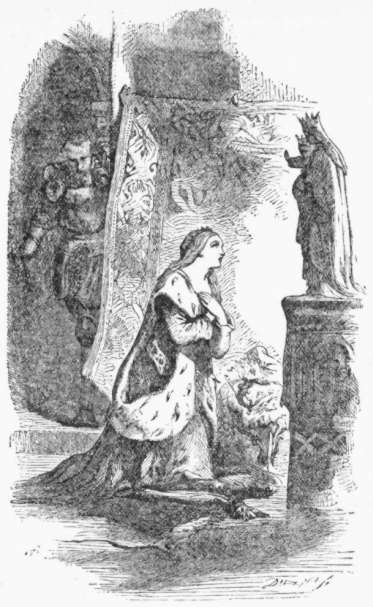
The shrine at Bassora.—A devotee at the shrine imploring the felicity of a happy marriage.
III.
ROYAL FESTIVAL GIVEN IN HONOR OF THE KINGLY VISITORS. THE BIRD CONVERSES ELOQUENTLY WITH FORMOSANTA.
In the centre of the gardens, between two cascades, an oval saloon, three hundred feet in diameter was erected, whose azure roof, intersected with golden stars, represented all the constellations and planets, each in its proper station; and this ceiling turned about, as well as the canopy, by machines as invisible as those which direct the celestial spheres. A hundred thousand flambeaux, inclosed in rich crystal cylinders, illuminated the gardens and the dining-hall. A buffet, with steps, contained twenty thousand vases and golden dishes; and opposite the buffet, upon other steps, were seated a great number of musicians. Two other amphitheatres were decked out; the one with the fruits of each season, the other with crystal decanters, that sparkled with the choicest wines.
The guests took their seats round a table divided into compartments that resembled flowers and fruits, all in precious stones. The beautiful Formosanta was placed between the kings of India and Egypt—the amiable Aldea next the king of Scythia. There were about thirty princes, and each was seated next one of the handsomest ladies of the court. The king of Babylon, who was in the middle, opposite his daughter, seemed divided between the chagrin of being yet unable to effect her marriage, and the pleasure of still beholding her. Formosanta asked leave to place her bird upon the table next her; the king approved of it.
The music, which continued during the repast, furnished every prince with an opportunity of conversing with his female neighbor. The festival was as agreeable as it was magnificent. A ragout was served before Formosanta, which her father was very fond of. The princess said it should be carried to his majesty. The bird immediately took hold of it, and carried it in a miraculous manner to the king. Never was any thing more astonishing witnessed. Belus caressed it as much as his daughter had done. The bird afterward took its flight to return to her. It displayed, in flying, so fine a tail, and its extended wings set forth such a variety of brilliant colors—the gold of its plumage made such a dazzling eclat, that all eyes were fixed upon it. All the musicians were struck motionless, and their instruments afforded harmony no longer. None ate, no one spoke, nothing but a buzzing of admiration was to be heard. The Princess of Babylon kissed it during the whole supper, without considering whether there were any kings in the world. Those of India and Egypt felt their spite and indignation rekindle with double force, and they resolved speedily to set their three hundred thousand men in motion to obtain revenge.
As for the king of Scythia, he was engaged in entertaining the beautiful Aldea. His haughty soul despising, without malice, Formosanta's inattention, had conceived for her more indifference than resentment. "She is handsome," said he, "I acknowledge: but she appears to me one of those women who are entirely taken up with their own beauty, and who fancy that mankind are greatly obliged to them when they deign to appear in public. I should prefer an ugly complaisant woman, that exhibited some amiability, to that beautiful statue. You have, madam, as many charms as she possesses, and you, at least, condescend to converse with strangers. I acknowledge to you with the sincerity of a Scythian, that I prefer you to your cousin."
He was, however, mistaken in regard to the character of Formosanta. She was not so disdainful as she appeared. But his compliments were very well received by the princess Aldea. Their conversation became very interesting. They were well contented, and already certain of one another before they left the table. After supper the guests walked in the groves. The king of Scythia and Aldea did not fail to seek for a place of retreat. Aldea, who was sincerity itself, thus declared herself to the prince:
"I do not hate my cousin, though she be handsomer than myself, and is destined for the throne of Babylon. The honor of pleasing you may very well stand in the stead of charms. I prefer Scythia with you, to the crown of Babylon without you. But this crown belongs to me by right, if there be any right in the world; for I am of the elder branch of the Nimrod family, and Formosanta is only of the younger. Her grandfather dethroned mine, and put him to death."
"Such, then, are the rights of inheritance in the royal house of Babylon!" said the Scythian. "What was your grandfather's name?"
"He was called Aldea, like me. My father bore the same name. He was banished to the extremity of the empire with my mother; and Belus, after their death, having nothing to fear from me, was willing to bring me up with his daughter. But he has resolved that I shall never marry."
"I will avenge the cause of your grandfather—of your father and also your own cause," said the king of Scythia. "I am responsible for your being married. I will carry you off the day after to-morrow by day-break—for we must dine to-morrow with the king of Babylon—and I will return and support your rights with three hundred thousand men."
"I agree to it," said the beauteous Aldea: and, after having mutually pledged their words of honor, they separated.
The incomparable Formosanta, before retiring to rest, had ordered a small orange tree, in a silver case, to be placed by the side of her bed, that her bird might perch upon it. Her curtains had long been drawn, but she was not in the least disposed to sleep. Her heart was agitated, and her imagination excited. The charming stranger was ever in her thoughts. She fancied she saw him shooting an arrow with Nimrod's bow. She contemplated him in the act of cutting off the lion's head. She repeated his madrigal. At length, she saw him retiring from the crowd upon his unicorn. Tears, sighs, and lamentations overwhelmed her at this reflection. At intervals, she cried out: "Shall I then never see him more? Will he never return?"
"He will surely return," replied the bird from the top of the orange tree. "Can one have seen you once, and not desire to see you again?"
"Heavens! eternal powers! my bird speaks the purest Chaldean." In uttering these words she drew back the curtain, put out her hand to him, and knelt upon her bed, saying:
"Art thou a god descended upon earth? Art thou the great Oromasdes concealed under this beautiful plumage? If thou art, restore me this charming young man."
"I am nothing but a winged animal," replied the bird; "but I was born at the time when all animals still spoke; when birds, serpents, asses, horses, and griffins, conversed familiarly with man. I would not speak before company, lest your ladies of honor should have taken me for a sorcerer. I would not discover myself to any but you."
Formosanta was speechless, bewildered, and intoxicated with so many wonders. Desirous of putting a hundred questions to him at once, she at length asked him how old he was.
"Only twenty-seven thousand nine hundred years and six months. I date my age from the little revolution of the equinoxes, and which is accomplished in about twenty-eight thousand of your years. There are revolutions of a much greater extent, so are there beings much older than me. It is twenty-two thousand years since I learnt Chaldean in one of my travels. I have always had a very great taste for the Chaldean language, but my brethren, the other animals, have renounced speaking in your climate."
"And why so, my divine bird?"
"Alas! because men have accustomed themselves to eat us, instead of conversing and instructing themselves with us. Barbarians! should they not have been convinced, that having the same organs with them, the same sentiments, the same wants, the same desires, we have also what is called a soul, the same as themselves;—that we are their brothers, and that none should be dressed and eaten but the wicked? We are so far your brothers, that the Supreme Being, the Omnipotent and Eternal Being, having made a compact with men, expressly comprehended us in the treaty. He forbade you to nourish yourselves with our blood, and we to suck yours.
"The fables of your ancient Locman, translated into so many languages, will be a testimony eternally subsisting of the happy commerce you formerly carried on with us. They all begin with these words: 'In the time when beasts spoke.' It is true, there are many families among you who keep up an incessant conversation with their dogs; but the dogs have resolved not to answer, since they have been compelled by whipping to go a hunting, and become accomplices in the murder of our ancient and common friends, stags, deers, hares, and partridges.
"You have still some ancient poems in which horses speak, and your coachmen daily address them in words; but in so barbarous a manner, and in uttering such infamous expressions, that horses, though formerly entertaining so great a kindness for you, now detest you.
"The country which is the residence of your charming stranger, the most perfect of men, is the only one in which your species has continued to love ours, and to converse with us; and this is the only country in the world where men are just."
"And where is the country of my dear incognito? What is the name of his empire? For I will no more believe he is a shepherd than that you are a bat."
"His country, is that of the Gangarids, a wise, virtuous, and invincible people, who inhabit the eastern shore of the Ganges. The name of my friend is Amazan. He is no king; and I know not whether he would so humble himself as to be one. He has too great a love for his fellow countrymen. He is a shepherd like them. But do not imagine that those shepherds resemble yours; who, covered with rags and tatters, watch their sheep, who are better clad than themselves; who groan under the burden of poverty, and who pay to an extortioner half the miserable stipend of wages which they receive from their masters. The Gangaridian shepherds are all born equal, and own the innumerable herds which cover their vast fields and subsist on the abundant verdure. These flocks are never killed. It is a horrid crime, in that favored country, to kill and eat a fellow creature. Their wool is finer and more brilliant than the finest silk, and constitutes the greatest traffic of the East. Besides, the land of the Gangarids produces all that can flatter the desires of man. Those large diamonds that Amazan had the honor of presenting you with, are from a mine that belongs to him. An unicorn, on which you saw him mounted, is the usual animal the Gangarids ride upon. It is the finest, the proudest, most terrible, and at the same time most gentle animal that ornaments the earth. A hundred Gangarids, with as many unicorns,[1] would be sufficient to disperse innumerable armies. Two centuries ago, a king of India was mad enough to attempt to conquer this nation. He appeared, followed by ten thousand elephants and a million of warriors. The unicorns pierced the elephants, just as I have seen upon your table beads pierced in golden brochets. The warriors fell under the sabres of the Gangarids like crops of rice mowed by the people of the East. The king was taken prisoner, with upwards of six thousand men. He was bathed in the salutary water of the Ganges, and followed the regimen of the country, which consists only of vegetables, of which nature hath there been amazingly liberal to nourish every breathing creature. Men who are fed with carnivorous aliments, and drenched with spirituous liquors, have a sharp adust blood, which turns their brains a hundred different ways. Their chief rage is a fury to spill their brother's blood, and, laying waste fertile plains, to reign over church-yards. Six full months were taken up in curing the king of India of his disorder. When the physicians judged that his pulse had become natural, they certified this to the council of the Gangarids. The council then followed the advice of the unicorns and humanely sent back the king of India, his silly court, and impotent warriors, to their own country. This lesson made them wise, and from that time the Indians respected the Gangarids, as ignorant men, willing to be instructed, revere the philosophers they cannot equal.
"Apropos, my dear bird," said the princess to him, "do the Gangarids profess any religion? have they one?"
"Yes, we meet to return thanks to God on the days of the full moon; the men in a great temple made of cedar, and the women in another, to prevent their devotion being diverted. All the birds assemble in a grove, and the quadrupeds on a fine down. We thank God for all the benefits he has bestowed upon us. We have in particular some parrots that preach wonderfully well.
"Such is the country of my dear Amazan; there I reside. My friendship for him is as great as the love with which he has inspired you. If you will credit me, we will set out together, and you shall pay him a visit."
"Really, my dear bird, this is a very pretty invitation of yours," replied the princess smiling, and who flamed with desire to undertake the journey, but did not dare say so.
"I serve my friend," said the bird; "and, after the happiness of loving you, the greatest pleasure is to assist you."
Formosanta was quite fascinated. She fancied herself transported from earth. All she had seen that day, all she then saw, all she heard, and particularly what she felt in her heart, so ravished her as far to surpass what those fortunate Mussulmen now feel, who, disencumbered from their terrestrial ties, find themselves in the ninth heaven in the arms of their Houris, surrounded and penetrated with glory and celestial felicity.
IV.
THE BEAUTIFUL BIRD IS KILLED BY THE KING OF EGYPT. FORMOSANTA BEGINS A JOURNEY. ALDEA ELOPES WITH THE KING OF SCYTHIA.
Formosanta passed the whole night in speaking of Amazan. She no longer called him any thing but her shepherd; and from this time it was that the names of shepherd and lover were indiscriminately used throughout every nation.
Sometimes she asked the bird whether Amazan had had any other mistresses. It answered, "No," and she was at the summit of felicity. Sometimes she asked how he passed his life; and she, with transport, learned, that it was employed in doing good; in cultivating arts, in penetrating into the secrets of nature, and improving himself. She at times wanted to know if the soul of her lover was of the same nature as that of her bird; how it happened that it had lived twenty thousand years, when her lover was not above eighteen or nineteen. She put a hundred such questions, to which the bird replied with such discretion as excited her curiosity. At length sleep closed their eyes, and yielded up Formosanta to the sweet delusion of dreams sent by the gods, which sometimes surpass reality itself, and which all the philosophy of the Chaldeans can scarce explain.
Formosanta did not awaken till very late. The day was far advanced when the king, her father, entered her chamber. The bird received his majesty with respectful politeness, went before him, fluttered his wings, stretched his neck, and then replaced himself upon his orange tree. The king seated himself upon his daughter's bed, whose dreams had made her still more beautiful. His large beard approached her lovely face, and after having embraced her, he spoke to her in these words:
"My dear daughter, you could not yesterday find a husband agreeable to my wishes; you nevertheless must marry; the prosperity of my empire requires it. I have consulted the oracle, which you know never errs, and which directs all my conduct. His commands are, that you should traverse the globe. You must therefore begin your journey."
"Ah! doubtless to the Gangarids," said the princess; and in uttering these words, which escaped her, she was sensible of her indiscretion. The king, who was utterly ignorant of geography, asked her what she meant by the Gangarids? She easily diverted the question. The king told her she must go on a pilgrimage, that he had appointed the persons who were to attend her—the dean of the counsellors of state, the high almoner, a lady of honor, a physician, an apothecary, her bird, and all necessary domestics.
Formosanta, who had never been out of her father's palace, and who, till the arrival of the three kings and Amazan, had led a very insipid life, according to the etiquette of rank and the parade of pleasure, was charmed at setting out upon a pilgrimage. "Who knows," said she, whispering to her heart, "if the gods may not inspire Amazan with the like desire of going to the same chapel, and I may have the happiness of again seeing the pilgrim?" She affectionately thanked her father, saying she had always entertained a secret devotion for the saint she was going to visit.
Belus gave an excellent dinner to his guests, who were all men. They formed a very ill assorted company—kings, ministers, princes, pontiffs—all jealous of each other; all weighing their words, and equally embarassed with their neighbors and themselves. The repast was very gloomy, though they drank pretty freely. The princesses remained in their apartments, each meditating upon her respective journey. They dined at their little cover. Formosanta afterward walked in the gardens with her dear bird, which, to amuse her, flew from tree to tree, displaying his superb tail and divine plumage.
The king of Egypt, who was heated with wine, not to say drunk, asked one of his pages for a bow and arrow. This prince was, in truth, the most unskillful archer in his whole kingdom. When he shot at a mark, the place of the greatest safety was generally the spot he aimed at. But the beautiful bird, flying as swiftly as the arrow, seemed to court it, and fell bleeding in the arms of Formosanta. The Egyptian, bursting into a foolish laugh, retired to his place. The princess rent the skies with her moans, melted into tears, tore her hair, and beat her breast. The dying bird said to her, in a low voice:
"Burn me, and fail not to carry my ashes to the east of the ancient city of Aden or Eden, and expose them to the sun upon a little pile of cloves and cinnamon." After having uttered these words it expired. Formosanta was for a long time in a swoon, and revived again only to burst into sighs and groans. Her father, partaking of her grief, and imprecating the king of Egypt, did not doubt but this accident foretold some fatal event. He immediately went to consult the oracle, which replied: A mixture of everything—life and death, infidelity and constancy, loss and gain, calamities and good fortune. Neither he nor his council could comprehend any meaning in this reply; but, at length, he was satisfied with having fulfilled the duties of devotion.
His daughter was bathed in tears, whilst he consulted the oracle. She paid the funeral obsequies to the bird, which it had directed, and resolved to carry its remains into Arabia at the risk of her life. It was burned in incombustible flax, with the orange-tree on which it used to perch. She gathered up the ashes in a little golden vase, set with rubies, and the diamonds taken from the lion's mouth. Oh! that she could, instead of fulfilling this melancholy duty, have burned alive the detestable king of Egypt! This was her sole wish. She, in spite, put to death the two crocodiles, his two sea horses, his two zebras, his two rats, and had his two mummies thrown into the Euphrates. Had she possessed his bull Apis, she would not have spared him.
The king of Egypt, enraged at this affront, set out immediately to forward his three hundred thousand men. The king of India, seeing his ally depart, set off also on the same day, with a firm intention of joining his three hundred thousand Indians to the Egyptian army, the king of Scythia decamped in the night with the princess Aldea, fully resolved to fight for her at the head of three hundred thousand Scythians, and to restore to her the inheritance of Babylon, which was her right, as she had descended from the elder branch of the Nimrod family.
As for the beautiful Formosanta, she set out at three in the morning with her caravan of pilgrims, flattering herself that she might go into Arabia, and execute the last will of her bird; and that the justice of the gods would restore her the dear Amazan, without whom life had become insupportable.
When the king of Babylon awoke, he found all the company gone.
"How mighty festivals terminate," said he; "and what a surprising vacuum they leave when the hurry is over."
But he was transported with a rage truly royal, when he found that the princess Aldea had been carried off. He ordered all his ministers to be called up, and the council to be convened. Whilst they were dressing, he failed not to consult the oracle; but the only answer he could obtain was in these words, so celebrated since throughout the universe: When girls are not provided for in marriage by their relatives, they marry themselves.
Orders were immediately issued to march three hundred thousand men against the king of Scythia. Thus was the torch of a most dreadful war lighted up, which was caused by the amusements of the finest festival ever given upon earth. Asia was upon the point of being over-run by four armies of three hundred thousand men each. It is plain that the war of Troy, which astonished the world some ages after, was mere child's play in comparison to this; but it should also be considered, that in the Trojans quarrel, the object was nothing more than a very immoral old woman, who had contrived to be twice run away with; whereas, in this case, the cause was tripartite—two girls and a bird.
The king of India went to meet his army upon the large fine road which then led straight to Babylon, at Cachemir. The king of Scythia flew with Aldea by the fine road which led to Mount Imaus. Owing to bad government, all these fine roads have disappeared in the lapse of time. The king of Egypt had marched to the west, along the coast of the little Mediterranean sea, which the ignorant Hebrews have since called the Great Sea.
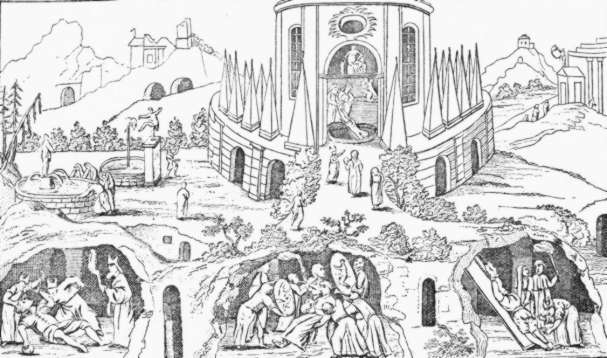
Consulting the oracle.
As to the charming Formosanta, she pursued the road to Bassora, planted with lofty palm trees, which furnished a perpetual shade, and fruit at all seasons. The temple in which she was to perform her devotions, was in Bassora itself. The saint to whom this temple had been dedicated, was somewhat in the style of him who was afterward adored at Lampsacus, and was generally successful in procuring husbands for young ladies. Indeed, he was the holiest saint in all Asia.
Formosanta had no sort of inclination for the saint of Bassora. She only invoked her dear Gangaridian shepherd, her charming Amazan. She proposed embarking at Bassora, and landing in Arabia Felix, to perform what her deceased bird had commanded.
At the third stage, scarce had she entered into a fine inn, where her harbingers had made all the necessary preparations for her, when she learned that the king of Egypt had arrived there also. Informed by his emissaries of the princess's route, he immediately altered his course, followed by a numerous escort. Having alighted, he placed sentinels at all the doors; then repaired to the beautiful Formosanta's apartment, when he addressed her by saying:
"Miss, you are the lady I was in quest of. You paid me very little attention when I was at Babylon. It is just to punish scornful capricious women. You will, if you please, be kind enough to sup with me to-night; and I shall behave to you according as I am satisfied with you."
Formosanta saw very well that she was not the strongest. She judged that good sense consisted in knowing how to conform to one's situation. She resolved to get rid of the king of Egypt by an innocent stratagem. She looked at him through the corners of her eyes, (which in after ages has been called ogling,) and then she spoke to him, with a modesty, grace, and sweetness, a confusion, and a thousand other charms, which would have made the wisest man a fool, and deceived the most discerning:
"I acknowledge, sir, I always appeared with a downcast look, when you did the king, my father, the honor of visiting him. I had some apprehensions for my heart. I dreaded my too great simplicity. I trembled lest my father and your rivals should observe the preference I gave you, and which you so highly deserved. I can now declare my sentiments. I swear by the bull Apis, which after you is the thing I respect the most in the world, that your proposals have enchanted me. I have already supped with you at my father's, and I will sup with you again, without his being of the party. All that I request of you is, that your high almoner should drink with us. He appeared to me at Babylon to be an excellent guest. I have some Chiras wine remarkably good. I will make you both taste it. I consider you as the greatest of kings, and the most amiable of men."
This discourse turned the king of Egypt's head. He agreed to have the almoner's company.
"I have another favor to ask of you," said the princess, "which is to allow me to speak to my apothecary. Women have always some little ails that require attention, such as vapors in the head, palpitations of the heart, colics, and the like, which often require some assistance. In a word, I at present stand in need of my apothecary, and I hope you will not refuse me this slight testimony of confidence."
"Miss," replied the king of Egypt, "I know life too well to refuse you so just a demand. I will order the apothecary to attend you whilst supper is preparing. I imagine you must be somewhat fatigued by the journey; you will also have occasion for a chambermaid; you may order her you like best to attend you. I will afterward wait your commands and convenience."
He then retired, and the apothecary and the chambermaid, named Irla, entered. The princess had an entire confidence in her. She ordered her to bring six bottles of Chiras wine for supper, and to make all the sentinels, who had her officers under arrest, drink the same. Then she recommended her apothecary to infuse in all the bottles certain pharmaceutic drugs, which make those who take them sleep twenty-four hours, and with which he was always provided. She was implicitly obeyed. The king returned with his high almoner in about half an hour's time. The conversation at supper was very gay. The king and the priest emptied the six bottles, and acknowledged there was not such good wine in Egypt. The chambermaid was attentive to make the servants in waiting drink. As for the princess, she took great care not to drink any herself, saying that she was ordered by her physician a particular regimen. They were all presently asleep.
The king of Egypt's almoner had one of the finest beards that a man of his rank could wear. Formosanta lopped it off very skillfully; then sewing it to a ribbon, she put it on her own chin. She then dressed herself in the priest's robes, and decked herself in all the marks of his dignity, and her waiting maid clad herself like the sacristan of the goddess Isis. At length, having furnished herself with his urn and jewels, she set out from the inn amidst the sentinels, who were asleep like their master. Her attendant had taken care to have two horses ready at the door. The princess could not take with her any of the officers of her train. They would have been stopped by the great guard.
Formosanta and Irla passed through several ranks of soldiers, who, taking the princess for the high priest, called her, "My most Reverend Father in God," and asked his blessing. The two fugitives arrived in twenty-four hours at Bassora, before the king awoke. They then threw off their disguise, which might have created some suspicion. They fitted out with all possible expedition a ship, which carried them, by the Straits of Ormus, to the beautiful banks of Eden in Arabia Felix. This was that Eden, whose gardens were so famous, that they have since been the residence of the best of mankind. They were the model of the Elysian fields, the gardens of the Hesperides, and also those of the Fortunate Islands. In those warm climates men imagined there could be no greater felicity than shades and murmuring brooks. To live eternally in heaven with the Supreme Being, or to walk in the garden of paradise, was the same thing to those who incessantly spoke without understanding one another, and who could scarce have any distinct ideas or just expressions.
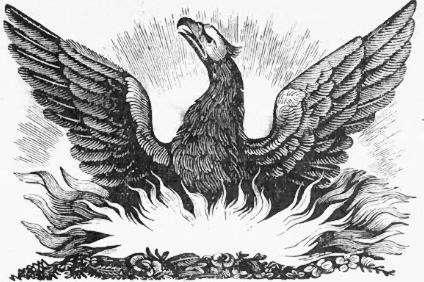
As soon as the princess found herself in this land, her first care was to pay her dear bird the funeral obsequies he had required of her. Her beautiful hands prepared a small quantity of cloves and cinnamon. What was her surprise, when, having spread the ashes of the bird upon this funeral pyre, she saw it blaze of itself! All was presently consumed. In the place of the ashes there appeared nothing but a large egg, from whence she saw her bird issue more brilliant than ever. This was one of the most happy moments the princess had ever experienced in her whole life. There was but another that could ever be dearer to her; it was the object of her wishes, but almost beyond her hopes.
"I plainly see," said she, to the bird, "you are the phœnix which I have heard so much spoken of. I am almost ready to expire with joy and astonishment. I did not believe in your resurrection; but it is my good fortune to be convinced of it."
"Resurrection, in fact," said the phœnix to her, "is one of the most simple things in the world. There is nothing more in being born twice than once. Every thing in this world is the effect of resurrection. Caterpillars are regenerated into butterflies; a kernel put into the earth is regenerated into a tree. All animals buried in the earth regenerate into vegetation, herbs, and plants, and nourish other animals, of which they speedily compose part of the substance. All particles which compose bodies are transformed into different beings. It is true, that I am the only one to whom Oromasdes[1] has granted the favor of regenerating in my own form."
Formosanta, who from the moment she first saw Amazan and the phœnix, had passed all her time in a round of astonishment, said to him:
"I can easily conceive that the Supreme Being may form out of your ashes a phœnix nearly resembling yourself; but that you should be precisely the same person, that you should have the same soul, is a thing, I acknowledge, I cannot very clearly comprehend. What became of your soul when I carried you in my pocket after your death?"
"Reflect one moment! Is it not as easy for the great Oromasdes to continue action upon a single atom of my being, as to begin afresh this action? He had before granted me sensation, memory, and thought. He grants them to me again. Whether he united this favor to an atom of elementary fire, latent within me, or to the assemblage of my organs, is, in reality, of no consequence. Men, as well as phœnixes, are entirely ignorant how things come to pass, but the greatest favor the Supreme Being has bestowed upon me, is to regenerate me for you. Oh! that I may pass the twenty-eight thousand years which I have still to live before my next resurrection, with you and my dear Amazan."
"My dear phœnix, remember what you first told me at Babylon, which I shall never forget, and which flattered me with the hope of again seeing my dear shepherd, whom I idolize; 'we must absolutely pay the Gangarids a visit together,' and I must carry Amazan back with me to Babylon."
"This is precisely my design," said the phœnix. "There is not a moment to lose. We must go in search of Amazan by the shortest road, that is, through the air. There are in Arabia Felix two griffins,[2] who are my particular friends, and who live only a hundred and fifty thousand leagues from here. I am going to write to them by the pigeon post, and they will be here before night. We shall have time to make you a convenient palankeen, with drawers, in which you may place your provisions. You will be quite at your ease in this vehicle, with your maid. These two griffins are the most vigorous of their kind. Each of them will support one of the poles of the canopy between their claws. But, once for all, time is very precious."
He instantly went with Formosanta to order the carriage at an upholsterer's of his acquaintance. It was made complete in four hours. In the drawers were placed small fine loaves, biscuits superior to those of Babylon, large lemons, pine-apples, cocoa, and pistachio nuts, Eden wine, which is as superior to that of Chiras, as Chiras is to that of Surinam.
The two griffins arrived at Eden at the appointed time. The vehicle was as light as it was commodious and solid, and Formosanta and Irla placed themselves in it. The two griffins carried it off like a feather. The phœnix sometimes flew after it, and sometimes perched upon its roof. The two griffins winged their way toward the Ganges with the velocity of an arrow which rends the air. They never stopped but a moment at night for the travelers to take some refreshment, and the carriers to take a draught of water.
They at length reached the country of the Gangarids. The princess's heart palpitated with hope, love, and joy. The phœnix stopped the vehicle before Amazan's house; but Amazan had been absent from home three hours, without any one knowing whither he had gone.
There are no words, even in the Gangaridian language, that could express Formosanta's extreme despair.
"Alas! this is what I dreaded," said the phœnix: "the three hours which you passed at the inn, upon the road to Bassora, with that wretched king of Egypt, have perhaps been at the price of the happiness of your whole life. I very much fear we have lost Amazan, without the possibility of recovering him."
He then asked the servants if he could salute the mother of Amazan? They answered, that her husband had died only two days before, and she could speak to no one. The phœnix, who was not without influence in the house, introduced the princess of Babylon into a saloon, the walls of which were covered with orange-tree wood inlaid with ivory. The inferior shepherds and shepherdesses, who were dressed in long white garments, with gold colored trimmings, served up, in a hundred plain porcelain baskets, a hundred various delicacies, amongst which no disguised carcasses were to be seen. They consisted of rice, sago, vermicelli, macaroni, omelets, milk, eggs, cream, cheese, pastry of every kind, vegetables, fruits, peculiarly fragrant and grateful to the taste, of which no idea can be formed in other climates; and they were accompanied with a profusion of refreshing liquors superior to the finest wine.
Whilst the princess regaled herself, seated upon a bed of roses, four peacocks, who were luckily mute, fanned her with their brilliant wings; two hundred birds, one hundred shepherds and shepherdesses, warbled a concert in two different choirs; the nightingales, thistlefinches, linnets, chaffinches, sung the higher notes with the shepherdesses, and the shepherds sung the tenor and bass. The princess acknowledged, that if there was more magnificence at Babylon, nature was infinitely more agreeable among the Gangarids; but whilst this consolatory and voluptuous music was playing, tears flowed from her eyes, whilst she said to the damsel Irla:
"These shepherds and shepherdesses, these nightingales, these linnets, are making love; and for my part, I am deprived of the company of the Gangaridian hero, the worthy object of my most tender thoughts."
Whilst she was taking this collation, her tears and admiration kept pace with each other, and the phœnix addressed himself to Amazan's mother, saying:
"Madam, you cannot avoid seeing the princess of Babylon; you know—"
"I know every thing," said she, "even her adventure at the inn, upon the road to Bassora. A blackbird related the whole to me this morning; and this cruel blackbird is the cause of my son's going mad, and leaving his paternal abode."
"You have not been informed, then, that the princess regenerated me?"
"No, my dear child, the blackbird told me you were dead, and this made me inconsolable. I was so afflicted at this loss, the death of my husband, and the precipitate flight of my son, that I ordered my door to be shut to every one. But since the princess of Babylon has done me the honor of paying me a visit, I beg she may be immediately introduced. I have matters of great importance to acquaint her with, and I choose you should be present."
She then went to meet the princess in another saloon. She could not walk very well. This lady was about three hundred years old; but she had still some agreeable vestiges of beauty. It might be conjectured, that about her two hundred and fortieth, or two hundred and fiftieth year, she must have been a most charming woman. She received Formosanta with a respectful nobleness, blended with an air of interest and sorrow, which made a very lively impression upon the princess.
Formosanta immediately paid her the compliments of condolence upon her husband's death.
"Alas!" said the widow, "you have more reason to lament his death than you imagine."
"I am, doubtless, greatly afflicted," said Formosanta; "he was father to—." Here a flood of tears prevented her from going on. "For his sake only I undertook this journey, in which I have so narrowly escaped many dangers. For him I left my father, and the most splendid court in the universe. I was detained by a King of Egypt, whom I detest. Having escaped from this tyrant, I have traversed the air in search of the only man I love. When I arrive, he flies from me!" Here sighs and tears stopped her impassioned harangue.
His mother then said to her:
"When the king of Egypt made you his prisoner,—when you supped with him at an inn upon the road to Bassora,—when your beautiful hands filled him bumpers of Chiras wine, did you observe a blackbird that flew about the room?"
"Yes, really," said the princess, "I now recollect there was such a bird, though at that time I did not pay it the least attention. But in collecting my ideas, I now remember well, that at the instant when the king of Egypt rose from the table to give me a kiss, the blackbird flew out at the window giving a loud cry, and never appeared after."
"Alas! madam," resumed Amazan's mother, "this is precisely the cause of all our misfortunes; my son had dispatched this blackbird to gain intelligence of your health, and all that passed at Babylon. He proposed speedily to return, throw himself at your feet, and consecrate to you the remainder of his life. You know not to what a pitch he adores you. All the Gangarids are both loving and faithful; but my son is the most passionate and constant of them all. The blackbird found you at an inn, drinking very cheerfully with the king of Egypt and a vile priest; he afterward saw you give this monarch who had killed the phœnix,—the man my son holds in utter detestation,—a fond embrace. The blackbird, at the sight of this, was seized with a just indignation. He flew away imprecating your fatal error. He returned this day, and has related every thing. But, just heaven, at what a juncture! At the very time that my son was deploring with me the loss of his father and that of the wise phœnix, the very instant I had informed him that he was your cousin german—"
"Oh heavens! my cousin, madam, is it possible? How can this be? And am I so happy as to be thus allied to him, and yet so miserable as to have offended him?"
"My son is, I tell you," said the Gangaridian lady, "your cousin, and I shall presently convince you of it; but in becoming my relation, you rob me of my son. He cannot survive the grief that the embrace you gave to the king of Egypt has occasioned him."
"Ah! my dear aunt," cried the beautiful Formosanta, "I swear by him and the all-powerful Oromasdes, that this embrace, so far from being criminal, was the strongest proof of love your son could receive from me. I disobeyed my father for his sake. For him I went from the Euphrates to the Ganges. Having fallen into the hands of the worthless Pharaoh of Egypt, I could not escape his clutches but by artifice. I call the ashes and soul of the phœnix, which were then in my pocket, to witness. He can do me justice. But how can your son, born upon the banks of the Ganges, be my cousin? I, whose family have reigned upon the banks of the Euphrates for so many centuries?"
"You know," said the venerable Gangaridian lady to her, "that your grand uncle, Aldea, was king of Babylon, and that he was dethroned by Belus's father?"
"Yes, madam."
"You know that this Aldea had in marriage a daughter named Aldea, brought up in your court? It was this prince, who, being persecuted by your father, took refuge under another name in our happy country. He married me, and is the father of the young prince Aldea Amazan, the most beautiful, the most courageous, the strongest, and most virtuous of mortals; and at this hour the most unhappy. He went to the Babylonian festival upon the credit of your beauty; since that time he idolizes you, and now grieves because he believes that you have proved unfaithful to him. Perhaps I shall never again set eyes upon my dear son."
She then displayed to the princess all the titles of the house of Aldea. Formosanta scarce deigned to look at them.
"Ah! madam, do we examine what is the object of our desire? My heart sufficiently believes you. But where is Aldea Amazan? Where is my kinsman, my lover, my king? Where is my life? What road has he taken? I will seek for him in every sphere the Eternal Being hath framed, and of which he is the greatest ornament. I will go into the star Canope, into Sheath, into Aldebaran; I will go and tell him of my love and convince him of my innocence."
The phœnix justified the princess with regard to the crime that was imputed to her by the blackbird, of fondly embracing the king of Egypt; but it was necessary to undeceive Amazan and recall him. Birds were dispatched on every side. Unicorns sent forward in every direction. News at length arrived that Amazan had taken the road toward China.
"Well, then," said the princess, "let us set out for China. I will seek him in defiance of both difficulty and danger. The journey is not long, and I hope I shall bring you back your son in a fortnight at farthest."
At these words tears of affection streamed from his mother's eyes and also from those of the princess. They most tenderly embraced, in the great sensibility of their hearts.
The phœnix immediately ordered a coach with six unicorns. Amazan's mother furnished two thousand horsemen, and made the princess, her niece, a present of some thousands of the finest diamonds of her country. The phœnix, afflicted at the evil occasioned by the blackbird's indiscretion, ordered all the blackbirds to quit the country; and from that time none have been met with upon the banks of the Ganges.
V.
FORMOSANTA VISITS CHINA AND SCYTHIA IN SEARCH OF AMAZAN.
The unicorns, in less than eight days, carried Formosanta, Irla, and the phœnix, to Cambalu, the capital of China. This city was larger than that of Babylon, and in appearance quite different. These fresh objects, these strange manners, would have amused Formosanta could any thing but Amazan have engaged her attention.
As soon as the emperor of China learned that the princess of Babylon was at the city gates, he dispatched four thousand Mandarins in ceremonial robes to receive her. They all prostrated themselves before her, and presented her with an address written in golden letters upon a sheet of purple silk. Formosanta told them, that if she were possessed of four thousand tongues, she would not omit replying immediately to every Mandarin; but that having only one, she hoped they would be satisfied with her general thanks. They conducted her, in a respectful manner, to the emperor.
He was the wisest, most just and benevolent monarch upon earth. It was he who first tilled a small field with his own imperial hands, to make agriculture respectable to his people. Laws in all other countries were shamefully confined to the punishment of crimes: he first allotted premiums to virtue. This emperor had just banished from his dominions a gang of foreign Bonzes, who had come from the extremities of the West, with the frantic hope of compelling all China to think like themselves; and who, under pretence of teaching truths, had already acquired honors and riches. In expelling them, he delivered himself in these words, which are recorded in the annals of the empire:
"You may here do us much harm as you have elsewhere. You have come to preach dogmas of intolerance, to the most tolerant nation upon earth. I send you back, that I may never be compelled to punish you. You will be honorably conducted to my frontiers. You will be furnished with every thing necessary to return to the confines of the hemisphere from whence you came. Depart in peace, if you can be at peace, and never return."
The princess of Babylon heard with pleasure of this speech and determination. She was the more certain of being well received at court, as she was very far from entertaining any dogmas of intolerance. The emperor of China, in dining with her tête-à-tête, had the politeness to banish all disagreeable etiquette. She presented the phœnix to him, who was gently caressed by the emperor, and who perched upon his chair. Formosanta, toward the end of the repast, ingenuously acquainted him with the cause of her journey, and entreated him to search for the beautiful Amazan in the city of Cambalu; and in the meanwhile she acquainted the emperor with her adventures, without concealing the fatal passion with which her heart burned for this youthful hero.
"He did me the honor of coming to my court," said the emperor of China. "I was enchanted with this amiable Amazan. It is true that he is deeply afflicted; but his graces are thereby the more affecting. Not one of my favorites has more wit. There is not a gown Mandarin who has more knowledge,—not a military one who has a more martial or heroic air. His extreme youth adds an additional value to all his talents. If I were so unfortunate, so abandoned by the Tien and Changti, as to desire to be a conqueror, I would wish Amazan to put himself at the head of my armies, and I should be sure of conquering the whole universe. It is a great pity that his melancholy sometimes disconcerts him."
"Ah! sir," said Formosanta, with much agitation and grief, blended with an air of reproach, "why did you not request me to dine with him? This is a cruel stroke you have given me. Send for him immediately, I entreat you."
"He set out this very morning," replied the emperor, "without acquainting me with his destination."
Formosanta, turning toward the phœnix, said to him:
"Did you ever know so unfortunate a damsel as myself?" Then resuming the conversation, she said:
"Sir, how came he to quit in so abrupt a manner, so polite a court, in which, methinks, one might pass one's life?"
"The case was as follows," said he. "One of the most amiable of the princesses of the blood, falling desperately in love with him, desired to meet him at noon. He set out at day-break, leaving this billet for my kinswoman, whom it hath cost a deluge of tears:
"Beautiful princess of the mongolian race. You are deserving of a heart that was never offered up at any other altar. I have sworn to the immortal gods never to love any other than Formosanta, princess of Babylon, and to teach her how to conquer one's desires in traveling. She has had the misfortune to yield to a worthless king of Egypt. I am the most unfortunate of men; having lost my father, the phœnix, and the hope of being loved by Formosanta. I left my mother in affliction, forsook my home and country, being unable to live a moment in the place where I learned that Formosanta loved another than me. I swore to traverse the earth, and be faithful. You would despise me, and the gods punish me, if I violated my oath. Choose another lover, madam, and be as faithful as I am."
"Ah! give me that miraculous letter," said the beautiful Formosanta; "it will afford me some consolation. I am happy in the midst of my misfortunes. Amazan loves me! Amazan, for me, renounces the society of the princesses of China. There is no one upon earth but himself endowed with so much fortitude. He sets me a most brilliant example. The phœnix knows I did not stand in need of it. How cruel it is to be deprived of one's lover for the most innocent embrace given through pure fidelity. But, tell me, whither has he gone? What road has he taken? Deign to inform me, and I will immediately set out."
The emperor of China told her, that, according to the reports he had received, her lover had taken the road toward Scythia. The unicorns were immediately harnessed, and the princess, after the most tender compliments, took leave of the emperor, and resumed her journey with the phœnix, her chambermaid Irla, and all her train.
As soon as she arrived in Scythia, she was more convinced than ever how much men and governments differed, and would continue to differ, until noble and enlightened minds should by degrees remove that cloud of darkness which has covered the earth for so many ages; and until there should be found in barbarous climes, heroic souls, who would have strength and perseverance enough to transform brutes into men. There are no cities in Scythia, consequently no agreeable arts. Nothing was to be seen but extensive fields, and whole tribes whose sole habitations were tents and chars. Such an appearance struck her with terror. Formosanta enquired in what tent or char the king was lodged? She was informed that he had set out eight days before with three hundred thousand cavalry to attack the king of Babylon, whose niece, the beautiful princess Aldea, he had carried off.
"What! did he run away with my cousin?" cried Formosanta. "I could not have imagined such an incident. What! has my cousin, who was too happy in paying her court to me, become a queen, and I am not yet married?" She was immediately conducted, by her desire, to the queen's tent.
Their unexpected meeting in such distant climes—the uncommon occurrences they mutually had to impart to each other, gave such charms to this interview, as made them forget they never loved one another. They saw each other with transport; and a soft illusion supplied the place of real tenderness. They embraced with tears, and there was a cordiality and frankness on each side that could not have taken place in a palace.
Aldea remembered the phœnix and the waiting maid Irla. She presented her cousin with zibelin skins, who in return gave her diamonds. The war between the two kings was spoken of. They deplored the fate of soldiers who were forced into battle, the victims of the caprice of princes, when two honest men might, perhaps, settle the dispute in less than an hour, without a single throat being cut. But the principal topic was the handsome stranger, who had conquered lions, given the largest diamonds in the universe, written madrigals, and had now become the most miserable of men from believing the statements of a blackbird.
"He is my dear brother," said Aldea. "He is my lover," cried Formosanta. "You have, doubtless, seen him. Is he still here? for, cousin, as he knows he is your brother, he cannot have left you so abruptly as he did the king of China.
"Have I seen him? good heavens! yes. He passed four whole days with me. Ah! cousin, how much my brother is to blame. A false report has absolutely turned his brain. He roams about the world, without knowing whither he is destined. Imagine to yourself his distraction of mind, which is so great, that he has refused to meet the handsomest lady in all Scythia. He set out yesterday, after writing her a letter which has thrown her into despair. As for him, he has gone to visit the Cimmerians."
"God be thanked!" cried Formosanta, "another refusal in my favor. My good fortune is beyond my hopes, as my misfortunes surpass my greatest apprehensions. Procure me this charming letter, that I may set out and follow him, loaded with his sacrifices. Farewell, cousin. Amazan is among the Cimmerians, and I fly to meet him."
Aldea judged that the princess, her cousin, was still more frantic than her brother Amazan. Hut as she had herself been sensible of the effects of this epidemic contagion, having given up the delights and magnificence of Babylon for a king of Scythia; and as the women always excuse those follies that are the effects of love, she felt for Formosanta's affliction, wished her a happy journey, and promised to be her advocate with her brother, if ever she was so fortunate as to see him again.
VI.
THE PRINCESS CONTINUES HER JOURNEY.
From Scythia the princess of Babylon, with her phœnix, soon arrived at the empire of the Cimmerians, now called Russia; a country indeed much less populous than Scythia, but of far greater extent.
After a few days' journey, she entered a very large city, which has of late been greatly improved by the reigning sovereign. The empress, however, was not there at that time, but was making a journey through her dominions, on the frontiers of Europe and Asia, in order to judge of their state and condition with her own eyes,—to enquire into their grievances, and to provide the proper remedies for them.
The principal magistrate of that ancient capital, as soon as he was informed of the arrival of the Babylonian lady and the phœnix, lost no time in paying her all the honors of his country; being certain that his mistress, the most polite and generous empress in the world, would be extremely well pleased to find that he had received so illustrious a lady with all that respect which she herself, if on the spot, would have shown her.
The princess was lodged in the palace, and entertained with great splendor and elegance. The Cimmerian lord, who was an excellent natural philosopher, diverted himself in conversing with the phœnix, at such times as the princess chose to retire to her own apartment. The phœnix told him, that he had formerly traveled among the Cimmerians, but that he should not have known the country again.
"How comes it," said he, "that such prodigious changes have been brought about in so short a time? Formerly, when I was here, about three hundred years ago, I saw nothing but savage nature in all her horrors. At present, I perceive industry, arts, splendor, and politeness."
"This mighty revolution," replied the Cimmerian, "was begun by one man, and is now carried to perfection by one woman;—a woman who is a greater legislator than the Isis of the Egyptians, or the Ceres of the Greeks. Most law-givers have been, unhappily, of a narrow genius and an arbitrary disposition, which conned their views to the countries they governed. Each of them looked upon his own race as the only people existing upon the earth, or as if they ought to be at enmity with all the rest. They formed institutions, introduced customs, and established religions exclusively for themselves. Thus the Egyptians, so famous for those heaps of stones called pyramids, have dishonored themselves with their barbarous superstitions. They despise all other nations as profane; refuse all manner of intercourse with them; and, excepting those conversant in the court, who now and then rise above the prejudices of the vulgar, there is not an Egyptian who will eat off a plate that has ever been used by a stranger. Their priests are equally cruel and absurd. It were better to have no laws at all, and to follow those notions of right and wrong engraven on our hearts by nature, than to subject society to institutions so inhospitable.
"Our empress has adopted quite a different system. She considers her vast dominions, under which all the meridians on the globe are united, as under an obligation of correspondence with all the nations dwelling under those meridians. The first and most fundamental of her laws, is an universal toleration of all religions, and an unbounded compassion for every error. Her penetrating genius perceives, that though the modes of religious worship differ, yet morality is every where the same. By this principle, she has united her people to all the nations on earth, and the Cimmerians will soon consider the Scandinavians and the Chinese as their brethren. Not satisfied with this, she has resolved to establish this invaluable toleration, the strongest link of society, among her neighbors. By these means, she obtained the title of the parent of her country; and, if she persevere, will acquire that of the benefactress of mankind.
"Before her time, the men, who were unhappily possessed of power, sent out legions of murderers to ravage unknown countries, and to water with the blood of the children the inheritance of their fathers. Those assassins were called heroes, and their robberies accounted glorious achievements. But our sovereign courts another sort of glory. She has sent forth her armies to be the messengers of peace; not only to prevent men from being the destroyers, but to oblige them to be the benefactors of one another. Her standards are the ensigns of public tranquillity."
The phœnix was quite charmed with what he heard from this nobleman. He told him, that though he had lived twenty-seven thousand nine hundred years and seven months in this world, he had never seen any thing like it. He then enquired after his friend Amazan. The Cimmerian gave the same account of him that the princess had already heard from the Chinese and the Scythians. It was Amazan's constant practice to run away from all the courts he visited, the instant any lady noticed him in particular and seemed anxious to make his acquaintance. The phœnix soon acquainted Formosanta with this fresh instance of Amazan's fidelity—a fidelity so much the more surprising, since he could not imagine his princess would ever hear of it.
Amazan had set out for Scandinavia, where he was entertained with sights still more surprising. In this place, he beheld monarchy and liberty subsisting together in a manner thought incompatible in other states; the laborers of the ground shared in the legislature with the grandees of the realm. In another place he saw what was still more extraordinary; a prince equally remarkable for his extreme youth and uprightness, who possessed a sovereign authority over his country, acquired by a solemn contract with his people.
Amazan beheld a philosopher on the throne of Sarmatia, who might be called a king of anarchy; for he was the chief of a hundred thousand petty kings, one of whom with his single voice could render ineffectual the resolution of all the rest. Eolus had not more difficulty to keep the warring winds within their proper bounds, than this monarch to reconcile the tumultuous discordant spirits of his subjects. He was the master of a ship surrounded with eternal storms. But the vessel did not founder, for he was an excellent pilot.
In traversing those various countries, so different from his own, Amazan persevered in rejecting all the advances made to him by the ladies, though incessantly distracted with the embrace given by Formosanta to the king of Egypt, being resolved to set Formosanta an amazing example of an unshaken and unparalleled fidelity.
The princess of Babylon was constantly close at his heels, and scarcely ever missed of him but by a day or two; without the one being tired of roaming, or the other losing a moment in pursuing him.
Thus he traversed the immense continent of Germany, where he beheld with wonder the progress which reason and philosophy had made in the north. Even their princes were enlightened, and had become the patrons of freedom of thought. Their education had not been trusted to men who had an interest in deceiving them, or who were themselves deceived. They were brought up in the knowledge of universal morality, and in the contempt of superstition.
They had banished from all their estates a senseless custom which had enervated and depopulated the southern countries. This was to bury alive in immense dungeons, infinite numbers of both sexes who were eternally separated from one another, and sworn to have no communication together. This madness had contributed more than the most cruel wars to lay waste and depopulate the earth.
In opposing these barbarous institutions, so inimical to the laws of nature and the best interests of society, the princes of the north had become the benefactors of their race. They had likewise exploded other errors equally absurd and pernicious. In short, men had at last ventured to make use of their reason in those immense regions; whereas it was still believed almost every where else, that they could not be governed but in proportion to their ignorance.
VII.
AMAZAN VISITS ALBION.
From Germany, Amazan arrived at Batavia; where his perpetual chagrin was in a good measure alleviated, by perceiving among the inhabitants a faint resemblance to his happy countrymen, the Gangarids. There he saw liberty, security, and equality,—with toleration in religion; but the ladies were so indifferent, that none made him any advances; an experience he had not met with before. It is true, however, that had he been inclined to address them, they would not have been offended; though, at the same time, not one would have been the least in love; but he was far from any thoughts of making conquests.
Formosanta had nearly caught him in this insipid nation. He had set out but a moment before her arrival.
Amazan had heard so much among the Batavians in praise of a certain island called Albion, that he was led by curiosity to embark with his unicorns on board a ship, which, with a favorable easterly wind, carried him in a few hours to that celebrated country, more famous than Tyre, or Atlantis.
The beautiful Formosanta, who had followed him, as it were on the scent, to the banks of the Volga, the Vistula, the Elbe, and the Weser, and had never been above a day or two behind him, arrived soon after at the mouth of the Rhine, where it disembogues its waters into the German Ocean.
Here she learned that her beloved Amazan had just set sail for Albion. She thought she saw the vessel on board of which he was, and could not help crying out for joy; at which the Batavian ladies were greatly surprised, not imagining that a young man could possibly occasion so violent a transport. They took, indeed, but little notice of the phœnix, as they reckoned his feathers would not fetch near so good a price as those of their own ducks, and other water fowl. The princess of Babylon hired two vessels to carry herself and her retinue to that happy island, which was soon to possess the only object of her desires, the soul of her life, and the god of her idolatry.
An unpropitious wind from the west suddenly arose, just as the faithful and unhappy Amazan landed on Albion's sea-girt shore, and detained the ships of the Babylonian princess just as they were on the point of sailing. Seized with a deep melancholy, she went to her room, determined to remain there till the wind should change; but it blew for the space of eight days, with an unremitting violence. The princess, during this tedious period, employed her maid of honor, Irla, in reading romances; which were not indeed written by the Batavians; but as they are the factors of the universe, they traffic in the wit as well as commodities of other nations. The princess purchased of Mark Michael Rey, the bookseller, all the novels which had been written by the Ausonians and the Welch, the sale of which had been wisely prohibited among those nations to enrich their neighbors, the Batavians. She expected to find in those histories some adventure similar to her own, which might alleviate her grief. The maid of honor read, the phœnix made comments, and the princess, finding nothing in the Fortunate Country Maid, in Tansai, or in the Sopha, that had the least resemblance to her own affairs, interrupted the reader every moment, by asking how the wind stood.
VIII.
AMAZAN LEAVES ALBION TO VISIT THE LAND OF SATURN.
In the mean time Amazan was on the road to the capital of Albion, in his coach and six unicorns, all his thoughts employed on his dear princess. At a small distance he perceived a carriage overturned in a ditch. The servants had gone in different directions in quest of assistance, but the owner kept his seat, smoking his pipe with great tranquillity, without manifesting the smallest impatience. His name was my lord What-then, in the language from which I translate these memoirs.
Amazan made all the haste possible to help him, and without assistance set the carriage to rights, so much was his strength superior to that of other men. My lord What-then took no other notice of him, than saying, "a stout fellow, by Jove!" In the meantime the neighboring people, having arrived, flew into a great passion at being called out to no purpose, and fell upon the stranger. They abused him, called him an outlandish dog, and challenged him to strip and box.
Amazan seized a brace of them in each hand, and threw them twenty paces from him; the rest seeing this, pulled off their hats, and bowing with great respect, asked his honor for something to drink. His honor gave them more money than they had ever seen in their lives before. My lord What-then now expressed great esteem for him, and asked him to dinner at his country house, about three miles off. His invitation being accepted, he went into Amazan's coach, his own being out of order from the accident.
After a quarter of an hour's silence, my lord What-then, looking upon Amazan for a moment, said. "How d'ye do?" which, by the way, is a phrase without any meaning, adding, "You have got six fine unicorns there." After which he continued smoking as usual.
The traveler told him his unicorns were at his service, and that he had brought them from the country of the Gangarids. From thence he took occasion to inform him of his affair with the princess of Babylon, and the unlucky kiss she had given the king of Egypt; to which the other made no reply, being very indifferent whether there were any such people in the world, as a king of Egypt, or a princess of Babylon.