THE HURON; OR, PUPIL OF NATURE.[1]
Reading edition
THE HURON; OR, PUPIL OF NATURE.[1]
I.
THE HURON ARRIVES IN FRANCE.
One day, Saint Dunstan, an Irishman by nation, and a saint by trade, left Ireland on a small mountain, which took its route toward the coast of France, and set his saintship down in the bay of St. Malo. When he had dismounted, he gave his blessing to the mountain, which, after some profound bows, took its leave, and returned to its former place.
Here St. Dunstan laid the foundation of a small priory, and gave it the name of the Priory Mountain, which it still keeps, as every body knows.
In the year 1689, the fifteenth day of July, in the evening, the abbot Kerkabon, prior of our Lady of the Mountain, happened to take the air along the shore with Miss Kerkabon, his sister. The prior, who was becoming aged, was a very good clergyman, beloved by his neighbors. What added most to the respect that was paid him, was, that among all his clerical neighbors, he was the only one that could walk to his bed after supper. He was tolerably read in theology; and when he was tired of reading St. Augustin, he refreshed himself with Rabelais. All the world spoke well of him.
Miss Kerkabon, who had never been married, notwithstanding her hearty wishes so to be, had preserved a freshness of complexion in her forty-fifth year. Her character was that of a good and sensible woman. She was fond of pleasure, and was a devotee.
As they were walking, the prior, looking on the sea, said to his sister:
"It was here, alas! that our poor brother embarked with our dear sister-in-law, Madam Kerkabon, his wife, on board the frigate 'Swallow,' in 1669, to serve the king in Canada. Had he not been killed, probably he would have written to us."
"Do you believe," says Miss Kerkabon, "that our sister-in-law has been eaten by the Cherokees, as we have been told?"
"Certain it is, had she not been killed, she would have come back. I shall weep for her all my lifetime. She was a charming woman; and our brother, who had a great deal of wit, would no doubt have made a fortune."
Thus were they going on with mutual tenderness, when they beheld a small vessel enter the bay of Rence with the tide. It was from England, and came to sell provisions. The crew leaped on shore without looking at the prior or Miss, his sister, who were shocked at the little attention shown them.
That was not the behavior of a well-made youth, who, darting himself over the heads of his companions, stood on a sudden before Miss Kerkabon. Being unaccustomed to bowing, he made her a sign with his head. His figure and his dress attracted the notice of brother and sister. His head was uncovered, and his legs bare. Instead of shoes, he wore a kind of sandals. From his head his long hair flowed in tresses, A small close doublet displayed the beauty of his shape. He had a sweet and martial air.[2] In one hand he held a small bottle of Barbadoes water, and in the other a bag, in which he had a goblet, and some sea biscuit. He spoke French very intelligibly. He offered some of his Barbadoes to Miss Kerkabon and her brother. He drank with them, he made them drink a second time, and all this with an air of such native simplicity, that quite charmed brother and sister. They offered him their service, and asked him who he was, and whither going? The young man answered: That he knew not where he should go; that he had some curiosity; that he had a desire to see the coast of France; that he had seen it, and should return.
The prior, judging by his accent that he was not an Englishman, took the liberty of asking of what country he was.
"I am a Huron," answered the youth.
Miss Kerkabon, amazed and enchanted to see a Huron who had behaved so politely to her, begged the young man's company to supper. He complied immediately, and all three went together to the priory of our Lady of the Mountain. This short and round Miss devoured him with her little eyes, and said from time to time to her brother:
"This tall lad has a complexion of lilies and roses. What a fine skin he has for a Huron!"
"Very true, sister," says the prior.
She put a hundred questions, one after another, and the traveler answered always pertinently.
The report was soon spread that there was a Huron at the priory. All the genteel company of the country came to supper. The abbot of St. Yves came with Miss, his sister, a fine, handsome, well-educated girl. The bailiff, the tax-gatherer, and their wives, came all together. The foreigner was seated between Miss Kerkabon and Miss St. Yves. The company eyed him with admiration. They all questioned him together. This did not confound the Huron. He seemed to have taken Lord Bolingbroke's motto, Nil admirari. But at last, tired out with so much noise, he told them in a sweet, but serious tone:
"Gentlemen, in my country one talks after another. How can I answer you, if you will not allow me to hear you?"
Reasoning always brings people to a momentary reflection. They were all silent.
Mr. Bailiff, who always made a property of a foreigner wherever he found him, and who was the first man for asking questions in the province, opening a mouth of large size, began:
"Sir, what is your name?"
"I have always been called the Ingenu," answered the Huron; "and the English have confirmed that name, because I always speak as I think, and act as I like."
"But, being born a Huron, how could you come to England?"
"I have been carried thither. I was made prisoner by the English after some resistance, and the English, who love brave people, because they are as brave and honest as we, proposed to me, either to return to my family, or go with them to England. I accepted the latter, having naturally a relish for traveling."
"But, sir," says the bailiff, with his usual gravity, "how could you think of abandoning father and mother?"
"Because I never knew either father or mother," says the foreigner.
This moved the company; they all repeated:
"Neither father nor mother!"
"We will be in their stead," says the mistress of the house, to her brother, the prior: "How interesting this Huron gentleman is!"
The Ingenu thanked her with a noble and proud cordiality, and gave her to understand, that he wanted the assistance of nobody.
"I perceive, Mr. Huron," said the huge bailiff, "that you talk better French than can be expected from an Indian."
"A Frenchman," answered he, "whom they had made prisoner when I was a boy, and with whom I contracted a great friendship, taught it me. I rapidly learn what I like to learn. When I came to Plymouth, I met with one of your French refugees, whom you, I know not why, call Huguenots. He improved my knowledge of your language; and as soon as I could express myself intelligibly, I came to see your country, because I like the French well enough, if they do not put too many questions."
Notwithstanding this candid remark, the abbé of St. Yves asked him, which of the three languages pleased him best, the Huron, English, or French?
"The Huron, to be sure," answered the Ingenu.
"Is it possible?" cried Miss Kerkabon. "I always thought the French was the first of all languages, after that of Low Britany."
Then all were eager to know how, in Huron, they asked for snuff? He replied:
"Taya."
"What signifies to eat?"
"Essenten."
Miss Kerkabon was impatient to know how they called, to make love?
He informed her, Trovander; and insisted on it, not without reason, that these words were well worth their synonyms in French and English. Trovander, especially, seemed very pretty to all the company. The prior, who had in his library a Huron grammar, which had been given him by the Rev. Father Sagar Theodat, a Recollet and famous missionary, rose from the table to consult it. He returned quite panting with tenderness and joy. He acknowledged the foreigner for a true Huron. The company speculated a little on the multiplicity of languages; and all agreed, that had it not been for the unfortunate affair of the Tower of Babel, all the world would have spoken French.
The inquisitive bailiff, who till then had some suspicions of the foreigner, conceived the deepest respect for him. He spoke to him with more civility than before, and the Huron took no notice of it.
Miss St. Yves was very curious to know how people made love among the Hurons.
"In performing great actions to please such as resemble you." All the company admired and applauded. Miss St. Yves blushed, and was extremely well pleased. Miss Kerkabon blushed likewise, but was not so well pleased. She was a little piqued that this gallantry was not addressed to her; but she was so good-natured, that her affection for the Huron was not diminished at all. She asked him, with great complacency, how many mistresses he had at home.
"Only one," answered the foreigner; "Miss Abacaba, the good friend of my dear nurse. The reed is not straighter, nor is ermine whiter,—no lamb meeker, no eagle fiercer, nor a stag swifter, than was my Abacaba. One day she pursued a hare not above fifty leagues from my habitation: a base Algonquin, who dwells an hundred leagues further, took her hare from her. I was told of it; I ran thither, and with one stroke of my club leveled him with the ground. I brought him to the feet of my mistress, bound hand and foot. Abacaba's parents were for burning him, but I always had a disrelish for such scenes. I set him at liberty. I made him my friend. Abacaba was so pleased with my conduct, that she preferred me to all her lovers. And she would have continued to love me, had she not been devoured by a bear! I slew the bear, and wore his skin a long while; but that has not comforted me."
Miss St. Yves felt a secret pleasure at hearing that Abacaba had been his only mistress, and that she was no more; yet she understood not the cause of her own pleasure. All eyes were riveted on the Huron, and he was much applauded for delivering an Algonquin from the cruelty of his countrymen.
The merciless bailiff had now grown so furious, that he even asked the Huron what religion he was of; whether he had chosen the English, the French, or that of the Huguenots?
"I am of my own religion," said he, "just as you are of yours."
"Lord!" cried Miss Kerkabon, "I see already that those wretched English have not once thought of baptizing him!"
"Good heavens," said Miss St. Yves, "how is it possible? How is it possible the Hurons should not be Roman Catholics? Have not those reverend fathers, the Jesuits, converted all the world?"
The Huron assured her, that no true American had ever changed his opinion, and that there was not in their language a word to express inconstancy.
These last words extremely pleased Miss St. Yves.
"Oh! we'll baptize him, we'll baptize him," said Miss Kerkabon to the prior. "You shall have that honor, my dear brother, and I will be his god-mother. The Abbot St. Yves shall present him to the font. It will make a fine appearance: it will be talked of all over Britany, and do us the greatest honor."
The company were all of the same mind with the mistress of the house; they all cried:
"We'll baptize him."
The Huron interrupted them by saying, that in England every one was allowed to live as he pleased. He rather showed some aversion to the proposal which was made, and could not help telling them, that the laws of the Hurons were to the full as good as those of Low Britany. He finished with saying, that he should return the next day. The bottles grew empty, and the company went to bed.
After the Huron had been conducted to his room, they saw that he spread the blankets on the floor, and laid himself down upon them in the finest attitude in the world.
II.
THE HURON, CALLED THE INGENU, ACKNOWLEDGED BY HIS RELATIONS.
The Ingenu, according to custom, awoke with the sun, at the crowing of the cock, which is called in England and Huronia, "the trumpet of the day." He did not imitate what is styled good company, who languish in the bed of indolence till the sun has performed half its daily journey, unable to sleep, but not disposed to rise, and lose so many precious hours in that doubtful state between life and death, and who nevertheless complain that life is too short.
He had already traversed two or three leagues, and killed fifteen brace of game with his rifle, when, upon his return, he found the prior of the Lady of the Mountain, with his discreet sister, walking in their nightcaps in their little garden. He presented them with the spoils of his morning labor, and taking from his bosom a kind of little talisman, which he constantly wore about his neck, he entreated them to accept of it as an acknowledgment for the kind reception they had given him.
"It is," said he, "the most valuable thing I am possessed of. I have been assured that I shall always be happy whilst I carry this little toy about me; and I give it you that you may be always happy."
The prior and Miss smiled with pity at the frankness of the Ingenu. This present consisted of two little portraits, poorly executed, and tied together with a greasy string.
Miss Kerkabon asked him, if there were any painters in Huronia?
"No," replied the Ingenu, "I had this curiosity from my nurse. Her husband had obtained it by conquest, in stripping some of the French of Canada, who had made war upon us. This is all I know of the matter."
The prior looked attentively upon these pictures, whilst he changed color; his hands trembled, and he seemed much affected.
"By our Lady of the Mountain," he cried out, "I believe these to be the faces of my brother, the captain, and his lady."
Miss, after having consulted them with the like emotion, thought the same. They were both struck with astonishment and joy blended with grief. They both melted, they both wept, their hearts throbbed, and during their disorder, the pictures were interchanged between them at least twenty times in a second. They seemed to devour the Huron's pictures with their eyes. They asked one after another, and even both at once, at what time, in what place, and how these miniatures fell into the hands of the nurse? They reckoned and computed the time from the captain's departure; they recollected having received notice that he had penetrated as far as the country of the Hurons; and from that time they had never heard anything more of him.
The Huron had told them, that he had never known either father or mother. The prior, who was a man of sense, observed that he had a little beard, and he knew very well that the Hurons never had any. His chin was somewhat hairy; he was therefore the son of an European. My brother and sister-in-law were never seen after the expedition against the Hurons, in 1669. My nephew must then have been nursing at the breast. The Huron nurse has preserved his life, and been a mother to him. At length, after an hundred questions and answers, the prior and his sister concluded that the Huron was their own nephew. They embraced him, whilst tears streamed from their eyes: and the Huron laughed to think that an Indian should be nephew to a prior of Lower Britany.
The Huron identified.—"By our Lady of the Mountain," he cried out, "I believe these to be the faces of my brother, the captain, and his lady."
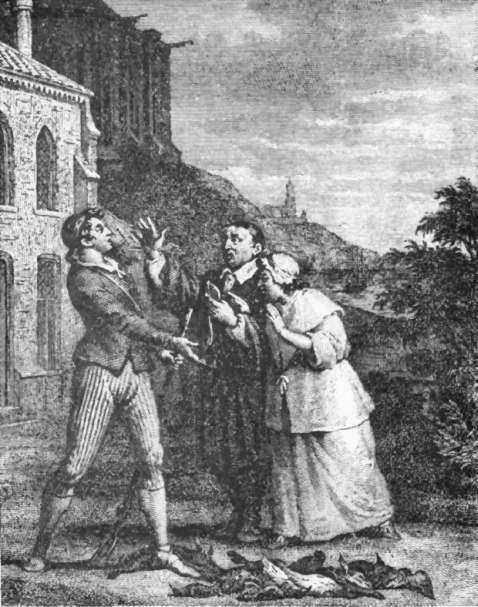
All the company went down stairs. Mr. de St. Yves, who was a great physiognomist, compared the two pictures with the Huron's countenance. They observed, very skillfully, that he had the mother's eyes, the forehead and nose of the late Captain Kerkabon, and the cheeks common to both.
Miss St. Yves, who had never seen either father or mother, was strenuously of opinion, that the young man had a perfect resemblance of them. They all admired Providence, and wondered at the strange events of this world. In a word, they were so persuaded, so convinced of the birth of the Huron, that he himself consented to be the prior's nephew, saying, that he would as soon have him for his uncle as another.
The prior went to return thanks in the church of our Lady of the Mountain; whilst the Huron, with an air of indifference, amused himself with drinking in the house.
The English who had brought him over, and who were ready to set sail, came to tell him that it was time to depart.
"Probably," said he to them, "you have not met with any of your uncles and aunts. I shall stay here. Go you back to Plymouth. I give you all my clothes, as I have no longer occasion for anything in this world, since I am the nephew of a prior."
The English set sail, without being at all concerned whether the Huron had any relations or not in Lower Britany.
After the uncle, the aunt, and the company had sung Te Deum; after the bailiff had once more overwhelmed the Huron with questions, after they had exhausted all their astonishment, joy, and tenderness, the prior of the Mountain and the Abbé of St. Yves concluded that the Huron should be baptized with all possible expedition. But the case was very different with a tall robust Indian of twenty-two, and an infant who is regenerated without his knowing anything of the matter. It was necessary to instruct him, and this appeared difficult; for the Abbé of St. Yves supposed that a man who was not born in France, could not be endowed with common sense.
The prior, indeed, observed to the company, that though, in fact, the ingenious gentleman, his nephew, was not so fortunate as to be born in Lower Britany, he was not, upon that account, any way deficient in sense; which might be concluded from all his answers; and that, doubtless, nature had greatly favored him, as well on his father's as on his mother's side?
He then was asked if he had ever read any books? He said, he had read Rabelais translated into English, and some passages in Shakespeare, which he knew by heart; that these books belonged to the captain, on board of whose ship he came from America to Plymouth; and that he was very well pleased with them. The bailiff failed not to put many questions to him concerning these books.
"I acknowledge," said the Huron, "I thought, in reading them, I understood some things, but not the whole."
The Abbé of St. Yves reflected upon this discourse, that it was in this manner he had always read, and that most men read no other way.
"You have," said he, to the Huron, "doubtless read the bible?"
"Never, Mr. Abbé: it was not among the captain's books. I never heard it mentioned."
"This is the way with those cursed English," said Miss Kerkabon; "they think more of a play of Shakespeare's, a plum pudding, or a bottle of rum, than they do of the Pentateuch. For this reason they have never converted any Indians in America. They are certainly cursed by God; and we shall conquer Jamaica and Virginia from them in a very short time."
Be this as it may, the most skillful tailor in all St. Malo was sent for to dress the Huron from head to foot. The company separated, and the bailiff went elsewhere to display his inquisitiveness. Miss St. Yves, in parting, returned several times to observe the young stranger, and made him lower courtesies than ever she did any one in her life.
The bailiff, before he took his leave, presented to Miss St. Yves a stupid dolt of a son, just come from college; but she scarce looked at him, so much was she taken up with the politeness of the Huron.
III.
THE HURON CONVERTED.
The prior finding that he was somewhat advanced in years, and that God had sent him a nephew for his consolation, took it into his head that he would resign his benefice in his favor, if he succeeded in baptizing him and of making him enter into orders.
The Huron had an excellent memory. A good constitution, inherited from his ancestors of Lower Britany, strengthened by the climate of Canada, had made his head so vigorous that when he was struck upon it he scarce felt it; and when any thing was graven in it, nothing could efface it. Nothing had ever escaped his memory. His conception was the more sure and lively, because his infancy had not been loaded with useless fooleries, which overwhelm ours. Things entered into his head without being clouded. The prior at length resolved to make him read the New Testament. The Huron devoured it with great pleasure; but not knowing at what time, or in what country all the adventures related in this book had happened, he did not in the least doubt that the scene of action had been in Lower Britany; and he swore, that he would cut off Caiphas and Pontius Pilate's ears, if ever he met those scoundrels.
His uncle, charmed with this good disposition, soon brought him to the point. He applauded his zeal, but at the same time acquainted him that it was needless, as these people had been dead upwards of 1690 years. The Huron soon got the whole book by heart. He sometimes proposed difficulties that greatly embarrassed the prior. He was often obliged to consult the Abbé St. Yves, who, not knowing what to answer, brought a Jesuit of Lower Britany to perfect the conversion of the Huron.
Grace, at length, operated; and the Huron promised to become a Christian. He did not doubt but that the first step toward it was circumcision.
"For," said he, "I do not find in the book that was put into my hands a single person who was not circumcised. It is therefore evident, that I must make a sacrifice to the Hebrew custom, and the sooner the better."
He sent for the surgeon of the village, and desired him to perform the operation. The surgeon, who had never performed such an operation, acquainted the family, who screamed out. The good Miss Kerkabon trembled lest her nephew, whom she knew to be resolute and expeditious, should perform the operation unskillfully himself; and that fatal consequences might ensue.
The prior rectified the Huron's mistake, representing to him, that circumcision was no longer in fashion; that baptism was much more gentle and salutary; that the law of grace was not like the law of rigor. The Huron, who had much good sense, and was well disposed, disputed, but soon acknowledged his error, which seldom happens in Europe among disputants. In a word, he promised to let himself be baptized whenever they pleased.
But before baptism it was necessary that he should go to confession, and this was the greatest difficulty to surmount. The Huron had still in his pocket the book his uncle gave him. He did not there find that a single apostle had ever been confessed, and this made him very restive. The prior silenced him, by showing him, in the epistle of St. James the Minor, these words: "Confess your sins to one another." The Huron was mute, and confessed his sins to a Recollet. When he had done, he dragged the Recollet from the confessional chair, and seizing him with a vigorous arm, placed himself in his seat, making the Recollet kneel before him:
"Come, my friend, it is said, 'we must confess our sins to one another;' I have related to you my sins, and you shall not stir till you recount yours."
Whilst he said this, he fixed his great knee against his adversary's stomach. The Recollet roared and groaned, till he made the church re-echo. The noise brought people to his assistance, who found the catechumen cuffing the monk in the name of St. James the Minor. The joy diffused at the baptizing at once a Low-Breton, a Huron, and an Englishman, surmounted all these singularities. There were even some theologians of opinion that confession was not necessary, as baptism supplied the place of every thing.
The Bishop of St. Malo was chosen for the ceremony, who flattered, as may be believed, at baptizing a Huron, arrived in a pompous equipage, followed by his clergy. Miss St. Yves put on her best gown to bless God, and sent for a hair dresser from St. Malo's, to shine at the ceremony. The inquisitive bailiff brought the whole country with him. The church was magnificently ornamented. But when the Huron was summoned to attend the baptismal font, he was not to be found.
His uncle and aunt sought for him every where. It was imagined that he had gone a hunting, according to his usual custom. Every one present at the festival, searched the neighboring woods and villages; but no intelligence could be obtained of the Huron. They began to fear he had returned to England. Some remembered that he had said he was very fond of that country. The prior and his sister were persuaded that nobody was baptized there, and were troubled for their nephew's soul. The bishop was confounded, and ready to return home. The prior and the Abbé St. Yves were in despair. The bailiff interrogated all passengers with his usual gravity. Miss Kerkabon melted into tears. Miss St. Yves did not weep, but she vented such deep sighs, as seemed to testify her sacramental disposition. They were walking in this melancholy mood, among the willows and reeds upon the banks of the little river Rence, when they perceived, in the middle of the stream, a large figure, tolerably white, with its two arms across its breast. They screamed out, and ran away. But, curiosity being stronger than any other consideration, they advanced softly amongst the reeds; and when they were pretty certain they could not be seen, they were willing to descry what it was.

IV.
THE HURON BAPTIZED.
The prior and the abbé having run to the river side, they asked the Huron what he was doing?
"In faith," said he, "gentlemen, I am waiting to be baptized. I have been an hour in the water, up to my neck, and I do not think it is civil to let me be quite exhausted."
"My dear nephew," said the prior to him, tenderly, "this is not the way of being baptized in Lower Britany. Put on your clothes, and come with us."
Miss St. Yves, listening to the discourse, said in a whisper to her companion:
"Miss, do you think he will put his clothes on in such a hurry?"
The Huron, however, replied to the prior:
"You will not make me believe now as you did before. I have studied very well since, and I am very certain there is no other kind of baptism. The eunuch of Queen Candace was baptized in a rivulet. I defy you to show me, in the book you gave me, that people were ever baptized in any other way. I either will not be baptized at all, or the ceremony shall be performed in the river."
It was in vain to remonstrate to him that customs were altered. He always recurred to the eunuch of Queen Candace. And though Miss and his aunt, who had observed him through the willows, were authorized to tell him, that he had no right to quote such a man, they, nevertheless, said nothing;—so great was their discretion. The bishop came himself to speak to him, which was a great thing; but he could not prevail. The Huron disputed with the bishop.
"Show me," said he, "in the book my uncle gave me, one single man that was not baptized in a river, and I will do whatever you please."
His aunt, in despair, had observed, that the first time her nephew bowed, he made a much lower bow to Miss St. Yves, than to any one in the company—that he had not even saluted the bishop with so much respect, blended with cordiality, as he did that agreeable young lady. She thought it advisable to apply to her in this great embarrassment. She earnestly entreated her to use her influence to engage the Huron to be baptized according to the custom of Britany, thinking that her nephew could never be a Christian if he persisted in being christened in the stream.
The Huron baptized.—"I have been an hour in the water, up to my neck, and I do not think it is civil to let me be quite exhausted."

Miss St. Yves blushed at the secret joy she felt in being appointed to execute so important a commission. She modestly approached the Huron, and squeezing his hand in quite a noble manner, she said to him.
"What, will you do nothing to please me?"
And in uttering these words, she raised her eyes from a downcast look, into a graceful tenderness.
"Oh! yes, Miss, every thing you require, all that you command, whether it is to be baptized in water, fire, or blood;—there is nothing I can refuse you."
Miss St. Yves had the glory of effecting, in two words, what neither the importunities of the prior, the repeated interrogations of the bailiff, nor the reasoning of the bishop, could effect. She was sensible of her triumph; but she was not yet sensible of its utmost latitude.
Baptism was administered, and received with all the decency, magnificence, and propriety possible. His uncle and aunt yielded to the Abbé St. Yves and his sister the favor of supporting the Huron upon the font. Miss St. Yves's eyes sparkled with joy at being a god-mother. She was ignorant how much this high title compromised her. She accepted the honor, without being acquainted with its fatal consequences.
As there never was any ceremony that was not followed by a good dinner, the company took their seats at table after the christening. The humorists of Lower Britany said, "they did not choose to have their wine baptized." The prior said, "that wine, according to Solomon, cherished the heart of man." The bishop added, "that the Patriarch Judah ought to have tied his ass-colt to the vine, and steeped his cloak in the blood of the grape; and that he was sorry the same could not be done in Lower Britany, to which God had not allotted vines." Every one endeavored to say a good thing upon the Huron's christening, and strokes of gallantry to the god-mother. The bailiff, ever interrogating, asked the Huron, "if he was faithful in keeping his promises?"
"How," said he, "can I fail keeping them, since I have deposited them in the hands of Miss St. Yves?"
The Huron grew warm; he had drank repeatedly his god-mother's health.
"If," said he, "I had been baptized with your hand, I feel that the water which was poured on the nape of my neck would have burnt me."
The bailiff thought that this was too poetical, being ignorant that allegory is a familiar figure in Canada. But his god-mother was very well pleased.
The Huron had, at his baptism, received the name of Hercules. The bishop of St. Malo frequently enquired, who was this tutelar saint, whom he had never heard mentioned before? The Jesuit, who was very learned, told him, "that he was a saint who had wrought twelve miracles." There was a thirteenth, which was well worth the other twelve, but it was not proper for a Jesuit to mention it. This was the marriage of fifty girls at one time—the daughters of king Thespius. A wag, who was present, related this miracle very feelingly. And all judged, from the appearance of the Huron, that he was a worthy representative of the saint whose name he bore.
V.
THE HURON IN LOVE.
It must be acknowledged, that from the time of this christening and this dinner, Miss St. Yves passionately wished that the bishop would again make her an assistant with Mr. Hercules in some other fine ceremony—that is, the marriage ceremony. However, as she was well brought up, and very modest,—she did not entirely agree with herself in regard to these tender sentiments; but if a look, a word, a gesture, a thought, escaped from her, she concealed it admirably under the veil of modesty. She was tender, lively, and sagacious.
As soon as the bishop was gone, the Huron and Miss St. Yves met together, without thinking they were in search of one another. They spoke together, without premeditating what they said. The sincere youth immediately declared, "that he loved her with all his heart; and that the beauteous Abacaba, with whom he had been desperately in love in his own country, was far inferior to her." Miss replied, with her usual modesty, "that the prior, her uncle, and the lady, her aunt, should be spoken to immediately; and that, on her side, she would say a few words to her dear brother, the Abbé of St. Yves, and that she flattered herself it would meet with no opposition."
The youth replied: "that the consent of any one was entirely superfluous; that it appeared to him extremely ridiculous to go and ask others what they were to do; that when two parties were agreed, there was no occasion for a third, to accomplish their union."
"I never consult any one," said he, "when I have a mind to breakfast, to hunt, or to sleep. I am sensible, that in love it is not amiss to have the consent of the person whom we wish for; but as I am neither in love with my uncle nor my aunt, I have no occasion to address myself to them in this affair; and if you will believe me, you may equally dispense with the advice of the Abbé of St. Yves."
It may be supposed that the young lady exerted all the delicacy of her wit, to bring her Huron to the terms of good breeding. She was very angry, but soon softened. In a word, it cannot be said how this conversation would have ended, if the declining day had not brought the Abbé to conduct his sister home. The Huron left his uncle and aunt to rest, they being somewhat fatigued with the ceremony, and long dinner. He passed part of the night in writing verses in the Huron language, upon his well-beloved; for it should be known, that there is no country where love has not rendered lovers poets.[1]
The next day his uncle spoke to him in the following manner. "I am somewhat advanced in years. My brother has left only a little bit of ground, which is a very small matter. I have a good priory. If you will only make yourself a sub-deacon, as I hope you will, I will resign my priory in your favor; and you will live quite at your ease, after having been the consolation of my old age."
The Huron replied:
"Uncle, much good may it do you; live as long as you can. I do not know what it is to be a sub-deacon, or what it is to resign, but every thing will be agreeable to me, provided I have Miss St. Yves at my disposal."
"Good heavens, nephew! what is it you say? Do you love that beautiful young lady so earnestly?"
"Yes, uncle."
"Alas! nephew, it is impossible you should ever marry her."
"It is very possible, uncle; for she did not only squeeze my hand when she left me, but she promised she would ask me in marriage. I certainly shall wed her."
"It is impossible, I tell you, she is your god-mother. It is a dreadful sin for a god-mother to give her hand to her god-son. It is contrary to all laws, human and divine."
"Why the deuce, uncle, should it be forbidden to marry one's god-mother, when she is young and handsome? I did not find, in the book you gave me, that it was wrong to marry young women who assisted at christenings. I perceive, every day, that an infinite number of things are done here which are not in your book, and nothing is done that is said in it. I must acknowledge to you, that this astonishes and displeases me. If I am deprived of the charming Miss St. Yves on account of my baptism, I give you notice, that I will run away with her and unbaptize myself."
The prior was confounded; his sister wept.
"My dear brother," said she, "our nephew must not damn himself; our holy father the pope can give him a dispensation, and then he may be happy, in a christian-like manner, with the person he likes."
The ingenuous Hercules embraced his aunt:
"For goodness sake," said he, "who is this charming man, who is so gracious as to promote the amours of girls and boys? I will go and speak to him this instant."
The dignity and character of the pope was explained to him, and the Huron was still more astonished than before.
"My dear uncle," said he, "there is not a word of all this in your book; I have traveled, and am acquainted with the sea; we are now upon the coast of the ocean, and I must leave Miss St. Yves, to go and ask leave to marry her of a man who lives toward the Mediterranean, four hundred leagues from hence, and whose language I do not understand! This is most incomprehensibly ridiculous! But I will go first to the Abbé St. Yves, who lives only a league from hence; and I promise you I will wed my mistress before night."
Whilst he was yet speaking, the bailiff entered, and, according to his usual custom, asked him where he was going?
"I am going to get married," replied the ingenuous Hercules, running along; and in less than a quarter of an hour he was with his charming dear mistress, who was still asleep.
"Ah! my dear brother," said Miss Kerkabon to the prior, "you will never make a sub-deacon of our nephew."
The bailiff was very much displeased at this journey; for he laid claim to Miss St. Yves in favor of his son, who was a still greater and more insupportable fool than his father.
VI.
THE HURON FLIES TO HIS MISTRESS, AND BECOMES QUITE FURIOUS.
No sooner had the ingenuous Hercules reached the house, than having asked the old servant, which was his mistress's apartment, he forced open the door, which was badly fastened, and flew toward the bed. Miss St. Yves, startled out of her sleep, cried.
"Ah! what, is it you! Stop, what are you about?" He answered:
"I am going to marry."
She opposed him with all the decency of a young lady so well educated; but the Huron did not understand raillery, and found all evasions extremely disagreeable.
"Miss Abacaba, my first mistress," said he, "did not behave in this manner; you have no honesty; you promised me marriage, and you will not marry; this is being deficient in the first laws of honor."
The outcries of the lady, brought the sagacious Abbé de St. Yves with his housekeeper, an old devotee servant, and the parish priest. The sight of these moderated the courage of the assailant.
"Good heavens!" cried the Abbé, "my dear neighbor, what are you about?"
"My duty," replied the young man, "I am fulfilling my promises, which are sacred."
Miss St. Yves adjusted herself, not without blushing. The lover was conducted into another apartment. The Abbé remonstrated to him on the enormity of his conduct. The Huron defended himself upon the privileges of the law of nature, which he understood perfectly well. The Abbé maintained, that the law positive should be allowed all its advantages; and that without conventions agreed on between men, the law of nature must almost constantly be nothing more than natural felony. Notaries, priests, witnesses, contracts, and dispensations, were absolutely necessary.
The ingenuous Hercules made answer with the observation constantly adopted by savages:
"You are then very great rogues, since so many precautions are necessary."
This remark somewhat disconcerted the Abbé.
"There are, I acknowledge, libertines and cheats among us, and there would be as many among the Hurons, if they were united in a great city: but, at the same time, we have direct, honest, enlightened people; and these are the men who have framed the laws. The more upright we are, the more readily we should submit to them, as we thereby set an example to the vicious, who respect those bounds which virtue has given herself."
This answer struck the Huron. It has already been observed, that his mind was well disposed. He was softened by flattering speeches, which promised him hopes; all the world is caught in these snares; and Miss St. Yves herself appeared, after having been at her toilet. Every thing was now conducted with the utmost good breeding.
The separation.
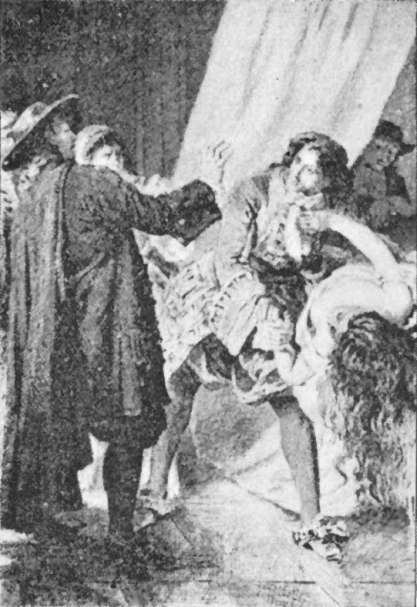
It was with much difficulty that Hercules was sent back to his relations. It was again necessary for the charming Miss St. Yves to interfere; the more she perceived the influence she had upon him, the more she loved him. She made him depart, and was much affected at it. At length, when he was gone, the Abbé, who was not only Miss St. Yves's elder brother by many years, but was also her guardian, endeavored to wean his ward from the importunities of this dreadful lover. He went to consult the bailiff, who had always intended his son for the Abbé's sister, and who advised him to place the poor girl in a convent. This was a terrible stroke. Such a measure would, to a young lady unaffected with any particular passion, have been inexpressible punishment; but to a love-sick maid, equally sagacious and tender, it was despair itself.
When the ingenuous Hercules returned to the Prior's, he related all that had happened with his usual frankness. He met with the same remonstrances, which had some effect upon his mind, though none upon his senses; but the next day, when he wanted to return to his mistress, in order to reason with her upon the law of nature and the law of convention, the bailiff acquainted him, with insulting joy, that she was in a convent.
"Very well," said he, "I'll go and reason with her in this convent."
That cannot be, said the bailiff; and then entered into a long explanation of the nature of a convent, telling him that this word was derived from conventus, in the Latin, which signifies "an assembly;" and the Huron could not comprehend, why he might not be admitted into this assembly. As soon as he was informed that this assembly was a kind of prison, in which girls were shut up, a shocking institution, unknown in Huronia and England; he became as furious as was his patron Hercules, when Euritus, king of Œchalia, no less cruel than the Abbé of St. Yves, refused him the beauteous Iola, his daughter, not inferior in beauty to the Abbé's sister. He was upon the point of going to set fire to the convent to carry off his mistress, or be burnt with her. Miss Kerkabon, terrified at such a declaration, gave up all hopes of ever seeing her nephew a sub-deacon; and, sadly weeping, she exclaimed: "The devil has certainly been in him since he has been christened."
VII.
THE HURON REPULSES THE ENGLISH.
The ingenuous Hercules walked toward the sea-coast wrapped in deep and gloomy melancholy, with his double charged fusee upon his shoulder, and his cutlass by his side, shooting now and then a bird, and often tempted to shoot himself; but he had still some affection for life, for the sake of his dear mistress; by turns execrating his uncle and aunt, all Lower Britany, and his christening; then blessing them, as they had introduced him to the knowledge of her he loved. He resolved upon going to burn the convent, and he stopped short for fear of burning his mistress. The waves of the Channel are not more agitated by the easterly and westerly winds, than was his heart by so many contrary emotions.
He was walking along very fast, without knowing whither he was going, when he heard the beat of a drum. He saw, at a great distance, a vast multitude, part of whom ran toward the coast, and the other part in the opposite direction.
A thousand shrieks re-echoed on every side. Curiosity and courage hurried him, that instant, toward the spot where the greatest clamor arose, which he attained in a few leaps. The commander of the militia, who had supped with him at the Prior's, knew him immediately, and he ran to the Huron with open arms:
"Ah! it is the sincere American: he will fight for us."
Upon which the militia, who were almost dead with fear, recovered themselves, crying with one voice:
"It is the Huron, the ingenuous Huron."
"Gentlemen," said he, "what is the matter? Why are you frightened? Have they shut your mistresses up in convents?"
Instantly a thousand confused voices cried out:
"Do you not see the English, who are landing?"
"Very well," replied the Huron, "they are a brave people; they never proposed making me a sub-deacon; they never carried off my mistress."
The commander made him understand, that they were coming to pillage the Abbé of the Mountain, drink his uncle's wine, and perhaps carry off Miss St. Yves; that the little vessel which set him on shore in Britany had come only to reconnoitre the coast; that they were committing acts of hostility, without having declared war against France; and that the province was entirely exposed to them.
"If this he the case," said he, "they violate the law of nature: let me alone; I lived a long time among them; I am acquainted with their language, and I will speak to them. I cannot think they can have so wicked a design."
During this conversation the English fleet approached; the Huron ran toward it, and having jumped into a little boat, soon rowed to the Admiral's ship, and having gone on board, asked "whether it was true, that they were come to ravage the coast, without having honestly declared war?"
The Admiral and all his crew burst out into laughter, made him drink some punch, and sent him back.
The ingenuous Hercules, piqued at this reception, thought of nothing else but beating his old friends for his countrymen and the Prior. The gentlemen of the neighborhood ran from all quarters, and joined them; they had some cannon, and he discharged them one after the other. The English landed, and he flew toward them, when he killed three of them with his own hand. He even wounded the Admiral, who had made a joke of him. The entire militia were animated with his prowess. The English returned to their ships, and went on board; and the whole coast re-echoed with the shouts of victory, "Live the king! live the ingenuous Hercules!"
Every one ran to embrace him; every one strove to stop the bleeding of some slight wounds he had received.
"Ah!" said he, "if Miss St. Yves were here, she would put on a plaster for me."
The bailiff, who had hid himself in his cellar during the battle, came to pay his compliments like the rest. But he was greatly surprised, when he heard the ingenuous Hercules say to a dozen young men, well disposed for his service, who surrounded him:
"My friends, having delivered the Abbé of the Mountain is nothing; we must rescue a nymph."
The warm blood of these youths was fired at the expression. He was already followed by crowds, who repaired to the convent. If the bailiff had not immediately acquainted the commandant with their design, and he had not sent a detachment after the joyous troop, the thing would have been done. The Huron was conducted back to his uncle and aunt, who overwhelmed him with tears and tenderness.
"I see very well," said his uncle, "that you will never be either a sub-deacon or a prior; you will be an officer, and one still braver than my brother the Captain, and probably as poor."
Miss Kerkabon could not stop an incessant flood of tears, whilst she embraced him, saying, "he will be killed too, like my brother; it were much better he were a sub-deacon."
The Huron had, during the battle, picked up a purse full of guineas, which the Admiral had probably lost. He did not doubt but that this purse would buy all Lower Britany, and, above all, make Miss St. Yves a great lady. Every one persuaded him to repair to Versailles, to receive the recompense due to his services. The commandant, and the principal officers, furnished him with certificates in abundance. The uncle and aunt also approved of this journey. He was to be presented to the king without any difficulty. This alone would give him great weight in the province. These two good folks added to the English purse a considerable present out of their savings. The Huron said to himself, "When I see the king, I will ask Miss St. Yves of him in marriage, and certainly he will not refuse me." He set out accordingly, amidst the acclamations of the whole district, stifled with embraces, bathed in tears by his aunt, blessed by his uncle, and recommending himself to the charming Miss St. Yves.
VIII.
THE HURON GOES TO COURT. SUPS UPON THE ROAD WITH SOME HUGUENOTS.
The ingenuous Hercules took the Saumur road in the coach, because there was at that time no other convenience. When he came to Saumur, he was astonished to find the city almost deserted, and to see several families going away. He was told, that half a dozen years before, Saumur contained upwards of fifty thousand inhabitants, and that at present there were not six thousand. He mentioned this at the inn, whilst at supper. Several Protestants were at table; some complained bitterly, others trembled with rage, others, weeping, said, Nos dulcia linquimus arva, nos patriam fugimus. The Huron, who did not understand Latin, had these words explained to him, which signified, "We abandon our sweet fields;—We fly from our country."
"And why do you fly from your country, gentlemen?"
"Because we must otherwise acknowledge the Pope."
"And why not acknowledge him? You have no god-mothers, then, that you want to marry; for, I am told it is he that grants this permission."
"Ah! sir, this Pope says, that he is master of the domains of kings."
"But, gentlemen, what religion are you of?"
"Why, sir, we are for the most part drapers and manufacturers."
"If the Pope, then, is not the master of your clothes and manufactures, you do very well not to acknowledge him; but as to kings, it is their business, and why do you trouble yourselves about it?"
Here a little black man took up the argument, and very learnedly set forth the grievances of the company. He talked of the revocation of the edict of Nantes with so much energy; he deplored, in so pathetic a manner, the fate of fifty thousand fugitive families, and of fifty thousand others converted by dragoons; that the ingenuous Hercules could not refrain from shedding tears.
"Whence arises it," said he, "that so great a king, whose renown expands itself even to the Hurons, should thus deprive himself of so many hearts that would have loved him, and so many arms that would have served him."
"Because he has been imposed upon, like other great kings," replied the little orator, "He has been made to believe, that as soon as he utters a word, all people think as he does; and that he can make us change our religion, just as his musician Lulli, in a moment, changes the decorations of his opera. He has not only already lost five or six hundred thousand very useful subjects, but he has turned many of them into enemies; and King William, who is at this time master of England, has formed several regiments of these identical Frenchmen, who would otherwise have fought for their monarch.
"Such a disaster is more astonishing, as the present Pope, to whom Louis XIV. sacrifices a part of his people, is his declared enemy. A violent quarrel has subsisted between them for nearly nine years. It has been carried so far, that France was in hopes of at length casting off the yoke, by which it has been kept in subjection for so many ages to this foreigner, and, more particularly, of not giving him any more money, which is the primum mobile of the affairs of this world. It, therefore, appears evident, that this great king has been imposed on, as well with respect to his interest, as the extent of his power, and that even the magnanimity of his heart has been struck at."
The Huron, becoming more and more interested, asked:
"Who were the Frenchmen who thus deceived a monarch so dear to the Hurons?"
"They are the Jesuits," he was answered, "and, particularly, Father la Chaise, the kings confessor. It is to be hoped that God will one day punish them for it, and that they will be driven out, as they now drive us. Can any misfortune equal ours? Mons. de Louvois besets us on all sides with Jesuits and dragoons."
"Well gentlemen," replied the Huron, "I am going to Versailles to receive the recompense due to my services; I will speak to Mons. de Louvois. I am told it is he who makes war from his closet. I shall see the king, and I will acquaint him with the truth. It is impossible not to yield to this truth, when it is felt. I shall return very soon to marry Miss St. Yves, and I beg you will be present at our nuptials."
These good people now took him for some great Lord, who traveled incognito in the coach. Some took him for the king's fool.
There was at table a disguised Jesuit, who acted as a spy to the Reverend Father de la Chaise. He gave him an account of everything that passed, and Father de la Chaise reported it to M. de Louvois. The spy wrote. The Huron and the letter arrived almost at the same time at Versailles.
IX.
THE ARRIVAL OF THE HURON AT VERSAILLES. HIS RECEPTION AT COURT.
The ingenuous Hercules was set down from a public carriage, in the court of the kitchens. He asks the chairmen, what hour the king can be seen? The chairmen laugh in his face, just as the English Admiral had done: and he treated them in the same manner—he beat them. They were for retaliation, and the scene had like to have proved bloody, if a soldier, who was a gentleman of Britany, had not passed by, and who dispersed the mob.
"Sir," said the traveler to him, "you appear to me to be a brave man. I am nephew to the Prior of our Lady of the Mountain. I have killed Englishmen, and I am come to speak to the king. I beg you will conduct me to his chamber."
The soldier, delighted to find a man of courage from his province, who did not seem acquainted with the customs of the court, told him it was necessary to be presented to M. de Louvois.
"Very well, then, conduct me to M. de Louvois, who will doubtless conduct me to the king."
"It is more difficult to speak to M. de Louvois than the king. But I will conduct you to Mr. Alexander, first commissioner of war, and this will be just the same as if you spoke to the minister."
They accordingly repair to Mr. Alexander's, who is first clerk, but they cannot be introduced, he being closely engaged in business with a lady of the court, and no person is allowed admittance.
"Well," said the soldier, "there is no harm done, let us go to Mr. Alexander's first clerk. This will be just the same as if you spoke to Mr. Alexander himself."
The Huron quite astonished, followed him. They remained together half an hour in a little anti-chamber.
"What is all this?" said the ingenuous Hercules. "Is all the world invisible in this country? It is much easier to fight in Lower Britany against Englishmen, than to meet with people at Versailles, with whom one hath business."
He amused himself for some time with relating his amours to his countryman; but the clock striking, recalled the soldier to his post, when a mutual promise was given of meeting on the morrow.
The Huron remained another half hour in the anti-chamber, meditating upon Miss St. Yves, and the difficulty of speaking to kings and first clerks.
At length the patron appeared.
"Sir," said the ingenuous Hercules, "If I had waited to repulse the English as long as you have made me wait for my audience, they would certainly have ravaged all Lower Britany without opposition."
These words impressed the clerk. He at length said to the inhabitant of Britany, "What is your request?"
"A recompense," said the other: "these are my titles;" showing his certificates.
The clerk read, and told him, "that probably he might obtain leave to purchase a lieutenancy."
"Me? what, must I pay money for having repulsed the English? Must I pay a tax to be killed for you, whilst you are peaceably giving your audience here? You are certainly jesting. I require a company of cavalry for nothing. I require that the king shall set Miss St. Yves at liberty from the convent, and give her to me in marriage. I want to speak to the king in favor of fifty thousand families, whom I propose restoring to him. In a word, I want to be useful. Let me be employed and advanced."
"What is your name, sir, who talk in such a high style?"
"Oh! oh!" answered the Huron; "you have not then read my certificates? This is the way they are treated. My name is Hercules de Kerkabon. I am christened, and I lodge at the Blue Dial." The clerk concluded, like the people at Saumur, that his head was turned, and did not pay him any further attention.
The same day, the Reverend Father de la Chaise, confessor to Louis XIV., received his spy's letter, which accused the Breton Kerkabon of favoring in his heart the Huguenots, and condemning the conduct of the Jesuits. M. de Louvois had, on his side, received a letter from the inquisitive bailiff, which depicted the Huron as a wicked, lewd fellow, inclined to burn convents, and carry off the nuns.
Hercules, after having walked in the gardens of Versailles, which had become irksome to him; after having supped like a native of Huronia and Lower Britany: had gone to rest, in the pleasant hope of seeing the king the next day; of obtaining Miss St. Yves in marriage; of having, at least, a company of cavalry; and of setting aside the persecution against the Huguenots. He was rocking himself asleep with these flattering ideas, when the Marechaussée entered his chamber, and seized upon his double-charged fusee and his great sabre.
They took an inventory of his ready money, and then conducted him to the castle erected by King Charles V., son to John II., near the street of St. Antoine, at the gate des Tournelles.
What was the Huron's astonishment in his way thither the reader is left to imagine. He at first fancied it was all a dream; and remained for some time in a state of stupefaction. Presently, transported with rage, that gave him more than common strength, he collared two of his conductors who were with him in the coach, flung them out of the door, cast himself after them, and then dragged the third, who wanted to hold him. He fell in the attempt, when they tied him, and replaced him in the carriage.
"This, then," said he, "is what one gets for driving the English out of Lower Britany! What wouldst thou say, charming Miss St. Yves, if thou didst see me in this situation?"
They at length arrived at the place of their destination. He was carried without any noise into the chamber in which he was to be locked up, like a dead corpse going to the grave. This room was already occupied by an old solitary student of Port Royal, named Gordon, who had been languishing here for two years.
"See," said the chief of the Marechaussée, "here is company I bring you;" and immediately the enormous bolts of this strong door, secured with large iron bars, were fastened upon them. These two captives were thus separated from all the universe besides.
X.
THE HURON IS SHUT UP IN THE BASTILE WITH A JANSENIST.
Mr. Gordon was a healthy old man, of a serene disposition, who was acquainted with two great things; the one was, to bear adversity; the other, to console the afflicted. He approached his companion with an open sympathizing air, and said to him, whilst he embraced him:
"Whoever thou art that is come to partake of my grave, be assured, that I shall constantly forget myself to soften thy torments in the infernal abyss where we are plunged. Let us adore Providence that has conducted us here. Let us suffer in peace, and trust in hope."
These words had the same effect upon the youth as cordial drops, which recall a dying person to life, and show to his astonished eyes a glimpse of light.
After the first compliments were over, Gordon, without urging him to relate the cause of his misfortune, inspired him by the sweetness of his discourse and by that interest which two unfortunate persons share with each other, with a desire of opening his heart and of disburdening himself of the weight which oppressed him; but he could not guess the cause of his misfortune, and the good man Gordon was as much astonished as himself.
"God must, doubtless," said the Jansenist to the Huron, "have great designs upon you, since he conducted you from Lake Ontario into England, from thence to France; caused you to be baptized in Lower Britany, and has now lodged you here for your salvation."
"I' faith," replied Hercules, "I believe the devil alone has interfered in my destiny.[1] My countrymen in America would never have treated me with the barbarity that I have here experienced; they have not the least idea of it. They are called savages;—they are good people, but rustic, and the men of this country are refined villains. I am indeed, greatly surprised to have come from another world, to be shut up in this, under four bolts with a priest; but I consider what an infinite number of men set out from one hemisphere to go and get killed in the other, or are cast away in the voyage, and are eaten by the fishes. I cannot discover the gracious designs of God over all these people."
Their dinner was brought them through a wicket. The conversation turned upon Providence, lettres de cachet, and upon the art of not sinking under disgrace, to which all men in this world are exposed.
"It is now two years since I have been here," said the old man, "without any other consolation than myself and books; and yet I have never been a single moment out of temper."
"Ah! Mr. Gordon," cried Hercules, "you are not then in love with your god-mother. If you were as well acquainted with Miss St. Yves as I am, you would be in a state of desperation."
At these words he could not refrain from tears, which greatly relieved him from his oppression.
"How is it then that tears solace us?" said the Huron, "It seems to me that they should have quite an opposite effect."
"My son," said the good old man, "every thing is physical about us; all secretions are useful to the body, and all that comforts it, comforts the soul. We are the machines of Providence."
The ingenuous Huron, who, as we have already observed more than once, had a great share of understanding, entered deeply into the consideration of this idea, the seeds whereof appeared to be in himself. After which he asked his companion.
"Why his machine had for two years been confined by four bolts?"
"By effectual grace," answered Gordon; "I pass for a Jansenist; I know Arnaud and Nicole; the Jesuits have persecuted us. We believe that the Pope is nothing more than a bishop, like another, and therefore Father la Chaise has obtained from the king, his penitent, an order for robbing me without any form of justice, of the most precious inheritance of man—liberty!"
"This is very strange," said the Huron, "all the unhappy people I have met with have been made so solely by the Pope. With respect to your effectual grace, I acknowledge I do not understand what you mean. But I consider it as a very great favor, that God has let me, in my misfortunes, meet with a man, who pours into my heart such consolation as I thought myself incapable of receiving."
The conversation became each day more interesting and instructive. The souls of the two captives seemed to unite in one body. The old man had acquired knowledge, and the young man was willing to receive instruction. At the end of the first month, he eagerly applied himself to the study of geometry. Gordon made him read Rohault's Physics, which book was still in fashion, and he had good sense enough to find in it nothing but doubts and uncertainties.
He afterward read the first volume of the Enquiry After Truth. This instructive work gave him new light.
"What!" said he, "do our imagination and our senses deceive us to that degree? What, are not our ideas formed by objects, and can we not acquire them by ourselves?"
When he had gone through the second volume, he was not so well satisfied; and he concluded it was much easier to destroy than to build.
His colleague, astonished that a young ignoramus should make such a remark, conceived a very high opinion of his understanding, and was more strongly attached to him.
"Your Malebranche," said he to Gordon one day, "seems to have written half his book whilst he was in possession of his reason, and the other half with the assistance only of imagination and prejudice."
Some days after, Gordon asked him what he thought of the soul, and the manner in which we receive our ideas of volition, grace, and free agency.
"Nothing," replied the Huron. "If I think sometimes, it is that we are under the power of the Eternal Being, like the stars and the elements—that he operates everything in us—that we are small wheels of the immense machine, of which he is the soul—that he acts according to general laws, and not from particular views. This is all that appears to me intelligible; all the rest is to me a dark abyss."
"But this, my son, would be making God the author of sin!"
"But, father, your effectual grace would equally make him the author of sin; for certainly all those to whom this grace was refused, would sin; and is not an all-powerful being who permits evil, virtually the author of evil?"
This sincerity greatly embarrassed the good man; he found that all his endeavors to extricate himself from this quagmire were ineffectual; and he heaped such quantities of words upon one another, which seemed to have meaning, but which in fact had none, that the Huron could not help pitying him. This question evidently determined the origin of good and evil; and poor Gordon was reduced to the necessity of recurring to Pandora's box—Oromasdes's egg pierced by Arimanes—the enmity between Typhon and Osiris—and, at last, original sin; and these he huddled together in profound darkness, without their throwing the least glimmering light upon one another. However, this romance of the soul diverted their thoughts from the contemplation of their own misery; and, by a strange magic, the multitude of calamities dispersed throughout the world diminished the sensation of their own miseries. They did not dare complain when all mankind was in a state of sufferance.
But in the repose of night, the image of the charming Miss St. Yves effaced from the mind of her lover every metaphysical and moral idea. He awoke with his eyes bathed in tears; and the old Jansenist forgot his effectual grace, and the Abbé of St. Cyran, and even Jansenius himself, to afford consolation to a youth whom he had judged guilty of a mortal sin.
After these lectures and their reasonings were over, their adventures furnished them with subjects of conversation; after this store was exhausted, they read together, or separately. The Huron's understanding daily increased; and he would certainly have made great progress in mathematics, if the thought of Miss St. Yves had not frequently distracted him.
He read histories, which made him melancholy. The world appeared to him too wicked and too miserable. In fact, history is nothing more than a picture of crimes and misfortunes. The crowd of innocent and peaceable men are always invisible upon this vast theatre. The dramatis personæ are composed of ambitious, perverse men. The pleasure which history affords is derived from the same source as tragedy, which would languish and become insipid, were it not inspired with strong passions, great events, and piteous misfortunes. Clio must be armed with a poniard as well as Melpomene.
Though the history of France is not less filled with horror than those of other nations, it nevertheless appeared to him so disgusting in the beginning, so dry in the continuation, and so trifling in the end, (even in the time of Henry IV.); ever destitute of grand monuments, or foreign to those fine discoveries which have illustrated other nations; that he was obliged to resolve upon not being tired, in order to go through all the particulars of obscure calamities confined to a little corner of the world.
Gordon thought like him. They both laughed with pity when they read of the sovereigns of Fezensacs, Fesansaguet, and Astrac: such a study could be relished only by their heirs, if they had any. The brilliant ages of the Roman Republic made him sometimes quite indifferent as to any other part of the globe. The spectacle of victorious Rome, the lawgiver of nations, engrossed his whole soul. He glowed in contemplating a people who were governed for seven hundred years by the enthusiasm of liberty and glory.
Thus rolled days, weeks, and months; and he would have thought himself happy in the sanctuary of despair, if he had not loved.
The natural goodness of his heart was softened still more when he reflected upon the Prior of our Lady of the Mountain, and the sensible Kerkabon.
"What must they think," he would often repeat, "when they can get no tidings of me? They must think me an ungrateful wretch." This idea rendered him inconsolable. He pitied those who loved him much more than he pitied himself.
XI.
HOW THE HURON DISCLOSES HIS GENIUS.
Reading aggrandizes the soul, and an enlightened friend affords consolation. Our captive had these two advantages in his favor which he had never expected.
"I shall begin to believe in the Metamorphoses," said he, "for I have been transformed from a brute into a man."
He formed a chosen library with part of the money which he was allowed to dispose of. His friend encouraged him to commit to writing such observations as occurred to him. These are his notes upon ancient history:
"I imagine that nations were for a long time like myself; that they did not become enlightened till very late; that for many ages they were occupied with nothing but the present moment which elapsed: that they thought very little of what was past, and never of the future. I have traversed five or six hundred leagues in Canada, and I did not meet with a single monument: no one is the least acquainted with the actions of his predecessors. Is not this the natural state of man? The human species of this continent appears to me superior to that of the other. They have extended their being for many ages by arts and knowledge. Is this because they have beards upon their chins and God has refused this ornament to the Americans? I do not believe it; for I find the Chinese have very little beard, and that they have cultivated arts for upwards of five thousand years. In effect, if their annals go back upwards of four thousand years, the nation must necessarily have been united and in a flourishing state more than five hundred centuries.
"One thing particularly strikes me in this ancient history of China, which is, that almost every thing is probable and natural. I admire it because it is not tinctured with anything of the marvelous.
"Why have all other nations adopted fabulous origins? The ancient chronicles of the history of France, which, by the by, are not very ancient, make the French descend from one Francus, the son of Hector. The Romans said they were the issue of a Phrygian, though there was not in their whole language a single word that had the least connection with the language of Phrygia. The gods had inhabited Egypt for ten thousand years, and the devils Scythia, where they had engendered the Huns. I meet with nothing before Thucydides but romances similar to the Amadis, and far less amusing. Apparitions, oracles, prodigies, sorcery, metamorphoses, are interspersed throughout with the explanation of dreams, which are the bases of the destiny of the greatest empires and the smallest states. Here are speaking beasts, there brutes that are adored, gods transformed into men, and men into gods. If we must have fables, let us, at least, have such as appear the emblem of truth. I admire the fables of philosophers, but I laugh at those of children, and hate those of impostors."
He one day hit upon a history of the Emperor Justinian. It was there related, that some Appedeutes of Constantinople had delivered, in very bad Greek, an edict against the greatest captain of the age, because this hero had uttered the following words in the warmth of conversation: "Truth shines forth with its proper light, and people's minds are not illumined with flaming piles." The Appedeutes declared that this proposition was heretical, bordering upon heresy, and that the contrary action was catholic, universal, and Grecian: "The minds of the people are enlightened but with flaming piles, and truth cannot shine forth with its own light." These Linostolians thus condemned several discourses of the captain, and published an edict.
"What!" said the Huron, with much emotion, "shall such people publish edicts?"
"They are not edicts," replied Gordon: "they are contradictions, which all the world laughed at in Constantinople, and the Emperor the first. He was a wise prince, who knew how to reduce the Linostolian Appedeutes to a state incapable of doing anything but good. He knew that these gentlemen, and several other Pastophores, had tired the patience of the Emperors, his predecessors, with contradictions in more serious matters."
"He did quite right," said the Huron, "the Pastophores should not be supported, but constrained."
He committed several other observations to paper, which astonished old Gordon. "What," said he to himself, "have I consumed fifty years in instruction and not attained to the degree of natural good sense of this child, who is almost a savage? I tremble to think I have so arduously strengthened prejudices, and he listens to simple nature only."
The good man had some little books of criticism, some of those periodical pamphlets wherein men, incapable of producing anything themselves, blacken the productions of others; where a Vise insults a Racine, and a Faidit a Fénelon. The Huron ran over some of them. "I compare them," said he, "to certain gnats that lodge their eggs in the nostrils of the finest horses, which do not, however, retard their speed."
The two philosophers scarce deigned to cast their eyes upon these dregs of literature.
They soon after went through the elements of astronomy. The Huron sent for some globes: he was ravished at this great spectacle.
"How hard it is," said he, "that I should only begin to be acquainted with heaven, when the power of contemplating it is ravished from me! Jupiter and Saturn revolve in these immense spaces;—millions of suns illumine myriads of worlds; and, in this corner of the earth on which I am cast, there are beings that deprive me of seeing and studying those worlds to which my eye might reach, and even that in which God has placed me. The light created for the whole universe is lost to me. It was not hidden from me in the northern horizon, where I passed my infancy and youth. Without you, my dear Gordon, I should be annihilated."
XII.
THE HURON'S SENTIMENTS UPON THEATRICAL PIECES.
The young Huron resembled one of those vigorous trees, which, languishing in an ungrateful soil, extend in a little time their roots and branches when transplanted to a more favorable spot; and it was very extraordinary that this favorable spot should be a prison.
Among the books which employed the leisure of the two captives were some poems and also translations of Greek tragedies, and some dramatic pieces in French. Those passages that dwelt on love communicated at once pleasure and pain to the soul of the Huron. They were but so many images of his dear Miss St. Yves. The fable of the two pigeons rent his heart: for he was far estranged from his tender dove.
Molière enchanted him. He taught him the manners of Paris and of human nature.
"To which of his comedies do you give the preference?"
"Doubtless to his Tartuffe."
"I am of your opinion," said Gordon; "it was a Tartuffe that flung me into this dungeon, and perhaps they were Tartuffes who have been the cause of your misfortunes."
"What do you think of these Greek tragedies?"
"They are very good for Grecians."
But when he read the modern Iphigenia, Phædrus, Andromache, and Athalia, he was in ecstacy, he sighed, he wept,—and he learned them by heart, without having any such intention.
"Read Rodogune," said Gordon; "that is said to be a capital production; the other pieces which have given you so much pleasure, are trifles compared to this."
The young man had scarce got through the first page, before he said, "This is not written by the same author."
"How do you know it?"
"I know nothing yet; but these lines neither touch my ear nor my heart."
"O!" said Gordon, "the versification does not signify." The Huron asked, "What must I judge by then?"
After having read the piece very attentively without any other design than being pleased, he looked steadfastly at his friend with much astonishment, not knowing what to say. At length, being urged to give his opinion with respect to what he felt, this was the answer he made: "I understood very little of the beginning; the middle disgusted me; but the last scene greatly moved me, though there appears to me but little probability in it. I have no prejudices for or against any one, but I do not remember twenty lines, I, who recollect them all when they please me."
"This piece, nevertheless, passes for the best upon our stage."
"If that be the case," said he, "it is perhaps like many people who are not worthy of the places they hold. After all, this is a matter of taste, and mine cannot yet be formed. I may be mistaken; but you know I am accustomed to say what I think or rather what I feel. I suspect that illusion, fashion, caprice, often warp the judgments of men."
Here he repeated some lines from Iphigenia, which he was full of; and though he declaimed but indifferently, he uttered them with such truth and emotion that he made the old Jansenist weep. He then read Cinna, which did not excite his tears, but his admiration.
XIII.
THE BEAUTIFUL MISS ST. YVES GOES TO VERSAILLES.
Whilst the unfortunate Hercules was more enlightened than consoled; whilst his genius, so long stifled, unfolded itself with so much rapidity and strength; whilst nature, which was attaining a degree of perfection in him, avenged herself of the outrages of fortune; what became of the Prior, his good sister, and the beautiful recluse, Miss St. Yves? The first month they were uneasy, and the third they were immersed in sorrow. False conjectures, ill-grounded reports, alarmed them. At the end of six months, it was concluded he was dead. At length, Mr. and Miss Kerkabon learned, by a letter of ancient date, which one of the king's guards had written to Britany, that a young man resembling the Huron arrived one night at Versailles, but that since that time no one had heard him spoken of.
"Alas," said Miss Kerkabon, "our nephew has done some ridiculous thing, which has brought on some terrible consequences. He is young, a Low Breton, and cannot know how to behave at court. My dear brother, I never saw Versailles nor Paris; here is a fine opportunity, and we shall perhaps find our poor nephew. He is our brother's son, and it is our duty to assist him. Who knows? we may perhaps at length prevail upon him to become a sub-deacon when the fire of youth is somewhat abated. He was much inclined to the sciences. Do you recollect how he reasoned upon the Old and New Testaments? We are answerable for his soul. He was baptized at our instigation. His dear mistress Miss St. Yves does nothing but weep incessantly. Indeed, we must go to Paris. If he is concealed in any of those infamous houses of pleasure, which I have often heard of, we will get him out."
The Prior was affected at his sister's discourse. He went in search of the Bishop of St. Malo's, who had baptized the Huron, and requested his protection and advice. The Prelate approved of the journey. He gave the Prior letters of recommendation to Father la Chaise, the king's confessor, who was invested with the first dignity in the kingdom; to Harlai, the Archbishop of Paris, and to Bossuet, Bishop of Meaux.
At length, the brother and sister set out; but when they came to Paris, they found themselves bewildered in a great labyrinth without clue or end. Their fortune was but middling, and they had occasion every day for carriages to pursue their discovery, which they could not accomplish.
The Prior waited upon the Reverend Father la Chaise; he was with Mademoiselle du Tron, and could not give audience to Priors. He went to the Archbishop's door: the Prelate was shut up with the beautiful Mademoiselle de Lesdiguières about church matters. He flew to the country house of the Bishop of Meaux: he was engaged in a close examination with Mademoiselle de Mauleon, of the mystery relating to Mademoiselle Guyon. At length, however, he gained access to these two prelates; they both declared they could not interfere with regard to his nephew, as he was not a sub-deacon.
He at length saw the Jesuit, who received him with open arms, protesting he had always entertained the greatest private esteem for him, though he had never known him. He swore that his society had always been attached to the inhabitants of Lower Britany.
"But," said he, "has not your nephew the misfortune of being a Huguenot?"
"No, certainly, Reverend Father."
"May he not be a Jansenist?"
"I can assure your Reverence, that he is scarce a Christian. It is about eleven months since he was christened."
"This is very well;—we will take care of him. Is your benefice considerable?"
"No, a very trifle, and our nephew costs us a great deal."
"Are there any Jansenists in your neighborhood? Take great care, my dear Mr. Prior, they are more dangerous than Huguenots, or even Atheists."
"My Reverend Father, we have none; it is not even known at our Lady of the Mountain what Jansenism is."
"So much the better; go, there is nothing I will not do for you."
He dismissed the Prior in this affectionate manner, but thought no more about him.
Time slipped away, and the Prior and his good sister were almost in despair.
In the meanwhile, the cursed bailiff urged very strenuously the marriage of his great booby son with the beautiful Miss St. Yves, who was taken purposely out of the convent. She always entertained a passion for her god-son in proportion as she detested the husband who was designed for her. The insult that had been offered her, by shutting her up in a convent, increased her affection; and the mandate for wedding the bailiff's son completed her antipathy for him. Chagrin, tenderness, and terror, racked her soul. Love, we know, is much more inventive and more daring in a young woman than friendship in an aged Prior and an aunt upwards of forty-five. Besides, she had received good instructions in her convent with the assistance of romances, which she read by stealth.
The beautiful Miss St. Yves remembered the letter that had been sent by one of the king's guards to Lower Britany, which had been spoken of in the province. She resolved to go herself and gain information at Versailles; to throw herself at the minister's feet, if her husband should be in prison as it was said, and obtain justice for him. I know not what secret intelligence she had gained that at court nothing is refused to a pretty woman; but she knew not the price of these boons.
Having taken this resolution, it afforded her some consolation; and she enjoyed some tranquillity without upraiding Providence with the severity of her lot. She receives her detested intended father-in-law, caresses her brother, and spreads happiness throughout the house. On the day appointed for the ceremony, she secretly departs at four o'clock in the morning, with the little nuptial presents she has received, and all she could gather. Her plan was so well laid, that she was about ten leagues upon her journey, when, about noon, her absence was discovered, and when every one's consternation and surprise was inexpressible. The inquisitive bailiff asked more questions that day than he had done for a week before; the intended bridegroom was more stupefied than ever. The Abbé St. Yves resolved in his rage to pursue his sister. The bailiff and his son were disposed to accompany him. Thus fate led almost the whole canton of Lower Britany to Paris.
The beautiful Miss St. Yves was not without apprehensions that she should be pursued. She rode on horseback, and she got all the intelligence she could from the couriers, without being suspected. She asked if they had not met a fat abbé, an enormous bailiff, and a young booby, galloping as fast as they could to Paris. Having learned, on the third day, that they were not far behind, she took quite a different road, and was skillful and lucky enough to arrive at Versailles, whilst they were in a fruitless pursuit after her, at Paris. But how was she to behave at Versailles? Young, handsome, untutored, unsupported, unknown, exposed to every danger, how could she dare go in search of one of the king's guards? She had some thoughts of applying to a Jesuit of low rank, for there were some for every station of life; as God, they say, has given different aliments to every species of animals. He had given the king his confessor, who was called, by all solicitors of benefices, the head of the Gallican Church. Then came the princes' confessors. The ministers had none, they were not such dupes. There were Jesuits for the genteel mob, and particularly those for chambermaids, by whom were known the secrets of their mistresses; and this was no small vocation, the beautiful Miss St. Yves addressed herself to one of these last, who was called Father Tout-à-tous (all to every one). She confessed to him, set forth her adventure, her situation, her danger, and conjured him to get her a lodging with some good devotee, who might shelter her from temptation.
The Confessional.
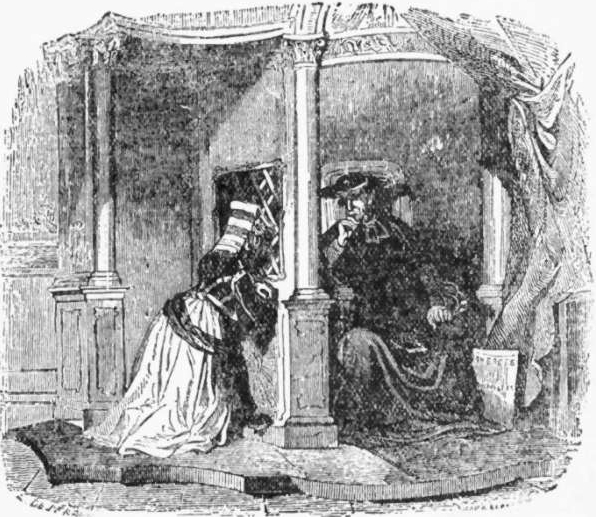
Father Tout-à-tous introduced her to the wife of the cup-bearer, one of his most trusty penitents. From the moment Miss St. Yves became her lodger, she did her utmost to obtain the confidence and friendship of this penitent. She gained intelligence of the Breton-Guard, and invited him to visit her. Having learned from him that her lover had been carried off after having had a conference with one of the clerks, she flew to this clerk. The sight of a fine woman softened him, for it must be allowed God created woman only to tame mankind.
The scribe, thus mollified, acknowledged to her every thing.
"Your lover has been in the bastile almost a year, and without your intercession he would, perhaps, have ended hid days there."
The tender Miss St. Yves swooned at this intelligence. When she had recovered herself, her informer told her:
"I have no power to do good; all my influence extends to doing harm. Take my advice, wait upon M. de St. Pouange, who has the power of doing both good and ill; he is Mons. de Louvois's cousin and favorite. This minister has two souls: the one is M. de St. Pouange, and Mademoiselle de Belle is the other, but she is at present absent from Versailles; so that you have nothing to do but captivate the protector I have pointed out to you."
The beautiful Miss St. Yves, divided between some trifling joy and excessive grief, between a glimmering of hope and dreadful apprehensions,—pursued by her brother, idolizing her lover, wiping her tears, which flowed in torrents; trembling and feeble, yet summoning all her courage;—in this situation, she flew on the wings of love to M. de St. Pouange's.
XIV.
RAPID PROGRESS OF THE HURON'S INTELLECT.
The ingenuous youth was making a rapid progress in the sciences, and particularly in the science of man. The cause of this sudden disclosure of his understanding was as much owing to his savage education as to the disposition of his soul; for, having learned nothing in his infancy, he had not imbibed any prejudices. His mind, not having been warped by error, had retained all its primitive rectitude. He saw things as they were; whereas the ideas that are communicated to us in our infancy make us see them all our life in a false light.
"Your persecutors are very abominable wretches," said he to his friend Gordon. "I pity you for being oppressed, but I condemn you for being a Jansenist. All sects appear to me to be founded in error. Tell me if there be any sectaries in geometry?"
"No, my child," said the good old Gordon, heaving a deep sigh; "all men are agreed concerning truth when demonstrated, but they are too much divided about latent truths."
"If there were but one single hidden truth in your load of arguments, which have been so often sifted for such a number of ages, it would doubtless have been discovered, and the universe would certainly have been unanimous, at least, in that respect. If this truth had been as necessary as the sun is to the earth, it would have been as brilliant as that planet. It is an absurdity, an insult to human nature—it is an attack upon the Infinite and Supreme Being to say there is a truth essential to the happiness of man which God conceals."
All that this ignorant youth, instructed only by nature, said, made a very deep impression upon the mind of the old unhappy scholiast.
"Is it really certain," he cried, "that I should have made myself truly miserable for mere chimeras? I am much more certain of my misery than of effectual grace. I have spent my time in reasoning about the liberty of God and human nature, but I have lost my own. Neither St. Augustine nor St. Prosner will extricate me from my present misfortunes."
The ingenuous Huron, who gave way to his natural instincts, at length said:
"Will you give me leave to speak to you boldly and frankly? Those who bring upon themselves persecution for such idle disputes seem to me to have very little sense; those who persecute, appear to me very monsters."
The two captives entirely coincided with respect to the injustice of their captivity.
"I am a hundred times more to be pitied than you," said the Huron; "I am born free as the air: I had two lives, liberty and the object of my love; and I am deprived of both. We are both in fetters, without knowing who put them on us, or without being able to enquire. It is said that the Hurons are barbarians, because they avenge themselves on their enemies; but they never oppress their friends. I had scarce set foot in France, before I shed my blood for this country. I have, perhaps, preserved a whole province, and my recompense is imprisonment. In this country men are condemned without being heard. This is not the case in England. Alas! it was not against the English that I should have fought."
Thus his growing philosophy could not brook nature being insulted in the first of her rights, and he gave vent to his just indignation.
His companion did not contradict him. Absence ever increases ungratified love, and philosophy does not diminish it. He as frequently spoke of his dear Miss St. Yves, as he did of morality or metaphysics. The more he purified his sentiments, the more he loved. He read some new romances; but he met with few that depicted to him the real state of his soul. He felt that his heart stretched beyond the bounds of his author.
"Alas!" said he, "almost all these writers have nothing but wit and art."
At length, the good Jansenist priest became, insensibly, the confident of his tenderness. He was already acquainted with love as a sin with which a penitent accuses himself at confession. He now learned to know it as a sentiment equally noble and tender; which can elevate the soul as well as soften it, and can at times produce virtues. In fine, for the last miracle, a Huron converted a Jansenist.