A CONVERSATION WITH A CHINESE.
Reading edition
In the year 1723, there was a Chinese in Holland, who was both a learned man and a merchant, two things that ought by no means to be incompatible; but which, thanks to the profound respect that is shown to money, and the little regard that the human species pay to merit, have become so among us.
This Chinese, who spoke a little Dutch, happened to be in a bookseller's shop at the same time that some literati were assembled there. He asked for a book; they offered him Bossuet's Universal History, badly translated. At the title Universal History—
"How pleased am I," cried the Oriental, "to have met with this book. I shall now see what is said of our great empire; of a nation that has subsisted for upwards of fifty thousand years; of that long dynasty of emperors who have governed us for such a number of ages. I shall see what these Europeans think of the religion of our literati, and of that pure and simple worship we pay to the Supreme Being. What a pleasure will it be for me to find how they speak of our arts, many of which are of a more ancient date with us than the eras of all the kingdoms of Europe! I fancy the author will be greatly mistaken in relation to the war we had about twenty-two thousand five hundred and fifty-two years ago, with the martial people of Tonquin and Japan, as well as the solemn embassy that the powerful emperor of Mogulitian sent to request a body of laws from us in the year of the world 500000000000079123450000."
"Lord bless you," said one of the literati, "there is hardly any mention made of that nation in this world, the only nation considered is that marvelous people, the Jews."
"The Jews!" said the Chinese, "those people then must certainly be masters of three parts of the globe at least."
"They hope to be so some day," answered the other; "but at present they are those pedlars you see going about here with toys and nicknacks, and who sometimes do us the honor to clip our gold and silver."
"Surely you are not serious," exclaimed the Chinese. "Could those people ever have been in possession of a vast empire?"
Here I joined in the conversation, and told him that for a few years they were in possession of a small country to themselves; but that we were not to judge of a people from the extent of their dominions, any more than of a man by his riches.
"But does not this book take notice of some other nations?" demanded the man of letters.
"Undoubtedly," replied a learned gentleman who stood at my elbow; "it treats largely of a small country about sixty leagues wide, called Egypt, in which it is said that there is a lake of one hundred and fifty leagues in circumference, made by the hands of man."
"My God!" exclaimed the Chinese, "a lake of one hundred and fifty leagues in circumference within a spot of ground only sixty leagues wide! This is very curious!"
"The inhabitants of that country," continued the doctor, "were all sages."
"What happy times were those!" cried the Chinese; "but is that all?"
"No," replied the other, "there is mention made of those famous people the Greeks."
"Greeks! Greeks!" said the Asiatic, "who are those Greeks?"
"Why," replied the philosopher, "they were masters of a little province, about the two hundredth part as large as China, but whose fame spread over the whole world."
"Indeed!" said the Chinese, with an air of openness and ingenuousness; "I declare I never heard the least mention of these people, either in the Mogul's country, in Japan, or in Great Tartary."
"Oh, the barbarian! the ignorant creature!" cried out our sage very politely. "Why then, I suppose you know nothing of Epaminondas the Theban, nor of the Pierian Heaven, nor the names of Achilles's two horses, nor of Silenus's ass? You have never heard speak of Jupiter, nor of Diogenes, nor of Lais, nor of Cybele, nor of—"
"I am very much afraid," said the learned Oriental, interrupting him, "that you know nothing of that eternally memorable adventure of the famous Xixofon Concochigramki, nor of the masteries of the great Fi-psi-hi-hi! But pray tell me what other unknown things does this Universal History treat of?"
Upon this my learned neighbor harangued for a quarter of an hour together about the Roman republic, and when he came to Julius Cæsar the Chinese stopped him, and very gravely said.
"I think I have heard of him, was he not a Turk?"
"How!" cried our sage in a fury, "don't you so much as know the difference between Pagans, Christians, and Mahometans? Did you never hear of Constantine? Do you know nothing of the history of the popes?"
"We have heard something confusedly of one Mahomet," replied the Asiatic.
"It is surely impossible," said the other, "but that you must have heard at least of Luther, Zuinglius, Bellarmin, and Œcolampadius."
"I shall never remember all those names," said the Chinese, and so saying he quitted the shop, and went to sell a large quantity of Pekoa tea, and fine calico, and then after purchasing what merchandise he required, set sail for his own country, adoring Tien, and recommending himself to Confucius.
As to myself, the conversation I had been witness to plainly discovered to me the nature of vain glory; and I could not forbear exclaiming:
"Since Cæsar and Jupiter are names unknown to the finest, most ancient, most extensive, most populous, and most civilized kingdom in the universe, it becomes ye well, O ye rulers of petty states! ye pulpit orators of a narrow parish, or a little town! ye doctors of Salamanca, or of Bourges! ye trifling authors, and ye heavy commentators!—it becomes you well, indeed, to aspire to fame and immortality."
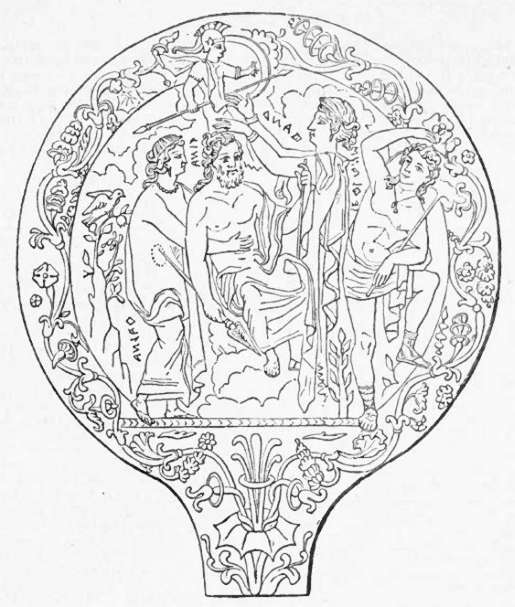
The birth of Minerva from the brain Of Jove.
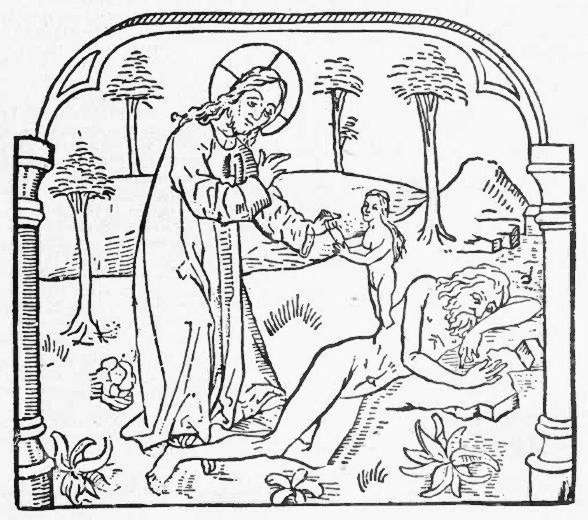
The birth of Eve from the side of Adam.
ANDROGYNOUS DEITIES.
The ancients ascribed the existence of the universe to the fiat of omnipotence. Almighty power conjoined with infinite wisdom had produced the world and all that it inhabits. Man, the head of visible creation, was formed in the image of the gods, but the gods only were endowed with generative or creative power. These gods were androgynous—that is, male and female—containing in one person both the paternal and maternal attributes. Plato taught that mankind, like the gods, were originally androgynous, and Moses tells us that Eve, in matured wisdom and beauty, sprang forth from the side of Adam, even as
"From great Jove's head, the armed Minerva sprung With awful shout."
"The thought of God as the Divine Mother," says a sincere and intelligent clergyman in a sermon recently published, "is a very ancient one, found in the most early nature worships." "We thank Thee O God," says the Rev. Theodore Parker, "that Thou art our Father and our Mother." "O God," says St. Augustine, "Thou art the Father, Thou the Mother of Thy children."
The preceding illustration of the birth of Minerva,—the goddess of wisdom,—i.e. wisdom issuing from the brain of Jove, is from Falkener's Museum of Classical Antiquities. It is taken from an ancient Etruscan patera (mirror), now in the Museum at Bologna, and is supposed to have been copied from the pediment of the eastern or main entrance to the Parthenon, or temple of Minerva. This pediment was the work of Phidias, and, like so many of the former monuments of ancient art and civilization, is now forever lost to mankind.
"The goddess," says the distinguished architect and antiquary M. De Quincy, "is shown issuing from the head of Jupiter. She has a helmet on her head, buckler on her arm, and spear in her hand. Jupiter is seated, holding a sceptre in one hand and a thunderbolt in the other. On the right of the new born goddess is Juno, whose arms are elevated, and who seems to have assisted at the extraordinary childbirth. On the left of Jupiter is Venus, recognizable by a sprig of myrtle and a dove. Behind Juno is Vulcan, still armed with the axe which has cleft the head of the god, and seeming to regard with admiration the success of his operations."
The engraving representing the birth of Eve, is from the Speculum Salutis, or the Mirror of Salvation, of which many manuscript copies were issued, for the instruction of the mendicant friars, between the twelfth and fifteenth centuries. "Heineken describes a copy in the imperial library of Vienna, which he attributes to the twelfth century. He says, such was the popularity of the work with the Benedictines that almost every monastery possessed a copy of it. Of the four manuscript copies owned by the British Museum, one is supposed to have been written in the thirteenth century, another copy is in the Flemish writing of the fifteenth century." This work, which contains several engravings and forty-five chapters of barbarous Latin rhymes, presents a good illustration of Christian art as it existed during the period immediately preceding the revival of letters, when the barbarism and ignorance of the dark ages had supplanted the artistic culture of ancient Greece and Rome.
Unprejudiced readers will doubtless admit that the birth of Minerva from the brain of Jove greatly resembles the birth of Eve from the side of Adam, and these myths show the analogy existing between the Jewish and Pagan mythologies; but the design and execution of the respective engravings, show the retrogression in art that had taken place between the time of the immortal Phidias and that of Pope Innocent III.[1]—between Pagan civilization as it existed prior to the Christian era, and the medieval barbarism of the successors of St. Peter.
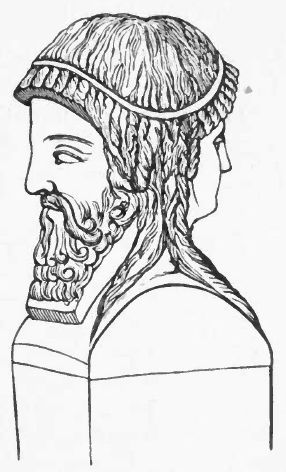
"God created man in his own image," says Godfrey Higgins in the Anacalypsis, (vol. 2, p. 397.) "Everything was supposed to be in the image of God; and thus man was created double—the male and female in one person, or androgynous like God. By some uninitiated Jews, of about the time of Christ, this double being was supposed to have been created back to back [see the bearded Bacchus and Ariadne on the following page]; but I believe, from looking at the twins in all ancient zodiacs, it was side by side; precisely as we have seen the Siamese boys,—but still male and female. Besides, the book of Genesis implies that they were side by side, by the woman being taken from the side of man. Among the Indians the same doctrine is found, as we might expect."
"We must rise to man," says the eloquent clergyman previously referred to, "in order to know rightly what God is. Humanity plainly images a power which is at once the source and pattern of the womanly as well as of the manly qualities, inasmuch as woman as well as man is needed to fill out the idea of humanity. The womanly traits—pity, forgiveness, gentleness, patience, sympathy, unselfishness—are as worthy of the Divine Being as the manly traits."—E.
Bacchus and Ariadne. [1]