MEN AND WOMEN AND HORSES
Reading edition
ERRYMOUNT MORTON walked briskly down Madison Avenue that warm November evening, when there was never a foretaste of winter in the intermittent breezes that blew gently across the city from river to river; and as he crossed the side streets one after another he saw the full moon in the east, low and large and mellow. On the brow of Murray Hill he checked his pace for a moment in frank enjoyment of the vista before him, differing in so many ways from the scenes which met his vision in the little college town of New England where he earned his living, and where he had spent the most of his life. The glow of the great town filled the air, and the roar of the city arose all about him. It seemed to him almost as though he could feel the heart of the metropolis throbbing before him. He caught himself wondering again whether he had not erred in accepting the professorship he had been so glad to get when he came back from Germany, and whether his life would not have been fuller and far richer had he come to New York, as once he thought of doing, and had he resolutely struck out for himself in the welter and chaos of the commercial capital of the country.

Down at the foot of the slope a cluster of electric lights spelled out the name of a trivial extravaganza then nearing its hundredth performance in the lovely Garden Theatre, and the avenue hereabouts had a strange, unnatural brilliance. High up in the pure dark blue the beautiful tower rose in air, its grace made visible by many lights of its own. The avenue was clogged with carriages, and the arcade before the theatre and under the tower was thick with men who carried under their arms folded card-board plans of the great amphitheatre, and who vociferously proffered tickets for the horse-show. So far remote from the current of fashion was Merrymount Morton that he had not been aware that the horse-show week was about to come to a glorious end. But he was familiar enough with New York to know that the horse-show was also an exhibition of men and women, and that the human entries were quite as important as the equine, and rather more interesting. He had never happened to be in the city at this season of the year; and although he had intended to spend the evening at the College Club, he seized the occasion to see a metropolitan spectacle which chanced to be novel to him.
From one of the shouting and insistent venders he bought a ticket, and he walked through the broad entrance-hall, the floor of which slanted upwards. He passed the door of a restaurant on his right, and he glanced down a staircase which led to the semi-subterranean stalls where the horses were tethered. A pungent, acrid, stable odor filled his nostrils. Then he found himself inside the immense amphitheatre, under the skeleton ribs of its roof picked out with long lines of tiny electric bulbs. Morton had a first impression of glittering hugeness, and a second of restless bustle. From a gallery behind him there came the blare and crash of a brass band playing an Oriental march; but even this did not drown the buzz and murmur of many thousand voices. The vast building seemed to Morton to be filled with men and women, all of them talking and many of them in motion. He found himself swept along slowly in the dense crowd that circled steadily around the high fence which guarded the arena wherein the horses were exhibited. This crowd was too compact for him to approach the railing, and he could not discover for himself whether or not anything was to be seen.
A thin line of more or less horsy fellows fringed the fence, and seemed to be interested in what was going on. The most of the men and women who filled the broad promenade between the railing and the long tier of private boxes paid little or no attention to the arena; they gave themselves up to staring at the very gayly dressed ladies in the boxes. It struck the New England college professor that the most of those present made no pretence of caring for the horses, as though horses could be seen any day; while they frankly devoted themselves to gazing at the people of fashion penned side by side in the boxes, and not often placing themselves so plainly on exhibition. Some of those who were playing their parts on this narrow and elevated stage had the self-consciousness of the amateur, and some had the ease that comes of long practice. These latter looked as though they were accustomed to be stared at, as though they expected it of right, as though they were there on purpose to be seen. They seemed to know one another; and it struck Morton that they were apparently all members of a secret fraternity of fashion, with their own signs and passwords and their own system of private grips; and they wholly ignored the people who had not been initiated and who were not members of their society. They nodded and smiled brightly to belated arrivals of their own set. They kept up a continual chatter among themselves, the women leaning across to talk to acquaintances in the adjoining compartments, and the men paying visits to the boxes of their friends. Now and again some one in a box would recognize some one in the circling throng below; but for the most part there was no communication between the two classes.
EXPLANATIONS
To Morton the spectacle had the attraction of novelty; it was so novel, indeed, that he did not quite know what to make of it. It disconcerted him not a little to see people, of position presumably, and obviously of wealth, willing thus to show themselves off, dressed, many of them, as though with special intent to attract attention. As a student of sociology, he found this inspection of Society—in the narrowest sense of the word—almost as instructive as it was interesting. At times the vulgarity of the whole thing shocked him, more especially once when he could not but hear the loud voices of one over-dressed group of women, who were discussing the characteristics of one "Willie."
"He's a wretched little beast!" cried one of these ladies.
"You mustn't say that," rejoined another, a tall woman with gray hair; "you know he's my corespondent." And at this stroke of wit the rest of the party laughed repeatedly.
But few of those on exhibition were as common as the members of this group. Indeed, Morton was struck with the fact that the most of the men and women who were being stared out of countenance were apparently people of breeding, and he wondered that they were willing to place themselves in what seemed to him so false a position. Many of the girls, for example, who wore striking costumes and extravagant hats, were themselves refined in face and retiring in bearing; they were stylish, no doubt, but they were well bred also. It seemed to Morton that style was perhaps the chief characteristic of these New York girls—style rather than beauty.
The average of good looks was high, and yet, as it happened, he was able to walk half around the huge building without seeing half a dozen women whom he was prepared to declare handsome. The girls appeared to be strong, healthy, lively, quick-witted, and charming, but rarely beautiful. They seemed to him, moreover, to be emphatically superior to the men who accompanied them, superior not only in looks, but in manners and intelligence.
Morton noted, to his surprise, that some of these men were quite as conscious of their clothes as any of the women were; and he caught also more than one remark showing that the appreciation of the women's clothes was not confined to the women themselves.
As he was nearing the Fourth Avenue end of the edifice he saw in a box just above him—for he found himself staring like the rest—a lady of striking beauty, with a look of sadness on her face, that gave place to a factitious smile when she spoke to one or another of the three or four young men who stood on the steps at the side of her chair. The face interested Morton, and it was recognized by two young men just behind him.
"Hello!" said one of them, "there's Mrs. Cyrus Poole. Smart gown, hasn't she?"
"Always has," answered the other. "Best-groomed woman in New York."
"She is pretty well turned out generally, for a fact," the first speaker responded. "But Cyrus Poole's made money enough out of the widow and the orphan this summer to pay for all the gowns his wife can wear this winter, at any rate."
It was only when Merrymount Morton had threaded his way half around the horse-show that he first saw a horse there. As he came to the Fourth Avenue end the crowd before him fell away, and a gate in the railing swung back across the promenade, while grooms led out of the arena five or six beautiful stallions. The New England college professor had a healthy liking for a fine horse, and his eyes followed these superb creatures till they were out of sight. Then in the clear space at the far end of the building he saw three coaches, one of them already equipped with its four-in-hand, while the horses were being harnessed to the others.
He stood there for a minute or two looking at them with interest. Then he turned his back, and once more began circling about the arena in the thick of the crowd, with no chance of seeing a horse again until he could get to the seat to which his ticket entitled him. He took out the bit of pasteboard and examined it again, and he saw that his place was very near the entrance, only he had gone to the right when he came in instead of to the left. By this time the men and women on exhibition in the boxes had begun to lose the attraction of novelty; and Morton walked on as swiftly as he could make his way through the crowd, wishing to get his seat in time to see the competition of the coaches.
He had come almost to the foot of the little flight of steps by which he could reach his seat when he happened to look up, and he caught sight of a familiar face. In a box only a score of feet before him there sat a lady about whose high-bred beauty there could hardly be two opinions. She was probably nearly thirty years old, but she looked fresher than either of the girls by her side. She wore a costume combining studied simplicity and marked individuality; and yet no one who saw her took thought of her attire, for her beauty subdued all things, and made any adornment she might adopt seem as though it were necessary and inevitable.
There was a suggestion of stiffness in her carriage, and perhaps a hint of haughtiness; but when she smiled she was as charming as she was handsome.
As his eyes first fell upon her Morton's heart gave a sudden thump, and then beat swiftly for a minute or two. Although he had not seen her for nearly ten years, he recognized her instantly. She had changed but little since they had met for the last time. He would have known her anywhere and at once.
And if he had been in any doubt as to her identity, it would have been dispelled by the conversation of the two young men who had been walking around the arena just behind him.
"Devilish pretty Mrs. Jimmy Suydam looks to-night, doesn't she?" asked one of them.
"She's had a good summer's rest," the other answered. "She was at St. Moritz with her mother while Jimmy was off with Lord Stanyhurst."
"Drove from Paris to Vienna, didn't he?" the first speaker queried. "I'd rather do it in a sleeper—wouldn't you?"
"I don't know," the second responded. "It's very swagger to drive your own coach all over Europe with a man like Stanyhurst, who knows everybody. I guess Jimmy thought it was cheap at the price. Besides, Punch called him the 'Wandering Jehu,' and they thought that was a great joke over there."
"The joke was at Jimmy's expense, of course," was the next remark. "They say Lord Stanyhurst never pays a bill himself when he can get an American to do it."
"Well, Jimmy made by the bargain," the other rejoined, "and he can afford it. Old man Suydam left a good business, and Jimmy knows enough to let it alone."
There had been a congestion of the crowd in front of Morton, but now there was a path opened before him. He drew back and let the two young men pass. He could not look away from the beautiful woman in the box before him. He wondered if he had courage to go up and speak to her. He remembered her so sharply, he recognized every turn of her head and every dainty gesture of her hands, he recalled so distinctly every word of their conversation the last time they met that it did not seem possible to him that she might have forgotten him. And yet it was not impossible. Why should she remember what he could not forget?
While he was hesitating, the party in her box broke up. One of the young ladies who were sitting with her arose and came down the steps, escorted by two young men, and as they passed Morton he caught from their conversation that they were going to the stables below to see a certain famous horse in his stall. The other young lady had changed her seat to the back of the box, where she was deep in conversation with a young man who had taken the chair beside hers. Mrs. Suydam was left alone in the front of the box.
She sat there apparently not bored with her own society, and obviously indifferent to the frank staring of the men and women who passed along the promenade a few feet below her. She sat there calm in her cold beauty, unmoved and uninterested, almost as though her thoughts were far away.
Morton made up his mind, and pressed forward again.
When he was within a yard or two of the steps leading to her box she happened to glance down, and she caught his eye fixed upon hers. She was about to glance away, when she looked again, and then a smile of recognition lighted her face, followed by the faintest of blushes.
She bowed as Morton raised his hat, and she held out her hand cordially when he climbed the steps to her box.
"I hardly dared to hope that you would remember me, Mrs. Suydam," he said, as he shook hands gently. "It is so long since I saw you last."
"How could you think I should ever forget the pleasant month I spent in your mother's house?" she returned. "We do not have so many pleasant months in life, do we, that we can afford to let any one of them slip out of memory? You haven't forgotten me, have you? Well, then, why should I forget you and your mother and the lovely little college town?"
"That month I can't forget," he responded; "but it was a long while ago, and my existence is uneventful always, while yours is full—and then so many things have happened since."
"Yes," she admitted, "so many things have happened. I'm married, for one thing. But that hasn't made me forget how kind you all were to me. Can't you sit down here for a few minutes and give me all the news of the college and the town?"
"I shall be only too glad," he said, taking the chair by her side. "Where shall I begin?"
"Tell me about yourself," she commanded.
"That won't take me long," he returned. "Very little has happened to me. I was going to Germany—perhaps you remember—that fall, after you left us. Well, I went, and I stayed two years, and I took my Ph.D. there, and I came back to the old college, and they gave me a professorship—and that's all."
"That's enough, I think," she answered, looking at him frankly with her dark eyes. "You have your work to do, and you do it. I don't believe there is anything better in life than to be sure what you ought to work at and to be able to work at it."
"I suppose you are right," Morton acknowledged. "I find hard labor is often the best fun, after all. But I can get solid enjoyment out of loafing, too. I don't recall that we worked very steadily that month that you were with us, and we certainly had a very good time. At least I did!"
"And so did I," she declared, unbending a little, and with a laugh of pleasant recollection. "I enjoyed every minute of my visit. I wish I could have such good times now!"
"Don't you?" he asked.
"Not often," she answered. "Perhaps never."
"You surprise me," he replied. "I supposed you were being entertained by day and by night, week in and week out, from one year's end to another."
"So we are," she explained. "But being entertained isn't always being interested, is it?"
"That's the theory, isn't it?" he rejoined.
"It may be the theory," she confessed, "but I'm sure it isn't the practice."
"I know that little college town of ours is remote from the path of progress," he went on, "but sometimes we behold those messengers of civilization, the New York Sunday newspapers. And whenever I do get one I am certain to see that you have been to a dinner-dance here, to a bal poudré there. I should judge that you lived in an endless merry-go-round of gayety."
She smiled again, and there was no sadness in her smile, only a vague, detached weariness. "Dinner-dances are the fashion just now," she said; "and if there is anything more absurd than the fashion it's to waste one's strength struggling against it."
"That is very end-of-the-century philosophy," he commented.
"It's philosophical not to want to be left out of things, isn't it?" she inquired. "Even if one doesn't care to go, one doesn't like not to be asked, and so one goes often when one would rather stay at home."
"I should think that if many people had motives like that, your parties here in New York might be rather dull," he retorted, with a little laugh.
"They are dull," she returned, calmly. "Sometimes they are very dull. But, of course, it doesn't do not to go."
"I suppose not," he agreed.
"But I find myself wondering sometimes," she continued, "where all the dull people in society were dug up. Sometimes after a long month of dinners I get desperate and almost wish I could renounce the world. Why, at the end of last winter I told my husband that we had not spent a single evening home since we got back from Florida, and we hadn't had a single pleasant evening, not one. He didn't think it was as bad as that, and perhaps it wasn't for him either, for I don't believe the women are as stupid as the men. Of course now and then there was a dinner I thought I should enjoy, but I never did. I'd see the clever man I'd have liked to talk to; I'd see him far down at the other end of the table, and that was all I did see of him. Some dreary old man would take me in, and then after dinner I'd have perhaps two or three little boys come up and try to pay compliments, and succeed in keeping away the men who might possibly have had something to say."
"And yet yours is the set that so many people seem to be trying so hard to enter," he suggested; "that is, if I understand aright what I read in New York novels."
"Yes," she answered, "I suppose that's the chief satisfaction we have—we know we are envied by the people who want to visit us, and to have us visit them. I suppose the desire to get into Society fills the emptiness in many a woman's life; it gives her something to live for."
"They don't seem to have much of the stern joy that foemen feel," Morton commented. "They take life desperately hard. Over there in the other corner I saw a handsome woman, and I overheard a man call her by name—she's the wife of Cyrus Poole, the Wall Street operator. And when I saw the unsatisfied aspiration in her face, I wondered whether she was one of those social strugglers I had read about."
"Mrs. Poole?" echoed Mrs. Suydam, indifferently. "I don't know her: I've met her, of course—one meets everybody—but I don't know her. She is good-looking, and she is in the thick of the social struggle. Upward and outward is her motto—Excelsior! They used to say that all last winter you could positively hear her climb. But then they have said that of so many people! She is clever, they say, and she entertains lavishly, so I shouldn't wonder if she succeeded sooner or later; and then she will be so disappointed."
Morton smiled. "From your account," he said, "the social struggle is rather a tragedy than a comedy; and I confess it has hitherto struck me as not without a suggestion of farce."
"It is absurd, isn't it?" she returned, smiling back. "And are we not a very snobbish lot? Jimmy declares that society in New York is almost as snobbish as it is in London even."
There was a moment of silence, and then Morton asked, a little stiffly, "How is Mr. Suydam? You know I have never had the pleasure of meeting him."
"Haven't you?" Mrs. Suydam responded. "You can see him soon. He's to drive George Western's coach. There they come now!"
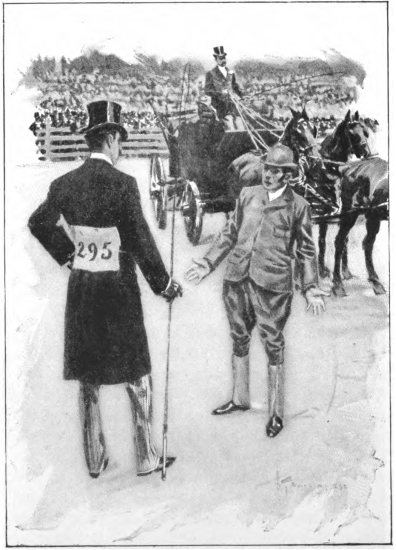
A trumpet sounded; a gate in the railing at the Fourth Avenue end of the building was opened; and a coach was driven into the arena. A very stout man sat on the box alone.
Mrs. Suydam raised her long-handled eye-glass and looked at the approaching coachman.
"Oh, that's not Jimmy," she said, quickly; "of course not. That's the man they call The Adipose Deposit."
The trumpet sounded again, and a second coach was turned into the arena. The four horses were beautifully matched bays. The driver was a tall, thin, youngish man, who sat impassible on the box, and gave no sign of annoyance when a wheel of the vehicle rasped the gate-post.
"That's Mr. Suydam," said the lady to whom Morton was talking, as the bays trotted briskly past them, the man on the box holding himself rigidly and handling the ribbons skilfully.
"He is quite a professional," Morton remarked.
"Isn't he?" Mrs. Suydam replied. "You know he drove the Brighton coach out of London for three years. He really does it very well, they all say. I've told him that if we ever lost our money he would make a very superior coachman."
"Those bays go together admirably," the college professor declared, "and Mr. Suydam handles them superbly. But how pitiful it is to see their tails docked!"
"Oh, they do that in England," she explained, "so it's fashionable. But it is ugly, isn't it? Do you remember what a lovely long tail that Kentucky mare had, the one I rode that day—"
Then Mrs. Suydam paused suddenly.
"Yes," answered Morton, not looking at her, "I remember it."
Mrs. Suydam conquered her slight embarrassment and gave a light little laugh.
"How rude I have been!" she said. "Here I've been talking about myself and about my husband, and I haven't asked about you. Are you married yet?"
"No," he answered, and now he looked at her, and she blushed again; "and I am not likely ever to marry, I think. There was only one woman in the world for me, and I told her so, but she didn't care for me at all, and she told me so—and then she touched up that Kentucky mare and rode away with my heart hanging at her saddle-bow."
"You can find a better woman than she is," was her response; "a woman who will make you a better wife than she would ever have done."
Before Morton could reply to this, the girl and the two young men who had been in the box at first returned from their visit to the stables. The trumpet sounded again, and the judges made the drivers of the four coaches—for two more had entered after Mr. Suydam's—repeat their evolutions around the arena. And then, after protracted consultation together, the awards were made, and grooms ran to attach rosettes to the leaders of the team driven by the stout gentleman, who took the first prize, and then to the leaders of the team driven by Suydam, who took the second prize. The numbers of the winning coaches were displayed on the wide sign-boards at each end of the hall. The coaches were driven around again, and then out. The trumpets were silent for a while; and the brass band crashed forth again.
"Jimmy won't like not getting the first prize, will he?" asked the girl who had just returned to the box.
"I don't think it will worry him," answered his wife, with a return of her haughty manner.
She had not introduced Morton to any of the others in the box.
In the presence of so many it was impossible to resume their conversation on the old friendly basis. It seemed to Morton that since the girl and the young men had come back there was a difference in Mrs. Suydam's manner towards him; he could not define it to himself, but he felt it. Perhaps she was conscious of this herself.
When he made a movement preparatory to going, she said: "Must you go? I wanted you to meet my husband. Can't you drop in and lunch with us to-morrow?"
Morton thanked her and regretted that he might have to take a midnight train, and expressed his pleasure at having met her again. Then she held out her hand once more; and a minute later he was again in the thick of the throng circling along the promenade.
Before he reached the entrance the music was checked suddenly and the trumpet blared out, and then the voice of a man in the centre of the building was heard, intermittently, hopelessly endeavoring to inform the thousands packed in the splendid edifice that the fastest trotter in the world would now be shown. The crowd which was staring steadily at the men and women in the boxes paid little attention to this proclamation; to it the men and women in the boxes were far more interesting than any horses could be, even if any one of these could trot a mile in two minutes without a running mate.
(1895.)