A DECORATION-DAY REVERY
Reading edition
HERE had been a late spring, set off by frequent rain; and when Decoration Day dawned there was a fresh fairness of foliage, as though Nature were making ready her garlands for our honored dead. When at length the march began, the sunshine sifted through the timid verdure of the trees in the square, and fell softly on the swaying ranks that passed beneath. The golden beams glinted from the slanting bayonets, and seemed to keep time with the valiant old war-tunes as they swelled up from the frequent bands. There was a contagion of military ardor in the air, and even the small boy who had climbed up into the safe eyry of a dismantled lamp-post had within him inarticulate stirrings of warlike ambition. In the pauses of the music fifes shrilled out, and the roll and rattle of drums covered the rhythmic tramping of the soldiers. I lingered for a while near the noble statue of the great admiral, who stood there firm on his feet, with the sea-breeze blowing back the skirt of his coat, and so presented by the art of the sculptor that the motionless bronze seemed more alive than most of the ordinary men and women who clustered about its base. Here, I thought, was the fit memorial of the man who had done his duty in the long struggle, to the heroes of which the day was sacred; and I was glad that the marching thousands should pass in review before that mute image of the best and bravest our country can bring forth. At that moment a detachment of sailors swung into view, and cheers of hearty greeting broke forth on all sides.

As I loitered, musing, a battalion of our little army strode by us in turn, with soldierly bearing, clad in no gaudy garb, but ready for their bloody work; ready with cold steel to give a cold welcome to the invading foreigner, ready with a prompt volley to put an end to lawless strife at home. After an interval came the first ranks of the citizen soldiery, trim in their workmanlike uniforms, with stretchers, with ambulances, with Gatling-guns. One after another advanced the regiments of the city militia, and no man need doubt that they would be as swift now to go forward to battle as were their former fellow-members whose deeds gave them the right to bear flags emblazoned with more than one battle as hard fought as Marathon or Philippi, Fontenoy or Waterloo. As they swept on down the Avenue in the morning sunlight, with the strident music veiled now and again by ringing cheers, my thoughts went back to the many other thousands I had seen go down that Avenue, now more than a quarter of a century ago, coming from the pine forests and the granite hills of New England, and going to the silent swamps and the dark bayous of the South. In those drear days of doubt I had watched the ceaseless tramp of the troops down that Avenue, a thousand at a time—young, earnest, ardent; and I remembered that I had seen them return but a scant hundred or two, it may be, worn and ragged, foot-sore and heart-sick, but resolute yet and full of grit. Death, like the maddened peasants in the strife of the Jacquerie, fights with a scythe; and for four long years Time held a slow glass and Death mowed a broad swath. There is many a house now where an old woman cannot hear the trivial notes of "Tramp, tramp, tramp, the boys are marching," without a sharp pain in the throat and a sudden vision of the prison-pen at Andersonville. No doubt there is many another woman south of that Mason and Dixon's line which was washed out in the blood of the war where the sentimental strains of "My Maryland" have an equal poignancy and an equal tenderness. Shiloh and Malvern Hill and Gettysburg are names made sacred forever by the deeds done there, and by the dead who lie there side by side in a common grave, where the gray cloth and the blue have faded into dust alike, and there is now naught to tell them apart. It is well that a spring day, fresh after rain and fair with blossoms, should help to keep their memory sweet.
Down the Avenue regiment after regiment went on briskly, with the easy pace of health and enjoyment. After the young men of the militia came the veterans, with flowers for their fallen comrades. Some of the older men were in carriages, with here and there a crutch across the seat; but for the most part they walked, keeping time, no doubt, though with a shorter stride. As a handful of brave men filed before us, bearing aloft the tattered remnant of a battle-flag, I raised my hat with instinctive reverence. For a moment the gesture shielded my eyes from the rays of the sun, and I caught sight of a group in the window of a house opposite. A lady, tall and stately, wearing a widow's cap above her gray hair as though it were a crown, stood in the centre with her hands on the shoulders of two young men—her sons, beyond all question—stalwart young fellows, with features at once fine and strong, bearing themselves with manly grace. I looked, and I recognized. When I lowered my eyes again to the procession I saw another set of faces that I knew by sight. In a carriage sat a man of some fifty years, stout, vulgar, with a cigar alight in the coarse hand which rested on the door of the vehicle. He had a shock of hair, once reddish and now grizzling to an unclean white. He wore in his button-hole the button of the Grand Army of the Republic. In the open barouche with him were three youngish men, noisy in laughter—apparently professional politicians of the baser sort.
"DISTRACTED BY THE CROSSING SHOUTS OF LOUD-VOICED MEN"
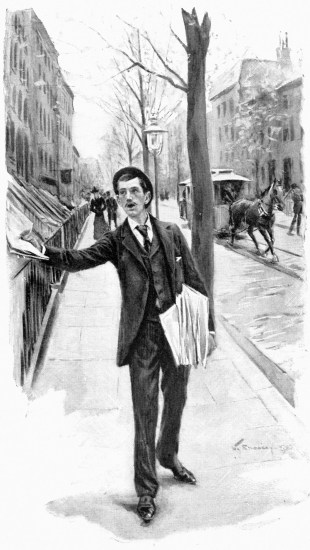
The man bowed effusively, with a broad and unctuous smile, when he saw a friend on the sidewalk; and the crowd about me recognized him, and called him by name one to another; and a little knot of young fellows on the corner raised a cheer.
I knew both groups, the unclean creature in the carriage and the noble lady in the window above him. I knew that both were survivals of the war.
As the procession passed on, I could hear an occasional cheer run along the line of spectators when one or another recognized the politician. I was not surprised, for the man's popularity with a portion of the people is patent to all of us. He was a soldier who had never fired a shot, a colonel who had never seen the enemy. His tactical skill had been shown in the securing of a detail for himself where there was chance of profit with no risk of danger. His strategy had been to secure the good word of those who dispensed the good things of life.
While others were battling for the country he was looking out for himself. When the war was over he presented his claims for recognition, and he was sent as consul to the Orient. In due time there came across the ocean rumors of scandals, and an investigation was ordered; whereupon he resigned, and the matter was never probed. Then he went into politics: he was ready of speech and loud-mouthed; he flattered the mob, believing that in politics the blarney-stone is the stepping-stone to success. He never paused to weigh his words when he assailed an opponent, believing that in politics billingsgate is the gate of success. He was prompt to set people by the ears that he might lead them by the nose the more readily. As though to make up for his delinquencies during the struggle, he was now untiring in his abuse of the Southern people, and his denunciation of them was always violent and virulent. In every election he besought his fellow-citizens to vote as they had shot. He was unfailingly bitter in his abuse of those who had fought for the cause of the South. He was, in short, a specimen of the scum which may float on the surface whenever there is an upheaval of the deep.
Brutal in political debate and brazen in political chicanery, he was a fit leader for the band of hirelings he had organized with no small skill. His position was not unlike that of the condottieri of the foreign mercenaries in the mediæval quarrels of the Italian republics. Like them, he led a compact body, prompt to obey orders so long as it received the pay and had hopes of the plunder for which it was organized. Although he belonged nominally to one of the two great parties which contended for the control of the nation, he was always ready to turn his forces against it if his pay and his proportion of the spoils of office failed to satisfy himself and his men-at-arms; or even in revenge for a slight, and in hope of higher remuneration from the other side.
For me, as I stood on the corner under Farragut's statue and watched the veterans file past, the knowledge of this man's career, and the sight of his presence among those who had fought a good fight for a high motive, seemed to tarnish the sacred occasion and to stain the glory of the morning. Again I looked up at the window where I had seen the lady with her two sons. She was still there, leaning forward a little, as though in involuntary excitement, and one hand clinched the arm of the soldierly young fellow at her right. The sight of those three refreshed me, for I knew who they were, and what they stood for in the history of our country—a shining example in the past and a beacon of hope for the future. The widow's cap which crowns the brow of that mother brought up before me the memory of a deed as noble as it was simple.
A fife-and-drum corps of boys dressed as sailors preceded a model of a monitor mounted on wheels and artfully adorned with flowers and wreaths. Behind this came the scanty score of old sailors who had formed themselves into Post Rodman R. Hardy. When they came abreast of the window where the lady stood with her two sons, they looked up and cheered. The eyes of Captain Hardy's widow had filled with tears when she caught sight of his old comrades; and when they cheered her and her boys her face flushed and the arm which rested on her son's trembled. She bowed, the two young men raised their hats, and the Post passed on down the Avenue to perform their sad office; though they might not deck with flowers the grave of their old commander, for he lies buried at the bottom of the sea, and great guns were firing many a salute with shot and shell when his body was lowered into its everlasting resting-place.
I have heard it said that a soldier's trade is learning how to kill and how to die, and that how he lives is little matter. Captain Hardy lived like a man, like a gentleman, like a Christian; and he died like a hero. He came of a generation of sailors. His great-grandfather had sailed with the fleet under Amherst when Louisburg was taken in 1758. His grandfather had been a midshipman with Paul Jones in the Bonhomme Richard. His father served on "Old Ironsides" when the Constitution captured the Guerrière. He himself had gone to sea in time to take part in the siege of Vera Cruz. When the war broke out he had been married but three years. He was on the Cumberland when the Merrimac sank her. While the new monitors were building he had a few brief weeks with his wife and his two baby boys. When the Onteora was finished he was a captain, and he was appointed to take command.
And there was no monitor which did better service or had more hard work than the Onteora. Just before the grand attack on Fort Davis he ran under the guns of a Confederate battery to shell a cruiser which had retreated up the river behind the strip of land on which the earthworks stood. Regardless of the fire from the battery, which bade fair to hammer his ship till it might become unmanageable, he trained his guns on the cruiser. He had no more than got the range when a fog settled down and hid the combatants from each other. The battery ceased firing or aimed wildly a few chance shots. The monitor, relying on the accuracy of its gunners, continued to send shell after shell through the thick wall of fog to the invisible place where the enemy's ship lay. When the fog lifted, the cruiser was on fire; and then the monitor fell back out of the range of the guns of the battery, having done the work Captain Hardy had set it to do.
The next day came the grand assault on Fort Davis. The admiral ordered the Onteora to follow the flag-ship in the attack. The channel was defended not only by the cannon of the fort itself and of its supporting earthworks and by a flotilla of gunboats, but also by hidden torpedoes, the position of which was wholly unknown even to the pilots, Union men of the port who had volunteered to guide our vessels through the tortuous windings of the entrance. The iron ship was made ready for battle; its deck was sunk level with the surface of the sea; and nothing projected but the revolving turret, with its two huge guns. In the little box of a pilot-house Captain Hardy took his place with the pilot. The admiral gave the signal to advance, and the Onteora followed in the wake of the flag-ship.
The first turning of the channel was made safely, and the monitor was at last full under the fire of the fort. The turret revolved slowly, and both guns were discharged against a pert gunboat which had ventured out beyond the protection of the fort. The second shot struck the steam-chest of the gunboat, and it blew up and drifted at the mercy of the current. Still the admiral advanced, and the Onteora followed. Then a sudden shock was felt, there was a dull roar, the monitor shivered from stem to stern, and began to settle. A torpedo had blown a hole in the bottom of the boat, and the Onteora was sinking. Almost at the same time a shot from Fort Davis struck the turret, and a fragment smote Captain Hardy and tore off his right arm. In the scant seconds after the explosion of the torpedo, before the shuddering ship lurched down, half a score of men escaped from the turret and flung themselves into the river. The captain had barely time to climb into the open air when his ship went down beneath him. When he arose from the vortex of whirling waters his unwounded hand grasped a chance fragment of wood, which served to sustain him despite the weakness from his open wound. He found himself by the side of the pilot, who was struggling vainly with the waves, his strength almost spent.
"Can't you swim?" asked Captain Hardy.
"Only a little," answered the pilot; "and I am almost gone now, I fear."
"Take this bit of wood," said the sailor.
The pilot reached out his arm and with despairing fingers gripped the broken plank. It was too small to support two men, and Captain Hardy released his hold. He sought to sustain himself with one hand, and for a little he succeeded. Then his strength failed him, and at last he went under almost where the Onteora had sunk beneath him. The battle raged above; shell from ship after ship answered shell from the fort and the batteries; another ironclad took up the work of the Onteora; brave hearts and quick heads were at work on sea and on shore; but Rodman Hardy was dead at the bottom of the river, leaving to his widow and his sons the heritage of a manly death.
The widow's cap which the young wife took that night she has never discarded to this day. His sons she has brought up to follow in their father's footsteps. One has already begun to make his mark in the navy, having been graduated from Annapolis, high up in his class. The other is a lawyer, who is solving for himself the problem of the scholar in politics. Although not yet thirty, he has spent two terms in the Legislature of the State, where he has done yeoman service for the city.
The parade was over at last—for the Rodman R. Hardy Post had been one of the latest in line—and I turned away across the square. The sight of the widow with her two sons had cleansed the atmosphere from the miasma that trailed behind the politician as he rode by me in his vulgar barouche. The memory of a great deed is an oasis in the vista of life, and the recollection of Captain Hardy's death made the day seem fairer. The sunshine flooded the streets with molten gold. A pair of young sparrows flitted across the park before me and alighted on a bough above my head. From over the house-tops came floating echoes of "John Brown's Body" and "Marching through Georgia."
(1890.)