A SPRING FLOOD IN BROADWAY
Reading edition
S he came down the steps of his sister's little house, that first Saturday in May, he saw before him the fresh greenery of the grass in Stuyvesant Square and the delicate blossoms on its sparse bushes and the young leaves on its trees; and he felt in himself also the subtle influences of the spring-tide. The sky was cloudless, serene, and unfathomably blue. The sun shone clearly, and the shadows it cast were already lengthening along the street. The gentle breeze blew hesitatingly. He heard the inarticulate shriek of the hawker bearing a tray containing a dozen square boxes of strawberries and walking near a cart piled high with crates. When he crossed Third Avenue he noticed that a white umbrella had flowered out over the raised chair of the Italian boot-black at the corner. A butcher-boy, with basket on arm, was lingering at a basement door in lively banter with a good-looking Irish cook. A country wagon, full of growing plants, crawled down the street while the vender bawled forth the cheapness of his wares.

There were other signs of the season at Union Square—the dingy landaus with their tops half open, the flowers bedded out in bright profusion, the aquatic plants adorning the broad basin of the fountain, the pigeons wooing and cooing languidly, the sparrows energetically flirting and fighting, the young men and maidens walking slowly along the curving paths and smiling in each other's faces. To Harry Grant, just home from a long winter in the bleak Northwest, it seemed as though man and nature were alike rejoicing in the rising of the sap and the bourgeoning of spring. It was as though the pulse of the strong city were beating more swiftly and with renewed youth. Harry Grant felt his own heart rejoice that he was back again amid the sights he loved, within a stone's-throw of the house where he was born, within pistol-shot of the residence of the girl he was now going at last to ask to marry him.
It was nearly a year since he had last seen her, but he knew she would greet him as cordially as she had always done. That Winifred was a good friend of his he knew well enough; what he did not know at all was whether or not the friendship had changed to love on her part also. He could hardly recall the time when he had not known her. He could distinctly remember the occasion when he had first told her that he intended to marry her when he was grown up—that was on a spring day like this, and he was seven and she was five, and they were playing together in Gramercy Park while their nurses followed them slowly around the enclosure. Now he was twenty-three and she was twenty-one; and in all these sixteen years there had been no day when he had not looked forward to their marriage. Of course, when he had grown to be a big boy and had been sent away to boarding-school, he had been ashamed to talk about such things. But when he went to college he had gazed ahead four years and almost fixed on the day he intended to propose.
Then his father had died, and the family affairs were left in inexplicable confusion. His uncle had offered to pay Harry's way through Columbia, but he was in a haste to be independent, to make his own path, to have a position which he could ask Winifred to share. He found a place at once in the office of a great dry-goods house; and he had been so successful there that one of their customers had offered him inducements to go out to a swiftly growing city in the new Northwest. Two years had Harry Grant spent out there—two years of hard work amid men who were all toiling mightily and who were capable of appreciating his youthful energy. Now he was back again in New York to act as the Eastern representative of the chief capitalist of the Northwestern city, an old man, who liked Harry, and who saw how useful his address and his character might be. The position was onerous for a man so young; but it was honorable also, and the salary was liberal even from a New York standpoint. At last he was again able to look at life from the point of view of a New-Yorker. At last he was ready to ask her to share his life.
He was in no hurry for the moment, as he could not make sure of finding her at home until nearly five o'clock, and it was now barely four by the transparent dial which Atlas bore on his back in the jeweller's upper window on the opposite side of the square. He crossed Broadway at Fourteenth Street, and there he was caught up at once and swept along by the spring-flood rolling up from down-town that beautiful afternoon in May. The windows of the florists' were lovely with Easter lilies and fragrant with branches of lilac. The windows of the confectioners' were gay with gaudy Easter eggs and with elaborate chocolate rabbits. Young girls pressed giggling through the doors to stand packed beside the soda-water fountains. Elderly men lingered at the street corners to stare at the young women.
Within an hour or two at the most Harry Grant intended to ask Winifred to be his wife, and as he saw the dread question so close before him he could not but wonder what the answer would be. Winifred liked him—that much he felt sure about. Whether she loved him, even a little, that he could not venture to guess. She had sturdy common-sense and she was self-reliant, he knew well, and yet he could not help fearing that perhaps the influence of her grandmother had been more powerful than he wished. It was possible, of course, that the restless and ambitious old lady had inoculated her young granddaughter with some of her own dissatisfaction.
As Harry's circumstances had changed since they were boy and girl together, so had Winifred's. Her father had died also, and then her grandfather, leaving a very large fortune to his widow, and Winifred had gone to live with her grandmother, Mrs. Winston-Smith. (It was her grandmother who had put the hyphen into the name, and who had insisted on its adoption by the son and the granddaughter.) That Mrs. Winston-Smith did not like him, Harry Grant knew only too well, or, at least, that she did not approve of him as a possible suitor for the hand of Miss Winston-Smith. She thought that her granddaughter ought to make a brilliant marriage. She had been heard to say that in England Winifred would have no difficulty in marrying a title. She had taken her granddaughter to London the season before, and they had been presented at court, to go afterwards on a round of country-house visits, returning late to finish the summer at Lenox.
All this Harry knew from the newspapers; but what Winifred had thought of it all he did not know, for he had not seen her since the day before her departure for England. And that interview itself had been in the presence of the grandmother and of two or three casual callers. Really he had not had chance of speech with the woman he had loved for three years—ever since Mrs. Winston-Smith had asked him to dinner one night, only to take him into the library and to tell him that she saw that he was attracted by Winifred, and no wonder, but that he must give up the hope of winning her. Mrs. Winston-Smith was some sixty-years old at the time of this talk with Harry Grant, and she was a very stately dame, with no lack of manner, but she could, if she chose, express herself with absolute frankness and directness. On that occasion she had seen fit to be perfectly plain-spoken. She had told him that Winifred had been used to luxury and could not do without it, and that if Winifred married against her wishes she would give all her money to the new cathedral, cutting the girl off without a cent. She asked Harry if he did not think it would be very selfish of him to press his suit when its success would mean the misery of the woman he pretended to love. She reminded him that his own income was meagre, and that he had no prospects. If, then, Winifred had no money, how could she as his wife have all the luxuries to which she was accustomed, and which had now become necessities? Of course she did not admit that Winifred was in any way interested in him. In fact, she hoped and trusted that the girl's affections were in no way engaged; and she relied on Mr. Grant's good sense and on his unwillingness to be so brutally selfish. After all, Winifred was a mere child, and had seen nothing of the world as yet.
Harry Grant had made no promises to Mrs. Winston-Smith, but he had felt the force of some of her arguments. Plainly he had no right to ask the woman he loved to give up everything for his sake; and as plainly he had no wish to live on any money her grandmother might give her. He meant, more than ever, to win her for his wife; but he saw clearly that he must make himself independent first. To be able to give her a home not unworthy of her he had worked hard all these years. At last he had succeeded, and he was in a position to ask her to marry him without at the same time asking her to surrender the most of the little comforts which made her life easy. With the salary he had now he could make her comfortable, even if her grandmother chose to take offence and cut her off without a cent. There was no false pride about the young fellow, and he did not pretend to himself that he did not care whether or not the grandmother carried out her threat. He was well aware that life would be very much pleasanter if Mrs. Winston-Smith should accept the situation and make the best of it, and give her granddaughter an adequate allowance.
Then, as these thoughts ran through his head, he smiled at his own fatuity in taking Winifred's consent for granted in this summary fashion. What Mrs. Winston-Smith said or did mattered little. What was of vital importance was Winifred's own answer to his question. He could not but recognize that to call on a young lady after a year's separation and to ask her in marriage, suddenly, without warning, was an unusual proceeding. And yet that was just what he was going to do; and he found himself musing over schemes for getting her away from her grandmother and from any chance visitors. He tried to devise a means of luring her into the library or of coaxing her into the conservatory. He cared not how soon they might be interrupted; he knew what he had to say, and he was prepared to say it briefly. Five minutes would be time enough—five minutes, if he could but have them clear. When a man has been wanting for years to be able to put a simple question, it ought not to take him long to say the needful words; and he knew that Winifred would not keep him waiting for his answer. Whether it was to be yes or no, she would know her own mind, and be ready and willing to accept him at once or to reject him with as little hesitation.
He had been keeping pace with the throng that was sweeping massively up-town, but as the fear seized him that, after all, he had little right to think she might love him, he lengthened his stride in futile impatience to get his answer sooner. He glanced up at Tiffany's clock, then almost over his head, and he slackened his speed as he saw that it was not yet five minutes past four. He had at least half an hour to wait before he could hope to find her at home.
Then, most unexpectedly, he was favored with fortune. The foremost of the carriages drawn up in Fifteenth Street alongside the jeweller's was a handsome coupé, in which a young lady was sitting alone. As Harry Grant drew near to the corner his glance fell on this coupé, and at that moment the young lady looked up. He saw that it was Winifred. As their eyes met a swift blush bloomed in her face, and faded as speedily. She smiled and held out her hand and laughed happily as he sprang to the door of the carriage.
"Winifred!" he cried.
"Harry!" she answered.
"I didn't expect to see you here!" he declared.
"Is that the reason you are here, then?" she returned.
He made no reply. He could not take his eyes from her. In his delight at seeing her again he had nothing to say.
"Well?" she asked, when she thought he had stared enough.
"Well," he answered, "I couldn't help it. You are prettier than ever."
Again a flush flitted across her face, fainter this time, and fleeting sooner.
"That's a very direct compliment, don't you think?" she retorted, withdrawing her hand, which he had kept clasped in his own. "And you are looking well, too. Your life out West there is good for you. I don't wonder you prefer it to this noisy old New York of ours."
"But I don't prefer it," he declared, hotly. "A week of New York is worth a year of the whole wide West put together. And I've done with all that now. I've come back here for good now—"
"Have you really?" she responded, as he hesitated, having so much to say that he did not know where to begin.
"I got back this morning," he explained, "and I was coming to see you this afternoon. I've—I've so many things to tell you."
She looked at him for a second, and then she glanced away, as she said: "You will have to talk very fast, then, if you have so many things to tell me. We are going to sail on Tuesday morning, and this afternoon we are off to Tuxedo for over Sunday."
"You sail on Tuesday?" he cried, despairingly. "Just when I have come back on purpose to see you again!"
"You didn't telegraph grandma that you were coming, or she might have made other arrangements," the young woman retorted, with a little laugh.
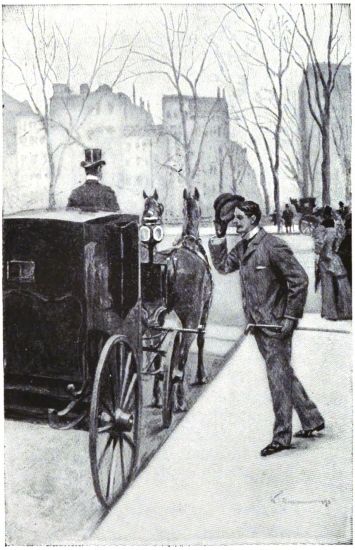
"'WINIFRED!' HE CRIED"
"And if you are going to Tuxedo to-night," he continued, paying no heed to this ironic suggestion, "then you won't be at home this afternoon?"
"No," she answered; "we shall be back just in time to dress and get away to the train. Grandma has two or three errands to do first—she's inside there arranging about some silver things she wants to take over with us."
"But I must see you to-day," he pleaded.
"Aren't you seeing me now?" she returned, as the blush rose again and fell.
"But I've got something I want to say to you!" he urged.
"Won't it keep till Monday afternoon?" she asked, with another light laugh; but beneath the levity there was more than a hint of feeling.
"No," he declared; "it won't keep an hour longer, for it's been kept too many years already. I've come here on purpose to tell you something—and I must do it to-day!"
"If it's something you want to tell grand-ma—" she began, as if to gain time.
"But it isn't," he returned, leaning his head almost inside the open window of the carriage. "It's you I want to talk to—not to your grandmother."
"Then," said she, with a subtle change of manner, "if it is something you don't want grandma to hear, don't try to say it now, for here she comes."
Harry Grant gave a hasty glance behind him, and he recognized the stately figure of Mrs. Winston-Smith in conversation with one of the salesmen just inside the door of the great store.
"Winifred," he said, pleadingly, taking her hand again, "where can I see you again, if only for a minute—only a minute? That's enough for what I want!"
Winifred looked at him and then down at her fingers. She hesitated, and finally she answered:
"I think I heard grandma say she was going to the florist's before she went home—that florist in Broadway near Daly's, you know. She has a lot of things to order there, and I shall sit in the carriage."
"I'll take the cable-car and be there waiting for you," he responded.
"Don't let grandma see you," she cried; "that is—well—"
Then she sank back on the cushions of the carriage, for Mrs. Winston-Smith was about to leave the store.
Harry Grant had caught sight of the old lady in time. He stepped away from the carriage, and, passing behind it, crossed to the other side of the street without giving Winifred's grandmother a chance to recognize him.
He waited on the opposite corner until Mrs. Winston-Smith took her place in the coupé beside her granddaughter, and until the carriage was turned and had started towards Fifth Avenue.
Then he crossed the broad space nearly to the edge of the park and jumped on the first car that came rushing around the curve. The platform was crowded, but he took no heed of the men who were pressed against him.
His thoughts were elsewhere and his heart was full of hope; it was attuned to the gladness of the spring-time. He did not see the young men and maidens who flocked thickly up Broadway; he saw Winifred only; he saw her face, her eyes, her smile of welcome. He was to see her again, at once almost, and he could tell her then how he loved her, and he could ask her if she would not try to love him. What if the only chance he should have was in the street itself? Only the proposal itself was of importance, the place mattered nothing. Perhaps the unconventionality of the proceeding even added zest to it. There was unconventionality in the frankness with which she had made the appointment. It was this frankness partly which made his heart leap with hope, and partly it was the welcome he thought he had read in her eyes when their glances met first.
The car sped on its way, stopping at almost every corner to take on and to let off men and women, who brushed against Harry Grant and whom he did not see, so absorbed was he in going over every word of his brief dialogue with the girl he loved. On the sidewalks were thick throngs of brightly dressed women looking into the windows of the shops, where were displayed brilliant parasols and trim yachting costumes and summer stuffs in lightsome colors.
As the car crossed Fifth Avenue he saw the carriage of Mrs. Winston-Smith only a block away. He recognized the coachman upright on the box, and then all at once he wondered what the coachman must have thought of his talk through the open window, and of his abrupt appearance. He smiled—indeed he laughed gently—for what did he care what the coachman might think, or anybody else? It was what she thought which was of importance, and nothing else mattered at all. And again he was seized with impatience to see her once and to tell her that he loved her, and to get her answer. The car was going swiftly, but it seemed to him to crawl. The coachman on the avenue was driving briskly, but Harry Grant was ready to rebuke the man for his sluggishness.
At last the car passed the door of the florist's Winifred had described. Its window was filled with azaleas massed with an artistic instinct almost Japanese. Harry Grant rode to the corner above and walked back very slowly, loitering before a shop window, but wholly unconscious of the spring neck-wear therein displayed. Two minutes later he saw Mrs. Winston-Smith's carriage coming down Twenty-ninth Street. It turned into Broadway and stopped before the florist's wide window. Mrs. Winston-Smith got out and ordered the coachman to wait at the corner.
She had disappeared inside the florist's before the coupé drew up in the side street.
As the coachman reined in his horses Harry Grant stepped up to the open window.
"Winifred—" he began.
"Oh!" she cried, "you are here already?" and again the blush crossed her face.
"Winifred," he repeated, leaning his head inside the carriage, "I may have only a minute to say what I have to say, and I know this isn't the right place to say it, either, but I have no choice, for I may not have another chance. I have waited so long that I simply must speak now."
He paused for a moment. She said nothing, but she rubbed the back of her glove as though to wear away a speck of dirt.
"Winnie," he went on, "what I want to say is simple enough. I love you. Surely you must know that?"
"Yes," she answered, raising her eyes to his, "I know that."
"Then it's easier for me to go on. You know me; you know all about me; you know all my faults, or most of them anyway; you know I love you. Do you think you could ever love me a little in return? I will try so hard to deserve it. I've been working ever since I was seventeen to make money enough to be able to ask you to marry me. I've got a good position now, one that I'm not ashamed to ask you to share. Will you? Will you marry me, Winnie?"
Before she could make any answer, Harry Grant heard the voice of Mrs. Winston-Smith behind him saying to the coachman, "Home!"
He stepped back and found himself face to face with her.
"It's Mr. Grant, isn't it?" she said, with a haughty inclination of her head. "It's very good of you to amuse Winifred while I was in the shop. I'd ask you to come and have a cup of tea with us, but we are off to Tuxedo. And we sail on Tuesday; perhaps Winifred told you."
She stood there, expecting him to open the carriage door for her. It was the least he could do, and he did it. But he could find no words to respond to her conventional conversation. He looked at Winifred, and he saw that the color was deepening on her cheeks, and that her eyes were very bright.
"Grandma," she said, when at last Mrs. Winston-Smith was seated beside her—"Grandma," she repeated, loud enough for the young man to hear as he stood by the open window, "Harry has asked me to marry him—and you came out just before I had time to tell him that I would!"
(1895.)