A VISTA IN CENTRAL PARK
Reading edition
T was the last Sunday in September, and the blue sky arched above the Park, clear, cloudless, unfathomable. The afternoon sun was hot, and high overhead. Now and then a wandering breeze came without warning and lingered only for a moment, fluttering the broad leaves of the aquatic plants in the fountain below the Terrace. At the Casino, on the hill above the Mall, men and women were eating and drinking, some of them inside the dingy and sprawling building, and some of them out-doors at little tables set in curving lines under the gayly colored awnings, which covered the broad walk bending away from the door of the restaurant. From the bandstand in the thick of the throng below came the brassy staccato of a cornet, rendering "The Last Rose of Summer." Even the Ramble was full of people; and the young couples, seeking sequestered nooks under the russet trees, were often forced to share their benches with strangers. Beneath the reddening maples lonely men lounged on the grass by themselves, or sat solitary and silent in the midst of chattering family groups.

The crowd was cosmopolitan and unhurried. For the most part it was good-natured and well-to-do. There was not a beggar to be seen; there was no appealing poverty. Fathers of families there were in abundance, well-fed and well-clad, with their wives and with their sons' wives and with their sons' children. Maids in black dresses and white aprons pushed baby-carriages. Young girls in groups of three and four giggled and gossiped. Young men in couples leaned over the bridge of the Lake, smoking and exchanging opinions. There was a general air of prosperity gladly displaying itself in the sunshine; the misery and the want and the despair of the great city were left behind and thrust out of mind.
"TWO SLIM JAPANESE GENTLEMEN"
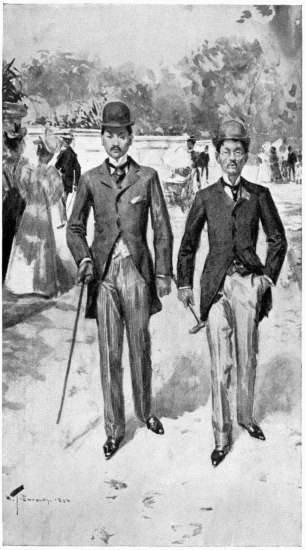
Two or three yards after a portly German with a little boy holding each of his hands while a third son still younger rode ahead astride of his father's solid cane, there came two slim Japanese gentlemen, small and sallow, in their neatly cut coats and trousers. A knot of laughing mulatto-girls followed, arm in arm; they, too, seemed ill-dressed in the accepted costume of civilization, especially when contrasted with half a dozen Italians who passed slowly, looking about them with curious glances; the men in worn olive velveteens and with gold rings in their ears, the women with bright colors in their skirts and with embroidery on their neckerchiefs. Where the foot-path touched the carriage-drive there stood a plain but comfortably plump Irishwoman, perhaps thirty years of age; she had a baby in her arms, and a little girl of scant three held fast to her patched calico dress; with her left hand she was proffering a basket containing apples, bananas, and grapes; two other children, both under six, played about her skirts; and two more, a boy and a girl, kept within sight of her—the girl, about ten years old, having a basket of her own filled with thin round brown cakes; and the boy, certainly not yet thirteen, holding out a wooden box packed with rolls of lozenges, put up in red and yellow and green papers. Now and again the mother or one of the children made a sale to a pedestrian on his way to the music. The younger children watched, with noisy glee, the light leaps of a gray squirrel bounding along over the grass behind the path and balancing himself with his horizontal tail.
The broad carriage-drive was as crowded as any of the foot-paths. Bicyclists in white sweaters and black stockings toiled along in groups of three and four, bent forward over the bars of their machines. Politicians with cigars in the corners of their mouths held in impatient trotters. Park omnibuses heavily laden with women and children drew up for an instant before the Terrace, and then went on again to skirt the Lake. Old-fashioned and shabby landaus lumbered along with strangers from the hotels. Now and then there came in sight a hansom cab with a young couple framed in the front of it, or a jolting dog-cart, on the high seat of which a British-looking young man was driving tandem. Here and there were other private carriages—coupés and phaetons, for the most part, with once and again a four-in-hand coach rumbling heavily on the firmly packed road.
A stylish victoria sped along, spick and span, with its glistening harness and its jingling steel chains, with its stalwart pair of iron-gray steppers and with two men on the box, correct and impassive. Suddenly, as it passed close to the walk at the end of the Terrace, the coachman drew up sharply, pulling his horses back on their haunches and swearing inaudibly at the plump Irishwoman who had dropped her basket of fruit just in time to rescue one of her children from being run over.
"It's more careful ye ought to be!" cried the mother, as she stood again on the walk with her daughter clasped to her waist.
"We are very sorry, indeed," said the lady in the victoria, leaning forward. "It was an accident."
"An accident, was it?" returned the Irishwoman. "An' it's an accident, then, ye wouldn't like if it was yer own children ye were runnin' over like that."
The childless couple in the carriage looked at each other for a moment only; and then the husband said, swiftly, "Drive on, John!"
He was a man of fifty, spare in frame and round-shouldered; he had a keen glance, and a weary smile came and went on his lips, not hidden by his sparse gray moustache. His wife was a woman of perhaps thirty, tall, dark, with passionate eyes and a full figure.
She was still leaning forward, clinching the side of the carriage as it turned northward and rolled along by the side of the Lake. Her voice showed that her excitement had not subsided, as she faced her husband again and said: "John is getting very careless. That is the third time this week he has nearly run over a child!"
"He has not quite run over one yet. It will be time enough to discharge him when he does," her husband answered, calmly. "That little girl there is none the worse for her fright. She seemed a pretty little thing, and she has been saved to grow up in a tenement-house and to go to the devil ten years from now. So her mother has cause to be thankful."
His wife looked at him indignantly. "I suppose," she said, "you mean that it is a pity that John didn't run over the child and kill her."
"I didn't mean that exactly," he responded. "But perhaps it is true enough. Death is not the worst thing in this world, you know."
"You are always talking of dying," returned his young wife, impatiently. "I wonder you don't commit suicide."
"I have thought of it," he answered, looking at her with a tolerant smile. "But life amuses me still—I have so much curiosity, you know. But I might do it, if I were sure I could have the privilege of coming back to see what you will be up to when I'm gone."
She looked straight before her and made no answer, keeping her lips firmly compressed.
There was a touch of tenderness in his tone as he went on, a curious cynical tenderness, quite characteristic of him. "Don't let some rascal marry you for my money. That would annoy me, I confess. And yet, I don't know why I should suggest the possibility of such a thing, for you will be a most fascinating widow."
She gazed ahead steadily and said nothing, but she had joined her hands together, and her fingers kept moving.
"Still," he continued, "I'm afraid I'm good for ten years more. We're a hardy stock, you know. My father lived to be eighty, and he was fifty when I was born. Besides, you take such good care of me always."
He held out his hand to her, and she took it and clasped it tight in both of hers, while the tears brimmed her eyes.
"But perhaps you are letting me stay out too long this afternoon," he said. "It is balmy, I know, but I'm getting tired already."
"John," she cried, hastily, "you may turn now, and go home."
"I don't want you to lose this lovely September afternoon," her husband declared. "Take me home, and come back to the Park here for an hour, while I have a nap, if I can."
Just then there was a break in the stream of vehicles, and the coachman took advantage of it and turned the horses' heads southward. In five minutes the victoria swerved to the westward, leaving the Lake behind, and making for the Riverside Drive.
The Lake was gay with boats. Black gondolas with white canopies and brilliant American flags were propelled adroitly by their standing boat-men. Light canoes were paddled briskly in and out of the bays and channels, where the ducks and swans swam lazily about. Young fellows in their shirt-sleeves tugged inexpertly at the oars of row-boats laden down with young women. By regular and easy strokes the Park watermen rowed the capacious barges, with their striped awnings, in the prescribed course around the Lake. The oars flashed in the flickering sunlight, and the sunshine gilded the prows of the distant canoes as they shot across the vista. The yellow leaves of the maples high on the bank over the opposite shore fluttered loosely away on the doubtful breeze, and at last fell languidly into the water. To the west a towering apartment-house lifted itself aloft over the edge of the Park, and seemed to shorten the space between. To the east the gilded dome of a new synagogue rose over the tree-tops. Above all was the blue concave of the calm and illimitable sky.
When the victoria, with its two men on the box and with its pair of high-stepping horses, returned to the Park, and skirted the Lake again, and approached the Terrace, the lady sat in it alone. As she came in sight of the Mall she bent forward, eagerly looking for the little girl whom they had almost run over half an hour earlier.
Near the Terrace she saw the pleasant-faced Irishwoman, with her basket of fruit in one hand and the baby in the other arm; the three little children were playing about their mother's feet, while the elder boy and girl were only a few yards away.
The lonely woman in the victoria bade the coachman draw up.
Seeing the carriage stop at the side of the road the Irishwoman came forward, proffering her fruit. Then she recognized the lady and checked her approach, hesitating.
The handsome woman in the carriage smiled, and said, "Which is the little girl we almost ran over?"
"That's the one," answered the mother, indicating the slip of a child who was now clasping the edge of the fruit-basket while staring at the strange lady with wide-open eyes.
"What a pretty child she is!" said the lady. "I hope she is none the worse for her fright?"
"Ye didn't break any bones, if that's what ye mean," the mother responded.
"And how old is she?" was the next question.
"She'll be three years old come Christmas," was the answer.
The lady in the carriage felt in her pocket, and brought out her purse and looked through it.
"Here," she said at last, as she took out a five-dollar gold-piece; "here is something I wish you would give her on Christmas morning as a present from me. Will you?"
"I will that," the mother replied, taking the money, "and gladly too. It's richer than her sisters she'll be now."
"How many children have you?" the lady inquired.
"Six; thank ye, ma'am, for askin'," was the response, "an' all well and hearty."
"Six?" echoed the woman in the victoria, with a hungry gleam in her eyes. "You have six children?"
"It's six I have," the mother answered; "and it's a fine lot they are altogether, though I say it that shouldn't."
The lady put her hand in her purse again.
"Buy something with this for the others," she said, placing a bank-note in the Irishwoman's hands. Then she raised her voice and added, "You may drive on, John!"
As the victoria rolled away to the westward the fruit-vender courtesied, and the children all looked after the carriage with interest.
"That lady must be very rich," said the eldest boy, the one who had the lozenges for sale. "I shouldn't wonder if she had two millions of dollars!"
"She must be very happy," the eldest girl added. "I suppose she can have ice-cream every day, and go to the Seaside Home for two weeks whenever she wants."
"It's a kind heart she has anyway, for all her money," was the mother's comment, as she unfolded the bank-note and saw the X in the corner of it.
Meanwhile the lady in the victoria was eaten with bitter thoughts as the carriage rattled along in the brilliant sunshine beneath the unclouded sky.
"Six children!" she was saying to herself. "That Irishwoman has six children! Why is it that some women have so much luck?"
(1893.)