VIII.—COSTUME OF THE HULA DANCER
Reading edition
The costume of the hula dancer was much the same for both sexes, its chief article a simple short skirt about the waist, the pa-ú. (PL I.)
When the time has come for a dance, the halau becomes one common dressing room. At a signal from the kumu the work begins. The putting on of each article of costume is accompanied by a special song.
First come the ku-pe’e, anklets of whale teeth, bone, shell-work, dog-teeth, fiber-stuffs, and what not. While all stoop in unison they chant the song of the anklet:
Mele Ku-pe’e
[Translation.]
Anklet-Song
Fragrant the grasses of high. Kane-hoa. Bind on the anklets, bind! Bind with finger deft as the wind That cools the air of this bower. 5Lehua bloom pales at my flower, O sweetheart of mine, Bud that I’d pluck and wear in my wreath, If thou wert but a flower!
The short skirt, pa-u, was the most important piece of attire worn by the Hawaiian female. As an article of daily wear it represented many stages of evolution beyond the primitive fig-leaf, being fabricated from a great variety of materials furnished by the garden of nature. In its simplest terms the pa-ú was a mere fringe of vegetable fibers. When placed as the shield of modesty about the loins of a woman of rank, or when used as the full-dress costume of a dancing girl on a ceremonious occasion, it took on more elaborate forms, and was frequently of tapa, a fabric the finest specimens of which would not have shamed the wardrobe of an empress.
In the costuming of the hula girl the same variety obtained as in the dress of a woman of rank. Sometimes her pa-ú would be only a close-set fringe of ribbons stripped from the bark of the hibiscus (hau), the ti leaf or banana fiber, or a fine rush, strung upon a thong to encircle the waist. In its most elaborate and formal style the pa-ú consisted of a strip of fine tapa several yards long and of width to reach nearly to the knees. It was often delicately tinted or printed, as to its outer part, with stamped figures. The part of the tapa skirt thus printed, like the outer, decorative one in a set of tapa bed-sheets, was termed the kilohana.
The pa-ú worn by the danseuse, when of tapa, was often of such volume as to balloon like the skirt of a coryphée. To put it on was quite an art, and on that account, if not on the score of modesty, a portion of the halau, was screened off and devoted to the use of the females as a dressing room, being known as the unu-lau-koa, and to this place they repaired as soon as the kumu gave the signal for dressing.
The hula pa-ú of the women was worn in addition to that of daily life; the hula pa-ú of the men, a less pretentious affair, was worn outside the malo, and in addition to it.
The method of girding on the pa-ú was peculiar. Beginning at the right hip—some say the left—a free end was allowed to hang quite to the knee; then, passing across the back, rounding the left hip, and returning by way of the abdomen to the starting point, another circuit of the waist was accomplished; and, a reverse being made, the garment was secured by passing the bight of the tapa beneath the hanging folds of the pa-ú from below upward until it slightly protruded above the border of the garment at the waist. This second end was thus brought to hang down the hip alongside of the first free end; an arrangement that produced a most decorative effect.
The Hawaiians, in their fondness for giving personal names to inanimate objects, named the two free ends (apua) of the pa-ú respectively Ku-kápu-úla-ka-láni and Léle-a-mahu’i.
According to another method, which was simpler and more commonly employed, the piece was folded sidewise and, being gathered into pleats, a cord was inserted the length of the fold. The cord was passed about the waist, knotted at the hip, and thus held the garment secure.
While the girls are making their simple toilet and donning their unique, but scanty, costume, the kumu, aided by others, soothes the impatience of the audience and stimulates their imagination by cantillating a mele that sets forth in grandiloquent imagery the praise of the pa-ú.
Oli Pa-ú
I ka pa-ú noenoe i hooluu’a,
5
Malama o lilo i ka pa-ú.
Pali ku kahakó liaka a-i,
10
Akahi ke ana, ka luhi i ka pa-ú:
Ka ho-oio i ke kapa-wai,
15
I hopu ’a i ka ua noe holo poo-poo,
Me he pa-ú elehiwa wale i na pali.
Ohiohi ka pali, ki ka liko o ka lama,
I hopu a omau ia e ka maino.
20
Holo ke oloná, paa ke kapa.
Hu’a lepo ole ka pa-ú;
25
Opua ke ahi i na pali,
I hookau kalena ia e ka makani,
I kaomi pohaku ia i Wai-manu,
30
I na alá, i alá lele
Lalau o Ha’i i ka ohe,
35
I kauhihi ia ia ohe laulii, ia ohe.
I apahu ia a poe,
40
He pola ia no ka pa-ú;
E hii ana e Ka-holo-kua-iwa,
Ke amo la e Pa-wili-wlli
45
Kau poku a hana ke ao,
Kau iluna o Hala’a-wili,
I owili hana haawe.
Ku-ka’a, olo-ka’a wahie;
50
Uwá, kamalii, hookani ka pihe,
I ka mahalo i ka pa-ú,
Pi’o anuenue a ka ua e ua nei.
This is a typical Hawaiian poem of the better sort, keyed in a highly imaginative strain. The multitude of specific allusions to topographical names make it difficult to translate it intelligently to a foreign mind. The poetical units are often so devised that each new division takes its clue from the last word of the previous verse, on the principle of “follow your leader,” a capital feature in Hawaiian poetry.
[Translation.]
Pa-ú Song
Gird on the pa-ú, garment tucked in one side,
Skirt lacelike and beauteous in staining,
That is wrapped and made fast about the oven.
Bubbly as foam of falling water it stands,
5
Quintuple skirt, sheer as the cliff Kupe-hau.
One journeyed to work on it at Honokane.
Have a care the pa-ú is not filched.
Scent from the robe Manú climbs the valley walls—
Abysses profound, heights twisting the neck.
10
A child is this steep thing of the cliff Kau-kini,
A swelling cloud on the peak of Auwana.
Wondrous the care and toil to make the pa-ú!
What haste to finish, when put a-soak
In the side-glancing stream of Apua!
15
Caught by the rain-scud that searches the glen,
The tinted gown illumines the pali—
The sheeny steep shot with buds of lama—
Outshining the comely malua-ula.
Which one may seize and gird with a strong hand.
20
Look at the oloná fibers inwrought,
Like the trickling brooklets of Wai-hilau.
The oloná, fibers knit with strength
This dainty immaculate web, the pa-ú,
25
And the filmy weft of the kilo-hana.
With the small bamboo the tapa is finished.
A fire seems to bud on the pali,
When the tapa is spread out to dry,
Pressed down with stones at Wai-manu—
30
Stones that are shifted about and about,
Stones that are tossed here and there,
Like work of the hail-thrower Kane.
At Wai-manu finished, ’tis cut at Wai-pi’o;
Ha’l takes the bamboo Ko-a’e-kea;
35
Deftly wields the knife of small-leafed bamboo;
A bamboo choice and fit for the work.
Cut, cut through, cut off the corners;
Cut round, like crescent moon of Hoaka;
Cut in scallops this shift that makes tabu:
40
A fringe is this for the pa-ú.
’Tis lifted by Ka-holo-ku-iwa,
’Tis borne by Pa-wili-wili;
A pa-ú narrow at top like a house,
That’s hung on the roof-tree till morning,
45
Hung on the roof-tree Ha-la’a-wili.
Make a bundle fitting the shoulder;
Lash it fast, rolled tight like a log.
The bundle falls, red shows the pali;
The children shout, they scream in derision.
50
The a’o bird shrieks itself hoarse
In wonder at the pa-ú—
Pa-ú with a sheen like Hi’i-lawe falls,
Bowed like the rainbow arch
Of the rain that’s now falling.
The girls of the olapa, their work in the tiring-room completed, lift their voices in a spirited song, and with a lively motion pass out into the hall to bloom before the waiting assembly in the halau in all the glory of their natural charms and adornments:
Oli
Ku ka punohu ula i ka moana;
Hele ke ehu-kai, uhi i ka aina;
Olapa ka uila, noho ï Kahiki.
Ulna, nakolo,
5
Uwa, ka pihe,
E Laka, e!
[Translation.]
Tiring Song.
The rainbow stands red o’er the ocean; Mist crawls from the sea and covers the land; Far as Kahiki flashes the lightning; A reverberant roar, 5A shout of applause From the four hundred. I appeal to thee, Laka!
The answering song, led by the kumu, is in the same flamboyant strain:
Oli
[Translation.]
Song
Lift Mahu’ilani on high; Thy palms Kauna-lewa a-waving!
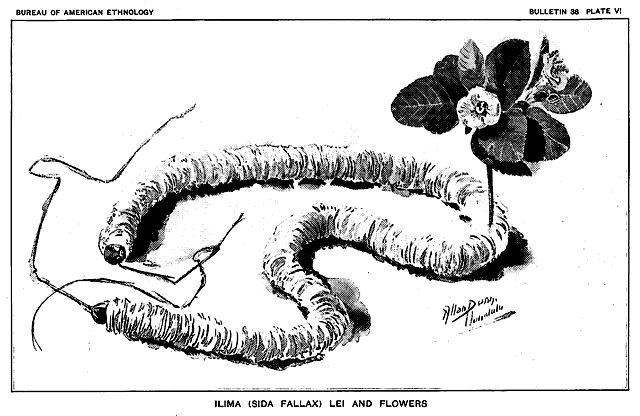
After the ceremony of the pa-ú came that of the lei, a wreath to crown the head and another for the neck and shoulders. It was not the custom in the old times to overwhelm the body with floral decorations and to blur the outlines of the figure to the point of disfigurement; nor was every flower that blows acceptable as an offering. The gods were jealous and nice in their tastes, pleased, only with flowers indigenous to the soil—the ilima (pl. VI), the lehua, the maile, the ie-ie, and the like (see pp. 19, 20). The ceremony was quickly accomplished. As the company knotted the garlands about head or neck, they sang:
Oli Lei
Ke lei mai la o Ka-ula i ke kai, e!
Ke malamalama o Niihau, ua malie.
A malie, pa ka Inu-wai.
Ke inu mai la na hala o Naue i ke kai.
5
No ka lua no i Kilauea.
[Translation.]
Wreath Song
Ka-ula wears the ocean as a wreath; Nii-hau shines forth in the calm. After the calm blows the wind Inu-wai; Naue’s palms then drink in the salt. 5From Naue the palm, from Puna the woman— Aye, from the pit, Kilauea.
Tradition tells a pathetic story (p. 212) in narrating an incident touching the occasion on which this song first was sung.