XVIII.—AN INTERMISSION
Reading edition
During the performance of a hula the halau and all the people there assembled are under a tabu, the imposition of which was accomplished by the opening prayer that had been offered before the altar. This was a serious matter and laid everyone present under the most formal obligations to commit no breach of divine etiquette; it even forbade the most innocent remarks and expressions of emotion. But when the performers, wearied of the strait-jacket, determined to unbend and indulge in social amenities, to lounge, gossip, and sing informal songs, to quaff a social bowl of awa, or to indulge in an informal dance, they secured the opportunity for this interlude, by suspending the tabu. This was accomplished by the utterance of a pule hoo-noa, a tabu-lifting prayer. If the entire force of the tabu was not thus removed, it was at least so greatly mitigated that the ordinary conversations of life might be carried on without offense. The pule was uttered by the kumu or some person who represented the whole-company:
Pule Hoo-noa
Lehua i-lalo,
A wawae,
5
A-koa-koa,
10
Papa pau.
Pau a’e iluna;
O Ku-mauna,
A me Laka,
15
A me Ku.
Ku i ka wao,
A me Hina,
Huna mele-lani.
A ua pau;
20
Pau kakou;
A ua noa;
Noa ke kahua;
Noa!
[Translation.]
Power to Remove Tabu
Bloom of lehua on altar piled, Bloom of lehua below, Bloom of lehua at altar’s base, In the month Ka-ulua. 5Present here is Haumea, And the father of thee, And the goddess of eloquent speech; Gather, now gather, Ye ranks of gods, 10And ye ranks of men, Complete in array. The heavenly service is done, Service of Ku of the mount, Service of Laka, 15And the great god Ku, Ku of the wilds, And of Hina, Hina, the heavenly singer. Now it is done, 20Our work is done; The tabu is lifted, Free is the place, Tabu-free!
Here also is another pule hoo-noa, a prayer-song addressed to Laka, an intercession for the lifting of the tabu. It will be noticed that the request is implied, not explicitly stated. All heads are lifted, all eyes are directed heavenward or to the altar, and the hands with a noiseless motion keep time as the voices of the company, led by the kumu, in solemn cantillation, utter the following prayer:
Pule Hoo-noa no Laka
5
Ka Lehua me ke Koa lau-lii;
O ka Lama me Moku-halii,
Lakou me Lau-ka-ie-ie,
Ka Palai me Maile-lau-lii.
10
Noa, noa i kou kuahu;
Noa, noa ia oe, Làka;
Pa-pá-lùa noa!
[Translation.]
Tabu-lifting Prayer (to Laka)
Oh wildwood bouquet, O Láka! Set her greenwood leaves in order due; And Ku, god of Ohia-La-ká, He and Ku, the shaggy, 5Lehua with small-leafed Koa, And Lama and Moku-hali’i, Kú-i-kú-i and Haia-pé-pé; And with these leafy I-e-i-e, Fern and small-leafed Maile. 10Free, the altar is free! Free through, you, Laka, Doubly free!
But even now, when the tabu has been removed and the assembly is supposed to have assumed an informal character, before they may indulge themselves in informalities, there remains to be chanted a dismissing prayer, pule hooku’u, in which all voices must join:
Pule Hooku’u
Ku au, hele;
Noho oe, aloha!
Aloha na hale o makou i makamaka ole,
5
H-u-l-i.
E huli a’e ana i ka makana,
I ke alana ole e kanaenae aku ia oe.
Eia ke kanaenae, o ka leo.
[Translation.]
Dismissing Prayer
Doomed sacrifice I in the love-quest,
To you who remain, farewell!
Farewell to our homes forsaken.
5
On the road beyond In-decision,
I turn me about—
Turn me about, for lack of a gift,
An offering, intercession, for thee—
My sole intercession, the voice.
This fragment—two fragments, in fact, pieced together—belongs to the epic of Pele. As her little sister, Hiiaka, is about to start on her adventurous journey to bring the handsome Prince Lohiau from the distant island of Kauai she is overcome by a premonition of Pole’s jealousy and vengeance, and she utters this intercession.
The formalities just described speak for themselves. They mark better than any comments can do the superstitious devotion of the old-timers to formalism, their remoteness from that free touch of social and artistic pleasure, the lack of which we moderns often lament in our own lives and sigh for as a lost art, conceiving it to have been once the possession of “the children of nature.”
The author has already hinted at the form and character of the entertainments with which hula-folk sometimes beguiled their professional interludes. Fortunately the author is able to illustrate by means of a song the very form of entertainment they provided for themselves on such an occasion. The following mele, cantillated with an accompaniment of expressive gesture, is one that was actually given at an awa-drinking bout indulged in by hula-folk. The author has an account of its recital at Kahuku, island of Oahu, so late as the year 1849, during a circuit of that island made by King Kamehameha III. This mele is reckoned as belonging to the ordinary repertory of the hula; but to which particular form of the dance it was devoted has not been learned:
Mele
Ua ona o Kane i ka awa;
Kipú mai la i ke kapa o ka noe.
5
Noe-noe na hokú o ka lani—
Imo-imo mai la i ka po a’e-a’e.
Meha na pali o Wai-pi’o
10
I ke kani mau o Kiha-pú;
A ono ole ka awa a ke alii
I ke kani mau o Kiha-pú;
Moe ole kona po o ka Hooilo;
Uluhua, a uluhua,
15
I ka mea nana e hull a loaa
I kela kupua ino i ka pali,
Olali la, a olali.
[Translation.]
Song
Kane is drunken with awa; His head is laid on the pillow; His body stretched on the mat. A trumpet sounds through the fog, 5Dimmed are the stars in the sky; When the night is clear, how they twinkle! Lani-kaula’s torches look double, The torches that burn for Kane. Ghostly and drear the walls of Waipio 10At the endless blasts of Kiha-pú. The king’s awa fails to console him; ’Tis the all-night conching of Kiha-pú. Broken his sleep the whole winter; Downcast and sad, sad and downcast, 15At loss to find a brave hunter Shall steal the damned conch from the cliff. Look, how it gleams [through the fog]!
Kane, the chief god of the Hawaiian pantheon, in company with other immortals, his boon companions, met in revelry on the heights bounding Wai-pi’o valley. With each potation of awa they sounded a blast upon their conch-shells, and the racket was almost continuous from the setting of the sun until drowsiness overcame them or the coming of day put an end to their revels.
The tumult of sound made it impossible for the priests to perform acceptably the offices of religion, and the pious king, Liloa, was distressed beyond measure. The whole valley was disturbed and troubled with forebodings at the suspension of divine worship.
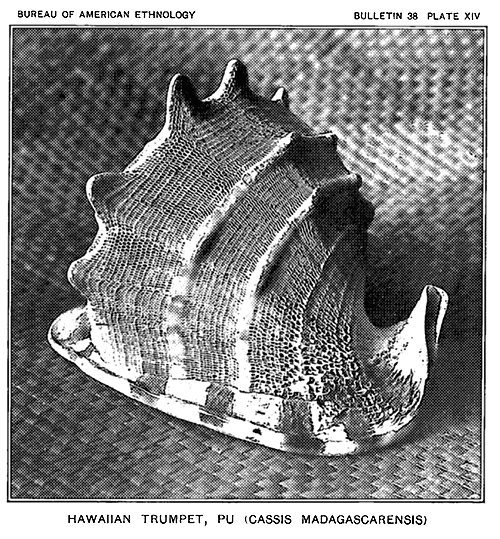
The chief offender was Kane himself. The trumpet which he held to his lips was a conch of extraordinary size (pl. XIV) and credited with a divine origin and the possession of supernatural power; its note was heard above all the others. This shell, the famed Kiha-pú, had been stolen from the heiau of Paka’a-lána, Liloa’s temple in Waipi’o valley, and-after many-adventures had come into the hands of god Kane, who used it, as we see, for the interruption of the very services that were intended for his honor.
The relief from this novel and unprecedented situation came from an unexpected quarter. King Liloa’s awa-patches were found to be suffering from the nocturnal visits of a thief. A watch was set; the thief proved to be a dog, Puapua-lenalena, whose master was a confirmed awa-toper. When master and dog were brought into the presence of King Liloa, the shrewd monarch divined the remarkable character of the animal, and at his suggestion the dog was sent on the errand which resulted in the recovery by stealth of the famed conch Kiha-pú. As a result of his loss of the conch, Kane put an end to his revels, and the valley of Wai-pi’o again had peace.
This mele is an admirable specimen of Hawaiian poetry, and may be taken as representative of the best product of Hawaii’s classical period. The language is elegant and concise, free from the redundancies that so often load down Hawaiian compositions. No one, it is thought, will deny to the subject-matter of this mele an unusual degree of interest.
There is a historic side to the story of the conch-shell Kiha-pú. Not many years ago the Hawaiian Museum contained an ethnological specimen of great interest, the conch-shell Kiha-pú. It was fringed, after the fashion of a witch-doll, with strings, beads, and wampumlike bits of mother-of-pearl, and had great repute as a kupua or luckbringer. King Kalakaua, who affected a sentimental leaning to the notions of his mother’s race, took possession of this famous “curio” and it disappeared from public view.