IX.—THE HULA ALA’A-PAPA
Reading edition
Every formal hula was regarded by the people of the olden time as a sacred and religious performance (tabu); but all hulas were not held to be of equal dignity and rank (hanohano). Among those deemed to be of the noblest rank and honor was the ala’a-papa. In its best days this was a stately and dignified performance, comparable to the old-fashioned courtly minuet.
We shall observe in this hula the division of the performers into two sets, the hoopa’a and the olapa. Attention will naturally bestow itself first on the olapa, a division of the company made up of splendid youthful figures, young men, girls, and women in the prime of life. They stand a little apart and in advance of the others, the right hand extended, the left resting upon the hip, from which hangs in swelling folds the pa-ú. The time of their waiting for the signal to begin the dance gives the eye opportunity to make deliberate survey of the forms that stand before us.
The figures of the men are more finely proportioned, more statuesque, more worthy of preservation in marble or bronze than those of the women. Only at rare intervals does one find among this branch of the Polynesian race a female shape which from crown to sole will satisfy the canons of proportion—which one carries in the eye. That is not to say, however, that the artistic eye will not often meet a shape that appeals to the sense of grace and beauty. The springtime of Hawaiian womanly beauty hastes away too soon. Would it were possible to stay that fleeting period which ushers in full womanhood!
One finds himself asking the question to what extent the responsibility for this overthickness of leg and ankle—exaggerated in appearance, no doubt, by the ruffled anklets often worn—this pronounced tendency to the growth of that degenerate weed, fat, is to be explained by the standard of beauty which held sway in Hawaii’s courts and for many ages acted as a principle of selection in the physical molding of the Hawaiian female.
The prevailing type of physique among the Hawaiians, even more marked in the women than in the men, is the short and thick, as opposed to the graceful and slender. One does occasionally find delicacy of modeling in the young and immature; but with adolescence fatness too often comes to blur the outline.
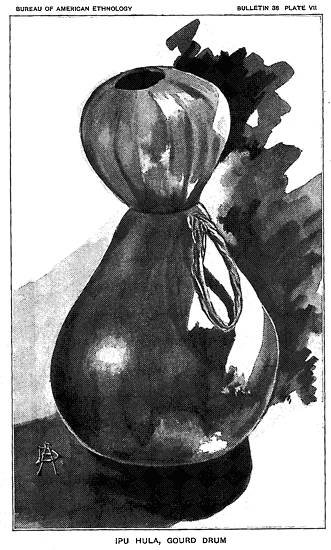
The hoopa’a, who act as instrumentalists, very naturally maintain a position between sitting and kneeling, the better to enable them, to handle that strangely effective drumlike instrument, the ipu, the one musical instrument used as an accompaniment in this hula. The ipu is made from the bodies of two larger pear-shaped calabashes of unequal sizes, which are joined together at their smaller ends in such a manner as to resemble a figure-of-eight. An opening is left at the top of the smaller calabash to increase the resonance. In moments of calm the musicians allow the body to rest upon the heels; as the action warms they lift themselves to such height as the bended knee will permit.
The ala’a-papa is a hula of comparatively moderate action. While the olapa employ hands, feet, and body in gesture and pose to illustrate the meaning and emotion of the song, the musicians mark the time by lifting and patting with the right hand the ipu each holds in the left hand. If the action of the play runs strong and stirs the emotions, each hoopa’a lifts his ipu wildly, fiercely smites it, then drops it on the padded rest in such manner as to bring out its deep mysterious tone.
At a signal from the kumu, who sits with the hoopa’a, the poo-pua’a, leader of the olapa, calls the mele (kahea i ka mele)—that is, he begins its recitation—in a tone differing but little from that of ordinary conversation, a sing-song recitation, a vocalization less stilted and less punctilious than that usually employed in the utterance of the oli or mele. The kumu, the leader of the company, now joins in, mouthing his words in full observance of the mele style. His manner of cantillation may be either what may be called the low relief, termed ko’i-honua, or a pompous alto-relievo style, termed ai-ha’a. This is the signal for the whole company to chime in, in the same style as the kumu. The result, as it seems to the untutored ear, is a confusion of sounds like that of the many-tongued roar of the ocean.
The songs cantillated for the hula ala’a-papa were many and of great variety. It seems to have been the practice for the kumu to arrange a number of mele, or poetical pieces, for presentation in the hula in such order as pleased him. These different mele, thus arranged, were called pale, compartments, or mahele, divisions, as if they were integral parts of one whole, while in reality their relation to one another was only that of the juxtaposition imposed upon them by the kumu.
The poetical pieces first to be presented were communicated to the author as mahele, divisions—hardly cantos—in the sense above defined. They are, however, distinct poems, though there chances to run through them all a somewhat similar motive. The origin of many of these is referred to a past so remote that tradition assigns them to what the Hawaiians call the wa po, the night of tradition, or they say of them, no ke akua mai, they are from the gods. It matters not how faithful has been the effort to translate these poems, they will not be found easy of comprehension. The local allusions, the point of view, the atmosphere that were in the mind of the savage are not in our minds to-day, and will not again be in any mind on earth; they defy our best efforts at reproduction. To conjure up the ghostly semblance of these dead impalpable things and make them live again is a problem that must be solved by each one with such aid from the divining rod of the imagination as the reader can summon to his help.
Now for the play, the song:
Mele no Ka Hula Alá’a-papa
MAHELE-HELE I
PAUKU 1
A Koolau wau, ike i ka ua,
E ko-kolo la-lepo ana ka ua,
E ka’i ku ana, ka’i mai ana ka ua,
E nu mai ana ka ua i ke kuahiwi,
5
E po’i ana ka ua me he nalu la.
E puka, a puka mai ka ua la.
Waliwali ke one i ka hehi’a e ka ua;
Ua holo-wai na kaha-wai;
Ua ko-ké wale na pali.
10
He ilio hae, ke nahu nei e puka.
[Translation.]
Song for the Hula Alá’a-papa.
CANTO I
STANZA 1
’Twas in Koolau I met with the rain: It comes with lifting and tossing of dust, Advancing in columns, dashing along. The rain, It sighs In the forest; 5The rain, it beats and whelms, like the surf; It smites, it smites now the land. Pasty the earth from the stamping rain; Full run the streams, a rushing flood; The mountain walls leap with the rain. 10See the water chafing its bounds like a dog, A raging dog, gnawing its way to pass out.
This song is from the story of Hiiaka on her journey to Kauai to bring the handsome prince, Lohiau, to Pele. The region is that on the windward, Koolau, side of Oahu.
PAUKU 2
Hoopono oe, he aina kai Waialua i ka hau;
I-loko, i-waho kaua la, e ka hoa,
5
I kahi e pau ai o ka oni?
Oni ana i ka manawa o ka lili.
Pee oe, pee ana iloko o ka hilahila.
I hilahila wale ia no e oe;
The lines from, the fourth to the ninth in this stanza (pauku) represent a dialogue between two lovers.
[Translation.]
STANZA 2
Look now, Waialua, land clothed with ocean-mist— Its wilderness-cries heaven’s ear only hears, The wilderness-gods of Ku-kani-loko. Within or without shall we stay, friend, 5Until we have stilled the motion? To toss is a sign of impatience. You hide, hiding as if from shame, I am bashful because of your presence; The house is yours, you’ve only to enter.
PAUKU 3
(Ko’i-honua)
5
Oi ka niho o ka ua o Hilo i ka lani;
Kua-wa’a-wa’a Hilo eli ’a e ka wai;
Kai-koo, haki na nalu, ka ua o Hilo;
10
Ha’i lau-wili mai ka nahele.
Nanalu, kahe waikahe o Wai-luku;
15
Halulu i ha-ku’i, ku me he uahi la
Ka puá, o ka wai ua o-aka i ka lani.
Eleele Hilo e, pano e, i ka ua;
Okakala ka hulu o Hilo i ke anu;
20
Ka lae ohi’a e kope-kope,
Me he aha moa la, ka pale pa laau,
25
Me ka ha’i laau i pu-kaula hala’i i ka ua.
Ke nana ia la e la’i i Hanakahi.
Oni aku Hilo, oni ku’u kai lipo-lipo,
Lei kahiko, lei nalu ka poai.
30
Puna-hoa la, ino, ku, ku wau a Wai-akea la.
[Translation.]
STANZA 3
(With distinct utterance)
Kea-au shelters, Waiakea lies in the calm, The deep peace of King Hana-kahi. Hilo, of many diversions, swims in the ocean, ’Tween Point Lele-iwi and Maka-hana-loa; 5And the village rests in the bowl, Its border surrounded with rain— Sharp from the sky the tooth of Hilo’s rain. Trenched is the land, scooped out by the downpour— Tossed and like gnawing surf is Hilo’s rain— 10Beach strewn with a tangle of thicket growth; A billowy freshet pours in Wailuku; Swoll’n is Wai-au, flooding the point Moku-pane; And red leaps the water of Anue-nue. A roar to heaven sends up Kolo-pule, 15Shaking like thunder, mist rising like smoke. The rain-cloud unfolds in the heavens; Dark grows Hilo, black with the rain. The skin of Hilo grows rough from the cold; The storm-cloud hangs low o’er the land. 20A rampart stand the woods of Haili; Ohi’as thick-set must be brushed aside, To tear one’s way, like a covey of fowl, In the wilds of Pa-ie-ie— Lehua growths mine—heart of Mokau-lele. 25A breaking, a weaving of boughs, to shield from rain; A look enraptured on Hana-kahi, Sees Hilo astir, the blue ocean tossing Wind-thrown-spray—dear sea—’gainst Point Lele-iwi— A time-worn foam-wreath to encircle its brow. 30Look, Pu’u-eo! guard ’gainst the earth-rib! It’s Puna-hoa reef; halt! At Waiakea halt!
PAUKU 4
(Ai-ha’a)
Kua loloa Kea-au i ka nahele; Hala kua hulu-hulu Pana-ewa i ka laau; Inoino ka maha o ka ohia o La’a. Ua ku kepakepa ka maha o ka lehua; 5Ua po-po’o-hina i ka wela a ke Akua. Ua u-ahi Puna i ka oloka’a pohaku, I ka huna pa’a ia e ka wahine. Nanahu ahi ka papa o Olu-ea; Momoku ahi Puna hala i Apua; 10Ulu-á ka nahele me ka laau. Oloka’a kekahi ko’i e Papa-lau-ahi; I eli ’a kahi ko’i e Ku-lili-kaua. Kai-ahea a hala i Ka-li’u; A eu e, e ka La, ka malama-lama. 15O-na-naka ka piko o Hilo ua me ke one, I hull i uka la, i hulihia i kai; Ua wa-wahi ’a, ua na-ha-há, Ua he-hele-lei!
[Translation.]
STANZA 4
(Bombastic style)
Ke’-au is a long strip of wildwood; Shag of pandanus mantles Pan’-ewa; Scraggy the branching of Laa’s ohias; The lehua limbs at sixes and sevens— 5They are gray from the heat of the goddess. Puna smokes mid the bowling of rocks— Wood and rock the She-god heaps in confusion, The plain Oluea’s one bed of live coals; Puna is strewn with fires clean to Apua, 10Thickets and tall trees a-blazing. Sweep on, oh fire-ax, thy flame-shooting flood! Smit by this ax is Ku-lili-kaua. It’s a flood tide of lava clean to Kali’u, And the Sun, the light-giver, is conquered. 15The bones of wet Hilo rattle from drought; She turns for comfort to mountain, to sea, Fissured and broken, resolved into dust.
This poem is taken from the story of Hiiaka. On her return from the journey to fetch Lohiau she found that her sister Pele had treacherously ravaged with fire Puna, the district that contained her own dear woodlands. The description given in the poem is of the resulting desolation.
PAUKA 5
5
Lilo ilalo e hele ai, e-e,
A ilalo hoi.
10
I ka ulu hala la, e-e,
Kai-ko’o Puna.
Ke waiho e mai la oe ilaila.
15
Ela ka mea ino la, he anu,
A he anu me he mea la iwaho kaua, e ke hoa;
Me he wai la ko kaua ili.
The author of this poem of venerable age is not known. It is spoken of as belonging to the wa po, the twilight of tradition. It is represented to be part of a mele taught to Hiiaka by her friend and preceptress in the hula, Hopoe. Hopoe is often called Hopoe-wahine. From internal evidence one can see that it can not be in form the same as was given to Hiiaka by Hopoe; it may have been founded on the poem of Hopoe. If so, it has been modified.
[Translation.]
STANZA 5
From mountain retreat and root-woven ladder Mine eye looks down on goddess Moana-Lehua; I beg of the Sea, Be thou calm; Would there might stand on thy shore a lehua— 5Lehua-tree tall of Ho-poe. The lehua is fearful of man; It leaves him to walk on the ground below, To walk the ground far below. The pebbles at Ke’-au grind in the surf. 10The sea at Ke’-au shouts to Puna’s palms, “Fierce is the sea of Puna.” Move hither, snug close, companion mine; You lie so aloof over there. Oh what a bad fellow is cold! 15’Tis as if we were out on the wold; Our bodies so clammy and chill, friend!
The last five verses, which sound like a love song, may possibly be a modern addition to this old poem. The sentiment they contain is comparable to that expressed in the Song of Welcome on page 39:
Eia ka pu’u nui o waho nei, he anu. The hill of Affliction out there is the cold.
MAHELE-HELE II
5
Ha’i ka nalu, wai kaka lepo o Pii-lani;
Hai’na ka iwi o Hilo,
I ke ku ia e ka wai.
Oni’o lele a ka ua o Hilo i ka lanu
Ke hookiikii mai la ke ao o Pua-lani,
10
Ke holuholu a’e la e puka,
Puka e nana ke kiki a ka ua,
Ka nonoho a ka ua i ka hale o Hilo.
He ole ke ku a mauna Hilo me Puna.
15
He kowa Puna mawaena Hilo me Ka-ú;
Ke pili wale la i ke kua i mauna-ole;
Pili hoohaha i ke kua o Mauna-loa.
He kuahiwi Ka-ú e pa ka makani.
20
Ka-u ku ke ehu lepo ke A’e;
Ku ke ehu-lepo mai la Ka-ú i ka makani.
Makani Kawa hu’a-lepo Ka-ú i ke A’e.
Kahiko mau no o Ka-ú i ka makani.
Makani ka Lae-ka-ilio i Unu-lau,
25
I ka ha’a nawali ia ino.
Ino wa o ka mankani o Kau-ná.
Nana aku o ka makani malaila!
O Hono-malino, malino i ka la’i o Kona.
30
He inoa la!
[Translation.]
CANTO II
Heaven-magic, fetch a Hilo-pour from heaven! Morn’s cloud-buds, look! they swell in the East. The rain-cloud parts, Hilo is deluged with rain, The Hilo of King Hana-kahi. 5Surf breaks, stirs the mire of Pii-lani; The bones of Hilo are broken By the blows of the rain. Ghostly the rain-scud of Hilo in heaven; The cloud-forms of Pua-lani grow and thicken. 10The rain-priest bestirs him now to go forth, Forth to observe the stab and thrust of the rain, The rain that clings to the roof of Hilo. Hilo, like Puna, stands mountainless; Aye, mountain-free stand Hilo and Puna. 15Puna ’s a gulf ’twixt Ka-ú and Hilo; Just leaning her back on Mount Nothing, She sleeps at the feet of Mount Loa. A mountain-back is Ka-ú which the wind strikes, Ka-ú, a land much scourged by the A’e. 20A dust-cloud lifts in Ka-ú as one climbs. A dust-bloom floats, the lift of the wind: ’Tis blasts from mountain-walls piles dust, the A’e. Ka-ú was always tormented with wind. Cape-of-the-Dog feels Unulau’s blasts; 25They turmoil the cove of Ka-hea-hea, Defying all strength with their violence. There’s a storm when wind blows at Kau-ná. Just look at the tempest there raging! Hono-malino sleeps sheltered by Kona. 30A eulogy this of a name.
“What name?” was asked of the old Hawaiian.
“A god,” said he.
“How is that? A mele-inoa celebrates the name and glory of a king, not of a god.”
His answer was, “The gods composed the mele; men did not compose it.”
Like an old-time geologist, he solved the puzzle of a novel phenomenon by ascribing it to God.
MAHELE III
(Ai-ha’a)
Neeu a’e la ka makahiapo o ka pali;
5
Ha’i a’e la ka pali;
Ha-nu’u ka pali;
Hala e Malu-ó;
Hala a’e la Ka-maha-la’a-wili,
Ke kaupoku hale a ka ua.
10
Me he mea i uwae’na a’e la ka pali;
Me he hale pi’o ka lei na ka manawa o ka pali Halehale-o-ú;
Me he aho i hilo ’a la ka wai o Wai-hi-lau;
Me he uahi pulehu-manu la ke kai o ka auwala hula ana.
15
Ka eku’na a ke kai i ka ala o Ka-wai-kapu—
Eku ana, me he pua’a la, ka lae Makani-lele,
Koho-lá-lele.
[Translation.]
CANTO III
(Bombastic style)
Haunt of white tropic-bird and big ruffled owl,
Up rises the firstborn child of the pali.
He climbs, he climbs, he climbs up aloft,
Kaholo-ku’-iwa, the pali of Ha’i.
5
Accomplished now is the steep,
The ladder-like series of steps.
Malu-ó is left far below.
Passed is Ka-maha-la’-wili,
The very ridge-pole of the rain—
10
It’s as if the peak cut it in twain—
An arched roof the peak’s crest Hale-hale-o-ú.
A twisted cord hangs the brook Wai-hilau;
Like smoke from roasting bird Ocean’s wild dance;
The shark-god is swimming the sea;
15
See the ocean charge ’gainst the cliffs,
Thrust snout like rooting boar against Windy-cape,
Against Koholá-lele.
MAHELE IV
He laau kala-ihi ia na ke anu,
5
Eha i ke anu ka nahele o Wai-ka-é,
A he aloha, e!
10
Aloha Wai-ká, ia’u me he ipo la;
Ka pua i ka nahele o Mahule-i-a,
E lau ka huaka’i-hele i ka pali loa;
15
O ku’u noho wale iho no i kahua, e-e.
A he aloha, e-e!
O kou aloha ka i hiki mai i o’u nei.
Mahea la ia i nalo iho nei?
This mele, Hole Waimea, is also sung in connection with the hula ipu.
The song above given, the translation of which is to follow, belongs to historic times, being ascribed to King Liholiho—Kamehameha II—who died in London July 13, 1824, on his visit to England. It attained great vogue and still holds its popularity with the Hawaiians. The reader will note the comparative effeminacy and sentimentality of the style and the frequent use of euphemisms and double-entendre. The double meaning in a Hawaiian mele will not always be evident to one whose acquaintance with the language is not intimate. To one who comes to it from excursions in Anglo-Saxon poetry, wandering through its “meadows trim with daisies pied,” the sly intent of the Hawaiian, even when pointed out, will, no doubt, seem an inconsequential thing and the demonstration of it an impertinence, if not a fiction to the imagination. Its euphemisms in reality have no baser intent than the euphuisms of Lyly, Ben Jonson, or Shakespeare.
[Translation.]
Song—Hole Waimea
PART IV
Love tousled Waimea with, shafts of the wind, While Kipuupuu puffed jealous gusts. Love is a tree that blights in the cold, But thrives in the woods of Mahiki. 5Smitten art thou with the blows of love; Luscious the water-drip in the wilds; Wearied and bruised is the flower of Koaie; Stung by the frost the herbage of Wai-ka-é: And this—it is love. 10Wai-ká, loves me like a sweetheart. Dear as my heart Koolau’s yellow eye, My flower in the tangled wood, Hule-í-a, A travel-wreath to lay on love’s breast, A shade to cover my journey’s long climb. 15Love-touched, distraught, mine a wilderness-home; But still do I cherish the old spot, For love—it is love. Your love visits me even here: Where has it been hiding till now?
PAUKU 2
Kau ka ha-é-a, kau o ka hana wa ele, Ke ala-ula ka makani, Kulu a e ka ua i kou wabi moe. Palepale i na auwai o lalo; 5Eli mawaho o ka hale o Koolau, e. E lau Koolau, he aina ko’e-ko’e; Maka’u i ke anu ka uka o ka Lahuloa. Loa ia mea, na’u i waiho aku ai.
[Translation.]
STANZA 2
A mackerel sky, time for foul weather; The wind raises the dust— Thy couch is a-drip with the rain; Open the door, let’s trench about the house: 5Koolau, land of rain, will shoot green leaves. I dread the cold of the uplands. An adventure that of long ago.
The poem above given from beginning to end is figurative, a piece of far-fetched, enigmatical symbolism in the lower plane of human nature.
PAUKU 3
Ha-uke-uke i ka wa o Koolau:
Eha e! eha la!
5
Hana ne’e ke kikala o ko Hilo Khii.
I ka po-lolo’ ua wahine o ka lua:
10
Mai ka lua no, e!
[Translation.]
STANZA 3
Puna plies paddle night-long in the storm; Is set back by a shift in the weather, Feels hurt and disgruntled; Dismayed at slap after slap of the squalls; 5Is struck with eight blows of Typhoon; Then smit with the lash of the North wind. Sad, he turns back to Hilo’s sand-beach: He’ll shake the town with a scandal— The night-long storm with the hag of the pit, 10Hag from Gehenna!
This is not a line-for-line translation; that the author found infeasible. Line 8 of the English represents line 7 of the Hawaiian. Given more literally, it might be, “He’ll shake the buttocks of Hilo’s forty thousand.”
The metaphor of this song is disjointed, but hot with the primeval passions of humanity.
PAUKU 4
Ho-ina-inau mea ipo i ka nahele; Haa-kokoe ana ka maka i ka Moani, I ka ike i na pua i hoomahie ’Iuna; Ua hi-hi-hina wale i ka moe awakea. 5Ka ino’ ua poina ia Mali’o. Aia ka i Pua-lei o Ha’o. I Puna no ka waihona o ka makani; Kaela ka malama ana a ka Pu’u-lena, I kahi mea ho-aloha-loha, e! 10E aloha, e!
[Translation.]
STANZA 4
Love is at play in the grove, A jealous swain glares fierce At the flowers tying love-knots, Lying wilted at noon-tide. 5So you’ve forgotten Mali’o, Turned to the flower of Puna— Puna, the cave of shifty winds. Long have I cherished this blossom, A treasure hid in my heart! 10Oh, sweetheart!
The following account is taken from the Polynesian Researches of the Rev. William Ellis, the well-known English missionary, who visited these islands in the years 1822 and 1823, and whose recorded observations have been of the highest value in preserving a knowledge of the institutions of ancient Hawaii:
In the afternoon, a party of strolling musicians and dancers arrived at Kairua. About four o’clock they came, followed by crowds of people, and arranged themselves on a fine sandy beach in front of one of the governor’s houses, where they exhibited a native dance, called hura araapapa.
The five musicians first seated themselves in a line on the ground, and spread a piece of folded cloth on the sand before them. Their instrument was a large calabash, or rather two, one of an oval shape about three feet high, the other perfectly round, very neatly fastened to it, having also an aperture about three inches in diameter at the top. Each musician held his instrument before him with both hands, and produced his music by striking it on the ground, where he had laid a piece of cloth, and beating it with his fingers, or the palms of his hands. As soon as they began to sound their calabashes, the dancer, a young man about the middle stature, advanced through the opening crowd.
His jet-black hair hung in loose and flowing ringlets on his naked shoulders; his necklace was made of a vast number of strings of nicely braided human hair, tied together behind, while a paraoa (an ornament made of a whale’s tooth) hung pendent from it on his breast; his wrists were ornamented with bracelets formed of polished tusks of the hog, and his ankles with loose buskins, thickly set with dog’s teeth, the rattle of which, during the dance, kept time with the music of the calabash drum. A beautiful yellow tapa was tastefully fastened round his loins, reaching to his knees. He began his dance in front of the musicians, and moved forward and backwards, across the area, occasionally chanting the achievements of former kings of Hawaii. The governor sat at the end of the ring, opposite to the musicians, and appeared gratified with the performance, which continued until the evening. (Vol. IV, 100-101, London, Fisher, Son & Jackson, 1831.)
NOTE BY THE AUTHOR.—At the time of Mr. Ellis’ visit to Hawaii the orthography of the Hawaiian language was still in a formative stage, and it is said that his counsels had influence in shaping it. His use of r instead of l in the words hula, alaapapa, and palaoa may, therefore, be ascribed to the fact of his previous acquaintance with the dialects of southern Polynesia, in which the sound of r to a large extent substitutes that of l, and to the probability that for that reason his ear was already attuned to the prevailing southern fashion, and his judgment prepossessed in that direction.