Act 3 — IRREVERENT INTERVIEWS AND OTHER IRRELEVANCES
Reading edition
WITH LORD BALFOUR AT THE WASHINGTON CONFERENCE
He received me with exquisite courtesy, waved me into a chair, sank into another himself, and sat, with folded hands and an expression compounded of saintly refinement and dignified composure, regarding me gravely through limpid, untroubled eyes, protected from the tarnishing realities of the world by horn-rimmed spectacles. His silky, white hair gleamed softly in the half-light. His moustache reposed over a mouth touched with wistful sadness, but serene and courageous. Rarely have I seen anything more placid and self-possessed. But he had his small irritations. I was one of them.
“Yes,” he began, with the faintest air of hesitation, “yes. It’s good of you to have come—er. Er—most obliging, I’m sure. It’s a pity they didn’t tell me about it. You see, I’d already arranged.... Yes—(really troubled)—most unfortunate! (Brightening.) We might walk a little way together. (Troubled again.) But perhaps that wouldn’t suit you—no. It would? That’s very lucky. Shall we go now?... They’ll give me a hat, I suppose?...”
We found ourselves walking down a prodigious staircase, and I heard him say, “Extraordinary buildings these American hotels! I always wonder on what principle they’re constructed. The groining of the roof, for instance....” Well, to be truthful, I’m not really sure that he said “groining,” for my mind (I confess it with shame) was wandering speculatively among the mysterious “them” by whom all great men are surrounded. “They” are always lurking in the background. “They” do all the interesting things; but when some really unpleasant job comes along “they” always work it off on “him.” You can picture “them” planning out the day. “Now,” they say, “there’s your speech on the Irish question, your report for the League of Nations, the article you promised to write for the Hibbert Journal, new socks and ties, another hat, and that awful check waistcoat you bought to be exchanged for something quieter. We’ll do all that. Then there’s the christening of the Infant Princess Vodkha, and General Thing’s funeral. You’d better take those. They’re very important. Oh, and there’s the Pilgrims’ dinner in the evening. You can go to that, too. Mind you say nothing in your speech that we shall be sorry for afterwards.” I should like to be one of “them,” and feel that I was really pulling my weight in the country.
That, roughly, was the train of my thoughts, when I remembered that an interviewer’s business is to interview and not to acquiesce in excursions into the by-paths of architecture. “They” would never allow that.
“—and I’ve wondered sometimes,” he was saying, “whether the cantilever had anything to do with it. But—but, no doubt, you can tell me that.”
“I can,” I said, “but it would take too long to explain. Besides, the public expects me to put my few moments with you to a better purpose than discussing mechanics. The world is expecting a new era to date from the Washington Conference; and, as the chief British delegate——”
“The trouble with the world,” he replied, “is that it is perpetually expecting the millennium. They expected it after the Congress of Berlin. They expected it to emerge from the Hague Peace Conference, and they got the Great War! They expected a new Heaven and a new Earth out of the Peace Treaty; they got the League of Nations, which was an enormous step forward. And because the League hasn’t revolutionised humanity, because in the space of two years it hasn’t yet effectively counter-checked all the instincts and passions which man has inherited from the anthropoid ape, they brand it as a failure—or, at best, a half success—and turn their eyes to Washington; and if we should not be able (and who can predict that we shall be able?) to realise all the passionate hopes and aspirations in their hearts, they’ll turn away from our work in despair (however useful and practical it may be), and they’ll go on staring into the future, straining their sight in search of changes, that, by their very nature, are not to be perceived; and, because they cannot watch a kind of sensational picture-drama of evolution unfolding before their eyes, they will condemn each progressive step as a futility.”
“Now, in this particular case,” I began, for he had paused dreamily.
“I have always had warm feelings for America,” he continued, inconsequently as it seemed; “indeed, some of my earliest public speeches were devoted—Yes? Were you about to say anything?—were devoted to pleading for what one might call a Pax Anglo-Americana, as something wider than the Pax Britannica, and as a step towards—a step towards some better understanding between the various states of the world.”
I sought to pin him down. “And is that your expectation of the outcome of this Conference?”
“I see no reason why one should not hope, and ... and, indeed, there seems to me every reason for believing, that our ... our discussions and conversations will reveal sufficient of our respective points of view to serve as a basis for future negotiations, and possibly to give a broad indication of the lines upon which a general agreement might ultimately be reached.”
I changed front swiftly. “You were in the United States in 1917?”
“In 1917, yes.”
“Do you notice many changes?”
“I can’t help feeling that there is a certain popular aridity which, I should have said, was conspicuously absent on the occasion of my last visit. Naturally, during a war, public opinion tends to be exuberant and ... and, indeed, at times fluid——”
“Then you think the political atmosphere of America has become noticeably drier?”
“I think you must not ask me to discuss the politics of a friendly Power within ... within the confines of that Power. Or, indeed, you may ask, of course, but I feel it would be improper to answer.”
I flung myself upon him from another angle.
“People in England cannot help wondering what effect Mr. Hara’s assassination will have on the Conference.”
“I have always thought,” he replied, after a pause, “that in a society so constituted as ours, it is impossible that such an incident—or, or, indeed, any incident—should be devoid of effect and significance.”
“It might prejudice the issue?”
“Conceivably. Or, on the other hand, in certain circumstances, by drawing attention to what is called the War Party in Japan—if such a party exists, as to which I say nothing—it might, in the long run, exercise quite the opposite influence.”
I tried a more direct approach. “Might I ask what will be the policy of the British Delegation?”
“Certainly. The policy of the British Delegation, subject to the approval of His Majesty’s Government, will be that decided upon, after due deliberation, by the Chief Delegate in consultation with his colleagues.”
We walked on a few yards in silence—I struggling to frame a question that he could not evade, he with his eyes on the horizon and his thoughts (I imagine) in another planet. To relieve my evident distress, he said at last, “Would you like me to say anything further?”
I threw diplomacy to the winds and faced him with savage determination. I said to myself that I would not be trifled with.
“Sir,” I cried, “we have talked for half an hour. I think I know less of your thoughts on this subject now than before we began. In the name of the publicity for which I have heard you appeal in the League of Nations, say something specific of your hopes and fears, something to which posterity may point a finger, saying, ‘Here was a statesman with vision. He knew.’”
“That,” he replied with gentle gravity, “is a little difficult. Er—as ... as you know, I am always unwilling to assume the rôle of prophet. Indeed, I am not prepared to say that in the scheme of things as I understand it—and using ... using the word in the sense that is customary to me—that such a thing as a prophecy has any existence at all. But I feel—yes, I feel the necessity which you have urged upon me with—er—with—er ... so eloquently; and I am above all things—and at all times—desirous of affording such proper information as the public ought to receive, upon such a topic as our present Conference, to those whose ... whose work it is to—to disseminate—er—such information. I see no harm, therefore, in acceding to your request, at the same time making it clear that, since these issues are momentous and easily imperilled, you must observe the ... the greatest discretion in any use—er—in any use to which you may put my words.”
Overpowered at the apparent success of my appeal to his better feelings, I could only bow my thanks. The veteran statesman veiled his eyes with their tired lids and seemed to ponder.
“Well,” he said at last, “subject to what I have already stated, I see no reason why I should not say that the Outlook is not ... is not as bad as it might be. And now—yes, this is where I must leave you. It has been a great pleasure to speak so frankly; and I know you will be discreet. Good-bye.”
And then he left me and strolled on his way with serene detachment. But whether the “Outlook” to which he referred was the paper of that name, or the prospect before the Washington Conference, those who have read so far are as well able to judge as I.
WITH MONSIEUR BRIAND AFTER THE WASHINGTON CONFERENCE
The great liner warped into the quay. Hushed expectation poised itself over the multitude. A dumpy figure, almost incredibly small against the vastness of the ship, appeared at the head of the accommodation ladder, and waddled slowly down the side, followed, at a respectful distance, by obsequious midgets. It approached nearer, resolving itself into a small round-shouldered man with a heavy, pale face, distinguished eyebrows and prodigious moustaches. His eyes were grey and meditative; his hair a shaggy, black mane, bursting irrepressibly from under his hat. He strode ashore, and prostrated himself on the soil of his beloved country.
“Ah, la patrie,” he cried in his thrilling, resonant voice, rising from his knees as he spoke, and lifting his right hand in solemn invocation. “Ah, my country, thy faithful Aristide, thy humble servitor salutes thee. He returns, inflated with no Imperialism, but none the less from the depths of his heart proud to have upheld, in thy name, before all the assembled conscience of mankind, those principles of liberty, those imperishable ideals of justice, of international comity and brotherhood, that fine spirit of self-abnegation in which it has ever been the boast of France to lead the world. Oh, liberty, what sacrifice would we not willingly offer in thy behalf? Oh, freedom, where is thy source if not in France? Oh, humanity——”
I tapped him on the shoulder.
“I’ve been waiting for you,” I said.
“Vous dites, M’sieur?” he asked indignantly.
“I’ve been waiting for you,” I repeated sternly. “What do I hear that you’ve been saying in Washington about British warships and sardine-hunting, French submarines and botanical expeditions, and the unknown X?”
He showed his teeth in a grim smile.
“The unknown X? Qu’est-ce que c’est ça? M’sieur veut dire peut-être ‘La femme X’?”
“No evasions,” I warned him. “I am here in the interests of the British public. They are pained, Monsieur, pained! They know nothing of international politics, and very little about politicians—even their own. But they know that, in their quiet way, they’ve grown to be fond of your people. They see that you misunderstand them. And it hurts them to think that the Entente Cordiale——”
He flicked his fingers impatiently.
“L’entente cordiale! Ah, M’sieu, l’entente cordiale! ... Are you understanding French?”
“Not noticeably,” I confessed.
“Alors! Well, I shall tell you in English.... What is it, this Entente Cordiale? Hein? An understanding of friends, n’est ce pas? What the Americans call a ‘gentleman’s agreement.’ You make it because you trust so much, that you will not care to have a Treaty. Well, then, but you must trust your vis-à-vis. You must not put all the bad construction on his doing. Not even a Treaty will stand that. You cannot have Entente, and then go on nag, nag, nag, like an old peasant woman with the toothache. Oh, it is impossible, M’sieu, impossible!”
“Angora?” I hinted.
“Angora....” He shrugged bluffly. “Well, yes, Angora. That is, perhaps, a pity. We are—we are in the soup with Angora.” He passed it off with a disarming grin. “But, après tout, what can you expect of Bouillon? We shall settle all that.... And it is not Angora that threaten our Entente, M’sieu. Ah, no! That is a small thing. A few Kemalist do not imperil Anglo-French relations. Pouf!...”
His face grew troubled and sad.
“M’sieu, you know perfectly. It is Germany. Yes. You talk a lot of the separate peace with Turkey. In the letter that is so; but in the spirit you make a separate peace with Germany. Oh, yes. This is not epigram—it is truth. Germany, she does not intend to pay. Perhaps she cannot pay. I do not know. It is possible she cannot; but you in England pretend to her that she cannot pay and to us that she will pay. Ménager la chèvre et le chou! Is that entente cordiale?...”
“You see,” I endeavoured to explain, “this is a subject on which there are two views in England. One side holds that Germany can pay something—the precise sum varies according to the knowledge and dispassion of the thinker. The other party contends that she can pay nothing at all—that it would be wiser in the general interest of Europe to cancel the whole debt; and that view, not widely held, is gaining ground——”
“At the expense of France,” he interjected sharply. “Yes. Not at your expense, my generous friend, but at the expense of France.”
“That,” I answered, “is partly true; but not entirely true. Viewed in its immediate context, it may be so; but taken in perspective, the trade revival in Germany——”
“Ah,” he cried, “Ah, ça, M’sieu! The trade revival in Germany. And then, M’sieu, and then? The political revival of Germany. The military revival of Germany. The German hegemony. Mittel Europa. Merci, M’sieu! And France, what of France?”
“France,” I began, “is a member of the League of Nations.”
“And Germany,” he replied, “is not. And America is not. And Russia, with her army of two millions, is not. Thank you for your League of Nations, M’sieu. What will it be in ten years? Perhaps the great co-ordinating harmoniser of the whole world. Perhaps not. What is America wishing since I leave Washington. They will have a new League, with no Covenant. C’est à dire nothing that binds—nothing that give security to such as France. Just a lot of amiable pleasantry, that you interpret as you please. Much of your Press are support them. Do that give confidence to France?... First we are to have the Tripartite Treaty—England, America, France. Then that is not ratify. And our English friends say, ‘Never mind. You have it all in Article 10. The League of Nations will protect you.’ Now, perhaps, the League will follow the Tripartite Treaty. Oh, yes, I know they say the Association will be side by side with the League. But how can you have that? It is a rival system. They say it will be found upon The Hague Tribunal. Then what comes to the International Court? It is to make of international politics a kind of bouillabaisse.... Non, M’sieu! I am head of a Government. I am responsible to a nation. Do you seriously advise me to trust in the League of Nations?”
“I advise you,” I answered, “to trust more in ideas, and less in things. Ideas let loose in the world cannot be destroyed. The League of Nations is an idea—not an office at Geneva. Civilisation is an idea; religion is an idea. What banded the nations together for the Great War? The strength of an idea.”
“Self-preservation,” he muttered, cynically.
“Monsieur le Président, that is unworthy.” (He bowed ironically at the rebuke.) “It is the contemptible argument of the materialist. What drew our young men to fight in 1914? Self-preservation. Never! I doubt if half of them knew the meaning of it. It was the conviction that an evil thing was being done, and the belief that it was their duty to prevent it.”
“Some of your Statesmen,” he continued, as if my remark had not been made, “are so kind as to teach my Government his business. They stand up in public and lecture us, warn us. Italy go wild with rage, because some lying journalist attribute to me what I have not said. England and America link arms and get drunk on formulas of disarmament, that perhaps mean nothing in the light of science to-day. Japan disguise herself as a mandarin and go behind the scenes in China ... and Germany and Russia look on with sardonic satisfaction to see the isolation of France, and prepare for the next ‘Day’! That give one great encouragement to disarm. And all the time to be uncertain—uncertain of one’s friends.... You say your people, they have love for France. Ma foi, they take a strange method to show it!... I do not understand. No, I do not understand.”
“Must one,” I asked him, “must one always understand? Cannot one have faith in a friendship, tried and proved?”
“You say to have faith,” he mused. “Yes, but that is not so easy. For every belief there must be a foundation—the rock on which the Church is build. Where is my rock?”
“The English dead,” I murmured.
His voice suddenly softened.
“Ah, M’sieu, those dead. I was forgetting.... We have all lived at so much pressure since the Peace, that we forget too often the fundamentals. We live for so many such strenuous years steeped in sentiment, that now we have a reaction.... Those dead in their quiet graves in the North of France—sleeping there till the end of time.
“Yes. We have been too impatient, and we say things that we do not mean. It is not only here in France; your Ministers, too, have been at fault. But, au fond, it means nothing.
“Listen. I shall tell you. Let us speak no more of L’Entente Cordiale. It is a phrase of politicians and tradesmen. We shall say in future La Grande Amitié. It shall be—it is—a great love between two peoples, sanctified in a bitter struggle for a common aim.... I am glad to have talked with you, M’sieu. Perhaps our conversation can be having good results.
“Do not be too hasty with us. Remember, France have much to fear on the Continent. If we do what seem to you wrong, then be patient. It is not perversity, always.”
He clambered into the car that waited, and drove away through the cheering ranks of his fellow-countrymen....
And I wondered.
WITH MR. LLOYD GEORGE DURING HIS PREMIERSHIP
“... And which of us,” he said, smiling at me over the breakfast table, “which of us do you wish to see?”
I murmured that I did not understand—er....
“A friend of yours writing in the press,” he explained drily, “has been good enough to find in me a second Jekyll and Hyde. Very well. With which of us do you wish to talk—Lloyd Jekyll or Hyde George?”
“Which,” I asked cautiously, “is which?”
“Both,” he replied, “are Me. Your friend misconceives the situation. He attributes all my political mistakes and failures to Hyde; and the successes I attain to Jekyll. But the truth is that between them they have always pulled me this way and that; and most of my actions are a compromise between their conflicting injunctions. Hyde is still the shrewd Welsh solicitor, who sharpened his wits from morning to night, that Jekyll might have his opportunity. Jekyll is still the idealist who dreamt in his youth of Welsh Home Rule; who upheld the Boers in his middle age because of the nobility of their struggle against overwhelming odds; and now in the fullness of maturity has conferred upon Ireland the freedom she has sought for centuries.”
“But——” I interjected.
He waved me aside. An inspiration had mastered him.
“The clouds of despair,” he chanted, “were gathered over our heads. They menaced our security, they threatened our national safety. No avenue of peace has been left unexplored.... The helmsman stands stark and firm, on the crosstrees. The ship of State lurches perilously on the ocean. The captain cons the passage with anxious eyes, the binnacle clasped in his hand, his belaying-pin beside him. Mountainous billows tower above us. The hour is dark. The time is nigh. Shipwreck, despite all our efforts, appears inevitable.... But faith, like a little child, steals in with the dawn; and the splendour of the sunlight, bursting upon the immemorial hills, floods the valleys with limpid rapture, and bathes all nature in joy unspeakable. The sheep frolic around the homestead. The housewife plies her needle with diligent care. And the ship of State, with its lonely pilot, worn but triumphant on the forecastle, glides in safety into the appointed harbour——”
“This,” I protested, “is not an Eisteddfodd,” but he ignored me.
“The tempest,” he continued, “the tempest will abate; the watchers will come down upon the shore with gladness in their hearts; and the golden glory of my native hills will shine in the souls of men, leading them upward, and ever toward the light.”
A galvanic sweep of the arms brought this whirlwind of speech to a conclusion. A dish of eggs and bacon abruptly clattered on the floor. He pushed the muffins towards me, and refilled his teacup.
“Hyde has been trying to persuade me for some time,” he began, leaning forward confidentially, “to go to the country on the Irish issue. A far stronger rallying cry than ‘Hang the Kaiser!’ and ‘Search their pockets!’ Better even than the ‘Land fit for heroes’ and the ‘Bulging corn-bins.’ It would have been quite easy, you know, to break off negotiations on the question of allegiance. From the point of view of expediency there was a lot to be said for it. It might have swept the country. But Jekyll refused. I think he was right.
“All the same, Hyde’s a shrewd fellow. He sees in a flash what can be turned to good account. He prides himself on knowing what the public wants; and he makes me give it to them. My speech just now, for instance, would have been immensely successful in the House of Commons.... It—er—it didn’t seem to appeal to you.”
“It reminded me,” I replied, “if I may say so without offence, of your Christmas message to the Lloyd George Liberal Magazine.”
“Ah!” he exclaimed, “another of Hyde’s activities. You read the magazine, then?”
“Not often,” I answered.
“I am afraid,” he said, “I am afraid you found my message wanting in literary flavour.”
“On the contrary, I should say its flavour was almost too pronounced.”
He smiled ruefully.
“Well,” he said, “you may be right—though personally I thought one or two passages rather fine. But, of course, Hyde ... the truth is, the fellow has an unerring flair for political situations; and he’s always bringing forward these highly flavoured sentiments and fathering them on to me, on the plea that they’re what the public wants. And the worst of it is, he’s right. The public likes that kind of thing.”
“Not the intelligent public,” I remonstrated.
“I don’t know what you mean by that. If you mean the intelligentsia, they don’t count politically.... Suppose my Government fell, what would happen? There’d be a General Election—in which I’m afraid Hyde George would come to the front—which I might lose. Another Government would replace me—perhaps Edward Grey and Bob Cecil. And then? One of two things. Either they’d carry on in the same quiet, undistinguished and often shifty manner, as I do, balancing one interest against another, and being satisfied with the occasional inch of progress that one makes from time to time; or they’d launch out in an ambitious way, and the conflicting interests of modern society would crush them in six months.”
“Surely,” I said, “government in accordance with principle——”
“The fundamental principle of Government,” he interrupted, “is reputed to be the consent of the governed. But one is not always dealing with first principles; and for practical purposes one of the most indispensable things is the goodwill of the Press. The Press is controlled by capital interests. That is a consideration. The organisation of Labour is another consideration—powerful, though less powerful than formerly. There is the Entente with France to maintain, without going so far to maintain it as will offend large numbers of people here. There is an understanding to keep with America, and an Alliance to modify with Japan. There is a part to be played in the League of Nations, and that must often inevitably conflict with the cordiality of this country’s relations with certain countries, that are doing us no harm but are misconducting their relations with other countries—instances abound. There is the question of raising revenue—who is to contribute; in what proportions; how? Every decision you make on any detail of these subjects, is going to hit somebody hard in the pocket, perhaps turn him out of employment.... And you talk of principles like a professor of mathematics considering the functions of π. I get so tired of this unpractical nonsense. That’s why I can’t get on with Bob Cecil. It’s a thousand pities; for if only he’d recognise these things and take his head out of the clouds, he’d be invaluable at the Foreign Office.... But to hear him talk, anyone would think, not only that my Government was a set of ill-balanced, self-seeking opportunists, inaccessible to any consideration except their own profit, but that what he calls honest government was as simple as beggar-my-neighbour.”
“You know, sir,” I interjected deferentially, “some people can’t help feeling that a little more adherence to principle in dealing with Ireland would have saved——”
“My dear young friend,” he said in a pitying tone, “have you ever studied the Irish question divorced from the rhodomontade of Ulster, and the hysteria of the South? If you have, you’ll see that there’s right—a lot of it—on both sides. It would have been easy enough to apply a catchpenny solution to Ireland—that’s what we’ve been doing for generations, as each successive crisis occurred. Any twopenny Tory demagogue can denounce me for not giving Ireland another taste of Cromwell. But can you see British troops engaged in the process? Any paltry crank can storm at my want of faith in not giving them a Republic long ago; but can you see this country acquiescing in the Balkanisation of the British Isles? And can you see the outside world welcoming the creation of another small State in Europe?... You’ve got to come to solutions slowly in these matters; and the only principle that counts, is the preservation of the Commonwealth of Nations to which we belong.”
“And have you preserved that by your settlement?” I asked him.
“It depends,” he said gravely, “on the spirit in which it is carried out. If neither party in Ireland can agree, and if they will not be reconciled to us, then we have achieved nothing. But if,” his voice grew in volume, “if there is a purpose in life; and if great trust breeds great trust, as I believe; and if faith and hope are more than words to humanity, and direct our thoughts and inspire our bravest acts; then, surely, this work will endure.”
He raised his hand, solemnly.
“Sir,” I said, “I have travelled much in our Empire. The Dominions are my second home. Are they to be Dominions still? Or, if they claim it, are they to become Free States also?”
“It is a Dominion status,” he replied. “The name does not matter.”
“Are you sure?”
“The real tie,” he answered, “must be one of loyalty and love. It is a small matter how the thing is called: and if those qualities are absent you will not better it by the name of Dominion....
“And now,” he said, “I’ve talked long enough. I’ve a Cabinet Council and an interview with the Foreign Secretary to get through before lunch; and there are three confounded deputations which Hyde insists on my seeing personally. So you must go.”
Wherewith he disappeared through one of the multitude of doors surrounding his breakfast-room.
WITH LORD BIRKENHEAD ON THE WOOLSACK
He had thrown himself negligently into a formidable wooden armchair. Lace ruffles of the eighteenth century clung round his wrists, and partly concealed his hands. Crossed over its fellow-knee, he displayed with pardonable ostentation a powerful calf, set on a shapely ankle, and set off by the silken hose of his high office. A prodigious cigar—Flor Monumento—protruded from the corner of his mouth. Intellectual intolerance was the distinguishing characteristic of his face.
The gentlemen ushers, marshals, petty bag keepers, javelin men and other menials, who had heralded me into the presence, bowed themselves obsequiously out. I sat down nervously on the edge of a chair. He eyed me with a freezing compound of disdainful curiosity and disfavour. Abashed out of countenance, I slipped out of my hands and fell on the floor with a faint thud. It seemed that it would only add to the solecism if I began groping about on the floor for myself—I made up my mind that I would let myself lie where I had fallen, until he wasn’t looking; but, somewhat to my surprise, he picked me up in the most courtly manner, dusted me, and restored me to my chair.
“Don’t be alarmed,” he said reassuringly. “It’s the look that does it. No witness has ever resisted it yet. They used to curl up, and go limp, and lean over the side of the box, when I began my cross-examination; and it has not lost its power.”
“Have you ever tried it on Mr. Lloyd George?” I gasped.
“Once,” he replied, “only once, and that long ago—for, you understand, it would hardly be fitting in me to hamper and embarrass His Majesty’s Government.”
“Was it effective?”
“I think I may claim that it impaired his digestion seriously for a few days. He tried to resist it, you see, and the after-effects in such a case become cumulatively more powerful.... As a matter of fact, his visit to Gairloch—well, perhaps I’d better say nothing further. Of course, the remainder of the Cabinet are the merest children. I can quell Fisher or Horne with comparative ease; I have even succeeded in making Curzon blush; and, as you know, on a recent occasion I overthrew poor Carson so severely that for several days they despaired of his reason. My castigations are notorious. Let me warn you to take great care....”
“Would it,” I began nervously, “would it fall under the heading of incurring a castigation, if I were so presumptuous as to inquire about your hobbies?”
“By no means. A very proper question. I am devoted to all sports. Football, cricket, tennis, water polo, lion hunting, kiss-in-the-ring and spillikins are among my favourites; but I think that most of all I enjoy a quiet game of pogo with the Cabinet.... Sing? Yes, I sing frequently. My favourite song? I think my favourite is that fine old ditty, ‘Rendle, My Son.’ You are unacquainted with it?” He broke into a prodigious baritone:
“Where have you been all the night, Rendle, my son? Where have you been all the night, my pretty one? At the O.P. Club, dear mother. Make my bed soon, For F. E. was there, and I fain would lie down.”
“Indeed,” he continued, “I am devoted to simple old songs of all kinds—‘Weel May the Dail Row,’ for instance, and ‘Solly in Our Alley.’”
“And now,” I ventured to say, “... I was instructed to ask you for a Christmas message to the public.”
“If you will write something of the necessary degree of sickliness, I’ve no objection to signing it,” he replied. “Or wait.... It happens that I have to deliver a judgment in the House this afternoon, in the case of a curious old man named Klaus against the Attorney-General for detinue, wrongful imprisonment, and a declaration of nationality. He has been excluded from the country under some of the numerous regulations of the Defence of the Realm Act, and his sack, which appears to contain an astonishing miscellany of objects, has been confiscated by the Customs authorities.... Would that serve your purpose? It will figure in the next edition of my judgments.”
“If I might hear it, perhaps....”
“Certainly.” He drew a formidable case-book from the shelf behind him, adjusted a pair of horn spectacles, and read as follows:
“In this case your lordships have been moved to set aside a decision by the Court of Appeal, affirming the decision of the King’s Bench, whereby the Attorney-General, the Sheriff, and the Justices of Lower Mudhaven were upheld in refusing admission into this country to the appellant, S. Klaus, a person of indubitable ex-enemy origin, but widely esteemed in this country, who carries on an old-established business in many parts of the world.
“It has been claimed on behalf of the appellant that, by long use, he has acquired a prescriptive domicile amounting to British nationality, which, since it has been enjoyed without interruption for more than ninety years, is to be taken, by irrebuttable presumption, as having arisen in time immemorial, which, as we are all aware, means from the time of Richard I. It was contended for the Crown, that, by reason of the various statutes and regulations prohibiting the presence of enemies in this country during the war of 1914-1918, this user was in law interrupted, and therefore is bad as a plea. The appellant replies that, despite the prohibitions, he did, in fact, continue to ply his calling here during the four years in question; and in the Court below he called a number of witnesses, whose credit is in no way impeached, to depose that, to their knowledge, at a certain season in each year, he visited this country in order to keep his business afloat. This is certainly a matter to which the attention of the proper authorities ought to be drawn, for clearly at that time the appropriate person to have carried on his affairs was the Controller of Enemy Businesses under the supervision of the Public Trustee; and some inquiry seems to me to be called for, into the neglect of that official to carry out his duties. This, however, by the way.
“Passing over the testimony of Elsie Biggers and John Marmaduke Baxter-Cunliffe, also known by the alias of ‘Tweety,’ both of whom depose to having seen the appellant descend through the chimney in their respective houses a year ago, but whose tender years—three in the first case and two and a-half, as I believe, in the second—raise a doubt in my mind as to their understanding of the nature of an oath, there is unquestionable and unimpeachable evidence of some person or persons unknown having placed a variety of articles in the houses, and, indeed, in the stockings, of a number of the deponents in this cause, which were not there before. The appellant avers that it was he who placed them there; and, as no alternative hypothesis has been advanced by the Crown, I should, I think, be disposed to accept the appellant’s word as conclusive, were it necessary for me, in advising your lordships as to the judgment which your lordships will shortly deliver, to pronounce either upon one side or upon the other in this conflict of testimony—so far as it can be so called.
“But is it necessary to go into these questions? Mr. Attorney-General, arguendo, has urged upon us that, where a person performs an act of which he is legally incapable, then it is as if the act in question had not been performed; and he cites the cases of a child under seven, who is doli incapax, and of a child between seven and fourteen, who is prima facie doli incapax, and the case of a minor incurring a debt other than for necessaries, and of a person who makes a will, not in due form of law. From these premises, he contends that, since it was illegal for the appellant to come to, or be in, this country, it must be taken, for our purposes, that he was never there; and the plea of prescriptive domicile must fall to the ground.
“My lords, I am unable to resist this argument. Where a person, whether wilfully or not, steps outside the ambit of the law, it is clearly established that he does so at his own risk; and ignorance will not thereafter avail him as an excuse. I must advise your lordships to pronounce, that, despite the evidence, the appellant was not in this country during the war, that the user upon which he bases his title was interrupted during that time, and, consequently, that his first plea must fail——”
He broke off, and looked at me, quizzically.
“What do you think of that reasoning?” he asked. “Ingenious, isn’t it?”
“Hardly ingenuous though,” I murmured; “and it seems to me——”
He drew himself to his full height, and glared. One corner of his mouth went down, and the other rose to the level of his lower eyelid. It was the celebrated sneer.
“No doubt,” he said icily, “no doubt in the purlieus of Tooting Bec or Brockley, whichever you inhabit, remarks of that kind pass current as wit. I daresay, among cannibals and anthropoid apes, there is to be found a rough sense of coarse buffoonery that is tickled by such vulgar exuberance; but, among the aristocracy of an old civilisation, your behaviour would provoke pity, rather than mirth, were it not that, with us, the impudence of a scavenger is accounted a more noxious thing than his trade——”
“Really,” I began, “I must protest——”
“What? Argument?” he cried harshly. He smote a bell. An old and trembling man doddered into the room. He pointed dramatically.
“Remove it,” he ordered.... I judged it best to remove myself.
And as I walked away along the corridor the notes of “Rendle, My Son” floated after me. Only at that distance I could not be quite sure that the name was Rendle.
OLD TORY
Spurn the Liberals: do not love them, Son o’ mine. We are very much above them, Son o’ mine. But we want to rule the nation; So, for mere self-preservation, We will steal their legislation, Son o’ mine. Never trust the Labour Party, Son o’ mine. They’re as wicked as Astarte, Son o’ mine. And the voter is a noodle; So we’ll win on this flapdoodle— “They will strip you of your boodle,” Son o’ mine. When we’ve carried all before us, Son o’ mine. We will praise ourselves in chorus, Son o’ mine. We’ll acclaim ourselves as sages, We’ll do all our jobs by stages, And we’ll hang things up for ages, Son o’ mine.
EDWARD AND EUSTACE
A Tale with a Moral.
Oh, uncle, why is Mister Wood So unequivocally good? And, in the name of mercy, Why does his comrade look so riled, So rigid and unreconciled, So stern of purpose? Hush, my child, That is Lord Eustace Percy. A most exemplary young man, A blameless Sabbatarian— By happy dispensation, They used to rule, E. Wood and he, In absolute authority, That singular corroboree, The Board of Education. Far otherwise it might have been But for Lord Younger’s dread machine. A Premier, less discerning, Might have set up, in Fisher’s chair, Some pedagogue or doctrinaire, Instead of that illustrious pair, To supervise our learning. But Providence, both wise and kind, To British interests never blind, The choice adroitly guided; Giving “effective preference” Over mere expert eminence, To men of large experience And virtues many-sided.
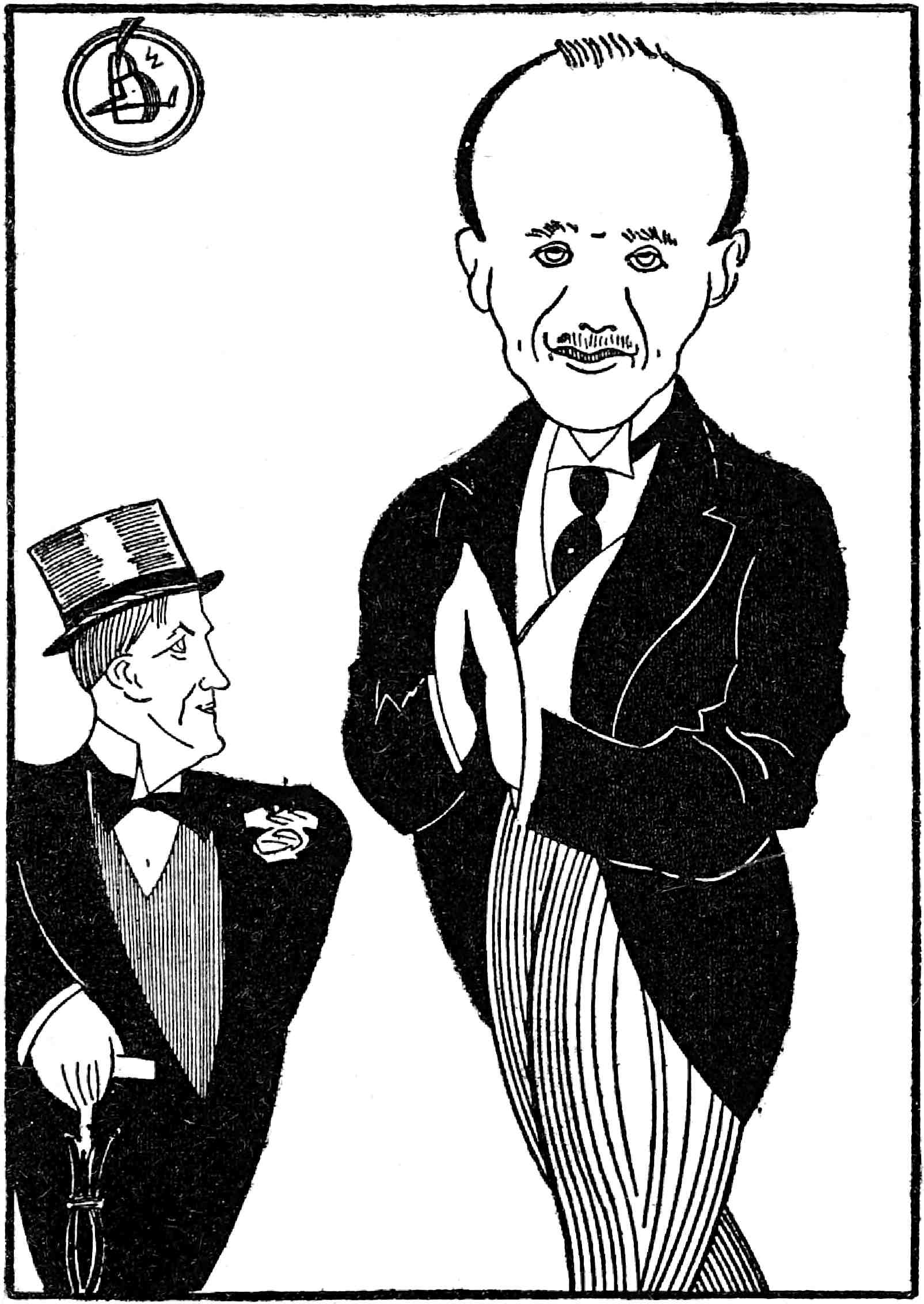
Edward and Eustace.
For Edward, who, in early days (Screened from the prying public’s gaze), Studied John Keble’s holy ways And theologic fever, Rose to be foremost underling In Winston’s Great Imperial Ring; And later had beneath his wing The Council of Geneva. While Eustace, hardy sciolist, Was firstly a diplomatist; And later tried his noble fist At something in the City; And later still enlarged his view, As Honorary Chairman to That product of the Irish stew The Claims and Grants Committee. So both must be presumed to know The habits of the Esquimaux, The properties of indigo, The ways of the Equator, The secret hopes of the Malay, The mysteries of settling-day— Essentials to an educa- Tional administrator. It is unnecessary to Remind so wise a child as you, No such arrangement could pursue Its course, undislocated. People began to make a fuss; They said: “Two men so virtuous Are rarer than the platypus, And better separated.” So Edward, calm, detached, serene, Remained on that exalted scene, Quaffing scholastic Hippocrene, In learned pastures browsing; While Eustace bent his nimble brains To joists, light-castings, sumps and drains, In Mr. Neville Chamberlain’s Belated scheme of Housing.
Moral.
And if, my nephew, like E. Wood And Eustace, you are always good, You’ll study from your babyhood To merit estimation. You’ll put aside that bowie knife, You will eschew all forms of strife, And earn, and keep throughout your life, The plaudits of the nation.
THE TWO WEDGWOODS
On the Front Opposition Bench (which great statesmen adorn) Cheek by jowl with Mr. Asquith; J. R. Clynes and George Thorne; Dark Ramsay of Aberavon; the learned member for Spen, Sat jovial Josiah Wedgwood and bold Wedgwood Benn. The toughness of salamander, and a monkey-gland vim, The endurance and determination, both of Cromwell and Pym, The persistence of twenty members, and the lung power of ten Distinguished Josiah Wedgwood and stern Wedgwood Benn. Did a foeman pause or stumble, or to error succumb (What though Pringle were exhausted, and e’en Kenworthy dumb), Swift as the summer swallow, or the fleet prairie hen, Out popped Josiah Wedgwood, or else Wedgwood Benn. From the bora of the Arctic to the rainfall of Spain, From the theories of Einstein to the “talks” of Frank Crane, There exists no place or subject, not embraced in the ken Of omniscient Josiah Wedgwood and wise Wedgwood Benn. Were they harsh?—They could be tender. Were they gay?—They could be grave. Did they thunder in anger?—They could also be suave. They could bruise like Joseph Beckett: they could sting like cayenne, Multifarious Josiah Wedgwood and slick Wedgwood Benn. Which explains my sense of outrage, that this sternest of men, Who comes (via Mr. Asquith) from a wild Highland Glen, Should have torn from one another, by a stroke of the pen, Jolly old Josiah Wedgwood and sad Wedgwood Benn.
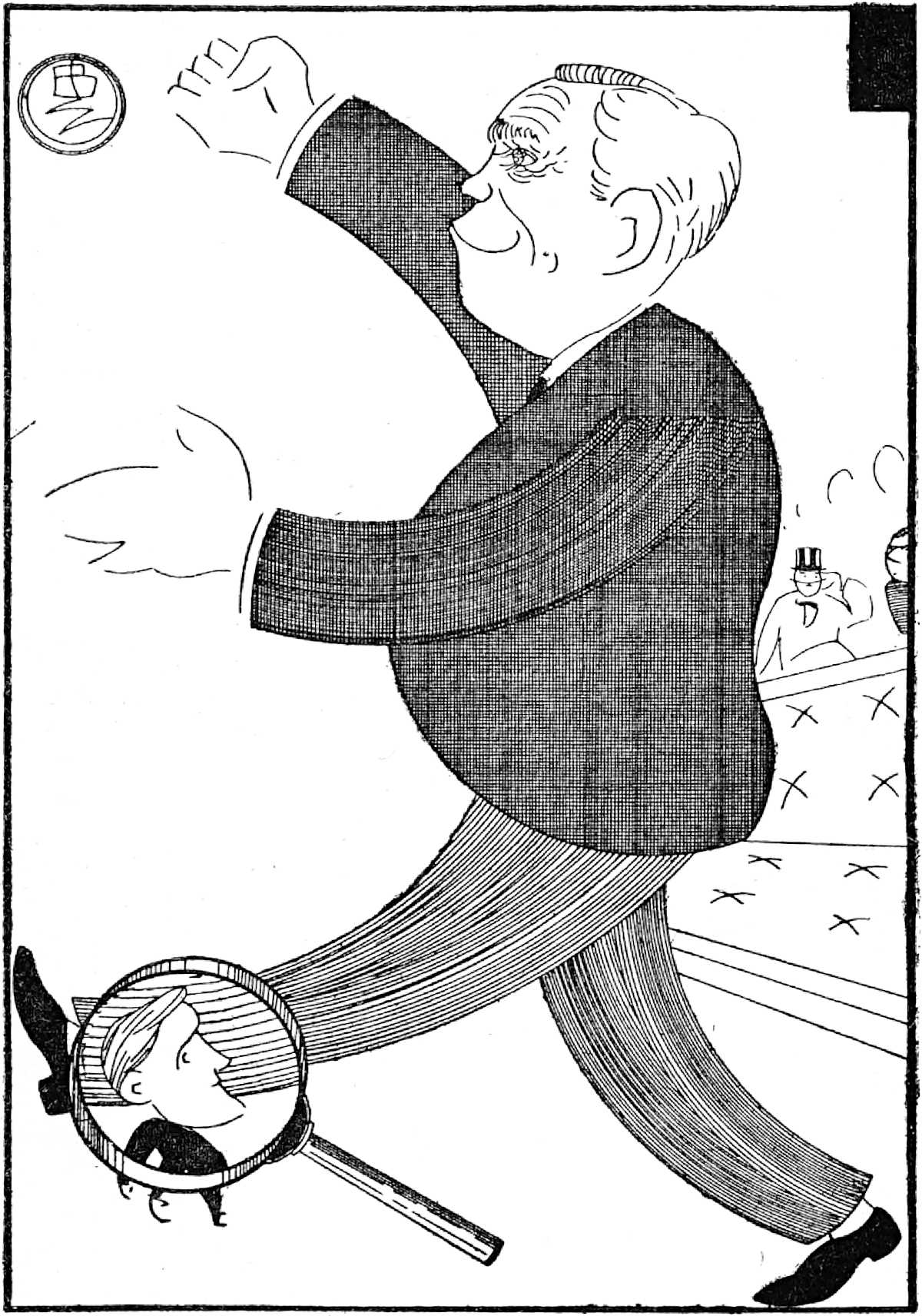
Jovial Josiah Wedgwood and bold Wedgwood Benn.
SONGS OF A DIE-HARD
Die-Hard.
A Die-Hard is a man who only cares To serve his land, in speechless self-denying, Yea, even to the Death!—provided there’s Some other idiot to do the dying.
CHORUS.
(Suitable to be sung at Anti-Proletarian Sunday Schools.)
Far away in sunny Alabamma, Where the pickaninny cotton-bushes grow, You can flatten out a nigger with a hammer Or put it well across him with your toe. That’s the way to deal with subject races (Subject populations kindly note!), Tie them up, and flog them with your braces, Probably they haven’t got a vote. Keep inferiors in their proper station, Don’t allow the brutes to make a fuss. In the many marvels of creation Nothing’s fit to kiss the boots of US.
NURSERY RHYME
(For little Die-Hards.)
Reduction of Force Makes Banbury cross! He’s sick of our Parliament’s vapid discourse. He’ll lead the Coldstreamers Against those blasphemers Who dare to treat Labour as other than schemers. Guns in his fingers and bombs in his clo’es, There shall be ructions wherever he goes. Shout yourselves hoarse His views to endorse: REDUCTION OF FORCE MAKES BANBURY CROSS!!!
THE OLD MEMBER
I will go down to the House again And sit—in the smoking room, And brood, with a friend with a first-class brain, In a state of abysmal gloom: And all I’ll ask is a tall glass, A pipe and a game of chess; For the country’s gone to the dogs, my lass, And who’s to clean up the mess? (Fortissimo) The country’s simply going to blazes. Who’s to swab up the mess? I will go down to the House once more And there—in the smoking room, I’ll wait (with old boon-fellows three or four) For the sound of the bell of doom: And all I’ll ask is a tall Whip To meet me on Charon’s boat, And hurriedly whisper “We’re Ayes” (or “Noes”) That I may know how to vote. (Sotto voce) I just can’t follow this modern craze For understanding your vote! I shall come back to the House one night From a somewhere neighbouring tomb, Peep in on the scene of the age-long fight, And pass—to the smoking room: And all I’ll ask is a tall ghost In the corridor’s darkling gloam, Crying “Hats off, Strangers,” “Make way for the Speaker,” And (mournfully) “Who goes Home?” (Pianissimo) The Dead troop back to the Abbey each night, To the sound of that “Who goes Home?”
W. H. Smith & Son, The Arden Press Stamford Street, London, S.E.I