Act 3 — ACT III.
Reading edition
Scene: The same room—if possible dingier than ever. Jemima is sitting hunched up by the fire, which is enveloping her in a yellow cloud. Bloggs is pushed into the room by a hard-faced man.
The Hard-Faced Man (grimly): I’ve brought you back your husband, ma’am. You may as well know he’s discharged from my employment.
Jemima (tonelessly): Oh?
The H.F.M.: And lucky he’s not prosecuted.
Jemima (as before): Oh?
The H.F.M.: Embezzlement’s a serious thing.
Jemima: Yes.... Starvation’s serious too.
The H.F.M.: That’s your affair.... I don’t want thanks. I don’t intend to prosecute, because it’s a nuisance. That’s all.
Jemima: Yes.
Bloggs (inadvertently stepping out of the picture): I tell you I did it to save my little girl. She’s dying. I must have money to save her—to send her abroad. Oh, Amy, Amy, my child. (He tries in vain to sob.)
The H.F.M. (chillingly): No sentiment, please! This is not the Lyceum.... Now, I’m going. I hope I never see either of you again. I don’t care two straws whether the girl dies or not. And I won’t wish you luck, because I don’t specially want you to have it, and anyway you wouldn’t get it. (But they are paying no attention, and he goes.)
Jemima (listlessly): Doctor’s been again.
Bloggs (the same): Oh yes?
Jemima: Says she’s getting better.
Bloggs: Is she? (He sits by the fire in his hat and coat. The inevitable Hooker slouches in, similarly clad, and takes his place on the other side. A melancholy silence reigns.)
Hooker (at last): It’s raining again.
Jemima (bringing in the milk-jug): The thunder’s turned the milk sour.
Bloggs (dismally): I thought it would.
Hooker (shivering, and hugging himself in his coat): There’s a thick fog, and it’s very damp.
Bloggs (gloomily): There always is.
Hooker: Yes. (The fire contributes to the general depression by a shower of soot, and a sudden belch of acrid yellow fumes.)
Bloggs: Jemima, the fire’s smoking.
Jemima (wearily): I’ll make it up in a minute. (She worries it with various implements. More soot falls and the smoke increases. She stirs it aimlessly with the poker. It flickers and goes out for the last time. They, and the audience, are too depressed to care. They sit staring blankly at the grate as the cold and fog gradually invade the room.)
The Curtain Falls very slowly.
UNDER EASTERN SKIES
(A Romantic Drama suitable for performance at His Majesty’s Theatre.)
First Scene.
—A street in Damascus, copied, with meticulous exactitude, from the Byway of Beggars in that famous city. Even the smells are there—thanks to an ingenious contrivance of concealed sprays, by means of which the appropriate odour is insinuated into the nostrils of the audience.
A party of camels, an elephant and a couple of giraffes, are loitering about in the charge of officials from the Zoological Gardens disguised as Bedouin Sheiks. Ali Baba, Sinbad the Sailor, Shibli Bagarag, and other familiar Eastern figures are exchanging hoarse Oriental salutations from their houses and shops. Goats, sheep, goatwomen, shepherds, etc., complete the picture.
Ali Baba (in a wailing shriek): Inshallah, wullahy, eywallah.
Shibli Bagarag (lamenting): Eywah! Traadisveribadahii! (He beats his breast).
A Passer-by (indignantly addressing a stolid camel-driver): Bismillah, O Son of my Uncle, have thy camels, on whom be peace, acquired a firman investing in them the sole use of this highway?
The Outraged Camel-driver (forgetting his part and falling back on the language of Regent’s Park): ’Ere. Look ’ere——
Another Passer-by (hastily interrupting, and turning upon the first with contumely): Hence, brother of a baboon. Mock not dumb beasts, as it is written.
A Goat: M-a-a-a-a.
A Goatwoman: Aie, little one, muzzle thy tongue ... (resuming her conversation). In sooth, O my father, as thou dost say——
The Goat (rebelliously): M-a-a-a-a-a.
The Goatwoman: Arree, be silent, child of misfortune, or thou shalt see the inside of a stewpan. (The goat thinks better of it.)
The Hajji Oskarashi Ben Daoud Ben Ismail (a holy and very dirty man of enormous size, sinister appearance and awe-inspiring voice, appearing from a hovel): Alms. Alms for the love of Allah. (People give him money. He takes it nonchalantly and without thanks.) Alms in the name of the Compassionate. (He moves majestically on, until he meets a disreputable-looking being who has just emerged from a side street. Aside to this apparition.) Is all arranged?
His Confederate (in a low tone): Ya, holy one. (At the top of his voice in order to deceive everyone except the audience.) Nay, I have nothing for thee, thou evil-smelling and consummate old humbug.
Oskarashi (whining): Deny not of thy plenty, O gracious benefactor, as it is written. (Aside) What is the signal?
His Confederate (giving money with bad grace): Veialeikum a-salaam, O holy one. (Aside) Three raps on the outer postern gate: and then——
Oskarashi (showing his teeth in a terrible smile): And then—blood and much booty (passing on). Alms in the name of Allah.
The Goat (unable to contain itself): M-a-a-a-a-a!
The Camels and Giraffes: M-o-o-o-o-o!
The Elephant—But no, we cannot describe the cry of the elephant.
A Muezzin (appearing on his minaret): La Allah il Allah (a bell tolls. The faithful prostrate themselves towards the East).
Second Scene.
—Bagdad. The harem of Oskarashi ben Daoud, etc. We deduce either that alms-seeking in the East is a highly lucrative profession, or else that the “much booty,” referred to in the first scene, proved even more abundant than was expected. The harem is an enormous apartment, about the size of the Albert Hall, with a swimming pool fed by a golden fountain in the centre, and rows of marble colonnades receding in all directions into an apparently illimitable distance. A vast concourse of beautiful and, despite their biscuit-coloured complexions, unmistakably European young women, languish on cushions of every variety of texture and colouring.
A pair of acrobats, a jazz band of strange instruments, and some kind of Oriental glee party are giving a simultaneous performance. Some withered crones with birches are chastising certain recalcitrant wives in a corner. Our friends the camels, giraffes and elephants have been replaced by a party of leopards, duck-billed platypuses, anthropoid apes, okapis and tapirs. Oskarashi himself, comatose after an enormous Eastern supper, is keeping awake with difficulty, propped up against a mound of cushions piled on a huge divan. Entwined around him, serpent-wise, is Zobeide el Okra, the Bulbul of the harem.
The Glee Party (bursting into the well-known Eastern ditty):
We sit and gobble with chopsticks and spoon From the midnight hour to the stroke of noon, Gobble at work and——
Oskarashi: Enough. Let them be dispatched. (Black slaves hurl them into the Tigris, which obligingly flows near by.) Let the feast proceed. (An obsequious conjurer appears; nobody, however, pays any attention, except the junior members of the audience, who are properly fascinated.)
One of the Acrobats (drawing aside his disguise and revealing himself as the terrible Aswarak—whom we forgot to mention in Scene I, but who plays an important part in the proceedings. He addresses one of the attendants, who draws aside his disguise and reveals the features of the dreaded Boo Boo): All is ready?
Boo Boo (grimly): Ya Aswarak. Allah hath favoured us. Every door is stopped and the black guards have received their price.
Aswarak: It is well.... Remember she is to be mine.
Boo Boo: Whom—I mean who?
Aswarak (rapturously): The Bulbul of the night, the reward of the favoured of Islam.
Boo Boo: Have a care, Holy One, we may be overheard.
Aswarak: And the signal?
Boo Boo: Thy song. (The conjurer concludes his entertainment.)
Aswarak: I will now sing.
Everyone: Oh, Allah, must this be?
Oskarashi (grimly): Let him sing. Guards be at hand to do my bidding.
Aswarak (aside): Thy last bidding in this world, O corpulent Father of Obscenity. (Aloud) As thou sayest, O Protector of the Poor. (He takes his lute and sings, gazing ardently—almost too ardently—at Zobeide):
Ah, when the sun Gives up the ghost; And lovers run, With ardent boast, To woo the one Each fancies most— The stars arise Behind thine eyes O Bulbul.
All:
O Bul-bul-bul.
Aswarak:
And I thy sighs Apostrophize O Bulbul.
All:
O Bul-bul-bul—
Oskarashi (who has no intention of allowing this kind of thing to go on): Enough! Well sung, Minstrel. (Darkly) Thy reward?
Aswarak (throwing off his disguise): Thy head, Father of Abomination. (Tumult. He draws a sword and rushes at the divan. The wives scuttle wailing, pursued by the guards, who pour into the chamber. Everyone runs shouting after someone else. Oskarashi strikes his assailants into a heap, and hurls himself roaring into the Tigris. The curtain falls upon a writhing mass of humanity.)
Third Scene.
—The action has for some reason shifted to China—probably in order that Mr. Gloomy Bishop, the celebrated producer, may be enabled to show the London public what he is really capable of, when he cares to extend himself. The stage, therefore, is a blaze of red lacquer and Chinese Lanterns, supplemented by pagodas, palanquins and pigtails. A forbidding archway of crumbling masonry—flanked on either side by a barbaric figure armed with crossbow, javelin, long horsehair moustache and a hideous expression of brutality, indicates that the action is about to continue at the Gateway of the Lotus—a bypath in Old Pekin. Oskarashi, the Venerable Hajji, has lain here in honourable concealment ever since his escape in the Tigris. But ah! his hiding place has been discovered. This is made apparent by the highly suspicious conduct of two strolling passers-by, whose physical characteristics appear to correspond more or less accurately with those of Aswarak and the odious Boo Boo.
First Stroller (accosting the other with all the honeyed courtesy of the Celestial Empire): Honourable Dweller in a foreign land, deign to accept of my accursed superfluity. (Gives money and continues in an undertone) The detested of Islam has been discovered.
Second Stroller (performing the ceremonies, observances and obeisances prescribed in the canons of Celestial etiquette): May the shadow of this undeserving one diminish and disappear, if he should unworthily be found wanting in gratitude to your honourable and beatific and excellent self. (Pouches the coins and continues also in an undertone) Where, O Father of Procrastination?
First Stroller: As Confucius justly remarks, charity—(dropping his voice). In a certain hovel in the back street beyond the wall, he conceals himself, plying the disreputable calling—may his porkers perish—of a seller of swine’s flesh—the curse of the prophet’s beard be upon him. Everything is arranged. To-night we surround the house: rush in at the appointed hour: and nail him to the counter in the midst of his abominable merchandise. Bismillah.
Second Stroller (fiercely): Inshallah! (Louder) The honourable greeting of your illustrious Excellency has brought sunshine and hope into the miserable existence of this one.
First Stroller: Your honourable praise is sweeter in the ears of this obsequious rubbish-heap, than the music of the Celestial stars. Peace be with you.
They depart. A bundle of rags and blankets in a neighbouring corner suddenly comes to life, and reveals the familiar lineaments of Oskarashi, as he slinks away, like an enormous anthropoid ape, to his hovel in the back street beyond the wall.
Fourth Scene.
—We now find ourselves at night in an even more ancient and dilapidated part of the city—the neighbourhood of the hovel in the back street, beyond the wall. A number of American tourists, shepherded by an unsightly and bespectacled Baboo from the local Cook’s office, are making a tour of these rather unsavoury precincts, before embarking to join the P. and O. steamer at Hong Kong. Lurking in the background are Aswarak, Boo Boo and Co., with an arsenal of weapons, closing in upon their enemy.
The Baboo (addressing his audience collectively): And—here—we—have—a—typical—example—of—the—ar—chitecture—of old—Pekin—dating—to—a—time—co—eval—with—Ginghis Khan—in—my—country.
A Tourist: My, Sally. Look at here! (To the guide) Say, cutey, what you callum this? (She points to a procession forming up among the houses.)
The Baboo: This—is—a very—fortunate—circumstance. Ladies—and—gentlemen—we—are—about—to—witness—a—Manchu—funeral.
Another Tourist: Some guy pegged out, I guess.
The Baboo: We must—withdraw—to—one—side. (They do so.)
Aswarak (or Boo Boo): A thousand curses. We must delay the assault until this pig of an unbeliever has been taken away. (They confer.)
The procession advances, headed by the Mourners, who are singing a terrible wailing melody. As they approach the words become audible.
The Mourners (dolefully):
Honourable mandarin gone west, Welly sick belly and pain in chest, Silly fellow leave off winter vest, No can facee breeze. First catchee chicken-pox, then get croup, Double pneumonia, and off he poop: Chop-suey, Laichee, Birds-nest-soup, That’s good stage Chinese.
(They go out with their melancholy burden.)
The Baboo: We—will—now—return—in time—for—the—especial—dance—for—ladies—and gentlemen—at—the—Nautical—Club. (He takes his tribe away.)
(The stage darkens. Aswarak and Co. begin to emerge stealthily from their hiding place. Red limelight illumines the stage. Weird music. They rush into the hovel. Reappear raving like Bedlamites. Oskarashi has escaped. They realise that he was in the coffin of the Manchu funeral. In the thick of the hubbub, the voices of the returning mourners are heard.)
The Mourners (returning):
Chinky Chinky Chip Chip Choop, And any damn rot you please, Chop-suey, Laichee, Birds-nest-soup Welly good stage Chinese.
Aswarak (foaming at the mouth): Halt, evil-tongued progeny of obscene mothers!
The Mourners (tearing off their disguises): What? Offal-eating scum of the bazaar! (They fall on each other. The curtain falls on the familiar spectacle of writhing humanity.)
The last scene we are not sure about. It depends largely on the temperamental judgment of Mr. Gloomy Bishop. It was originally planned to be the courtyard of the Dalai Lamasery of Thibet. Mr. Bishop, however, leans in favour of a Patagonian village or alternatively a street scene in Tristan d’Acunha. He thinks the latter might enable him to introduce a talking penguin as a counterweight to Mr. Charles Cochran’s singing duck. And he is not absolutely certain that he wouldn’t like a Honolulu surf scene, or perhaps a salt mining camp on the Gulf of Carpentaria. Mr. Bishop is not sure; and he must have time to think it over.
Things, therefore, are held up until the producer and author can come to an agreement. But on one thing the author is adamant. Oskarashi has got to come to a sticky end. The author absolutely refuses to allow the fellow to be perpetuated in another play.
THE VODKA BOTTLE
(A Play of Russian Life in the manner of Anton Tchekov.)
The study of Ivan Ivanovitch Bougárov, a wealthy landowner. Bougárov is alone at the desk. A vodka bottle and a measuring glass are at his elbow.
Bougárov (sniffing the glass): It’s strong enough, I think.... Brr, what a filthy stench!... Where are the directions? (He gropes for a piece of paper.) Here they are. Sprinkle it on toasted cheese, and leave it lying about in the vicinity of their holes. (Examining the bottle.) That ought to be sufficient for all the rats in Little Russia as the saying is. (Enter Stepan Stepanovitch Rumbunkski.)
Rumbunkski: Good morning, honoured Ivan Ivanovitch.
Bougárov: Little Fathers, Stepan Stepanovitch, how you startled me.
Rumbunkski: Your nerves are upset, my darling. You must give up the vodka, and all that.
Bougárov: But my dear little Stepan Stepanovitch, you are wrong; because you see, my dearest little Stepan Stepanovitch, I don’t drink vodka now, and so it can’t be vodka.
Rumbunkski: Don’t drink vodka?
Bougárov: No, my precious, I don’t drink it any more; so you see you must be wrong, my little woodchuck.
Rumbunkski: But, Ivan Ivanovitch, my dear fellow, don’t try to stuff my head, as the French say. You must drink vodka, because there’s a bottle and glass on the table before you. I don’t say you drink to excess, my dearest little love-bird, but you must drink it sometimes—or you wouldn’t have it always on the table in front of you, and so on.
Bougárov: Stepan Stepanovitch, be careful how you contradict me, because I can’t stand it, my dear little flying-fish, and that’s a fact. You ought to know better than to come into a brother landowner’s house and accuse him of drunkenness to his face. It’s mean; it’s beastly; it’s not worthy of you, my little alligator.
Rumbunkski: I didn’t accuse you of anything of the kind. I only said——
Bougárov: Well, well, you withdraw. That’s all right. We’ll say no more about it.
Rumbunkski: But excuse me, my dear Ivan Ivanovitch, I don’t withdraw, because I have said nothing that calls for withdrawal. I didn’t make any beastly accusation and all that. All I said——
Bougárov: Oh, little God Almighty, won’t you stop talking! I can’t stand it, I tell you. My head’s bursting, and I’ve got a terrible pain in my shoulder blades. And both my ears are burning.
Rumbunkski: All I said was that vodka didn’t agree with you, and you know it doesn’t. Why everyone knows perfectly well that one night, at Roobikov’s, you——
Bougárov: Excuse me, Stepan Stepanovitch, but you’d better go. Yes, you had better go. I might do you a mischief, and so on; and I shall be sorry afterwards. That night at Roobikov’s, let me tell you, you were in a disgusting state yourself, and unfit to pass an opinion on anybody.
Rumbunkski: That’s a lie, Ivan Ivanovitch: you were always a liar and an intriguer. And as for doing me a mischief, come and try, that’s all!
Bougárov: Oh, little Mothers, help me to be patient. You’re a skunk and a coward, Stepan Stepanovitch. A skunk. You know you’re safe in threatening me, because I’m on my last legs with disease, and dying out, and all that, and so you think you can insult me with impunity. But when Dmitri Dmitriov thrashed you with a cane——
Rumbunkski: What’s this? What’s this lie about Dmitri Dmitriov. Oh, Little Uncles and Aunts, this is a bit too much!
Bougárov: Yes. Dmitri Dmitriov thrashed you, didn’t he? And you ran squealing about the room, trying to hide under the furniture——
Rumbunkski: Ivan Ivanovitch, how can you tell such falsehoods? I was wounded at the time and couldn’t put up a fight. But I settled him afterwards.
Bougárov: Yes. By having him waylaid and thrashed by Yats, the blacksmith.
Rumbunkski: Ivan Ivanovitch, you impugn my honour. You insult me. If you weren’t an old infirm vodka drunkard I’d smash you into a jelly. I’d stamp on your face. But please don’t imagine I shall marry your daughter now. I say, please don’t. That’s finished. You don’t marry into a family that insults you. No. Never.
Bougárov: Now, my dear Stepan Stepanovitch, do be reasonable. Anything harsh that I may have said you brought on yourself, my darling. You shouldn’t have begun about the vodka, my dearest little duck-billed platypus.
Rumbunkski: So I’m a coward, am I? Just wait. I’ll get my breath, and then you’ll see.... I’m sick. I must have a drink. (Seizes the vodka bottle.)
Bougárov (trying to take it away): Not that, my dear fellow. Give it back, I implore you.
Rumbunkski: I must have a drink, I tell you... I’m seeing stars ... bats are flying round my head ... I’m falling—(drinks from the bottle). T’shoo! Pfui!! What disgusting liquor.
Bougárov (protesting): It isn’t liquor at all, honoured Stepan Stepanovitch. It’s poison, my dearest little frog. I told you it wasn’t vodka, and you wouldn’t believe me.
Rumbunkski (in wild horror): Poison. Where’s an emetic?... I can’t see.... My head’s going to burst.... Now my heart’s come to pieces. My nose is twitching. Both my eyes are falling out. Ah—h——(falls into a chair sobbing hysterically).
Bougárov (yelling): He’s poisoned. I’m a rat-catcher ... we’re all murderers.... Little Fathers, have pity! (Enter Irena Ivanovna, Bougárov’s daughter.) There. Your husband to be. I’ve murdered him. Lock me up. Suffocate yourself. Tickle his throat. Give him mustard and water. A drink. I’m fainting. Quick. (She gives him the glass from the desk. He drains it.) Pouagh! Now I’m poisoned too.... My ears have gone to sleep.... All my teeth are aching. I’m agony all over (collapses on the sofa screaming).
Irena Ivanovna (wildly): Vodka—Champagne—Mustard and Water. (She plies them with assorted liquors, which they drink gratefully. They are shaken by internal tempests. They recover slowly.)
Bougárov (faintly): Give thanks to Irena Ivanovna, my dear Stepan Stepanovitch. Without the presence of mind of your wife-to-be you’d be a dead man, my little angel-elect.
Rumbunkski (feebly): I say no. I’ve told you I won’t marry her. Impugn my honour and all that. A thousand times no.
Irena (tenderly): Nobody’s impugned your honour, illustrious Stepan Stepanovitch. Your mind is affected by the poison, my little darling.
Rumbunkski: No. He did (indicates Bougárov). He accuses me of waylaying Dmitri Dmitriov. Not that he has any right to talk after what was done to Andrey Andreyvitch.
Bougárov (as violently as he is able): Now I give you one chance, Stepan Stepanovitch. Either stop these insinuations or leave my house. Yes. I’m sick of you. Yes. I’ve had enough. Enough, I say.
Rumbunkski (staggering): I’ll go. Yes. I’d better go. I’m fainting with pain, and I’ve such a bilious attack I can hardly move without nausea; but I’d sooner suffer any torments than put up with false friends.
Irena: False friends? Take care what you say, Stepan Stepanovitch. When you talk about false friends remember how you betrayed Nicolai Nicolaivitch at Moscow, and so on. Think of the Cheka and all that, before you talk of disloyalty, my little wood pigeon.
Bougárov (sneering): And remember that even if I am a dying man with heart disease and paralysis, I’ve got people in my house who are good enough to settle the hash of a lame hen like you, honoured Stepan Stepanovitch Rumbunkski.
Rumbunkski: Ah, you threaten, do you? Wait a bit.... Ah, Little Fathers, this poison. I’m dead again. (He falls over sideways.)
Irena Ivanovna (screaming at Bougárov): He’s dead. Unnatural father. Murderer.
Bougárov (at the top of his voice): Don’t yell like that. You inflict me with the most acute palpitations.... I can’t see.... I’m a dead man. (He sinks back in his chair.)
Irena Ivanovna: Little Fathers and Mothers!... I must escape. (She drains the vodka bottle and falls prostrate. They all lie motionless. You think they are dead; but they are not. Just as the light is failing they come to life one by one and resume their dispute. The fall of the curtain and the end of the play leave nothing decided.)
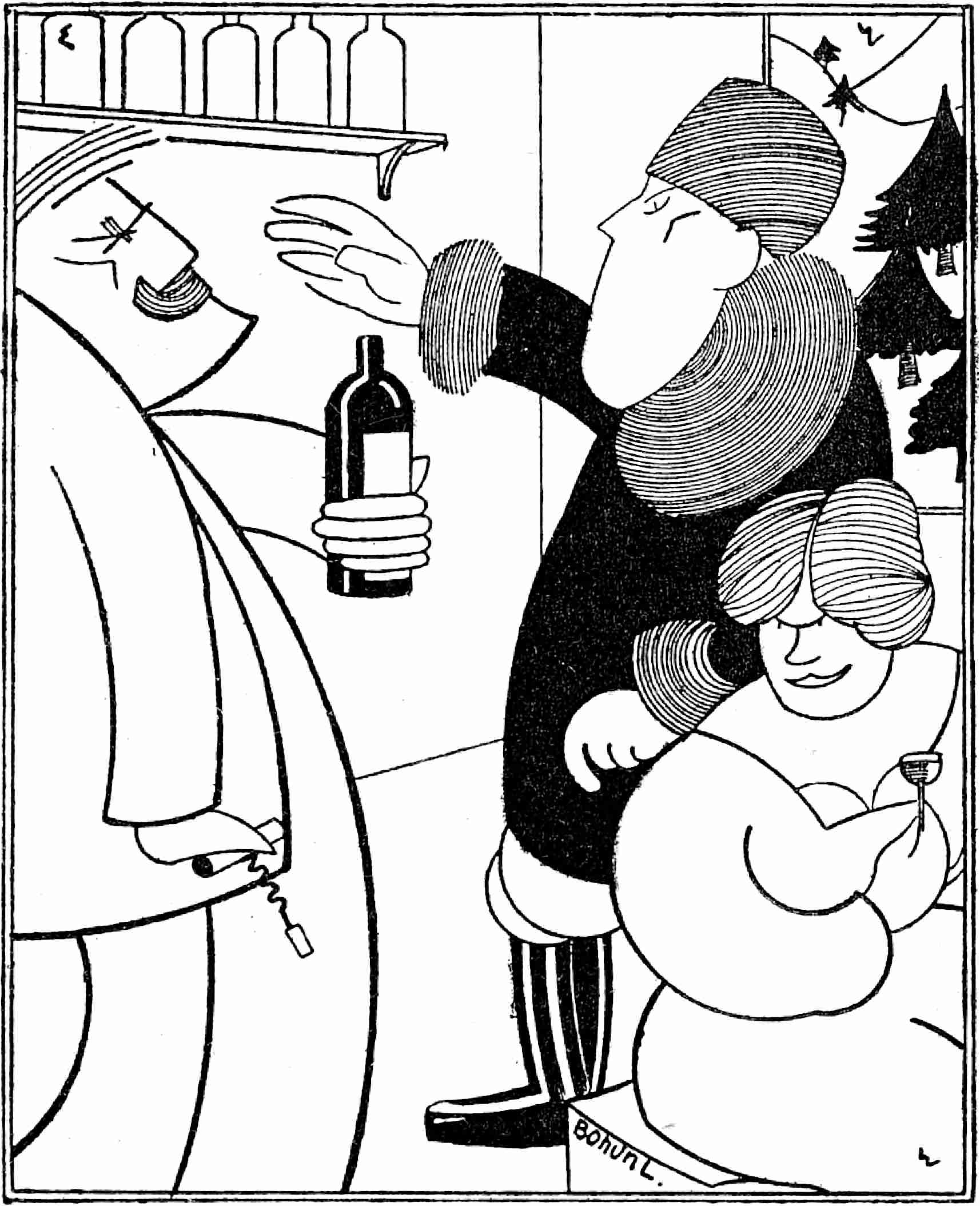
Rumbunkski: Ah! Little Fathers, this poison——
KING DAVID I
(An Historical Drama in the manner sometimes attributed to the Lord Verulam.)
Scene: The Welsh Hills near Criccieth. A vast concourse of people, Druids and Burghers among them. Flourish of trumpets. Enter King David, attended by Alfred, Knight of Swansea, and Riddell of Walton Heath.
The Knight of Swansea: Gif me your attentions, I pray you, and mark vell dese vorts. Ve Velshman haf great traditions. Ve are proud and ancient peoples. Some tink perhaps ve shows too much ze pride of race, yes? Ze fierce Celtic patriotism? But ve are chustly proud to tink ourself descendant of Cadvallader, cradle of Tudors, and fine stocks of Owen Clendower, look you—Mark den vat vorts our leader shall tell you and observe dese rulings. (He withdraws a pace.)
First Druid:
Methinks his words, though seasoned with good sense And aptly illustrative of our merits, Bewray a foreign origin.
Second Druid:
Why, sir, The man’s as good a Welshman as e’er breathed! His pedigree I’ll tell you in brief space, Identifying in so many words Wales with the lost ten tribes of Israel. Moses begat——
A Herald: Peace Ho! Have silence there.
Voices from the Crowd: Silence for David.
Other Voices: Peace for the Man of Wales.
Riddell (aside):
Mark, Swansea, how impregnable he looks, Like some proud eagle, weary of scouring the skies, That pauses on a lofty pinnacle Refashioning his pinions, whetting his beak Ready to swoop again.
King David:
Good countrymen, And ye, my immemorial Cymric Hills, I came among ye in my indecision To steel myself anew. Good countrymen, I have well pondered here in Criccieth And now have made resolve, in which I’ll pray A moment hence for your support; but first ’Tis meet I should explain. Ye well do know How lately has arisen from the ranks A party sutler, subtle enough it seems, Older than I, yet Younger by God’s grace, Who seeks to take direction by the throat, Sow discord where was harmony before, Bring ruin on the Coalition, bind Our fortunes, mine and yours, to Torydom, Vex all my policies, overthrow my plans, And make of our political affairs The kind of stew the French call bouillabaisse.
The Crowd (murmuring): We’ll have none of that. None of that. We’ll rise and storm their strongholds. We’ll burn down their castles to the ground.
King David:
Peace, peace, my friends, and hear me out. They say (Insolent curs), these Younger statesmen say, They’d have my leadership because they know, Perchance, that I have prowess in the field. But in the Council Chamber I’ll be nought, A thing, a cipher, ordered here and there.... What? Shall we now on Unionists depend? Sue them for favours, fawn on them for smiles? Eat from the dish of infamy the food They’d grudge to give had they the giving of it? Not in these trousers, sirs!
Druids:
Nay, never! Never! He’s been despitefully and most vilely used.
King David:
Must I go on and watch complacently The fairest promise turned to rottenness By bigots—dull, reactionary fools? Why, I could form a better Government (With Riddell’s and my faithful Swansea’s help) Of certain Davieses and sundry Jones, Llewellyns a few, an Evans here and there, A sprinkle of the goodly Williams blood; And not a Chamberlain among the lot To dull our spirits with his laggard’s breath.
The Davieses (talking among themselves): There’s much in this.
The Williamses: Most true and notable.
The Evanses: Not to be lightly put aside, look you.
A Druid: Peace, he begins again.
King David:
My noble friends, This, then, the resolution I have formed. I’ll back to Westminster and beard them there And put this Younger’s power to the test. If, as I think, he fall before my lance, Why, we’ll admit them to some sort of quarter; But if, as may be, they resist my terms, Then to the hustings with our banners high, Our hopes and hearts and courage higher still; And I, and doughty Riddell, and wise Mond, Fisher and Greenwood, Churchill and Monro, And all these gallant gentlemen of ours, Will armour up and lead our forces out ’Gainst Bonar and his liver-hearted crew Of purse-proud commoners and needy peers, And bear them down and roll them in the dust. Heads shall fall right and left, Curzon’s and Chamberlain’s, Amery’s, Baldwin’s. We’ll have Ormsby’s gore, Young F. E.’s Birken-head and Carson’s scowl, Old Devonshire’s yawning mask, and Derby’s jowl; And Younger on a dung heap shall be thrown That day when David comes into his own.
All:
Away. Away. We’ll to the fray, amain; And see Welsh David cleanse the land again.
(Sound a flourish. Exeunt.)
THE SLAYBOY OF THE WESTERN WORLD
(A Play in the Irish Manner.)