Act 3 — IMPOLITICS
Reading edition
A MEMBER OF PARLIAMENT
A man, or woman, who has just been elected to Parliament may be pardoned if, in the words of Gilbert, “the compliment implied, inflates” him (or her) “with legitimate pride.” It is rather difficult, when the declaration of the poll is announced by the Returning Officer, and you find yourself, by a swinging (or narrow) majority, the elected representative of some 30,000 people, to avoid a certain feeling of pleasurable self-congratulation. For the first time in your life you are, suddenly, the central figure of a great demonstration. You are astonished at your own popularity. Strangers rush up and clasp you by the hand; bearded men kiss you on both cheeks; you are taken in charge by the police, to save you from being torn limb from limb by your almost too enthusiastic friends. And, if there is a fleeting resemblance, in the triumphal march from the returning office to the headquarters of your organisation, to the old-time procession to the scaffold of a popular highwayman—a resemblance heightened by the necessity for making a speech on a crazy wooden erection usually known as “the hustings,” that air of spurious importance is, for the most part, effaced next day, when you leave your constituency by train, unrecognised and even unremarked. After the splendours of the previous night, this anonymity is an almost painful contrast; but there are lower depths of abasement to be reached. You have yet to pay your first visit to the House of Commons.
In the interval between your election and the summoning of Parliament, you have probably to some extent recovered your normal self-confidence. You have doubtless secured a home near Westminster, “to be near the House, you know.” You may even have been interviewed by a provincial paper. It is just possible that one of the leaders of your party—a junior one—in the first generous glow of the election results, may have shaken you by the hand. Perhaps (but this happens very rarely) the august personage who speaks from the Front Bench in the name of your party, may have stared you out of countenance at Lady Broadside’s reception. You are actually beginning to feel that you are Somebody after all; and so you nerve yourself to make your first visit to the scene of your future labours.
Somehow, as you slink into Old Palace Yard, the fine fervour of enthusiasm, that accompanied you in your walk along Victoria Street, seems to have largely abated. You cannot help secretly wondering whether you will be required to produce credentials by the doorkeeper. You visualise a painful moment, when a gigantic functionary will say politely, but oh so firmly, in response to your frantic asseverations, “Very sorry, sir, but if you can’t prove you’re a member, I can’t let you in.” You wonder whether he will accept the evidence of the birth certificate, and the cutting from the “Times” announcing your victory, which you hastily stuffed into your pocket before starting out; or whether you had better lie in wait for some senior member of your party, and steal in, in his wake. And, whilst these fearful doubts are invading your mind, you find yourself at the entrance, and an enormous, genial, rubicund policeman accosts you smilingly: “Good morning, Sir! New member, Sir?”
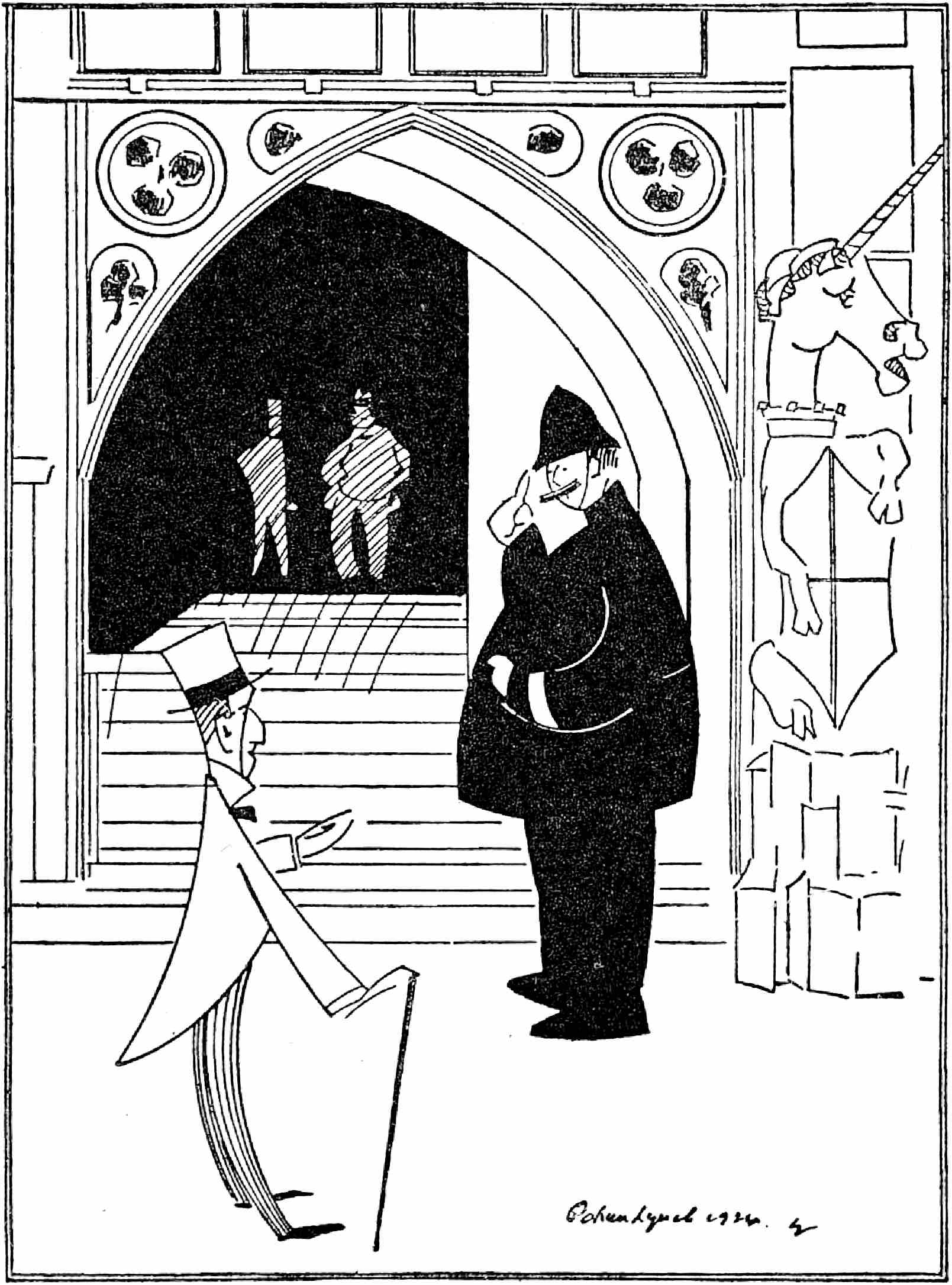
“New Member, Sir?”
Down, swelling heart!
You try to avoid bursting with pride; acknowledge his salute; and walk in. But ah, you think, the terrors are yet to come. Another constable equally large, equally genial, touches his hat as you pass through the swing doors, and says: “Cloakroom on the right, sir.” “Here at least,” you fear, “there will be a challenge.” An attendant comes up to you. He gives you a searching look. Your heart sinks into your boots. “Good Heavens,” you think to yourself, “I am in the wrong part of the building—this is probably reserved for Cabinet Ministers.” You are about to mutter an excuse and slink away. Quite unnecessary. He was only memorising your face. “Name, sir?” he asks. You give it; you will never have to do so again. Like your face and appearance, it has been indelibly recorded for future reference. “Your peg’s here, sir,” he says; and you find, rather to your astonishment, that a peg has already been reserved for you, and bears your name. Two or three other members come in—old members evidently, for he knows them personally. They exchange greetings; and you think to yourself: now where have I seen something like this before?—Your mind, in a flash, bridges a gulf of a quarter of a century, and takes you back to your first day at your public school.... “New boy, sir?” said the janitor, committing your face and name to memory. “Mr. ——’s house, sir? That’s your peg in that corner; them’s the school notices under that shed, see? You ought to read them every day; and that’s the tuckshop the other side of the road opposite the gates.” ... “New member, sir?” enquires the attendant. “There’s your peg, sir; you’ll find the Post Office at the top of the stairs on the left of the Lobby; you ought to ask there for the letters. Smoking-room, sir? Along the corridor, turn to the right; and it’s on your left-hand side.”
Truly the boy is father to the man.
You leave your coat, and wander up the stairs to the inner Lobby. You sample the thrill of receiving your first batch of letters in the House of Commons. You peep reverentially into the empty Chamber—half afraid to go inside for fear of inadvertently transgressing some rule of the House. You would like to look at the Library and the smoking-room; and yet you feel a certain unwillingness to trouble the attendants with questions. Suddenly a stranger, noticing your irresolution, saunters up to you. “New member?” he asks affably (as who should say “New boy?”); and when you have admitted the soft impeachment—“Thought so,” he continues, “I think I knew most of the last Parliament. Care to look round? I’ve nothing to do for an hour.”
And, even as you accept, you remember how Williams (or Brown), who afterwards grew to be your alter ego, took pity on you in the old days at Greyfriars, led you round and “put you wise”; and, whilst your new friend is explaining the mysteries of the Chamber—the Chair, the Cross Benches, the Bar, the Galleries—leading you through the Library, along the passages to the House of Lords, and making you acquainted with your new public school, you think with gratitude, and some wonder, of the eternal youth of human institutions.
WOES OF THE WHIPS
The Chief Whip of a Party is a very august personage. He shares in the councils of the Party leaders. He is one of the links that bind them to the Headquarters organisation, and the constituencies. He holds the party together on the lines laid down by the Leader. He keeps a watchful eye upon recalcitrants, like a sheep-dog with wayward sheep. He is, in fact, the Chief of Staff; and his lot is not an unenviable one.
The Junior Whips are another matter. Rebellious members of the party who would, however, feel some compunction about speaking their minds to the Chief Whip, lay bare their grievances, with embarrassing plain-spokenness, to the juniors. The Scottish and Welsh Whips must often find themselves like to the unfortunate victims of that mythological giant, whose habit it was to tie the legs of his foes to opposing fir-trees, and, releasing the trees, divide them in twain—by reason of the rival claims of their own particular groups of members and of the Chief Whip himself. Needless to say, in all parties, there is the fullest opportunity for members to bring their point of view to the notice of the leaders, both through the Whips and at party meetings. But once a party decision has been taken, it is obvious that, for the sake of the unity of the party, it is highly important that its members should present a consolidated front. And it is when the preconceived opinions of individual members, or special circumstances in their constituencies, happen to be at variance with the general policy of the party, that the troubles of the Junior Whips begin. They have obviously an inclination towards those who compose their own group, such as the Welsh members or Scottish members; they have also their duty towards the party as a whole—not always easily to be reconciled. Anyone who experienced the unenviable position of a Junior Staff Officer in one of the feuds that habitually raged between battalion and brigade, or between brigade and division, during the war, will have a fairly accurate understanding of the trials of a Junior Whip.
But that is not all. The Whips are responsible for the social side of the party as well. Sir Augustus and Lady Broadside, let us say, offer to arrange a reception. For some reason, limitation of space for instance, it is not possible to invite everybody. On the Whips falls the invidious duty of making the selection, who shall be asked and who not. And when this difficult task has been performed, it is discovered that, by an oversight, there is no record of the fact that some new member is married—consequently he is asked and his wife is not, with inevitable heartburnings as the result. Or, again, there are ceremonial duties to be attended to. Members wishing to attend the King’s Levee must have their paths made smooth. The presentation at Court of the wives and daughters of members must be arranged. The Whips must expect to be consulted, as well, on sumptuary questions, such, for instance, as whether a member ought to buy a levee dress, or whether it will be considered sufficient if he avails himself of the new regulation, and attends in evening coat and knee breeches; and what is the most appropriate garment, other than a white sheet, in which to make a maiden speech.
As if that was not enough, there are the speaking arrangements to be made. It does not, of course, follow that the list will be adhered to, but, for the convenience of the Speaker, it is usual for him to be furnished “through the usual channels,” which means in other words by the Whips, with a list of members of each party who would like to speak in any Debate. Obviously some selection must be made, or in a Parliament of active politicians, such as the present, the list of each party would be impossibly large. More than half a dozen names for each party would be more of a hindrance to the Speaker than a help, because there would be no possibility of getting them all in—seeing that the normal hours of Debate are between four in the afternoon and eleven at night—seven hours in all—and the average duration of speeches is twenty minutes, giving a maximum of twenty-one speakers. This process of selection calls for tact of the highest order. On the one hand, if the list is too full, the Whip must not put off further volunteers in such a manner as to discourage them. On the other hand, he must be careful not to create the impression that he wants them to speak always, or they will never leave him in peace. Even the most sensible and level-headed people are touchy about their speaking; and the effect of a hasty word may easily take a whole session to efface from the mind of the person to whom it was addressed.
Nor do the Whip’s duties end there. A question suddenly arises needing instant determination. On the one hand, the leader may make up his mind at once as to the party attitude; in that case the Whips must hurry round, and communicate it to the members of the party. On the other hand, the leader may wish to know the feelings of his party before deciding on a course of action; there is no opportunity for holding a party meeting, the decision must be taken probably within half an hour; it now becomes the duty of the Whips to flit from member to member, collecting opinions and suggestions for communication to the Leader by the “Chief.” Or it may be necessary to “keep a house” for one of the back-benchers who is “raising a question on the adjournment”; again the busy Whips must hurry here and there lobbying their party to make sure that forty members will be present, to protect their colleague against the misfortune of being “counted out.”
And then, on top of all this, there is liaison with the other parties, which in practice is more or less reserved for the Chief Whip himself—for this kind of work demands the delicacy of Agag. These are the accommodations, arrangements of business, exchange of party views, that necessarily go on behind the scenes as a preliminary to the set Debates—especially in connection with the procedure of the House and the settlement of the order of public business.
There is a certain glamour in being styled a Whip. Your name and, probably, your photograph are published in the papers; you are given special facilities for entertaining your fellow-members; if your party happens to be in power, you hold a junior office in the Treasury. The Chief Whip, despite his responsibilities, has, on the whole, an interesting job. He is largely concerned with what is sometimes called the kitchen side of politics; but his function of linking up the Parliamentary party with the leader, calls for high qualities; and his weight, in the determination of the party programme in the conclave of leaders, is considerable. The Junior Whips are devotees of a high order to their party’s organisation. Their task is a thankless one. They condemn themselves to well-nigh Trappist vows in the Chamber, because they are almost always at work outside it. They place themselves at everyone’s beck and call. They are in demand to smooth out any difficulty that may arise.
In fact, as a man once said, who was A.D.C. to a Colonial Governor: “It’s a spittoon of a life.”
YOUNG MEN AND “MAIDENS”
Defer it as you may, upon one pretext or another, the fatal moment will come at last when you must make your maiden speech. There have, it is to be supposed, been members of Parliament of such agonising modesty or such iron self-restraint, that they would have been willing to pass their entire Parliamentary lives in silence. But sooner or later, and probably sooner than later, an aggregation of pressures—duty to the constituency, the spur of amour propre, green jealousy of the triumph of X., who so impressed the House by his speech on the Protection of Insects Bill, the subtle encouragement of some fair flatterer who, when X.’s speech was discussed, eyed you archly and murmured, “Of course you ...” leaving your vanity to fill in the blanks—these, and other compelling reasons, combine to persuade you to the irrevocable step of giving in your name to the Whips, after which, feeling like a man who has made an appointment with his dentist, you slink away and prepare for the worst.
With becoming modesty, you select some insignificant, and relatively trivial, subject—such as World Federation, the Solar system, or the relations of the Almighty and the Universe, as affording you scope for the pronouncement you feel it in you to make. You collect a whole pantechnicon-load of authorities, which, when you have read them through, are allowed to lie piled in the darkest passages of your house for the servants to fall over; you take a ticket for the British Museum Library; you apply yourself to study with all the fervour of a Bengalee competing for an examination. And then, one or at the most two days before the great oration is scheduled to be delivered, your Whip says casually, “Oh, we’ve had to change the arrangements. We’re getting you in on the Committee stage of the Impurities in Milk (Abolition) Bill”; and all your labour is shown to be wasted and vain. There are only three days left. You rush to the Dairy Produce Association, the Institute of Milkmaids, and the Society for the Preservation of Cattle and Kine, from each of which you receive an undigested mass of propaganda, disguised in the form of scientific tracts. There is no time to push your investigations beyond these, so you set yourself to learn them word by word. You come down to the House on the fatal day primed with knowledge, with lactialities on your lips and the milk of human kindness bubbling from your heart—and you discover that, before your arrival, a member of your own party, interested in the welfare of subject populations of the Empire, has moved the Adjournment of the House to draw attention to a matter of urgent and definite public importance, namely, the refusal of the Government to issue practising licences and a charter of incorporation to the witch-doctors in the U-Ba-Be district of Abeokeuta.
You seek out your Whip, demanding information. He tells you that the Government has changed its mind about the Bill on which you were to speak, and intends, in its place, to introduce an Amending Act in connection with the Acquisition of Mineral Royalties in Zanzibar, Proclamation of 1872. Having no knowledge whatever of Zanzibar or minerals, other than those in bottles, and only a nodding acquaintance with the lesser grades of royalty, you feel bound to demur, when he suggests that you should “give tongue” at such short notice on this subject. Whereupon he offers you your choice between the Protection of Herrings (Scotland) Bill, Second Reading; the Civil Service and Revenue Departments (grants in respect of medical referees, destitute aliens, and port and riparian sanitary authorities) Vote on Account; and the Army and Air Force Annual Bill. Smitten with despair at the prospect of the vigils, prayer and fasting entailed in the mastery of any one of these three subjects, and fortified by a hazy recollection of “King Solomon’s Mines,” you quaveringly ask whether it would not be possible for you to speak on the Witch Doctors Adjournment. As your Whip has been searching high and low for someone to do this very thing, he almost invites you to dinner in his relief; and hurries away with your name to the Speaker. In due course he seeks you out in the Library, where you are sitting, in a cold perspiration at your own temerity, and struggling to master a report on “Witchcraft and the Black Arts as practised in the Continent of Africa,” furnished through the medium of the Aborigines Suppression Society in 1850—apparently the only standard work on the subject. He informs you that you will be called immediately after the Government has replied. Your heart sinks into your boots; a clammy sweat breaks out upon your forehead; and you apply yourself assiduously to the report.
Just before 8.15 p.m. you stagger into the Chamber. To your excited fancy it seems to have grown very large. The seat on which you are accustomed to sit, seems an immense distance from the Speaker’s Chair. But, as the House is practically empty, you sneak into somebody’s corner seat, and hope for the best. The one encouraging factor in the whole proceedings is that, in spite of the ghastly hash that the mover of the resolution seems to be making, the patient House is attentively listening in silence. After all, you think, remembering your own triumphant speeches during the election, the swing of the words, the thrill of the audience, the storm of applause—after all, it can’t be as difficult as all that.... An Under-Secretary begins a half-hearted defence of the Government. He says he is quite certain that in this case the House will consider that the House ought to be extremely careful before responding to the suggestion made by his hon. and gallant friend that the House is at liberty to vary a former decision of that House, as hon. members below the gangway seem to imagine. He goes on to say, er—that the Government—er—will, of course, be ruled—er—or perhaps he ought to say guided—er—by the view of the House towards—er—or with regard to the matter—assuming that in that matter or—er—as he would rather put it, in such questions—er—the opinion of the House must be the governing consideration. Furthermore, he would remind the House, with the permission of the House, that the House is always reluctant to set aside a privilege won by the House in former times and upheld on the floor of the House by statesmen like Drigg and Bulgman with the full approval of the House—an approval, Mr. Speaker, which, as the House is aware, is recorded in the journals of the House, and which he is satisfied—nay, assured—that all members of the House would pause before challenging.
With this adjuration he resumes his place. You climb tremulously to your feet. The Speaker calls: “Mr. Wutherspoon.” And immediately most of the people in the Chamber rise, and hurry out, with looks of disgust and loathing. The bustle of their exit rather takes away from the effect of your carefully prepared opening sentences; and your biting gibe at the expense of the Minister seems in some mysterious way to have lost the greater part of its sting. Those to whom it is audible ejaculate a mirthless “Ha, ha,” to encourage a maiden speaker, and vanish in the wake of those members who have already left. You wonder to yourself, in dismay, whatever induced you to embark upon a Parliamentary career; and at the same moment, stumbling, quite by accident, upon some happy phrase, you are greeted, to your astonishment, with modified cheering. This is what you were waiting for. You feel that Parliament is not so insensible to your merits, as you had at first supposed. You seize the lapel of your coat with your left hand, and, throwing out your right in a generous half-circle, you venture boldly upon the great passage in your speech, beginning, “The witch-doctors of U-Ba-Be, a humble section of our fellow-subjects, organised, as who shall say they have no right to be organised, in a society, union or corporation, turn their eyes and lift up their voices to this House of Commons imploring....” Somehow, by the malignant intervention of unhappy chance, before you have said half a dozen words of this moving passage, a deathly silence has fallen upon the Chamber; all eyes are fixed upon you; you stumble and falter; and murmured conversation at once begins. Again you blunder on a telling phrase. Once more you find you are being listened to. This is a pity, because it betrays you into a touch of self-confidence. Immediately, all around you, faces, like flowers in the morning sun, expand into smiling bloom. But you are getting into your stride: you correct that mistake with a modest remark and a deprecating movement of the hand. Whereupon, you are cheered. You turn with graceful assurance towards the Chair. “Why, Mr. Speaker, the witch-doctors of U-Ba-Be,” you begin; and you find that the Speaker, who has a legion of duties beyond listening to the speeches, is in earnest conversation over the arm of the Chair with one of the Whips, or perhaps is writing, or—and this is so disconcerting as almost to petrify one with astonishment—he has vacated the Chair to the Deputy-Speaker, who wearing neither wig nor gown, is well-nigh invisible under the mighty canopy. In the dismay of this paralysing discovery, your legs endeavour to collapse under you. You nerve yourself for a prodigious effort, jettison the witch-doctors into space, and endeavour to sweep into the peroration, so carefully prepared on the subject of World Peace, adapted later to the Milk Bill, and now, with suitable alterations, doing service on behalf of the subject populations of the Empire. You get along very nicely for about two minutes; you feel that you are taking the House into your arms; you carefully avoid a second glance at the Chair, and look along the benches, warming to your work. Alas! at that moment somebody laughs. In all human probability his laughter had nothing to do with anything you said. In a feverish effort to recall your words, for purposes of correction, you lose the sequence of ideas, and the peroration follows the witch-doctors into the limbo of forgotten things. You lamely thank the House for its indulgence; and sit down covered with ignominy and shame.
Then, to your astonishment, other members turn round, and nod to you—nods of approval. Somebody says “Well done.” Somebody else leans forward, and pats you on the back. One of the leaders on the Front Bench actually turns round and looks at you. The Whip who arranged for your call offers words of congratulation.
You congratulate yourself—on having got it over.
FRONT BENCHES AND BACK BENCHES
The Front Bench, which faces the Treasury Box, and is located on the right of the Speaker’s Chair, is reserved for Ministers of the Crown. The Front Opposition Bench, which is on the left of the Speaker’s Chair and faces a similar box, is reserved for ex-Ministers and Privy Councillors in opposition. What secrets of State these massive brass-bound boxes contain, must be a source of anxious wonder to everyone who attends a Debate and looks down upon them from one of the Galleries. They look as though they are the very Holy of Holies of the Constitution, the arcana in which repose the mystic foundations of our greatness. You feel that, at least, they ought to contain Doomsday Book, the original manuscript of Magna Carta, and the Declaration of Rights. So massive and monumental is their appearance, so hallowed their associations, that you would not be surprised to discover that the special form of oath in the House of Commons was to swear “By the Treasury Box!” as kings of old did swear par le splendeur Dex.
Lovers of Stevenson will recall how, during his stay on the Island of Apemama, having been afflicted by influenza, and when all Western medicines had failed, he put himself in the hands of Tembinok’s Chief Magician, who, by invoking the deity Chench, effected a miraculous cure—so shaking the scepticism of Stevenson that he pursued investigations with the magician, which culminated in the discovery that Chench occupied a small wooden box in the Warlock’s house. Insatiable in his desire to extend his theological knowledge, he succeeded, after protracted bargaining, in acquiring the tenement of the god, bore it home in triumph, found himself, like one of his own characters in the story of the Bottle Imp, unable to resist the pangs of curiosity, and, with who can guess what delicious anticipations of the unknown, removed the lid—only to discover three cowrie shells and a little piece of matting. Such are the disappointments of the seeker after truth who should bring himself to open the Treasury boxes, for one is empty and the other contains a cheaply bound and quite unremarkable copy of the Bible and a couple of pieces of cardboard bearing a certain family resemblance to that part of the paraphernalia of the optician that he hangs on the wall to test your sight by—which are, in fact, copies in large letters of the oath, the Scotch oath and the Affirmation, required by law to be taken on signing the roll of Parliament, and embodied in this form for the convenience of the Clerk who administers them.
But this is a digression from the Front and Back Benches. The two members for the City of London, by some curious old survival, are entitled to sit on the Front Bench of their party; but in practice, since both Front Benches are notoriously insufficient to accommodate all claimants to seats, this traditional right of the City members is only exercised on the first day of a new Session, as who should put a barrier once a year across a private road, to prevent the right from lapsing. Nowadays with three large parties in the House, the third headed by two ex-Prime Ministers and a number of distinguished ex-Ministers and Privy Councillors, the front bench below the gangway, on the right of the Speaker’s Chair, has, by the Speaker’s ruling, become a Front Bench. Its opposite number on the left of the Chair has no special status. By virtue of their office, the Whips sit on the front benches of their respective parties. All the remainder of the House constitutes the back benches, with the exception of the Cross-benches—which, however, though actually within the Chamber, are, by a fiction, outside the House, being behind the Bar. It follows that a member may not address the House from the Cross-benches; but since, by way of compensation, the Members’ Galleries on either side of the House, though outside the Chamber, are, in fact, by a similar fiction, inside the House, a member may, and in Mr. Pemberton Billing’s time did, address the House from these lofty altitudes above it (if he is so fortunate as to catch the Speaker’s eye), giving himself, in the exercise of this privilege, the appearance of a contemplative passenger leaning over the side of a ship.
So much for the physical difference between the Front and Back Benches. What of the Front and Back Benchers? The Front Bencher is the finished product of the Parliamentary machine. He is, to the humble majority of his fellows, what the members of those august and mystic societies, like “Pop” at Eton, are reputed to be, to their less distinguished brethren. A Front Bencher is, by tradition of the House, entitled to catch the Speaker’s eye in preference to any Back Bencher. He need not attend prayers: indeed, if he values the privileges of his order, he will be careful never to attend prayers, but will saunter in to take his place whilst the Speaker’s Chaplain is bowing his way backwards down the floor of the House. He has the privilege of putting his feet on the Table, a practice which he not infrequently carries into his own home—to the mingled pride of his family and astonishment of his friends. But if the position has these privileges to give, it has also its responsibilities. Front Benchers must behave with decorum, and that is more than is expected of anyone else. They are the Sixth Form boys, and must set an example.
The successful Back Bencher should approach his work in the spirit of the Lower Third. Whilst he should not actually permit himself the relaxation of practical joking, and would perhaps be called to order if he shook a mouse out of his trouser leg, like “Pater” Winton in Kipling’s story, he has within reasonable limits of good humour, an ample licence to make sport. One well-known member of the House spends the greater part of his Parliamentary time twisting order papers into something between a spill and a spear, which he then ostentatiously throws upon the floor, as though he feared to encounter the temptation of continuing to hold them. Another is assiduous in the manufacture of paper darts, which as yet have never been thrown.
The experiences of other deliberative Assemblies have taught the House of Commons that Back Benchers are not to be trusted with inkwells. This is probably the reason why there is no provision for making notes, except upon one’s knee. But a lot of quiet fun can be had out of raising points of order that are not points of order, and by the judicious organisation of a hum of conversation to drown an opponent’s speech. Isolated interjections, if possible foreign to the subject of the Debate, and Supplementary Questions bearing no relation whatever to the original question, are also amongst the legitimate weapons of the Back Benchers. And finally, there is the great Parliamentary instrument, the use of which is almost entirely confined to Back Benchers, of moving the Adjournment of the House. Where some luckless Minister can be tripped up in answering a question, and it can be made to appear that the answer reveals a state of affairs definite, urgent and of public importance, the Speaker may be asked for leave to move the adjournment. If leave be granted, the motion is made, and, if supported by 40 members, is set down for discussion at 8.15 on the same evening, irrespective of what business has been allotted to that hour. This, in the hands of senior Back Benchers, can be turned to very effective account. Junior Back Benchers are well advised to master the use of the lesser Parliamentary weapons to begin with.
In all seriousness, there is a noticeable difference between Front and Back Benchers, noticeable whether you put Back Benchers on the front benches or Front Benchers on the back benches. Thus, in the last Parliament, Mr. Austen Chamberlain and Mr. Lloyd George, addressing the House from back bench corner seats, contrived to present the appearance of Gullivers amid Lilliputian surroundings—a phenomenon largely attributable to the Front Bench manner. Some members of the new Government (and one or two members of the last Government) who have not yet attained to Front Bench dimensions, present an equally astonishing contrast of the opposite kind. Their painfully unsuccessful efforts to command attention are a source of dismay to their friends and discomfort to their foes. The secret of successful Front Benchery is heavy thinking, and a heavier form of expression. His chief weapon is the polysyllable. A Back Bencher does best to study plain speech, the simpler the better. He may enliven his argument with jest and flippancy. He may controvert his opponent with a plain denial.
Woe to the leader who makes a joke. “Pas de plaisanteries, Madame,” observed a scandalised European monarch, to his jesting spouse: and that is a safe rule for Front Benchers in Debate. If a man is dull enough he can get almost anywhere, once he has reached the Front Bench; but ah, how difficult are the demands upon those behind him! The speeches which the House would fill to hear from the Front Bench, would, with equal certainty, denude it of all occupants, if delivered from behind. A Front Bench speech may run half an hour, three-quarters of an hour, and even, in the case of the leaders, an hour. No Back Bencher should speak for more than twenty minutes, and fifteen is better. The Front Bench speech should be sonorous, well documented, weighty, responsible—in fact, a pronouncement. The Back Bench speech should be pithy, strictly to the point, not too serious, and, above all, modest—in the nature of a tentative expression of opinion.
Fortunately Front Benchers are not always dull—though they do their best. And Back Benchers as a rule are far from modest.
For a consequence the proceedings often provide such a feast of good fun, that successive Chancellors of the Exchequer have only narrowly resisted the imposition of an Entertainment Tax. This would be fair enough, if substantial compensation were payable for enduring the agonies of devastating boredom entailed by sitting through, for instance, some of the Scot——
Hush! There are too many Members of that virile race, for such remarks to be altogether wise.
“ORDER, ORDER”
In other lands they manage things differently. The President of the Lower House is enthroned on a majestic dais, at the head of a steep flight of steps; the Tribune, from which speeches are made, is beneath him; and he could, if he wished, bring the orator to reason, or, if need be, to the conclusion of his discourse, by a few steadying taps on the head with the ivory mallet which (auctioneer-wise) is his normal instrument for obtaining order. The mallet is reinforced by a large muffin bell, which, in times of distress, the President rings. And his final means of expressing disapproval is to put on his hat—a custom which perhaps furnishes us with the source of the jolly old folk tale, recorded in Grimm, of the King who used to suppress insurrections by pulling down his hat over his eyes, whereby cannons were fired off in all directions. This picturesque ceremonial, far more imposing than the procedure of the House of Commons, is also less effective for the maintenance of order. In the course of really closely reasoned arguments, in those less reticent assemblies, inkwells have been known to fly, the members have been kept from each other’s throats only by the intervention of the sabre-girt attendants, and the very citadel of the President himself has been beset; whereat, jangling his bell with one hand, and repulsing his assailants with a ruler in the other, he has resolutely maintained his hat upon his head, in testimony of the fact that, legally speaking and despite “the tumult and the shouting,” the séance has long been at an end.
But in the House of Commons the powers of the Speaker are satisfactorily real; not only has he temporary jurisdiction over all persons within the precincts of the Palace, he has also unassailable power to deal with the members. He is himself both a member and something more than a member. He is chosen by the vote of the House; and, once approved by the King, is vested with supreme authority in the management of the Commons. Should a point of procedure arise, his decision is final. Should a question be put of which he disapproves he may disallow it. Should a member say that which, in the Speaker’s opinion, should not have been said, he may order the member to withdraw. Should his ruling be disobeyed he may send a member out of the Chamber. Should the defiance be persisted in, he may suspend the member from the service of the House, whereafter that member may not be admitted to the precincts, until, by resolution, the House itself has terminated his suspension. Yet the Speaker, omnipotent though he seems, is also the servant of the House. It was instructive not long ago to hear Speaker Whitley define his powers, in relation to the Crown, almost in the very words used by Speaker Lenthall, well-nigh three hundred years before: “For myself I think my reply must be that I have no tongue to speak in this place, but as the House is pleased to direct me.”
It must not, however, be supposed that the Speaker exercises his functions of authority harshly. His principal weapon, in fact, is a kind of awful benignity. It is doubtful if there has ever been a Speaker of the House of Commons who maintained his position by severity; indeed, the House of Commons, which is far from being the unintelligent assembly one might suppose, if one judged by the Press, would never choose a person with whom there was the slightest risk of friction; for the House is very jealous of the rights of members. An indication of the kind of results that might be produced by an assumption of too pedagogic a heaviness, on the part of the Chair, was given in the Debate on the Army and Air Force Annual Bill in the last Parliament. In the early hours of the morning, after a trying all-night sitting, Sir Frederick Banbury, who was temporarily in the Chair, raised his voice a little beyond the pitch of good humour in calling to order Mr. Lansbury, who was addressing the House, whereat the latter bluffly retorted: “You must not shout at me. Order yourself.” Strictly speaking, Mr. Lansbury was out of order in making this retort. He should have deferred to the ruling of the temporary Chairman, and, if necessary, raised the matter with the Speaker after questions on the following day. But there has never been in modern times a member so jealous of the privileges of the House as Sir Frederick Banbury. He realised that tempers, his own perhaps included, had worn a little frayed during the sitting; and therefore, contenting himself by reminding the offender that he must not challenge the decisions of the Chair, he dexterously shepherded the discussion into safer channels.
Speaker Whitley keeps order by an unbroken suavity of manner, a great sense of fair play and a wise lenience towards faults committed in error, from which it will be seen that his hold upon the House is very largely due to the feelings of personal affection, in addition to natural respect and loyalty, with which he is regarded by all members, even the most junior. He is quite capable of administering a rebuke, but he prefers to conquer by gentleness: that is his peculiar quality. With Speaker Lowther it was a keen sense of humour and, if necessary, a blasting and ironic wit, that gave him his ascendancy. This is not to say that Speaker Whitley is always grave; far from it. His rulings are most often touched with humour. But it is a quiet, gentle humour, like the man himself—the humour of a serious man, not the esprit of a wit. With Mr. Speaker Peel the governing factor was a tremendous, awe-inspiring dignity—something of the same kind as that traditionally ascribed to Dr. Arnold of Rugby School.
It must not, indeed, be imagined that the House of Commons never gets out of hand: nor must it be imagined that the House of Commons has only got out of hand since the Labour Party grew large. The House of Commons must always have been a troublesome body. “Scenes” in the House have taken place right back to the days of Oliver Cromwell; indeed, Mr. Drinkwater in his play gave a vivid representation of a scene in the House in those days. The very carpets on the floor are eloquent of what took place in former times; for the red line, down the outer edge of the strip that borders the front benches, is no less than a warning to members that, in speaking, they must not put their feet beyond it, on pain of being “out of order”: and the purpose of this rule is to keep them from engaging each other with their swords instead of their tongues in the heat of Debate! There were scenes in the House, constant scenes, in the old Reform Bill days and in the old Irish days. Mr. T. P. O’Connor still tells the dramatic story of the expulsion of Bradlaugh, and equally dramatic stories of the bodily removal of Irish members. Mr. Lloyd George himself has stories of suspension to tell. There were scenes in Parliament just before the war—when, for instance, Mr. McNeill threw a book at Mr. Churchill. There were scenes in the last Parliament, as when the four Labour members were suspended, and on other occasions. There will inevitably be scenes in the present Parliament; and it is safe to say that scenes will take place so long as the Commons shall survive.
But whereas in other countries, despite the muffin bell and the top hat, the President cannot avoid being drawn in, in the Mother of Parliaments the Speaker is something more than a restraining influence, he is the embodiment of law and order. He has behind him for the suppression of disorder the whole power of the State. He could fill the House of Commons with police, and suppress disorder of any magnitude; and if such an occasion arose, and threatened, as it would, our whole Parliamentary institution, the Speaker for the time being would unhesitatingly do so. But that situation will hardly arise. We do most things in this country in the spirit in which we play our games. Members know that, if they transgress the rules beyond a certain point, they will be suspended. They know that when suspended the Speaker will sign to the Sergeant-at-Arms and the Sergeant-at-Arms, advancing up the floor of the House, will require them to leave the Chamber. And because it is part of the rules of the game that they must do so, they will do so, in the same spirit as they would accept the decision of the umpire in a cricket match. So much for individuals. And if a party—which happened once in the last Parliament—as an organised whole, were to make business impossible by concerted noise, the Speaker has yet another weapon in his armoury. Under Standing Order he may, “in view of grave disorder,” adjourn the House “without question put,” and give the forces of reason time to reassert themselves.
How undramatic! Yes. But the whole point about the Speaker is that he is not a Loud-Speaker.
LORDS AND COMMONS
Though housed in the same building, though separated by a mere matter of yards of stone-flagged corridor and lobby, no two assemblies more essentially different in character, than the House of Commons and the House of Peers, could easily be imagined. They exist, it is true, for legislative purposes, the one being complementary to the other; but when that has been said not many points of similarity remain. The Speaker of the Commons is enthroned in a majestic canopied chair, dominating the Assembly over which he rules; the Lord Chancellor, who presides over the proceedings of the House of Lords, squats on a monstrous crimson cushion, like a feather-bed gone mad, facing a yet more monstrous crimson cushion upon which, on occasions of State, His Majesty’s Judges sit back to back, reproducing that obsolete formation, the hollow square, with which we won the battle of Waterloo. The Speaker of the Commons is so called because he so seldom speaks—because, indeed, he is the only member of the House who may not speak, except as the House directs him. The Lord Chancellor, on the other hand, may, and habitually does, indulge in any flights of dithyrambic eloquence that happen to surge out of his teeming brain; and, though, unlike the Speaker, it does not lie with him to determine the order in which Noble Lords shall address the House, he might, if he chose, monopolise the whole time with his own speeches. Indeed, when Lord Birkenhead was Chancellor such a happening was not regarded as....
Fortunately, no such proceeding is possible in the House of Commons, or, with a series of stunning reports, Mr. Pringle, Commander Kenworthy and Mr. David Kirkwood would explode from suppressed mortification; and there are others whose peace of mind would be seriously impaired. But in the House of Lords they are only too anxious to avoid speaking; indeed, the difficulty usually seems to be, to overcome the natural reluctance of Noble Lords to allow their voices to be heard, in that rarefied atmosphere, before they have reached the years of threescore and ten, laid down by the Psalmist as the normal span of mankind.
In such circumstances of difference what wonder that each House regards the other as a sort of lusus naturæ, a freak, a giant pumpkin? This sense of strangeness finds the extreme of its expression, in the House of Commons, in such outbursts as Mr. Jack Jones’s bitter expostulation against “those marionettes,” on the occasion when the Commons were sent for by the Lords to hear a Commission read, and found in the Gilded Chamber five Lords Commissioners resplendent in robes, seated in line; a solitary Back Bench Bishop, and one very junior Peer, probably a mere Baron, who, having wandered in by mistake, sought to efface himself under the lee of Black Rod’s box. “That,” said Mr. Jack Jones bitterly, “is what they think of Us.” Indeed, a chilling disdain is the chief characteristic of the public attitude of the Upper towards the Lower House—as for instance when the latter, in a new Parliament, are haughtily bidden to “repair to the place where you are to sit,” as though they were fowls, “and proceed to the choice of some proper person to be your Speaker,” as though, without that admonition, they would choose somebody from the neighbourhood of Leicester Square. This well-bred contempt is repaid, in the Commons, by veiled references to “another place.” On this exchange of courtesies, the Peers seem to come off best; though, when it comes to practicalities, the positions are reversed, as any student of the Parliament Act knows only too well—little now remaining to the Peers of their former legislative glory.
They get it back upon the faithful Commons, in virtue of their position in the Constitution as the Supreme Judicial Tribunal of the kingdom, whereby it follows that, if, under the Parliament Act, they cannot oppose indefinitely the legislative will of the Commons, they can to some small extent indemnify themselves, in their capacity of final interpretative authority, after the legislation has been passed. In practice they delegate this function to the Law Lords, five of whom, seated on the red benches with rickety desks in front of them, spend interminable mornings appraising subtle and circumlocutory arguments addressed to them from the Bar of the House by learned Counsel, standing at a kind of lectern, and surrounded by their fellows eager to propound distinctions. There is, however, nothing to prevent any Noble Lord so minded from partaking in this intellectual feast. Indeed, a legend obtains of a sturdy independent Peer, jealous of what would be called in the House of Commons “private members’ rights,” who, for years, insisted on attending, on these occasions, and delivering himself of ponderous allocutions of which no one present, himself least of all, understood one word of the meaning. It says much for the self-restraint of our Hereditary Nobles that his example has not been followed in modern times—though with Sir Frederick Banbury elevated to the Peerage one can never be quite sure.
The House of Lords, in short, is a living example of the utility of the unworkable, the practicality of the impracticable, and the incredible sanity of the British Constitution. By all the rules of the game, in a Chamber composed of more than 600 people, fully half of whom have no serious political interests, governed apparently by no rules of procedure, and held in check, in fact, by nothing except tradition, the proceedings might be expected to be those of a disorderly rabble. In fact, 80 members is a good attendance, and 50 is nearer the average. The speeches are as a rule so closely reasoned, so admirably informed and of such excellence of style, as to be a source of never-ending envy to members of the Commons. Such a thing as a “constituency” speech is, of course, unknown. There are no “dockyard” members. Nothing need be said with a view to a general election. Nor can a member of the Upper Chamber be imagined making a speech, for the sake of speaking. It is not exactly an inviting atmosphere for such an undertaking. Imagine yourself standing up to address a huge and almost empty chamber, furnished with crimson benches, and tenanted by a smattering of elderly gentlemen all staring with polite fixity at their boots. It really looks as though this undemocratic and almost atavistic body, despite all its anomalies, was in practice something of an example to its elective fellow-House, both in the expeditious transaction of business and in the orderliness of its proceedings. Their very method of voting is indicative of their critical keenness, their impatience with the institutions of this world, their determination to be satisfied with nothing less than perfection. The form of the vote is not, as in the Commons, “Aye” and “No,” but “Content” and “Not Content.”
Usually they are not content.