ACT IV
Reading edition
Scene: The streets of London (many years later). Heavyweight and Diggers walk slowly along, searching the faces of the passers-by. Suddenly Heavyweight stops in front of a thin, emaciated woman.
Heavyweight: God! It’s you, Agatha, at last.... Have you come to this?
Agatha (unsteadily): Don’t interfere with me. I’m looking after myself. What I do is my affair.
Diggers (incoherently): Oh, Miss Agatha, Miss Agatha. (He strokes her hand.)
Heavyweight (tenderly): My dear. You’re worn out, thin, hungry. Wait. We’ll buy some food and wine and take you back. Come, Diggers. (They enter a shop. She leans against a lamp-post. A detective appears suddenly beside her.)
The Detective (addressing her sharply): Solicitin’, you was.... You come along o’ me.
Agatha (furiously): I won’t, I won’t! It’s a lie.
The Detective: Now, then, be civil.... Ticket o’ leave, ain’t you?
Agatha: Oh, what’s that to do with you? I’ve served my time. You’ve no further claim on me.
The Detective (grimly): ’Aven’t we? You just come along. (He takes her arm. Maddened, she deals him a vicious backhander in the mouth and escapes from his grasp, fleeing along the pavement.) That won’t do you no good, my girl. (He starts in pursuit. Heavyweight reappears, followed by the faithful Diggers.)
Heavyweight (anxiously): Agatha, Agatha.... My God! (Realising what has happened, he rushes in pursuit.)
Diggers: Oh, Miss Agatha, Miss Agatha. (He walks unsteadily after them, wringing his hands. There is a hoarse shout, off, then a horrible crash and a sharp, sickening scream. The detective and Heavyweight reappear, carrying a lifeless form.)
Diggers (in an agony): What’s happened? Oh, what’s happened to Miss Agatha?
The Detective (huskily): Run over. (Addressing Heavyweight): Not my fault, Sir. I couldn’t let ’er ’op it like that.
Heavyweight (brokenly): My poor fellow, I know. You only did your duty.... The social code must be upheld. Morality demands——(His voice breaks for the last time, and the curtain descends on his tears.)
The End of the Play.
ETERNITY AND POST-ETERNITY
(An endless Tone-Drama in the Shavian manner.)
Through the skylight of the subterranean dwelling of Colonel Lazyboy (R.A.S.C., T.D.), in the Chiltern Hills, an apparently endless procession of clouds may be seen racing across a Mediterranean-blue sky, a sure sign that rain will fall later. We may omit a number of stage directions about the history of the Lazyboy family, the detailed furnishing of the cavern, the mental processes of the Colonel himself, and a stupendous preface on “Midwifery and the Modern Play”—it being sufficient to state that, although a spacious mansion stands in the grounds hard by, it is entirely given over to the servants, the family preferring to share the cave life of the Colonel, who, since he commanded a Chinese Labour Battalion during the second battle of the Somme, has been quite unable to reaccustom himself to living in a house, preferring, as he says, the harder and more natural life of the dug-out.
The Colonel, Mrs. Lazyboy (a faded, bored woman), Mercia, their daughter, and Harmodius Hashovit, her husband, are at their morning wrangle. In the middle of the row, Nurse Allsopp hurries in. Being Mercia’s old nurse she is virtually mistress (and master) of the house.
Mrs. Lazyboy: Oh, dear! What is it now, Nursey?
Nurse: Oh, Im sure I beg pardon, Maam, but heres Miss Mercias young man—(suddenly observing Hashovit)—Oh, Im sure I beg pardon, sir, I didn’t see you. I meant to say——
Hashovit (heavily): You meant that popinjay Eustace Brill. You needn’t make a mystery about it, Nurse. Everyone knows hes my wifes young man.
Nurse (shocked): Oh, that Im sure they dont, sir.
The Colonel (pained): Harmodius, my dear fellow, er——Allsopp, tell Mr. Brill were not at home.
Mercia (bouncing up): Certainly not! Send Youstee away because Harmys jealous. Ill go and let him in myself.
Hashovit (sneering): So that you can kiss him in the passage without anyone seeing you——
Mercia (proudly): Ill kiss him before you all. (A terrific crash and splintering of glass heralds the arrival of Eustace by the skylight. He lands on the table, which collapses under him; recovers his feet, and smiles genially around.)
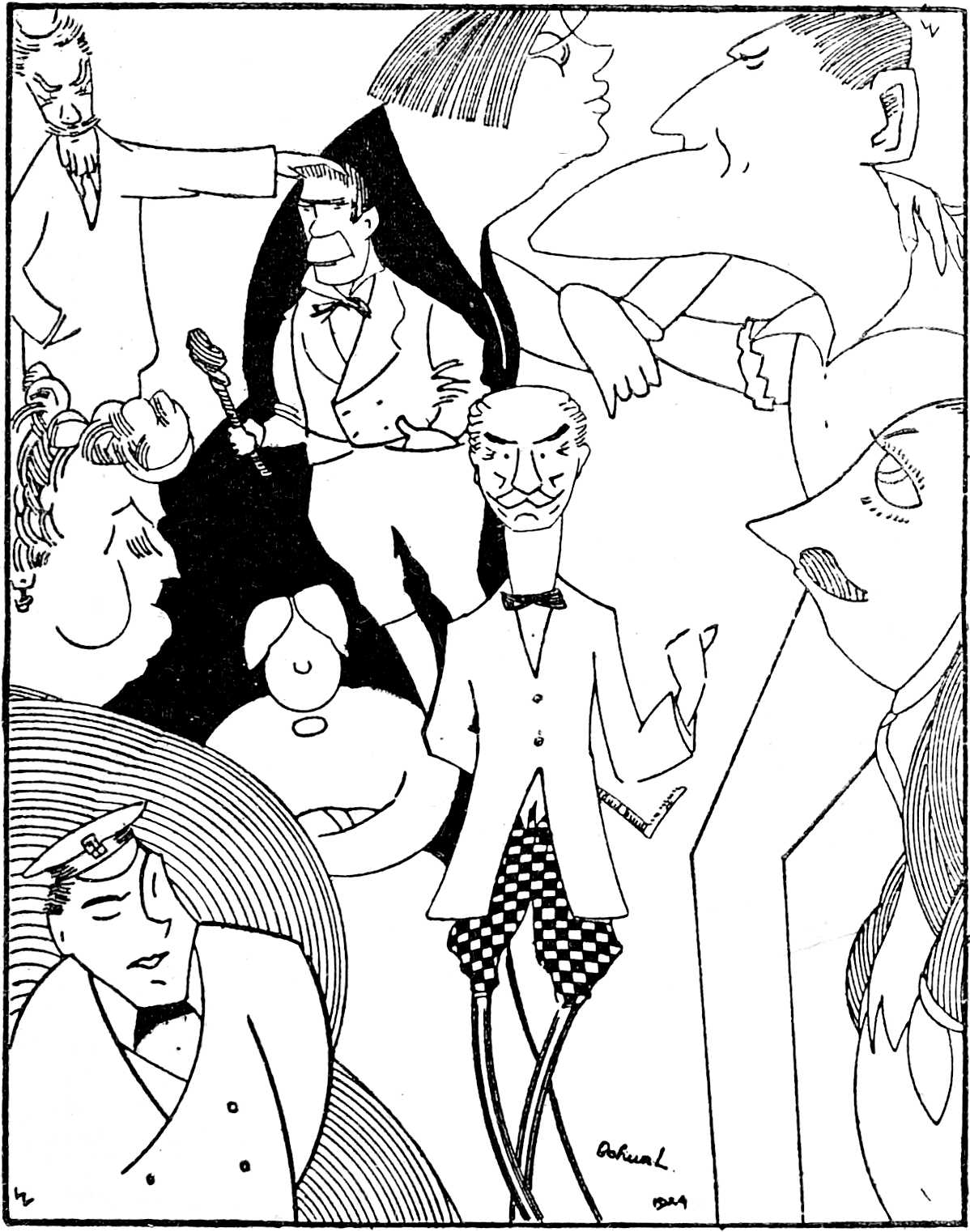
“The influence of that man Shaw.”
Mercia (crooning): Yousteeee!
The Colonel (testily): Confound it all, Brill, I wish you wouldn’t tear the place to pieces like that.... And you’ve shot a great fid of glass into my eye. Damn the thing. (He gropes, and finally extracts it.) There, now itll bleed for the rest of the day!
Eustace (surprised): I thought you prided yourself on keeping up active service conditions.
The Colonel: So I do.
Eustace: Then why make all this fuss about a trifling wound? You ought to be grateful. It adds a touch of reality to your life.
The Colonel: Id rather you left me to supply the reality myself, Brill. However—(Mercia, true to her threat, embraces Eustace with fervour).... Now really, Mercia, upon my soul.... (He clicks his tongue with vexation.)
Eustace (taken aback): Mercia, dear. I know you mean it awfully nicely. But really, in public——
Hashovit (glowering): You see—you degrade yourself to no purpose.
The Colonel (warmly): Degrade? Nonsense!... I, of course, dont mean to imply——
Hashovit: But damn it all, Colonel——
Mercia (screaming): Dont shout, Harmodius.
The wrangle proceeds on the familiar Shavian lines, the party being reinforced for no apparent reason by the arrival of Dan Bigby, an old sea-captain, and Michael John O’Sullivan.
Eustace (at long last): Look here, Im getting sick of this. Its all too much like a play by Bernard Shaw.
Hashovit (growling): Everyone is at heart a Shavian.
The Colonel (hastily): No, really, Harmodius.... O’Sullivan, Brill, we cant have that——
Eustace: The truth about Shaw—— } (Spoken together.)
Hashovit: My idea of Shaw—— }
Michael John: Sure, if you come to talk about Shaw—— }
Mrs. Lazyboy: Hes quite right. The influence of that man Shaw—— }
Captain Dan: Who was Shaw, anyway? }
The Colonel (in his parade voice): Silence. Youre on parade. Behave accordingly.
Captain Dan: Avast there. Belay.
Mercia (stamping): I wont belay. I object——
Eustace: But whats this to do with Shaw? And whats the use of objecting when cosmic forces grip people by the throat? Ive no wish whatever to do anything thats not A1 at Lloyds and all that. But——
Hashovit: Cosmic fiddlesticks. Its lust, Brill, and you know it. You and Mercia want to misconduct yourselves, and its no good your trying to draw a red herring of formulas and psycho-analytic bosh across the track. It wont wash. In my young days——
Mercia (icily): I dont think were greatly interested in your young days, Harmodius.
Hashovit: Be quiet, Mercia. I will speak my mind, so youd better make up your minds to listen. In my young days if a man and a girl wanted to behave improperly they just did so and said no more about it. But youve no decency. Youre not content with forbidden fruit, you go and flaunt your liaison in the husband’s face, and make a parade of it before all his and your friends. I wonder you dont advertise it in the papers. Upon my soul, its what were coming to——
Eustace: But——
Hashovit (yelling): Dont you interrupt me, sir. I dont care a swizzle stick about your stealing my wifes affections. As a matter of fact, she hasnt got any, as youll jolly soon discover when the noveltys worn off——
Mercia: Oh, Harmy. (She weeps.)
Hashovit: I dont care if you take her to Brighton or Nijni Novgorod—if youre such a blasted fool as to spend so much money on her. I dont care if you sit all day squeezing her hand, looking into her eyes till you both squint, pawing her about, and talking that horrible sickly twaddle I couldn’t help overhearing last night (he shudders at the recollection).... But—(rising to his feet)—but I will not have all your friends and my friends whispering and talking about me as though I were something to be pitied. (His voice rising to a scream.) If you want to know, I think Im just about the damn luckiest fellow alive to have unloaded this viperish, discontented, addle-headed, empty-hearted baggage on the most crass and pitiable fool Ive ever met—and if you want to say any more—(his poor, overstrained voice cracks and dies away in his throat with a mouse’s squeak; whereat he expresses his feelings by tearing the cushions to pieces and scattering the bits on the floor.)
The Colonel: Come, come, my dear fellow—pull yourself together.
Mercia (crisply): What I like about Harmodius is his obvious self-control.
Hashovit (his eyes bulging; he speaks in a hoarse whisper): Shut up, you she-porcupine, you hateful female skunk, you—(his vocal chords snap and his voice goes for ever.)
Mercia: His manners are so perfect, too: and hes so brave.... Cry-baby!
Hashovit (inarticulately): o o o o o o o b b—(or some similar noise. Blood gushes from his mouth.)
Nurse Allsopp: There, my poddle-poodkins, come with nursey-wursey. (Addressing the others sharply): And if you want any lunch go and wash your hands, all of you. (She leads Harmodius out by the hand. The others, except Eustace and Mercia, follow her meekly.)
Eustace (uneasily): You expect me to admire all that, I suppose.
Mercia (fixing him with vampire eyes): I expect you to admire nothing except me.
Eustace: Admire you. I loathe you. I struggle to escape from you. Youre like some awful drug, the same odious intoxication, the same irresistible fascination, and the same deadly remorse when its all over. You steal away my senses, and make me a slave.
Mercia: I make you a priest, not a slave.
Eustace: No, its slavery.
Mercia: Priesthood. High Priesthood to the divine desire in all of us.
Eustace (retreating): Im afraid of that.
Mercia (snaring him with her eyes): Afraid! Afraid of worshipping love?
Eustace: Yes. Ive no vocation.
Mercia (dangerously): Does that mean youve no inclination?
Eustace: No. It means what it says.... You talk about priesthood of love. You seem to think no vocation is necessary, though I suppose youd admit it in the case of a priest of Buddhism. Religion is a dedication of the spirit; Love, a dedication of the heart. You cant dedicate your spirit till its broken; nor can you your heart; and hearts dont break as easily as crockery, let me tell you. (Espying Michael John in the passage): O’Sullivan.
Michael John (entering and curling himself up in the coal-scuttle): Speak.
Eustace: Tell her how long a mans heart must beat against that of a woman before it will break.
Michael John: Four years and ninety minutes exactly. On the tick of the ninetieth minute the heart cracks, and the imprisoned soul passes from its bondage into the numbing bliss of everlasting heartache——
Captain Dan (entering unobserved and taking up the tale): And in the fifth year he shall be exalted above human understanding.... In the dog watches and under the dog stars Ive looked upon the ways of mankind, and held my hand from destroying them in sheer——
Eustace: Pity?
Captain Dan: Pity. No! Indifference.
Mercia (fixing him with her eyes): Danny, I make you mine. The priesthood of love——
Captain Dan (uneasily): Avast there.
Mercia (triumphantly): There’s no avasting where Ill take you. (Breaking into a chant)
I go by the mountains and rivers, I go by the seashore and fell.
Eustace (satirically):
While the thankless old mariner shivers
Michael John:
And strives to break loose from her spell.
Mercia (her voice rising to prophetic fervour):
But the child, still unborn, of my yearning, Shall go in the van as our guide,
Captain Dan (chuckling feebly):
Down the pathway of shame to the burning,
Mercia (laughing horribly):
When Im Daniel the Mariners Bride.
(She sweeps him into her arms and carries him away shouting.)
Mercia (disappearing): Io. Io. Dionysos!
Captain Dan (in a high falsetto): Let the skies rain joy!
Eustace (passionately): How can you, Mercia, how can you? (He is seized by uncontrollable weeping.) Im crying, O’Sullivan——
Michael John: Im wantin a cry meself. (He bursts into tears.)
Mercia’s voice (a long way off): But you must let me come back and look after Harmodius’s clothes——
Many years elapse. They are still talking.
Mercia (temporizing): After all, if I leave Harmodius for Eustace, or Eustace for Danny——
The Colonel (who is deaf by now): Whats that?
Mrs. Lazyboy (who is nearly as deaf and very feeble): Shes talking about the childrens holidays.
The Colonel: He! He! He!
A long time passes by.
Mr. Fuzzlewhitt (Mercias great grandson): After all, if she had deserted Harmodius Hashovit——
Mrs. Fuzzlewhitt (who is thoroughly tired of the story): Yes, Rejjy, I know....
Centuries roll by.
Monsieur Chose: Bernard Shaw says in his play about Mercia and Harmodius Hashovit that if Mrs. Lazyboy——
Æons pass.
Somebody: Theres a storm coming. Its going to cleanse the world. (The sky darkens.)
Somebody else: It makes no difference. The human brain will survive.
A Third Person: The human antheap will continue to surge with meaningless movement.
A Fourth: The human voice will continue to cry from nothing to nothing.
A Fifth: The human hand will continue to write, and posterity will bury the writings.
A Sixth: And Shaw alone shall be assured of immortality.
The storm breaks with prodigious force. Eternity arrives.
A Shining One: Yes, the immortals are all in their places. Dante and Cervantes had a squabble last night, but theyve made it up.
The Eternal: Good.
The Shining One: Shakespeare has been giving trouble, too. Hes jealous of Shaw.
The Eternal (apprehensively): Im not at all easy in my own mind about Shaw.
Eternity passes.
Mr. Shaw (on the steps of the eternal throne): Im really very sorry. Its no wish of mine, you know.
The Eternal (apologetically, and handing over the crown and sceptre of Heaven): Not at all. Its a pleasure to make this trifling acknowledgment of your genius.
The End of the Play.
THE ENCHANTED ISLAND
(A Fantasy in the manner of J. M. Barrie.)
I
The pink and white drawing-room of Emily Jane’s house—or rather of the house of Emily Jane’s father, Mister Balbus, is so caressingly harmonious to the eye, so surpassingly restful, so eminently a place of happy people, that one knows instinctively it will be visited by a tragedy. It is just a question of time, and this gentle atmosphere will find itself charged with the electricity of conflicting human emotions; dear women’s hearts will break and be laid aside in pot-pourri jars; strong sentimental men will walk their sweet, melancholy way; and we shall all go home the cleaner, mentally, for a refreshing bath of tears. Emily Jane is not yet in the drawing-room. The appropriate atmosphere has first to be created, so that we may catch our breath just a little as Miss Compton or Miss Celli trips on. Emily Jane is really a very ordinary kind of girl, plump, pleasant-looking, and neither very clever nor specially athletic. But to her mother she is still a tiny toddling mite in a knitted woollen coat with pink ribbons, and to Daddy, Mister Balbus, she is a resplendent goddess.
At last, after a preliminary conversation about stamp-collecting, or some other harmless hobby, between McVittie and Price, two old dullards introduced to fill in the few awkward minutes while the latecomers are clambering into their stalls, Mister Balbus comes into the room. There is nothing remarkable about Mister Balbus. In the eyes of his wife he is an irresistibly lovable plexus of male weaknesses; in the eyes of Emily Jane he is closely related to the Almighty. Actually he is nobody in particular, an architect of sorts; but we are to see him through their eyes, and so he appears in the play as a genial and gigantic mixture of a demigod and a buffoon. Mr. Aynesworth is appropriately selected to represent him.
“Good morning,” he says.
“Good morning,” reply McVittie and Price, delighted that any of the principal characters should condescend to speak to them.
“Where’s our little Emily Jane?” he asks, tenderly.
“Here, Daddy,” replies a sweet voice.
“Where, my lovely one?”
“In the chimney, Daddy”; and the dear child clambers down and rushes into his arms without even waiting to brush off the soot. McVittie and Price make clucking noises of approval and delight. This is typical of what goes on in the Balbus household every day. How can it be possible that anything except joy should be in store for them? But ah——
Mr. Balbus: Where is Mammy, my treasure?
Emily Jane: Waiting for Daddy darling, in his study.
Mr. Balbus: Will my little heart ask her to come?
Emily Jane trips away so happily and obediently. “Well, Price,” says Mr. Balbus, “I must go and see how they’re getting on with the wall.”
Price: Haven’t you finished it yet?
Mr. Balbus: I don’t think I ever shall. Balbus was building a wall in the time of the Roman Empire; and I suppose he’ll go on for the rest of time.
McVittie: Which wall is it this time, Balbus?
Mr. Balbus: The Great Wall of China. They’ve retained me to go and inspect it. I leave to-morrow.
Mrs. Balbus hurries in and embraces her husband shamelessly. Emily Jane follows and embraces them both. McVittie and Price, not to be outdone, embrace each other in the corner.
“You’re going to China, my husband?” asks Mrs. Balbus, tenderly.
“Yes, wife.”
“I’ll go with you.”
Emily Jane: And I, Daddy.
McVittie & Price: We will come too, old friend.
Mr. Balbus beams at them through his tears. The audience beam at each other through theirs.
II
They have been wrecked.
They are all on a deserted island which, from the stunted shrubs and bleak outlook, is probably in the neighbourhood of Tristan da Cunha. McVittie and Price are pretending to be tremendously brave and contented over a meal of roasted berries.
“These are really delicious,” says McVittie.
“Capital,” says Price. “Have some more.”
“No thanks. My doctor, you know. He won’t let me enjoy myself.”
“A glass of this delicious rock-water, then. Most stimulating.”
“No, my dear fellow. I’ve done magnificently. Not another sup.”
But it is really only pretend. The brave fellows are concealing their anxiety for fear of alarming Emily Jane and her mother who are resting in the bivouac near by. Actually they are full of apprehension.
“Price,” says McVittie at last, leaning forward mysteriously.
“McVittie?” He leans forward too; their long noses almost touch.
“I’m uneasy.” A hoarse whisper.
“So am I. Very.” A squeak of terror.
“I’ve found out the name of this island, Price.”
“Indeed?”
McVittie sinks his voice even deeper.
“It’s called—Umborroweeboo.”
“Gracious. What ever does that mean?”
“It means....” His voice becomes blood-curdling in its intensity. “It means The-Island-that-wants-to-be-let-alone. It’s a sinister spot, Price. They say....”
Darkness begins to close in rapidly. Price shivers.
“What do they say?”
“They say it can vanish beneath the sea and reappear in another place, after remaining submerged for years.”
“Good heavens.” Price is very uneasy. Emily Jane appears from the bivouac and prostrates herself on the ground.
“I love you, dear little island,” she murmurs, kissing the shore. “I would like to be married to a beautiful island like you.”
“I shall come to claim that promise one day,” says a deep, rich voice from nowhere.
Emily Jane: Did anyone speak?
McVittie: No one. I heard nothing.
Price: I thought—why, what’s that?
Mr. Balbus (emerging from a hollow tree): What’s what?
Price: That. There. Look.
The others: Where?
Price: There. Look. Now it’s there. Quick. It’s moved again. (A strain of unearthly music.)
Everybody: Hark. What’s that? (Mrs. Balbus crawls out of the bivouac on her hands and knees.)
Mrs. Balbus (fondly): John, you’ve left off your comforter.... Why are you all in a ring? You’ll have the fairies out if you stand in a ring.
McVittie (uneasily): In a ring? I didn’t notice. I think——(He turns to move away but finds himself rooted to the ground.) Well, this is most extraordinary.
Emily Jane: What is extraordinary, dear Mr. McVittie?
McVittie: I can’t move hand or foot.
Mr. Balbus: Good Lord. Nor can I.
Price: Nor I.
Emily Jane: I can a little. It’s getting very difficult. Now I can’t either. (The strain of music is heard again.)
Mrs. Balbus: Ugh! The horrid thing’s got hold of me now. I can’t move either. John, make them stop it at once.
Mr. Balbus (feebly): How can I, my dear? I’m quite powerless.
Emily Jane (illusion suddenly stripped from her eyes—for that is what happens under the spell of this magic island): Oh, Daddy, I thought there was nothing you couldn’t do. And now, now—you’re just like anybody else.
Mrs. Balbus (critically): You certainly look strange, John; not at all your usual self.
Mr. Balbus (for the first time seeing his wife and daughter as they really are): Please be quiet both of you and don’t talk about things you don’t understand. McVittie, what are we to do?
McVittie (philosophically): Wait for the island to disappear, I suppose. (The strain of music sounds once more.)
Price (excitedly): There it is moving about again. The thing I saw before.
Emily Jane: It’s like a tiny, tiny man.
Mr. Balbus: I don’t fancy this at all.
Price: It’s coming nearer. (An elvish figure appears dancing towards them. It is puffing a stupendous pipe.)
Mr. Balbus (trying to be severe and failing signally): Who are you, please?
The Figure (dancing more than ever): Macconachie.
Emily Jane: What do you mean by trespassing on our island?
Macconachie: I live here. It’s my home. You are the trespassers. But you’re very welcome. (With goblin glee.) I’ve been waiting for you, for a long time.
Mr. Balbus: Waiting for us. Nonsense. You don’t know who we are, even.
Macconachie: Oh yes I do. I’ve been watching you for a long time. Especially Emily Jane. I want Emily Jane.
Mrs. Balbus: Want Emily Jane? The idea of such a thing! Go away, Sir, at once.
Macconachie: You think you’re her mother, I suppose? (Addressing Balbus) And you believe yourself to be her father?
Mr. Balbus (with dignity): I certainly do.
Macconachie: But you’re not, you’re not. She’s mine.
Mrs. Balbus (indignantly): Sir! John, don’t listen to a word he says.
Macconachie: You’re all mine. I want you all.
McVittie (hoarsely): Want us all? What for, may I ask?
Macconachie: To draw tears from simple hearts. You’ll see.
But they don’t understand at all, and look blankly at one another, as he flits about like a will o’ the wisp still puffing at his gigantic pipe.
III
The drawing-room again. They are all, except Emily Jane, sitting there in disconsolate melancholy.
Mr. Balbus (with a deep sigh): It’s for the best of course.... But I miss her sadly.
McVittie & Price: It’s terrible, terrible. (They sigh).
Mrs. Balbus: I always felt there was something unearthly about the child. (She sighs very deeply.)
There is a long pause. They are thinking of their terrible experience when Macconachie flitted over their heads like a sprite, and the solid island sank beneath their feet, and they were left clinging to a raft.
“When the island began to submerge”—begins Mr. Balbus, and then he checks himself with a sob.
McVittie (for the hundredth time): I could have sworn I had her in my arms on the raft. (His voice breaks.)
Price: You didn’t hear the Voice—
Mrs. Balbus: Voice—what voice?
Price: Something about claiming a promise. And she gave a little cry of wonder. I heard it. (He walks gloomily over to the window.)
Mr. Balbus (suddenly enlightened): That’s what Macconachie meant, when he said “to draw tears from simple hearts.” I begin to understand....
Price (at the window): How very curious.
Mrs. Balbus: My curtains? They are certainly not.
Price (in choking tones): Look at the lake—it’s drying up, or something.
They all rush to the window. An amazing thing is in progress. The bottom of the lake seems to be rising. Stunted shrubs are pushing themselves above the water.
“My gracious powers, it’s the island,” cries Mr. Balbus.
Price (quoting McVittie’s long-forgotten remark): They say it can vanish beneath the sea, and reappear in another place after remaining submerged for years.
McVittie: There’s somebody moving on it. Look. Among the trees.
Mr. Balbus: It’s Macconachie. (He hails the island. Macconachie comes ashore, and flits up to the house.)
Mr. Balbus (in a trembling voice): Where is she, Sir? Tell us where she is?
Macconachie: Emily Jane? She’s touring in America. Making a fortune.
Mr. Balbus: But will she come back, Sir?
Macconachie: If you need her sufficiently, and wish for her often enough, and believe with strength, she will assuredly come back.
Mr. Balbus: But why should she have been taken from us, Sir? We loved her, cared for her. She was happy with us.
“To carry my message to the hearts of men,” replies Macconachie, with a wistful smile. “I may need any of you in the future and then——” He pauses. “But till then farewell.” And he flits through the window; and the island submerges again. But the others sit in rapt silence, for they have seen beyond the veil.
PRESIDENT WILSON
(A Chronicle in the manner of John Drinkwater.)