Volume 2 — CHAPTER IV.
Reading edition
Embarkation of the party in the boats, and voyage down the Morumbidgee—The skiff swamped by striking on a sunken tree—Recovery of boat and its loading—Region of reeds—Dangers of the navigation—Contraction of the channel—Reach the junction of a large river—Intercourse with the natives on its banks—Character of the country below the junction of the rivers—Descent of a dangerous rapid—Warlike demonstrations of a tribe of natives—Unexpected deliverance from a conflict with them—Junction of another river—Give the name of the “Murray” to the principal stream.
The camp was a scene of bustle and confusion long before day-light. The men whom I had selected to accompany me were in high spirits, and so eager to commence their labours that they had been unable to sleep, but busied themselves from the earliest dawn in packing up their various articles of clothing, &c. We were prevented from taking our departure so early as I had intended, by rain that fell about six. At a little after seven, however, the weather cleared up, the morning mists blew over our heads, and the sun struck upon us with his usual fervour. As soon as the minor things were stowed away, we bade adieu to Harris and his party; and shortly after, em
Notwithstanding that we only used two oars, our progress down the river was rapid. Hopkinson had arranged the loads so well, that all the party could sit at their ease, and Fraser was posted in the bow of the boat, with gun in hand, to fire at any new bird or beast that we might surprise in our silent progress. The little boat, which I shall henceforward call the skiff, was fastened by a painter to our stern.
As the reader will have collected from what has already fallen under his notice, the country near the depot was extensively covered with reeds, beyond which vast plains of polygonum stretched away. From the bed of the river we could not observe the change that took place in it as we passed along, so that we found it necessary to land, from time to time, for the purpose of noting down its general appearance. At about fifteen miles from the depot, we came upon a large creek-junction from the N.E., which I did not doubt to be the one M'Leay and I had crossed on the 25th of December. It was much larger than the creek of the Macquarie, and was capable of holding a very great body of water, although evidently too small to contain all that occasionally rushed from its source. I laid it down as the supposed junction of the Lachlan, since I could not, against the corroborating facts in my possession, doubt its originating in the marshes of that river. Should this, eventually, prove to be the case, the similar termination of the
We were just about to land, to prepare our dinner, when two emus swam across the river ahead of us. This was an additional inducement for us to land, but we were unfortunately too slow, and the birds escaped us. We had rushed in to the right bank, and found on ascending it, that the reeds with which it had hitherto been lined, had partially ceased. A large plain, similar to those over which we had wandered prior to our gaining the flooded region, stretched away to a considerable distance behind us, and was backed by cypresses and brush. The soil of the plain was a red sandy loam, covered sparingly with salsolae and shrubs; thus indicating that the country still preserved its barren character, and that it is the same from north to south. Among the shrubs we found a tomb that appeared to have been recently constructed. No mound had been raised over the body, but an oval hollow shed occupied the centre of the burial place, that was lined with reeds and bound together with strong net-work. Round this, the usual walks were cut, and the recent traces of women's feet were visible upon them, but we saw no natives, although, from the number and size of the paths that led from the river, in various directions across the plain, I was led to conclude, that, at certain seasons, it is hereabouts numerously frequented. Fraser gathered some rushes similar to those used by the natives of the Darling in the fabrication of their nets, and as they had not before been observed, we judged them, of course, to be a sign of our near approach to that river.
As soon as we had taken a hasty dinner, we again embarked, and pursued our journey. I had hoped, from the appearance of the country to the north of us, although that to the south gave little indication of any change, that we should soon clear the reeds; but at somewhat less than a mile they closed in upon the river, and our frequent examination of the neighbourhood on either side of it only tended to confirm the fact, that we were passing through a country subject to great and extensive inundation. We pulled up at half-past five, and could scarcely find space enough to pitch our tents.
The Morumbidgee kept a decidedly westerly course during the day. Its channel was not so tortuous as we expected to have found it, nor did it offer any obstruction to the passage of the boats. Its banks kept a general height of eight feet, five of which were of alluvial soil, and both its depth and its current were considerable. We calculated having proceeded from 28 to 30 miles, though, perhaps, not more than half that distance in a direct line. No rain fell during the day, but we experienced some heavy squalls from the E.S.E.
The second day of our journey from the depot was marked by an accident that had well nigh obliged us to abandon the further pursuit of the river, by depriving us of part of our means of carrying it into effect. We had proceeded, as usual, at an early hour in the morning, and not long after we started, fell in with the blacks who had visited us last, and who were now in much better humour than upon
At sunset we were obliged to relinquish our task, the men complaining of violent head-aches, which the nature of the day increased. Thinking our own efforts would be unavailing, I directed two of the men to go up the river for the blacks, at day-light in the morning, and set the reeds on fire to attract their notice. The day had been cloudy and sultry in the afternoon, the clouds collecting in the N.E.: we heard the distant thunder, and expected to have
In the morning we resumed our search for the still head, which Hopkinson at length fortunately struck with his oar. It had been swept considerably below the place at which M'Leay had dived, or we should most probably have found it sooner. With its recovery, all our fatigues were at once forgotten, and I ordered the breakfast to be got ready preparatory to our reloading the skiff. Fraser and Mulholland, who had left the camp at daylight, had not yet returned. I was sitting in the tent, when Macnamee came to inform me that one of the frying-pans was missing, which had been in use the evening previous, for that he himself had placed it on the stump of a tree, and he therefore supposed a native dog had run away with it. Soon after this, another loss was reported to me, and it was at last discovered that an extensive robbery had been committed upon us during the night, and that, in addition to the frying-pan, three cutlasses, and five tomahawks, with the pea of the steelyards, had been carried away. I was extremely surprised at this instance of daring in the natives, and determined, if possible,
Leaving this unlucky spot, we made good about sixteen miles during the afternoon. The river maintained its breadth and depth nor were the reeds continuous upon its banks. We passed several plains that were considerably elevated above the alluvial deposits, and the general appearance of the country induced me strongly to hope that we should shortly get out of the region of reeds, or the great flooded concavity on which we had fixed our depot; but the sameness of vegetation, and the seemingly diminutive size of the timber in the distance, argued against any change for the better in the soil of the interior. Having taken the precaution of shortening the painter of the skiff, we found less difficulty in steering her clear of obstacles, and made rapid progress down the Morumbidgee during the first cool and refreshing hours of the morning. The channel of the river became somewhat less contracted, but still retained sufficient depth for larger boats than ours, and preserved a general westerly course. Although no decline of country was visible to the eye, the current in places ran very strong. It is impossible for me to convey to the reader's mind an idea of the nature
I had remarked that the Morumbidgee was not, from the depot downwards, so broad or so fine a river as it certainly is at the foot of the mountain ranges, where it gains the level country. The observations of the last two days had impressed upon my mind an idea that it was rapidly falling off, and I began to dread that it would finally terminate in one of those fatal marshes in which the Macquarie and the Lachlan exhaust themselves. My hope of a more favourable issue was considerably damped by the general appearance of the surrounding country; and from the circumstance of our not having as yet passed a single tributary. As we proceeded down the river, its channel gradually contracted, and immense trees that had been swept down it by floods, rendered the navigation dangerous and intricate. Its waters became so
About noon, we fell in with a large tribe of natives, but had great difficulty in bringing them to visit us. If they had heard of white men, we were evidently the first they had ever seen. They approached us in the most cautious manner, and were unable to subdue their fears as long as they remained with us. Collectively, these people could not have amounted to less than one hundred and twenty in number.
As we pushed off from the bank, after having stayed with them about half an hour, the whaleboat struck with such violence on a sunken log, that she immediately leaked on her starboard side. Fortunately she was going slowly at the time, or she would most probably have received some more serious injury. One of the men was employed during the remainder of the afternoon in bailing her out, and we stopped sooner than we should otherwise have done, in order to ascertain the extent of damage, and to repair it. The reeds terminated on both sides of the river some time before we pulled up, and the country round the camp was more elevated than usual, and bore the appearance of open forest pasture land, the timber upon it being a dwarf species of box, and the soil a light tenacious earth.
About a mile below our encampment of the 12th, we at length came upon a considerable creek-junction from the S.E. Below it, the river increased both in breadth and depth; banks were lofty and perpendicular, and even the lowest levels were but partially covered with reeds. We met with fewer
Soon after passing this hill, the whale-boat struck upon a line of sunken rocks, but fortunately escaped without injury. Mulholland, who was standing in the bow, was thrown out of her, head foremost, and got a good soaking, but soon recovered himself. The composition of the rock was iron-stone, and it is the first formation that occurs westward of the dividing range. We noticed a few cypresses in the distance, but the general timber was dwarf-box, or flooded-gum, and a few of the acacia longa scattered at great distances. In verifying our position by some lunars, we found ourselves in 142° 46´ 30´´ of east long., and in lat. 35° 25´ 15´´ S. the mean variation of the compass being 4° 10´´ E. it appearing that we were decreasing the variation as we proceeded westward.
On the 13th, we passed the first running stream that joins the Morumbidgee, in a course of more than 340 miles. vice versa, but the channel had become so narrow that, although the banks were not of increased height, we were involved in comparative darkness, under a close arch of trees, and a danger was hardly seen ere we were hurried past it, almost without the possibility of avoiding it. The reach at the head of which we stopped, was crowded with the trunks of trees, the branches of which crossed each other in every direction, nor could I hope, after a minute examination of the channel, to succeed in taking the boats safely down so intricate a passage.
We rose in the morning with feelings of apprehension, and uncertainty; and, indeed, with great doubts on our minds whether we were not thus early destined to witness the wreck, and the defeat of the expedition. The men got slowly and cautiously into the boat, and placed themselves so as to leave no part of her undefended. Hopkinson stood at the bow, ready with poles to turn her head from anything upon which she might be drifting. Thus prepared, we allowed her to go with the stream. By extreme care and attention on the part of the men we passed this formidable barrier. Hopkinson in particular exerted himself, and more
It is impossible for me to describe the effect of so instantaneous a change of circumstances upon us. The boats were allowed to drift along at pleasure, and such was the force with which we had been shot out of the Morumbidgee, that we were carried nearly to the bank opposite its embouchure, whilst we continued to gaze in silent astonishment on the capacious channel we had entered; and when we looked for that by which we had been led into it, we could hardly believe that the insignificant gap that presented itself to us was, indeed, the termination of the beautiful and noble stream, whose course we had thus successfully followed. I can only compare the relief we experienced to that which the seaman feels on weathering the rock upon which he expected his vessel would have struck—to the calm which succeeds moments of feverish anxiety, when the dread of danger is succeeded by the certainty of escape.
To myself personally, the discovery of this river was a circumstance of a particularly gratifying nature, since it not only confirmed the justness of my opinion as to the ultimate fate of the Morumbidgee, and bore me out in the apparently rash and hasty step I had taken at the depot, but assured me of ultimate success in the duty I had to perform. We had got on the high road, as it were, either to the south coast, or to some important outlet; and the appearance of the river itself was such as to justify our most sanguine
We entered the new river at right angles, and, as I have remarked, at the point of junction the channel of the Morumbidgee had narrowed so as to bear all the appearance of an ordinary creek. In breadth it did not exceed fifty feet, and if, instead of having passed down it, I had been making my way up the principal streams, I should little have dreamt that so dark and gloomy an outlet concealed a river that would lead me to the haunts of civilized man, and whose fountains rose amidst snow-clad mountains. Such, however, is the characteristic of the streams falling to the westward of the coast ranges. Descending into a low and level interior, and depending on their immediate springs for existence, they fall off, as they increase their distance from the base of the mountains in which they rise, and in their lower branches give little results of the promise they had previously made.
The opinion I have expressed, and which is founded on my personal experience, that the rivers crossed by Messrs. Hovell and Hume had already united above me, was strengthened by the capacity of the stream we had just discovered. It had a medium width of 350 feet, with a depth of from twelve to twenty. Its reaches were from half to three-quarters of a mile in length, and the views upon it were splendid. Of course, as the Morumbidgee entered it from the north, its first reach must have been E. and W., and it was so, as nearly as possible; but it took us a little to the southward of the latter point, in a distance of about eight miles that we pulled down it in the course of the afternoon. We then landed and pitched our tents for the night. Its transparent waters were running over a sandy bed at the rate of two-and-a-half knots an hour, and its banks, although averaging eighteen feet in height, were evidently subject to floods.
We had not seen any natives since falling in with the last tribe on the Morumbidgee. A cessation had, therefore, taken place in our communication with them, in re-establishing which I anticipated considerable difficulty. It appeared singular that we should not have fallen in with any for several successive days, more especially at the junction of the two rivers, as in similar situations they generally have an establishment. In examining the country back from the stream, I did not observe any large paths, but it was evident that fires had made extensive ravages in the neighbourhood, so that the country was, perhaps, only tem
The river maintained its character, and raised our hopes to the highest pitch. Its breadth varied from 160 to 200 yards; and only in one place, where a reef of iron-stone stretched nearly across from the left bank, so as to contract the channel near the right and to form a considerable rapid, was there any apparent obstruction to our navigation. I was sorry, however, to remark that the breadth of alluvial soil between its outer and inner banks was very inconsiderable, and that the upper levels were poor and sandy. Blue-gum generally occupied the former, while the usual productions of the plains still predominated upon the latter, and showed that the distant interior had not yet undergone any favourable change. We experienced strong breezes from the north, but the range of the thermometer was high, and the weather rather oppressive than otherwise. On the night of the 16th, we had a strong wind from the N.W., but it moderated with day-light, and shifted to the E.N.E., and the day was favourable and cool. Our progress was in every way satisfactory, and if any change had taken place in the river, it was that the banks had increased in height, in many places to thirty feet, the soil being a red loam, and the surface much above the reach of
About 4 p.m., some natives were observed running by the river side behind us, but on our turning the boat's head towards the shore, they ran away. It was evident that they had no idea what we were, and, from their timidity, feeling assured that it would be impossible to bring them to a parley, we continued onwards till our usual hour of stopping, when we pitched our tents on the left bank for the night, it being the one opposite to that on which the natives had appeared. We conjectured that their curiosity would lead them to follow us, which they very shortly did; for we had scarcely made ourselves comfortable when we heard their wild notes through the woods as they advanced towards the river; and their breaking into view with their spears and shields, and painted and prepared as they were for battle, was extremely fine. They stood threatening us, and making a great noise, for a considerable time, but, finding that we took no notice of them, they, at length, became quiet. I then walked to some little distance from the party, and taking a branch in my hand, as a sign of peace, beckoned them to swim to our side of the river, which, after some time, two or three of them did. But they approached me with great caution, hesitating at every step. They soon, however, gained confidence, and were ultimately joined by all the males of first who swam the river a tomahawk (making this a rule in order to encourage them) with which he was highly delighted. I shortly afterwards placed them all in a row and fired a gun before them: they were quite unprepared for such an explosion, and after standing stupified and motionless for a moment or two, they simultaneously took to their heels, to our great amusement. I succeeded, however, in calling them back, and they regained their confidence so much, that sixteen of them remained with us all night, but the greater number retired at sunset.
On the following morning, they accompanied us down the river, where we fell in with their tribe, who were stationed on an elevated bank a short distance below—to the number of eighty-three men, women, and children. Their appearance was extremely picturesque and singular. They wanted us to land, but time was too precious for such delays. Some of the boldest of the natives swam round and round the boat so as to impede the use of the oars, and the women on the bank evinced their astonishment by mingled yells and cries. They entreated us, by signs, to remain with them, but, as I foresaw a compliance on this occasion would hereafter be attended with inconvenience, I thought it better to proceed on our journey, and the natives soon ceased their importunities, and, indeed, did not follow or molest us.
The river improved upon us at every mile. Its reaches were of noble breadth, and splendid appearance. Its cur
About noon of the 18th, we surprised two women at the water-side, who immediately retreated into the brush. Shortly after, four men showed themselves, and followed us for a short distance, but hid themselves upon our landing. The country still appeared undulated to the S.E.; the soil was sandy, and cypresses more abundant than any other tree. We passed several extensive sand-banks in the river, of unusual size and solidity, an evident proof of the sandy nature of the interior generally. The vast accumulations of sand at the junctions of every creek were particularly remarkable. The timber on the alluvial flats was not by any means so large as we had hitherto observed it; nor were the flats themselves so extensive as they are on the Morumpositive change had as yet taken place in the general feature of the interior. The river continued to flow in a direction somewhat to the northward of west, through a country that underwent no perceptible alteration. Its waters, confined to their immediate bed, swept along considerably below the level of its inner banks; and the spaces between them and the outer ones, though generally covered with reeds, seemed not recently to have been flooded; while on the other hand, they had, in many places, from successive depositions, risen to a height far above the reach of inundation. Still, however, the more remote interior maintained its sandy and sterile character, and stretched away, in alternate plain and wood, to a distance far beyond the limits of our examination.
About the 21st, a very evident change took place in it. The banks of the river suddenly acquired a perpendicular and water-worn appearance. Their summits were perfectly level, and no longer confined by a secondary embankment, but preserved an uniform equality of surface back from the stream. These banks, although so abrupt, were not so high as the upper levels, or secondary embankments. They indicated a deep alluvial deposit, and yet, being high above the reach of any ordinary flood, were covered with grass, under an open box forest, into which a moderately dense scrub occasionally penetrated. We had fallen into a concavity similar to those of the marshes, but successive depositions had almost filled it, and no longer subject to in
On the 19th, as we were about to conclude our journey for the day, we saw a large body of natives before us. On approaching them, they showed every disposition for combat, and ran along the bank with spears in rests, as if only waiting for an opportunity to throw them at us. They were upon the right, and as the river was broad enough to enable me to steer wide of them, I did not care much for their threats; but upon another party appearing upon the left bank, I thought it high time to disperse one or the other of them, as the channel was not wide enough to enable me to keep clear of danger, if assailed by both, as I might be while keeping amid the channel. I found, however, that they did not know how to use the advantage they
The old men slept very soundly by the fire, and were the last to get up in the morning. M'Leay's extreme good humour had made a most favourable impression upon them, and I can picture him, even now, joining in their wild song. Whether it was from his entering so readily into their mirth, or from anything peculiar that struck them, the impression upon the whole of us was, that they took him to have been originally a black, in consequence of which they gave him the name of Rundi. Certain it is, they pressed him to show his side, and asked if he had not received a wound there—evidently as if the original Rundi had met with a violent death from a spear-wound in that place. The whole tribe, amounting in number to upwards of 150, assembled to see us take our departure. Four of them accompanied us, among whom there was one remarkable for personal strength and stature.—The 21st passed without our falling in with any new tribe, and the night of the 22nd, saw us still wandering in that lonely desert together. There was something unusual in our going through such an extent of country without meeting another tribe, but our companions appeared to be perfectly aware of the absence of inhabitants, as they never left our side.
Although the banks of the river had been of general
It was upon the crest of one of these steep and lofty banks, that on the morning of the 22nd, the natives who were a-head of the boat, suddenly stopped to watch our proceedings down a foaming rapid that ran beneath. We were not aware of the danger to which we were approaching, until we turned an angle of the river, and found ourselves too near to retreat. In such a moment, without knowing what was before them, the coolness of the men was strikingly exemplified. No one even spoke after they became aware that silence was necessary. The natives (probably anticipating misfortune) stood leaning upon their spears upon the lofty bank above us. Desiring the men not to move from their seats, I stood up to survey the channel, and to steer the boat to that part of it which was least impeded by rocks. I was obliged to decide upon a hasty survey, as we were already at the head of the rapid. It appeared to me that there were two passages, the one down the centre of the river, the other immediately under its right bank. A considerable rock stood directly in own way to the latter, so that I had no alternative but to descend the former. About forty yards below the rock, I noticed that a line of rocks occupied the space between the two channels, whilst a reef, projecting from the left bank, made the central passage distinctly visible, and the rapidity of the current proportionably great. I entertained hopes that the passage was
The four natives joined us in the camp, and assisted the men at their various occupations. The consequence was,
We pitched our tents upon a flat of good and tenacious soil. A brush, in which there was a new species of melaleuca, backed it, in the thickest part of which we found a deserted native village. The spot was evidently chosen for shelter. The huts were large and long, all facing the same point of the compass, and in every way resembling the huts occupied by the natives of the Darling. Large flocks of whistling ducks, and other wild fowl, flew over our heads to the N.W., as if making their way to some large or favourite waters. My observations placed us in lat. 34° 8´ 15´´ south, and in east long. 141° 9´ 42´´ or nearly so; and I was
The natives, in attempting to answer my interrogatories, only perplexed me more and more. They evidently wished to explain something, by placing a number of sticks across each other as a kind of diagram of the country. It was, however, impossible to arrive at their meaning. They undoubtedly pointed to the westward, or rather to the south of that point, as the future course of the river; but there was something more that they were anxious to explain, which I could not comprehend. The poor fellows seemed quite disappointed, and endeavoured to beat it into Fraser's head with as little success. I then desired Macnamee to get up into a tree. From the upper branches of it he said he could see hills; but his account of their appearance was such that I doubted his story: nevertheless it might have been correct. He certainly called our attention to a large fire, as if the country to the N.W. was in flames, so that it appeared we were approaching the haunts of the natives at last.
It happened that Fraser and Harris were for guard, and they sat up laughing and talking with the natives long after we retired to rest. Fraser, to beguile the hours, proposed shaving his sable companions, and performed that opera
After breakfast, we proceeded onwards as usual. The river had increased so much in width that, the wind being fair, I hoisted sail for the first time, to save the strength of my men as much as possible. Our progress was consequently rapid. We passed through a country that, from the nature of its soil and other circumstances, appeared to be intersected by creeks and lagoons. Vast flights of wild fowl passed over us, but always at a considerable elevation, while, on the other hand, the paucity of ducks on the river excited our surprise. Latterly, the trees upon the river, and in its neighbourhood, had been a tortuous kind of box. The flooded-gum grew in groups on the spaces subject to inundation, but not on the levels above the influence of any ordinary rise of the stream. Still they were much smaller than they were observed to be in the higher branches of the river. We had proceeded about nine miles, when we were surprised by the appearance in view, at the termination of a reach, of a long line of magnificent trees of green and dense foliage. As we sailed down the reach, we observed a vast concourse of natives under them, and, on a nearer approach, we not only heard their war-song, if
It was with considerable apprehension that I observed the river to be shoaling fast, more especially as a huge sand-bank, a little below us, and on the same side on which the natives had gathered, projected nearly a third-way across the channel. To this sand-bank they ran with tumultuous uproar, and covered it over in a dense mass. Some of the chiefs advanced to the water to be nearer their victims, and turned from time to time to direct their followers. With every pacific disposition, and an extreme reluctance to take away life, I foresaw that it would be impossible any longer to avoid an engagement, yet with such fearful numbers against us, I was doubtful of the result. The spectacle we had witnessed had been one of the most appalling kind, and sufficient to shake the firmness of most men; but at that trying moment my little band preserved their temper coolness, and if any thing could be gleaned from their countenances, it was that they had determined on an obstinate resistance. I now explained to them that their only chance of escape depended, or would depend, on their firmness. I desired that after the first volley had been fired, M'Leay and three of the men, would attend to the defence of the boat with bayonets only, while I, Hopkinson, and Harris, would keep up the fire as being more used to it. I ordered, however, that no shot was to be fired until after I had discharged both my barrels. I then delivered their arms to the men, which had as yet been kept in the place appropriated for them, and at the same time some rounds of loose cartridge. The men assured me they would follow my instruc
Illustration 9
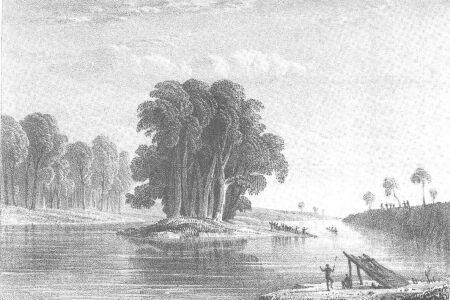
JUNCTION OF THE SUPPOSED DARLING WITH THE MURRAY.
We were again roused to action by the boat suddenly striking upon a shoal, which reached from one side of the river to the other. To jump out and push her into deeper water was but the work of a moment with the men, and it was just as she floated again that our attention was withdrawn to a new and beautiful stream, coming apparently from the north. The great body of the natives having posted themselves on the narrow tongue of land formed by the two rivers, the bold savage who had so unhesitatingly interfered on our account, was still in hot dispute with them, and I really feared his generous warmth would have brought down upon him the vengeance of the tribes. I hesitated, therefore, whether or not to go to his assistance. It appeared, however, both to M'Leay and myself, that the tone of the natives had moderated, and the old and young men having listened to the remonstrances of our friend, the middle-aged warriors were alone holding out against him. A party of about seventy blacks were upon the right bank of the newly discovered river, and I thought that by land
It was my first care to call for our friend, and to express to him, as well as I could, how much we stood indebted to him, at the same time that I made him a suitable present; but to the chiefs of the tribes, I positively refused all gifts, notwithstanding their earnest solicitations. We next prepared to examine the new river, and turning the boat's head towards it, endeavoured to pull up the stream. Our larboard oars touched the right bank, and the current was too strong for us to conquer it with a pair only; we were, therefore, obliged to put a second upon her, a movement that excited the astonishment and admiration of the natives. One old woman seemed in absolute ecstasy, to whom M'Leay threw an old tin kettle, in recompense for the amusement she afforded us.
As soon as we got above the entrance of the new river, we found easier pulling, and proceeded up it for some miles, accompanied by the once more noisy multitude. The river preserved a breadth of one hundred yards, and a depth of rather more than twelve feet. Its banks were sloping and grassy, and were overhung by trees of magnificent size. Indeed, its appearance was so different from the water-worn banks of the sister stream, that the men ex