Volume 2 — CHAPTER III.
Reading edition
Character of the Morumbidgee where it issues from the hilly country—Appearance of approach to swamps—Hamilton Plains—Intercourse with the natives—Their appearance, customs, &c.—Change in the character of the river—Mirage—Dreariness of the country—Ride towards the Lachlan river—Two boats built and launched on the Morumbidgee; and the drays, with part of the men sent back to Goulburn Plains.
From our camp, the Morumbidgee held a direct westerly course for about three miles. The hills under which we had encamped, rose so close upon our right as to leave little space between them and the river. At the distance of three miles, however, they suddenly terminated, and the river changed its direction to the S.W., while a chain of ponds extended to the westward, and separated the alluvial flats from a somewhat more elevated plain before us. We kept these ponds upon our left for some time, but, as they ultimately followed the bend of the river, we left them. The blacks led us on a W. by S. course to the base of a small range two or three miles distant, near which there was a deep lagoon. It was evident they here expected to have found some other natives. Being disappointed, how
The two blacks who had been with us so long, and who had not only exerted themselves to assist us, but had contributed in no small degree to our amusement, though they had from M'Leay's liberality, tasted all the dainties with which we had provided ourselves, from sugar to concentrated cayenne, intimated that they could no longer accompany the party. They had probably got to the extremity of their beat, and dared not venture any further. They left us with evident regret, receiving, on their departure, several valuable presents, in the shape of tomahawks &c. The last thing they did was to point out the way to us, and to promise to join us on our return, although they evidently little anticipated ever seeing us again.
In pursuing our journey, we entered a forest, consisting of box-trees, casuarinae, and cypresses, on a light sandy soil, in which both horses and bullocks sunk so deep that their labour was greatly increased, more especially as the weather had become much warmer. At noon I altered my course from N.W. by W. to W.N.W., and reached the Morumbidgee at 3 in the afternoon. The flats bordering it were extensive and rich, and, being partially mixed with sand, were more fitted for agricultural purposes than the stiffer and purer soil amidst the mountains; but the interior beyond them was far from being of corresponding quality. We
As we proceeded down the river on the 8th, the flats became still more extensive than they had ever been, and might almost be denominated plains. Vegetation was scanty upon them, although the soil was of the first quality. About nine miles from our camp, we struck on a small isolated hill, that could scarcely have been of 200 feet elevation; yet, depressed as it was, the view from its summit was very extensive, and I was surprised to find that we were still in some measure surrounded by high lands, of which I took the following bearings, connected with the present ones.
A High Peak . . N. 66 E. distance 40 miles.
Kengal . . N. 110 E. distant.
Double Hill . . S. 10 W. distant.
To the north, there were several fires burning, which appeared rather the fires of natives, than conflagrations, and as the river had made a bend to the N.N.W., I doubted not that they were upon its banks. From this hill, which was of compact granite, we struck away to the W.N.W., and shortly afterwards crossed some remarkable sand-hills.
On the 9th, the river fell off again to the westward, and we lost a good deal of the northing we had made the day before. We journeyed pretty nearly equidistant from the stream, and kept altogether on the alluvial flats. As we were wandering along the banks of the river, a black started up before us, and swam across to the opposite side, where he immediately hid himself. We could by no means induce him to show himself; he was probably the lonely being whom we had scared away from the fire the day before. In the afternoon, however we surprised a family of six natives, and persuaded them to follow us to our halting place. My boy understood them well; but the young savage had the cunning to hide the information they gave him, or, for aught I know, to ask questions that best suited his own purposes, and therefore we gained little intelligence from them.
Every day now produced some change in the face of the country, by which it became more and more assimilated to
The Morumbidgee appeared, on examination, to have increased in breadth, and continued to rise gradually. It is
I had hitherto been rather severe upon the animals, for although our journey had not exceeded from twelve to fifteen miles a day, it had been without intermission. I determined, therefore, to give both men and animals a day of rest, as soon as I should find a convenient place. We started on the 11th with this intention, but we managed to creep over eight or ten miles of ground before we halted. The country was slightly undulated, and much intersected by creeks, few of which had water in them. The whole
In this neighbourhood, the dogs killed an emu and a kangaroo, which came in very conveniently for some natives whom we fell in with on one of the river flats. They were, without exception, the worst featured of any I had ever seen. It is scarcely possible to conceive that human beings could be so hideous and loathsome. The old black, who was rather good-looking, told me they were the last we should see for some time, and I felt that if these were samples of the natives on the lowlands, I cared very little how few of I them we should meet.
Illustration 8
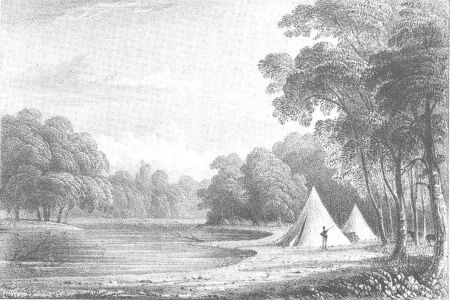
VIEW ON THE MORUMBIDGEE RIVER.
The country on the opposite side of the river had all the features of that to the north of it, but a plain of such extent suddenly opened upon us to the southward, that I halted at once in order to examine it, and by availing myself of a
With a view to examine the plain opposite to us, I directed our horses to be taken across the river early in the morning, and after breakfast, M'Leay and I swam across after them. We found the current strong, and could not keep a direct line over the channel, but were carried below the place at which we plunged in. We proceeded afterwards in a direction W.S.W. across the plain for five or six miles, before we saw trees on the opposite extremity, at a still greater distance. We thus found ourselves in the centre of an area of from 26 to 30 miles. It appeared to be
On our return to the camp we found several natives with our people, and among them one of the tallest I had ever seen. Their women were with them, and they appeared to have lost all apprehension of any danger occurring from us. The animals were benefited greatly by this day of rest. We left the plain, therefore, on the 13th with renewed spirits, and passed over a country very similar to that by which we had approached it, one well adapted for grazing, but intersected by numerous creeks, at two of which we
We started in the morning with our new acquaintances, and kept on a south-westerly course during the day, over an excellent grazing, and, in many places, an agricultural country, still intersected by creeks, that were too deep for the water to have dried in them. The country more remote from the river, however, began to assume more and more the character and appearance of the northern interior. I rode into several plains, the soil of which was either a red sandy loam, bare of vegetation, or a rotten and blistered earth, producing nothing but rhagodiae, salsolae, and misembrianthemum.
We fell in with another tribe of blacks during the journey, to whom we were literally consigned by those who had
In the evening we fell in with some more blacks, among whom were two brothers, of those who were acting as our guides. One had a very pretty girl as a wife, and all the four brothers were very good-looking young men. There cannot, I should think, be a numerous population on the banks of the Morumbidgee, from the fact of our
We passed a very large plain in the course of the day, which was bounded by forests of box, cypress, and the acacia pendula, of red sandy soil and parched appearance. The Morumbidgee evidently overflows a part of the lands we crossed, to a greater extent than heretofore, though the alluvial deposits beyond its influence were still both rich and extensive. The crested pigeon made its appearance on the acacias, which I took to be a sure sign of our approach to a country more than ordinarily subject to overflow; since on the Macquarie and the Darling, those birds were found only to inhabit the regions of marshes, or spaces covered by the acacia pendula, or the polygonum. We had not, however, yet seen any of the latter plant, although we were shortly destined to be almost lost amidst fields of it.
We were now approaching that parallel of longitude in
We found this part of the Morumbidgee much more populous than its upper branches. When we halted, we had no fewer than forty-one natives with us, of whom the young men were the least numerous. They allowed us to choose a place for ourselves before they formed their own camp, and studiously avoided encroaching on our ground so as
From this camp, one family only accompanied us. We journeyed due west over plains of great extent. The soil upon them was soft and yielding, in some places being a kind of light earth covered with rhagodiae, in others a red tenacious clay, overrun by the misembrianthemum and salsolae. Nothing could exceed the apparent barrenness of these plains, or the cheerlessness of the landscape. We had left all high lands behind us, and were now on an extensive plain, bounded in the distance by low trees or by dark lines of cypresses. The lofty gum-trees on the river
I had deferred my intended excursion to the hills under which I imagined Mr. Oxley had encamped, until we were out of sight of them, and I now feared that it was almost too late to undertake it, but I was still anxious to determine a point in which I felt considerable interest. I was the more desirous of surveying the country
On our way to the river, we Passed through some dense bushes of casuarinae and cypresses, to the outskirts of the plains through which the Morumbidgee winds. We reached the camp two or three hours after sunset, and found it crowded with natives to the number of 60. They were extremely quiet and inoffensive in their demeanour,
The cattle about this time began to suffer, and, anxious as I was to push on, I was obliged to shorten my journeys, according to circumstances. Amidst the desolation around us, the river kept alive our hopes. If it traversed deserts, it might reach fertile lands, and it was to the issue of the journey that we had to look for success. It here, however, evidently overflowed its banks more extensively than heretofore, and
It is impossible for me to describe the kind of country we were now traversing, or the dreariness of the view it presented. The plains were still open to the horizon, but here and there a stunted gum-tree, or a gloomy cypress, seemed placed by nature as mourners over the surrounding desolation. Neither beast nor bird inhabited these lonely and inhospitable regions, over which the silence of the grave seemed to reign. We had not, for days past, seen a blade of grass, so that the animals could not have been in
On the 21st, we found the same singular substance* [Gypsum. See Plate.] embedded in the bank of the river that had been collected, during the former expedition, on the banks of the Darling; and hope, which is always uppermost in the human breast, induced me to think that we were fast approaching that stream. My observations placed me in 34° 17´ 15´´ S. and 145° of E. longitude.
On the 22nd, my black boy deserted me. I was not surprised at his doing so, neither did I regret his loss, for he had been of little use under any circumstances. He was far too cunning for our purpose. I know not that the term ingratitude can be applied to one in his situation, and in
A creek coming from the N.N.W. here fell into the Morumbidgee; a proof that the general decline of country was really to the south, although a person looking over it would have supposed the contrary.
We started on the 23rd, with the same boundlessness of plain on either side of us; but in the course of the morning a change took place, both in soil and productions; and from the red sandy loam, and salsolaceous plants, amidst which we had been toiling, we got upon a light tenacious and blistered soil, evidently subject to frequent overflow, and fields of polygonum junceum, amidst which, both the crested pigeon and the black quail were numerous. The drays and animals sank so deep in this, that we were obliged to make for the river, and keep upon its immediate banks. Still, with all the appearance of far-spread inundation, it continued undiminished in size, and apparently in the strength of its current. Its channel was deeper than near the mountains, but its breadth was about the same.
On the 24th, we were again entangled amidst fields of polygonum, through which we laboured until after eleven, when we gained a firmer soil. Some cypresses appeared upon our right, in a dark line, and I indulged hopes that a change was about to take place in the nature of the coun
M'Leay, who was always indefatigable in his pursuit after subjects of natural history, shot a cockatoo, of a new species, hereabouts, having a singularly shaped upper mandible. It was white, with scarlet down under the neck feathers, smaller than the common cockatoo, and remarkable for other peculiarities.
Two or three natives made their appearance at some distance from the party, but would not approach it until after we had halted. They then came to the tents, seven in number, and it was evident from their manner, that their
Our horses literally sank up to their knees on parts of the great plain over which we had in the first instance to pass, and we rode from three to four miles before we caught sight of a distant wood at its northern extremity; the view from the river having been for the last two or three days, as boundless as the ocean. As we approached the wood, two columns of smoke rose from it, considerably apart, evidently the fires of natives near water. We made for the central space between them, having a dead acacia scrub upon our right. On entering the wood, we found that it contained for the most part, flooded-gum, under which bulrushes and reeds were mixed together. The whole space seemed liable to overflow, and we crossed numerous little drains, that intersected each other in every direction. From the resemblance of the ground to that at the bottom of the marshes of the Macquarie, I prognosticated to my companion that we should shortly come upon a creek, and we had not ridden a quarter of a mile further, when we found ourselves on the banks of one of considerable size. Crossing it, we proceeded northerly, until we got on the outskirts of a plain of red sandy soil, covered with rhagodia alone, and without a tree upon the visible horizon. The country appeared to be rising before us, but was extremely depressed to the eastward. After continuing along this plain for some time, I became convinced from appearances, that we were receding from water, and that the fires of the natives, which were no longer visible, must have been on the creek we had crossed, that I judged to be leading W.S.W. from the op
Considering our situation as connected with the marshes of the Lachlan, I cannot but infer that the creek we struck upon during this excursion serves as a drain to the latter, to conduct its superfluous waters into the Morumbidgee in times of flood, as those of the Macquarie are conducted by the creek at the termination of its marshes into Morrisset's Chain of Ponds. It will be understood that I only surmise this. I argue from analogy, not from proof. Whether I am correct or not, my knowledge of the facts I have stated, tended very much to satisfy my mind as to the lay of the interior; and to revive my hopes that the Morumbidgee would not fail us, although there was no appearance of the country improving.
We started on the 26th, on a course somewhat to the N.W., and traversed plains of the same wearisome description as those I have already described. The wheels of the drays sank up to their axle-trees, and the horses above their fetlocks at every step. The fields of polygonum spread on every side of us like a dark sea, and the only green object within range of our vision was the river line of trees.
The circumstances in which we were so unexpectedly placed, occupied my mind so fully that I could not sleep; and I awaited the return of light with the utmost anxiety. If we were indeed on the outskirts of marshes similar to those I had on a former occasion found so much difficulty in examining, I foresaw that in endeavouring to move round then I should recede from water, and place the expedition in jeopardy, probably, without gaining any determinate point, as it would be necessary for me to advance slowly and with caution. Our provisions, however, being calculated to last only to a certain period, I was equally reluctant to delay our operations. My course was, therefore, to be regulated by the appearance of the country and of the river, which I purposed examining with the earliest dawn. If the latter should be found to run into a region of reeds, a boat would be necessary to enable me to ascertain its direction; but, if ultimately it should be discovered to exhaust itself, we should have to strike into the interior on a N.W. course, in search of the Darling. I could not think of putting the whale-boat together in our then state of uncertainty, and it struck me that a smaller one could sooner be prepared for the purposes for which I should require it. These considerations, together with the view I had taken of the measures I might at last be forced into, determined me, on rising, to order Clayton to fell a suitable tree, and to prepare a saw-pit. The labour
The attention both of M'Leay, and myself, was turned to the hasty building of the whale-boat. A shed was erected, and every necessary preparation made, and although Clayton had the keel of the small boat already laid down, and some planks prepared, she was abandoned for the present, and, after four days more of arduous labour, the whale-boat was painted and in the water. From her dimensions, it appeared to me impossible that she would hold all our provisions and stores, for her after-part
It was impossible that I could do without Clayton, whose perseverance and industry had mainly contributed to the building of the boats; of the other prisoners, I chose Mulholland and Macnamee; leaving the rest in charge of Robert Harris, whose steady conduct had merited my approbation. My servant, Harris, Hopkinson, and Fraser, of course, made up the crews. The boats were loaded in the evening of Jan. 6th, as it had been necessary to give the paint a little time to dry. On the 4th, I had sent Clayton and Mulholland to the nearest cypress range for a mast
As soon as the different arrangements were completed, I collected the men, and told off those who were to accompany me. I then gave the rest over in charge to Harris, and, in adverting to their regular conduct hitherto, trusted they would be equally careful while under his orders. I then directed the last remaining sheep to be equally divided among us; and it was determined that, for fear of accidents, Harris should remain stationary for a week, at the expiration of which time, he would be at liberty to proceed to Goulburn Plains, there to receive his instructions from Sydney; while the boats were to proceed at an early hour of the morning down the river,—whether ever to return again being a point of the greatest uncertainty.