Volume 1 — CHAPTER VI.
Reading edition
CONCLUDING REMARKS
Obstacles that attend travelling into the interior of Australia—Difficulty of carrying supplies—Importance of steady intelligent subordinates—Danger from the natives—Number of men requisite,—and of cattle and carriages—Provisions—Other arrangements—Treatment of the natives—Dimensions of the boat used in the second expedition.
Having now had considerable experience in the fitting out and management of expeditions in New South Wales, I cannot refrain from making some few observations on the subject. And without presuming to lay dawn any fixed rules, I shall only refer to those by which I have best succeeded, in hopes that some of my remarks may prove of use to future travellers who may venture to penetrate into the trackless deserts over so small a portion of which I wandered.
The great difficulty of examining the interior of Australia, is that of carrying supplies; for increasing the number of individuals composing an expedition is of no avail, since an additional number of men must necessarily in
The number of individuals of which the expedition down the banks of the Macquarie was composed, was fourteen: that is to say, myself, Mr. Hume, two soldiers, one free man, and seven prisoners of the crown. The latter behaved, on all occasions, as steadily as it was possible for men to do. Yet the circumstance of the two soldiers being with me increased my confidence in the whole, for I
Experience, therefore, of the value of the two soldiers, whom General Darling was good enough to permit me to take on the strength of the party, fully bears me out in recommending that one man, at least, of general responsibility shall be attached to all future expeditions. The success of an expedition depends so much on the conduct of the persons of whom it is composed, that too much attention cannot be given to the selection even of the most subordinate. Men of active intelligent minds, of persevering habits, and of even temper, should be preferred to mechanics who do not possess these most requisite qualities. On the other hand, it is impossible to do without a good carpenter, however defective he may be in other respects. I was indebted to Mr. Maxwell, the superintendent of Wellington Valley, for some excellent men, both on my first and on my second journey, because he understood the nature of the service for which they were required, and the
In reference to what I have already said with regard to the natives, it was supposed that they were so little to be apprehended, that when I went on the first occasion into the interior, I applied for a limited number of men only, under an impression that with a few men I could carry provisions equal to a consumption of a greater number, and by this means be enabled to keep the field for a greater length of time. But I do not think it would be safe to penetrate into the distant country with fewer than fifteen men, for although, happily, no rupture has as yet taken place with the natives, yet, there is no security against their treachery, and it is very certain that a slight cause might involve an expedition in inextricable difficulty, and oblige the leader to throw himself on the defensive, when far away from other resources than those with which he should have provided himself, and that, perhaps, when navigating a close and intricate river, with all the dangers and perplexities attendant on such a situation. It is absolutely necessary to
With regard to the animals, I should recommend an equal number of horses as of bullocks; since it has been found that the latter, though slow, travel better over swampy ground than horses, which, on the other hand, are preferable for expeditious journeys, to which bullocks would never be equal. One of the colonial pack-saddles weighs fifty pounds complete, and is preferable to those sent out from England. This, with a load of 250 lbs. is sufficient for any animal, since it enables the men to place a part of their provisions with the general loads. The difficulty of keeping the backs of the animals free from injury, more especially where any blemish has before existed, is exceedingly great. They should undergo an examination twice a-day, that is, in the morning prior to moving off, and in the afternoon before they are turned out to feed; and measures
In addition to the pack-animals, I would recommend the employment of a dray or cart under any practicable circumstances. It serves to carry necessary comforts, gives an expedition greater facility for securing its collections, and is of inconceivable advantage in many other respects.
Constant and most earnest attention should be paid to the issue of provisions, on the discreet management of which so much depends, and the charge of them should be committed to the second in command. The most important articles are flour, tea, sugar, and tobacco. All should be husbanded with extreme care, and weighed from time to
Mr. Cornelius O'Brien, an enterprising and long-established settler, who has pushed his flocks and herds to the banks of the Morumbidgee, was good enough to present me with eight wethers as I passed his station. It may be some gratification to Mr. O'Brien to know, that they contributed very materially to our comforts, and he will, perhaps, accept my acknowledgements in this place, not only for so liberal a present to myself, but for his attention and kindness to my men as long as they remained in his neighbourhood. It was found that the sheep gave but little additional trouble, requiring only to be penned at night, as much to secure them from the native dogs as to prevent them from straying away. They followed the other animals very quietly, and soon became accustomed to daily move
The provisions should, if possible, be issued weekly, and their diminution should be so regulated as to give an equal relief to the animals.
For general information I have annexed a list of the supplies I took with me on my first expedition. It may appear long, but the articles were packed in a small compass, and their value immaterial.
As a precautionary measure I should advise, that one of the pack animals be kept apart for the purpose of carrying water. Two casks of equal weight are the best for such a purpose. In long and hot marches, the men experience great relief from having water at hand.
In reference to the natives, I hope sufficient has been said of the manner of communicating with them to prevent the necessity of a repetition here. The great point is not to alarm their natural timidity: to exercise patience in your intercourse with them; to treat them kindly; and to watch them with suspicion, especially at night. Never permit the men to steal away from the camp, but keep them as compact as possible; and at every station so arrange your drays and provisions that they may serve as a defence in case of your being attacked.
The natives appeared to me to be indifferent to our pre
I believe I have now touched on all the more important points: on minor ones no observation I can make will be of use; men must, in many things, be guided by circumstances.
I may here notice that, in my second expedition, as it was anticipated that I should require adequate provision for water conveyance, at one stage or other of my journey down the Morumbidgee, I was furnished with a whale-boat, the dimensions of which are given below. She was built by Mr. Egan, the master builder of the dock-yard and a native of the colony, and did great credit to his judgment. She carried two tons and a half of provisions, independently of a locker, which I appropriated for the security of the arms, occupying the space between the after-seat and the stern. She was in the first instance put together loosely, her planks and timbers marked, and her ring bolts, &c. fitted. She was then taken to pieces, carefully packed up, and thus conveyed in plank into the interior, to a distance of four hundred and forty miles, without injury. She was admirably adapted for the service, and rose as well as could have been expected over the seas in the lake. It was evident, however, that she would have been much safer if she had
Breadth across 7th timber aft, 5 ft. 1/2 an inch outside. Across 12th timber, 5 ft. 11 1/4 in. Across 17th timber forward, 5 ft. 25 ft. 8 in. in length inside. Curve of the keel No. 1, from the after side of each apron, 3 ft. 3 3/4 in. No. 2, from head to head of the dead wood, 13 1/2 in. No. 3, from one end of keel to the other inner side, 3 in. No. 4, round of keel from the toe of each dead wood, 7/8 1/16th.
The timbers were marked, beginning from the stern to the bow on the starboard side, and from bow to stern on the larboard.
APPENDIX
No. I.
LETTER OF INSTRUCTIONS.
By His Excellency Lieutenant General Ralph Darling, Commanding His Majesty's Forces, Captain-General and Governor-in-Chief of the Territory of New South Wales, and its dependencies, and Vice Admiral of the same, &c. &c. &c.
To Charles Sturt, Esq. Captain in the 39th Regiment of Foot.
Whereas it has been judged expedient to fit out an expedition for the purpose of exploring the interior of New Holland, and the present dry season affords a reasonable prospect of an opportunity of ascertaining the nature and extent of the large marsh or marshes which stopped the progress of the late John Oxley Esq, Surveyor General, in following the courses of the rivers Lachlan and Macquarie in the years 1817 and 1818. And whereas I repose full confidence in your abilities and zeal for conducting such an expedition, I do hereby constitute and appoint you to command and take charge of the expedition now preparing for the purpose of exploring the interior of the country, and for ascertaining, if
In the prosecution of this service, you will be guided generally by the following instructions.
You will be accompanied on this expedition by Mr. Hamilton Hume, whose great experience in travelling through the remote parts of the Colony, cannot fail to be highly useful to you. You will also be attended by two soldiers and six convicts, of whom one is to understand the shoeing of horses, one to be a carpenter, one a harness-maker and three stock-men, and you will be provided with six horses and twelve bullocks.
A small boat has been built here for the use of the expedition, and for its conveyance, there is provided a light four-wheeled carriage to be drawn by two bullocks. The deputy Commissary General has received orders for supplying the expedition with provisions of the best quality sufficient for six months' consumption, together with tents, blankets, clothing, pack-saddles, utensils, instruments, tools, and necessaries of all kinds of which you are likely to stand in need. Orders are also given for providing you with arms and ammunition, with rockets for signals, and an ample supply of simple medicines—You are to consider it an important duty to attend to the providing of all these supplies, and to take care that not only every article is of the best quality that can be procured, but also that no article be wanting with which you may desire to be provided.
Orders are given for forwarding without delay all your provisions, stores and supplies of every kind to Wellington Valley, at which place, you, Mr. Hume, and all your men
After you shall have completed all your arrangements, you are to lose no time in finally departing from Wellington Valley in prosecution of the immediate objects of the expedition.
You are first to proceed to Mount Harris, where you are to form a temporary depot, by means of which you will have an opportunity of more readily communicating with Mr. Maxwell.
You are then to endeavour to determine the fate of the Macquarie River, by tracing it as far as possible beyond the point to which Mr. Oxley went, and by pushing westward, you are to ascertain if there be any high lands in that direction, or if the country be, as it is supposed, an unbroken level and under water. If you should fail in these objects, you will traverse the plains lying behind our north-west boundaries, with a view to skirt any waters by which you may have been checked to the westward; and if you should succeed in skirting them, you are to explore the country westward and southward as far as possible, endeavouring to discover the Macquarie beyond the marsh of Mr. Oxley, and following it to its mouth if at all practicable.
There is some reason to believe that the over-flowing of the Macquarie when visited by Mr. Oxley, was occasioned by heavy rains falling in the mountains to the eastward, and that as you are to visit the same spot at a different season of the year, you may escape such embarrassment; but although you should get beyond the point at which
The success of the expedition is so desirable an object, that I cannot too strongly impress upon you the importance of perseverance in endeavouring to skirt any waters or marshes which may check your course as long as you have provisions sufficient for your return; but you must be cautious not to proceed a single day's journey further than where you find that your provisions will be barely sufficient to enable you to reach the nearest place at which you can depend upon getting supplies.
If after every endeavour you should find it totally impracticable to get to the westward, you are still to proceed northward, keeping as westerly a direction as possible; and when the state of your provisions will oblige you to retreat, you will be guided by your latitude, as to the place to which you are to make the best of your way, but you are not to make for any place on the coast, if Wellington valley should still be nearer.
You must be aware that the success of the expedition will greatly depend upon the time for which your provisions
You are to keep a detailed account of your proceedings in a journal, in which all observations and occurrences of every kind, with all their circumstances, however minute, are to be carefully noted down. You are to be particular in describing the general face of all the country through which you pass, the direction and shape of the mountains, whether detached or in ranges, together with the bearings and estimated distances of the several mountains, hills, or eminences from each other. You are likewise to note the nature of the climate, as to heat, cold, moisture, winds, rains, &c, and to keep a register of the temperature from Fahrenheit's thermometer, as observed at two or three periods of each day. The rivers, with their several branches, their direction, velocity, breadth, and depth, are carefully to be noted. It is further expected that you will, as far as may be in your power, attend to the animal, vegetable, and mineral productions of the country, noting down every thing that may occur to you, and preserving specimens as far as your means will admit, especially some of all the ripe seeds which you may discover; when the preservation of specimens is impossible, drawings or detailed accounts of them, are very desirable.
You will note the description of the several people whom you may meet, the extent of the population, their means of subsistence, their genius and disposition, the nature of their amusements, their diseases and remedies, their objects
Lastly. On your return from your journey, you are to cause all the journals or other written documents belonging to, and curiosities collected by the several individuals composing the expedition, to be carefully sealed up with your own seal and kept in that state until you shall have made your report to me in writing of the result of the expedition.
Given at Sydney, this eighteenth day of November, 1828. By Command of His Excellency the Governor, ALEXANDER M'LEAY.
No. II.
LIST OF STORES SUPPLIED FOR THE EXPEDITION.
List of Articles delivered from His Majesty's Stores, in charge of D. A. C. Goodsir, to Captain Sturt, viz.—
1 Hack saddle. 9 Harness casks.
1 Bridle. 23 Canvas bags.
2 Tents. 4 Tin cases.
14 Pack saddles. 16 Padlocks.
14 Pair hobbles. 6 Tarpaulens.
24 Sets horse shoes. 10 Haversacks.
2000 Horse nails. 113 Fathom one-inch rope.
113 Fathoms 1 1/2 inch rope. 1 Boat compass.
1 Hammer, (Blacksmith's) 1 Telescope.
1 Paring knife. 1 Spare glass for ditto.
2 Chipping do. 1 Tin case (for charts.)
2 Rasps. 100 Fish-hooks, (large.)
1 Pair pincers. 12 Fishing-lines.
1 Cutter. 10 Knives.
2 lb. Pack thread. 10 Forks.
24 Needles. 10 Spoons.
1/4 lb. Bristles. 2 Frying-pans.
7 lbs. Leather. 2 Tinder-boxes.
1/2 lb. Thread. 1 Tea-kettle, (tin.)
1 Pair of steelyards. 10 Tin dishes.
10 Tin pots. 8 Jackets.
1 Flour seive. 8 Duck frocks.
2 Felling-axes. 8 Shirts.
4 Tomahawks. 16 Trousers.
2 Hammers. 24 Pair shoes.
1 Hand-saw. 16 Blankets.
3 Bill-hooks. 16 Pair stockings.
3 Awls. 2 Bullock collars.
3 Broad hoes. 2 Do. back-bands and pipes.
4 Razors. 2 Leading cruppers.
4 Brushes. 1 Boat with sail and oars.
4 Combs. 1 Do. carriage.
3 Iron pots, (camp kettles.) 1 Canvass boat-cover.
1 Pair scissors. 3 Water breaker.
Commissariat Office, Sydney, Nov. 10th, 1828.
P.S.—1 Tarpaulen.
Large Fish-hook.
1 Tin tea-kettle.
1 Camp kettle.
Pitch and oil.
Hemp or twine.
No. III.
SHEEP-FARMING RETURNS, SHOWING THE INCREASE IN FOUR YEARS, from two Breeding Flocks, consisting of 670 Ewes in Lamb.
(A.)—1st JUNE, 1828.
Flocks.Breeding Ewes.Lambs.Total.Remarks.
2 yrs. old3 yrs. oldMaleFemale
Lambs.
No. 1 330 148 149 627Deaths 6Incr.297
No. 2 330 154 154 638 4 308
*1265 10 605
* [The increase throughout these returns is calculated at from 270 to 290 Lambs, to 300 Ewes, which is the usual average in N.S.W.]
ABSTRACT.
Purchased two Flocks of Ewes, at 84s 670
Increase of Lambs 605
Casual Deaths 10 595
Total as per Return 1265
(B.)—1st JUNE, 1829.
FlocksEwesWethersRamsLambsTotalRemarks
BreedingMaidenMaleFemale
No. Lambs.
1 3-yr. 327 154 154 635Deaths 3Incr.308
2 4-yr. 326 155 155 636 4 310
3 1-yr. 302 302 1 618
4 1-yr. 302 18 320 8
1893
ABSTRACT.
Return (A) Total 1265
Increase by Lambing 618
Ditto Rams purchased 18
636
Casual Deaths 8 628
Total as per return 1893
(C.)—1st JUNE, 1830.
FlocksEwesWethersRamsLambsTotalRemarks
BreedingMaidenMaleFemale
No. Lambs.
1 2-yr. 296 133 133 562Deaths 6Incr.266
2 4-yr. 325 150 150 625 2 300
3 5-yr. 326 160 160 646 320
4 2-yr. 302 27 329
5 1-yr. 309 309 886
6 1-yr. 309 309
3 Rams died
278012 ditto purchased.
ABSTRACT.
Return (B) Total 1893
Increase by Lambing 886
Ditto Rams purchased 12
898
Deaths 11 887
Total as per return 2780
(D.)—1st JUNE, 1831.
FlocksEwesWethersRamsLambsTotalRemarks
BreedingMaidenMaleFemale
No. Lambs.
1 2-yr. 304 136 136 576Deaths 5Incr.272
2 3-yr. 293 135 136 564 3 271
3 5-yr. 324 156 156 636 1 312
4 6-yr. 320 156 156 632 2 312
Killed 4
5 3-yr. 300 300Deaths 2 1167
6 2-yr. 308 308 1
7 1-yr. 443 443
8 1-yr. 442 442 1
9 40 40 5
3941 20
Purchased 12
ABSTRACT.
Return (C) Total 2780
Increase by Lambing 1167
Ditto Rams purchased 18
1185
Casual deaths 20…Killed for use 4 241161
Total as per return 3941
(E.)—1st JUNE, 1832.
FlocksEwesWethersRamsLambsTotalRemarks
Breeding Maiden Male Female (Killed)
No. Lambs.
1 2-yr. 344 154 154 652Deaths 6Incr.308
2 3-yr. 344 162 161 667 4 323
4 3-yr. 342 164 165 671 3 329
5 6-yr. 320 155 155 630 2 (2) 310
6 7-yr. 300 145 145 590 2 (18) 290
7 4-yr.
300 300 1560
8 3-yr. 302 302 2
9 2-yr. 440 440 1 (2)
10 1-yr 583 583
11 1-yr 584 584 (22)
12 45 45 5Purch.10
1650 5841625 45 780 780546425 Casual deaths
ABSTRACT.
Return (D) Total 3941
Increase by Lambing 1560
Ditto Rams purchased 10
1570
Decrease by casual death 25
Do. by slaughtered for use 22 1523
47
Grand Total as above 5464
Memorandum,—The deaths have been calculated at the lowest rate under the best management. It may be safer to assume a rate of four or five per cent. per annum.
Account of Expenditure and Income upon Sheep Stock in Australia, appended to Returns A. B. C. D. and E.
1st YEAR, (RETURN A.) JUNE, 1829.
INCOME.
By 1265 fleeces, average weight 2 1/4 lbs. 2846 lbs
wool at 1s. 6d. per lb. £213 9 0
EXPENDITURE.
To 2 Shepherds at £30 £60 0 0
To 1 Watchman at 20 20 0 0 PROFIT.
To Hurdles, &c. 10 0 0
90 0 0
£123 9 0
2nd YEAR, (B.) JUNE, 1830.
INCOME.
By 1893 fleeces, at 2 1/4 lbs. 4259 lbs.
wool at 1s. 6d. £319 8 6
EXPENDITURE.
To 2 Shepherds at £30 £60 0 0
To 2 Ditto 20 40 0 0
To 1 Watchman 20 0 0
To Hurdles &c. 5 0 0
£125 0 0
To 18 Rams at £10* 180 0 0
£305 0 0
14 8 6
* [The price of rams will probably fall to £5.]
3rd YEAR, (C.) JUNE, 1831.
INCOME.
By 2780 fleeces, at 2 1/4 lbs. 6255 lbs.
wool at 1s. 6d. £469 2 6
EXPENDITURE.
To 2 Shepherds at £30 £60 0 0
To 1 Ditto 25 25 0 0
To 3 Ditto 20 60 0 0
To 2 Watchman 20 40 0 0
To Hurdles &c. 10 0 0
195 0 0
To 12 Rams at £10 120 0 0
£315 0 0
154 2 6
4th YEAR, (D.) JUNE, 1832.
INCOME.
By 3941 fleeces, at 2 1/4 lbs. 8867 lbs.
wool at 1s. 6d. £665 0 0
EXPENDITURE.
To 2 Shepherds at £30 £60 0 0
To 2 Ditto 25 50 0 0
To 4 Ditto 20 80 0 0
To 3 Watchmen, &c. (1 to take charge of Rams) 60 0 0
To Hurdles, &c. 10 0 0
260 0 0
To 18 Rams at £10. 180 0 0
£440 0 0
225 0 0
5th YEAR, (E.) JUNE, 1833.*
INCOME.
By 5464 fleeces at 2 1/4 lbs. 12,294 lbs.
wool at 1s. 6d. £922 0 0
EXPENDITURE.
To 2 Shepherds at £30 £60 0 0
To 3 Ditto 25 75 0 0
To 5 Ditto 20 100 0 0
To 3 Watchman 20 60 0 0
To Hurdles &c. 20 0 0
315 0 0
To 10 Rams at £10 100 0 0
£415 0 0
507 0 0
Net profit by sales of wool in 5 years £1024 0 0
£1024 divided by 5, gives £204 8 0 for annual interest on the original capital of £2814, (about 7 1/4 per cent. per annum,) in addition to the accumulation of capital itself, shown by the valuation of stock.
* [These accounts are a year in advance of the sheep returns, in order to bring them to the time at which the wool would be sold.]
VALUATION OF SHEEP, JUNE, 1832—(RETURN E.)
1614 Ewes from 1 to 4 years old £3 each£4842 0 0
620 Do. 4 to 7 years old 2 " 1240 0 0
780 Female Lambs 2 " 1560 0 0
2405 Wethers and Male Lambs 15s. 1803 0 0
45 Rams (original cost, 450l.) 400 0 0
£9845 0 0
Note.—About £500 would be added to the Income on the fifth year, by the sale of wethers of 3 and 4 years old.
The cost of rams ought, strictly speaking, to be added to capital, and not deducted from Income; but these returns were made out in their present form at the request of a gentleman proceeding to the Colony with a limited capital, and who wished to know how much he might safely invest in sheep.
No. IV.
LIST OF GEOLOGICAL SPECIMENS, COLLECTED IN THE DISTANT INTERIOR DURING THE FIRST EXPEDITION, WITH THEIR LOCALITIES AND THEIR RELATIVE DISTANCES FROM EACH OTHER.
It may be necessary to observe that the height of the Cataract of the Macquarie River above the sea, was ascertained by barometrical admeasurement to be 650 feet. The country subsequently traversed is considerably lower. The specimens refer only to the geological formation of the distant interior.
Schorl Rock.—Colour blueish grey, fine grained, extremely hard. Composed of Tourmaline and Quartz. Forms the bed of the Macquarie at the Cataract, 75 miles to the N.W. of Wellington Valley.
Decomposed Mica Slate.—Colour white; yields to the knife; adheres strongly to the tongue.
Decomposed Feldspar.—Colour pale rose-pink; very fine grained; easily scratched with the knife; adheres strongly to the tongue.
Both specimens immediately succeed the Schorl rock at the Cataract, in large smooth-sided masses.
This formation may be said to terminate the rocks connected with the dividing ranges, since it is the last that occurs at their western base.
A little below the Cataract, the county undergoes a remarkable change, and becomes extremely depressed.
Porphyry with Feldspar.—Colour dull red, with white spots, or grey with red spots; very hard, compact, sonorous, magnetic. (See pp. 27 and 115.) Composition of Mount Harris, a hill called by Mr. Oxley, elevated about 170 feet above the level of the plains. It lies 65 miles to the N.N.W. of the Cataract, and is about 16 miles distant from the first of the marshes of the Macquarie.
Porphyry with Feldspar.—Colour grey with red spots, similar to the last. Was not observed to affect the needle. Formation of Mount Foster. Mount Foster is more than 200 feet in height, and lies about 5 miles to the N.N.W. of Mount Harris. From the summit of both, Arbuthnot's range is visible, bearing nearly due east, distant 70 miles. (See page 28.)
Quartz Rock varieties—Slaty Quartz varieties.—Composition of the first elevations to the Westward of the marshes of the Macquarie, called New Year's Range, a group of five hills. The loftiest about 200 feet in elevation; distant about 80 miles to the N.W. of Mount Harris.
Granite.—Colour red, coarse-grained. Composed of Quartz, Feldspar, and Mica.
Illustration 6
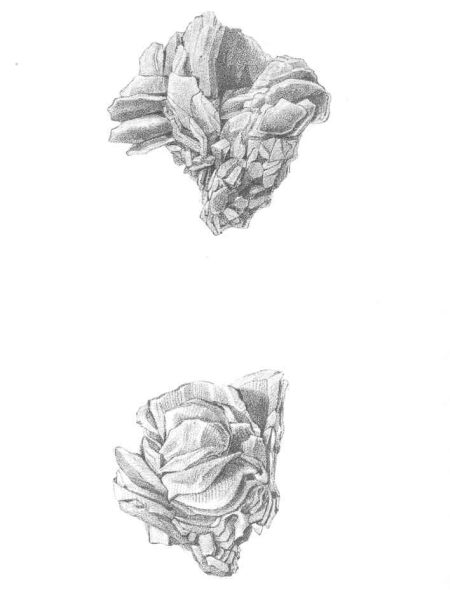
A SELENITE. CHRYSTALLIZED SULPHATE OF LIME.
Granite, Porphyritic.—Colour light red. Both occurring in the bed of New Year's Creek, traversing it obliquely, and are visible for a
Old Red Sandstone.—Composition of Oxley's Table Land, 500 feet above the level of the plains. It is broken into two hills, that appear to have been separated by some convulsion. (See page 81.) It bears N.W. by W. from New Year's Range, distant 50 miles.
Old Red Sandstone.—Composition of D'Urban's group. The highest elevation ascended during the expedition, being nearly 600 feet above the level of the plain in which it rises. It lies to the S.S.W. of Oxley's Table Land, distant 40 miles, and the rock of which it is composed is much harder and closer.
Breccia.—Colour pale yellow, silicious cement. Composition of some trifling elevations to the North of New-Year's range, with which it is doubtful whether they are connected.
Chrystallized Sulphate of Lime.—Found imbedded in the alluvial soil forming the banks of the Darling river. Occurring in a regular vein. Soft, yielding to the nail; not acted on by acids.—See Plate.
Breccia.—Pale ochre colour, silicious cement, extremely hard. Cellular, and sharp edges to the fractured pebbles. Has apparently undergone fusion. Occurs in the bed of the Darling in one place only.
Sandstone Varieties.—Colour dull red and muddy white; appears like burnt bricks; light, easily frangible; adheres to the tongue; occurs in large masses in the bed of the Darling;
Variety of the same description of rock.
Jasper and Quartz.—Showing itself above the surface of a plain, from which D'Urban's group bore S. 40 E. distant 33 miles.
It is a remarkable fact, that not a pebble or a stone was picked up during the progress of the expedition, on any one of the plains; and that after it again left Mount Harris for the Castlereagh, the only rock-formation discovered was a small Freestone tract near the Darling river. There was not a pebble of any kind either in the bed of the Castlereagh, or in the creeks falling into it.
No. V.
OFFICIAL REPORTS TO THE COLONIAL GOVERNMENT.
GOVERNMENT ORDER
Colonial Secretary's Office, 23rd January, 1829.
His Excellency the Governor has been pleased to order, that the following communication, dated the 25th of December last, from Captain Sturt, of the 39th Regiment, who is employed in an exploring expedition into the interior of the country, be published for general information.
By his Excellency's Command, ALEXANDER M'LEAY.
Western Marshes, 25th December, 1828.
SIR,—I do myself the honor to forward, for the Governor's perusal, a copy of my journal up to the date of my
Mr. Hume ascended the hill at sun-rise, and thought he could see mountains to the north east, but at such a distance as to make it quite a matter of uncertainty. Agreeing, however, in the prudence of an immediate descent, we left our encampment on the morning of the 23rd, under Mount Foster, to which we had removed from Mount Harris, and pursued a north-north-west course to the spot on which we rest at present. We passed some fine meadow land near the river, and were obliged to keep wide of it in consequence of fissures in the ground. Traversing a large and blasted plain, on which the sun's rays fell with intense heat, and on which there was but little vegetation, we skirted the first great morass, and made the river immediately beyond it. It is of very considerable extent, the channel of the river passing through it. We are encompassed on every side by high reeds, which exist in the woods as well as in the plains. Mr. Hume and myself rode forward yesterday through the second morass, and made the river on slightly elevated ground, at a distance of about five miles; the country beyond appeared to favour our object, and we, to-morrow, proceed with the party to the north-west. The river seems to bend to the north-east; but in
I regret to add, that the effects of the sun on the plain over which we passed on the 23rd produced a return of inflammation in the eyes of the men, I have named in my journals, and caused the same in the eyes of several others of my party. I halted, therefore, to expedite their recovery. They are doing well now, and we can proceed in the cool of the morning without any fear of their receiving injury by it. One of the men, who were to return to Wellington Valley, was attacked slightly with dysentery, but the medicines I gave him carried it off in the course of a day or two. I have taken every precaution with regard to the health of the men, in preparing them for the country into which they are going; and I have to request that you will inform the governor that the conduct of the whole party merits my approbation, and that I have no fault to find. The men from Sydney are not so sharp as those from Wellington Valley, but are equally well disposed. The animals, both horses and bullocks, are in good order, and I find the two soldiers of infinite service to me. The boat has received some damage from exposure to intense heat, but is
His Excellency, having been good enough to order a fresh supply of provisions to Wellington Valley, I have to beg they may be forwarded to Mount Harris, and that the person in charge thereof be instructed to remain at that station for one month. We shall, during the interval, have examined the country to the north-west; and, in case we are forced back, shall require a supply to enable us to proceed to the northward, in furtherance of the views I have already had the honor to submit for the Governor's approval.
I have the honor to be, Sir, Your most obedient and humble Servant, CHARLES STURT, Captain, 39th Regt.
The Honorable The Colonial Secretary
GOVERNMENT ORDER
Colonial Secretary's Office, 6th April, 1829.
His Excellency the Governor is pleased to direct that the following interesting Report which has been received from Captain Sturt, 39th Regiment, who has been employed for some months past, (as will be seen on reference to the Government Order, No. 4, published with Captain Sturt's First Report in the Sydney Gazette, of the 24th
It appears that the river Macquarie ceases to exist near the spot where the expedition under the late Mr. Oxley terminated, which, from the state of country at the time, being then flooded, could not be ascertained; and that another river of no inconsiderable magnitude, fed by salt springs, was discovered by Captain Sturt on the 2nd February last, about 100 miles to the westward of the Macquarie, running to the southward and westward.
By His Excellency's Command, ALEXANDER M'LEAY.
Mount Harris, 4th March, 1829.
SIR,—I do myself the honor to acquaint you, for the information of His Excellency the Governor, that I returned to this eminence on Monday, the 23rd ult. having been driven from the interior, in consequence of the extreme drought which prevails there.
I am to state, in reference to my former communication, that agreeably to what I then reported, I moved, on the 26th December last, lower down the plains of the Macquarie, but encountered a barrier of reeds, formed by the marshes of that river, through which we in vain endeavoured to force our way. I was in consequence obliged to make the nearest part of the river to my left, and to take such measures as the nature of my situation required. Here, for the first time, I set the boat afloat, deeming it
The next day I moved to the place where Mr. Hume had struck upon the channel of the river, but was again doubtful in what direction to proceed.
The marsh, at the commencement of which we now found ourselves, being the third from Mount Foster, but the second great one, seemed to extend beyond us to the north for many miles, but varying in breadth. In the evening I went in the boat up the channel, and found it at first, deep and sullen, as that of the river above. It soon however, narrowed, and the weeds formed over its surface, so that I abandoned the boat and walked along a path up it. I had not gone far when the channel divided; two
In this extremity, I knew not what movement to make, as Mr. Hume had been checked in his progress north. I therefore determined to ascertain the nature of the country to the eastward and to the westward, that I might move accordingly; I proposed to Mr. Hume, to take a week's provisions, with two attendants, and go to the north-east, in order again to turn the marsh, but with the expectation that the angle formed by the junction of the Castlereagh with the Macquarie would arrest its progress, as the last was fast approaching the former.
I myself determined to cross the river, and to skirt the marshes on the left, and in case they turned off to the north east, as they appeared to do, it was my intention to pursue a N.W. course into the interior, to learn the nature of it. With these views I left the camp on the 31st of December, and did not return until the 5th of January. Having found early in my journey, from the change of soil and of timber, that I was leaving the neighbourhood of the Macquarie, I followed a N.W. course, from a more northerly one, and struck at once across the country, under an impression that Mr. Hume would have made the river again long before my return. I found, after travelling between twenty and thirty miles, the country began to rise; and at the end of my journey, I made a hill of considerable
In the immediate neighbourhood of the marshes we were obliged to sink wells for water, and it was thus early that we began to feel the want of a regular supply.
Having made a creek about four miles from our position by cutting through the reeds where there was a narrow space, we pursued a westerly course over a plain, having every appearance of frequent inundation, and for four or five days held nearly the same direction; in the course of which we crossed both our tracks on the excursions we had made, which had intersected each other in a dense oak brush; thus renewing the few doubts, or rather the doubt
It appears, then, that the Macquarie, flowing as it does for so many miles, through a bed, and not a declining country, and having little water in it, except in times of flood, loses its impetus long ere it reaches the formidable barrier that opposes its progress northwards; the soil in which the reeds grow being a stiff clay. Its waters consequently spread, until a slight declivity giving them fresh impulse, they form a channel again, but soon gaining a level, they lose their force and their motion together, and spread not only over the second great marsh, but over a vast extent of the surrounding country, the breadth of ground thus subject to inundation being more than twenty miles, and its length considerably greater; around this space there is a gentle rise which confines the waters, while small hollows in various directions lead them out of the marshes over the adjacent plains, on which they eventually subside. On my return from the interior, I examined those parts round which I had not been, with particular attention, partly in company with Mr. Hume, and this statement was confirmed by what we saw. Thus, at a distance of about twenty-five miles from Mount Foster to the N.N.W. the river Macquarie ceases to exist, in any shape as a river, and at a distance of between fifty and sixty, the marshes
Having executed the first part of the instructions with which I had been honoured, I determined on pursuing a west, or north-west course into the interior, to ascertain the nature of it, in fulfilment of the second, but in doing this I was obliged to follow creeks, and even on their banks had to carry a supply of water, so uncertain was it that we should meet with any at the termination of our day's journey, and that what we did find would be fit to drink. Our course led us over plains immediately bordering the lower lands of the Macquarie, alternating with swamp oak, acacia pendula, pine, box, eucalyptus, and many other trees of minor growth, the soil being inclined to a red loam, while the plains were generally covered with a black scrub, though in some places they had good grass upon them. We crossed two creeks before we made the hills Mr. Hume had ascended, and which he called New Year's Range. Around these hills the country appeared better—they are gentle, picturesque elevations, and are for the most part, covered with verdure, and have, I fancy, a whinstone base, the rock of which they are composed being of various substances. I place New Year's Range in lat. 30° 21´, long. 146° 3´ 30´´. Our course next lying north-west along a creek, led us to within twenty miles of the hill that had terminated my excursion, and as I hoped that a more leisurely survey of the country from its summit would open something favourable to our view, I struck over for it, though eventually obliged to return. From it Mr. Hume
Oxley's Table Land . . N. 40 E., distant 40 miles.
Kengall Hill . . due E. very distant.
Conical Hill . . S. 60 E.
Highland . . S.E. distance 30 miles.
Highland . . S. 30 E. distance 25 miles.
Long Range . . S. 16 E. distance 60 miles.
Long Range . . S. 72 W. distance 60 miles.
Distant Range . . S. 25 W. supposed.
It was in vain, however, that we looked for water. The country to the north-west, was low and unbroken, and alternated with wood and plain.
The country from New Year's Range to the hill I had made, and which I called Oxley's Table Land, had been very fair, with good soil in many places, but with a total want of water, except in the creeks, wherein the supply was both bad and uncertain; on our second day's journey from the former, we came to the creek on which we were moving, where it had a coarse granite bottom. The country around it improved very much in appearance, and there was abundance of good grass on the surface of it, in spite of the drought. On the right of this creek, a large plain stretches parallel to it for many miles, varying in quality of soil. Near Oxley's Table Land, we passed over open forest, the prevailing timber of which was box. I
Finding it impracticable to move westward from the hill I again descended on the creek, whose general course was to the north-west, in which direction we at length struck upon a river whose appearance raised our most sanguine expectations. It flowed round an angle from the north-east to the north-west, and extended in longitude five reaches as far as we could see. At that place it was about sixty yards broad, with banks of from thirty to forty feet high, and it had numerous wild fowl and many pelicans on its bosom, and seemed to be full of fish, while the paths of the natives on both sides, like well-trodden roads, showed how numerous they were about it. On tasting its waters, however, we found them perfectly salt, and useless to us, and as our animals had been without water the night before, this circumstance distressed us much; our first day's journey led us past between sixty and seventy huts in one place, and on our second we fell in with a numerous tribe of natives, having previously seen some between two creeks before we made New-Year's Range. At some places the water proved less salt than at others; our animals drank of it sparingly: we found two small fresh-water holes, which served us as we passed. After tracing the river for a considerable distance, we came on brine springs in the bed of it, the banks having been encrusted with salt from the first; and as the difficulty of getting fresh water was so great, I here foresaw an end to our wanderings. And as I was resolved not to involve my party in greater distress, I halted it, on overtaking the animals, and the next morning turned back to the nearest fresh-water, at a distance of
We found the river held a south-west course, and appeared to be making for the central space between a high land, which I called Dunlop's Range, at Mr. Hume's request, and a lofty range to the westward. It still continued its important appearance, having gained in breadth and in the height of its banks, while there were hundreds of pelicans and wild-fowl on it. Flowing through a level country with such a channel, it may be presumed that this river ultimately assumes either a greater character, or that it adds
This river differs from most in the colony, in having a belt of barren land of from a quarter of a mile to two miles in breadth in its immediate neighbourhood, and which is subject to overflow. This belt runs to the inland plains, where a small elevation checks the further progress of the flood. There is magnificent blue gum on both sides the river, but the right bank is evidently the most fertile, and I am mistaken greatly if there is not a beautiful country north of it.
Of the country over which we have passed, it is impossible for me to have formed a correct opinion under its present melancholy circumstances. It has borne the appearance of barrenness, where in even moderate rain, it might have shown very differently, though no doubt we passed over much of both good and bad land; our animals on the whole, have thrived on the food they have had, which would argue favourably for the herbage. Generally speaking, I fear the timber is bad—the rough-gum may be used for knees, and such purposes, and we may have seen wood for the wheelwright and cabinet-maker, specimens of which I have procured, but none for general or household purposes.
The creeks we have traced are different in character from those in the settled districts, inasmuch as that, like the river, they have a belt of barren land near then and but little grass—they have all of them been numerously frequented by the natives, as appeared from the number
Our return is to be attributable to the want of water alone, and it is impossible for me to describe the effects of the drought on animal as well as vegetable nature. The natives are wandering in the desert, and it is melancholy to reflect on the necessity which obliges them to drink the stinking and loathsome water they do—birds sit gasping in the trees and are quite thin—the wild dog prowls about in the day-time unable to avoid us, and is as lean as he can be in a living state, while minor vegetation is dead, and the very trees are drooping. I have noticed all these things in my Journal I shall have the honour of submitting through you, for the Governor's perusal and information, on my return. Finally, I fear our expedition will not pave the way to any ultimate benefit; although it has been the means by which two very doubtful questions,—the course of the Macquarie, and the nature of the interior, have been solved; for it is beyond doubt, that the interior for 250 miles beyond its former known limits to the W.N.W., so far from being a shoal sea, has been ascertained not only to have considerable elevations upon it, but is in itself a table land to all intents and purposes, and has scarcely water on its surface to support its inhabitants.
I beg you will inform His Excellency the Governor, that I have on all occasions received the most ready and valuable assistance from Mr, Hume. His intimate acquaintance with the manners and customs of the natives, enabled him to enter into intercourse with them, and chiefly contributed to the peaceable manner in which we have journeyed, while his previous experience put it in his power to be of real use to me. I cannot but say he has done an essential service to future travellers, and to the colony at large, by his conduct on all occasions since he has been with me; nor should I be doing him justice, if I did not avail myself of the first opportunity of laying my sentiments before the Governor, through you. I am happy to add that every individual of the party deserves my warmest approbation, and that they have, one and all, borne their distresses, trifling certainly, but still unusual, with cheerfulness, and that they have at all times been attentive to their duty, and obedient to their orders. The whole are in good health, and are eager again to start.
I have the honor to be, Sir, Your most obedient and most humble servant, CHARLES STURT, Capt. 39th Regt.
The Honorable The Colonial Secretary.
Mount Harris, 5th March, 1829.
SIR,—It having appeared to me, that after discovering such a river as the one I have described in my letter of yes
I am to inform you that in this neighbourhood the
I am also to report, that the natives attempted the camp with the supplies before my arrival at Mount Harris, but that on the soldier with the party firing a shot, after they had thrown a stone and other of the weapons, they fled. It was in consequence of their fires, which I saw at a distance of forty miles, and which they never make on so extensive a scale, except as signals when they want to collect, and are inclined to be mischievous, that I made forced marches up, and I am led to believe my arrival was very opportune. The natives have visited us since, and I do not think they will now attempt to molest either party when we separate.
I have the honour to be, Sir, Your most obedient and most humble servant, CHARLES STURT, Capt. 39th Regt.
The Hon. The Colonial Secretary.