Volume 1 — CHAPTER II.
Reading edition
Prosecution of our course into the interior—Mosquito Brush—Aspect and productions of the country—Hunting party of natives—Courageous conduct of one of them—Mosquitoes—A man missing—Group of hills called New-Year's Range—Journey down New-Year's Creek—Tormenting attack of the kangaroo fly—Dreariness and desolation of the country—Oxley's Table Land—D'Urban's Group—Continue our journey down New-Year's Creek—Extreme Disappointment on finding it salt—Fall in with a tribe of natives—Our course arrested by the want of fresh water—Extraordinary sound—Retreat towards the Macquarie.
We left our position at the head of the plain early on the 13th of January, and, ere the sun dipped, had entered a very different country from that in which we had been labouring for the last three weeks. We had, as yet, passed over little other than an alluvial soil, but found that it changed to a red loam in the brushes immediately backing the camp. An open forest track succeeded this, over which the vegetation had an unusual freshness, indicating that the waters had not long subsided from its surface. We shortly afterwards crossed a hollow, similar to that Mr. Hume had described, in which bulrushes had taken the place of reeds. Flooded-gum trees, of large size, were also growing in it, but on either side box alone prevailed, under which the forest grass grew to a considerable height. We crossed the hollow two or three times, and as often remarked the line of separation between those trees. The
On the 14th we took up a westerly course, and in the first instance traversed a plain of great extent; the soil of which was for the most part a red sandy loam, but having patches of light earth upon it. The former was covered with plants of the chenopedia kind; the latter had evidently been quagmires, and bore even then the appearance of moisture. At about seven miles from Mosquito Brush we struck upon a creek of excellent water, upon which the wild fowl were numerous. Some natives was seen, but they were only women, and seemed so alarmed that I purposely avoided them. As the creek was leading northerly, we traced it down on that course for about seven miles, and then halted upon its banks, which were composed of a light tenacious earth. Brushes of casuarina existed near it, but a tortuous box was the prevailing tree, which, excepting for the knees of small vessels, could not have been applied to any use, while the flooded-gum had entirely disappeared. Some ducks were shot in the after
From the creek, which both I and Mr. Hume must have crossed on our respective journeys, we held a westerly course for about fifteen miles, through a country of alternate plain and brush, the latter predominating, and in its general character differing but little from that we had traversed the day previous.
The acacia pendula still continued to exist on the plains backed by dark rows of cypresses.* [Cupressus callitris] In the brushes, box and casuarina,† [Casuarina tortuosa] with several other kinds of eucalypti, prevailed; but none of them were sufficiently large to be of use. The plains were so extremely level that a meridian altitude could have been taken without any material error; and I doubt much whether it would have been possible to have traversed them had the season been wet.
As we were travelling through a forest we surprised a hunting party of natives. Mr. Hume and I were considerably in front of our party at the time, and he only had his
From a more open forest, we entered a dense scrub, the soil in which was of a bright-red colour and extremely sandy, and the timber of various kinds. A leafless species of stenochylus aphylta, which, from the resemblance, I at first thought one of the polygonum tribe, was very abundant in the open spaces, and the young cypresses were occasionally so close as to turn us from the direction in which we had been moving. In the scrub we crossed Mr. Hume's tract, and, from the appearance of the ground, I was led to believe mine could not be very distant.
We struck upon a creek late in the afternoon, at which we stopped; New Year's Range bearing nearly due west at about four miles' distance. Had we struck upon my track, the question about which we were so anxious would still have been undecided; but the circumstance of our having crossed Mr. Hume's, which, from its direction, could not be mistaken, convinced me of the fate of the Macquarie, and I felt assured that, whatever channels it might have for the distribution of its waters, to the north of our line of route, the equality of surface of the interior would never permit it again to form a river; and that it only required an examination of the lower parts of the marshes to confirm the theory of the ultimate evaporation and absorption of its waters, instead
On the 17th of January we encamped under New Year's Range, which is the first elevation in the interior of Eastern Australia to the westward of Mount Harris. Yet when at its base, I do not think that we had ascended above forty feet higher than the plains in the neighbourhood of that last mentioned eminence. There certainly is a partial rise of country, where the change of soil takes place from the alluvial deposits of the marshes, to the sandy loam so prevalent on the plains we had lately traversed; but I had to regret that I was unable to decide so interesting a question by other than bare conjecture.
Notwithstanding that Mr. Hume had already been on them, I encouraged hopes that a second survey of the country from the highest point of New Year's Range would enable us to form some opinion of it, by which to direct our future movements; but I was disappointed.
The two wooded hills I had seen from Oxley's Table Land were visible from the range, bearing south; and other eminences bore by compass S.W. and W. by S.; but in every other direction the horizon was unbroken. To the westward, there appeared to be a valley of considerable extent, stretching N. and S., in which latter direction there was a long strip of cleared ground, that looked very like the sandy bed of a broad and rapid river. The bare possibility of the reality determined me to ascertain by inspection, whether my conjecture was right, and Mr. Hume
The view from them was confused, nor did any fresh object meet our observation. We had, however, considerably neared the two wooded hills, and the elevations that from the range were to the S.W., now bore N.W. of us. We had wandered too far from the camp to admit of our returning to it to sleep; we therefore commenced a search for water, and having found some, we tethered our horses near it for the night, and should have been tolerably comfortable, had not the mosquitoes been so extremely troublesome. They defied the power of smoke, and annoyed me so much, that, hot as it was, I rolled myself in my boat
We reached the camp about noon the following day, and learnt, to our vexation, that one of the men, Norman, had lost himself shortly after we started, and had not since been heard of. Dawber, my overseer, was out in search of him. I awaited his return, therefore, before I took any measures for the man's recovery; nor was I without hopes that Dawber would have found him, as it appeared he had taken one of the horses with him, and Dawber, by keeping his tracks, might eventually have overtaken him. He returned, however, about 3 p.m. unsuccessful, when Mr. Hume and I mounted our horses, and proceeded in different directions in quest of him, but were equally disappointed.
We met at the creek in the dark, and returned to the camp together, when I ordered the cypresses on the range to be set on fire, and thus illuminated the country round for many miles. In the morning, however, as Norman had not made his appearance, we again started in search of the poor fellow, on whose account I was now most uneasy; for his horse, it appeared, had escaped him, and was found with the others at watering time.
I did not return to the camp until after sunset, more fatigued than I recollect ever having been before. I was, however, rejoiced on being informed that the object of my
To my enquiries he replied, that, being on horseback, he thought he could have overtaken a kangaroo, which passed him whilst waiting at the creek for the cattle, and that in the attempt, he lost himself. It would appear that he crossed the creek in the dark, and his horse escaped from him on the first night. He complained more of thirst than of hunger, although he had drunk at the watering-place to such an excess, on his return, as to make him vomit; but, though not a little exhausted, he had escaped better than I should have expected.
New Year's Range consists of a principal group of five hills, the loftiest of which does not measure 300 feet in height. It has lateral ridges, extending to the N.N.W. on the one hand, and bending in to the creek on the other. The former have a few cypresses, sterculia, and iron bark upon them; the latter are generally covered with brush, under box; the brush for the most part consisting of two distinct species of stenochylus, and a new acacia. The whole range is of quartz formation, small fragments of which are profusely scattered over the ridges, and are abundantly incrusted with oxide of iron. The soil in the neighbourhood of New Year's Range is a red loam, with a slight mixture of sand. An open forest country lies between it and the creek, and it is not at all deficient in pasture.
That a change of soil takes place to the westward of the creek, is obvious, from the change of vegetation, the most remarkable feature of which is the sudden check given to the further extension of the acacia pendula, which is not to be found beyond it, it being succeeded by another acacia of the same species and habits; neither do the plants of the chenopedia class exist in the immediate vicinity of the range.
I place these hills, as far as my observations will allow, in east long. 146° 32´ 15´´, and in lat. 30° 21´ south; the variation of the compass being 6° 40´ easterly.
As New Year's Creek was leading northerly, it had been determined to trace it down as long as it should keep that course, or one to the westward of it. We broke up the camp, therefore, under the range, on the evening of the 18th, and moved to the creek, about two miles north of the place at which we had before crossed it, with the intention of prosecuting our journey on the morrow. But both Mr. Hume and I were so fatigued that we were glad of an opportunity to rest, even for a single day. We remained stationary, therefore, on the 19th; nor was I without hope that the natives whom we had surprised in the woods, would have paid us a visit, since Mr. Hume had met them in his search for Norman, and they had promised not only to come to us, but to do all in their power to find the man, whose footsteps some of them had crossed. They did not, however, venture near us; and I rather attribute their having kept aloof, to the circumstance of Mr. Hume's having fired a shot, shortly after he left them, as a signal
I have said that we remained stationary the day after we left the range, with a view to enjoy a little rest; it would, however, have been infinitely better if we had moved forward. Our camp was infested by the kangaroo fly, which settled upon us in thousands. They appeared to rise from the ground, and as fast as they were swept off were succeeded by fresh numbers. It was utterly impossible to avoid their persecution, penetrating as they did into the very tents.
The men were obliged to put handkerchiefs over their faces, and stockings upon their hands; but they bit through every thing. It was to no purpose that I myself shifted from place to place; they still followed, or were equally numerous everywhere. To add to our discomfort, the animals were driven almost to madness, and galloped to and fro in so furious a manner that I was apprehensive some of them would have been lost. I never experienced such a day of torment; and only when the sun set, did these little creatures cease from their attacks.
It will be supposed that we did not stay to subject our
Although we had left the immediate spot at which the kangaroo flies (cabarus) seemed to be collected, I did not expect that we should have got rid of them so completely as we did. None of them were seen during the day; a proof that they were entirely local. They were about half the size of a common house fly, had flat brown bodies, and their bite, although sharp and piercing, left no irritation after it.
About noon we stopped at the creek side to take some refreshment. The country bore an improved appearance around us, and the cattle found abundance of pasture. It was evident that the creek had been numerously frequented by the natives, although no recent traces of them could be found. It had a bed of coarse red granite, of the fragments of which the natives had constructed a weir for the purpose of taking fish. The appearance of this rock in so isolated a situation, is worthy of the consideration of geologists.
The promise of improvement I have noticed, gradually
It appeared, from their traces that the natives had lingered on this ground, on which they had perhaps been born, as long as it continued to afford them a scanty
We passed some considerable plains, lying to the eastward of the creek, on parts of which the grass, though growing in tufts, was of luxuriant growth. They were, however, more generally covered with salsola and rhagodia, and totally destitute of other vegetation, the soil upon them being a red sandy loam. The paths across the plains, which varied in breadth from three to eight miles, were numerous; but they had not been recently trodden. The creek continued to have a thick brush of casuarina and acacia near it, to the westward of which there was a rising open forest track; the timber upon it being chiefly box, cypress, and the acacia longifolia. It was most probably connected with New Year's Range, those elevations being about thirty miles distant. It terminated in some gentle hills which, though covered in places with acacia shrub, were sufficiently open to afford an extensive view. From their summit Oxley's Table Land, towards which we had been gradually working our way, was distinctly visible, distant about twenty miles, and bearing by compass W. by S. On [Called the Pink Hills, from the colour of a flower upon them] which were scattered over with fragments of slaty quartz, we traversed a box flat, apparently subject to overflow, having a barren sandy scrub to its left. I had desired the men to preserve a W.N.W. direction, on leaving them, supposing that that course would have kept them near the creek; but, on overtaking the party, I found that they had wandered completely away from it. The fact was, that the creek had taken a sudden bend to the eastward of N. and had thus thrown them out. It was with some difficulty that we regained it before sunset; and we were at length obliged to stop for the night at a small plain, about a quarter of a mile short of it, but we had the satisfaction of having excellent feed for the animals.
Fearful that New Year's Creek would take us too far to the eastward, and being anxious to keep westward as much as possible, it struck me that we could not, under existing circumstances, do better than make for Oxley's Table Land. Water, I knew, we should find in a swamp at it's base, and we might discover some more encouraging feature than I had observed on my hasty visit to it. We left the creek, therefore on the 23rd, and once more took up a westerly course. Passing through a generally open country, we stopped at noon to rest the animals; and afterwards got on an excellent grazing forest track, which continued to the brush, through another part of which I had penetrated to the marsh more to the south. While making our way through it, we came upon a small pond of water, and must
In the morning, Mr. Hume walked with me to the hill, a distance of about a mile. It is not high enough to deserve the name of a mountain, although a beautiful feature in the country, and showing well from any point of view. We ascended it with an anxiety that may well be imagined, but were wholly disappointed in our most sanguine expectations. Our chief object, in this second visit to Oxley's Table Land, had been to examine, more at leisure, the face of the country around it, and to discover, if possible, some fixed point on which to move.
If the rivers of the interior had already exhausted themselves, what had we to expect from a creek whose diminished appearance where we left it made us apprehend its speedy termination, and whose banks we traversed under constant apprehension? In any other country I should have followed such a water course, in hopes of its ultimately leading to some reservoir; but here I could encourage no such favourable anticipation.
The only new object that struck our sight was a remarkable and distant hill of conical shape, bearing by compass S. 10 E. To the southward and westward, in the direction of D'Urban's Group, a dense and apparently low brush extended; but to the N. and N.W., there was a regular
Our situation, at this time, was extremely embarrassing, and the only circumstance on which we had to congratulate ourselves was, the improved condition of our men; for several of the cattle and horses were in a sad plight. The weather had been so extremely oppressive, that we had found it impossible to keep them free from eruptions. I proposed to Mr. Hume, therefore, to give them a few days' rest, and to make an excursion, with such of them as were serviceable, to D'Urban's Group. We were both of us unwilling to return to the creek, but we foresaw that a blind reliance upon fortune, in our next movements, might involve us in inextricable difficulty.
On the other hand, there was a very great risk in delay. It was more than probable, from the continued drought, that our retreat would be cut off from the want of water, or that we should only be enabled to effect our retreat with loss of most of the animals. The hope, however, of our intersecting some stream, or of falling upon a better country, prevailed over other considerations; and the excursion was, consequently, determined upon.
We left the camp on the 25th, accompanied by Hopkinson and the tinker; and, almost immediately after, entered an acacia scrub of the most sterile description, and one, through which it would have been impossible to have found a passage for the boat carriage. The soil was almost a pure sand, and the lower branches of the trees were decayed so generally as to give the whole an indescribable appearance of desolation. About mid-day, we crossed a light sandy plain, on which there were some dirty puddles of water. They were so shallow as to leave the backs of the frogs in them exposed, and they had, in consequence, been destroyed by solar heat, and were in a state of putrefaction. Our horses refused to drink, but it was evident that some natives must have partaken of this sickening beverage only a few hours before our arrival. Indeed, it was clear that a wandering family must have slept near this spot, as we observed a fresh made gunneah (or native hut), and their foot-prints were so fresh along the line we were pursuing, that we momentarily expected to have overtaken them. It was late in the evening when we got out of this brush into better and more open ground, where, in ordinary seasons we should, no doubt, have found abundance of water. But we now searched in vain for it, and were contented to be enabled to give our wearied animals better food than they had tasted for many days, the forest grass, though in tufts, being abundant.
Illustration 5
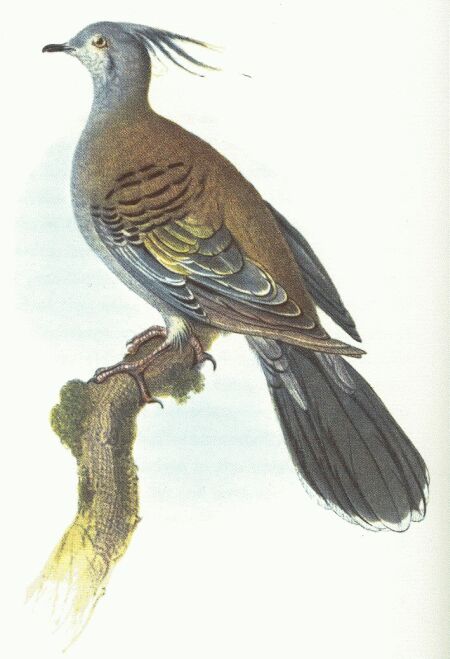
THE CRESTED PIGEON OF THE MARSHES.
We brought up for the night at the edge of a scrub, having travelled from thirty-two to thirty-five miles, judging
In the morning we started at an early hour, and immediately entered the brush, beneath which we had slept; pursuing a westerly course through it. After a short ride, we found ourselves upon a plain, that was crowded with flocks of cockatoos. Here we got a supply of water, such as it was—so mixed with slime as to hang in strings between the fingers; and, after a hasty breakfast, we proceeded on our journey, mostly through a barren sandy scrub that was a perfect burrow from the number of wombats in it, to within a mile of the hill group, where the country appeared like one continuous meadow to the very base of them. I never saw anything like the luxuriance of the grass on this tract of country, waving as it did higher than our horses' middles as we rode through it. We ascended the S.W. face of the mountain to an elevation of at least 800 feet above the level of the plain, and had some difficulty in scaling the masses of rock that opposed themselves to our progress. But on gaining the summit, we were amply repaid for our trouble. The view extended far and wide, but we were again disappointed in the main object that had induced us to undertake the journey. I took the following bearings by compass. Oxley's Table Land bore N. 40 E. distant forty-five miles; small and distant hill due E.; conical peak seen from Oxley's Table Land S. 60 E., very distant; long ridge of high land, S.E., distant thirty-five miles; high land, S. 30 E., distant thirty miles; long range, S. 25 W.
To the westward, as a medium point, the horizon was unbroken, and the eye wandered over an apparently endless succession of wood and plain. A brighter green than usual marked the course of the mountain torrents in several places, but there was no glittering light among the trees, no smoke to betray a water hole, or to tell that a single inhabitant was traversing the extensive region we were overlooking. We were obliged to return to the plain on which we had breakfasted, and to sleep upon it.
D'Urban's Group is of compact sandstone formation. Its extreme length is from E.S.E. to W.N.W., and cannot be more than from seven to nine miles, whilst its breadth is from two to four. The central space forms a large basin, in which there are stunted pines and eucalyptus scrub, amid huge fragments of rocks. It rises like an island from the midst of the ocean, and as I looked upon it from the plains below, I could without any great stretch of the imagination, picture to myself that it really was such. Bold and precipitous, it only wanted the sea to lave its base; and I cannot but think that such must at no very remote period have been the case, and that the immense flat we had been traversing, is of comparatively recent formation.
We reached the camp on the 28th of the month, by nearly the same route; and were happy to find that, after the few days' rest they had enjoyed, there was a considerable improvement in the animals.
Our experience of the nature of the country to the south
Oxley's Table Land is situated in lat. 29° 57´ 30´´, and in E. long. 145° 43´ 30´´, the mean variation being 6.32 easterly.
We left Oxley's Table Land on the morning of the 31st of January, pursuing a northern course through the brush and across a large plain, moving parallel to the smaller hill, and keeping it upon our left. The soil upon this plain differed in character from that on the plains to the eastward, and was much freer from sand. We stopped to dine at a spot, whence Oxley's Table Land bore by compass, S. by W., distant about twelve miles. Continuing our journey, at 2 p.m. we cleared the plain, and entered a tract covered with the polygonum junceum, on a soil evidently the deposit of floods. Box-trees were thinly scattered over it, and among the polygonum, the crested pigeons were numerous. These general appearances, together with a dip of country to the N.N.W., made us conclude that we were approaching the creek, and we accordingly intersected it on a N.N.E. course, at about three miles' distance from where we had dined. It had, however, undergone so complete a change, and had increased so much in size and in the height of its banks, that we were at a loss to recognise it. Still, with all these favourable symptoms, there was not a drop of water in it. But small
The party crossed to the right bank of the creek, and then moved in a westerly direction along it in search of water. A brush extended to our right, and some broken stony ground, rather elevated, was visible, to which Mr. Hume rode; nor did he join me again until after I had halted the party for the night.
My search for water had been unsuccessful, and the sun had set, when I came upon a broad part of the creek that appeared very favourable for an encampment, as it was encompassed by high banks, and would afford the men a greater facility of watching the cattle, that I knew would stray away if they could.
My anxiety for them led me to wander down the bed of the creek, when, to my joy, I found a pond of water within a hundred yards of the tents. It is impossible for me to describe the relief I felt at this success, or the gladness it spread among the men. Mr. Hume joined me at dusk, and informed me that he had made a circuit, and had struck upon the creek about three miles below us but that, in tracing it up, he had not found a drop of water
We had not touched upon the creek from the time we left it in the morning, having wandered from it in a northerly direction, along a native path that we intersected, and that seemed to have been recently trodden, since footsteps were fresh upon it. At sunset, we crossed a broad dry creek that puzzled us extremely, and were shortly afterwards obliged to stop for the night upon a plain beyond it. We had, during the afternoon, bent down to the S.W. in hopes that we should again have struck upon New Year's Creek; and, under an impression that we could not be far from it, Mr. Hume and I walked across the plain, to ascertain if it was sufficiently near to be of any service to us. We came upon a creek, but could not decide whether it was the one for which we had been searching, or another.
Its bed was so perfectly even that it was impossible to say to what point it flowed, more especially as all remains of debris had mouldered away. It was, however, extremely broad, and evidently, at times, held a furious torrent. In the centre of it, at one of the angles, we discovered a pole
The creek had flooded-gum growing upon its banks, and, on places apparently subject to flood, a number of tall straight saplings were observed by us. We returned to the camp, after a vain search for water, and were really at a loss what direction next to pursue. The men kept the cattle pretty well together, and, as we were not delayed by any preparations for breakfast, they were saddled and loaded at an early hour. The circumstance of there having been natives in the neighbourhood, of whom we had seen so few traces of late, assured me that water was at hand, but in what direction it was impossible to guess. As the path we had observed was leading northerly, we took up that course, and had not proceeded more than a mile upon it, when we suddenly found ourselves on the banks of a noble river. Such it might in truth be called, where water was scarcely to be found. The party drew up upon a bank that was from forty to forty-five feet above the level of the stream. The channel of the river was front seventy to eighty yards broad, and enclosed an unbroken sheet of water, evidently very deep, and literally covered with pe
Its banks were too precipitous to allow of our watering the cattle, but the men eagerly descended to quench their thirst, which a powerful sun had contributed to increase; nor shall I ever forget the cry of amazement that followed their doing so, or the looks of terror and disappointment with which they called out to inform me that the water was so salt as to be unfit to drink! This was, indeed, too true: on tasting it, I found it extremely nauseous, and strongly impregnated with salt, being apparently a mixture of sea and fresh water. Whence this arose, whether from local causes, or from a communication with some inland sea, I knew not, but the discovery was certainly a blow for which I was not prepared. Our hopes were annihilated at the moment of their apparent realization. The cup of joy was dashed out of our hands before we had time to raise it to our lips. Notwithstanding this disappointment, we proceeded down the river, and halted at about five miles, being influenced by the goodness of the
One would have imagined that our perplexities would have been sufficient for one day, but ere night closed,
In consequence of the doubts that hung upon Mr. Hume's mind, as to the course of the river, we arranged that the animals should precede us to the fresh water; and that we should keep close in upon the stream, to ascertain that point. After traversing a deep bight, we arrived nearly as soon as the party, at the appointed rendezvous. The rocks composing the channel of the river at the crossing place, were of indurated clay. In the course of an hour, the animals appearing quite refreshed, we proceeded on our journey, and at about four miles crossed New Year's Creek, at its junction with the salt river. We passed several parts of the main channel that were perfectly dry, and were altogether
We passed over vast spaces covered with the polygonum junceum, that bore all the appearance of the flooded tracks in the neighbourhood of the marshes, and on which the travelling was equally distressing to the animals. Indeed, it had been sufficiently evident to us that the waters of this river were not always confined to its channel, capacious as it was, but that they inundated a belt of barren land, that varied in width from a quarter of a mile to a mile, when they were checked by an outer embankment that prevented them from spreading generally over the country, and upon the neighbouring plains. At our halting place, the cattle drank sparingly of the water, but it acted as a violent purgative both on them and the men who partook of it.
On the 5th, the river led us to the southward and westward. Early in the day, we passed a group of seventy huts, capable of holding from twelve to fifteen men each. They appeared to be permanent habitations, and all of them fronted the same point of the compass. In searching amongst them we observed two beautifully made nets, of
In one hut, the floor of which was swept with particular care, a number of white balls, as of pulverised shells or lime, had been deposited—the use of which we could not divine. A trench was formed round the hut to prevent the rain from running under it, and the whole was arranged with more than ordinary attention.
We had not proceeded very far when we came suddenly upon the tribe to which this village, as it might be called, belonged.
In breaking through some brush to an open space that was bounded on one side by the river, we observed three or four natives, seated on a bank at a considerable distance from us; and directly in the line on which we were moving. The nature of the ground so completely favoured our approach, that they did not become aware of it until we were within a few yards of them, and had ascended a little ridge, which, as we afterwards discovered, ended in an abrupt precipice upon the river, not more than thirty yards to our right. The crack of the drayman's whip was the first thing that aroused their attention. They gazed upon us for a moment, and then started up and assumed an attitude of horror and amazement; their terror apparently increasing upon them. We stood perfectly immovable, until at length they gave a fearful yell, and darted out of sight.
Their cry brought about a dozen more natives from the river, whom we had not before observed, but who now ran after their comrades with surprising activity, and without once venturing to look behind them. As our position was a good one, we determined to remain upon it, until we should ascertain the number and disposition of the natives. We had not been long stationary, when we heard a crackling noise in the distance, and it soon became evident that the bush had been fired. It was, however, impossible that we could receive any injury on the narrow ridge upon which we stood, so that we waited very patiently to see the end of this affair.
In a short time the fire approached pretty near to us, and dense columns of smoke rose into the air over our heads. One of the natives, who had been on the bank, now came out of the bush, exactly from the spot into which he had retreated. He advanced a few paces towards us, and bending his body so that his hands rested on his knees, he fixed his gaze upon us for some time; but, seeing that we remained immovable, he began to throw himself into the most extravagant attitudes, shaking his foot from time to time. When he found that all his violence had no effect, he turned his rear to us in a most laughable manner, and absolutely groaned in spirit when he found that this last insult failed of success.
He stood perplexed and not knowing what next to do, which gave Mr. Hume an opportunity to call out to him, and with considerable address he at length got the savage
We had on this occasion a remarkable instance of the docility of the natives of the interior, or of the power they have of subduing their apprehensions; manifesting the opposite extremes of fear and confidence. These men whom we had thus surprised, and who, no doubt, imagined that we were about to destroy them, having apparently never seen nor heard of white men before, must have taken us for something preternatural; yet from the extremity of fear that had prompted them to set their woods in flames, they in a brief space so completely subdued those fears as to approach the very beings who had so strongly excited their alarm. The savage who had been the principal actor in the scene, was an elderly man, rather descending to the vale of years than what might be strictly called aged. I know not how it was, but I regarded him with peculiar interest. Mr.
Some of the men, however, were painted with red and yellow ochre, with which it was evident to me they had besmeared themselves since our appearance, most likely in preparing for the combat in which they fancied they would be engaged. We distributed such presents as we had to those around us, and when we pursued our journey, the majority accompanied us, nor did they wholly leave us until we had passed the place to which their women had retired. They might have left us when they pleased, for we intended them no harm; as it was, however, they struck into the brushes to join their families, and we pushed on to make up for lost time.
The travelling near the river had been so bad, not only in consequence of the nature of the soil and brush, but from the numerous gullies that had been formed by torrents, as they poured into its channel after heavy rains and floods, that it was thought advisable to keep at a greater distance from it. We turned away, therefore, to the plains, and found them of much firmer surface. They partook, however, of the same general character as the plains we had traversed more to the eastward. Their soil was a light sandy loam, and the same succulent plants still continued to prevail upon them, which we have already noticed as
On the 6th, we journeyed again through a barren scrub, although on firmer ground, and passed numerous groups of huts. At about eight miles from our last encampment, we came upon the river, where its banks were of considerable height. In riding along them, Mr. Hume thought he observed a current running, and be called to inform me of the circumstance. On a closer examination, we discovered some springs in the very bed of the river, from which a considerable stream was gushing, and from the incrustation around
After such a discovery, we could not hope to keep our position. No doubt the current we had observed on first reaching the river, was caused by springs that had either escaped our notice or were under water. Here was at length a local cause for its saltness that destroyed at once the anticipation and hope of our being near its termination, and, consequently, the ardour with which we should have pressed on to decide so interesting a point.
Our retreat would have been a measure of absolute necessity ere this, had we not found occasional supplies of fresh water, the last pond of which was now about eighteen miles behind us.
Whether we should again find any, was a doubtful question, and I hesitated to run the risk. The animals were already, from bad food, and from the effects of the river water, so weak, that they could scarcely carry their loads, and I was aware, if any of the bullocks once fell, he would never rise again. Under such circumstances, I thought it better to halt the party at the edge of the scrub, though the feed was poor, and the water not drinkable. Our situation required most serious consideration. It was necessary that we should move either backward or forward in the morning. Yet we could not adopt either measure with satisfaction to ourselves, under such unfavorable circumstances. I determined to relieve my own mind by getting
Notwithstanding we had been thus forced to a partial retreat, both Mr. Hume and myself were unwilling to quit the pursuit of the river, in so unsatisfactory a manner. There was no difference in the appearance of the country to the westward of it; but a seeming interminable flat stretched away in that direction. A journey across it was not likely, therefore, to be attended with any favorable results, since it was improbable that any other leading feature was within our reach. I proposed, therefore, to take the most serviceable of the horses with me down the river, that, in the event of our finding fresh water, we might again push forward. Mr. Hume requesting to be permitted to accompany me, it was arranged that we should start on the 8th, thereby giving the animals a day's rest. We had not seen any natives since our parting with the chief horde; and as we were stationed at some little distance from the river, I hoped that they would not visit the camp during my absence. This was the only circum
About 3 p.m. on the 7th, Mr. Hume and I were occupied tracing the chart upon the ground. The day had been remarkably fine, not a cloud was there in the heavens, nor a breath of air to be felt. On a sudden we heard what seemed to be the report of a gun fired at the distance of between five and six miles. It was not the hollow sound of an earthly explosion, or the sharp cracking noise of falling timber, but in every way resembled a discharge of a heavy piece of ordnance. On this all were agreed, but no one was certain whence the sound proceeded. Both Mr. Hume and myself had been too attentive to our occupation to form a satisfactory opinion; but we both thought it came from the N.W. I sent one of the men immediately up a tree, but he could observe nothing unusual. The country around him appeared to be equally flat on all sides, and to be thickly wooded: whatever occasioned the report, it made a strong impression on all of us; and to this day, the singularity of such a sound, in such a situation, is a matter of mystery to me.
On the 8th, we commenced our journey down the river, accompanied by two men, and a pack-horse, carrying our provisions on one side and a bucket of water on the other. Keeping in general near the stream, but making occasional turns into the plains, we got to the brush from which the party had turned back, about 3 p.m. Passing through, we crossed a small plain, of better soil and vegetation
The horses would not drink the river water, so that we were obliged to give them a pint each from our own supply. On the following morning we continued our journey. The country was generally open to the eastward, and we had fine views of D'Urban's Group, distant from twenty to twenty-five miles. About noon, turning towards the river to rest, both ourselves and the horses, we passed through brush land for about a mile and a half. When we came upon its banks, we found them composed of a red loam with sandy superficies. We had, in the course of the day, crossed several creeks, but in none of them could we find water, although their channels were of great depth.
The day had been extremely warm, and from shaking in the barrel our supply of water had diminished to a little more than a pint; it consequently became a matter of serious consideration, how far it would be prudent to proceed farther; for, however capable we were of bearing additional fatigue, it was evident our animals would soon fail, since they trembled exceedingly, and had the look of total exhaustion.
As soon as we had bathed and finished our scanty meal, I took the bearings of D'Urban's Group, and found them to be S. 58 E. about thirty-three miles distant; and as we mounted our horses, I named the river the “Darling,” as a lasting memorial of the respect I bear the governor.
I should be doing injustice to Mr. Hume and my men,