PART II.
Reading edition
CONTENTS
PAGE
Optical Illusions II-1
Freaks of Figures II-20
Chess Cameos II-26
Science at Play II-58
Curious Calculations II-114
Word and Letter Puzzles II-147
Solutions II-167
OPTICAL ILLUSIONS
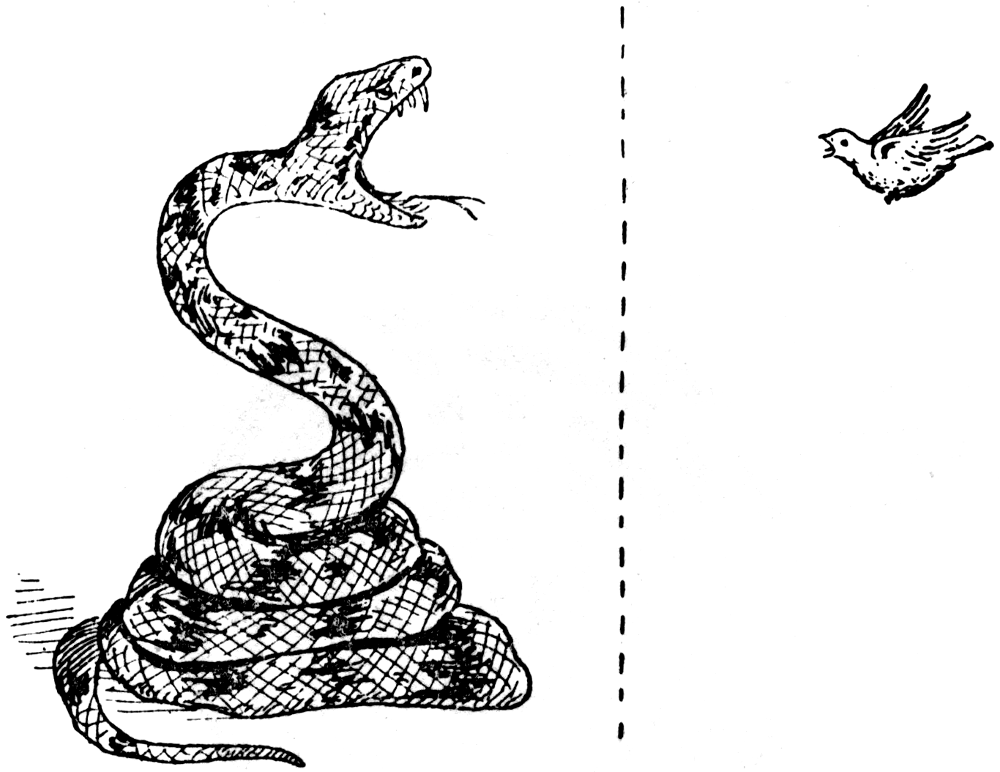
No. I.—SWALLOWED!
Take a small card and place it on its longer edge upon the dotted line. Now set the picture in a good light on the table, and let your head drop gradually towards the card until you almost touch it with your nose. You will see the bird fly into the jaws of the snake!
AMUSING PROBLEMS
THE CARPENTER’S PUZZLE
1. A carpenter was called in to mend a hole in a wooden floor. The gap was two feet wide, and twelve feet long, while the only board at hand was three feet wide, and eight feet long.

This had been put aside as useless, but, on catching sight of it, the carpenter ran his rule over it and said that he could make a perfect fit, and cover all the hole by cutting the board into two pieces. How did he do this?
Solution
No. II.—AN ILLUSION OF ROTATION
This most interesting optical illusion was devised by Professor Thompson some years ago:—
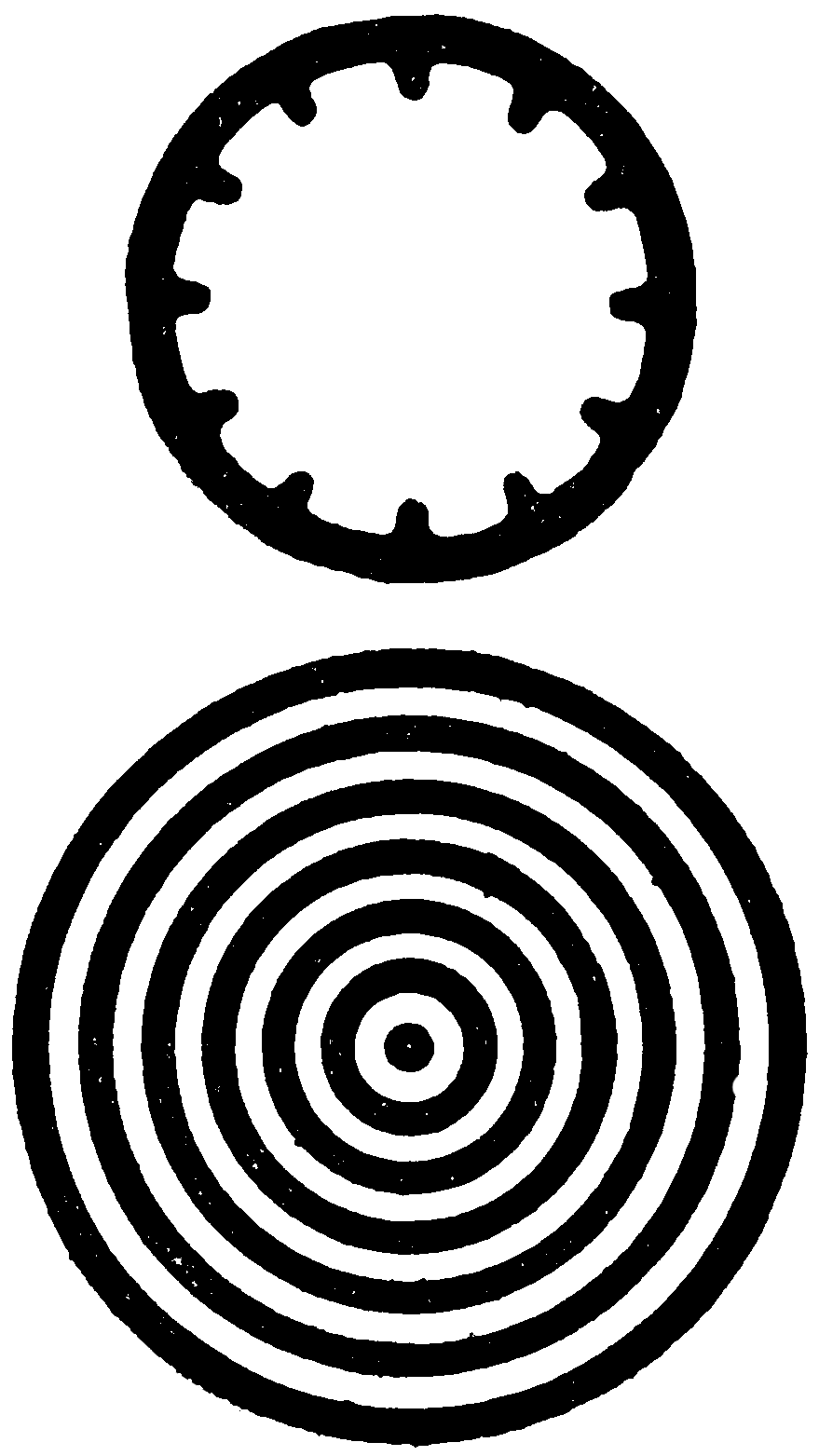
If the illustration is moved by hand in a small circle on the level, with such motion as is given in rinsing out a bowl, the circles of the larger diagram will seem to revolve in the direction in which the paper is moved, while the cogs of the smaller diagram will apparently turn slowly in the opposite direction.
No. III.—WHIRLING WHEELS
Here is another combination of the clever illusion of the whirling wheels.
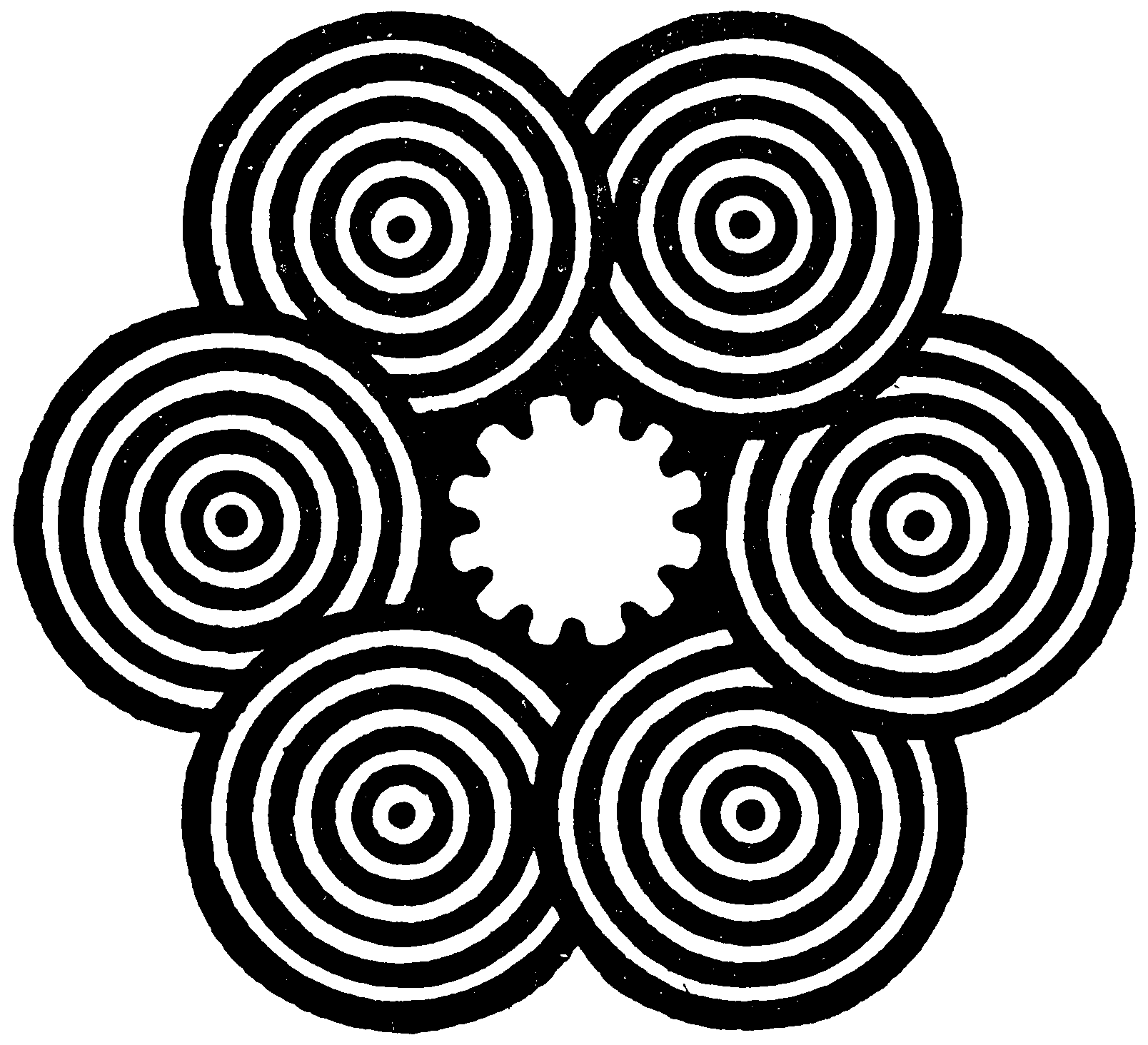
If a rapid rotating motion is given to the diagram, each circle will seem to revolve, and the cog wheel in the centre will appear to move slowly round in the opposite direction.
GOLDEN PIPPINS
2. A man leaves an orchard of forty choice apple trees to his ten sons. On the first tree is one apple, on the second there are two, on the third three, and so on to the fortieth, on which there are forty.
Each son is to have four of the trees, and on them an equal number of the apples. How can they thus apportion the trees, and how many apples will each son have? Here is one way:—
1 2 3 4 5 6 7 8 9 10
20 19 18 17 16 15 14 13 12 11
21 22 23 24 25 26 27 28 29 30
40 39 38 37 36 35 34 33 32 31
82 82 82 82 82 82 82 82 82 82
Can you find another perfect solution?
Solution
No. IV.—AN ILLUSION OF MOTION
We call very particular attention to this fascinating illustration of the fact that the mind and eye may receive and register false impressions under quite simple conditions:—
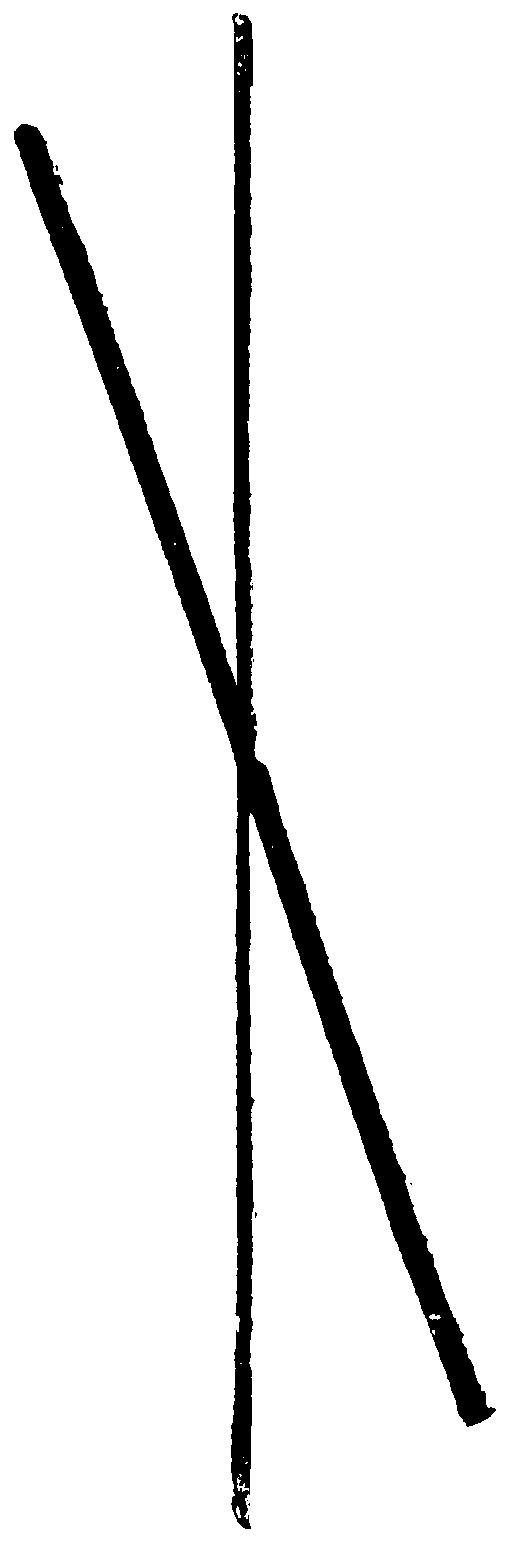
Hold this at rather more than reading distance, upright, and move it steadily up and down. The dark line will soon seem to slide up and down upon the perpendicular line. It will be better seen if drawn to pattern on a card.
No. V.—ARE THEY PARALLEL?
As the eye falls upon the principal lines of this interesting diagram, an immediate impression is formed that they are not parallel.
This, however, is a most curious illusion, created in the mind entirely by the short sloping lines, as is found at once by the simple test of measurement.
AN AWKWARD FIX
3. With no knowledge of the surrounding district, I was making my way to a distant town through country roads, guided by the successive sign-posts that were provided.
Coming presently to four cross-roads I found to my dismay that some one had in mischief uprooted the sign-post and thrown it into the ditch. In this perplexing fix how could I find my way? A bright thought struck me. What was it?
Solution
LINKED SWEETNESS LONG DRAWN OUT
4. As I stood on the platform at a quiet country station, an engine, coming along from my left at thirty miles an hour, began to whistle when still a mile away from me. The shrill sound continued until the engine had passed a mile and a half to my right. For how long was I hearing its whistle?
Solution
No. VI.—ILLUSION OF LENGTH
In this curious optical illusion the lines are exactly equal in length.
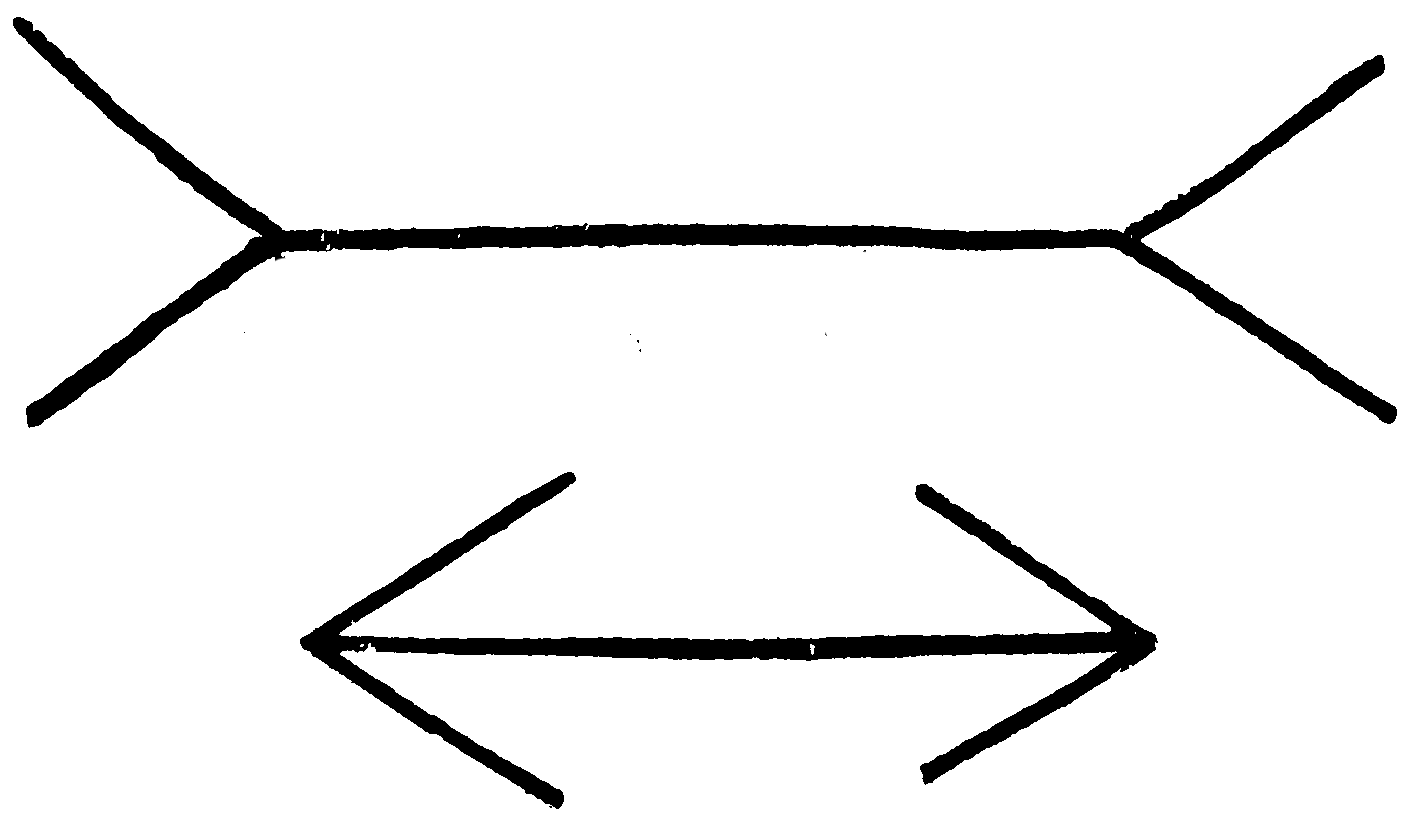
The eye is misled by the effect which the lines drawn outward and inward at their ends produce upon the mind and sight.
ELASTIC QUARTERS
5.
In room marked A two men were placed, A third he lodged in B; The fourth to C was next assigned, The fifth was sent to D. In E the sixth was tucked away, F held the seventh man; For eighth and ninth were G and H, Then back to A he ran. Thence taking one, the tenth and last, He lodged him safe in I; Thus in nine rooms ten men found place, Now can you tell me why?
Solution
EXCLUDED DAYS
6. Are there any particular days of the week with which no new century can begin?
Solution
No. VII.—ILLUSION OF HEIGHT
These straight lines, at right angles to each other, are, though they do not seem to be, exactly equal in length.
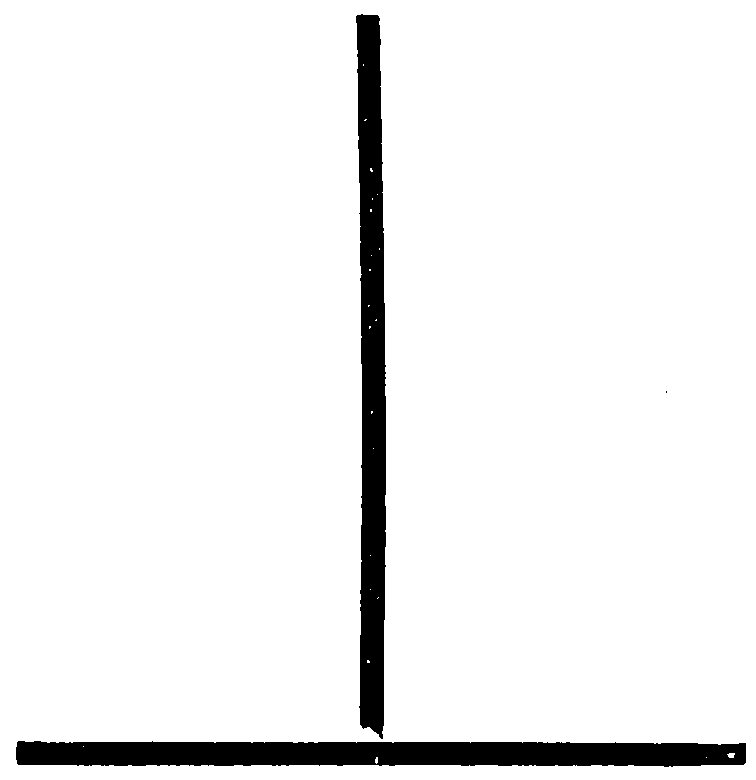
This and similar illusions are probably due to the variation of the vague mental standard which we unconsciously employ, and to the fact that the mind cannot form and adhere to a definite scale of measurement.
DRIVING POWER
7. Why has a spliced cricket bat such good driving power? and why is the “follow through” of the head of a golf club so telling in a driving stroke?
Solution
THE BUSY BOOKWORM
8. On my bookshelf in proper order stand two volumes. Each is two inches thick over all, and each cover is an eighth of an inch in thickness. How far would a bookworm have to bore in order to penetrate from the first page of Vol. I. to the last page of Vol. II.?
Solution
No. VIII.—ILLUSION OF DIRECTION
Can you decide at a glance which of the two lines below the thick band is a continuation of the line above it?
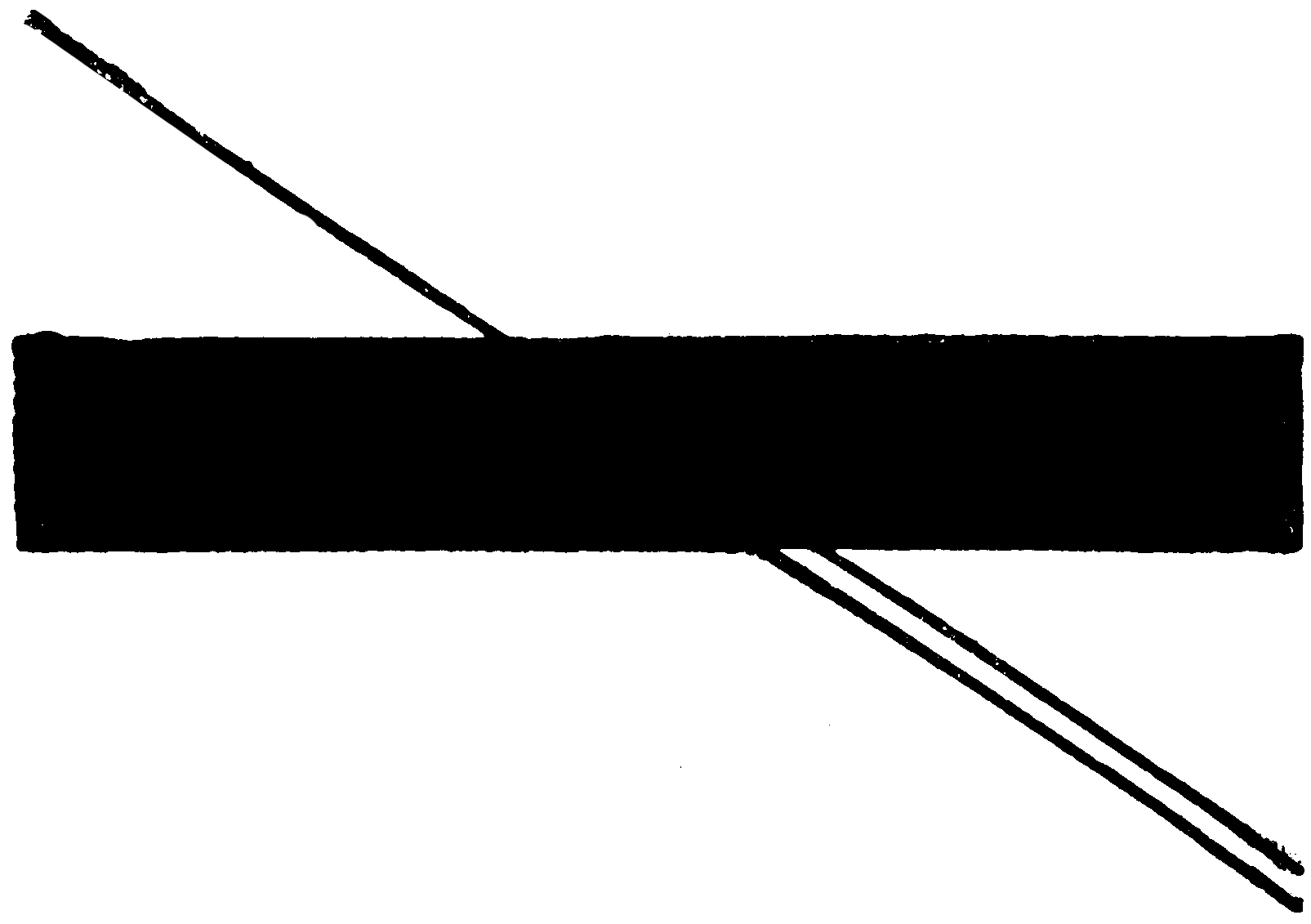
Make up your mind quickly, and then test your decision with a straight edge.
A TERRIBLE TUMBLE
9. From what height must a man fall out of an airship—screaming as he goes overboard—so as to reach the earth before the sound of his cry?
N.B.—Resistance of the air, and the acoustical fact that sound will not travel from a rare to a dense atmosphere, are to be disregarded.
Solution
IN A PREDICAMENT
10. Imagine a man on a perfectly smooth table surface of considerable size, in a vacuum, where there is no outside force to move him, and there is no friction. He may raise himself up and down, slide his feet about, double himself up, wave his arms, but his centre of gravity will be always vertically above the same point of the surface.
How could he escape from this predicament, if it was a possible one?
Solution
No. IX.—THINGS ARE NOT WHAT THEY SEEM
It is difficult, even after measurement, to believe that these figures are of the same size.
But they will stand the test of measurement.
A CLIMBING MONKEY
11. A rope passes over a single fixed pulley. A monkey clings to one end of the rope, and on the other end hangs a weight exactly as heavy as the monkey. The monkey presently starts to climb up the rope. Will he succeed?
Solution
GAINING GROUND
12. Seeing that the tension on a pair of traces tends as much to pull the horse backward as it does to pull the carriage forward, why do the traces move on at all?
Solution
No. X.—THE SHIFTING BRICK
A very curious and interesting form of optical illusion is well illustrated by what may be called “the shifting brick.”
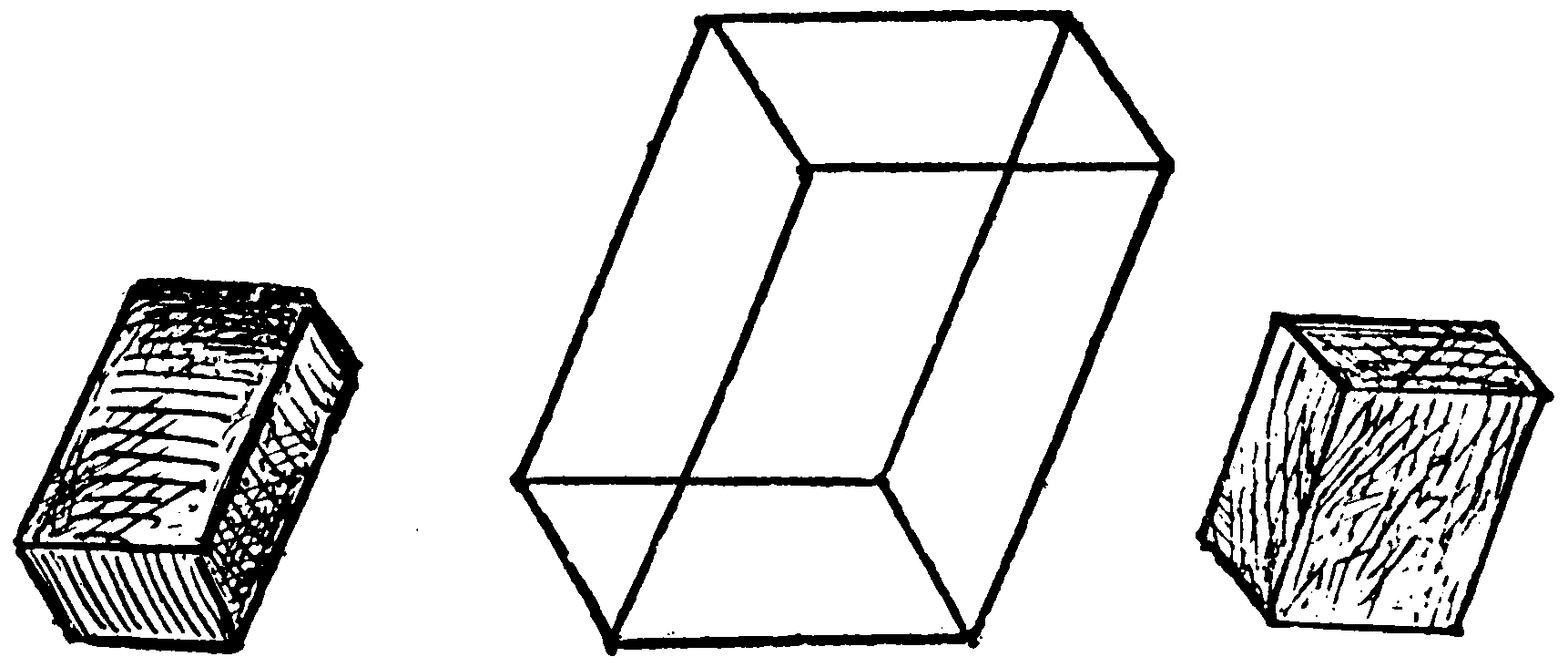
The central brick, drawn to show all its edges, as though it were made of glass, will assume the form indicated by one or other of the smaller bricks at its right and left, according to the way in which the eyes accommodate themselves for the moment to one pattern or to the other. If you do not see this at first, look steadily for awhile at the pattern you desire.
ASK A CYCLIST
13. Why does a rubber tyre leave a double rut in dust, and a single one in mud?
Solution
TODHUNTER’S UNIQUE PUZZLE PROBLEM
14. If two cats, on opposite sides of a sharply sloping roof, are on the point of slipping off, which will hold on the longest?
Solution
No. XI.—AN ILLUSION WITH COINS
If you place four coins in the positions shown at the top of this diagram, and attempt, or challenge some one to attempt, without any measuring, to move the single coin down in a straight line until the spaces from C to D on either side exactly equal the distance from A to B—
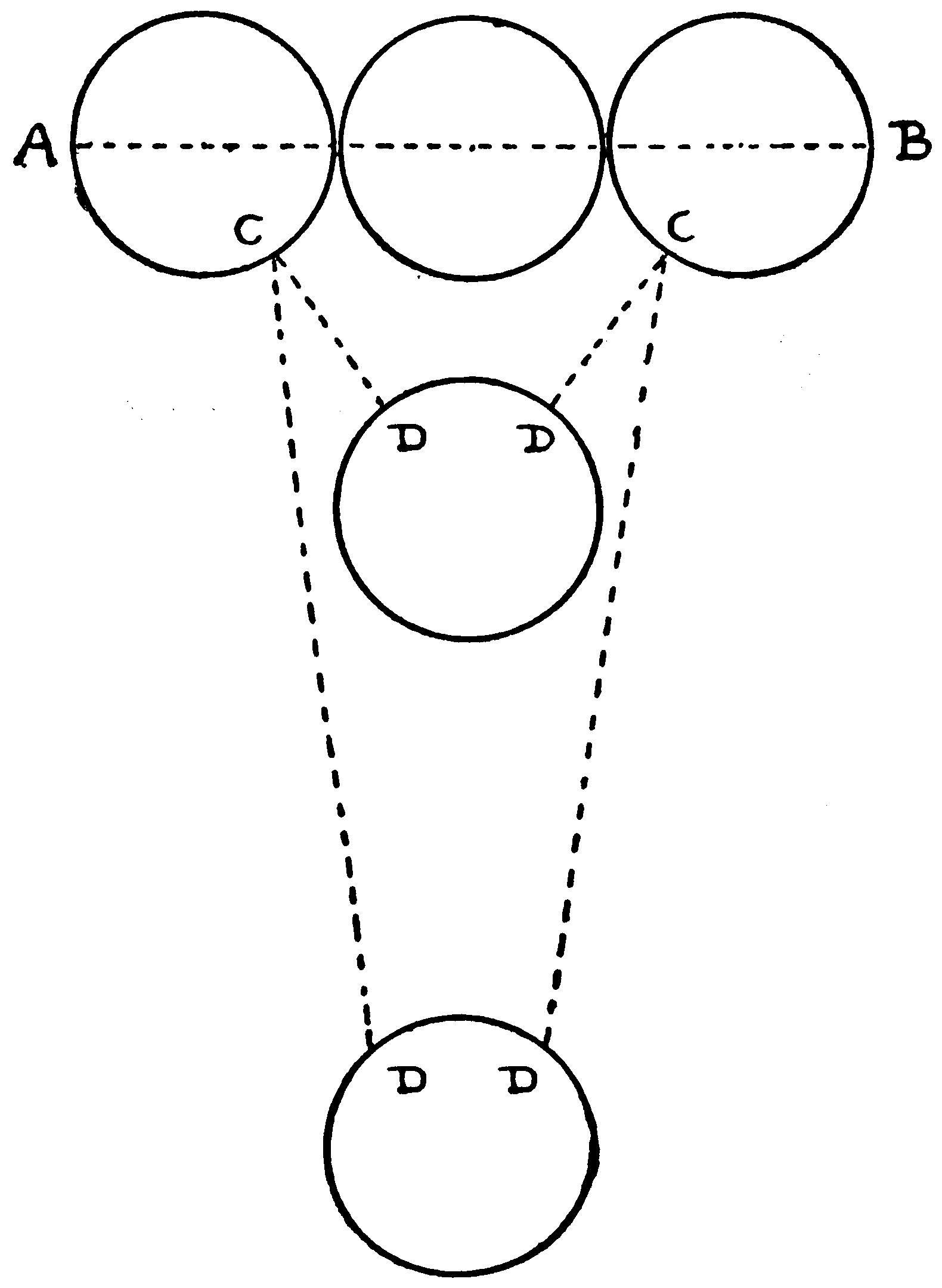
It must drop as far as is shown here, which seems to the unaided eye to be too far.
This excellent illusion can be shown as an after-dinner trick with four napkin-rings.
No. XII.—THE FICKLE BARREL
Here is another excellent optical illusion. Look attentively at the diagram below, and notice in which direction you apparently look into it, as though it were an open cask.
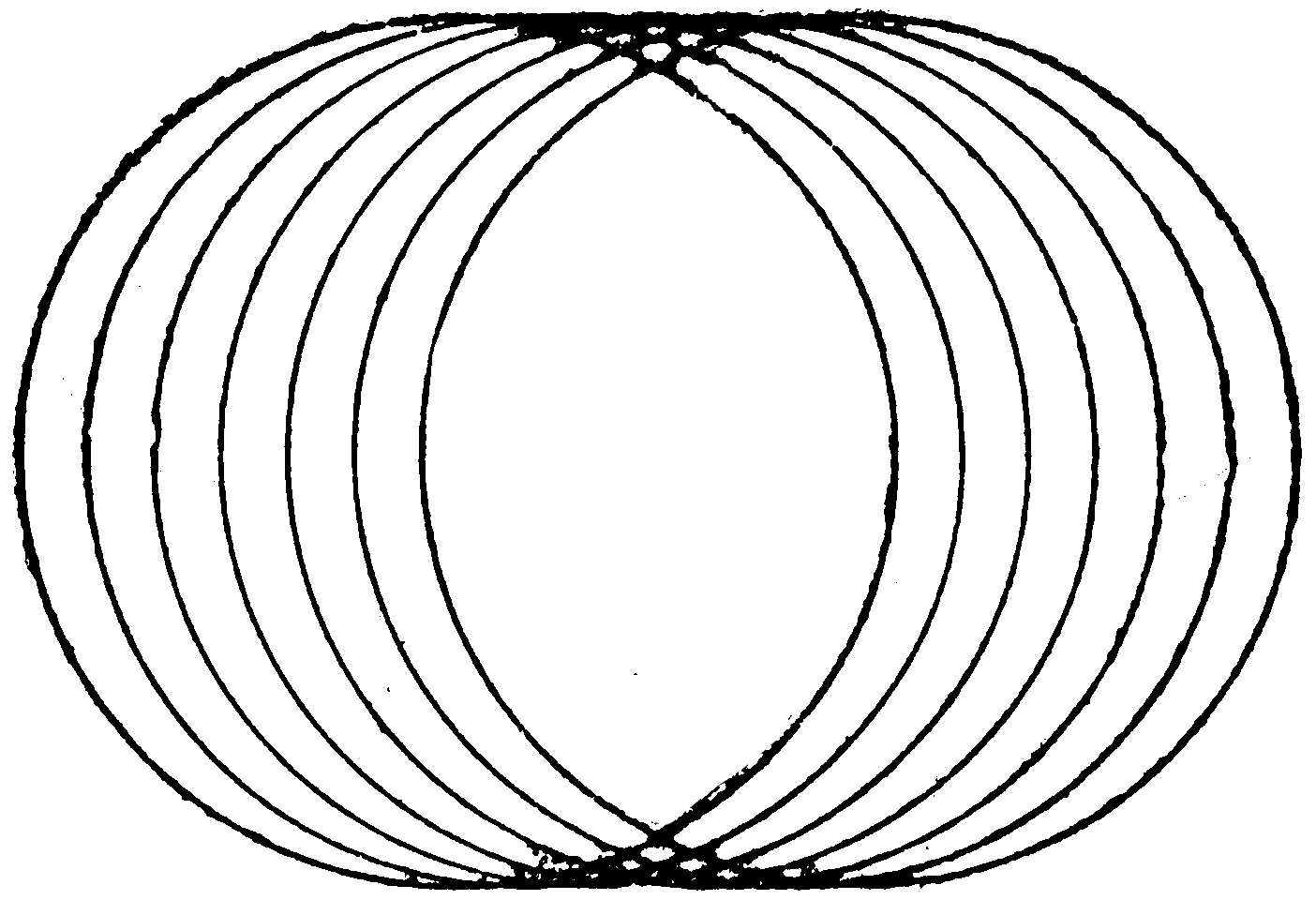
Now shake the paper, or move it slightly, and you will find, more often than not, that you seem to see into it in quite the opposite direction.
HEADS I WIN!
15. I hold a penny level between my finger and thumb, and presently let it fall from the thumb by withdrawing my finger. It makes exactly a half-turn in falling through the first foot. If it starts “heads,” how far must it fall to bring it “heads” to the floor?
Solution
HE DID IT!
16. “They call these safety matches,” said Funnyboy at his club one day, “and say that they strike only on the box. Don’t believe it! I can strike them quite easily on my boot.”
No sooner said than done. He took out a match, struck it on his boot, and—phiz!—it was instantly alight. The box was handed round, and match after match was struck by the bystanders on their boots, but not one of them could succeed.
“You don’t give the magic touch,” said Funnyboy, as he gaily struck another. How did he do it?
Solution
No. XIII.—A STRANGE OPTICAL ILLUSION
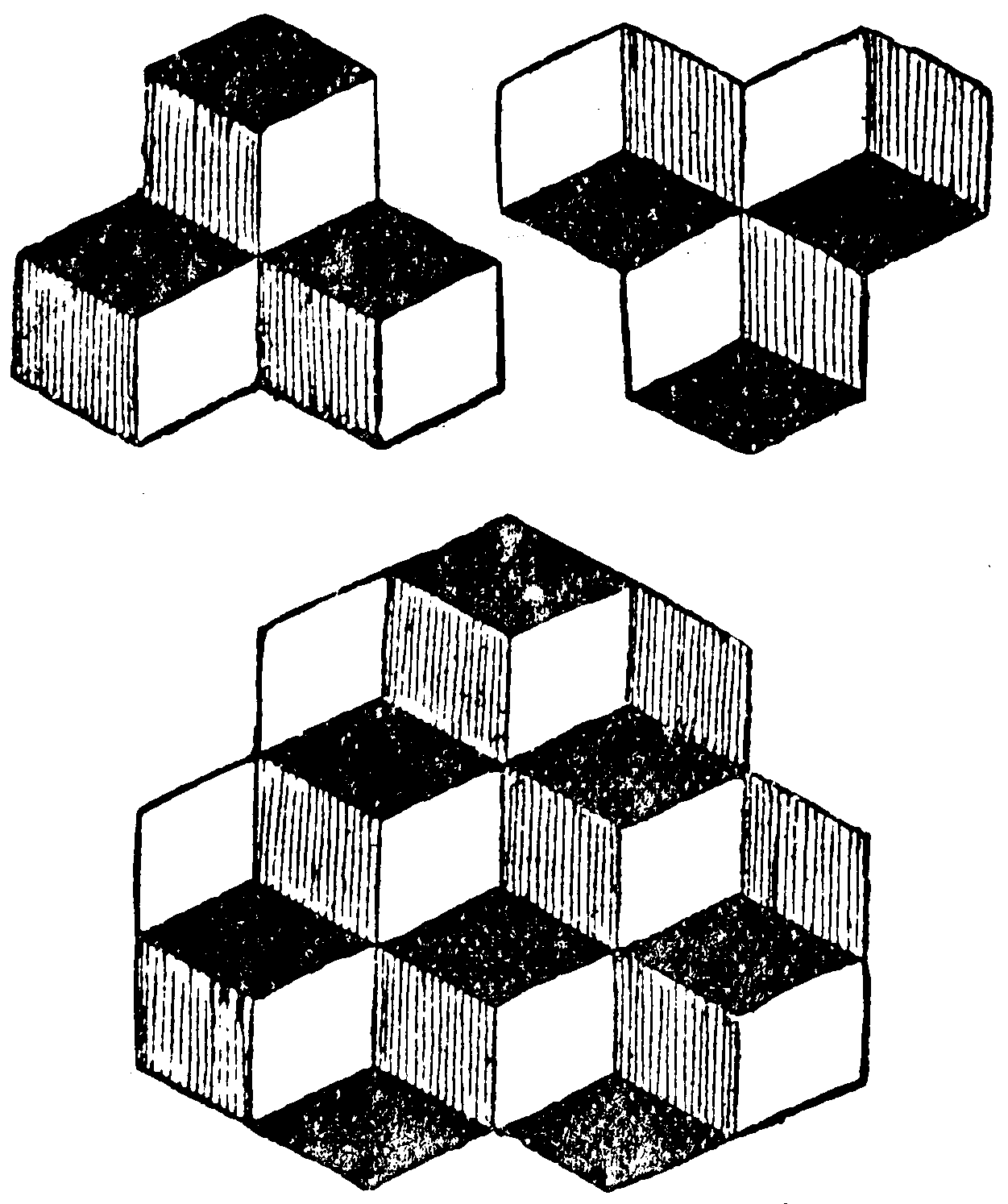
How many cubes can you see as you look at the large diagram? The two smaller ones should be looked at first alternately, and they will assist the eye to see at one time six, and at another time seven, very distinct cubes.
No. XIV.—A CIRCULAR ILLUSION
This curious optical illusion is not easily followed by eye to the finish of the several lines.
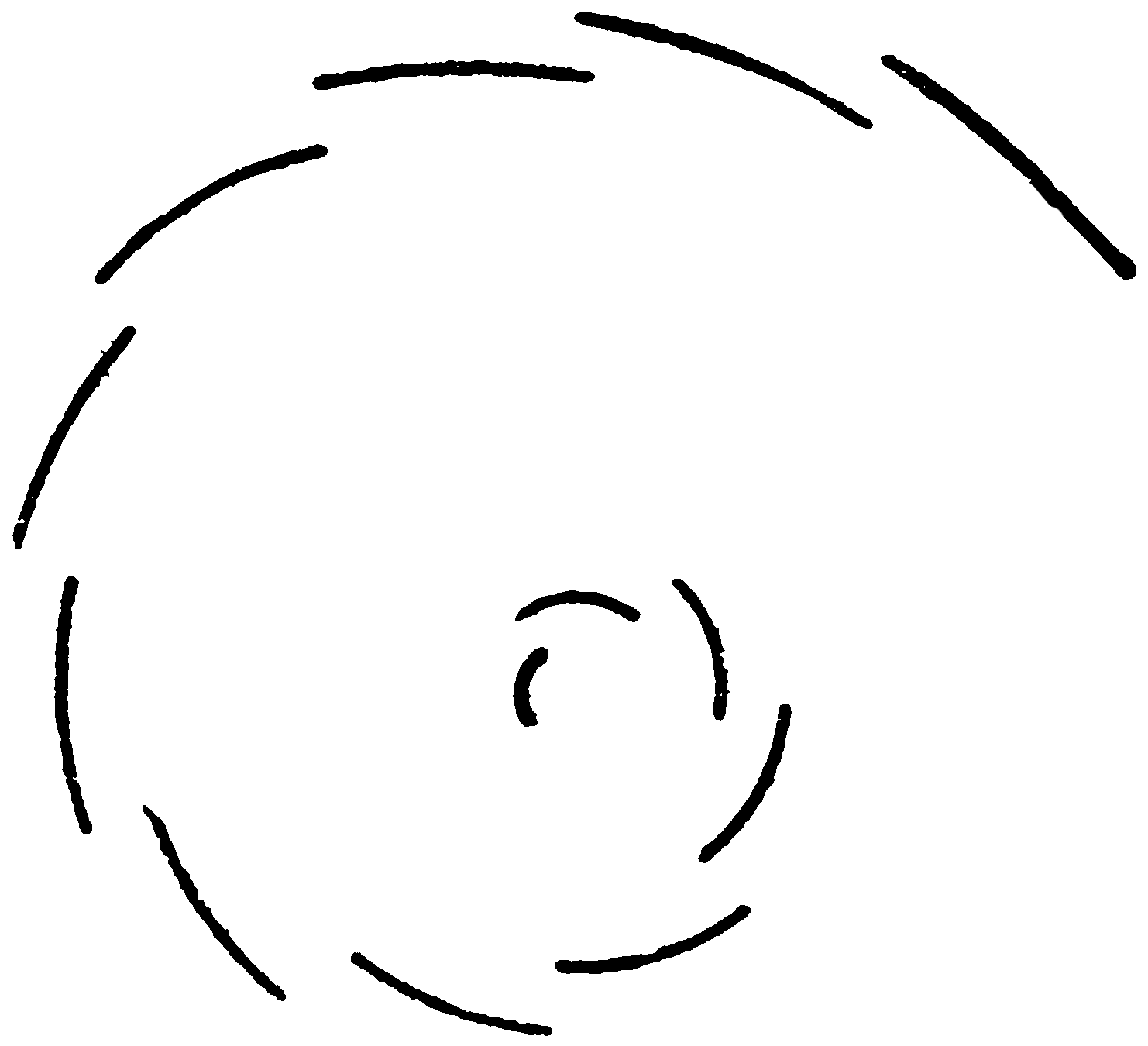
Each short line is, in fact, part of the circumference of a circle, and the circles when completed will be found to be accurately concentric. It would seem at first sight that the lines are taking courses which would eventually meet at some point common to them all.
A CYCLE SURPRISE
17. We commend this curious point to the special attention of cyclists:—
A bicycle is stationary, with one pedal at its lowest point. If this bicycle is lightly supported, and the bottom pedal is pulled backward, what will happen?
Solution
No. XV.—THE GHOST OF A COIN
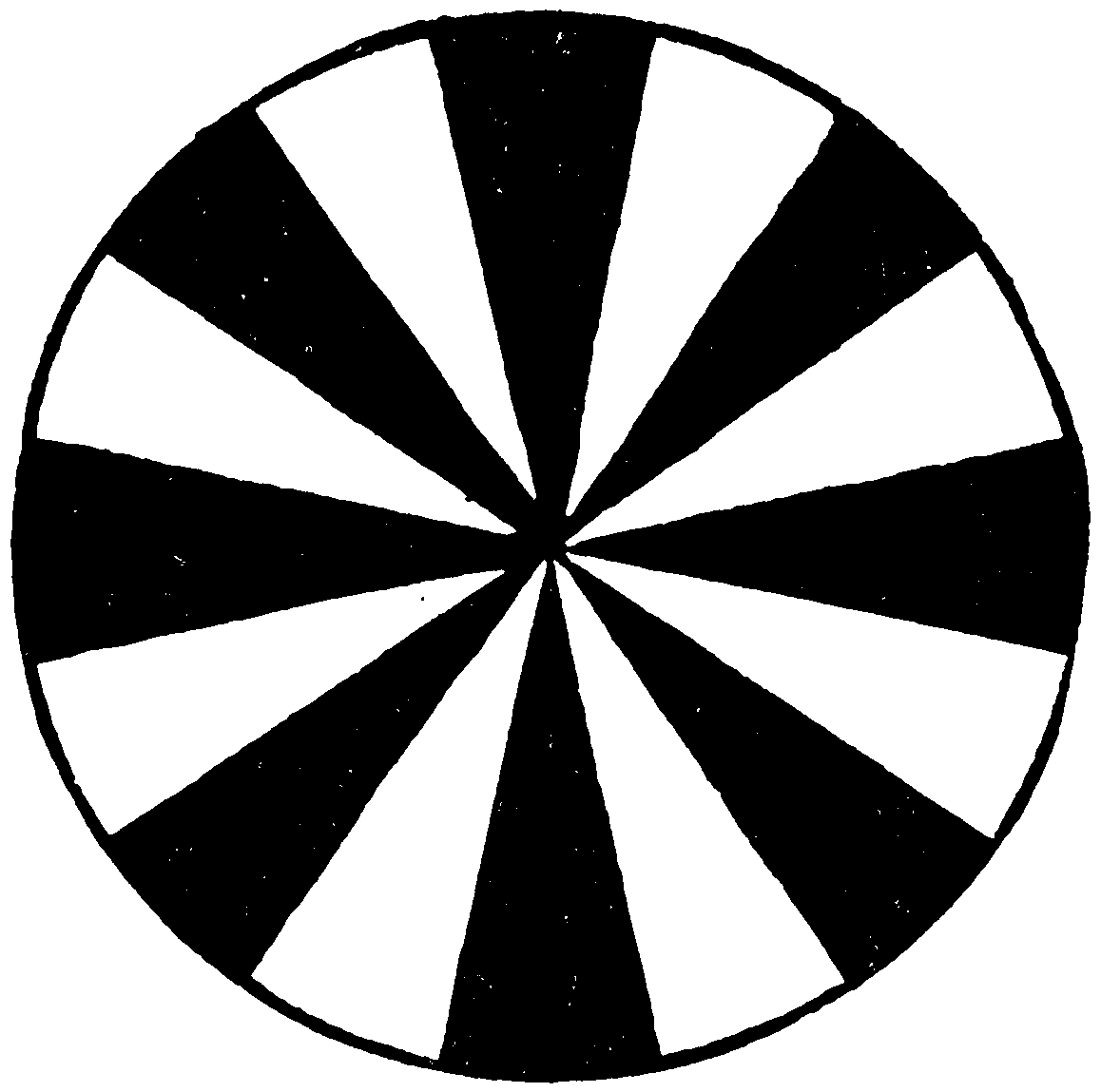
A most remarkable optical illusion is produced by the blending of the dark and light converging rays of this diagram. Stand with your back to the light, hold the page, or better still, the diagram copied on a card, by the lower right-hand corner, give it a continuous revolving movement in either direction, and the visible ghost of a silver coin, sometimes as large as sixpence, sometimes as large as a shilling, will appear! Where can it come from?
ROUGH AND READY
18. A merchant has a large pair of scales, but he has lost his weights, and cannot at the moment replace them. A neighbour sends him six rough stones, assuring him that with them he can weigh any number of pounds, from 1 to 364. What did each stone weigh?
Solution
No. XVI.—A TAME GOOSE
Here is a pretty form of our first illusion:—
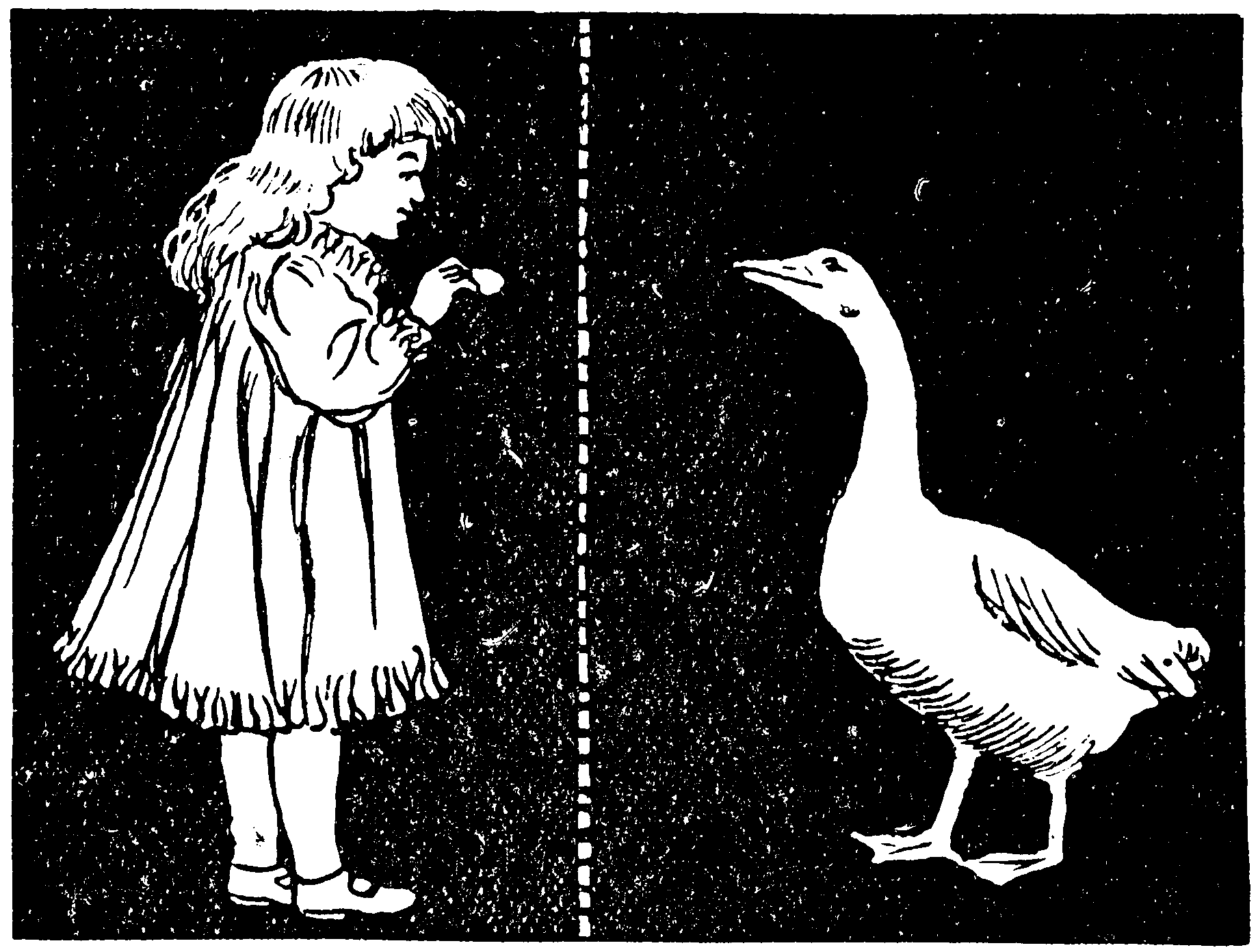
Place the edge of a card on the dotted line, look down upon it in a good light, and, as you drop your face till it almost touches the card, you will see the goose move towards the sugar in the little maiden’s hand.
REJECTED ADDRESSES
19. A wheel is running along a level road, and a small clot of mud is thrown from the hindermost part of the rim. What happens to it? Does it ever renew its acquaintance with the wheel that has thus rejected it?
Solution
No. XVII.—ILLUSION OF LENGTH
Here is another method by which an optical illusion of length is very plainly shown:—
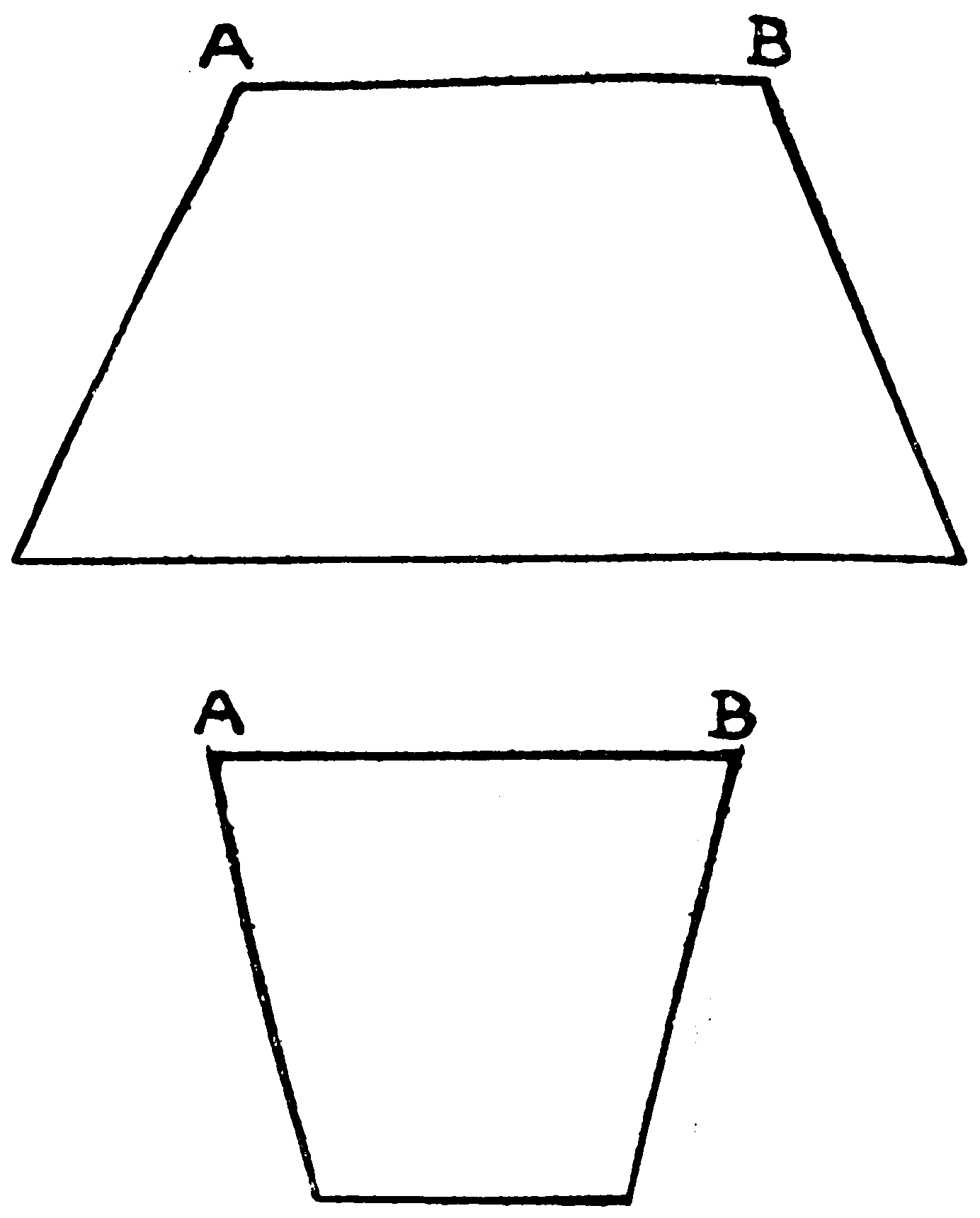
Judged by appearances, the line A B in the larger figure is considerably longer than the line A B below it, but tested by measurement they are exactly equal.
THE CARELESS CARPENTER
20. A village carpenter undertook to make a cupboard door. When he began to put it in its place it was too big, so he took it back to his workshop to alter it. Unfortunately he now cut it too little. What could he do? He determined to cut it again, and it at once became a good fit. How was this done?
Solution
No. XVIII.—PERPENDICULAR LINES
Here is another excellent illustration that seeing is not always believing.
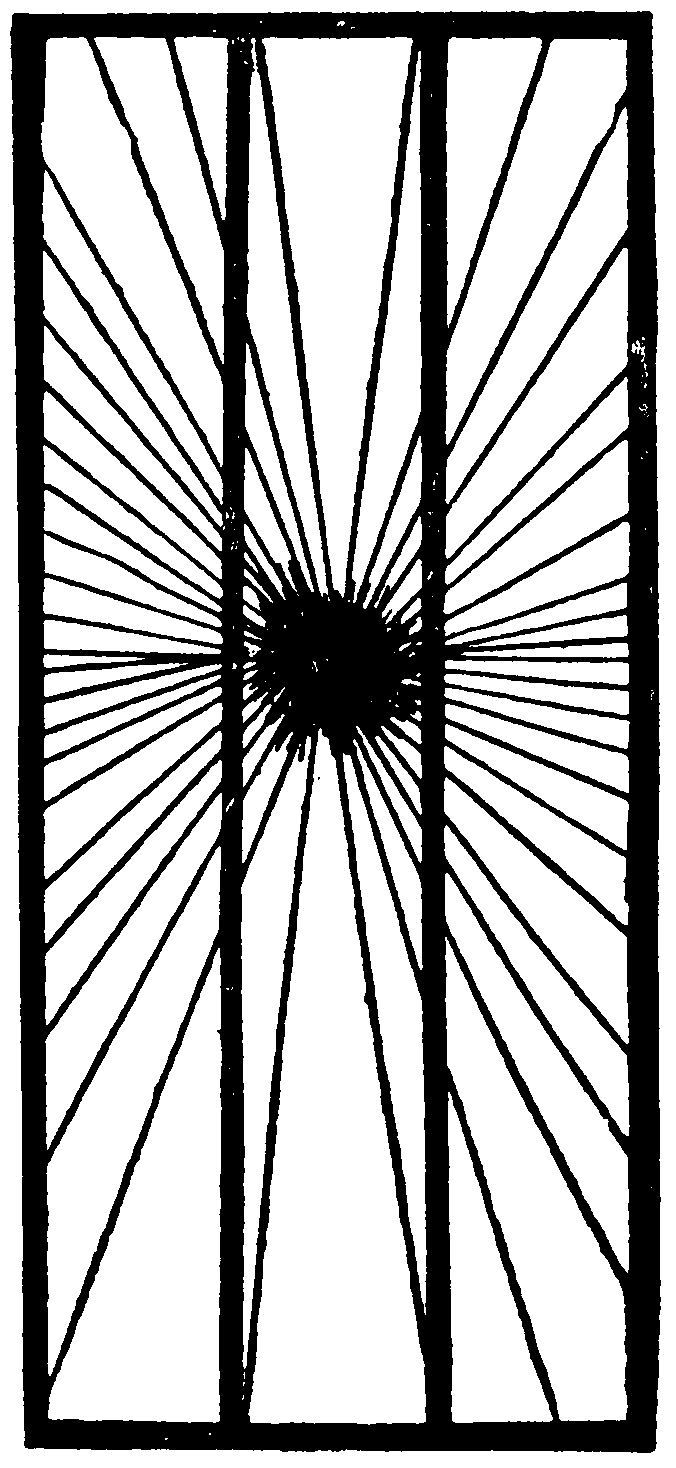
No one could suppose at first sight that these four lines are perfectly straight and parallel, but they will stand the test of a straight edge. The divergent rays distract the vision.
BY THE COMPASS
21. If from the North Pole you start sailing in a south-westerly direction, and keep a straight course for twenty miles, to what point of the compass must you steer to get back as quickly as possible to the Pole?
Solution
No. XIX.—ILLUSION OF PERSPECTIVE
The optical illusion in the picture which we reproduce is due to the defective drawing of the two men on the platform. In actual size upon the paper the further man looks much taller than the other.
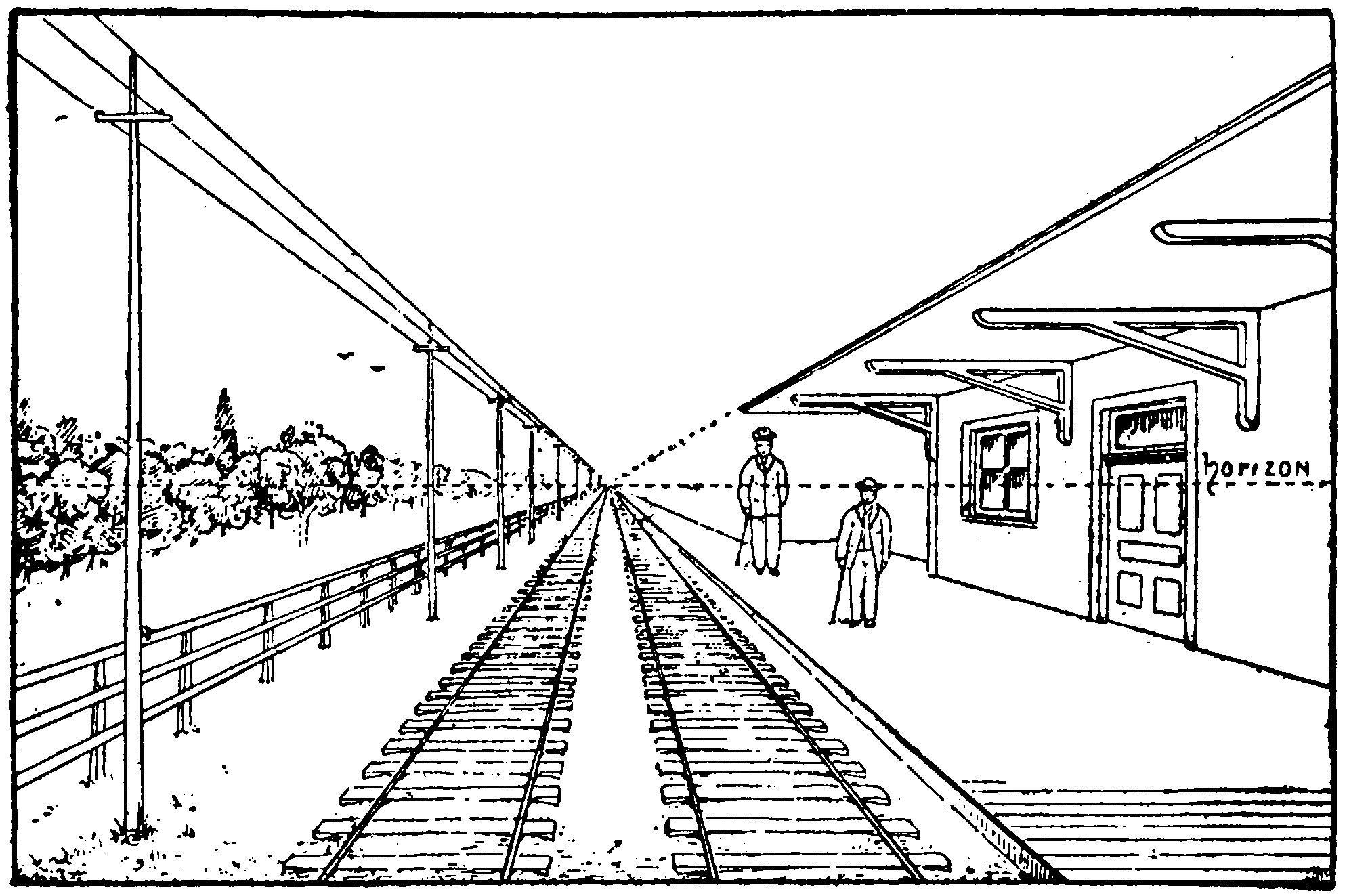
Measurement, however, shows the figures to be exactly of a height. This illusion is due to the fact that the head of the further man is quite out of perspective. If he is about as tall as the other, and on level ground, both heads should be about on the same line. As drawn, he is, in fact, a monster more than eight feet high.
DICK IN A SWING
22. If Dick, who is five feet in height, stands bolt-upright in a swing, the ropes of which are twenty feet long, how much further in round numbers do his feet travel than his head in describing a semi-circle?
Solution
No. XX.—OUR BLIND SPOT
Here is an excellent and very simple illustration of a well-known optical curiosity:—

Hold this picture at arm’s length in the right hand, hold the left hand over the left eye, and draw the picture towards you gradually, looking always at the black cross with the right eye. The black disc will presently disappear, and then come into sight again as you continue to advance the paper.
A POSER
23. Can you name nine countries in Europe of which the initial letters are the same as the finals?
Solution
FREAKS OF FIGURES
A HANDY SHORT CUT
Here is a delightfully simple way in which market gardeners, or others who buy or sell weighty produce, can check their invoices for potatoes or what not.
Say, for example, that a consignment weighs 6 tons, 10 cwts., 1 qr. Then, since 20 cwts. are to a ton as 20s. are to a pound, and each quarter would answer on these lines to 3d., we can at once write down £6 10s. 3d., as the price at £1 the ton. On this sure basis any further calculation is easily made.
No. XXI.—THE PERSISTENCE OF VISION

HOW TO SEE THE GHOST
Look steadily, in a good light, for thirty seconds at the cross in the eye of the pictured skull; then look up at the wall or ceiling, or look fixedly at a sheet of paper for another thirty seconds, when a ghost-like image of the skull will be developed.
NOT SO FAST!
A gardener, when he had planted 100 trees on a line at intervals of 10 yards, was able to walk from the first of these to the last in a few seconds, for they were set on the circumference of a circle!
No. XXII.—THE PERSISTENCE OF VISION
Here is another example of what is known as the persistence of vision:—
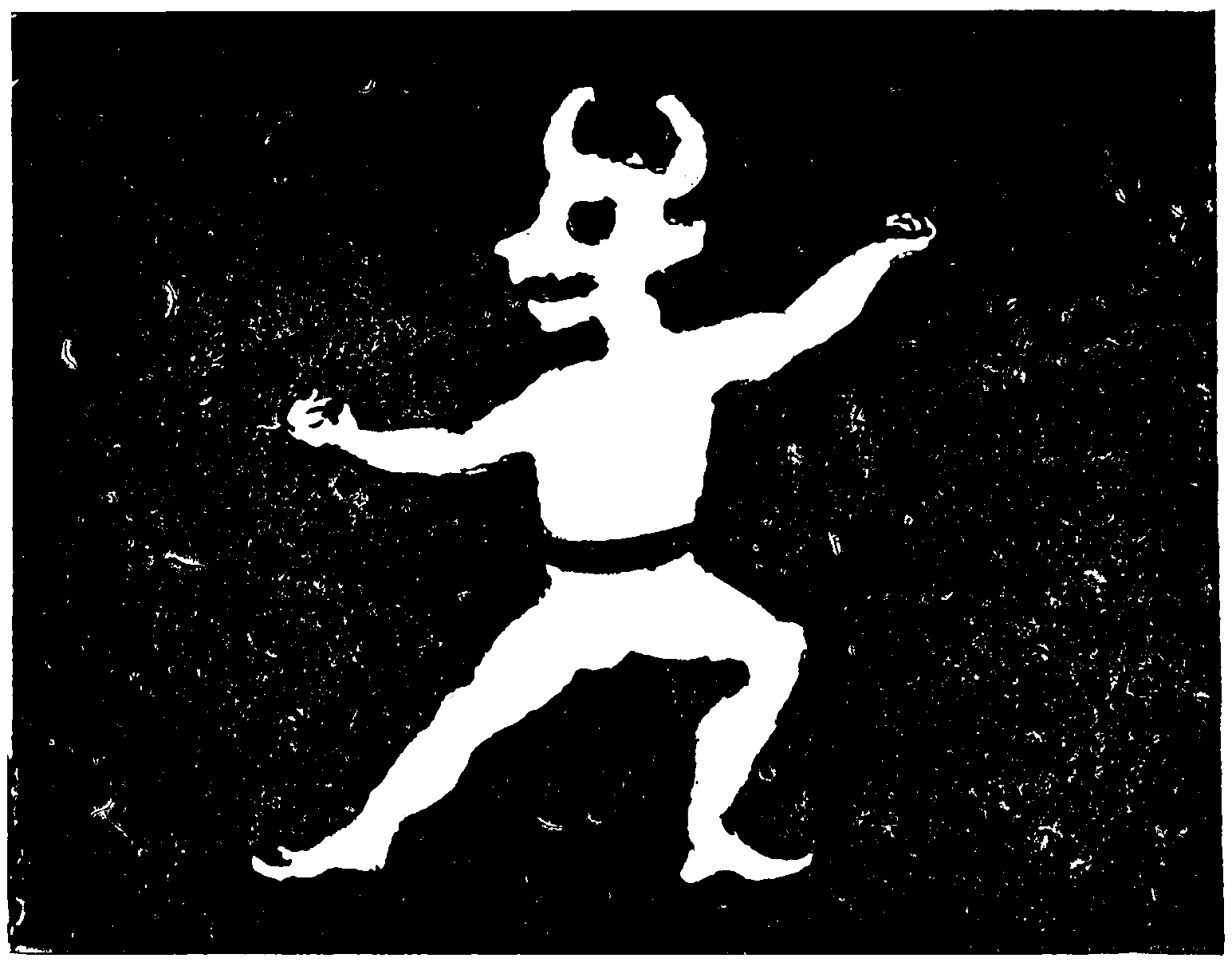
Look fixedly for some little time at this grotesque figure, then turn your eyes to the wall or ceiling, and you will in a few seconds see it appear in dark form upon a light ground.
A PUZZLE NUMBER
The sum of nine figures a number will make, Of which just a third will remain If fifty away from the whole you should take, Thus turning a loss to a gain.
It needs something more than mere arithmetic to discover that the solution to this puzzle is XLV, the sum of the nine digits, for if the L is removed, XV, the third of XLV, remains.
No. XXIII.—ANOTHER PARALLEL FREAK
Here is another curious illusion:—
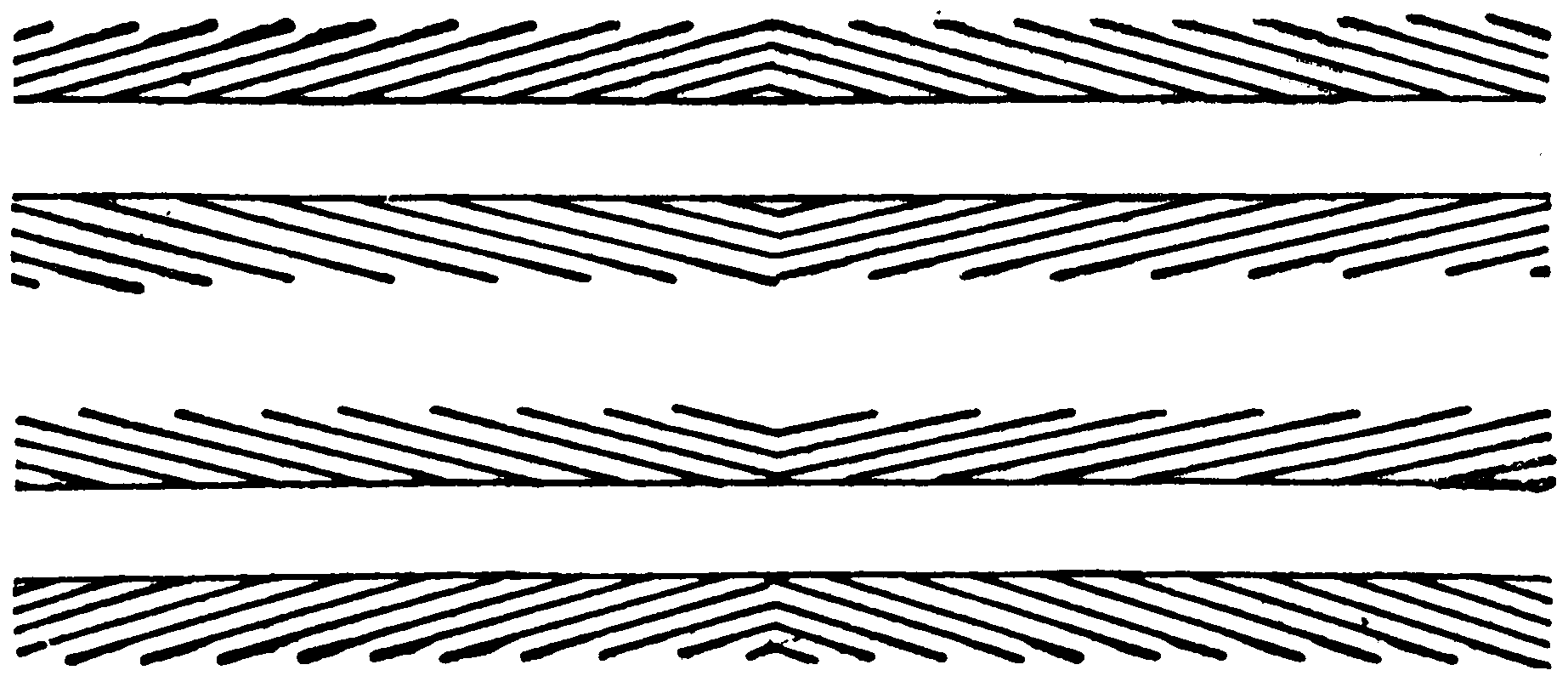
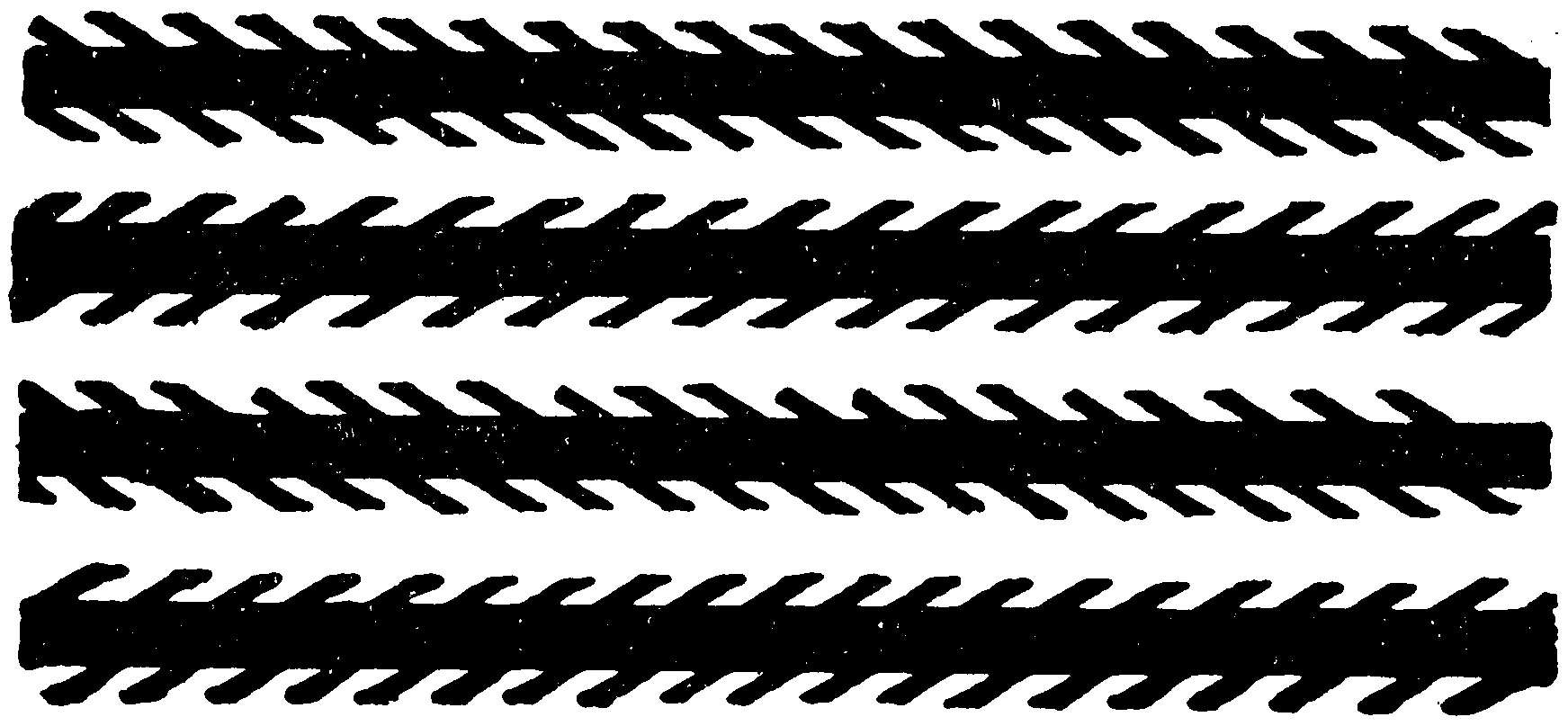
The four straight lines are perfectly parallel, but the contradictory herring-bones disturb the eye.
THE MAGIC OF FIGURES
If our penny had been current coin in the first year of the Christian era, and had been invested at compound interest at five per cent., it would have amounted in 1905 to more than £132,010,000,000,000,000,000,000,000,000,000,000,000.
This gigantic sum would afford an income of £101,890,000,000,000,000,000 every second to every man, woman, and child in the world, if we take its population to be 1,483,000,000 souls!
Absurdly small in contrast to these startling figures is the modest eight shillings which the same penny would have yielded in the same time at simple interest.
No. XXIV.—ILLUSION OF LENGTH
Here in another form is shown the illusion of length.
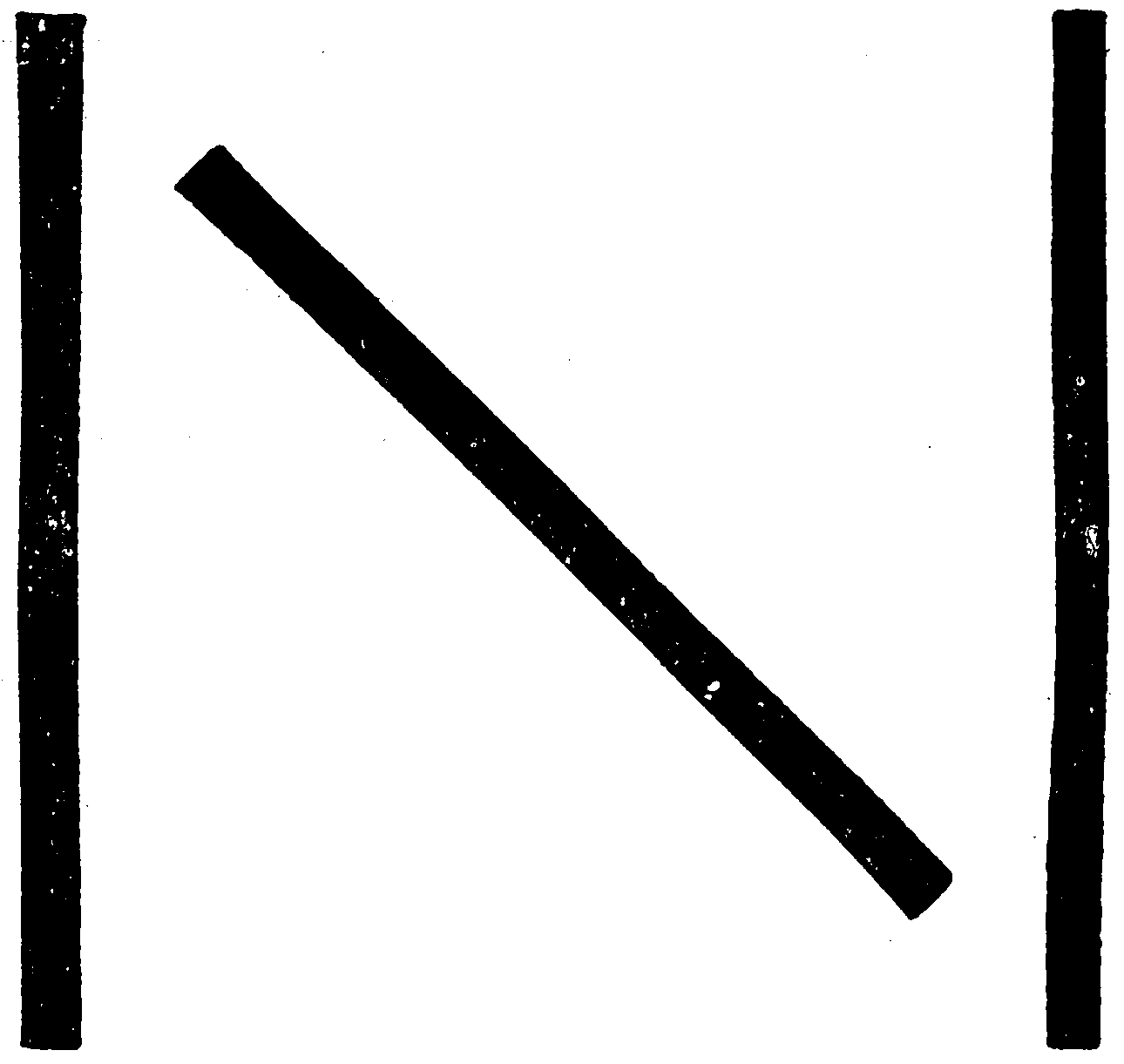
At first sight it seems that the two upright lines are distinctly longer than the line that slopes, but it is not so.
WHAT IS YOUR AGE?
Here is a neat method of discovering the age of a person older than yourself:—
Subtract your own age from 99. Ask your friend to add this remainder to his age, and then to remove the first figure and add it to the last, telling you the result. This will always be the difference of your ages. Thus, if you are 22, and he is 35, 99 - 22 = 77. Then 35 + 77 = 112. The next process turns this into 13, which, added to your age, gives his age, 35.
No. XXV.—THE HONEYCOMB ILLUSION
In this diagram one hundred and twenty-one circular spots are grouped in a diamond.
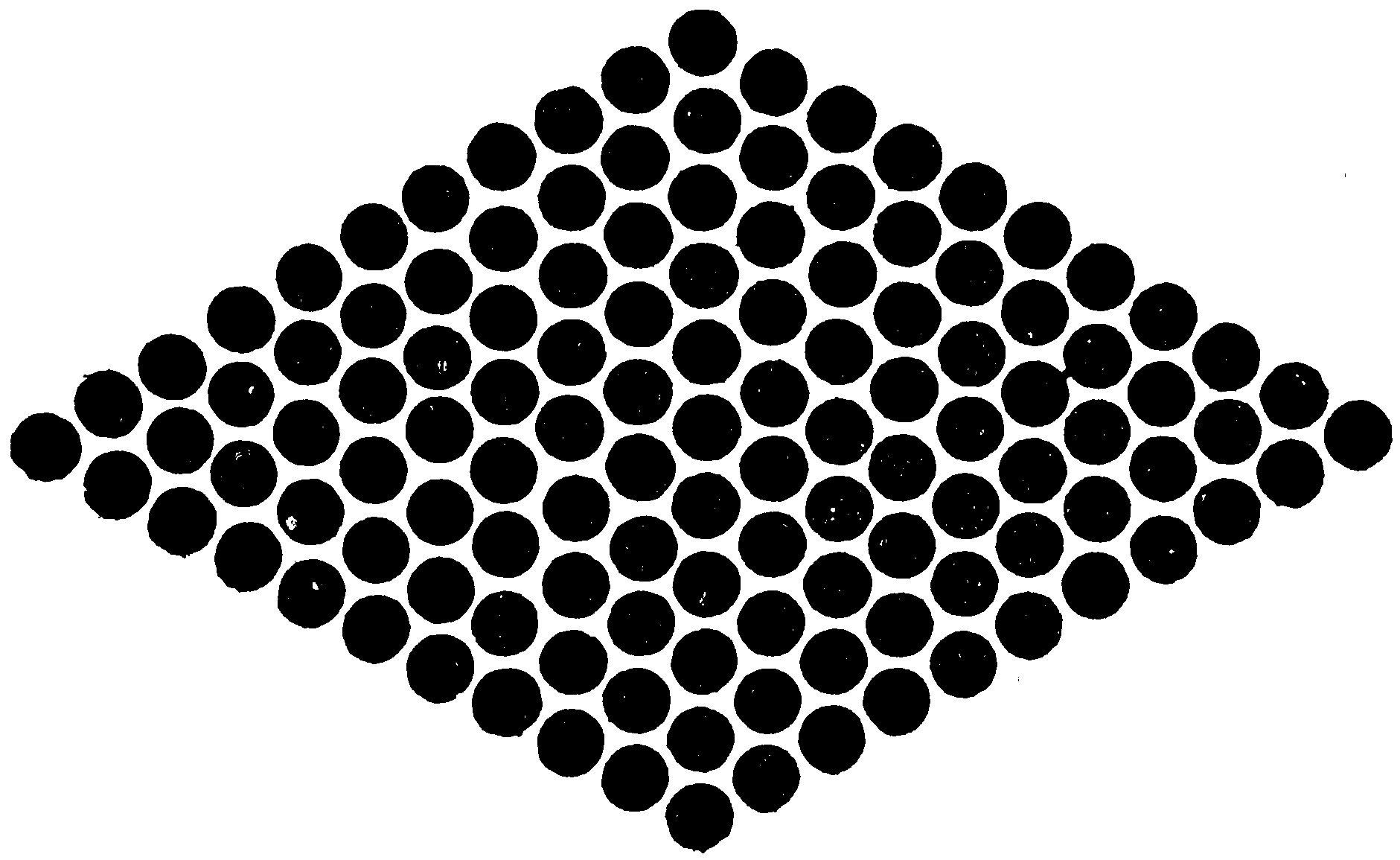
If we half close our eyes, and look at this through our eye-lashes, we find that it takes on the appearance of a section of honeycomb, with hexagonal cells.
MULTIPLICATION NO VEXATION
Here is a ready method for multiplying together any two numbers between 12 and 20.
Take one of the two numbers and add it to the unit digit of the other. Beneath the sum thus obtained, but one place to the right, put the product of the unit digits of the two original numbers.
The sum of these new numbers is the product of the numbers that were chosen. Thus:—
19 × 13. (19 + 3) = 22
(9 × 3) = 27
247
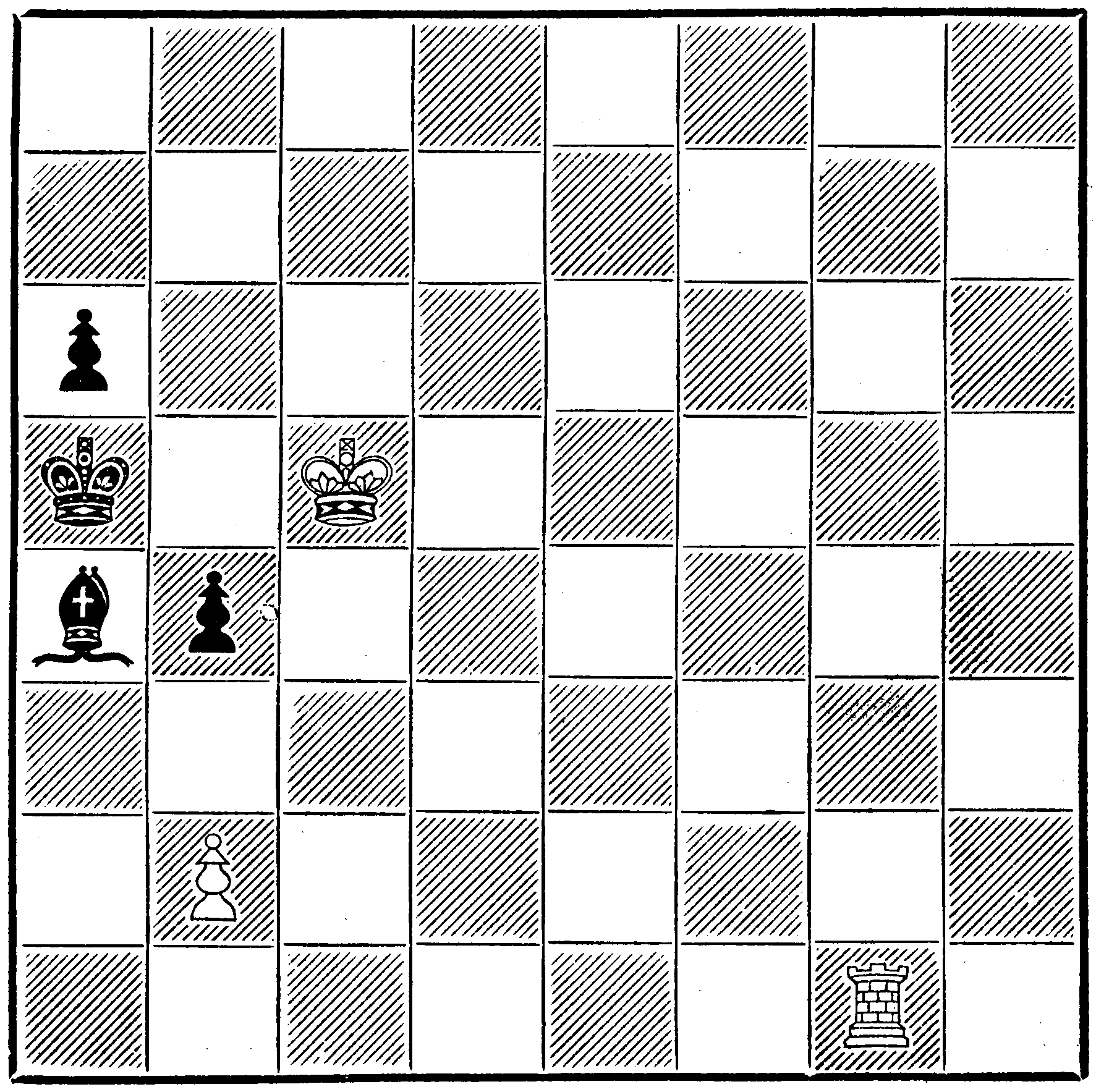
No. XXVI.—CHESS CAMEO By Dr Gold A Chess Joke
BLACK
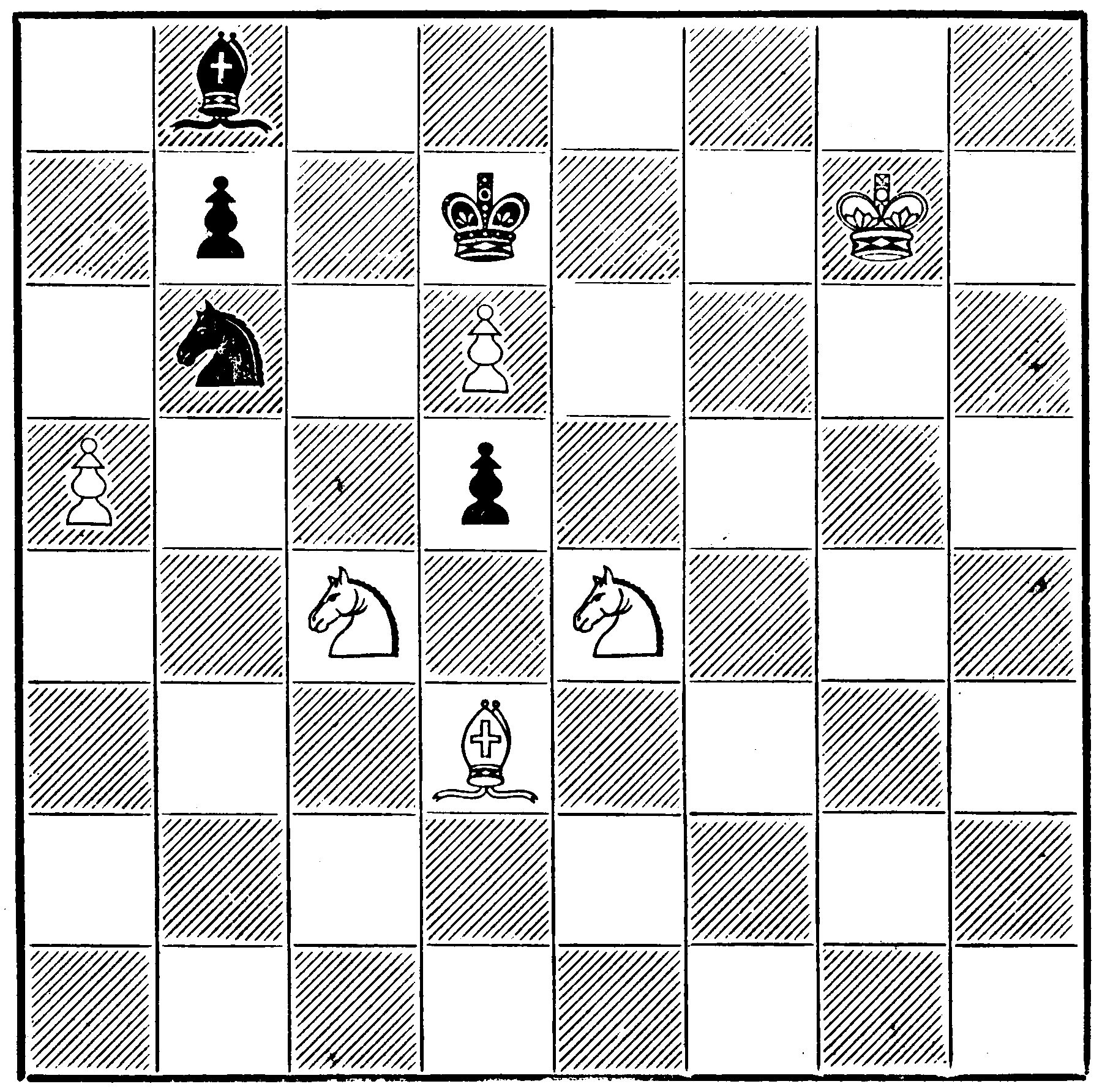
WHITE
Black has made an illegal move. He must replace this, and move his king as the penalty. White then mates on the move.
Solution
[1]SHOT IN A PYRAMID
Here is a method for determining the total number of balls in a solid pyramid built up on a square base:—
Multiply the number of shot on one side of the base line by 2, add 3, multiply by the number on the base line, add 1, multiply again by the number on the base, and finally divide by 6. Thus, if the base line is 12—
12 × 2 + 3 = 27; 27 × 12 + 1 = 325; 325 × 12 = 3900; and 3900 ÷ 6 = 650, which is the required number.
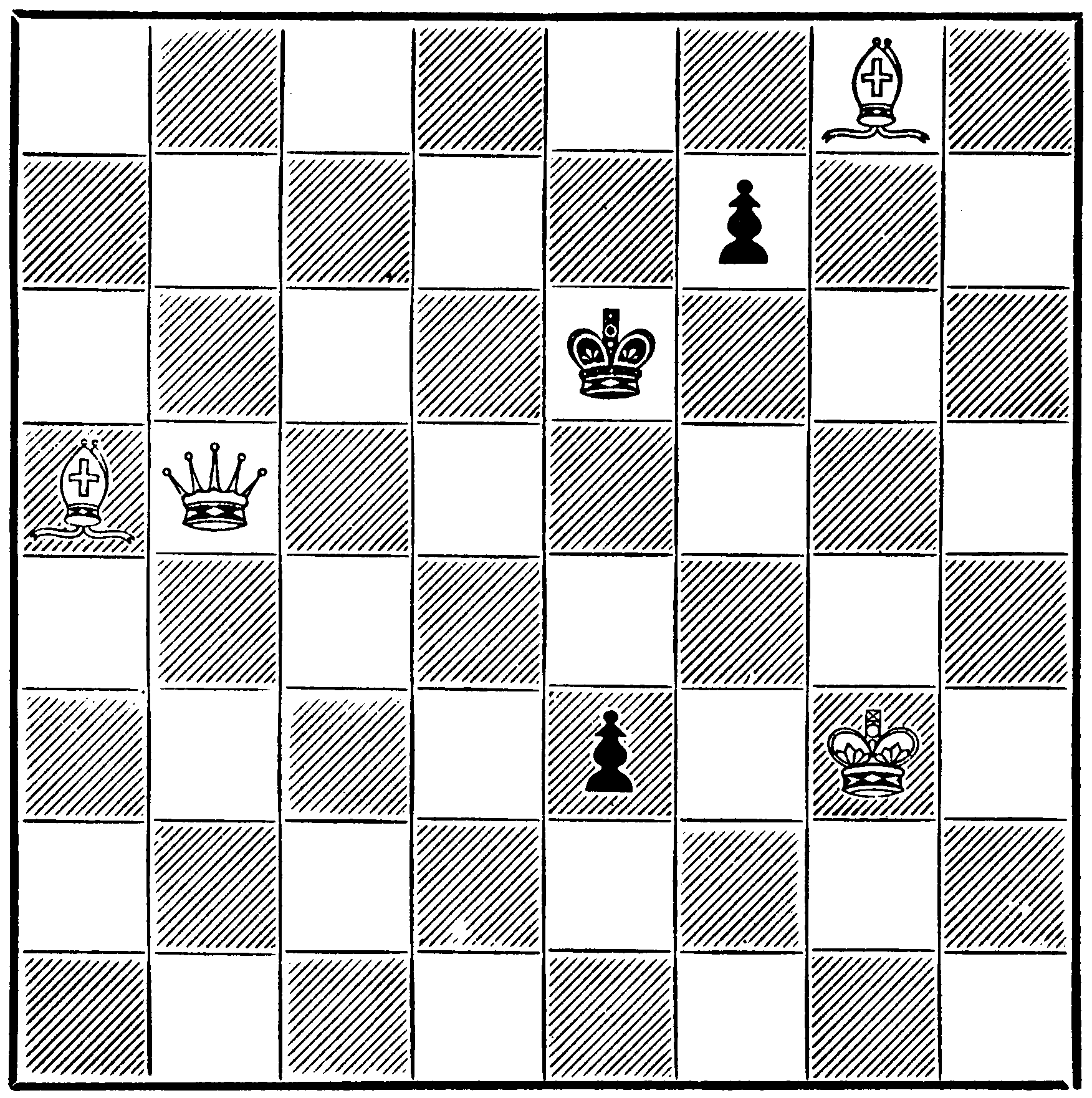
No. XXVII.—CHESS CAMEO By A. Cyril Pearson A Chess Puzzle
BLACK
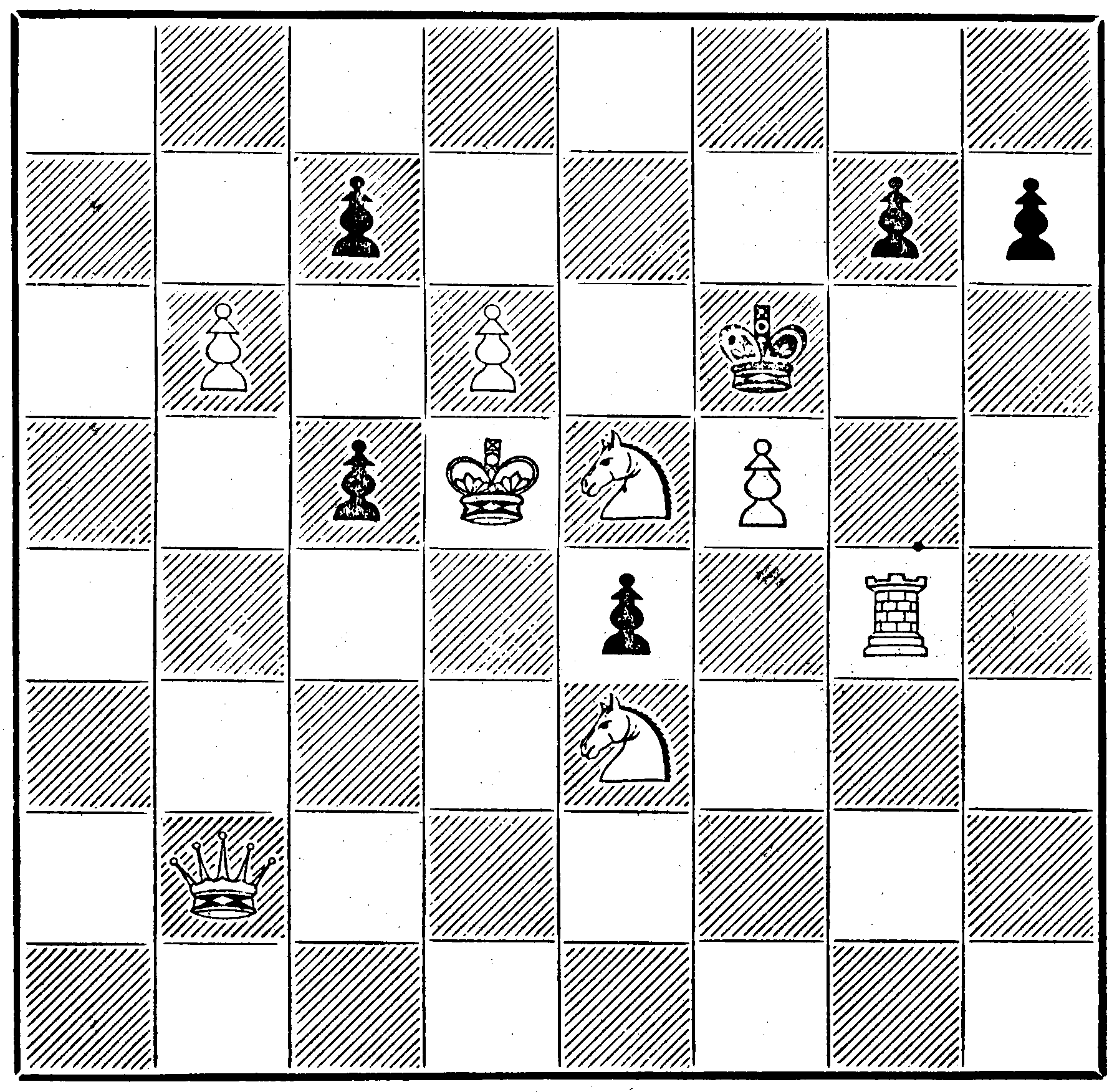
WHITE
White might have given mate on the last move. White now to retract his move, and mate at once.
Show by analysis the mating position.
Solution
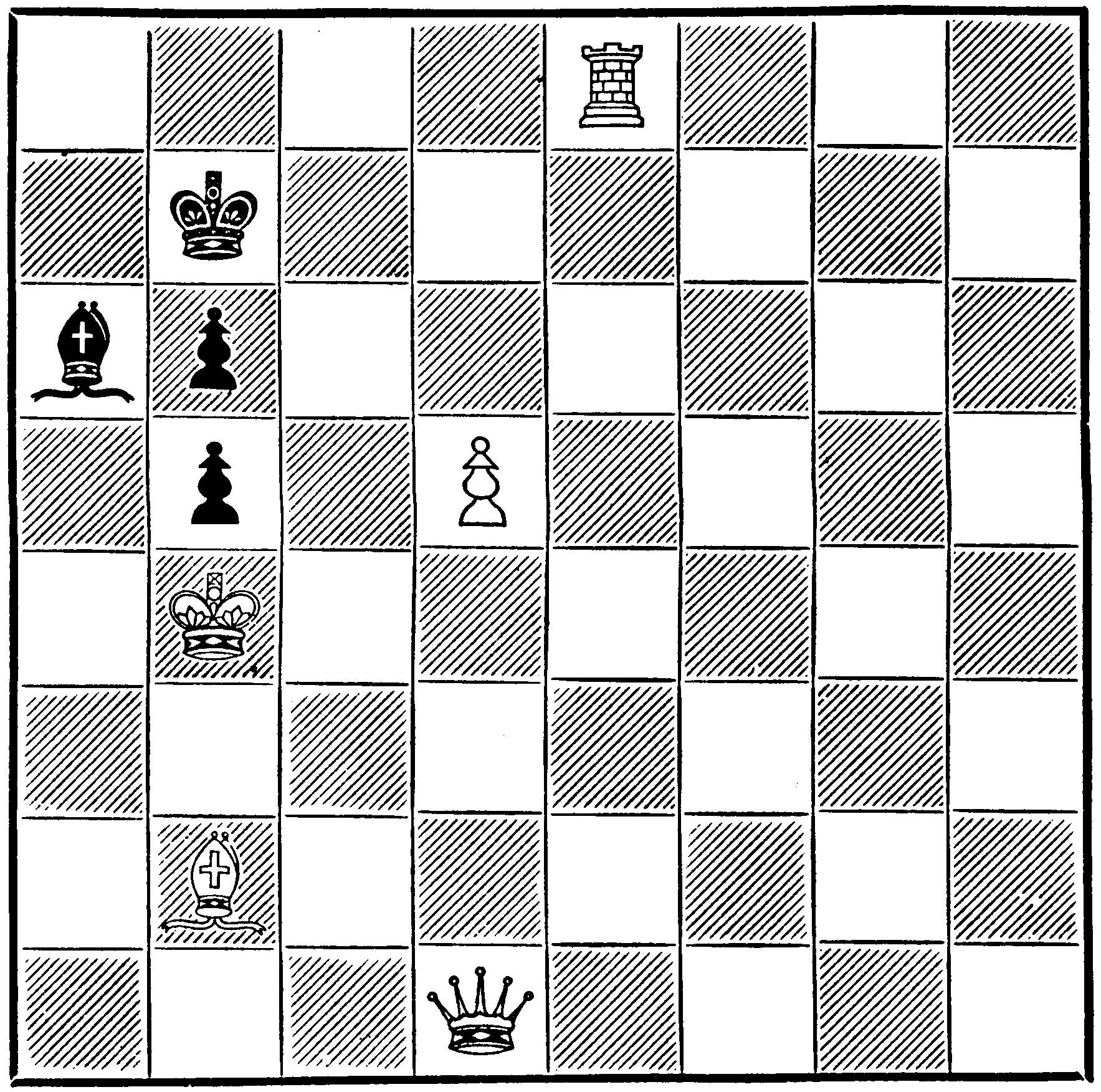
No. XXVIII.—CHESS CAMEO By J. G. Campbell A very Clever Device
BLACK
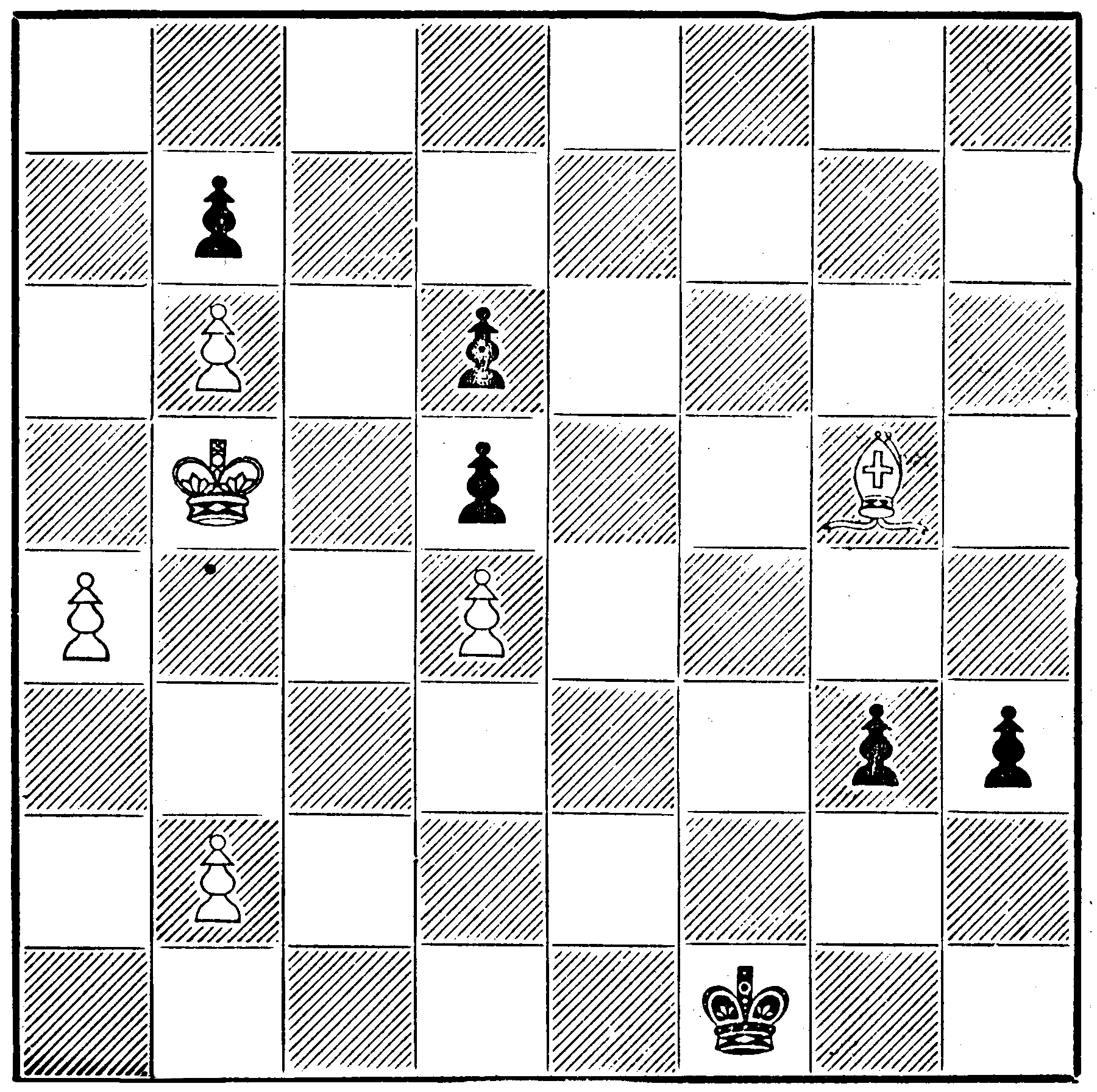
WHITE
White to play and draw.
Solution
COMIC ARITHMETIC
“Now, boys,” said Dr Bulbous Roots to class, “you shall have a half-holiday if you prove in a novel way that 10 is an even number.”
Next morning, when the doctor came into school, he found this on the blackboard:—
SIX = 6
SIX = 9
By subtraction S = -3
SEVEN = 7
S = -3
Therefore SEVEN = 10
Q. E. D. (Quite easily done!)
The half-holiday was won.
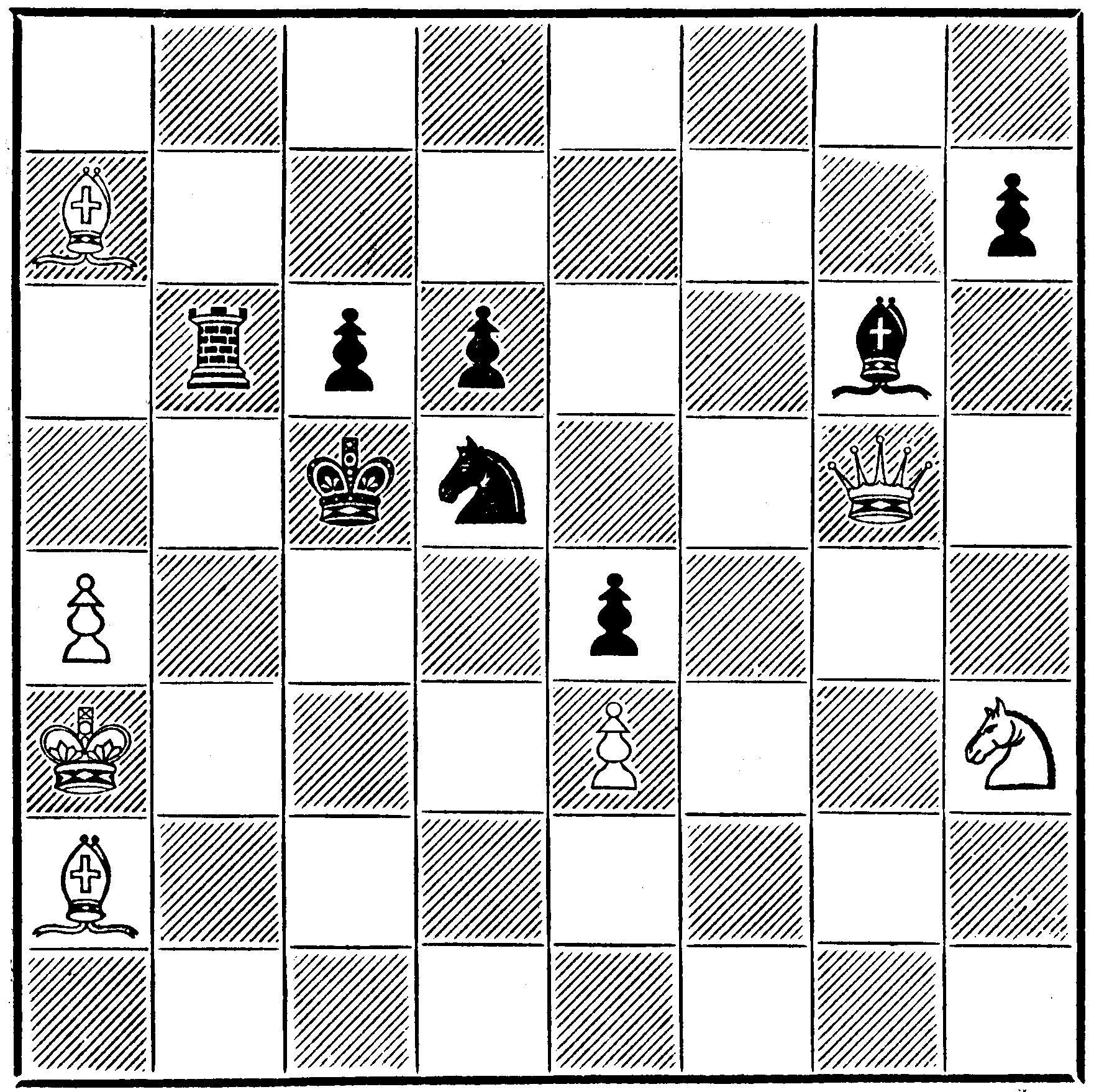
No. XXIX.—CHESS CAMEO By E. B. Cook A Fine Example
BLACK
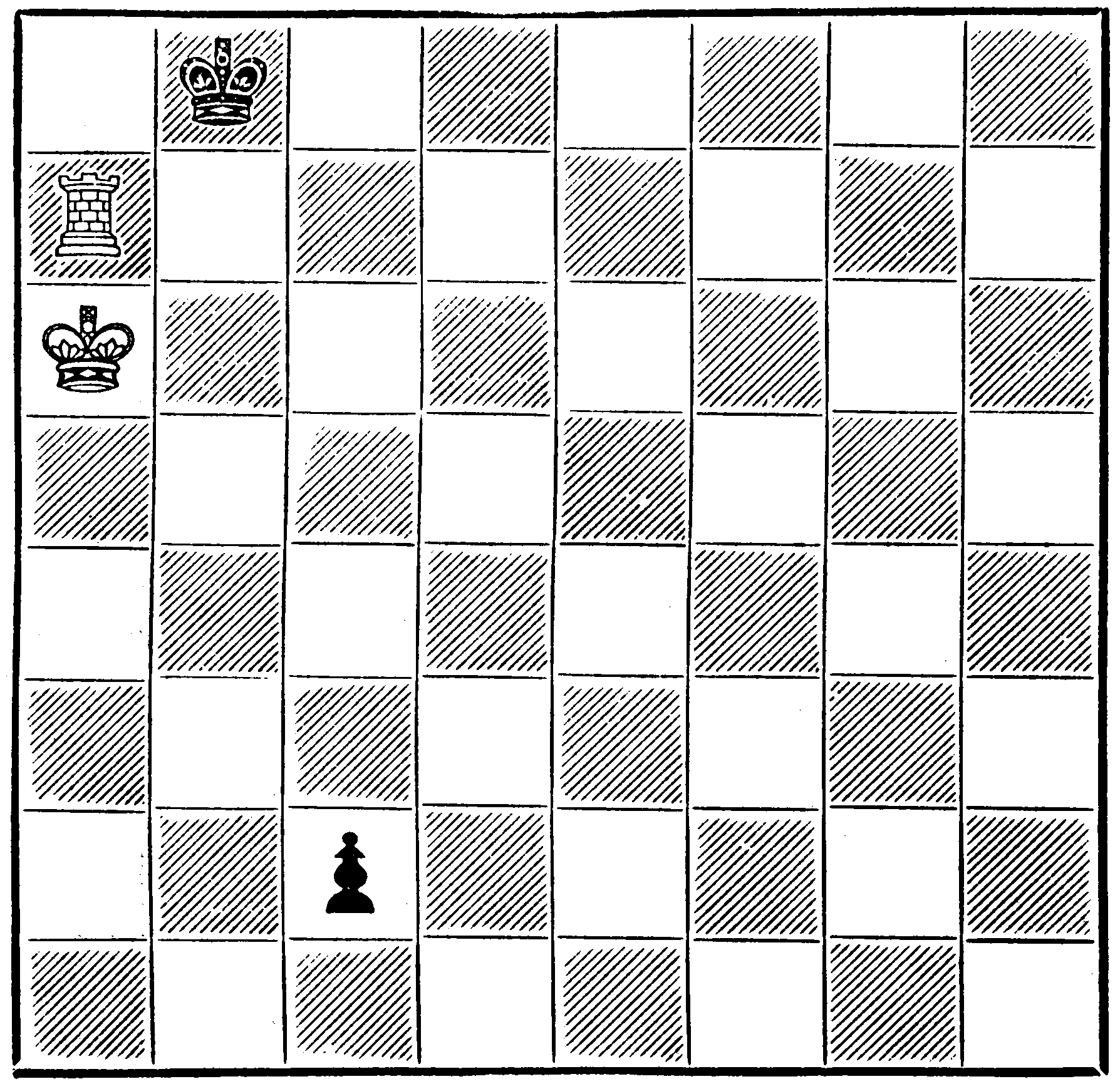
WHITE
White to play, and draw.
Solution
No. XXX.—CHESS CAMEO By A. F. Mackenzie A Prize Problem
BLACK
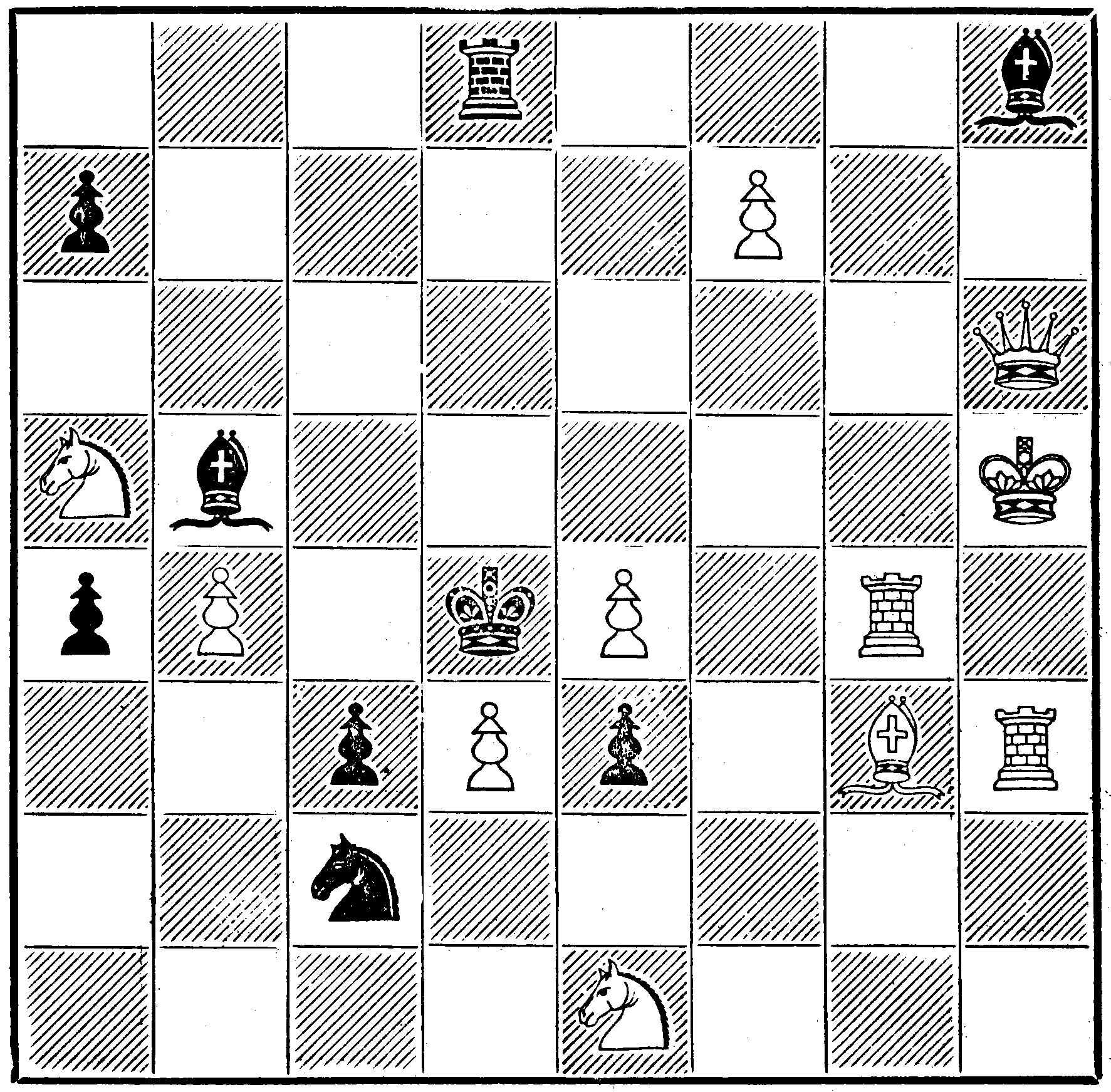
WHITE
White to play, and mate in two moves.
There are twelve variations in this beautiful problem.
Solution
MAGIC MULTIPLICATION
It will interest all who study short cuts and contrivances to know that a novice at arithmetic who has mastered simple addition, and can multiply or divide by 2, but by no higher numbers, can, by using all these methods, multiply any two numbers together easily and accurately.
This is how it is done:—
Write down the numbers, say 53 and 21, divide one of them by 2 as often as possible, omitting remainders, and multiply the other by 2 the same number of times; set these down side by side, as in the instance given below, and wherever there is an even number on the division side, strike out the corresponding number on the multiplication side. Add up what remains on that side, and the sum is done. Thus:—
53 21)
26 (42)
13 84)
6 (168)
3 336)
1 672)
1113)
which is 53 multiplied by 21.
No. XXXI.—CHESS CAMEO By A. W. Galitzky A Prize Problem
BLACK
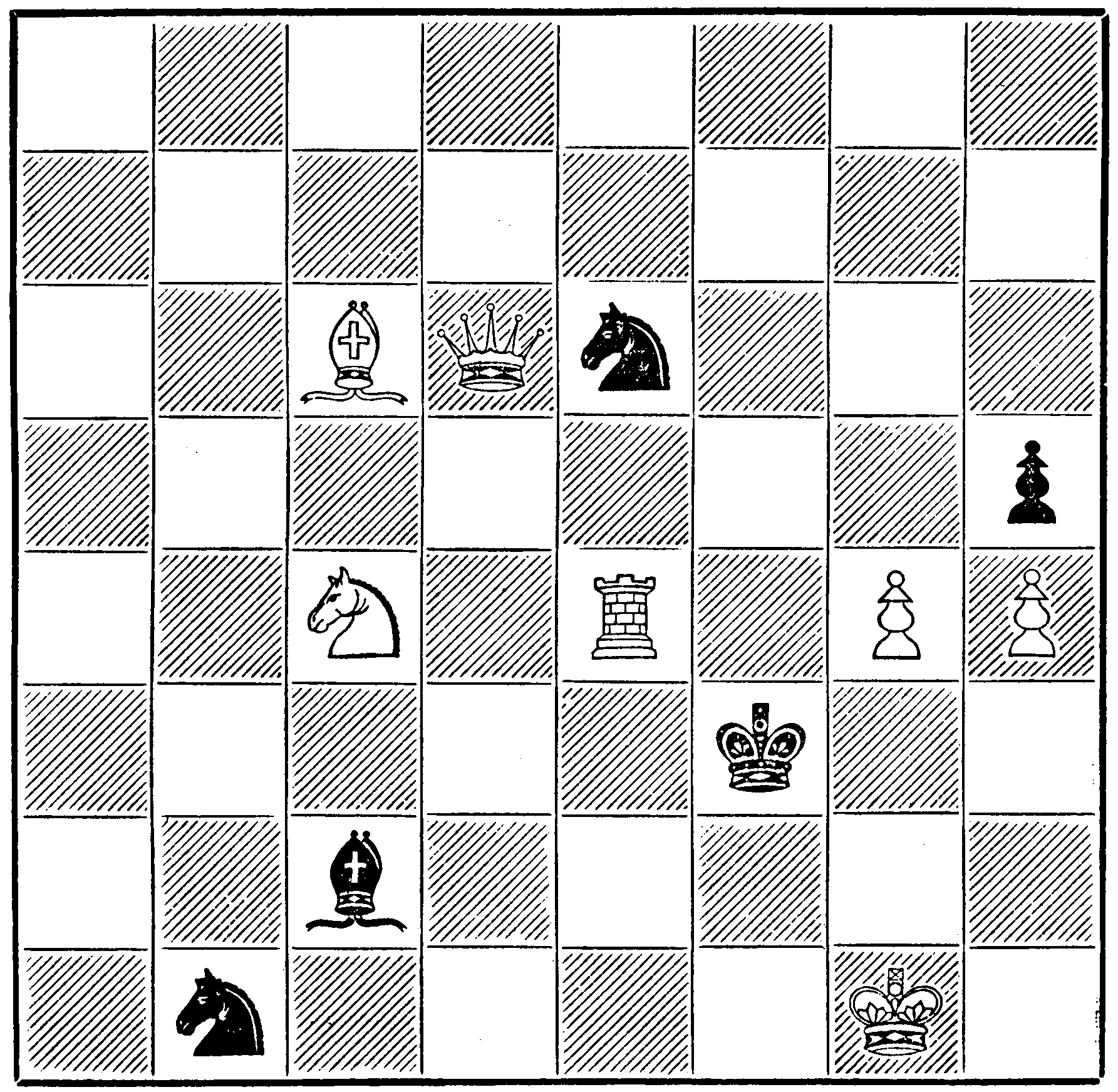
WHITE
White to play, and mate in two moves.
Solution
No. XXXII.—CHESS CAMEO By S. Loyd
BLACK
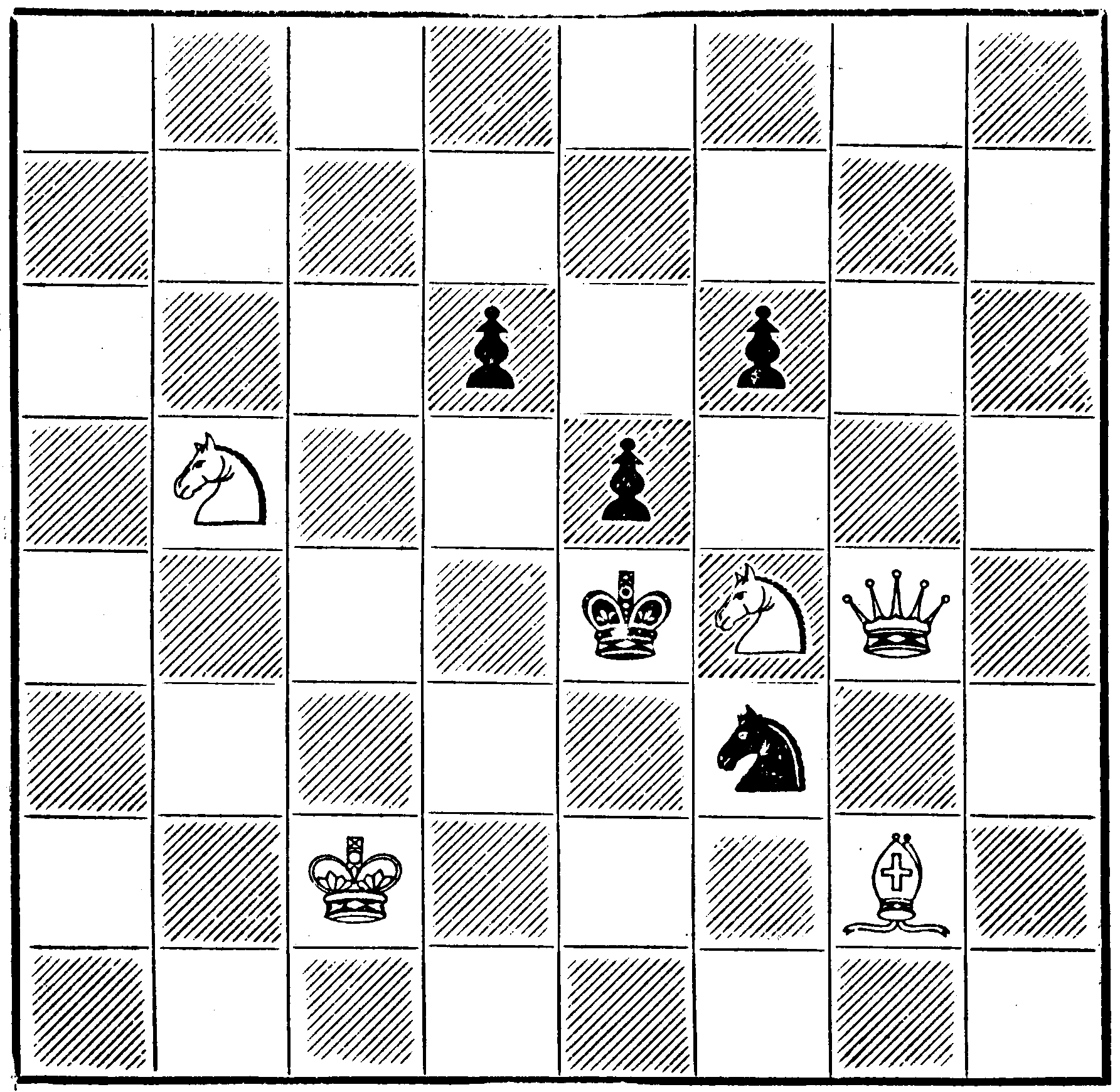
WHITE
White to play, and mate in two moves.
Solution
No. XXXIII.—CHESS CAMEO By B. G. Laws A Prize Problem
BLACK
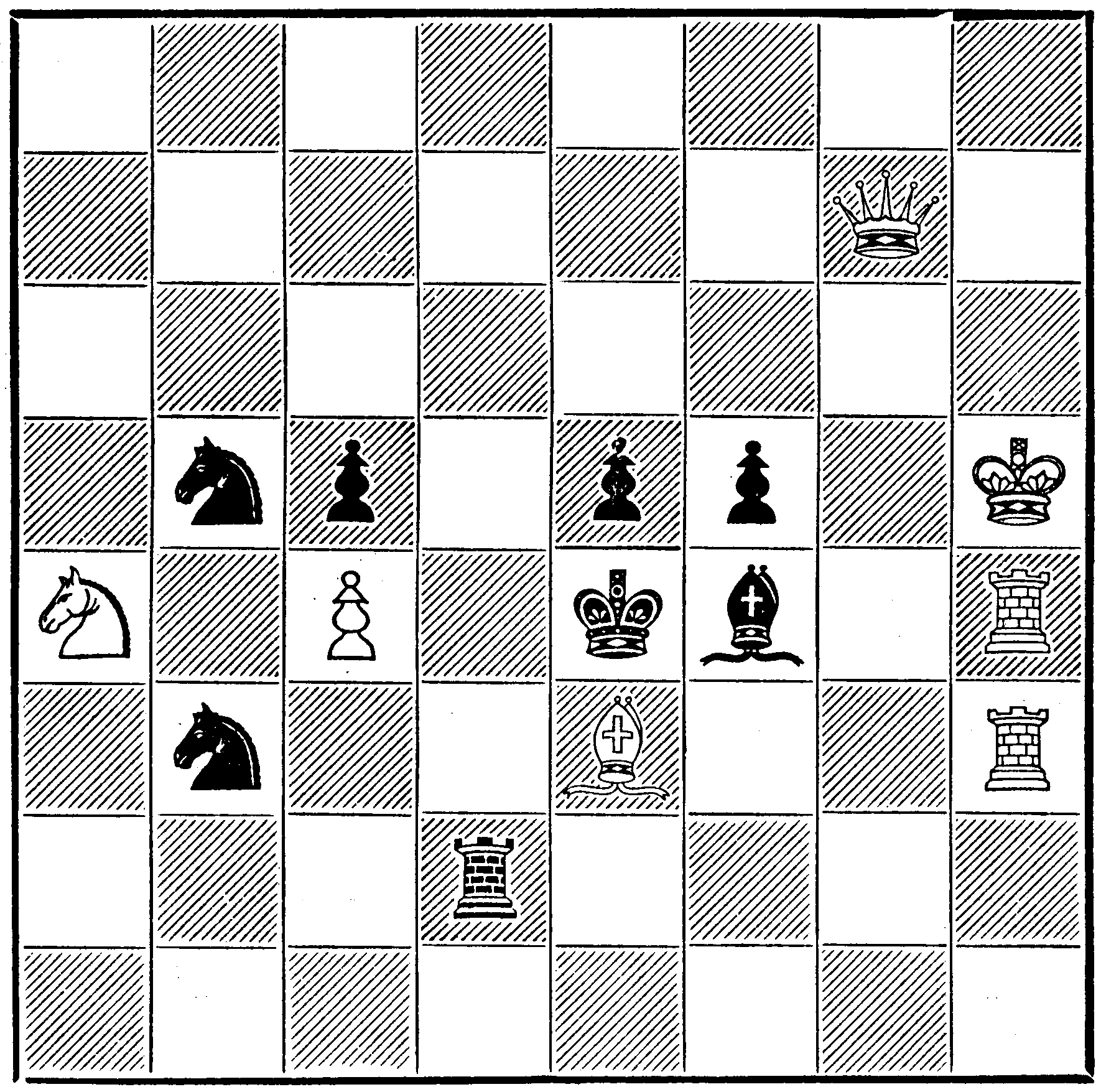
WHITE
White to play, and mate in two moves.
Solution
PERFECT NUMBERS
The following particulars about a very rare property of numbers will be new and interesting to many of our readers:—
The number 6 can only be divided without remainder by 1, 2, and 3, excluding 6 itself. The sum of 1 + 2 + 3 is 6. The only exact divisors of 28 are 1, 2, 4, 7, and 14, and the sum of these is 28; 6 and 28 are therefore known as perfect numbers.
The only other known numbers which fulfil these conditions are 496; 8128; 33,550,336; 8,589,869,056; 137,438,691,328; and 2,305,843,008,139,952,128. This most remarkable rarity of perfect numbers is a symbol of their perfection.
No. XXXIV.—CHESS CAMEO By Emil Hoffmann
BLACK
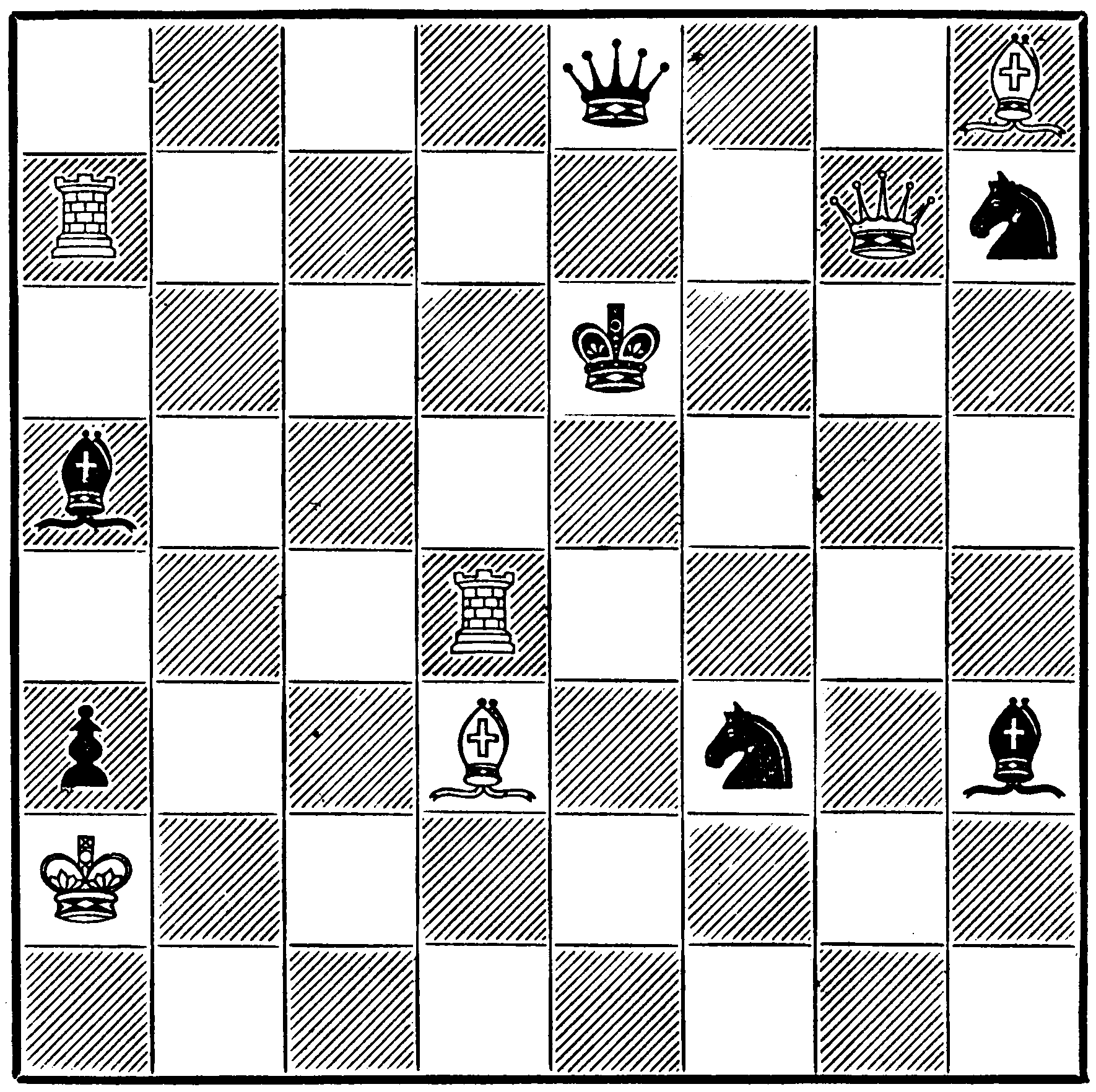
WHITE
White to play, and mate in two moves. There are no less than twelve variations!
Solution
No. XXXV.—CHESS CAMEO By J. Pospicil A Prize Problem
BLACK
WHITE
White to play, and mate in two moves.
Solution
AMICABLE NUMBERS
Somewhat akin to perfect numbers are what are known as amicable numbers, of which there is a still smaller quantity in the realm of numbers.
The number 220 can be divided without remainder only by 1, 2, 4, 5, 10, 11, 22, 44, 55, and 110, and the sum of these divisors is 284. The only divisors of 284 are 1, 2, 4, 71, and 142, and the sum of these is 220.
The only other pairs of numbers which fulfil this curious mutual condition, that the sum of the divisors of each number exactly equals the other number, are 17,296 with 18,416, and 9,363,584 with 9,437,056. No other numbers, at least below ten millions, are in this way “amicable.”
No. XXXVI.—CHESS CAMEO By H. J. C. Andrews A Prize Problem
BLACK
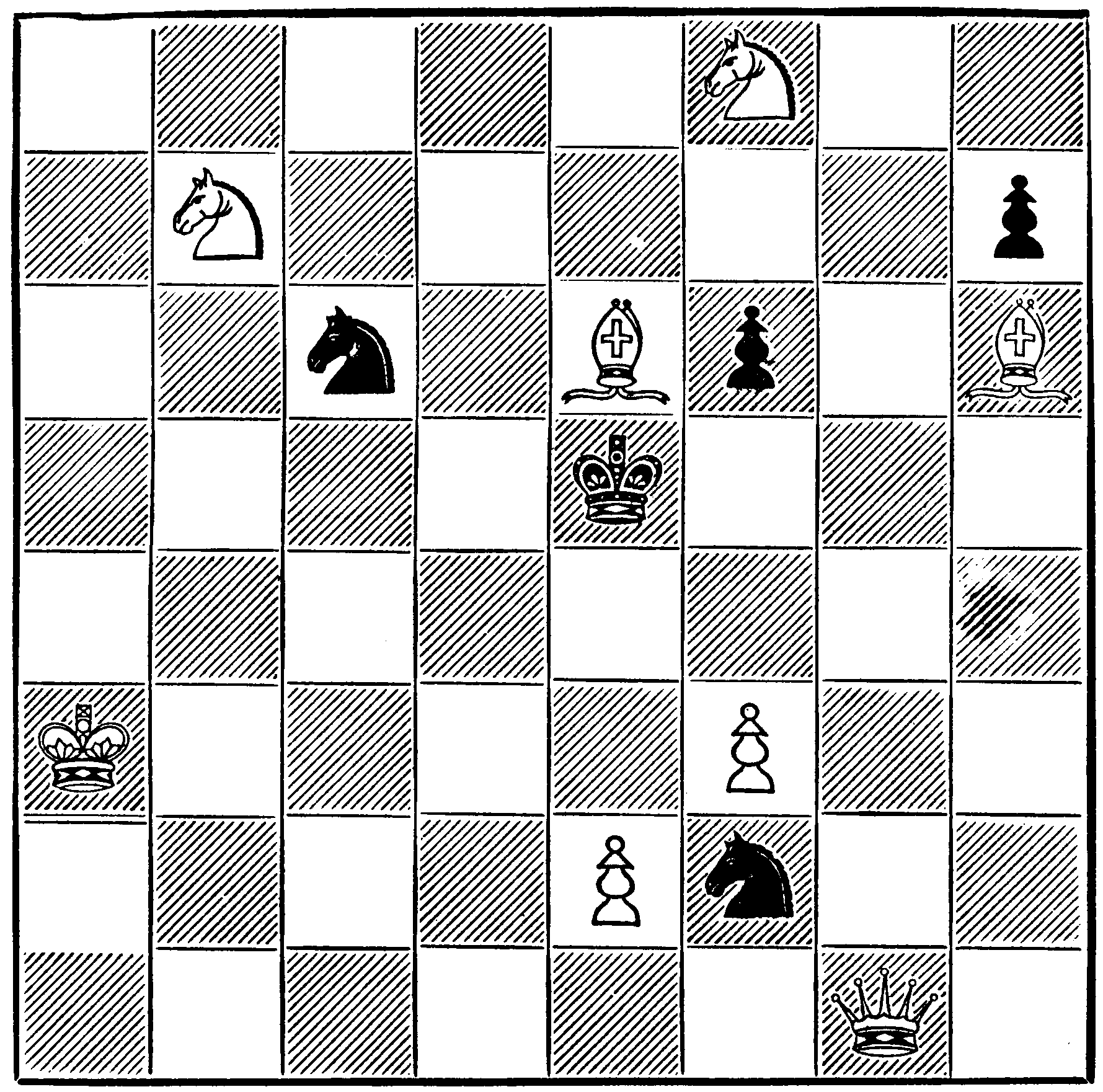
WHITE
White to play, and mate in two moves.
Solution
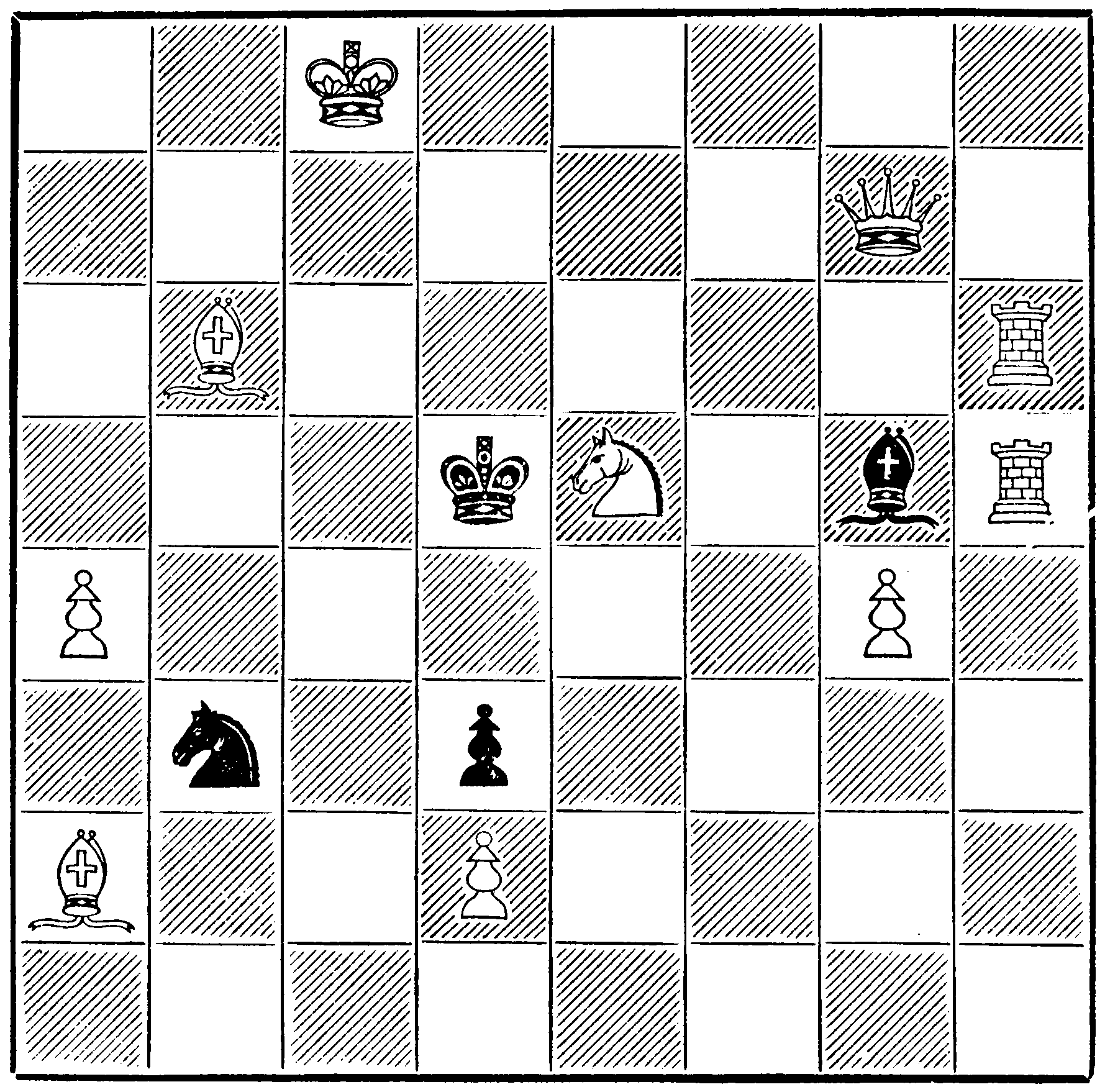
No. XXXVII.—CHESS CAMEO By Alfred de Musset A Gem of the First Water
BLACK
WHITE
White to play, and mate in three moves.
Solution
A SWARM OF ONES
1 × 9 + 2 = 11
12 × 9 + 3 = 111
123 × 9 + 4 = 1111
1234 × 9 + 5 = 11111
12345 × 9 + 6 = 111111
123456 × 9 + 7 = 1111111
1234567 × 9 + 8 = 11111111
12345678 × 9 + 9 = 111111111
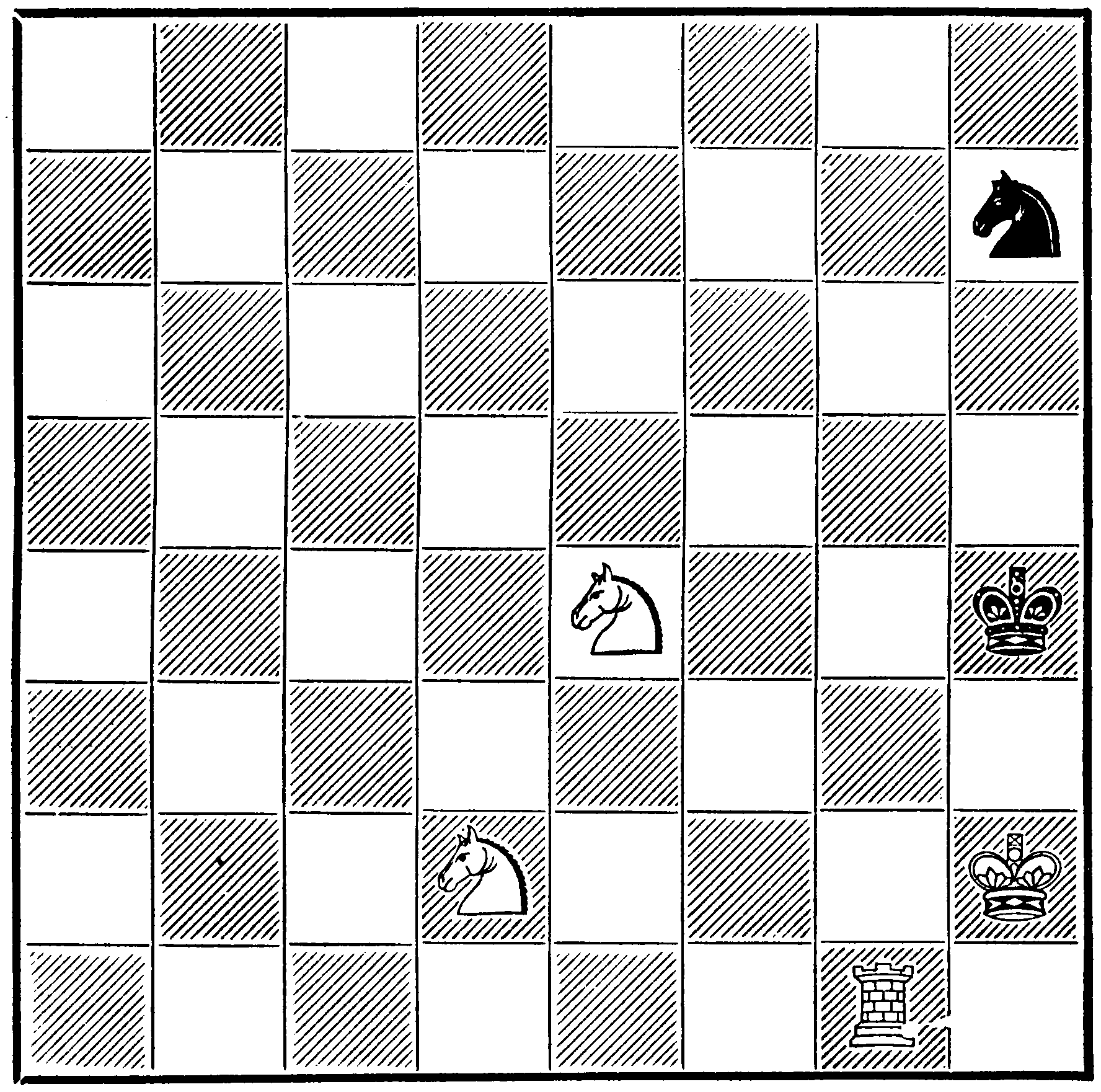
No. XXXVIII.—CHESS CAMEO By Frank Healey A Masterpiece
BLACK
WHITE
White to play, and mate in three moves.
Solution
DIVINATION BY FIGURES
There is a pleasant touch of mystery in the following method of discovering a person’s age:—Ask any such subjects of your curiosity to write down the tens digit of the year of their birth, to multiply this by 5, to add 2 to the product, to multiply this result by 2, and finally to add the units digit of their birth year. Then, taking the paper from them, subtract the sum from 100. This will give you their age in 1896, from which their present age is easily determined.
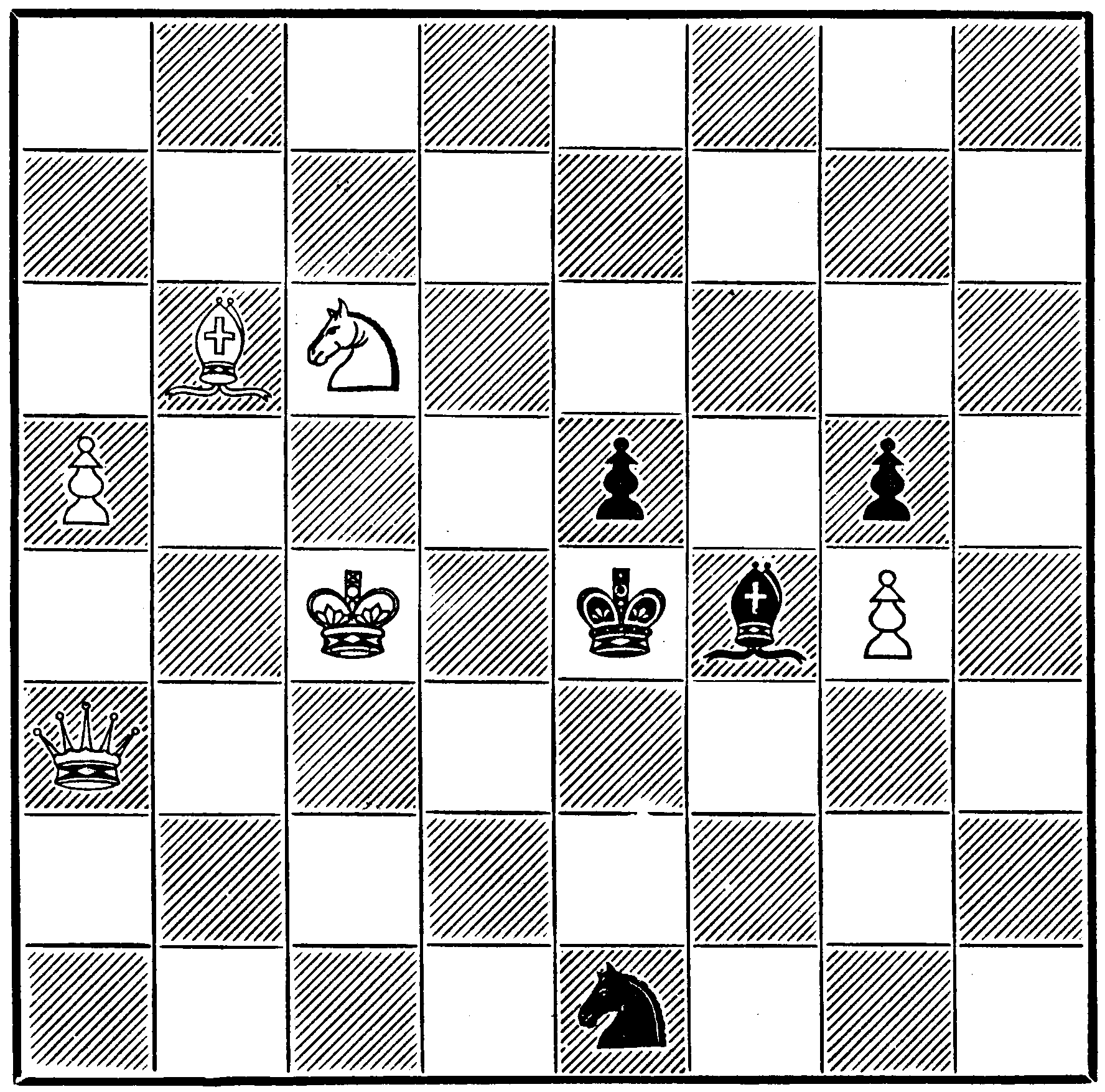
No. XXXIX.—CHESS CAMEO By Frank Healey The “Bristol Prize Problem”
BLACK
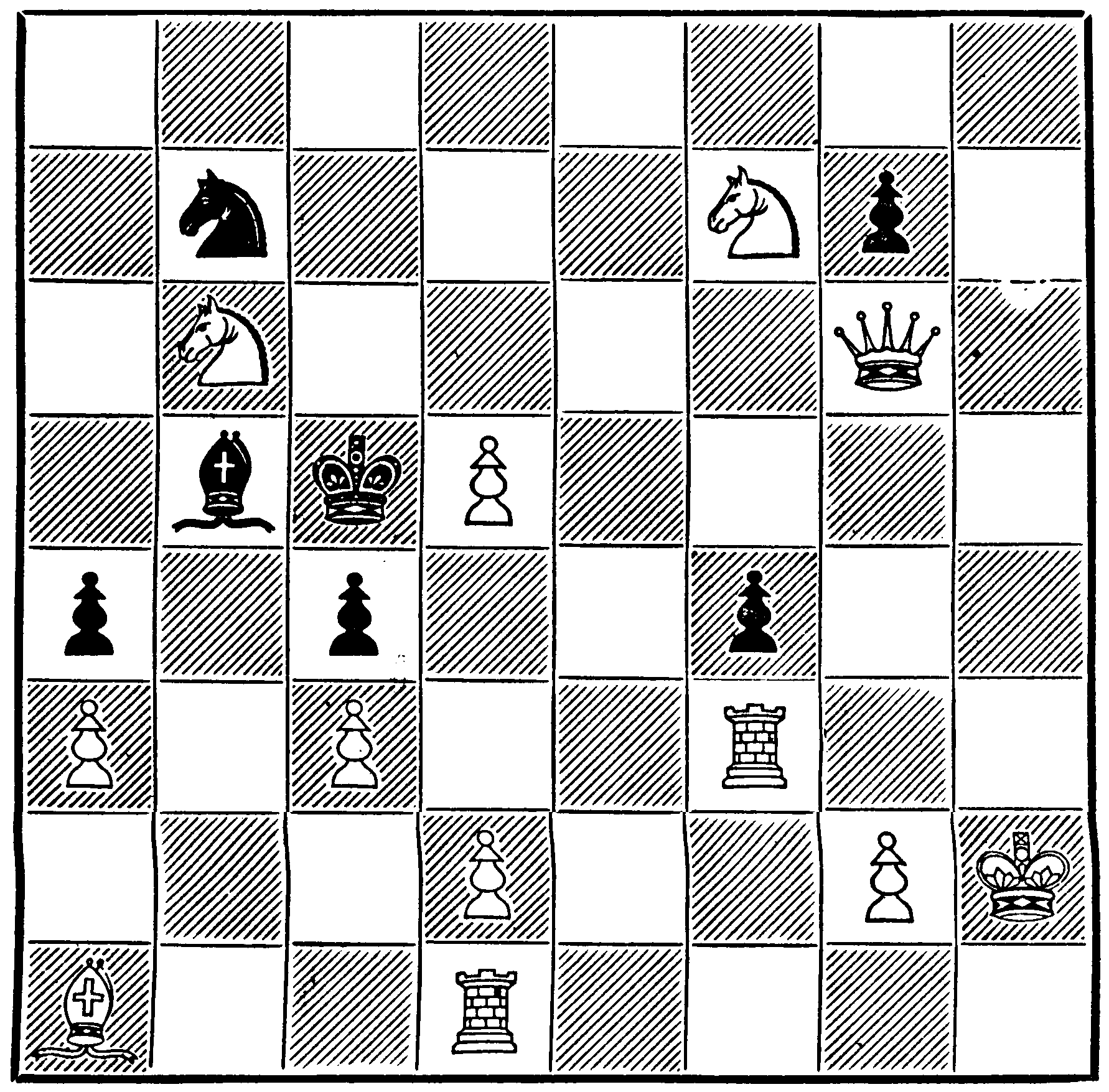
WHITE
White to play, and mate in three moves.
Solution
FUR AND FEATHERS
As I came in after a day among the birds and rabbits, the keeper asked me—“Well, sir, what sport?” I replied, “36 heads and 100 feet.” It took him some time to calculate that I had accounted for 22 birds and 14 rabbits.
No. XL.—CHESS CAMEO By J. E. Campbell Splendid Strategy
BLACK
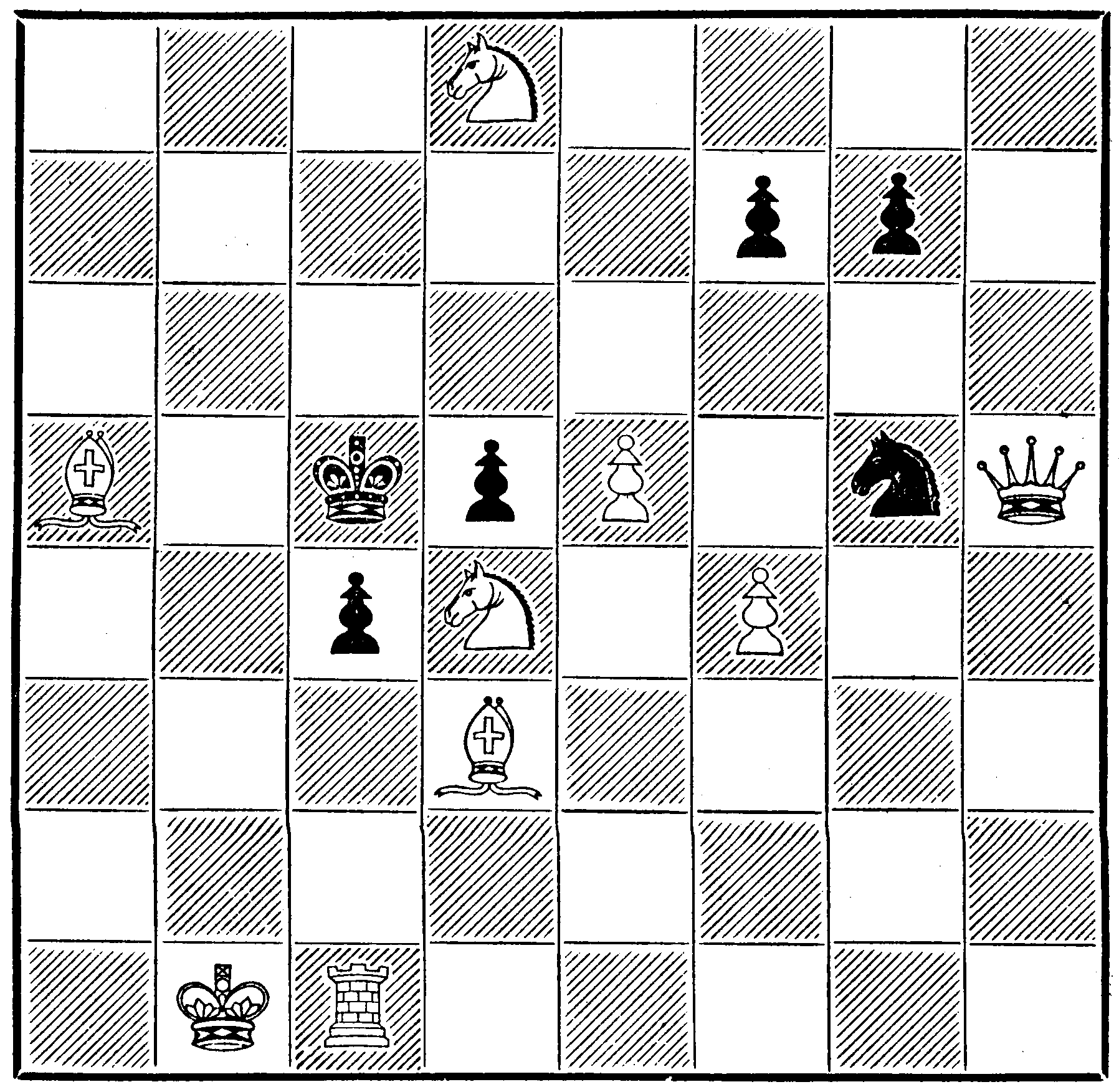
WHITE
White to play, and mate in three moves.
Solution
JUGGLING WITH THE DIGITS
The nine digits can be arranged to form fractions equivalent to
13 14 15 16 17 18 19
thus:—
582317469 = 13 795631824 = 14 297314865 = 15 294317658 = 16 527436918 = 17 932174568 = 18 836175249 = 19
No. XLI.—CHESS CAMEO By W. Grimshaw
BLACK
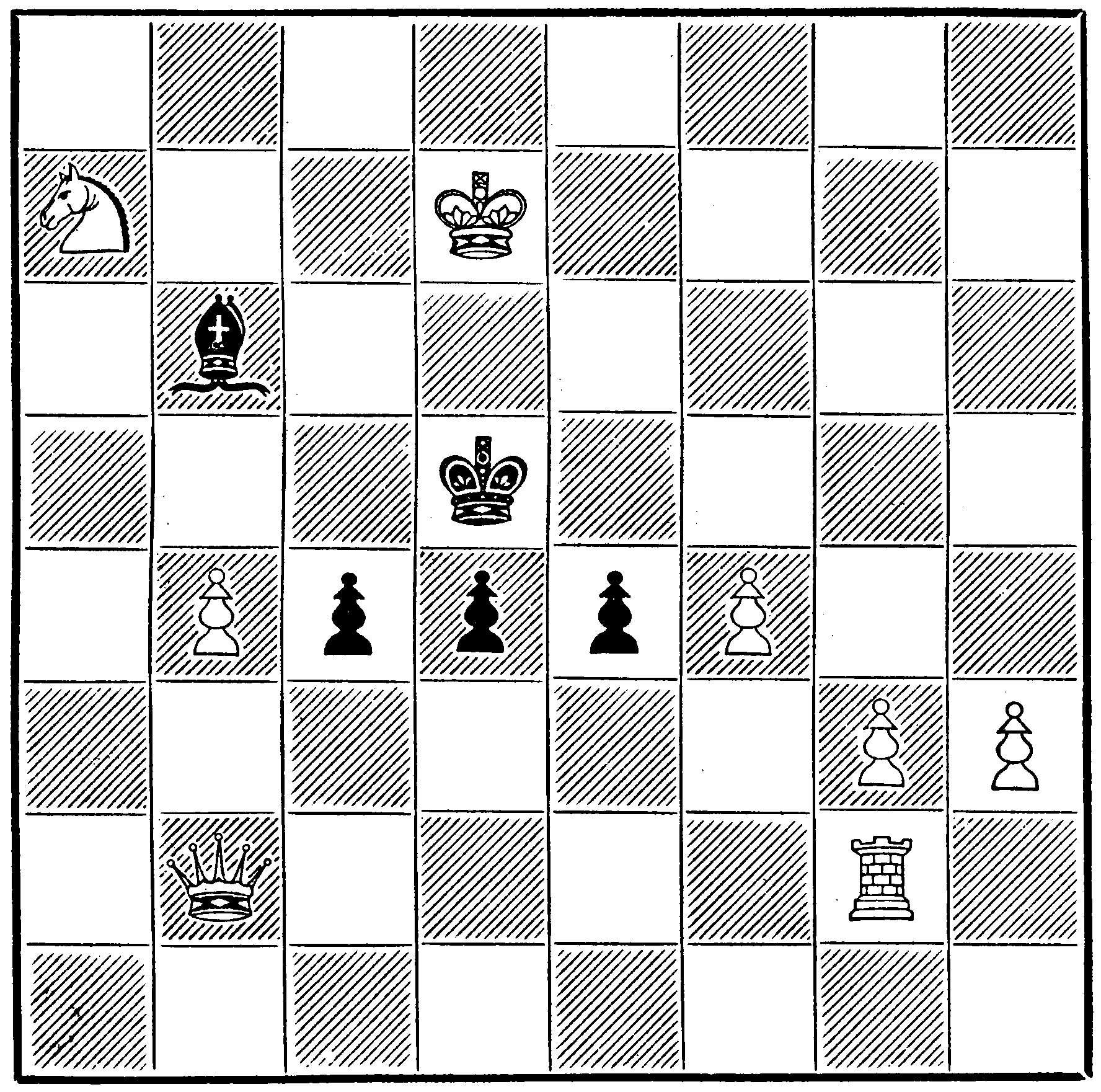
WHITE
White to play, and mate in three moves.
Solution
No. XLII.—CHESS CAMEO By S. Loyd
BLACK
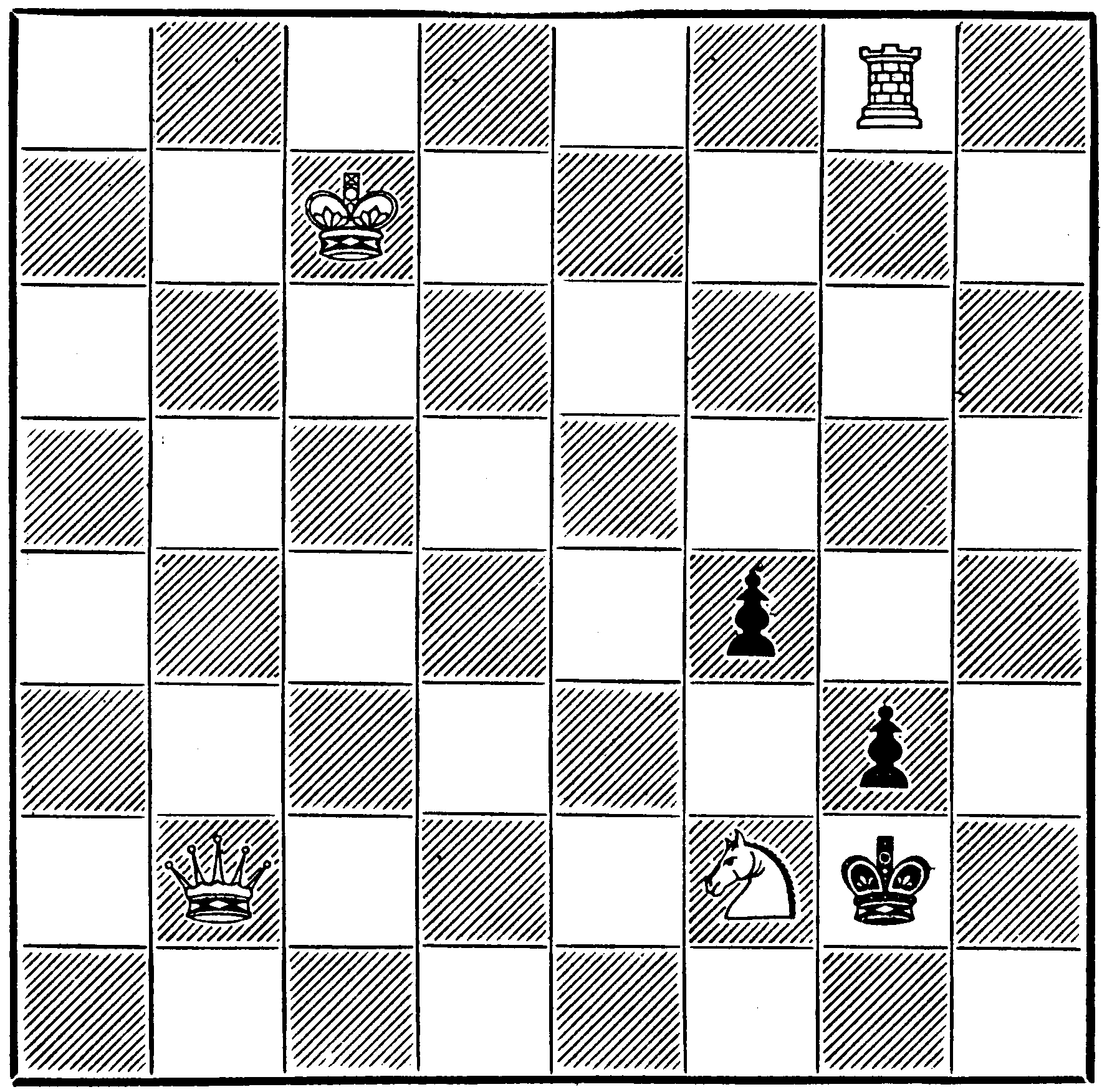
WHITE
White to play, and mate in three moves.
Solution
A MOTOR PROBLEM
This motor problem will be new and amusing to many readers:—
Let m be the driver of a motor-car, working with velocity v. If a sufficiently high value is given to v, it will ultimately reach pc. In most cases v will then = o. For low values of v, pc may be neglected; but if v be large it will generally be necessary to square pc, after which v will again assume a positive value.
By a well-known elementary theorem, pc + lsd = (pc)2, but the squaring may sometimes be effected by substituting x3 (or × × ×) for lsd. This is preferable, if lsd is small with regard to m. If lsd be made sufficiently large, pc will vanish.
Now if jp be substituted for pc (which may happen if the difference between m and pc be large) the solution of the problem is more difficult. No value of lsd can be found to effect the squaring of jp, for, as is well-known, (jp)2 is an impossible quantity.
No. XLIII.—CHESS CAMEO By J. G. Campbell
BLACK
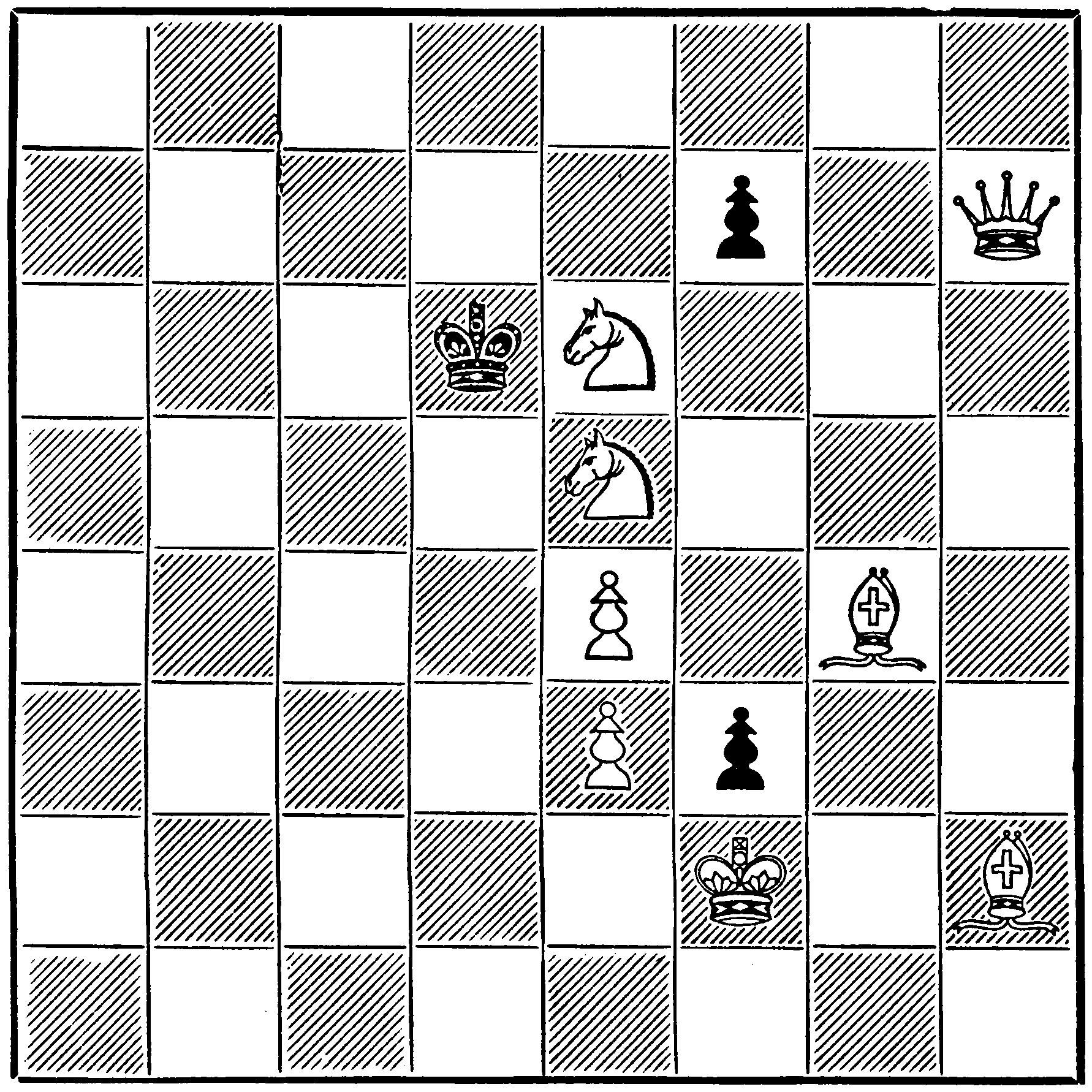
WHITE
White to play, and mate in three moves.
Solution
No. XLIV.—CHESS CAMEO By Frank Healey
BLACK
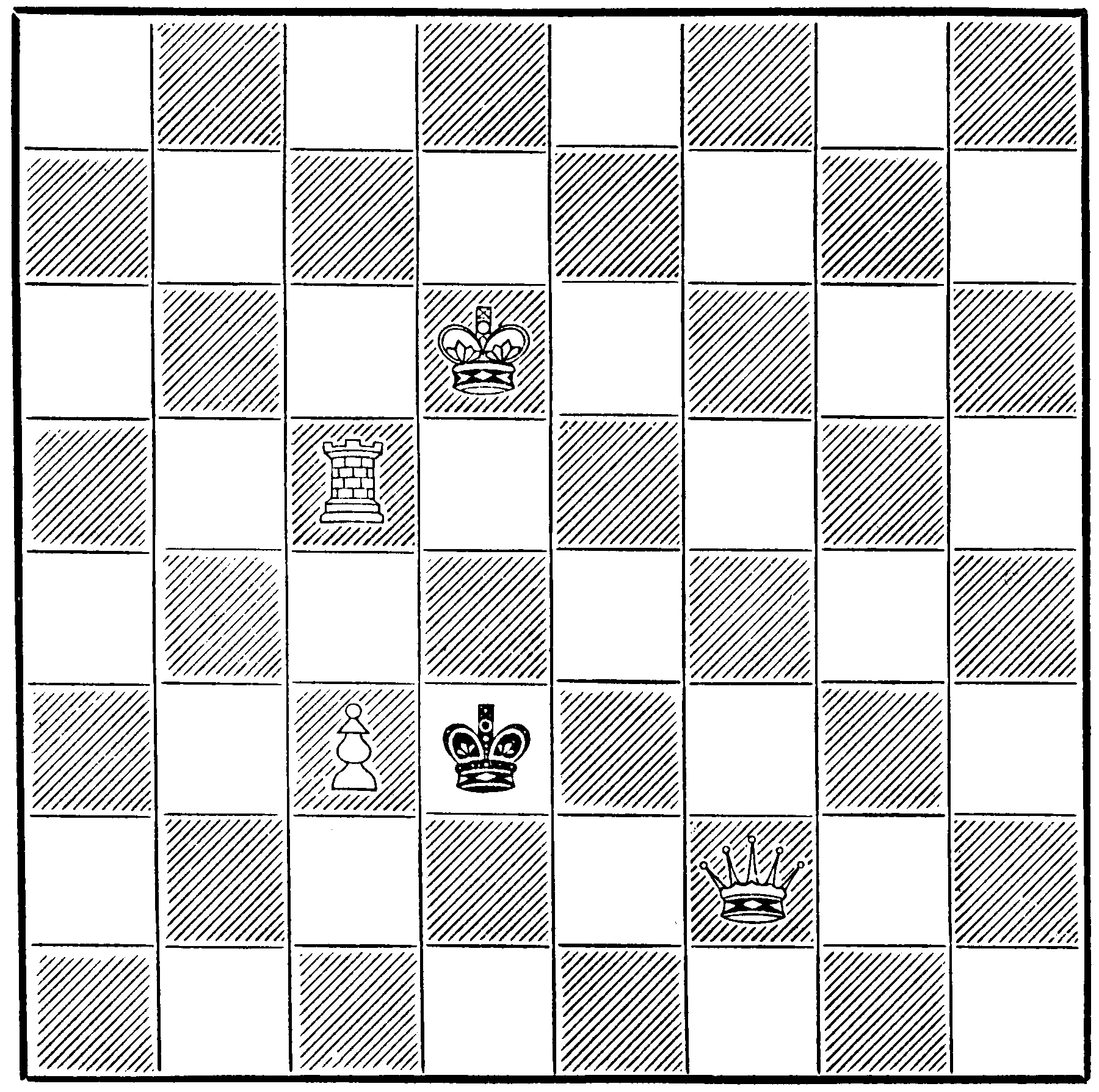
WHITE
White to play, and mate in three moves.
Solution
A NEAT METHOD OF DIVISION
To divide any sum easily by 99, cut off the two right-hand figures of the dividend and add them to all the others. Set down the result of this in line below, and then repeat this process until no figures remain on the left to be thus dealt with.
Now draw a line down between the tens and hundreds columns, and add all up on the left of it, thus:—
8694 32 120 78
87 26 1 98
1 13 99
14 121 and 99 over.
8782 and 14 over. In other words, 122.
The last number on the right of the lines shows always the remainder. If this should appear as 99 (as in the second example above), add one to the number on the left.
No. XLV.—CHESS CAMEO By Blumenthal and Kund
BLACK
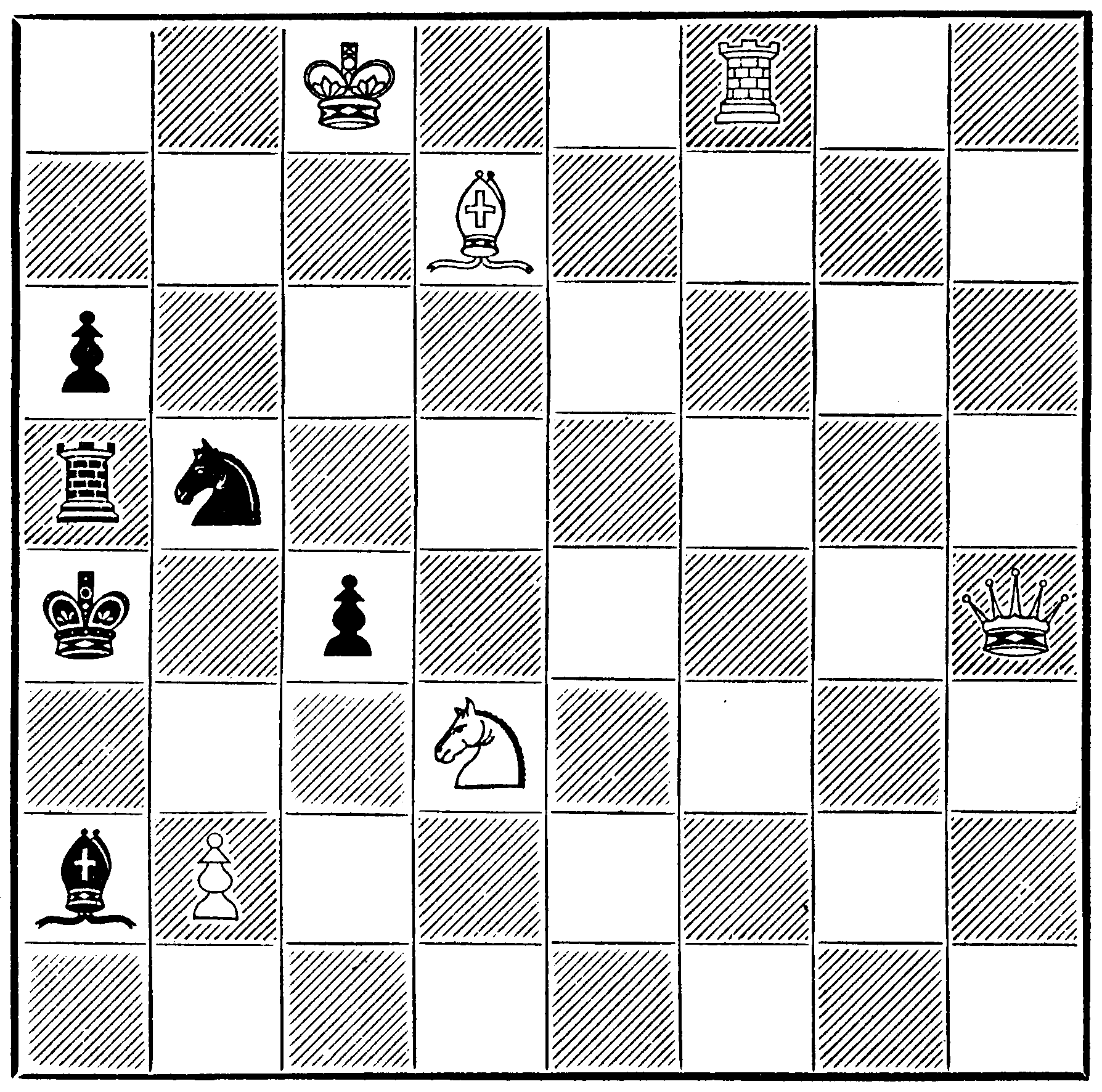
WHITE
White to play, and mate in three moves.
Solution
No. XLVI.—CHESS CAMEO By A. F. Mackenzie A Prize Problem
BLACK
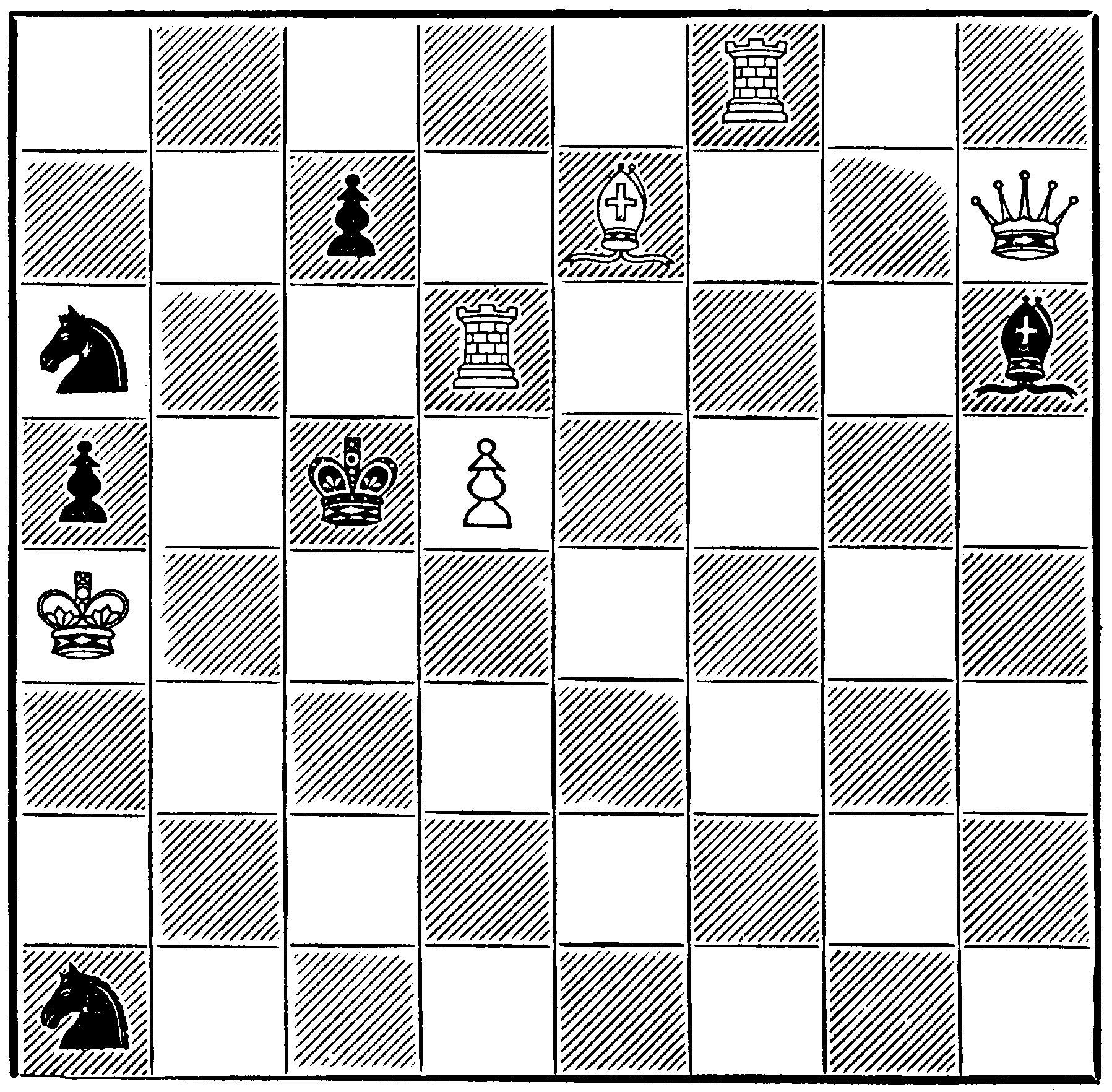
WHITE
White to play, and mate in three moves.
Solution
A SMART SCHOOLBOY
The question, “How many times can 19 be subtracted from a million?” was set by an examiner, who no doubt expected that the answer would be obtained by dividing a million by 19. One bright youth, however, filled a neatly-written page with repetitions of
1,000,000 1,000,000 1,000,000
19 19 19
999,981 999,981 999,981
and added at the foot of the page, “N.B.—I can do this as often as you like.”
There was a touch of unintended humour in this, for, after all, the boy gave a correct answer to a badly worded question.
No. XLVII.—CHESS CAMEO By A. Cyril Pearson
BLACK
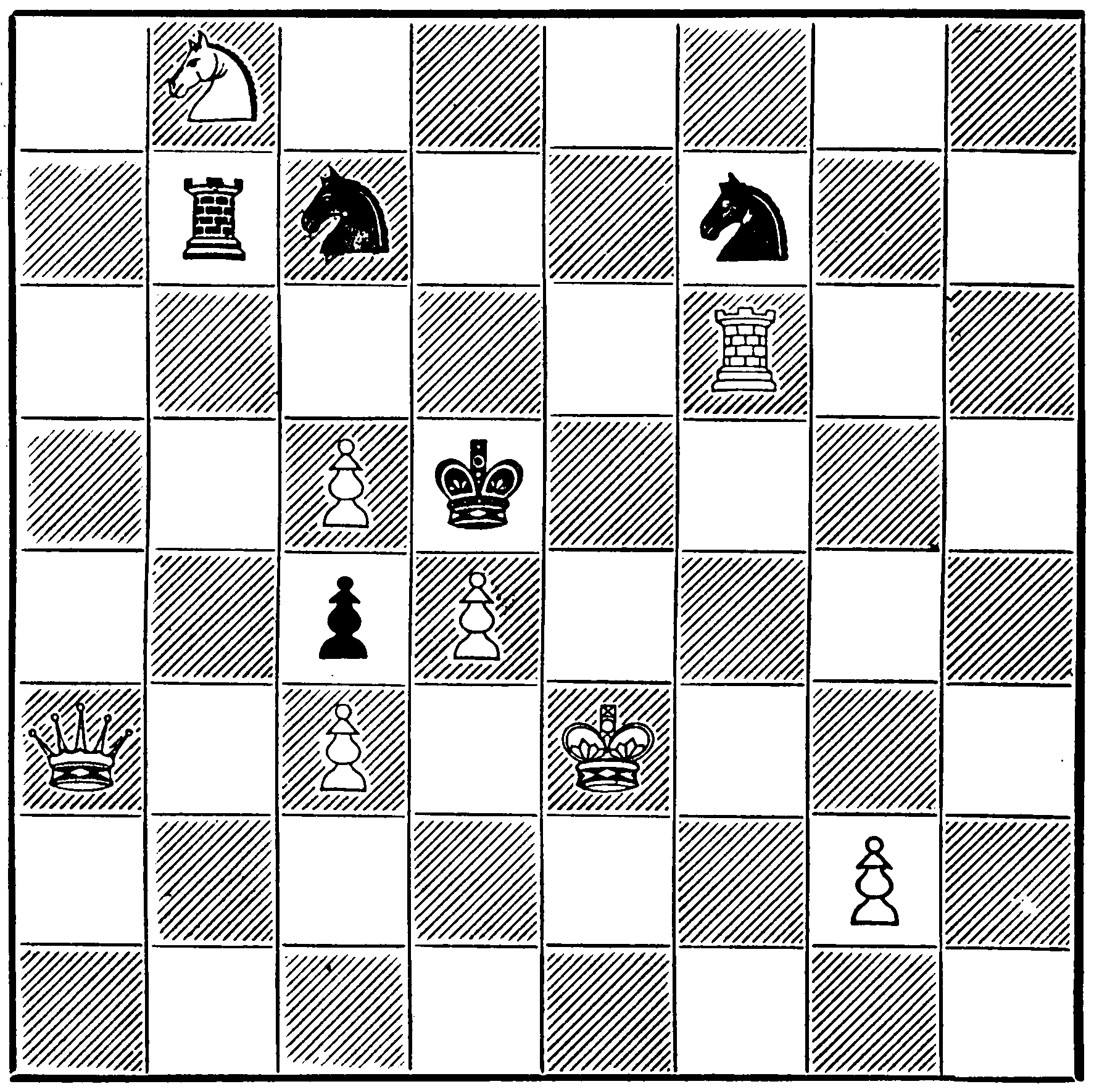
WHITE
White to play, and mate in three moves.
Solution
No. XLVIII.—CHESS CAMEO By Frank Healey Quite a Gem
BLACK
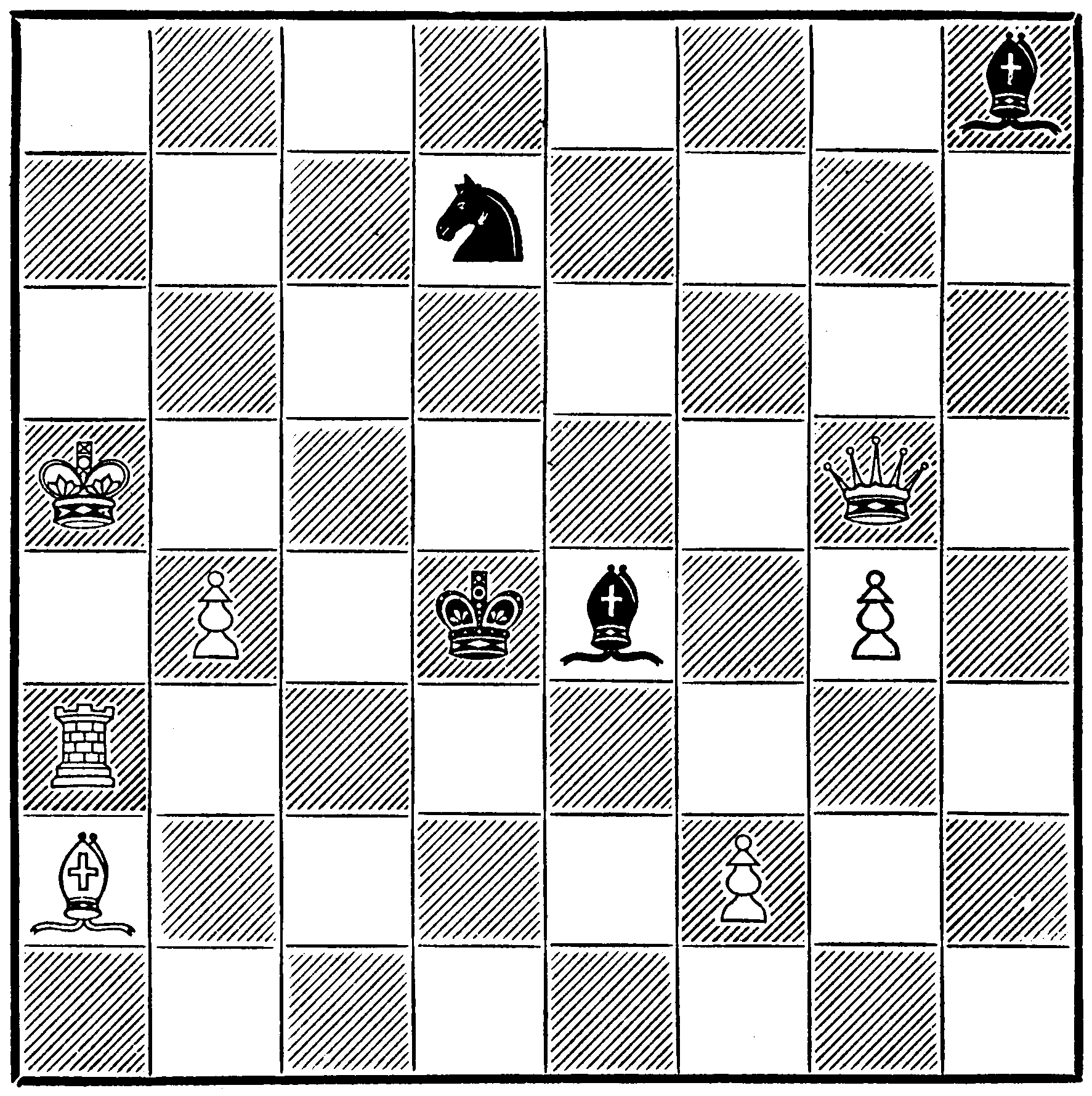
WHITE
White to play, and mate in three moves.
Solution
LEWIS CARROLL’S SHORT CUT
Here is a very smart and very simple method of dividing any multiple of 9 by 9, from the fertile brain of Lewis Carroll:—Place a cypher over the final figure, subtract the final figure from this, place the result above in the tens place, subtract the original tens figure from this, and so on to the end. Then the top line, excluding the intruded cypher, gives the result desired. Thus:—
36459 ÷ 9 = 4051,0 36459 = 4051.
No. XLIX.—CHESS CAMEO By A. Bayersdorfer
BLACK
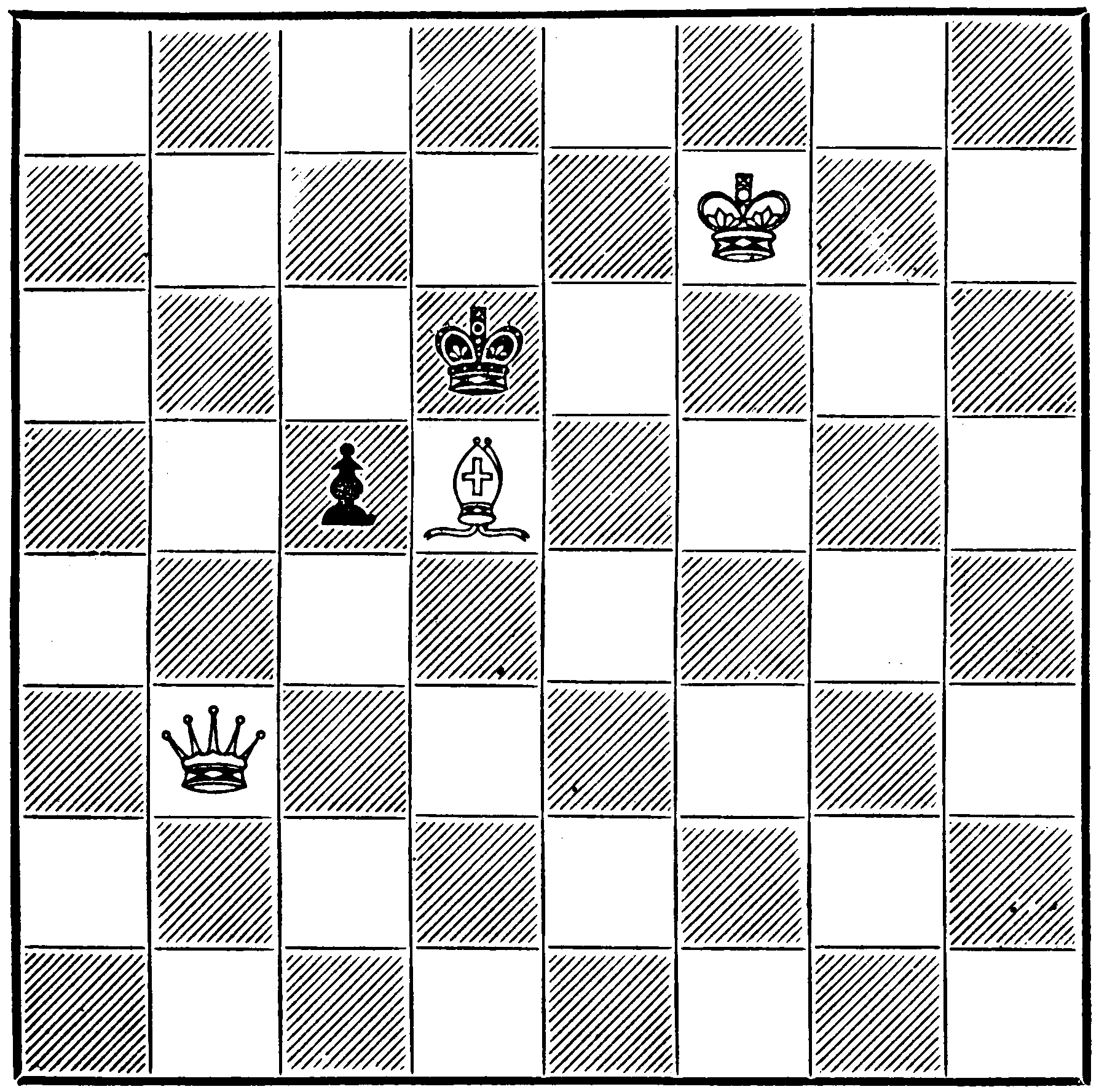
WHITE
White to play, and mate in three moves.
Solution
ANOTHER FREAK OF FIGURES
1 × 8 + 1 = 9
12 × 8 + 2 = 98
123 × 8 + 3 = 987
1234 × 8 + 4 = 9876
12345 × 8 + 5 = 98765
123456 × 8 + 6 = 987654
1234567 × 8 + 7 = 9876543
12345678 × 8 + 8 = 98765432
123456789 × 8 + 9 = 987654321
No. L.—CHESS CAMEO By J. Dobrusky
BLACK
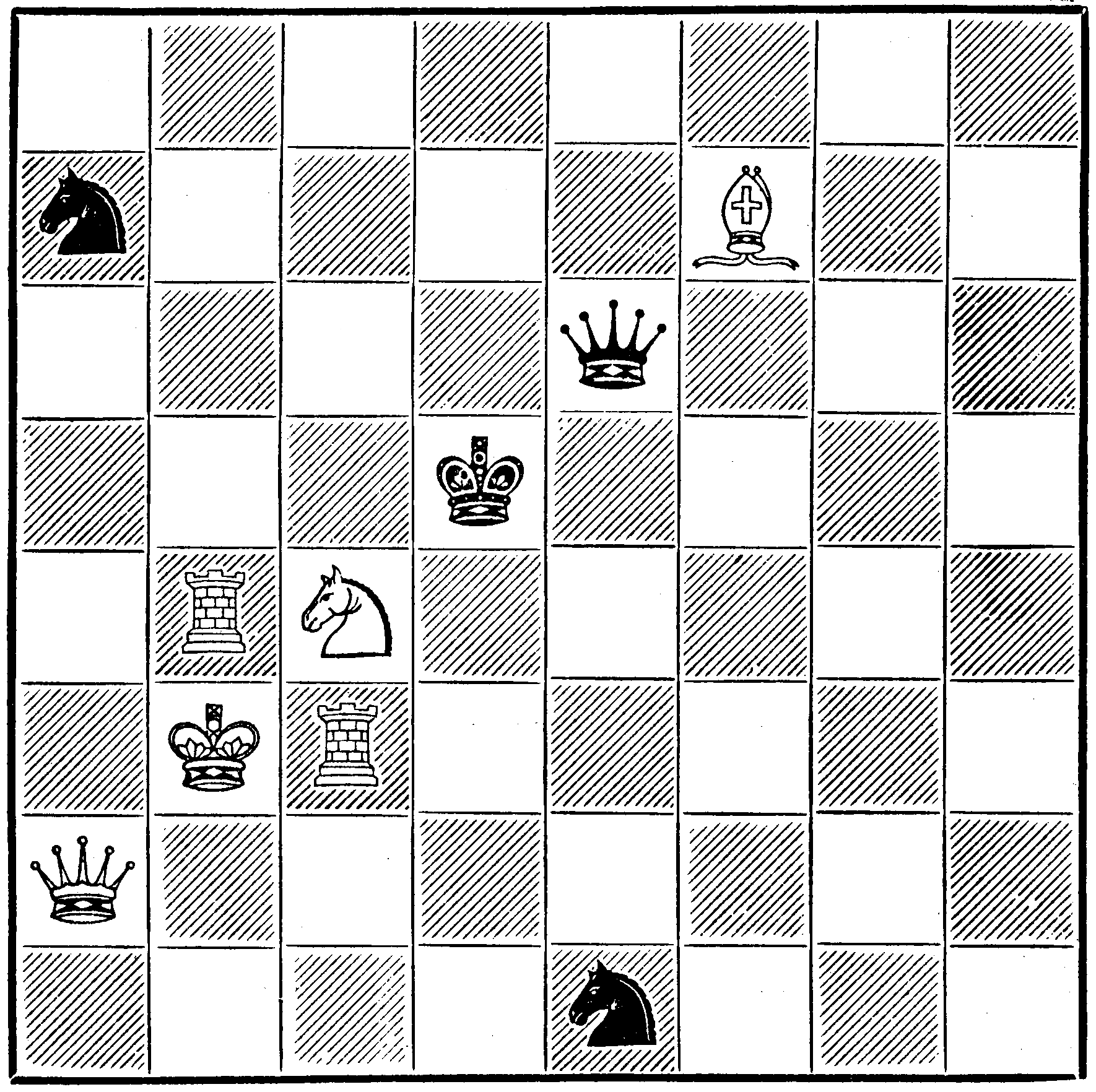
WHITE
White to play, and mate in three moves.
Solution
DIVINATION BY NUMBERS
Here is one of the methods by which we can readily discover a number that is thought of. The thought-reader gives these directions to his subject: “Add 1 to three times the number you have thought of; multiply the sum by 3; add to this the number thought of; subtract 3, and tell me the remainder.” This is always ten times the number thought of. Thus, if 6 is thought of—6 × 3 + 1 = 19; 19 × 3 = 57; 57 + 6 - 3 = 60, and 60 ÷ 10 = 6.
No. LI.—CHESS CAMEO By Konrad Bayer
BLACK
WHITE
White to play, and mate in three moves.
Solution
COINCIDENCES
Here is a curious rough rule for remembering distances and sizes:—
The diameter of the earth multiplied by 108 gives approximately the sun’s diameter. The diameter of the sun multiplied by 108 gives the mean distance of the earth from the sun. The diameter of the moon multiplied by 108 gives the mean distance of the moon from the earth.
No. LII.—CHESS CAMEO By J. Berger
BLACK
WHITE
White to play, and mate in three moves.
Solution
PERSONAL ARITHMETIC
Says Giles, “My wife and I are two, Yet faith I know not why, sir.” Quoth Jack, “You’re ten, if I speak true, She’s one, and you’re a cypher!”
No. LIII.—CHESS CAMEO By H. F. L. Meyer
BLACK
WHITE
White to play, and mate in three moves.
Solution
DIVISION BY SUBTRACTION
Here is a curious and quite uncommon method of dividing any multiple of 11 by 11.
Set down the multiple of 11, place a cypher under its last figure, draw a line, and subtract, placing the first remainder under the tens place. Subtract this from the next number in order, and so on throughout, adding in always any number that is carried. Thus:—
363 56408 375034
0 0 0
33 5128 34094
No. LIV.—CHESS CAMEO By Frank Healey
BLACK
WHITE
White to play, and mate in three moves.
Solution
LUCK IN ODD NUMBERS
Perhaps the old saying, “there is luck in odd numbers,” may have some connection with the curious fact that the sum of any quantity of consecutive odd numbers, beginning always with 1, is the square of that number. Thus:—
1 + 3 + 5 = 9 = 3 × 3.
1 + 3 + 5, etc., up to 17 = 81 = 9 × 9.
1 + 3 + 5, etc., up to 99 = 2500 = 50 × 50.
No. LV.—CHESS CAMEO By Frank Healey
BLACK
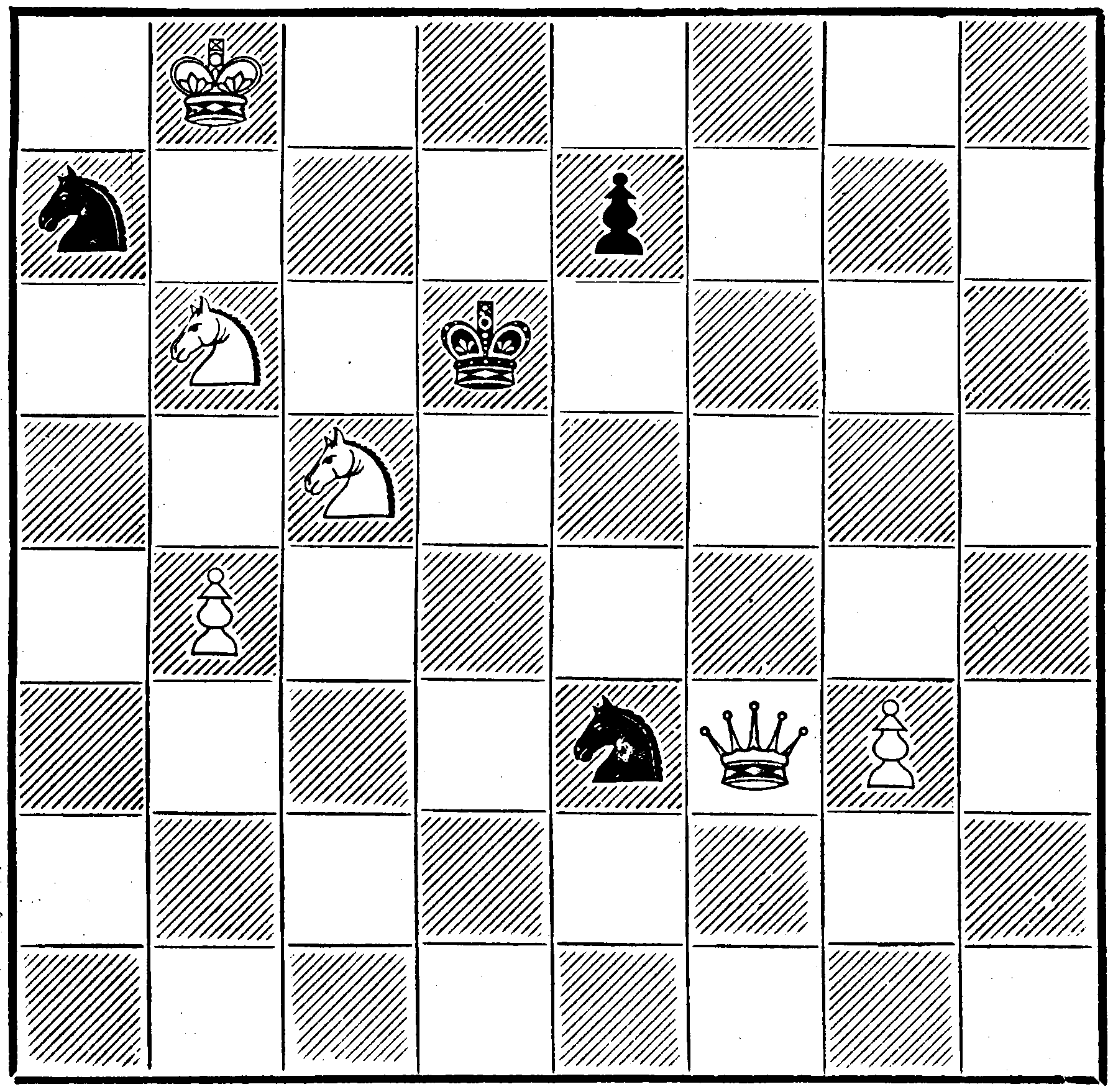
WHITE
White to play, and mate in three moves.
Solution
THE VERSATILE NUMBER
In the number 142857, if the digits which belong to it are in succession transposed from the first place to the end, the result is in each case a multiple of the original number. Thus:—
285714 = 142857 × 2
428571 = 142857 × 3
571428 = 142857 × 4
714285 = 142857 × 5
857142 = 142857 × 6
No. LVI.—CHESS CAMEO By J. E. Campbell
BLACK
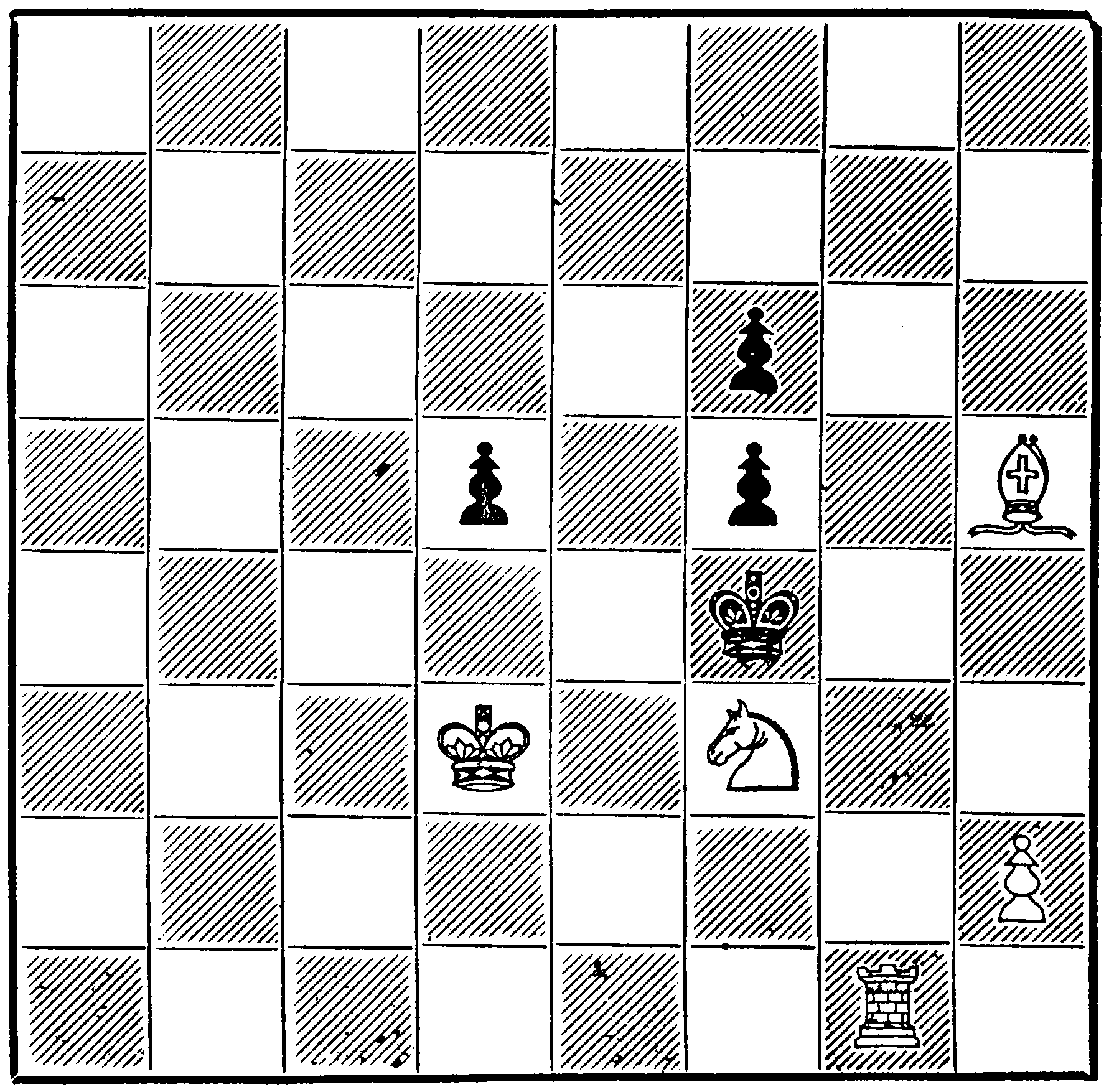
WHITE
White to play, and mate in three moves.
Solution
A PARADOX
By the following simple method, a plausible attempt is made to prove that 1 is equal to 2:—
Suppose that a = b, then
ab = a2
∴ ab - b2 = a2 - b2
∴ b(a - b) = (a + b)(a - b)
∴ b = a + b
∴ b = 2b
∴ 1 = 2
This process only proves in reality that 0 × 1 = 0 × 2, which is true.
No. LVII.—CHESS CAMEO Double First Prize By A. Cyril Pearson
BLACK
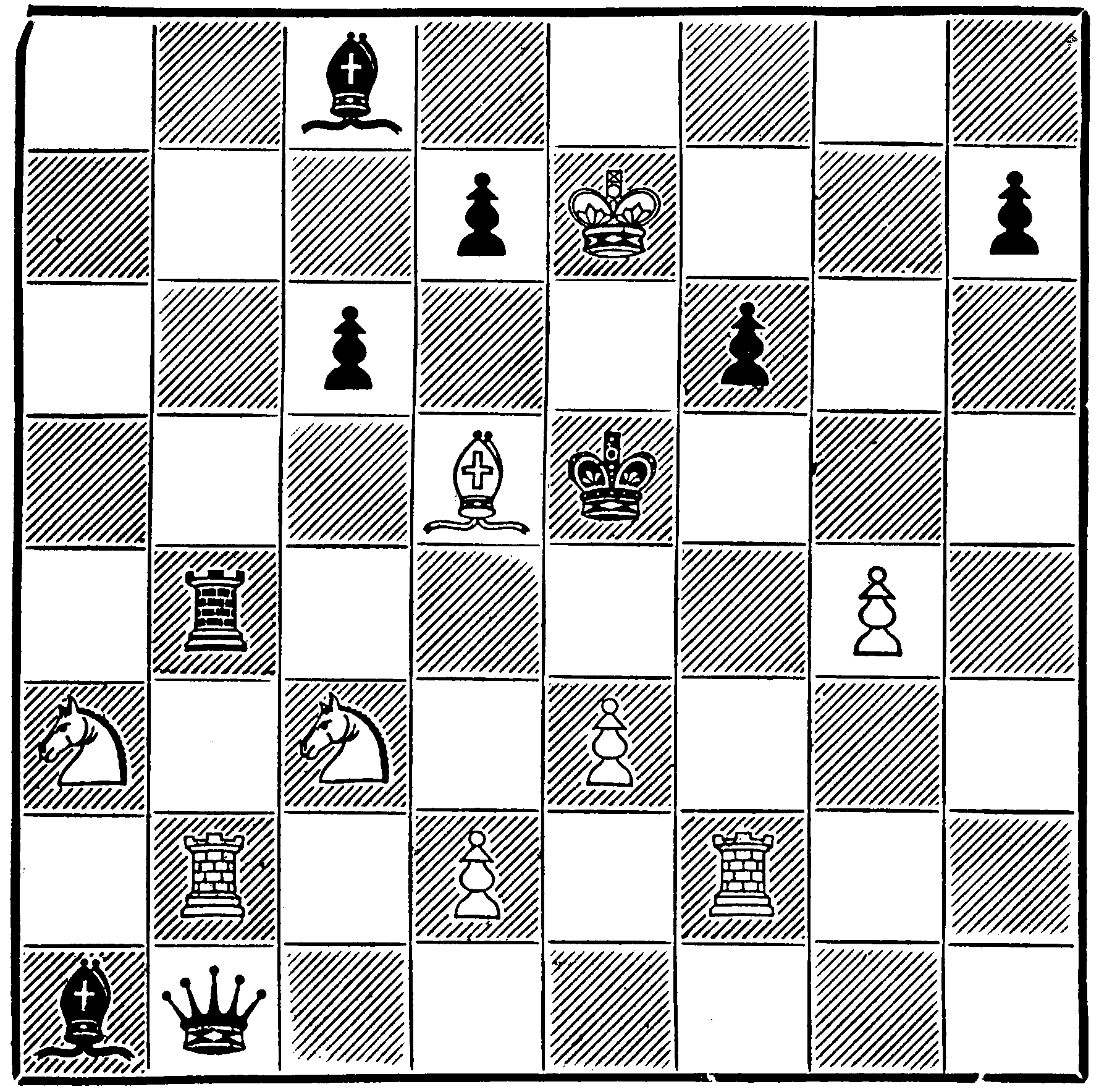
WHITE
White to play, and mate in four moves.
Solution
QUICK CALCULATION
Few people know a very singular but simple method of calculating rapidly how much any given number of pence a day amounts to in a year. The rule is this:—Set down the given number of pence as pounds; under this place its half, and under that the result of the number of original pence multiplied always by five. Take, for example, 7d a day:—
£7 0 0
3 10 0
2 11
£10 12 11
The reason for this is evident as soon as we remember that the 365 days of a year may be split up into 240, 120, and 5, and that 240 happens to be the number of pence in a pound.
SCIENCE AT PLAY
No. LVIII.—THE GEARED WHEELS
A small wheel with ten teeth is geared into a large fixed wheel which has forty teeth. This small wheel, with an arrow mark on its highest cog, is revolved completely round the large wheel. How often during its course is the arrow pointing directly upwards? Here is a diagram of the starting position.
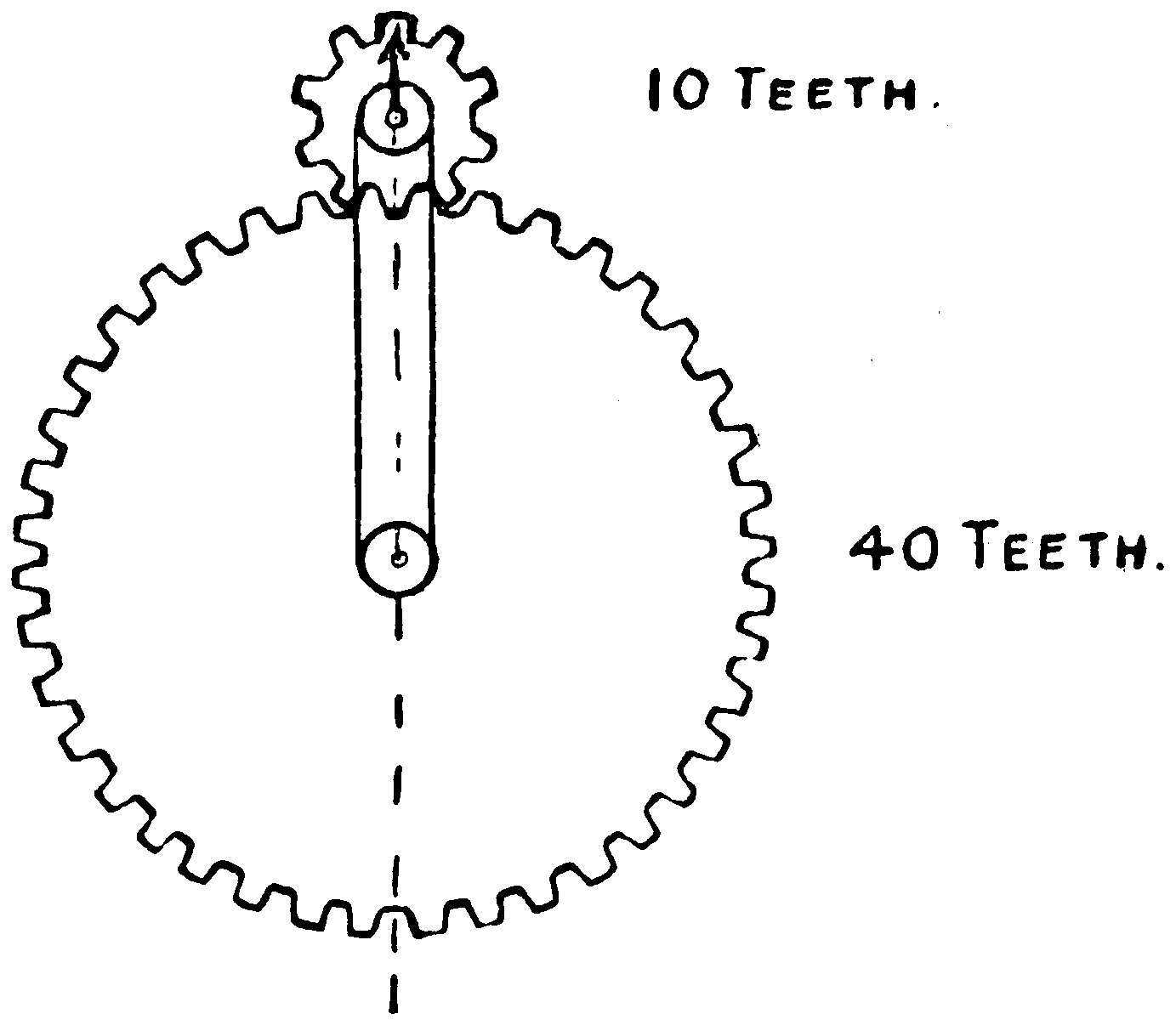
Solution
No. LIX.—ADVANCING BACKWARDS
Here is a most curious and interesting question:—When an engine is drawing a train at full speed from York to London, what part of the train at any given moment is moving towards York?
At any time, when the engine is drawing a train at full speed from York to London, that part of the flange of each wheel which is for the moment at its lowest is actually moving backwards towards York.
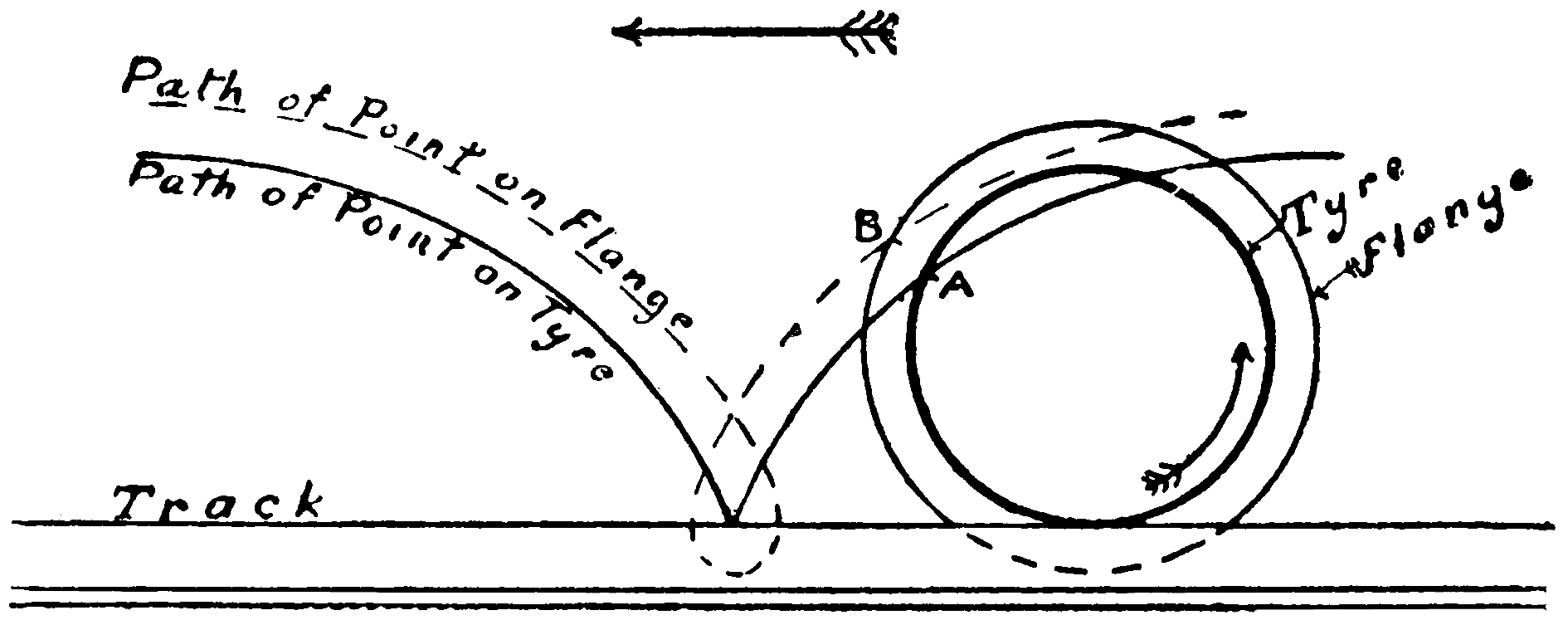
For any point, such as A, on the circumference of the tyre, describes in running along a series of curves, as shown by full lines in the diagram; and any point, B, on the outer edge of the flange, follows a path shown by the dotted curves.
If these lines are followed round with a pencil in the direction of the arrows, it will be found that the point on the flange actually moves backwards as it passes below the track, while the point A, as it completes each curve, is at rest for the instant on the track, just before it starts afresh. The speed of the train does not affect these very curious facts.
No. LX.—THE FIFTEEN BRIDGES
In the subjoined diagram A and B represent two islands, round which a river runs as is indicated, with fifteen connecting bridges, that lead from the islands to the river’s banks.
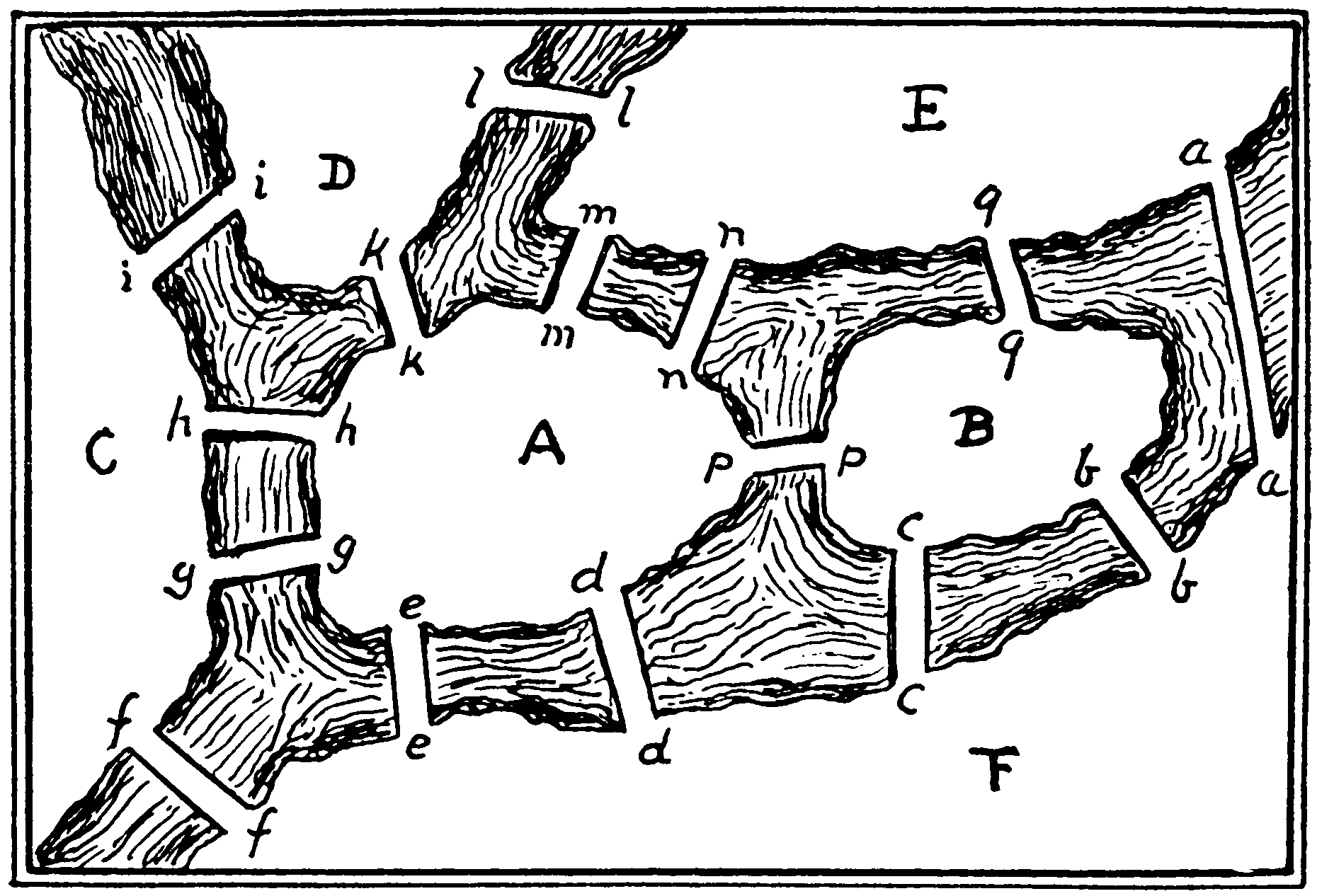
Can you contrive to pass in turn over all these bridges without ever passing over the same one twice?
Solution
ARRANGING THE DIGITS
In a school where two boys were taught to think out the bearings of their work, a sharp pupil remarked that 100 is represented on paper by the smallest digit and two cyphers, which are in themselves symbols of nothing. The master, quick to catch any signs of mental activity, took the opportunity to propound to his class the following ingenious puzzle:—How can the sum of 100 be represented exactly in figures and signs by making use of all the nine digits in their reverse order? This is how it is done:—
9 × 8 + 7 + 6 + 5 + 4 + 3 + 2 + 1 = 100.
Another ingenious method of using the nine digits, so that by simple addition they sum up to exactly 100, and each is used once only, is this:—
15 + 36 + 47 = 98 + 2 = 100
Here is another arrangement by which the nine digits written in their inverse order can be made to represent exactly 100:—
98 - 76 + 54 + 3 + 21 = 100.
Here is yet another way of arriving at 100 by using each of the digits, this time with an 0:—
401⁄2 5938⁄76 100
No. LXI.—LOOPING THE LOOP
Here is quite a pretty scientific experiment, which any one of a handy turn can construct and arrange:—
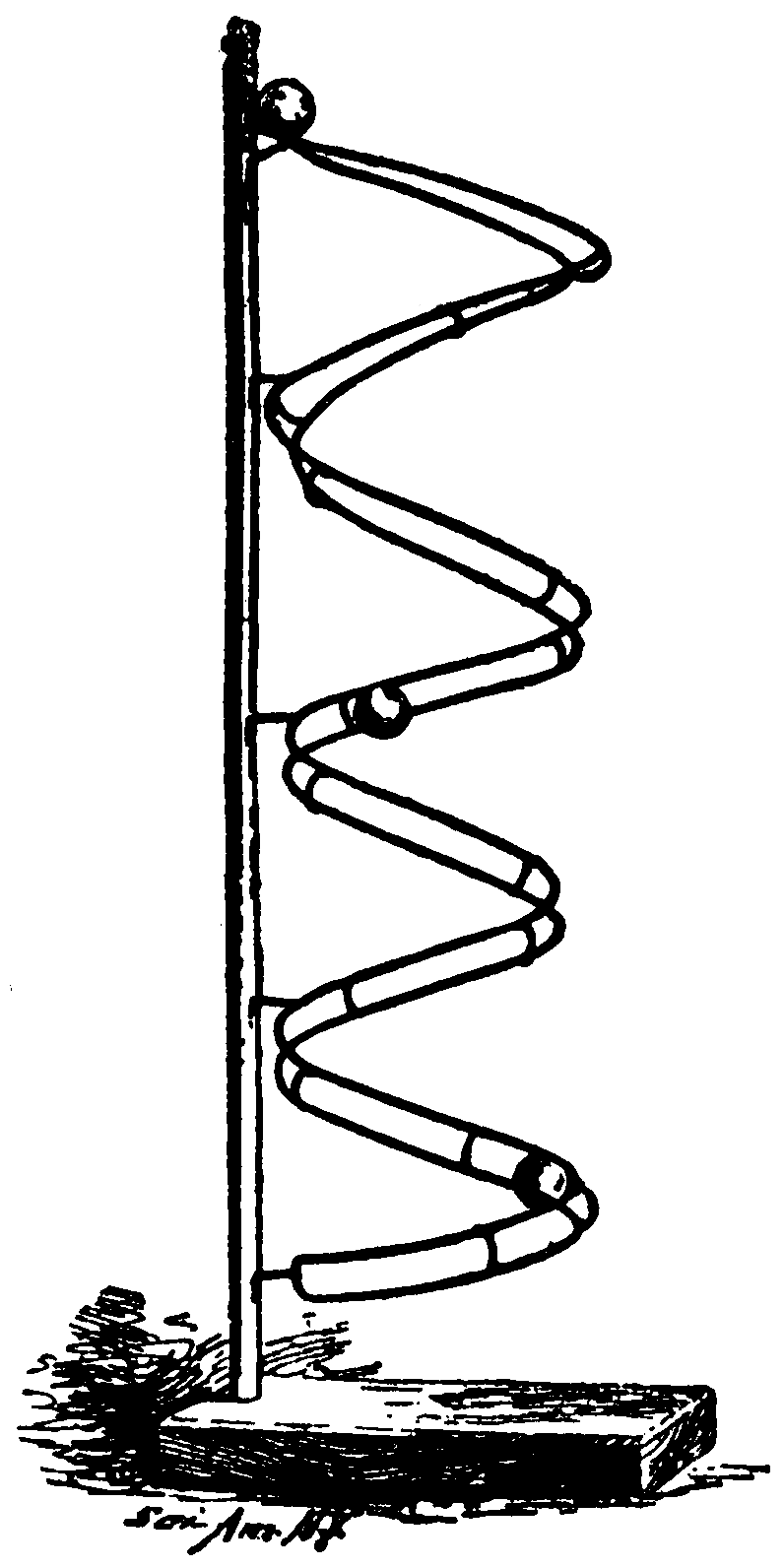
The spiral track is formed of two wires bent, and connected by curved cross-pieces. The upper twist is turned so that the ball starts on a horizontal course.
During the accelerated descent the ball acquires momentum enough to keep it on the vertical track, held outwardly against the wires by centrifugal force.
Convenient proportions are: height of spiral two feet, diameter six inches, and wire rails three-quarters of an inch apart.
No. LXII.—A MECHANICAL BIRD
A close approach to an ideal flying machine can be made with a little ingenuity. Two Y-shaped standards, secured to the backbone rod, support two wires which carry wings of thin silk, provided with light stays, and connected at their inner corners with the backbone by threads.
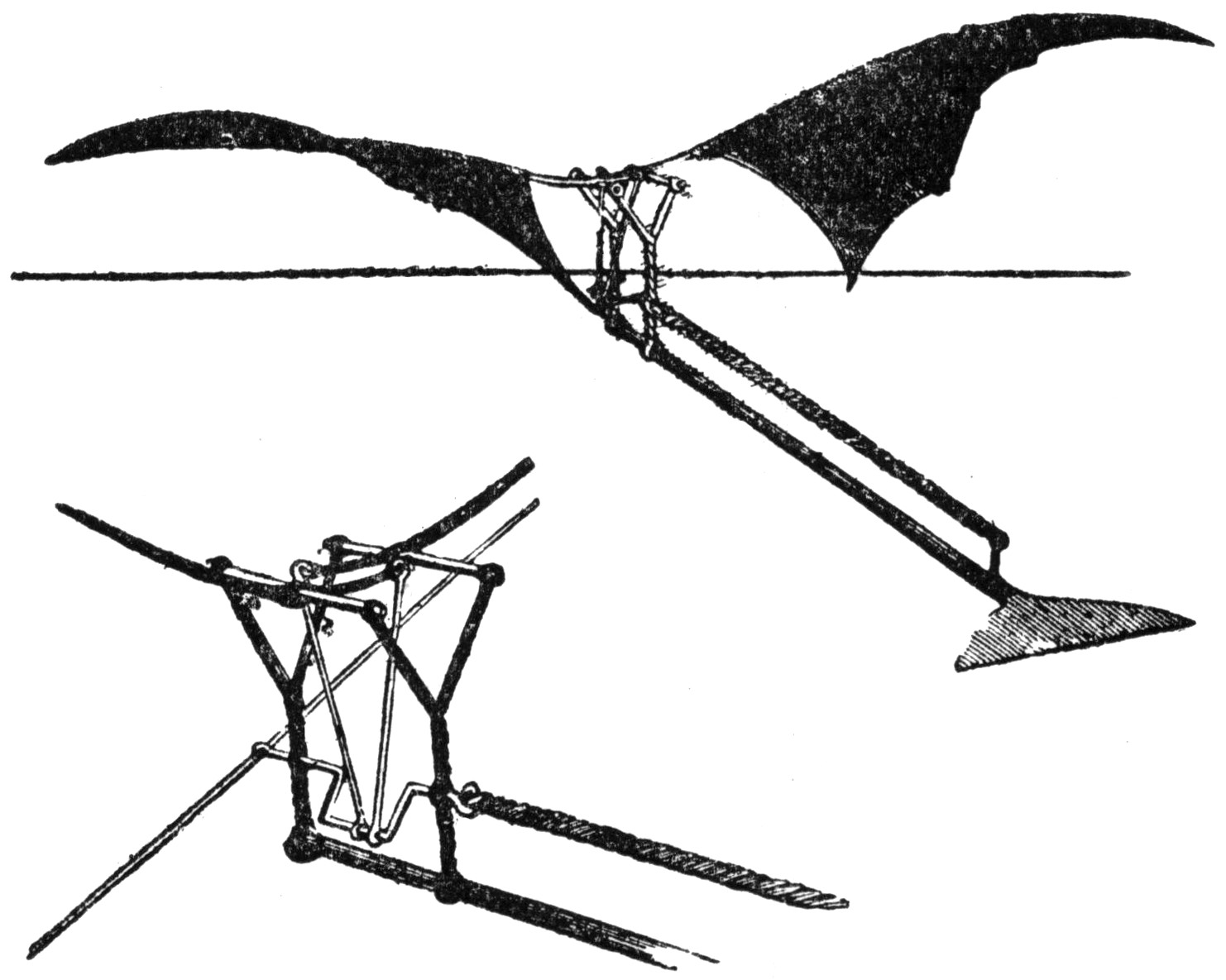
Rubber bands are attached to a loop on the inner end of the crank shaft, and secured to a post at the rear. These are twisted by turning the shaft with the cross wire, and when the tension is released the wings beat the air and carry the bird forward. It is known as Penaud’s mechanical bird, and has been sold as an attractive toy.
No. LXIII.—LINE OF SWIFTEST DESCENT
A simple apparatus constructed on the lines of this illustration will give an interesting proof of the laws which govern falling bodies on an inclined plane or on a curved path.
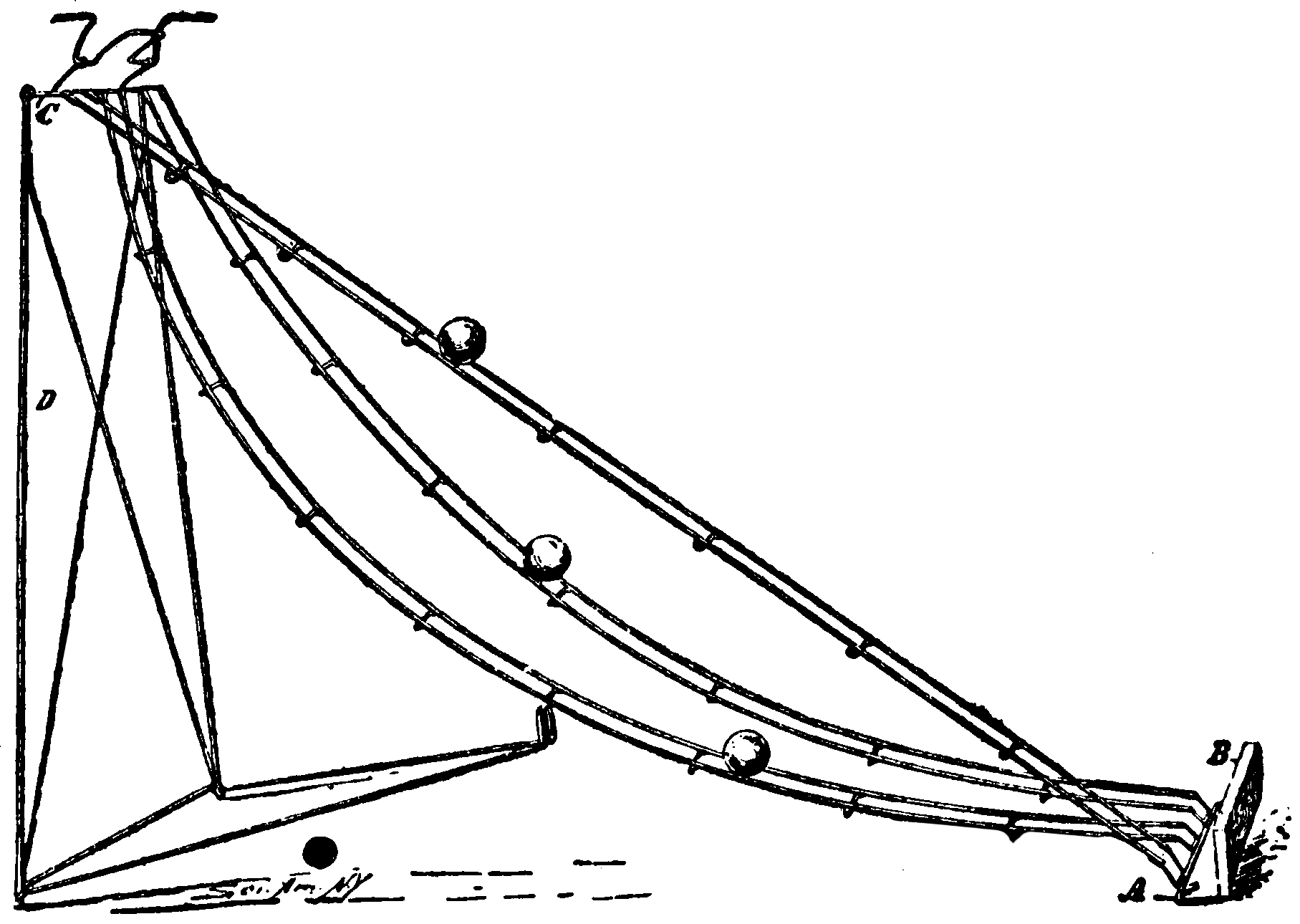
In the case of the inclined plane the ball is governed by the usual law which controls falling bodies. In that of the concave circular curve, as it is accelerated rapidly at the start, it makes its longer journey in quicker time. In the case of the cycloidal curve it acquires a high velocity. This curve has therefore been called “the curve of swiftest descent,” as a falling body passes over it in less time than upon any path except the vertical.
No. LXIV.—A CENTRIFUGAL RAILWAY
Here is another very simple and pretty illustration of the natural forces which come into play in “looping the loop.”
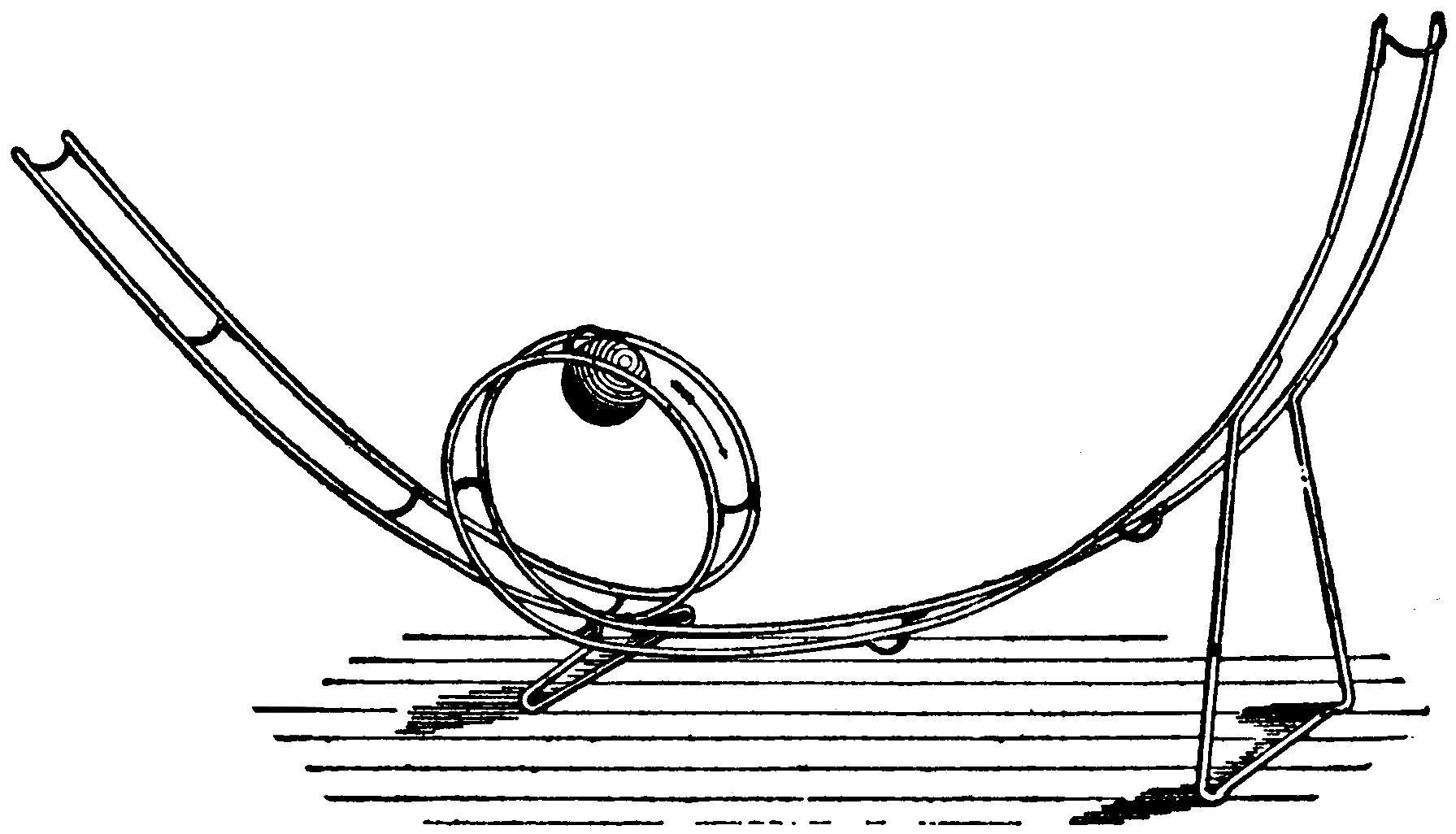
This scientific toy on a small scale may be easily made, if care is taken that the height of the higher end of the rails is to the height of the circular part in a greater ratio than 5 to 4.
A ball started at the higher end follows the track throughout, and at one point is held by centrifugal force against the under side of the rails, against the force of gravity.
No. LXV.—A QUESTION OF GRAVITY
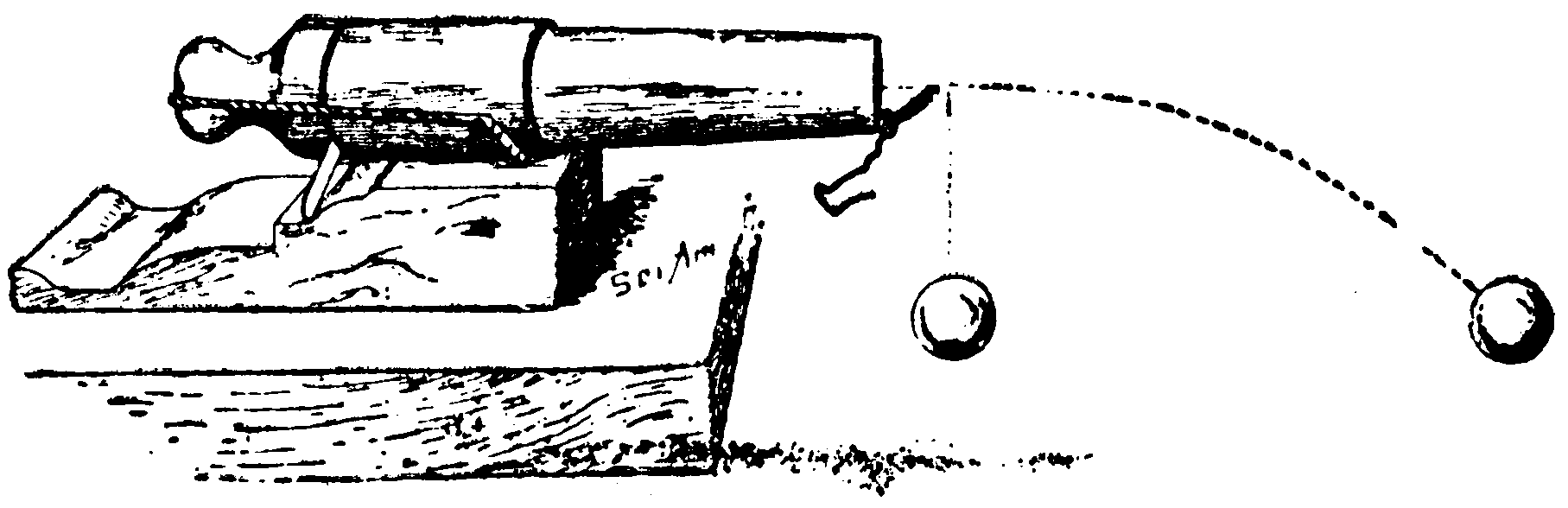
If a ball is fired point blank from a perfectly horizontal gun, and travels half a mile over a level plain before it touches ground, and another similar ball is at the same moment dropped from the same height by some mechanical means, the two balls will touch ground simultaneously. The flight, however long, of one through the air has no influence upon the force of gravity, which draws it earthward at the same resistless rate as it draws the other that is merely dropped.
A SHORT CUT
A quick method of multiplying any number of figures by 5 is to divide them by 2, annexing a cypher to the result when there is no remainder, and if there is any remainder annexing a 5. Thus:—
464 × 5 = 2320; 464 ÷ 2 = 232, annex 0, = 2320. 753 × 5 = 3765; 753 ÷ 2 = 376, annex 5, = 3765.
No. LXVI.—A DUCK HUNT
A duck begins to swim round the edge of a circular pond, and at the same moment a water spaniel starts from the middle of the pond in pursuit of it.
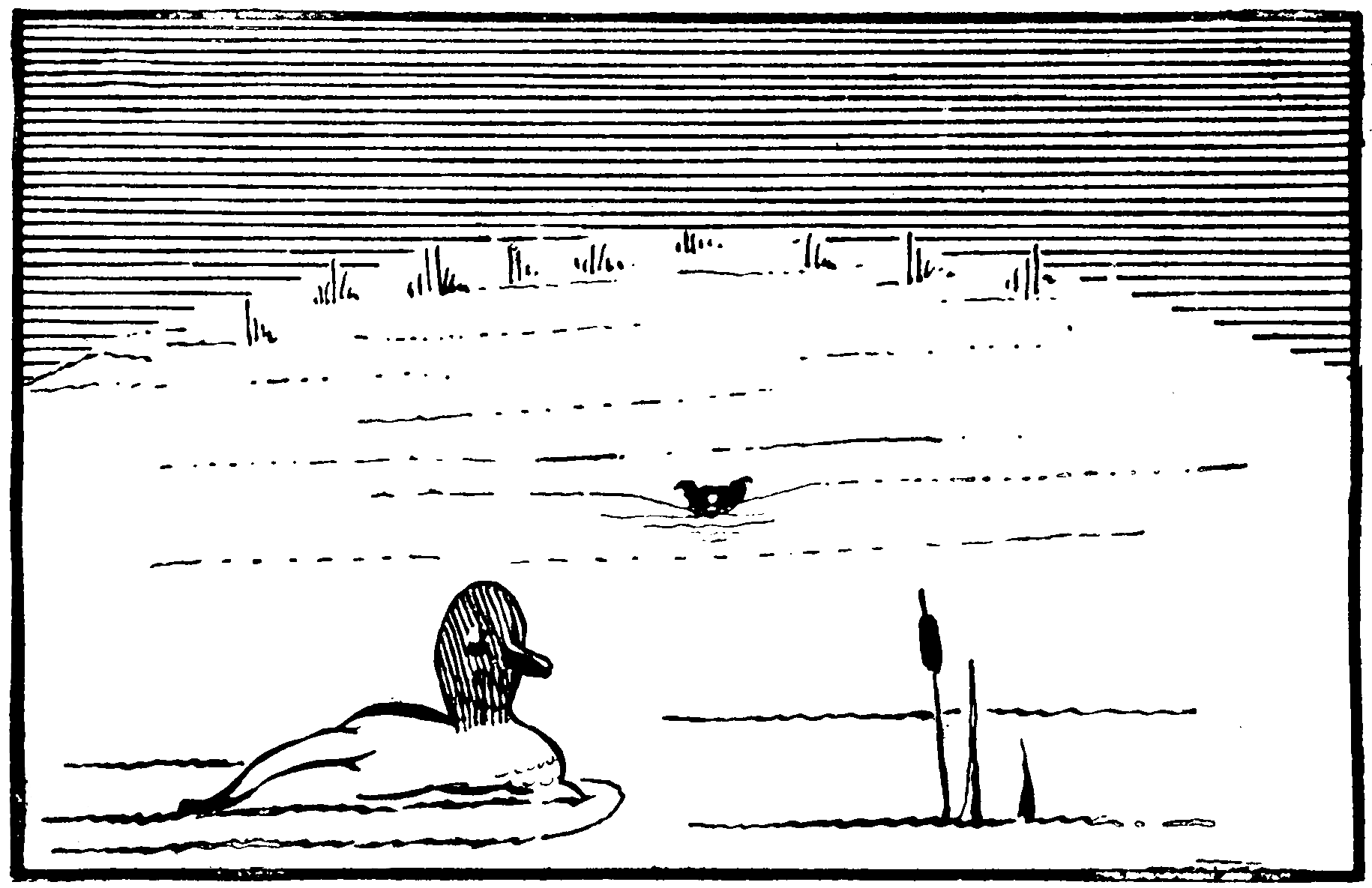
If both swim at the same pace, how must the dog steer his course so that he is sure in any case to overtake the duck speedily?
Solution
THE MAGIC OF DATES
Louis Napoleon, Emperor 1852
1852 1852 1852
date 1 date 1 date 1
of 8 of 8 of 8
his 0 Empress’s 2 their 5
birth 8 birth 6 marriage 3
1869 1869 1869
Thus, by a most remarkable series of coincidences, the principal dates of the Emperor and Empress of the French added, as is shown above, to the year of the Emperor’s accession, express in each instance the year before his fall.
No. LXVII.—GEOMETRY WITH DOMINOES
In this domino diagram we have a pretty and practical proof that the squares of the sides containing the right angle in any right-angled triangle are together equal to the square of the side opposite to the right angle.
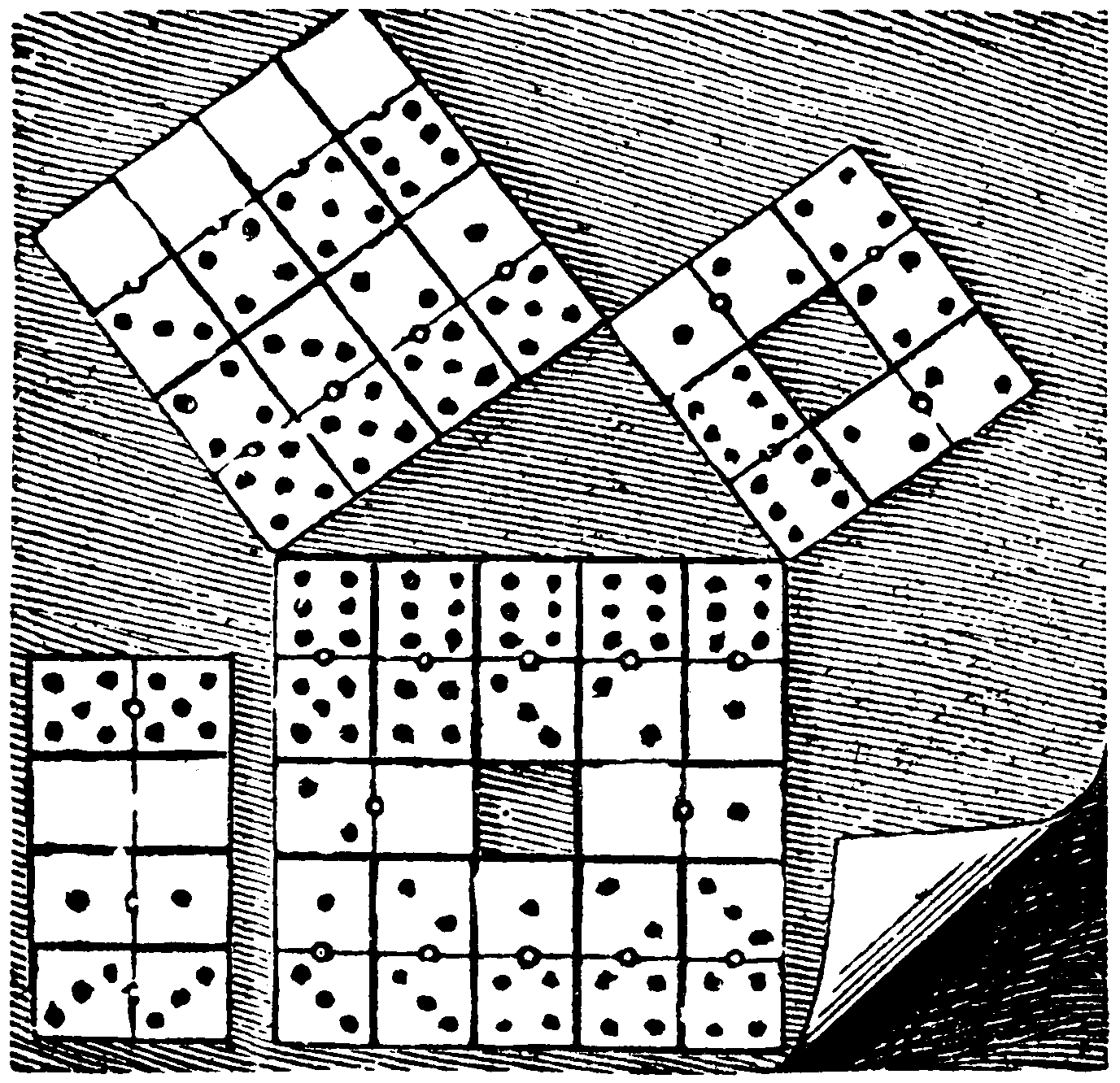
Each stone forms two squares, and it is easily seen that the number of squares which make up the whole square on the line opposite the right angle are equal to the number of those which make up the two whole squares on the lines which contain that angle.
A second point to be noticed is that the number of pips on the large square are equal to the number on the other two squares combined, an arrangement of the stones which forms quite a game of patience to reproduce, if this pattern is not at hand.
No. LXVIII.—TO COLOUR MAPS
Four colours at most are needed to distinguish the surfaces of separate districts on any plane map, so that no two with a common boundary are tinted alike.
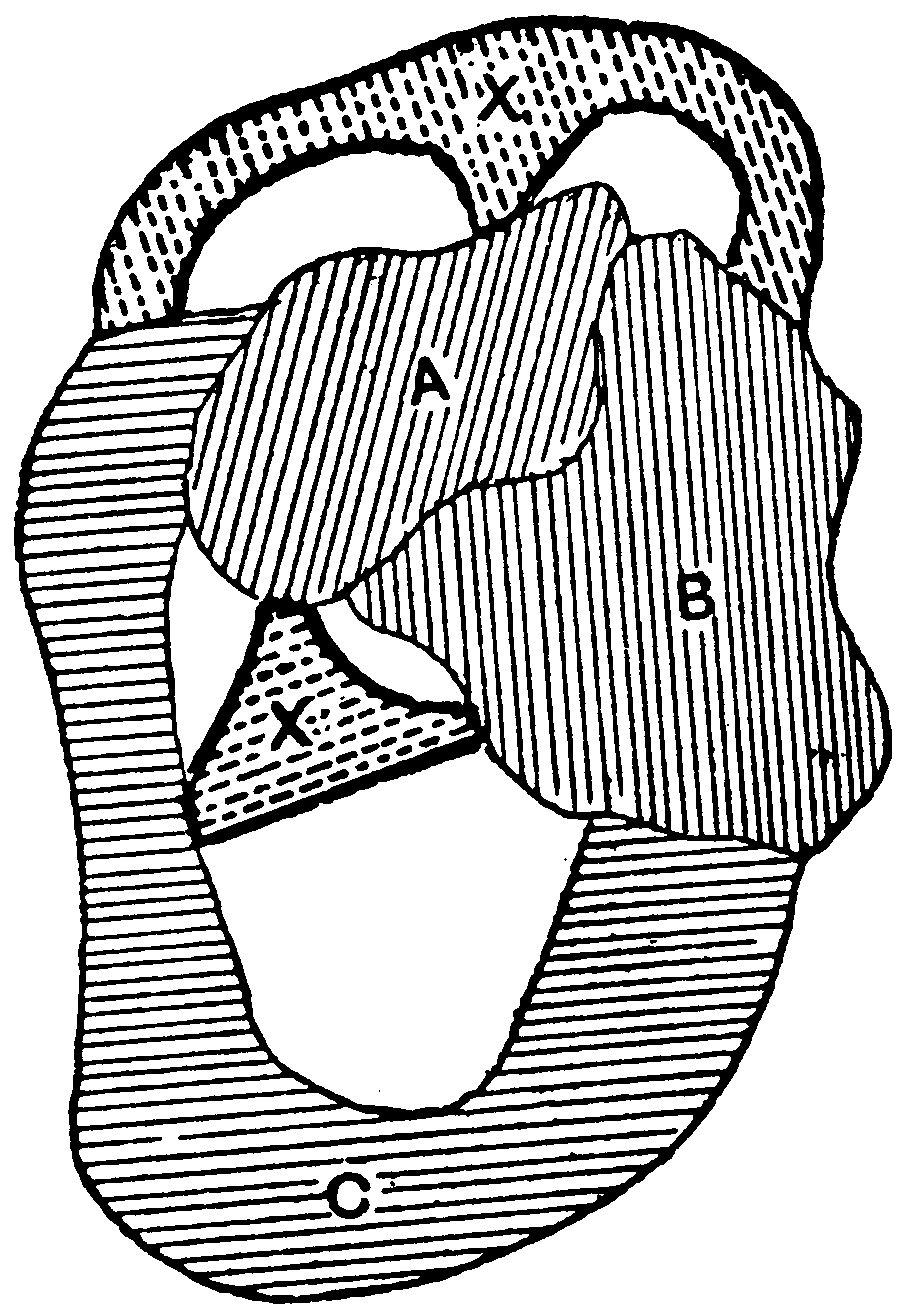
On this diagram A, B, and C, are adjoining districts, on a plane surface, and X borders, in one way or another, upon each.
It is clearly impossible to introduce a fifth area which shall so adjoin these four districts as to need another tint.
A FREAK OF FIGURES
Here is another freak of figures:—
9 × 1 - 1 = 8
9 × 21 - 1 = 188
9 × 321 - 1 = 2888
9 × 4321 - 1 = 38888
9 × 54321 - 1 = 488888
9 × 654321 - 1 = 5888888
9 × 7654321 - 1 = 68888888
9 × 87654321 - 1 = 788888888
9 × 987654321 - 1 = 8888888888
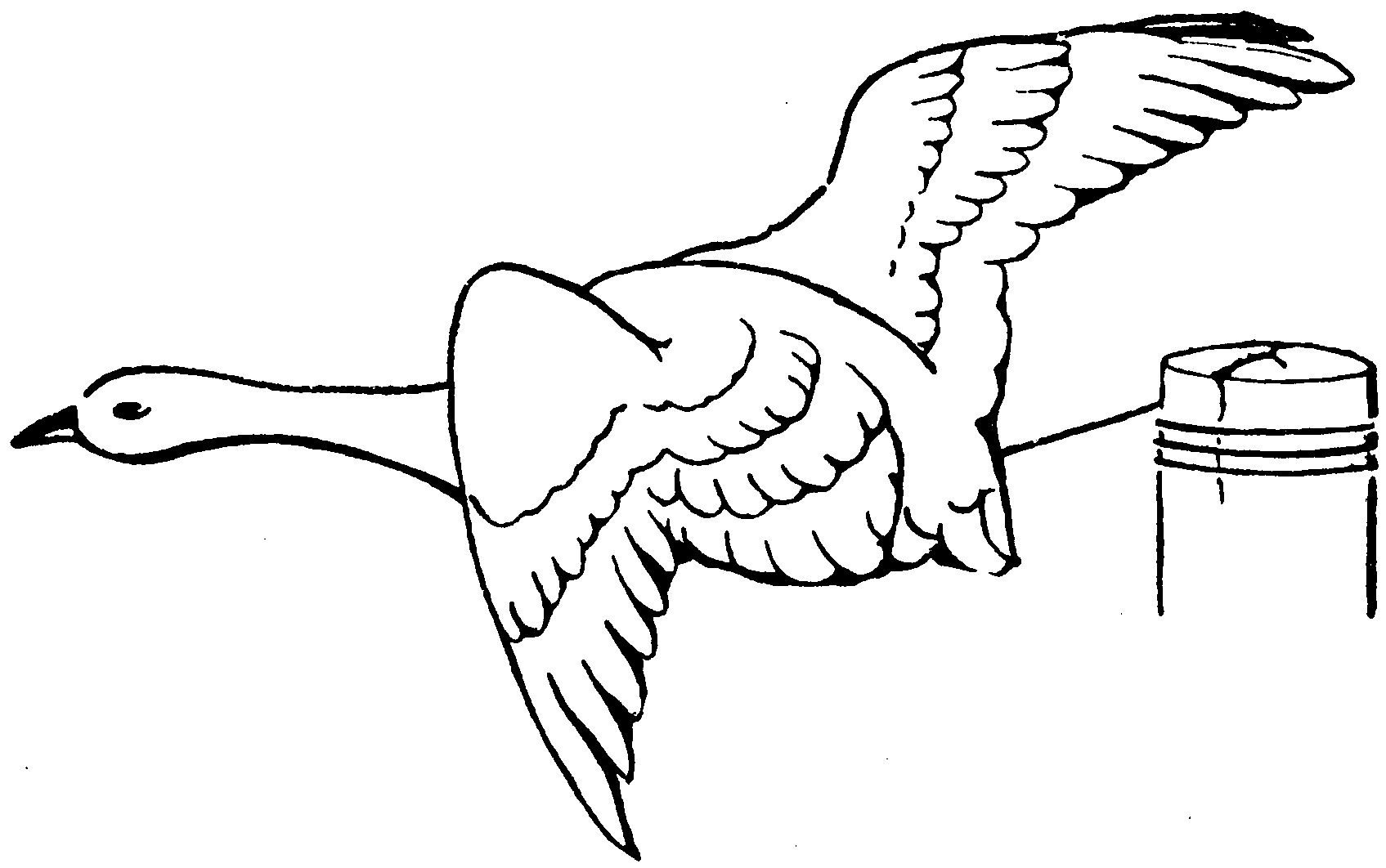
No. LXIX.—THE TETHERED BIRD
A bird made fast to a pole six inches in diameter by a cord fifty feet long, in its flight first uncoils the cord, keeping it always taut, and then recoils it in the reverse direction, rewinding the coils close together. If it starts with the cord fully coiled, and continues its flight until it brings up against the pole, how far does it fly in its double course?
Solution
STRIKE IT OUT
Ask a person to write down in a line any number of figures, then to add them all together as units, and to subtract the result from the sum set down. Let him then strike out any one figure, and add the others together as units, telling you the result.
If this has been correctly done, the figure struck out can always be determined by deducting the final total from the multiple of 9 next above it. If the total happens to be a multiple of 9, then a 9 was struck out.
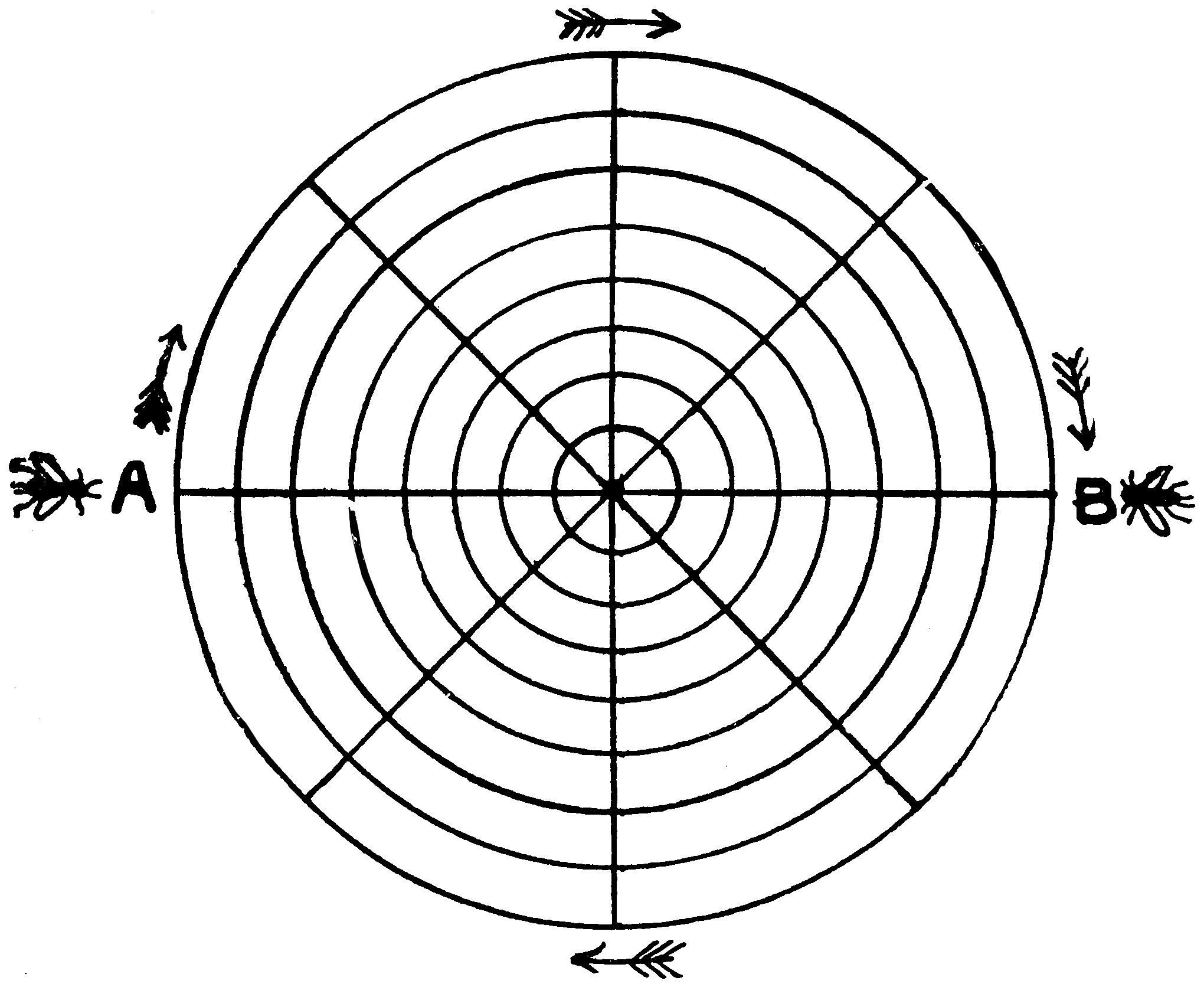
No. LXX.—THE MOVING DISC AND THE FLY
A fly, starting from the point A, just outside a revolving disc, and always making straight for its mate at the point B, crosses the disc in four minutes, while the disc is revolving twice. What effect has the revolution of the disc on the path of the fly?
Solution
A MAGIC SQUARE
This Magic Square is so arranged that the product of the continued multiplication of the numbers in each row, column, or diagonal is 4096, which is the cube of the central 16.
8 256 2
4 16 64
128 1 32
No. LXXI.—A SHUNTING PUZZLE
The railway, D E F, has two sidings, D B A and F C A, connected at A. The rails at A, common to both, are long enough to hold a single wagon such as P or Q, but too short to admit the whole of the engine R, which, if it runs up either siding, must return the same way.
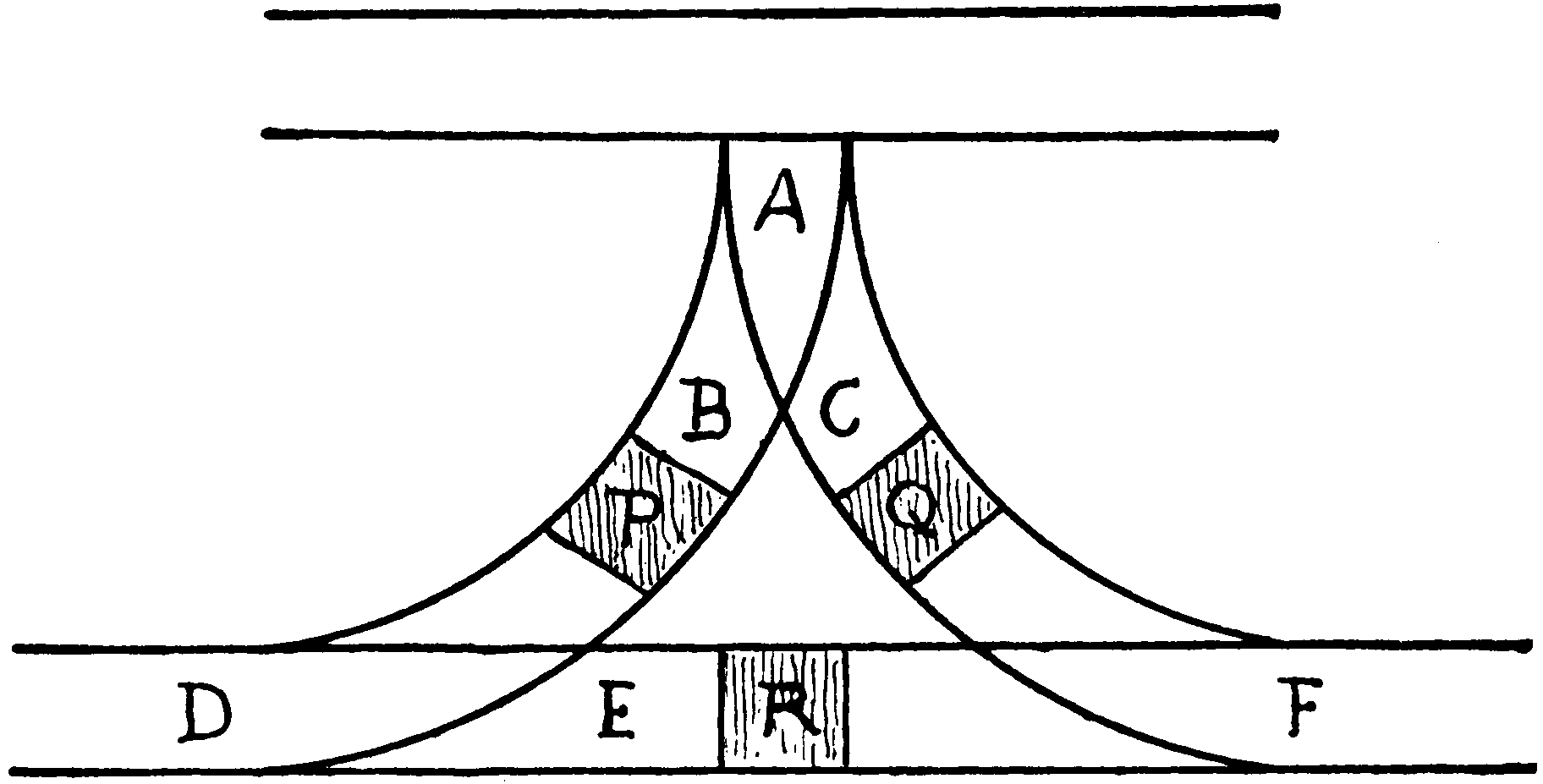
How can the engine R be used to interchange the wagons P and Q without allowing any flying shunts?—From Ball’s Mathematical Recreations.
Solution
No. LXXII.—A CURIOUS FACT
It is a little known and very interesting fact that an equilateral triangle can easily be drawn by rule of thumb in the following way:—Take a triangle of any shape or size, and on each of its sides erect an equilateral triangle. Find and join the centres of these, and a fourth equilateral triangle is always thus formed, as shown by the dotted lines.
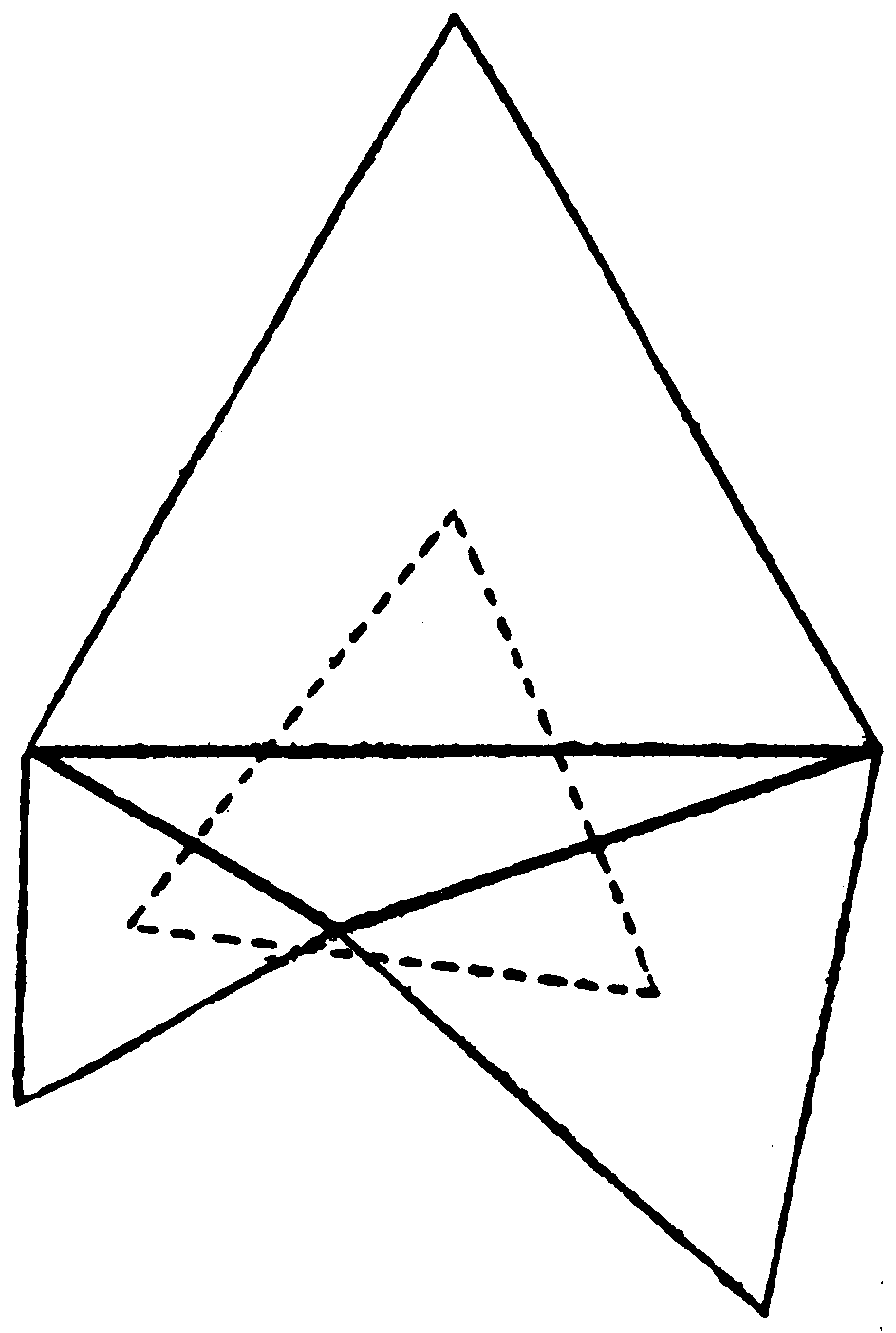
These centres are centres of gravity, and they are symmetrically distributed around the centre of gravity of the original triangle.
The figure formed by joining them must therefore be symmetrical, and, as in this case, it is a triangle, it must be always equilateral.
No. LXXIII.—TRY THIS EXPERIMENT
There can be no better instance of how the eye may be deceived than is so strikingly afforded in these very curious diagrams:—
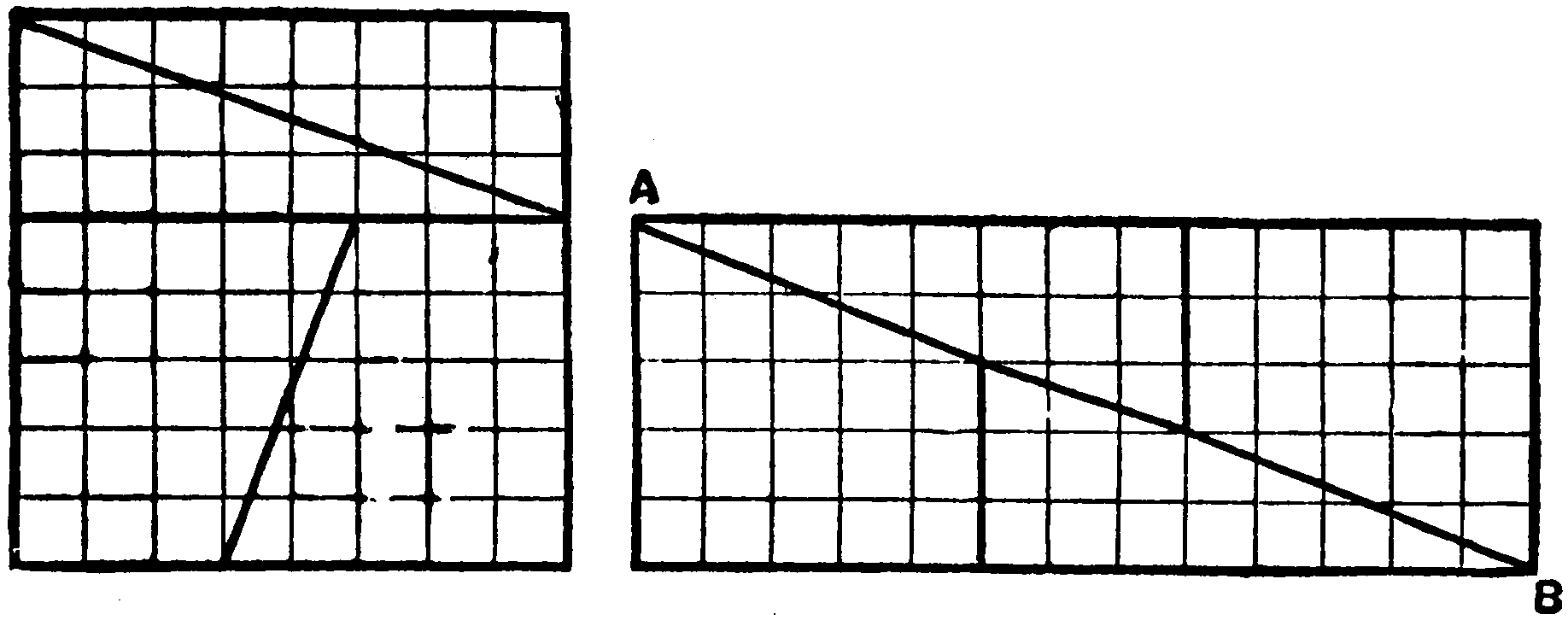
The square which obviously contains sixty-four small squares, is to be cut into four parts, as is shown by the thicker lines. When these four pieces are quite simply put together, as shown in the second figure, there seem to be sixty-five squares instead of sixty-four.
This phenomena is due to the fact that the edges of the four pieces, which lie along the diagonal A B, do not exactly coincide in direction. In reality they include a very narrow diamond, not easily detected, whose area is just equal to that of one of the sixty-four small squares.
FIGURES IN SWARMS
Very curious are the results when the nine digits in reverse order are multiplied by 9 and its multiples up to 81. Thus:—
9 8 7 6 5 4 3 2 1 × 9 = 8 8 8 8 8 8 8 8 8 9
× 18 = 1 7 7 7 7 7 7 7 7 7 8
× 27 = 2 6 6 6 6 6 6 6 9 9 7
× 36 = 3 5 5 5 5 5 5 5 5 5 6
× 45 = 4 4 4 4 4 4 4 4 4 4 5
× 54 = 5 3 3 3 3 3 3 3 3 3 4
× 63 = 6 2 2 2 2 2 2 2 2 2 3
× 72 = 7 1 1 1 1 1 1 1 1 1 2
× 81 = 8 0 0 0 0 0 0 0 0 0 1
It will be seen that the figures by which the reversed digits are multiplied reappear at the beginning and end of each result except the first, and that the figures repeated between them are to be found by dividing the divisors by 9 and subtracting the result from 9. Thus, 54 ÷ 9 = 6, and 9 - 6 = 3.
No. LXXIV.—A TRIANGLE OF TRIANGLES
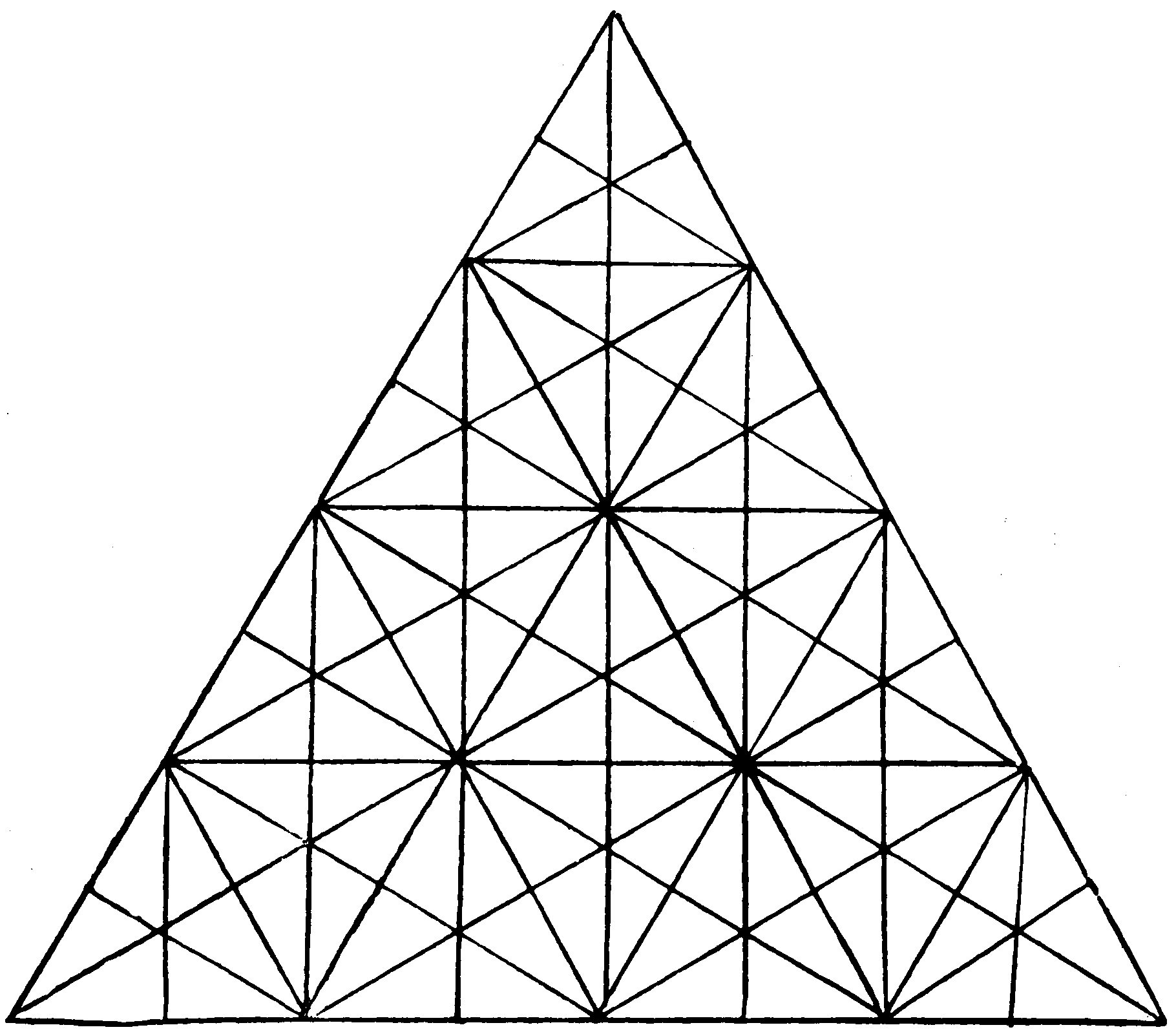
In this nest of triangles there are no less than six hundred and fifty-three distinct triangles of various shapes and sizes.
No. LXXV.—PHARAOH’S SEAL
In a chamber of the Great Pyramid an ancient Egyptian jar was found, marked with the device now known as Pharaoh’s seal.
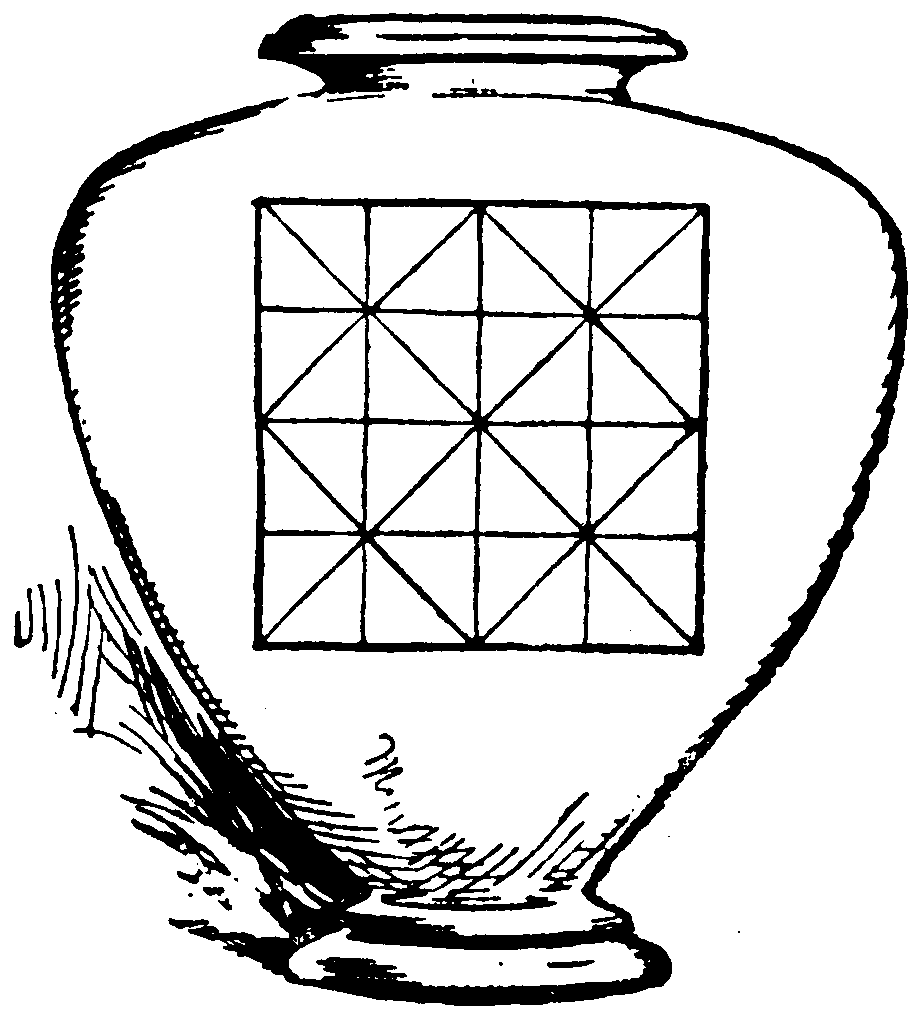
Can you count the number of triangles or pyramids, of many sizes, but all of similar shape that are expressed on it? Solvers should draw the figure on a larger scale.
Solution
MAKING CUBES
It is interesting to note that the repeated addition of odd numbers to one another can be so arranged as to produce cube numbers in due sequence. Thus:—
1 = 1 × 1 × 1
3 + 5 = 2 × 2 × 2
7 + 9 + 11 = 3 × 3 × 3
13 + 15 + 17 + 19 = 4 × 4 × 4
21 + 23 + 25 + 27 + 29 = 5 × 5 × 5
and so on, to any extent.
No. LXXVI.—ROUND THE GARDEN
In a large old-fashioned garden walks were arranged round a central fountain in the shape of a Maltese cross.
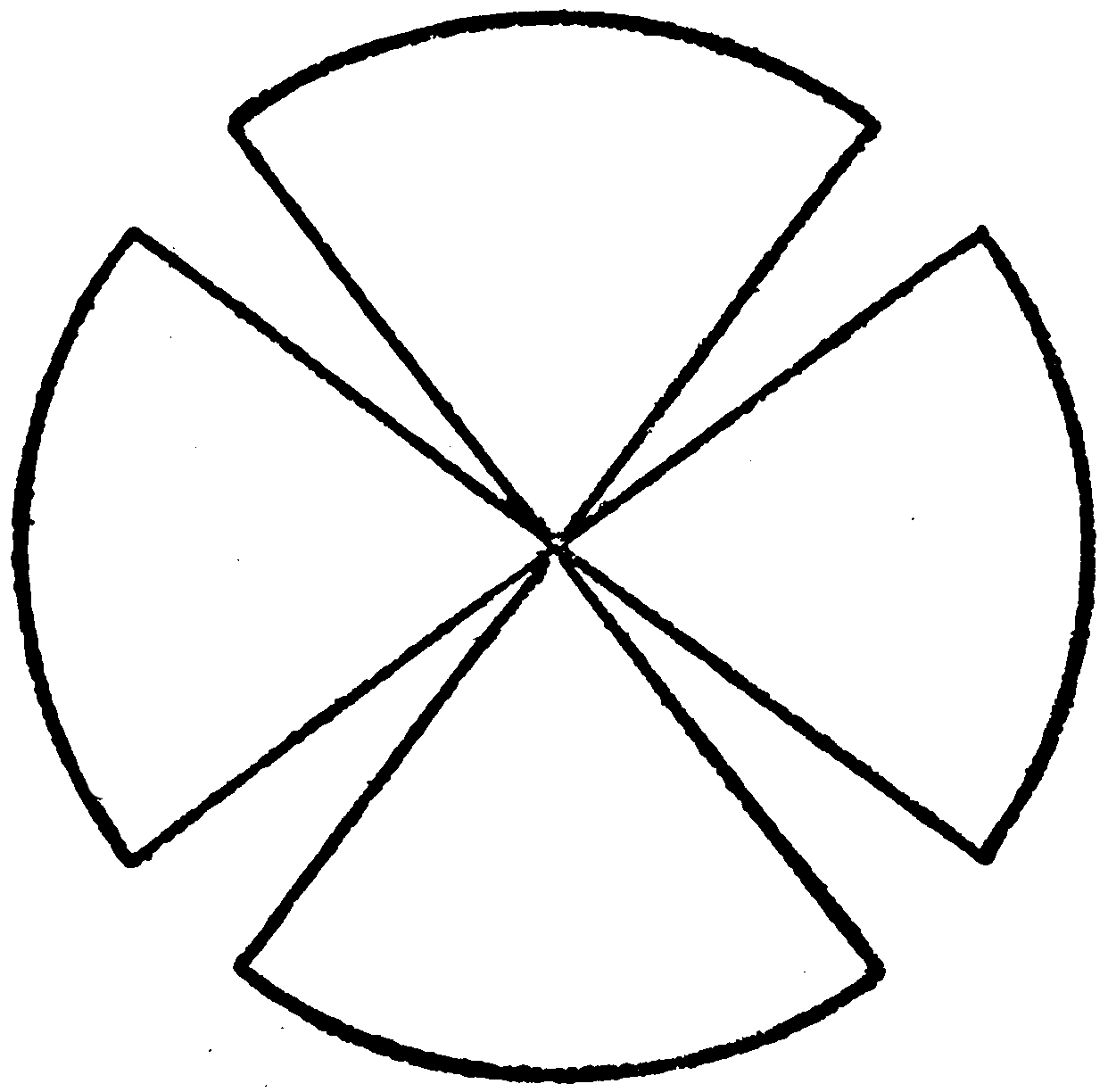
If four persons started at noon from the fountain, walking round the four paths at two, three, four and five miles an hour respectively, at what time would they meet for the third time at their starting-point, if the distance on each track was one-third of a mile?
Solution
A NICE SHORT CUT
When the tens of two numbers are the same, and their units added together make ten, multiply the units together, increase one of the tens by unity, and multiply it by the other ten. The result is the product of the two original numbers, if the first result follows the other. Thus:—
43 × 47 = 2021.
No. LXXVII.—A JOINER’S PUZZLE
Can you cut Fig. A into two parts, and so rearrange these that they form either Fig. B or Fig. C?
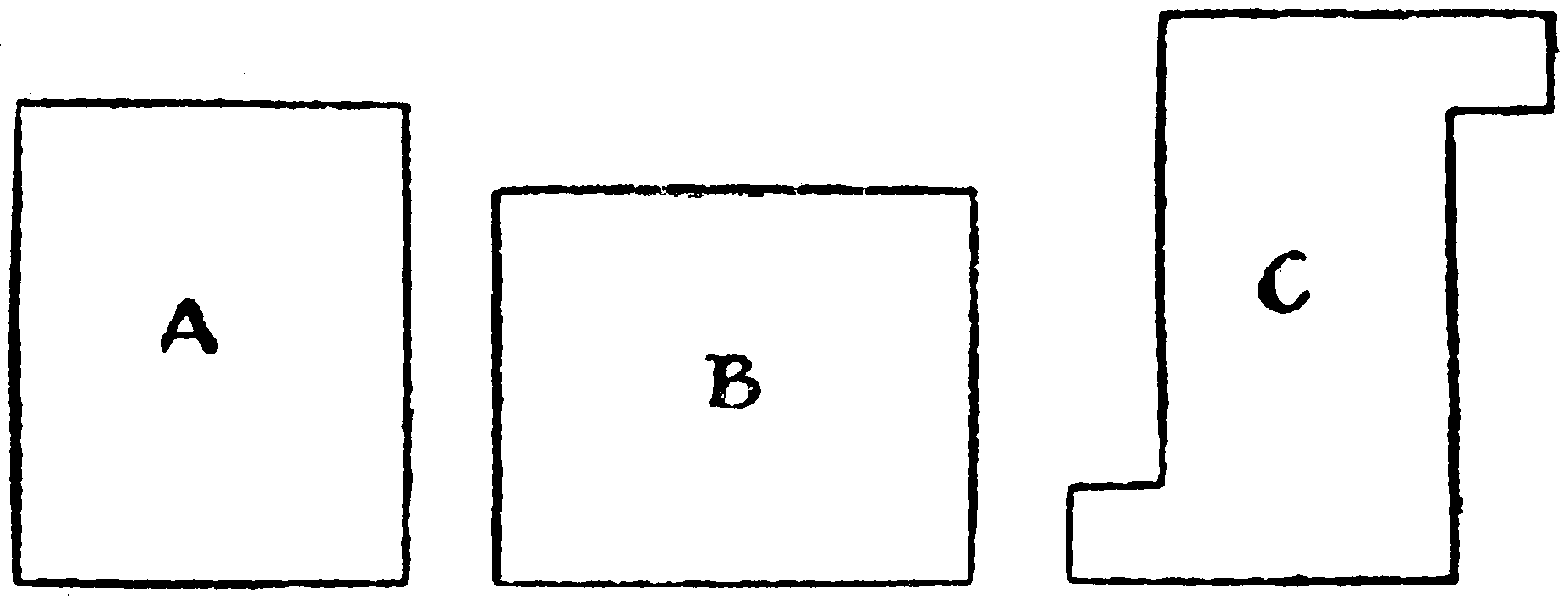
The two parts of A must not be turned round to form B or C, but must retain their original direction.
Solution
A CALCULATION
Coal may fail us, but we can never run short of material for “words that burn.” It has been calculated that if a man could read 100,000 words in an hour, and there were 4,650,000 men available, they could not pronounce the possible variations which could be formed from the alphabet in 70,000 years!
A PARADOX
It is possible, in a sense, by the following neat method, to take 45 from 45, and find that 45 remains:—
987654321 = 45.
123456789 = 45.
864197532 = 45.
No. LXXVIII.—THE BROKEN OCTAGON
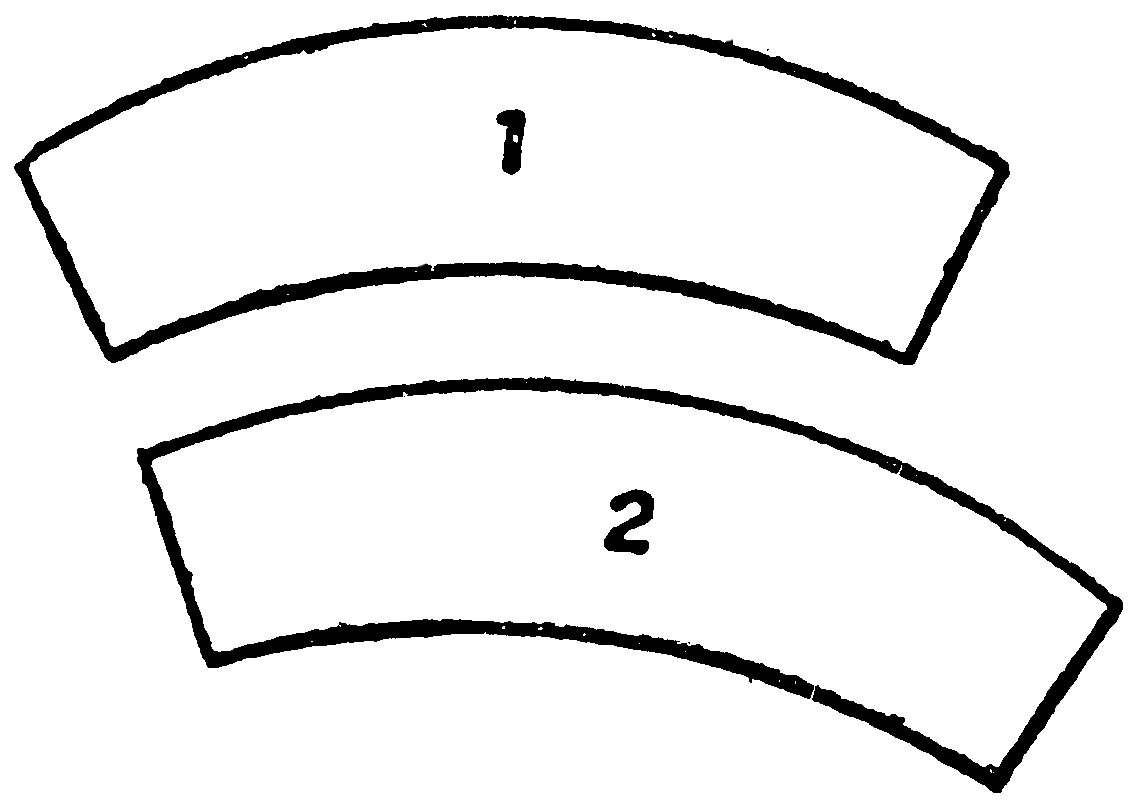
Cut out in stiff cardboard four pieces shaped as Fig. 1, four as Fig. 2, and four as Fig. 3, taking care that they are all exactly true to pattern in shape and proportion to one another.
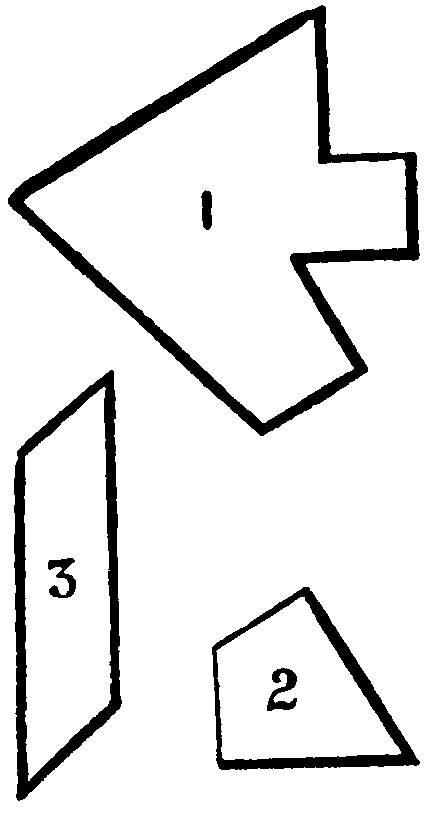
Now see whether you can put the twelve pieces together so as to form a perfect octagon.
Solution
PROPERTIES OF SEVEN
Here is a proof that 7, if it cannot rival the mystic 9, has quaint properties of its own:—
1 5 8 7 3 × 7 = 1 1 1 1 1 1
3 1 7 4 6 × 7 = 2 2 2 2 2 2
4 7 6 1 9 × 7 = 3 3 3 3 3 3
6 3 4 9 2 × 7 = 4 4 4 4 4 4
7 9 3 6 5 × 7 = 5 5 5 5 5 5
9 5 2 3 8 × 7 = 6 6 6 6 6 6
1 1 1 1 1 1 × 7 = 7 7 7 7 7 7
1 2 6 9 8 4 × 7 = 8 8 8 8 8 8
1 4 2 8 5 7 × 7 = 9 9 9 9 9 9
A SWARM OF EIGHTS
Here is an arithmetical curiosity:—
9 × 9 + 7 = 8 8
9 × 9 8 + 6 = 8 8 8
9 × 9 8 7 + 5 = 8 8 8 8
9 × 9 8 7 6 + 4 = 8 8 8 8 8
9 × 9 8 7 6 5 + 3 = 8 8 8 8 8 8
9 × 9 8 7 6 5 4 + 2 = 8 8 8 8 8 8 8
9 × 9 8 7 6 5 4 3 + 1 = 8 8 8 8 8 8 8 8
9 × 9 8 7 6 5 4 3 2 + 0 = 8 8 8 8 8 8 8 8 8
No. LXXIX.—AT A DUCK POND
A farmer’s wife kept a pure strain of Aylesbury ducks for market on a square pond, with a duck-house at each corner. As trade grew brisk she found that she must enlarge her pond. An ingenious neighbour undertook to arrange this without altering the shape of the pond, and without disturbing the duck-houses. What was his plan?
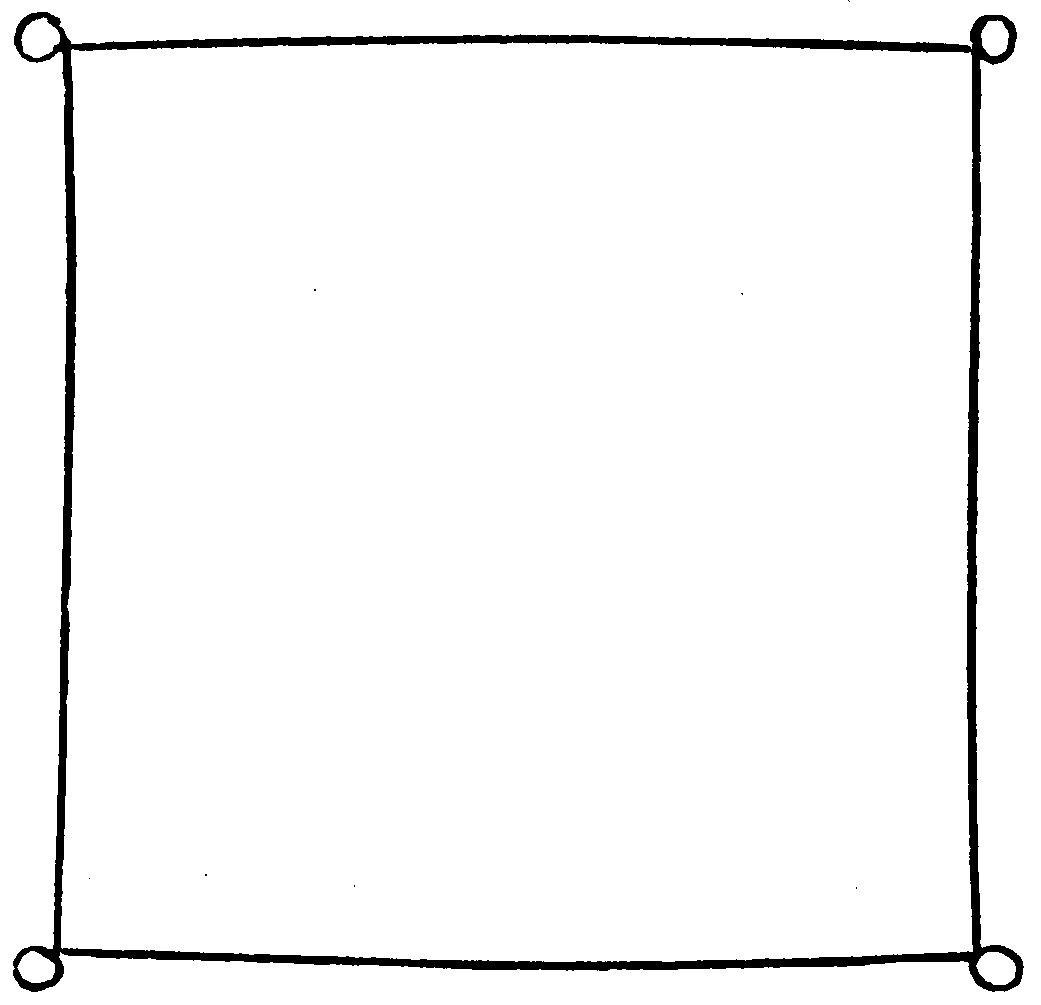
Solution
STRANGE SUBTRACTION
It would seem impossible to subtract 69 from 55, but it can be arranged thus, with six as a remainder:—
SIX IX XL
IX X L
S I X
No. LXXX.—ALL ON THE SQUARE
Cut out in cardboard twenty triangular pieces exactly the size and shape of this one, and try to place them together so that they form a perfect square.
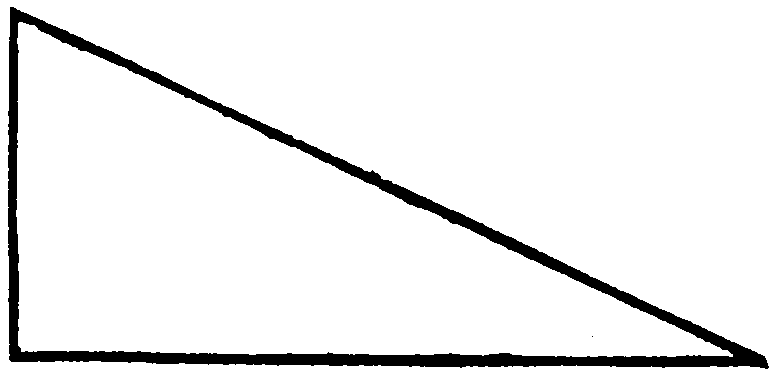
Solution
ANOTHER MYSTIC NUMBER
The decimal equivalent of 1⁄13 is .076923. This (omitting the point), multiplied by 1, 3, 4, 9, 10, or 12, yields results in which the same figures appear in varied order, but similar sequence, and multiplied by 2, 5, 6, 7, 8, or 11, it yields a different series, with similar characteristics. Thus:—
76923 × 1 = 76923 76923 × 2 = 153846
× 3 = 230769 × 5 = 384615
× 4 = 307692 × 6 = 461538
× 9 = 692307 × 7 = 538461
× 10 = 769230 × 8 = 615384
× 12 = 923076 × 11 = 846153
DON’T BUY IT TO TRY IT
A kaleidoscope cylinder contains twenty small pieces of coloured glass. As we turn it round, or shake it, so as to make ten changes of pattern every minute, it will take the inconceivable space of time of 462,880,899,576 years and 360 days to exhaust all the possible symmetrical variations. (The 360 days is good!)
No. LXXXI.—PINS AND DOTS
Here is an amusing little exercise for the ingenuity of our solvers.
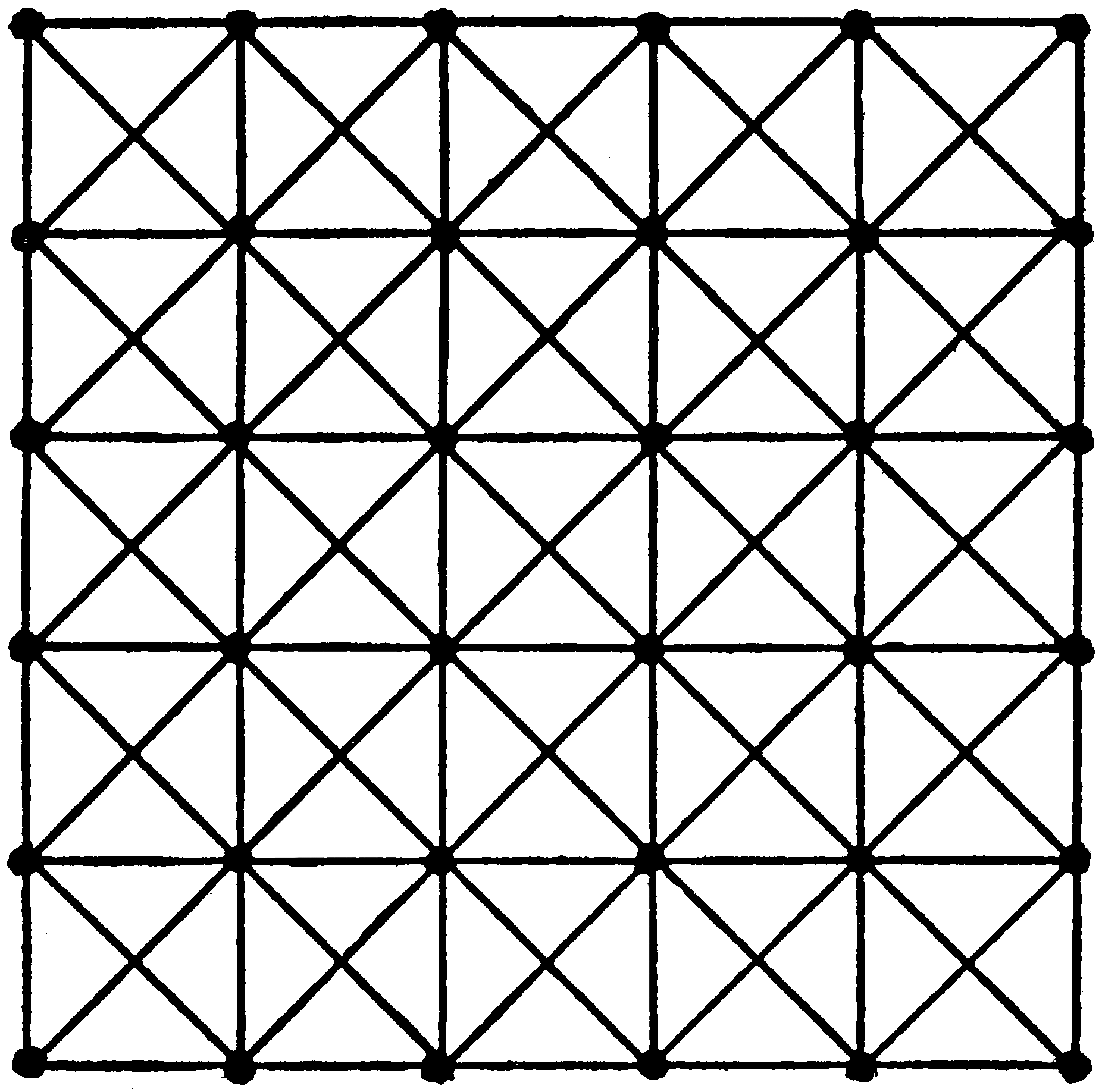
Take six sharp pins, and puzzle out how to stick them into six of the black dots, so that no two pins, are on the same line, in any direction, vertical, horizontal, or diagonal.
Solution
No. LXXXII.—A TRICKY COURSE
The middle of a large playground was paved with sixty-four square flagstones of equal size, which are numbered on this diagram from one to sixty-four.
1 9 17 25 33 41 49 57
2 10 18 26 34 42 50 58
3 11 19 27 35 43 51 59
4 12 20 28 36 44 52 60
5 13 21 29 37 45 53 61
6 14 22 30 38 46 54 62
7 15 23 31 39 47 55 63
8 16 24 32 40 48 56 64
One of the schoolmasters, who had a head for puzzles, took his stand upon the square here numbered 19, and offered a prize to any boy who, starting from the square numbered 46, could make his way to him, passing through every square once, and only once. It was after many vain attempts that the course was at last discovered. Can you work it out?
Solution
No. LXXXIII.—FOR THE CHILDREN
Place twelve draughtsmen, or buttons, in a square, so that you count four along each side of it, thus:—
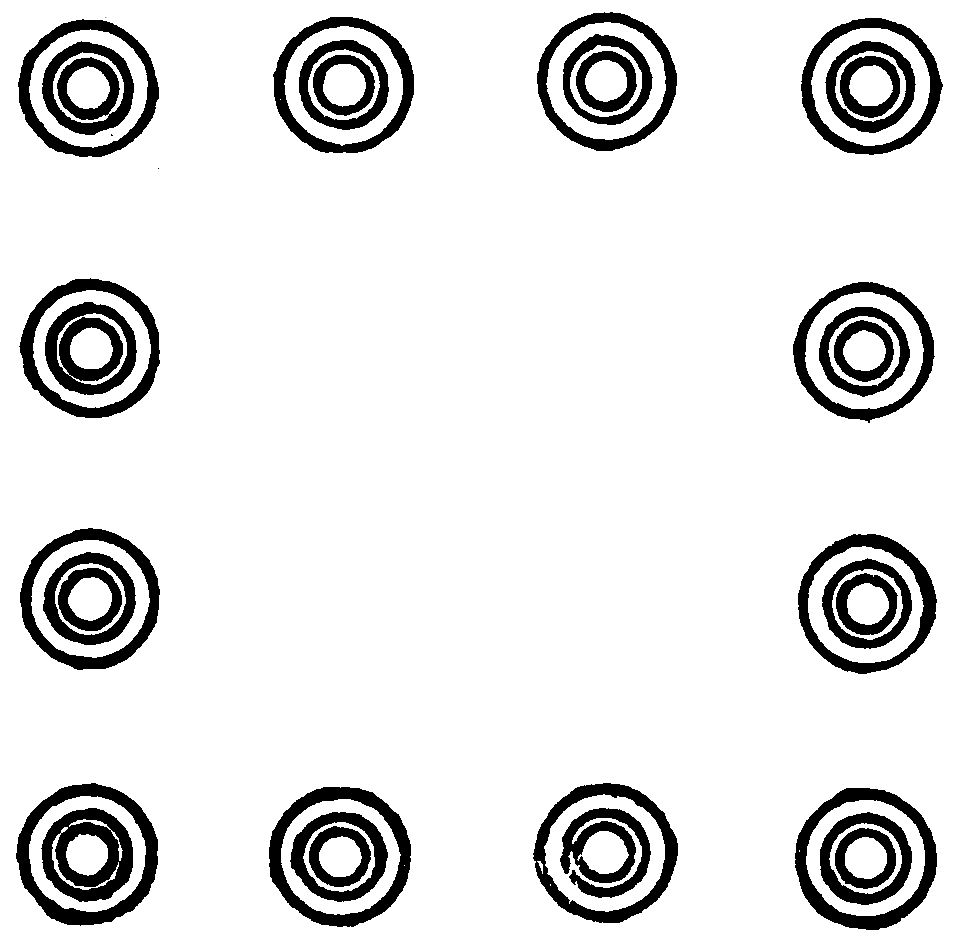
Now take the same men or buttons, and arrange them so that they form another square, and you can count five along each side of it.
Solution
A GAME OF NINES
Here is a good specimen of the eccentricities and powers of numbers:—
153846 × 13 = 1999998
230769 × 13 = 2999997
307692 × 13 = 3999996
384615 × 13 = 4999995
461538 × 13 = 5999994
538461 × 13 = 6999993
615384 × 13 = 7999992
692307 × 13 = 8999991
No. LXXXIV.—TELL-TALE TABLES
She was quite an old maid, and her age was a most absolute secret. Determined to discover it, her scapegrace nephew, on Christmas Eve, produced these tables, and asked her with well simulated innocence on which of them she could see the number of her age.
1 23 45 2 23 46 16 27 54
3 25 47 3 26 47 17 28 55
5 27 49 6 27 50 18 29 56
7 29 51 7 30 51 19 30 57
9 31 53 10 31 54 20 31 58
11 33 55 11 34 55 21 48 59
13 35 57 14 35 58 22 49 60
15 37 59 15 38 59 23 50 61
17 39 61 18 39 62 24 51 62
19 41 A 19 42 B 25 52 C
21 43 22 43 26 53
8 27 46 4 23 46 32 43 54
9 28 47 5 28 47 33 44 55
10 29 56 6 29 52 34 45 56
11 30 57 7 30 53 35 46 57
12 31 58 12 31 54 36 47 58
13 40 59 13 36 55 37 48 59
14 41 60 14 37 60 38 49 60
15 42 61 15 38 61 39 50 61
24 43 62 20 39 62 40 51 62
25 44 D 21 44 E 41 52 F
26 45 22 45 42 53
From her answer he was able to calculate that the old lady was fifty-five.
The tell-tale tables disclosed her age thus:—As it appeared in tables A, B, C, E, and F, he added together the numbers at the top left-hand corners, and found the total to be fifty-five. This rule applies in all cases.
No. LXXXV.—A PAPER PUZZLE
Of the many paper-cutting tricks which appeal to us none is more simple and attractive than this:—
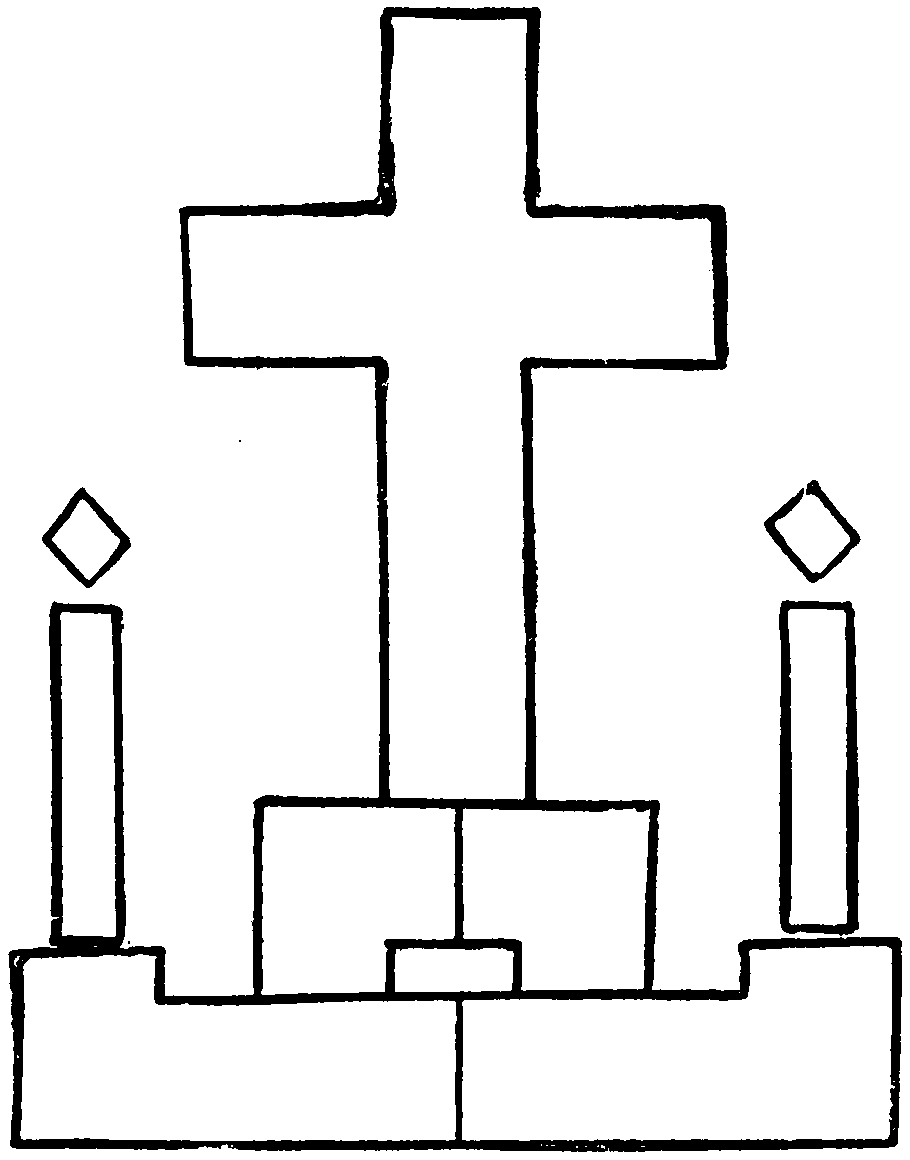
Take a piece of paper, say 5 inches by 3 inches, but any oblong shape and size will do, and after folding it four times cut it lengthways up the centre. Unfold the pieces, and to your surprise you will find a perfect cross and other pieces in pairs of the shapes shown above. The puzzle is how to fold the paper.
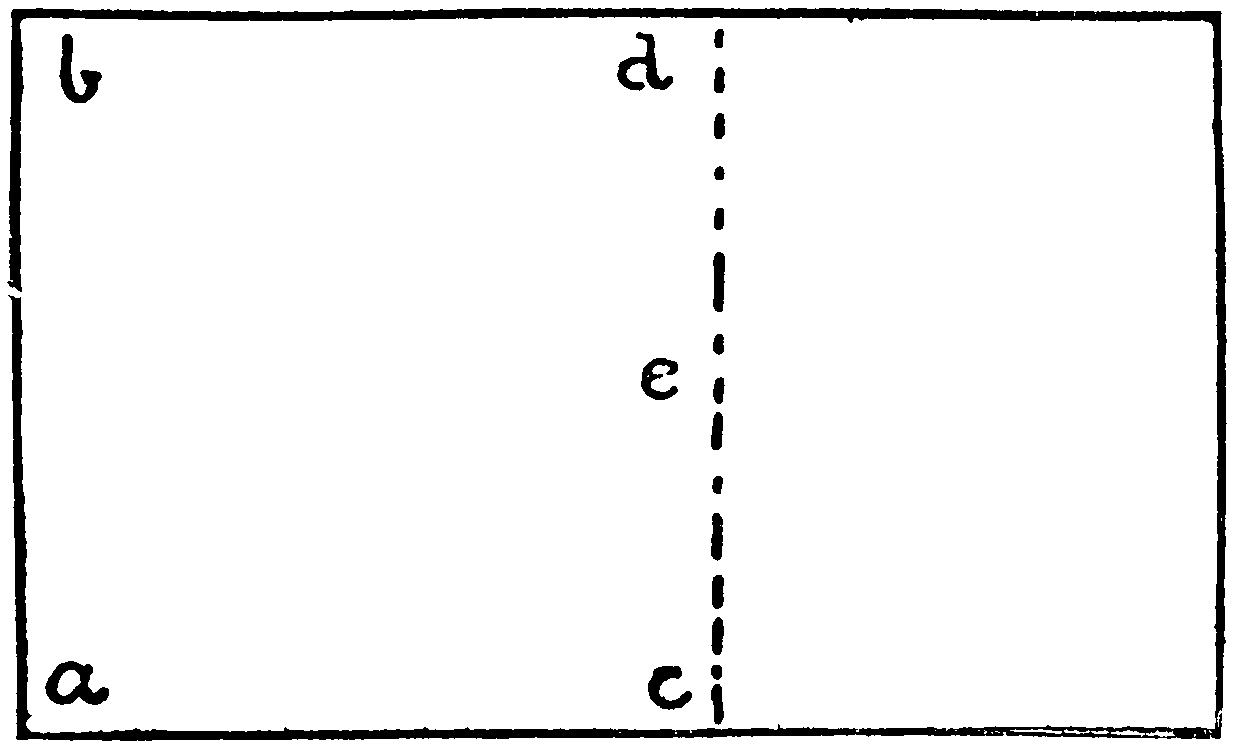
The paper must be folded first so that B comes upon C, then so that A comes upon D, then from D to C, and lastly from E to C. If it is now cut lengthways exactly along the centre the figures shown on the original diagram will be formed, which resemble a cross and lighted candles on an altar.
No. LXXXVI.—A HOME-MADE PUZZLE
Take a thin board, about eight inches square, and mark it out into thirty-six equal parts; bore a hole in the centre of each part, and then fit in a small wooden peg, leaving about a quarter inch above the surface, as is shown in Fig. 1, the section below the diagram.
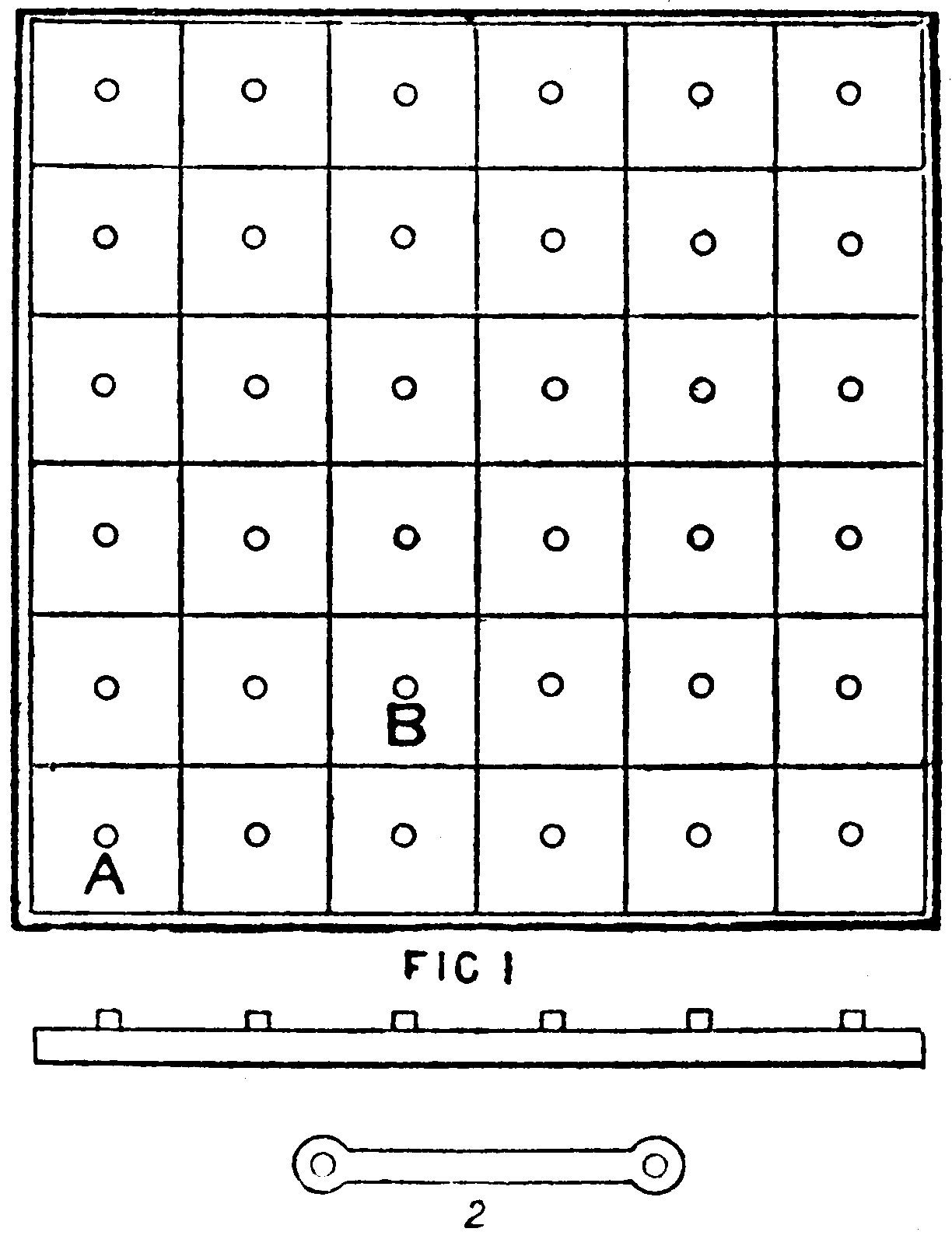
Prepare thirty-six pieces of white or coloured cardboard of the length A to B, and place them over the pegs in any direction in which they will fit so as to form some such symmetrical pattern as is given on the second diagram, putting two holes only on each peg. Chess-players will see that this is the regular knight’s move.
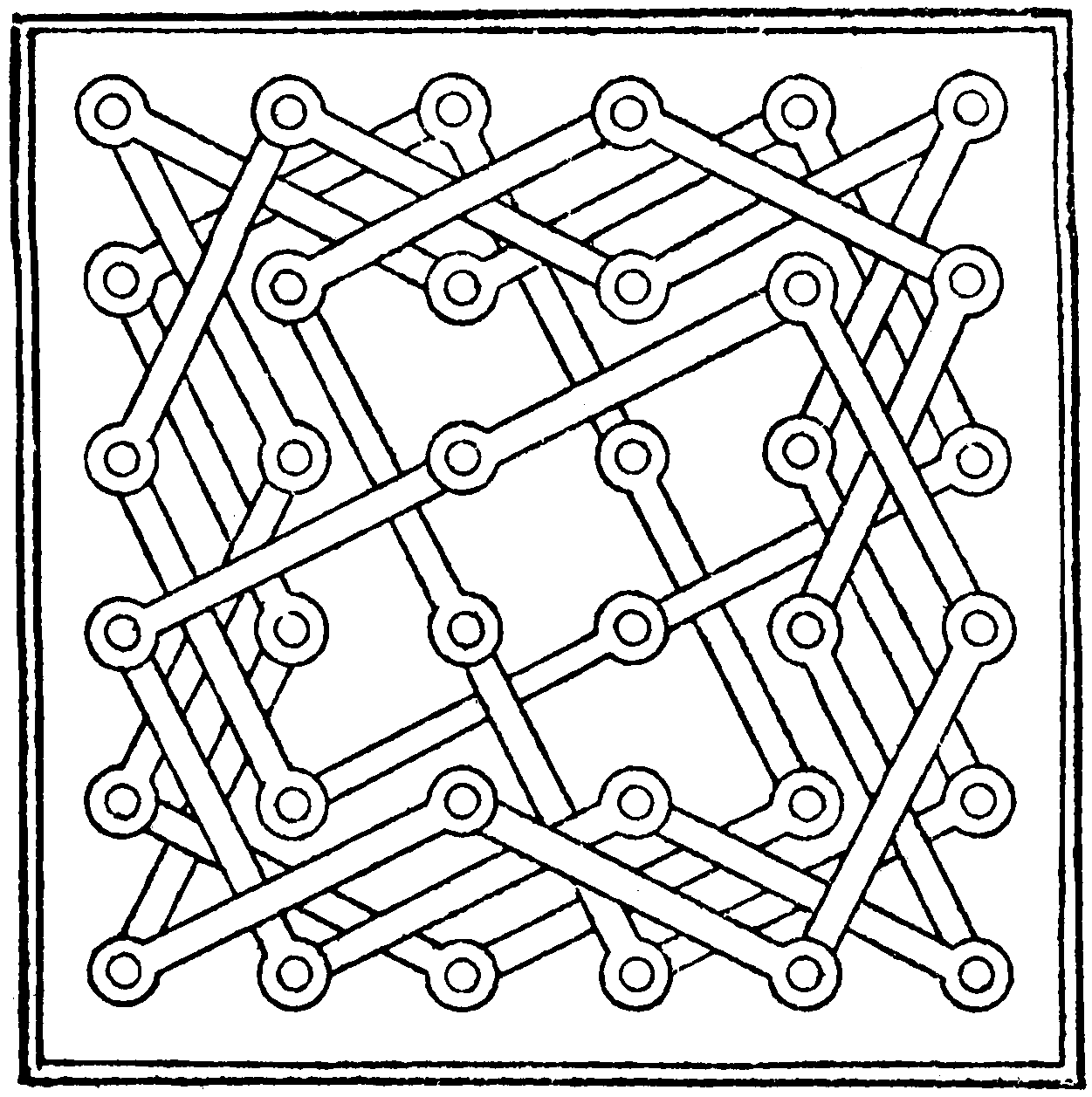
Quite a number of beautiful designs can be thus formed, and those who have not the means at hand for making a complete set can enjoy the puzzle by merely marking out thirty-six squares, and drawing lines from centre to centre of the exact length from A to B, with black or coloured pencils.
No. LXXXVII.—LOYD’S MITRE PROBLEM
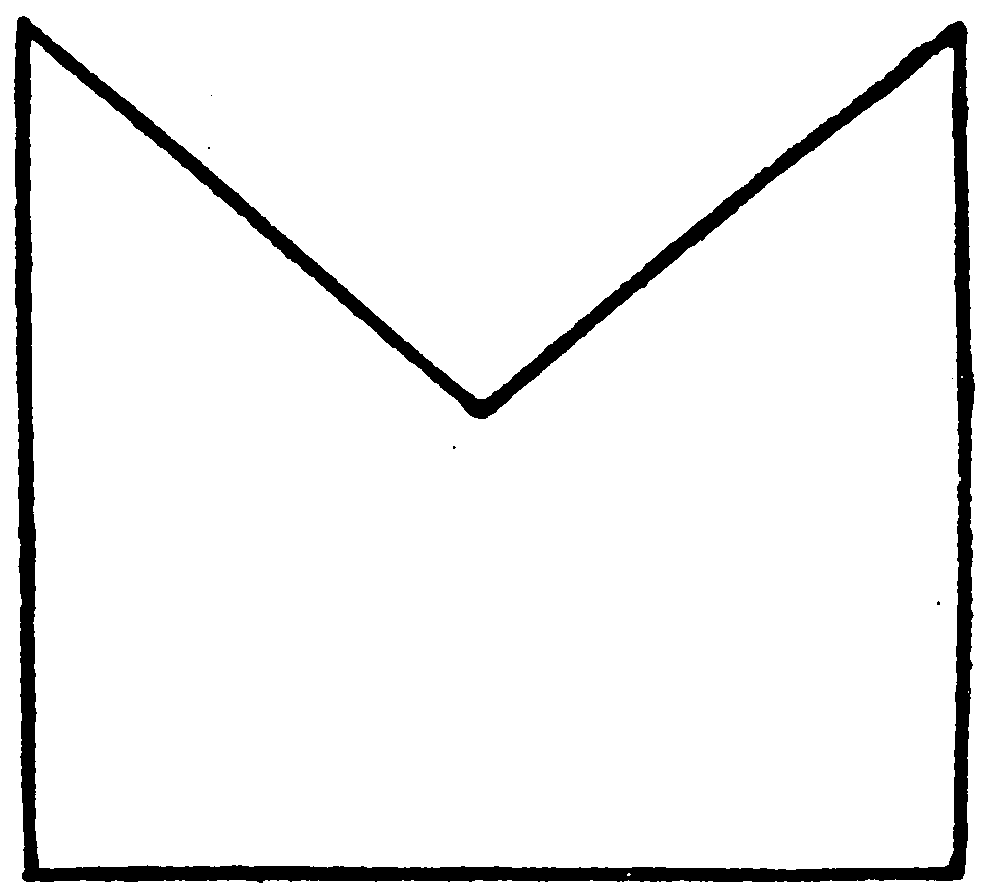
Divide this figure into four similar and equal parts.
Solution
A PRETTY PROBLEM
The solution of the pretty little problem: place three twos in three different groups, so that twice the first group, or half the third group equals the second group, is this:—
22 + 2 = 12 2 - 22 = 1 2 + 22 = 2
No. LXXXVIII.—CONTINUOUS LINES
The following figure, which represents part of a brick wall, cannot be marked out along all the edges of the bricks in less than six continuous lines without going more than once over the same line:—
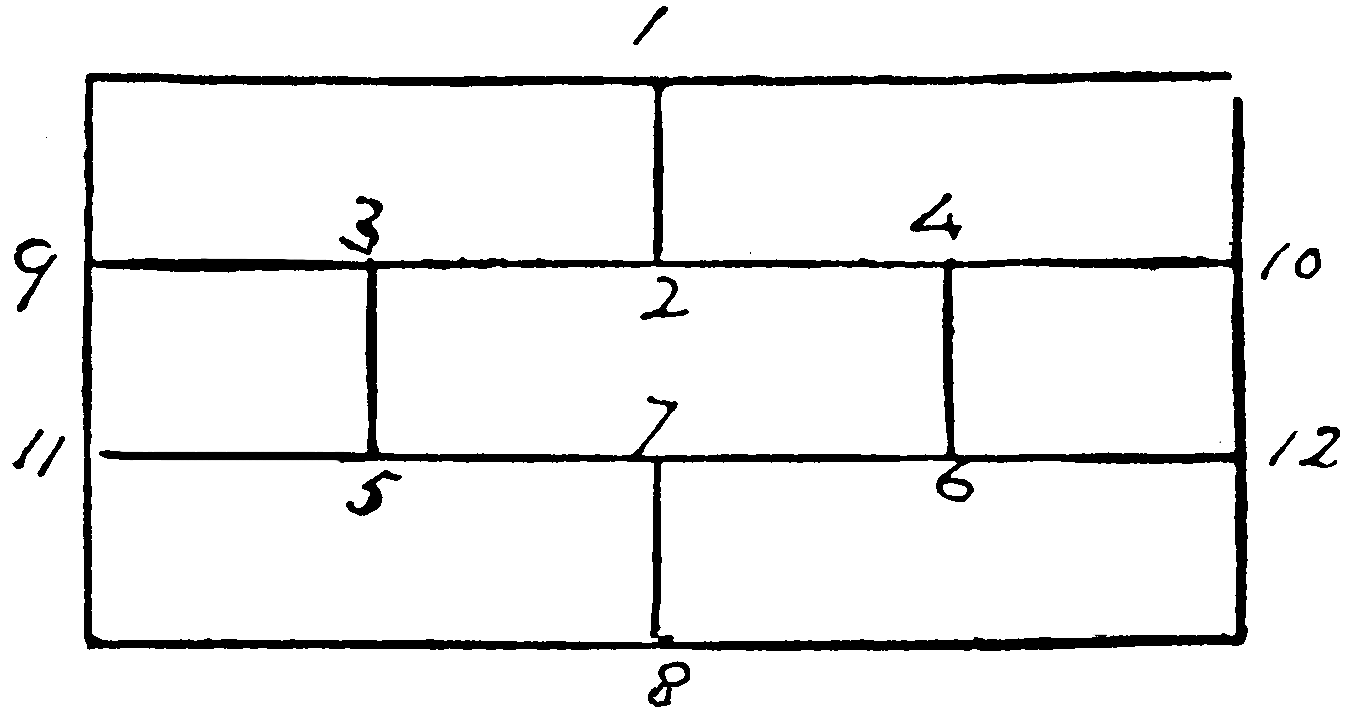
Here, in strong contrast to the simple figure given above, which could not be traced without lifting the pen six times from the paper, is an intricate design, the lines of which, on the upper or on the lower half, can be traced without any break at all.
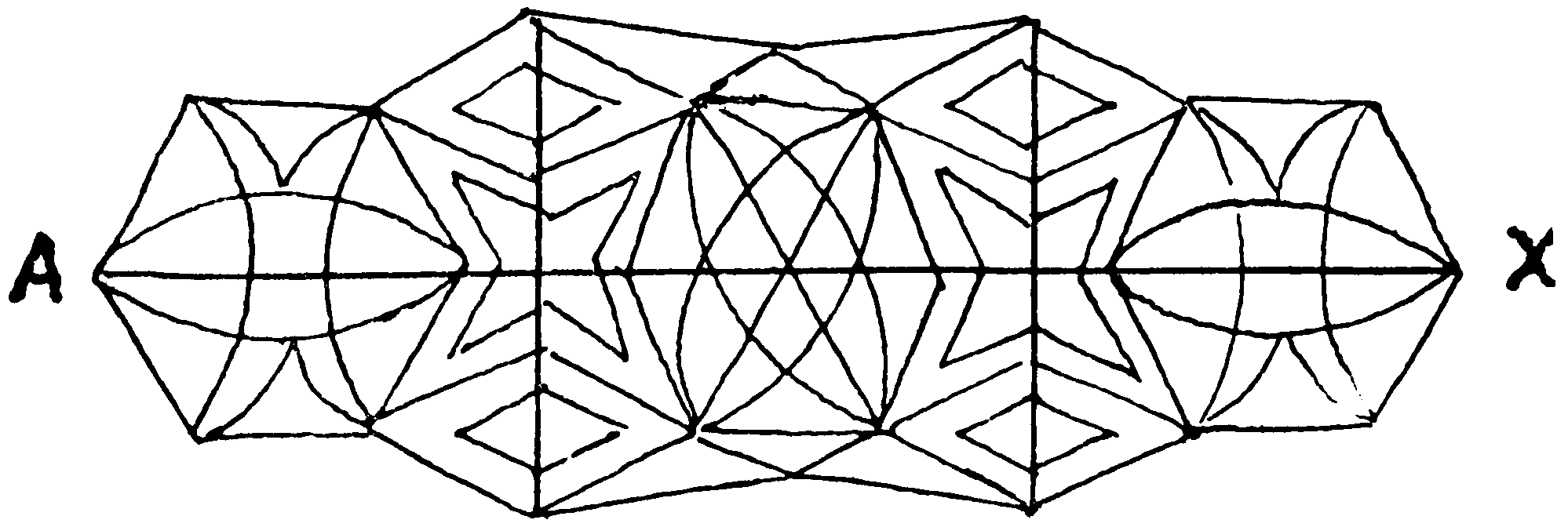
The general rule that governs such cases is, that where an uneven number of lines meet a fresh start has to be made. In the diagram now given the only such points are at the extremities of the upper and lower halves of the figure at A and X. At all other points two, or four, or six lines converge, and there is no break of continuity in a tracing of the figure.
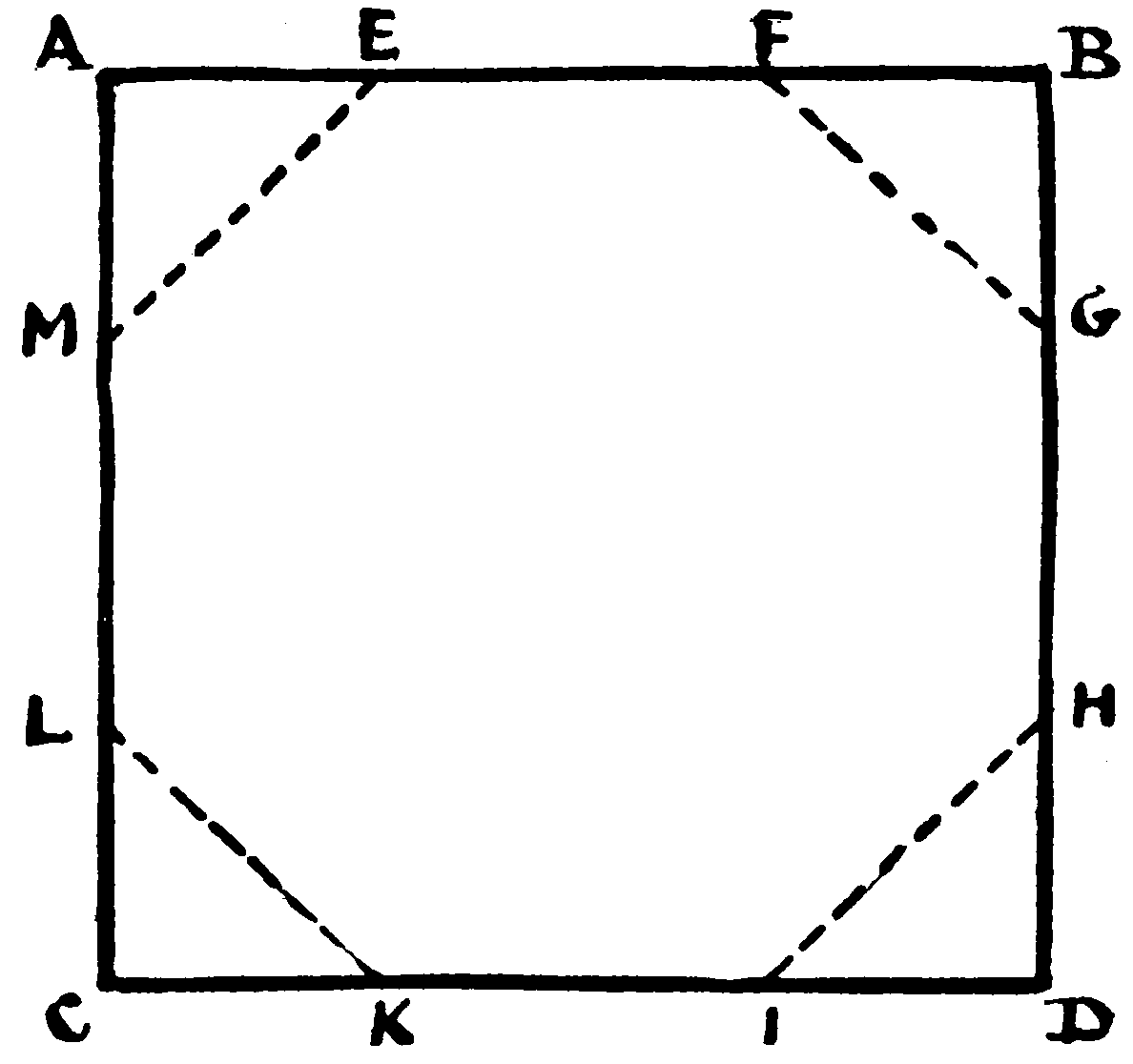
No. LXXXIX.—CUT OFF THE CORNERS
Can you suggest quite a simple and practical way to fix the points on the sides of a square which will be at the angles of an octagon formed by cutting off equal corners of the square, as shown below?
Solution
MYSTIC FIGURES
Very interesting and curious are the properties of the figures 142857, used in varied order but always in similar sequence, in connection with 7 and 9:—
1 4 2 8 5 7 × 7 = 9 9 9 9 9 9 ÷ 9 = 1 1 1 1 1 1
2 8 5 7 1 4 × 7 = 1 9 9 9 9 9 8 ÷ 9 = 2 2 2 2 2 2
4 2 8 5 7 1 × 7 = 2 9 9 9 9 9 7 ÷ 9 = 3 3 3 3 3 3
5 7 1 4 2 8 × 7 = 3 9 9 9 9 9 6 ÷ 9 = 4 4 4 4 4 4
7 1 4 2 8 5 × 7 = 4 9 9 9 9 9 5 ÷ 9 = 5 5 5 5 5 5
8 5 7 1 4 2 × 7 = 5 9 9 9 9 9 4 ÷ 9 = 6 6 6 6 6 6
No. XC.—THE FIVE TRIANGLES
The subjoined diagram shows how a square with sides that measure each 12 yards can be divided into five triangles, no two of which are of equal area, and of which the sides and areas can be expressed in yards by whole numbers:—
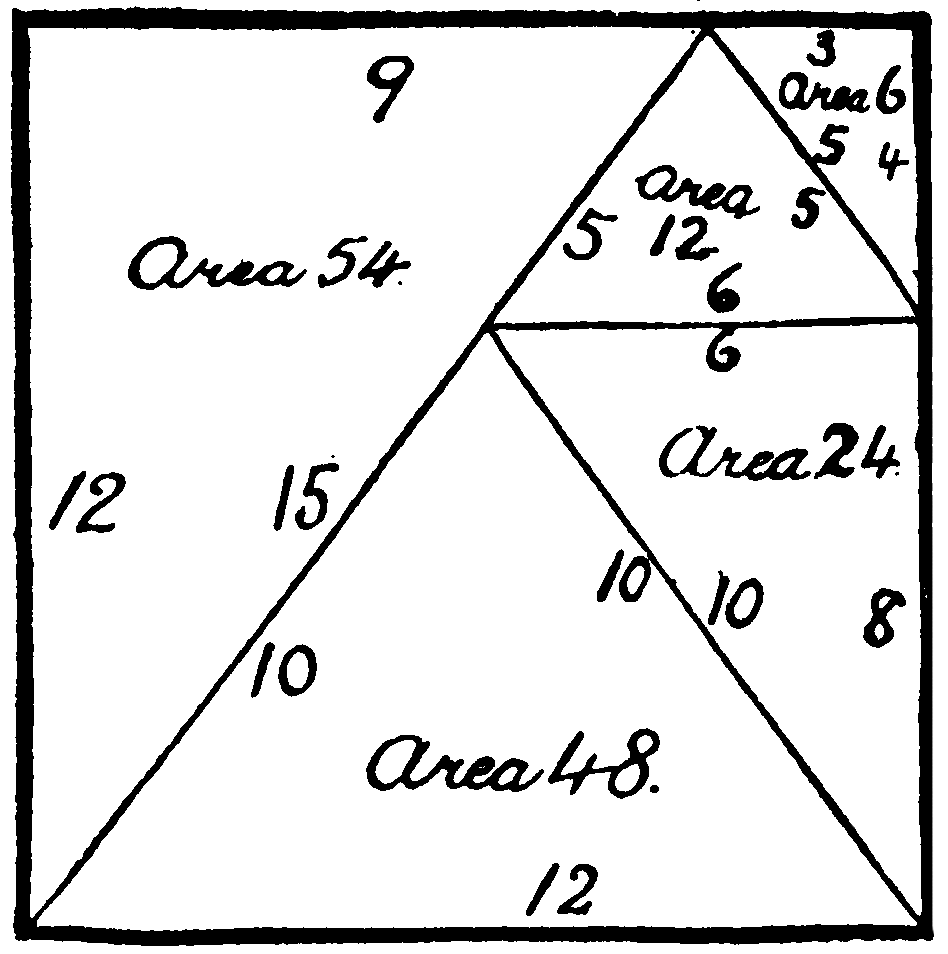
The areas of these triangles are 6, 12, 24, 48, and 54 square yards respectively, and the sum of these, 144 square yards, is the area of the square.
CURIOUS COINCIDENCES
Our readers may remember the remarkable fact that the figures of the sum, £12, 12s. 8d., when written thus, 12,128, exactly represent the number of farthings it contains. Now this, so far as we know, is the only instance of the peculiarity, but there are at least five other cases which come curiously near to it. They are these:—
£ s. d.
9 9 6 = 9096 farthings
6 6 4 = 6064 „
3 3 2 = 3032 „
10 10 6 1⁄2 = 10106 „
13 13 8 1⁄2 = 13138 „
No. XCI.—PLACING A LADDER
If a ladder, with rungs 1 foot apart, rests against a wall, and its thirteenth rung is 12 feet above the ground, the foot of the ladder is 25 feet from the wall.
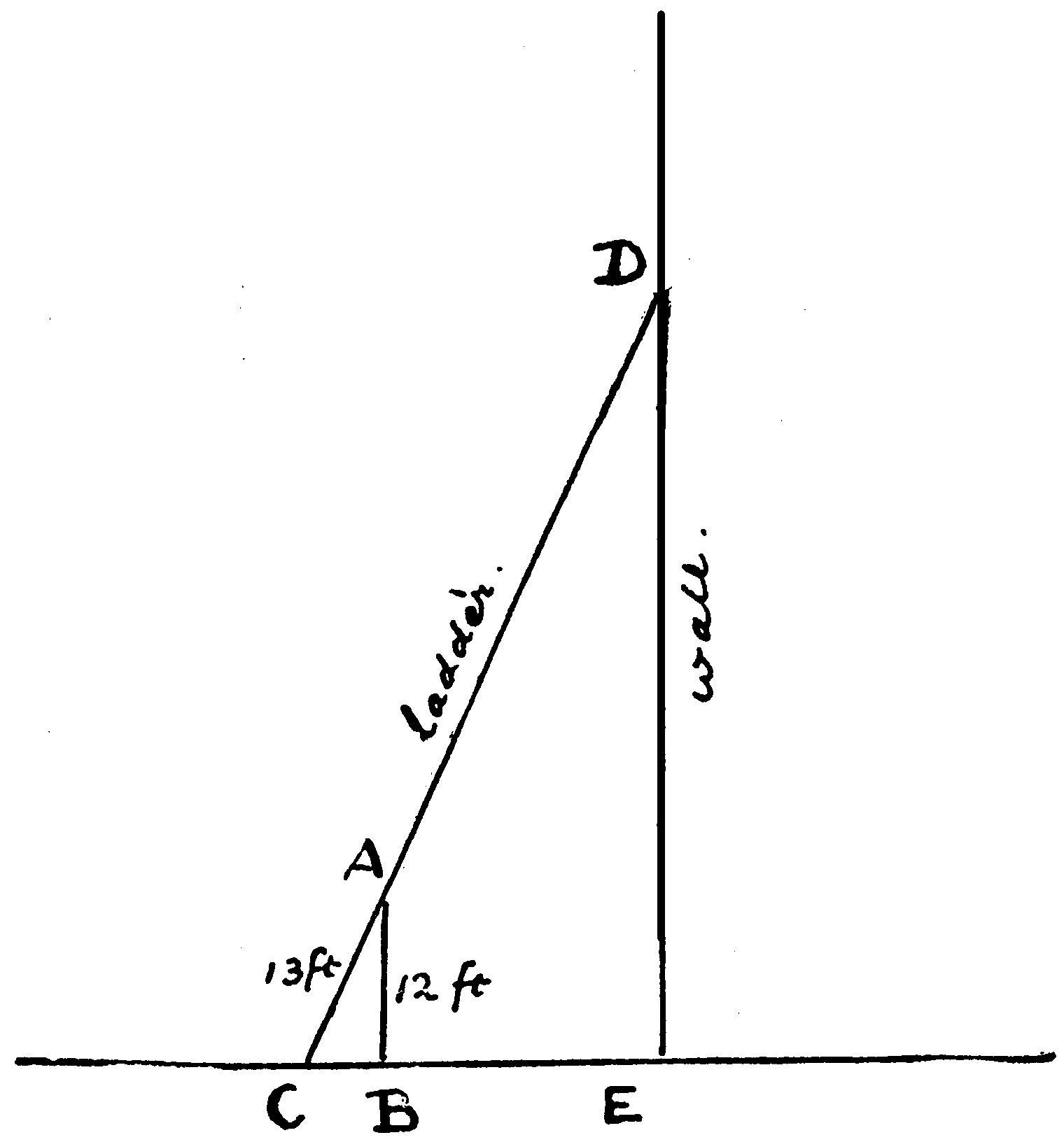
Proof.—Drop a perpendicular from A to B. Then, as A B C is a right angle, and the squares on A C, A B, are 169 feet and 144 feet, the square on C B must be 25 feet, and the length of C B is 5 feet. We thus move 5 feet towards the wall in going 13 feet up the ladder, and in mounting 65 feet (five times as far) we must cover 25 feet.
No. XCII.—GRACEFUL CURVES
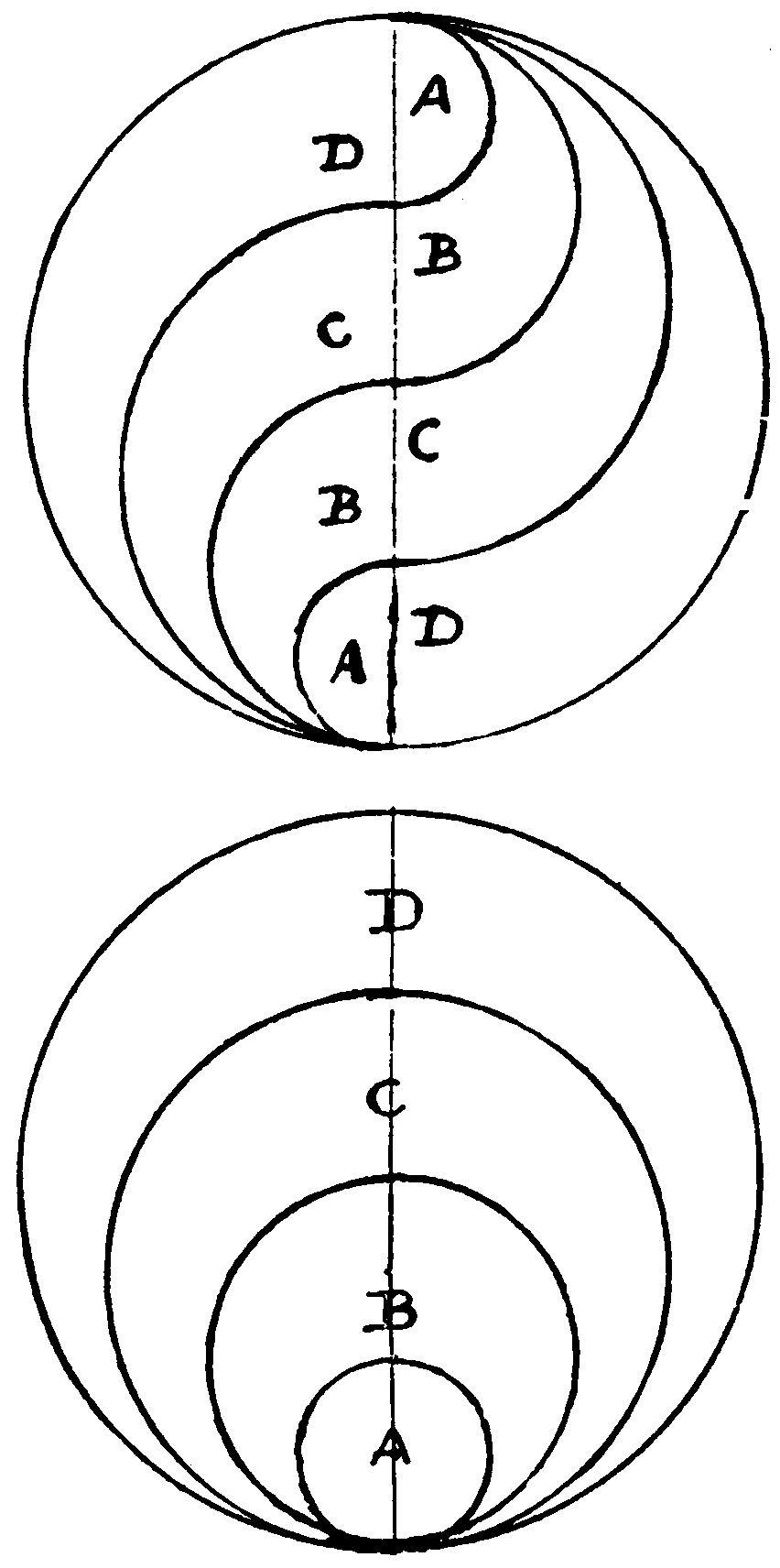
A prettily ingenious method of dividing the area of a circle into quarters, each of them a perfect curve, with perimeter (or enclosing line) equal to the circumference of the circle, and with which four circles can be formed, is clearly shown by the subjoined diagrams:—
NIGHTS AT A ROUND TABLE
The host of a large hotel at Cairo noticed that his Visitors’ Book contained the names of an Austrian, a Brazilian, a Chinaman, a Dane, an Englishman, a Frenchman, a German, and a Hungarian. Moved by this curious alphabetical list, he offered them all free quarters and the best of everything if they could arrange themselves at a round dining-table so that not one of them should have the same two neighbours on any two occasions for 21 successive days.
The following is one of many ways in which this arrangement can be made, and it seems to be the simplest of them all.
Number the persons 1 to 8; and for our first day set them down in numerical order except that the two centre ones (4 and 5) change places:
(1st day)— 1 2 3 5 4 6 7 8
Keep the 1 and the 7 unaltered but double each of the other numbers. When the product is greater than 8, divide by 7, and only set down the remainder. Thus we get:
(8th day)— 1 4 6 3 8 5 7 2
(Here the fourth figure 3 is 5 × 2 ÷ 7, giving remainder 3, and so on.)
Repeat this operation once more:
(15th day)— 1 8 5 6 2 3 7 4
To fill in the intermediate days we have only to keep 1 unchanged and let the remaining numbers run downwards in simple numerical order, following 8 with 2, 2 with 3, and so on. Thus:—
1st day— 1 2 3 5 4 6 7 8
2nd day— 1 3 4 6 5 7 8 2
3rd day— 1 4 5 7 6 8 2 3
4th day— 1 5 6 8 7 2 3 4
5th day— 1 6 7 2 8 3 4 5
6th day— 1 7 8 3 2 4 5 6
7th day— 1 8 2 4 3 5 6 7
8th day— 1 4 6 3 8 5 7 2
9th day— 1 5 7 4 2 6 8 3
10th day— 1 6 8 5 3 7 2 4
11th day— 1 7 2 6 4 8 3 5
12th day— 1 8 3 7 5 2 4 6
13th day— 1 2 4 8 6 3 5 7
14th day— 1 3 5 2 7 4 6 8
15th day— 1 8 5 6 2 3 7 4
16th day— 1 2 6 7 3 4 8 5
17th day— 1 3 7 8 4 5 2 6
18th day— 1 4 8 2 5 6 3 7
19th day— 1 5 2 3 6 7 4 8
20th day— 1 6 3 4 7 8 5 2
21st day— 1 7 4 5 8 2 6 3
This completes the schedule. It will be found on examination that every number is between every pair of the other numbers once, and once only.
In order to reduce our first-day ring to exact numerical order we have only to interchange the numbers 4 and 5 throughout. The first three lines for example would then become:
1 2 3 4 5 6 7 8
1 3 5 6 4 7 8 2
1 5 4 7 6 8 2 3, etc.
or, by putting letters for figures,
A B C D E F G H
A C E F D G H B
A E D G F H B C, etc.
An arrangement of the guests is thus arrived at for twenty-one successive days, so that not one of them has the same two neighbours on any two occasions.
No. XCIII.—MAKING MANY SQUARES
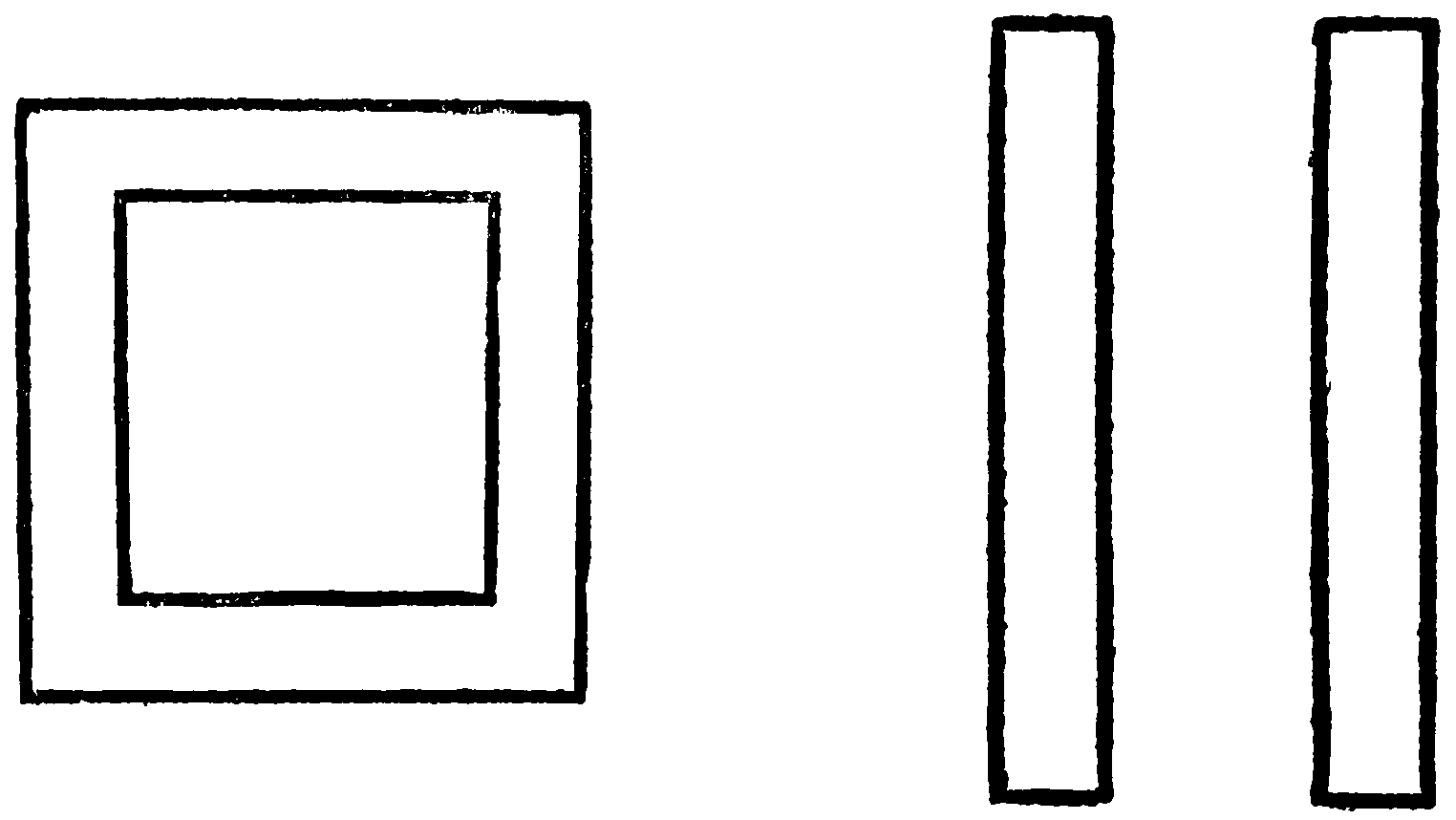
Can you apply the two oblongs drawn below to the two concentric squares, so as to produce thirty-one perfect squares?
Solution
No. XCIV.—CUT ACROSS
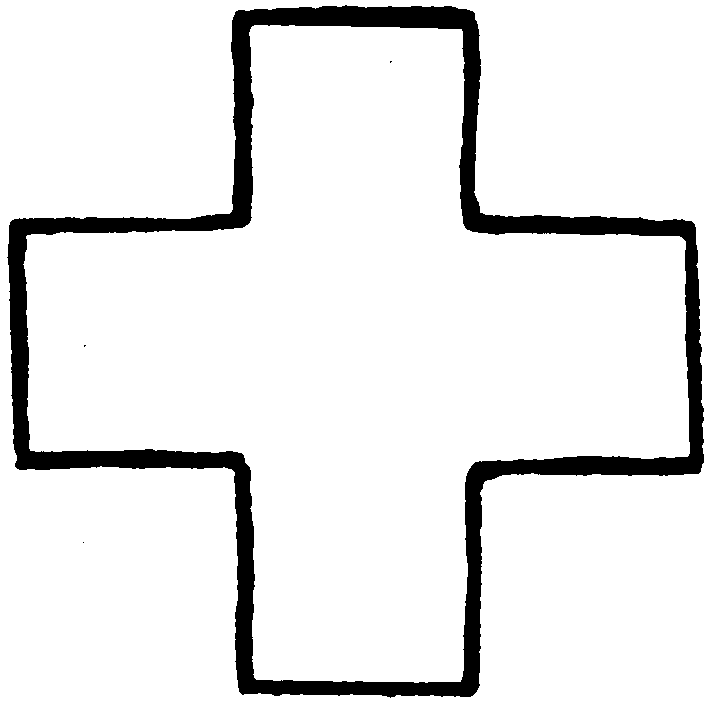
Take a piece of cardboard in the form of a Greek cross with arms, as shown here, and divide it by two straight cuts, so that the pieces when reunited form a perfect square.
Solution
No. XCV.—A PRETTY PUZZLE
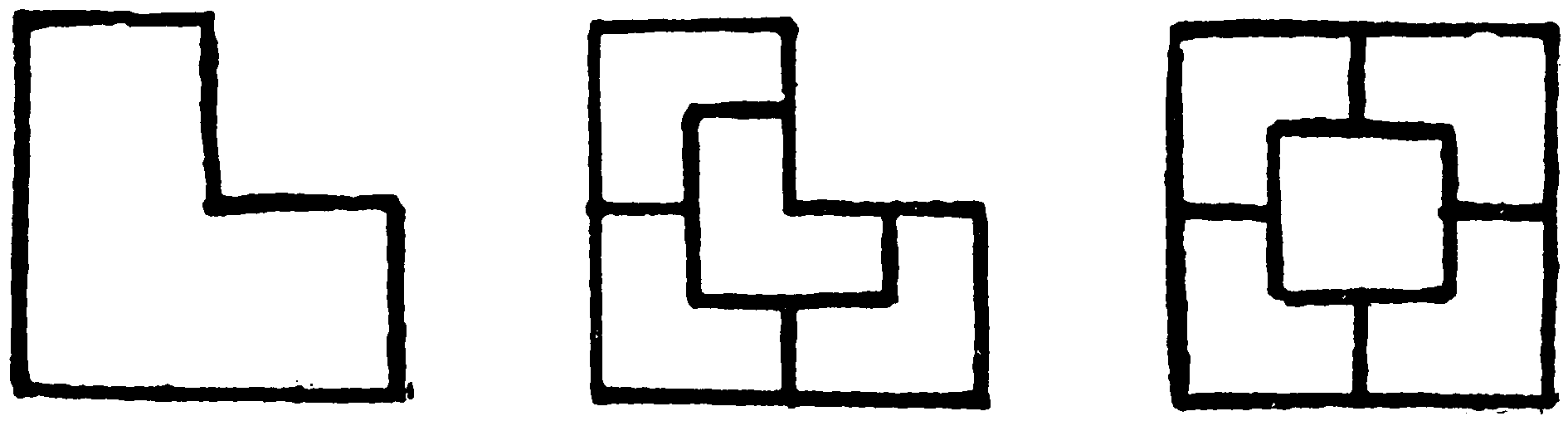
The diagrams which we give below show how a hollow square can be formed of the pieces of three-quarters of another square from which a corner has been cut away:—
No. XCVI.—A FIVE-FOLD SQUARE
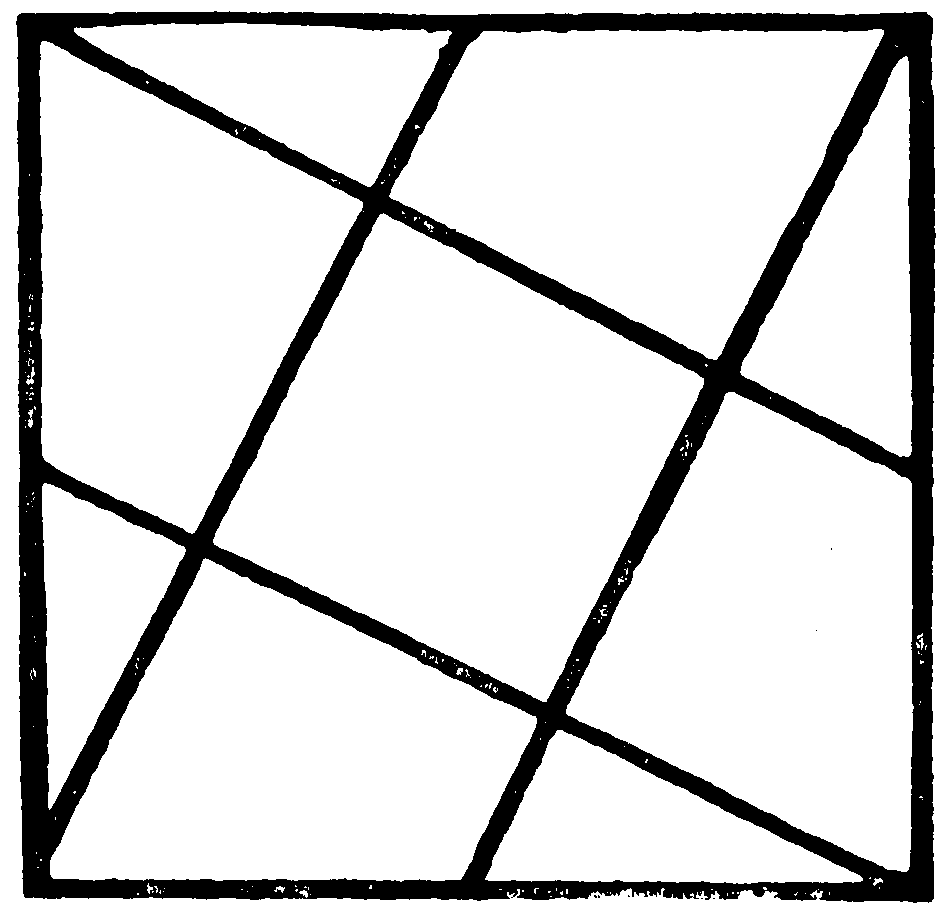
The subjoined diagram shows how a square of paper or cardboard may be cut into nine pieces which, when suitably arranged, form five perfect squares.
THE SOCIABLE SCHOOLGIRLS
On how many days can fifteen schoolgirls go out for a walk so arranged in rows of three, that no two are together more than once?
Fifteen schoolgirls can go out for a walk on seven days so arranged in rows of three that no two are together more than once.
It is said, on high authority, that there are no less than 15,567,522,000 different solutions to this problem. Here is one of them, given in Ball’s Mathematical Recreations, in which k stands for one of the girls, and a, b, c, d, e, f, g, in their modifications, for her companions on the seven different days:—
Sunday Monday Tuesday Wednesday Thursday Friday Saturday
ka1a2 kb1b2 kc1c2 kd1d2 ke1e2 kf1f2 kg1g2
b1d1f1 a1d2e2 a1d1e1 a2b2c2 a2b1c1 a1b2c1 a1b1c2
b2e1g1 a2f2g2 a2f1g1 a1f2g1 a1f1g2 a2d2e1 a2d1e2
c1d2g2 c1d1g1 b1d2f2 b1e1g2 b2d1f2 b1e2g1 b2d2f1
c2e2f2 c2e1f1 b2e2g2 c1e2f1 c2d2g1 c2d1g2 c1e1f2
It is an excellent game of patience, for those who have time and inclination, to place the figures 1 to 15 inclusive in seven such columns, so as to fulfil the conditions.
No. XCVII.—THE THREE CROSSES
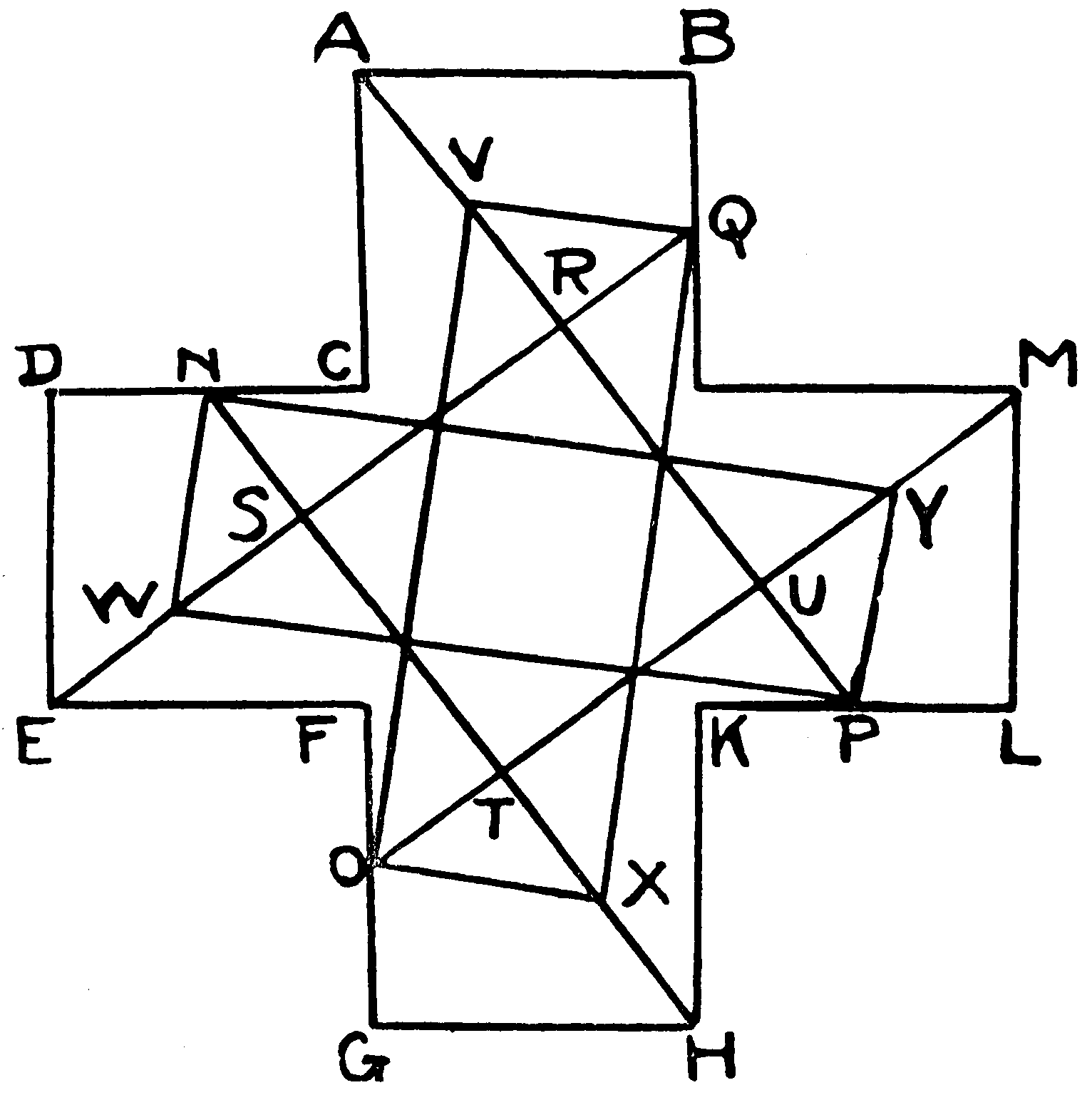
It is possible from a Greek cross to cut off four equal pieces which, when put together, will form another Greek cross exactly half the size of the original, and by this process to leave a third Greek cross complete.
This is how to do it:—
Bisect C D at N, F G at O, K L at P, and B I at Q.
Join N H, O M, P A, Q E, intersecting at R, S, T, U.
Bisect A R at V, E S at W, T H at X, and M U at Y.
Join V Q, N Y, W P, O X, N W, V O, Q X, Y P.
Carefully cut out from the original Greek cross the newly-formed Greek cross, and the odd pieces from around it can be arranged to form another Greek cross.
No. XCVIII.—THE HAMMOCK
The greatest number of plane figures that can be formed by the union of ten straight lines is thirty-six.
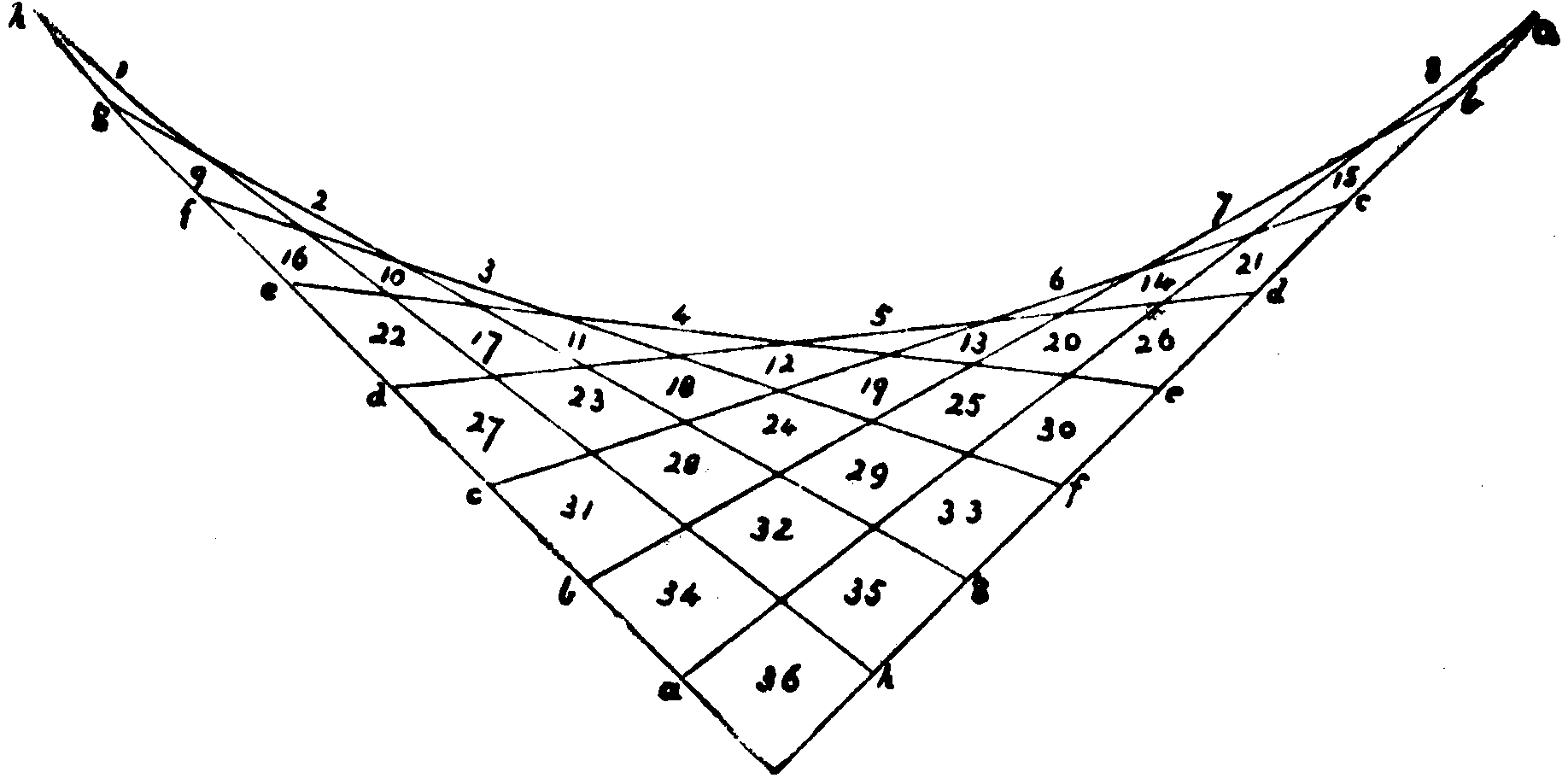
The two equal lines at right angles are first drawn, and each is divided into eight equal parts. The other eight straight lines are then drawn from a to a, from b to b, and so on, until the hammock-shaped network of thirty-six plane figures is produced.
No. XCIX.—CUTTING A CRUMPET
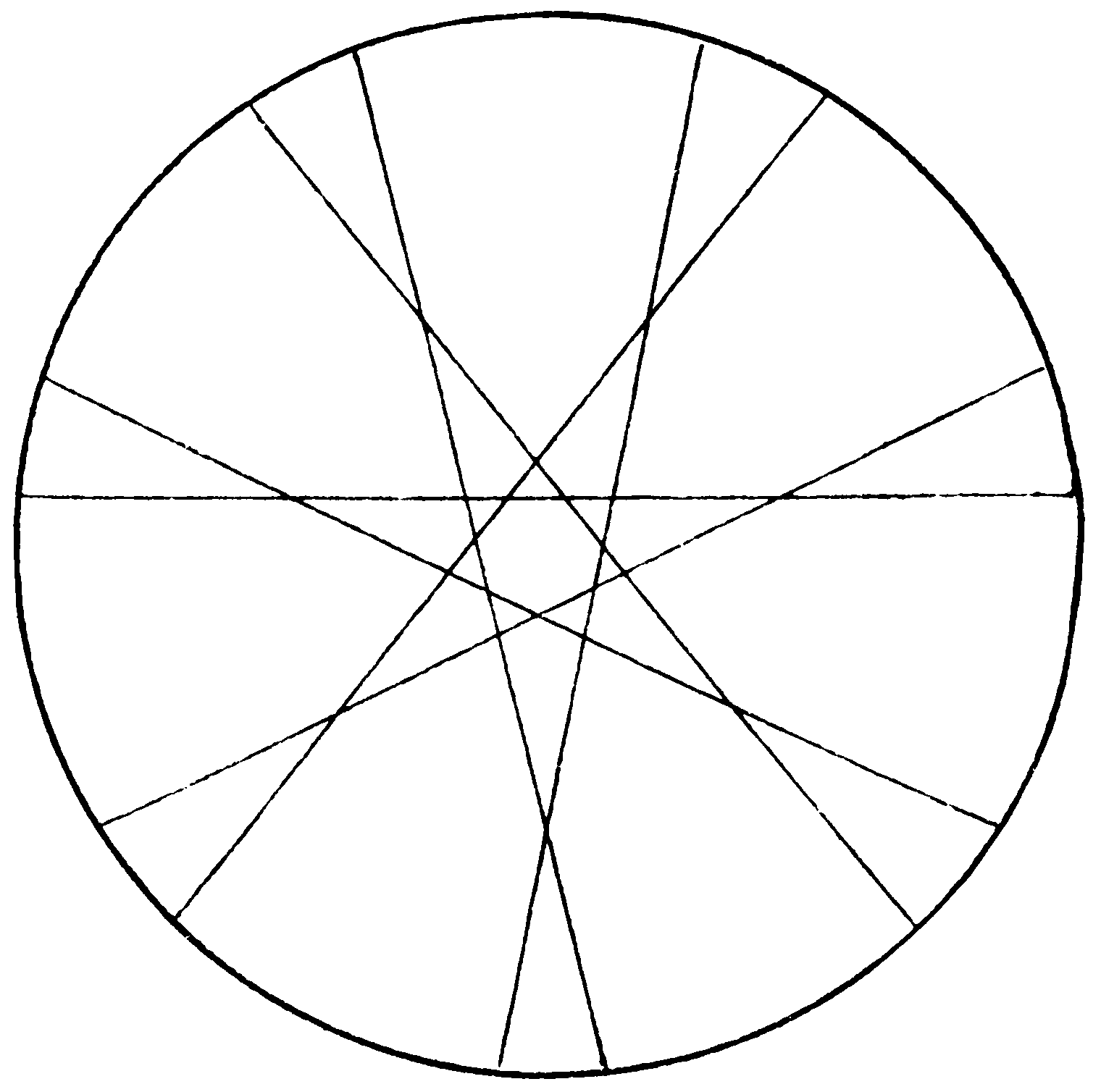
It will be seen on the diagram below that seven straight vertical cuts with a table-knife will divide a crumpet into twenty-eight parts.
BALANCE THE SCALES
The nine digits can be so adjusted as to form an equation, or, if taken as weight, to balance the scales. Thus:—
9, 61⁄2 = 3, 5, 74⁄8
TRUE STRETCHES OF IMAGINATION
How large is the sea? This is a bold big question, and any possible answer involves a considerable stretch of the imagination. Here is a startling illustration of its vast volume:—
If the water of the sea could be gathered into a round column, reaching the 93,000,000 miles which separate us from the sun, the diameter of this column would be nearly two miles and a half!
It is perhaps even more difficult to realise that this mighty mass of waters could be dissipated in a few moments, if the column we have imagined could become ice, and if the entire heat of the sun could be concentrated upon it. All would be melted in one second of time, and converted into steam in eight seconds!
No. C.—TO MAKE AN ENVELOPE
Many of our readers may be glad to know an easy way to make an envelope of any shape or size.
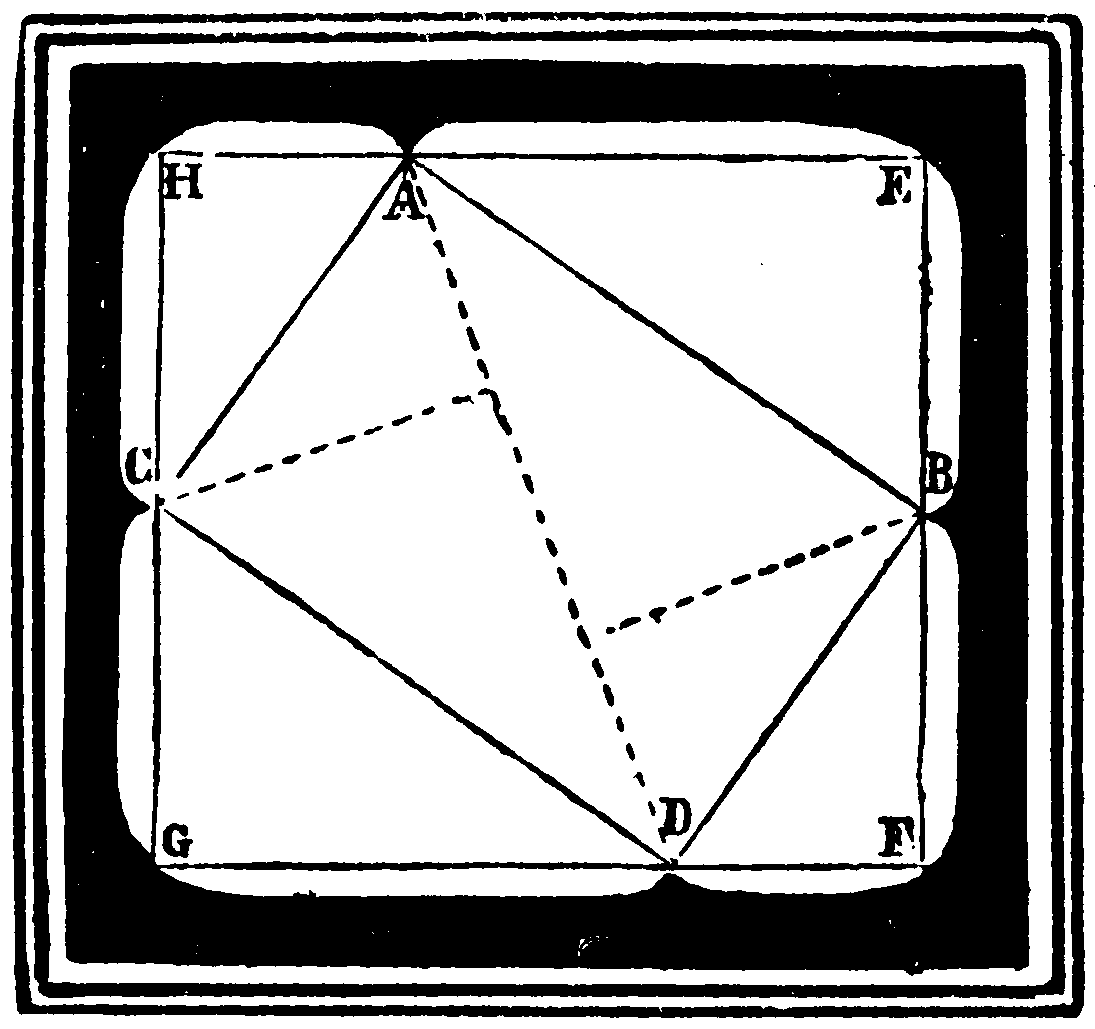
This diagram speaks for itself. When the lines A B, A C, D B, D C have been drawn, the corners of the rectangle, H E G F, are folded over, as shown by the dotted lines, after the corners have been rounded, and the margins touched with gum.
No. CI.—SQUARING AN OBLONG
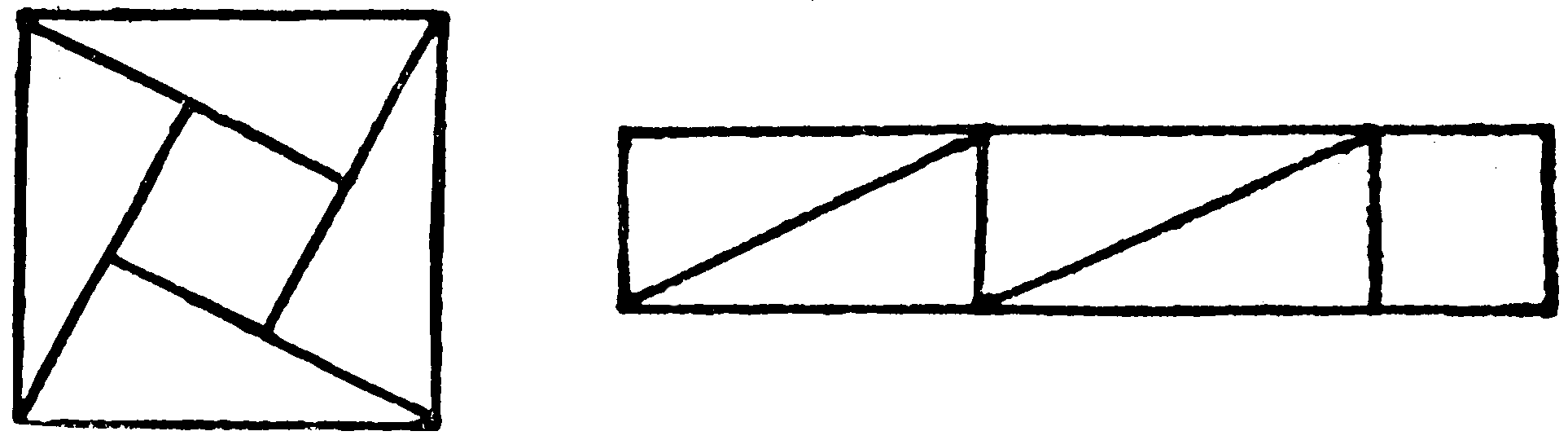
The diagrams below will show how a piece of paper, 15 inches long and 3 inches wide, can be cut into five parts, and rearranged to form a perfect square.
A PLAGUE OF BLOW-FLIES
The following astounding calculation is answer enough to a question put by one of the authors of “Rejected Addresses:”—“Who filled the butchers’ shops with big blue flies?”
A pair of blow-flies can produce ten thousand eggs, which mature in a fortnight. If every egg hatches out, and there are equal numbers of either sex, which forthwith increase and multiply at the same rapid rate, and if their descendants do the like, so that all survive at the end of six months, it has been calculated that, if thirty-two would fill a cubic inch of space, the whole innumerable swarm would cover the globe, land and sea, half a mile deep everywhere.
No. CII.—BY RULE OF THUMB
Here is quite a neat way to make an equilateral triangle without using compasses:—
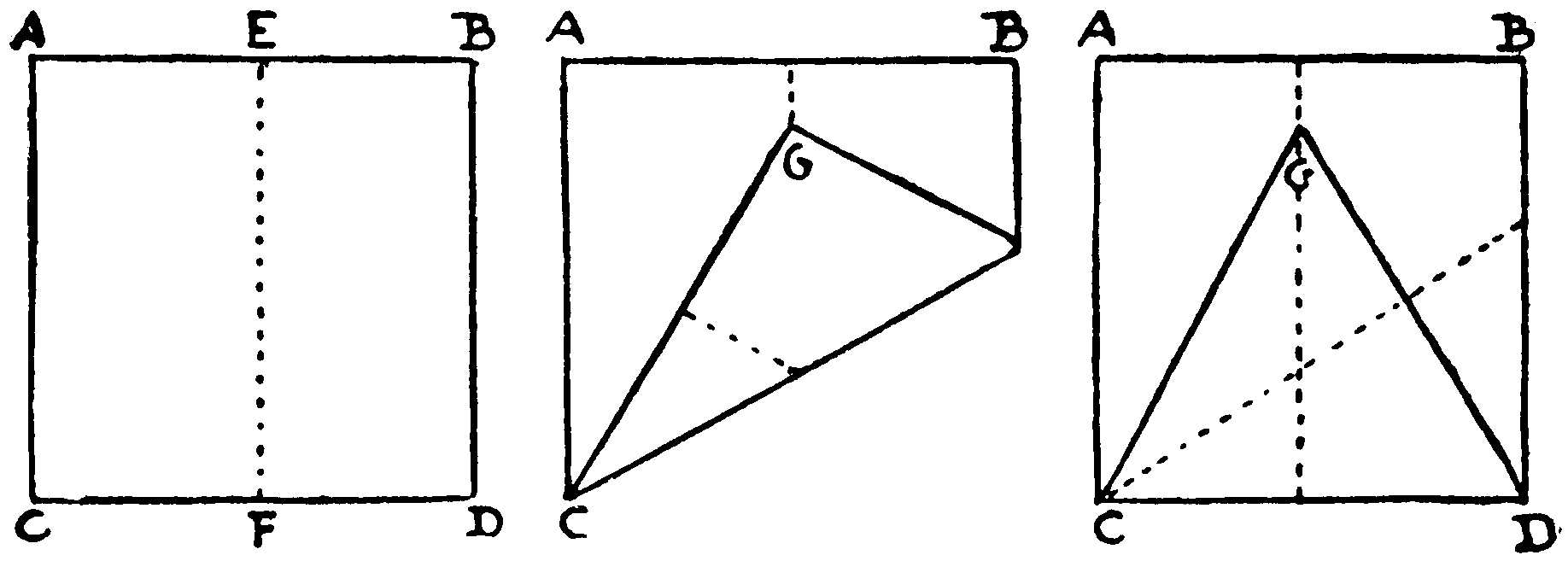
Take a piece of paper exactly square, which we will call A B C D, fold it across the middle, so as to form the crease E F; unfold it, and fold it again so that the corner D falls upon the crease E F at G, and the angle at G is exactly divided. Again unfold the square, and from G draw the straight lines G C and G D. Then G C D is the equilateral triangle required.
THE VALUE OF A FRENCHWOMAN
How can we be sure that the value of a Frenchwoman is just 1 franc 8 centimes?
We can be sure that the exact value of a Frenchwoman is 1 franc 8 centimes, for
Two Frenchwomen = Deux Françaises.
Deux Françaises = deux francs seize. (2 francs 16).
Therefore, One Frenchwoman = 1 franc 8!
No. CIII.—CLEARING THE WALL
If a 52-feet ladder is set up so as just to clear a garden wall 12 feet high and 15 feet from the building, it will touch the house 48 feet from the ground.
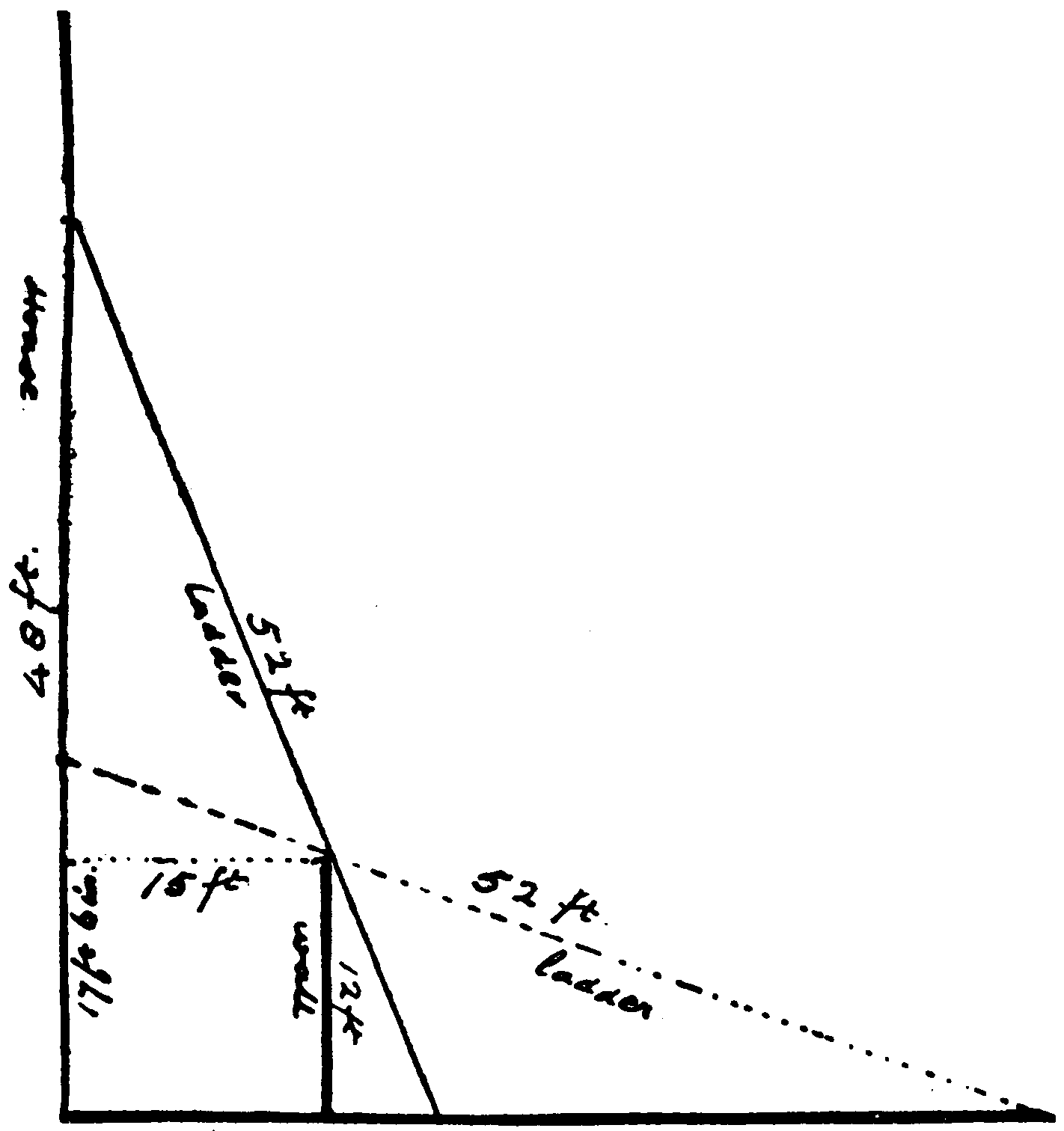
Our diagram shows this, and also, by a dotted line, the only other possible position in which it could fulfil the conditions, if it were then of any practical use.
A BURDEN OF PINS
If one pin could be dropped into a vessel this week, two the next, four the next, and so on, doubling each time for a year, the accumulated quantity would be 4,503,599,627,370,495, and their weight, if we reckon 200 pins to the ounce, would amount to 628,292,358 tons, a full load for 27,924 ships as large as the Great Eastern, whose capacity was 22,500 tons.
No. CIV.—MEMORIES OF EUCLID
When at the signpost which said “To A 4 miles, to B 9 miles” on one arm, and on the other “To C 3 miles, to D —— miles,” and the boy whom I met could only tell me that the farm he worked at was equidistant from A, B, C, and D, and nearer to them than to the signpost, and that all the roads ran straight, I found, thanks to memories of Euclid, that I was 12 miles from D.
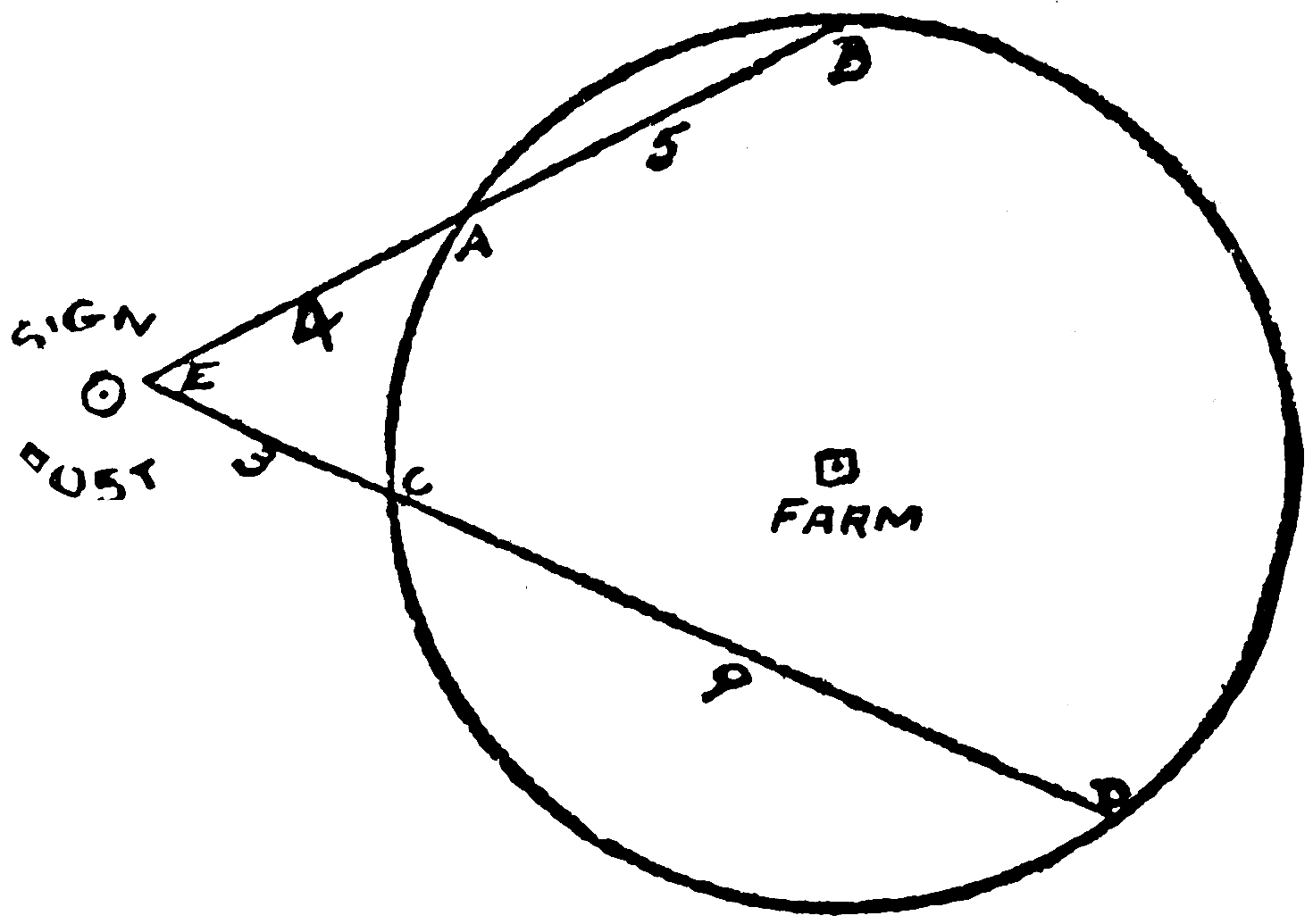
Since B A and D C intersect outside the circle at the signpost E,
therefore A E × E B = C E × E D.
but A E × E B = 4 × 9 = 36,
therefore C E × E D = 36,
and C E = 3, therefore E D = 12.
Q.E.D.
No. CV.—A TRANSFORMATION
This seems to be quite a poor attempt at a Maltese cross, but there is method in the madness of its make.
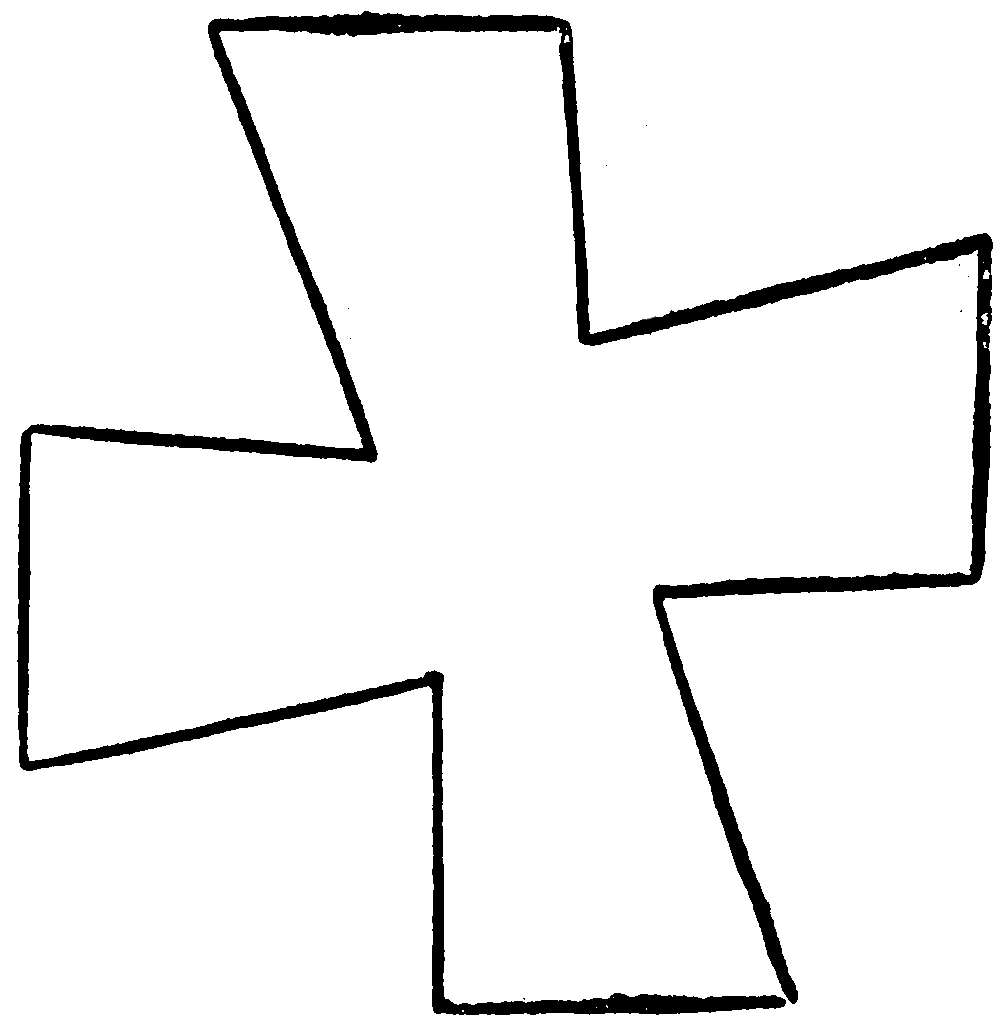
It is possible by two straight cuts to divide this uneven cross into four pieces which can be arranged together again so that they form a perfect square. Where must the cuts be made, and how are the four pieces rearranged?
Solution
BREVITY IS THE SOUL OF WIT
We all remember that splendidly terse message of success sent home to the authorities by Napier when he had conquered the armies of Scinde—“Peccavi!” (I have sinned).
History had an excellent opportunity for repeating itself when Admiral Dewey defeated the Spaniel fleet, for he might have conveyed the news of his victory by the one burning word—“Cantharides”—“The Spanish fly!”
No. CVI—SHIFTING THE CELLS
In the diagram below a square is subdivided into twenty-five cells.
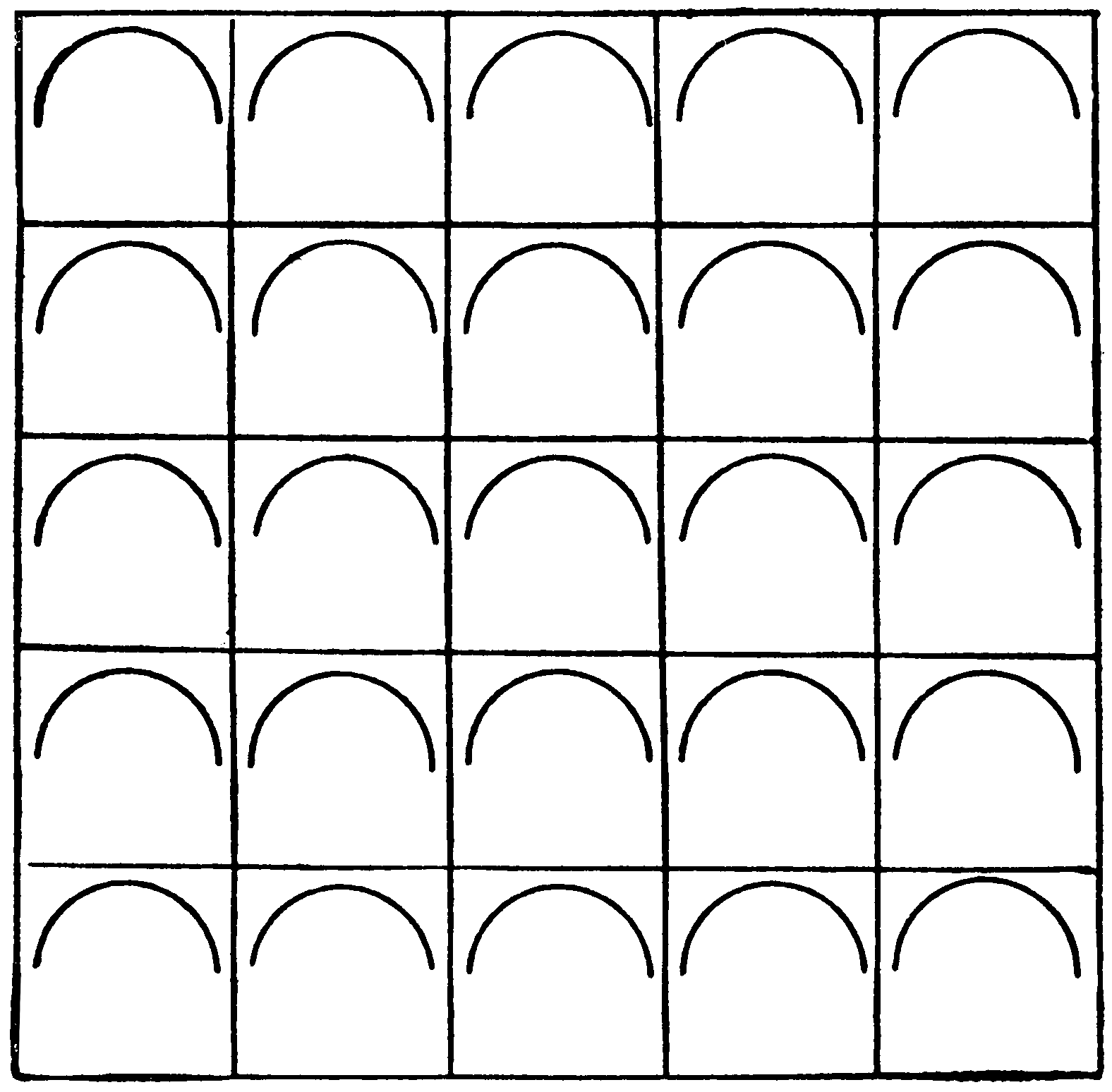
Can you, keeping always on the straight lines, cut this into four pieces, and arrange these as two perfect squares, in which every semicircle still occupies the upper half of its cell?
Solution
A HOME-MADE MICROSCOPE
The following very simple recipe for a home-made microscope has been suggested by a Fellow of the Royal Microscopical Society:—
Take a piece of black card, make a small pinhole in it, put it close to the eye, and look at some small object closely, such as the type of a newspaper. A very decided magnifying power will be shown thus.
No. CVII.—IN A TANGLE
Where on this diagram must we place twenty-one pins or dots so that they fall into symmetrical design and form thirty rows, with three in each row?
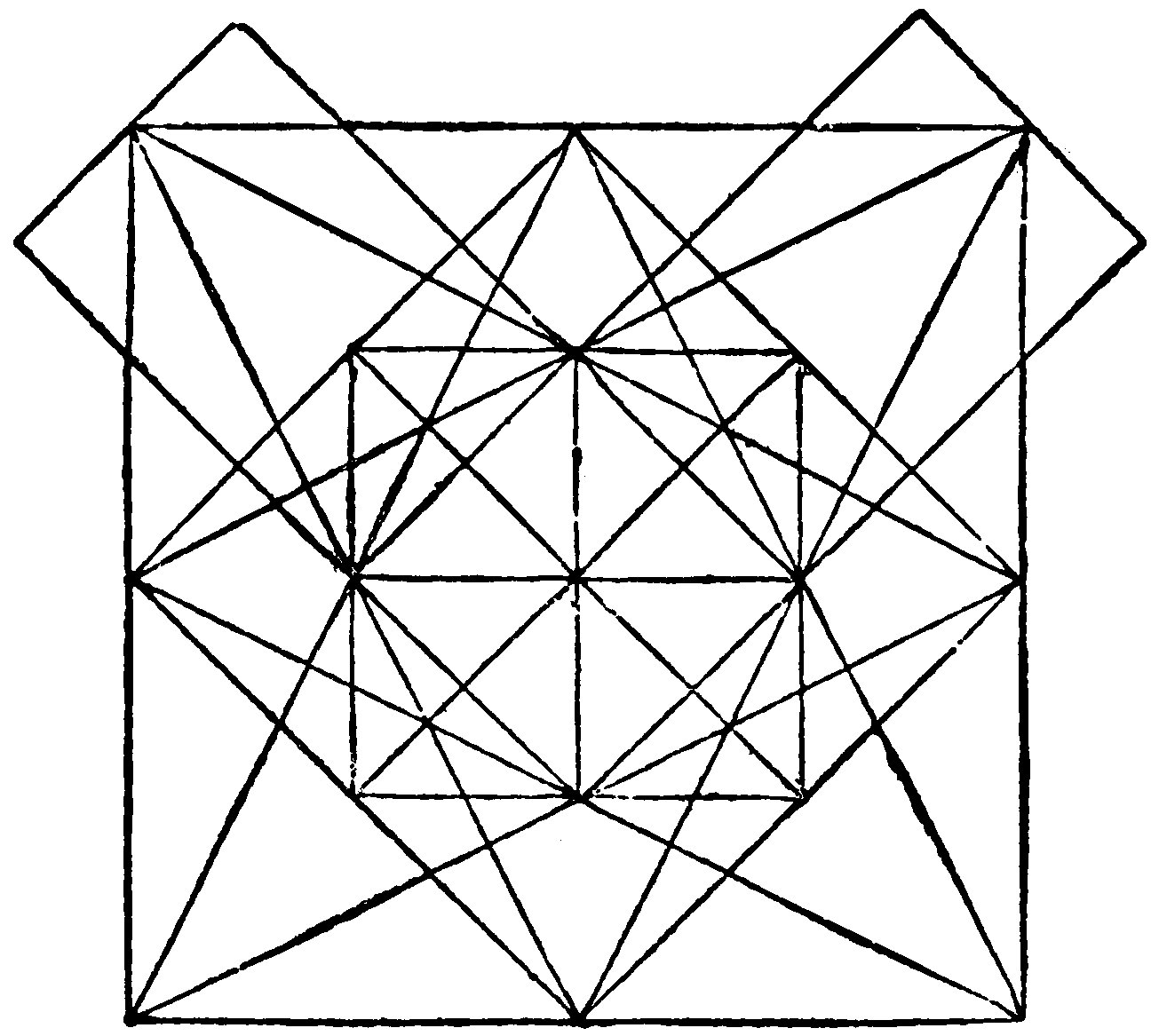
Solution
ON ALL FOURS
Those who are fond of figures will find it a most interesting exercise to see how far they are able to represent every number, from one up to a hundred, by the use of four fours. Any of the usual signs and symbols of arithmetic may be brought into use. Here are a few instances of what may thus be done:—
3 = 4 + 4 + 44; 9 = 4 + 4 + 44;
36 = 4(4 + 4) + 4; 45 = 44 + 44;
52 = 44 + 4 + 4; 60 = 4 × 4 × 4 - 4.
No. CVIII.—STILL A SQUARE
This figure, which now forms a square, and the quarter of that square, can be so divided by two straight lines that its parts, separated and then reunited, form a perfect square. How is this done?
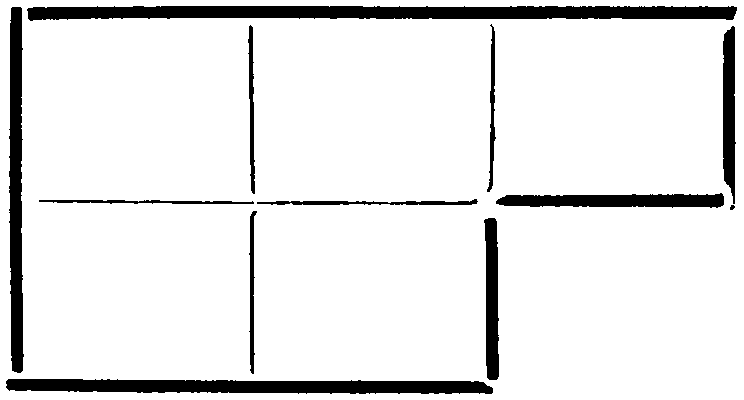
Solution
A MAGIC SQUARE
Here we have arranged five rows of five cards each, so that no two similar cards are in the same lines. Counting the ace as eleven, each row, column, and diagonal adds up to exactly twenty-six.
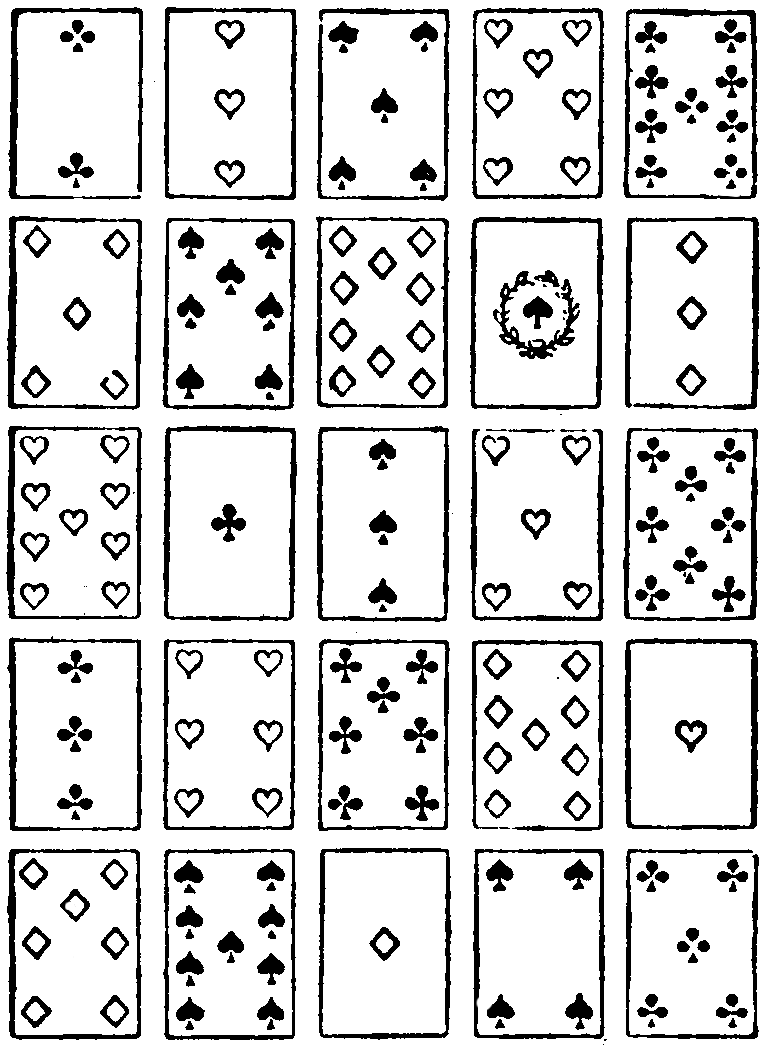
After you have looked at this Magic Square, and set it out on the table, shuffle the cards, and try to re-arrange them so as to give the same results.
No. CIX.—A TRANSFORMATION
Cut a square of paper or cardboard into seven such pieces as are marked in this diagram.
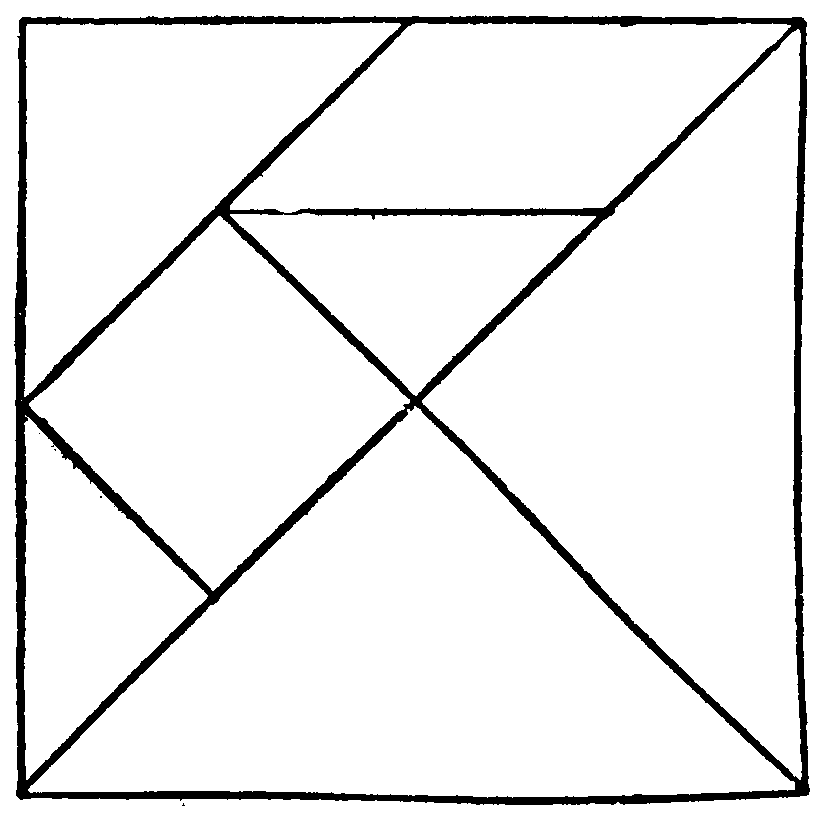
Can you rearrange them so that they form the figure 8.
Solution
A SECRET REVEALED
There are several ways in which strange juggling with figures and numbers is to be done, but none is more curious than this:—
Ask someone, whose age you do not know, to write down secretly the date and month of his birth in figures, to multiply this by 2, to add 5, to multiply by 50, to add his age last birthday and 365. He then hands you this total only from this you subtract 615. This reveals to you at a glance his age and birthday.
Thus, if he was born April 7 and is 23, 74 (the day and the month) × 2 = 148; 148 + 5 = 153; 153 × 50 = 7650; 7650 + 23 (his age) = 7673; and 7673 + 365 = 8038. If from this you subtract 615, you have 7423, which represents to you the seventh day of the fourth month, 23 years age! This rule works out correctly in all cases.
No. CX.—TO MAKE AN OBLONG
Cut out in stiff paper or cardboard two pieces of the shape and size of the small triangle, and four pieces of the shapes and sizes of the other three patterns—fourteen pieces in all.
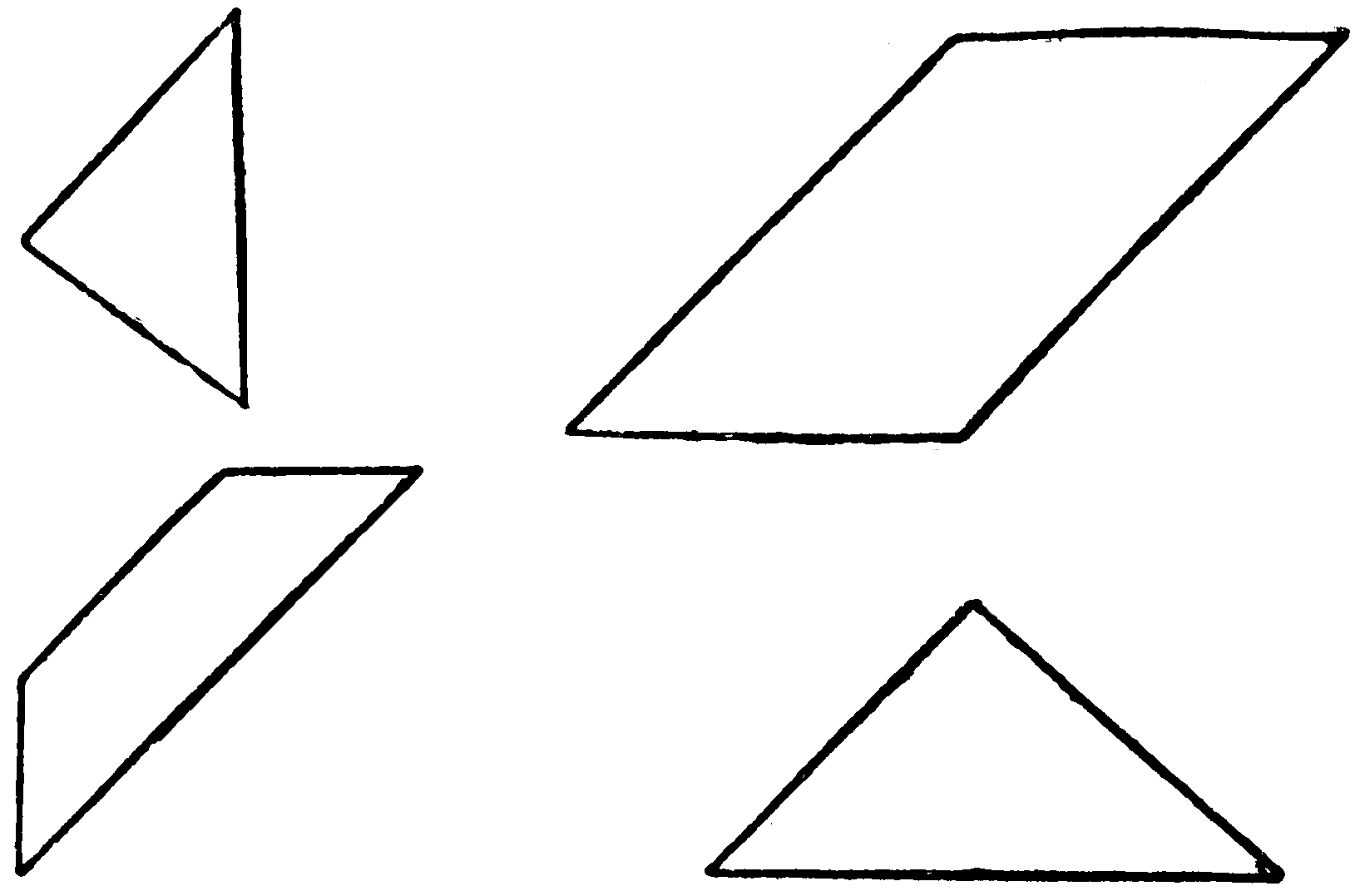
The puzzle is to fit these pieces together so that they form a perfect oblong.
Solution
SLEEPERS THAT SLIP AND SLEEP
Here is a string of sentences, which may be used as stimulating mental gymnastics when we leave the “Land of Nod.”
A sleeper runs on sleepers, and in this sleeper on sleepers sleepers sleep. As this sleeper carries its sleepers over the sleepers that are under the sleeper, a slack sleeper slips. This jars the sleeper and its sleepers, so that they slip and no longer sleep.
DAYS THAT ARE BARRED
Clever calculation has established a fact which we shall not be able to verify by personal experience. Whatever else may happen, the first day of a century can never fall on Sunday, Wednesday, or Friday.
No. CXI.—SQUARES ON THE CROSS
On this cross there are seventeen distinct and perfect squares marked out at their corners by asterisks.
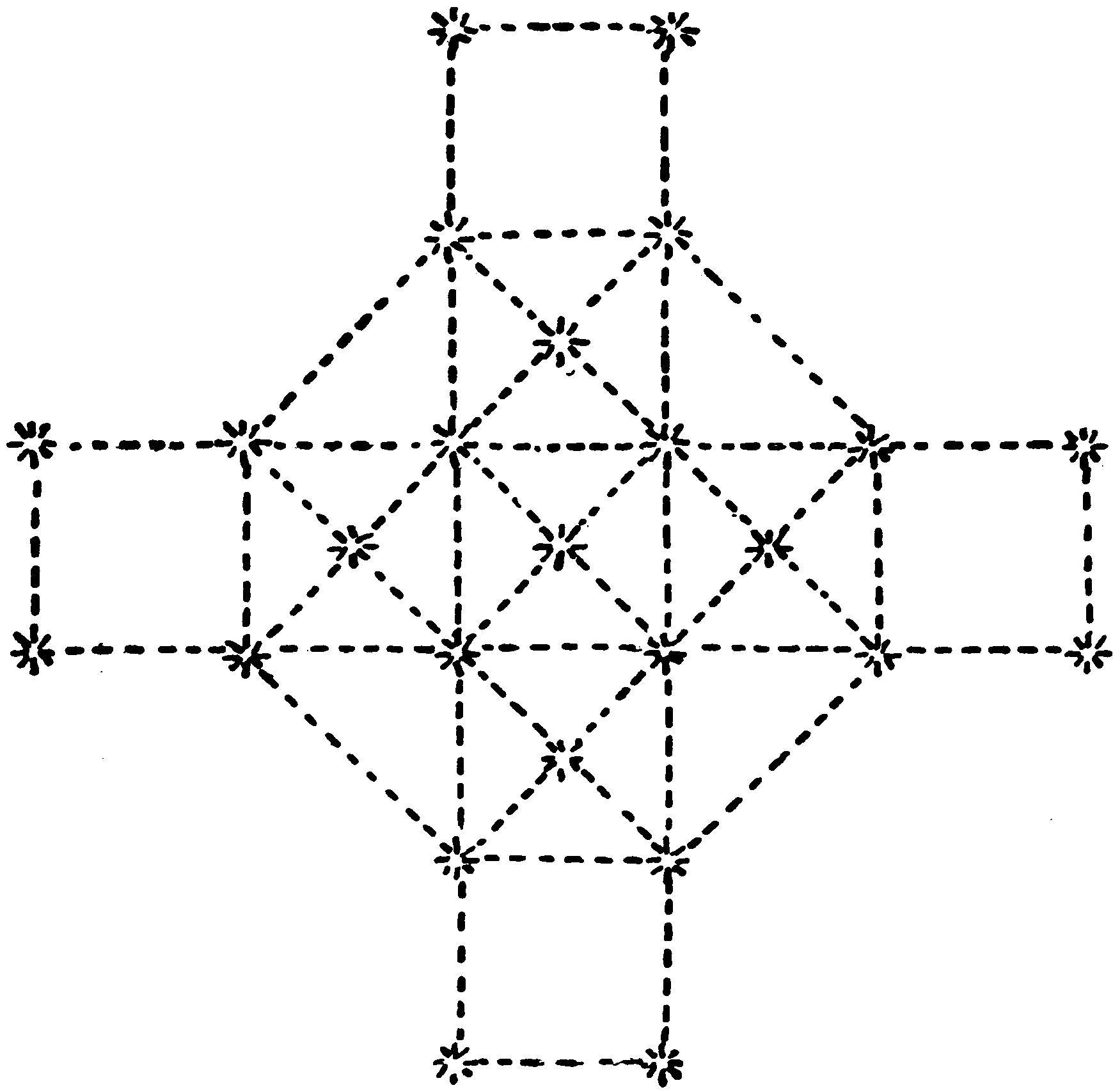
How few, and which, of these can you remove, so that not a single perfect square remains?
Solution
STANDING ROOM FOR ALL
On a globe 2 feet in diameter the Dead Sea appears but as a small coloured dot. If it were frozen over there would be standing room on its surface for the whole human race, allowing 6 square feet for each person; and if they were all suddenly engulfed, it would merely raise the level of the lake about 4 inches.
No. CXII.—A CHINESE PUZZLE
Here is quite a good exercise for ingenious brains and fingers. Cut a piece of stiff paper or cardboard into such a right-angled triangle as is shown below.
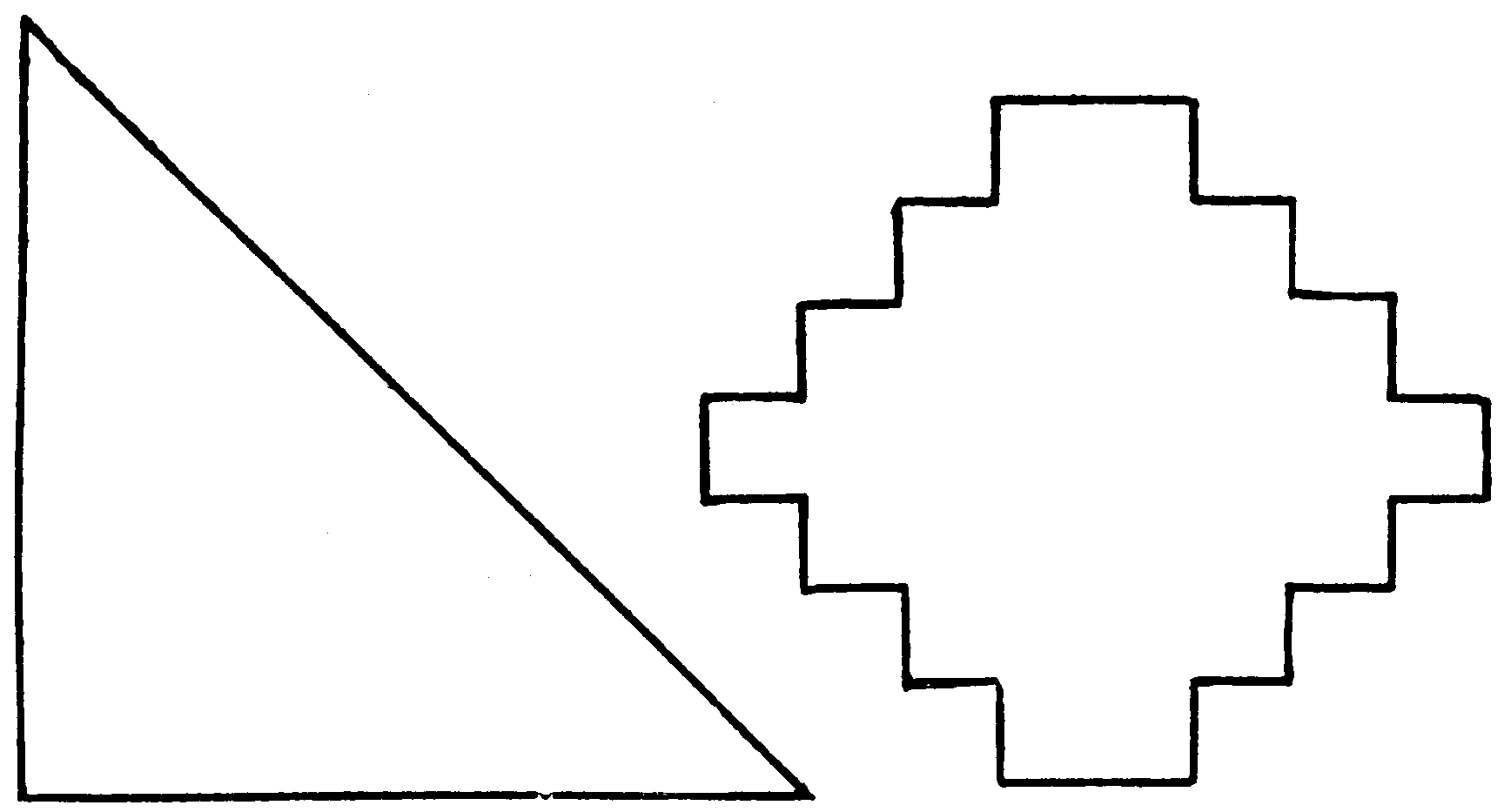
Can you divide this into only three pieces, which, when rearranged, will form the design given as No. 2?
Solution
A DEAL IN ROSES
I sent an order for dwarf roses to a famous nursery-garden, asking for a parcel of less than 100 plants, and stipulating that if I planted them 3 in a row there should be 1 over; if 4 in a row 2 over; if 5 in a row 3 over, and if 6 in a row 4 over, as a condition for payment.
The nurseryman was equal to the occasion, charged me for 58 trees, and duly received his cheque.
No. CXIII.—FIRESIDE FUN
This puzzle is not so easy of solution as it may seem at first sight.
Take a counter, or a coin, and place it on one of the points; then push it across to the opposite point, and leave it there. Do this with a second counter or coin, starting on a vacant point, and continue this process until every point is covered, as we place the eighth counter or coin on the last point.
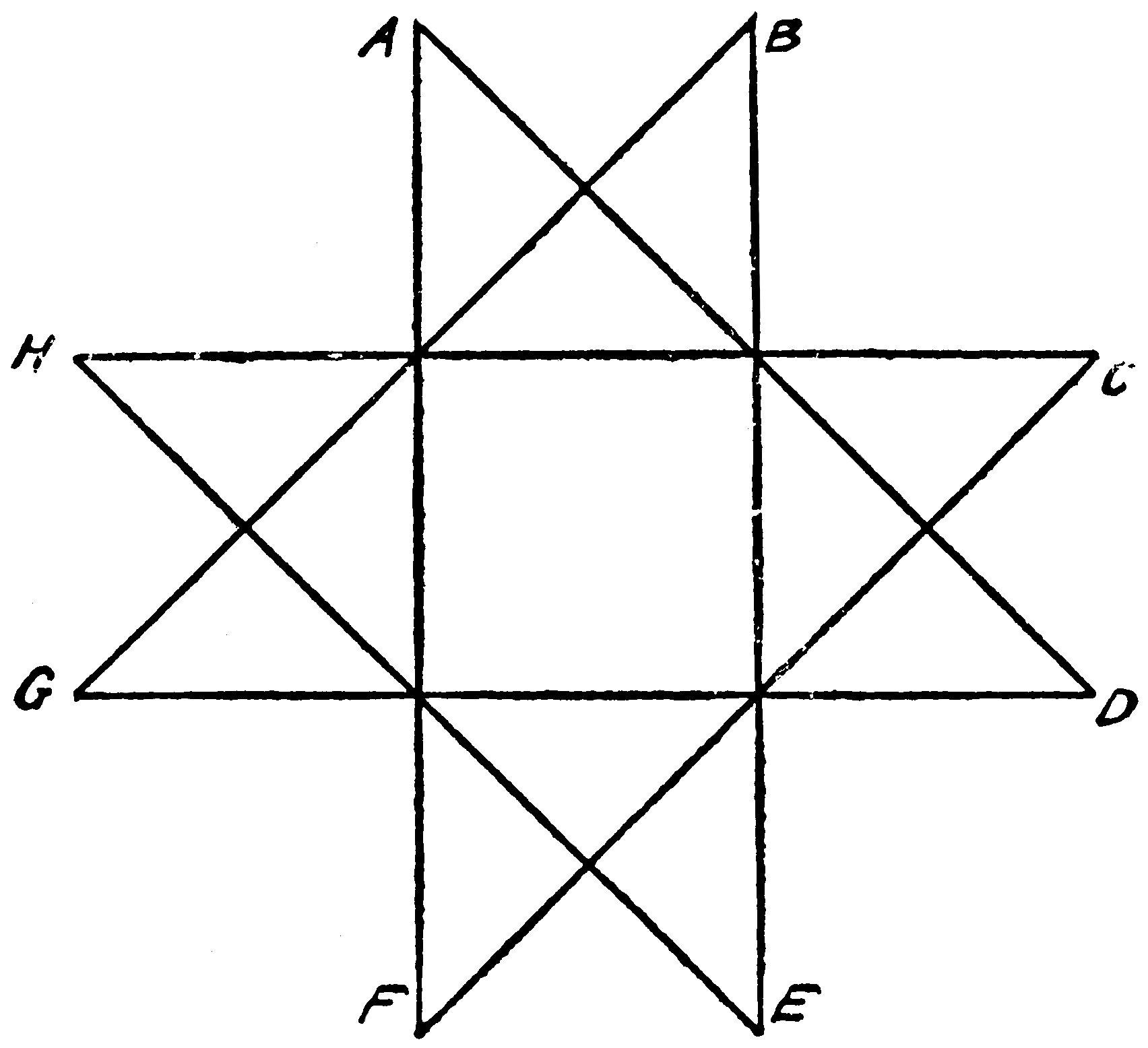
Solution
A NOVEL EXERCISE
“Write down,” said a schoolmaster, “the nine digits in such order that the first three shall be one third of the last three, and the central three the result of subtracting the first three from the last.”
The arrangement which satisfies these conditions is, 219, 438, 657.
CURIOUS CALCULATIONS
1.
There is a sum of money of such sort that its pounds, shillings, and pence, written down as one continuous number, represent exactly the number of farthings which it contains. What is it?
Solution
THE SLIP CARRIAGE
2. If on a level track a train, running all the time at 30 miles an hour, slips a carriage, which is uniformly retarded by the brakes, and which comes to rest in 200 yards, how far has the train itself then travelled?
Solution
3.
A traveller said to the landlord of an inn, “Give me as much money as I have in my hand, and I will spend sixpence with you.” This was done, and the process was twice repeated, when the traveller had no money left. How much had he at first?
Solution
4.
How can we obtain eleven by adding one-third of twelve to four-fifths of seven?
Solution
FILL IN THE GAPS
5. Can you replace the missing figures in this mutilated long division sum?
2 1 5 ) * 7 * 9 * ( 1 * *
* * *
* 5 * 9
* 5 * 5
* 4 *
* * *
Solution
6.
I buy as many heads of asparagus in the market as can be contained by a string 1 foot long. Next day I take a string 2 feet long, and buy as many as it will gird, offering double the price that I have given before. Was this a reasonable offer?
Solution
ALIKE FROM EITHER END
7. As “one good turn deserves another,” first reverse me, then reverse my square, then my cube, then my fourth power. When all this is done no change has been made. What am I?
Solution
THE SEALED BAGS
8. How can a thousand pounds be so conveniently stored in ten sealed bags that any sum in pounds from £1 to £1000 can be paid without breaking any of the seals?
Solution
9.
This is at once a problem and a puzzle:—
Though you twist and turn me over, Yet no change can you discover. Take me thrice, and cut in twain, You will find but one remain.
Solution
10.
Three gamblers, when they sit down to play, agree that the loser shall always double the sum of money that the other two have before them. After each of them has lost once, it is found that each has eight sovereigns on the table. How much money had each at starting?
Solution
FIND THE MULTIPLIER
11. When Tom’s back was turned, the boy sitting next to him rubbed out almost all his sum. Tom could not remember the multiplier, and only this remained on his slate—
3 4 5
. .
. . . .
. . . .
. . 7 6 .
Can you reconstruct the sum?
Solution
JUGGLING WITH THE DIGITS
12. The sum of the nine digits is 45. Can you hit upon other arrangements of 1, 2, 3, 4, 5, 6, 7, 8, 9, writing each of them once only, which will produce the same total. Of course fractions may be used.
Solution
A BRAIN TWISTER
13. The combined ages of Mary and Ann are forty-four years. Mary is twice as old as Ann was when Mary was half as old as Ann will be when Ann is three times as old as Mary was when Mary was three times as old as Ann. How old, then, is Mary?
Solution
14.
Mr Oldboy was playing backgammon with his wife on the eve of his golden wedding, and could not make up his mind whether he should leave a blot where it could be taken up by an ace, or one which a tré would hit.
His grandson, at home from Cambridge for the Christmas vacation, solved the question for him easily. What was his decision?
Solution
“ASK WHERE’S THE NORTH?”—Pope.
15. I am aboard a steamer, anchored in a bay where the needle points due north, and exactly 1200 miles from the North Pole. If the course is perfectly clear, and I steam continuously at the rate of 20 miles an hour, always steering north by the compass needle, how long will it take me to reach the North Pole?
Solution
16.
Three persons, A, B, and C, share twenty-one wine casks of equal capacity, of which seven are full, seven are half full, and seven are empty. How can these be so apportioned that each person shall have an equal number of casks, and an equal quantity of wine, without transferring any of it from cask to cask?
Solution
17.
A hungry mouse, in search of provender, came upon a box containing ears of corn. He could carry three ears home at a time, and only had opportunity to make fourteen journeys to and fro. How many ears could he add to his store?
Solution
18.
Take exactly equal quantities of lard and butter; mix a small piece of the butter intimately with all the lard. From this blend take a piece just as large as the fragment removed from the butter, and mix this thoroughly with the butter. Is there now more lard in the butter or more butter in the lard?
Solution
WHERE IS THE FALLACY?
19. Here is an apparent proof that 2 = 3:—
4 - 10 = 9 - 15
4 - 10 + 25⁄4 = 9 - 15 + 25⁄4
and the square roots of these:—
2 - 5⁄2 = 3 - 5⁄2
therefore 2 = 3.
Solution
PARCEL POST LIMITATIONS
20. Our Parcel Post regulations limit the length of a parcel to 3 feet 6 inches, and the length and girth combined to 6 feet. What is the largest parcel of any size that can be sent through the post under these conditions?
Solution
21.
How can we show, or seem to show, that either four, five, or six nines amount to one hundred?
Solution
TEST YOUR SKILL
22. Can you arrange nine numbers in the nine cells of a square, the largest number 100, and the least 1, so that the product by multiplication of each row, column and diagonal is 1000?
Solution
CATCHING CRABS
23. Seven London boys were at the seaside for a week’s holiday, and during the six week-days they caught four fine crabs in pools under the rocks, when the tide was out at Beachy Head.
Hearing of this, the twenty-one boys of a school in the neighbourhood determined to explore the pools; but with the same rate of success they only caught one large crab. For how long were they busy searching under the seaweed?
Solution
SETTING A WATCH
24. On how many nights could a watch be set of a different trio from a company of fifteen soldiers, and how often on these terms could one of them, John Pipeclay, be included?
Solution
“IMPERIAL CÆSAR”
25. If Augustus Cæsar was born on September 23rd, B.C. 63, on what day and in what year did he celebrate his sixty-third birthday, and by what five-letter symbol can we express the date?
Solution
26.
A was born in 1847, B in 1874. In what years have the same two digits served to express the ages of both, if they are still living?
Solution
THIS SHOULD “AMUSE”
27.
A hundred and one by fifty divide, To this let a cypher be duly applied; And when the result you can rightly divine, You find that its value is just one in nine.
Solution
OVER THE FERRY
28. A man started one Monday morning with money in his purse to buy goods in a neighbouring town. He paid a penny to cross the ferry, spent half of the money he then had, and paid another penny at the ferry on his return home.
He did exactly the same for the next five days, and on Saturday evening reached home with just one penny in his pocket. How much had he in his pocket on Monday before he reached the ferry?
Solution
THE MEN, THE MONKEY, AND THE MANGOES
29. Three men gathered mangoes, and agreed that next day they would give one to their monkey and divide the rest equally. The first who arrived gave one to the monkey, and then took his proper share; the second came later and did likewise, and the third later still, neither knowing that any one had preceded him. Finally they met, and, as there were still mangoes, gave one to the monkey, and shared the rest equally. How many mangoes at least must there have been if all the divisions were accurate?
Solution
30.
I look at my watch between four and five, and again between seven and eight. The hands have, I find, exactly changed places, so that the hour-hand is where the minute-hand was, and the minute-hand takes the place of the hour-hand. At what time did I first look at my watch?
Solution
A LARGE ORDER
31. There is a number consisting of twenty-two figures, of which the last is 7. If this is moved to the first place, the number is increased exactly sevenfold. Can you discover this lengthy number?
Solution
32.
A farmer borrowed from a miller a sack of wheat, 4 feet long and 6 feet in circumference. He sent in repayment two sacks, each 4 feet long and 3 feet in circumference. Was the miller satisfied?
Solution
THE FIVE GAMBLERS
33. Five gamblers, whom we will call A, B, C, D, and E, play together, on the condition that after each hazard he who loses shall give to all the others as much as they then have in hand.
Each loses in turn, beginning with A, and when they leave the table each has the same sum in hand, thirty-two pounds. How much had each at first?