PART I. (continued 2)
Reading edition
Solution
A RABBIT RUN
45. How far can a rabbit run into a square wood, with sides that each measure a mile, if it keeps on a straight course and does not break cover?
Solution
46
Often talked of, never seen, Ever coming, never been, Daily looked for, never here, Still approaching in the rear. Thousands for my presence wait, But, by the decree of Fate, Though expected to appear They will never see me here.
Solution
47.
I received my first because I was rash enough to say my second to my third, when seeking re-election at my whole.
Solution
48
How is it, in this charming weather, You and I can’t lunch together?
Solution
49
With a head, and without a head, With a tail, and without a tail, With a head without a tail, With a tail without a head, With a head and tail, Without a head and tail.
Solution
50.
“Ask me another,” she said, when he pressed her to name the happy day. “I will,” he replied. “Why is the letter ‘d’ like the answer which I seek from you?”
Solution
51 SWIFT’S RIDDLE
Two thirds of an ass, and a hole in the ground, Will dress you a dinner worth many a pound.
Solution
TOM HOOD’S RIDDLE
52. Here is a riddle for which Tom Hood was responsible. Can you solve it?
Twice to thine, Once to mine, With Congou make a gift divine.
Solution
53.
Hold up your hand and you will see what you never have seen, never can see, and never will see. What is this?
Solution
54.
Can you tell the difference between the Emperor of Russia and an ill-shod beggar?
Solution
55.
Why did Eden Philpotts?
Solution
56.
We have heard much of man’s imagined connection with the monkey, through some missing link. What evidence can we gather from early records of, at any rate, some verbal kinship with the patient ass?
Solution
57.
My first is gold, my second is silver, my third is copper, and my whole is tin.
Solution
58.
What is highest when its head is off?
Solution
59.
What word is there of six letters which can be so read that it claims to be spelt with only one?
Solution
60.
If a good oyster is a native, what is a bad one?
Solution
61.
Why is John Bright?
Solution
62.
If I walk into a room full of people, and place a new penny upon the table in full view of the company, what does the coin do?
Solution
63.
Jones, who had made it, and put it into his waistcoat pocket, lost it. Brown picked it up, and lighted his cigar with it. Then they both went to the train in it, and ran all the way.
Solution
64.
Why cannot a deaf and dumb man tickle nine people?
Solution
65.
When did “London” begin with an l and end with an e?
Solution
66.
I sent my second to my first, but many a whole passed before he came back to me.
Solution
67.
Which weighs most, the new moon or the full moon?
Solution
68.
Here is a puzzle which is unique and most remarkable, and which seems to be impossible, though it is absolutely sound:—
There is an English word of more than two letters, of which “la” is the middle, is the beginning, and is the end, though there is but one “a” and one “l” in the word. What is it?
Solution
69.
Why is a bee like a rook?
Solution
70 A DARK REBUS
O B e D
Solution
71 A MONKEY PUZZLER
If a monkey is placed before a cross, why does it at once get to the top?
Solution
72 A RIDDLE BY COWPER
I am just two and two, warm and cold, And the parent of numbers untold; Lawful, unlawful, duty, fault, Often costly, worthless bought. A priceless boon, a matter of course, Willingly yielded, taken by force.
The answer has been defined as “two heads and an application.”
Solution
HOW’S THAT, UMPIRE?
73. How can the Latin exhortation “Macte!” which may be roughly rendered “Go on and prosper!” be applied at cricket to a batsman at a critical moment?
Solution
BY TAPE MEASUREMENT
74. Are you good at topography? If so, can you discover and locate, from this description of its surroundings, a town within 30 miles of London?
Half an inch before the trees, and half a foot and half a yard after them, lead us to an English town.
Solution
75.
We know how, by the addition of a single letter, our cares can be softened into a caress; but in the following enigma a still more contradictory result follows, without the addition or alteration of a letter, by a mere separation of syllables:—
None can locate the subject of my riddle, For all the world would seek its place in vain; Cut it asunder almost in the middle, And in our very midst its place is plain. An aching void, an absolute negation, Into the opposite extreme it breaks; With just a gap to mark their new relation Each letter still the same position takes.
Solution
76. MULTUM IN PARVO
What two letters describe in nine letters the position of one who has been left alone in his extremity?
Solution
77. A CHANGE OF SEX
“Oh! would I were a man,” cried a schoolmistress, “that I might always teach boys.”
We boys overheard her, and placed her with us. What did we thus turn her into?
Solution
78. A STRIKING MATCH PUZZLE
How can you make a Maltese cross with less than twelve unbent and unbroken matches?
Solution
79
Have we any reason to suppose that in very early times there were less vowels than we have now?
Solution
80. A FRENCH RIDDLE
As Susette was sitting in the cool shadow of an olive grove at Mentone, Henri came up and said to her, with his best bow, “Je sais que vous n’avez pas mon premier, mais que vous êtes mon second, et je vous donnerai mon tout!” What did he hold out to her?
Solution
81
On a church close to an old ruined priory, near Lewes, there is a weathercock in the shape of a fish, probably an emblem of the faith. What moral lesson does this relic of early days convey to us?
Solution
82
Take five from half of ten, Set fifty in the middle, Add twice five hundred then To finish up the riddle, And make it with your pen As fit as any fiddle.
Solution
83. A PARADOX
“For the want of water we drank water, and if we had had water we should have drank wine.”
Who can have said this, and what did they mean?
Solution
84. WHAT IS IT?
The poor have two, the rich have none, Millions have many, you have one.
Solution
85
A thousand and one, And a sixth part of twenty; Some may have none, But others have plenty!
Solution
86. GREAT SCOTT!
“Charge, Chester, charge! on, Stanley, on!” Were the last words of Marmion. Now, had I been in Stanley’s place When Marmion urged him to the chase, You would have thought, unless you knew, That Scottish fray was Irish stew!
Shade of Sir Walter! What does all this mean?
Solution
87
I may be half of ten, I may be nearly nine; If eight contains me then Two-thirds of six are mine. A third of one, a fourth of four, I am an eighth of many more.
Solution
88. QUITE A BEATITUDE
Let her be, or beat her, Give her little ease; Then in safety seat her All among the bees.
Solution
89
Sharpen your wits till they are keen, Then see if you can guess What word it is that I have seen, And spell it with an s!
Solution
90. RATHER PERSONAL
Take part of a foot, And with judgment transpose. You will find that you have it Just under your nose.
Solution
NUTS TO CRACK
CRAZY LOGIC
1. Can you prove, by what we may call crazy logic, that madman is equal to madam?
Solution
A BIT OF BOTANY
2. A rat with its teeth in the webbed feet of its prey was what the squirrel saw one summer’s day, when he ran down from the tree-tops for a cool drink in the pond below his nest. Can you find out from this the name of the water-plant that was floating in the shade?
Solution
SIX SUNKEN ISLANDS
3. He set down the answer to that sum at random.
By bold policy Prussia became a leading power.
A great taste for mosaic has arisen lately.
The glad news was swiftly borne over England.
At dusk, year after year, the old man rambled home.
The children cried, hearing such dismal tales.
In each of these lines the name of an island is buried.
Solution
BURIED GEOGRAPHICAL NAMES
4. We could hide a light royal boat with a man or two; the skipper, though, came to a bad end.
In this short sentence seven geographical names are buried, formed by consecutive letters, which are parts always of more than one word. Can you dig them out?
Solution
A TRANSPOSITION
5. What can you make of this? The letters are jumbled, but the words are in due order.
Eltsheothwoedlaniscimtyyesrmh Tsihptsnrtoniaisoetcra; Ndaothetdandartssdensitemeb Ehcatreeltnisitlpace.
Solution
6 ALL IN A ROW
Three little articles all in a line Lead to a thousand, expressing, If with another all these you combine What can be never a blessing.
Solution
7 ASK A POLICEMAN
Ask a policeman, possibly he knows, In uniformed array. If not, an added letter plainly shows How little he can say.
Solution
8 RULING LETTERS
We rule the world, we letters five, We rule the world, we do; And of our number three contrive To rule the other two.
Solution
MIND YOUR STOPS
9. How would you punctuate the following sentence?
Maud like the pretty girl that she was went for a walk in the meadows.
Solution
10. ANSWER BY ECHO
What were they who paid three guineas To hear a tune of Paganini’s?
Solution
11. BREAKING A RECORD
Only eight different letters are used in the construction of this verse:—
Sad as the saddest end is his, He hath insensate died. He sinned, and that his Satan is That standeth at his side.
Wishing to break this record, we have put together a rhyming verse of similar length, in which only five letters are used. They are these:
(18 times) eeeeeeeeeeeeeeeeee. (20 times) nnnnnnnnnnnnnnnnnnnn. (18 times) tttttttttttttttttt. (16 times) iiiiiiiiiiiiiiii. (15 times) sssssssssssssss.
Solution
12. A CATCH SENTENCE
If is is not is and is not is is what is it is not is and what is it is is not if is not is is? Can you punctuate this so that it has meaning?
Solution
13. CATCHING A HINT
Passing one day by train through a station I caught sight of two words upon a large advertisement, which seemed cut out for puzzle purposes; and before long I had framed the following riddle:
Bisect my first, transpose its first half, and between this and its second half insert what remains if you take my second from my first. The result is as good to eat as my first and second are to drink.
Solution
14. IS IT GRAMMAR?
It is difficult at first sight to grasp the meaning of this apparently simple sentence:—“Time flies you cannot they pass at such irregular intervals.” How does it read?
Solution
15. ROYAL MEMORIES
In Queen Victoria’s Jubilee year I went to the South Kensington Museum. As I entered, looking at my watch, I thought of the good Queen. After some hours of quiet enjoyment I came away, again looking at my watch, and was reminded that the Prince Consort was not alive to share the Jubilee joys. At what time, and for how long was I in the Museum?
Solution
16. A SEASONABLE MOTTO
CCC SAW
Solution
17. AN OLD LATIN LEGEND
AMANS TAM ERAT HI DESINT HERO AD DIGITO UT MANDO
What is the interpretation?
Solution
18. THINGS ARE NOT WHAT THEY SEEM
Does the following statement imply that there is a curative virtue in rose-coloured rays?
“I know that roseate hues preserve.”
Solution
19. DOCTOR FELL
“Keep the patients warm and quiet; Solids are not well; Let all sops be now their diet,” So said Doctor Fell.
To what objection was this diet open?
Solution
20. DISLOCATED WORDS
These thirty-six letters form an English sentence:—
SAR BAB SAR BAB SAR BAB SAR BAB SAR BAB SAR ARA
What can it be?
Solution
21. BROAD WILTSHIRE
“Igineyvartydreevriswutts.”
Can you interpret this sentence, spoken by a sturdy farmer in the corn market?
Solution
22. FIND A RHYME
Try to find a rhyme to Chrysanthemum.
Solution
23. ABOUT THE EGGS
Did you hear that pathetic tale of the three eggs?
Solution
24. AN ANCIENT LEGEND
Doun tooth ers A sy Ouw ould bed One by.
Solution
25. A FAMILY PARTY
HERE LIE
Two grandmothers, and their two granddaughters; Two husbands, and their two wives; Two fathers, and their two daughters; Two mothers, and their two sons; Two maidens, and their two mothers; Two sisters, and their two brothers; Yet but —— in all lie buried here.
How many does the —— represent?
Solution
26. A SIMPLE CHARM
A superstitious couple in the country who heard mysterious noises at night in their house, sought the advice of a “wise woman” in the neighbourhood. She gave them on paper the following charm, which would, she assured them, counteract their evil star, and solve the mystery:—
ground turn evil star.
What was its significance?
Solution
27. MADE IN FRANCE
We are five varied vowels of foreign sound, Supported by one consonant between us. Three letters now in four, where may be found Another trio, quite a silly genus.
Solution
28. A PARADOX
What in his mind no man can find Four symbols will display; But only one remains behind If one we take away.
Solution
29. THE BARBER’S JOKE
A barber placed prominently in his window the following notice:—
What do you think I will shave you for nothing and give you a drink.
Attracted by this, a man went into the shop, and was shaved, but instead of receiving any liquid refreshment, he was surprised by a demand for the usual payment.
What was the barber’s explanation?
Solution
30. A FLIGHT OF FANCY
GENUI NE JAM A ICARUM.
This label, said to have been found among the ruins of old Rome, seems to bear a very early reference to the birth of Icarus, the flying man; or perhaps to some flying machine named after him, but not yet perfected. Can this be so?
Solution
31. A SPELL
Two c’s, an h, an n, a p, Three a’s, a u, an i, an e, Tell us what English word are we?
Solution
32. JOHNSON’S CAT
Johnson’s cat went up a tree, Which was sixty feet and three; Every day she climbed eleven, Every night she came down seven. Tell me, if she did not drop, When her paws would touch the top.
Solution
33. THE EXPANDING NINES
Some of us may perhaps remember Titania’s promise to Bottom in A Midsummer Night’s Dream:
“I have a venturous fairy, that shall seek The squirrel’s hoard, and fetch thee new nuts.”
Here is a little puzzle so fresh and curious that it will tempt the fancy of those who find it added to our hoard:
A third of six behind them fix, A third of six before; Thus make two nines, when all combines, Exactly fifty-four.
Solution
34. ACROSS THE MOAT
Form a square with four matches. Outside this, at an equal distance all round, form another square with twelve matches, just so far away that the space between them cannot be spanned by a match. With two matches only, form a firm bridge from the outer to the inner square.
Solution
35. IS IT BANTING?
We start when the ninth hour is past, Then there’s an end of you. A vengeful goddess shows at last What antifat will do.
Solution
36. QUITE A FAMILY PARTY
The telephone-bell roused Mrs P.W. from her after-luncheon nap, and her husband’s voice came to her ears, from his office in the city:—“I am bringing home to dinner my father’s brother-in-law, my brother’s father-in-law, my father-in-law’s brother, and my brother-in-law’s father.”
“Right!” she replied, knowing his quaint ways, “I shall be prepared.” For how many guests did she provide?
Solution
37. THE WILY WAYFARER
“Give me as much money as I have in my hand,” said Will Slimly to the landlord of a country inn, “and I will spend sixpence with you.” This was done, and repeated twice with the cash that was still in hand, and then the traveller was penniless. How much had he at first, and how much did the landlord contribute to Will’s refreshment?
Solution
38. A CLEVER CONSTRUCTION
How can four triangles of equal size be formed with six similar matches?
Solution
39. A KNOTTY POINT
When first the marriage knot was tied Between my wife and me, My age as oft repeated hers As three times three does three; But when ten years and half ten years We man and wife had been, Her age came then as near to mine As eight does to sixteen. What age was hers, what age was mine, When we were wed, from this divine.
Solution
40. A DIVISION SUM
“Take this half-crown,” said the vicar at a village festival, “and divide it equally between those two fathers and their two sons, but give nothing of less value than a penny to either of them.”
The schoolboy, who was a sharp lad, changed the half-crown, and divided it equally among them. How was this possible?
Solution
41. A CROOKED ANSWER
Tom (yawning) to Nell—“I wish we could play lawn-tennis!”
Nell (annoyed).—“Odioso ni mus rem. Moto ima os illud nam?”
Can you make head or tail, in Latin or in English, of her reply?
Solution
42. THE PEELER’S SMILE
Two policemen stood behind a hedge, watching for motor-car scorchers. One looked up the road, the other looked down it, so as to command both directions.
“Bill,” said one, without turning his head, “what are you smiling at?” How could he tell that his mate was smiling?
Solution
43. THE NIMBLE NINES
Twenty-seven with three nines You and I can score; Anyone one on other lines Can extend them more. Who can write them to be seen Equal only to sixteen?
Solution
44. A TRYING SENTENCE
That that is is that that is not is not is not that it it is.
Solution
45. SHORT AND SWEET
What is this?
ALLO.
Solution
46. SUPPLY THE CONSONANTS
An English Proverb
ieaoaaaeaai
Solution
47. IT LOOKS BLACK
| | | | | | | | | | | | |
Add thirteen more strokes, and make—what?
Solution
48. THE CORONER’S CHOICE
Can a coroner, after signing his name, write his official position in more ways than one?
Solution
HOW MANY PIPS?
Here is a good and simple card trick. Ask anyone to choose three cards from a pack, and to place them face downwards on the table. Then, beginning to count with the number of pips on each card laid down, let him place other cards upon these, one heap at a time, until in every case he counts up to 15, adding mentally 1 as he places down each card.
When he has completed the three heaps, take from him the remaining cards, and count them. Their number, less 4, will always be the number of pips on the three chosen cards. An ace counts 11, and a court card 10.
Thus, if he has chosen a 7, a 10, and an ace (11), he must cap these with 8, 5, and 4 cards respectively. There will then be 32 cards left, and 32 - 4 = 28, which is the sum of 7, 10, and 11.
ROUND THE MONKEY
Now for a few words about an old friend, familiar to most of us. If a monkey sits on a post holding one end of a string, and continually moves to face a man who holds the other end, and who walks round the post, does that man walk round the monkey?
R. A. Proctor, the astronomer, treated the question thus, some years ago in Knowledge:—“In what way does going round a thing imply seeing every side of it? Suppose a man shut his eyes, would that make any difference? Or suppose the man stood still, and the monkey turned round, so as to show the man its front and back, would the stationary man have gone round the monkey?”
We commend this ancient and puzzling subject of controversy to our readers. Our own opinion is that the man does walk round the monkey, in the commonly accepted meaning of the words, but “who shall decide when doctors disagree?”
BURIED ANIMALS
Here are a few cleverly buried animals:
“Come hither, mine friend,” said the monk, eyeing him kindly, “be a very good boy, step through the furze bravely, and seek the lost riches.”
Ermine; monkey; beaver; zebra; ostrich.
We, as electricians, proclaim the electric motor cab a boon to London.
Weasel; baboon.
QUESTIONS WELL ANSWERED
What could not the cruet stand? Seeing an apostle spoon. Why did the barmaid champagne? Because the stout porter bitter.
A TABLE OF AFFINITY
When it was reported that M. de Lesseps and his son were to marry sisters, the Rappel suggested these possible complications. Lesseps the younger will be his father’s brother-in-law, and his wife will be her own sister’s sister-in-law.
If Lesseps the elder has a son, and Lesseps the younger has a daughter, and these marry, then the daughter of Lesseps the younger will be her father’s sister-in-law, and the son of Lesseps the elder will be the son-in-law of his brother. The son of the second marriage will have two grandfathers, Lesseps the elder and the younger, so that old Lesseps will become his own son’s brother.
MARY QUITE CONTRARY
Mary had a little lamb, With feet as black as soot; And into Mary’s bread and milk He put his little foot. Now Mary was an honest girl, And scorned a hollow sham; So the one word that Mary said Was mother to the lamb!
MACARONIC VERSE
Latin
“Is acer,” sed jacto his mas ter at te, “Cantu passus sum jam?” “Notabit,” anser de; “Mi jam potis empti, solis tento me, For uva da lotas i vere vel se!”
English
“I say, sir,” said Jack to his master at tea, “Can’t you pass us some jam?” “Not a bit,” answered he, “My jam pot is empty, so listen to me, For you’ve had a lot as I very well see!”
HAM SANDWICHES
We most of us know the good old double-barrelled riddle, “Why need we never starve in the desert?” “Because of the sand which is there.” “How did the sandwiches get there?” “Ham settled there, and his descendants bred and mustered.” This clever metrical solution is by Archbishop Whately:—
A traveller o’er the desert wild Should ne’er let want confound him, For he at any time can eat The sand which is around him. It might seem strange that he should find Such palatable fare, Did we not know the sons of Ham Were bred and mustered there.
A GOOD MOTTO
We know that Latin motto, with its clever double meaning, suggested for a retired tobacconist, “Quid rides”—why do you smile?—or quid rides. Here is another, proposed many years ago, for a doctor of indifferent repute:—
Take some device in your own way, Neither too solemn, nor too gay; Three ducks suppose, white, grey, and black, And let your motto be “Quack! Quack!”
ON ONE NOTT
There was a man who was Nott born, His sire was Nott before him; He did Nott live, he did Nott die, His tombstone was Nott o’er him.
ON JOHN SO
So died John So, So, so, did he so? So did he live, and So did he die, So, so, did he so? So let him lie!
STRANGE SIGHTS
The importance of proper punctuation is very happily illustrated by the following lines:—
I saw a peacock with a fiery tail I saw a blazing comet pour down hail I saw a cloud enwrapped with ivy round I saw an oak tree swallow up a whale I saw the boundless sea brimful of ale I saw a Venice glass fifteen feet deep I saw a well full of mens’ tears that weep I saw wet eyes among the things that I saw Were no sore eyes nor any other eye-sore.
A QUAINT INSCRIPTION
There is a curiously constructed inscription over the door of the cloister of the Convent of the Carmelites at Caen, which runs thus:—
D di Si scap ac ab as
um vus mon ulare cepit tris.
T sæ Dæ ul in in an
The lines are in honour of one Simon Stock of that order, and they may be freely rendered:—
W ho Si first beg pr
hen ly mon an his eaching.
T wi De howled to sc t
NONSENSE VERSE IMPROMPTU, BY AN OLD DIVINE
If down his throat a man should choose In fun to jump or slide, He’d scrape his shoes against his teeth, Nor soil his own inside. Or if his teeth were lost and gone, And not a stump to scrape upon, He’d see at once how very pat His tongue lay there by way of mat, And he would wipe his feet on that!
EDGAR POE’S RIDDLE
Edgar A. Poe addressed the following puzzle-valentine to a lady, adding, “You will not read the riddle, though you do the best you can do:”—
For her this rhyme is penned whose luminous eyes, Brightly expressive as the twins of Leda, Shall find her own sweet name, that nestling lies Upon the page, enwrapped from every reader. Search narrowly the lines—they hold a treasure Divine—a talisman—an amulet That must be worn at heart. Search well the measure.
The first letter of the first line, the second of the second, the third of the third, and so on spell the lady’s name—Frances.
AN ILLUSION OF TYPE
A curious optical illusion is illustrated by printing a row of ordinary capital letters and figures which are symmetrical, thus:—
SSSSSXXXXX3333388888
If we glance at them casually it does not strike us that their upper parts are smaller than the lower, but if we turn the paper upside down we are at once surprised to see how marked the difference really is.

AN EXCHANGE OF COMPLIMENTS
At a tavern one night Messrs More, Strange, and Wright Met, good cheer and good thoughts to exchange. Says More, “Of us three The whole town will agree There is only one knave, and that’s Strange!” “Yes,” says Strange, rather sore, “I’m sure there’s one More, A most terrible knave, and a bite, Who cheated his mother, His sister, and brother.” “Oh yes,” replied More, “that is Wright!”
ΗΚΙΣΤΑ ΛΙΨ HE KISSED HER LIPS
(According to the daily Press, a good old-fashioned kiss lately lost favour in some quarters.)
Though a billiard player’s miss Cannot meet or make a kiss; Though a modern school of misses Be not in the cue for kisses; Chloe’s lips are not amiss, Kismet! I have met a kiss.
QUESTIONS WELL ANSWERED
We must not fail to register these two Questions Well Answered, which it is hard to match for excellence:—
Q.—Why did the fly fly?
A.—Because the spider spied her!
And
Q.—Why did the lobster blush?
A.—Because it saw the salad dressing!
The following puzzling lines were the outburst of the wanton wit of a lover, in his effort to play off one lady against another, and so retain two strings to his bow:—
I don’t want the one that I don’t want to know That I want the one that I want; But the one that I do want wants me to go And give up the one I don’t want. Why I don’t want the one that I don’t want to know That I want the one that I want, Is because, if the one that I want can’t be so, I shall want the one I don’t want.
Charles Lamb was responsible for the following ingenious perversion of words, when the Whig associates of the Prince Regent were sore at not obtaining office:—
Ye politicians tell me pray Why thus with woe and care rent? This is the worst that you can say, Some wind has blown the wig away, And left the hair apparent!
We may assume that this was the germ of the riddle “What is the difference between the Prince of Wales, a bald-headed man, and a monkey?” One is the heir-apparent, the second has no hair apparent, and the third is a hairy parent.
GRAMMAR OF A SORT
When is whiskey an adverb? When it qualifies water. When does a cow become a pronoun? When it stands for Mary.
Can the conjunction “and” be used otherwise than as a connecting link?
Yes, as in the puzzle sentence, “It was and I said not or,” which, if no comma is placed after “said,” no one can read easily at sight.
A TONGUE TWISTER
The tragedy “William Tell” was to be played many years ago at the old Drury Lane Theatre, and an actor, familiarly known as Will, asked the exponent of the part of Tell, on the eve of its production, whether he thought the play would tell with the critics and the public.
The following question and answer passed between them, in which only two different words were used, in an intelligible sequence of twenty-five words:—
Will.—“The question has arisen Tell, ‘will Will Tell tell?’ Will Tell tell Will ‘will Will Tell tell?’”
Tell.—“Tell will tell Will ‘will Will Tell tell?’ ‘Will Tell will tell!’”
THE LADY AND THE TIGER
Many of our readers will enjoy this very clever rendering of a well-known Limerick:—
There was a young lady of Riga, Who smiled as she rode on a tiger. They returned from the ride With the lady inside, And the smile on the face of the tiger! Puella Rigensis ridebat, Quam tigris in tergo vehebat; Externa profecta, Interna revecta, Sed risus cum tigre manebat!
ANOTHER TONGUE TWISTER
Six sieves of sifted thistles, Six sieves of unsifted thistles, And six thistle sifters.
To be repeated six times rapidly and articulately.
NOVEL DEFINITION OF A MAN’S HAT
Darkness that may be felt.
IS IT LATIN?
The following cryptic notice was posted recently on the green baize notice-board of a West-End Club:—
O nec ango in ab illi Ardor pyram id contestata Potor ac an non. Si deis puto nat times Ora res tu sed.
For some time its message was a mystery, until the sharp eyes of a member deciphered in what seemed to be real Latin, and was made up of Latin words, this English sentence, appropriate to the place:—“One can go in a billiard or pyramid contest at a pot or a cannon. Side is put on at times, or a rest used.”
FOR THE CHILDREN
A QUESTION
How much wood would a wood-chuck chuck, If a wood-chuck could chuck wood?
THE REPLY
The wood that a wood-chuck would chuck Is the wood that a wood chuck could chuck, If the wood-chuck that could chuck would chuck, Or a wood-chuck could chuck wood!
A QUAINT CONCEIT
The Capitol was saved of old By geese with noisy bill; More sage than silly, birds so bold Should have a mission still. Time was when roving on the loose, A goose would raise my dander; But now I feel each proper goose Should have her propaganda!
A LACK OF HOPS!
A man fond of his joke, and speaking of Lenten fare to a friend in a letter, wrote:—
I had a fish In a dish From an Archbish——
leaving it to his ingenuity to complete the broken line. The reply was a clever solution to the puzzle:—
I had a fish In a dish From an Archbish—— ’Op is not here For he gave me no beer!
FOR THE CHILDREN
The following simple calculation will be amusing to children:—If an even number of coins or sweets are held in one hand, and an odd number in the other, let the holder multiply those in the right hand by 2, and those in the left hand by 3, and add together the two results. If this is an even quantity the coins or sweets in the right hand are even, and in the left odd; if it is odd the contrary is the case.
PETER PIPER’S WIFE
(To be read or said rapidly.)
Betty bit a bit o’ butter, Bitter bit! But a better bit o’ butter Betty bit!
PHONETIC VERSE “A haunt each mermaid knows”
Eh horn teach myrrh made nose, Buy seize wear awl groat ales; Hear chilled wrens port inn rose, Seek your gain steals oar wails. Sum son there yell oh hare, Sums whim threw sigh leant baize; Sow form sand fay says fare Shy never knight sand daze.
PORSON’S EPIGRAM
Porson wrote a Latin epigram on a Fellow of one of the Colleges who always pronounced the a of Euphrates short. This was wittily translated thus:—
With fear on the Euphrates shore The wild waves made him shiver. But he thought to pass more quickly o’er, So he abridged—the river!
ALL THE ALPHABET
All the letters of the alphabet are used in these lines, which have such an easy flow:—
“God gives the grazing ox his meat, And quickly hears the sheep’s, low cry. But man, who tastes his finest wheat, Should joy to lift His praises high.”
A FRENCH TONGUE TWISTER
A French mother, as she gives to her child a cup of tea to allay its cough, says:—
“Ton thé t’a-t-il oté ta toux?” (Thy tea, has it removed thy cough?)
This sentence, repeated rapidly, is warranted to tire the nimblest tongue.
QUEER QUESTIONS AND QUAINT REPLIES
Why does the cannon ball? Because the Vickers Maxim (the vicar smacks him!) Why is the river Itchen? Because there is a current in its bed.
WAS IT SCANDAL?
Dick and Harry meet in a dim hotel passage:—
Dick.—Did you hear that story about No. 288?
Harry (all ears).—No; what was it?
Dick.—Oh, it’s too gross, too gross entirely!
Harry.—Tell away. I’ll try to stand it.
Dick.—Well; 288 is two gross, isn’t it?
AN INCONSEQUENT ECHO
Byron in his “Bride of Abydos” is responsible for the following strangely inconsequent echo:—
Hark to the hurried question of Despair, “Where is my child?” and Echo answers, “Where?”
A well-conducted echo would assuredly have seconded the cry of Despair by repeating the final syllables “my child!”
AN APPROPRIATE ANSWER
Why did the Razorbill raise her bill? To let the sea urchin see her chin!
CRICKET LATIN
Bene audax. Well bowled!
MACARONIC VERSE
Here is a modern specimen of Macaronic verse:—
Luce metat ipse sutor (Cantas Orci madentes!) “Qua forum an empti putor Potor tria quarto pes!”
Which reads into English thus:—
Lucy met a tipsy suitor (Can’t a saucy maiden tease!) “Quaff o’ rum an empty pewter Pot, or try a quart o’ peas!”
MACARONIC PROSE
LATIN
Puris agem, suetis a sylva bella vi olet indue mos is pura sueta far, amar vel verre ex que sit.
ENGLISH READING
Pure is a gem, sweet is a silver bell, a violet in dewy moss is purer, sweeter far, a marvel very exquisite.
THE LONG AND THE SHORT OF IT
These quaint lines were once addressed to a very tall barrister, named Long, when he was briefless:—
“Longè longorum longissime, Longe, virorum, Dic mihi, te quæso, num Breve quicquid habes?”
MOORE’S RIDDLE
Thomas Moore, the poet, is responsible for the following rude riddle, and its reply:—
Why is a pump like Viscount Castlereagh?
Because it is a slender thing of wood, That up and down its awkward arms doth sway, And coolly spout, and spout, and spout away, In one weak, washy, everlasting flood!
BIGGAR AND BIGGER
Mrs Biggar had a baby. Which was the bigger? The baby was a little Biggar!
Which was the bigger, Mr Biggar or the baby? Mr Biggar was father Biggar!
Mr Biggar died; was the baby then bigger than Mrs Biggar? No, for the baby was fatherless!
MAGIC CARD SQUARE
Place the sixteen court cards from an ordinary pack in the form of a square, so arranged that no row, no column, and neither of the diagonals shall contain more than one card of each suit, and one of each rank.
As the solution presents no difficulty, but merely calls for patience and attention, we will leave it to the ingenuity of our readers.
THE ANNO DOMINI PUZZLE
A Scottish tradesman had made, as he supposed, about £4,000, but his old clerk produced a balance-sheet which plainly showed £6,000 to his credit. It came upon the old gentleman as quite a disappointing shock when presently the puzzle was solved by the discovery that in the addition the year of Our Lord had been taken into account!
A PUBLIC SINK
The following ingenious play upon words dates from the days when a promise was made that the Thames pollution should cease in five years:—
In shorter time, kind sir, contrive To purify our drink; For while your figure is a Five Our river is a Cinq!
ENGLISH AS SHE IS SPOKE
“Mr Smith presents his compliments to Mr Brown, and I have got a hat that is not his, and he has got a hat that is not yours, so no doubt they are the expectant ones!”
PICKING FROM PUNCH
This play upon words appeared many years ago in the pages of Punch, and is worth preserving:—
To win the maid the poet tries, And sonnets writes to Julia’s eyes. She likes a verse, but, cruel whim, She still remains averse to him.
FRENCH ALLITERATION
“Si six scies scient six cigares, six cent six scies scient six cent six cigares.”
To be said trippingly without a trip.
If 6 saws cut 6 cigars, 606 saws cut 606 cigars.
MIND YOUR STOPS!
Here is a good illustration of the nonsense that may easily result from the misuse of punctuation:—
Every lady in the land Has twenty nails on each hand; Five and twenty on hands and feet, This is true without deceit.
A NOVEL DERIVATION
“Yes,” said an Eton captain of the boats to his uncle, the admiral, “I can quite believe that the British Jack Tar takes his name from that Latin verb, which is so suggestive of a life on the ocean wave, jactari, to be tossed about.”
AN AERATED BISHOP
A bishop of Sodor and Man found himself entered in the visitor’s book of a French hotel as “L’évêque du siphon et de l’homme!”
A HAPPY THOUGHT
They cannot be complete in aught Who are not humourously prone; A man without a merry thought Can hardly have a funny bone.
OUGH!
Though the tough cough and hiccough Make me hoarse, Through life’s dark lough I plough My patient course.
CUM GRANO SALIS
I know Eno, you know too, Fact is we all three know. We know Eno, he knows you. You know I know Eno!
OLD AND SOUND ADVICE
Nicholas, 1828.
He who a watch would wear This must he do; Pocket his watch, and watch His pocket too!
COLD-DRAWN CONCLUSIONS
Why is a lame dog like a blotting-pad?
A lame dog is a slow pup.
A slope up is an inclined plane.
An ink-lined plane is a blotting-pad!
THE LAST OF MARY
Mary had a little lamp, Filled with benzoline; Tried to light it at the fire, Has not since benzine!
A BURIED WORD
It is difficult to imagine that the very incarnation of what is wild and forbidding is buried in those words of peace and promise, “On Christmas Eve you rang out Angel peals,” until we find in them the consecutive letters “ourangoutang!”
EVE’S APPLE
How many apples were eaten by Adam and Eve? We know that Eve 81, and that Adam 812, total 893. But Adam 8142 please his wife, and Eve 81242 please Adam, total 89,384. Then again Eve 814240 fy herself, and Adam 8124240 fy himself, total 8,938,480!
U C I D K (You see I decay!)
“Surely, good sir, you follow me? It is as plain as A B C.” “Repeat it in a treble clef, For I am rather D E F!”
BURIED BY ACCIDENT
Quite unconscious that he was burying a cat in his melodious lines Moore wrote:—
“How sweet the answer Echo makes To music at night...!”
A LAWYER’S PROPOSAL
Fee simple and the simple fee, And all the fees in tail, Are nothing when compared with thee, Thou best of fees, fe-male!
A BROAD GRIN
“Sesquipedalia verba,” words a foot and a half long, were condemned by Horace in his “Ars Poetica.” Had he known English, what would he have said of “smiles,” a word so long that there is a mile between its first and last letters?
SWISS HUMOUR
A Swiss lad asked me, as I stopped quite breathless on an Alpine height, “Do you prefer ‘monter’ to ‘descendre?’” I declared a preference for downhill, but he most convincingly replied, “I prefer ‘mon thé’ to ‘des cendres!’” (my tea to cinders).
QUESTIONS WELL ANSWERED
Why did the penny stamp? Because the threepenny bit. Why did the sausage roll? Because it saw the apple turn-over.
MEN OF LETTERS
A budding author something new Submitting, signed himself X Q. The editor the essay read, And begged he might be X Q Z!
PUZZLES ON THE PAVEMENT
An angry street arab, who seems to have caught the infection of our letter puzzles, was heard recently to call out to a gutter-snipe, “You are a fifty-one ar!” (LIAR.)
PHONETIC ANSWERS
Why may you pick an artist’s pocket?—Because he has pictures.
What is the solace for a mind deprest?—Deep rest.
A FLIGHT OF FANCY
There was a man from Yankeeland Who round a walnut tree Did run so fast—that lissome man— His own back he could see!
BURNS IN SABOTS
“Guigne a beau de qui sabot de Nid a beau de t’elle?”
DOG LATIN
Here are all the elements of a rat hunt, expressed in Latin words:—“Sit stillabit,” sed amanto hiscat, “sta redde, sum misi feror arat trito unda minus, solet me terna ferret in micat.” They read into English, if differently pointed, thus:—Sit still a bit, said a man to his cat, stay ready, some mice I fear, or a rat try to undermine us, so let me turn a ferret in, my cat.
EARLY RITUAL
It is said that at first Adam thought Eve angelical, but there came a time when they both took to vestments.
LEST WE FORGET
If a man says that he forgets what he does not wish to remember, does he mean to say that he does not remember what it is that he wishes to forget; or that he is able to forget that which he does not wish to remember?
QUAINT ANGLO-FRENCH QUESTION AND REPLY
Pas qu’il ma, ou qu’il pas?
Marwood!
SOME POPULAR DEFINITIONS
Cricket. Lawn Tennis. Football.
Lords Ladies Legs
Stumps Jumps Bumps.
REAL DOG LATIN
Pax in bello. The dogs of war.
A QUAINT EPITAPH
Here in S X I lies. Killed by X S I dies.
A PHONETIC REPLY
What is the French for teetotaler?—Thé tout à l’heure!
A FREE RENDERING
Varietas pro Rege. Change for a sovereign!
A FREE TRANSLATION
“Splendide mendax.” Lying in State.
A WORD AND A BLOW
When Dunlop, in playful mood, said that no one could make a good pun on his name, a smart bystander at once exclaimed, “Lop off the end, and the thing is done!”
DOG LATIN (FOR SCHOOLBOYS)
Mitte meos super omnes ad candam aut esse homines mortui.
The Dog Latin may be rendered thus: “Send my overalls to the tailor to be mended.”
HIS L. E. G.
Some printer’s devil must have been at work when the proof-reader found “The Legend of the Cid,” set up in type as “The leg end of the Kid!”
SOLUTIONS
No. V.—THE MAKING OF A MAGIC SQUARE
The perfect Magic Square, for which we have given the construction of two preparatory squares, is formed by placing one of these over the other, so that the numbers in their corresponding cells combine, as is shown below.
Preparatory Square No. 1.
*
1 3 5 2 4
5 2 4 1 3
4 1 3 5 2
3 5 2 4 1
2 4 1 3 5
Preparatory Square No. 2.
*
5 15 0 10 20
10 20 5 15 0
15 0 10 20 5
20 5 15 0 10
0 10 20 5 15
The Perfect Magic Square.
6 18 5 12 24
15 22 9 16 3
19 1 13 25 7
23 10 17 4 11
2 14 21 8 20
No less than 57,600 Magic Squares can be formed with twenty-five cells by varying the arrangement of these same figures, but not many are so perfect as our specimen, in which sixty-five can be counted in forty-two ways. These comprise each horizontal row; each perpendicular row; main diagonals; blended diagonals from every corner (such as 6, with 14, 17, 25, 3; or 15, 18, with 21, 4, 7); centre with any four equidistant in outer cells; any perfect St George’s cross (such as 18, 22, 1, 15, 9); and any perfect St Andrew’s cross (such as 6, 22, 13, 5, 19).
Back to Description
No. XII.—A CENTURY OF CELLS
Here is the solution of the ingenious Magic Square of 100 cells with 36 cells unfilled. The rows, columns, and diagonals all add up to 505.
91 2 3 97 6 95 94 8 9 100
20 82 83 17 16 15 14 88 89 81
21 72 73 74 25 26 27 78 79 30
60 39 38 64 66 65 67 33 32 41
50 49 48 57 55 56 54 43 42 51
61 59 58 47 45 46 44 53 52 40
31 69 68 34 35 36 37 63 62 70
80 22 23 24 75 76 77 28 29 71
90 12 13 87 86 85 84 18 19 11
1 99 98 4 96 5 7 93 92 10
Notice that the top and bottom rows contain all the numbers from 1 to 10 and from 91 to 100; the two rows next to these range from 11 to 20 and from 81 to 90; the two next from 21 to 30 and from 71 to 80; the two next from 31 to 39 and 60 to 70, excluding 61, but including 41; and the two central rows the numbers run from 42 to 59, with 40 and 61.
Back to Description
No. XXIII.—TWIN PUZZLE SQUARES
The following diagram shows how the twin Magic Squares are evolved from our diagram:—
1 5 6 2 3 7
2 6 7 3 4 8
3 7 8 4 5 9
The sums of the corresponding rows in each square are now equal, and the sums of the squares of the corresponding cells of these rows are equal. The sums of the four diagonals are also equal, and the sum of the squares of the cells in corresponding diagonals are equal. The sum of any two numbers symmetrically placed with respect to the connecting link between the 7 and the 3 is always 10.
Back to Description
No. XXX.—THE UNIQUE TRIANGLE
The figures to be transposed in triangle A are 9 and 3 and 7 and 1.
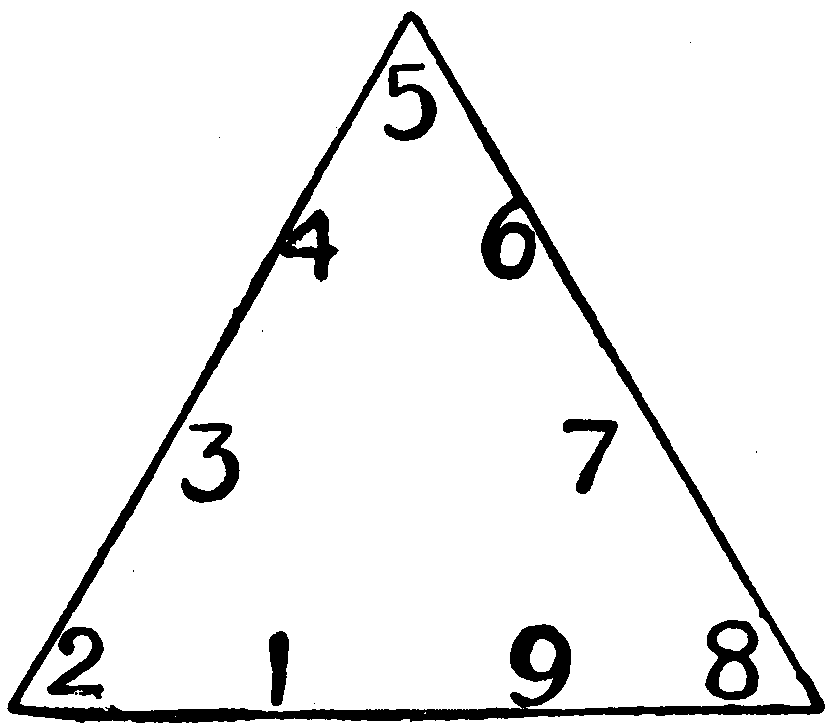
A
5
4 6
3 7
2 1 9 8
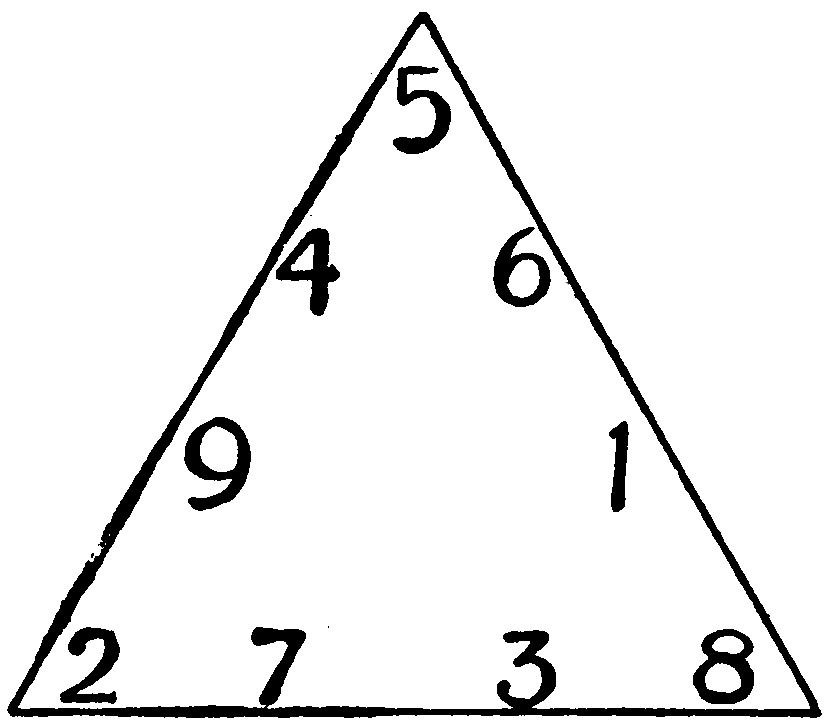
B
5
4 6
9 1
2 7 3 8
Then in triangle B, the sum of the side is in each case 20, and the sums of the squares of the numbers along the sides is in each case 126.
Back to Description
No. XXXI.—MAGIC TRIANGLES
The subjoined diagram shows the order in which the first 18 numbers can be arranged so that they count 19, 38, or 57 in many ways, down, across, or along some angles, 19 in 6 ways, 38 in 12, and 57 in 14 ways.
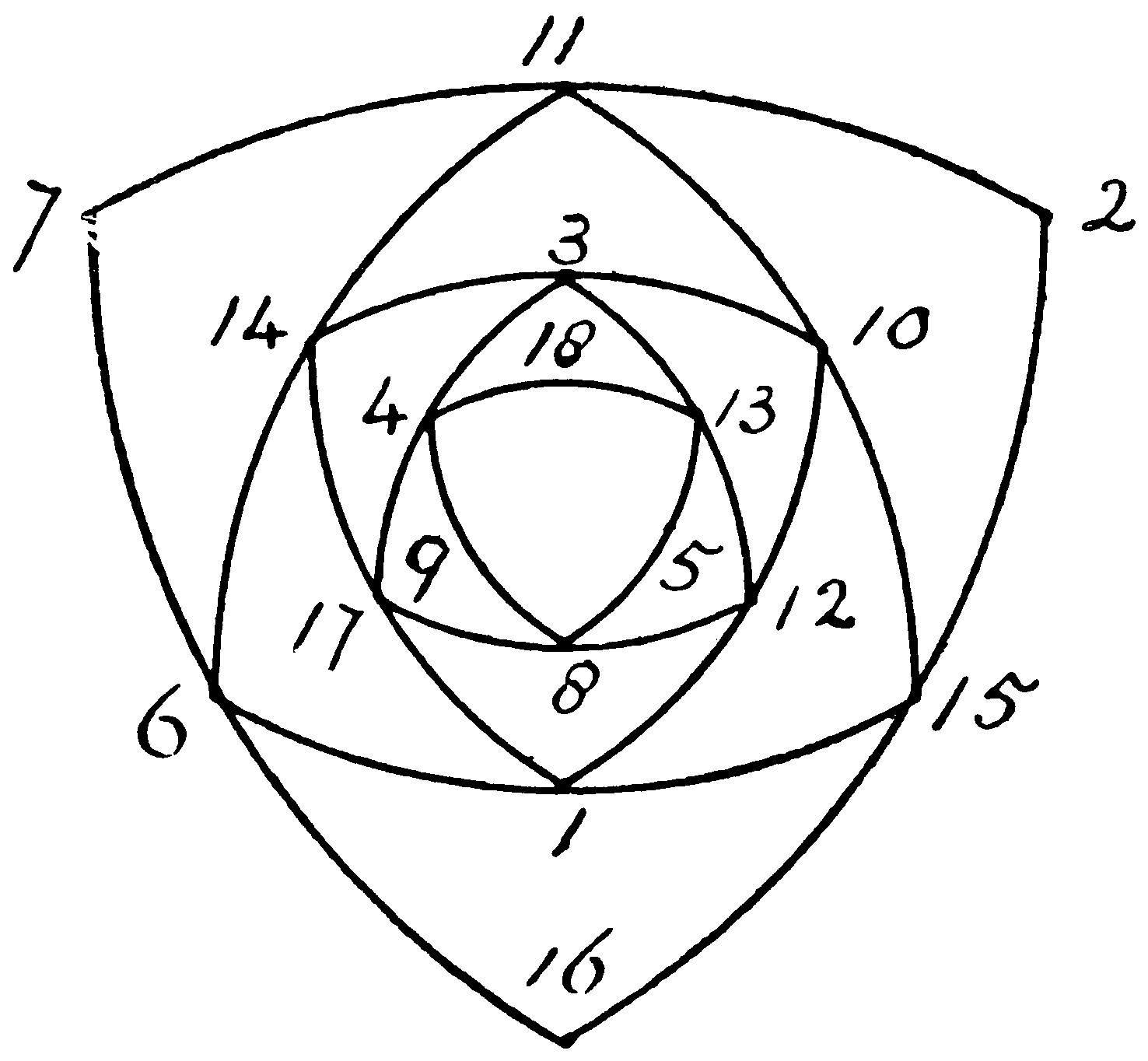
Thus, for examples—
7 + 12 = 14 + 5 = 4 + 15 = 19
7 + 11 + 14 + 6 ——— = 38
7 + 14 + 4 + 5 + 12 + 15 = 57
Back to Description
No. XXXIV.—MAGIC HEXAGON IN A CIRCLE
The figures in the Magic Hexagon must be arranged as is shown in this diagram:—
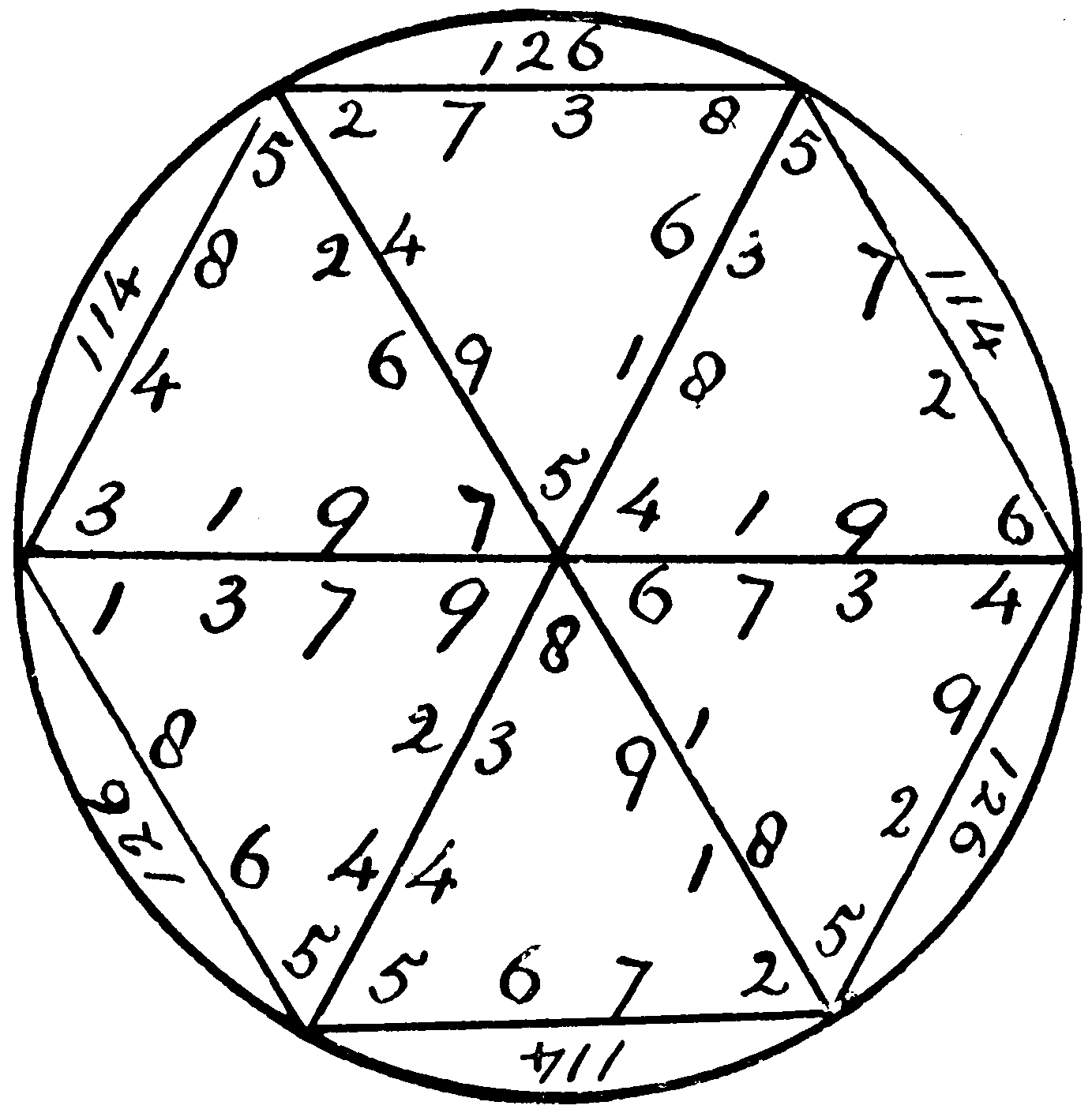
126
5 2 7 3 8 5
8 2 4 6 3 7
114 114
4 6 9 1 8 2
3 1 9 7 5 4 1 9 6
1 3 7 9 8 6 7 3 4
8 2 3 9 1 9
126 126
6 4 4 1 8 2
5 5 6 7 2 5
114
It will be seen that the sum of the four digits on each side of each triangle is twenty, and that, while their arrangements vary, the total of the added squares of the numbers on the alternate sides of the hexagon are equal.
Back to Description
No. XXXVI.—A CHARMING PUZZLE
✦ ✦ ✦
✦ ✦ ✦
✦ ✦ ✦
To pass through these nine dots with four continuous straight lines, start at the top right-hand corner, and draw a line along the top of the square and beyond its limits, until its end is in line with the central dots of the side and base. Draw the second line through these, continuing it until its end is below and in line with the right-hand side of the square; draw the third line up to the starting-point, and the fourth as a diagonal, which completes the course.
Back to Description
No. XXXVII.—LEAP-FROG
On a chess or draught-board three white men are placed on squares marked a and three black men on squares marked b in the diagram—
a a a b b b
1 2 3 4 5 6 7
Every a can move from left to right one square at a time, and every b from right to left, and any piece can leap over one of another colour on to an unoccupied square. They can reverse their positions thus:—
If we number the cells or squares consecutively, and notice that at starting the vacant cell is No. 4, then in the successive moves the vacant cells will be 3, 5, 6, 4, 2, 1, 3, 5, 7, 6, 4, 2, 3, 5, 4. Of the moves thus indicated six are simple, and nine are leaps.
Back to Description
No. XXXVIII.—SORTING THE COUNTERS
The counters are changed in four moves only, moving two at a time as follows:—


Move 2 and 3 to 9 and 10.
„ 5 and 6 to 2 and 3.
„ 8 and 9 to 5 and 6.
„ 1 and 2 to 8 and 9.
Back to Description
No. XXXIX.—A TRANSFORMATION
To change the ten-pointed star of wooden matches into one of five points without touching it, let a little water fall into the very centre, as it lies on quite a smooth surface, and in a few moments, under the action of the water, it will gradually assume the shape shown in the second diagram, of a five-pointed star.
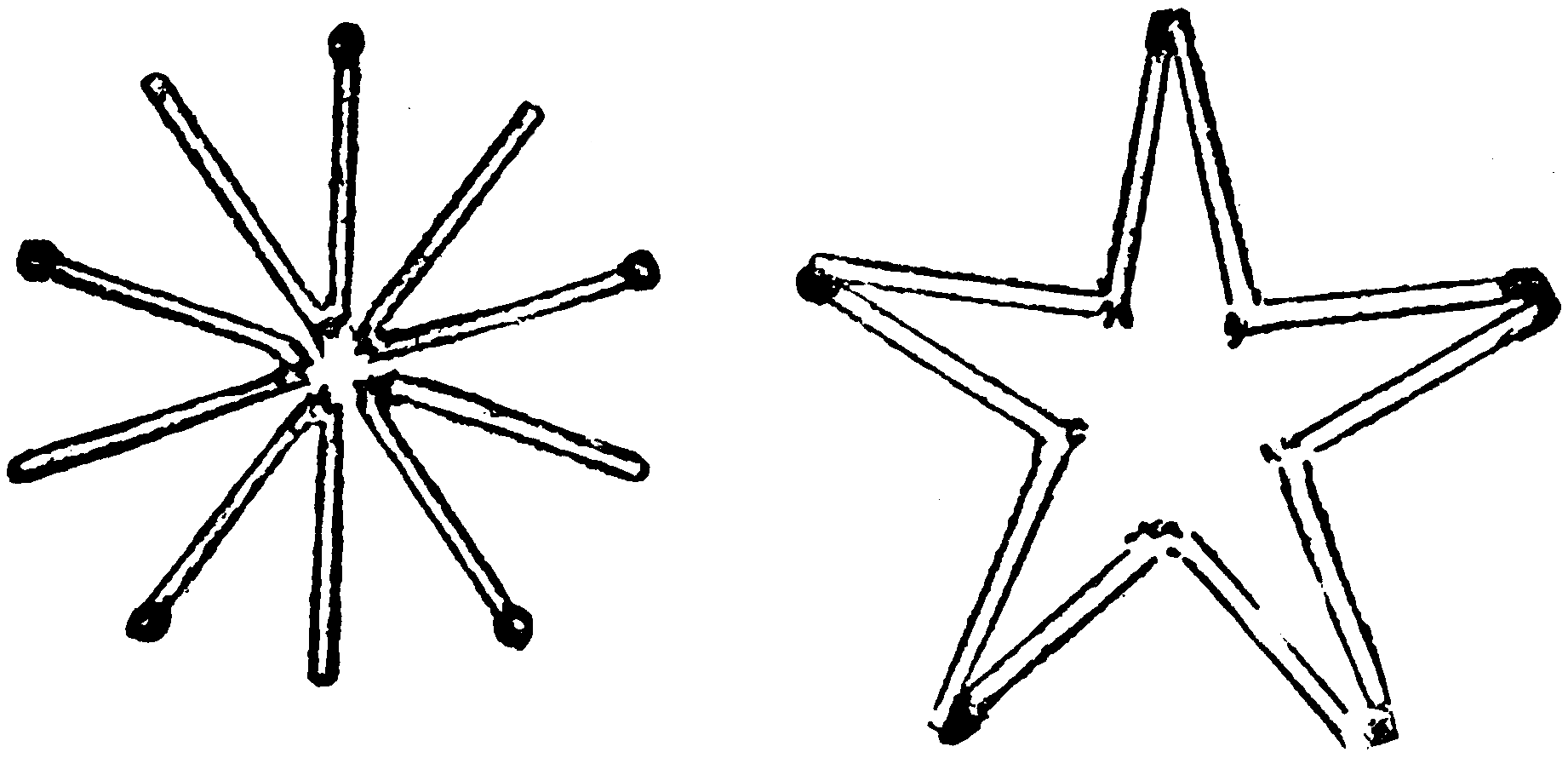
This is a very simple and effective after-dinner trick. Small matches move best.
Back to Description
No. XLI.—FAST AND LOOSE
The twelve counters or draughtsmen lying loosely at the bottom of a shallow box can be arranged so that they wedge themselves together and against the side thus:—
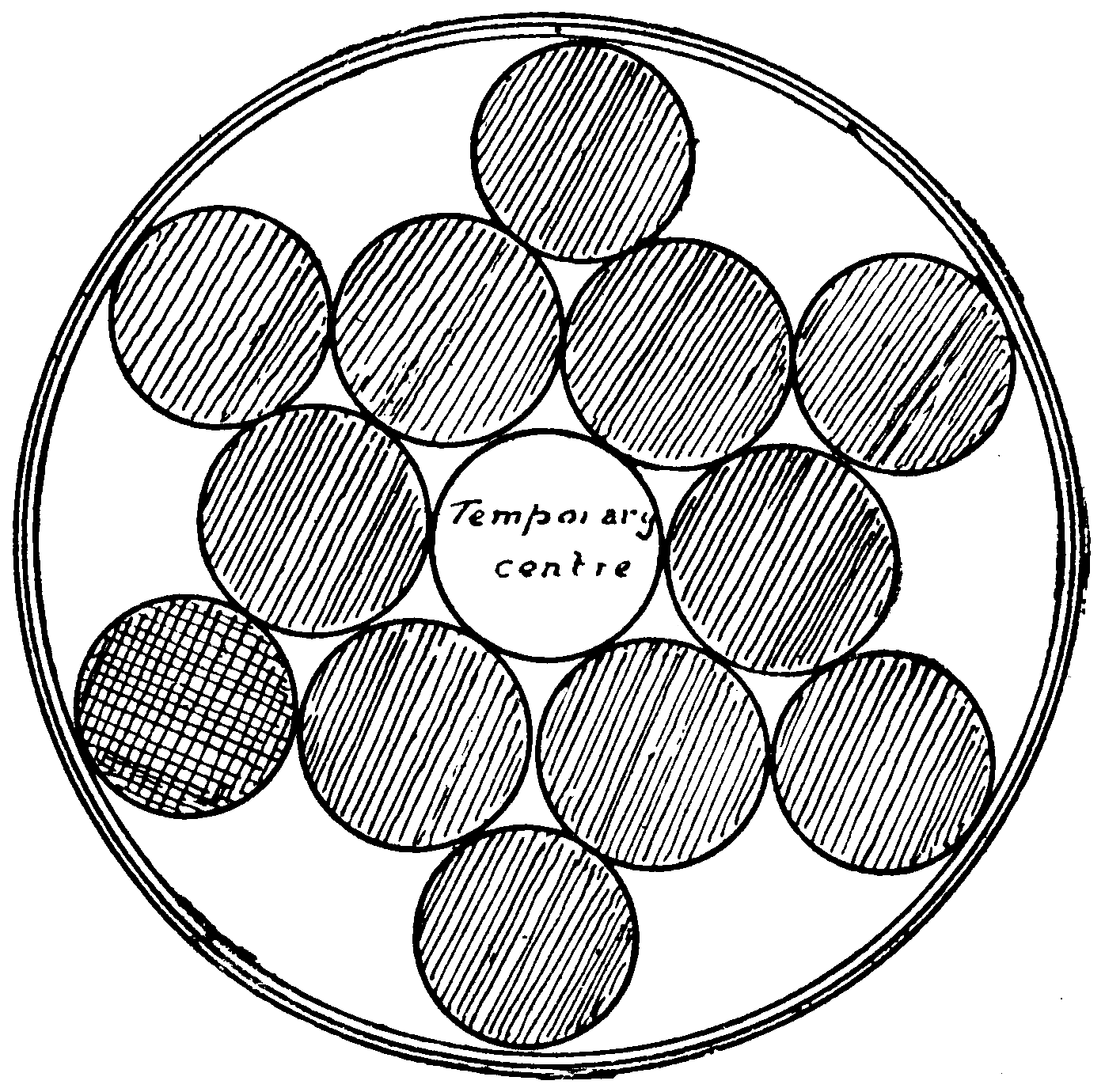
Temporary centre
Place one for the moment in the centre, and six round it. Hold these firmly in their places with the left hand, and fix the other five round them, as is shown in the diagram. Then remove the temporary centre, and fill in with it the vacant place. All will then be in firm contact, and the box may be turned upside down without displacing them.
Back to Description
No. XLIII.—FOR CLEVER PENCILS
This diagram, shows how a continuous course is possible without taking pencil from paper, or going twice over any line.
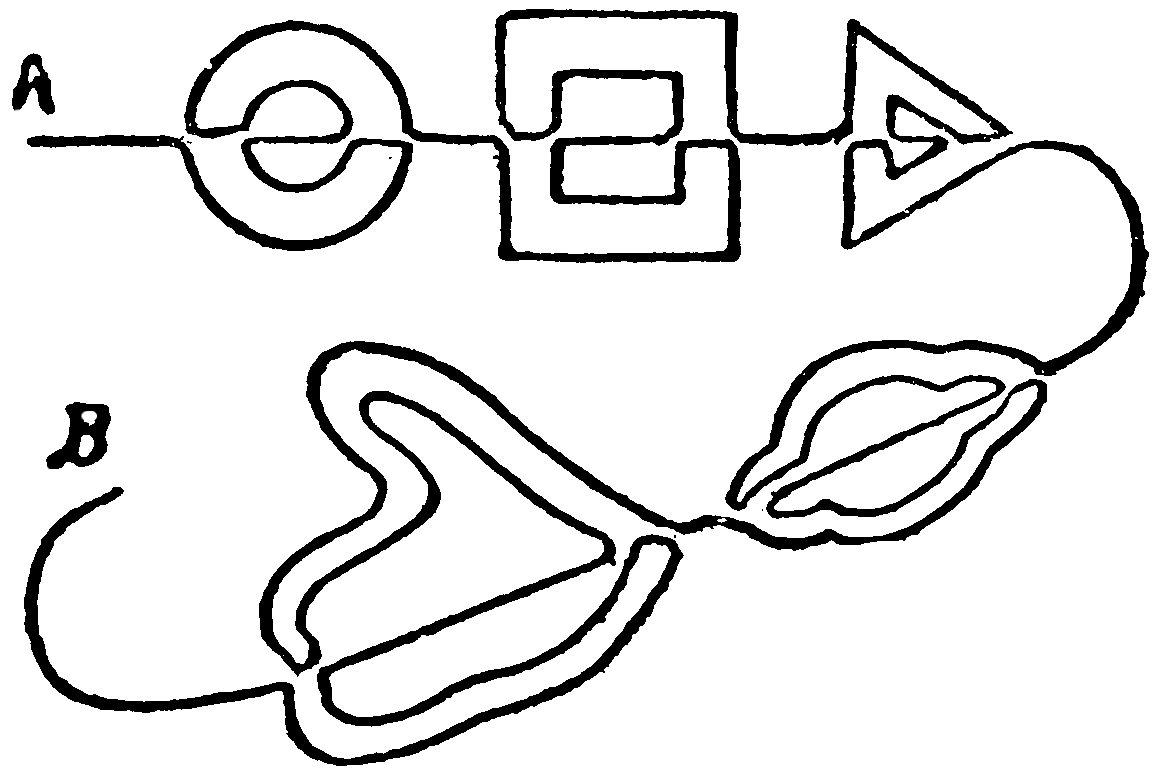
We have purposely left spaces wide enough to make the solution perfectly clear.
Back to Description
No. XLVIII.—A BOTTLED BUTTON
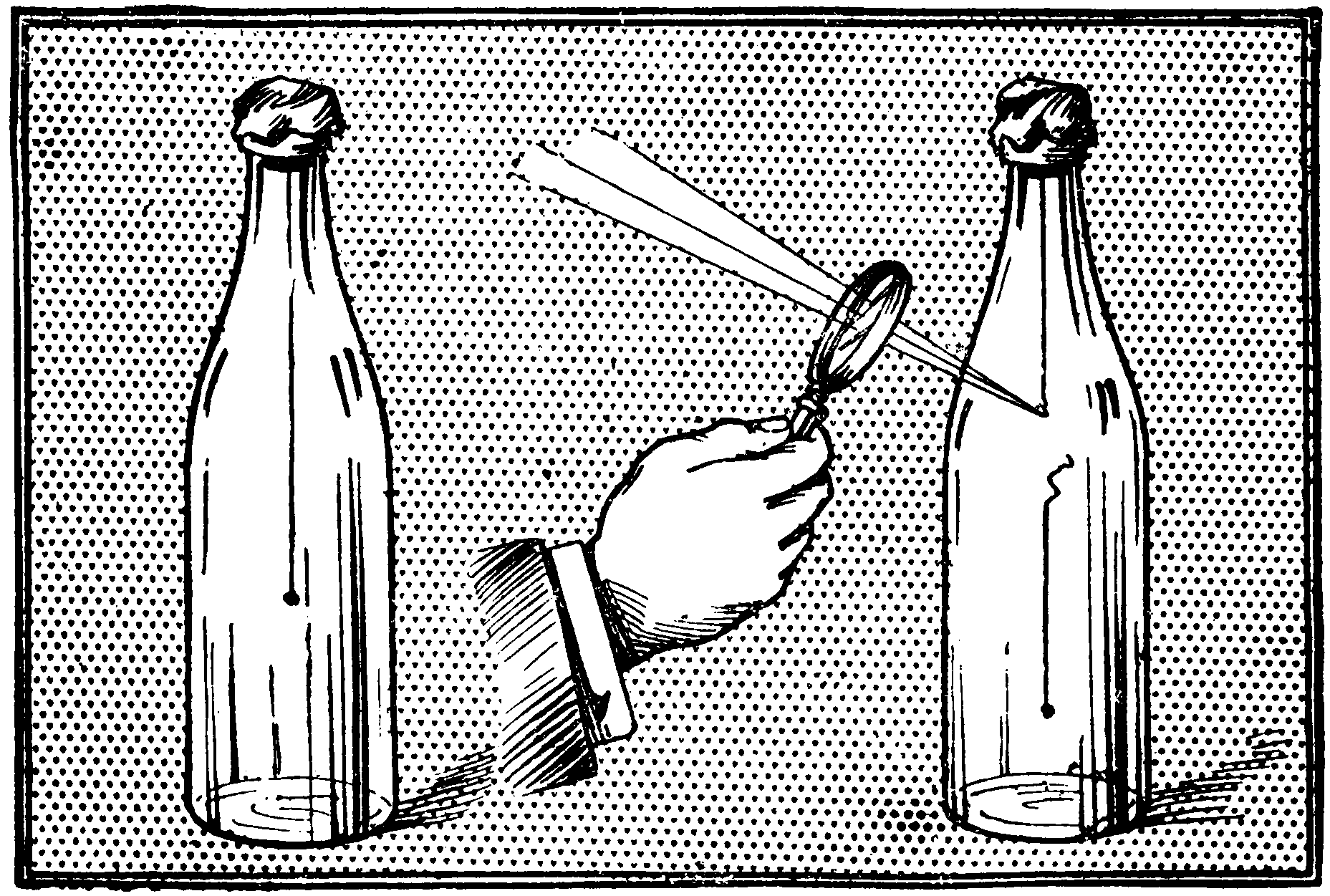
The diagram below shows how the thread within the bottle is severed so that the button falls, without uncorking the bottle or breaking it.
Nothing is needed but a lens to focus the rays of the sun, which pass through the glass without heating it, and burn the thread.
Back to Description
No. XLIX.—CLEARING THE WAY
In order to cause the coin to fall into the bottle without touching coin, match, or bottle, let a drop or two of water fall upon the bent middle of the match.
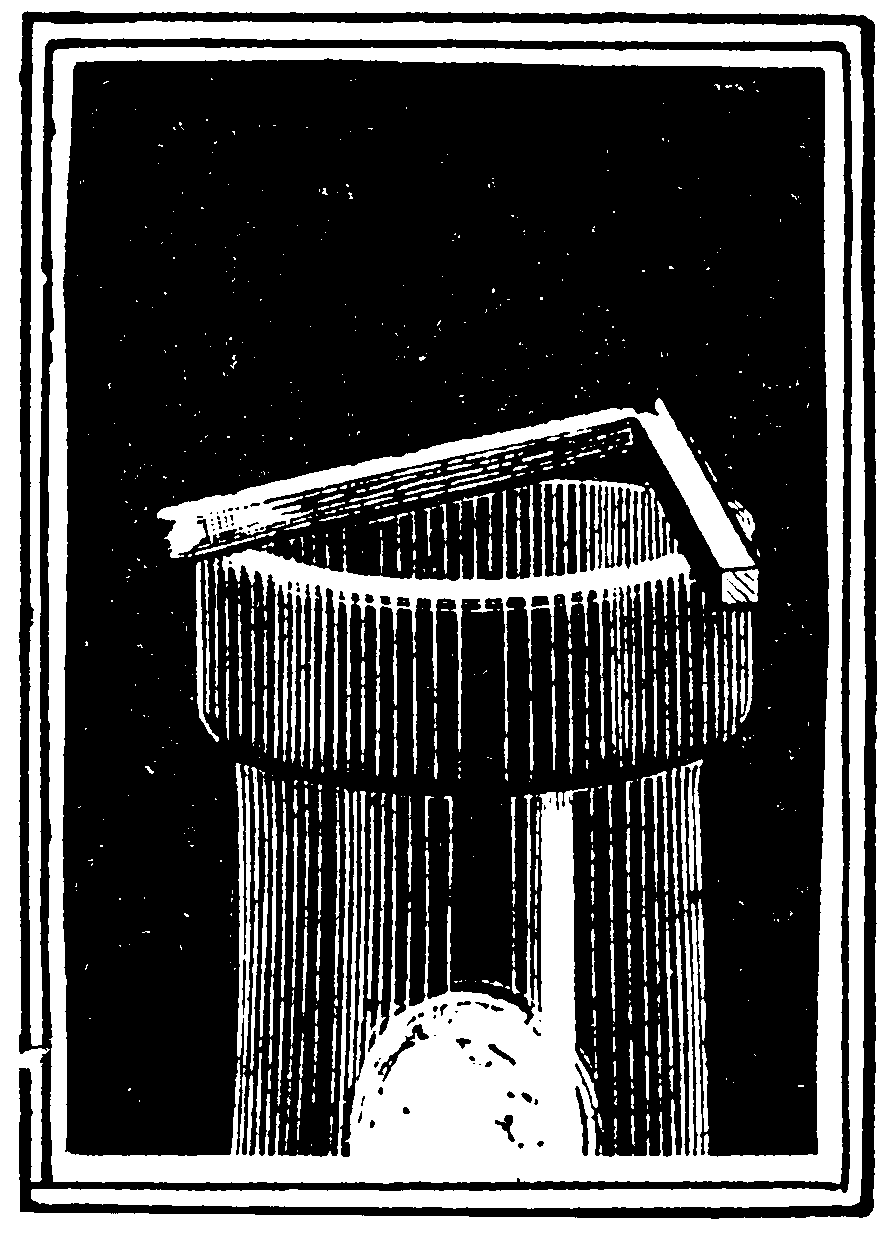
Very soon, under the action of the water, the two ends of the match will open out so that the coin which was resting on them falls between them into the bottle.
Back to Description
No. LII.—BILLIARD MAGIC
The diagram we give below shows the ingenious trick by which the plain white, if struck gently with a cue, will, aided by the tumbler, pot the spot white ball without in any way disturbing the red.
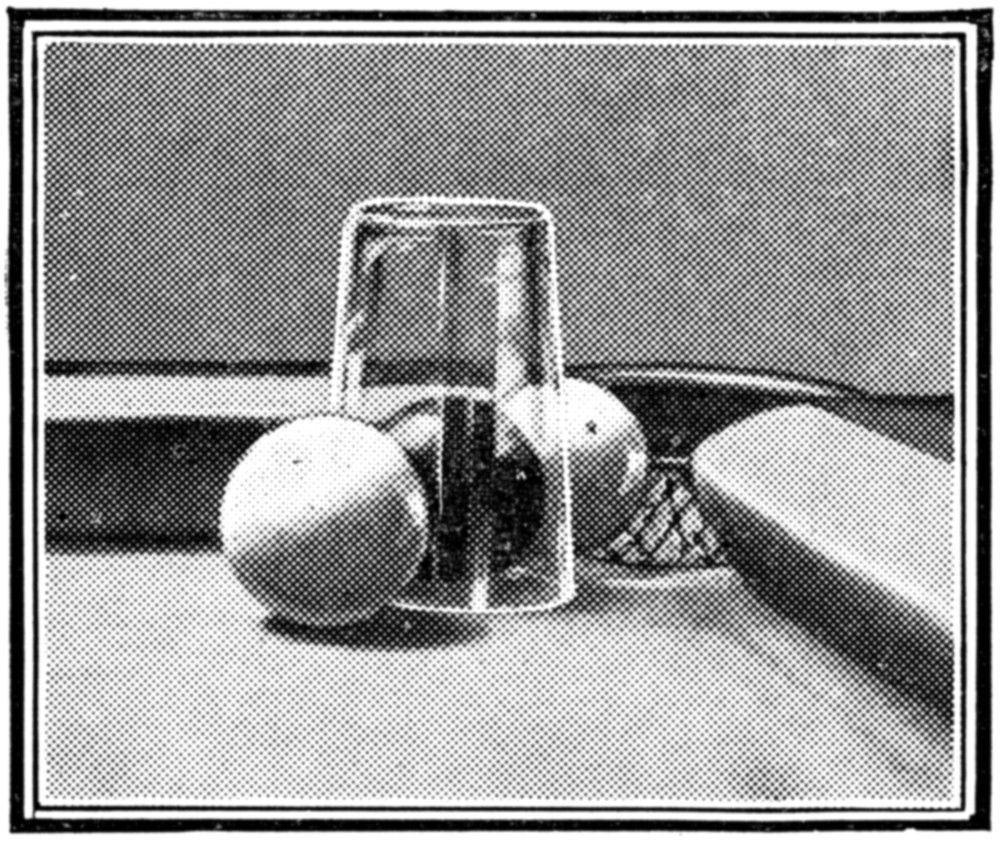
The balls to start with are an eighth of an inch apart, and there is not room for a ball to pass between the cushions and the red. Place the tumbler close to spot white.
Back to Description
No. LIII.—THE NIMBLE COIN
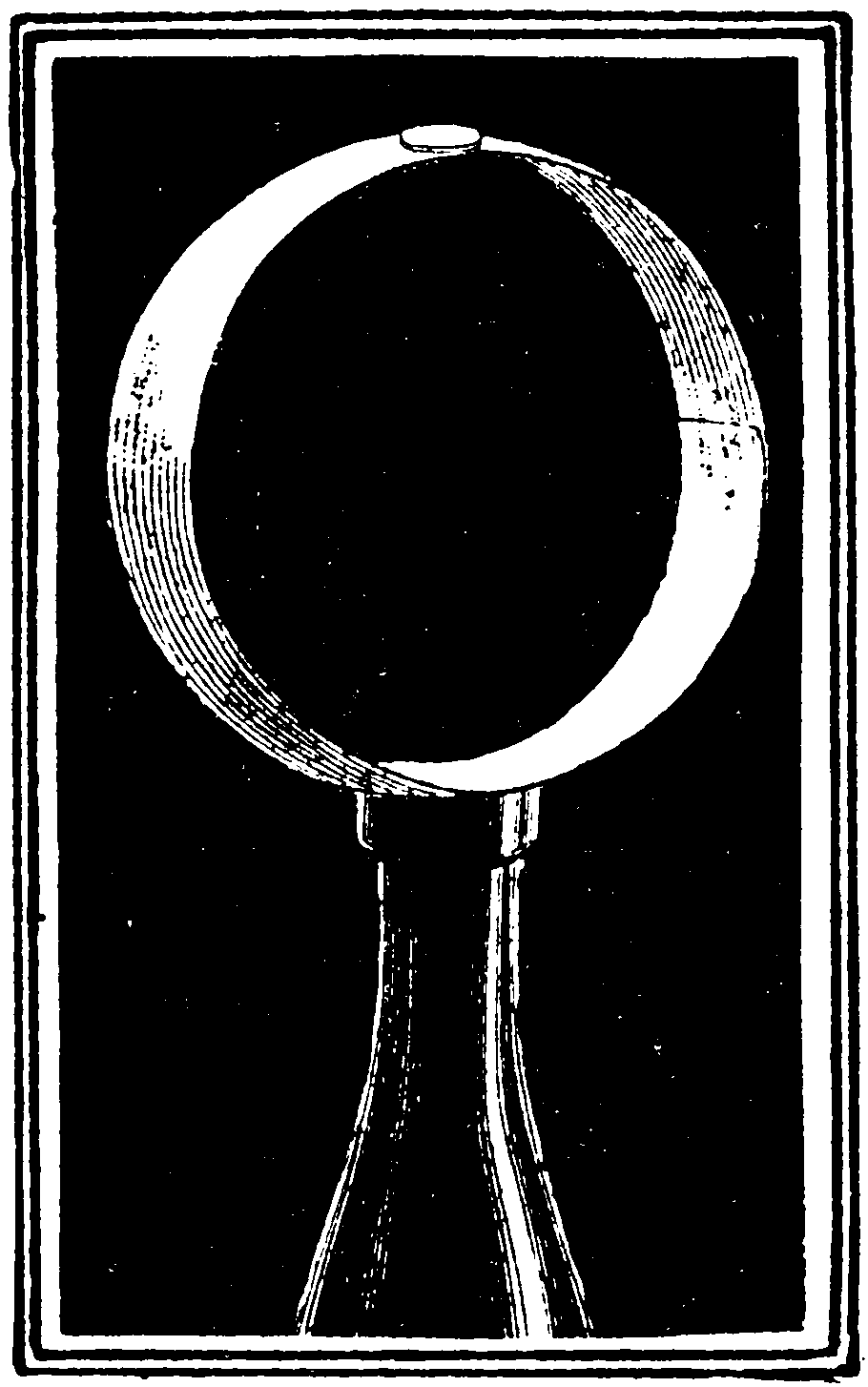
The most effective way to transfer the coin from the top of the circular band of paper into the bottle is to strike a smart blow with a cane, or any small stick, on the inside of the paper band. There is not time for the coin to be influenced in the same direction, and it falls plumb into the neck of the bottle.
Back to Description
No. LVIII.—WHAT WILL HAPPEN?
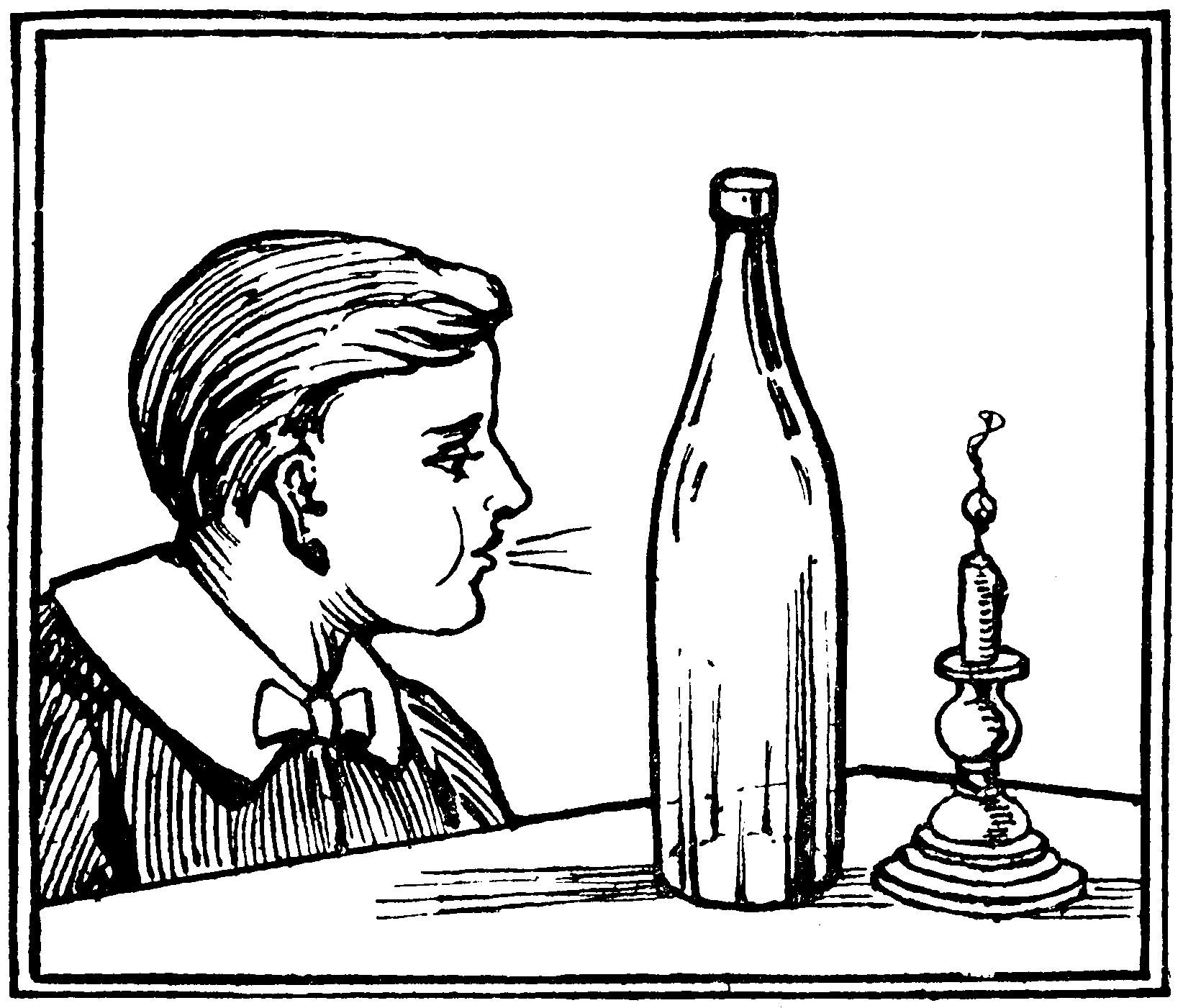
When the boy shown in this picture blows hard at the bottle which is between his mouth and the candle flame, the divided air current flows round the bottle, reunites, and extinguishes the flame.
Back to Description
No. LX.—VIS INERTIÆ
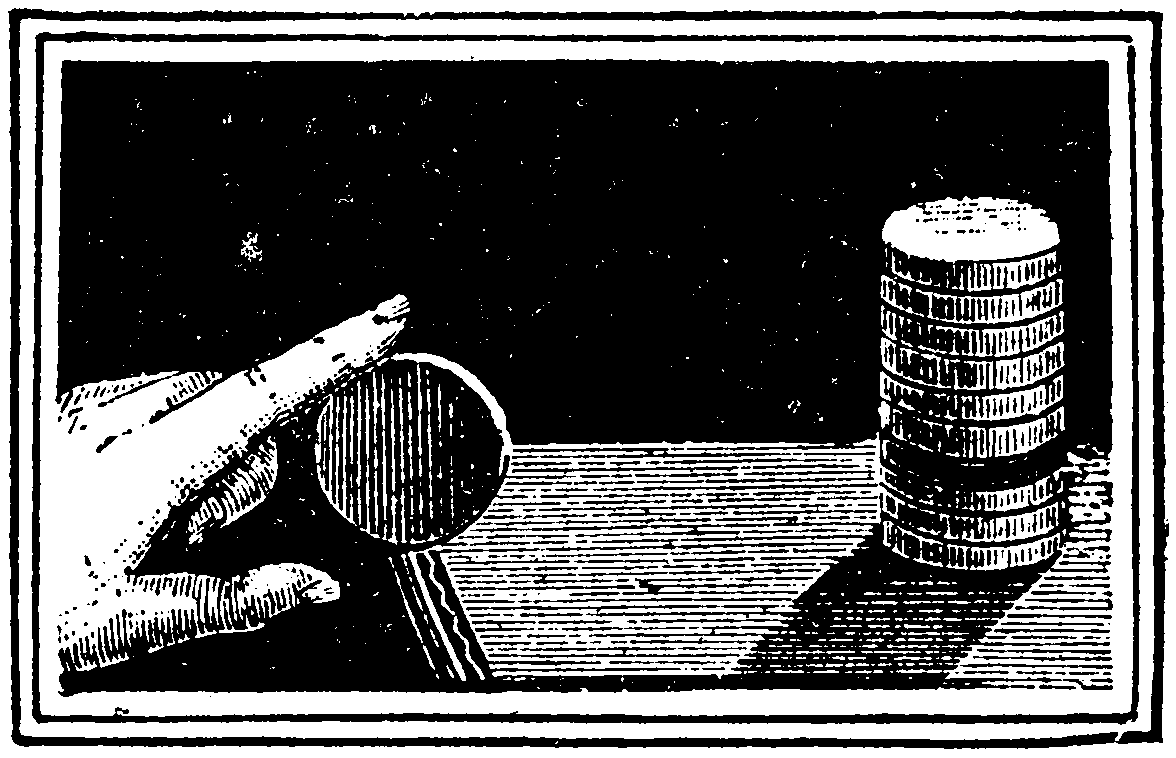
If, by a strong pull of my finger, I launch the draughtsman that is on the edge of the table against the column of ten in front of it, the black man, which is just at the height to receive the full force of the blow, will be knocked clean out of its place, while the others will not fall. This is another illustration of the vis inertiæ.
Back to Description
No. LXI.—CUT AND COME AGAIN
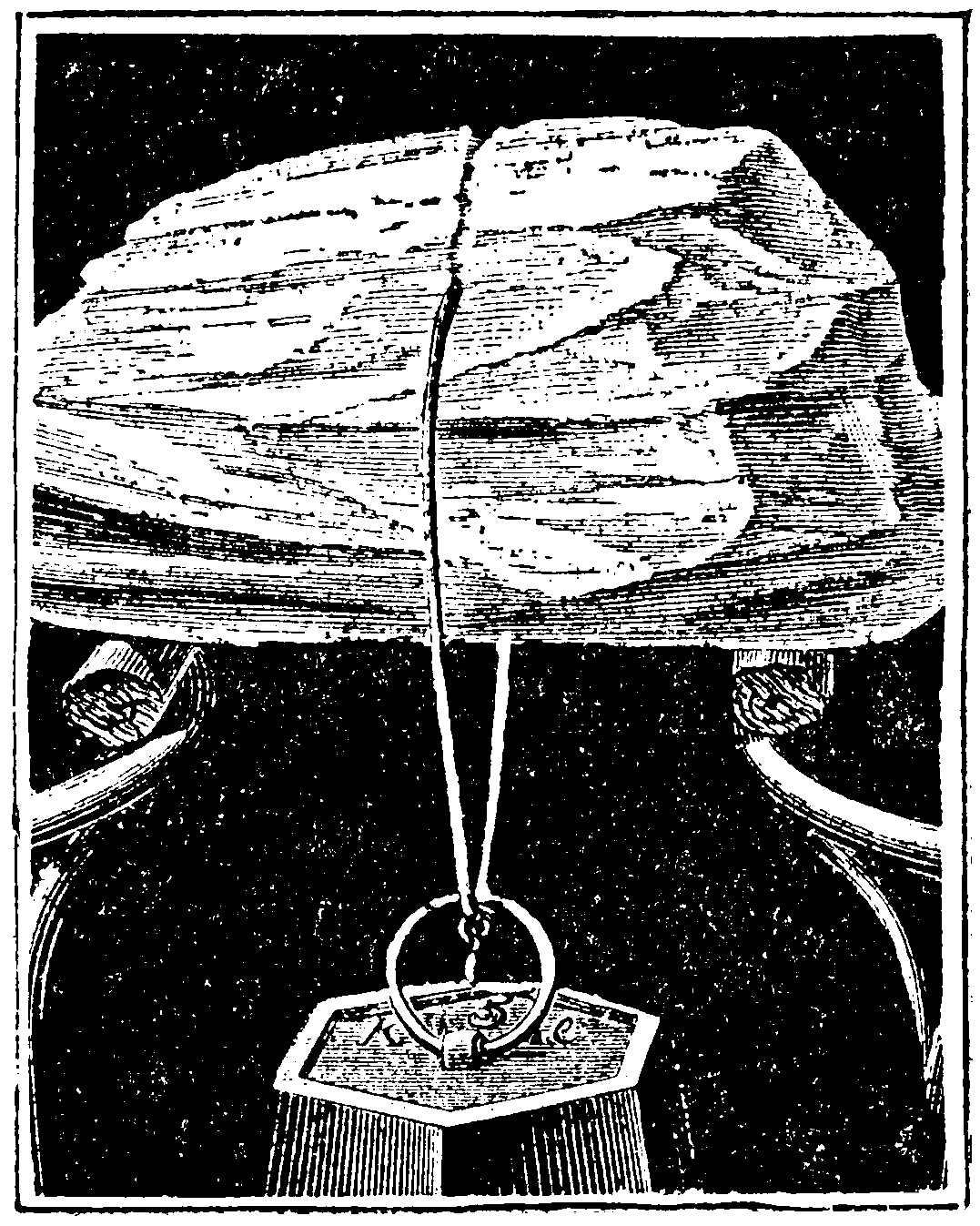
A block of ice would never be divided completely by a loop of wire on which hangs a 5 ℔ weight. For as the wire works its way through, the slit closes up by refreezing, and the weight falls to the ground with the wire, leaving the ice still in a single block.
Back to Description
No. LXIII.—CATCHING THE DICE
It is quite easy to throw the upper of this pair of dice into the air and catch it in the cup, but the other is more elusive. As you throw it upward with sufficient force you will also throw the die that has been already caught out of the cup.
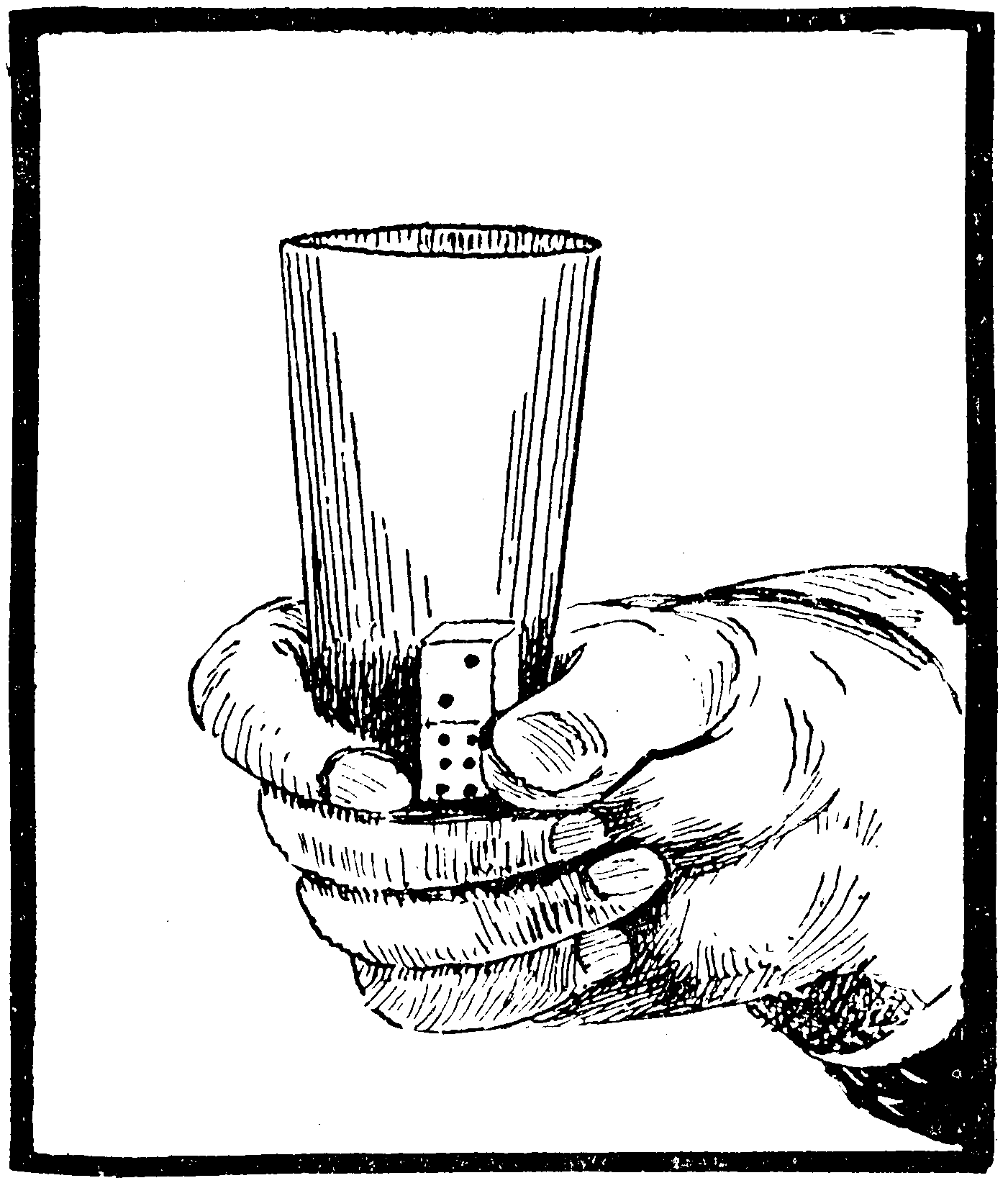
The secret of success lies in dropping the hand and cup rapidly downwards, quitting hold at the same moment of the die, which then falls quietly into the cup held to receive it.
Back to Description
No. LXIV.—WILL THEY FALL?
When the single domino shown in the diagram in front of the double archway, is quite smartly tipped up by the forefinger carefully inserted through the lower arch, the stone which lies flat below another is knocked clean out, while none of the other stones fall, another practical illustration of vis inertiæ.
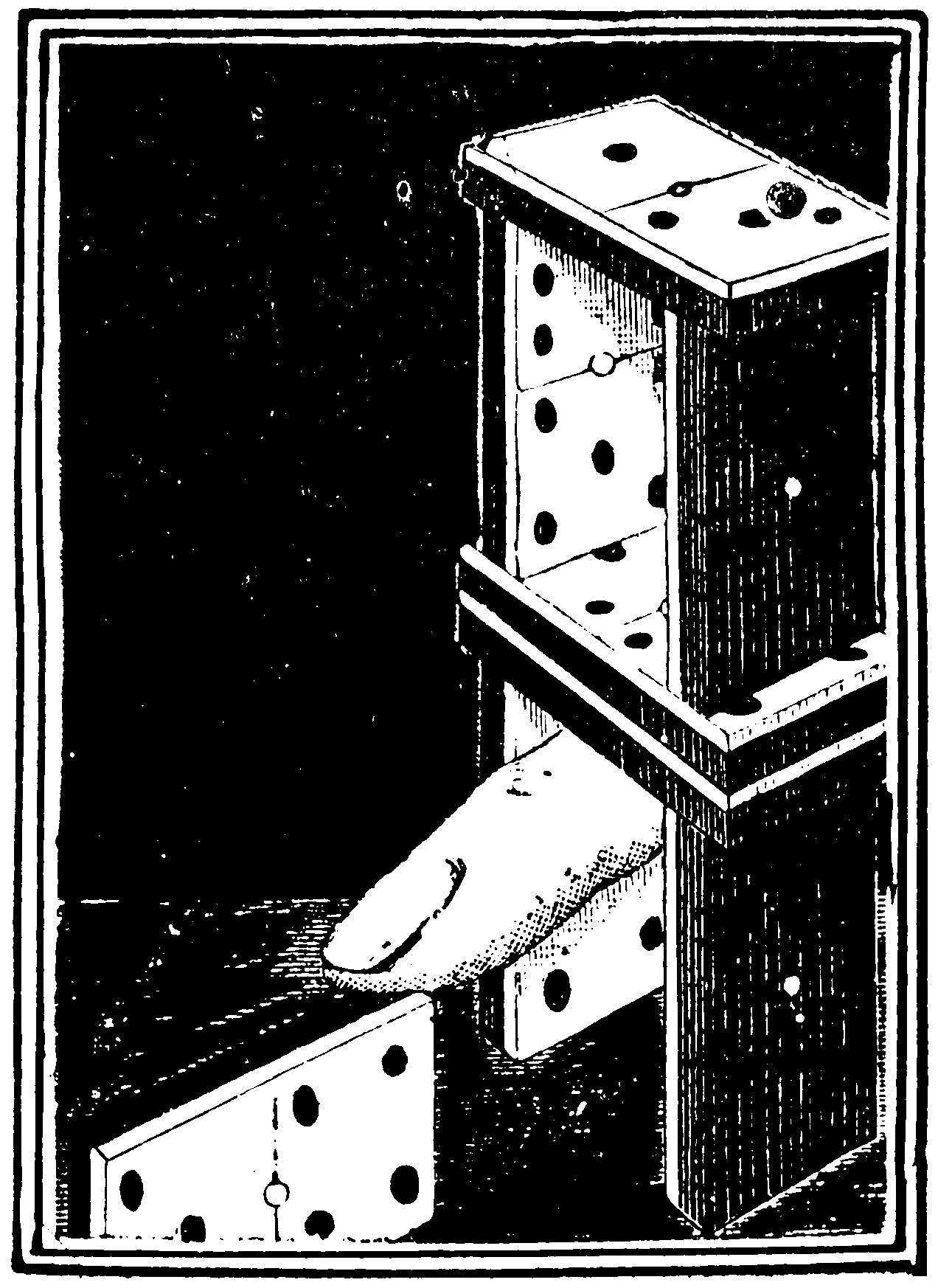
For this very curious trick, club dominoes, thick and large, should be used. Some patience and experience is needed, but success at last is certain.
Back to Description
No. LXV.—A TRANSPOSITION
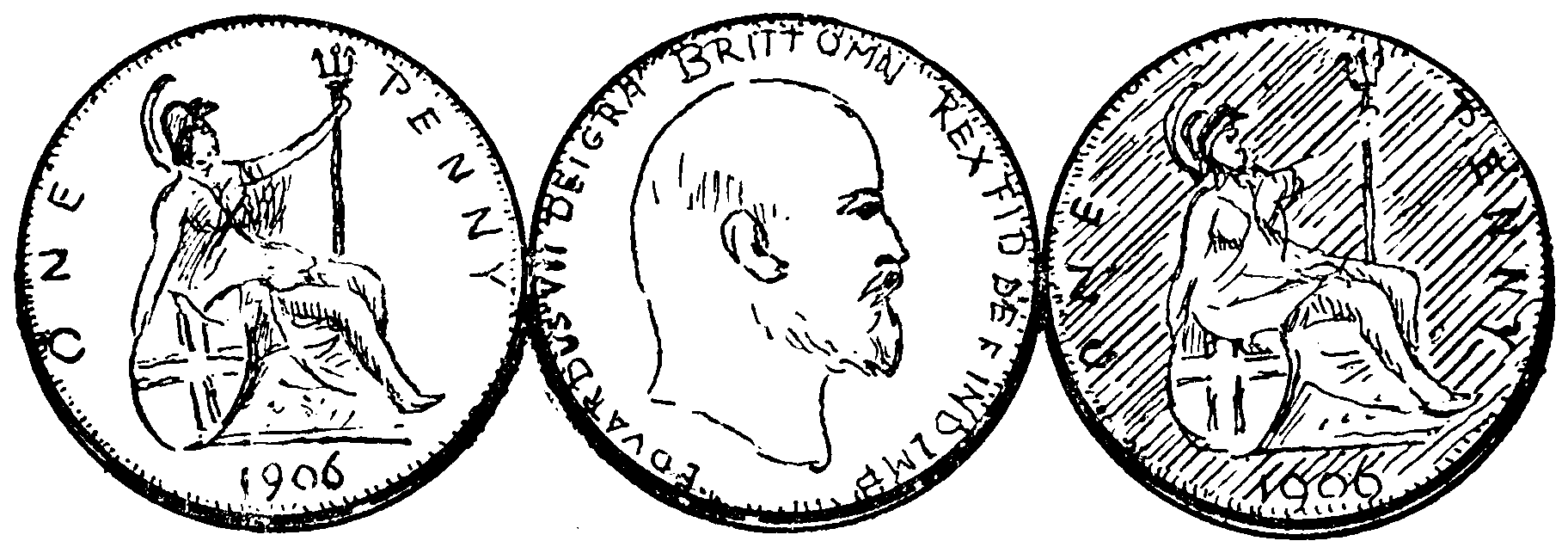
You will be able to place the shaded coin between the other two in a straight line without touching one of these, and without moving the other, if you place a finger firmly on the king’s head and then move the shaded coin an inch or two to the right, and flick it back against the coin you hold. The other “tail” coin will then spring away far enough to allow the space that is required.
Back to Description
No. LXVI.—COIN COUNTING
After reaching and turning the coin which you first call “four,” miss three coins, and begin then a fresh set of four; repeat this process to the end.
Back to Description
No. LXVIII.—NUTS TO CRACK
Hold a cup of water so that it will wet the handle of the knife, then remove it, and place the nut exactly on the spot where the drop of water falls from the handle.
Back to Description
No. LXXI.—WHAT IS THIS?
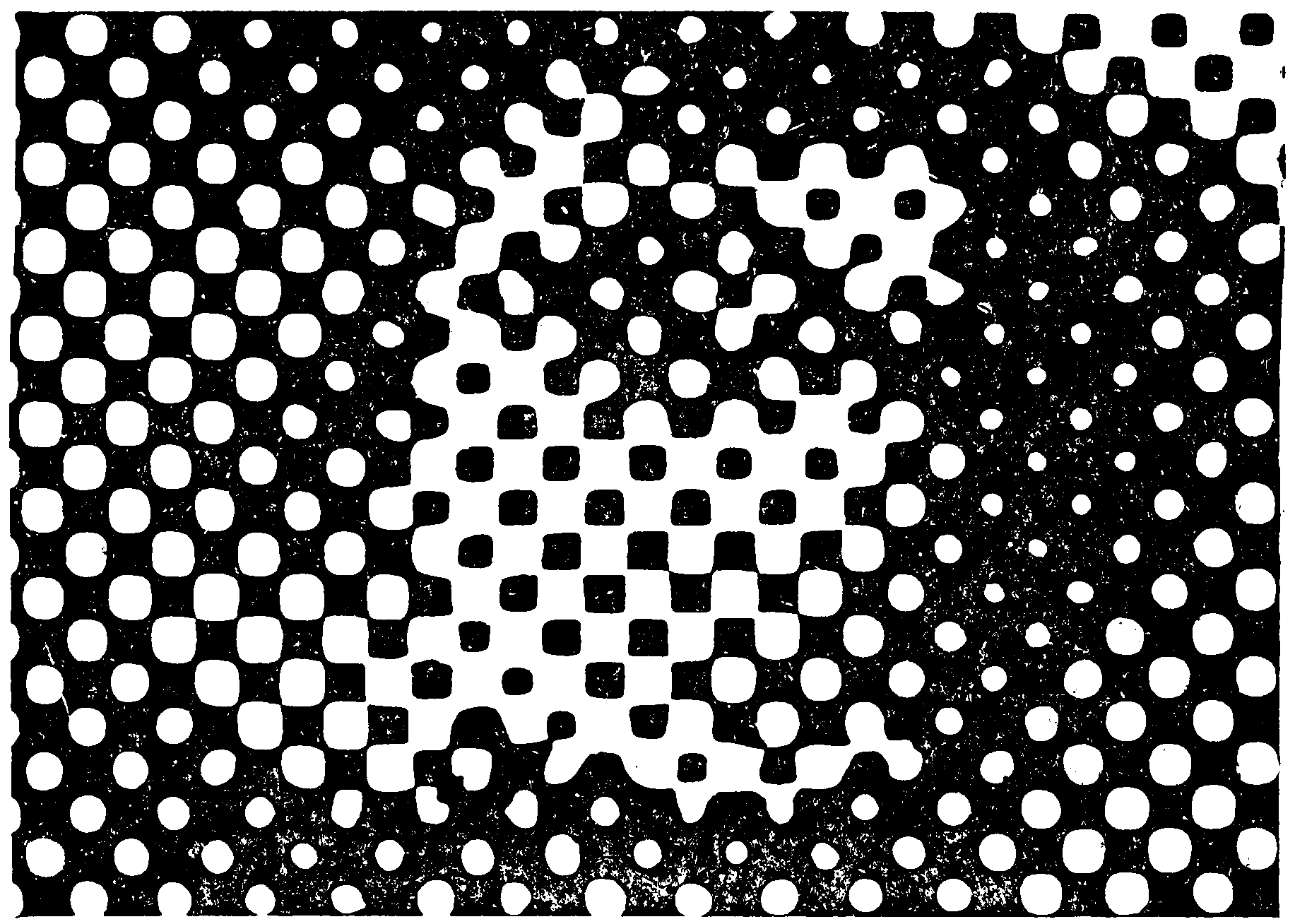
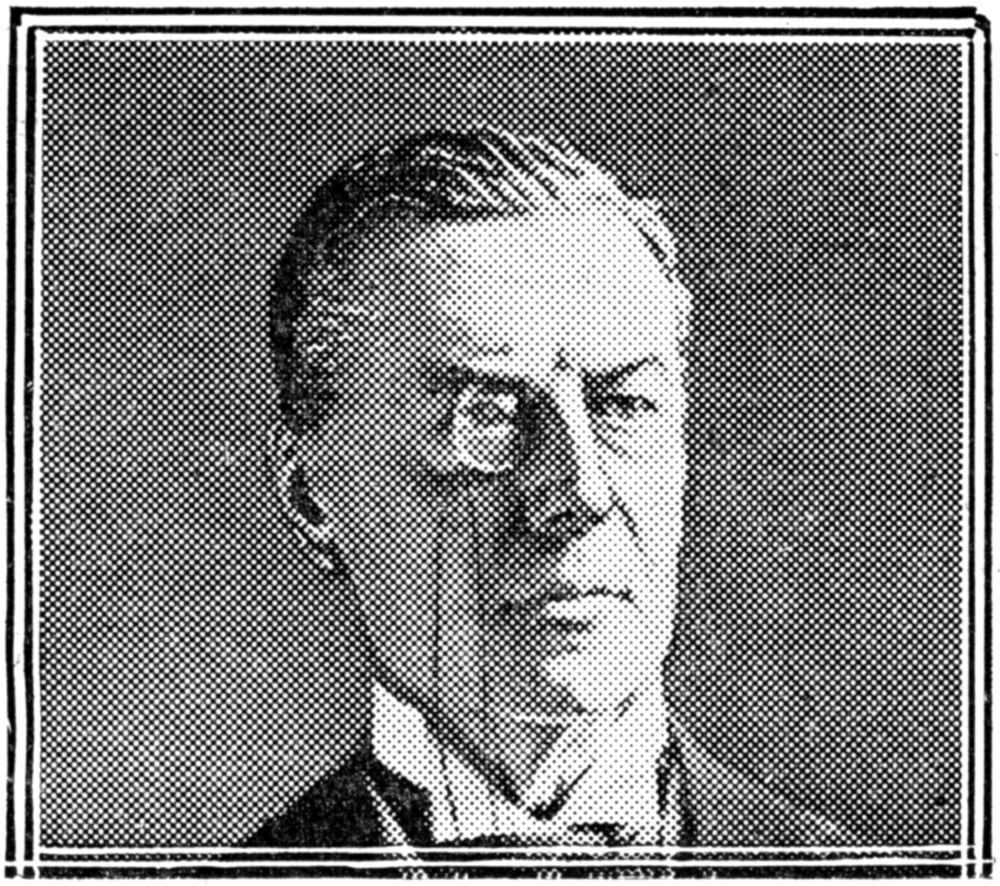
The photographic enlargement is simply a much magnified reproduction of Mr Chamberlain’s eye and eyeglass, exactly as they appear in the picture which we give below, taken from its negative. A strong condensing lens will reproduce the original effect, which can also be obtained by holding the enlargement at a distance.
Back to Description
No. LXXV.—THE SEAL OF MAHOMET
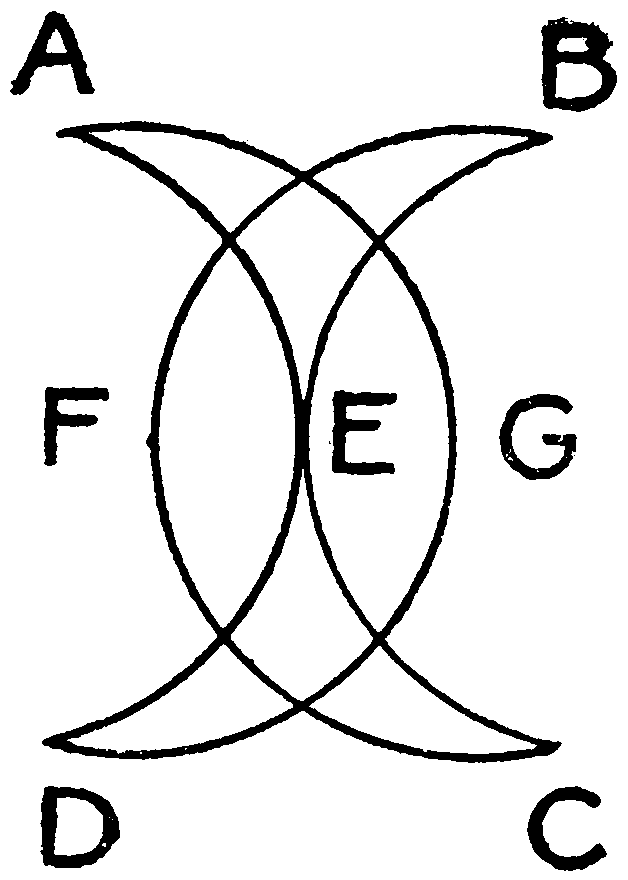
This double crescent may be drawn by one continuous line, without passing twice over any part, by starting at A, passing along the curve AGD, from D along DEB, from B along BFC, and from C along CEA.
Back to Description
No. LXXVI.—MOVE THE MATCHES
If fifteen matches are arranged thus—
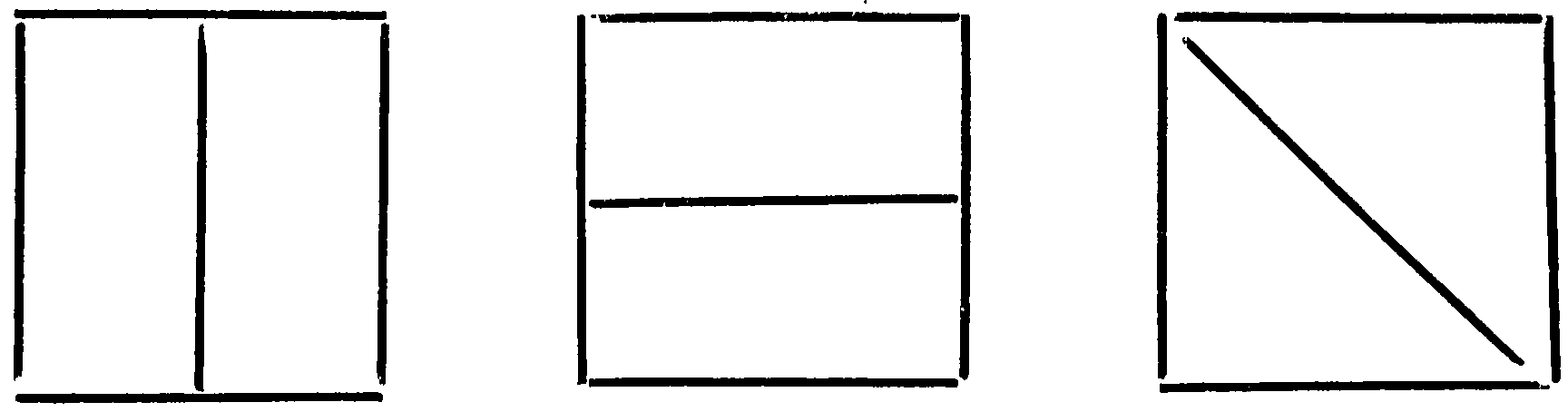
and six are removed, ten is the number that remains, thus—
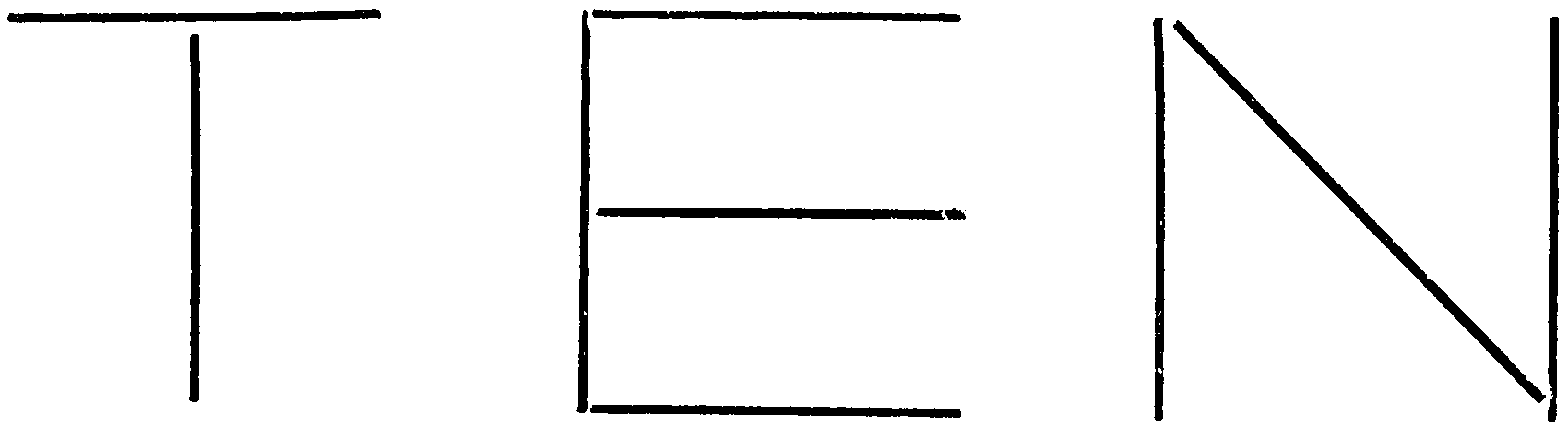
or one hundred may remain, thus:—

Back to Description
No. LXXVII.—LINES ON AN OLD SAMPLER
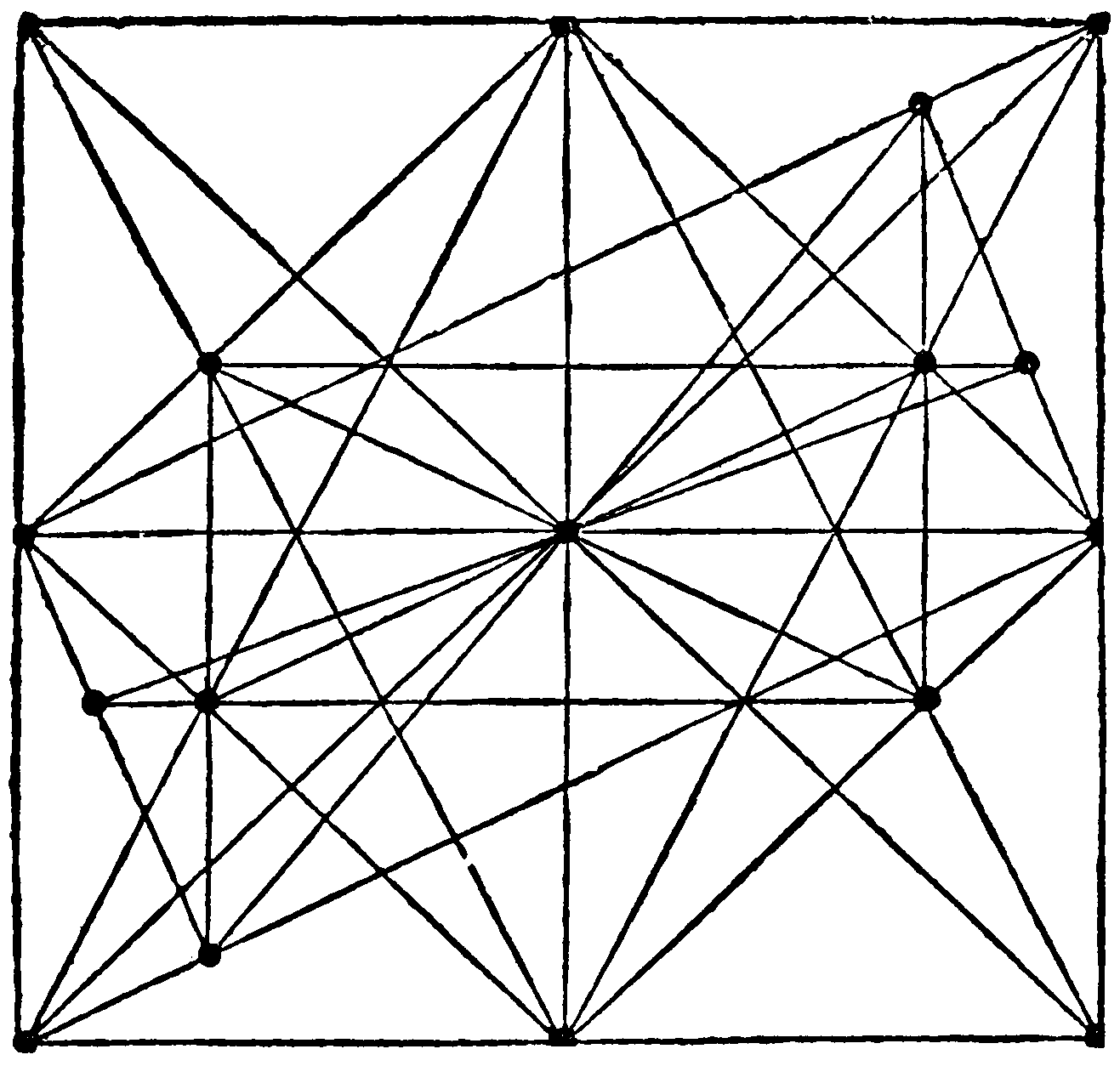
This diagram shows the arrangement in which seventeen trees can be planted in twenty-eight rows, three trees in each row:—
Back to Description
No. LXXXI.—COUNTING THEM OUT
Here is an arrangement of dominoes which enables us to count out the first twelve numbers, one after the other, by their spelling:—

Start with the double five, and, touching each stone in turn, say o, n, e, one; remove the stone with one pip, and go on, t, w, o, two; remove the two, and say t, h, r, e, e, three, and so on till you reach at last the twelve.
Playing cards can be used, counting knave, queen, as eleven, twelve. It makes quite a good trick if you place the cards face downwards in the proper order, and then, saying that you will call up each number in turn, move the cards one at a time to the other end, spelling out each number as before, either aloud or not, and turning up and throwing out each as you hit upon it. If you do not call the letters aloud it adds to the mystery if you are blindfolded.
Back to Description
No. LXXXII.—TRICKS WITH DOMINOES
This is the other combination of stones and their pips which fulfils the conditions, and forms the word AGES.
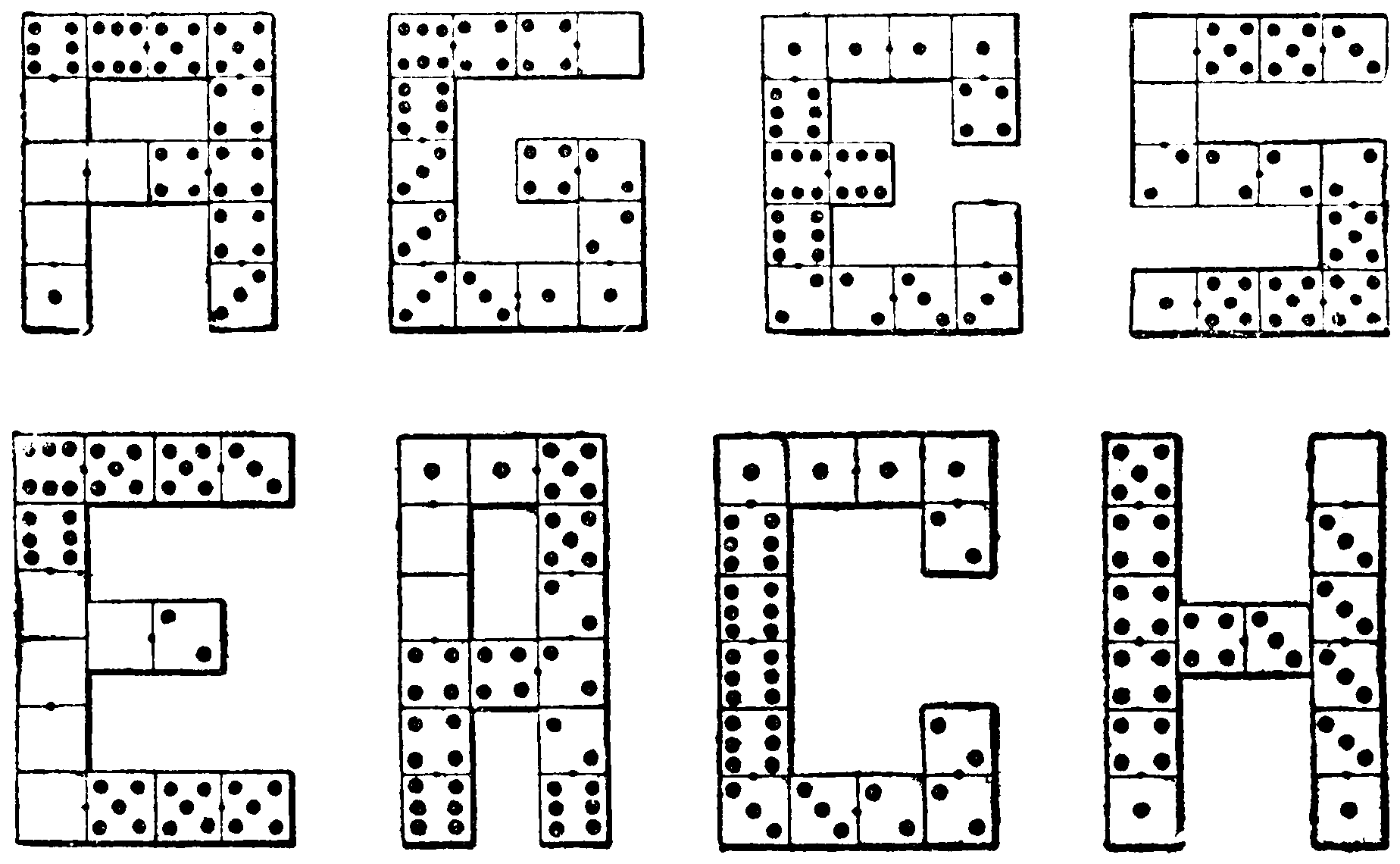
In both cases a complete set of stones is used, which are arranged in proper domino sequence, and everyone of the eight letters carries exactly forty-two pips.
Back to Description
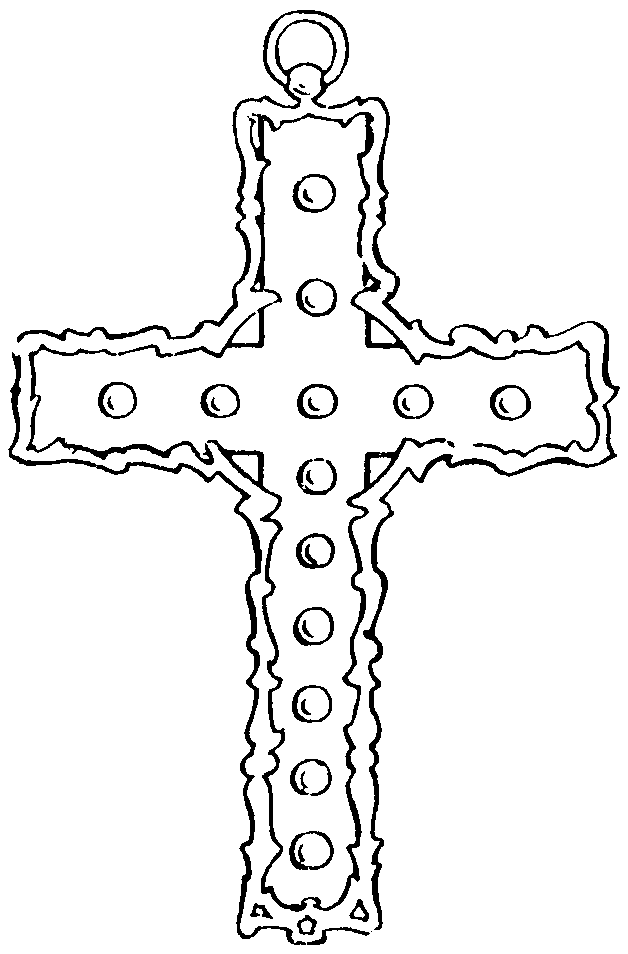
No. XCI—THE STOLEN PEARLS
The dishonest jeweller reset the pearls in a cross so that its arms were a stage higher up. It will be seen that by this arrangement nine pearls can still be counted in each direction.
Back to Description
ENIGMAS
1. Self-assassin, a neddy. Saw an ass in an eddy!
Back to Enigma
2. To get her: Together.
Back to Enigma
3. A candle.
Back to Enigma
4. Liquorice.
Back to Enigma
5. A book.
Back to Enigma
6. One solver proposes raven, croaking before a storm; once an object of worship; seldom seen; forbidden in Leviticus as food; alone with Noah when its mate was sent forth; weighing about 3 lbs; the name of a small South Carolina island, having as its first and last letters R and N; the Royal Navy.
Another finds in K the key, as that letter with no ar is alone in ark. With much ingenuity he shows that the last line calls for a second letter, and that the letters K and G can be traced throughout almost all Hallam’s “lights;” Kilogram being nearly 3 lbs., and Knot a mile; while either K.G. (Knight of the Garter) or King would fit the final line.
Back to Enigma
7. The lines become “rank treason” if the corresponding lines of the two stanzas are read together, thus:—
The pomps of Courts and pride of Kings I fain would banish far from hence,
and so on throughout.
Back to Enigma
8. A pair of skates.
Back to Enigma
9. A shadow.
Back to Enigma
10. A chair.
Back to Enigma
11. The changes that are rung are one, eno, Noe, neo, eon, on, none.
Back to Enigma
12. Cares, caress.
Back to Enigma
13. Echo.
Back to Enigma
14. Strike.
Back to Enigma
15. A pair of spurs.
Back to Enigma
16. A.D.A.M.; Adam; a dam; Adam; a damson; a dam.
Back to Enigma
17. The CID, the Castilian hero whose fame was at its height in the middle of the eleventh century.
Back to Enigma
18. A sigh.
Back to Enigma
19. Coxcomb.
Back to Enigma
20. Jack and Jill.
Back to Enigma
21. A man’s felt hat.
Back to Enigma
22. Measurable.
Back to Enigma
23. Chair, char, arch.
Back to Enigma
24. Sala (G.A.S.), which reversed is alas.
Back to Enigma
25. Page, (p)age.
Back to Enigma
26. C (sea), A (hay), T (tea).
Back to Enigma
27. A BROKEN TALE
The deil jumped over the clouds so high That he bounded almost right over the sky. Over gates and fields, and under the trees He dodged, with his tail dragging over all these, But, alas! made a terrible blunder, For a twist in his tail hooked under a rail, And broke that appendage asunder.
Back to Enigma
28. Yesterday. Most excludes Adam, and ter is half of terror.
Back to Enigma
29. Donkey.
Back to Enigma
30. Mental, lament, mantle.
Back to Enigma
31. His heels.
Back to Enigma
32. Tares, tears, a rest.
Back to Enigma
33. Connecticut.
Back to Enigma
34. Grate, rate, rat, ate.
Back to Enigma
35. Mary, in fanciful mood, on her thirty-sixth birthday, decorated her pincushion thus—XXXVI.
Back to Enigma
36. Opinionist.
Back to Enigma
37. Violin (LVII + on).
Back to Enigma
38. Trout (tr—out).
Back to Enigma
39. Post—stop.
Back to Enigma
40. A pair of scissors in a case.
Back to Enigma
41. Dog.
Back to Enigma
42. Mainland.
Back to Enigma
43. Changed.
Back to Enigma
44. The name of the Russian nobleman’s third son, the boy who went to sea, was Yvan. As the name of the eldest, Rab, who became a lawyer, was Bar reversed, and that of the soldier son Mary was Army as an anagram, so Yvan’s name resolves itself into Navy, his profession.
Back to Enigma
45. VIVID.
Back to Enigma
46. Nothing.
Back to Enigma
47. London.
Back to Enigma
48. Rock, cork.
Back to Enigma
49. Place, lace, ace, lac.
Back to Enigma
50. a, e, i, o, u, y.
Back to Enigma
51. The solution of the enigma which begins:—
“Twice six is six, and so Six is but three; Three is just five you know, What can we be?”
is the number of letters of the alphabet used in spelling a number. Thus twice six, or twelve, is composed of six letters, and so on.
Back to Enigma
52. A button.
Back to Enigma
53. LEVEL—MADAM.
Back to Enigma
54. An egg.
Back to Enigma
55. Vague.
Back to Enigma
56.
A headless man had a letter to write, (The letter O, i.e. nothing.) He who read it had lost his sight, (He read nothing.) The dumb repeated it word for word, (He said nothing.) And deaf was he who listened and heard. (He heard nothing.)
Back to Enigma
57. Highway.
Back to Enigma
58. A set of false teeth.
Back to Enigma
59. The “fearful fate” enigma is slaughter; cut off its head and we have laughter; lop off its shoulders and we find aught.
Back to Enigma
60. Speculation—peculations.
Back to Enigma
61. The word “united” is “of fellowship the token,” and the requirement “reverse it, and the bond is broken” refers only to the two central letters. When this is reversed the word “untied” is formed.
Back to Enigma
62. Average.
Back to Enigma
63. German—manger.
Back to Enigma
64. Corkscrew.
Back to Enigma
65. Tar is transformed by Art, and as a sailor is fond of port, and blisters in the sun. When it turns to run it becomes Rat, and when it doubles it is Tartar, and is caught.
Back to Enigma
66.
A man with one eye two plums must have seen, One perfectly ripe, the other quite green. The former he took, and ate it with pleasure, The other he left to ripen at leisure.
Back to Enigma
67. A widower who has lost two wives.
Back to Enigma
68. The grape-vine on the Marquis of Breadalbane’s estate, Killin, N.B., which bears more than 5000 bunches of grapes, of which only 500, properly thinned out, are allowed to mature, so that the fewer and smaller bunches bear finer fruit.
Back to Enigma
69. Poe, poet, poetry.
Back to Enigma
70. Theatres. The articles the and a lead on to the other four letters tres, and these form the word rest, if the t is transferred to the end.
Back to Enigma
71. Scold, cold, old.
Back to Enigma
72. Justice, (just—ice).
Back to Enigma
73. A shadow.
Back to Enigma
74. VI., IV., I.
Back to Enigma
75. The letter I.
Back to Enigma
76. The letter V.
Back to Enigma
77. An army.
Back to Enigma
78. A rich table; chair, table; charitable.
Back to Enigma
79. High-low.
Back to Enigma
80. Orange, pear, date, banana, peach, plum, lime, lemon, mango, apple.
Back to Enigma
81. Innuendo.
Back to Enigma
82. Snipe, of which pines is an exact anagram.
Back to Enigma
83.
None can locate the subject of my riddle, For all the world would seek its place in vain, Cut it asunder almost in the middle, And in our very midst its place is plain
is solved by nowhere, now here.
Back to Enigma
CHARADES
1. Good-night (knight).
Back to Charade
2. Grandson.
Back to Charade
3. Oyster.
Back to Charade
4. Stay-lace.
Back to Charade
5. Ann—ounce.
Back to Charade
6. VOID, OVID.
Back to Charade
7. Disconsolate (disc—on—so—late).
Back to Charade
8. Ginger—Nigger. (G.E.R. Great Eastern Railway).
Back to Charade
9. Honesty (hone, below the razor).
Back to Charade
10. Nutmeg.
Back to Charade
11. Waterloo.
Back to Charade
12. Whether (whet—her).
Back to Charade
13. Mendicant (mend I can’t).
Back to Charade
14. Campbell.
Back to Charade
15. Foxglove.
Back to Charade
16. Anglesea.
Back to Charade
17. Shewed.
Back to Charade
18. Sparrow, often a gutter percher!
Back to Charade
19. Dishonest (dish—one—st).
Back to Charade
20. Dogmatism.
Back to Charade
21. Anthem.
Back to Charade
22. Gigantic (gig—antic).
Back to Charade
23. Toad (ad is Latin for to).
Back to Charade
24. Cineraria (sinner—area).
Back to Charade
25. Ignis—fatuus, or Will-o’-the-wisp (ignis, fire—fatuus, a fool).
Back to Charade
26. Isis (sis in Latin, thou mayest be).
Back to Charade
27. Capacity.
Back to Charade
28. Scarcity.
Back to Charade
29. Pardon.
Back to Charade
30. Humbug.
Back to Charade
31. Ramrod.
Back to Charade
32. Dumpling.
Back to Charade
33. Into.
Back to Charade
34. Herring.
Back to Charade
35. Dublin (bud—nil).
Back to Charade
36. Peerless.
Back to Charade
37. Beatrice.
Back to Charade
38. Beam—be is half of the word verb, am is half of same, and be and am are similar in sense.
Back to Charade
39. Pulpit.
Back to Charade
40. Spare—rib.
Back to Charade
41. Usher.
Back to Charade
42. The ship Carmania.
Back to Charade
43. Candid.
Back to Charade
44. Husbandman.
Back to Charade
45. Hamlet.
Back to Charade
46. Handcuff.
Back to Charade
47. Sinecure.
Back to Charade
48. Infancy.
Back to Charade
49. Teachest.
Back to Charade
50. Hippodrome.
Back to Charade
51. Invalid.
Back to Charade
52. Woman.
Back to Charade
53. Kensington.
Back to Charade
54. Benjamin.
Back to Charade
55. Stipendiary.
Back to Charade
56. Wonder.
Back to Charade
57. Cabin.
Back to Charade
58. Falstaff.
Back to Charade
59. Periwinkle.
Back to Charade
60. Nameless.
Back to Charade
61. Fourscore.
Back to Charade
62. Hatred.
Back to Charade
63. Catsup.
Back to Charade
64. Molestation.
Back to Charade
65. Omen.
Back to Charade
66. Isinglass.
Back to Charade
67. Muffin.
Back to Charade
68. Footman.
Back to Charade
69. Sparrow-grass.
Back to Charade
70. Matchless.
Back to Charade
71. Planted.
Back to Charade
72. Toast-rack.
Back to Charade
73. Half-and-half, if properly punctuated.
Back to Charade
RIDDLES AND CONUNDRUMS
1. Washerwoman.
Back to Riddle
2.
“Call me an uncle, then you speak me fair, Call me an uncle-an uncle if you dare!”
Back to Riddle
3. Pluck the goose.
Back to Riddle
4. Also.
Back to Riddle
5. A lawsuit.
Back to Riddle
6. Because they are bargains.
Back to Riddle
7. A pair of shoes.
Back to Riddle
8. Because whenever he goes out he can put his portmanteaux (Portman toes) into his boots.
Back to Riddle
9. FIVE.
Back to Riddle
10. Rail—liar.
Back to Riddle
11. Because it slopes with a flap!
Back to Riddle
12. In California they eat all the peaches they can, and can all they can’t!
Back to Riddle
13. The utmost effort ever made by a piebald (or by any) horse at a high jump is four feet from the ground!
Back to Riddle
14. Insatiate (in—sat—I—ate).
The clever couplet—
Under my first my second stood. That’s your riddle: mine’s as good!
was intended to point out that the enigma
In my first my second sat, Then my third and fourth I ate
was understood, and to frame at the same time a fresh one of similar sort.
Back to Riddle
15. A gardener minds his peas, a billiard-marker his cues, a precise man his p’s and q’s, and a verger his keys and pews.
Back to Riddle
16. A man with one eye can see more than a man with two, for in addition to all else he can see the other man’s two eyes, which can only see his one.
Back to Riddle
17. When you ask a policeman what o’clock it is, you are like the Viceroy of India, because you are as king for the time.
Back to Riddle
18. “What does Y E S spell?” is the question to which “yes” is the only possible reply.
Back to Riddle
19. An umbrella.
Back to Riddle
20. London for many years was a wonderful place for sound, for you could laugh at 5 p.m. at Waterloo Junction, and by walking briskly across the river be in time for the late Echo at Charing Cross.
Back to Riddle
21. Because it may be smelt!
Back to Riddle
22. The full reading of “1s. 6d. me a bloater” is “Bob Tanner sent me a bloater.”
Note.—If any solver should ask, “But where is the ‘sent’?” we reply, “The scent was in the bloater!”
Back to Riddle
23. The solution of the prime conundrum “Why is a moth flying round a candle like a garden gate?” is—Because if it keeps on it singes its wings (its hinges it swings).
Back to Riddle
24. (Twe)lve—twe(nty) = twenty.
Back to Riddle
25. Because it would be my newt (minute).
Back to Riddle
26. The steps by which, in paying my debt to a lawyer, a threepenny piece swells to the needed six and eightpence are these:—
Three pence is one and two pence; One and two pence is fourteen pence; Fourteen pence is six and eight pence!
Back to Riddle
27. When the Vickers Maxim (vicar smacks him).
Back to Riddle
28. Children should go to bed soon after tea because when “t” is taken away night is nigh.
Back to Riddle
29. Scottish may be lighter than Irish men, for while Irishmen may be men of Cork, Scotsmen may be men of Ayr.
Back to Riddle
30. Because barbers do not cut hair any longer!
Back to Riddle
31. Colenso.
Back to Riddle
32. This is Archbishop Whately’s riddle, and a solution, suggested long after his offer of £50 had expired:—
When from the Ark’s capacious round Mankind came forth in pairs, Who was it that first heard the sound Of boots upon the stairs? To him who cons the matter o’er, A little thought reveals, He heard it first who went before Two pairs of soles and eels!
Back to Riddle
33. If Moses was the son of Pharaoh’s daughter, he was the daughter of Pharaoh’s son.
Back to Riddle
34. The word of three syllables which represents woman or man alternately by three contractions is heroine—hero—her—he.
Back to Riddle
35. Solution to-morrow!
Back to Riddle
36. Wholesome.
Back to Riddle
37. They were jolly well tired!
Back to Riddle
38. The stocks.
Back to Riddle
39. Because it makes a far—thing present.
Back to Riddle
40. If I were in the sun, and you were out of it, it would be a sin.
Back to Riddle
41. COLD.
Back to Riddle
42. Take off—ice.
Back to Riddle
43. Enduring.
Back to Riddle
44. Uncross the “t” of “a foot,” and it becomes “a fool.”
Back to Riddle
45. A rabbit can run into a square wood with sides that each measures a mile, keeping always in a straight line, until it reaches the middle of the wood, when it must begin to run out of it!
Back to Riddle
46. To-morrow.
Back to Riddle
47. Scar—bo—rough.
Back to Riddle
48.
Though I in time for lunch may be, U cannot come till after T.
Back to Riddle
49. A wig.
Back to Riddle
50. Because we cannot be wed without it.
Back to Riddle
51. A spit.
Back to Riddle
52. Wit (double you—I—tea).
Back to Riddle
53. Holding up your hand you will see what you never have seen, never can see, and never will see—namely, the little finger as long as the finger next to it!
Back to Riddle
54. The Emperor of Russia issues manifestoes. An ill-shod beggar manifests toes without his shoes!
Back to Riddle
55. To show Walsham How a good bishop is made.
Back to Riddle
56. There was certainly a tribe of Man—asses.
Back to Riddle
57. L. s. d.
Back to Riddle
58. A pillow.
Back to Riddle
59. Abused (a—b—used).
Back to Riddle
60. A settler.
Back to Riddle
61. Because John Burns.
Back to Riddle
62. It looks round!
Back to Riddle
63. A minute.
Back to Riddle
64. A deaf and dumb man cannot tickle nine persons, because he can only gesticulate (just tickle eight!).
Back to Riddle
65. London always began with an l, and end always began with an e!
Back to Riddle
66. Season.
Back to Riddle
67. The new moon, for the full moon is much lighter.
Back to Riddle
68. Island (la is the middle, is is the beginning, and is the end!).
Back to Riddle
69. Because! (bee caws).
Back to Riddle
70. The reading of the Dark Rebus
O B e D
is—a little blackie in bed with nothing over him.
Back to Riddle
71. If a monkey is placed before a cross it at once gets to the top, for APE is then APEX.
Back to Riddle
72. The answer to this riddle, defined as “two heads and an application,” is a kiss.
Back to Riddle
73. The Latin expression of encouragement “macte” may be applied in its English equivalent in-crease to a batsman when an umpire says of him “not out” after a risky run.
Back to Riddle
74. The place which answers to the description “Half an inch (ch) before the trees (elms), half a foot (fo), and half a yard (rd) after them leads us to an English town,” is Chelmsford.
Back to Riddle
75. The subject of the riddle, which none can locate, is nowhere. Cut asunder almost in the middle, it breaks into the opposite extreme, and becomes now here!
Back to Riddle
76. The two letters which in nine letters describe the position of one who has been left alone in his extremity are a b and one d. Abandoned.
Back to Riddle
77. Usher (us—her).
Back to Riddle
78. You can make a Maltese cross with less than twelve unbent and unbroken matches, by striking only one match and dropping it down his back. If the first fails, try another!
Back to Riddle
79. We may suppose that there were less vowels than we have now in the early days of Noe, when u and i were not there.
Back to Riddle
80. An orange (or—ange).
Back to Riddle
81. The moral taught to us by the old emblem of a weathercock in the shape of a fish on a church near Lewes is, “It is vain to aspire!”
Back to Riddle
82. FIDDLE.
Back to Riddle
83. The words “for the want of water we drank water, and if we had had water we should have drank wine,” were spoken by the crew of a vessel that could not cross the harbour bar for want of water, and who had no wine on board.
Back to Riddle
84.
The poor have two, the rich have none, Millions have many, you have one,
is solved by O.
Back to Riddle
85. Money.
Back to Riddle
86. Had I been in Stanley’s place when Marmion cried “On, Stanley, on!” the resulting word on-i-on would have made the Scottish fray seem more like Irish stew.
Back to Riddle
87. The figure O.
Back to Riddle
88.
Let her be, or beat her, Give her little ease; Then in safety seat her All among the bees,
is solved by A Queen Bee. The Bee is made up of the letter b, in Greek called beta, and two little es.
Back to Riddle
89. Its.
Back to Riddle
90. Inch—chin.
Back to Riddle
NUTS TO CRACK
1. CRAZY LOGIC
Can you prove that madman = madam is solved thus:—
A madman is a man beside himself. Therefore a madman = two men.
Madam is a woman. Woman is double you O man (w-o-man). Therefore madam = two men.
And as things which are equal to the same are equal to one another, therefore madman = madam.
Q. E. D. (Quite easily Done.)
Back to Description
2. A BIT OF BOTANY
The water-plant is the Frogbit, which floats and spreads on the surface of ponds and pools.
Back to Description
3. The six islands buried in the lines—
He set down the answer to that sum at random.
By bold policy Prussia became a leading power.
A great taste for mosaic has arisen lately.
The glad news was swiftly borne over England.
At dusk, year after year, the old man rambled home.
The children cried, hearing such dismal tales.
are Sumatra, Cyprus, Formosa, Borneo, Skye, Malta.
Back to Description
4. The seven geographical names “buried” in the sentence, “We could hide a light royal boat with a man or two; the skipper, though, came to a bad end,” are Deal, Troy, Witham, Esk, Perth, Baden, Aden.
Back to Description
5. The jumbled letter lines read thus:—
Let those who deal in mystic rhymes This transposition trace; And to The Standard send betimes Each letter in its place.
Back to Description
6.
Three little articles all in a line Lead to a thousand, expressing, If with another all these you combine, What can be never a blessing—
is solved by ANATHEMA (an-a-the-M-a).
Back to Description
7.
Ask a policeman, possibly he knows In uniformed array If not, an added letter plainly shows How little he can say—
is solved by adding n to uniformed—uninformed.
Back to Description
8. The Ruling letters in:—
We rule the world, we letters five, We rule the world, we do! And of our number three contrive To rule the other two—
are B. U. T. (beauty), and Y. Z. (wise head).
Back to Description
9. Many might punctuate the sentence, “Maud like the pretty girl that she was went for a walk in the meadows” by merely putting a full stop at the end of it. But why not make a dash after Maud?
Back to Description
10. The answer by Echo to
What were they who paid three guineas To hear a tune of Paganini’s
is Pack o’ ninnies!
Back to Description
11. The verse in which only five different letters are used is—
It is nineteen tennis nets, Nine in tents in tints intense. Ten sent in inset in sets, See it, test it, it is sense!
Back to Description
12. The catch sentence: “If is is not is and is not is is what is it is not is and what is it is is not if is not is is?” becomes intelligible if it is punctuated thus: If “is” is not “is,” and “is not” is “is,” what is it “is not” is, and what is it “is” is not, if “is not” is “is?”
Back to Description
13. The words on the placard were PALE ALE, and these through the steps described become PA-LE AP-LE, APPLE.
Back to Description
14. The reading of “Time flies you cannot they pass at such irregular intervals,” is as though it ran “You cannot time flies, they pass at such irregular intervals.”
Back to Description
ROYAL MEMORIES
15. I was reminded of Queen Victoria as I entered the South Kensington Museum at five minutes to one, because I noticed that the hands of my watch were so placed as to represent a very perfect V.
When I left the building it was twenty-five minutes and forty-five seconds to six, and then the hands, with the help of the seconds hand which crossed it, formed a very perfect A, and so reminded me of Prince Albert.
Back to Description
16. The solution of
CCC SAW
is “the season was backward.”
Back to Description
17. THE OLD LATIN LEGEND
AMANS TAM ERAT HI DESINT HERO AD DIGITO UT MANDO
reads off into excellent English thus:—
“A man’s tame rat hides in the road; dig it out man, do!”
Back to Description
18. The statement “I know that roseate hues preserve” does not imply that there is any curative virtue in rose-coloured rays, but asserts “I know that Rose ate Hugh’s preserve!”
Back to Description
19. The following exception was taken to Dr Fell’s diet for the sick of all sops:—
“Sure the doctor’s wits are failing,” Cried a saucy wag. “Allsopp’s ale the sick and ailing To their bier will drag.”
Back to Description
20. The English dislocated sentence formed by these thirty-six letters:—
SAR BAB SAR BAB SAR BAB SAR BAB SAR BAB SAR ARA
is, “A bar as a barb bars Barbara’s Barabbas.”
Back to Description
21. The Wiltshire farmer’s sentence—
“Igineyvartydreevriswutts”
when interpreted runs, “I gave him forty-three for his oats.”
Back to Description
22. Here is a tolerable rhyme to Chrysanthemum:—
Through gardens where appear Beds of chrysanthemum, We pass at eve to hear Our choir their anthem hum.
Back to Description
23. This was, in brief, the pathetic tale of the three eggs—“Two bad!”
Back to Description
24. THE ANCIENT LEGEND
Doun tooth ers A sy Ouw ould bed One by.
reads thus:—“Do unto others as you would be done by.”
Back to Description
25. There were but six persons in the vault which contained two grandmothers and their two grand-daughters; two husbands and their two wives; two fathers and their two daughters; two mothers and their two sons; two maidens and their two mothers; two sisters and their two brothers. Two widows had each one son, and each married the son of the other, and had a daughter by the marriage.
Back to Description
26. The supposed charm—
ground turn evil star
given by the wise woman to a nervous couple, to counteract their evil star, and account for mysterious noises, is merely “Rats live underground,” turn being a direction to the solver.
Back to Description
27. The word composed of five varied vowels of foreign sound, with but one consonant between them, is oiseau, the French for bird. The three letters which flow in four are eau, water, which flows in the River Oise, and the other trio spell oie, a goose, which is found therein.
Back to Description
28. The Paradox—
What in his mind no man can find Four symbols will display; But only one remains behind If one we take away—
is solved by Bone.
Back to Description
29. The barber who had placed in his window the notice—
“What do you think I will shave you for nothing and give you a drink”
explained, to the man who expected a free shave and a cool drink, that the interpretation was really this:—“What? Do you think I will shave you for nothing, and give you a drink?”
Back to Description
30. The curious Latin label—
GENUI NE JAM A ICARUM.
has no reference to Icarus, or to flying machines. Its proper place was on a cask of “Genuine Jamaica Rum.”
Back to Description
31. The puzzle word is ipecacuanha.
Back to Description
32.
Johnson’s cat went up a tree, Which was sixty feet and three; Every day she climbed eleven, Every night she came down seven. Tell me, if she did not drop, When her paws would touch the top—
is solved thus:—As each day and night the cat climbed up eleven feet, and came down seven, the daily upward gain was four feet, and thirteen days would bring her fifty-two feet up the tree. Then on the fourteenth day she mounted the remaining eleven feet, and was at the top, so that no coming down seven feet is to be taken into account, and she attains her place in fourteen days.
Back to Description
33.
A third of six behind them fix, A third of six before; Thus makes two nines, when all combines, Exactly fifty-four—
is solved:—
IX NINE (the two nines.)
IX NINES = 54.
(S is a third of six) S
Back to Description
34. To bridge the moat, or space between the two squares which one match cannot span, place one match across one of the corners of the outer square, and the other from this to the inner square.
Back to Description
35.
We start when the ninth hour is past, Then there’s an end of you. A vengeful goddess shows at last What Antifat will do—
is solved by attenuate (at ten-u-Ate, goddess of vengeance).
Back to Description
36. Mrs P.W. had only one guest to provide for. Her husband had invited his father’s brother-in-law, Jones, who was his brother’s father-in-law, because Mr P.W.’s brother had married Jones’ daughter, and his father-in-law’s brother, because he had himself married Jones’ niece, and also his brother-in-law’s father, as Mr P.W.’s sister married Jones’ son.
Back to Description
37. This sharp customer started with fivepence farthing, and gradually extracted from the landlord’s pocket a shilling and three farthings towards the eighteenpence which he spent in refreshments.
Back to Description
38. To form four triangles of equal size with six similar matches, place three of them in a triangle on the table, and hold or balance the other three above these, so as to form the skeleton of a pyramid.
Back to Description
39. The following couplet solves this question:—
Forty-five-years I had seen When my bride was but fifteen
Back to Description
40. The lad gave tenpence each to a grandfather, his son, and his grandson.
Back to Description
41. Nell’s reply to Tom, when he said, with a yawn, “I wish we could play lawn-tennis!” “Odioso ni mus rem. Moto ima os illud nam,” was not Latin, but good sound English. Read each word in its order backwards, and you have-- “Oh! so do I in summer. Oh, Tom! am I so dull, I man?”
Back to Description
42. The policeman who was looking up the road for motor-car scorchers was able to see that his mate, who was looking down the road, was smiling, because they stood face to face.
Back to Description
43.
Twenty-seven with three nines You and I can score; Anyone on other lines Can extend them more. Who can write them to be seen Equal only to sixteen?—
is solved thus:—Two of the three nines are reversed, and then
966 = 16.
Back to Description
44. The trying sentence, “that that is is that that is not is not is not that it it is,” is cleared thus by proper punctuation:—That that is, is; that that is not, is not. Is not that it? It is.
Back to Description
45. A L L O is “Nothing after all.”
Back to Description
46. The proverb with missing consonants is—Give a dog a bad name and hang him.
Back to Description
47. If to the thirteen upright strokes—
| | | | | | | | | | | | |
thirteen more are added, the word HOTTENTOT may be formed.
Back to Description
48. A coroner could, after signing his name, write down his official position with c or one r.
Back to Description