PART I.
Reading edition
CONTENTS
PAGE
Magic Squares, Puzzles, Tricks, Enigmas I-1
Charades, Etc. I-80
Riddles and Conundrums I-104
Nuts to Crack I-115
Solutions I-148
MAGIC SQUARES
No. I.—FOUR HUNDRED YEARS OLD!
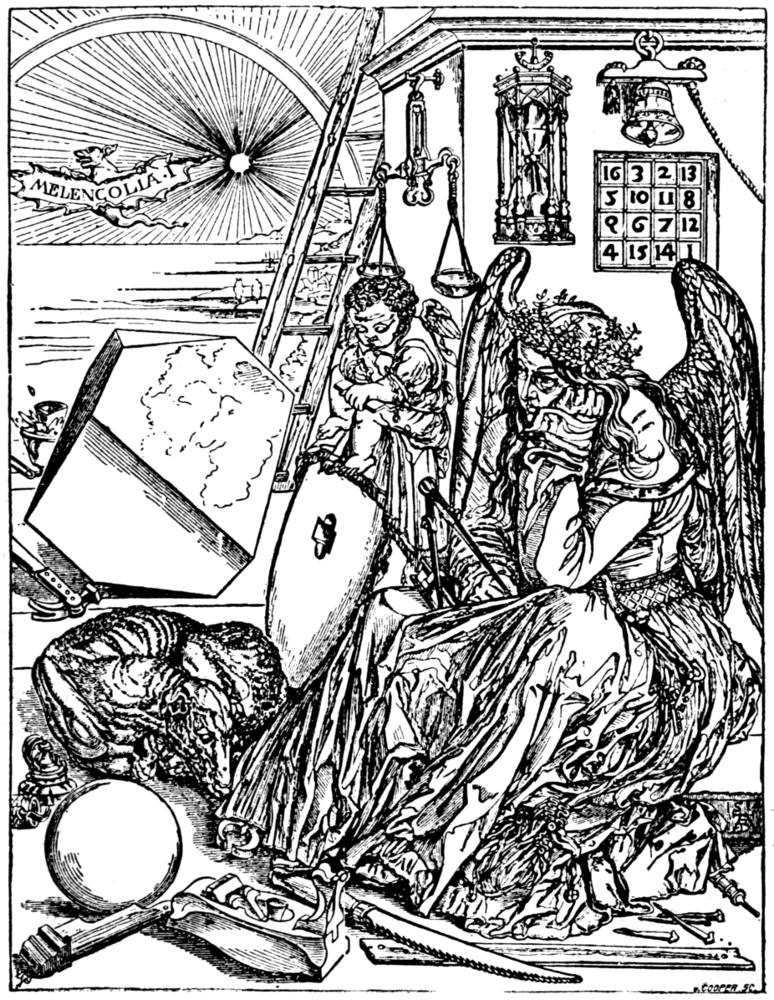
In Albert Dürer’s day, as in Milton’s, “melancholy” meant thoughtfulness, and on this ground we find on his woodcut, “Melancholia, or the Genius of the Industrial Science of Mechanics,” a very early instance of a Magic Square, showing that Puzzles had a recognised place in mental gymnastics four hundred years ago.
No. II.—A SIMPLE MAGIC SQUARE
Much time was devoted in olden days to the construction and elaboration of Magic Squares. Before we go more deeply into this fascinating subject, let us study the following pretty and ingenious method of making a Magic Square of sixteen numbers, which is comparatively simple, and easily committed to memory:—
1 15 14 4
12 6 7 9
8 10 11 5
13 3 2 16
Start with the small square at the top left-hand corner, placing there the 1; then count continuously from left to right, square by square, but only insert those numbers which fall upon the diagonals—namely, 4, 6, 7, 10, 11, 13, and 16.
Then start afresh at the bottom right-hand corner, calling it 1, and fill up the remaining squares in order, from right to left, counting continuously, and so placing in their turn 2, 3, 5, 8, 9, 12, 14, and 15. Each row, column, diagonal, and almost every cluster of four has 34 as the sum of its numbers.
No. III.—ANOTHER MAGIC SQUARE
1 20 16 23 5
15 7 12 9 22
24 18 13 8 2
4 17 14 19 11
21 3 10 6 25
In this Magic Square the rows, columns, and diagonals add up to 65, and the sum of any two opposite and corresponding squares is 26.
ENIGMAS
1 A MYSTIC ENIGMA
He stood himself beside himself And looked into the sea; Within himself he saw himself, And at himself gazed he. Now when himself he saw himself Within himself go round, Into himself he threw himself, And in himself was drowned. Now if he had not been himself, But other beast beside, He would himself have cut himself Nor in himself have died.
Solution
No. IV.—A NEST OF CENTURIES
22 47 16 41 10 35 4
5 23 48 17 42 11 29
30 6 24 49 18 36 12
13 31 7 25 43 19 37
38 14 32 1 26 44 20
21 39 8 33 2 27 45
46 15 40 9 34 3 28
The numbers in this Magic Square of 49 cells add up in all rows, columns, and diagonals to 175. The four corner cells of every square or rectangle that has cell 25 in its centre, and cells 1, 7, 49, 43, add up to 100.
2
One morning Chloe, to avoid the heat, Sat in a corner of a shady seat. Young Strephon, on the self-same errand bound, This fairest flower of all the garden found. Her peerless beauty set his heart aflame, Three monosyllables expressed his aim. At a respectful distance he conversed About the weather; then became immersed In other topics, lessening the while The space between them, heartened by her smile. The same three simple words, now joined in one, Expressed their happy state at set of sun.
Solution
No. V.—THE MAKING OF A MAGIC SQUARE
An ideal Magic Square can be constructed thus:
Place 1, 2, 3, 4, 5 in any order in the five top cells, set an asterisk over the third column, as shown in the diagram; begin the next row with this figure, and let the rest follow in the original sequence; continue this method with the other three rows.
Preparatory Square No. 1.
*
1 3 5 2 4
5 2 4 1 3
4 1 3 5 2
3 5 2 4 1
2 4 1 3 5
Preparatory Square No. 2.
*
5 15 0 10 20
10 20 5 15 0
15 0 10 20 5
20 5 15 0 10
0 10 20 5 15
Make a similar square of 25 cells with 0, 5, 10, 15, 20, as is shown in No. 2, placing the asterisk in this case over the fourth column of cells, and proceeding as before, in an unchanging sequence. Using these two preparatory squares, try to form a Magic Square in which the same number can be counted up in forty-two different ways.
Solution
No. VI.—ANOTHER WAY TO MAKE A MAGIC SQUARE
Here is one of many methods by which a Magic Square of the first twenty-five numbers can readily be made.
1
2 6
3 20 7 24 11
4 16 8 25 12 4 16
5 9 21 13 5 17 21
10 22 14 1 18 10 22
15 2 19 6 23
20 24
25
This is done by first placing the figures from 1 to 25 in diagonal rows, as is shown above, and then introducing the numbers that are outside the square into it, by moving each of them five places right, left, up, or down. A Magic Square is thus formed, the numbers of which add up to 65 in lines, columns and diagonals, and with the centre and any four corresponding numbers on the borders.
No. VII.—A MONSTER MAGIC SQUARE
Here is what may indeed be called a Champion Magic Square:—
23 464 459 457 109 111 108 110 132 133 130 131 373 371 357 356 372 382 370 335 30 22
25 41 436 435 433 432 196 195 241 242 200 225 284 287 246 245 288 261 51 58 47 460
27 45 13 474 469 467 82 81 72 90 91 83 401 400 396 398 399 397 20 12 440 458
461 55 15 34 450 449 447 446 156 157 180 181 326 327 306 307 44 37 33 470 430 24
456 56 17 42 3 484 479 477 66 65 68 67 422 421 416 415 10 2 443 468 429 29
137 428 471 41 5 127 126 125 361 362 363 364 365 366 118 117 116 480 444 14 57 348
153 431 466 31 7 347 148 338 339 145 143 342 142 344 345 139 138 478 454 19 54 332
154 439 98 453 481 325 161 169 168 318 319 320 321 163 162 324 160 4 32 387 46 331
384 266 407 445 476 292 293 191 190 299 298 297 186 185 184 302 193 9 40 78 219 101
383 268 406 442 424 270 280 272 273 211 210 209 208 278 279 205 215 61 43 79 217 102
379 265 392 172 60 248 227 250 251 230 232 231 233 256 257 258 237 425 313 93 220 106
378 267 391 173 59 226 249 228 229 252 254 253 255 234 235 236 259 426 312 94 218 107
351 282 405 176 74 204 214 206 207 277 276 275 274 212 213 271 281 411 309 80 203 134
350 263 390 177 73 182 192 301 300 189 187 188 296 295 294 183 303 412 308 95 222 135
334 199 77 330 423 171 315 323 322 164 165 166 167 317 316 170 314 62 155 408 286 151
333 216 96 311 413 149 346 147 146 340 341 144 343 141 140 337 336 72 174 389 269 152
100 221 76 310 414 369 359 360 124 123 122 121 120 119 367 368 358 71 175 409 264 385
99 223 75 291 483 1 6 8 419 420 417 418 63 64 69 70 475 482 194 410 262 386
104 202 97 452 35 36 38 39 329 328 305 304 159 158 179 178 441 448 451 388 283 381
105 238 473 11 16 18 403 404 393 395 394 402 84 85 89 87 86 88 465 472 247 380
136 438 49 50 52 53 289 290 244 243 285 260 201 198 239 240 197 224 434 427 437 349
463 21 26 28 376 374 377 375 353 352 355 354 112 114 128 129 113 103 115 150 455 462
Its 484 cells form, as they are numbered, a Magic Square, in which all rows, columns, and diagonals add up to 5335, and it is no easy matter to determine in how many other symmetrical ways its key-number can be found.
When the cells outside each of the dark border lines are removed, three other perfect Magic Squares remain.
Collectors should take particular note of this masterpiece.
No. VIII.—A NOVEL MAGIC SQUARE
A Magic Square of nine cells can be built up by taking any number divisible by 3, and placing, as a start, its third in the central cell. Thus:—
28 29 24
23 27 31
30 25 26
Say that 81 is chosen for the key number. Place 27 in the centre; 28, 29, in cells 1, 2; 30 in cell 7; 31 in 6; and then fill up cells 3, 4, 8, and 9 with the numbers necessary to make up 81 in each row, column, and diagonal.
Any number above 14 that is divisible by 3 can be dealt with in this way.
3
Enriched I am with much that’s fat, Yet money I possess not; Enlightening all who come to me, True wisdom I express not. I may be wicked, but protest That sinful none have found me; Though I destroy myself to be Of use to those around me.
Solution
No. IX.—TWIN MAGIC SQUARES
Among the infinite number of Magic Squares which can be constructed, it would be difficult to find a more remarkable setting of the numbers 1 to 32 inclusive than this, in which two squares, each of 16 cells, are perfect twins in characteristics and curious combinations.
1 8 29 28 11 14 23 18
30 27 2 7 21 20 9 16
4 5 32 25 10 15 22 19
31 26 3 6 24 17 12 13
There are at least forty-eight different ways in which 66 is the sum of four of these numbers. Besides the usual rows, columns, and diagonals, any square group of four, both corner sets, all opposite pairs on the outer cells, and each set of corresponding cells next to the corners, add up exactly to 66.
4
Of Spanish extraction, my hue Is as dark as a negro can be; I am solid, and yet it is true That in part I am wet as the sea, My second and first are the same In all but condition and name; My second can burst The abode of my first, And my whole from the underground came.
Solution
No. X.—A BORDERED MAGIC SQUARE
Here is a notable specimen of a Magic Square:—
4 5 6 43 39 38 40
49 15 16 33 30 31 1
48 37 22 27 26 13 2
47 36 29 25 21 14 3
8 18 24 23 28 32 42
9 19 34 17 20 35 41
10 45 44 7 11 12 46
The rows, columns, and diagonals all add up to exactly 175 in the full square. Strip off the outside cells all around, and a second Magic Square remains, which adds up in all such ways to 125.
Strip off another border, as is again indicated by the darker lines, and a third Magic Square is left, which adds up to 75.
5 AN OLD ENIGMA By Hannah More
I’m a strange contradiction: I’m new and I’m old, I’m sometimes in tatters and sometimes in gold, Though I never could read, yet letter’d I’m found, Though blind I enlighten, though free I am bound. I’m English, I’m German, I’m French, and I’m Dutch; Some love me too dearly, some slight me too much. I often die young, though I sometimes live ages, And no Queen is attended by so many pages.
Solution
No. XI.—A LARGER BORDERED MAGIC SQUARE
Here is another example of what is called a “bordered” Magic Square:—
5 80 59 73 61 3 63 12 13
1 20 55 30 57 28 71 26 81
4 14 31 50 29 60 35 68 78
76 58 46 38 45 40 36 24 6
7 65 33 43 41 39 49 17 75
74 64 48 42 37 44 31 18 8
67 10 47 32 53 22 51 72 15
66 56 27 52 25 54 11 62 16
69 2 23 9 21 79 19 70 77
These 81 cells form a complete magic square, in which rows, columns, and diagonals add up to 369. As each border is removed fresh Magic Squares are formed, of which the distinctive numbers are 287, 205, and 123. The central 41 is in every case the greatest common divisor.
No. XII.—A CENTURY OF CELLS
Can you complete this Magic Square, so that the rows, columns, and diagonals add up in every case to 505?
91 2 3 97 6 95 94 8 9 100
20 16 15 81
21 25 26 30
60 66 65 41
50 49 48 57 55 56 54 43 42 51
61 59 58 47 45 46 44 53 52 40
31 35 36 70
80 75 76 71
90 86 85 11
1 99 98 4 96 5 7 93 92 10
We have given you a substantial start, and, as a further hint, as all the numbers in the first and last columns end in 0 or 1, so in the two next columns all end in 2 or 9, in the two next in 3 or 8, in the two next in 4 or 7, and in the two central columns in 5 or 6.
Solution
6 HALLAM’S UNSOLVED ENIGMA
I sit on a rock while I’m raising the wind, But the storm once abated I’m gentle and kind. I’ve Kings at my feet, who await but my nod To kneel in the dust on the ground I have trod. Though seen to the world, I am known to but few, The Gentile detests me, I’m pork to the Jew. I never have passed but one night in the dark, And that was with Noah alone in the ark. My weight is three pounds, my length is a mile. And when I’m discovered you’ll say, with a smile, That my first and my last are the pride of this isle.
Solution
No. XIII.—A SINGULAR MAGIC SQUARE
In this Magic Square, not only do the rows, columns, and diagonals add up to 260, but this same number is produced in three other and quite unusual ways:—
18 63 4 61 6 59 8 41
49 32 51 14 53 12 39 10
2 47 36 45 22 27 24 57
33 16 35 46 21 28 55 26
31 50 29 20 43 38 9 40
64 17 30 19 44 37 42 7
15 34 13 52 11 54 25 56
48 1 62 3 60 5 58 23
(1) Each group of 8 numbers, ranged in a circle round the centre; there are six of these, of which the smallest is 22, 28, 38, 44, 19, 29, 35, 45, and the largest is 8, 10, 56, 58, 1, 15, 49, 63. (2) The sum of the 4 central numbers and 4 corners. (3) The diagonal cross of 4 numbers in the middle of the board.
No. XIV.—SQUARING THE YEAR
On another page we give an interesting Magic Square of 121 cells based upon the figures of the year 1892. Here, in much more condensed form, is one more up to date.
637 630 635
632 634 636
633 638 631
The rows, columns, and diagonals of these nine cells add up in all cases to the figures of the year 1902.
The central 634 is found by dividing 1902 by its lowest factor greater than 2, and this is taken as the middle term of nine numbers, which are thus arranged to form a Magic Square.
7 RANK TREASON By an Irish Rebel, 1798
The pomps of Courts and pride of Kings I prize above all earthly things; I love my country, but the King Above all men his praise I sing. The royal banners are displayed, And may success the standard aid! I fain would banish far from hence The “Rights of Men” and “Common Sense;” Confusion to his odious reign, That Foe to princes, Thomas Payne. Defeat and ruin seize the cause Of France, its liberties and laws!
Where does the treason come in?
Solution
No. XV.—SQUARING ANOTHER YEAR
The following square of numbers is interesting in connection with the year 1906.
A B C D
476 469 477 484
E F G H
483 478 470 475
I J K L
471 474 482 479
M N O P
480 481 473 472
Add the rows — ABCD, EFGH, IJKL, MNOP.
or the squares — ABEF, CDGH, IJMN, KLOP.
or semi-diagonals — AFIN, BEJM, CHKP, DGLO,
AFCH, BEGD, INKP, MJOL.
and the sum, in every case, is 1906.
No. XVI.—MANIFOLD MAGIC SQUARES
Here is quite a curious nest of clustered Magic Squares, which is worth preserving:—
2 13 24 10 16 2 13 24 10 16 2
9 20 1 12 23 9 20 1 12 23 9
11 22 8 19 5 11 22 8 19 5 11
18 4 15 21 7 18 4 15 21 7 18
25 6 17 3 14 25 6 17 3 14 25
2 13 24 10 16 2 13 24 10 16 2
9 20 1 12 23 9 20 1 12 23 9
11 22 8 19 5 11 22 8 19 5 11
18 4 15 21 7 18 4 15 21 7 18
25 6 17 3 14 25 6 17 3 14 25
2 13 24 10 16 2 13 24 10 16 2
9 20 1 12 23 9 20 1 12 23 9
11 22 8 19 5 11 22 8 19 5 11
Every square of every possible combination of 25 of these numbers in their cells, such as the two with darker borders, is a perfect Magic Square, with rows, columns, and diagonals that add up in all cases to 65.
8 AN ENIGMA FOR CHRISTMAS HOLIDAYS
Formed half beneath and half above the earth, We owe, as twins, to art our second birth. The smith’s and carpenter’s adopted daughters, Made upon earth, we travel on the waters. Swifter we move as tighter we are bound, Yet never touch the sea, or air, or ground. We serve the poor for use, the rich for whim, Sink if it rains, and if it freezes swim.
Solution
No. XVII.—LARGER AUXILIARY MAGIC SQUARES
A very interesting method of constructing a Magic Square is shown in these three diagrams:—
1 2 3 4 5 6 7 8 9 10 11
3 4 5 6 7 8 9 10 11 1 2
5 6 7 8 9 10 11 1 2 3 4
7 8 9 10 11 1 2 3 4 5 6
9 10 11 1 2 3 4 5 6 7 8
11 1 2 3 4 5 6 7 8 9 10
2 3 4 5 6 7 8 9 10 11 1
4 5 6 7 8 9 10 11 1 2 3
6 7 8 9 10 11 1 2 3 4 5
8 9 10 11 1 2 3 4 5 6 7
10 11 1 2 3 4 5 6 7 8 9
0 11 22 33 44 55 66 77 88 99 110
33 44 55 66 77 88 99 110 0 11 22
66 77 88 99 110 0 11 22 33 44 55
99 110 0 11 22 33 44 55 66 77 88
11 22 33 44 55 66 77 88 99 110 0
44 55 66 77 88 99 110 0 11 22 33
77 88 99 110 0 11 22 33 44 55 66
110 0 11 22 33 44 55 66 77 88 99
22 33 44 55 66 77 88 99 110 0 11
55 66 77 88 99 110 0 11 22 33 44
88 99 110 0 11 22 33 44 55 66 77
1 13 25 37 49 61 73 85 97 109 121
36 48 60 72 84 96 108 120 11 12 24
71 83 95 107 119 10 22 23 35 47 59
106 118 9 21 33 34 46 58 70 82 94
20 32 44 45 57 69 81 93 105 117 8
55 56 68 80 92 104 116 7 19 31 43
79 91 103 115 6 18 30 42 54 66 67
114 5 17 29 41 53 65 77 78 90 102
28 40 52 64 76 88 89 101 113 4 16
63 75 87 99 100 112 3 15 27 39 51
98 110 111 2 14 26 38 50 62 74 86
It will be noticed that each row after the first, in the two upper auxiliary squares, begins with a number from the same column in the row above it, and maintains the same sequence of numbers. When the corresponding cells of these two squares are added together, and placed in the third square, a Magic Square is formed, in which 671 is the sum of all rows, columns, and diagonals.
No. XVIII.—SQUARING BY ANNO DOMINI
Here is a curious form of Magic Square. The year 1892 is taken as its basis.
112 124 136 148 160 172 184 196 208 220 232
147 159 171 183 195 207 219 231 122 123 135
182 194 206 218 230 121 133 134 146 158 170
217 229 120 132 144 145 157 169 181 193 205
131 143 155 156 168 180 192 204 216 228 119
166 167 179 191 203 215 227 118 130 142 154
190 202 214 226 117 129 141 153 165 177 178
225 116 128 140 152 164 176 188 189 201 213
139 151 163 175 187 199 200 212 224 115 127
174 186 198 210 211 223 114 126 138 150 162
209 221 222 113 125 137 149 161 173 185 197
Within this square 1892 can be counted up in all the usual ways, and altogether in 44 variations. Thus any two rows that run parallel to a diagonal, and have between them eleven cells, add up to this number, if they are on opposite sides of the diagonal.
9
The sun, the sun is my delight! I shun a gloomy day, Though I am often seen at night To dart across the way. Sometimes you see me climb a wall As nimble as a cat, Then down into a pit I fall Like any frightened rat. Catch me who can—woman or man— None have succeeded who after me ran.
Solution
No. XIX.—A MAGIC SQUARE OF SEVEN
1
8 2
15 9 3
22 47 16 41 10 35 4
29 5 23 48 17 42 11 29 5
36 30 6 24 49 18 36 12 6
43 37 13 31 7 25 43 19 37 13 7
44 38 14 32 1 26 44 20 14
45 21 39 8 33 2 27 45 21
46 15 40 9 34 3 28
47 41 35
48 42
49
This Magic Square of 49 cells is constructed with a diagonal arrangement of the numbers from 1 to 49 in their proper order. Those that fall outside the central square are written into it in the seventh cell inwards from where they stand. It is interesting to find out the many combinations in which the number 175 is made up.
10 WHAT MOVED HIM?
I grasped it, meaning nothing wrong, And moved to meet my friend, When lo! the stalwart man and strong At once began to bend. The biped by the quadruped No longer upright stood, But bowed the knee and bent his head Before the carved wood.
Solution
No. XX.—CURIOUS SQUARES
These are two interesting Magic Squares found on an antique gong, at Caius College, Cambridge:—
6 13 8
11 9 7
10 5 12
7 14 9
12 20 8
11 6 13
In the one nine numbers are so arranged that they count up to 27 in every direction; and in the other the outer rows total 30, while the central rows and diagonals make 40.
11 RINGING THE CHANGES
My figure, singular and slight, Measures but half enough at sight. I rode the waters day and night. I tell the new in Time’s quick flight, Or how old ages rolled in might. Cut off my tail, it still is on! Put on my head, and there is none!
Solution
No. XXI.—A MOORISH MAGIC SQUARE
Among Moorish Mussulmans 78 is a mystic number.
40 10 20 8
7 21 9 41
12 42 6 18
19 5 43 11
Here is a cleverly-constructed Magic Square, to which this number is the key.
The number 78 can be arrived at in twenty-three different combinations—namely, ten rows, columns, or diagonals; four corner squares of four cells; one central square of four cells; the four corner cells; two sets of corresponding diagonal cells next to the corners; and two sets of central cells on the top and bottom rows, and on the outside columns.
No. XXII.—A CHOICE MAGIC SQUARE
Here is a Magic Square of singular charm:—
31 36 29 76 81 74 13 18 11
30 32 34 75 77 79 12 14 16
35 28 33 80 73 78 17 10 15
22 27 20 40 45 38 58 63 56
21 23 25 39 41 43 57 59 61
26 19 24 44 37 42 62 55 60
67 72 65 4 9 2 49 54 47
66 68 70 3 5 7 48 50 52
71 64 69 8 1 6 53 46 51
The 81 cells of this remarkable square are divided by parallel lines into 9 equal parts, each made up of 9 consecutive numbers, and each a Magic Square in itself within the parent square. Readers can work out for themselves the combinations in the larger square and in the little ones.
12 CANNING’S ENIGMA
There is a noun of plural number, Foe to peace and tranquil slumber. Now almost any noun you take By adding “s” you plural make. But if you add an “s” to this Strange is the metamorphosis. Plural is plural now no more, And sweet what bitter was before.
Solution
XXIII.—THE TWIN PUZZLE SQUARES
1 2 3 2 3
5 6 4 5
7 8 7 8 9
Fill each square by repeating two of its figures in the vacant cells. Then rearrange them all, so that the sums of the corresponding rows in each square are equal, and the sums of the squares of the corresponding cells of these rows are also equal; and so that the sums of the four diagonals are equal, and the sum of the squares of the cells in corresponding diagonals are equal.
Solution
13
There is an old-world charm about this Enigma:—
In the ears of young and old I repeat what I am told; And they hear me, old and young, Though I have no busy tongue. When a thunder-clap awakes me Not a touch of terror takes me; Yet so tender is my ear That the softest sound I fear. Call me not with bated breath, For a whisper is my death.
Solution
No: XXIV.—MAGIC FRACTIONS
Here is an arrangement of fractions which form a perfect Magic Square:—
38 512 524
16 13 12
1124 14 724
If these fractions are added together in any one of the eight directions, the result in every case is unity. Thus 3⁄8 + 1⁄3 + 7⁄24 = 1, 1⁄6 + 1⁄3 + 1⁄2 = 1, and so on throughout the rows, columns, and diagonals.
14 “DOUBLE, DOUBLE, TOIL AND TROUBLE!”
“By hammer and hand All arts do stand”— So says an ancient saw; But hammer and hand Will work or stand By my unwritten law. Behold me, as sparks from the anvils fly, But fires lie down at my bitter cry.
Solution
No. XXV.—MORE MAGIC FRACTIONS
We are indebted to a friend for the following elaborate Magic Square of fractions, on the lines of that on the preceding page.
1980 720 140 1180 14
1340 18 980 940 1780
110 780 15 516 310
316 740 2380 1140 340
320 2180 38 120 1380
The composer claims that there are at least 160 combinations of 5 cells in which these fractions add up to unity, including, of course, the usual rows, columns, and diagonals.
15
Two brothers wisely kept apart, Together ne’er employed; Though to one purpose we are bent Each takes a different side. We travel much, yet prisoners are, And close confined to boot, Can with the fleetest horse keep pace, Yet always go on foot.
Solution
No. XXVI.—A MAGIC OBLONG
On similar lines to Magic Squares, but as a distinct variety, we give below a specimen of a Magic Oblong.
1 10 11 29 28 19 18 16
9 2 30 12 20 27 7 25
24 31 3 21 13 6 26 8
32 23 22 4 5 14 15 17
The four rows of this Oblong add up in each case to 132, and its eight columns to 66. Two of its diagonals, from 10 to 5 and from 28 to 23, also total 66, as do the four squares at the right-hand ends of the top and bottom double rows.
16
My name declares my date to be The morning of a Christian year; And motherless, as all agree, And yet a mother, too, ’tis clear. A father, too, which none dispute, And when my son comes I’m a fruit. And, not to puzzle overmuch, ’Twas I took Holland for the Dutch.
Solution
17
My head is ten times ten, My body is but one. Add just five hundred more, and then My history is done. Although I own no royal throne, Throughout the sunny South in fame I stand alone.
Solution
No. XXVII.—A MAGIC CUBE
Much more complicated than the Magic Square is the Magic Cube.
First Layer from Top.
121 27 83 14 70
10 61 117 48 79
44 100 1 57 113
53 109 40 91 22
87 18 74 105 31
Second Layer from Top.
2 58 114 45 96
36 92 23 54 110
75 101 32 88 19
84 15 66 122 28
118 49 80 6 62
Third Layer from Top.
33 89 20 71 102
67 123 29 85 11
76 7 63 119 50
115 41 97 3 59
24 55 106 37 93
Fourth Layer from Top.
64 120 46 77 8
98 4 60 111 42
107 38 94 25 51
16 72 103 34 90
30 81 12 68 124
Lowest Layer.
95 21 52 108 39
104 35 86 17 73
13 69 125 26 82
47 78 9 65 116
56 112 43 99 5
Those who enjoy such feats with figures will find it interesting to work out the many ways in which, when the layers are placed one upon another, and form a cube, the number 315 is obtained by adding together the cell-numbers that lie in lines in the length, breadth, and thickness of the cube.
18
Sad offspring of a blighted race, Pale Sorrow was my mother; I’ve never seen the smiling face Of sister or of brother. Of all the saddest things on earth, There’s none more sad than I, No heart rejoices at my birth. And with a breath I die!
Solution
No. XXVIII.—A MAGIC CIRCLE
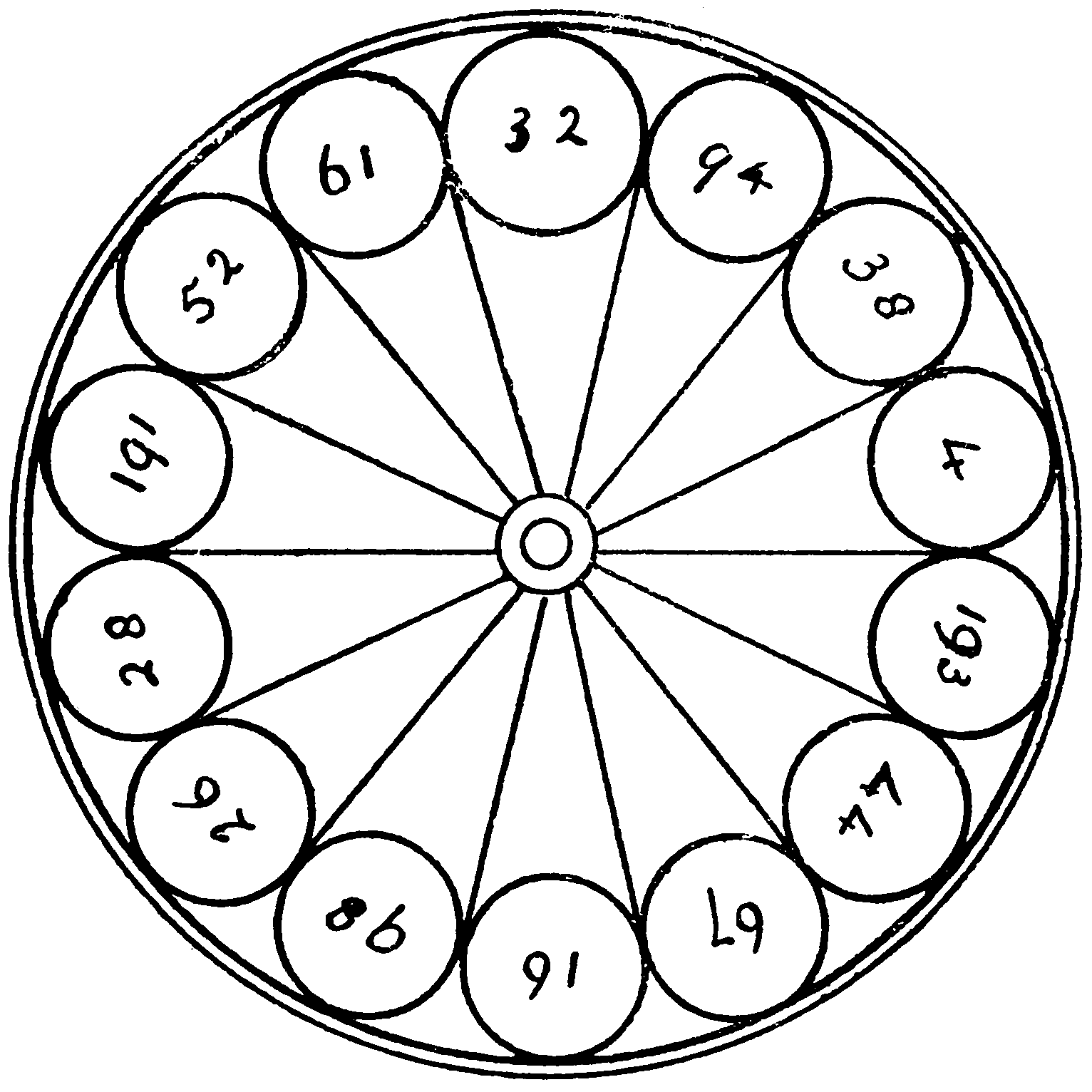
The Magic Circle below has this particular property:—
32
61 94
52 38
191 4
28 193
26 44
98 67
16
The 14 numbers ranged in smaller circles within its circumference are such that the sum of the squares of any adjacent two of them is equal to the sum of the squares of the pair diametrically opposite.
19
Add a hundred and nothing to ten, And the same to a hundred times more, Catch a bee, send it after them, then Make an end of a fop and a bore.
Solution
No. XXIX.—MAGIC CIRCLE OF CIRCLES
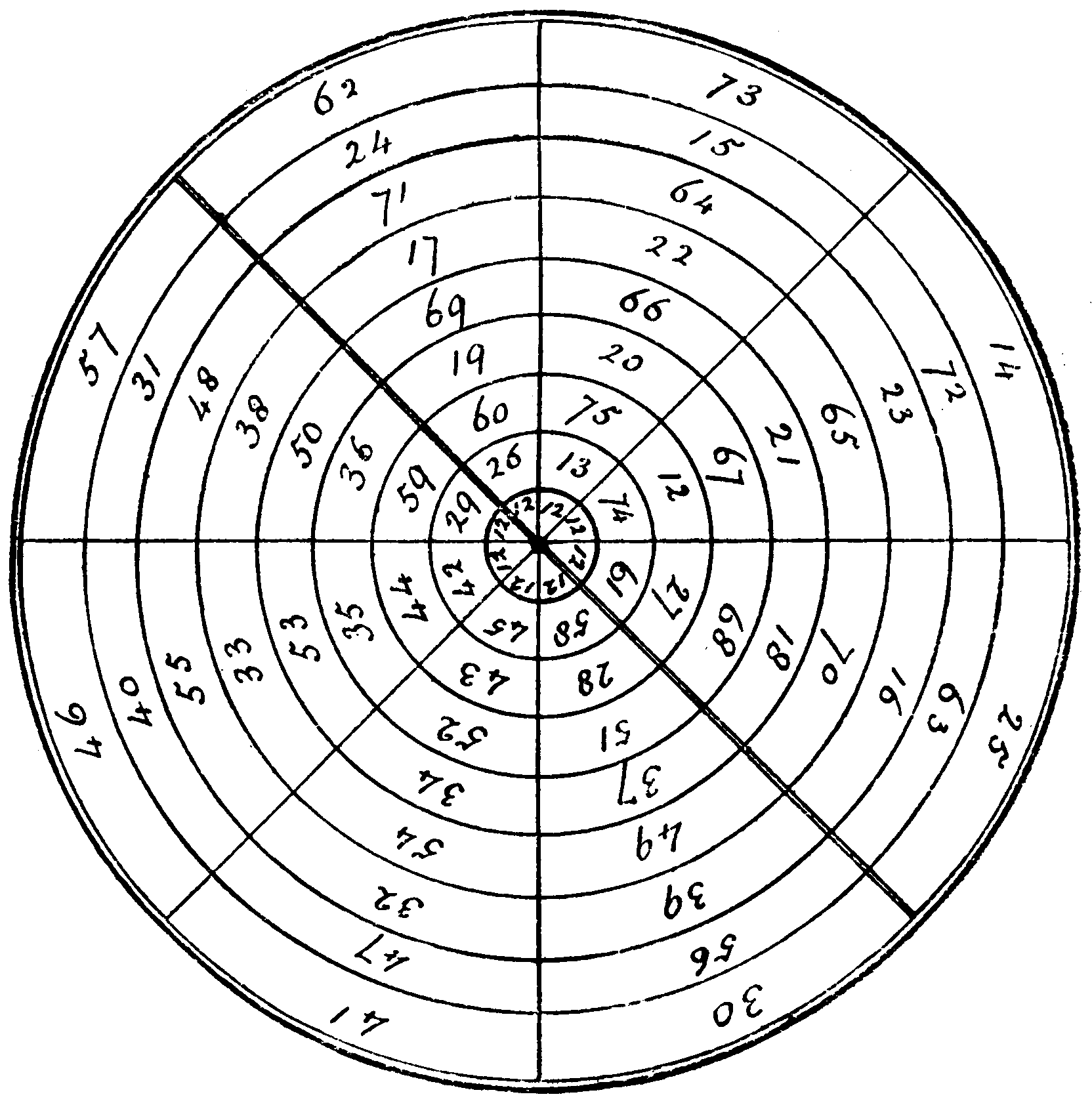
We have had some good specimens of Magic Squares. Here is a very curious and most interesting Magic Circle, in which particular numbers, from 12 to 75 inclusive, are arranged in 8 concentric circular spaces and in 8 radiating lines, with the central 12 common to them all.
62 73
24 15
71 64
17 22
69 66
19 20
60 75
26 13
57 31 48 38 50 36 59 29 12 74 12 67 21 65 23 72 14
46 40 55 33 53 35 44 42 16 27 68 18 70 16 63 25
45 58
43 28
52 51
34 37
54 49
32 39
47 56
41 30
The sum of all the numbers in any of the concentric circular spaces, with the 12, is 360, which is the number of degrees in a circle.
The sum of the numbers in each radiating line with the 12, is also 360.
The sum of the numbers in the upper or lower half of any of the circular spaces, with half of 12, is 180, the degrees of a semi-circle.
The sum of any outer or inner four of the numbers on the radiating lines, with the half of 12, is also 180.
No. XXX.—THE UNIQUE TRIANGLE
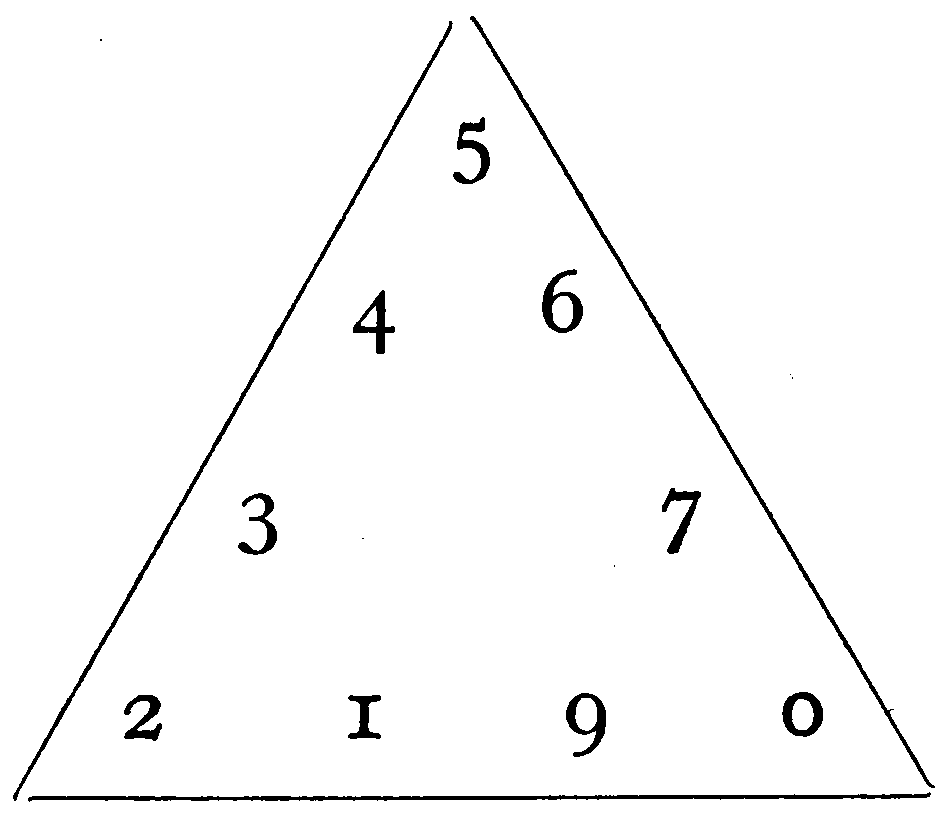
In the following triangle, if two couples of the figures on opposite sides are transposed, the sums of the sides become equal, and also the sums of the squares of the numbers that lie along the sides. Which are the figures that must be transposed?
5
4 6
3 7
2 1 9 0
Solution
20
They did not climb in hope of gain, But at stern duty’s call; They were united in their aim, Divided in their fall.
Solution
21
Forsaken in some desert vast, Where never human being dwelt, Or on some lonely island cast, Unseen, unheard, I still am felt. Brimful of talent, sense, and wit, I cannot speak or understand; I’m out of sight in Church, and yet Grace many temples in the land.
Solution
No. XXXI.—MAGIC TRIANGLES
Here is a nest of concentric triangles. Can you arrange the first 18 numbers at their angles, and at the centres of their sides, so that they count 19, 38, or 57 in many ways, down, across, or along some angles?
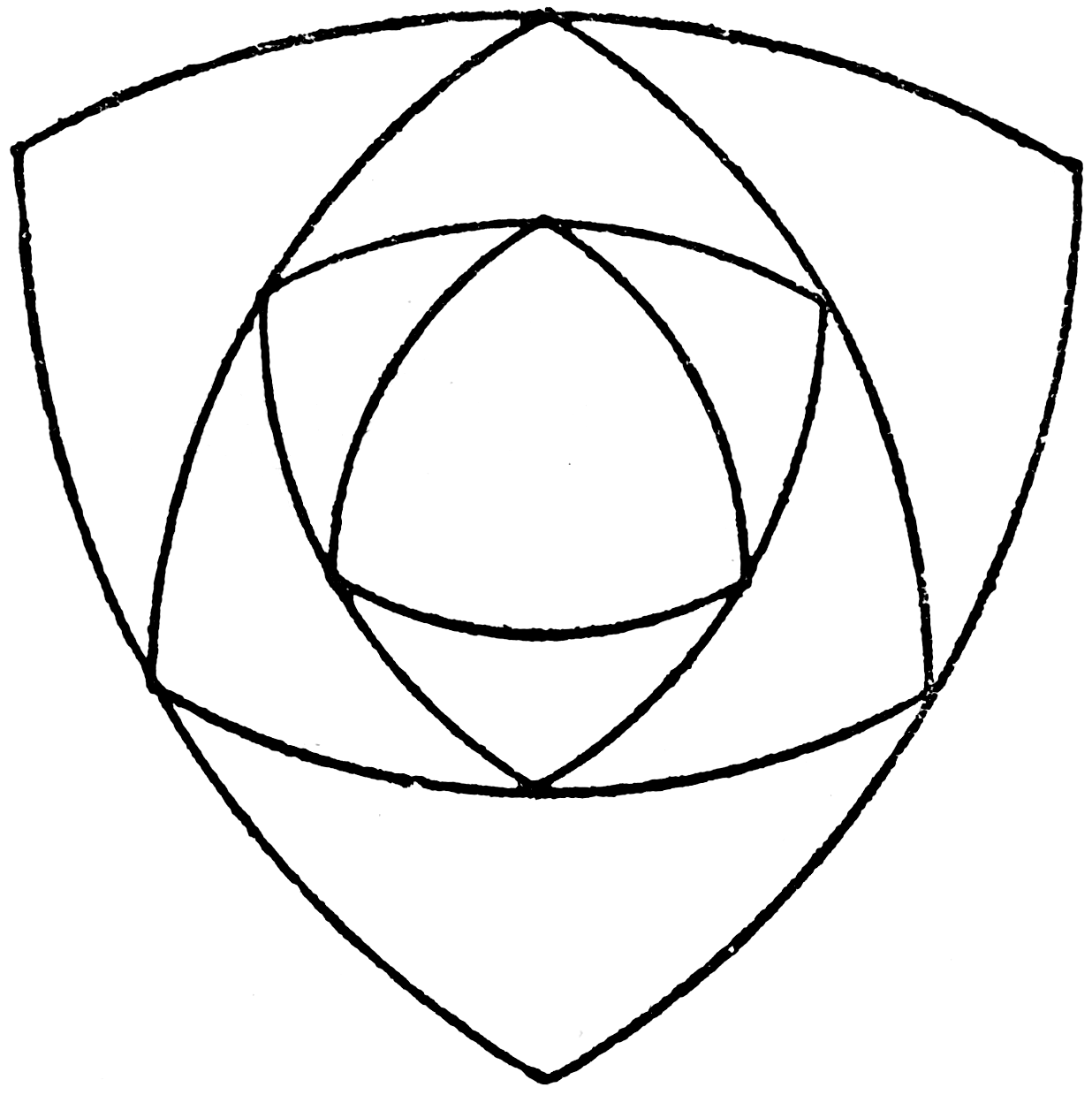
This curiosity is found in an old document of the Mathematical Society of Spitalfields, dated 1717.
Solution
22
Allow me, pray, to go as first, And then as number two; Then after these, why, there you are, To follow as is due. But lest you never guess this queer And hyperbolic fable, Pray let there follow after that Whatever may be able.
Solution
No. XXXII.—TWIN TRIANGLES
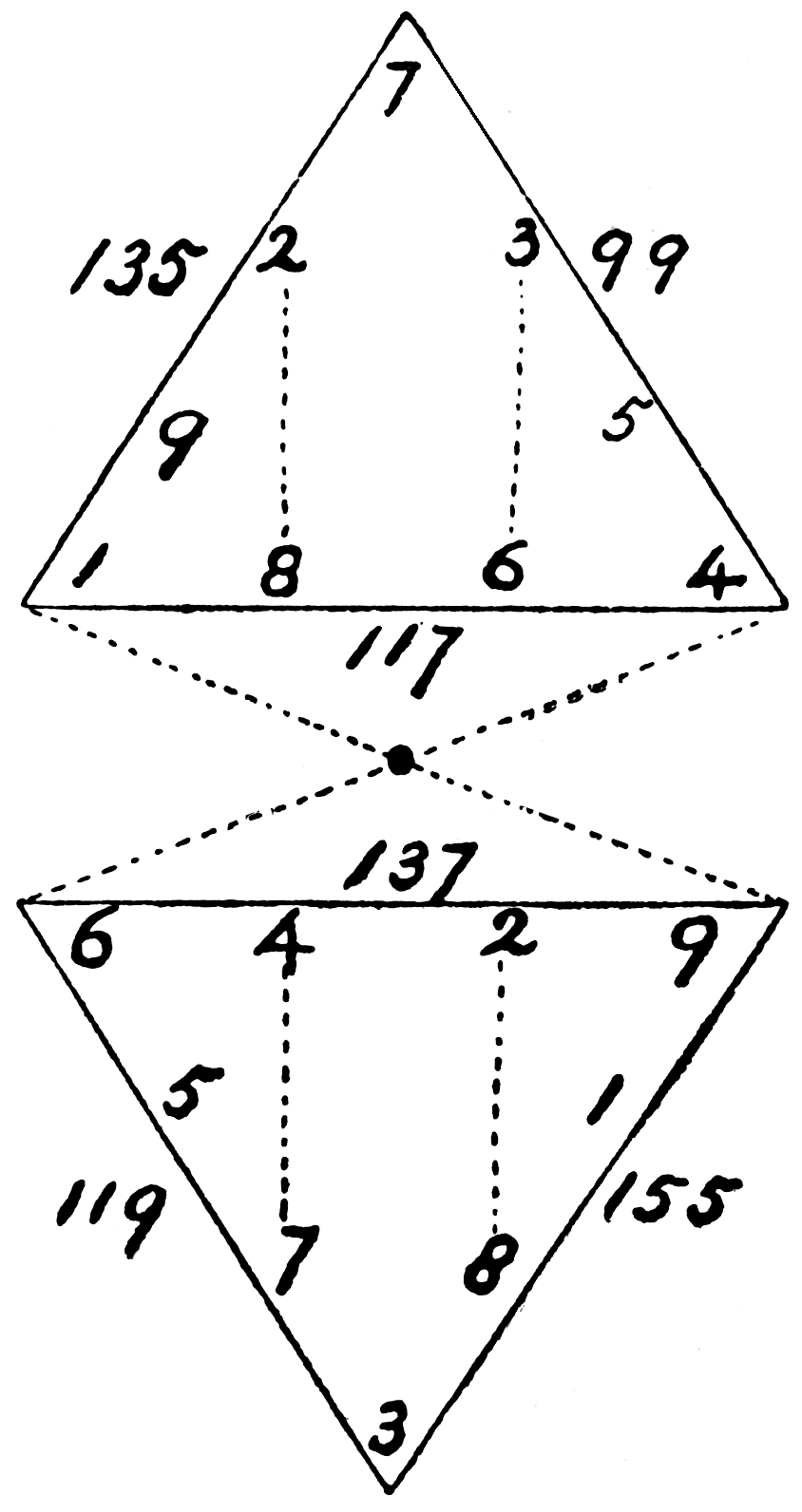
The numbers outside these twin triangles give the sum of the squares of the four figures of the adjacent sides:—
7
2 3
135 99
9 5
1 8 6 4
117
*
137
6 4 2 9
5 1
119 155
7 8
3
The twins are also closely allied on these points:—
18 is the common difference of 99, 117, 135, and of 119, 137, 155.
19 is the sum of each side of the upper triangle.
20 is the common difference of any two sums of squares symmetrically placed, both being on a line through the central spot.
21 is the sum of each side of the lower triangle.
10 is the sum of any two figures in the two triangles that correspond.
254 is the sum of 135, 119, of 117, 137, and of 90, 155.
By transposing in each triangle the figures joined by dotted lines, the nine digits run in natural sequence.
No. XXXIII.—A MAGIC HEXAGON
We have dealt with Magic Squares, Circles, and Triangles. Here is a Magic Hexagon, or a nest of Hexagons, in which the numbers from 1 to 73 are arranged about the common centre 37.
1 5 6 70 60 59 58
63 8
62 19 53 46 22 45 9
61 20 24 64
2 48 31 42 38 49 57
3 47 39 40 44 56
67 51 41 37 33 23 7
66 50 34 35 54 11
65 25 36 32 43 26 12
10 30 27 13
17 29 21 28 52 55 72
18 71
16 69 68 4 14 15 73
Each of these Hexagons always gives the same sum, when counted along the six sides, or along the six diameters which join its corners, or along the six which are at right angles to its sides. These sums are 259, 185, and 111.
23
When I am in, its four legs have no motion; When I am out, as fish it swims the ocean. Then, if transposed, it strides across a stream, Or adds its quality to eyes that gleam.
Solution
No. XXXIV.—MAGIC HEXAGON IN A CIRCLE
Inscribe six equilateral triangles in a circle, as shown in this diagram, so as to form a regular hexagon.
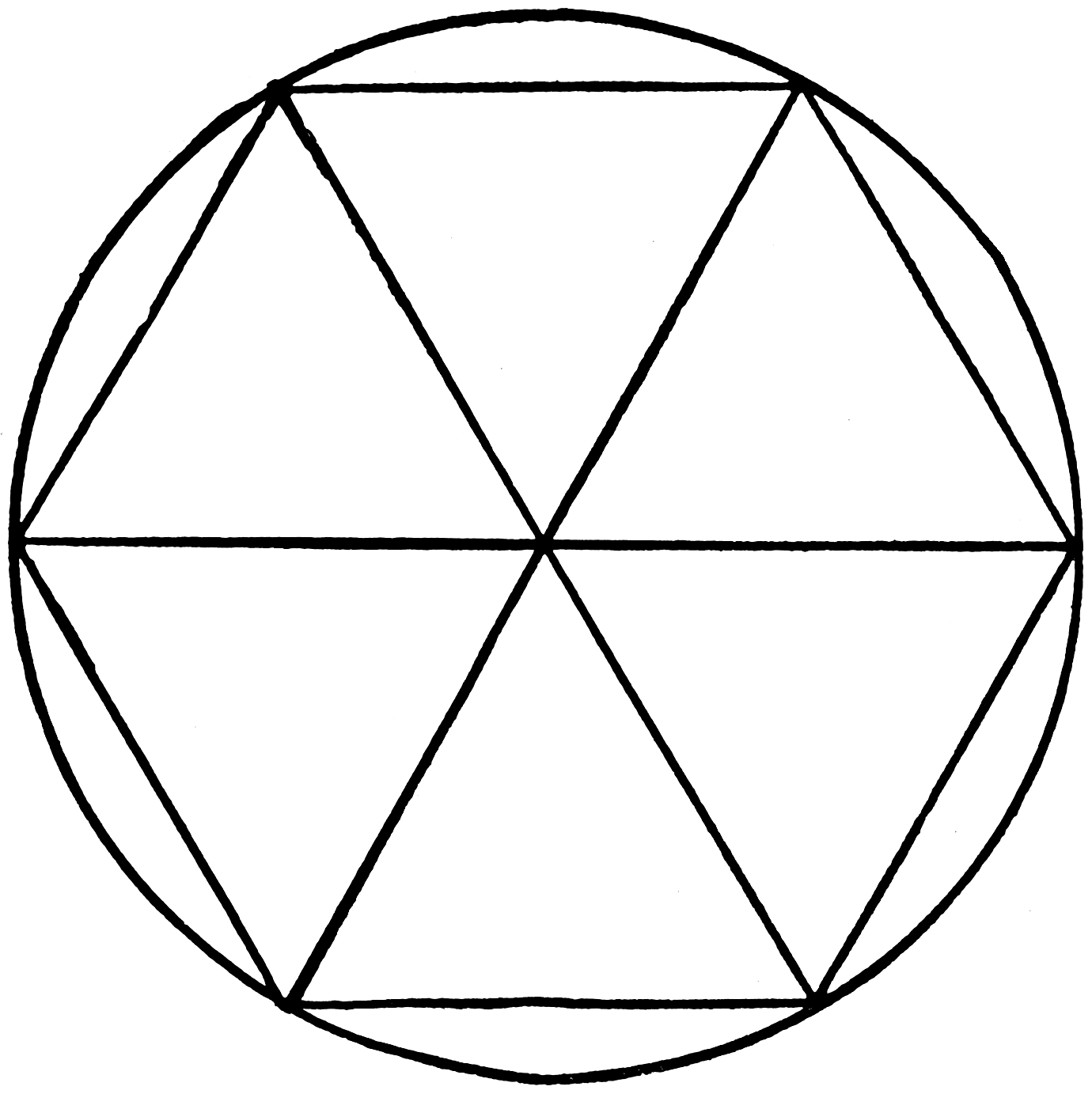
Now place the nine digits round the sides of each of the triangles, so that their sum on each side may be 20, and so that, while there are no two triangles exactly alike in arrangement, the squares of the sums on the other sides may be alternately equal.
Solution
24 A PERSONAL ENIGMA
We can but see his sad reverse, And while we say alas! We hail his work so keen and terse, With just a touch of gas.
Solution
No. XXXV.—A MAGIC CROSS
There are 33 different combinations of four of the numbers in the cells of this magic cross which total up in each case to 26.
1 12
9 8 5 4
2 7 6 11
10 3
Those who care to work them out on separate crosses will find that there is a very regular correspondence in the positions which the numbers occupy.
25
What boy can live on with a prospect of age, If you cut off his head at an early stage?
Solution
26 By Lord Macaulay
Here’s plenty of water, you’ll all of you say; And minus the h a thing used every day; And here is nice beverage; put them together— What is it with claws, but with never a feather?
Solution
No. XXXVI.—A CHARMING PUZZLE
Here is quite a charming little puzzle, which is by no means easy of accomplishment:—
✦ ✦ ✦
✦ ✦ ✦
✦ ✦ ✦
Start from one of these nine dots, and without taking the pen from the paper draw four straight lines which pass through them all. Each line, after the first, must start where the preceding one ends.
Solution
27 A BROKEN TALE
The deil jumped the clouds so high That he bounded almost right the sky. the trees gates and fields and He dodged with his tail dragging all these, But, alas! made a terrible bl, For a twist in his tail a rail, hooked And broke that appendage as.
Solution
No. XXXVII.—LEAP-FROG
Place on a chess or draught-board three white men on the squares marked a, and three black men on the squares marked b.
a a a b b b
The pieces marked a can only move one square at a time, from left to right, and those marked b one square at a time, from right to left, on to unoccupied squares; and any piece can leap over one of the other colour, on to an unoccupied square. What is the least number of moves in which the positions of the white and the black men can be reversed, so that each square now occupied by a white is occupied by a black, and each now occupied by a black holds a white piece?
Solution
28
To a word of assent join the first half of fright, Then add what will never be seen in the night. By such a conjunction we quickly attain What most men have seen, but can’t see again.
Solution
29
My first is stately, proud, and grave, My next will guard your treasure; My whole, a slow but sturdy slave, Will wait upon your pleasure.
Solution
No. XXXVIII.—SORTING THE COUNTERS
In the upper row of this diagram four white and four black counters are placed alternately.


It is possible, by moving these counters two at a time, to arrange them in four moves as they stand on the lower row. Can you do this? Draughtsmen are handy for solving this puzzle, on a paper ruled as above.
Solution
30
I am a word of letters six, First link me with your mind; Then shuffle me, and lo! I mix With grief of noisy kind. Shake me again, and you may fix A cloak that hangs behind.
Solution
31
We are of use to every man In walking, riding, rambling; We join the gambols of the knave, And play the knave in gambling!
Solution
No. XXXIX.—A TRANSFORMATION
Take five wooden matches, and bend each of them into a V. Place them together, as is shown in the diagram, so that they take the form of an asterisk, or a ten-pointed star.
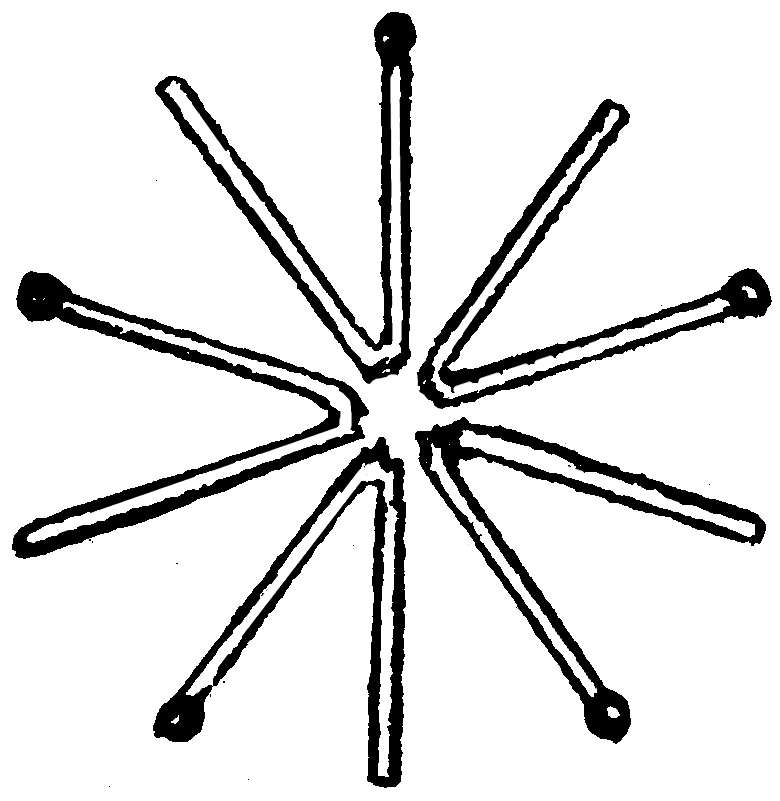
Lay them on some smooth surface, and without touching them transform them into a star with five points.
Solution
32
Strange that a straggling tiresome weed Will change its meaning quite, And turn into a sign of grief If we transpose it right; And, stranger still, transposed again Will tell of ease from grief or pain.
Solution
33
Find me two English verbs that ever In a united state will blend, Let one say “join,” the other “sever,” While I divide them to the end.
Solution
No. XL.—DOMINO BUILDING
It is possible, with plenty of patience, to build up a whole set of dominoes, so that they are safely supported on only two stones set up on end.
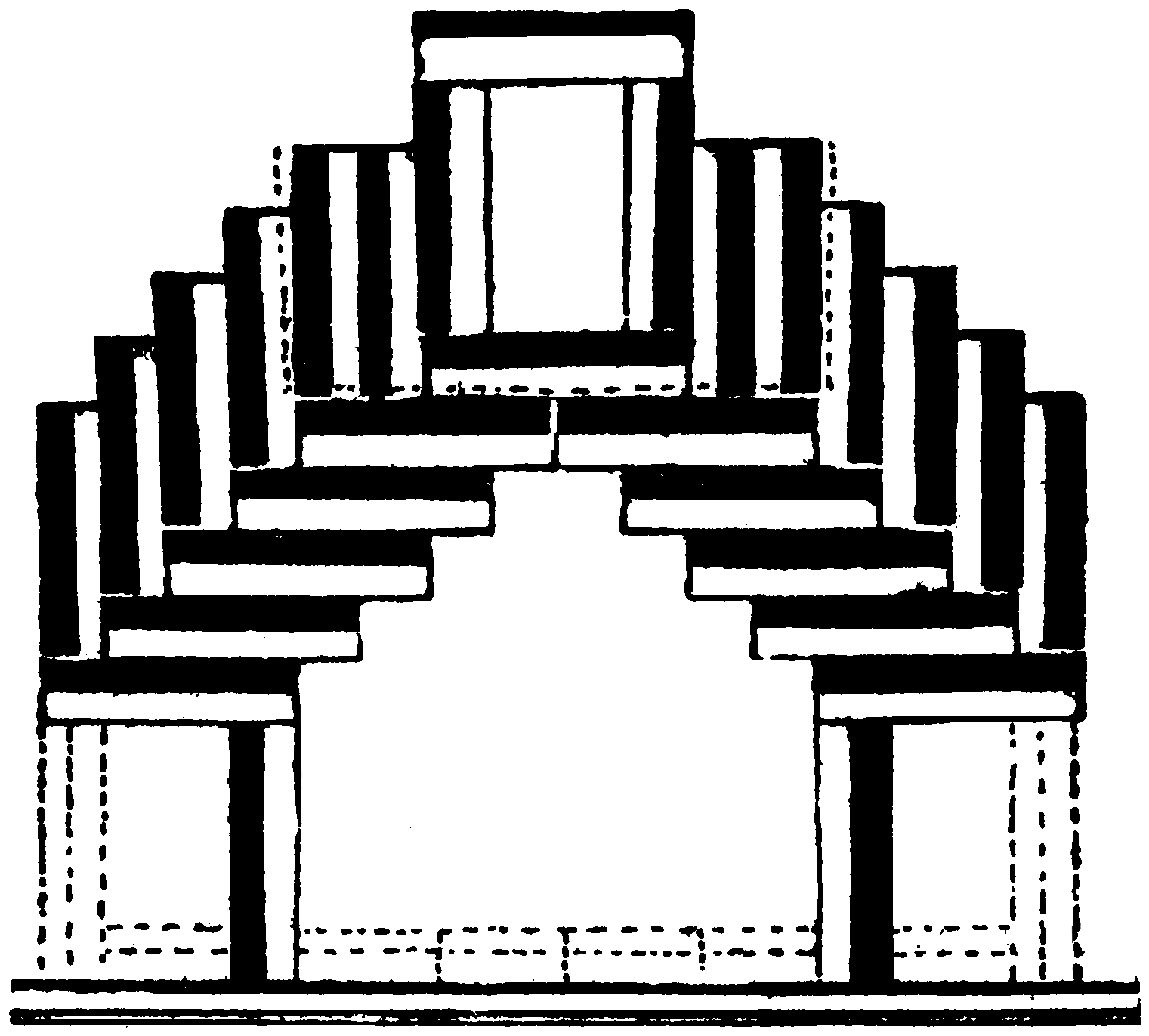
This, which might well seem impossible, is done by placing, as a foundation, dominoes in the positions indicated by dotted lines. The arch is then carefully constructed, as shown in the diagram, and for the finish the four stones between the two foundation arches are drawn out, and placed in pairs on end above, and finally, with the utmost care, the other four are drawn away, and built in on the top. Thus the stones indicated by the dotted lines at the base take their place within the dotted lines above.
No. XLI.—FAST AND LOOSE
This diagram represents a shallow box, on the bottom of which twelve counters or draughtsmen are lying loose.
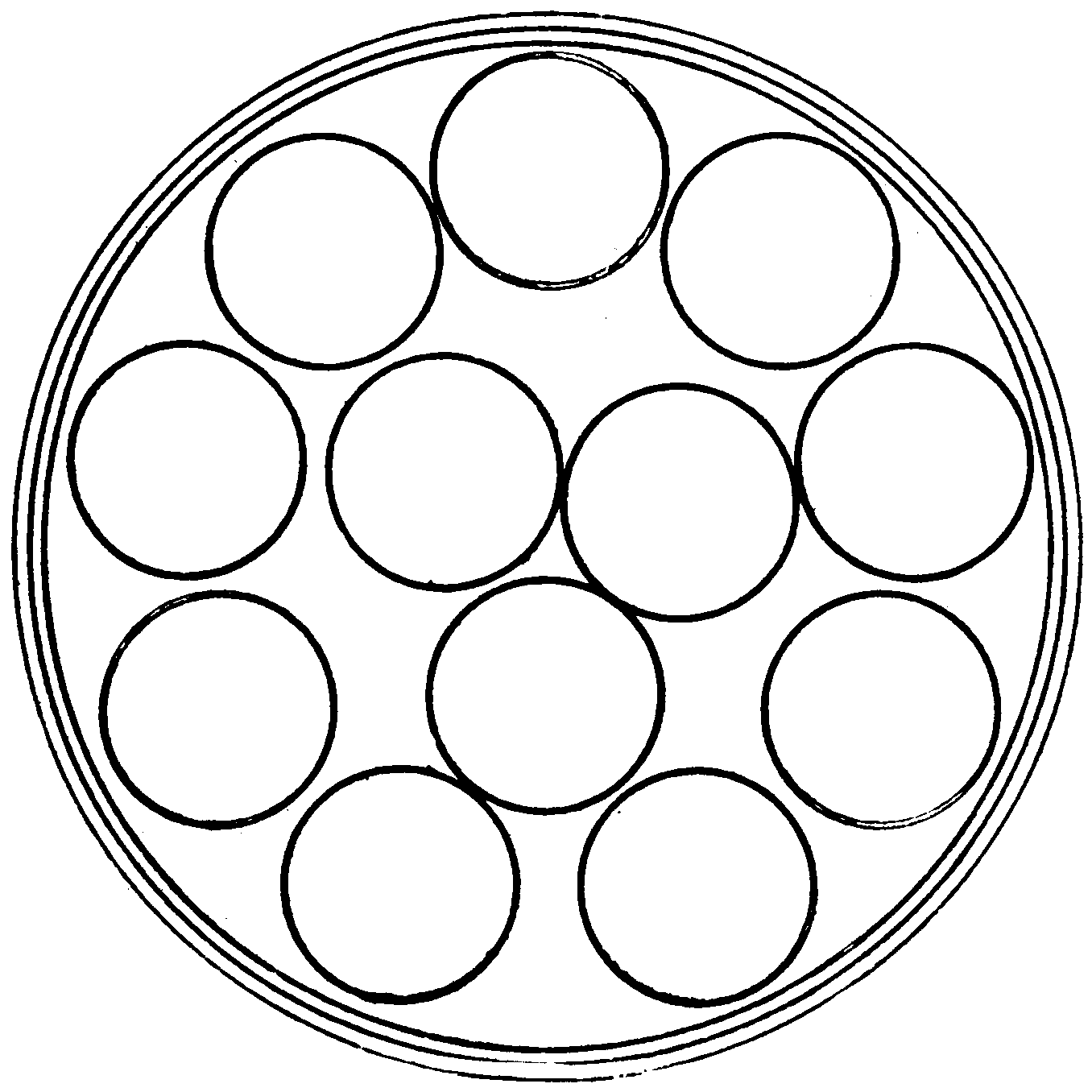
How can they be readjusted so that they will wedge themselves together, and against the side of the box, and it can be turned upside down without displacing them?
Solution
34
Taken entire I’m full of fire. With head away A tax I pay. If tail you bar I turn from tar. Headless again, With tail restored. Goddess of pain, I sow discord.
Solution
No. XLII.—MAZY PROGRESS.
The diagram below is an exact reproduction of an old-fashioned maze, cut in the ground near Nottingham. It is eighteen yards square, and the black line represents the pathway, which is 535 feet in length.
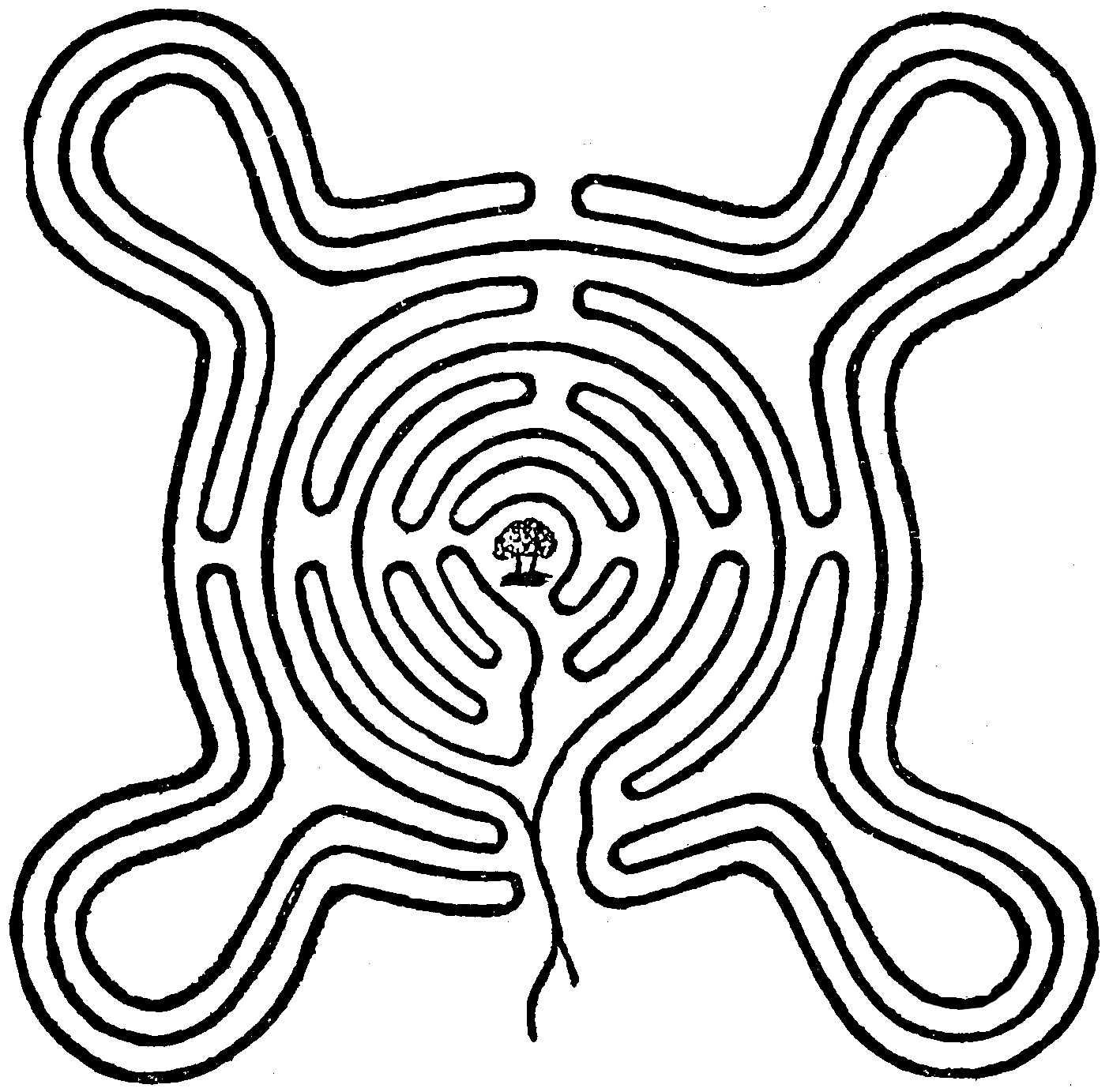
The point of this convoluted path is not so much to puzzle people, as to show how much ground may be covered without diverging far from a centre, or going over the same ground twice. As we advance along the line there are no obstructions, and we find ourselves, after passing over the whole of it, on the spot whence we set out.
35
Thrice three pins in shining line Mary meant to fix; Why did Mary turn the nine Into thirty-six?
Solution
No. XLIII.—FOR CLEVER PENCILS
Start at A, and trace these figures with one continuous line, finishing at B.
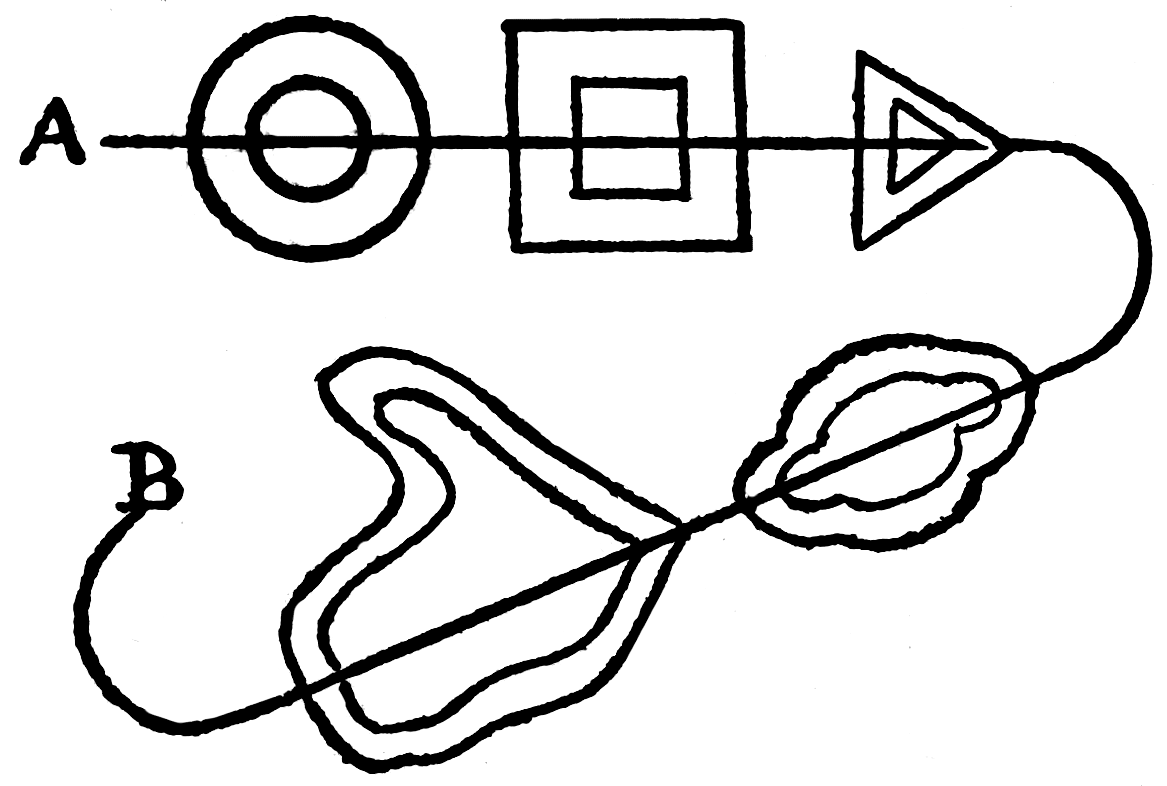
You must not take your pencil from the paper, or go over any line twice.
Solution
36
A ring and a wing and three-fourths of a fog, Will bring to your view a most obstinate dog.
Solution
37
Add fifty-seven to two-thirds of one, Then take a fiddle, And it will help to show you what is done, To make this riddle.
Solution
38
I am a fish so neat and clever, In pools and crystal streams I play, To find me out my name you sever As near the middle as you may.
Solution
No. XLIV.—TEST AND TRY
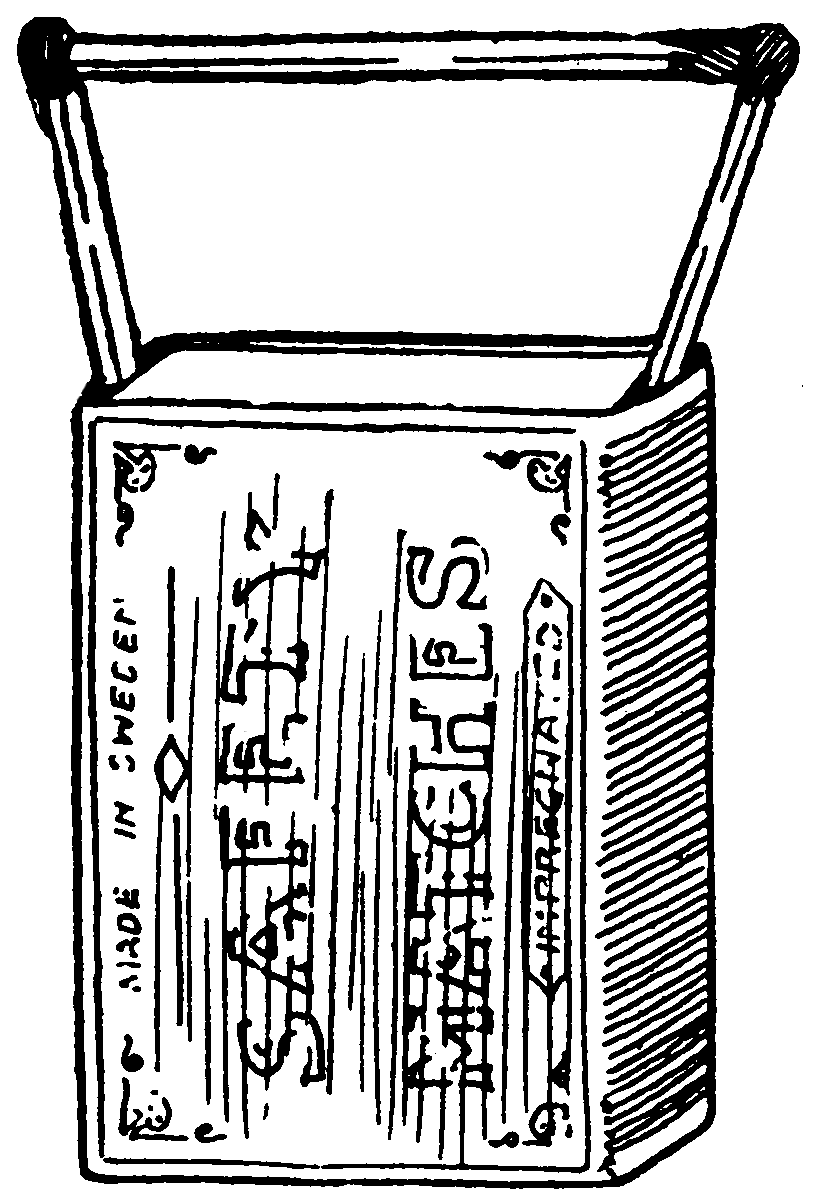
Those who have not seen it will find some real fun in the following little experiment. Fix three matches as shown in the diagram, light the cross match in the middle, and watch to see which of the ends will first catch fire, or what will happen.
39
I stand stock still, let who will hurry, You cannot put me in a flurry, Nor stir my stumps, for all your worry. I am in haste, let none delay me As fleetest couriers convey me. You must transpose me ere you stay me.
Solution
40
Two to one, in case we hide, You will find us in our site; We are harmless side by side, Parted we prepare to bite. When united we divide, When divided we unite.
Solution
No. XLV.—A CURIOUS PHENOMENON
Equal volumes of alcohol and water, when mixed, occupy less space than when separate, to the extent indicated in this picture:
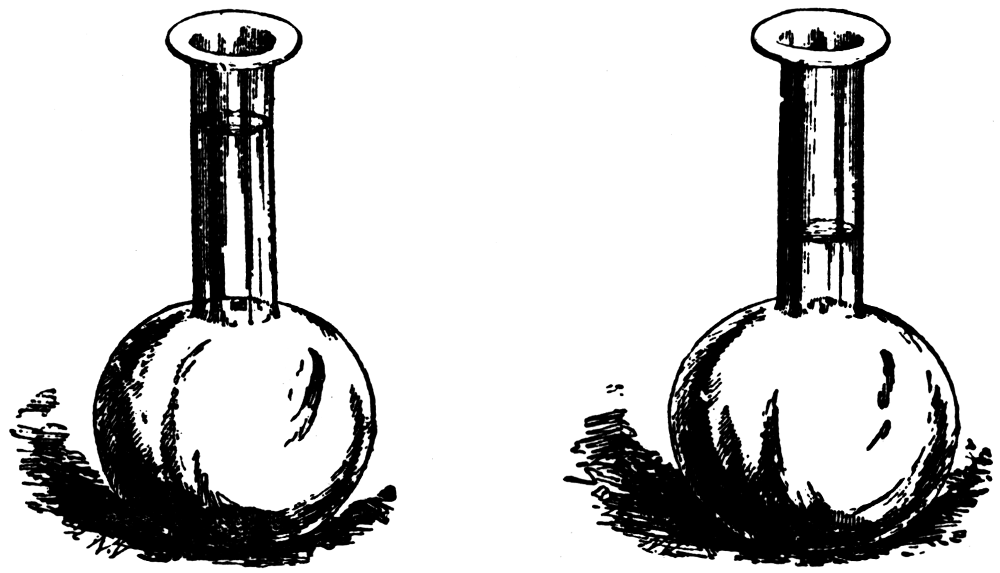
If the sum of the volume of the two separate liquids is 100, the volume of the mixture will be only 94. It is thought that the molecules of the two liquids accommodate themselves to each other, so as to reduce the pores and diminish the volume of the mixture.
41
Cut off my head, I’m every inch a king, A warrior formed to deal a heavy blow; Halve what remains, my second is a thing Which nothing but my third can e’er make go. My whole will vary as you take your line, This less than human, that way all divine.
Solution
42
One half of me in solid earth you find, The other half in ocean’s ample bed: When in my whole we see these parts combined, The earth remains, but all the sea is fled.
Solution
No. XLVI.—A HOME-MADE MICROSCOPE
The simplest and cheapest of all microscopes can easily be made at home. The only materials needed are a thin slip of glass, on to which one or two short paper tubes, coated with black sealing wax, are cemented with the wax, a small stick, and a tumbler half full of water.
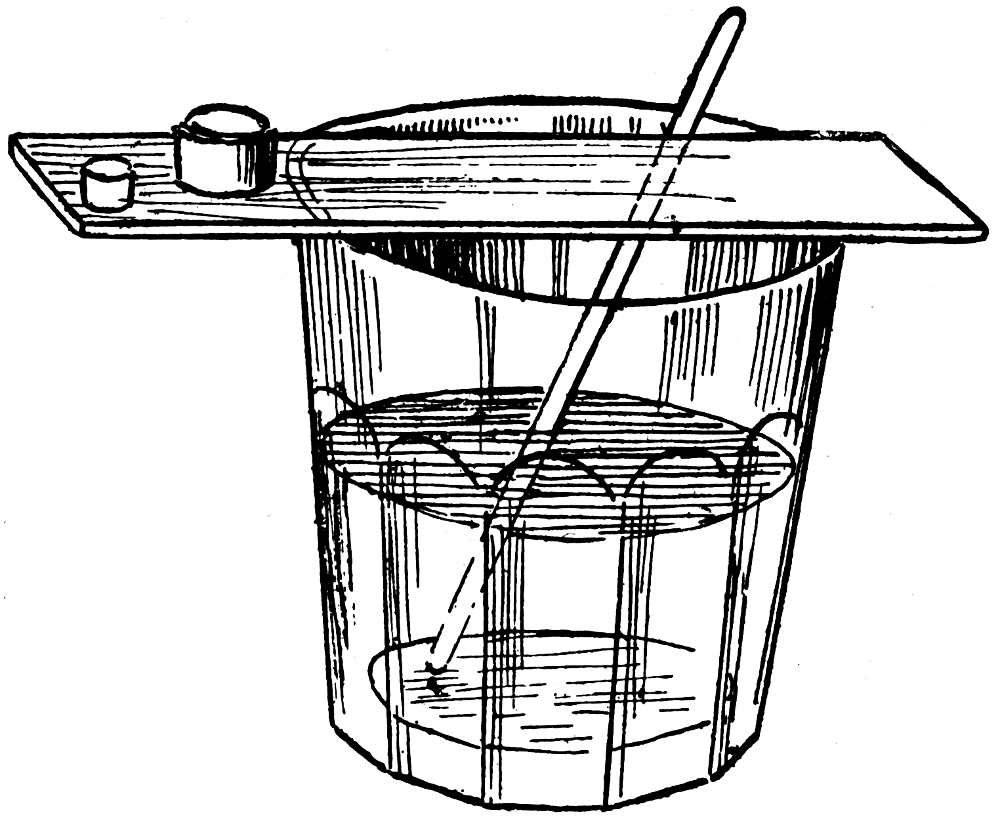
Water is dropped gradually by aid of the stick into the cells, until lenses are formed of the desired convexity, and objects held below the glass will be more or less magnified.
43
Not ever changed unless unchanged, Nor hanged unless beheaded; Quick eyes may find in me arranged Almost an angel bedded.
Solution
No. XLVII.—A PRETTY EXPERIMENT
For this curious experiment a glass bottle or decanter about half full of water and a sound stalk of straw are needed.
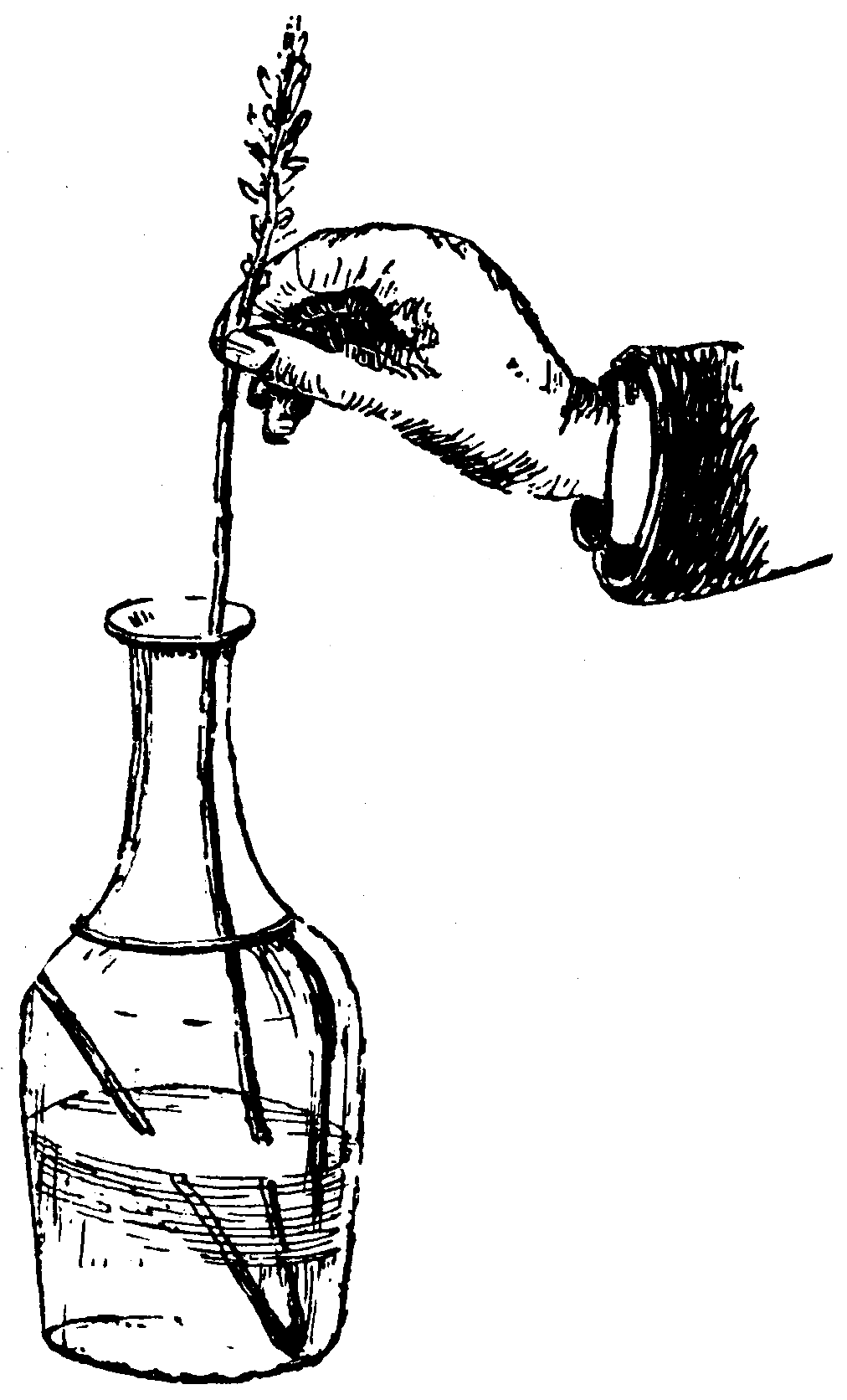
Bend the straw without breaking it, and put it, as is shown, into the bottle, which can then be lifted steadily and safely by the straw, if it is a sound one.
44 “WHAT THE DICKENS IS HIS NAME?” Merry Wives of Windsor.
A Russian nobleman had three sons. Rab, the eldest, became a lawyer, his brother Mary was a soldier, and the youngest was sent to sea. What was his name?
Solution
No. XLVIII.—A BOTTLED BUTTON
The button in a clear glass bottle, as is shown below, hangs attached by a thread to the cork, which is securely sealed at the top.
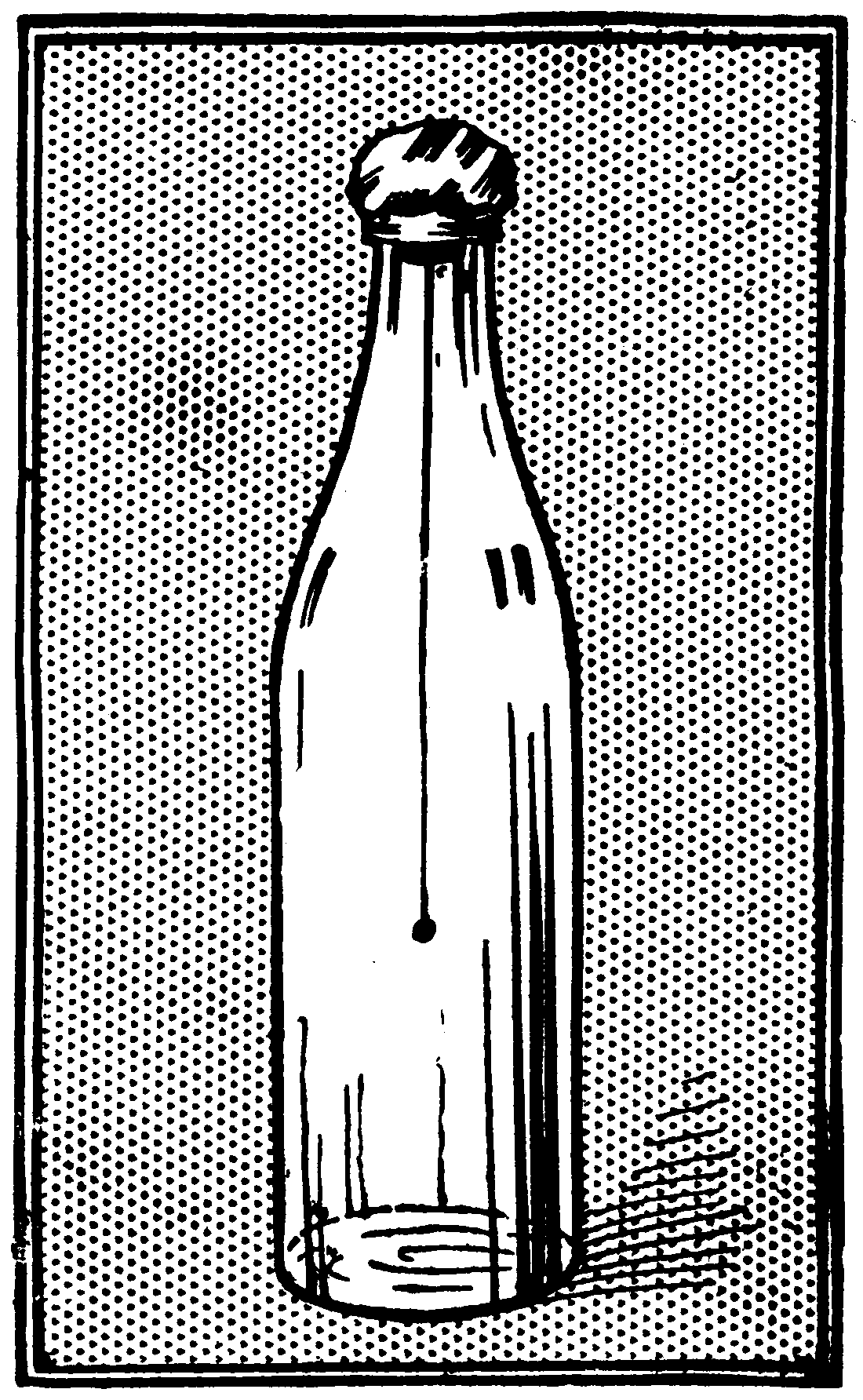
How can you sever the thread so that the button falls to the bottom without uncorking or breaking the bottle?
Solution
45 A NEW “LIGHT BRIGADE”
Six before six before Five times a hundred; This must be brilliant, or Solvers have blundered.
Solution
No. XLIX.—CLEARING THE WAY
Here is a pretty trick which requires an empty bottle, a lucifer match, and a small coin.
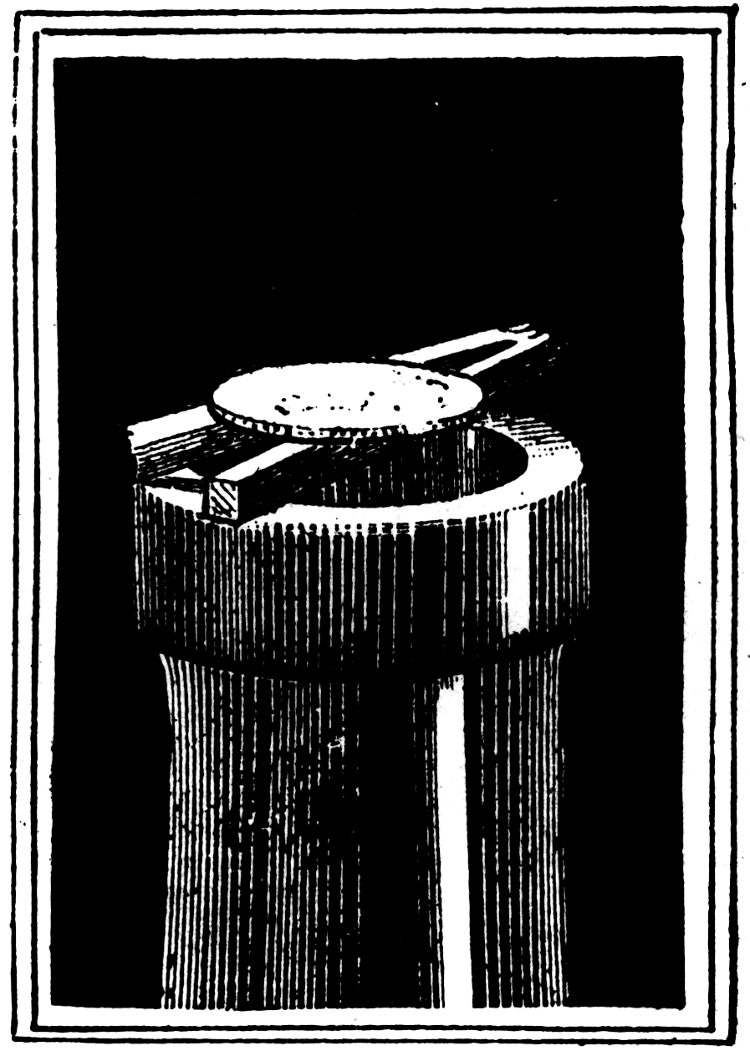
Break the wooden match almost in half, and place it and the coin in the position shown above. Now consider how you can cause the coin to drop into the bottle, if no one touches it, or the match, or the bottle.
Solution
46
Scorned by the meek and humble mind, And often by the vain possessed, Heard by the deaf, seen by the blind, I give the troubled spirit rest.
Solution
47
To fifty for my half append Two-thirds of one; The other third my whole will end When you have done.
Solution
No. L.—IS WATER POROUS?
Our belief that two portions of matter cannot occupy the same space at the same time is almost shaken by the following experiment:
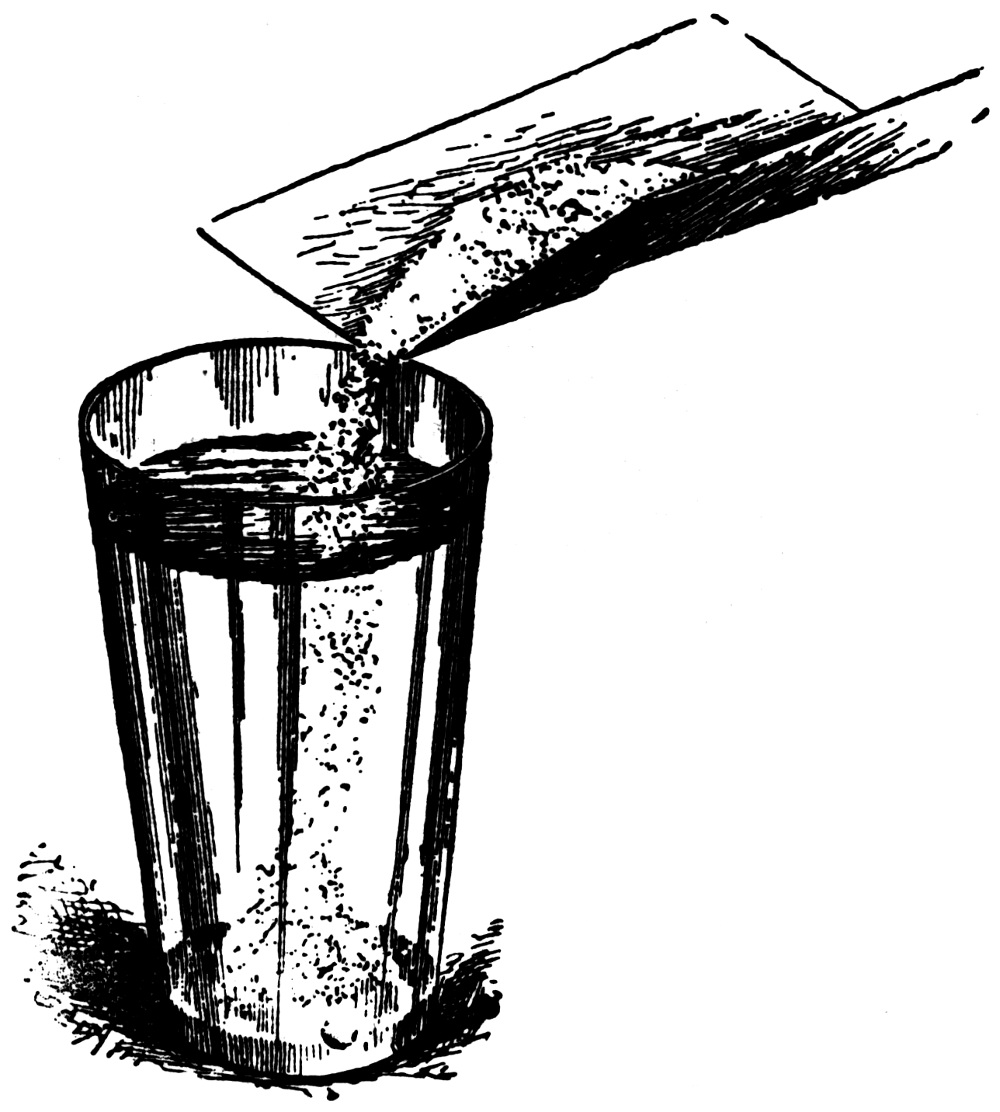
If we introduce slowly some fine powdered sugar into a tumblerful of warm water a considerable quantity may be dissolved in the water without increasing its bulk.
It is thought that the atoms of the water are so disposed as to receive the sugar between them, as a scuttle filled with coal might accommodate a quantity of sand.
48 A DOUBLE SHUFFLE
See, the letters that I bring Change their meaning quite; Spell a hard and heavy thing, Spell a soft and light.
Solution
No. LI.—A TEST OF GRAVITY
Set a stool, as is shown in the diagram below, about nine or ten inches from the wall.
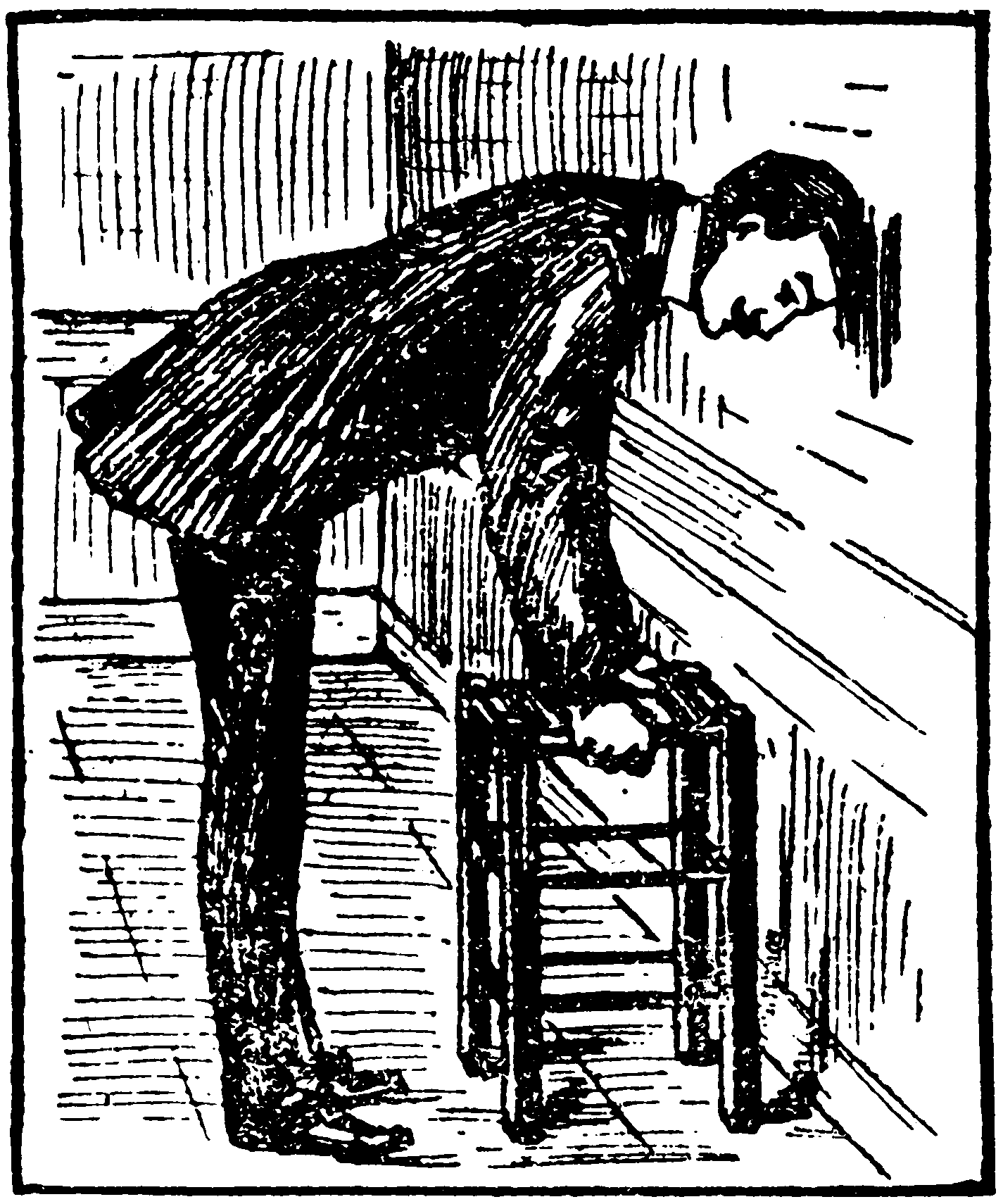
Clasp it firmly by its two side edges, plant your feet well away from it, and rest your head against the wall. Now lift the stool, and then try, without moving your feet, to recover an upright position.
It will be as impossible as it is to stand on one leg while the foot of that leg rests sideways against a wall or door.
No. LII.—BILLIARD MAGIC
Place a set of billiard balls as is shown in the diagram, the spot ball overhanging a corner pocket, and the red and the plain white in a straight line with it, leaving an eighth of an inch between the balls.
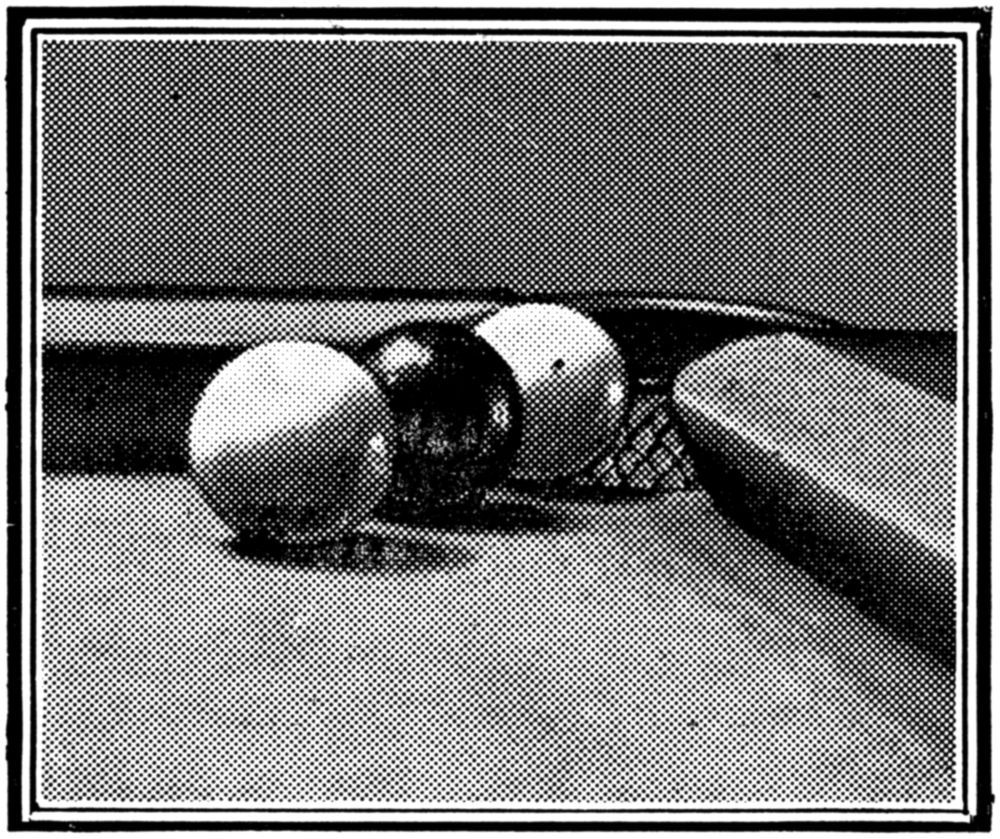
How can you pot the spot white with the plain white, using a cue, and without touching, or in any way disturbing, the red ball? There is not room to pass on either side between the red ball and the cushion.
Solution
No. LIII.—THE NIMBLE COIN
Prepare a circular band of stiff paper, as is shown in the diagram, and balance it, with a coin on the top, on the lip of a bottle.
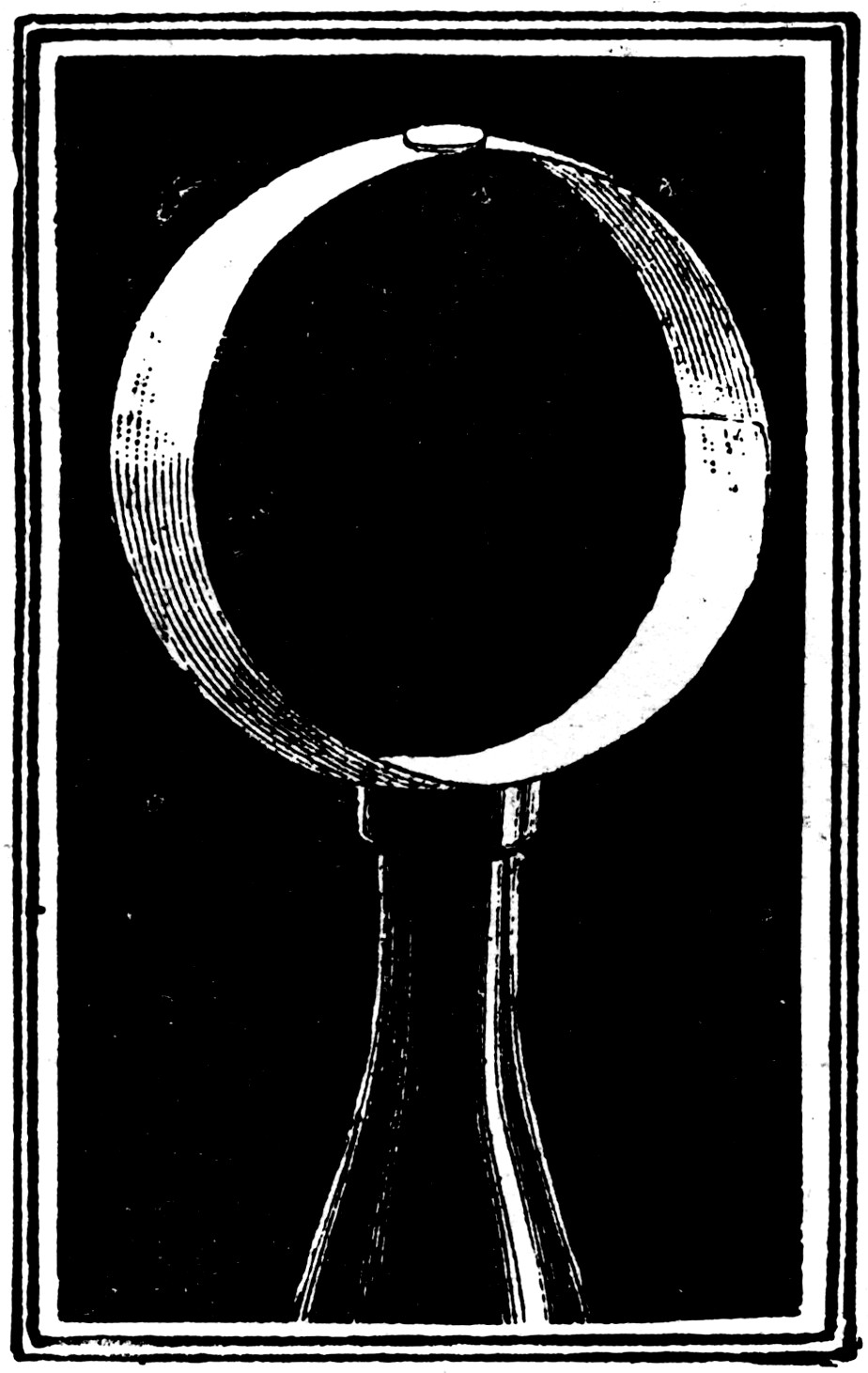
How can you most effectively transfer the coin into the bottle?
Solution
49 AN ENIGMA BY MUTATION
Search high or low, you’d find me where you list; For not a place without me can exist. I lose my head, and, seen with shoulders fair, Become the very fairest of the fair. Again I lose it, and, like some staunch hound, The first and best amongst a pack am found. And if at first both head and tail I lose I am a portion such as all would choose.
Solution
No. LIV.—HIT IT HARD!
Place a strip of thin board, or a long wide flat ruler, on the edge of a table, so that it just balances itself, and spread over it an ordinary newspaper, as is shown in the illustration.
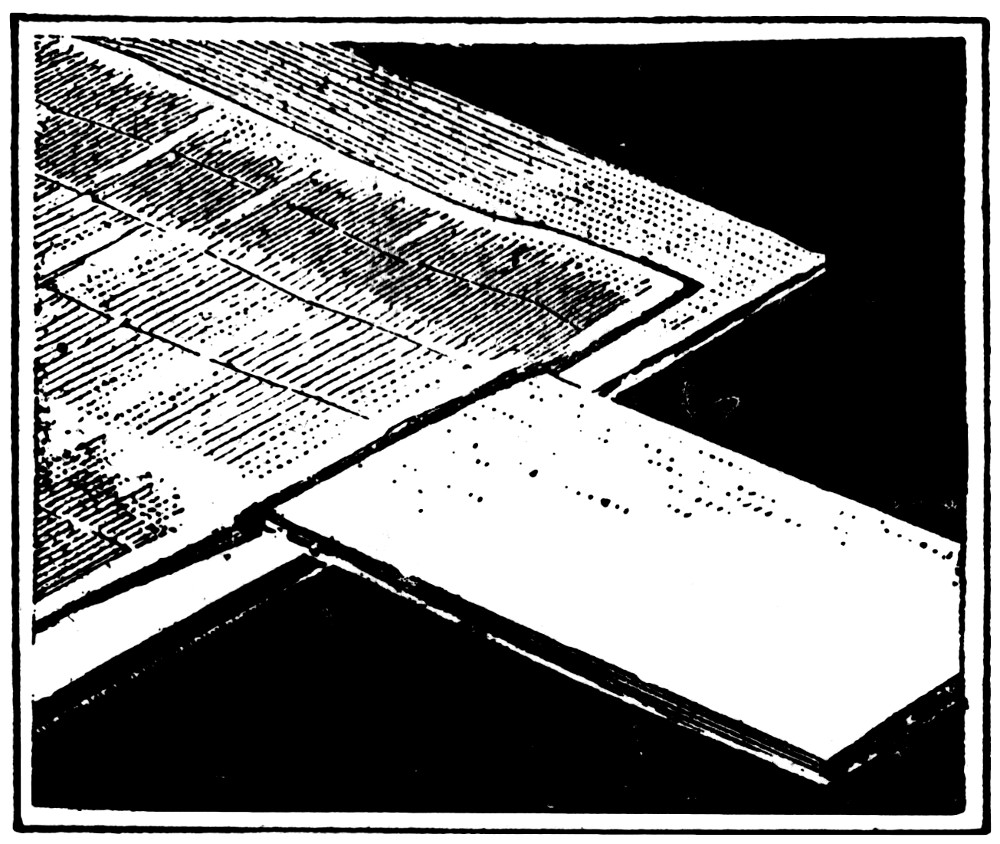
You may now hit it quite hard with your doubled fist, or with a stick, and the newspaper will hold it down, and remain as firmly in its place as if it were glued to the table over it. You are more likely to break the stick with which you strike than to displace the strip of wood or the paper. Try the experiment.
50 AN ENIGMA BY SWIFT
We are little airy creatures All of different voice and features. One of us in glass is set, One of us is found in jet. Another you may see in tin, And the fourth a box within. If the others you pursue They can never fly from you.
Solution
No. LV.—THE BRIDGE OF KNIVES
Here is an after-dinner balancing trick, which it is well to practise with something less brittle than the best glass:—
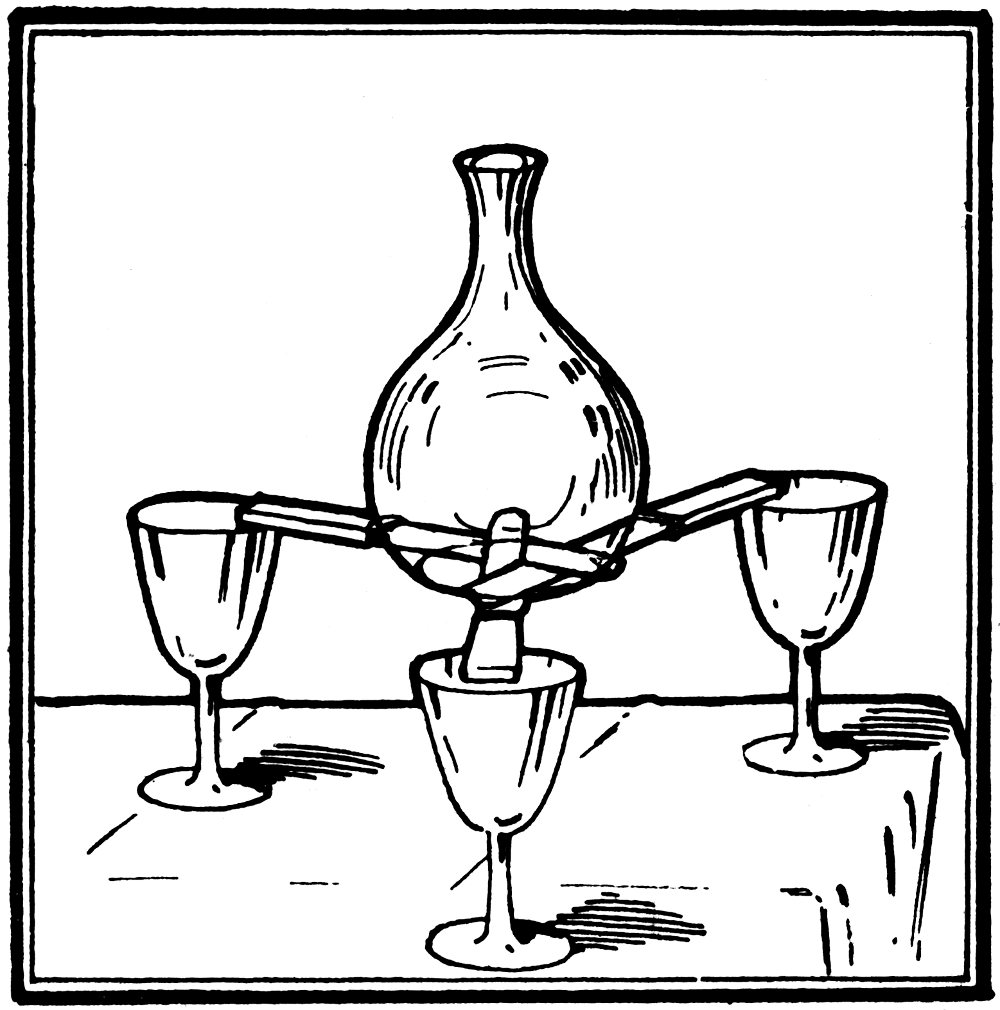
It will be seen that the blades of the knives are so cunningly interlaced as to form quite a firm support.
51 A MEDLEY
Twice six is six, and so Six is but three; Three is just five you know, What can we be? Would you count more of us, Nine are but four of us, Ten are but three.
Solution
No. LVI.—DIFFERENT DENSITIES
Here is a pretty little experiment, which shows the effect of liquids of different densities.
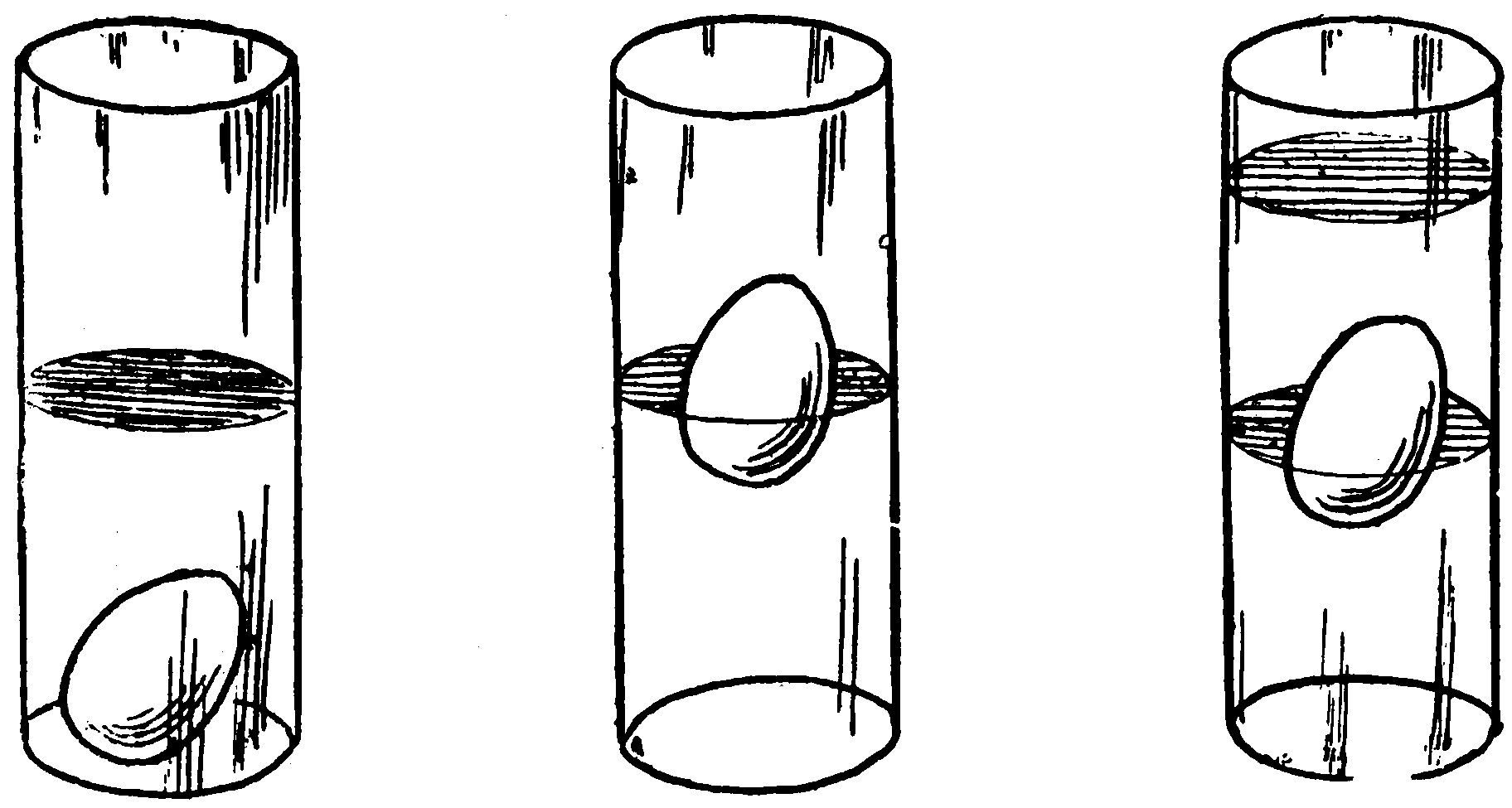
Drop an egg into a glass vessel half full of water, it sinks to the bottom. Drop it into strong brine, it floats. Introduce the brine through a long funnel at the bottom of the pure water, and the water and the egg will be lifted, so that the egg floats between the water and the brine in equilibrium. The egg is denser than the water, and the brine is denser than the egg.
52 THE MISSING LINK
A friend to all the human race From emperor to peasant, None is more missed when out of place, More opportune when present. Obedient to the general will I yield to due control; And yet the public twist me, till They put me in a hole!
Solution
No. LVII.—COLUMBUS OUTDONE
Here is a very simple and effective little trick. Offer to balance an egg on its end on the lip of a glass bottle.
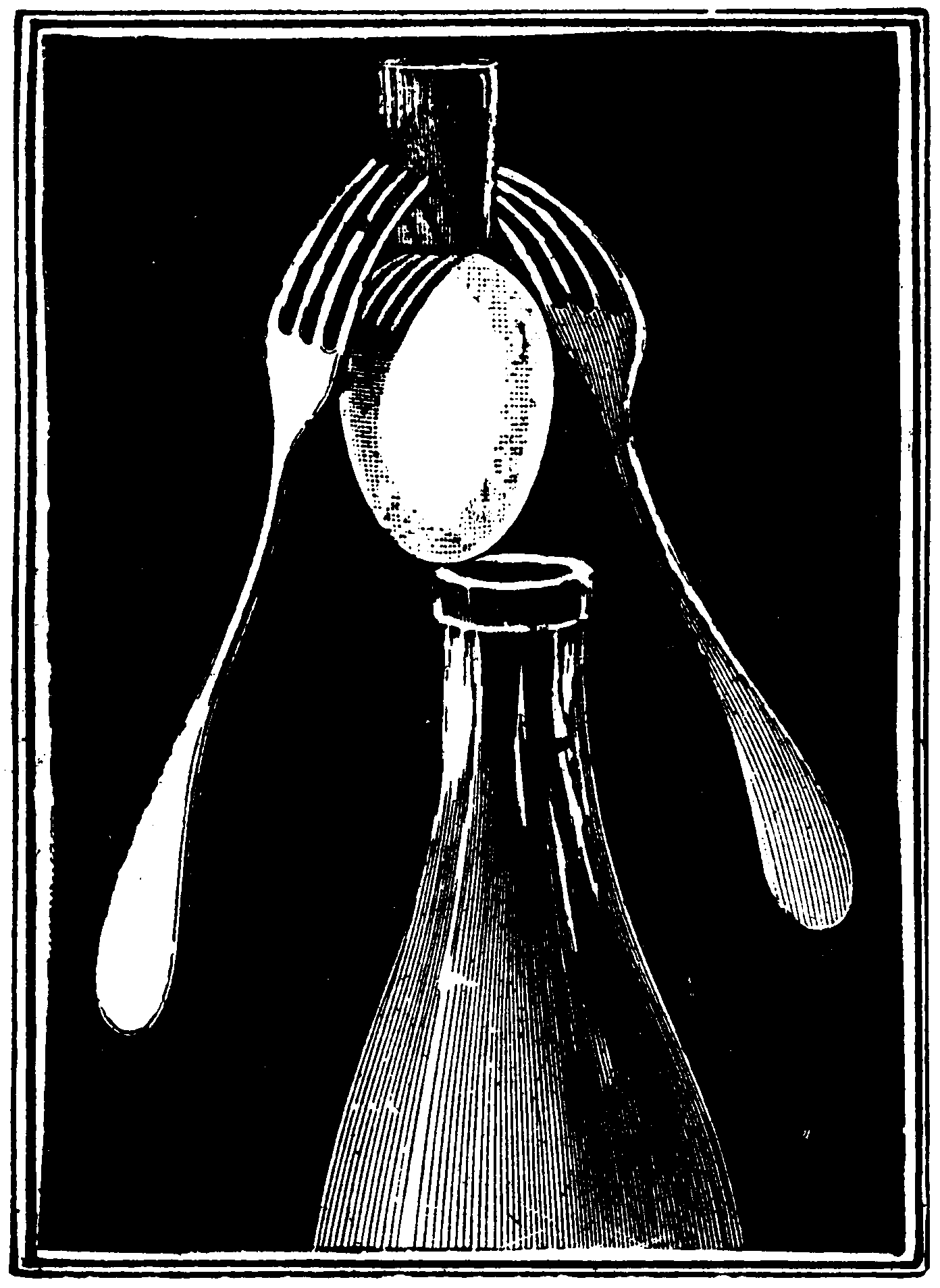
The picture shows how it is done, with the aid of a cork and a couple of silver forks.
(From “La Science Amusante”).
53
Two words of equal length we here indite, Which hold a famous father and his mate. Embracing five, with fifty left and right, The mother, looking both ways, keeps things straight. Her husband, following a thousand quite, With them has changed his sex, a funny fate, And if this lady lose her head, she might, Being a man, oppose the water-rate.
Solution
No. LVIII.—WHAT WILL HAPPEN?
The boy in this picture is blowing hard against the bottle, which is between his mouth and the candle flame.
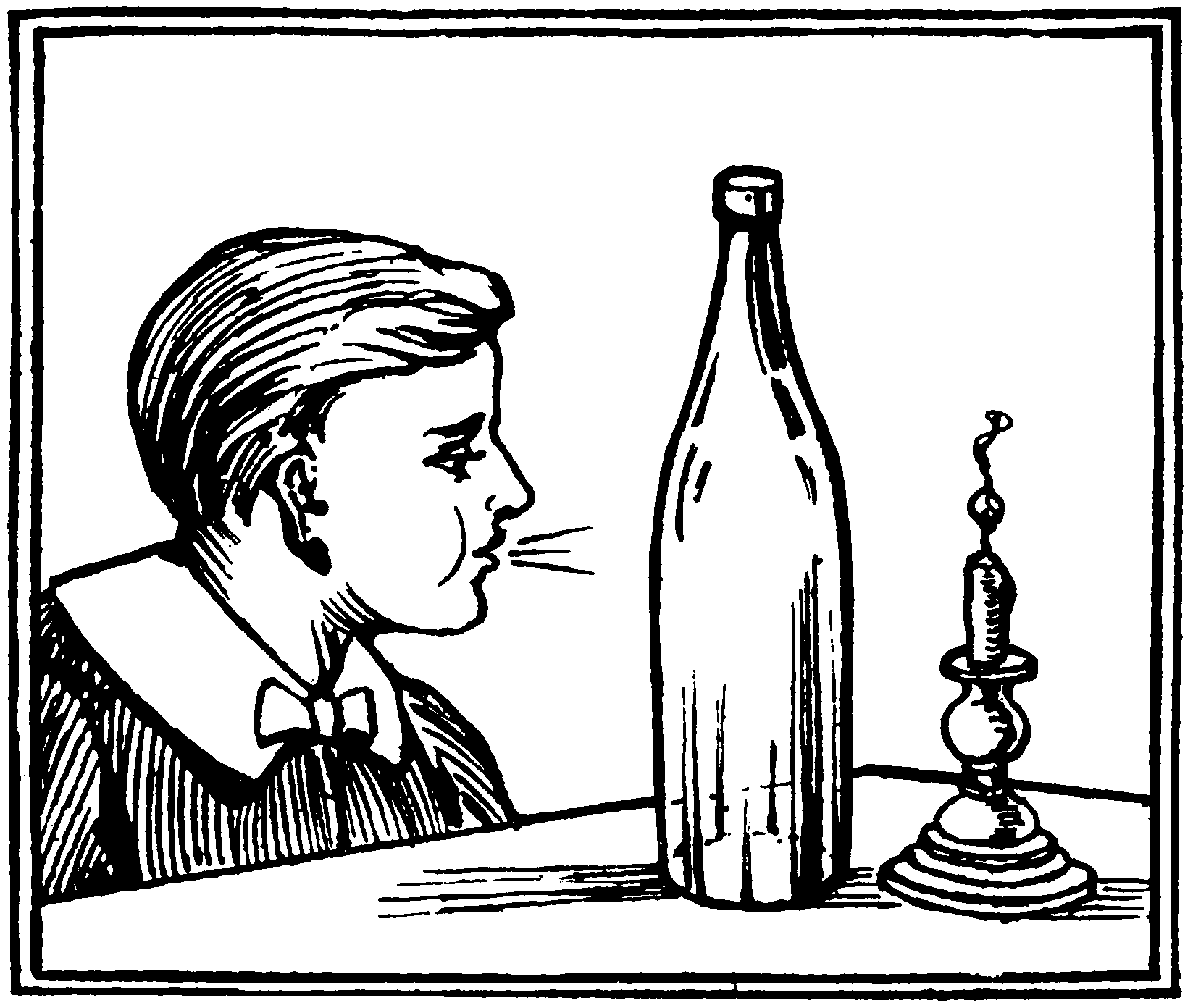
What will happen?
Solution
54
In marble walls as white as milk, Lined with a skin as soft as silk, Within a fountain crystal clear A golden apple doth appear. No doors are there to this stronghold, Yet thieves break in, and steal the gold.
Solution
No. LIX.—THE FLOATING NEEDLE
Here is a simple way to make a needle float on water:—
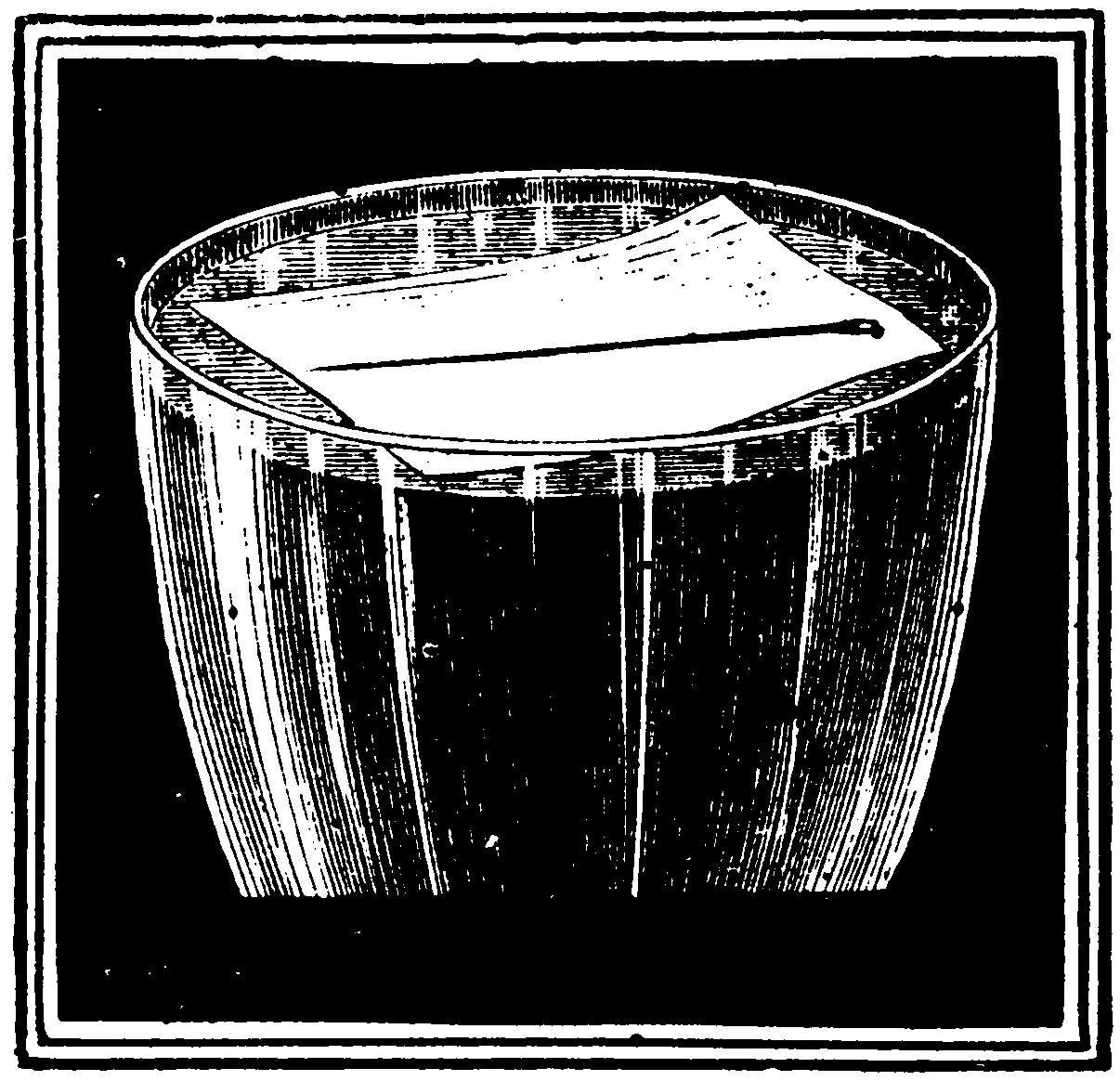
Fill a wineglass or tumbler with water, and on this lay quite flat a cigarette paper; place a needle gently on this, and presently the paper will sink, and the needle will float on the water.
55
A one-syllable adjective I, Indeterminate, misty, obscure: Reduce me by five, and then try How you like my attacks to endure. I’m now a two-syllable noun, My victims are hot and are cold; In country more rife than in town, I’m not such a pest as of old.
Solution
No. LX.—VIS INERTIÆ
Here is a pile of ten draughtsmen—one black among nine white.
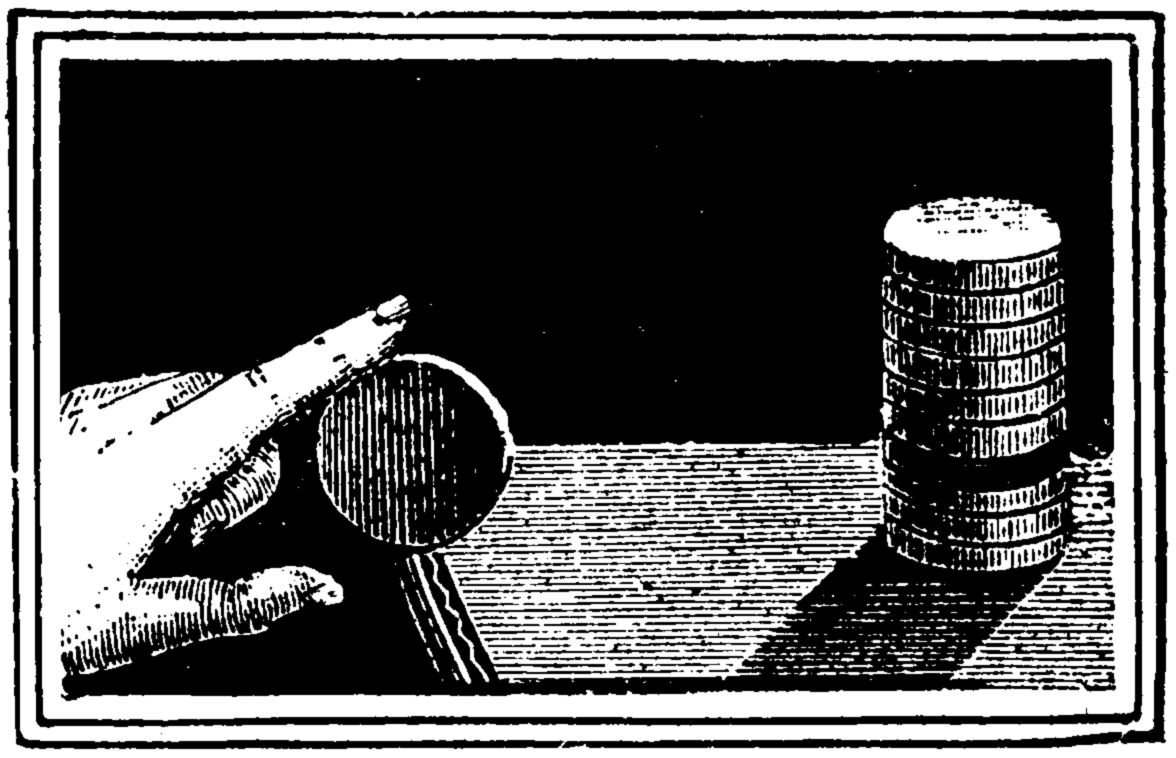
If I take another draughtsman, and with a strong pull of my finger send it spinning against the column, what will happen?
Solution
56 DR. WHEWELL’S ENIGMA
A headless man had a letter to write, He who read it had lost his sight. The dumb repeated it word for word, And deaf was the man who listened and heard.
Solution
57 AN ENIGMA FOR MOTORISTS
I am rough, I am smooth, I am wet, I am dry; My station is low, My title is high. The King my lawful master is, I’m used by all, though only his.
Solution
No. LXI.—CUT AND COME AGAIN
How long would it take to divide completely a 2 ft. block of ice by means of a piece of wire on which a weight of 5 lb. hangs?
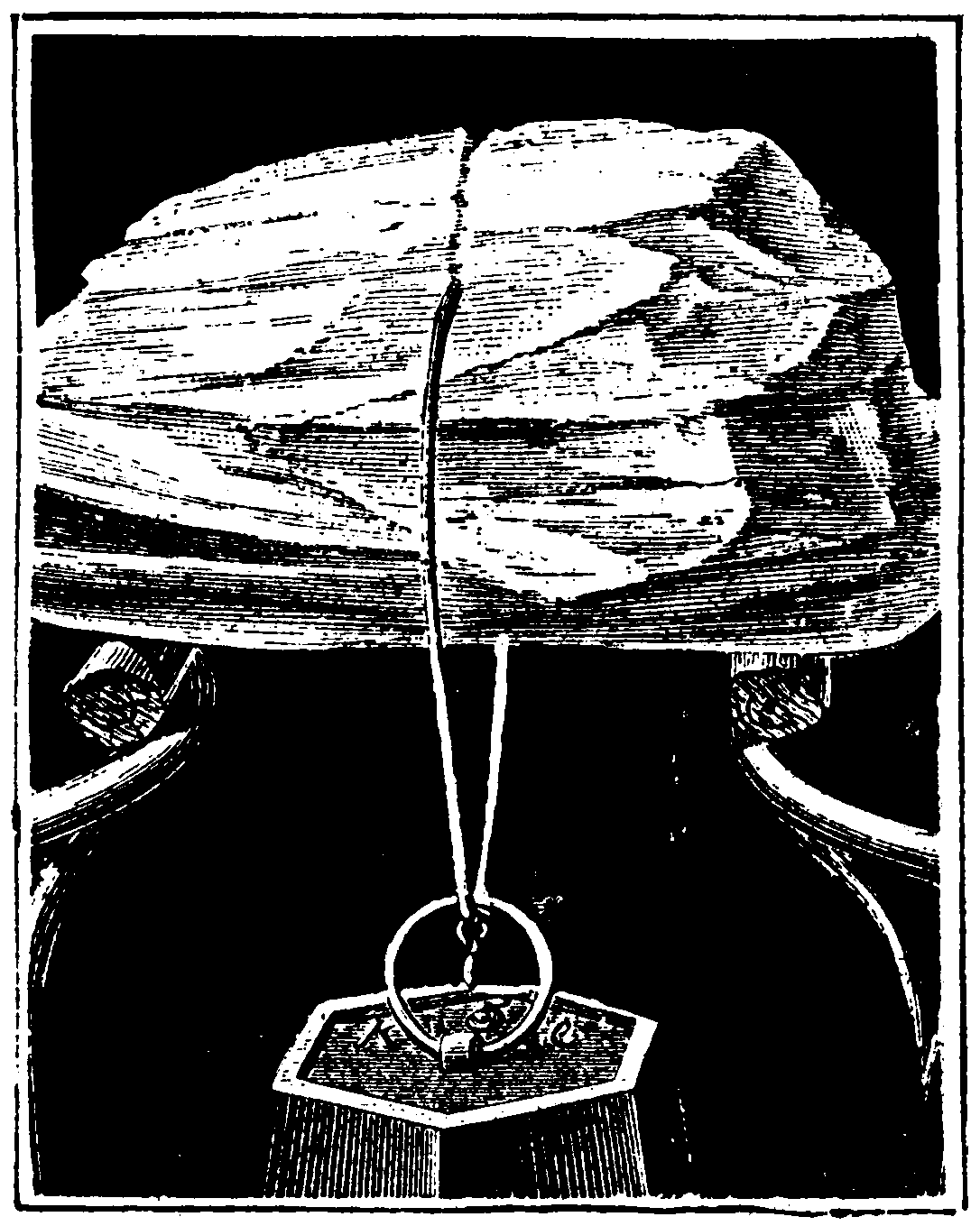
Solution
58
Without a dome, we are within a dome; Homeless and roofless, we have roof and home. Though frequent streams may flood our base and roof, We rest unharmed, and always waterproof.
Solution
59
I’m the most fearful of fates upon earth, Cut off my head and bright moments have birth, Lop off my shoulders, and riddle my riddle; Anything seems to be found in my middle.
Solution
No. LXII.—WHERE WILL IT BREAK?
When weak cords of equal strength are attached to opposite parts of a wooden or metal ball which is suspended by one of them, a sharp, sudden pull will snap the lower cord before the movement has time to affect the ball; but a gentle, steady pull will cause the upper cord to snap, as it supports the weight below it.
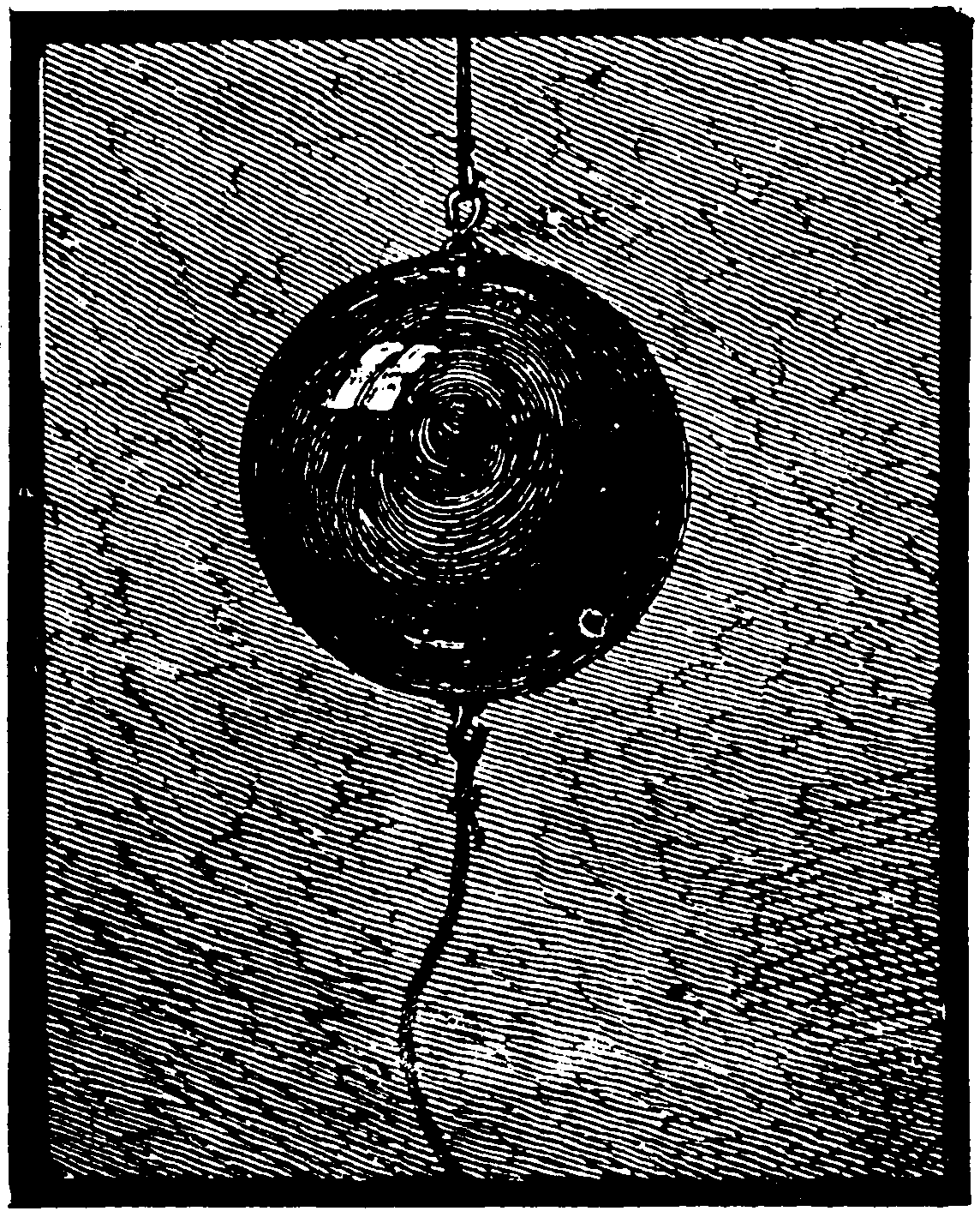
60
I may be safe when honest ways prevail, With no unworthy tricks or jobbery. Cut off my head and fix it to my tail, And I become at once rank robbery.
Solution
No. LXIII.—CATCHING THE DICE
Hold a pair of dice, and a cup for casting them, in one hand as is shown in the diagram.
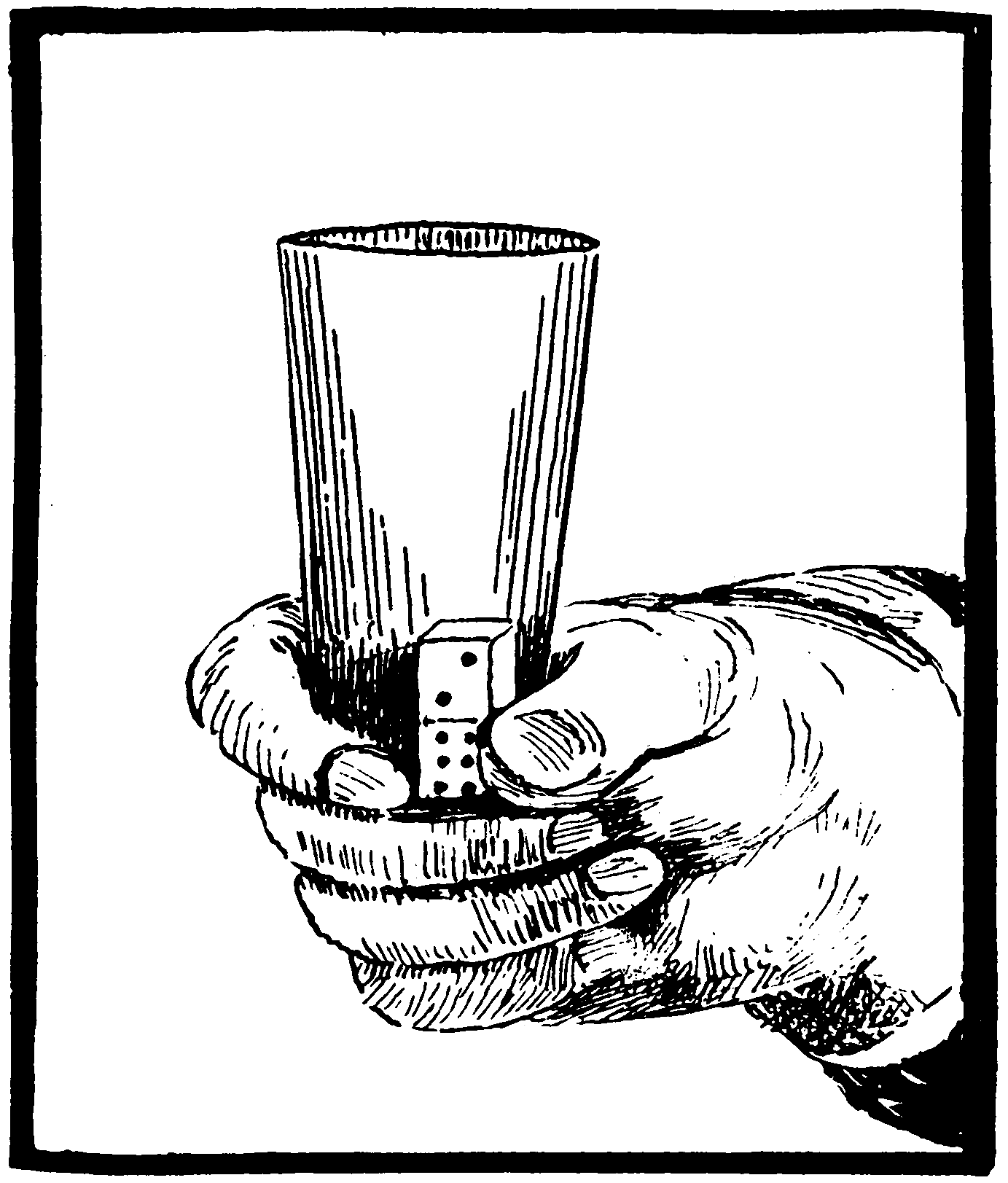
Now, holding the cup fast, throw up one of the dice and catch it in the cup. How can you best be sure of catching the other also in the cup?
Solution
61
Here is a metrical Enigma, which appeals with particular force to all married folk, and to our cousins in America:
This is of fellowship the token, Reverse it, and the bond is broken.
Solution
No. LXIV.—WILL THEY FALL?
Build up seven dominoes into a double arch, as is shown in the diagram below, and place a single domino in the position indicated.
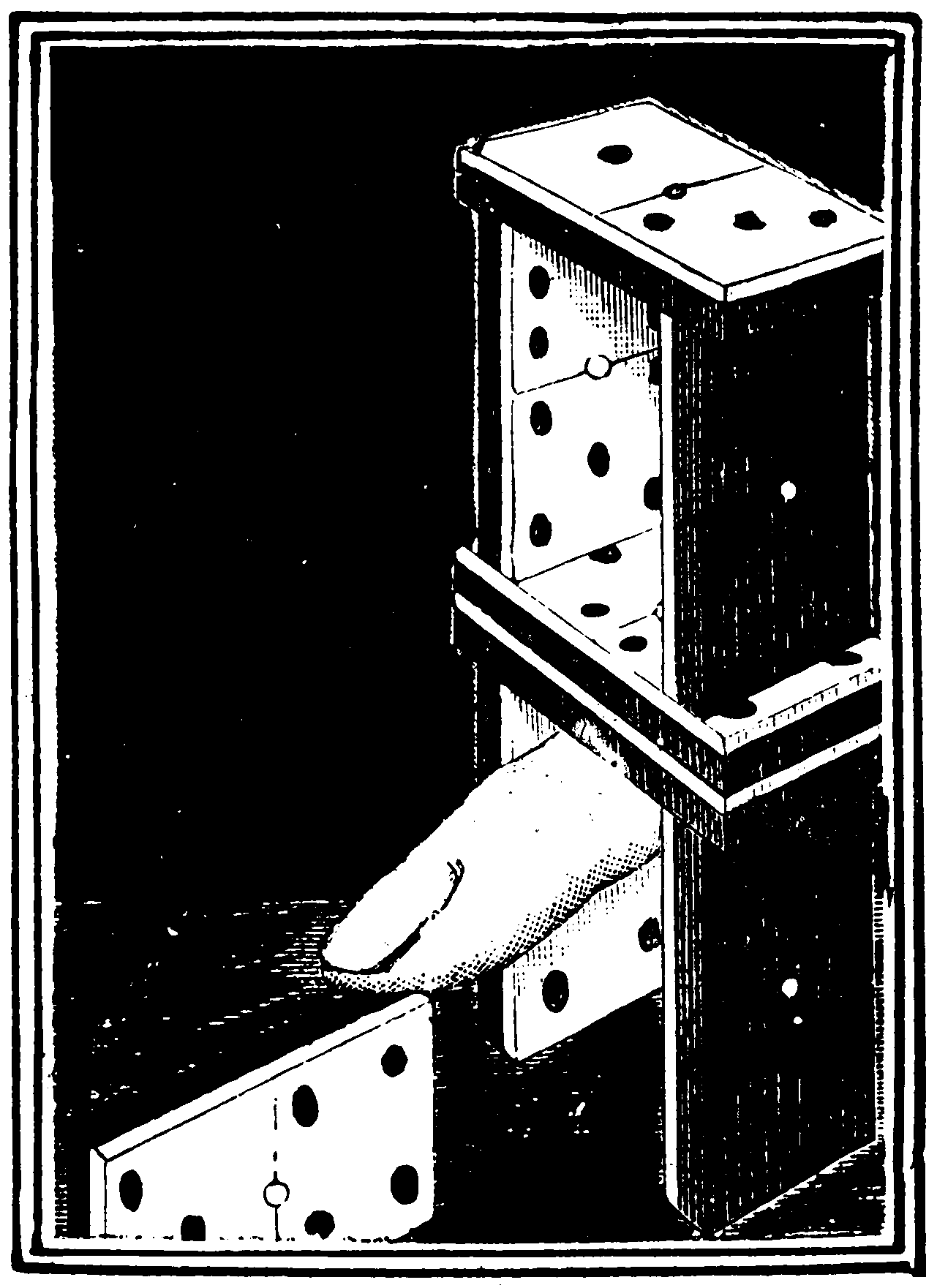
Now put the fore-finger carefully through the lower archway, and give this domino quite a smart tip up by pressing on its corner. What will happen if this is done cleverly? Try it.
Solution
62
A monk in a moment, by violence heated, Endangered the peace of his soul. To atone for my second, my first he repeated Just ten times a day on my whole.
Solution
No. LXV.—A TRANSPOSITION
Place three pennies in contact in a line as is shown below, so that a “head” is between two “tails.”
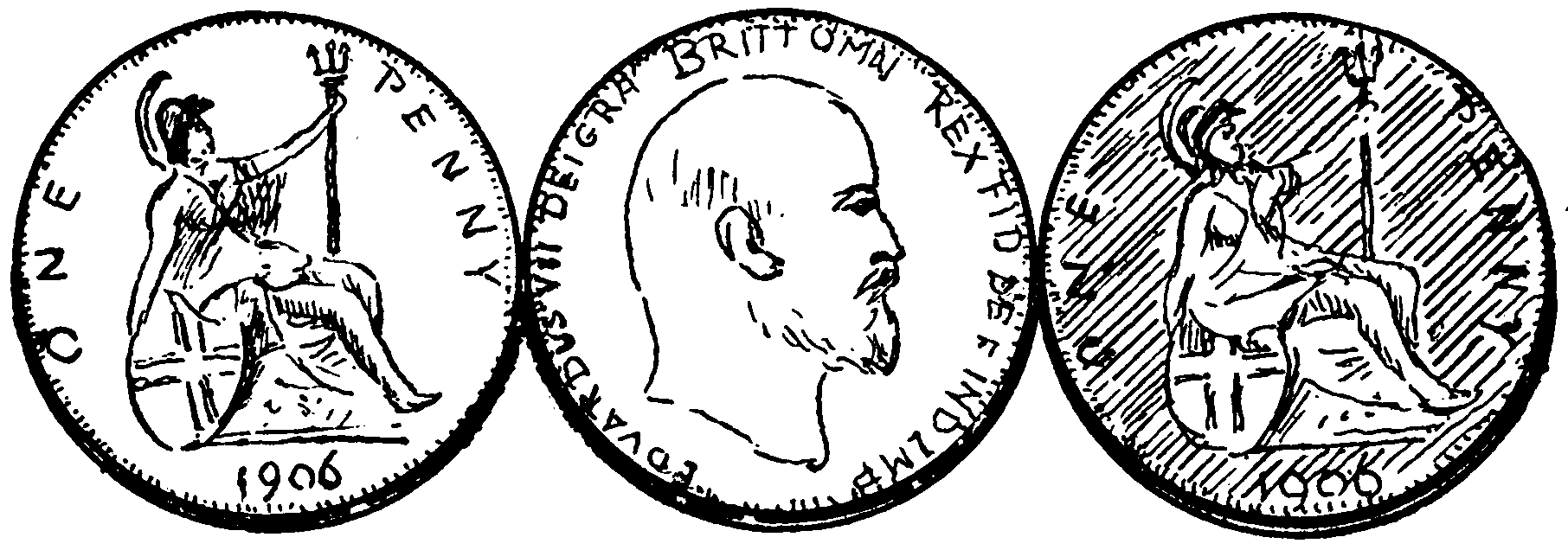
Can you introduce the coin with a shaded surface between the other two in a straight line, without touching one of these two, and without moving the other?
Solution
63
Two syllables this word contains: Reverse them and then what remains? With cap and pipe and goggles too The comics hold him up to view, Reverse his parts you would declare A dog should not be quartered there.
Solution
64
Though I myself shut up may be, My work is to set prisoners free. No slave his lord’s commands obeys With more insinuating ways. All find me handy, sharp, and bright, Where men in wit and wine delight; While many keep me for their ease, And turn and twist me as they please.
Solution
No. LXVI.—COIN COUNTING
Place ten coins in a circle, as is shown in this diagram, so that on all of them the king’s head is uppermost.
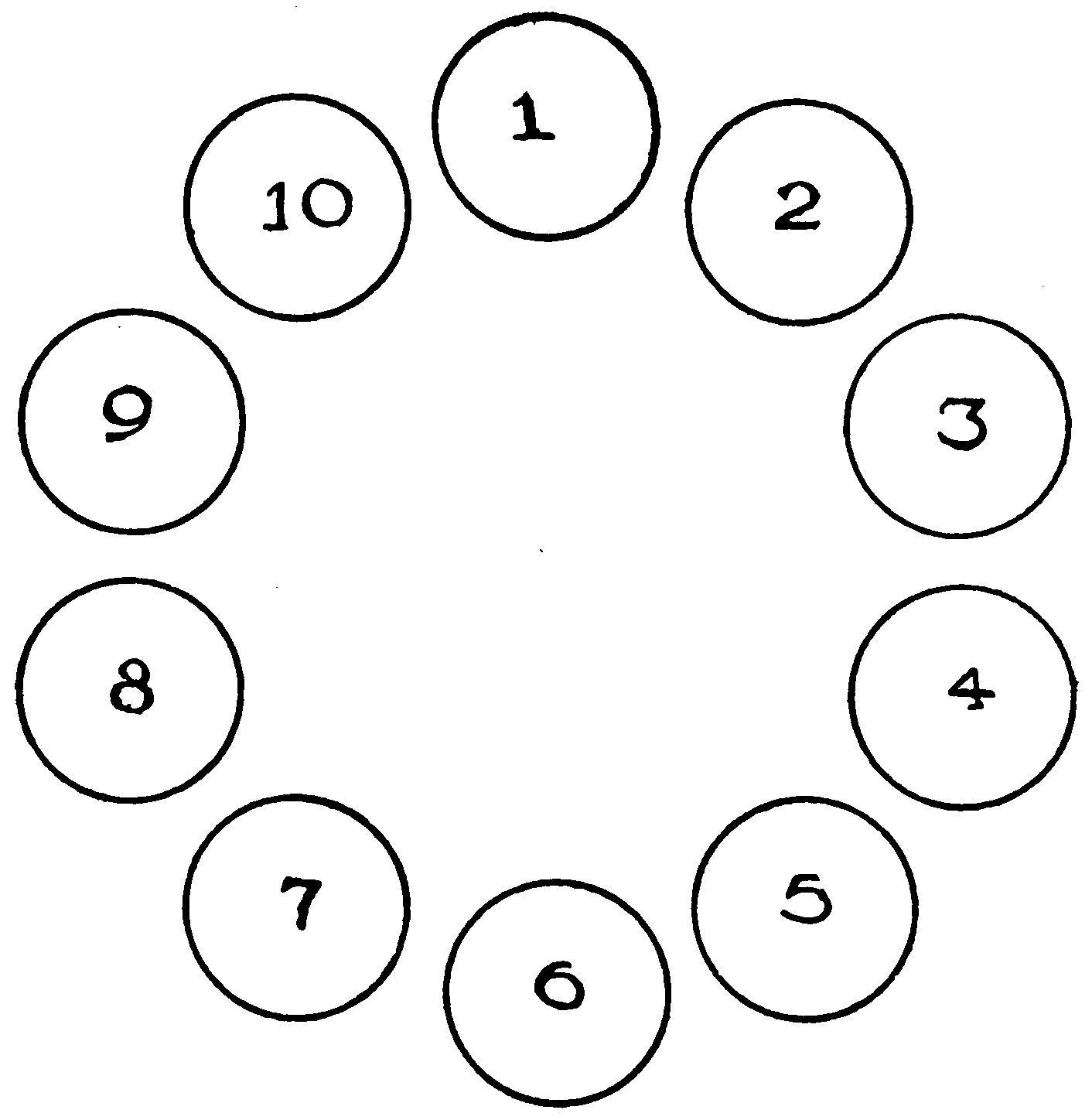
Now start from any coin you choose, calling it 1, the next 2, and so on, and turn the fourth, so that the tail is uppermost. Start again on any king’s head, and again turn the fourth, and continue to do this until all but one are turned.
Coins already turned are reckoned in the counting, but the count of “four” must fall on an unturned coin.
Can you find a plan for turning all the coins but one in this way without ever failing to count four upon a fresh spot, and to start on an unturned coin?
Solution
No. LXVII.—THE BALANCED CORK
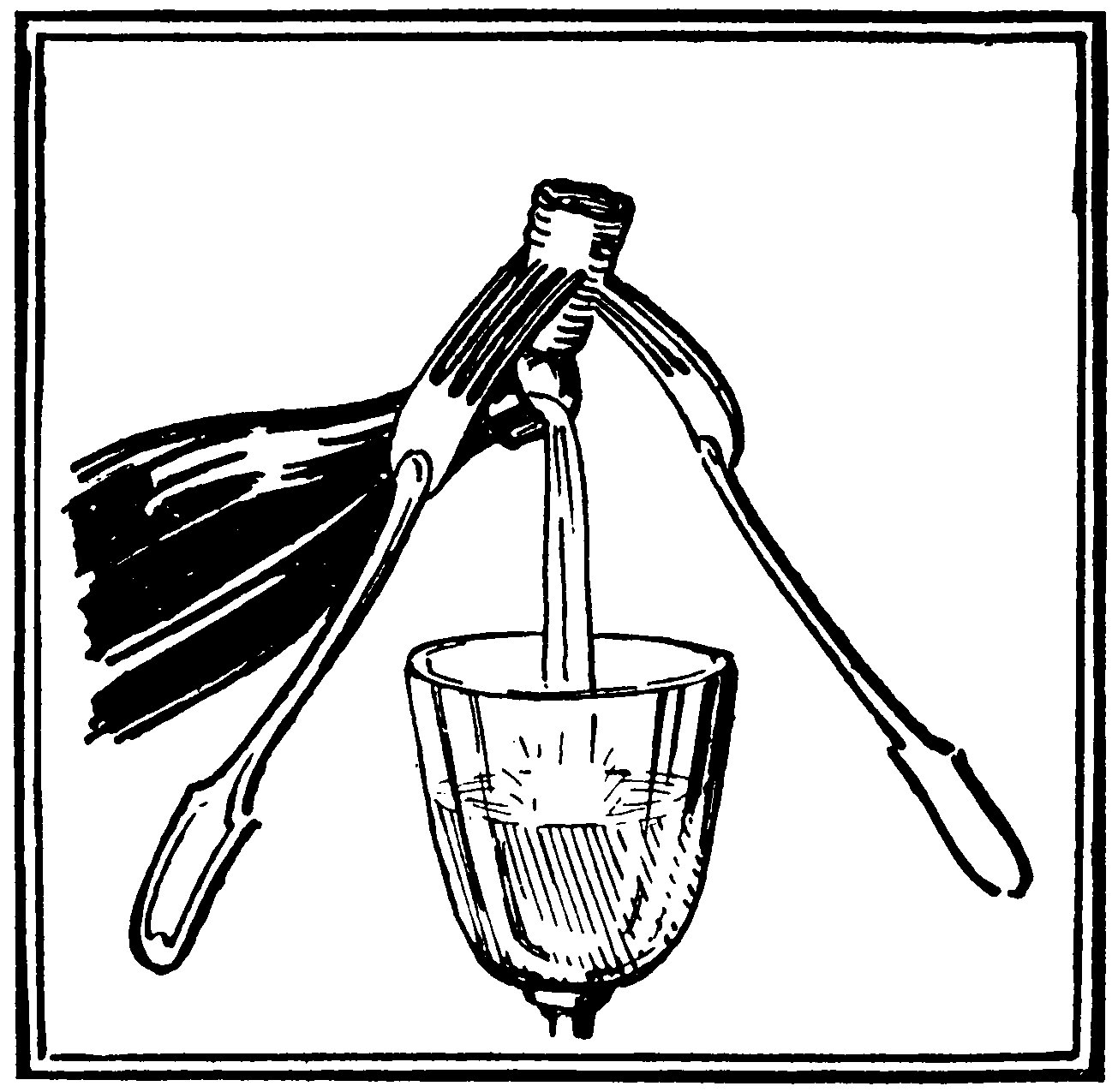
The diagram below shows how, using one hand only, and grasping a bottle of wine by its body, the contents can be poured out without cutting or boring the cork, or altogether removing it from the bottle.
65
Transformed by art, and fond of port, I blister in the sun; But when I turn, and face the sport, Away full tilt I run; For if I double I am caught, And that can be no fun.
Solution
66
A man without eyes saw plums on a tree, He neither took plums nor plums left he.
Solution
No. LXVIII.—NUTS TO CRACK
A sharply-pointed knife with a heavy handle is stuck very lightly into the lintel of a door, and the nut that is to be cracked is placed under it, so that when the knife is released by a touch the nut is cracked.
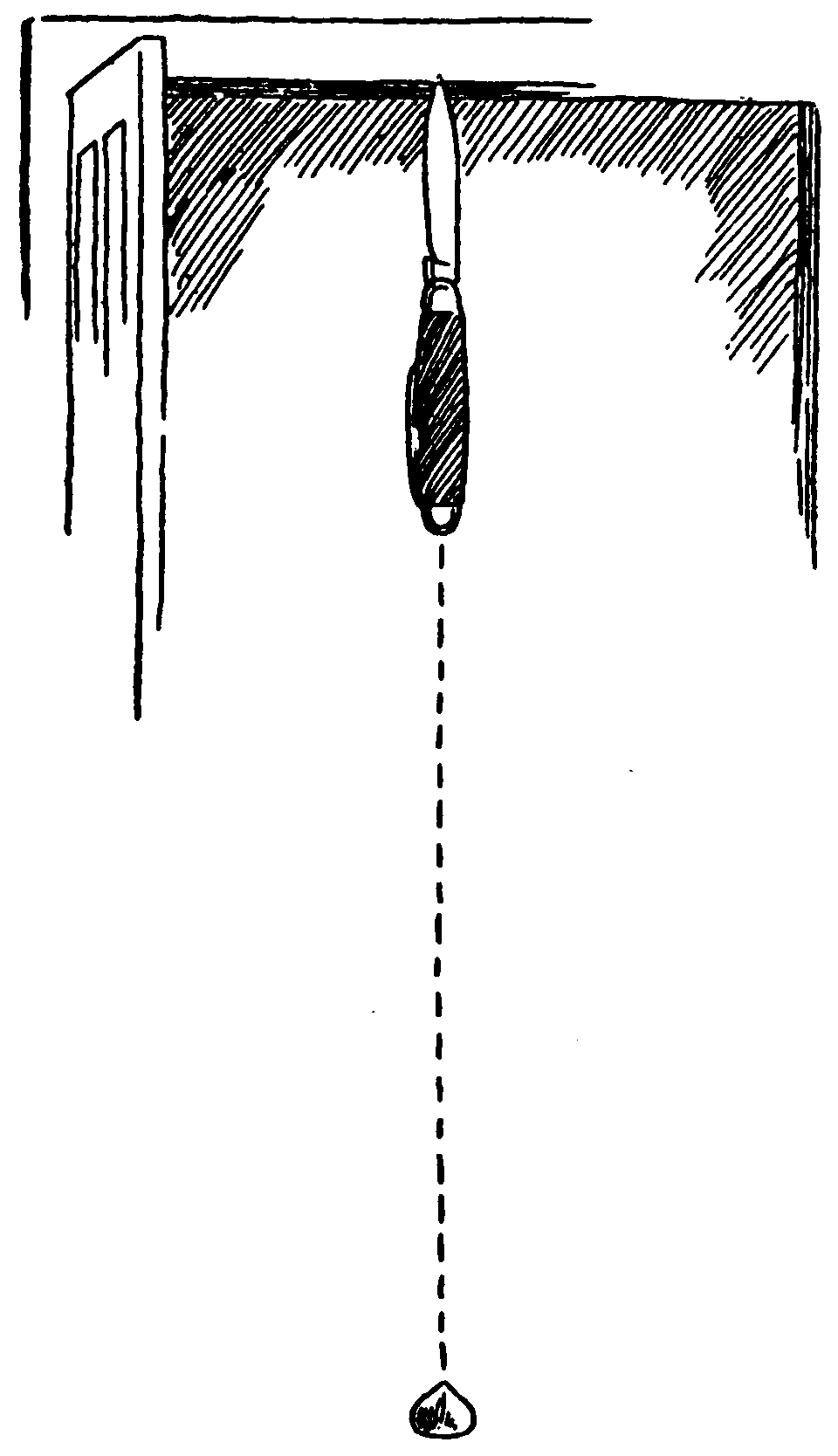
What simple and certain plan can you suggest for making sure that the knife shall hit the nut exactly in the middle without fail?
Solution
67 A SINGULAR ENIGMA
Strange paradox! though my two halves are gone, I still remain an undivided whole. But were I double what I am, though one, I then should be but half, upon my soul!
Solution
No. LXIX.—THE FLOATING CORKS
If we throw an ordinary wine cork into a tub of water it will naturally float on its side. It is, however, possible to arrange a group of seven such corks, without fastening them in any way, so that they will float in upright positions.
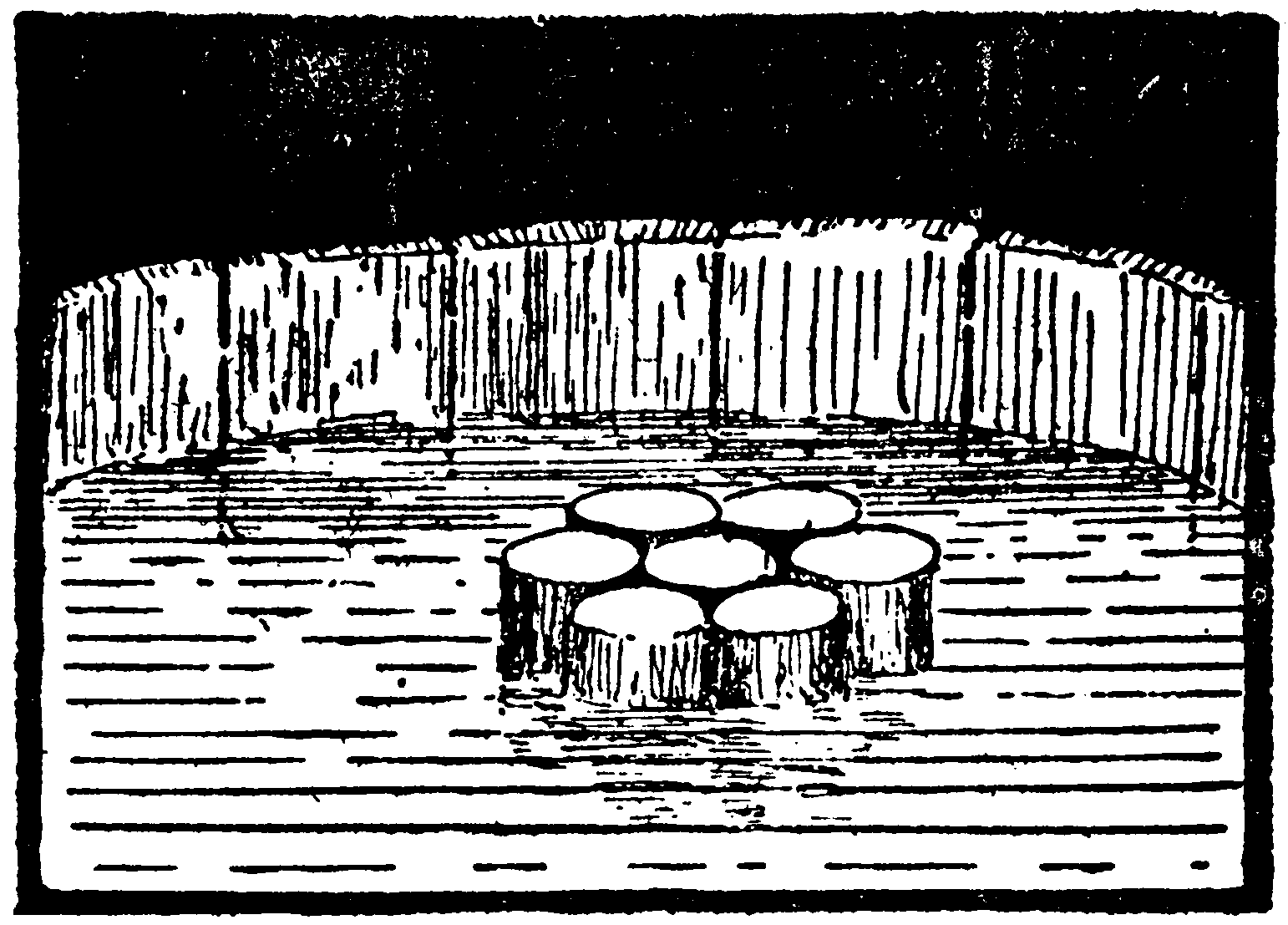
Place them together, as is shown in the illustration, and, holding them firmly, dip them under the water till they are well wetted. Then, keeping them exactly upright, leave go quietly, and they will float in a compact bunch if they are brought slowly to the surface.
68 A PARADOX
I start with five thousand, and take nothing off, Yet really in doing so nine-tenths I doff; And it proves with no strain upon numbers or reason, That the smaller are larger in size and in season.
Solution
No. LXX.—A LIGHT, STEADY HAND
As an exercise of patience and dexterity, try to balance a set of dominoes upon one that stands upon its narrow end:—
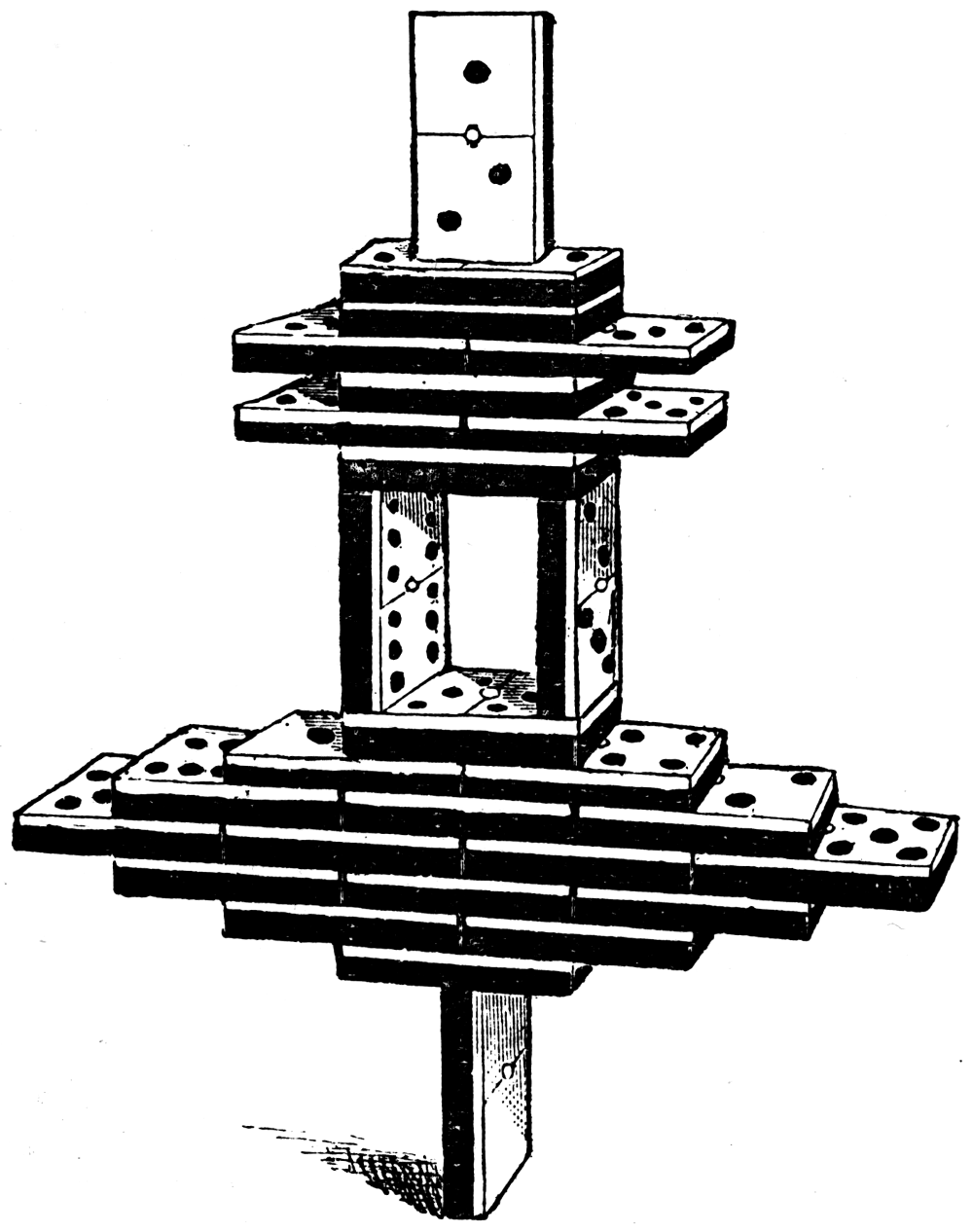
This is no easy matter, but a little patience will enable us to arrange the stones in layers, which can with care be lifted into place and balanced there.
69
With letters three indite my name, Add one to show what I became, Or try to tell what brought me fame.
Solution
No. LXXI.—WHAT IS THIS?
We expect to puzzle our readers completely by this diagram:—
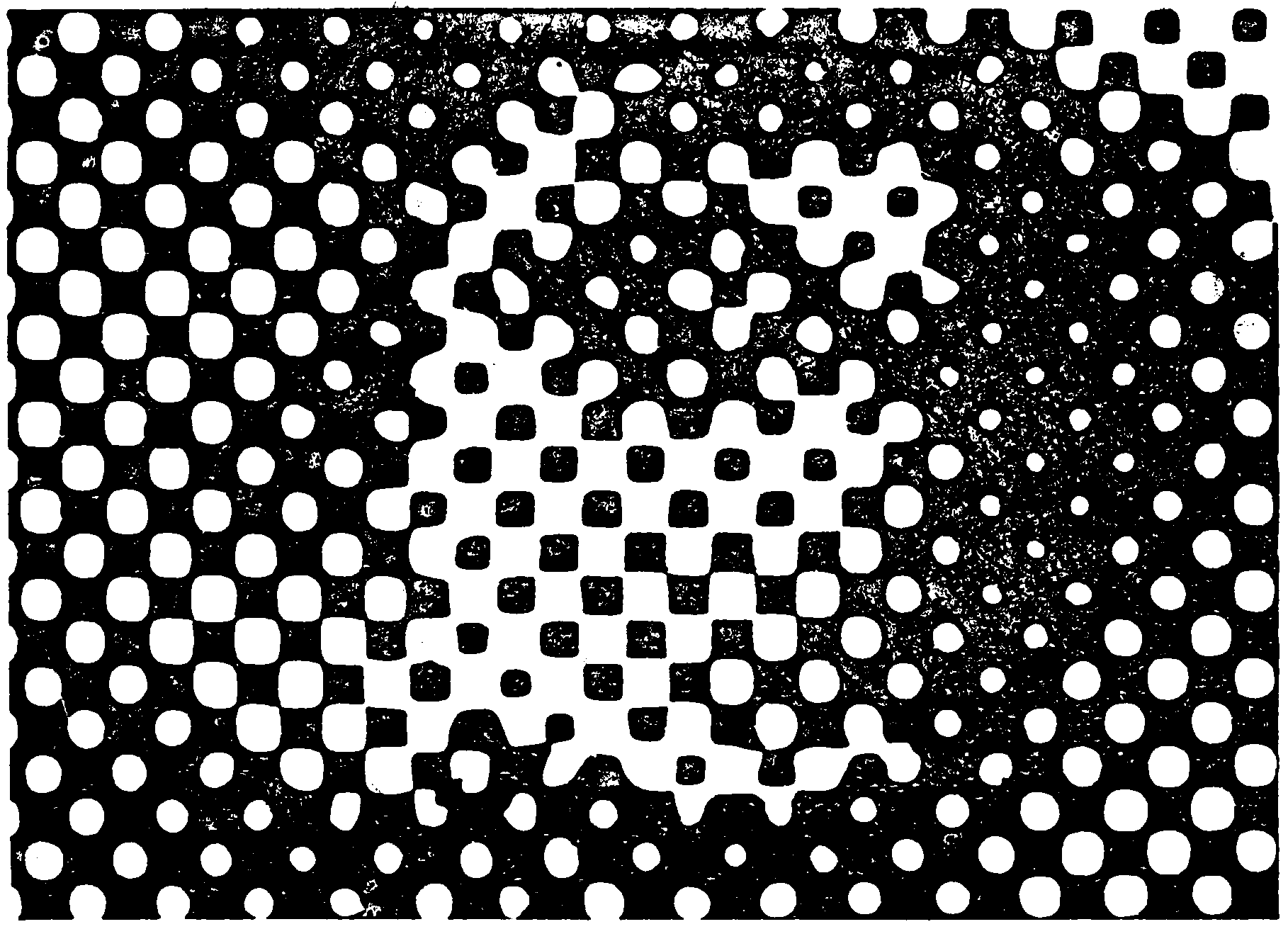
It is simply the enlargement by photography of part of a familiar picture.
Solution
70
Eight letters respond to the quest Of all for enjoyment athirst; Two articles lead to the rest, And the last of the rest is the first.
Solution
71
When letters five compose my name I’m seldom seen but in a flame. Take off one letter, then you see That winter is the time for me. Another take, and I appear What many must be year by year.
Solution
No. LXXII.—TAKING THE GROUND FROM UNDER IT
Place a strip of smooth paper on a table so that it overhangs the side, as is shown in the diagram. Stand a new penny steadily on edge upon the paper.
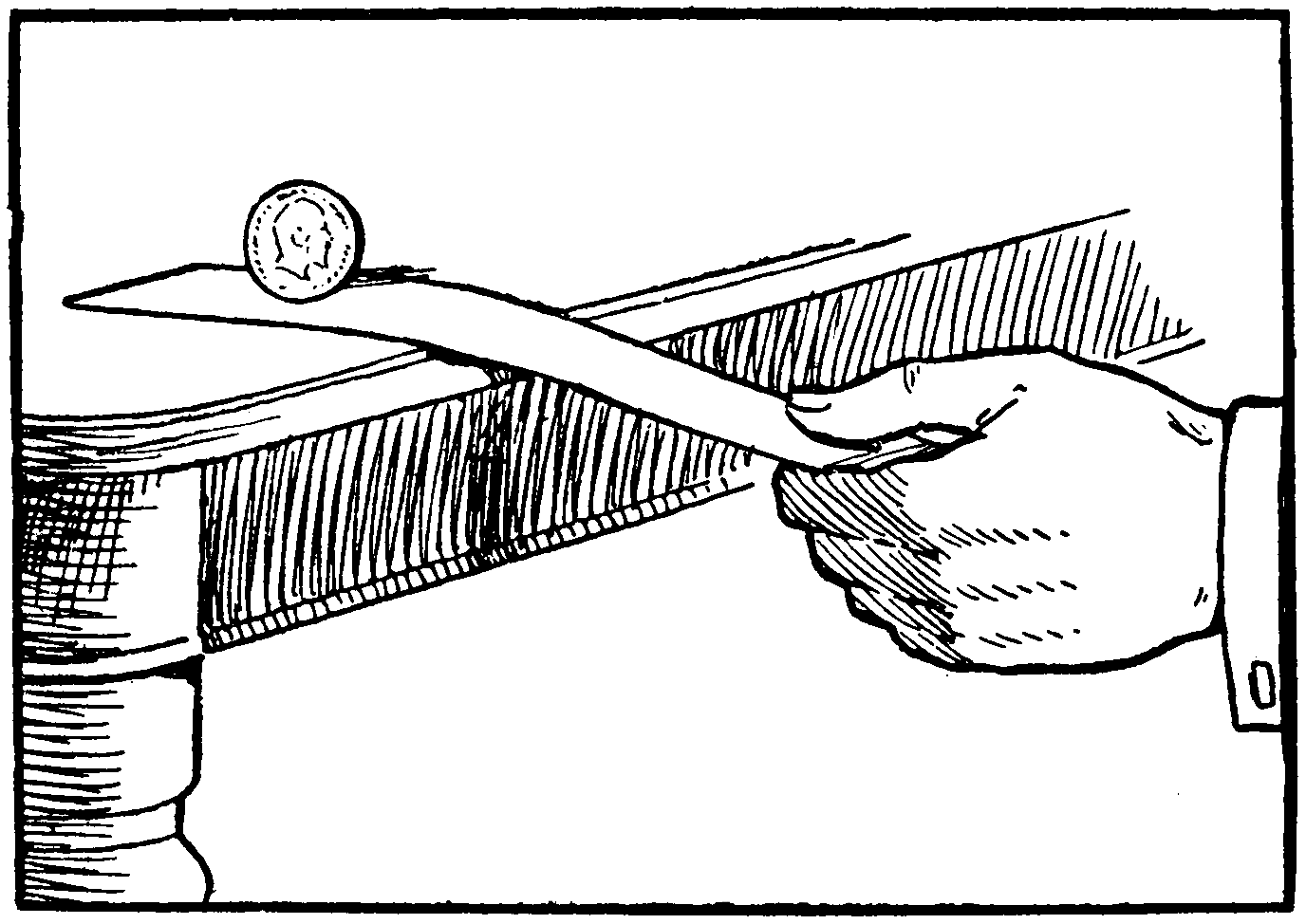
Take hold of the paper firmly, and give it a smart, steady pull. If this is properly done it will leave the penny standing unmoved in its place.
72
A shining wit pronounced of late That water in a freezing state Is like an acting magistrate. What was the quibble in his pate?
Solution
73
By something formed I nothing am, Yet anything that you can name. In all things false, yet ever true, And still the same but never new; Like thought I’m in a moment gone, Nor can I ever be alone.
Solution
No. LXXIII.—A READY RECKONER
Two men, standing on the bank of a broad stream, across which they could not cast their fishing lines, could not agree as to its width. A bet on the point was offered and accepted, and the question was presently decided for them by an ingenious friend who came along, without any particular appliances for measurement.
He stood on the edge of the bank, steadied his chin with one hand, and with the other tilted his cap till its peak just cut the top of the opposite bank.
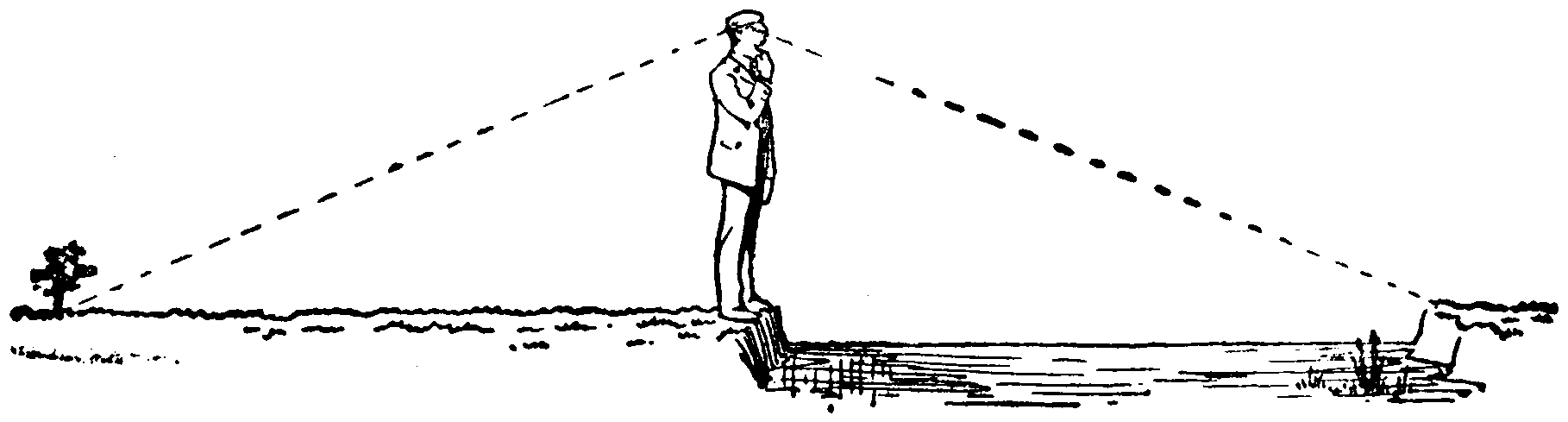
Then, turning round, he stood exactly where the peak cut the level ground behind him, and, by stepping to that spot, was able to measure a distance equal to the width of the stream.
74
When you and I together meet, Then there are six to see and greet. If I and you should meet once more, Our company would be but four. And when you leave me all alone I am a solitary one.
Solution
No. LXXIV.—THE CLIMBING HOOP
Paste or pin together the ends of a long strip of stiff paper so as to form a hoop, and place on the table a board resting at one end upon a book. Challenge those in your company to make the hoop run up the board without any impulse.
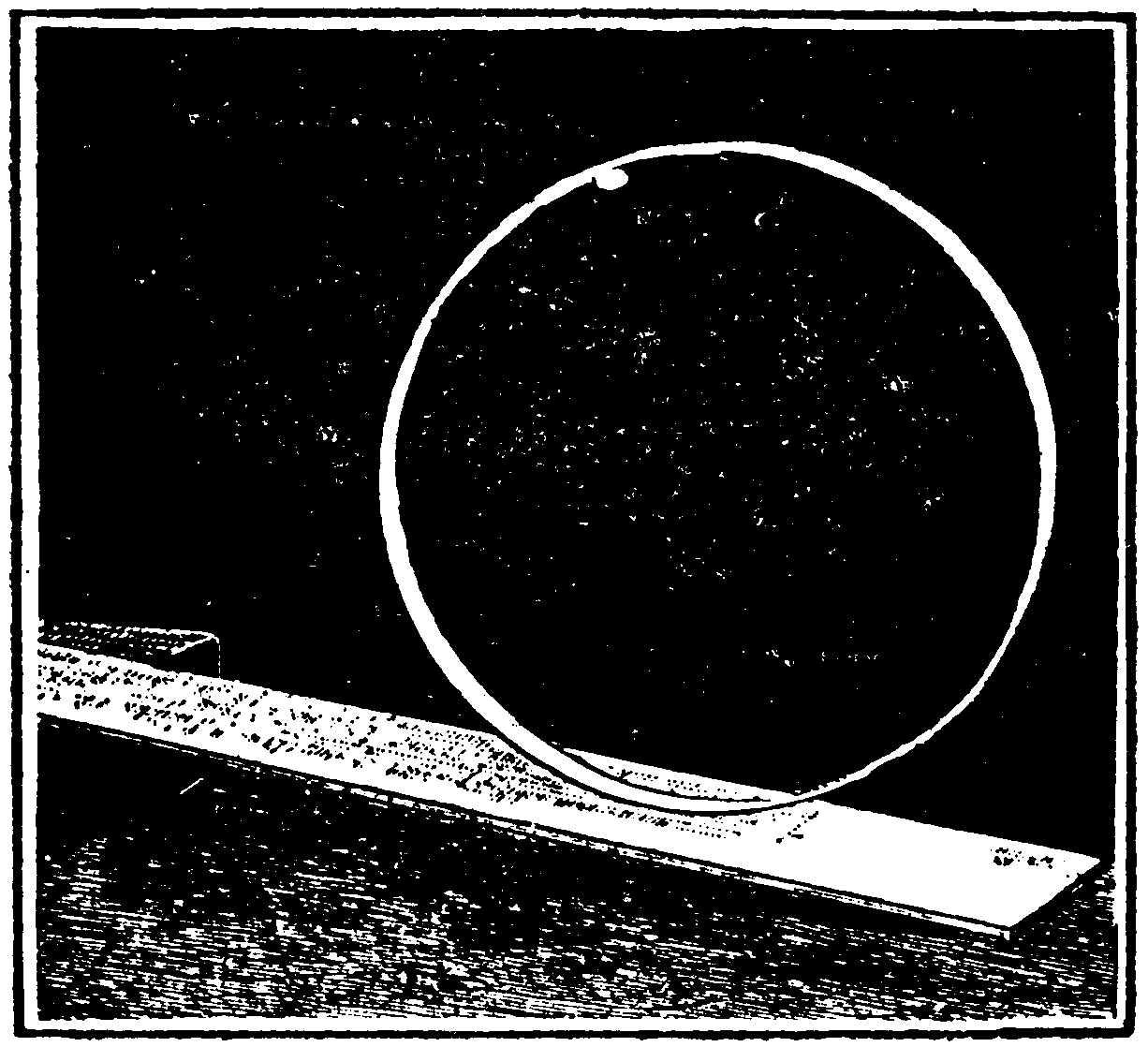
They must of course fail, but you can succeed by secretly fastening with beeswax a small stone or piece of metal inside the hoop, as is indicated in the diagram.
75
Invisible yet never out of sight, I am indeed a centre of delight. In quiet times I help to make things right, Yet act as second in the fiercest fight.
Solution
No. LXXV.—THE SEAL OF MAHOMET
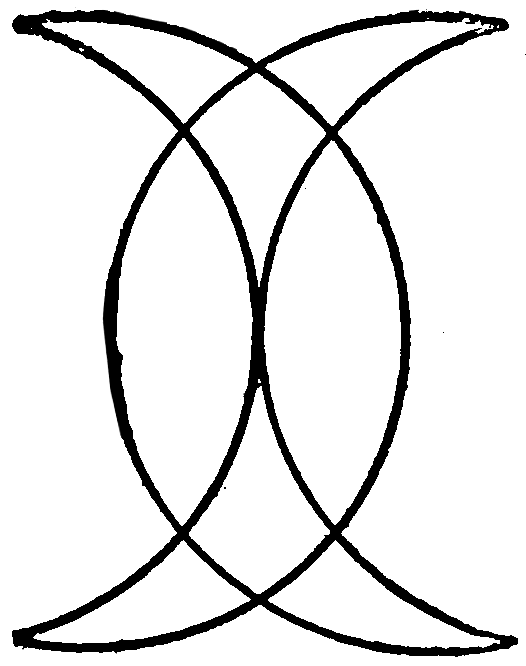
This double crescent, called the Seal of Mahomet, from a legend that the prophet was wont to describe it on the ground with one stroke of his scimitar, is to be made by one continuous stroke of pen or pencil, without going twice over any part of it.
Solution
76
Though I mingle with thieves, And with all that deceives, And never keep clear of depravity Though possessed by a devil, Or seen in a revel, I do keep my centre of gravity.
Solution
77
There’s not a bird that cleaves the sky With crest or plume more gay than I, Yet guess me by this token: That I am never seen to fly Unless my wings are broken.
Solution
No. LXXVI.—MOVE THE MATCHES
Arrange 15 matches thus—
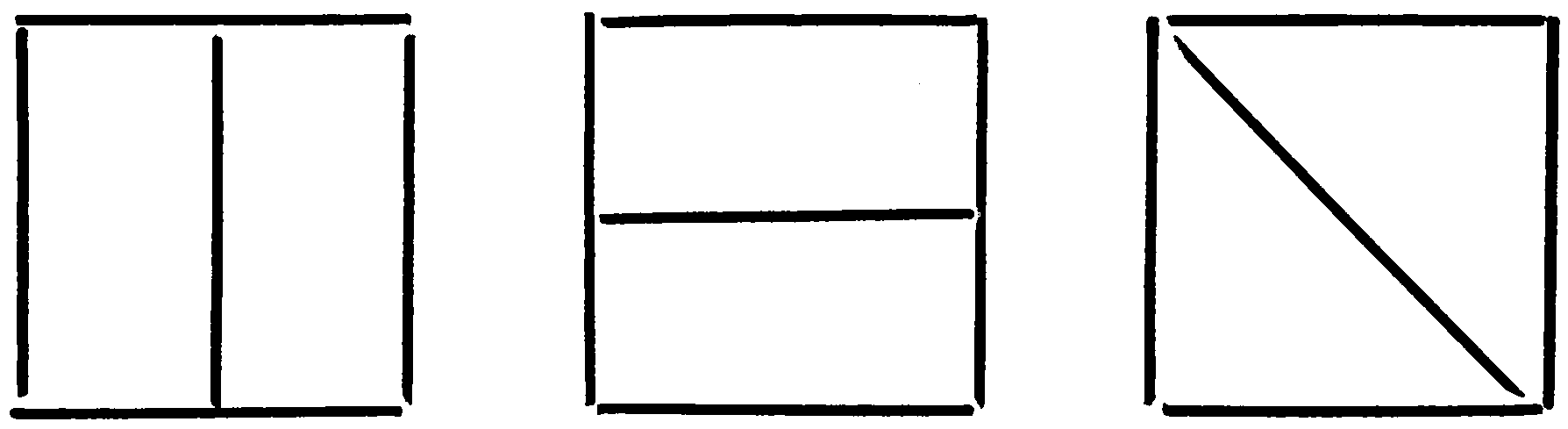
Remove 6 and what number will be left?
Solution
78
Split into three and mixed, With Dives I am found. Split into two and fixed On four legs, flat or round. In my most kindly sense unbroken, Warm hearts and helpers I betoken.
Solution
79
I am high, I am low, I am thick, I am thin, I can keep out the snow, But may let the rain in.
Solution
80 HIDDEN FRUIT
Go range through every clime, where’er The patriot muse appears He deeds of valour antedates, His ban an army fears. By midnight lamp each poet soul Is plumed for flight sublime; Pale monarch moon and shining stars Witness his glowing rhyme! Incited by the muse man goes To grapple with his wrongs; The poet cares not who makes laws, If he may make the songs.
Can you discover ten fruits in these lines?
Solution
No. LXXVII.—LINES ON AN OLD SAMPLER
When I can plant with seventeen trees Twice fourteen rows, in each row three; A friend of mine I then shall please, Who says he’ll give them all to me.
Solution
81
The last of you before the end Close to an inn we first must find, If nothing follows all will tend To hints that rankle in the mind.
Solution
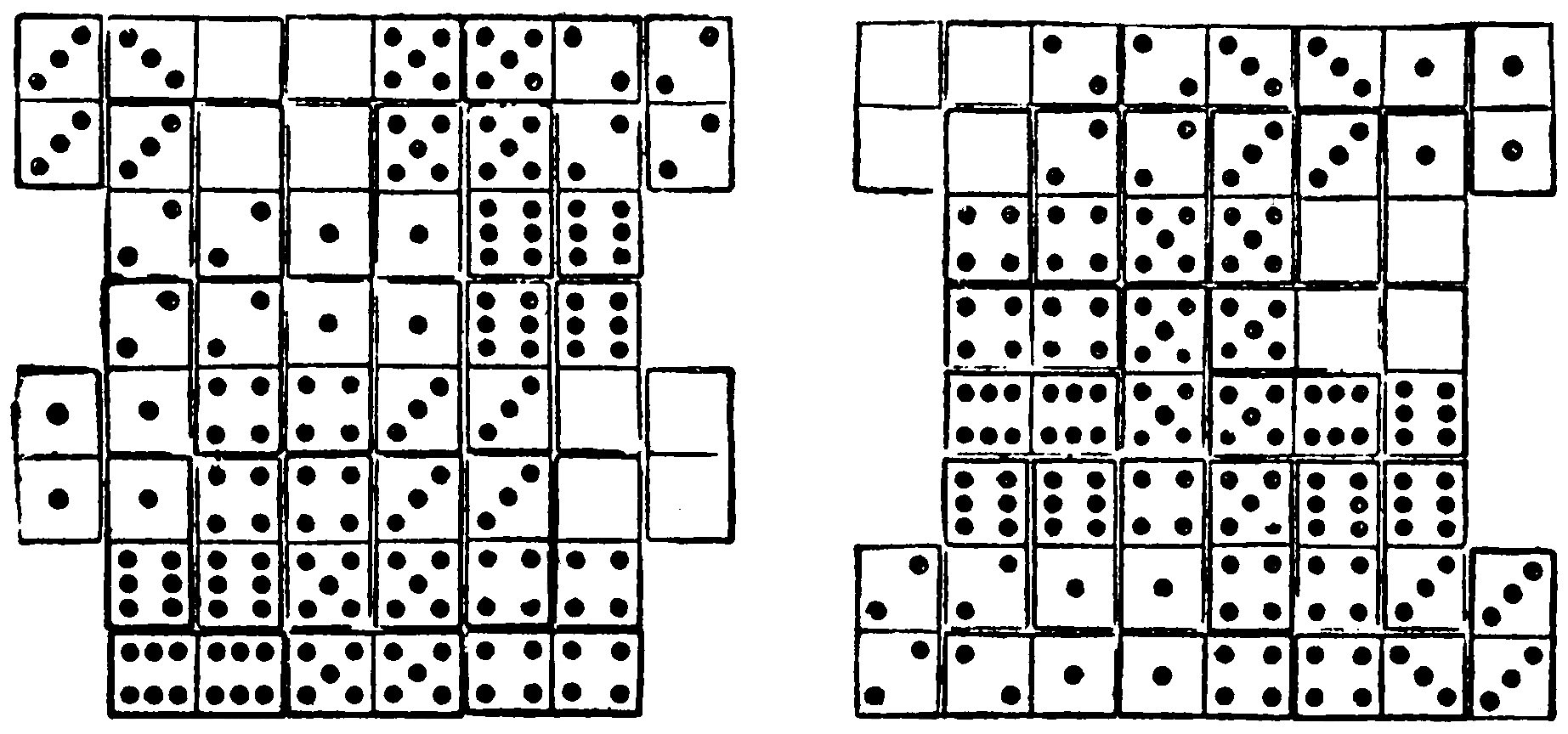
No. LXXVIII.—DOMINO DUPLICITY
By the following ingenious arrangement of the stones a set of dominoes appears to be unduly rich in doublets:—
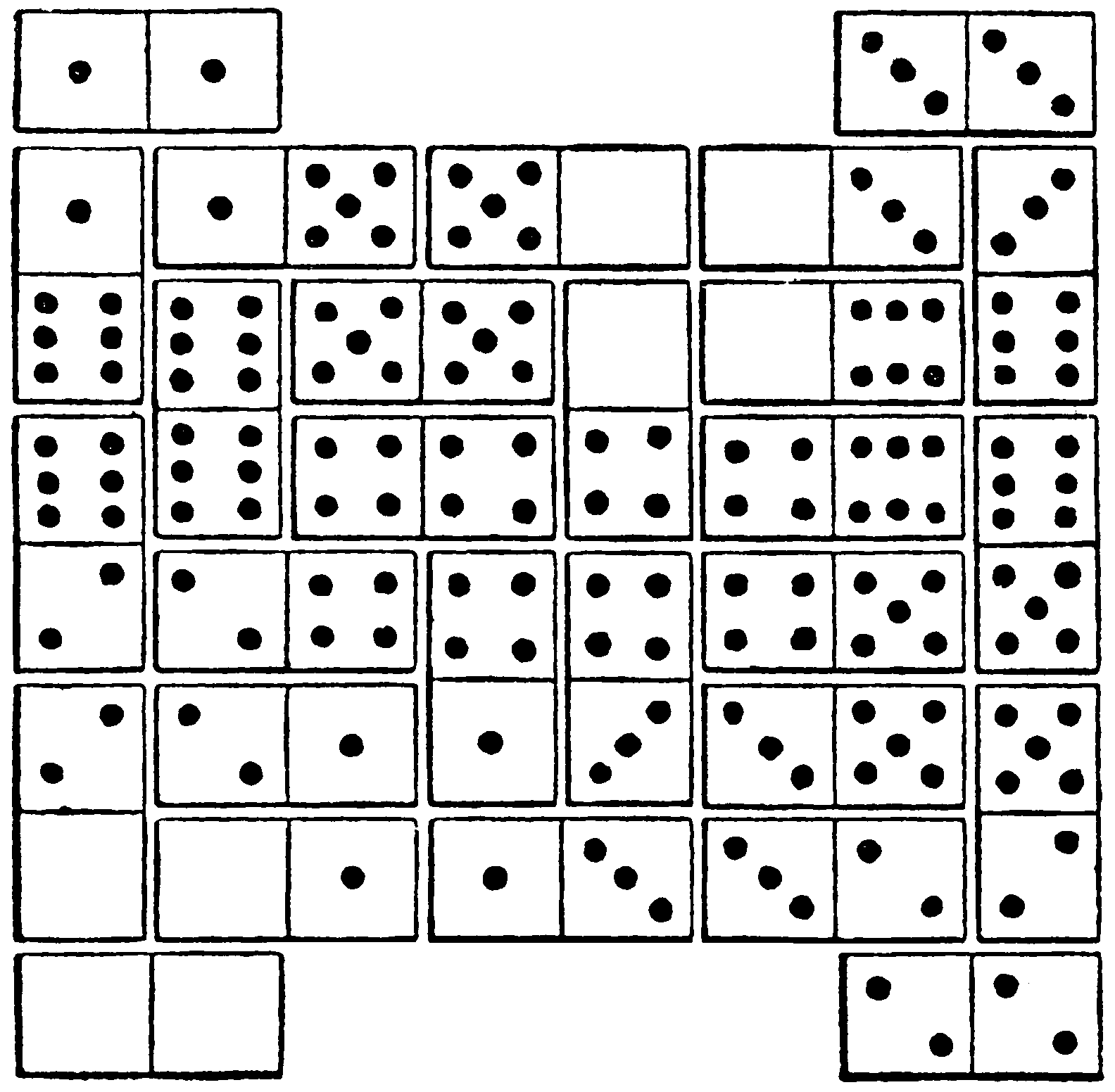
It will be noticed that the charm of this arrangement is that the whole figure contains a double set of quartettes, on which the pips are similar.
82
Many men of many minds, Many birds of many kinds, Some are dun, and some are gray— Which is this one? tell me, pray! See him where the water shines, But not perching on the pines.
Solution
No. LXXIX.—MORE DOMINO DUPLICITY
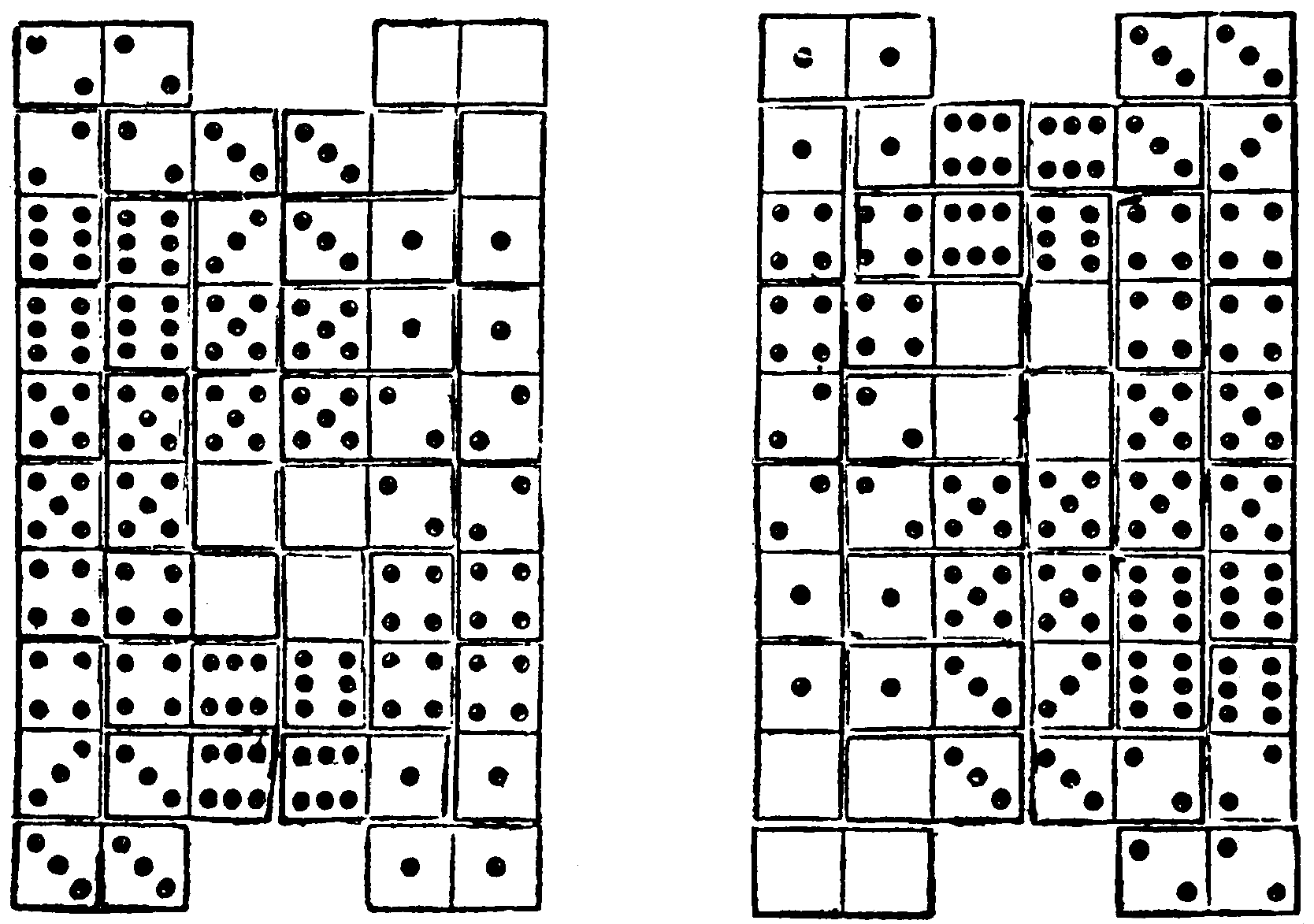
This again shows how the stones can be placed so that an ordinary set of dominoes seems to be unduly rich in doublets.
83
We know how, by the addition of a single letter, our cares can be softened into a caress; but in the following Enigma a still more contradictory result follows, without the addition or alteration of a letter, by a mere separation of syllables:—
None can locate the subject of my riddle. For all the world would seek its place in vain; Cut it asunder almost in the middle, And in our very midst its place is plain. An aching void, an absolute negation, Into the opposite extreme it breaks; With just a gap to mark their new relation Each letter still the same position takes.
Solution
No. LXXX.—TWO MORE PATTERNS
Here are two more perfect arrangements of a set of dominoes in quartettes, so that the pips and blanks are similarly grouped and repeated:—
CHARADES
1 SIR WALTER SCOTT’S CHARADE
Sir Hilary fought at Agincourt, Sooth! ’twas an awful day And though in olden days of sport The rufflers of the camp and court Had little time to pray, ’Tis said Sir Hilary muttered there Two syllables by way of prayer. “My first to all the brave and proud Who see to-morrow’s sun; My next with her cold and quiet cloud To those who find a dewy shroud Before the day is won. And both together to all bright eyes That weep when a warrior nobly dies!”
Solution
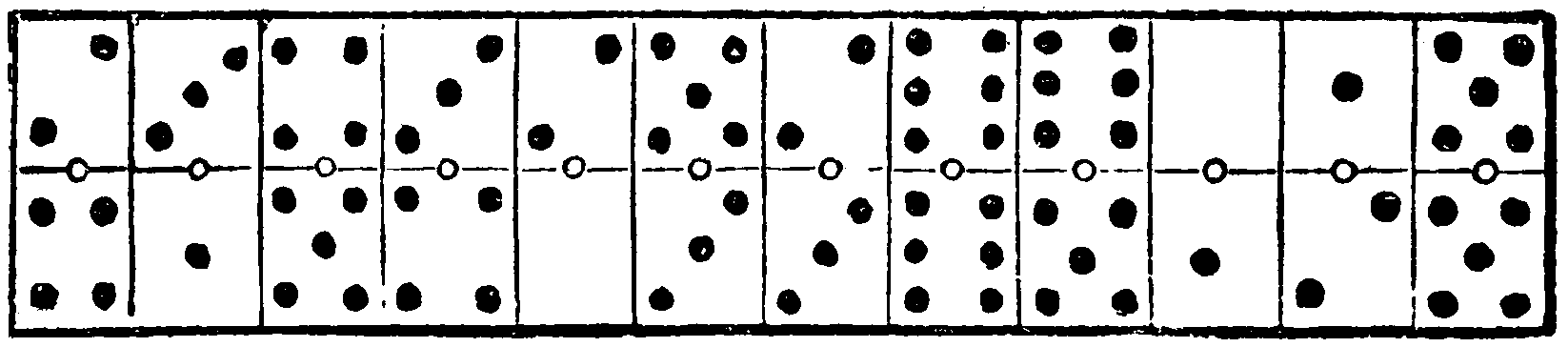
No. LXXXI.—COUNTING THEM OUT
Arrange twelve dominoes as is shown in this diagram, and start counting in French from the double five, thus u, n, un; remove the stone you thus reach, which has one pip upon it, and start afresh with the next stone, d, e, u, x, deux; this brings you to the stone with two pips; then t, r, o, i, s, trois, brings you to that with three, and so on until douze brings you to twelve.
Always remove the stone as you hit upon each consecutive number.
Now who can re-arrange these same stones so that a similar result works out in English, thus—o, n, e, one (remove the stone), t, w, o, two, and so on throughout?
Solution
2 A FAMILY CHARADE
A man with fourscore winters white Sat dozing in his chair; His frosted brow was quite my first, Crowned with its silver hair. My whole, when playing at his feet, Sly glances upward stole; My second, standing at his side, Was father of my whole.
Solution
No. LXXXII.—TRICKS WITH DOMINOES
In this diagram the word EACH is formed by the use of a complete set of stones, placing every letter in proper domino sequence.
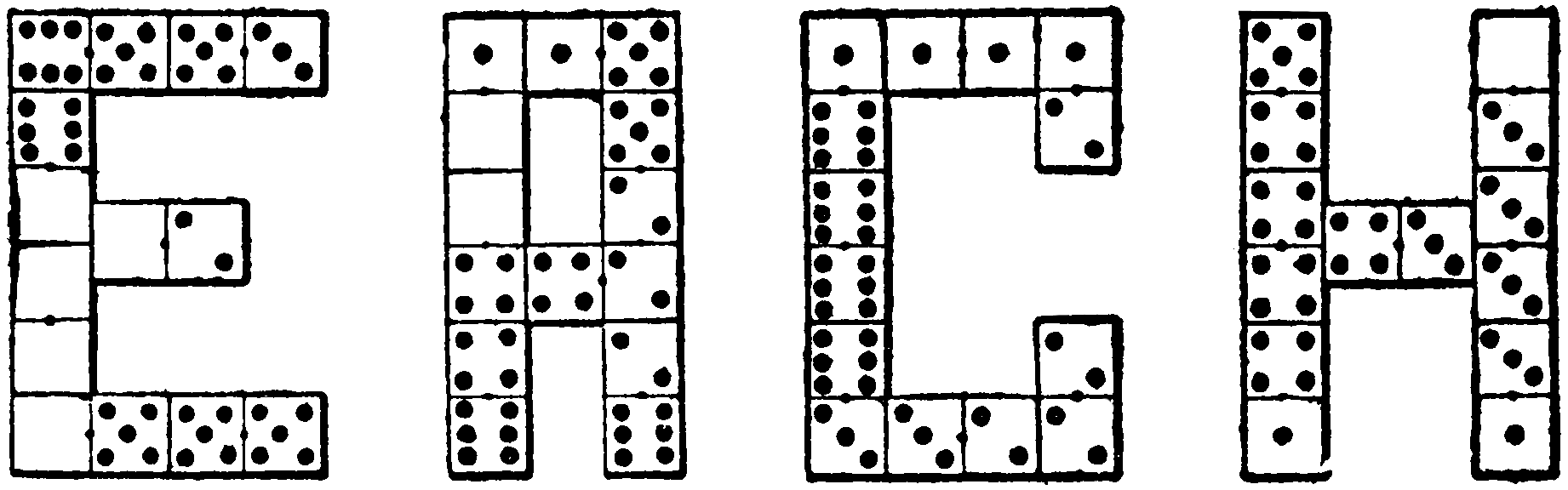
There are also the same number of pips in each letter. Can you construct another English word under the same conditions? As a hint, the word that we have in mind is plural.
Solution
3
Upon my face is not a single hair, Although my beard uncut is growing there. Men call me Shelley, though I can’t converse, To me all tongues alike would be a curse. I in my house must night and day abide, And though quite well must keep my bed, outside. For me no bell shall toll a funeral knell, I’m doomed, like Shelley, dead to have no shell.
Solution
4
This amusing Charade is from the pen of a wise and witty Irish Bishop:—
True to the trumpet call of fame and duty The soldier arms, and hastens to depart; Nor casts one look behind, though love and beauty Whisper my first in tones that thrill his heart. The war is o’er, with wealth and honour laden The hero seeks the well-remembered Hall: He woos and wins the unreluctant maiden, And bids my second o’er her blushes fall. He takes her hand—a mist of rapture thickens Before her eyes. Such bliss succeeding pain O’ertasks her strength, and fainting nature sickens, Until my whole is rudely snapt in twain.
Solution
No. LXXXIII.—THE HOUR GLASS
This very beautiful specimen of a knight’s tour on the chess-board takes its name from the figure formed by the tracery at its centre.
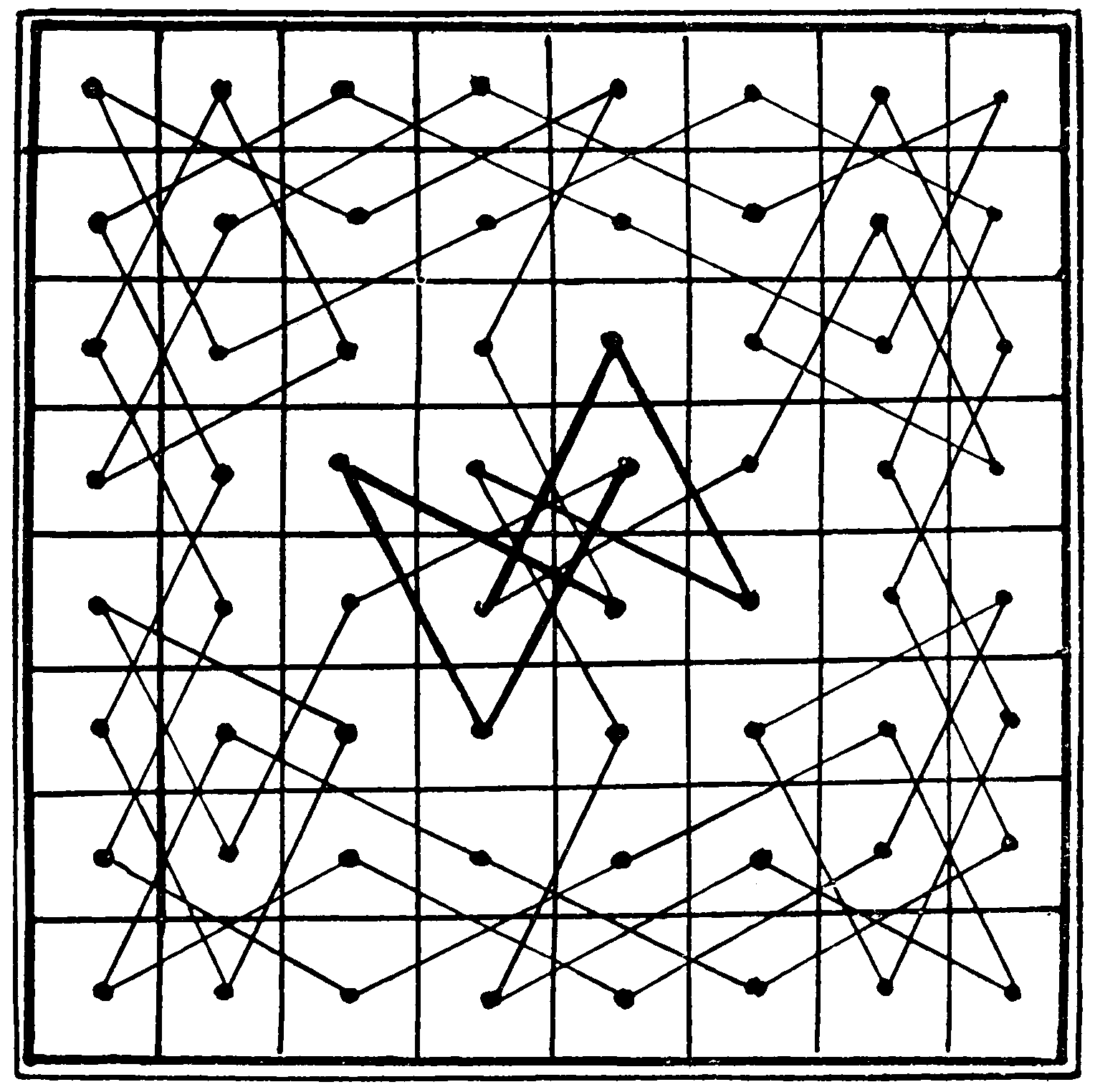
An endless number of symmetrical patterns of varied design can be formed, by a knight’s consecutive moves, with patience and ingenuity.
No. LXXXIV.—A STAR’S TOUR
Here is a pretty and very regular specimen of a knight’s tour on the chess board.
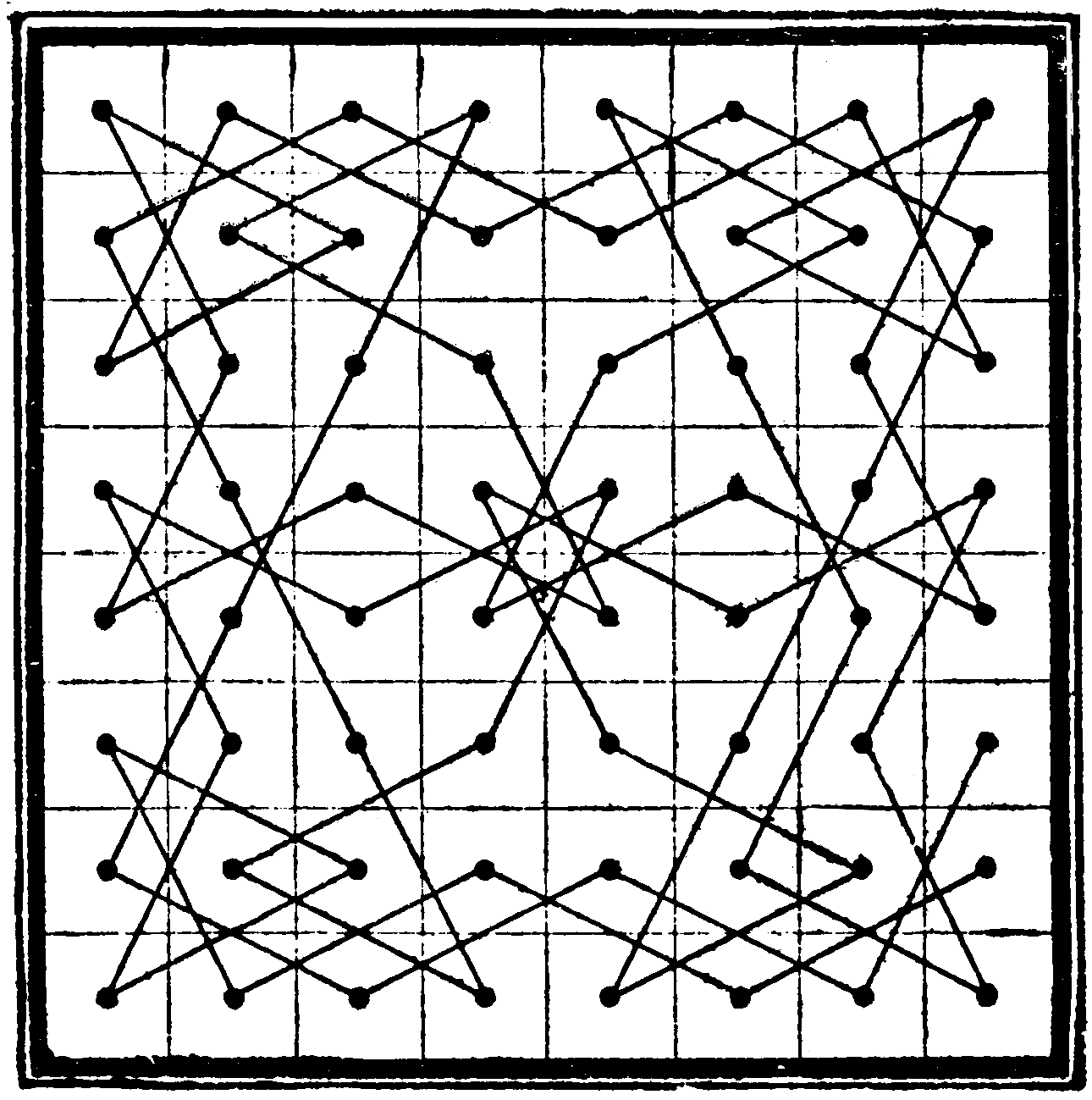
It is one of many variations which produce in the tracery a central star.
5 MAKE IT KNOWN
My first she was a serving maid, Who went to buy some tea; How much she bought my second tells, As all may plainly see. Now when the answer you have found Tell it to others too; My whole will then to maids and men Explain what ’tis you do.
Solution
No. LXXXV.—THE MARBLE ARCH
Here is a remarkably symmetrical specimen of a knight’s tour on the chess board.
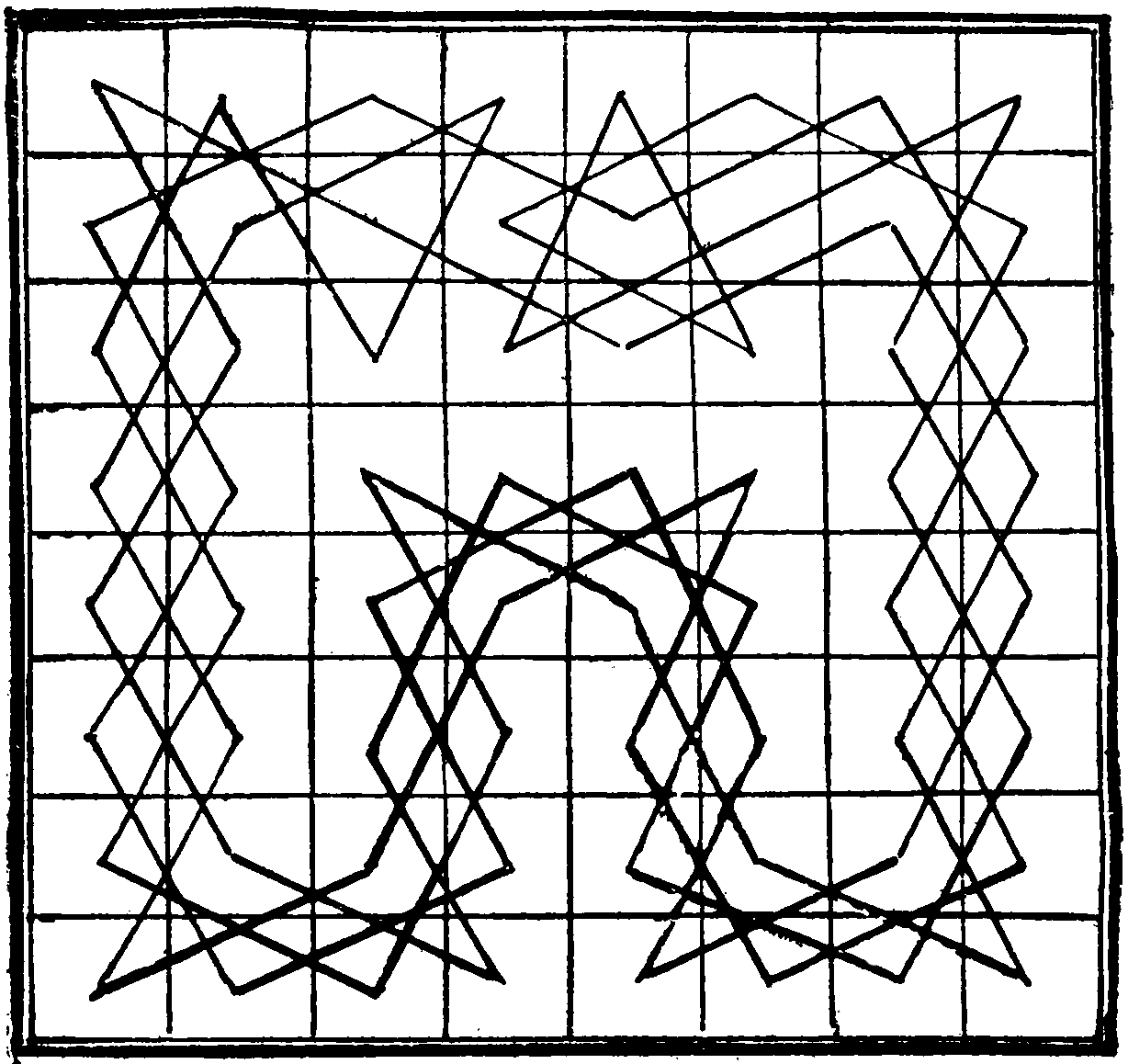
It takes its name from the central archway, which this arrangement forms.
6
My fourth is just ten times my first When that takes on my second; My third and second when reversed Double my first are reckoned. All this is empty, though my pen So full may seem to show it; Reverse my first and second, then My whole becomes a poet.
Solution
7
O’er distant hills the rising moon The evening mist dispersed: And beaming radiant in the sky She plainly showed my first. A horseman guided by her light, Approached with headlong speed And as he rode my second said To urge his flagging steed. His lady waited at the gate, Though trysting hour was past. She was my whole, because her lord Was then my third and last.
Solution
No. LXXXVI.—ANOTHER TOUR AMONG STARS
In No. LXXXIV we gave a pretty illustration of a knight’s tour, with a central star.
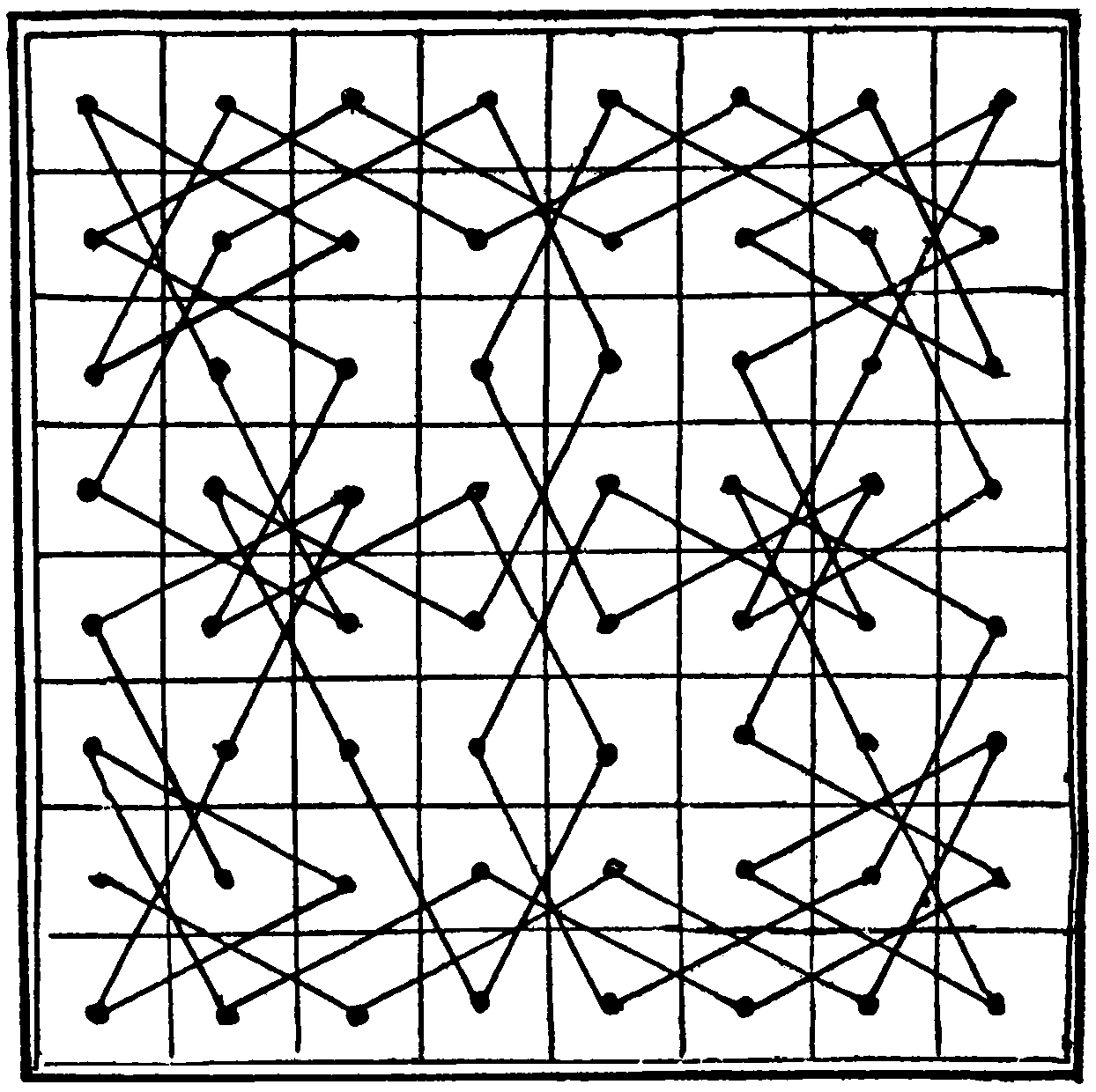
Here is a good course which shows in its symmetrical tracery a pair of stars.
No. LXXXVII.—THE WINDMILL
Among the countless fanciful variations of the knight’s tour that are possible, some have been so designed that more than a merely symmetrical pattern is involved.
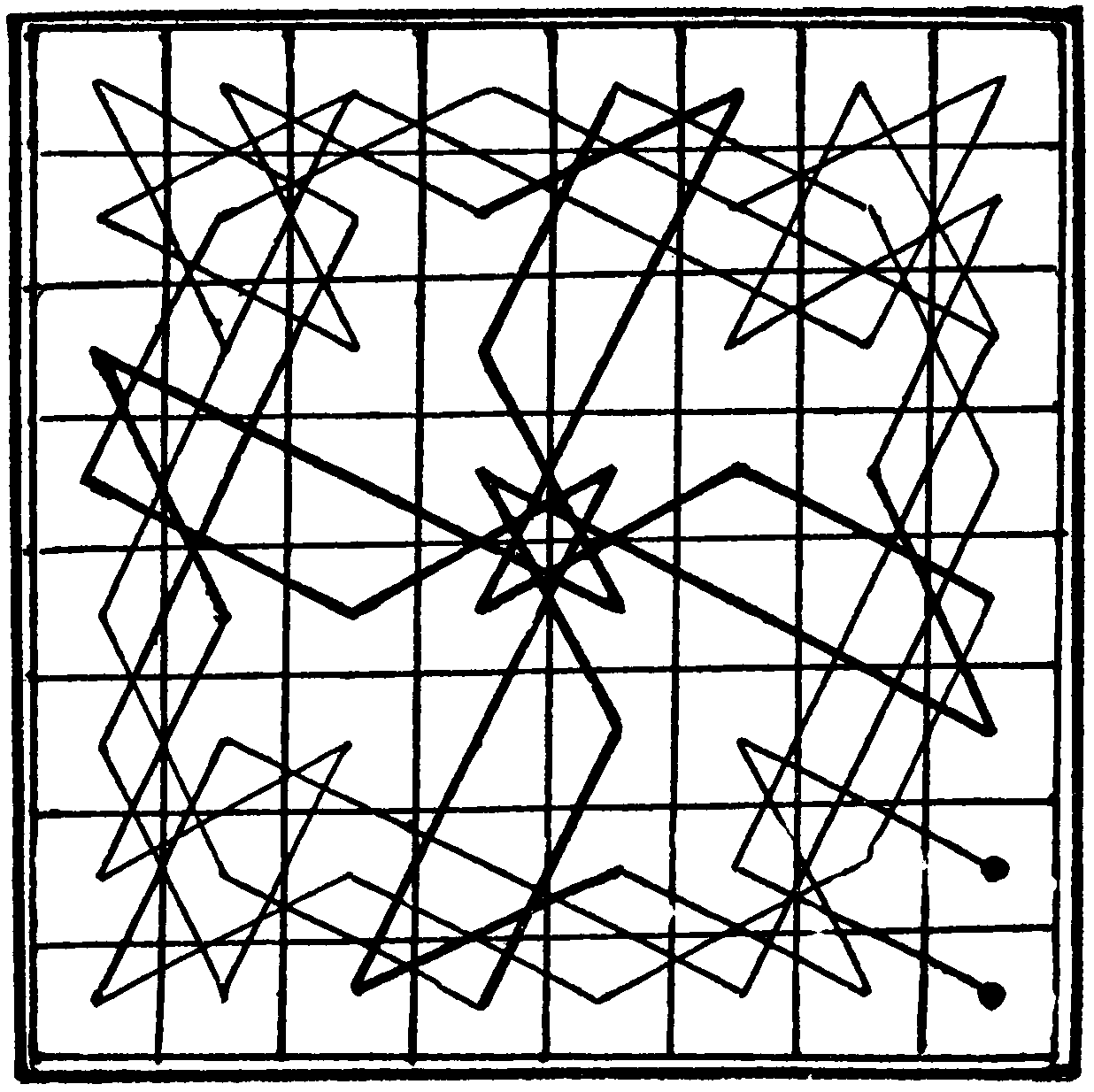
Here is, for example, an excellent suggestion of the sails of a windmill with their central fittings.
8 A TROPICAL CHARADE
My first’s a liquid or a solid snare, My all is hot, or in a maiden’s hair; My second just a track. Transpose my first, and they will both declare My all is now a black.
Solution
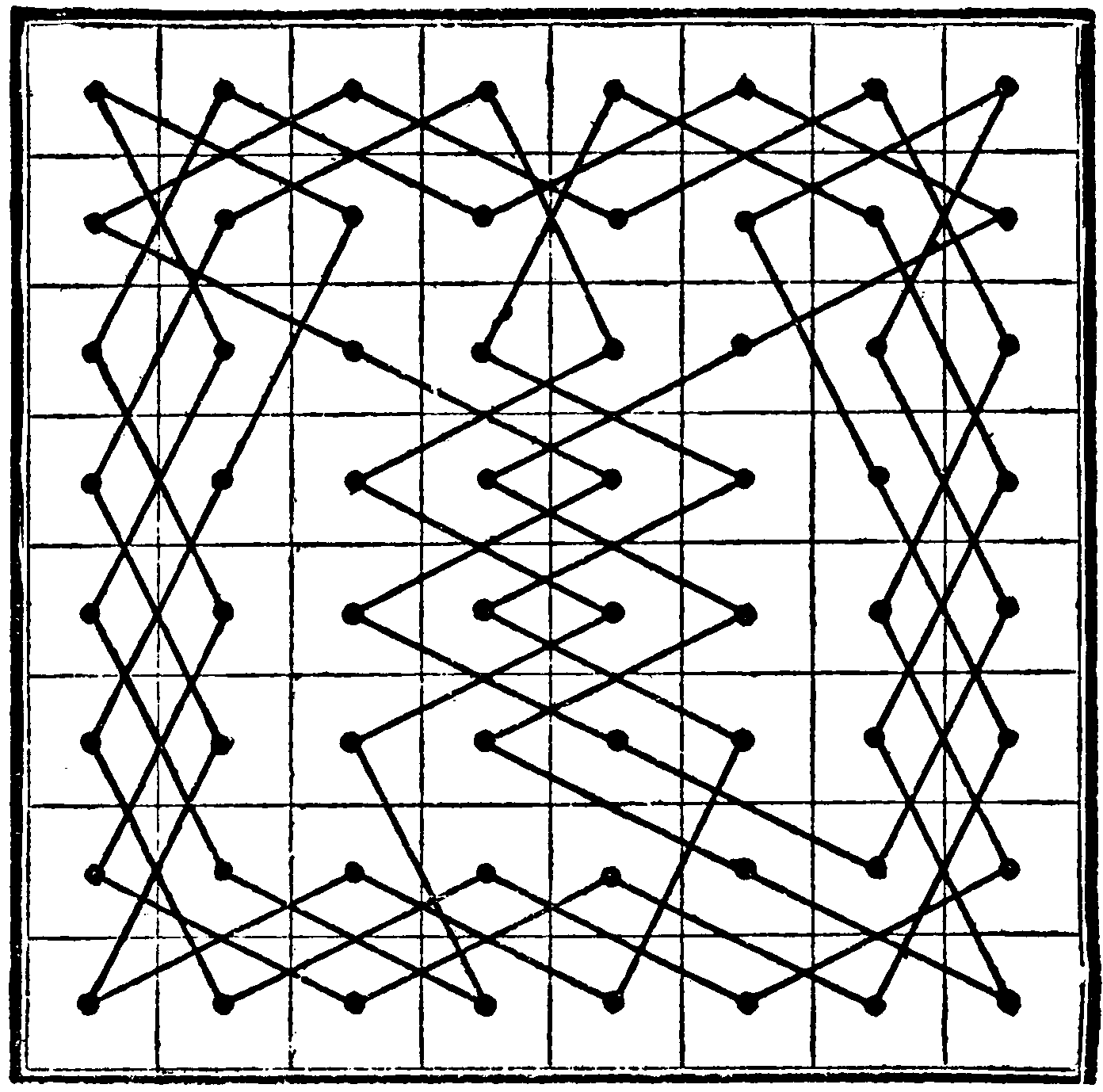
No. LXXXVIII.—LAZY TONGS
Here is a very distinctive specimen of the knight’s tour, in which the design reminds us of the old-fashioned lazy-tongs, which stretched out and then back, by opening or shutting their handles on finger and thumb.
9 A FLORAL CHARADE
My first must be below the ground, To do its proper duty; Within my second may be found Chaps that can boast no beauty; Some simple garden holds the two combined, Old-fashioned emblem of a candid mind.
Solution
No. LXXXIX.—CHESS ARITHMETIC
This beautiful symmetrical knight’s tour involves in its accomplishment a pretty problem in arithmetic:—
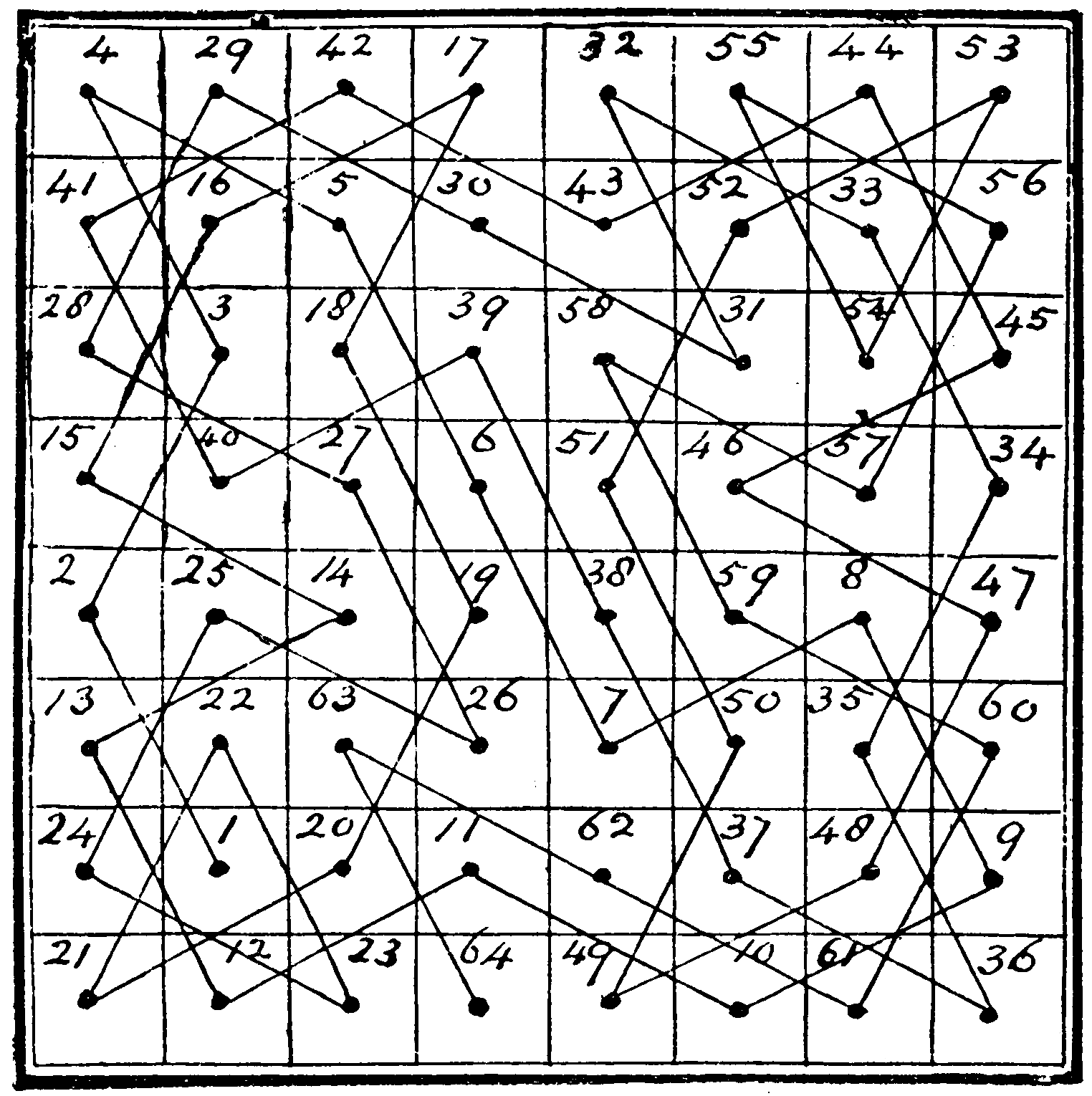
If we follow the course of the knight step by step, and number consecutively the squares on which it rests at each move, we find that there is a constant difference of 32 between the numbers on any two of these squares that correspond in position on opposite sides of the central line.
10
My first can be no joke to crack, My second I adore; Reverse her name, and you will see Just what that maiden is to me. My whole is grown where boys are black Upon a sultry shore.
Solution
No. XC.—A SHORT KNIGHT’S TOUR
This short symmetrical knight’s tour can be tested on a corner of the chessboard:—
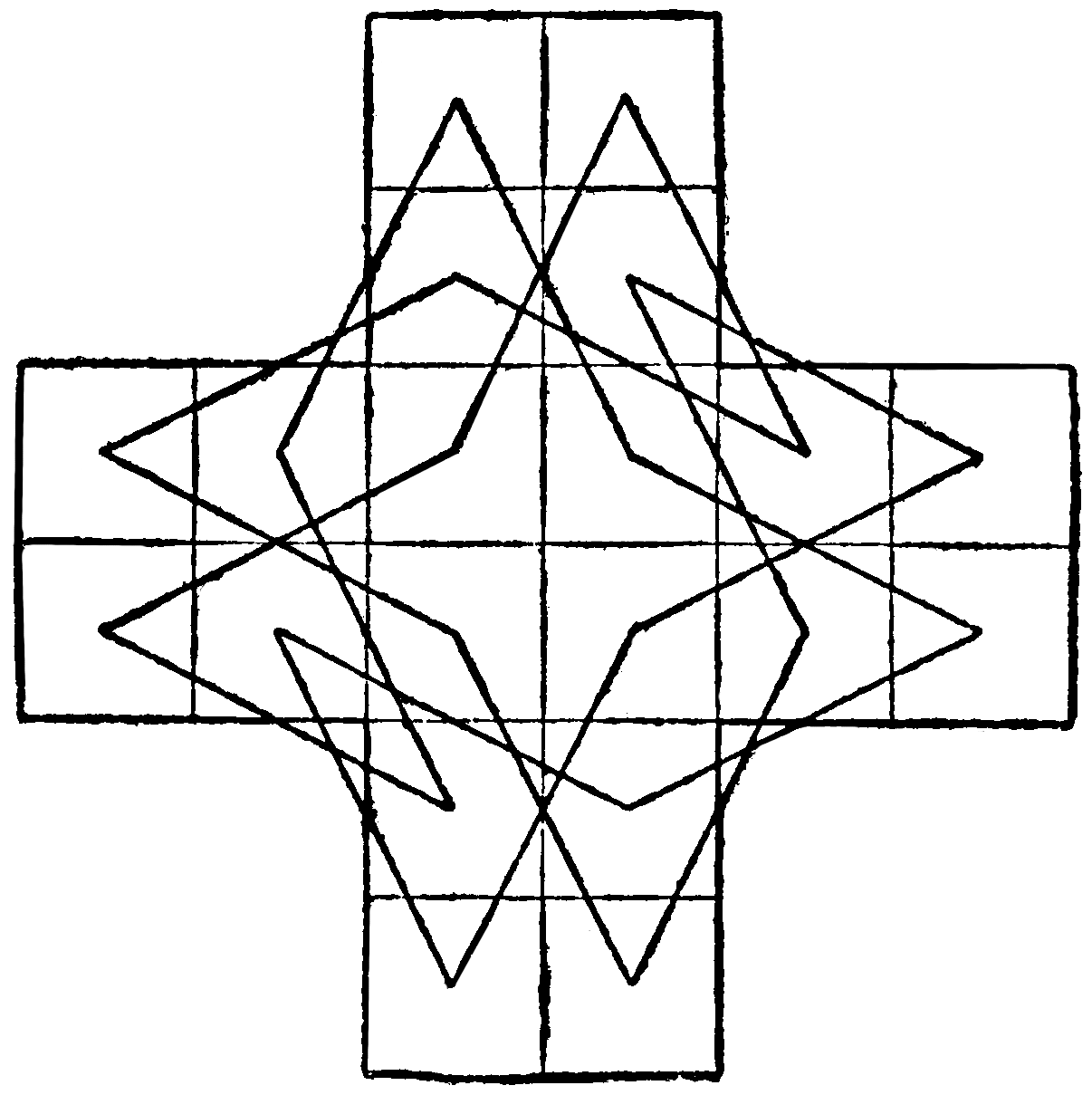
The knight can start from any square, and, taking the course indicated, return on the twentieth move to the starting point.
11 By George Canning
Though weak my first is reckoned, And game made of my second; Yet both bade hosts defiance When joined in close alliance.
Solution
12
As Lubin did my first, and, scythe in hand, Espied his Phyllis by the hedgerow stand, He called out to my next, in cheery tones and clear, “Tell me, sweet all, you’ll fetch a pot of beer.”
Solution
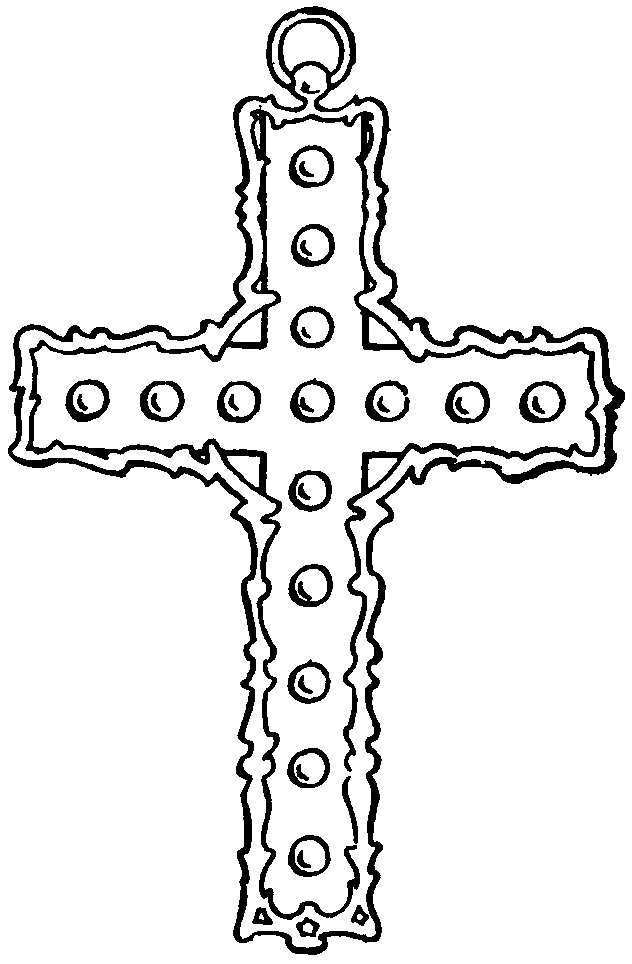
No. XCI.—THE STOLEN PEARLS
A dishonest jeweller, who had a cross of pearls to repair for a lady of title, on which nine pearls could be counted from the top, or from either of the side ends to the bottom, kept back two of the pearls, and yet contrived to return the cross re-set so that nine pearls could still be counted in each direction, as at first. How was this done?
Solution
13 A WORD OF WARNING
Says William to his thriftless wife, “To first unless you try, Your wasteful ways will spoil our life.” Her’s is a curt reply. Second and third her answer give; Full soon their fortunes fall, Each of the hapless pair must live And wander as my all.
Solution
14 A FINE CHARADE BY PRAED
Come from my first, ay, come; The battle dawn is nigh, And the screaming trump and the thundering drum Are calling thee to die. Fight, as thy father fought, Fall, as thy father fell: Thy task is taught, thy shroud is wrought, So forward and farewell! Toll ye my second, toll; Fling high the flambeau’s light, And sing the hymn for a parted soul Beneath the silent night. The helm upon his head, The cross upon his breast, Let the prayer be said, and the tear be shed Now take him to his rest! Call ye my whole, go call The lord of lute and lay, And let him greet the sable pall With a noble song to-day. Ay, call him by his name, No fitter hand may crave To light the flame of a soldier’s fame On the turf of a soldier’s grave!
Solution
15
My first has cause in dread to hold The foggy month November. My next, when given to knights of old Was held to mean “remember!”
Solution
16
With one line many do my first, With two it can but meet; My second, as its breakers burst, Around my whole may beat.
Solution
17
She was my first; one happy day She was my second, And shewed my all. Now can you say How this is reckoned?
Solution
18
My first it may a seaman save, Or cause a fighter’s fall; My next reminds us of the wave, Or of unseemly brawl. My whole is rather pert than brave, And like a rubber ball.
Solution
19
Seen with a stolen spoon, my first was reckoned Bad as my whole in moral tone. Whether a number or alone my second Touched by my third is turned to stone.
Solution
20 NOT A CATECHISM
My first a friend, companion, guide, Is loving, staunch, and cheery; My second has a cleansing side, My third denotes a theory. My whole, good luck! is held by few To bore and make us weary.
Solution
21
My first is an insect, My second a border; My whole puts the face Into tuneful disorder.
Solution
22
My first seldom crosses your path, Though wheels and a body it hath; My next from a clown Much applause will bring down, My whole was Goliath of Gath.
Solution
23
My first he sat upon my whole And used it as my second. His halves akin in Latin and In English may be reckoned.
Solution
24 A PHONETIC FLORAL CHARADE
My first comes often to our mind When for a saint we look. My second sees the greetings kind Of Bobby and the cook. My whole in hothouse you may find, Or pictured in a book.
Solution
25
Man cannot live without my first, By day and night ’tis used; My second is by all accursed, By day and night abused. My whole is never seen by day, And never used by night, ’Tis dear to friends when far away, But hated when in sight.
Solution
26 BY AN OXFORD OAR
I am my first, my second thou mayest be In classic shades, where gently roll The crystal waters of my whole To seek the sea.
Solution
27
My first is worn by night and day, And very useful reckoned; London, or Bath, or Bristol may With truth be styled my second. Now if you cannot find me out You lack my whole without a doubt.
Solution
28
My first now marks the soldier’s face, Who was my next’s defender; But when my whole attacked the place It drove him to surrender.
Solution
29
My first is away from Paris, and may Come round with a rap at your portal; My second is Spanish, but quickly will vanish If it turns to a nod from a mortal.
Solution
30
Often my first a B begins, One always starts my second. My all, though free from grosser sins, Of little worth is reckoned.
Solution
31
My first is a kind of butter, My second is a sort of cutter; My whole, whether smaller or larger, Was always a kind of charger.
Solution
32
My first is but lately promoted To a place in our language, and quoted. My second it lives in the sea. On the hill-tops it flourishes free. My whole I should certainly call A delectable dainty for all.
Solution
33 AN ENIGMA-CHARADE
Take in my first, and you will find It helps you to make up your mind. Write to my second, and behold You see into the secret told.
Solution
34 A QUAINT CHARADE By Charles James Fox
My first is expressive of no disrespect, But I never call you by it when you are by; If my second you still are resolved to reject, As dead as my whole I shall presently lie.
Solution
35
My first reversed will plainly show An apple in its embryo. Reverse my second, and we see That which in sight can never be. Replace them both, and write me down Six letters that will spell a town.
Solution
36
My first is equal to the rest, My second not so much; My whole is better than the best, Beyond compare nonsuch.
Solution
37 AN ITALIAN POET’S LOVE SONG
Hear me, my all: oh, be my first! My second is a single; If you say yes, then in my third Our happy lives shall mingle.
Solution
38 A PARADOX
My first a simple verb, or half a verb, may be; Almost the same my next, or half the same, we see. My whole may weigh a ton or more, and yet be light, Dull, and bereft of motion; swift, exceeding bright.
Solution
39
My first is found in fruit, You take it for my second; My whole in church to suit Attentive ears is reckoned.
Solution
40
My first is frugal, lean, and thin, My second leads to eve, My whole is hidden by a skin, But not of sheep or beeve.
Solution
41 VERY PERSONAL
My first to us may point ’tis clear, And what I say is true, sir! My next to her your thoughts will steer, My whole it is in view, sir!
Solution
42
My second in my first can speed Across United States; My third from Q’s pen we can read, My whole has water-rates; My first and second drive my first along, My third and second drive a mind all wrong.
Solution
43
To puzzle solvers can I shine, And so my first is writ. With this my second did combine To make a happy hit. My whole, with both fixed in a line Firm as I can, did fit.
Solution
44 A RUSTIC CHARADE
My first and second are my third, My third my first and second may be; My whole, if right you read the word, May never have a wife or baby.
Solution
45
Let my second cut my first Into slices thin; Seek in Shakespeare for my whole, Injured by his kin.
Solution
46 A FIRM GRIP
I may give you my first with my second, Or my second may give with my first; The one act as friendly is reckoned, The other will rank with the worst. If my whole through my second creeps over my first, It will cling as a bond that no effort can burst.
Solution
47
My first is called a sin in name, My third its simple cure; My second puts an end to fame, My whole in ease is sure.
Solution
48
In my first ’tis sweet to tarry ’Mid my second’s realms of bliss. In the two, though none can marry, All are subject to a kiss.
Solution
49
My first, which washes half a nation’s gums, From foreign climes within my second comes: And though, my whole, thine is no teacher’s part, Thou art not science, but thou teachest art!
Solution
50
My first on country hedges grows, My next is found in garden rows, My third to make it more transpose, My whole is one of London’s shows.
Solution
51
My first the best solver can never find out, My second is looked for in vain; My third may hide all from our view round about, My whole must be weak, or in pain.
Solution
52 SORROW’S ANTIDOTE
My first does affliction denote, Which my second is destined to bear; My whole is the sweet antidote That affliction to soothe and to share.
Solution
53
I see a sign of music not reversed, and then My second and my third both pass beyond my ken.
Solution
54
My first has my second my third his mouth; My whole was a tribe in the sunny south.
Solution
55 “QUOD” ERAT DEMONSTRANDUM
My second makes my ending, My first is its reverse; My whole bad men is sending From court to quarters worse.
Solution
56
My first, though won and never lost, Reversed is now before ye: My second turns as red as blood Upon a field of glory. My whole is plain, yet you’ll confess It is a wonder if you guess.
Solution
57
I get my second when I take my first, And then my upright character is lost; My whole gives quarters to a rat reversed, Or is a refuge for the tempest tost.
Solution
58
My first is almost a cropper; My second is often a propper; My whole was entirely a whopper.
Solution
59 A FLORAL CHARADE
My first by poet’s eye was seen Sad watching at the gates of heaven. My next in tints of tender green By Dickens with quaint art was given.
Solution
60
My first is nothing but a name My second is more small; My whole is of such slender fame It has no name at all.
Solution
61
When second is of whole a fourth, And first a fifth of second, Then first by second multiplied To make my whole is reckoned.
Solution
62 A CHARADE WITH A MORAL
My first is black, my second red, My whole no man should take to bed.
Solution
63
My first upon their prey can dart, My next can ne’er be down; My whole performs a saucy part In country or in town.
Solution
64
My first makes hills unpleasant To every cyclist’s wheel. My next is where they take you to If in the streets you steal. My whole is what I most dislike When in the dumps I feel.
Solution
65
My first is the voice of heart-sorrows or joys, My second, bar one, have been all of them boys, My whole is made ill by the harsh raven’s noise.
Solution
66 QUITE SELF-CONTAINED
My first is in my second, My third contains an ass; And when my whole is reckoned You see it is in glass.
Solution
67
Safe on Lucinda’s arm my first may rest, And raise no tumult in Alonzo’s breast. My second can the want of legs supply To those that neither creep, nor walk, nor fly; My whole is rival to the fairest toast, And when most warmly welcomed suffers most.
Solution
68
My second, my first can control, If his understanding is reckoned. My second may not be my whole, But my whole must be always my second.
Solution
69 AN OLD COCKNEY CHARADE
My first’s a little thing that hops, My second comes with summer crops, My whole is good with mutton chops.
Solution
70 A STRIKING CHARADE
My first I gently strike, and lo! It soon becomes my second. Indeed if this should not be so My whole it is not reckoned.
Solution
71 PLANTING PEAS
“I think,” said Ted, “it will be wise To set the peas this way; For here they will face friendly skies, And sun shines all the day.” “Your first is good,” the gardener said, “Peas thrive in sun and shower; So now, good second, dig the bed Where all can see them flower.”
Can you fit a word of two syllables to this Charade?
Solution
72
My first is found where wit and wine Combine to grace the festal board; My second where sad captives pine, In dungeon of some tyrant lord. My whole is ready for the doomed, Twice tried by fire ere once consumed.
Solution
73 A BRAIN TWISTER
My first is half my second And my third is half my first My second and my third are good To quench a mighty thirst.
Solution
RIDDLES AND CONUNDRUMS
1.
Woman is my end, was my beginning, and you will find her in my midst.
Solution
2
I am an uncle, but it is not nice To be saluted as an uncle twice.
Why not?
Solution
3.
If a tailor and a goose are on the top of the Monument, which is the quickest way for the tailor to get down?
Solution
4.
My first is almost all, so is my second, and also my whole?
Solution
5
Those who have me do not desire me, And yet they never wish to lose me, Those who gain me have me no longer.
Solution
6.
Why may a barrister’s fees be said to be cheap?
Solution
7
Two brothers are we, great burdens we bear, By which we are heavily prest: We are full all the day to endure wear and tear, But empty when able to rest.
Solution
8.
Peter Portman was so proud of his small feet that a wag started the following riddle: “Why are Portman’s feet larger than any others in his club?”
Solution
9
There is a word of letters four, Take two away, and four remain; Take three away, and five before Your eyes you see as plain as plain.
Solution
10
To one syllable adjusted, Running on the ground, I have two, no longer trusted, If you turn me round.
Solution
11.
Why is a raven like a writing desk?
Solution
12.
What do they do with peaches in California?
Solution
13.
What is the utmost effort ever made by a piebald horse at a high jump?
Solution
14
“In my first my second sat, Then my third and fourth I ate.” Under my first my second stood, That’s your riddle: mine’s as good!
Solution
15.
What are the differences between a gardener, a billiard-marker, a precise man, and a verger?
Solution
16.
Which can see most, a man with two eyes, or a man with one?
Solution
17.
When you do not know the time, and “ask a policeman” what o’clock it is, why are you like the Viceroy of India?
Solution
18.
What is the question to which “yes” is the only possible reply?
Solution
19.
What is that which will go up a pipe down, but will not go down a pipe up; or will go down a pipe down, but not up a pipe up, and yet when it has gone up a pipe or down a pipe, will go up or down?
Solution
20.
Why was London for many years a wonderful place for carrying sound?
Solution
21.
Why is a motor-car like swimming fish?
Solution
22.
Who can decipher this?
1/6d. me a bloater.
Solution
23.
Why is a moth flying round a candle like a garden-gate?
Solution
24
To half a dozen add half a score, And you will plainly see Just twenty, neither less nor more— Now say, how can this be?
Solution
25.
If I caught a newt why would it be a small one?
Solution
26.
How can a lawyer’s fee be paid with only a threepenny piece?
Solution
27.
When does the cannon ball?
Solution
28.
Why should children go to bed soon after tea?
Solution
29.
Which may weigh the most, Scotsmen or Irishmen?
Solution
30.
Why cannot we have our hair cut?
Solution
31.
Divide a hundred and fifty by half of ten, add two-thirds of ten, and so you will find a town.
Solution
32.
The following riddle is from the pen and fertile brain of Archbishop Whately, who, it is said, offered in vain £50 for its solution:—
When from the Ark’s capacious round Mankind came forth in pairs, Who was it that first heard the sound Of steps upon the stairs?
Solution
33.
If Moses was the son of Pharaoh’s daughter, who was the daughter of Pharaoh’s son?
Solution
34.
I am a word of three syllables, and in all my fulness I represent woman. Rob me of five letters and I am a man. Take away but four, I am woman again. Remove only three, and I resume my manhood. What am I?
Solution
35.
A cyclist on a night journey punctures his tyre, and finds that he has forgotten his outfit for repairs. After wheeling the disabled machine uphill for about two miles he registers a vow. What is it?
Solution
36
Some more than the mere whole my whole contains; Remove that whole, and some of it remains!
Solution
37.
Why were Younghusband’s pack-horses in Thibet like up-to-date motor cars?
Solution
38
The public credit and the public shame Differ in everything except in name.
Solution
39.
Why is a telescope like a miser?
Solution
40.
If I were in the sun, and you were out of it, what would it be?
Solution
41
I’m a word of four letters akin to the snow, Just half of my first my third letter will show. One fifth of my fourth my first you may call, Of my second ’tis best to say nothing at all.
Solution
42.
What is the chief and most natural thing for politicians to desire to do when for the time they are out in the cold, awaiting a change of Government?
Solution
43.
I am long lasting, beginning at my end, ending with no beginning, and my end and my beginning between them will bring you to an end.
Solution
44
With both feet crossed sit steady on a stool, Then uncross one, and try to find a fool.