PART II. (continued 2)
Reading edition
Solution
34.
Knowing that the square of 87 is 7569, how can we rapidly, without multiplication, determine in succession the squares of 88, 89, and 90?
Solution
NOT WHOLE NUMBERS
35.
Two numbers seek which make eleven, Divide the larger by the less, The quotient is exactly seven, As all who solve it will confess.
Solution
AN AMPLE CHOICE
36. If there are twenty sorts of things from which 9 9 9 9 9 9 9 9 9 9 9 9 9 9 9 9 9 9 9 9 different selections can be made, how many of each sort are there?
Solution
37.
Three women, with no money, went to market. The first had thirty-three apples, the second twenty-nine, the third twenty-seven. Each woman sold the same number of apples for a penny. They all sold out, and yet each received an equal amount of money. How was this?
Solution
SIMPLE SUBTRACTION
38.
Take five from five, oh, that is mean! Take five from seven, and this is seen.
Solution
39.
If a bun and a half cost three halfpence, how many do you buy for sixpence?
Solution
40.
How many times in a day would the hands of a watch meet each other, if the minute-hand moved backward and the hour-hand forward?
Solution
41.
How can half-a-crown be equally divided between two fathers and two sons so that a penny is the coin of smallest value given to them?
Solution
SIZE AND SPEED
42. If the number of the revolutions of the wheel of a bicycle in six seconds is equal to the number of miles an hour at which it is running, what is the circumference of the wheel?
Solution
43.
Hearing a clock strike, and being uncertain of the hour, I asked a policeman. He had a turn for figures, and replied: “Take half, a third, and a fourth of the hour that has just struck, and the total will be one larger than that hour.” What o’clock was it?
Solution
AFTER LONG YEARS
44.
If cash is lent at five per cent. To those who choose to borrow, How soon shall I be worth a pound If I lend a crown to-morrow?
Solution
ON THE JUMP
45. If I jump off a table with a 20-lb. dumb-bell in my hand, what is the pressure upon me of its weight while I am in the air?
Solution
AT A BAZAAR
46. In charitable mood I went recently to a bazaar where there were four tents arranged to tempt a purchaser. At the door of each tent I paid a shilling, and in each tent I spent half of the money remaining in my purse, giving the door-keepers each another shilling as I came out.
It took my last shilling to pay the fourth door-keeper. How much money had I at first, and what did I spend in each tent?
Solution
OUT IN THE RAIN
47. Rain is falling vertically, at a speed of 5 miles an hour. I am walking through it at 4 miles an hour. At what angle to the vertical must I hold my umbrella, so that the raindrops strike its top at right angles?
Solution
A MONKEY PUZZLER
48. The following interesting problem, translated from the original Sanscrit, is given by Longfellow in his “Kavanagh”:—
“A tree, 100 cubits high, is distant from a well 200 cubits. From the top of this tree one monkey descends, and goes to the well. Another monkey leaps straight upwards from the top, and then descends to the well by the hypotenuse. Both pass over an equal space. How high does the second monkey leap?”
Solution
49.
A steamboat 105 miles east of Tynemouth Lighthouse springs a leak. She puts back at once, and in the first hour goes at the rate of 10 miles an hour.
More and more water-logged, she decreases her speed each succeeding hour at the rate of one-tenth of what it has been during the previous hour. When will she reach the lighthouse?
Solution
50.
If a hen and a half lays an egg and a half in a day and a half, how many eggs will twenty-one hens lay in a week?
Solution
51.
If the population of Bristol exceeds by two hundred and thirty-seven the number of hairs on the head of any one of its inhabitants, how many of them at least, if none are bald, must have the same number of hairs on their heads?
Solution
52.
A benevolent uncle has in his pocket a sovereign, a half-sovereign, a crown, a half-crown, a florin, a shilling, and a threepenny piece. In how many different ways can he tip his nephew, using only these coins, and how is this most easily determined?
Solution
53.
Here is a prime problem, in more senses than one, which will tax the ingenuity of our solvers:—I am a prime number of three figures. Increased by one-third, ignoring fractions, I become a square number. Transpose my first two figures and increase me by one-third, and again I am a square number. Put my first figure last, and increase me by one-third, and I am another square number. Reverse my three figures, and increase as before by one-third, and for a fourth time I become a square number. What are my original figures?
Solution
54.
In how many different ways can six different things be divided between two boys?
Solution
55.
What is quite the highest number that can be scored at six card cribbage by the dealer, if he has the power to select all the cards, and to determine the order in which every card shall be played?
Solution
COVERING THE WALLS
56. A fanciful collector, who bought pictures with more regard to quantity than quality, gave instructions that the area of each frame should exactly equal that of the picture it contained, and that the frames should be of the same width all round.
At an auction he picked up a so-called “old master,” unframed, which measured 18 inches by 12 inches. What width of frame will fulfil his conditions?
Solution
A FAMILY REGISTER
57. Our family consists of my mother, a brother, a sister, and myself. Our average age is thirty-nine. My mother was twenty when I was born; my sister is two years my junior, and my brother is four years younger than she is. What are our respective ages?
Solution
58.
A spider in a dockyard unwittingly attached her web to a mechanical capstan 1 foot in diameter, at the moment when it began to revolve. To hold her ground she paid out 73 feet of thread, when the capstan stopped, and she found herself drained of silk.
To make the best of a bad job she determined to unwind her thread, walking round and round the capstan at the end of the stretched thread. When she had gone a mile in her spiral path she stopped, tired and in despair. How far was she then from the end of her task?
Solution
59.
A mountebank at a fair had six dice, each marked only on one face 1, 2, 3, 4, 5, or 6, respectively. He offered to return a hundredfold any stake to a player who should turn up all the six marked faces once in twenty throws. How far was this from being a fair offer?
Solution
CATS’-MEAT FOR DOGS
60.
If ninety groats for twenty cats Will furnish three weeks’ fare, How many hounds for forty pounds, Less one, may winter there? Just ninety days and one assume The winter’s space to be; And note that what five cats consume Will serve for dogs but three.
(A groat = 4d.)
Solution
61.
Two wineglasses of equal size are respectively half and one-third full of wine. They are filled up with water, and their contents are then mixed. Half of this mixture is finally poured back into one of the wineglasses. What part of this will be wine and what part will be water?
Solution
62.
A legend goes that on a stout ship on which St Peter was carried with twenty-nine others, of whom fourteen were Christians and fifteen Jews, he so arranged their places, that when a storm arose, and it was decided to throw half of the passengers overboard, all the Christians were saved. The order was that every ninth man should be cast into the sea. How did he place the Christians and the Jews?
Solution
A PROLIFIC COW
63. Farmer Southdown was the proud possessor of a prize cow, which had a fine calf every year for sixteen years. Each of these calves when two years old, and their calves also in their turn, followed this excellent example. How many head did they thus muster in sixteen years?
Solution
64.
A shepherd was asked how many sheep he had in his flock. He replied that he could not say, but he knew that if he counted them by twos, by threes, by fours, by fives, or by sixes, there was always one over, but if he counted them by sevens, there was no remainder. What is the smallest number that will answer these conditions?
Solution
READY RECKONING
65. If a number of round bullets of equal size are arranged in rows one above another evenly graduated till a single bullet crowns the flat pyramid, how can their number be readily reckoned, however long the base line may be?
Solution
THE TITHE OF WAR
66.
Old General Host A battle lost, And reckoned on a hissing, When he saw plain What men were slain, And prisoners, and missing. To his dismay He learned next day What havoc war had wrought; He had, at most, But half his host Plus ten times three, six, ought. One-eighth were lain On beds of pain, With hundreds six beside; One-fifth were dead, Captives, or fled, Lost in grim warfare’s tide. Now, if you can, Tell me, my man, What troops the general numbered, When on that night Before the fight The deadly cannon slumbered?
Solution
67.
A farmer sends five pieces of chain, of three links each, to be made into one continuous length. He agrees to pay a penny for each link cut, and a penny for each link joined. What was the blacksmith entitled to charge if he worked in the best interest of the farmer?
Solution
68.
In a parcel of old silver and copper coins each silver piece is worth as many pence as there are copper coins, and each copper coin is worth as many pence as there are silver coins, and the whole is worth eighteen shillings. How many are there of each?
Solution
A FEAT WITH FIGURES
69. Take the natural numbers 1 to 11, inclusive, and arrange them in five groups, not using any of them more than once, so that these groups are equal. Any necessary signs or indices may be used.
Solution
HOW OLD WAS JOHN?
70. John Bull passed one-sixth of his life in childhood and one-twelfth as a youth. When one-seventh of his life had elapsed he had a son who died at half his father’s age, and John himself lived on four years more. How old was he at the last?
Solution
FIGURE IT OUT
71. There are two numbers under two thousand, such that if unity is added to each of them, or to the half of each, the result is in every case a square number. Can you find them?
Solution
72.
A cheese in one scale of a balance with arms of unequal length seems to weigh 16 lbs. In the other scale it weighs but 9 lbs. What is its true weight?
Solution
“DIVISION IS AS BAD!”
73. Can you divide 100 into two such parts that if the larger is divided by the lesser the quotient is also 100?
Solution
74.
I have marbles in my two side pockets. If I add one to those in the right-hand pocket, and multiply its increased contents by the number it held at first, and then deal in a similar way with those in the other pocket, the difference between the two results is 90. If, however, I multiply the sum of the two original quantities by the square of their difference, the result is 176. How many marbles had I at first in each pocket?
Solution
A SURFEIT OF BRIDGE
75. A friendly circle of twenty-one persons agreed to meet each week, five at a time, for an afternoon of bridge, so long as they could do so without forming exactly the same party on any two occasions.
As a central room had to be hired, it was important to have some idea as to the length of time for which they would require it. How long could they keep up their weekly meetings?
Solution
76.
A herring and a half costs a penny and a half; what is the price of a dozen?
Solution
77.
What sum of money is in any sense seen to be the double of itself?
Solution
COMIC ARITHMETIC
78. At the close of his lecture upon unknown quantities, Dr Bulbous Roots, in playful mood, wrote this puzzle on his blackboard:—
Divide my fifth by my first and you have my fourth; subtract my first from my fifth and you have my second; multiply my first by my fourth followed by my second, and you have my third; place my second after my first and you have my third multiplied by my fourth. What am I?
Solution
DROPPED THROUGH THE GLOBE
79. If we can imagine the earth at a standstill for the purpose of our experiment, and if a perfectly straight tunnel could be bored through its centre from side to side, what would be the course of a cannon ball dropped into it from one end, under the action of gravity?
Solution
LOVE LETTERS
80.
A lady to her lover cried, “How many notes have you of mine?” “Six more I’ve sent,” the youth replied, “Than I have had of thine.” “But if from one pound ten you take The pennies we on stamps have spent, One eighth their cost you thus will make.” How many had they had and sent?
Solution
81.
A man, on the day of his marriage, made his will, leaving his money thus:—If a son should be born, two-thirds of the estate to that son and one-third to the widow. If a daughter should be born, two-thirds to the widow and one-third to that daughter. In the course of time twins were born, a boy and a girl. The man fell sick and died without making a fresh will. How ought his estate to be divided in justice to the widow, son, and daughter?
Solution
82.
My carpet is 22 feet across. My stride, either backwards or forwards, is always 2 feet, and I make a stride every second. If I take three strides forwards and two backwards continuously until I cross the carpet, how long does it take me to reach the end of it?
Solution
NO TIME TO BE LOST
83. A merchant at Lisbon has an urgent business call to New York. Taking these places to be, as they appear on a map of the world, on the same parallel of latitude, and at a distance measured along the parallel, of some 3600 miles, if the captain of a vessel chartered to go there sails along this parallel, will he be doing the best that he can for the impatient merchant?
Solution
ROUND THE ANGLES
84. Two schoolboys, John and Harry, start from the right angle of a triangular field, and run along its sides. John’s speed is to Harry’s as 13 is to 11.
They meet first in the middle of the opposite side, and again 32 yards from their starting point. How far was it round the field?
Solution
AN ECHO FROM THE PAST
85. The following question is given and spelt exactly as it was contributed to a puzzle column by “John Hill, Gent.,” in 1760:—
“A vintner has 2 sorts of wine, viz. A and B, which if mixed in equal parts a flagon of mixed will cost 15 pence; but if they be mixed in a sesqui-alter proportion, as you should take two flagons of A as often as you take three of B, a flagon will cost 14 pence. Required the price of each wine singly.”
Solution
PROMISCUOUS CHARITY
86. A man met a beggar and gave him half the money he had in his pocket, and a shilling besides. Meeting another he gave him half of what was left and two shillings, and to a third, he gave half of the remainder and three shillings. This left a shilling in his pocket. How much had he at first?
Solution
87.
A young clerk wishes to start work at an office in the City on January 1st. He has two promising offers, one from A of £100 a year, with a yearly rise of £20, the other from B of £100 a year with a half-yearly rise of £5. Which should he accept, and why?
Solution
HOW CAN I PAY MY BILL?
88. I have an abundance of florins and half-crowns, but no other coins. In how many different ways can I pay my tailor £11, 10s. without receiving change?
Solution
89.
A monkey climbing up a greased pole ascends 3 feet and slips down 2 feet in alternate seconds till he reaches the top. If the pole is 60 feet high, how long does it take him to arrive there?
Solution
“SAFE BIND, SAFE FIND”
90. Old Adze, the village carpenter, who kept his tools in an open chest, found that his neighbours sometimes borrowed and forgot to return them.
To guard against this, he secured the lid of the chest with a letter lock, which carried six revolving rings, each engraved with twelve different letters. What are the chances against any one discovering the secret word formed by a letter on each ring, which will open the lock, and be the only key to the puzzle?
Solution
91.
Five merry married couples happened to meet at a Swiss hotel, and one of the husbands laughingly proposed that they should dine together at a round table, with the ladies always in the same places so long as the men could seat themselves each between two ladies, but never next to his own wife. How long would their nights at the round table be continued under these conditions?
Solution
SOUNDING THE DEPTH
92. In calm water the tip of a stiff rush is 9 inches above the surface of a lake. As a steady wind rises it is gradually blown aslant, until at the distance of a yard it is submerged. Can you decide from these data the depth of the water in which the rush grows?
Solution
AMINTA’S AGE
93.
If to Aminta’s age exact Its square you add, and eighteen more, And from her age its third subtract, And to the difference add three score, The latter to the former then Will just the same proportion bear As eighteen does to nine times ten. Can you Aminta’s age declare?
Solution
ONE FOR THE PARROT
94. A bag of nuts was to be divided thus among four boys:—Dick took a quarter, and finding that there was one over when he made the division, gave it to the parrot. Tom dealt in exactly the same way with the remainder, as did Jack and Harry in their turns, each finding one nut from the reduced shares to spare for the parrot. The final remainder was equally divided among the boys, and again there was one for the bird. How many nuts, at the lowest estimate, did the bag contain?
Solution
95.
Here is an easy one:—
If five times four are thirty-three, What will the fourth of twenty be?
Solution
96.
What fraction of a pound, added to the same fraction of a shilling, and the same fraction of a penny, will make up exactly one pound?
Solution
MENTAL ARITHMETIC
97. “Now, boys!” said Dr Tripos, “I think of a number, add 3, divide by 2, add 8, multiply by 2, subtract 2, and thus arrive at twice the number I thought of.” What was it?
Solution
98.
Two club friends, A and B, deposit similar stakes with C, and agree that whoever first wins three games at billiards shall take the whole of them. A wins two games and B wins one. Upon this they determine to divide the stakes in proper shares. How must this division be arranged?
Solution
99.
Not so simple as it sounds is the following compact little problem:—If I run by motor from London to Brighton at 10 miles an hour, and return over the same course at 15 miles an hour, what is my average speed?
Solution
100.
“I can divide my sheep,” says Farmer Hodge, who from his schooldays had a turn for figures, “into two unequal parts, so that the larger part added to the square of the smaller part shall be equal to the smaller part added to the square of the larger part.”
How many sheep had the farmer?
Solution
A HELPFUL BURDEN
101. The following question was proposed in an old book of Mathematical Curiosities published more than a hundred years ago:—
“It often happens that if we take two horses, in every respect alike, yet, if both are put to the draught, that horse which is most loaded shall be capable of performing most work; so that the horse which carries the heavier weight can draw the larger load. How is this?”
Solution
102.
In the king’s treasury were six chests. Two held sovereigns, two shillings, and two pence, in equal numbers of these coins. “Pay my guard,” said the king, “giving an equal share to each man, and three shares to the captain; give change if necessary.” “It may not be possible,” replied the treasurer, “and the captain may claim four shares.” “Tut, tut,” said the king, “it can be done whatever the amount of the treasure, and whether the captain has three shares or four.”
Was the king right? If so, how many men were there in the guard?
Solution
NUTS TO CRACK
103. I bought a parcel of nuts at forty-nine for twopence. I divided it into two equal parts, one of which I sold at twenty-four, the other at twenty-five for a penny. I spent and received an integral number of pence, but bought the least possible number of nuts. How many did I buy? What did they cost? What did I gain?
Solution
MONEY MATTERS
104. My purse contained sovereigns and shillings. After I had spent half of its contents there were as many pounds left as I had shillings at first. With what sum did I start?
Solution
A DELICATE QUESTION
105. A lady was asked her age in a letter, and she replied by postcard thus:—
If first my age is multiplied by three, And then of that two-sevenths tripled be, The square root of two-ninths of this is four, Now tell my age, or never see me more!
What was her age?
Solution
106.
If cars run at uniform speed on the twopenny tube, from Shepherd’s Bush to the Bank at intervals of two minutes, how many shall I meet in half an hour if I am travelling from the Bank to Shepherd’s Bush?
Solution
PAYMENT BY RESULTS
107. What would it cost me to keep my word if I were to offer my greengrocer a farthing for every different group of ten apples he could select from a basket of a hundred apples?
Solution
108.
If the minute-hand of a clock moves round in the opposite direction to the hour-hand, what will be the real time between three and four, when the hands are exactly together?
Solution
109.
Two monkeys have stolen some filberts and some walnuts. As they begin their feast they see the owner of the garden coming with a stick. It will take him two and a half minutes to reach them. There are twice as many filberts as walnuts, and one monkey finishes the walnuts at the rate of fifteen a minute in four-fifths of the time and bolts. The other manages to finish the filberts just in time.
If the walnut monkey had stopped to help him till all was finished, when would they have got away if they ate filberts at equal rates?
Solution
110.
A cashier, in payment for a cheque, gives by mistake pounds for shillings and shillings for pounds. The receiver spends half-a-crown, and then finds that he has twice as much as the cheque was worth. What was its value?
Solution
111.
What five uneven figures can be added together so as to make up 14?
Solution
112.
Three posts which vary in value are vacant in an office. In how many ways can the manager fill these up from seven clerks who apply for the appointments?
Solution
113.
“It is now 5⁄11 of the time to midnight,” said the fasting man, who began his task at noon. What time was it?
Solution
A STRIKING TIME
114. If a clock takes six seconds to strike six how long will it take to strike eleven?
Solution
WHAT ARE THE ODDS?
115. How would you arrange twenty horses in three stalls so as to have an odd number of horses in each stall?
Solution
116.
Here is a pretty little problem, which has at any rate an Algebraic form, and is exceedingly ingenious:—
Given a, b, c, to find q.
Solution
WHEN WAS HE BORN?
117. Tom Evergreen was asked his age by some men at his club on his birthday in 1875. “The number of months,” he said, “that I have lived are exactly half as many as the number which denotes the year in which I was born.” How old was he?
Solution
118.
Draw three circles of any size, and in any position, so long as they do not intersect, or lie one within another. How many different circles can be drawn touching all the three?
Solution
119.
We have seen that the nine digits can be so dealt with, using each once, as to add up to 100. How can 1, 2, 3, 4, 5, 6, 7, 8, 9, 0 be arranged so that they form a sum which is equal to 1?
Solution
120.
How is it possible, by quite a simple method, to find the sum of the first fifty numbers without actually adding them together?
Solution
121.
Two tram-cars, A and B, start at the same time. A runs into a “lie by” in four minutes, and waits there five minutes, when B meets and passes it. Both complete the whole course at the same moment. In what time can A complete it without a rest?
Solution
A CURIOUS DEDUCTION
122. Take 10, double it, deduct 10, and tell me what remains.
Solution
123.
The average weight of the Oxford crew is increased by 2 lbs., when one of them, who weighs 12 stone, is replaced by a fresh man. What is the fresh man’s weight?
Solution
ASK ANY MOTORIST
124. A motor car is twice as old as its tyres were when it was as old as its tyres are. When these tyres are as old as the car is now, the united ages of car and tyres will be two years and a quarter. What are their respective ages now?
Solution
125.
A and B on the edge of a desert can each carry provisions for himself for twelve days. How far into the desert can an advance be made, so that neither of them misses a day’s food?
Solution
126.
A bottle of medicine and its cork cost half-a-crown, but the bottle and the medicine cost two shillings and a penny more than the cork. What did the cork cost?
Solution
IN A FIX
127. A boat’s crew are afloat far from land with no sail or oars. How can they, without making any use of wind or stream, and without any outside help, regain the shore by means of a coil of rope which happens to be at hand.
Solution
128.
What is the largest sum in silver that I can have in my pockets without being able to give change for a half-sovereign.
Solution
129.
I have apples in a basket. Without cutting an apple I give half of the number and half an apple to one person; half of what then remains and half an apple to another, and half of what are still left and half an apple to a third. One apple now remains in the basket. How many were there at first?
Solution
A QUEER DIVISION
130.
A third of twelve divide By just a fifth of seven; And you will soon decide That this must give eleven.
Solution
131.
A motor goes 9 miles an hour uphill, 18 miles an hour downhill, and 12 miles an hour on the level. How long will it take to run 50 miles and return at once over the same course?
Solution
132.
In firing at a mark A hits it in two out of three shots, B in three out of four, and C in four out of five. The mark was hit 931 times. If each fired the same number of shots, how many hits did each make, and how many shots were fired?
Solution
133.
If a cat and a dog, evenly matched in speed, run a race out and back over a course 75 yards in all, and the dog always takes 5 feet at a bound and the cat 3 feet, which will win?
Solution
IN A FOG
134. In a fog a man caught up a wagon going in the same direction at 3 miles an hour. If the wagon was just visible to him at a distance of 55 yards, and he could see it for five minutes, at how many miles an hour was he walking?
Solution
135.
Three horses start in a race. In how many different ways can they be placed by the judge?
Solution
NEW ZEALAND FOOTBALL
136. The New Zealanders, winning a match against Oxbridge, scored 34 points, from tries and tries converted into goals.
If every try had been converted they would have made four-fifths of the maximum which a score of 34 points from tries and goals can yield.
What is this maximum, and what was their actual score?
Solution
137.
What is the smallest number, of which the alternate figures are cyphers, that is divisible by 9 and by 11?
Solution
138.
Here is an interesting little problem:—A, with 8d. in his hand, meets B and C, who have five and three loaves respectively. In hungry mood they all agree to share the loaves equally, and to divide the money fairly between B and C. How much does each receive?
Solution
THE MONEY-BOXES
139. When four money-boxes, containing pennies only, were opened and counted, it was found that the number in the first with half those in all the others, in the second with a third of all the others, in the third with a fourth of all the others, and in the fourth with a fifth of all the others, amounted in each case to 740. How much money did the boxes contain, and how was it divided?
Solution
140.
Two steamers start together to make a trip to a far-off buoy and back. Steamer A runs all the time at 10 miles an hour. Steamer B does the passage out at 8 miles an hour, and the return at 12 miles. Will they regain port together?
Solution
141.
A golf player has two clubs mended in London. One has a new head, the other a new leather face. The head costs four times as much as the face. At St Andrews it costs five times as much, and the leather face at St Andrews is half the London price. Including a shilling for a ball he pays twice the St Andrews charges for these repairs. What is the London charge for each?
Solution
FROM TWO WRONGS TO MAKE A RIGHT
142. Two children were asked to give the total number of animals in a pasture, where sheep and cattle were grazing. They were told the numbers of sheep and of cattle, but one subtracted, and gave 100 as the answer, and the other arrived at 11,900 by multiplication. What was the correct total?
Solution
THE STONE CARRIER
143. Fifty-two stones are placed at intervals along a straight road. The distance between the first and the second is 1 yard, between the second and the third it is 3 yards, between the next two 5 yards, and so on, the intervals increasing each time by 2 yards.
How far would a tramp have to travel to earn five shillings promised to him when he had brought them one by one to a basket placed at the first stone?
Solution
144.
On a division in the House of Commons, if the Ayes had been increased by fifty from the Noes, the motion would have been carried by five to three. If the Noes had received sixty votes from the Ayes, it would have been lost by four to three. Did the motion succeed? How many voted?
Solution
A WATCH PUZZLE
145. How many positions are there on the face of a watch in which the places of the hour and minute-hands can be interchanged so as still to indicate a possible time?
Solution
CRICKET SCORES
146. In a cricket match the scores in each successive innings are a quarter less than in the preceding innings. The match was played out, and the side that went in first won by fifty runs. What was the complete score?
Solution
HOW HIGH CAN YOU THROW?
147. A boy throws a cricket ball vertically upwards, and catches it as it falls just five seconds later. How high from his hands does the ball go?
Solution
MEASURE THE CARPET
148. It may be said of a section of the gigantic carpet at Olympia that had it been 5 feet broader and 4 feet longer it would have contained 116 more feet; but if 4 feet broader and 5 longer the increase would have been but 113 feet. What were its actual breadth and length?
Solution
149.
In estimating the cost of a hundred similar articles, the mistake was made of reading pounds for shillings and shillings for pence in each case, and under these conditions the estimated cost was £212 18s. 4d. in excess of the real cost. What was the true cost of the articles?
Solution
SQUARES IN STREETS
150. The square of the number of my house is equal to the difference of the squares of the numbers of my next door neighbour’s houses on either side.
My brother, who lives in the next street, can say the same of the number of his house, though his number is not the same as mine. How are our houses numbered?
Solution
151.
Two men of unequal strength are set to move a block of marble which weighs 270 lbs., using for the purpose a light plank 6 feet long. The stronger man can carry 180 lbs. How must the block be placed so as to allow him just that share of the weight?
Solution
152.
A man has twenty coins, of which some are shillings and the rest half-crowns. If he were to change the half-crowns for sixpences and the shillings for pence he would have 156 coins. How many shillings has he?
Solution
COUNT THE COINS
153. Some coins are placed at equal distances apart on a table, so that they form the sides of an equilateral triangle.
From the middle of each side as many are then taken as equal the square root of the number on that side, and placed on the opposite corner coin. The number of coins on each side is then to the original number as 5 is to 4. How many coins are there in all?
Solution
PUTTING IN THE POSTS
154. A gardener, wishing to fence round a piece of ground with some light posts, found that if he set them a foot apart there would be 150 too few, but if placed a yard apart there would be 70 to spare. How many posts had he?
Solution
155.
A gives B £100 to buy 100 animals, which must be cows at £5 each, sheep at £1, and geese at 1s. How many of each sort can he buy?
Solution
156.
John is twice as old as Mary was when he was as old as Mary is. John is now twenty-one. How old is Mary?
Solution
157.
In a cricket match A made 35 runs; C and D made respectively half and one-third as many as B, and B’s score was as much below A’s as C’s was above D’s. What did B, C, and D each score?
Solution
SETTLED BY REMAINDERS
158. What is the least number which, divided by 2, 3, 4, 5, 6, 7, 8, 9, or 10, leaves respectively as remainders 1, 2, 3, 4, 5, 6, 7, 8, and 9?
Solution
TABLE TURNING
159. A square table stands on four legs, which are set at the middle point of its sides. What is the greatest weight that this table can uphold upon one of its corners?
Solution
BRIBING THE BOYS
160. Well pleased with the inspector’s report, the rector of a country parish came into his school with 99 new pennies in his pocket, and said that he would give them to the five boys in Standard VII. if they could, within an hour, show him how to divide them so that the first share should exceed the second by 3, be less than the third by 10, be greater than the fourth by 9, and less than the fifth by 16. What was the answer which would satisfy these conditions?
Solution
SHEEP-STEALING
161. Some Indian raiders carried off a third of a flock of sheep, and a third of a sheep. Another party took a fourth of what remained, and a fourth of a sheep. Others took a fifth of the rest and three-fifths of a sheep. What was the number of the full flock, if there were then 409 left?
Solution
162.
Three boys begin to fill a cistern. A brings a pint at the end of every three minutes, B a quart every five minutes, and C a gallon every seven minutes. If the cistern holds fifty-three gallons, in what time will it be filled, and who will pour in the last contribution?
Solution
ESTIMATE OF AGE
163. A man late in the last century said that his age was the square root of the year in which he was born. In what year did he say this?
Solution
A DEAL IN CHINA
164. A dealer in Eastern curios sold a Satzuma vase for £119, and on calculation found that the number which expressed his profit per cent. expressed also the cost price in pounds of the vase. What was this number?
Solution
165.
What is the chance of throwing at least one ace in a single throw with a pair of dice?
Solution
166.
A thief starts running from a country house as fast as he can. Four minutes later a policeman starts in pursuit. If both run straight along the road, and the policeman gets over the ground one-third faster than the thief, how soon will he catch him?
Solution
167.
Twenty-seven articles are exposed for sale on one of the stalls of a bazaar. What choice has a purchaser?
Solution
VERY PERSONAL
168. “How old are you, dad?” said Nellie on her birthday, as her father gave her as many shillings as she was years old. His answer was quite a puzzle for a time, but with the help of her schoolfellows Nellie worked it out.
This is what he said:—
“I was twice as old as you are The day that you were born. You will be just what I was then When fourteen years are gone.”
How old was Nellie, and how old was her dad?
Solution
WORD AND LETTER PUZZLES
A MAGIC COCOON
This Magic Cocoon is so cleverly spun that the word can be traced and read in many ways.
N
N O N
N O O O N
N O O C O O N
N O O C O C O O N
N O O C O C O C O O N
N O O C O C O O N
N O O C O O N
N O O O N
N O N
N
How many readings can you discover starting from one or other of the Cs, and passing up and down or sideways, but not diagonally, and never over the same letter twice in a reading? There are 756!
THE CHRONOGRAM
The Chronogram, severely classed by Addison as “a species of false wit” is a sentence in which the salient letters represent in Roman numerals some particular year. A good English specimen is this: “My Day Closed Is In Immortality.” The capital letters in these words give MDCIII., or 1603, the year in which Queen Elizabeth died.
A FRENCH CHRONOGRAM
The battle-cry at Montlhéry in 1465 was:—“à CheVaL, à CheVaL, gendarMes, à CheVaL!” Taking the letters printed in capitals—
M = 1000
CCC = 300
LLL = 150
VVV = 15
we have the date of the battle 1465
A NOTABLE CHRONOGRAM
QVI CHRISTI IAVDES CANTANT SANCTÆ PASSIONIS SVÆ VIRTVTE IN IPSO ET PATRE VNVM SINT.
This curious inscription is placed over the organ at Ober Ammergau. Add together its Roman numerals and they give the date at which the organ was dedicated. The English of it is:—
May those who sing the praises of Christ be by virtue of His Sacred Passion one in The Father and in Himself.
A PERFECT CHRONOGRAM
On a damaged inscription to Bishop Berkeley in Winchester Cathedral are the words—VIXI, LVXI—I have lived, I have shone. Added together in their values as Roman numerals the letters of these two words give his age exactly at his death—eighty-three.
A PRIZE MOTTO
On the return of the C.I.V. from the Boer War a prize was offered by Truth for the best motto appropriate to them. This was to consist of three words of which the first must begin with C the second with I and the third with V.
The prize was taken by the following Latin motto which is singularly happy both in construction and in meaning:—
CIVI IVI VICI
I roused I went I won.
The sequence of events is perfect; no letters but C.I.V. are used and the motto is a palindrome if read by syllables.
THE MUSICAL SCALE
As in olden days some of the Psalms and other writings were constructed in acrostic form, so in the Middle Ages even serious writers would juggle with letters, as though they felt that such tricky methods were an aid to memory.
It was in this spirit that Guido Aretino, a Benedictine monk of Tuscany in 1204, gave names to the notes used in the musical scale from the first syllables of the lines of a Latin hymn. “Ut” is still used in France, though we and the Italians have substituted “do.”
UT queant laxis REsonare fibris,
MIra gestorum FAmuli tuorum,
SOLve polutis LAbii reatis
O Pater alme!
ALL THE ALPHABET!
Many of us know that there is a long verse in the Book of Ezra in which all the letters of the alphabet are used, taking “j” as “i” (Ezra vii., v. 21).
This very curious coincidence also occurs in a comparatively short sentence in “The Beth Book,” by Sarah Grand:—“It was an exquisitely deep blue just then, with filmy white clouds drawn up over it like gauze;” and here “j” is itself in evidence.
APT ALLITERATION
Schopenhauer, the famous German philosopher, who was a confirmed bachelor and misogynist, was compelled while living at Frankfort to support an old lady who had been crippled by his violence. When her death came as a welcome relief to him, he composed the following clever epitaph:—
Obit anus, Abit onus.
which by the interchange of two letters pictured the position. It may be freely rendered:—
Old lady dies, My burden flies.
A DOUBLE SEQUENCE
The following clever composition, which appeared in the pages of Truth, contains a double sequence of words, which increase a letter at a time, the same letters appearing in varied order until at last “o” culminates in thornless, and “a” in restrainest. It is quite a remarkable tour-de-force.
O lack-a-day! at eve we sat, One star had lit its lamps on high. We did not note the circling bat, Start from the stone when flitting nigh. For the strait gate of honest doubt Shut off the thrones of Love and Gain; We dreamed not, as we mourned without, That Time’s swift transit shortens pain. O Thou, Who trainest souls to shine, Though once we craved a thornless lot, This gracious truth we now divine: The bruised reed Thou strainest not; But by restraints, that gently tame; Restrainest Passion’s kindling flame.
THE REIGN OF TERROR
During the Reign of Terror, France and her people and position were thus alphabetically described:—
Le peuple Français A B C. (abaissé).
La gloire nationale F A C. (effacée).
Les places fortes O Q P. (occupées).
Quarante trois députés C D. (cédés).
L’armée D P C. (dépaysée).
Les ministres A J. (agés).
La liberté O T. (ôtée).
La charte L U D. (éludée).
SEE-SAW
This elaborate method of piling up no less than seven consecutive “thats,” so that they make tolerable sense, was told to his boys during school-time by Dr Moberly, then headmaster of Winchester, and afterwards Bishop of Salisbury, just fifty years ago:—
I saw that C saw.
C saw that that I saw.
I saw that that that C saw was so.
C saw that, that that that I saw was so.
I saw that, that that that that C saw was so.
C saw that that, that that that that I saw was so.
I saw that that, that that that that that C saw was so.
FOR A ROMAN HOLIDAY
If the Roman ladies and children, at their equivalent for Christmas, amused themselves by acting verbal charades, an excellent word was at their disposal, “sustineamus”—“let us endure,” which can be broken up exactly into sus, tinea, mus—a sow, a moth, a mouse.
A WORD SQUARE
1. Can you complete this word square, so that its four words read alike from top to bottom and from left to right?
* E * *
E * * *
* * * E
* * E *
Solution
ANOTHER WORD SQUARE
2. Can you fill in this word square?
C * * C * E
* N U * E S
* U * E S *
C * E * S *
* E S * * E
E * T E * *
Solution
DUPLICATE LETTERS
3. In this sentence, when complete,
So * * * * AG * * * * LATI * * * * X * * * * ITH
each group of four missing letters contains two pairs of letters which are alike. Can you on these lines complete the sentence?
Here is a similar sentence by way of illustration:
T * * * * M * * * * TERTAIN * * * * MUND,
which becomes when filled in—
Two women entertained Edmund.
Solution
ANOTHER WORD SQUARE
4. Can you complete this word square by substituting letters for the dots?
W * * * E
* * T * *
* T O N *
* * N * *
E * * * T
Solution
WORD BUILDING
5. What word can be made with these?
L S D U D O D U D.
Solution
6.
A lovelorn youth consulted a married lady on his condition, and was asked by her on a slip of paper:—
“Loruve?”
When he had deciphered this, and had answered in the affirmative, she handed to him another slip, on which this advice was written:—
L
“Prove A F and ensure success.”
D
What did it all mean?
Solution
A DOUBLE ACROSTIC
7.
Saint of Spain, whose daily word Twenty years hath London heard! Sweet days, elastic metal, motion sharp. My halls once echoed to an Irish harp. The “son of sorrow,” honourable of yore. Dread goddess, loosing the loud dogs of war. Time’s atom—total of eternities. This name an insect bears, a patriot bore. “So do, yet hear me,” said Themistocles.
Solution
ANOTHER WORD SQUARE
8. Can you complete this word square?
* M * N * S
M * N * O *
* N * B * E
N * B * L *
* O * L * R
S * E * R *
Solution
A FRENCH ORACLE
9. A spruce young Frenchman at a fête consulted a modern oracle as to how he could best please the ladies. This was the mystic response:—
MEC DO BIC.
Can you interpret it?
Solution
A QUAINT EQUATION
10. In our young days we have often wrestled with vulgar fractions, but apart from Algebra we have had no serious concern with any in which letters take the place of figures. A specimen of this sort, not known to science, is the following curiosity:—
m ot y = mo.
Solution
11.
The puzzle in Truth was recently founded upon “ourang-outang,” which had been cleverly buried. We will give a few of the best results. This is one:—
Poor wretch! a moisture filled his eye, “Do not rebuff a lonely boy,” Said he, “If ere I sink and die Your smile—O! pardon will be joy!”
Another is:—
Though I jump, and row, and run, Cap or cup I never won.
What animals are buried in these lines?
Solution
LIKE A PEACOCK’S TAIL
12.
Fourteen letters here we fix, Vowels only two are spoken; All together these we mix Into what can not be broken.
Solution
A WEIRD WORD
13. There is an English word of thirteen letters in which the same vowel occurs four times, the same consonant six times, another consonant twice, and another once. Can you hit upon it?
Solution
A CONDENSED PROVERB
14. Though brevity is said to be the soul of wit, we are too often flooded nowadays with a superabundance of words.
Here is an attempt at modest condensation. A familiar English proverb is quite clearly expressed to the solver’s seeing eyes in this brief phrase:—
WE IS DO
What is the proverb?
Solution
ANOTHER WORD SQUARE
15. Can you complete this word square?
W * * * * S
* R * * R *
* * O R * *
* * R M * *
* R * * N *
S * * * * M
Solution
CAN YOU DECIPHER IT?
16. The following puzzle lines are attributed to Dr Whewell:—
O O N O O.
U O A O O I O U
O N O O O O M E T O O.
U O A O I D O S O
I O N O O I O U T O O!
Solution
A BROKEN DIAMOND
17. Can you fill in the vacancies in this diamond?
P
F O *
C * R * *
F * * C * * *
P O R C E L A I N
R * * L * * *
S * A * *
S I *
N
Its words must read alike from left to right and from top to bottom.
Solution
WHAT IS THIS?
18.
Tan HE Edsa VEN in It N Gja SmeTs AsgN aD Az Rett De.
Solution
A PHONETIC JOURNEY
19. I can travel first-class on the Great Eastern Railway from 2 2 2 2 2 2 2 2 4 4 4 4 4 5 0 0. What is the cost of my journey, and its length in time?
Solution
A CURIOUS OLD INSCRIPTION
20.
Seogeh sreve ereh wcisume vahl Lah sehs se otreh nos llebdnas Regni freh nos gnires rohyer Ganoed iryd ale nifae esots sorcy Rub nabot es rohk co caed ir.
Can you decipher it?
Solution
IRISH STEW AT SIMPSON’S
21. I wrote the following note recently:—
Dear Jack,—Meet me at Simpson’s to-morrow at 1.30. We will sample their excellent Irish stew. Here are some catchwords that will remind you of the invitation:—
Join me at and Join me at ai Join me at as
Why should they remind him of it?
Solution
ENGLISH AS SHE IS SPELT!
22. This was the exact text of a letter sent to the master of an English village school by a labourer as an excuse for his boy’s absence:—
“Cepatomtogoatatrin”
Can you decipher it?
Solution
A DOUBLE ACROSTIC
23. This double Acrostic will afford an easy exercise in mental gymnastics for those to whom such pastime appeals:—
Now we are fain To rack your brain.
1. More fit for babes and sucklings than for you.
2. Robbed of externals this is very true.
3. Diminutive in measure and in weight.
4. Pen-name of one a true pen potentate.
5. A palindrome quite plain is here in sight.
6. Sans head and tail it also yields this light.
7. Here is in short what anyone may write.
Solution
FIND THE PROVERB
24. c e f h i m n o r s t v y
3 2 2 2 7 1 1 2 6 5 8 3 9
4 4 1 2 1 6 1
3 1 5 8 2 3
5 7 9 6
4
The letters with ones under them are the first letters of words, those with twos under them are second letters of words, and so on.
Solution
A PUZZLE WILL
25. Having occasion to make a few slight additions to my will, I called in my lawyer to arrange the matter. How far forward did the instructions contained in the following lines carry him in his work?
Set down a hundred in my will, Add nothing to the text; Five hundred now a space may fill, And one be added next. Another hundred write as well, And yet another one; Then fifty more, and try to tell The deed that now is done.
Solution
ANOTHER WORD SQUARE
26. Can you complete this word square?
* D * * O *
D * * I * E
* S * A * D
T * A * A *
* R * A * E
R * D * E *
Solution
MUSICAL EPITAPHS
27. Over the grave of a French musician, who was choked by a fish bone, the following epitaph was inscribed in notes of music:—A. G. A. E. A.
Over the porch of the house of Gustave Doré these musical notes were placed on a tablet:—C. E. B. A. C. D.
What do these inscriptions signify?
Solution
QUITE TOO TOO
28. “Where can we meet to-morrow?” said Jack Spooner to his best girl.
“We will go,” she replied, “at 222222222222 LEY STREET.”
When and where did they meet?
Solution
A BROKEN WORD
29. What does this spell?
CT T T T T T T T T T
Solution
CONTRADICTORY TERMS
30. What English word is it which may be so treated as to affirm or disallow the use of its own initial or final letter?
Solution
PRINTERS’ PIE
31. Can you arrange these letters
E I O O O U B C N N R R S S
so that they form the title of a book well-known to boys?
Solution
FILL IN THE GAPS
32. Keeping these letters in their present order make a sensible sentence by inserting among them as often as is necessary another letter, which must be in every case the same.
A DEN I I CAN DOCK.
Solution
DISTORTED SHAKESPEARE
33. Here is a well-known quotation from Shakespeare, which seems to need some straightening out:—
OXXU8 MAAULGIHCTE
NOR
Solution
A PHONETIC NIGHTMARE
34. Here, as an awful warning to those who are ready to accept the definition of English spelling given by a former headmaster of Winchester—“Consonants are interchangeable, and vowels do not count”—is a common English word of twelve letters, in “linked sweetness long drawn out.”
Iewkngheaurrhphthewempeighghtips.
Can you decipher it?
Solution
ANOTHER WORD SQUARE
35. Can you, by filling in letters, complete this word square so that it shall read alike across and from top to bottom?
* A * *
A * * A
* E * *
* A * E
Solution
A QUAINT INSCRIPTION
36. The following curious inscription may be seen on a card hanging up in the bar of an old riverside inn in Norfolk:—
THEM * ILL * ERSLEA * VET * HEMI LLT * HEW * HER * RYMEN * LOW ERTH * EIRS * AILTH * EMA LTS * TER * SLE * AVET * HE * KI LN * FORAD * ROPO * FTH EWHI * TESW * AN * SALE.
Can you decipher it?
Solution
A POET’S PI
37.
TONDEBNIOTOCHUMFOARYHUR OTDIRECTTHAWHOTERSOFKLSYA; TIKATESTUBALIGHTSTILLETRUFLYR OTBOWLALLNEFESLEAVARFWYAA.
In this printer’s pie the words are in their proper sequence, but the letters are tangled.
Solution
BURIED PLACES
38. In the following short sentences five names of places are buried—that is to say, the letters which spell them in proper order form parts of more words than one. Thus, for example “Paris” might be buried in the words “go up a rise:”
“The men could ride all on donkeys, the skipper, though, came to a bad end.”
When you have discovered these places, try to find out what very unexpected word of more than four letters is buried in the sentence, “On Christmas Eve you rang out angel peals.”
Solution
TREASON CONDONED
39. According to an old poet, Sir John Harrington (1561-1612):—
“Treason doth never flourish; what’s the reason? For if it prosper none dare call it treason!”
The classic lines may possibly have been the germ of the flippant modern riddle, “Why is it no offence to conspire in the evening?”
Solution
A BIT OF BOTANY
40.
Inscribe an m above a line And write an e below, This woodland flower is hung so fine It bends when zephyrs flow.
Solution
A PIED PROVERB
41. The following letters, if they are properly rearranged, will fall into the words which form a popular proverb:—
A A E E G G H I L L M N N N O O O O R R S S S S T T
Can you place them in position?
Solution
A DROP LETTER PUZZLE
42. Can you fill in the gaps of this proverb?
E**t* *e*s**s *a*e *h* *o** **i*e.
Solution
MULTUM IN PARVO
43. There is an English word of five syllables which has only eight letters, five of them vowels—an a, an e, twice i, and y. What are its consonants?
Solution
DOUBLETS
44. Can you turn TORMENT to RAPTURE, using four links, changing only one letter each time, and varying the order of the letters?
Solution
A PIED PROVERB
45. Can you arrange these letters so that they form a sentence of five words?
a a c e e e f f h h i i i i i m n n o o o p r r s s t t t t t.
The result is a well-known English proverb.
Solution
WHAT CAN IT BE?
46. Add one letter, and make this into a sensible English sentence:—
G D L D P R T F R R T H D X X F R D D N S
Solution
OUT OF PROPORTION
47.
One vowel in an English word is found, Which by eight consonants is hedged around.
Solution
48.
Can you form an English word with these letters?
A A A A A B B N N I I R S S T T.
Solution
49.
What is this? It is found in Shakespeare:—
K I N I.
Solution
ALPHA BETA
50. There are two English words which contain each of them ten letters, and six of these are a, b, c, d, e, f, the first six letters of the alphabet. Can you build up either or both of them without looking at the solution?
Solution
SHIFTING NUMBERS
51.
Of a band of true kinsmen I stand at the head, Who, to keep themselves warm, cluster three in a bed. Put four into gaol and their number has risen, So that six can be counted together in prison. Take the six and recount them, they dwindle to three; Count again, and a change into five you will see. With no number from one to one hundred I mix, Yet with five of my mates I am seen to make six.
Solution
AN IMPUDENT PRODIGAL
52. The prodigal son of a wealthy colonial farmer received a letter from his father, to suggest that a considerable part of his inheritance should be safeguarded before he squandered it. His reply ran thus:—“Dear dad, keep 1000050.” As such a sum, even in dollars, was out of the question, the father was completely puzzled.
What did the prodigal mean?
Solution
BURIED POETS
53. The names of eight famous British poets are buried in these lines, that is to say, the letters that spell the names form in their proper order parts of different words:—
The sun is darting rays of gold Upon the moor, enchanting spot, Whose purpled heights, by Ronald loved, Up open to his Shepherd cot. And sundry denizens of air Are flying, aye, each to his nest; And eager make at such an hour All haste to reach the mansions-blest.
Can you dig them up?
Solution
A FATEFUL LETTER
54. When A. B. gave up the reins of government, and C. B. took office in his place, it was found that their political positions could be exactly described by two quite common English verbs, which differ only in this, that the one is longer by one letter than the other, while the rest of the letters are the same, and in the same order. What are these two verbs?
Solution
A PRIZE REBUS
55. The following is a prize Rebus:—
done mutt and i you make me
a glutt T. c. d.
Solution
A LETTER TANGLE
56.
First a c and a t, last a c and a t, With a couple of letters between, Form a sight that our eyes are delighted to see, Unless in their sight it is seen.
Solution
A TRANSPOSITION
57.
Cut off my tail and set it at my head, What was an island is a little bear instead.
Solution
A REBUS
T S.
58. What English word do these two letters indicate? There are two possible solutions of equal merit.
Solution
A PHONETIC PHRASE
59. How can we read this?
I N X I N X I N.
Solution
A GOOD END
60.

IFS
Solution
SOLUTIONS
CHESS CAMEOS
No. XXVI
Black has made the false move Kt from Q sq to Kt 3. When this is replaced, and the king is moved as the proper penalty, White mates at once with one or other of the Knights.
Back to Cameo
No. XXVII
Replace the White Kt at B 7, and a Black Pawn at K 4; then P takes P en pas. Mate.
ANALYSIS AND PROOF
It can be proved that Black’s last move must have been P from K 2 to K 4, so that White may take the P en pas.
The Black King cannot have moved from any occupied square.
(The White Kt now occupies B 7.)
Nor from Kt 3 or 4, as both are now doubly guarded, so that he cannot have moved out of a check.
(The White Kt now helps to guard Kt 5.)
Nor can he have moved from K 2, as the White P on Q 6 cannot have moved to give check.
No other P can have moved.
The K P cannot have moved from K 3, became of the position of the White King.
Therefore Black’s last move must have been P from K 2 to K 4, which White can take en pas giving Mate.
Back to Cameo
No. XXVIII
B—Q 2P—R 7 B—R 5P—R 7 becomes Q P—Kt 4any White hasno move.
The way in which the B runs to earth and is shut in is most ingenious. Black with the new Q cannot anyhow give White a move.
Back to Cameo
No. XXIX
R—Kt 7, ch.K moves R—Kt 5P becomes Q R—B 5, ch.Q × R, stalemate.
Back to Cameo
No. XXX
B—Kt 8.
Back to Cameo
No. XXXI
B—R 4.
Back to Cameo
No. XXXII
B—R sq.
Back to Cameo
No. XXXIII
B—Q 4.
Back to Cameo
No. XXXIV
B—B sq.
Back to Cameo
No. XXXV
K—R 4.
Back to Cameo
No. XXXVI
Kt—Kt’s 6.
Back to Cameo
No. XXXVII
R—Kt 5Kt × R Kt—B 6Kt—B 6 ch. Kt × Kt mate
Back to Cameo
No. XXXVIII
Kt—R 7B moves Q—KB 8B returns Q—R 8 mate.
Any other move of the Kt would impede the movements of the Q.
Back to Cameo
No. XXXIX
R—R sq.B moves. Q—Kt sq.B returns. Q to Kt sq. mate.
Back to Cameo
No. XL
This beautiful problem is solved by:—
Q—Kt 6P × Q K—B 2any mates accordingly.
or
Kt—K 3 R—B 3any mates accordingly.
Back to Cameo
No. XLI
R—R 2.B × Kt Q—R sq.any Q mates.
if
B—Q sq. Kt—QB 8,any Q or Kt mates.
if
B elsewhere Kt—QB 6,any Q or Kt mates.
Back to Cameo
No. XLII
Kt—Kt 4, dis. ch.K—R 8. Q—KR 2, ch.P × Q. Kt—B 2, mate.
There are other variations.
Back to Cameo
No. XLIII
B—Kt sq.P × Kt, Q—QR7,K × Kt. Q mates.
If K × Kt, Q × P, and mates next move.
Back to Cameo
No. XLIV
K—Q 7,K moves R—Q 5,K × R Q mates.
Back to Cameo
No. XLV
R—Q 8K moves Q × P, ch.K × Q B mates.
if
B moves Q—K 7any Q mates.
Back to Cameo
No. XLVI
B—B 6K × R Q—Q 7, ch.K × Q R mates.
if
B × R R—B 6, ch.K × P Q mates.
There are other variations.
Back to Cameo
No. XLVII
Q—R 8Kt × Q Kt—B 6any mates accordingly.
Back to Cameo
No. XLVIII
B—Kt 8B—K Kt 2 Q × B, ch.Kt—K 4 Q—QR 7, mate.
if
B—B 3 Q—Q 2, ch.K moves P mates.
Back to Cameo
No. XLIX
B—Kt 2K—K 4 Q—K 3 ch.any mates.
There are other variations.
Back to Cameo
No. L
Q—KR 2K—B 3 or B4 Q—Q 6, ch.Q × Q Kt—K 5. double ch. mate.
There are other variations.
Back to Cameo
No. LI
R—QR sq.P moves R—R 2P × R P mates.
Back to Cameo
No. LII
Q—B sq.P—K 7 Q × BP ch.K—Q 3 Q mates.
if
K—Q 2 Q × BP ch.K—B 3 Q mates.
There are other variations.
Back to Cameo
No. LIII
B—R 8K—R 2 Q—QR sq.K moves Q—Q Kt. 7, mate.
Back to Cameo
No. LIV
Q—R 5B × Q or B—B 2 Kt—Kt 5any Kt mates.
Back to Cameo
No. LV
K—Kt 7Kt—B 3 Q—Q 5, ch.Kt × Q Kt. mates.
if
P—K 3 Q—B 8, ch.K moves Q mates.
Back to Cameo
No. LVI
R—Kt 6P moves B—Kt 4P × B R × P mate.
Back to Cameo
No. LVII
Kt from R 3—Kt 5P × Kt B—B 4P × B P—Q 4 ch.P × P en pas R—B 5 mate.
if
R × B R—Kt 5 ch.any mates accordingly.
and if
Q—K 6 Kt—Q 6Q—Kt 3 R—B 5 ch.Q × R Kt—B 7 mate.
Back to Cameo
SCIENCE AT PLAY
No. LVIII.—THE GEARED WHEELS
The arrow head at the top of a small wheel with ten teeth, which is geared into and revolved round a large fixed wheel with forty teeth, will point directly upwards five times in its course round the large wheel. Four of these turnings are due to the rotation of the small wheel on its own axis, and one of them results from its revolution round the large wheel.
Back to Description
No. LX.—THE FIFTEEN BRIDGES
It is possible to pass over all the bridges which connect the islands A and B and the banks of the surrounding river without going over any of them twice.
The course can be shown thus, using capital letters for the different regions of land, and italics for the bridges:—Ea Fb Bc Fd Ae Ff Cg Ah Ci Dk Am En Ap Bq ElD.
This order of the bridges can, of course, be reversed.
Back to Description
No. LXVI.—A DUCK HUNT
In order that a spaniel starting from the middle of a circular pond, and going at the same pace as a duck that is swimming round its edge, shall be sure to catch it speedily, the dog must always keep in the straight line between the duck and the centre of the pond.
The duck can never gain an advantage by turning back, and if it swims on continuously in a circle it will be overtaken when it has passed through a quarter of the circumference, for the dog will in the same time have described a semi-circle whose diameter is the radius of the pond, ending at the point where the duck is caught.
Back to Description
No. LXIX.—THE TETHERED BIRD
When a bird tethered by a cord 50 feet long to a post 6 inches in diameter uncoils the full length of the cord, and recoils it in the opposite direction, keeping it always taut, it flies 10,157 feet, or very nearly 2 miles, in its double course.
To avoid possible misunderstanding, we point out that, in order to pass from the uncoiling to the recoiling position, the bird must fly through a semicircle at the end of the fully extended cord.
Back to Description
No. LXX.—THE MOVING DISC AND THE FLY
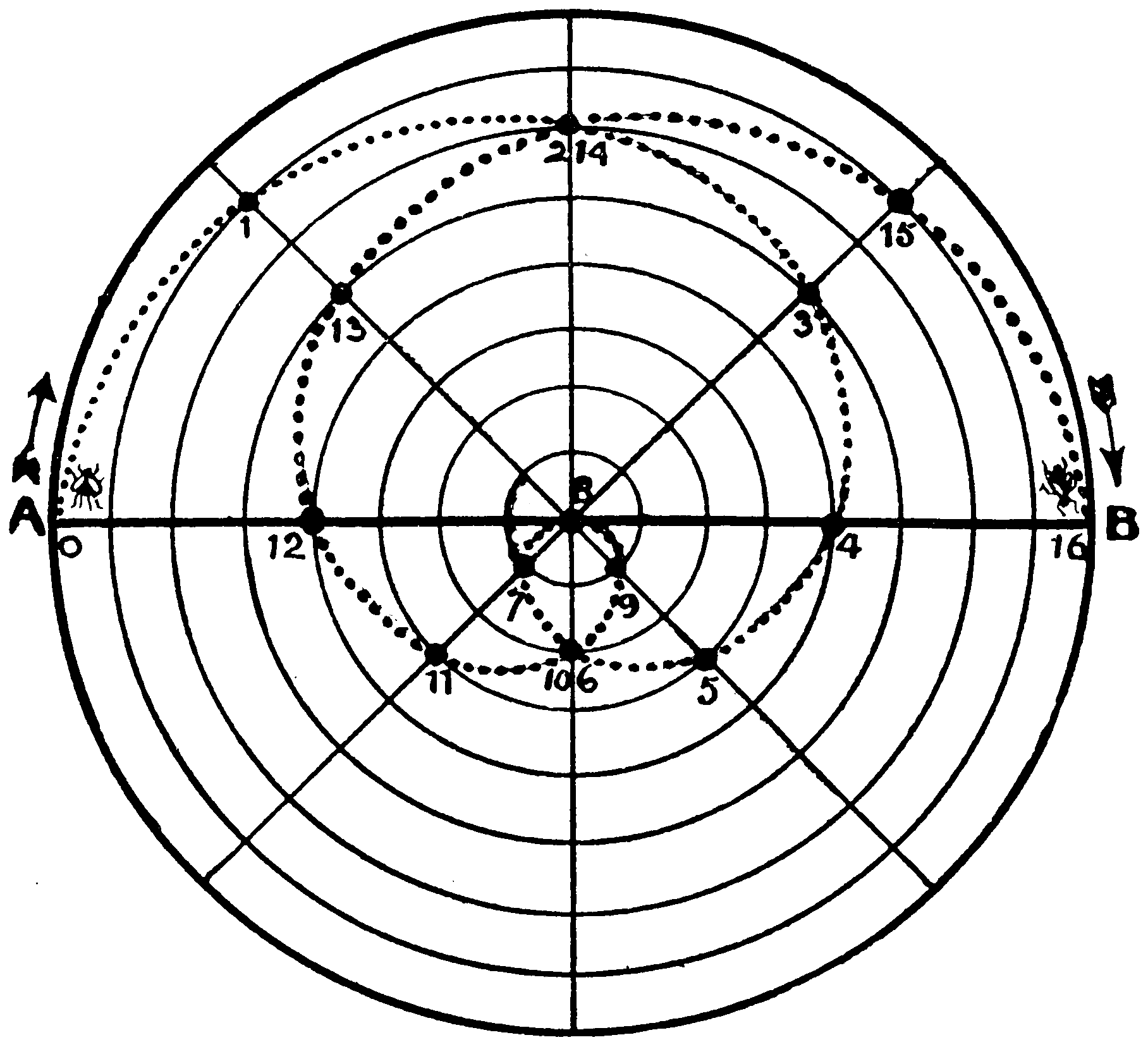
When a fly, starting from the point A, just outside the revolving disc, and always making straight for its mate at the point B, crosses the disc in four minutes, during which time the disc is turning twice, the revolution of the disc has a most curious and interesting effect on the path of the fly.
The fly is a quarter of a minute in passing from the outside circle to the next, during which the disc has made an eighth of a revolution, and the fly has reached the point marked 1. The succeeding points up to 16 show the position of the fly at each quarter of a minute, until, by a prettily repeated curve, B is reached.
Back to Description
No. LXXI.—A SHUNTING PUZZLE
The following method enables the engine R to interchange the positions of the wagons, P and Q, for either of which there is room on the straight rails at A, while there is not room there for the engine, which, if it runs up either siding, must return the same way:—
1. R pushes P into A. 2. R returns, pushes Q up to P in A, couples Q to P, draws them both out to F, and then pushes them to E. 3. P is now uncoupled, R takes Q back to A, and leaves it there. 4. R returns to P, pulls P back to C, and leaves it there. 5. R, running successively through F, D, B, comes to A, draws Q out, and leaves it at B.
Back to Description
No. LXXV.—PHARAOH’S SEAL
It is quite puzzling to decide how many similar triangles or pyramids are expressed on the seal of Pharaoh. There are in fact 96.
Back to Description
No. LXXVI.—ROUND THE GARDEN
The four persons who started at noon from the central fountain, and walked round the four paths at the rates of two, three, four, and five miles an hour would meet for the third time at their starting point at one o’clock, if the distance on each track was one-third of a mile.
Back to Description
No. LXXVII.—A JOINER’S PUZZLE
This diagram shows how to divide Fig. A into two parts, and so rearrange these that they form either Fig. B or Fig. C, without turning either of the pieces.
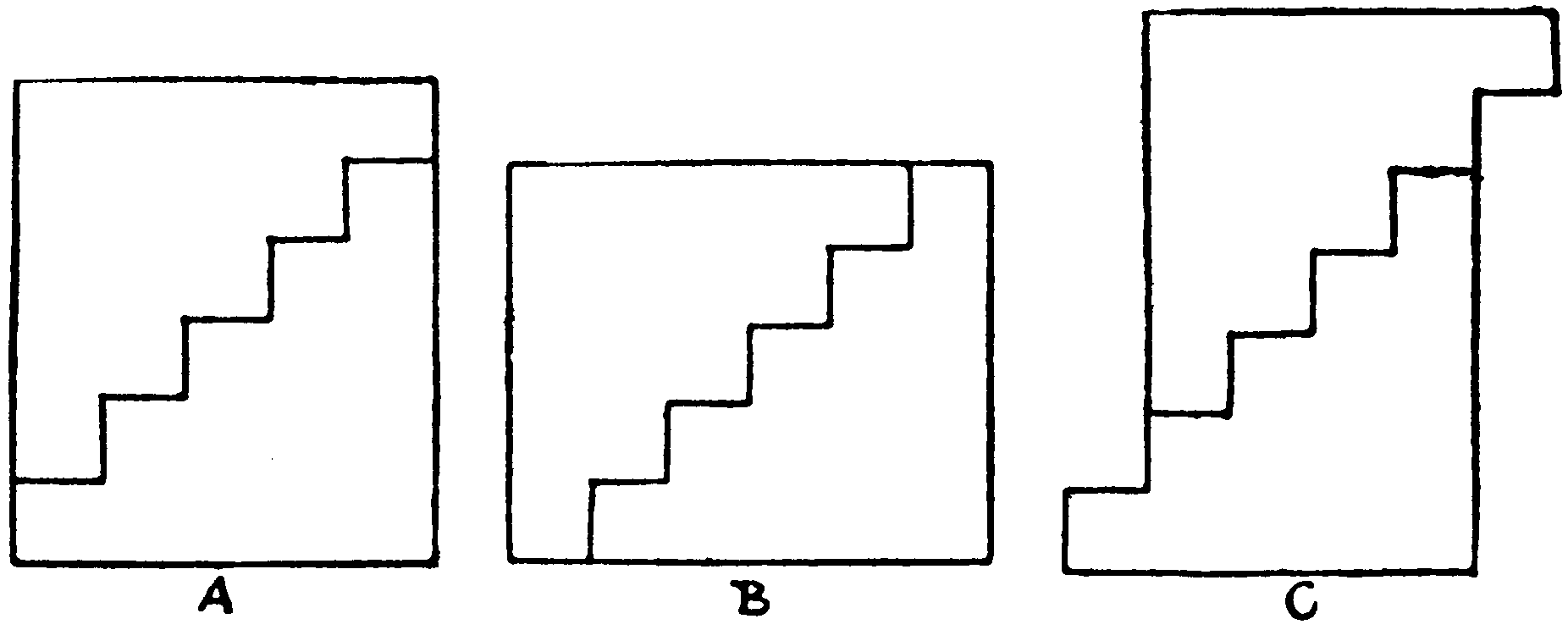
Cut the five steps, and shift the two pieces as is shown.
Back to Description
No. LXXVIII.—THE BROKEN OCTAGON
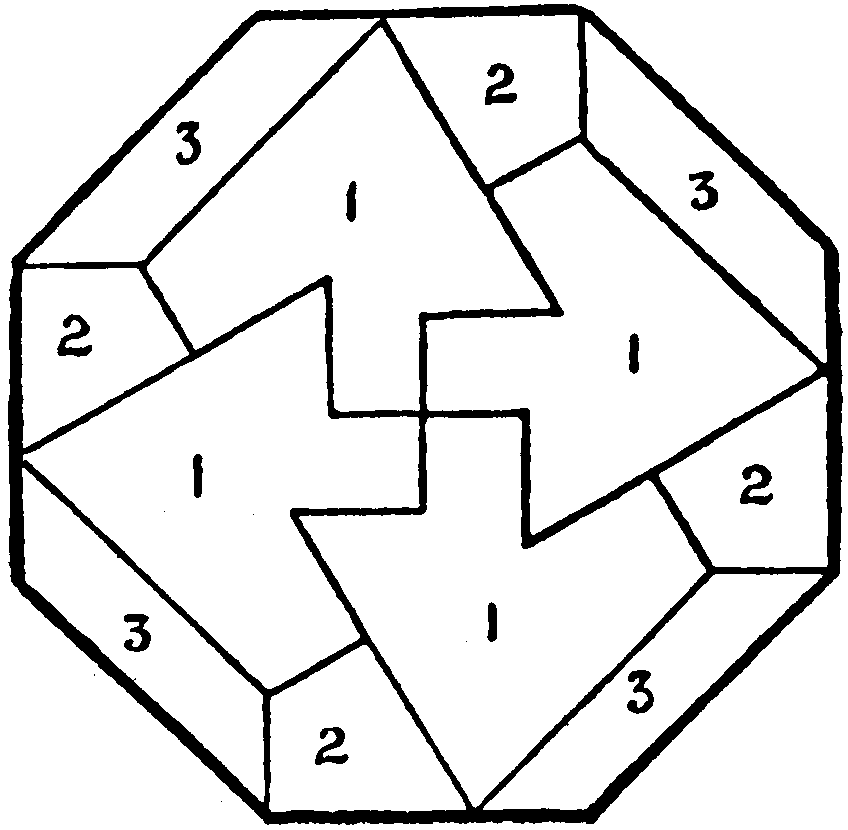
The Broken Octagon is repaired and made perfect if its pieces are put together thus:—
Back to Description
No. LXXIX.—AT A DUCK POND
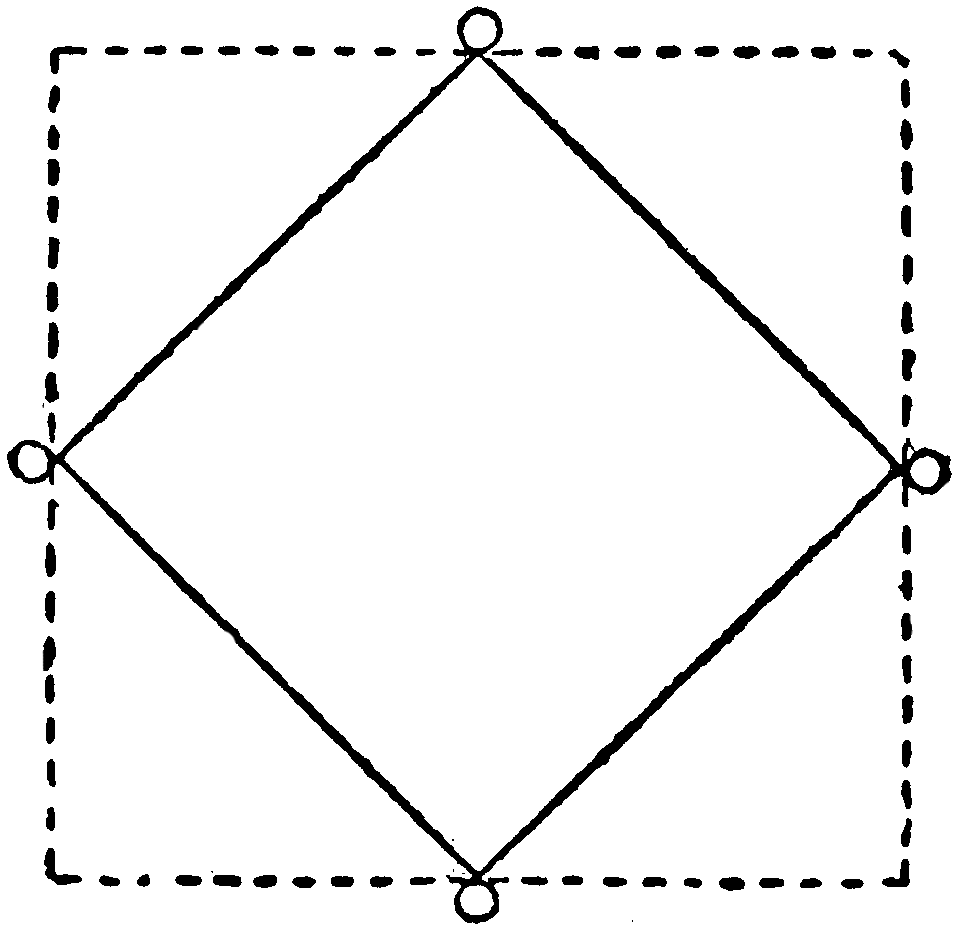
The pond was doubled in size without disturbing the duck-houses, thus:—
Back to Description
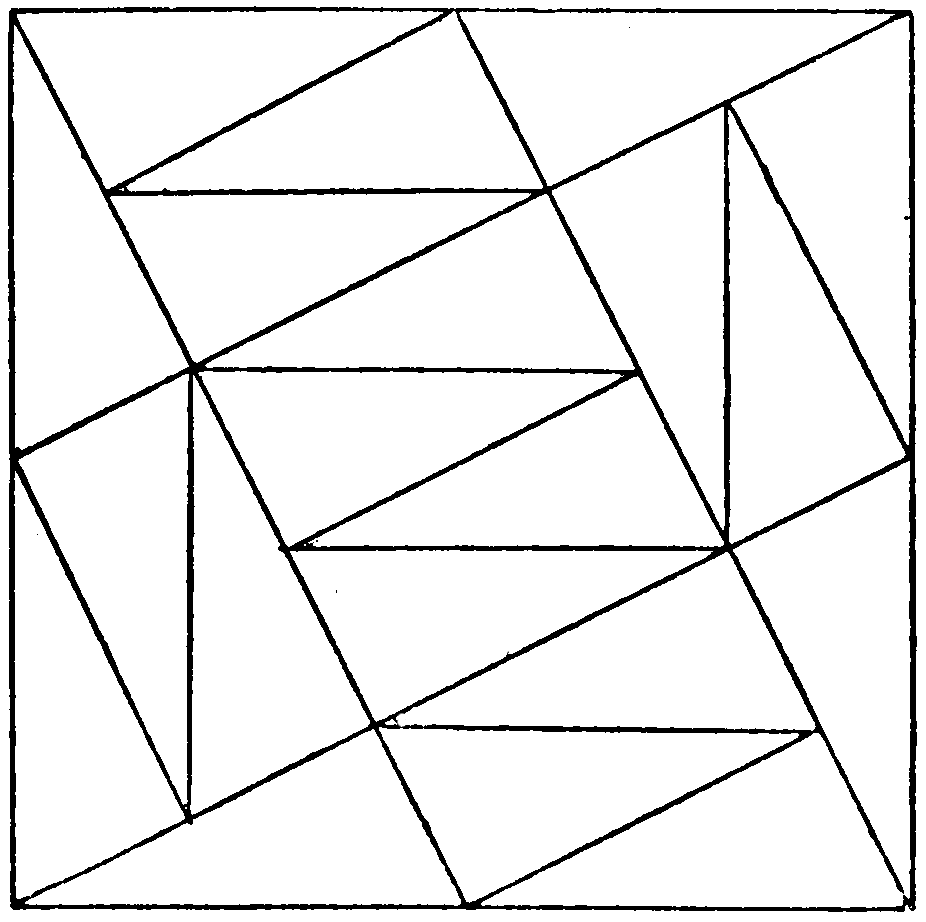
No. LXXX.—ALL ON THE SQUARE
This is a perfect arrangement:—
Back to Description
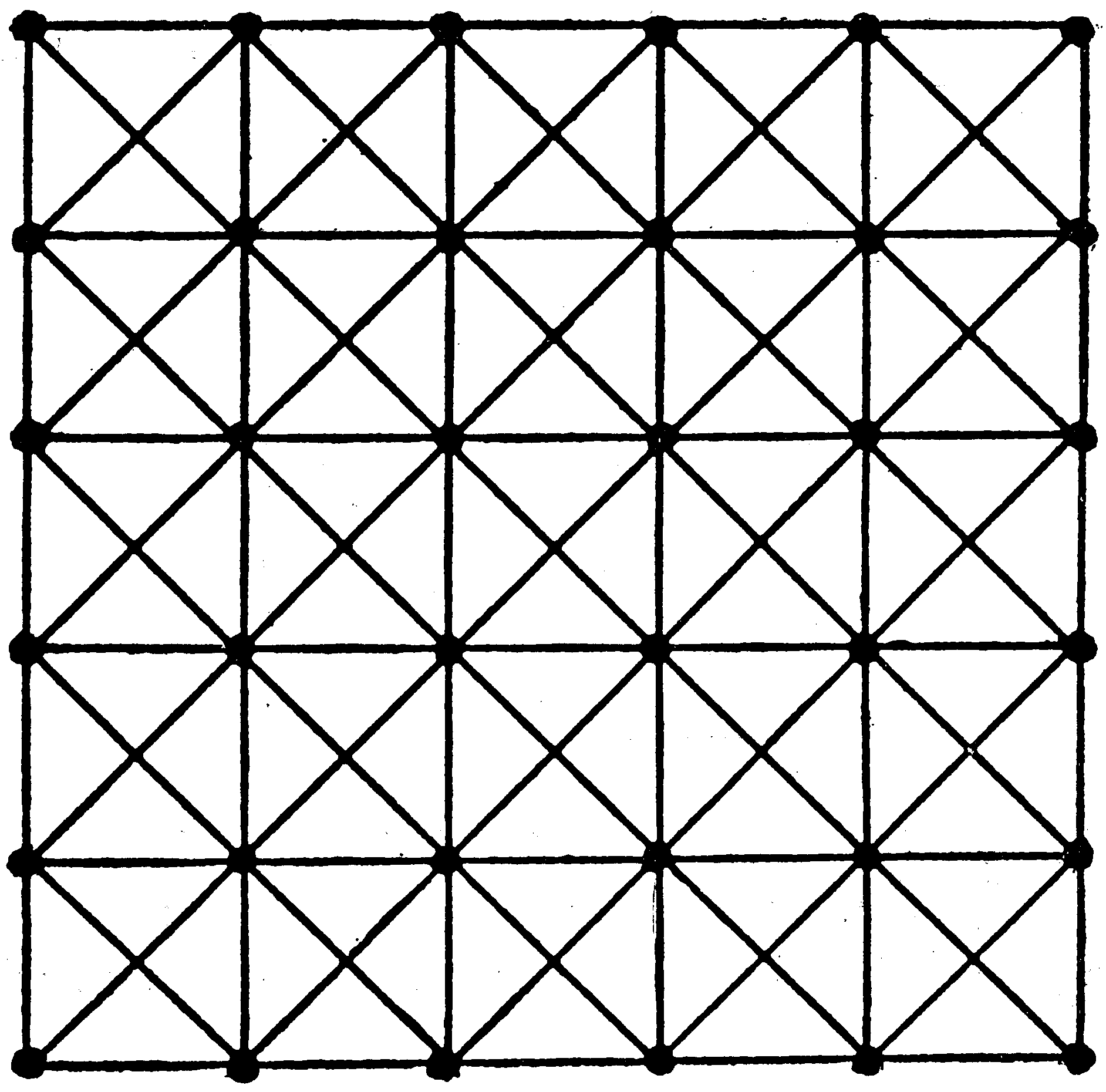
No. LXXXI.—PINS AND DOTS
The pins may be placed thus:—
On the third dot in the top line; on the sixth dot in the second line; on the second dot in the third line; on the fifth dot in the fourth line; on the first dot in the fifth line; on the fourth dot in the sixth line.
Back to Description
No. LXXXII.—A TRICKY COURSE
To trace this course draw lines upon the diagram from square 46 to squares 38, 52, 55, 23, 58, 64, 8, 57, 1, 7, 42, 10, 13, 27, and 19. This gives fifteen lines which pass through every square only once.
Back to Description
No. LXXXIII.—FOR THE CHILDREN
Make a square with three on every side, and place the remaining four one on each of the corner men or buttons.
Back to Description
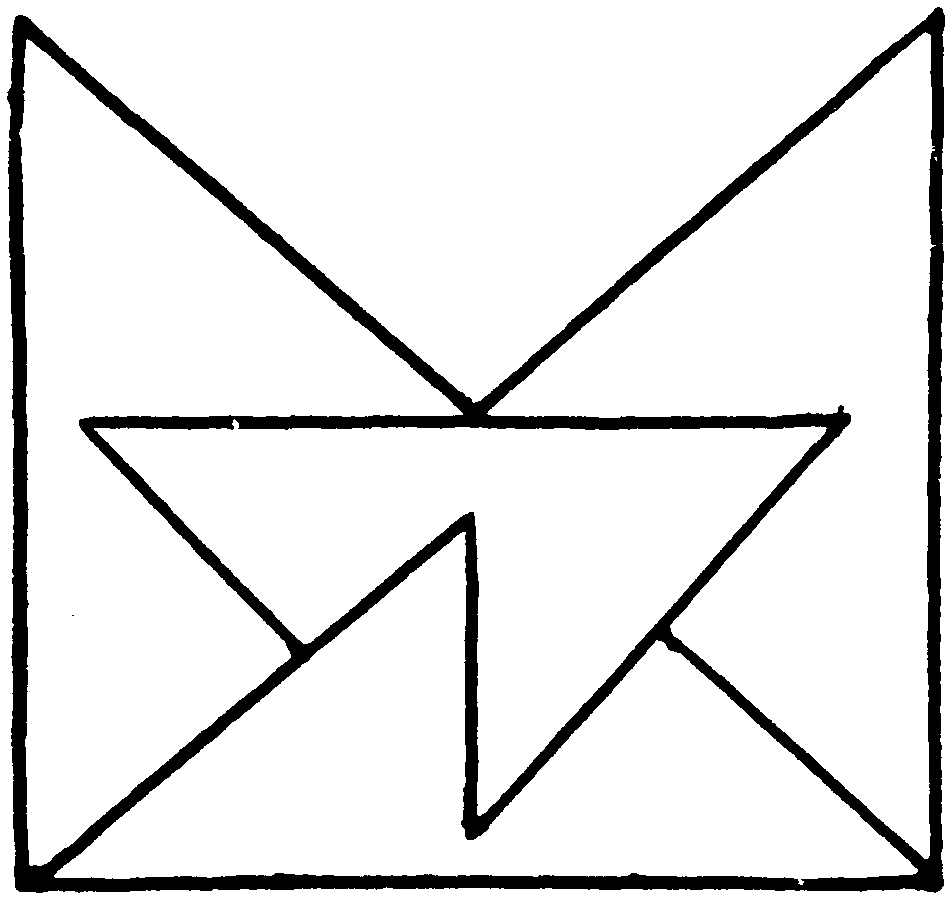
No. LXXXVII.—LOYD’S MITRE PROBLEM
The figure given is thus divided into four equal and similar parts:—
Back to Description
No. LXXXIX.—CUT OFF THE CORNERS
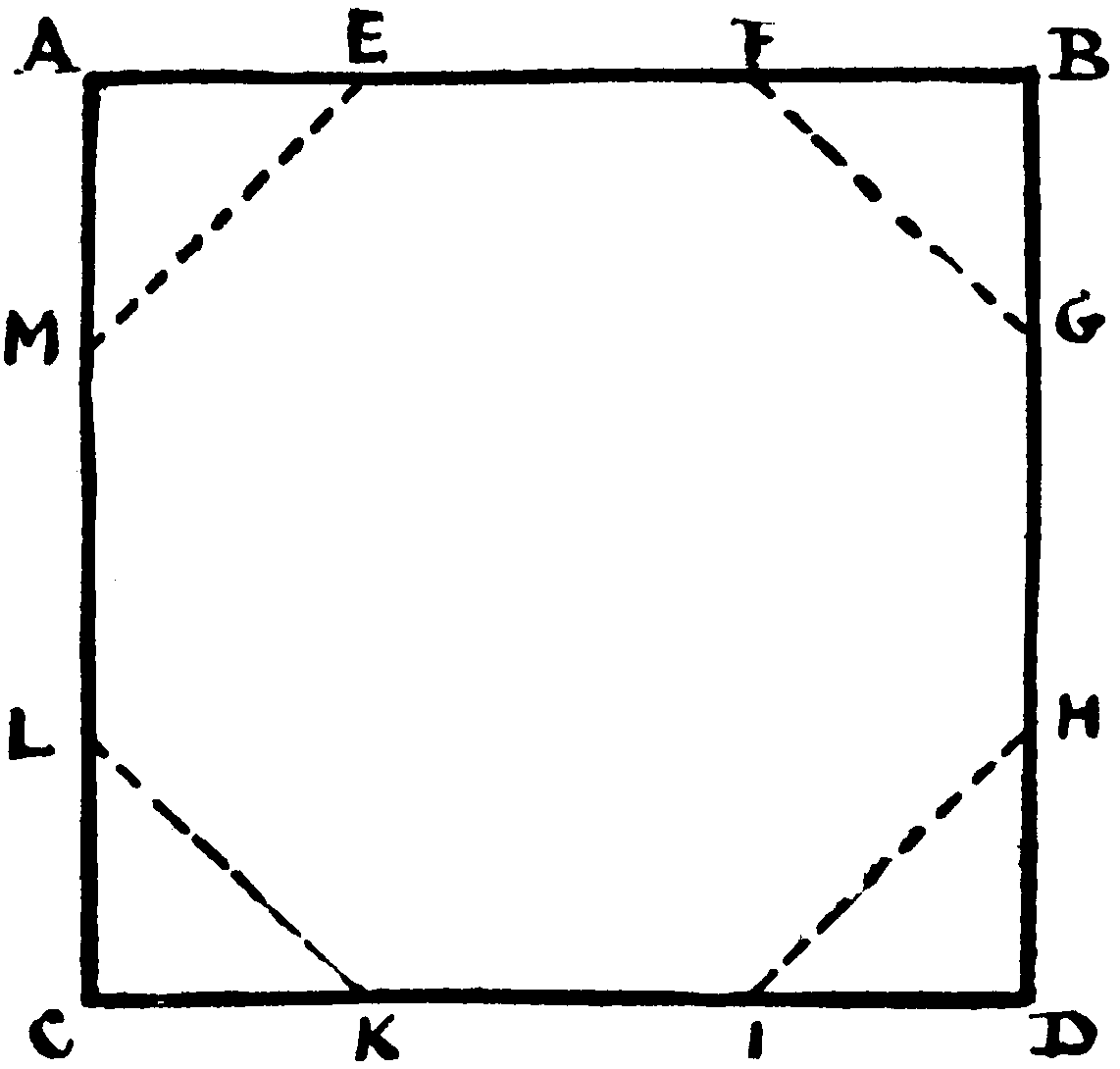
A very simple rule of thumb method for striking the points in the sides of a square, which will be at the angles of an octagon formed by cutting off equal corners of the square, is to place another square of equal size upon the original one, so that the centre is common to both, and the diagonal of the new square lies upon a diameter of the other parallel to its side.
Back to Description
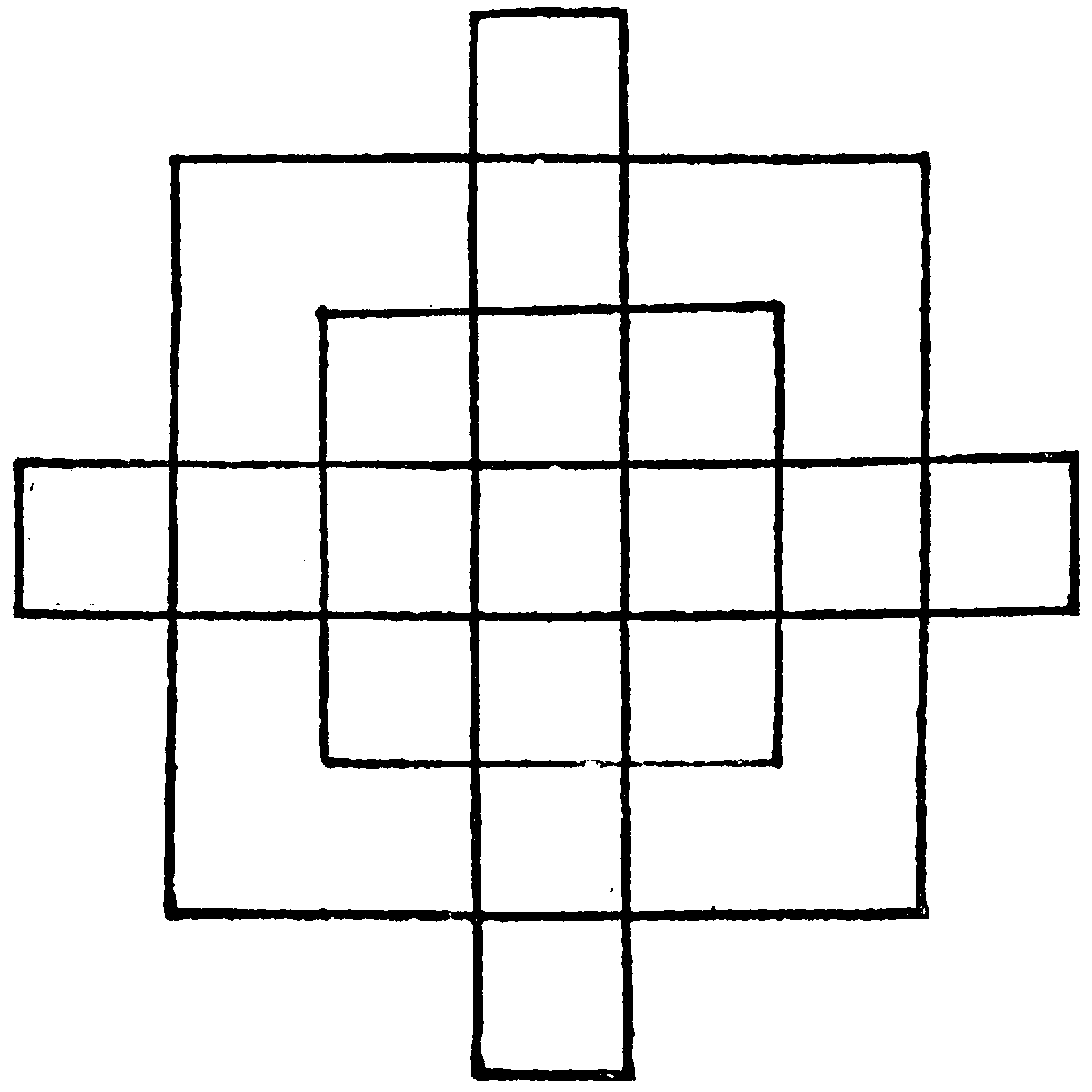
No. XCIII.—MAKING MANY SQUARES
The subjoined diagram shows how the two oblongs, applied to the two concentric squares, produce 31 perfect squares, namely, 17 small ones, one equal to 25 of these, 5 equal to 9, and 8 equal to 4.
Back to Description
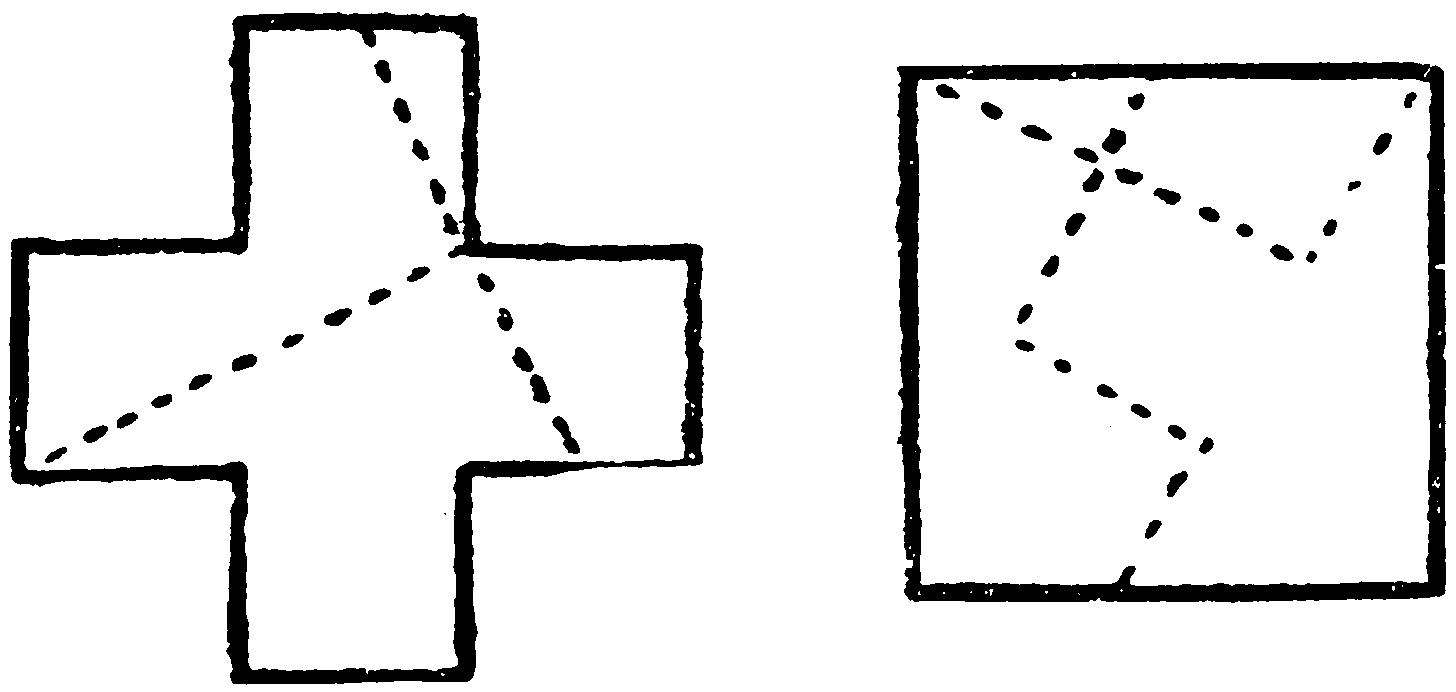
No. XCIV.—CUT ACROSS
The Greek Cross can be divided by two straight cuts, so that the resulting pieces will form a perfect square when re-set, as is shown in these figures:—
Back to Description
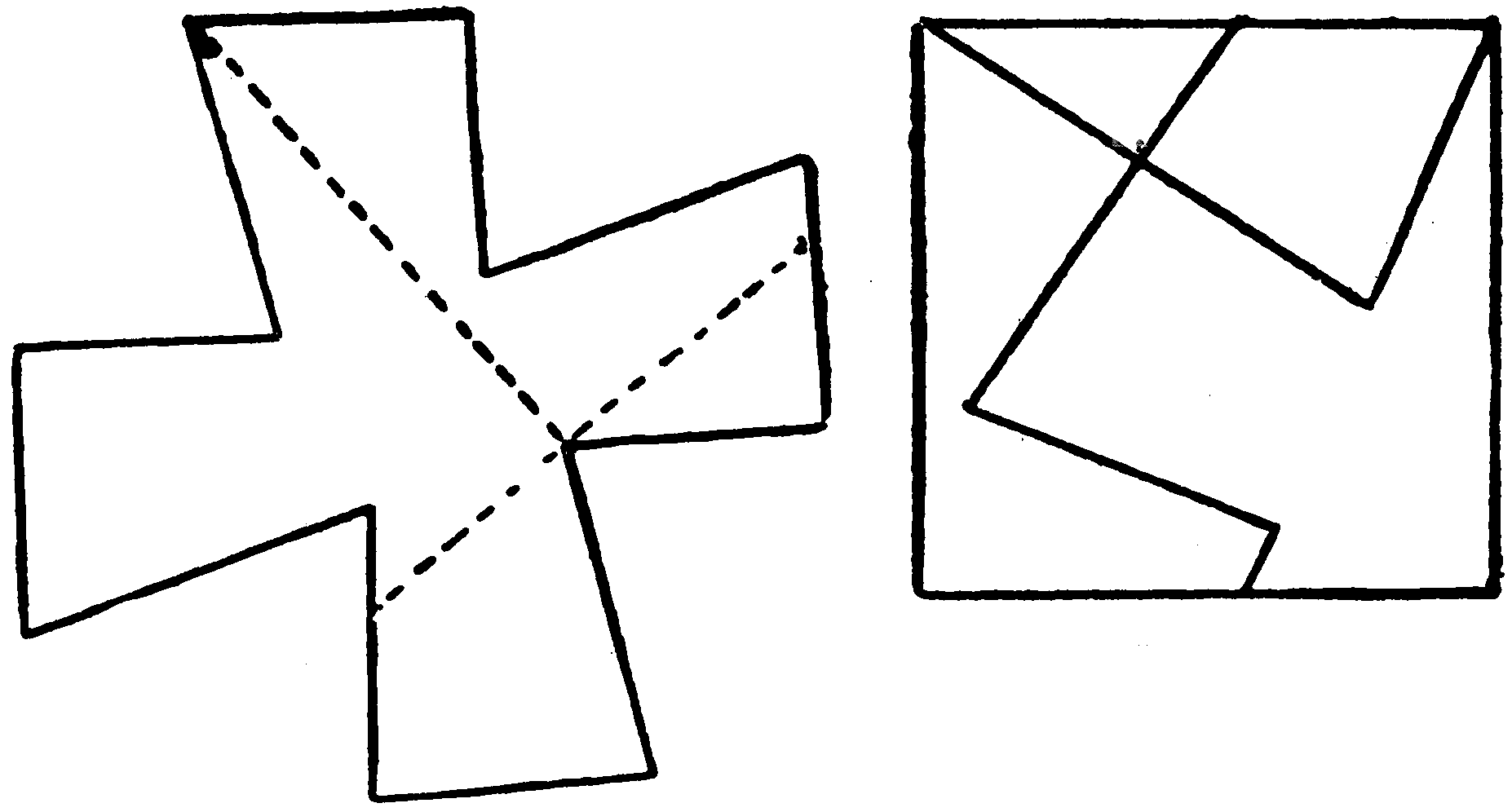
No. CV.—A TRANSFORMATION
The diagram which is given below shows how the irregular Maltese Cross can be divided by two straight cuts into four pieces, which form when properly rearranged, a perfect square.
Back to Description
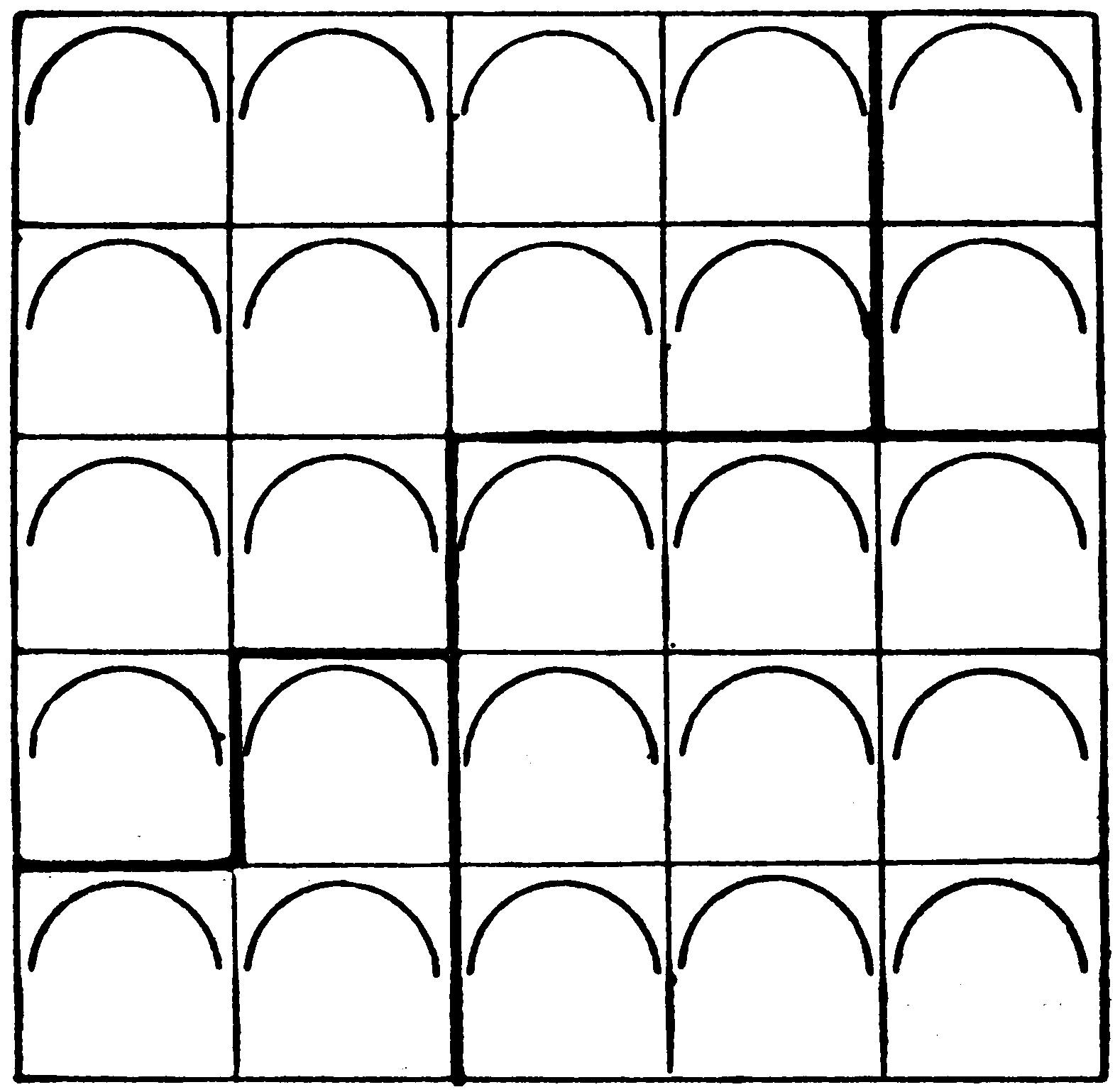
No. CVI.—SHIFTING THE CELLS
The following diagram shows by its dark lines how the whole square can be cut into four pieces, and these arranged as two perfect squares in which every semicircle still occupies the upper half of its cell.
One piece forms a square of nine cells, and it is easy to arrange the other three pieces in a square of sixteen cells by lifting the three cells and dropping the two.
Back to Description
No. CVII.—IN A TANGLE
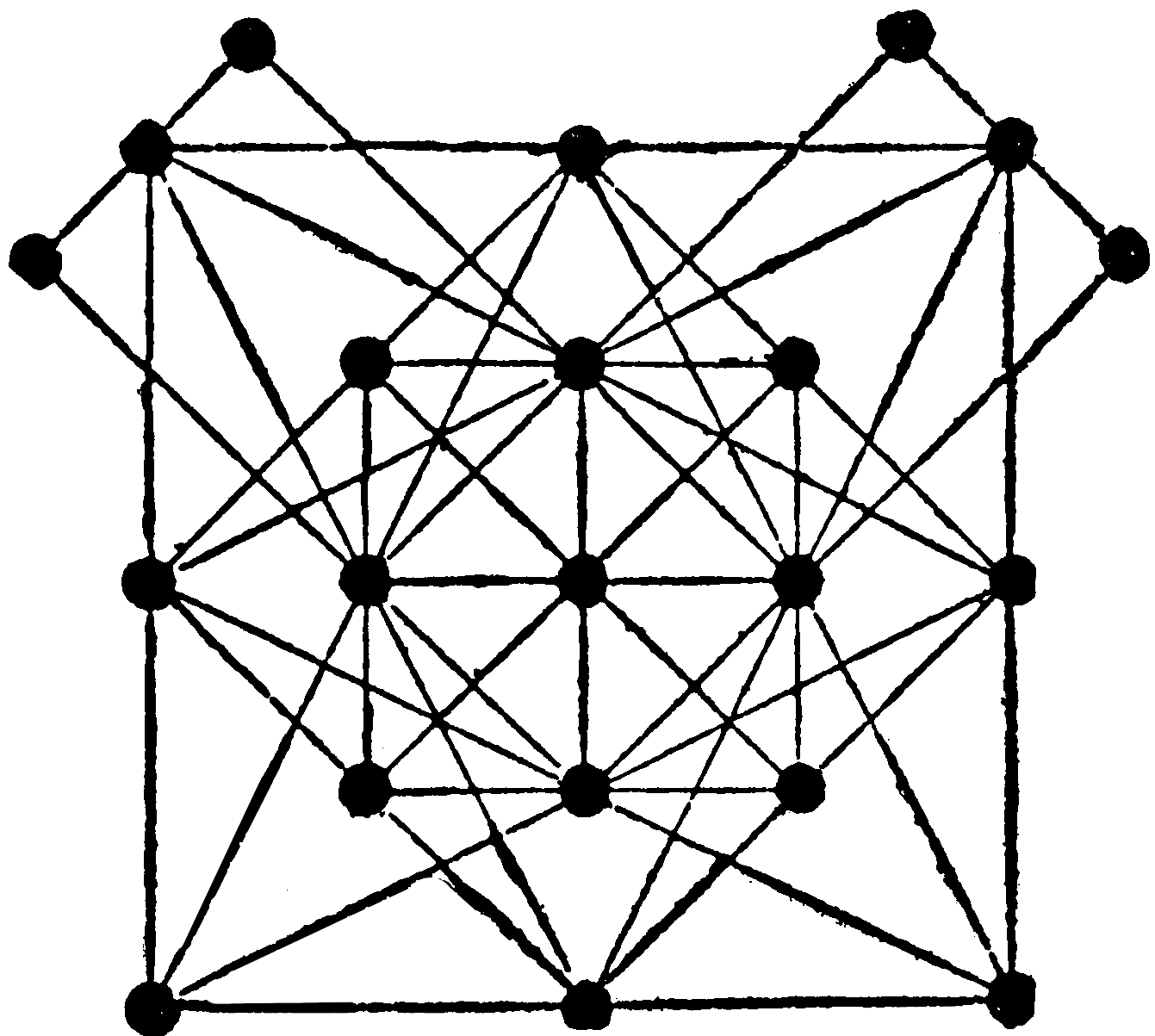
It will be seen, on the subjoined diagram, how twenty-one counters or coins can be placed on the figure so that they fall into symmetrical design, and form thirty rows, with three in each row.
Back to Description
No. CVIII.—STILL A SQUARE
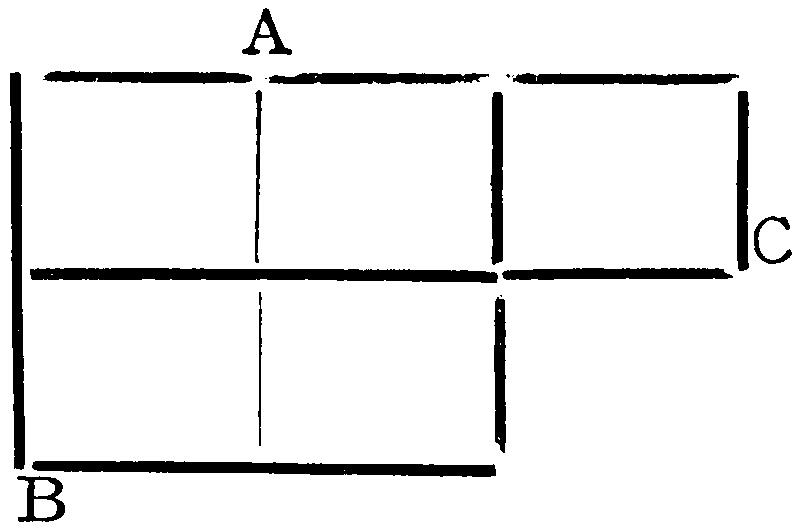
In order that a square and an additional quarter may be divided by two straight lines so that their parts, separated and then reunited, form a perfect square, lines must be drawn from the point A to the corners B and C. Draw the figure on paper, cut through these lines, and you will find that the pieces can be so reunited that they form a perfect square.
Back to Description
No. CIX.—A TRANSFORMATION
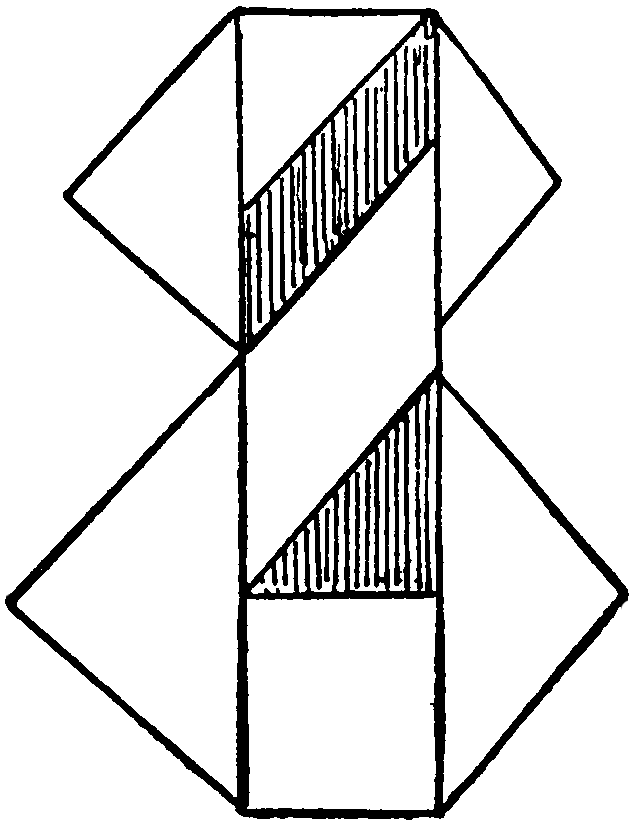
The diagram below shows how the seven parts of the square can be rearranged so that they form the figure 8.
Back to Description
No. CX.—TO MAKE AN OBLONG
Here is an oblong formed by piecing together two of the smaller triangles, and four of each of the other patterns—
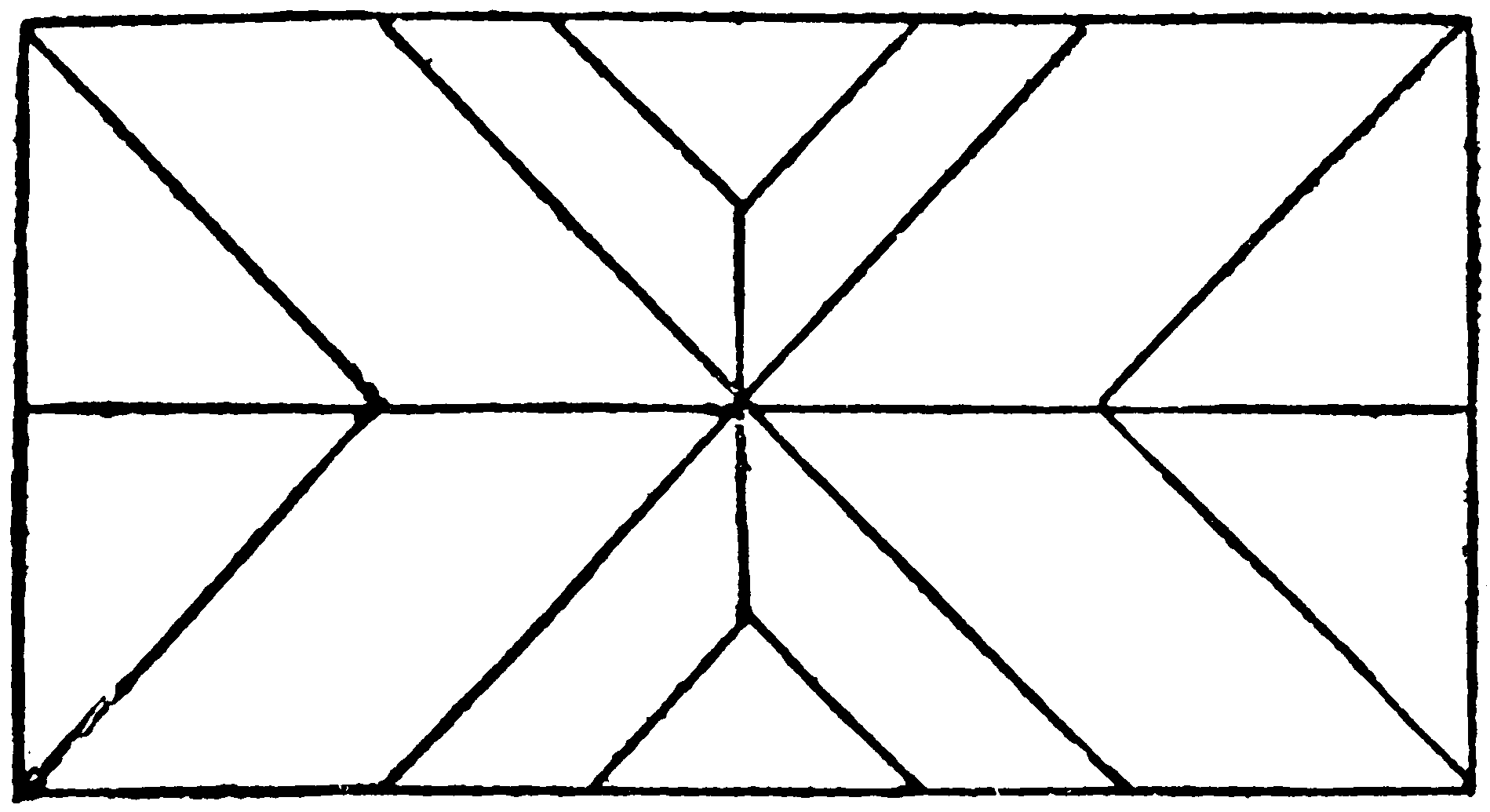
Here is another:—
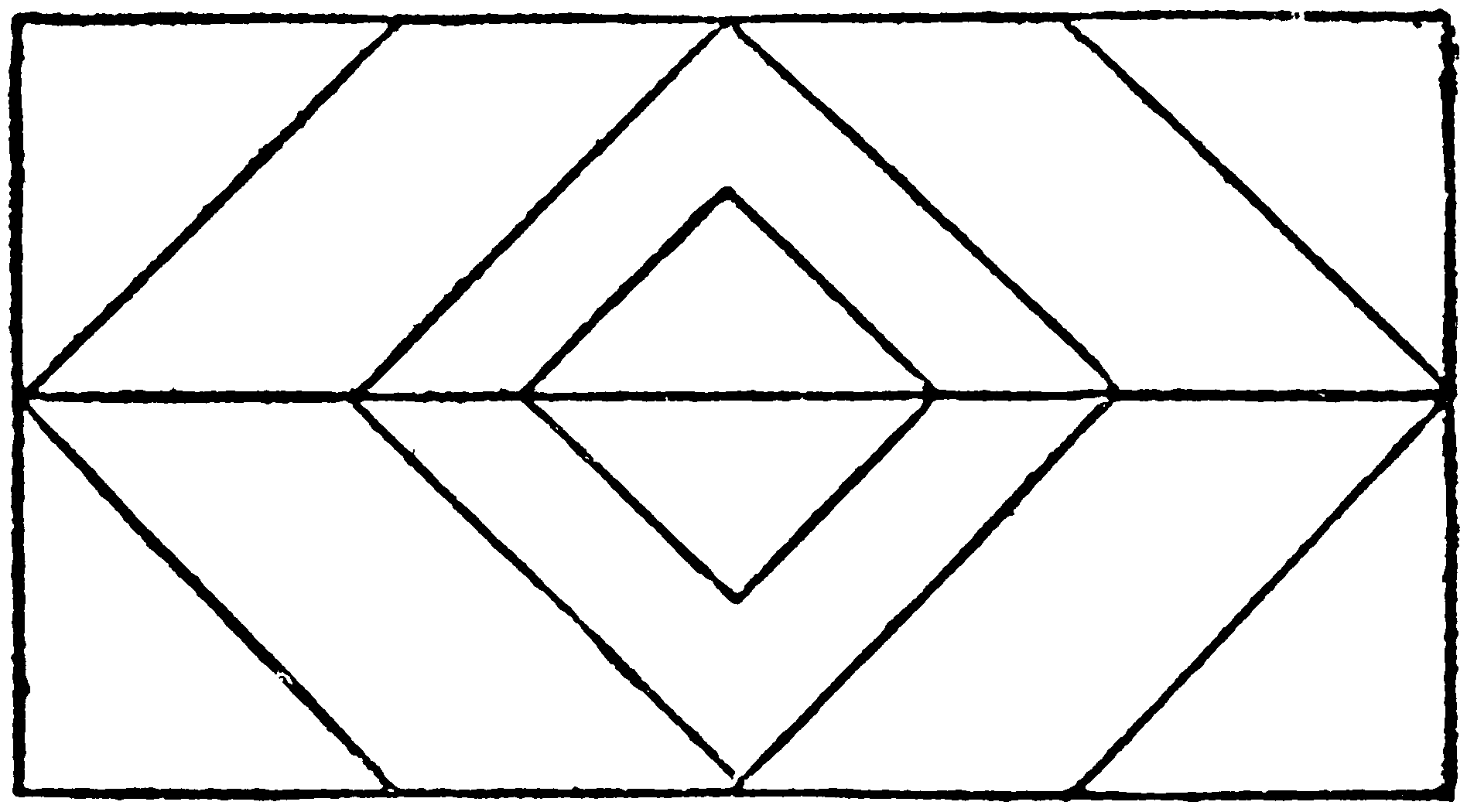
Back to Description
No. CXI.—SQUARES ON THE CROSS
This diagram shows how every indication of the seventeen squares is broken up by the removal of seven of the asterisks which mark their corners.
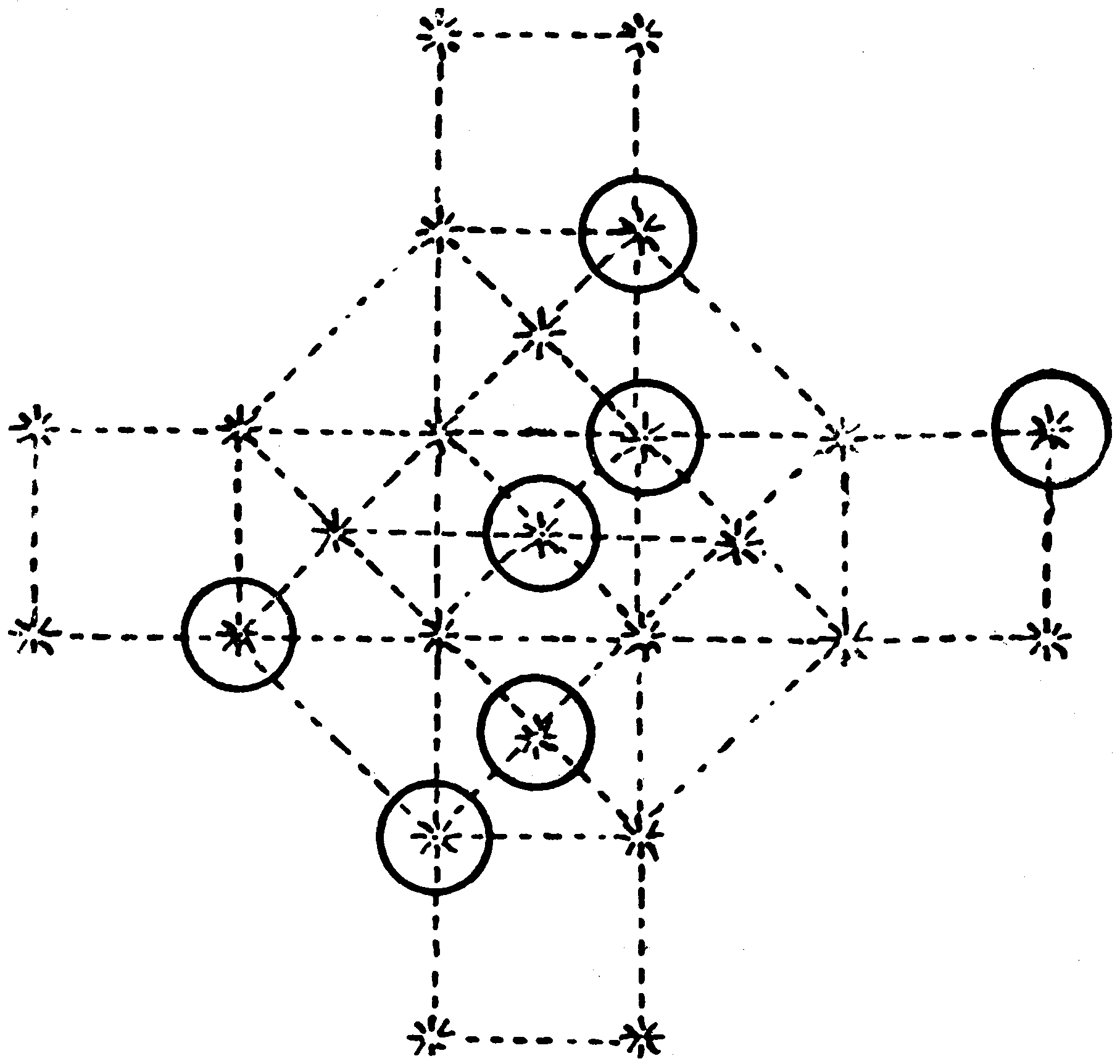
Those surrounded by circles are to be removed.
Back to Description
No. CXII.—A CHINESE PUZZLE
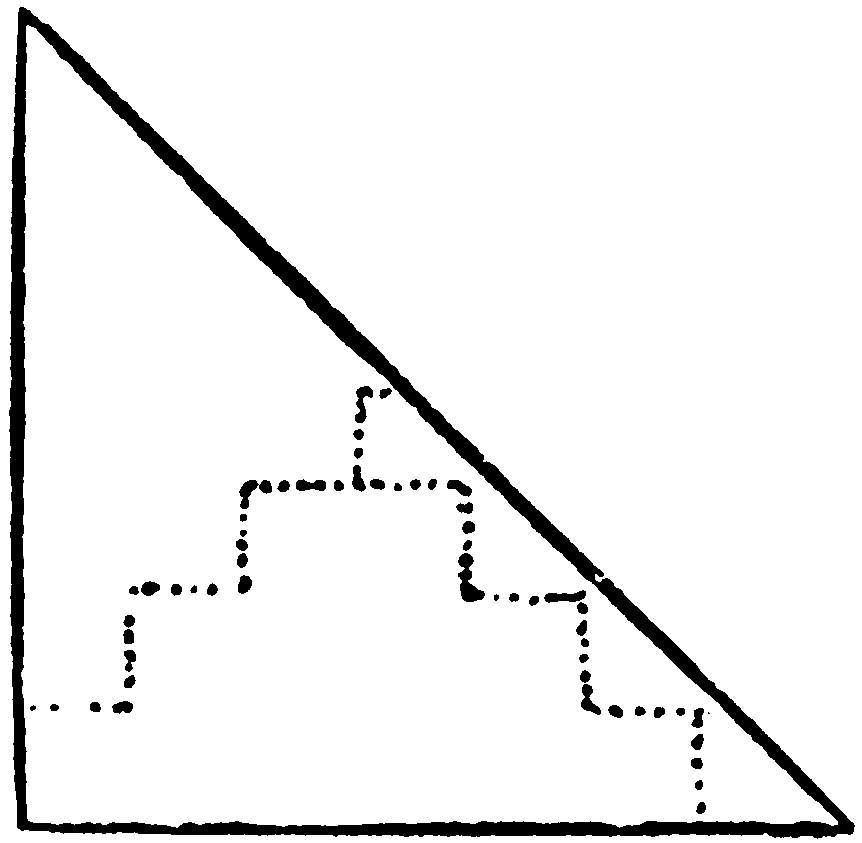
The dotted lines on the triangular figure show how a piece of cardboard cut to the shape of Fig. 1 can be divided into three pieces, and rearranged so that these form a star shaped as in Fig. 2.
Back to Description
No. CXIII.—FIRESIDE FUN
To solve this puzzle slip the first coin or counter from A to D, then the others in turn from F to A, from C to F, from H to C, from E to H, from B to E, from G to B, and place the last on G. It can only be done by a sequence of this sort, in which each starting point is the finish of the next move.
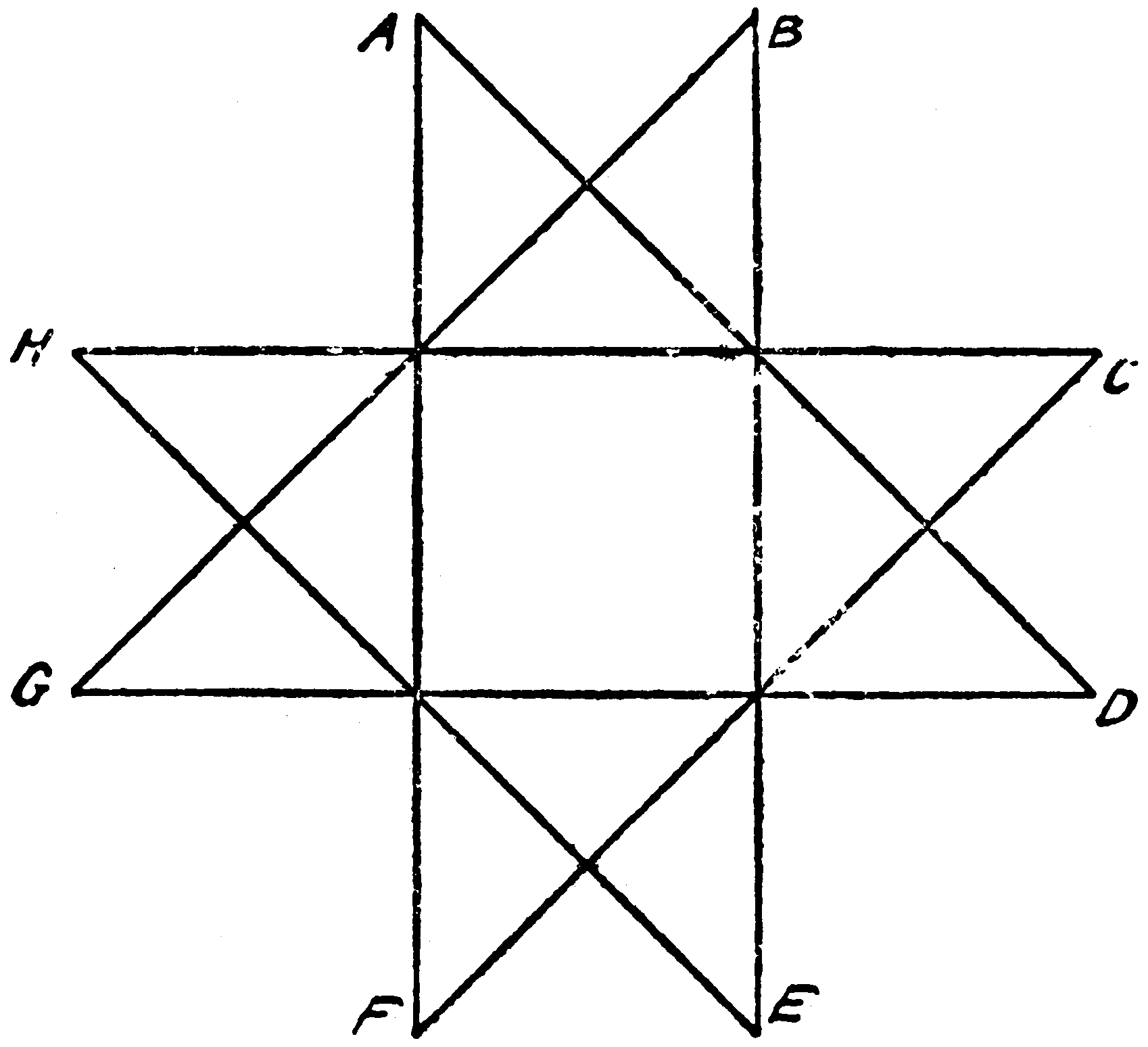
Back to Description
AMUSING PROBLEMS
1. THE CARPENTER’S PUZZLE
The carpenter cleverly contrived to mend a hole 2 feet wide and 12 feet long, by cutting the board which was 3 feet wide and 8 feet long, as is shown in Fig. 1, and putting the two pieces together as is shown in Fig. 2.

Back to Problem
2. GOLDEN PIPPINS
Here is another solution:—
1 3 5 7 9 11 13 15 17 19
39 37 35 33 31 29 27 25 23 21
2 4 6 8 10 12 14 16 18 20
40 38 36 34 32 30 28 26 24 22
82 82 82 82 82 82 82 82 82 82
Back to Problem
3. AN AWKWARD FIX
I was able to find my way in a strange district, when the sign-post lay uprooted in the ditch, without any difficulty. I simply replaced the post in its hole, so that the proper arm, with its lettering, pointed the way that I had come, and then, of necessity, the directions of the other arms were correct.
Back to Problem
4. LINKED SWEETNESS LONG DRAWN OUT
The train was whistling for 5 minutes. Sound travels about a mile in 5 seconds, so the first I heard of it was 5 seconds after it began. Its last sound reached me 71⁄2 seconds after it ceased, so I heard the whistle for 5 minutes, 21⁄2 seconds.
Back to Problem
5.
These quarters were not so elastic as they are made to appear. In good truth, considering that the second man who was placed in A was afterwards removed to I, no real second man was provided for at all.
Back to Problem
6.
The first day of a new century can never be Sunday, Wednesday, or Friday. The cycle of the Gregorian calendar is completed in 400 years, after which all dates repeat themselves.
As in this cycle there are only four first days of a century, it is clear that three of the seven days of the week must be excluded. Any perpetual calendar shows that the four which do occur are Monday, Tuesday, Thursday, and Saturday, so that Sunday, Wednesday, and Friday are shut out.
A neat corollary to this proof is that Monday is the only day which may be the first, or which may be the last, day of a century.
Back to Problem
7.
A cricket bat with spliced handle has such good driving power, because the elasticity of the handle allows the ball to be in contact with the blade of the bat for a longer time than would otherwise be possible.
With similar effect the “follow through” of the club head at golf maintains contact with the ball, when it is already travelling fast.
Back to Problem
8.
When two volumes stand in proper order on my bookshelf, each 2 inches thick over all, with covers 1⁄8 of an inch in thickness, a bookworm would only have to bore 1⁄4 of an inch, to penetrate from the first page of Vol. I, to the last page of Vol. II, for these pages would be in actual contact if there was no binding. This very pretty and puzzling question combines in its solution all the best qualities of a clever catch with solid and simple facts.
Back to Problem
9.
A man would have to fall from a height of nearly 15 miles to reach earth before the sound of his cry as he started. The velocity of sound is constant, while that of a falling body is continually accelerated. At first the cry far outstrips the falling man, but he overtakes and passes through his own scream in about 141⁄2 miles, for his body falls through the 15 miles in 70 seconds, and sound travels as far in 72 seconds. Air resistance, and the fact that sound cannot pass from a rare to a dense atmosphere, are disregarded in this curious calculation.
Back to Problem
10.
A man on a perfectly smooth table in a vacuum, and where there was no friction, though no contortions of his body would avail to get away from this position, could escape from the predicament by throwing from him something which he could detach from his person, such as his watch or coat. He would himself instantly slide off in the opposite direction!
Back to Problem
11.
The monkey clinging to one end of a rope that passes over a single fixed pulley, while an equal weight hangs on the other end, cannot climb up the rope, or rise any higher from the ground.
If he continues to try to climb up, he will gradually pull the balancing weight on the other end of the rope upwards, and the slack of the rope will drop below him, while he remains in the same place.
If, after some efforts, he rests, he will sink lower and lower, until the weight reaches the pulley, because of the extra weight of rope on his side, if friction is disregarded.
Back to Problem
12.
Though the tension on a pair of traces tends as much to pull the horse backward as it does to pull the carriage forward, it is the initial pull from slack to taut which sets the traces in motion; and this, once started, must continue indefinitely until checked by a counter pull.
Back to Problem
13.
Some say that a rubber tyre leaves a double rut in dust and a single one in mud, because the air, rushing from each side into the wake of the wheel, piles up the loose dust. Others hold that the central ridge is caused by the continuous contraction of the tyre as it passes its point of contact with the road.
A correspondent, writing some years ago to “Knowledge,” said:—“It is our old friend the sucker. The tyre being round, the weight on centre of track only is great enough to enable the tyre to draw up a ridge of dust after it.”
Back to Problem
14.
If two cats on a sloping roof are on the point of slipping off, one might think that whichever had the longest paws (pause) would hold on best. Todhunter, in playful mood, saw deeper into it than that, and pronounced for the cat that had the highest mew, for to his mathematical mind the Greek letter mu was the coefficient of friction!
Back to Problem
15.
If a penny held between finger and thumb, and released by withdrawing the finger, starts “heads” and makes half a turn in falling through the first foot, it will be “heads” again on reaching the floor, if it is held four feet above it at first.
Back to Problem
16. HE DID IT!
Funnyboy had secretly prepared himself for the occasion by rubbing the chemical coating from the side of the box on to his boot.
Back to Problem
17. THE CYCLE SURPRISE
If a bicycle is stationary, with one pedal at its lowest point, and that pedal is pulled backwards, while the bicycle is lightly supported, the bicycle will move backwards, and the pedal relatively to the bicycle, will move forwards. This would be quite unexpected by most people, and it is well worth trying.
Back to Problem
18.
The rough stones, by which any number of pounds, from 1 to 364, can be weighed, are respectively 1 ℔., 3 ℔s., 9 ℔s., 27 ℔s., 81 ℔s., and 243 ℔s. in weight.
Back to Problem
19.
If we disregard the resistance of the air, a small clot of mud thrown from the hindermost part of a wheel would describe a parabola, which would, in its descending limb, bring it back into kissing contact with the wheel which had rejected it.
Back to Problem
20. THE CARELESS CARPENTER
When the carpenter cut the door too little, he did not in fact cut it enough, and he had to cut it again, so that it might fit.
Back to Problem
21.
If from the North Pole you start sailing in a south-westerly direction, and keep a straight course for twenty miles, you must steer due north to get back as quickly as possible to the Pole, if, indeed, it has been possible to start from it in any direction other than due south.
Back to Problem
22. DICK IN A SWING
Dick’s feet will travel in round numbers nearly 16 feet further than his head, or to be exact, 15·707,960 feet.
Back to Problem
23. A POSER
The initial letters of Turkey, Holland, England, France, Italy, Norway, Austria, Lapland, and Spain spell, and in this sense are the same as, “the finals.”
Back to Problem
CURIOUS CALCULATIONS
1.
The only sum of money which satisfies the condition that its pounds, shillings, and pence written down as a continuous number, exactly give the number of farthings which it represents, is £12, 12s., 8d., for this sum contains 12,128 farthings.
Back to Description
2.
If, when a train, on a level track, and running all the time at 30 miles an hour, slips a carriage which is uniformly retarded by brakes, and this comes to rest in 200 yards, the train itself will then have travelled 400 yards.
The slip carriage, uniformly retarded from 30 miles an hour to no miles an hour, has an average speed of 15 miles an hour, while the train itself, running on at 30 miles an hour all the time, has just double that speed, and so covers just twice the distance.
Back to Description
3.
The traveller had fivepence farthing when he said to the landlord, “Give me as much as I have in my hand, and I will spend sixpence with you.” After repeating this process twice he had no money left.
Back to Description
4.
This is the way to obtain eleven by adding one-third of twelve to four-fifths of seven—
TW(EL)VE + S(EVEN) = ELEVEN
Back to Description
5.
Here is the completed sum:—
2 1 5 ) * 7 * 9 * ( 1 * * 2 1 5 ) 3 7 1 9 5 ( 1 7 3
* * * 2 1 5
* 5 * 9 1 5 6 9
* 5 * 5 1 5 0 5
* 4 * 6 4 5
* * * 6 4 5
The clue is that no figure but 3, when multiplied into 215, produces 4 in the tens place.
Back to Description
6.
If I attempt to buy as many heads of asparagus as can be encircled by a string 2 feet long for double the price paid for as many as half that length will encompass, I shall not succeed. A circle double of another in circumference is also double in diameter, and its area is four times that of the other.
Back to Description
7.
If, when you reverse me, and my square, and my cube, and my fourth power, you find that no changes have been made, I am 11, my square is 121, my cube 1331, and my fourth power 14641.
Back to Description
8.
A thousand pounds can be stored in ten sealed bags, so that any sum in pounds up to £1,000 can be paid without breaking any of the seals, by placing in the bags 1, 2, 4, 8, 16, 32, 64, 128, 256, and 489 sovereigns.
Back to Description
9.
It is the fraction 6⁄9 which is unchanged when turned over, and which, when taken thrice, and then divided by two becomes 1.
Back to Description
10.
When the three gamblers agreed that the loser should always double the sum of money that the other two had before them, and they each lost once, and fulfilled the conditions, remaining each with eight sovereigns in hand, they had started with £13, £7, and £4 as the following table shows:—
A B C
£ £ £
At starts 13 7 4
When A loses 2 14 8
When B loses 4 4 16
When C loses 8 8 8
Back to Description
11.
Tom’s sum, which his mischievous neighbour rubbed almost out, is reconstructed thus:—
3 4 5 3 4 5
* * 3 7
* * * * 2 4 1 5
* * * * 1 0 3 5
* * 7 6 * 1 2 7 6 5
Back to Description
12.
Here are two other arrangements of the nine digits which produce 45, their sum; each is used once only:—
5 × 8 × 9 × (7 + 2)1 × 3 × 4 × 6 = 45
72 - 5 × 8 × 93 × 4 × 6 + 1 = 45
Back to Description
13.
If, when the combined ages of Mary and Ann are 44, Mary is twice as old as Ann was when Mary was half as old as Ann will be when Ann is three times as old as Mary was when Mary was three times as old as Ann, Mary is 271⁄2 years old, and Ann is 161⁄2.
For, tracing the question backwards, when Ann was 51⁄2 Mary was 161⁄2. When Ann is three times that age she will be 491⁄2. The half of this is 243⁄4, and when Mary was at that age Ann was 133⁄4. Mary’s age, by the question, was twice this, or 271⁄2.
Back to Description
14.
It is safer at backgammon to leave a blot in the tables which can be taken by an ace than one which a three would hit. In either the case of an actual ace or a three the chance is one in eleven; but there are two chances of throwing deuce-ace, the equivalent of three.
Back to Description
15.
If I start from a bay, where the needle points due north, 1200 miles from the North Pole, and the course is perfectly clear, I can never reach it if I steam continuously 20 miles an hour, steering always north by the compass needle. After about 200 miles I come upon the Magnetic Pole, which so affects the needle that it no longer leads me northward, and I may have to steer south by it to reach the geographical Pole.
Back to Description
16.
The 21 casks, 7 full, 7 half full, and 7 empty, were shared equally by A, B, and C, as follows:—
Full cask. Half full. Empty.
A 2 3 2
B 2 3 2
C 3 1 3
or—
A 3 1 3
B 3 1 3
C 1 5 1
Thus each had 7 casks, and the equivalent of 31⁄2 caskfuls of wine.
Back to Description
17.
The foraging mouse, able to carry home three ears at a time from a box full of ears of corn, could not add more than fourteen ears of corn to its store in fourteen journeys, for it had each time to carry along two ears of its own.
Back to Description
18.
If, with equal quantities of butter and lard, a small piece of butter is taken and mixed into all the lard, and if then a piece of this blend of similar size is put back into the butter, there will be in the end exactly as much lard in the butter as there is butter in the lard.
Back to Description
19.
The fallacy of the equation—
4 - 10 = 9 - 15 4 - 10 + 25⁄4 = 9 - 15 + 25⁄4
and the square roots of these—
2 - 5⁄2 = 3 - 5⁄2 therefore 2 = 3
is explained thus:—The fallacy lies in ignoring the fact that the square roots are plus or minus. In the working we have taken both roots as plus. If we take one root plus, and the other minus, and add 5⁄2, we have either 2 = 2, or 3 = 3.
Back to Description
20.
The largest possible parcel which can be sent through the post under the official limits of 3 feet 6 inches in length, and 6 feet in length and girth combined, is a cylinder 2 feet long and 4 feet in circumference, the cubic contents of which are 26⁄11 cubic feet.
Back to Description
21.
We can show, or seem to show, that either four, five, or six nines amount to 100, thus:—
999⁄9 = 100 IX IX IX IX IX 100 9 × 9 + 9 + 99⁄9 = 100
Back to Description
22.
This is the magic square arrangement, so contrived that the products of the rows, columns, and diagonals are all 1,000.
50 1 20
4 10 25
5 100 2
Back to Description
23.
If seven boys caught four crabs in the rock-pools at Beachy Head in six days, the twenty-one boys who searched under the seaweed and only caught one crab with the same rate of success were only at work for half a day.
Back to Description
24.
A watch could be set of a different trio from a company of fifteen soldiers for 455 nights, and one of them, John Pipeclay, could be included ninety-one times.
Back to Description
25.
If Augustus Cæsar was born September 23, B.C. 63, he celebrated his sixty-third birthday on September 23, B.C. 0; or, writing it otherwise, September 23, A.D. 0; or again, if we wish to include both symbols, B.C. 0 A.D. It is clear that his sixty-second birthday fell on September 23, B.C. 1, and his sixty-fourth on September 23, A.D. 1, so that the intervening year may be written as above.
Back to Description
26.
The difference of the ages of A and B who were born in 1847 and 1874, is 27, or 30 - 03. Hence, when A was 30 B was 03. And A was 30 in 1877. Eleven years later A was 41 and B 14, and eleven years after that A was 52 and B 25. Thus the same two digits served to express the ages of both in 1877, 1888, and 1899. This can only happen in the cases of those whose ages differ by some multiple of nine.