C. Curriculum Vitae and Excerpts from the Testimony of the Defendant Milch (continued 2)
Reading edition
Q. Witness, what was the development after Stalingrad of your relationship to Hitler and Goering?
Presiding Judge Toms: Before you go on, will you ask for the date of this conference of Hitler’s again?
A. It was on 5 March 1943.
On the question of how my relationship to Hitler and Goering developed later on I have to say the following: It became worse and worse from time to time. It was due to a struggle which I had about the German air defense which contradicted Hitler’s idea of waging war, for this was the specific field of the Luftwaffe and I as Inspector General of the Luftwaffe was forced to make suggestions. I did not let this matter drop, and I repeatedly brought it to the front, in contrast with political proposals or proposals in the field of the army and navy, which were outside of my field of tasks and which I could not bring to anyone’s attention unless Hitler gave me his permission or if he wished me to.
Q. With respect to this conference, did you inform him of the fact that you wanted to have Goering gone?
A. Yes. I did. I told Goering about that. I did not want to stab him in the back.
Q. Then, what happened to your relationship with Goering?
A. I do not believe that this single incident had any influence on our relationship, which was bad anyway. Goering was not the kind of a man who would hold it against me. He had a certain understanding of the circumstances. There were other things that he did not like about me.
[March 17]
Q. Witness, the last time you were giving us a description of the suggestions you made with Hitler with regard to achieving a change. What was the impression you had afterwards as to whether he was going to follow your suggestions or not?
A. At that time I first of all hoped that he would somehow react to my suggestion, because in the case of the Stalingrad assignment which had been given to me although too late, I saw indications that at that time he still had confidence in me, and also in my military ability. During the following weeks and months I waited for something to happen, but nothing did. In the spring of 1943, after my conference, new attacks were ordered by him on the eastern front. He was not making an attack for the purposes of defense, he was going to try to reestablish the front along the Volga River. He was also going to try again to advance towards the Caucasus. It was only in November 1943 that he followed one of my suggestions, namely, to ascertain how many men were fighting in the East, as I said last Friday, and I need not repeat it. The attack was catastrophic, but in spite of that, no basic changes were made after that. All the other suggestions, political, military, and those regarding the personnel, were not followed. Through that I lost my last hope, namely, that a final basis favorable to Germany could be established to bring an end to this war through political means, in other words, peace negotiations, which might have had certain prospects of success.
Q. Witness, now I shall have to put to you this question. Why, after you recognized that fact did you continue your activity at all. What were the reasons which made you place your service at their disposal at all?
A. The main reason was that I was responsible to my people, and even if all the plans failed to materialize, I, nevertheless, still had one last hope at least, that a proper air defense could be arranged for Germany in order to protect our home country and the people from the worst, and the destruction of their homes and places of culture. That was my main reason.
Q. What then are the steps that you took in order to achieve your last final aim for the German people?
A. After 1941 I had a constant struggle, I would like to say, with Goering and with Hitler in order to achieve an air defense which I considered necessary. My last effort then was the foundation of the Jaegerstab.
Q. Witness, you have just testified that you had founded the Jaegerstab in order gradually to leave your post. Did that further have any other purpose, for instance, the removal of existing difficulties outside your own department?
A. Yes. Air armament within the entire armament program had very small, very negligible powers. As Hitler especially demanded army and naval rearmament, Speer’s Ministry for years had encroached on a large scale in all matters which were important for my industry. As a result experts and other workers had been simply taken away from us. The armament inspectors and district military administrative authorities, both of whom were under Speer, were able to carry this through. It was merely by accident that I learned of this in individual cases, when, for instance, one of the industrialists happened to come to see me. We raised objections but we could not alter the situation, I mentioned this the other day. I wanted to use the Jaegerstab in order to transfer part of this responsibility for air armament to Speer and his ministry so that such encroachment, which was particularly noticeable where materials were concerned, should no longer happen.
The man who had approximately the same task as my own in Speer’s Ministry was Mr. Saur. Saur was a very clever man, very able, very energetic, and since he was always sent to report to Hitler personally, he knew Hitler and his intentions very well, and he knew therefore that Hitler was not so keen on air armament, and from that he drew the conclusion which led to these encroachments into our sphere. I was very anxious to have him join the Jaegerstab so that there too he would share in the responsibility. There was a struggle about this with Speer until it finally came about that Saur joined the Jaegerstab. I did not want to found the Jaegerstab without him, and it turned out that Saur now tackled this new task very energetically and he did in fact succeed to some extent in bringing Hitler at least to a standstill. But Hitler’s views and Hitler’s orders he could not change. Apart from that it was necessary, if I wanted to transfer armament work to Speer, for the final armament would have to go through Saur’s hands eventually, so it was essential that Saur should be included right from the start.
Q. Thank you. Did you give him responsibility to a small or a large extent within the Jaegerstab?
A. Let me answer that like this: I gave him as much freedom of action as possible, since he was going to take it over later, and it was his nature that when any matter was placed in his hands he took it up very energetically, and I was happy to see that he was going ahead so vigorously.
Q. Witness, you have made notes about everything you did during the war. Can you tell this high Tribunal whether you gradually withdrew from the Jaegerstab and how many meetings you participated in each month?
A. In March, I participated in 15 meetings—they took place daily—and two trips. In April, I participated in eight meetings, and one journey. In May, I attended five meetings and took part in two journeys. In June I attended two meetings only, and had also two journeys. In July, I didn’t attend any meetings at all, neither did I participate in any journey. I took more active interest in the journeys, totaling seven, in order to go into the provinces and show that the handing over of my task to Saur was taking place with my agreement. These are the figures: March 15, then eight, then five, then two.
Q. You mean the meetings?
A. Yes; that applies to meetings. In other words, I participated in a total of 30 meetings.
Q. But there was one more on 1 August 1944, wasn’t there?
A. That was after my retirement. It was a meeting when Speer was in the chair, in which the Jaegerstab was now finally discontinuing its work, as the tasks of the Jaegerstab were now being incorporated with ordinary armament under Speer in the armament staff. It was a purely formal meeting of handing over, and I deliberately took part, so as not to create the impression that I was leaving reluctantly or that I was angry about anything, for, of course, the exact opposite was the case.
Q. Witness, did the Jaegerstab have anything to do with workers?
A. Do you mean building workers?
Q. I mean generally speaking, for the moment.
A. I see. Well, you have to draw a clear dividing line. There were two completely different conceptions for us, armament workers and building workers. Armament workers came through the existing channels; in other words, requests were made to Sauckel by the industries, and Sauckel fulfilled, or did not fulfill such requests. Information about this first of all went to Speer’s Ministry through the Armament Inspectorates, and secondly, there were statistical reports monthly from industry to air force. Building workers, on the other hand, did not concern any of us at all, not even statistically speaking; that is, insofar as the GL was concerned and his representatives on the Jaegerstab. This was entirely a problem for Todt’s Organization. We knew absolutely nothing about this problem as far as we were concerned.
Q. Witness, did the Jaegerstab include a representative of the GBA, the Plenipotentiary General for Labor, Sauckel, on its board?
A. I cannot at this moment recollect that accurately, but I believe not. As far as I know, for these questions there was only a representative from Speer’s Ministry. That was Mr. Schmelter, who has been a witness in this trial, and who on his part used to hear our requests and take our requests to his ministry to help as far as he could.
Q. In order to help in labor problems did Schmelter have to go to Sauckel on his part?
A. Yes, quite decidedly. He, on his own initiative, could not distribute workers because he did not have any workers reserves of any kind.
Q. Witness, the construction work which Hitler stated had to be constructed either by Kammler or Dorsch, was that all for the purpose of the Jaegerstab or also for other armament purposes?
A. I know that these constructions were meant for many other purposes because if these questions were discussed in the Jaegerstab I repeatedly heard Saur or some of his representatives saying, “We wish to change this; we want to use this for making tanks; or here, for instance, we will have V-2 rockets.” That is how it fluctuated. In any case, I know that the subterranean constructions or tunnels were meant for other armament purposes.
Q. Witness, did you ever hear about the fact that for the construction of the surface concrete factories concentration camp inmates were to be used?
A. I heard about that in the Jaegerstab, I believe; and that is how we can explain Kammler’s task.
Q. Witness, in your capacities as GL, as member of the Central Planning Board, or member of the Jaegerstab, what did you have to do with the concentration camp inmates? Did you apply for those?
A. No, we had nothing whatsoever to do with it. But they were requisitioned for industry through channels which I did not know at the time. At that time I knew from a conference that in Oranienburg, at Heinkel’s, people were being used from the concentration camps which were near there. I heard one of my men say that the work that was being done over there was good work, I myself did not see these inmates working. However, at that time I was convinced of the fact, through my visit to the concentration camp of Dachau in 1935, that these were, in the main, only German criminals.
Q. Witness, did you hear in connection with labor for concrete construction work, that Hitler gave orders for the use of one hundred thousand Jews, or did the Jaegerstab request this?
A. I am sure that the Jaegerstab did not do that. I cannot say for sure if before the collapse I knew anything at all about this matter. I know from the record that Hitler is said to have had a conference on 4 January 1944 about this question. However, I know that that conference lasted for quite a few days, I believe, from 1 to 4 January. I participated for a very short time in that conference on 4 January. I do not know, or I cannot recall, if during the time I was there they discussed that point.
Q. Did you later on find out that Jewish concentration camp inmates were used in this construction?
A. I never found out for sure.
Q. However, in the sessions of the Jaegerstab they had discussed that point?
A. I cannot remember anything about it. Many things were discussed there every day, so that it is not quite possible to remember every detail that they discussed.
Q. During those conferences or meetings, the number of which you had mentioned, did you always participate in these conferences?
A. No. I was called out very often. I left on my own initiative sometimes in order to make certain arrangements in connection with my other fields of work; otherwise, I should not have been able to do any work whatsoever in my other spheres. At that time I had the whole set-up of General Foerster under my orders, and also the entire training of the Luftwaffe; on top of that were the questions of the Inspectorate General and his problems.
Q. Witness, I shall come now to your speech of 25 March 1944, which has been repeatedly mentioned here, Document NOKW-017, Prosecution Exhibit 54. It is your speech to the chief engineers of the Luftwaffe and the chief quartermasters. It says here at one point that for construction a few hundred thousand laborers were being used who had been withdrawn from other places. By that don’t you mean those 100,000 Jews we just mentioned?
A. No. Under no circumstances. At that time workers had been transferred for these purposes from many other constructions which were already under way.
Q. Witness—
A. May I add to that, this: I could not possibly imagine why Jews should be used as construction workers. Therefore, I am sure that it would have struck me if I had heard that, for Jews are not used as carpenters and bricklayers. They are mostly people who work in offices, and one could hardly expect construction work from them. I don’t believe that I myself, as a man who has never done that kind of work, would be of any use for it.
Q. Witness, explain to us now the purpose of this speech of yours, which uses rather strong language.
A. During the severe air raids we had lost many stocks of material, mainly of parts. The new output of these parts could not possibly keep pace with the destruction. There was only one way left, namely, to take these parts from troops’ stocks. The troops had large stocks over which the GL himself had no power of disposal whatsoever. He just gave the orders for the manufacture of them. The requests of the troops, in my opinion, were always too high—4.2 billion marks’ worth of parts were being ordered at that time, that is proof of it. If we wanted to have these planes, which were half ready, in time, it was possible only if the troops would give us some of their parts. Prior to this conference many attempts to that effect had been made, but the Quartermaster General, because of the veto of his chief quartermasters and chief engineers, had refused my wishes. I was very annoyed about that. Saur came to see me and stressed once more that the completion of the planes was impossible. He thought that in the army that would have been taken care of long ago, but in the Luftwaffe there did not seem to be any definite power to give orders, and he would take this matter up with the higher authorities. That, for the second time, made me very cross, and when this conference took place immediately after these things, I spoke in very strong terms in order that the Quartermaster General with his staff should give me the parts that were needed. That was the purpose and the aim of the whole thing, and contrary to what had happened before, when they had refused me those parts, the harsh military speech I made was crowned with success.
Q. Witness, in this speech there are certain passages which in themselves have nothing to do with those aims you just mentioned. I would like to show you these passages. At one spot you come to the question concerning labor, and you say that the portion assigned to the Luftwaffe in the allocation of labor had been constantly diminished, that the foreigners were running away and not keeping their contracts, and that if a foreman reprimanded or beat one of these young laborers who was engaged in sabotage, he, the foreman, got into trouble; and that the international law could not be applied here and that you would see to it yourself that the prisoners, with the exception of the Americans and British, were removed from the power of the military organization—then, if a man committed sabotage, he should be hanged in his own factory or workshop. What does that have to do with this speech and these aims that you mentioned?
A. As far as prisoners of war were working with the Luftwaffe itself, the Quartermaster General and the Chief Quartermaster had something to do with it. This was to be a threat to that department, namely, that certain rights would be withdrawn from them. Of course, I could not do that. I don’t believe that Goering would have followed such a suggestion of mine either.
I have no excuse whatsoever for these words which I used. I have now had the time to read this passage in peace, and I cannot understand it myself. I can only repeat that I myself was in an impossible position. I could see what was coming, and I could no longer help my people. At that time—I do not wish to say this as an excuse, but just in order to explain—I was still suffering very badly from my accident, and I could not quite get over the concussion, because at that time I could not possibly be absent for one minute. I knew that because my doctor was worried about me and he tried to help me with all sorts of drugs and medicines.
Q. Witness, a number of witnesses who were here have stated that very often you had outbursts of rage. At the time when you made that statement did you have the sincere wish to carry through these measures?
A. No. I can say that with a good conscience. Never, never in my life did I do such a thing, and I believe that he who really knows me knows exactly that, on the contrary, I was different. However, at that time I simply had to give vent to my feelings, and I could not use strong words to the people I really wanted to use them on. That was not consistent with the discipline you have in an army. I also have to say that immediately after such a discussion I myself no longer knew what I had said during one of those outbursts of rage. Even today I could not say for sure that I said that. However, I cannot deny it.
Q. Witness, did you at that time use such wild expressions with reference to these Luftwaffe gentlemen, and did you threaten them as well?
A. Yes. I did. I read now that I did so. I am very sorry even today that I used such strong words against my comrades.
Q. Later on in another place you said that people who acted as if they were sick ought to be whipped to work and that the whip should be used as a medicine. That is a similar statement?
A. That was just silly talk, so to speak, and I also used strong words about myself and called myself an idiot once in a while.
Q. Did you ever issue orders to drive people to work with the whip?
A. Never, and I am sure that I myself would have intervened in such a case.
Q. Did you ever have anybody hanged because of sabotage at any time.
A. No. First, I did not do it. Second, I could not do it. I never had anybody punished for sabotage in any way because that was not within my competency, not even in the few instances where sabotage had actually taken place.
Q. Witness, weren’t you afraid, however, that if you spoke like that before this circle of men, that those people would actually act according to your words?
A. In this circle there was nobody who could possibly have the power to carry out such things, and second, I believe that everybody knew me, because my friends even at that time had told me that I had lost my control over myself. It was a very good thing that nobody took me seriously at such a time. I also always promised myself that I would not burst into rage again. However, at that time I did not have full control over myself because the situation was becoming more serious every day. Moreover, I knew that all this could have been avoided, that it had never been necessary to go to war, but if so, that the war could have been terminated long ago, and apart from all this, if nothing else, the destruction of Germany could have been avoided. That thought did not leave me alone day or night, and that actually contributed to these explosions. When everything was over, from that day I became more quiet.
Q. Witness, those people you spoke to were soldiers, were they not?
A. Yes.
Q. Could those soldiers, according to your knowledge, have possibly been led to carry out these orders which were against international law?
A. No, never. They quite rightly thought, as people often told me, that I was crazy during such outbursts. I myself was in no position to judge that, however.
Q. Witness, however, a certain number of measures in contradiction to international law were carried out in Germany. Did you know anything about that, could you have thought then that maybe you were also causing such measures against international law?
A. No. I did not know about that, with the very few exceptions that were discussed here. However, I never connected them with myself. There never was any connection at any time.
[March 18]
Q. Witness, after you received the Knight’s Cross in 1940, did you receive any distinctions from Hitler, any decorations?
A. Yes, I did, in 1940 I received the promotion to a field marshal, and that was also in 1940. After 1940 I did not receive anything which I considered a distinction as a soldier, because the bonus I received in 1942—yes, I will refer to that later—I couldn’t see any distinction in that as a soldier.
Q. Will you now talk of this bonus which you received? Give us some details about it.
A. Hitler sent his adjutant on my 50th birthday, with a picture of Hitler, that is, a photograph, with a dedication, and a letter in which he congratulated me, and there was a check inside to the amount of 250,000 marks. Hitler wrote in his letter that he knew I was leading a very modest life and he would like to give me in this way the possibility of making it a little pleasanter.
I thanked Hitler, and I told him that I gladly accepted the money, because after all I could not refuse it, as a compensation for the fact that I had earned a little less by this amount than I would have earned if I had remained with the Lufthansa, because my salary in the Lufthansa was twice as high, and even later on, three times as high as the money I received from the State. Consequently, I did not consider that as a gift exceeding my merits.
Q. Witness, did the Air Ministry not offer you a bonus, also?
A. That was not a bonus but the President of the Air Ministry told me that the industry wanted to give me a present to the value of 50,000 marks. I told him that I rejected this present; it looked to me like bribery. He immediately withdrew the offer, especially as he knew that never in my life had I accepted a present from industry while I was in government service.
Q. Was it possible for you to remove directors of industry, or to appoint them?
A. No. Either there were limited companies [G.m.b.H.], or shareholder companies, and they had their own organizations, their own administrations. The shareholders appointed the board of directors and the board of directors decided who was to be the general manager, and we never interfered with that.
Q. Witness, will you explain to the Tribunal how overburdened you were with work during all these years?
A. May I refer to my field of tasks which is shown in one exhibit?
Dr. Bergold: May I ask this Tribunal now to see the charts which are in the document book—the first document?
A. Until the end of 1941 my main task was that of Inspector General of the Luftwaffe. From that point onward, the work as GL took the first place, while in my capacity as Inspector General I was continuously travelling by plane. But as Inspector General I was tied more closely to the Berlin ministry. Oh, I beg your pardon, I mean to say as GL. There we had meetings every day; and in my capacity as GL I took over a technical staff in the Ministry of over four thousand. I reduced this staff to about half; but in spite of that the number of conferences and meetings could not be reduced. Therefore, I had to go through the incredible amount of papers which were to be read and also the papers which had to be signed; and I had to take them home in the evening. I think that always amounted to two large suitcases and sometimes even three of them. On the average I would work at home until 2:00 o’clock, a.m. The reading was the main task because in all technical matters I had to be up to the mark myself; and that was not very easy for me because, after all, I had not studied technique but rather was a self-taught man as a soldier who had been a pilot. In the morning I would start my duties at 9:00 o’clock or at 9:15. Generally I would eat my lunch at my desk, and often I even ate my dinner at my desk, so that I had the impression that I was overburdened with work. Even apart from these two functions, as GL and Inspector General of the Luftwaffe, the direction of the different other offices in the Ministry made quite a lot of work for me, though in my last position the excellent General Foerster took most of the work off me.
Q. Witness, are the offices correct as they are shown on this chart which I have submitted to the Tribunal, and can you confirm them as such?
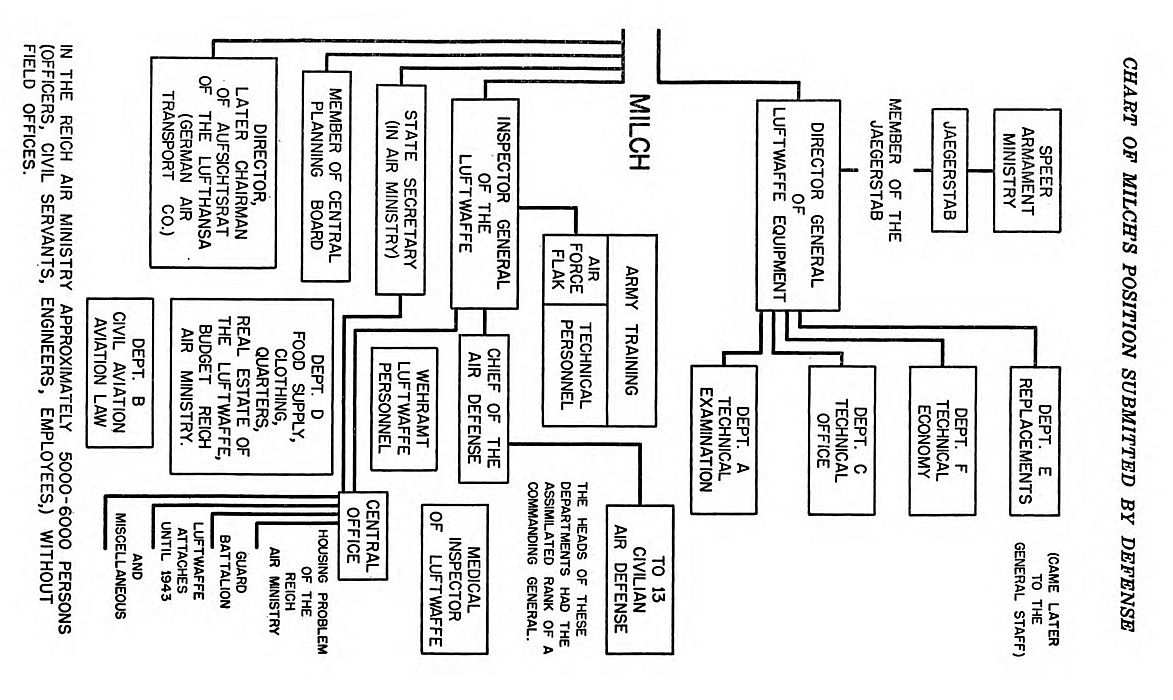
CHART OF MILCH’S POSITION SUBMITTED BY DEFENSE
A. Yes.
Dr. Bergold: May it please the Tribunal, this concludes my interrogation; and I make room now for the prosecution.
CROSS-EXAMINATION
Mr. Denney: You testified as a witness before the International Military Tribunal on behalf of the defendant Goering, did you not?
A. Yes, I did.
Q. And in the course of your testimony before the Tribunal you stated that you were the second highest officer in the air force?
A. Yes, that was my rank.
Q. So that the only one who ranked higher than you was Goering?
A. Yes.
Q. And that continued up until the time when you told us this morning that you completely withdrew, which, I believe was some time in January of 1945?
A. Yes. May I remark here that from 1937 several officers were in the second place. That is to say, the chief of the general staff, the chief of the personnel office, and also the GL. We were all of the same rank, as it were, but I was the most senior officer among them.
Q. And under Goering there were really four echelons; that is, the chief of staff, the inspector general, the GL, and the director of the personnel office?
A. Yes. They were all equal to each other.
Q. Goering was on top, and then came these four in a parallel line below him; is that right?
A. Yes, under Goering.
Q. And you, from 1941, November, following Udet’s death until sometime in the middle of 1944, held both the office of GL and inspector general?
A. That is correct.
Mr. Denney: If your Honor pleases, I ask that this be marked Prosecution Exhibit 133 for identification. This is a letter, dated 1 April 1943. The writer of the letter is Sauckel, and the letter is addressed to the defendant.
“Most honored Field Marshal,
“I take the liberty of enclosing in confidence three copies of the speech I gave in Poznan on 5 and 6 February 1943, on the occasion of the Reich and Gauleiters meeting and beg you kindly to peruse it. The figures contained in this speech refer to the end of the year 1942. Of course, the figures given concerning utilization of labor have again increased in the meantime. I would ask for your continued sympathetic understanding of the interests of manpower utilization, and your understanding and assistance in my task as far as possible. On my side, I can assure you that I always have asked the offices of the labor allocation administration subordinate to me for close and successful cooperation with all departments, and that I will do so for the future too.
“Heil Hitler,
“Yours respectfully,
[Signed] “Sauckel”
And, on the 7th, the last page, the defendant acknowledges receipt of this letter:
“Most esteemed Gauleiter,
“I thank you most cordially for kindly transmitting to me the speech you made in Poznan on 5 and 6 February 1943 on the occasion of the Reich and Gauleiters meeting.
“Heil Hitler! Yours.”
Q. Do you recall receiving it from Sauckel on 1 April 1943?
A. No. At the beginning of April I wasn’t there the first few days. I see a remark, by somebody else, on this document. It probably says—I can’t read it very well—“for the files of the Central Planning Board”. Perhaps this letter may have been submitted to me later on—I do not know whether I replied myself. I certainly did not read the report because otherwise I would be able to recall the figures.
Q. But you did initial the letter, didn’t you?
A. I do not know. I do not recall it at all.
Mr. Denney: On the copy that your Honors have, I believe it’s apparent in the upper left-hand corner of the first page, the defendant’s initials appear there, as well as on the original letter.
Q. Now, do you ever recall saying that you would put the German workers into concentration camps, the ones who did not work well?
A. When I talked about slackers, I referred to education by Himmler, but not to sending them into concentration camps. Himmler had other training places for workers where such people who were disinclined to work were being trained by making their supplementary rations dependent on their production.
Q. Don’t you recall that you asked that certain camps be set up especially to take care of these German workers who weren’t doing well?
A. I did not say that we should make a special camp, but that they should go to the training camps which already existed and we could get them back from there. I do wish to emphasize here these were people, Germans, who did not do their duty towards their Fatherland. I thought it justified that such people should be trained.
Mr. Denney: Witness, I believe you said you kept a diary?
A. A diary? You could not call it exactly a diary, I only took some short notes concerning my stay, and I jotted down a few key words which conveyed generally the most important matters.
Q. That was lost, was it, or destroyed, when you were captured?
A. It has not been lost. I still have it here.
Q. That is what you are referring to?
A. If I look up where I was at a particular day or what personalities I met, I refer only to the most important questions, not to everything, I can see whom I was with. Sometimes there is a table of contents, too, which is more detailed, according to the interest I had in those questions. For instance, for 28 October, which you referred to a while ago, I only have the following: My dispute with Goering he had reported to Hitler; he had not obtained anything, and now he started to vent his bad humor on me. Then comes a short note again that there was a conference afterwards with Goering. That was in Karinhall. It went on for the whole day. It was one hour from Berlin by car. I noted down that Speer was there, that Sauckel was there, Grawitz, von der Heyde, and some others. There is no mention what subjects were discussed, but the attendance of Sauckel clarifies the matter for me. That is an example of how I would enter these notes in this book.
Q. Insofar as you recall, you were at that meeting on 28 October?
A. Yes, indeed. I have found it here in my book.
Presiding Judge Toms: Mr. Denney, let’s get an unequivocal answer to this. Did you put the initials on the letter from Sauckel?
Milch: The “Mi”, yes, indeed.
Q. You wrote that?
A. Yes, I did. I wrote it. Somebody else wrote “to the files—”
Q. Never mind what somebody else wrote. Now, on the first page of the pamphlet, the printed speech, there are some initials. Did you write those?
A. On the cover, yes; I did, “Mi, 6/4”, that is what I wrote.
Q. All right.
Mr. Denney: Do you recall saying that Americans were never assigned to work in any of the airplane factories?
Milch: Yes, I said that.
Q. This is Document NOKW-364, which is a partial translation of the minutes of the Jaegerstab, held on 19 June 1944. The cover page, which is photostated here in the German, which will be given to the Secretary General, bears the initials of the defendant.
Presiding Judge Toms: Is this a new exhibit?
Mr. Denney: Yes, your Honor. This will bear Prosecution Exhibit Number 135 for identification, if your Honor pleases. Document NOKW-364, a partial translation of the minutes of the Jaegerstab of a meeting held 19 June 1944. On the covering page there appear the initials of the defendant. Perhaps the Secretary General would be good enough to let Mr. Blakeslee have the original so the cover page can be shown to the defendant. Just show it to him, Mr. Blakeslee.
(The document was handed to the defendant.)
Mr. Denney: Do your records show that you attended a conference of the GL on 4 August 1942?
A. Yes, indeed. These discussions were twice a week. (NOKW-409, Pros. Ex. 140.)
Judge Musmanno: Curiosity consumes me as to what would happen if an officer inferior in rank to yourself took you at your word and actually executed a number of these workers or prisoners of war. Would that officer then be punished?
A. No one was there who would have been in a position to do that. Apart from that, all those who were under my orders knew me and my way of handling things. They knew that I didn’t mean it, and apart from that they always laughed about my remarks when I let myself go, as they said.
Q. In other words the comment of the Field Marshal in a matter of this seriousness was really of no value?
A. Because the people knew that I got excited very easily about certain things, and these incidents here have been selected and produced. From every one of these meetings which took place twice a month, there was a long report and owing to one or other of these reports, maybe once or twice, there would be a certain outburst or explosion, and then, as we soldiers were accustomed to do, we would just get mad, that is all. However, I didn’t intend to do anything about it and I spoke to those under my orders when the opportunity offered. They pointed the matter out to me. They knew exactly from my words that this was not meant seriously. They knew exactly that no such order had been given and that I myself would never cause anybody to be punished, not even then when it might have been justified, for the very simple reason that I did not have the power to administer punishments.
Judge Phillips: Mr. Denney read this paragraph to you, Document NOKW-409, Prosecution Exhibit 140. I understood you to say this, that the paragraph did not contain your attitude there, that you never gave such an order, that when you were worried you sometimes used strong language as a soldier would. Didn’t you say that?
A. Yes.
Q. Well, now whether you meant it or not, you would say these things, and by so doing you counseled and advised others under you at a meeting over which you presided to do such things. Whether you meant it or not you did that, didn’t you?
A. No, I never gave an order by using these words, because my people spoke with me, and they knew afterwards from my words that I never meant it earnestly.
Q. Didn’t you say, “I would band the workers together and have fifty percent of them shot. I would then publish this fact and compel the other fifty percent to work by beating if necessary.” Did you say that or not?
A. I do not remember having said that. However, three days ago I believe I said that, when I had such a rush of blood to my head, due to that injury I had, and I couldn’t remember what I had said at that particular moment. I just burst out with rage.
Q. Well, if you did say that, you were advising and counseling others to do that, were you not?
A. No, that was not a counsel or an advice to anybody else. On the contrary, it was known that if someone had done such a thing I would have intervened myself.
[March 20]
Judge Musmanno: Since we are on the subject of Jews, I would like to refer to something which occurred at the first trial. Now you are not compelled to discuss this matter if for any reason you prefer not to, but you will recall that you were cross-examined by Justice Jackson on the subject of your being Aryanized. Do you recall that?
A. Yes, I recall it.
Q. Now you gave an explanation at the trial which, however, was not definite, it seems to have left something in mid-air, and since you have given us quite a long autobiographical sketch of yourself, if you would care to enlighten us on this point, you are free to do so.
A. My point of view is as I stated at the time.
Q. Yes.
A. That point of view I still adhere to.
Q. Let us see. You were asked certain questions and gave certain answers as follows:
“Question: At that time” (Goering had referred to 1933) “Goering had you—we will have no misunderstanding about this—Goering made you what you call a full Aryan; was that right?
“Answer: I do not think he made me one; I was one.
“Question: Well, he had it established, let us say.
“Answer: He had helped me in clearing up this question, which was not clear.
“Question: That is, your mother’s husband was a Jew; is that correct?
“Answer: It was not said so.
“Question: You had to demonstrate that none of your ancestry was Jewish; is that correct?
“Answer: Yes, everybody had to do that.
“Question: And in your case that involved your father, your alleged father, is that correct?
“Answer: Yes.” [There the inquiry rested.]
A. Yes.
Q. Just what had to be done to demonstrate that you were a full Aryan, and why did the question arise?
A. The first time that question arose was in 1933, and the occasion was the following: The president of the German Aero Club was reported as being adverse to the Hitler regime, and I protected that man. Following that, a man who was a member of the SA sent a letter to Goering, and I may add that this was a man who was trying to become a state secretary in the Air Ministry, and he had been deeply hurt when he, an old Party member, had to take second place to me. In this letter he said that State Secretary Milch was not a full Aryan. This happened in the summer of 1933. Goering forwarded this letter to me, and I went to Goering. Following that I was asked to submit my family tree. That is how this matter arose.
Q. In other words, you had to establish that no Jewish blood flowed in your veins, is that correct?
A. Yes, that is what I was supposed to do.
Q. And you established that to their satisfaction?
A. That was established.
Q. * * * Now, I understand you to say that the first time you learned of the proposed war against Poland was on 21 August, and even then it was not very clearly indicated that a war could actually be unleashed, and that further it was not until the very end of the day, that is to say, at five o’clock in the afternoon of 31 August that you were directed to put the Luftwaffe, or all your forces, in readiness for the attack. Is that correct? Is that what you said?
A. On 31 August, not to get ready, but I received the order: “The attack starts tomorrow,” that was the order for an attack, whereas, over-all preparations had been made previously at the meeting which took place with Hitler on 22 August, only then there was still the possibility of negotiations which were still going on. These negotiations came to an end on 31 August at 1700 hours.
Q. Did you not tell this Tribunal that after the meeting of 23 May 1939 you were convinced that war was not intended?
A. 23d of May?
Q. Yes, 23 May 1939?
A. Yes.
Q. That you had no intimation that Hitler intended an aggressive war on Poland?
A. Yes, because at that time, according to my recollection, Hitler stated again and again that he was certainly going to settle the Polish problem, but that he would not allow war to break out.
Q. And that you had called to his attention the necessity of manufacturing bombs, because you believed that hostilities might break out?
A. That was before that date, before the 23d, and also after the 23d, because I myself did not share Hitler’s optimism. Although he may not have intended to wage war, his policy might nevertheless have led to war, for he alone was not the deciding factor, the others would have something to say as well.
Q. And that assumption lulled you into the conviction that there would be no war, since he refused you authority to manufacture bombs?
A. Today I must assume that, at that time I was not aware of it.
Q. When did you first learn that an attack on Russia was intended?
A. At the beginning of January 1941—I beg your pardon—yes, that is right, 1941, on 13 January actually. It was then that Goering, during a conference with a large circle of commanding officers, informed us that one’s attention should be turned to the East, as Hitler was fearing an attack by the Russians.
Q. Yes, and you finally came to the conclusion that the declaration of war, or rather, the undeclared war against Russia was a crime against Germany.
A. Yes.
Q. Did you think it was a crime against Russia?
A. Yes, against Russia also.
Q. Also?
A. Yes.
Q. Now, you endeavored to see Hitler to persuade him not to enter this war.
A. Yes.
Q. And your immediate circle, your military friends, realized that it was foolhardy to provoke a war with Russia and thereby establish two fronts?
A. Exactly the way I saw it, yes. My immediate circle were of the same opinion as I was.
Q. And all the generals were of the same impression—that it was hopeless for Germany, and that further it was tragic and suicidal to Germany to allow Hitler to take over the control of the armed forces? You were practically unanimous in that belief, were you not?
A. This was never discussed in any larger circles.
Q. But you have testified—it is in the record—that you were all of that belief.
A. It transpired at a later stage, when it was discussed, that they were all of the same opinion.
Q. When was that?
A. Later on in the course of the war.
Q. When did you realize that it was a mistake to have Hitler as Commander in Chief of the Armed Forces?
A. I, personally?
Q. When was it thoroughly recognized, even though not expressed at a public meeting among the generals, that it was suicidal, a great mistake, to have Hitler as Commander in Chief?
A. That was the general point of view after Stalingrad. That is when it became general.
Q. And when was that?
A. That was the end of January 1943.
Q. Yes. You still had two and a half years of war ahead of you?
A. Yes.
Q. Why didn’t you do something about having Hitler removed?
A. It was my duty toward my people to keep allegiance to him. I had sworn an oath of allegiance to Hitler. I am only a human being who can see this world subjectively and I cannot presume to be an impartial judge on such questions. Moreover, I believe that in the whole of Germany’s history there is not one instance of soldiers rising against their military commander. I certainly do not know of one.
Q. Even though you realized that Hitler was leading Germany into stark annihilation and unspeakable hardship, and even though all the generals were of that same belief, yet you upheld this fetish of an allegiance which was destined, and very clearly so, to bring unparalleled misery to the people that you professed to be faithful to?
A. Your Honor, I personally did not presume to say that my judgment was right, and that Hitler’s judgment, and the judgment of all those around him, was wrong.
Q. Then, you modify your statement that Hitler was wrong? You say that he might have been right?
A. No, no, I am not saying that. What I am trying to say is that it was my point of view that the question whether the head of the state was to be overthrown or not was a matter for the constitution, and that for this eventuality the constitution and the state must surely have powers, means through which in such cases there could be intervention; but then it could not be the task of any individual general to take steps in such questions, which were, after all, unlawful.