3. THE JAEGERSTAB[109]
Reading edition
3. THE JAEGERSTAB[109]
EXCERPT FROM STATEMENT OF THE PROSECUTION REGARDING MILCH’S ACTIVITY IN THE JAEGERSTAB, 13 JANUARY 1947[110]
Mr. King: If your Honors please, the prosecution begins now the presentation of that phase of its case dealing with the defendant Milch’s participation in the Jaegerstab. I might add that that has to do with the slave labor phase of the Milch case.
First, I wish to say a few words about the background of the Jaegerstab. The Jaegerstab was formed on 1 March 1944 by decree of Albert Speer issued pursuant to an order of Adolf Hitler. Our evidence will show, however, that it was the defendant Milch who conceived and instigated the formation of the Jaegerstab.
The purpose of the Jaegerstab was increased production of fighter aircraft. Fighter plane production had suffered severe set-backs due to British and American air attacks. Defendant Milch and his Luftwaffe had also suffered in the battle for new raw materials.
Fighter aircraft were Germany’s principal defense against bombing raids. Early in 1944 the defendant Milch had concluded that without adequate fighter protection the entire German armament industry would soon be destroyed. After repeated urgings, Milch was finally successful in his efforts to create a special commission of top officials from various ministries to undertake a special effort in the field of fighter production.
The Jaegerstab, therefore, was actually a concentration of experts drawn from various ministries. Our evidence will show that the defendant Milch and Speer were designated as the joint chiefs of the Jaegerstab with Karl Adolf Saur acting as Chief of Staff.
The methods adopted by the Jaegerstab in the execution of its tasks were (1) transfer of German aircraft industry underground, (2) the decentralization of German aircraft industry, (3) quick repair of bombed-out plants.
Our proof will show that the labor for this program, which was the decisive consideration in the discussions of the Jaegerstab, was obtained from three sources: (1) Sauckel Ministry, (2) concentration camps, (3) direct recruitment from occupied countries.
Evidence
Prosecution Documents
Doc. No.Pros. Ex. No.Description of DocumentPage
NOKW-01754Extracts from the minutes of the conference with air force engineers and chief quartermasters under chairmanship of Milch, 25 March 1944.527
NOKW-26170Chart of the organization of the Jaegerstab drawn by Saur with letter of transmittal to prosecution staff, 14 November 1946.535
1584-III-PS71Correspondence between Himmler and Goering, 9 March 1944, concerning the use of concentration camp prisoners in the aircraft industry.537
R-12448-EExtracts from the minutes of discussions between Saur and the Fuehrer, 6 and 7 April 1944.539
NOKW-24761Appointment of Field Marshal Milch as Goering’s plenipotentiary for the intensification of air force armament.540
F-82457Order of Field Marshal von Kluge regarding compulsory recruitment of labor in the West, 25 July 1944.542
NOKW-33775Extracts from transcript of stenographic minutes of the Jaegerstab Conference of 6 March 1944.544
NOKW-33875Extracts from transcript of stenographic minutes of the Jaegerstab Conference on Friday, 17 March 1944.545
NOKW-34675Extracts from transcript of stenographic minutes of the Jaegerstab Conference under chairmanship of Field Marshal Milch on Monday, 20 March 1944.546
NOKW-38875Extracts from transcript of stenographic minutes of the Jaegerstab Conference of 28 March 1944.547
NOKW-33475Extract from transcript of stenographic minutes of the Jaegerstab Conference of 25 April 1944.550
NOKW-36275Extracts from transcript of stenographic minutes of Jaegerstab Conference on the occasion of the 5th trip of the “Hubertus Undertaking”, 2 and 3 May 1944.552
NOKW-39075Extract from transcript of stenographic minutes of the Jaegerstab Conference of 4 May 1944.553
NOKW-44275Extract from transcript of stenographic minutes of the Jaegerstab Conference on 5 May 1944.554
NOKW-36175Extract from transcript of stenographic minutes of the Jaegerstab Conference during the 6th journey of the “Hubertus Undertaking” from 8-10 May 1944.554
NOKW-33675Extracts from transcript of stenographic minutes of the Jaegerstab Conference on 26 May 1944.555
NOKW-35975Extracts from transcript of stenographic minutes of the Jaegerstab Conference on 27 June 1944.557
NOKW-32073Extract from interrogation of Karl Otto Saur on 13 November 1946, concerning the use of concentration camp prisoners in Jaegerstab construction.558
NOKW-26676Affidavit of Fritz Schmelter, 19 November 1946, concerning the organization of the Jaegerstab.559
Defense Documents
Doc. No.Pros. Ex. No.Description of DocumentPage
Speer Ex. 3417Order of Hitler, 21 April 1944, delegating to Dorsch authority for Jaegerstab constructions.560
NOKW-33712Excerpts from the stenographic minutes of the Jaegerstab Conference on 6 March 1944 in the Reich Air Ministry.561
NOKW-33813Excerpts from the stenographic minutes of the Jaegerstab Conference presided over by Field Marshal Milch on Friday, 17 March 1944, 1100 hours, in the Reich Air Ministry.562
NOKW-36515Extract from the stenographic minutes of the Jaegerstab Conference, 12 April 1944.563
NOKW-33416Extracts from stenographic minutes of the Jaegerstab Conference, 25 April 1944.564
NOKW-44221Extract from the stenographic minutes of the Jaegerstab Conference, 5 May 1944.565
NOKW-33623Excerpts from the stenographic minutes of the Jaegerstab Conference on Friday, 26 May 1944, at 10:00 o’clock.566
Testimony
Extracts of testimony of defense witness Fritz Schmelter567
Extracts of testimony of defense witness Xaver Dorsch583
PARTIAL TRANSLATION OF DOCUMENT NOKW-017
PROSECUTION EXHIBIT 54
EXTRACTS FROM THE MINUTES OF THE CONFERENCE WITH AIR FORCE ENGINEERS AND CHIEF QUARTERMASTERS UNDER CHAIRMANSHIP OF MILCH, 25 MARCH 1944
[Handwritten note] To my files
Mi.
Secret
MINUTES OF THE CONFERENCE WITH AIR FORCE ENGINEERS AND CHIEF QUARTERMASTERS UNDER THE CHAIRMANSHIP OF FIELD MARSHAL MILCH ON SATURDAY, 25 MARCH 1944, AT 10 O’CLOCK
Dr. Koppert/Lm.
25 March 1944
Field Marshal Milch: Gentlemen! I welcome you. I have called you together here in order to discuss with you questions of importance for our German defense.
Beginning with the year 1942, the Luftwaffe put special emphasis upon a considerable increase in the number of fighter planes produced each month which at that time amounted to 200 to 220. It was possible, by July of last year, to exceed the figure of one thousand as the norm, in accordance with our program. Then the heavy raids, especially against our armament industry, began first against the preliminary industry [Vorindustrie] in the Ruhr, then against our fighter and airplane industry itself. The enemy enumerated 65 completely destroyed fighter factories and factories producing parts for fighters in his lists. Beginning in the middle of 1942 we undertook extensive evacuations, and did so to small localities above ground, smaller places, and the like. In so doing, about 4½ million square meters of factory space, productive space, were evacuated. That was the maximum that could be accomplished with the means at our disposal. We were lacking in transport space, we were lacking in machine tools, and primarily we were lacking in skilled workers and managerial forces, more of whom are of course needed in a dispersed system of manufacture than in a centralized system. The extraordinary drafting into the Wehrmacht and just at the end also the SE 3-drive deprived the Luftwaffe armament industry of its key personnel. We have in our employ today approximately 60 percent foreigners and 40 percent Germans, whereby one has to take into consideration that the women work in the factories only half a day. Therefore, the ratio of Germans to foreigners becomes considerably more unfavorable. The ratio is gradually approaching 90 percent foreign with 10 percent German supervising them. The rest of the Germans are concentrated in development factories and the like.
The enemy has now adopted a definite plan—as you as soldiers know yourselves and learn constantly from foreign news—of destroying aircraft production first, and mainly the production of fighter planes and night fighters, in order to be able to deal with Germany as he pleases. The enemy believes that this stage has almost been reached now. There is, however, still some confusion in his news reports. One day he expresses his amazement that the German fighter planes did not appear. Then again the newspapers receive a secret directive: “Unpleasant surprises do occur, so do not emphasize so strongly that the enemy has already disappeared from the air.” On the whole, however, the enemy hopes that it has come to the point where Germany’s backbone has been broken or that at least that stage has almost been reached where the enemy has been granted the possibility of dealing with Germany as he pleases.
Another plan our Western enemies have concerns the questions surrounding the concept of the invasion. The invasion and its success would of course also be favorably influenced by a destruction of German anti-air raid defenses.
We of the Luftwaffe armaments have been asking for over a year already that a strong home defense in the air be set up. We have made efforts to establish the prerequisites necessary for this, namely, the providing of sufficient planes to serve as day and night fighters. * * * Being fully aware that the strength of the Luftwaffe alone is insufficient both as regards quotas and with respect to the workers, etc., in order to bring about an extensive change in the field of air armaments, we applied to Minister Speer and his colleagues to undertake a common special effort in this field. The establishment of a Ruhr staff served as an example for us; it was established at the time when the industry in the Ruhr area seemed to be entirely put out of commission by the continuous raids. At that time the Ruhr staff was set up and the necessary quotas, buildings, etc., were put at its disposal. Thereby the entire situation was changed. Minister Speer and his colleagues, fully aware that without air armaments and without air defense the rest of the armament industry would very soon be destroyed and become useless, agreed to this plan enthusiastically and with initiative. Thus it came about that a definite proposal was made to the Reich Marshal and the Fuehrer: the Jaegerstab was created. The order of the Fuehrer provides clearly that the fighter plane program which the Jaegerstab is starting has priority over all other fields of armament, which means, to be sure, that other important armaments are not to be infringed upon by it. * * *
The Jaegerstab is made up as follows: the direction is in the hands of Reich Minister Speer and myself. Deputy for both of us, and at the same time our chief of staff, is Hauptdienstleiter Dipl. Ing. Saur, who is sitting on my left. Saur is the man who carried out the large-scale armament program for the army and the navy in the Speer Ministry in recent years in an exemplary manner. Saur again and again during the past year and a half succeeded in raising the production figures in all important fields and sometimes even in multiplying them.
Further, I name only the leaders of the Jaegerstab. We have put the question of over-all planning in the hands of Dr. Wegener. Construction matters will be directed by Dipl. Ing. Schlempp. The evacuation underground will be in the hands of SS Gruppenfuehrer Kammler. The supply, one of the most essential factors, and everything in the way of semi-manufactured material that comes to our factories for completion, will be taken care of by Director Schaaf, deputy to Staatsrat Dr. Schieber, the chief of the armament supply office [Ruestungslieferungsamt] in Speer’s Ministry. Dr. Schmelter will take care of labor commitment. Sites suitable for dispersal, confiscations, etc., will be in the hands of Ministerialrat Speh of the armaments supply office. Gruppenfuehrer Nagel of the Organization Speer will be in charge of transportation. The supply of power will be in the hands of General Director Fischer. Engineer Lange will be in charge of machinery, Mr. Nobel of repairs. Reich railroad questions will be in the hands of the President of the Reich railroad, Pueckler. Post Office: Oberpostrat Dr. Zerbel. Health matters: Dr. Poschmann. Social welfare: Dr. Birkenholz. Special problems for Me 262 and steel power units: Captain Dr. Krome. Raw materials and quota system: Dr. Stoffregen. Questions of technical simplification, etc.: Oberstabsing. Klinker. Office manager: Petri.
* * * On the spot the individual gentlemen are then told, supported by the combined authority of the state, the Wehrmacht, and the Party, that is, Saur and me—Speer is unfortunately still on sick leave, otherwise he would also be present—what it is all about. That takes ten minutes. After ten minutes the individual members of the Jaegerstab disappear and get together with the men from the factory who are competent for their sphere of activity. Thus, all pertinent questions are dealt with in the conferences about the commitment of labor, and all competent men, who have anything to do with the commitment of labor meet, especially the president of the competent Provincial Labor Office. Thus it is determined on the spot, in the individual spheres, what the factory lacks. If the circumstances require it, it is immediately demonstrated to the factory that their requests are nonsense. Unreasonable demands and excessive claims are revised. Well-founded demands are immediately filled. While the discussions are still going on, telegrams are sent to the different offices, and the people are already set to work. In general, the people arrive in 24 hours. Unfortunately there are exceptions, for which the Wehrmacht sector is responsible. The Wehrmacht does not work as smoothly and beautifully as civilian offices. It is an error to believe that civilian offices are more bureaucratic than military offices. On the basis of my continuous and extensive experience I can assure you exactly the opposite is true.
* * * Our entire German ball-bearing industry, and that outside Germany, was eliminated one hundred percent by the enemy in a, I must say, brilliant attacking operation: Erfurt, Schweinfurt, Frankfurt on the Main, Stuttgart, Italy. We were faced with the question whether without ball bearings we could produce new planes at all, new tanks, or whether we had to capitulate as an armament industry. For ball bearings are an indispensable factor in modern armament industry. One finds and needs them everywhere, even in places where one does not think of them at first. Now it became apparent, thank God, that the branches of the Wehrmacht had hoarded ball bearings and roller bearings in such large masses that we got along for three months with the hoarded material alone. In this case it was lucky that we still had so much, that so many ball bearings had been hoarded. I have to admit that. But that is not the normal way. It is certain that in the whole period up to now too many spare parts have been requested just in order to gather such hoards. And this in spite of the fact that not everything has been attained by far, but only very large stocks. I should like to say that with the material you have, 20 to 30,000 planes could be newly built or newly equipped without further ado. That is how much material you have! And this does not concern large parts; for in that field I was always strict—it concerns rather all the accessories and apparatus. In considering these figures one has to know that about 52 percent of the total man-hours are spent in equipping a plane and only 48 percent in building the aircraft frame and the engine. Only then does one realize fully the importance for us of all that small junk that is lying around all over. It is not necessary that the troops always take along all their spare parts. * * *
Gentlemen, in this connection I may call your attention to another important point. If I visit an office and find out that something is being hidden there, then I ask for the death penalty for such a crime today! That is fraud! That is sabotage of the German armament industry!
Then there is still the human factor. We often had considerable difficulty with the human factor. The fluctuation there is very considerable. The quota of the Luftwaffe in the distribution of manpower is constantly lowered. The foreigners run away. They do not keep to any contract. There are difficulties with Frenchmen, Italians, Dutch. The prisoners of war are partly unruly and fresh. These people are also supposed to be carrying on sabotage. These elements cannot be made more efficient by small means. They are just not handled strictly enough. If a decent foreman would sock one of those unruly guys because the fellow won’t work, then the situation would soon change. International law cannot be observed here. I have asserted myself very strongly, and with the help of Saur I have very strongly represented the point of view that the prisoners, with the exception of the English and the Americans, should be taken away from the military authorities. Soldiers are not in a position, as experience has shown, to cope with these fellows who know all the answers. I shall take very strict measures here and shall put such a prisoner of war before my court martial. If he has committed sabotage or refused to work, I will have him hanged, right in his own factory. I am convinced that that will not be without effect.
Anyhow, the strangest things occur in the treatment of the workers. It is said that the people collapse, and then one has to find out that they have a furlough of three or four days every eight weeks. That is dirty business of the first order and treason to the country! Then perhaps a construction battalion arrives and is supposed to be put to work. The commanding officer, perhaps some overfed grade-school teacher, declares that the men must drill and must take part in sports! Damn it, the fellows are there to work so that the maximum amount of work will result. One has to act very strictly here. A construction battalion was ordered to Regensburg. The commanding officer was one of those scholars who said he could not billet the men in peacetime conditions and, therefore, he refused to start work. Such a guy should be convicted by a court martial and hanged. I would be grateful if the gentlemen would proceed in that manner. As with me in industry, so every stupidity is possible everywhere else also. As chief, one has to take up these matters. I know what kind of obstacles become apparent. There is bureaucracy. It is not easy to go against bureaucracy. But we have to cut through that also, and if you, Gentlemen, proceed with the right attitude here, then we are already assured of success.
* * * In saying this I do not even consider the fact that the workshops have first-class personnel, whereas we in the Luftwaffe armament industry have Russians, French prisoners of war, Dutch, and members of 32 other nations. Obtaining interpreters alone presents a big difficulty there. * * *
A further question concerns the efforts for housing the machines. That is very important, and I would be very grateful if you would think this matter over also. In this manner you would not only facilitate the question of spare parts but also the scarce supply of materials. Each fighter plane contains about one ton of aluminum. Every small bomber contains four tons of aluminum; and a larger bomber, seven to eight tons. The captured bombers contain eleven to twelve tons of aluminum. There are in any case tremendous amounts of material involved here. Let us take twelve tons as normal for an American heavy bomber, or let us say only ten tons, and let us assume that we actually shoot down 500 such American bombers a month and that we can salvage them over our own territory; that alone means 5,000 tons of aluminum, 5,000 tons: that is 25 percent of the aluminum quota at the disposal of the Luftwaffe. You can see how important these questions are, too. We can certainly count on more Americans being shot down in the future because we will have more fighter planes.
I further ask for support by the Luftwaffe physicians. With all the rabble that we have among the foreign workers there is of course a lot of shirking. At the moment the Russians—that is, the Russian prisoners of war—are feigning a lot of fatigue and illness. The incidence of sickness of one-and-a-half to two percent which we have had up to now has at least doubled and in some factories it has been increased to eight, nine, and ten percent. That is, of course, done by previous agreement. There the official physicians must undertake an examination and if the physicians, who have to be very strict, find out that it is not true, then we return the fellows to work by means of the whip. Then the whip serves as cure.
A further request which is very important from the point of view of leadership! Sometimes we do not know in case of an alert what orders we want to give for our factories. If a factory knows that it is about to be attacked, and it has a few trench shelters but does not have a bomb-proof shelter or the like, then the people simply run away from the factory, automatically at each raid, after the first one, and they usually cannot be caught the next day, either. That applies particularly to the foreigners. We have, therefore, now issued the following order, and have equipped the superiors accordingly with weapons and pistols: as soon as a factory which has already been attacked a few times can count on the raids being aimed at that particular factory again, then the personnel leave the factory; but in closed groups by shops, under the leadership of the man in charge of the shop, and, to the extent that they are German personnel, they leave singing military songs. The people are led away from the factory to a distance of 1,000 or 1,500 meters. There they have to lie down in slit trenches and watch their factory from there, so that they can immediately rush to it after the raid in order to help and to save what can be saved. That is the only correct way to do it. * * *
Gentlemen, you come from the fronts, and some of you were perhaps surprised to see how Berlin looks. I recommend to you, if you still have time today, to drive around in a bus and see Berlin. The center still looks quite nice. But have a look at other districts of Berlin too, or look at Frankfurt or Duesseldorf or whatever all of these places are called, in their present condition; then you will admit to me that the population will not be able to endure this condition permanently; not that there is any danger of a revolution or any such thing as we know it from 1918. But at a certain point a human being just cannot endure any more. It is quite surprising how the population has endured this thing so far or how it always gets on its feet again, when it is led in the proper way by true leaders (Fuehrer) who, thank God, are present among the people through the Party and the rest of the leadership. But you must not forget, Gentlemen, the war of nerves has reached a point which causes us in the leadership group worry. The people cannot endure that forever.
One does not have to see only how the people are working—I have told you that—but also how they live, where they are living today, how they are sleeping today. There are hundreds of thousands of Berliners who have not known any heating for months, who have not been able to take a bath for months, who have not been able to shave with warm water for months, and the like. They are happy if they can still put their warm coffee [Plirsch] in their stomachs in the morning and at noon their soup. And with that they work seventy-two hours. It is a damned difficult affair. Whoever does not understand that and whoever does not say on this occasion: From now on our work will be done quite differently than was the case so far, is a miserable wretch in my opinion. And everyone of us and everyone you appoint has to be trained to accomplish in this sphere what the others have been accomplishing for a long time. We have to do that, we have to increase our production so that we can push the enemy back in the next few weeks and months in the same way as he has advanced to Berlin and farther, step by step.
Please go wherever you are going and knock everybody down who blocks your way! We cover up everything here. We do not ask whether he is allowed to or whether he is not allowed to. For us, there is nothing but this one task. We are fanatics in this sphere. We do not even consider letting anything at all distract us from that task. No order exists which could prevent me from fulfilling this task. Nor shall I ever be given such an order. Now, do not let anything deter you, and get your people to the point that no one deters them. If there is a little hindrance from below, this is not due to ill will but to stupidity. Gentlemen! In the fifth year of war stupidity is a crime!
Gentlemen, I know, not every subordinate can say: For me, the law no longer exists, but he has to have someone who covers up for him, not out of cowardice; but if you act according to the spirit of the old field service regulation, “Abstaining from doing something hurts us more than erring in the choice of the means,” and if, moreover, you keep in touch and immediately clarify difficult points so that something can be done, then we are willing to accept the responsibility, whether this is the law or not. I see only two possibilities for me and for Germany: Either we succeed and thereby save Germany, or we continue these slipshod methods and then get the fate that we deserve. I prefer to fall while I am doing something that is against the rules but that is right and sensible and be called to account for it and, if you like, hanged, rather than be hanged because Papa Stalin is here in Berlin, or the Englishman. I have no desire for that. I would rather die in a different way. But I think we can accomplish this task, too. We are in the fifth year of war. I repeat: The decision will come within the next six weeks!
Heil Hitler!
(End: 12:20 hours)
TRANSLATION OF DOCUMENT NOKW-261
PROSECUTION EXHIBIT 70
CHART OF THE ORGANIZATION OF THE JAEGERSTAB DRAWN BY SAUR WITH LETTER OF TRANSMITTAL TO PROSECUTION STAFF, 14 NOVEMBER 1946
Nuernberg, 14 November 1946
K. O. Saur
TO: Mr. King, via Prison Office.
In accordance with your request enclosed please find the organization chart of the Jaegerstab which was founded by decree of Reich Minister Speer on 1 March 1944. The chart was drawn up from memory.
The working methods of the Jaegerstab are disclosed in their essence by the following paragraph from the Armament Staff Charter issued by Reich Minister Speer on 1 August 1944.
“Also in the future in order to prevent the Armament Staff from developing gradually into an extensive agency, the regulation concerning the purely personal membership will be maintained, as was the case for the Jaegerstab. The technical work will be done, therefore, in the office and agencies to which the personal members belong, under the responsibility of the competent office chiefs or agency directors.”
The ministries and their offices or agencies responsible for the different tasks are mentioned individually in the organization chart.
For reasons of clarity, the Jaegerstab, as liaison office, has been framed in red; the technological office, which then was under my own responsibility has been framed in blue. [See legend on chart.]
[Signed] Saur
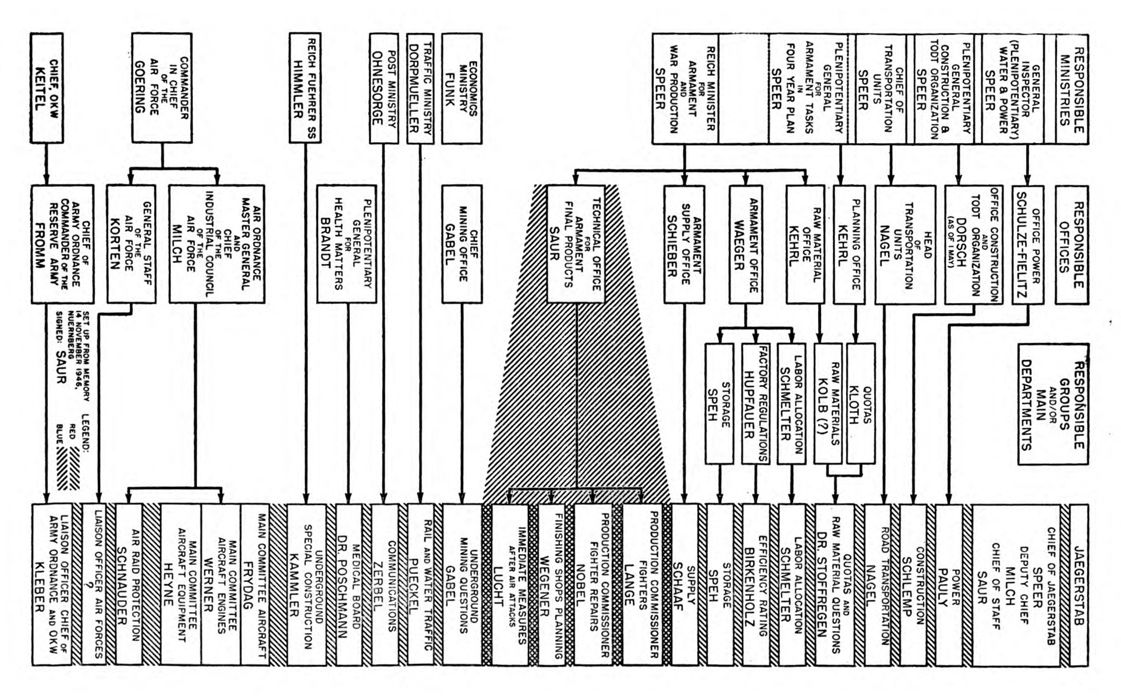
Chart: Responsible Groups and/or Main Departments.
TRANSLATION OF DOCUMENT 1584-III-PS
PROSECUTION EXHIBIT 71
CORRESPONDENCE BETWEEN HIMMLER AND GOERING, 9 MARCH 1944, CONCERNING THE USE OF CONCENTRATION CAMP PRISONERS IN THE AIRCRAFT INDUSTRY
1879/44Secret 9March 1944
Field-command office
Subject: Employment of prisoners in the aviation industry.
Reference: Teletype of 14 February 1944.
5 copies, 5th copy
Top Secret State Matter
Most honored Reich Marshal,
Following my teletype letter of 18 February 1944, I herewith transmit a survey on the employment of prisoners in the aviation industry.[111]
This survey indicates that at the present time about 36,000 prisoners are employed for the purposes of the air force. An increase to a total of 90,000 prisoners is contemplated.
The production is being discussed, established, and executed between the Reich Ministry of Aviation and the Chief of my Economic Administrative Main Office, SS Obergruppenfuehrer and General of the Waffen SS Pohl.[112]
We shall render assistance with all forces at our disposal.
The task of my Economic Administrative Main Office, however, is not solely fulfilled with the delivery of the prisoners to the aviation industry, as SS Obergruppenfuehrer Pohl and his assistants take care of the required working speed through constant control and supervision of the work-groups [Kommandos] and therefore have some influence on the results of production. In this respect I may suggest consideration of the fact that in enlarging our responsibility through a speeding up of the total work better results can definitely be expected.
We also have for some time adjusted our own stone quarries to production for the air force. For instance, in Flossenbuerg near Weiden the prisoners employed previously in the quarry are working now in the fighter plane program for the Messerschmitt corporation, Regensburg, which saw in the availability of our stonemason shops and labor forces after the attack on Regensburg at that time a favorable opportunity for the immediate partial transfer of their production. Altogether 4,000 prisoners will work there after the expansion. We produce now with 2,000 men 900 sets of engine cowlings and radiator covers as well as 120,000 single parts of various kinds for the fighter Me 109.
In Oranienburg we are now employing 6,000 prisoners at the Heinkel works for construction of the He 177. With these we are supplying 60 percent of the total crew of the plant.
The prisoners are working without fault. Up till now 200 suggestions regarding the improvement of work have been handed in at Heinkel from the ranks of the prisoners, which were used and were rewarded with premiums. We are increasing this employment to 8,000 prisoners.
We also have employed female prisoners in the aviation industry. For instance at the mechanical workshops in Neubrandenburg 2,500 women are working now in the manufacture of devices for dropping bombs and rudder control. The plant has adjusted the total aerial production to employ prisoners. In the month of January 30,000 devices as well as 500 rudder controls and altitude regulators have been manufactured. We are increasing employment to 4,000 women. The performance of the women is excellent.
In our own plant in Butschowitz near Bruenn (Brno) we produce also for the air force, there however with civilian workers. This plant supplies 14,000 wooden-built rear control apparatus for Me 109 to the Messerschmitt Corporation, Augsburg.
The movement of manufacturing plants of the aviation industry to subterranean locations requires further employment of about 100,000 prisoners. The plans for this employment on the basis of your letter of 14 February 1944 are already under way.
I shall keep you, most honored Reich Marshal, currently informed on this subject.
Heil Hitler!
[Initialed] H.H.
[Heinrich Himmler]
TRANSLATION OF DOCUMENT R-124
PROSECUTION EXHIBIT 48-E
EXTRACTS FROM THE MINUTES OF DISCUSSIONS BETWEEN SAUR AND THE FUEHRER, 6 AND 7 APRIL 1944
Top Secret State Matter
The Chief of the Technical Office
TA Ch S/Kr
Berlin, 9 April 1944
MINUTES OF DISCUSSIONS WITH THE FUEHRER ON 6 AND 7 APRIL 1944
16. Reports made to the Fuehrer by myself [Saur] and Field Marshal Milch, based on tables and drawings, as to the achievements of the Jaegerstab stressing the satisfactory cooperation of the new organization with all offices and plants. Reported in detail that plans have been made for the best part of transfers, and that, as a first installment, the decentralization above ground will be completed by August, and, as the second installment, that the most vulnerable plants will be underground by the end of the year.
17. Field Marshal Milch reported on the result of a construction staff meeting of the Central Planning Board according to which the most important building projects only could materialize due to a great tension in general conditions. In spite of this, the Fuehrer demands that the two huge buildings of 600,000 square meters each should be erected with all speed. He agrees that one of these buildings is not to be made from concrete but—according to our suggestion—will be set up as an extension of, and close to, the Middle Plant [Mittelwerk] as a so-called “Middle-Building” [Mittelbau], and that this plant will be placed under the direction of the Junkers Works. Plans have to be made without delay to secure production in bottleneck items of the Junkers Works, production of Me 262 at 1,000 per month, and fighters at 2,000 per month.
Suggested to the Fuehrer that, due to lack of builders and equipment, the second big building project should not be set up in German territory but in close vicinity to the border on suitable soil (preferably on gravel base and with transport facilities) on French, Belgian, or Dutch territory. The Fuehrer agrees to this suggestion if the works could be set up behind a fortified zone. For the suggestion of setting this plant up in French territory speaks mainly the fact that it would be much easier to procure the necessary workers. Nevertheless, the Fuehrer asks that an attempt be made to set up the second works in a safer area, namely in the Protectorate. If it should prove impossible there, too, to get hold of the necessary workers, the Fuehrer himself will contact the Reich Leader SS and will give an order that the required 100,000 men are to be made available by bringing in Jews from Hungary. Stressing the fact that the building organization of the Industry Association Silesia [Industriegemeinschaft Schlesien] was a failure, the Fuehrer demands that these works must be built by the O.T. [Organization Todt] exclusively and that the workers should be made available by the Reich Leader SS. He wants to hold a meeting shortly in order to discuss details with all the men concerned.
The Fuehrer agrees that these items may be used as a basis for future conferences.
[signed] Saur
[typed] (Saur)
TRANSLATION OF DOCUMENT NOKW-247
PROSECUTION EXHIBIT 61
APPOINTMENT OF FIELD MARSHAL MILCH AS GOERING’S PLENIPOTENTIARY FOR THE INTENSIFICATION OF AIR FORCE ARMAMENT
Copy
The Reich Marshal of Greater Germany
Chairman of the Reich Defense Council
Berlin, June [sic]
AUTHORIZATION
The war situation calls for the utmost intensification of the armament capacity of the German Air Force within the shortest time. The goal of the measures to be taken has to be the fourfold increase of the present production in all branches of air force armament. I commission the State Secretary of the Ministry of Aviation, Field Marshal Milch, with the speediest execution of this intensification of armament ordered by the Fuehrer. To secure the attainment of the end at which we aim I confer herewith the most extensive power of authority on Field Marshal Milch within the sphere defined as follows:
1. Shutting-down and seizure of factories, decisions about expropriations and forced leases, seizure and expropriation of construction material in agreement with the Plenipotentiary General for Construction, erection of auxiliary buildings exempted from restricting provisions of the building police, of the office for the supervision of industry, of air-raid protection, social institutions, etc., as far as these provisions are incompatible with the fast completion of the building projects.
2. Confiscation, expropriation, and renting of machinery of all kinds and its distribution to the armament factories of the Luftwaffe. Forced transfer of workers who are unemployed or employed in industry of any kind whatsoever, this not only for the erection of the buildings but also for allocation to Luftwaffe armament factories.
3. Confiscation of raw materials absolutely essential for the Luftwaffe program; only superfluous raw materials may then be distributed in the manner as now. This refers especially to light metals and gasoline.
4. Removal and transfer of key personnel of the entire armament industry irrespective of existing contracts under private law; cancellations of or changes in existing powers of authorization, and issue of new powers; creation of industrial associations, patent associations, merger of companies; creation of new companies, and separation of uneconomically working firms and their coordination or subordination to better managed firms.
5. Deviation from existing regulations about the financing of the war and premiums in cases where the utmost intensification of output cannot be achieved otherwise. In this connection due consideration has to be given to the economical situation and to the financial capacity of the firms involved.
6. All decisions of and all measures taken by my plenipotentiary on the basis of this authorization have to be regarded as if they were ordered by me. These decrees and measures have priority in respect to all other official directions and decrees as far as these are not compatible with the speediest execution of the intensification of the production capacity.
TRANSLATION OF DOCUMENT F-824
PROSECUTION EXHIBIT 57
ORDER OF FIELD MARSHAL VON KLUGE REGARDING COMPULSORY RECRUITMENT OF LABOR IN THE WEST, 25 JULY 1944
Secret [Stamp]
2a [Handwritten]
Headquarters, 25 July 1944
546 [Handwritten]
Commander in Chief West Section
IaT No. 1731/44 secret
Reference:1.OKW/WFST/Qu. (Adm.1) Qu.2 (West) No. 05201/44 secret of 8 July 1944 (distributed only to Commander in Chief West and the Military Commanders.)
2.OKW/WFST/Qu. (Adm.1) Qu.2 (West) No. 05431/44 secret of 19 July 1944.
(File Notes)
Subject:Procurement of Labor in the West.
With Ref. to 2, Chief OKW has ordered:
“The communication of Field Marshal Von Kluge of 8 July, addressed to the Reich Minister for Armament and War Production, crossed with my order of the same day.” (OKW/WFST/Qu. (Adm. 1) Qu. 2 (West) No. 05201/44 secret).
From this it is evident that, by order of the Fuehrer, under suspension of orders to the contrary, the wishes of the Plenipotentiary for Labor [Sauckel] and of Reich Minister Speer must, in principle, be carried out. Further, to my teletype, the following additional general directions apply in future, as a result of the conference of ministers in the Reich Chancellery on 11 July, about which the Commander in Chief West will have been informed by the military commander:
Rejecting justified misgivings with regard to peace and security in the interior of the country, seizures must be carried out wherever the opportunities referred to in my above-mentioned teletype offer themselves. As the only limitation, the Fuehrer has ordered that no forcible means shall be employed against the population in the actual combat area as long as it [the population] shows itself prepared to assist the German Armed Forces. However, recruiting of volunteers from among refugees from the combat zone is to be carried out vigorously. Moreover, every means is justified to seize as much labor as possible otherwise, apart from [using] the powers granted to the armed forces.
In order to render as effective as possible the measures which have been introduced, the troops are furthermore to be instructed in general as to the necessity of the organization for conscription of labor in order to put an end to the open and covert resistance which has arisen in many instances. The field commandants and the offices of the military administration must give wide support to the representatives of the Plenipotentiary for Labor Allocation and refrain from encroaching on their sphere of activity.
I now direct that the necessary orders in this sense be given and that I be constantly informed about the measures taken and their execution.
Indorsement of Commander in Chief West:
In accordance with this, Commander in Chief West has reported the following to the Chief of the OKW on 23 July 1944:
1.I have authorized the execution of the Sauekel-Laval agreement of 12 May in spite of misgivings because of interior security.
2.I will issue more detailed directives for the execution of the measures in the combat zone in accordance with OKW/WFST/Qu. (Adm.1)/2 (West) No. 05201/44 secret of 8 July 1944.
The Commander in Chief West
[Typewritten] von Kluge
Field Marshal
Additional orders will follow.
For the Commander in Chief West
The Chief of Staff
By Order
(illegible signature)
Colonel, GSC
Distribution:
High Command Army Group B
High Command Army Group G
Armored Group Command West
Mil. Cmdr. in France
Armed Forces Commander in Belgium and northern France
For Information:
Commander in Chief West/Ic [Intelligence]
IaT (Draft)
PARTIAL TRANSLATION OF DOCUMENT NOKW-337[113]
PROSECUTION EXHIBIT 75
EXTRACTS FROM TRANSCRIPT OF STENOGRAPHIC MINUTES OF THE JAEGERSTAB CONFERENCE OF 6 MARCH 1944
SS Major: [unidentified] I have already discussed with Lt. Col. Diesing our requirements according to our construction plan in the immediate program. From tomorrow 5,000 prisoners will be in readiness to carry out this measure. For that we need 750 guard personnel.
Field Marshal Milch: We must distribute our German people as key personnel. That is, out of three construction companies we can probably make ten complete ones by introducing 70 percent foreigners.
SS Major: They must be skilled workers. In handling the prisoners, it appears best that we should give 5 to 10 of them to one man who knows his job.
Saur: The construction companies will be dissolved to provide key personnel for teams 10 times or even 100 times their size. That is a question which must be clarified by 10 a.m. tomorrow between the Plenipotentiary General for Construction and the air force construction units on one side and Kammler’s construction staff on the other. That will be clarified by tomorrow and he then must say what he needs. The Todt Organization must take part in the discussion, but I cannot consent to the inclusion of the Todt Organization in the matter as a third leading organization, as we would get confused. The Todt Organization must bleed with the rest. It is the same as your construction companies. It is the donor but he is the organizer and usufructuary. He is by all means the usufructuary. For besides being organizer, he is the usufructuary for the construction sites of the Plenipotentiary General for Construction.
SS Major: Therefore it is important that these construction companies should be under military leadership!
Field Marshal Milch: * * * We further appealed to the Fuehrer that we should get the 64 miners who are in Berchtesgaden, as the work there will probably soon be finished. He made the suggestion that we, like the SS, should also train miners in the greater degree and mentioned the figure of 10,000 who would have to be trained one after another because they could not all be trained at once.
Saur: The SS should be told that the training of miners should rest entirely with them because the SS runs the best mining school.
Field Marshal Milch: We must also ask the SS to get more miners from Italy and Slovakia.
Saur: * * * We must bring more order into the PW base camps [Stalags]. We have made a proposal that the PW base camps should be transferred to the SS. The Italians and eastern peoples should be treated more roughly.
PARTIAL TRANSLATION OF DOCUMENT NOKW-338[114]
PROSECUTION EXHIBIT 75
EXTRACTS FROM TRANSCRIPT OF STENOGRAPHIC MINUTES OF THE JAEGERSTAB CONFERENCE ON FRIDAY, 17 MARCH 1944
Stobbe-Dethleffsen: * * * We already count on 100,000 men for the tasks of the Jaegerstab. To transfer them would mean breaking into the rest of the armament economy to an unheard-of degree.
(Saur: 100,000 without Kammler!)
Including the labor we give Kammler but not including the concentration camp people.
Saur: Right from the beginning we realized that 200,000 men would be transferred.
Stobbe-Dethleffsen: I have just spoken to Prinzel about it. It is absolutely necessary that the few German key personnel at our disposal should be taken with the concentration camp inmates or with the other subjugated people in such a proportion as will guarantee the best use of this valuable German strength * * *.
Stobbe-Dethleffsen: I am always getting demands for German labor. For example: Here are 5,000 concentration camp inmates, give me 1,000 German workers. I do not fulfill these requests in this proportion; otherwise my German labor would soon come to an end. We have filled only a fraction of the positions. I distribute German workers only in the ratio of 1:10.
Milch: The air force stresses the importance of getting the whole cave for the purposes of manufacture. * * *
Porsche: * * * I shall talk to Weiss again about our getting more concentration camp people for finishing off the work.
(Diesing: We probably shall not get them.)
I’ll get them from the Reich Leader. I already have 3,500. Two of Obergruppenfuehrer Pohl’s men are going to France to prepare everything locally with regard to housing and feeding.
Nobel: Can one be responsible for foreigners working as airfield control personnel? The repair works say: yes!
(Milch: Not as pilots!)
I do not think that is intended. The repair works said yesterday that it would be a help to them if foreigners could be used as airfield control personnel. * * *
PARTIAL TRANSLATION OF DOCUMENT NOKW-346
PROSECUTION EXHIBIT 75
EXTRACTS FROM TRANSCRIPT OF STENOGRAPHIC MINUTES OF THE JAEGERSTAB CONFERENCE UNDER CHAIRMANSHIP OF FIELD MARSHAL MILCH ON MONDAY, 20 MARCH 1944
Saur: * * * As far as Hungary is concerned, I should be grateful if the Field Marshal would call up Mr. Sauckel and tell him that the whole group mobilized in Hungary should be primarily at the disposal of the Jaegerstab. Large construction [of entrenchments] columns [Schanz Kolonnen] must be formed. The people have to be treated like prisoners. Otherwise it won’t work.
Saur: Where are the 54,000 Czechs?
Mahnke: Of the 58,000 Czechs, 17,000 have been earmarked for Czechoslovakia. 31,000 are intended for the Reich, and after that 26,000 have been divided among the special commissions [Sonderausschusse]. 31,000 were for power units.
PARTIAL TRANSLATION OF DOCUMENT NOKW-388
PROSECUTION EXHIBIT 75
EXTRACTS FROM TRANSCRIPT OF STENOGRAPHIC MINUTES OF THE JAEGERSTAB CONFERENCE OF 28 MARCH 1944
Nobel: The labor situation in the repair sector is very unsatisfactory. Of the 2,000 people promised me before from the Action Sauckel, not one has yet arrived. There is no point in saying that people should apply to the armament department [Ruestungskommando]. The armament departments and inspectorates [Ruestungskommandos and Inspektionen] have not got anybody. If these men are not roped in by higher authority, the repair workshops cannot get any labor. My people are not in a position to stop production because we have not received any men since 11 March.
Member Of The Jaegerstab: I brought this matter up yesterday with Ministerialdirigent Dr. Timm of the office of the Plenipotentiary General for Labor Allocation, and told him that we handed in our request on 17 March, but had not yet received any laborers. He could not tell me anything but will let us know today. I will ask Schmelter, who is coming to this meeting later, to follow up the matter.
Milch: Tell Schmelter, that if I can help in any way by calling Sauckel, etc., he should let me know.
Schmelter: I have received such high demands, for instance today over 3,000, tomorrow over 5,000, and the day after, again over 4,000, that it cannot possibly be that the labor is really needed, or else the firms do not understand the program. What has been received from you, Mr. Lange, has been passed on. It is also to be expected that these laborers will come within the next 10-14 days. I have arranged with Sauckel that I shall give out red tickets for the most urgent demands, first of all a consignment of 10,000. That will do to begin with. These red tickets will have priority, even over other red tickets. Of course, that will cause difficulties over skilled workers. When we have a picture of the number of skilled workers we need, we must decide from which branch of manufacture we can remove them, for Sauckel does not have so many skilled workers. Those who have already arrived are, for the most part, from the East. That is still the most prolific source. Very few come from the West and they are slowly starting to come from Italy. There are comparatively few skilled workers among them. So we must decide what factories are to be closed or restricted and where we shall take away the skilled workers. I can only let you have details in a few days when I have a complete picture of requirements.
Nobel: If I must speed up repair work in a limited time, I need the labor at once. Since 16 March not one of the 2,000 people that Sauckel was going to send has arrived. That is already two weeks ago. They tell me that if they have to deliver 50 machines they must have 60 people today or tomorrow. But that won’t work because I have not got the people. I have always said—you will not get skilled workers. They answer—then give us others. If we do not fulfill these demands, their confidence in the Jaegerstab will be undermined. This morning I shall get material from Hansen & Company in Muenster. The labor office there is not yet clear about the set-up of the Jaegerstab and the priority of the fighter program. It is the result of the bureaucracy of the authorities. My men have to argue with the authorities and thereby lose valuable time.
Schmelter: It is now customary, if one fails to produce something to put the blame on the labor office. I remind you of the Messerschmitt affair.
(Milch: That is not so in all cases.)
Assuredly! The gentlemen were with me on Saturday. They had got back 50 tool makers from the army into the bargain, which they had had in the meantime, and said nothing about. First, they could not employ them, secondly, they did not need them, and thirdly, they got them elsewhere. Furthermore Sauckel puts the people at the disposal of the repair department. It was immediately reported that the labor offices worked too slowly.
Milch: You will make things easier for yourselves if you build up gradually a small reserve of a few hundred people, at first 500 which you can later raise to 2,000 so that you can cover immediately any need that arises. Then our work will gain the respect of others. At the moment it is like this—either we must transfer people and leave a gap where it is less vital, or wait until the people are brought in by Sauckel. When one sees the figures that Sauckel has produced and ascertains what the armament industry has received, the comparison is ridiculous.
Schmelter: A letter is on the way from the minister to Mr. Sauckel. During the first three months Sauckel has brought in between 300,000 and 400,000 people, but not even a miserable 66,000 red tickets could be honored.
Milch: I personally cannot get over it! Take the help away from the housewives! In the past year 800,000 domestic servants have been negotiated and we are fighting for 2,000 men!
Schmelter: In one year the demand for female domestic servants in Germany has risen by 200,000, the demands of the armament industry during the same period by 600. I have arranged that transports that come from abroad are directed straight to the points of greatest need.
Milch: Every week 2,000 people come from the East.
(Schmelter: Most of them go into agriculture.)
The Jaegerstab has priority over agriculture. Can you not intercept them?
Schmelter: I have arranged that. The 2,000 are disposed of; some of them are already at work. But it does not always happen that the reports of the firms are 100 percent correct. We have often checked that up. It often happens that firms take the people and put them into another branch of production but still shout for people for the high priority processes.
(Nobel: That is not the case in my repair industry!)
Frydag: Yesterday, I was in Wiener-Neustadt. The works have a considerable assignment and a hefty increase. Merely in order to get out of the room unscathed I gave them 200 men from the airframes industry.
Schmelter: In Wiener Neustadt there was a demand for 1,000 or 1,500. A thousand were supposed to come from Air Fleet 2 in Italy. An engineer official, Weidinger, was going to produce them. On Sunday I received a phone call to the effect that the engineer official could not produce them.
Frydag: That is quite right. But you must put yourself in the firm’s place. The firm must have these people.
Schmelter: Then I must see to it that I take them from somewhere else.
Milch: You know our position. We are convinced that you do everything you can. But we must now commit a robbery. We can no longer operate along legal lines.
(Schmelter: That is the only possibility.)
There will be abuse but we must accept that.
Schmelter: I shall go tomorrow to Mr. Sauckel and tell him that he must give the fighter industry the next transport of workers from the East. The proposal that the fighter industry should not give back the laborers it received who originally worked in agriculture has been turned down by Sauckel. I am commissioned to inform you of this.
Milch: That is out of the question. Nothing shall go out of the fighter industry!
Schmelter: I am commissioned to say that he must have this labor back again.
Milch: Later, not now! One more thing. We must protect all the factories working for the fighter program. We must say to them: You must not give up people for anything whatsoever except on command of the Jaegerstab. None can touch you, not even the local labor offices and the ministerial authorities; requests for personnel must all be directed to the Jaegerstab. We must put that out clearly as an order.
(Petri: That is already in previous minutes.)
Schmelter: May I request that this order should be extended to the management and repair personnel of the electricity and gas works.
Milch: I can only do it for the Jaegerstab. I am not doing it for the bomber and other branches either as we have only that special authority.
Schmelter: I should like to ask that it should only be done for manufacture and not construction.
Milch: Agreed! We must write a letter to Keitel of the OKW and a letter to Sauckel saying: Requests are to be made only directly to the Jaegerstab.
PARTIAL TRANSLATION OF DOCUMENT NOKW-334[115]
PROSECUTION EXHIBIT 75
EXTRACT FROM TRANSCRIPT OF STENOGRAPHIC MINUTES OF THE JAEGERSTAB CONFERENCE OF 25 APRIL 1944
[page 27]
Wegener: I have a question for Schmelter: Has the question of the transfer of western Europeans been clarified?
Werner: On this subject I can say that it is especially difficult for BMW [Bavarian Motor Works], because we can only transfer Russians and concentration camp inmates, and the guards for these are mainly Belgians and French.
Wegener: As far as I can remember, 200 key personnel are needed for Markirch.
Milch: Perhaps that must be brought before the Fuehrer again.
Schaaf: Saur came back and said there was no more to be said on this subject to the Fuehrer.
Milch: That is out of date now. I have discussed with Saur the fact that we cannot keep up this state of affairs. Saur is of my opinion. It must be discussed once more with the Fuehrer. I can discuss it again with the Reich Marshal. We shall do what we can, but we cannot throw everything into confusion without due consideration. How should we then manage to produce! I am convinced that the Fuehrer will agree as soon as we can put these people reasonably into barracks so that they do not come into contact with the population.
Schaede: Whenever French key personnel are brought to Lorraine, they run away without fail in a short time. This one must tell the firm. Already they do not come back from leave.
Milch: It will only work if we put these workers into barracks. We cannot exactly treat them as prisoners. It must appear otherwise, but it must be so in practice.
Milch: I am personally convinced after talking to the Fuehrer that he will agree as soon as it is made reasonable. The people should not be able to mingle with the population and to conspire. Nor should they be allowed to run around free, so that they can cross the frontier every day. Both practices must be stopped.
Heyne: I have two short points. Yesterday Maehrisch-Truebau was removed from the program because the Quartermaster General told me the previous night that it was possible to move in on the morning of 28 April. The matter is already progressing. Last night I was called up again because the Chief of Prisoners of War Affairs did not quite agree with the new accommodation in Brunswick of the prisoners from Maehrisch-Truebau for some reasons of security.
I should like to ask Major Kleber, who was also yesterday announced as Mr. Saur’s liaison officer with the OKW, to exert some pressure here.
Apart from that, General Schmidt said that there were also some fighter units and suchlike in the barracks; that he could not move out as quickly as that; he would not take orders; otherwise he would go to the Reich Marshal.
Milch: I am of the opinion that that must be done at once. It’s all the same to me if individual people do object. Protest does not interest me at all, whether from the Chief of Prisoners of War Affairs or from our side.
Kleber, would you be so good as to take care of this?
Kleber: As far as prisoners of war are concerned I can take care of it, but not where it concerns the air force. That must be handled separately.
Milch: Naturally. This matter must be handled by us. There was in fact, another proposal but we do not want it. Otherwise someone else will come complaining.
Kleber: I should like to transfer the prisoners further off to Brunswick.
Milch: I think it is an excellent idea for the prisoners to go there if Brunswick continues to be attacked.
Saur: I must come back again to the question of western European workers. Make an energetic attempt to make a compromise within the factories. I think it will work out. I do not think the Fuehrer will give in even if we put the French into barracks. He has spoken so firmly and for reasons which I cannot but recognize. I am all the more thankful that permission has been given for the Protectorate. I am going to see State Minister Frank on Friday and I shall discuss with him the whole question of dispersal in the Protectorate. I shall like Schmelter to accompany me to Prague on Friday to discuss the question of transfer of workers.
Milch: I said before that we wanted to carry out the transfer within the factories. Then if something is left over, we should have to approach the Fuehrer again, but only on condition that they are in barracks and that there are replacements for them.
PARTIAL TRANSLATION OF DOCUMENT NOKW-362
PROSECUTION EXHIBIT 75
EXTRACTS FROM TRANSCRIPT OF STENOGRAPHIC MINUTES OF JAEGERSTAB CONFERENCE ON THE OCCASION OF THE 5TH TRIP OF THE “HUBERTUS UNDERTAKING”, 2 AND 3 MAY 1944
[Page 65]
Milch: * * * I also ask that every time the civilian population is attacked [Translator’s note: by low-flying aircraft], in private cars, on [rail] roads, etc., the local offices make reports accordingly. The Fuehrer has ordered extremely severe measures against these enemy crews who harass the civilian population. There is not the slightest military necessity for this and the Fuehrer intends absolutely to act according to the Japanese pattern. (Enthusiastic applause!) We must only take cases individually so that we have the necessary material and can produce it. We owe that to our boys who are prisoners over there, who will be held as hostages unless we have proper proof.
[Page 110]
Schnauder: * * *
1. At the Heinkel factory at Barth there are 3,300 workers, consisting of 300 Germans and 3,000 concentration camp inmates. Of the 3,000 concentration camp inmates, 1,500 are men. In order to maintain their working capacity it is necessary to evacuate these men too during daylight air attacks. However, there are not enough guards and sometimes there is a deficit of as many as 20. As guards cannot be drawn from any other source, it has been decided that the factory is to arm as guards certain men from its own ranks to guard the concentration camp inmates. * * *
PARTIAL TRANSLATION OF DOCUMENT NOKW-390
PROSECUTION EXHIBIT 75
EXTRACT FROM TRANSCRIPT OF STENOGRAPHIC MINUTES OF THE JAEGERSTAB CONFERENCE OF 4 MAY 1944
Saur: 12. Can the arrival of the reported 50,000 Italians be relied on? By what date will the first transport arrive? This wording is, frankly, unintelligible. It was quite clear that the 50,000 Italians were coming so that the transport facilities were guaranteed long ago. How did such a report get into the minutes of 14 April?
(Comment: The camps into which these people are to go don’t even exist yet!)
We shan’t get any further like this! Inform Mr. Schmelter.
Field Marshal Milch: Are they coming via Sauckel?
Saur: No. This is our own undertaking. Pueckel has clarified various doubtful points with Nagel and got ready a large number of vehicles and now all that comes to nothing. Schmelter must report on it tomorrow, not in the sense of whether it can be done, but that this and that must be done, and by such and such means.
PARTIAL TRANSLATION OF DOCUMENT NOKW-442[116]
PROSECUTION EXHIBIT 75
EXTRACT FROM TRANSCRIPT OF STENOGRAPHIC MINUTES OF THE JAEGERSTAB CONFERENCE ON 5 MAY 1944
Schmelter: Then the transport of the Italians. 50,000 Italians have not yet been transported. It was due to the fact that the escort for the transport has not yet been appointed. The conversation yesterday with the Plenipotentiary in Milan proved that the transport should leave today for this place Woerl (?) [sic] where further distribution will be undertaken. I booked another call this morning but did not get through. I hope to be able to give more details tomorrow.
Milch: Has a proper reception center been set up in Woerl?
(Schmelter: Yes.)
Is it assured that the number of those leaving is in reasonable proportion to those arriving? * * *: [sic] That shall be. A man has been appointed by Schmelter to travel down there especially and control directly the conscription of civilians.
Milch: Is there someone at the Escort Detachment Headquarters in Italy responsible for seeing that people do not get out and run away during the journey?
* * * [sic] That is what the escorting personnel is there for.
(Milch: Someone of standing?)
Dr. Wendt is responsible for the whole undertaking.
Milch: I am of the opinion that, if anyone jumps out, he should be shot; otherwise a thousand will get on and only twenty will arrive there. The Gendarmerie and all military posts must look out for those who abscond on the journey. They will be arrested at once and will appear before a court martial.
(End of meeting 1225 hours).
PARTIAL TRANSLATION OF DOCUMENT NOKW-361
PROSECUTION EXHIBIT 75
EXTRACT FROM TRANSCRIPT OF STENOGRAPHIC MINUTES OF THE JAEGERSTAB CONFERENCE DURING THE 6TH JOURNEY OF THE “HUBERTUS UNDERTAKING” FROM 8-10 MAY 1944
Gabel: We must have 1,000 underground workers at once.
Saur: Definitely.
Bornitz: The Erzberg [ore mine] has, furthermore, a loss of from 1,400 to 1,500 men per annum due to climatic conditions. It goes up as high as 1,500 meters.
Saur: Do you give the men up systematically, and to whom?
Bornitz: Not systematically. They collapse, report sick, and the foreigners do not come back. Some escape too, as in the mountain country it is not possible to seal everything hermetically.
(Comment: A year ago the labor potential of a large concentration camp was thoroughly gone into. That possibility must not be entirely disregarded).
Gabel: Careful! Concentration camp internees are not strong enough to be able to work underground.
PARTIAL TRANSLATION OF DOCUMENT NOKW-336[117]
PROSECUTION EXHIBIT 75
EXTRACTS FROM TRANSCRIPT OF STENOGRAPHIC MINUTES OF THE JAEGERSTAB CONFERENCE ON 26 MAY 1944
[Page 31-32]
Reich Minister Speer: With regard to construction it is important that we should not start more building than we can supply labor and equipment for. Equipment is of secondary importance. We must not continue with the mistakes we found in the air force armament industry when we took over, i.e., the beginning of no end of buildings for which, at that time, only 20 to 30 percent of the necessary labor was available.
Saur: That is the case now unfortunately. We have at least 3 times as many buildings under construction as we have labor available.
Reich Minister Speer: What is the news about the Hungarian Jews?
Kammler: They are on the way. At the end of the month the first transports will arrive for surface work on the surface bunkers.
[Page 33]
Schlempp: * * * Dorsch said yesterday that he wanted to bring 100,000 Jews from Hungary, 50,000 Italians, 10,000 men from bomb damage repair, also 1,000 from Waldbroehl (?) [sic]; then he wanted to get something from Greiser’s zone by negotiation, then 4,000 Italian officers, 10,000 men from South Russia and 20,000 from North Russia. That would be 220,000 altogether.
Reich Minister Speer: We have often made such calculations; but the people never came.
[Page 34]
Kammler: For all these measures [Translator’s note: A and B construction measures which were the responsibility of the SS], I must take in 50,000 more people in protective custody [Schutzhaeftlinge].
[Page 43]
Reich Minister Speer: We shall carry out a special operation [Sondereinsatz] of our own in order to build up reserves of manpower [Schwerpunkte]. It will bring in 90,000 men in three installments of 30,000.
It will be experts who are called up. And it would be a good thing if one linked up with it the conscription of tool makers within the firms so that one would have a body of tool makers in the armament industry. These people would get leave from this group and would function as armed forces employees. If we make them armed forces employees we have the advantage of being independent of Sauckel’s offices.
[Page 80]
Field Marshal Milch: How long do the Italian PW’s actually work here?
Schmelter: As long as the factory works. There is a regulation that PW’s must work so long.
Field Marshal Milch: Could you not look into this? You can see people on the streets about 4 or 5 o’clock and nobody after that.
(Schmelter: I can look into it!)
I do not believe that any Italian prisoner of war works 72 hours.
[Page 81]
Schmelter: * * * Dorsch will accompany me to Greiser to try and get 20 to 30 thousand men out of him.
Reich Minister Speer: Kammler had his doubts about that before.
Representative of Kammler: He didn’t think the 100,000 Jews would come.
Schmelter: To that I can add the following. Till now two transports have arrived at the SS camp Auschwitz. For fighter construction we were offered only children, women, and old men with whom very little can be done. * * * Unless the next transports bring men of an age fit for work the whole action will not have much success.
PARTIAL TRANSLATION OF DOCUMENT NOKW-359
PROSECUTION EXHIBIT 75
EXTRACTS FROM TRANSCRIPT OF STENOGRAPHIC MINUTES OF THE JAEGERSTAB CONFERENCE ON 27 JUNE 1944
[Page 27]
Schmelter: I have another small point to bring up. I said once before that we had fairly large numbers of English and American “Terror Flyers” in air force camps, who cannot be used. It is a matter, in all, of about 17,000 people, approximately half officers and NCO’s who do not need to work. That means that there are 6 to 9 thousand men in camps who just sit about doing nothing. The suggestion that they should be put to work has now been turned down on the grounds that it concerns especially intelligent people trained in collecting information and, apart from that, inclined to acts of sabotage.
Saur: Can we put them into the manufacture of component parts?
Lange: Perhaps we can employ them in underground factories.
Saur: We could employ them in the manufacture of component parts. Who is responsible for this matter?
Krause: The Commission for Prisoners of War; it comes under the Quartermaster General.
Saur: Will you undertake to put this matter in order? These people must be put at the disposal of the component parts industry. That would be an unbelievable help to us.
Schmelter: It must be laid down that these people all go into fighter production or into the component parts industry. Otherwise a part will be sent off elsewhere. The people in question are excellent people, good material.
[Page 31]
Schmelter: I have a few more points. Up till now 12,000 female concentration camp internees, Jewesses, have been demanded. The matter is now in order. The SS has agreed to deliver these Hungarian Jewesses in batches of 500. Thus the smaller firms, too, will be in a position to employ these concentration camp Jewesses better. I request that these people should be ordered in batches of 500.
Mahnke: How many are still there?
Schmelter: There are still enough there.
TRANSLATION OF DOCUMENT NOKW-320
PROSECUTION EXHIBIT 73
EXTRACT FROM INTERROGATION OF KARL OTTO SAUR ON 13 NOVEMBER 1946, CONCERNING THE USE OF CONCENTRATION CAMP PRISONERS IN JAEGERSTAB CONSTRUCTION
Q. Were special factories built after the creation of the Jaegerstab?
A. All building of factories above the ground was stopped, and subterranean factories were built. We divided approximately 30 factories into 700 individual workshops to avoid offering targets for attacks.
Q. What kind of workers were used for this construction?
A. The construction was divided into three parts: the two Kammler parts, (a) new construction underground, and (b) expansion underground, and the Todt Organization part.
Q. This expansion program was directed by Kammler,[118] then?
A. Parts (a) and (b) were directed quite independently by Kammler. He had full authority from Goering as of 4 March 1944 and was then made a member of the Jaegerstab. * * * The whole affair was carried out by Kammler alone.
Q. And the workers who were used for this purpose were concentration camp prisoners?
A. To my knowledge, they must have been concentration camp prisoners.
TRANSLATION OF DOCUMENT NOKW-266
PROSECUTION EXHIBIT 76
AFFIDAVIT OF FRITZ SCHMELTER, 19 NOVEMBER 1946, CONCERNING THE ORGANIZATION OF THE JAEGERSTAB
I, Fritz Schmelter, swear, testify, and state:
1. That, since about January 1944 until April 1945, I held, in the end, the office of Ministerialdirigent in the Ministry for Armament and War Production (Ministry Speer); that as Ministerialdirigent I was in charge of the Division for Labor Assignment, and from December 1944 until April 1945 of the Central Department for Labor Assignment and Labor Output, and that, as a holder of these positions I was also a member of the Jaegerstab.
2. That Milch and Speer together were in charge of the Jaegerstab; that Saur was the Chief of Staff and was, in this capacity, the immediate subordinate of Milch and Speer.
3. That during its existence the Jaegerstab met almost every day and that these meetings were presided over in most cases by Milch, in the beginning, and later on by Saur; that Speer was very rarely present and only on special occasions; that these meetings took place, first, in the Reich Air Ministry and after this was destroyed in the barrack at Tempelhof.
4. That in the meetings of the Jaegerstab the supply of labor for the Luftwaffe was discussed; that, for the Jaegerstab, the labor requirements necessary to the industry of the Luftwaffe were discussed with the Plenipotentiary for Labor Allocation (Ministry Sauckel); that Sauckel satisfied these requirements as far as possible; that the Chief of Staff, in the Jaegerstab, Saur occasionally also distributed the available labor to the different Luftwaffe plants.
5. That in the year of 1944 the air raids made it necessary to decentralize many of the plants of the Luftwaffe; that this decentralization was ordered by the Jaegerstab; that many factories of the Luftwaffe were transferred into subterranean buildings and that for the completion of these subterranean buildings concentration camp inmates and Jews were also used; that the whole building program of the Jaegerstab was established and controlled by this Jaegerstab itself.
6. That the above facts are personally known to me; that these facts are known to me on account of the position I held and the responsibility it gave me in the Jaegerstab and in the Ministry Speer.
I have read the above statement which consists of two pages in German, and I state that this is the full truth, to the best of my knowledge and belief. I have had the opportunity to make changes and corrections in the above statements. I have given this testimony voluntarily, without any promise of reward and without being, in any way, forced or threatened.
Nuernberg, 19 November 1946.
[Signed] Dr. Fritz Schmelter
TRANSLATION OF SPEER EXHIBIT 34[119]
DEFENSE EXHIBIT 17
ORDER OF HITLER, 21 APRIL 1944, DELEGATING TO DORSCH AUTHORITY FOR JAEGERSTAB CONSTRUCTIONS[120]
Copy
The Fuehrer
Fuehrer’s Headquarters
21 April 1944
To the Reich Minister for Armament and War Production and
Head of the Todt Organization, Reich Minister Speer
Berlin W 8
I delegate Ministerialdirektor Dorsch, Chief of the Todt Central Office, to carry out the erection of the six fighter production buildings ordered by me, while retaining his other functions in your sphere of work.
You are to be responsible for taking care of all the prerequisites necessary for the speedy erection of these buildings. You are particularly to effect the best possible coordination with the other war-essential buildings, if necessary referring to me for a decision.
[Signed] Adolf Hitler
PARTIAL TRANSLATION OF DOCUMENT NOKW-337[121]
DEFENSE EXHIBIT 12
EXCERPTS FROM THE STENOGRAPHIC MINUTES OF THE JAEGERSTAB CONFERENCE ON 6 MARCH 1944 IN THE REICH AIR MINISTRY[122]
Saur: I see a great many unknown faces and I do not know what business all these gentlemen have here. I suggest that a check be made at the door and that the showing of passes be mandatory. Otherwise there is danger that other people may sneak in here. I demand therefore a stricter control under all circumstances. Furthermore I would ask that gentlemen remain at meetings only as long and no longer as their business makes it necessary. I would therefore request that each gentleman report his presence and state whether he has any matters of general interest. These things could then be taken up first and that would settle that and the man could leave. We only want one gentleman for one subject, not a whole bunch of them.
Saur: Does the term “construction company”[123] exist at all? I think it does not exist.
Diesing: We have construction companies with the Luftwaffe, among them masons, slaters, window fitters, etc. That is how we arrived at the term “construction company”. We cannot again withdraw the six construction companies which we have taken from Berlin. For each building site we need approximately 100 skilled people, this on the basis of a fixed distribution key and we do not know where to get them.
Milch: Now we come to the question of foreign exchange. Here the Fuehrer has announced his consent that the requests of the Slovaks to purchase antiaircraft guns, etc., be complied with. Saur has reported orally how many antiaircraft guns have actually been finished and how far we have exceeded the program. This is a good and acceptable method for us.
We have furthermore approached the Fuehrer in order to obtain the 64 miners, at present employed at Berchtesgaden, since the work there should soon be finished. He said that we, like the SS, should train miners on a larger scale too, and named the figure of 10,000 to be trained in successive shifts because one cannot train them all at the same time.
Saur: The gentlemen of the SS should be told of this, that the entire training of miners is supposed to be done by the SS because the SS has the best school for that.
Milch: Furthermore we must ask the SS to get hold of further miners from Italy and Slovakia.
Saur: Barowski (?) [sic] must know that! This question must be cleared up at once, today, in order to agree on the selection with the SS.
PARTIAL TRANSLATION OF DOCUMENT NOKW-338[124]
DEFENSE EXHIBIT 13
EXCERPTS FROM THE STENOGRAPHIC MINUTES OF THE JAEGERSTAB CONFERENCE PRESIDED OVER BY FIELD MARSHAL MILCH ON FRIDAY, 17 MARCH 1944, 1100 HOURS, IN THE REICH AIR MINISTRY[125]
[Page 13]
Stobbe-Dethleffsen:[126] Probably you have not understood me quite correctly. When I asked this question, I did not have in mind the projects of 600,000 and 800,000 square meters,
(Saur: But I did!)
but the original 60,000 square meter works. I now ask: shall these 60,000 square meter works now be simply cancelled in consideration of the big works, and are they no longer to be taken into consideration? This seems hazardous to me because we must make the following distinction. The construction capacity of underground works in mountains and caves is entirely different from the one to be reckoned with at such concrete works. It is available for concrete works and consequently it should be used. It was not as if we had to go into caves or worm ourselves into the mountain. The question of the big works is a very difficult one for us from the point of view of capacity. It alone requires another 25,000 workers. We reckon already now 100,000 men for the tasks of the Jaegerstab. To switch to some other work would constitute an inroad of unheard of proportions into the remaining armament economy.[127]
(Saur: 100,000 without Kammler!)
Including the manpower we give Kammler, but without the people from concentration camps!
Milch: We have been ordered to carry out these two construction projects by the Fuehrer. If I now take a higher compression ratio and thus attain much higher figures, even this higher figure would not prevent us from having to deal with further shifting afterwards, besides concrete works and cave works, smaller caves, tunnels, etc. It is now doubtless correct to ascertain: (1) What has to be constructed, (2) for whom it has to be constructed, (3) where it has to be constructed. We have to distribute it in such a way that we can efficiently cope with manpower and all the other questions, power, transportation, etc.
PARTIAL TRANSLATION OF DOCUMENT NOKW-365
DEFENSE EXHIBIT 15
EXTRACT FROM THE STENOGRAPHIC MINUTES OF THE JAEGERSTAB CONFERENCE, 12 APRIL 1944
STENOGRAPHIC MINUTES OF THE JAEGERSTAB CONFERENCE
PRESIDED OVER BY HAUPTDIENSTLEITER
SAUR, LATER ON PRESIDED OVER BY FIELD
MARSHAL MILCH, ON WEDNESDAY, 12 APRIL
1944, 10 O’CLOCK IN THE REICH AIR MINISTRY
Saur: Please tell this to Schmelter. We are in an incredible situation as a result of lack of manpower. Here we are in the middle of the month already, and the 10,000 people allocated to us according to red slips have not arrived yet. A way must be found to assure priority for red-slip matters over all other allocations. Tell Herr Schmelter to contact Gauleiter Sauckel today. Going further than that, the discontinuation, transfer, or concentration of every other type of production must be brought about by us at once.
Schaaf: The 4,000 people from Kahla!
Lange: Schmelter’s people complain particularly because they have no means of making pressure demands to Sauckel which will also be complied with.
Saur: Field Marshal, the best thing would be for you to approach Sauckel yourself since he is the man in charge of labor allocation.
Milch: I shall tell him that the 10,000 red slips were not honored.
Balcke: On that I can report that the requests were sent out on the 5th and that on the 11th they had not yet reached the labor offices. The way is long, it is true. Therefore it is not yet possible for the people to be employed.
PARTIAL TRANSLATION OF DOCUMENT NOKW-334[128]
DEFENSE EXHIBIT 16
EXTRACTS FROM THE STENOGRAPHIC MINUTES OF THE JAEGERSTAB CONFERENCE, 25 APRIL 1944
STENOGRAPHIC MINUTES OF THE JAEGERSTAB CONFERENCE
OF 25 APRIL 1944, 10 O’CLOCK IN THE
REICH AIR MINISTRY
PRESIDED OVER BY FIELD MARSHAL MILCH
Herr Saur does not appear until towards the end of the meeting.
Wegener: I have a question for Schmelter: Has the question of the transfer of west European workers been settled?
Werner: On this I can say that especially for the Bavarian Motor Works matters are particularly difficult because we can transfer only Russians and concentration camp inmates, and the staff used for supervision consists mostly of Belgians and Frenchmen.
Kreutz: Mueller declared at one time—and he believed he could do it—that he would try and shift a part of the head personnel within the concern.
Schaede: If you bring the French key personnel to Lorraine, I can guarantee you that they would run away within the shortest possible time. That must be told to the firm. Even now they do not return from their vacation.
Milch: It will work only if we place these people into barracks. It is true we cannot treat them as prisoners of war; the outward appearance must be different, but in actual practice that is just what it must be.
Schaede: I merely wanted to suggest to the firms to take along as few French people as possible so that they would not lose them altogether, and rather follow the system of Mueller.
Milch: Exactly. And if then there are still some left one can say that this will be limited in terms of time, perhaps to several months, and that in return certain advantages will be granted to them because they will be subject to certain deprivation of their freedom.
Milch: As early as today at noon, we may face the situation that Bavarian Motor Works at Allach is completely destroyed and that we have to get out. Then we cannot deal with things such as 200 or 300 French people who cannot come to Lorraine. That must be explained to the Fuehrer once more. Otherwise, I see no possibility for carrying through our assignment.
Personally, I am firmly convinced—after the conversations with the Fuehrer—that he will then consent provided it is done in a sensible way. The people must not sit together with the population and they must not be able to conspire. Nor should they have sufficient freedom of movement to be able to pass the green border line. Both of these things must be prevented.
In compensation for these restrictions we can, on the other hand, give these people something and make them happy—be it even only cigarettes.
PARTIAL TRANSLATION OF DOCUMENT NOKW-442[129]
DEFENSE EXHIBIT 21
EXTRACT FROM THE STENOGRAPHIC MINUTES OF THE JAEGERSTAB CONFERENCE, 5 MAY 1944
THE STENOGRAPHIC MINUTES OF THE JAEGERSTAB
CONFERENCE ON FRIDAY, 5 MAY 1944, 10 O’CLOCK
IN THE REICH AIR MINISTRY
Schmelter: I was supposed to report on the employment of labor in the penal institutions.[130] The Minister of Justice has not yet forwarded the complete list of workers available in the penal institutions. I have made another inquiry. Dr. Schmelter (?) [sic] has appointed Attorney Karl as special official in charge. He is the liaison to the Reich Ministry of Justice. * * *
Heyne: Such conversations have taken place. They do not get us anywhere. The thing we need is a listing of all localities showing how large a number of prisoners are yet available there. Then we must see whether they are required there. Herr Schmelter planned to concentrate the skilled workers in those spots. There are only 2-3 percent skilled workers in all among all prisoners. That is too little.
Milch: I suggest you are going to submit to me today a letter to Thierack, to wit: Taking into consideration the extraordinary urgency of the work in connection with the Jaegerstab we need this assistance. We have failed for a long time unfortunately to obtain the compilation from the authorities concerned. We need such and such data. I ask him to concern himself personally with the matter and to let us have the material in the very near future.
PARTIAL TRANSLATION OF DOCUMENT NOKW-336[131]
DEFENSE EXHIBIT 23
EXCERPTS FROM THE STENOGRAPHIC MINUTES OF THE JAEGERSTAB CONFERENCE ON FRIDAY, 26 MAY 1944, AT 10 O’CLOCK
(Minister Speer and Field Marshal Milch entering.)
Milch: I welcome our Minister Speer for the first time in the circle of the Jaegerstab, and would like to express my special happiness and at the same time yours, that you, dear Speer, are again with us, well, cheerful, and in the old creative spirit.
This machinery, created by your orders, accomplished excellent things in the three months of its existence. It has made special efforts to bring the production of fighters and all that goes with them to a high level.
Schmelter: The reports of the board of examiners show that a larger number could be deducted from the plants belonging to the Luftwaffe if one succeeds in establishing joint direction for the department of plane construction, the technical plant groups and companies. Up to now they exist separately under three different commands and leaderships, and that would make it possible to deduct more workers. The board of examiners thinks that hundreds of laborers could be deducted if a single command would be established. This must be done by Field Marshal Milch.
Milch: The Quartermaster General to whom all are subordinate! No one is subordinate to me.
(Schmelter: Probably they will work in plants where people do not work for 72 hours.)
Isn’t it possible—to avoid injustice toward our workers—to have our other plants work too, not all of them for 72 hours, but perhaps up to 64 hours? That should suffice if all would do it.
Schmelter: I prepared already for the conference of the chiefs of the various offices the suggestion that working hours in civilian production should be increased. There are still many production plants working only 48 hours.
Milch: Then one can equalize and we need not work all the time for 72 hours.
EXTRACTS OF TESTIMONY OF DEFENSE WITNESS FRITZ SCHMELTER[132]
DIRECT EXAMINATION
[Tr. pp. 717-734]
Dr. Bergold: Witness, will you give us your first name and your last name?
Witness Schmelter: Fritz Schmelter.
Q. When were you born?
A. On the first of March 1904.
Q. What was your position at the end of the war?
A. At the end of the war, I was Central Department Manager at the Ministry of Armament.
Q. Thank you. Witness, when and in what position did you have to do official business with the defendant?
A. I had some dealings with him on official business after 1944 when I became Chief of the Amtsgruppeneinsatz in the Ministry of Armament. I saw him again after the Jaegerstab was formed, that is, after March 1944.
Q. In your position in the Ministry of Armament, did you have anything to do with the Central Planning Board?
A. I had something to do with them insofar as the chief of staff of the armament office was concerned. He was my chief. I had to write down the necessary figures concerning labor assignments when I accompanied him to certain sessions of the Central Planning Board as assistant.
Q. What month was that, approximately?
A. As far as I can remember the first session in which I participated was in February or March 1944. I did not always participate in these sessions, only in a few of them when I accompanied the man I mentioned before.
Q. Did the sessions of February and March 1944 deal with labor assignments?
A. Yes.
Q. During these conferences, were they trying to clear the numbers or the figures which were announced by Sauckel?
A. In one of the conferences I remember they wanted to make Sauckel a proposal concerning the distribution of labor he wanted to provide. I remember that the Central Planning Board had a written proposal submitted to him concerning requests about labor assignments. Sauckel said that he would acknowledge this proposal but would take care of the distribution personally.
Q. Did they, during these sessions, try to find out whether the numbers and figures Sauckel reported were correct? If he mentioned figures which were too high, did they speak about those matters in this conference?
A. I do not remember that day. But I know that in various conferences the question of reliability of the figures played a great part. There was always a difference between the figures Sauckel reported and those Speer reported.
Q. Did this apply to figures which Sauckel mentioned as having already been brought in or did it apply to figures on labor still to come?
A. That applied particularly to the numbers of laborers who had already been brought. It was not possible to try to control the number of laborers wanted because it was only something that was being planned, nothing else.
Q. That is correct, but from previous experiences, weren’t they in a position to find out that Sauckel’s promises were not being kept?
A. At the time they doubted that the figures which Sauckel reported could ever be brought in.
Q. Is it correct that in your position, as a member of the Speer ministry, or in your capacity as a member of the Todt Organization, you very often participated in the staff meetings of Sauckel?
A. Every month Sauckel would call such a staff meeting where representatives of the most important labor assignment ministries took part. I almost always participated in those meetings.
Q. What other ministries apart from the Ministry of Armaments participated in those conferences?
A. The Air Ministry, the OKW, the Ministry of Economics, the Agricultural Ministry, and I do not think I can remember anything further.
Q. Did the defendant Milch ever participate in those sessions?
A. No. Those were conferences in which the experts of the ministries took part; not the leaders and not their representatives, either.
Q. Who was the chief of the Air Ministry?
A. Goering.
Q. At these staff conferences, did Sauckel ever make any statements saying he brought the laborers voluntarily to the Reich?
A. I remember that Sauckel repeatedly said approximately the following:
“They say that I am forcing laborers to come to Germany. Once somebody said I went to foreign countries with a lasso and caught people and brought them over to Germany. They said I forced them to come to Germany.”
Furthermore, he said:
“I declare all those things are not true. The laborers are brought to Germany by me on the basis of contracts with other governments, as far as there are governments in those occupied territories, or on the orders of the local military commanders or other local German agencies.”
He asked us to tell our superiors his opinion on that question.
Q. Is it known to you that there was an agreement with the French Government according to which one prisoner of war would be released to France for two laborers.
A. Yes.
Q. Is it known to you that the French workers during their activity in Germany got leave once in a while?
A. Yes.
Q. A leave to France?
A. Yes.
Q. Did they ever return from their leave or did they just stay there?
A. The greater part came back from their leave; quite a number did not come back. Part of the laborers who went on leave did not come back. Some of them came back.
Q. Was that the larger part that came back or the smaller part?
A. I did not hear any figures concerning that. As far as I know the greatest of them came back. According to the factory manager, the larger part always came back, but of course I have no exact figures.
Q. Witness, you then joined the Jaegerstab. Do you know anything about the creation of the Jaegerstab?
A. Approximately on the first of March, I do not remember the exact date, I was asked by my chief of staff to go to the Air Ministry where Milch and Mr. Saur were present. He said the air armament was so badly damaged by the air raids that there had to be a fighter program. For that purpose a staff needed to be developed to hold daily conferences which would be necessary in order to increase the fighter production or at least bring it to the same level that it used to be. A number of gentlemen from air as well as from the armament industry were designated to participate in these sessions and to report to their offices what had taken place and put orders into effect.
As a representative of the Armament Ministry, I was assigned to labor assignment. Later on I heard that this Jaegerstab was under the management of Speer and Milch and that Saur was the manager of the Jaegerstab. Later on there were conferences almost daily, first at the Air Ministry and later on at a barracks at the Tempelhof, near Berlin. They dealt, first of all, with the production of the fighters and with all the questions in connection with the fighters and also with labor assignment.
Q. Who directed these conferences?
A. At the beginning Milch participated almost regularly in those sessions and he was the one that actually led or presided over the conferences; formally, that is, Mr. Saur was the speaker most of the time. Mr. Speer very seldom, according to my recollection perhaps three of four times, participated in those sessions, which on those particular days were transferred to the Armament Ministry.
Q. You just said that Milch at the beginning had the formal leadership. From what time on did that cease?
A. After the transfer into the Armament Ministry, or rather, into the Caserne at Tempelhof—I don’t remember the date—Milch did not participate as regularly as he did before. At those conferences, after the transfer of the fighter staff into the Armament Ministry, he only participated once or never.
Q. Witness, concerning the conferences of the staff, there were always verbatim records taken. Is that known to you?
A. Yes.
Q. Apart from those minutes, were any other minutes taken?
A. Yes. An extract of the verbatim record—I want to call it a “result record”—was compiled and these records were sent to all of the offices which were interested in those conferences. Those verbatim records which were taken down by stenographers during the session, according to my knowledge, were sent only to Mr. Speer, and of course they remained with both Saur and Milch. In other words, very few copies were made.
Q. Were these verbatim records ever controlled?
A. No, I don’t think so. I don’t believe that the large records were read or checked by someone else.
Q. Can one say then that the decisions of the Jaegerstab were contained in the records?
A. Not only the decisions but also the more important deliberations that took place. However, when decisions were made, then they were included in the result records.
Q. During these conferences did it ever occur that the participants were not always present?
A. That happened very often because the sessions lasted for a long time and it happened many times that I, for instance, was called out and ordered to take care of my business, at least by telephone, and the members of the Jaegerstab themselves did not always participate in the conferences, but later on—that is, from May on—they had representatives or deputies replace them.