THE TRIAL. (continued 8)
Reading edition
Attorney-General
But the matter does not rest there—would it did. I come now to the transaction of the Monday, and I find £1020 of Cook’s money applied to the prisoner’s use. He goes up to London; he had ascertained by some means or other the amount that Cook was entitled to receive on the Monday—possibly Cook had told him; Fisher was Cook’s agent, and the probability is that Cook desired the prisoner to hand an account of his bets which he had won to Fisher, who would go and settle with the parties at Tattersall’s; Fisher would have to pay himself back the £200; we know that he intended his accounts should pass through Fisher, because he asked Fisher to advance the £200 upon the credit of it; but it is suggested that under the guidance of Palmer he now meditated a fraud, and that he intended to pass his account through Mr. Herring, in order to avoid paying Fisher the £200 for a time. Is it charitable to Mr. Cook to ascribe to him a fraud of this description, which, so far as we know, he was not in the habit of doing? I ask you this question as reasonable men, supposing he had disposed of his ready money, and we find none left—that he had given the prisoner £300 to send up, you cannot suppose that this man who had nothing of his fortune left, who sees ruin staring him in the face—he was not a ruined man as long as he had this money, but having parted with this money he was a ruined man—you cannot suppose that he intended to deprive himself of the whole of the money that he had won, to leave himself destitute and naked for the coming winter; the thing is out of the question—besides, if the prisoner’s representation is true which he made to Mr. Cheshire, that he had got the genuine cheque of this man for very nearly the amount, through his agents, Messrs. Wetherby, of the stakes at Shrewsbury, you are asked to believe on the one hand that he had given him his ready money, and on the other hand that he had given him a cheque to receive of Messrs. Wetherby, and that he had given him £1020, which constituted absolutely the whole that the poor man possessed—you are asked to believe that he hands it over to the prisoner to go and dispose of as he pleases—that is my learned friend’s proposition, but I do not think you will adopt it.
Attorney-General
Then, if that be not so, what does the prisoner do? He goes to London, but does not go to Fisher, who was the agent of Cook, who would, in the first place, have paid himself back the £200, and, in the second place, would not have paid the sums which he received except upon Cook’s authority and instruction, but would have sent the money to Cook, or have paid it upon Cook’s written direction as to what was to be done with it. He takes the account, therefore, to a comparative stranger, who never had acted for Mr. Cook before, feeling that that stranger would have no hesitation or repugnance in paying the money according to the direction of the man from whom he had the direction to receive it, supposing that both emanated from Mr. Cook, the person interested in the money. Accordingly he says to Mr. Herring, “Here is a list of bets which Cook will be entitled to be paid at Tattersall’s; they are so much, you dispose of it in this way; pay yourself £200”; it being the fact that Mr. Cook and the prisoner had before raised the sum, I think, of £600; £200 had been raised by Mr. Cook on his acceptance, and £400 had been raised on the acceptance of the prisoner. Mr. Cook’s portion had been paid off, but that of the prisoner remained unpaid. Palmer says to Mr. Herring, “Pay yourself £200, then go to Pratt’s and pay him £450; then go to Padwick and pay him £350.” Now, it is perfectly clear that the £450 was a debt due from Palmer to Pratt, and it is untrue that Cook had anything to do with it. The debt of £350 to Padwick was for some bet, and although it is not proved, I have reason to believe that the minor part of it was a debt of Cook’s, but the larger part was a debt of Palmer’s upon a matter in which they stood in together. There is evidence that Mr. Palmer treated the debt due to Padwick as his. He says, “I will pay you my bet of £350 at such a time.” I am giving him credit for what I believe was the fact, that a part of it was Cook’s. Why was Cook’s debt paid then? There was a warrant of attorney in the hands of Mr. Padwick, and Mr. Padwick was getting impatient for his £1000, and if this bet had not been paid to Mr. Padwick, Mr. Padwick would have resented the non-payment of the debt of honour which he had no means of enforcing, and would have come down upon Mr. Palmer, no doubt, at a very early period in respect of the £1000 due upon the bill dishonoured twelve months before. Exactly that came to pass—in consequence of Mr. Herring not receiving the whole of the money, he was not able to pay Mr. Padwick, and the result was that Mr. Padwick put the process of the law in motion against the prisoner on that bill, and brought an action against his mother. The bill for £1000 was the bill of Mr. Palmer, upon which Mr. Cook was not primarily liable. I say here was a distinct interest which the prisoner had to appropriate this money to himself, because it was the means for the moment, and the only means he could resort to, of staving off the evil hour which was rapidly approaching. The degree of difficulty in which he was placed must not be measured simply by the amount of his pecuniary liabilities. It was not merely that he had these large bills upon which at any moment process might be issued, but he had made his mother answerable for those bills, and the moment the first of them was put in motion in the Courts the fraud and forgery would come to light, and he would be exposed not merely to the consequences of his inability to pay his debts, but to the consequences of the law which he had violated. The former might have been got rid of in the Insolvent Court or the Bankruptcy Court, but the crime of forgery could not have been got rid of; for that he would have to answer at the bar of a Court of criminal justice, and would have incurred the penalty of transportation, or of penal servitude in an aggravated form. But there is a further sum besides the £1000; he appropriated a further sum of £350, which was to be got from Messrs. Wetherby. It is said that he got a genuine cheque from Cook to entitle him to receive that money, but it is not for a moment suggested what induced Cook to give it to him. Was it a genuine cheque? That matter might have been solved by its production. It is not produced; yet it is quite clear that it was returned to the prisoner’s hands by Messrs. Wetherby when they could not get the money. It is quite clear that it was of great importance to him to get the money, because there was £100 to be paid to Pratt, which must be paid in order to stave off the evil day upon the bill of £1500, which was due on the 9th of November. Where is that cheque? If it had been produced we could have seen whether it was a genuine cheque or not. It is not forthcoming. What are the circumstances under which he presents that cheque to Mr. Cheshire? He goes to Mr. Cheshire upon the Tuesday, and, having shown the cheque to Mr. Cheshire, he asks Mr. Cheshire to be so good as to fill up the body of it. I suppose he saw some manifestation of surprise in Mr. Cheshire, and he said, “Cook, poor fellow, is ill, and I am apprehensive if I fill up the body of the cheque Wetherbys will know my handwriting.” Why should not they know his handwriting? What objection was there, if the cheque was genuine, and if the transaction was an honest one, to Messrs. Wetherby knowing that the handwriting was his? Does not it pretty plainly indicate that there was some fraud going on which he was afraid might be detected? Why, in heaven’s name, should he send for Cheshire? He had to send for Cheshire from the post office when Cheshire was busily engaged in the business of the evening, at seven o’clock in the evening. Just about that same period, a little before or a little after, as the case may be, he had to meet Dr. Bamford and Mr. Jones in consultation as to Cook’s case. Mr. Jones was his intimate friend—the trusty friend that came over that afternoon. If poor Cook intended to give him the cheque, and was at the same time so ill that he could not write, why not have said to Mr. Jones, “Jones, I do not want to bother Cook to fill up this cheque, fill it up in my favour for £350, and we will get Cook to sign it?” Why should he send to the post office to get Cheshire down to his house, alleging at the time that he was apprehensive that if he filled it up his own handwriting might be known. Does not that transaction bear fraud upon the face of it? On the other hand, it may be a genuine cheque; but, I ask again, where is it? Between the time when these matters were called in question and the time when Mr. Palmer was finally arrested, not upon the criminal but upon the civil process, which came down unluckily for him before the coroner’s inquest, which secured his bodily presence to answer not only the pecuniary matters but these charges, in the interval he had undisturbed possession of his own papers. From the moment when that freedom of action and possession ceased, we have traced the possession of the papers; and it is clear that at the time those papers were taken possession of that cheque was not amongst them; it is clear that the prisoner, who had possession of it, must have dealt with it in some manner. What has become of it? Why is it not produced? Can you help drawing the inference from its non-production that there is something in the transaction that will not bear the light? It is clear that he intended to get possession of the £350, which ought to have been given to Cook, upon false pretences. He had not a farthing himself, for when he went to Shrewsbury races he borrowed £25. As I have shown, a person made a bet for him upon the races, and, having won £200, pressed him for the debt, but could not get another shilling from him. I show you that he comes back to Rugeley, and is from that moment in the possession of money. Where could he have got that money? It is clear that he must have got it from Cook, who had not any left himself; it is clear that he had all that money to the extent of £350, probably much more, and besides that he gets £1020 as the proceeds of the betting at Tattersall’s, and he attempts to get, but does not get, £375, which ought to have been paid into Messrs. Wetherbys’ hands. This was the whole of the worldly possessions, the whole sum of the wealth of this poor young man.
Attorney-General
But he is not satisfied with that—it is clear that he meditated another fraud of a different description. On the Friday, almost as soon as the breath is out of the man’s body, he intimates that he has a claim upon him for £3000 or £4000 in respect of bills which had his (Palmer’s) name or acceptance upon them, but which, in fact, had been negotiated for Cook’s purposes. He tells the same story to the father-in-law, but it is as clear as the sun at noonday that he endeavoured to fabricate an instrument to give a show of colour to those representations. He goes on the Thursday or the Friday to Mr. Cheshire, and brings to him a document which he asks him to attest, that document bearing the signature “J. P. Cook.” The man having left the body, and living only in the spirit eight-and-forty hours before that signature had been brought to be attested, who can fail to see that here was some great fraud and design meditated? What was the document? It was a document which purported to be an acknowledgment from Cook that certain large bills which had been negotiated were for Cook’s benefit, and for Cook’s benefit alone, and that he (Palmer) had had no part of the proceeds. Now, there are no such bills in existence. We have exhausted the bills pretty well, I think, and none such are proved to exist; but if there be any such bills in existence, who would know it better than the prisoner at the bar? He could have no difficulty in satisfying you of the fact, and of removing this great stumbling-block in the way of his defence; but he produces this document; and on the same day, the day that followed this poor man’s death, he writes to Pratt, and says, “Mind, I must have ‘Polestar’ if it can be arranged.” What was this scheme? Having got every shilling of the man’s money, his purpose was to secure the little property that remained in “Polestar,” the value of which he may perhaps to himself have considerably exaggerated. The mare had just won, and she might be supposed to be worth more than she had been, or he had in view speculating at other races to bring about results of benefit to himself. Further, he may have intended to pay out of Cook’s estate some of those bills, under the pretence that Cook had had the money for them. For all these purposes, from the beginning to the end, it was necessary that Cook should be put on one side. Then with this document in his hand he goes to Cheshire, and he asks Cheshire to attest the signature of a man who was then dead. If Cheshire had had the weakness and wickedness to comply he would have had him in his power; and the next thing would have been that he would have brought him trembling and reluctant into the witness-box of some Court of justice to swear to the fact that he had seen the dead man put his signature to that piece of paper. But it may be suggested that, after all, the document was a genuine one, and that the signature was not a forgery. Then produce it and we can judge. Here, again, I point out, and there is no escape from it, that the papers of the prisoner were in his possession till the time of his arrest, and they have been taken care of since then, and are here one and all, either to be answered for or produced in his presence, or they have been handed over to his brother. Who would not fail to notice that this paper has never been found or asked for? Who can doubt that that paper brought to Cheshire remained in the possession of the prisoner? Who can doubt that it is either destroyed or is purposely withheld? Under these circumstances who can doubt that in it is to be found proof of some meditated act—of some vast design of a fraudulent and flagitious character, for the full completion of which the death of Cook was a necessary thing?
Now, gentlemen, I have gone through that part of the case which relates to the motives of the prisoner, and it will be for you to say whether you are satisfied that this was a death by strychnia—that the prisoner was in possession of strychnia—that he had access to the dead man’s bedside, and that he administered pills to him at a period short enough to be capable of being connected with the catastrophe that afterwards happened; and it will be for you to say whether you do not find that the state of things with reference to pecuniary matters to which I have been just alluding is sufficient to account for the act which is ascribed to the prisoner.
Attorney-General
But there is another part of his conduct as throwing light upon this matter to which I cannot fail to refer. What has become of Cook’s betting book? What has been the conduct and the language of the prisoner with reference to it? On the night when Cook died, ere the breath had hardly passed from that poor man’s body, the prisoner at the bar was rummaging his pockets and searching under his pillow. That may have been for a perfectly legitimate purpose. But let us see what takes place. He calls to Mr. Jones, and he tells Mr. Jones that it is his duty, as the nearest friend of the dead man, to take possession of his effects, and Mr. Jones does take possession of his watch, and afterwards, at the suggestion of the prisoner, of his rings. At the same time Mr. Jones asks for the betting book. My learned friend endeavoured to explain away this most awkward part of the case by saying, “There were other persons who had access to the place. The undertaker came there with his men, the women came to lay out the dead body, and the servants were there; any one of those might have stolen the book.” But all this is met by the fact that, on that same night, before the women had had anything to do in the room—before they came to lay out the corpse—before anybody made their appearance—that very night, when Mr. Jones is seeking to gather up the effects of the dead man, he asks for the book. What is the answer? “Oh,” says Palmer, adopting the language which he afterwards repeated, “the betting book will be of no use to any one.” Does anybody doubt in his own mind where that betting book had gone to? The father-in-law came down on the Friday, and he begins to discourse about the affair, and he is not satisfied with the answers he gets. The day passes away. He says to Mr. Jones, “Be so good as to collect my son-in-law’s betting book and papers and bring them away.” Mr. Jones goes upstairs; he is immediately followed by the prisoner—up they go, but there is no betting book to be found. Down comes Mr. Jones, and says to Mr. Stevens, “We cannot find the betting book.” “Not find the betting book! surely you must be mistaken”; and, turning round, he says, “Why, Mr. Palmer, how is this?” Upon which Mr. Palmer says, “Oh, the betting book is of no use.” “No use! I am the best judge of that. I think it will be of a good deal of use.” The observation is again repeated, “It is of no use.” Mr. Stevens said, “Why?” “Because a dead man’s bets are void, and because he received the money himself upon the course at Shrewsbury.” A dead man’s bets are void! Yes, that is true; they are void, but not when they have been received in his lifetime. Who received the dead man’s bets? The prisoner at the bar. Who appropriated the proceeds of the dead man’s bets? The prisoner at the bar. Who was answerable for them? The prisoner at the bar. Who had an interest in concealing the fact that he had received them? He had. What was the best mode of doing it? The destruction of the betting book. What was the best mode of calming the determination of the man who was the executor of the dead man, when he wanted to know what he was entitled to receive and what he had received, and to see the record of his pecuniary transactions? Why, to tell him that the record, even if found, would be of no use, for a dead man was not entitled to any bets, he having died before they were received—yet at that very moment he had received the proceeds of the bets which he was representing as void, and was applying the proceeds to his own purpose. Does not that throw light upon the real nature of the transaction? What possible motive could he have for representing that the bets were void, having himself received them, unless he knew that he had received them fraudulently and wrongfully? See what would have taken place if the truth had come out. Mr. Stevens, if he had seen that book, would have seen that his stepson was entitled to receive £1020. He would have inquired who was his agent, to see whether by any possibility those debts could be realised; he would have learned what everybody knew, at least that portion of the turfites with whom Cook was in the habit of communicating, that Fisher was his agent. Fisher would have told him, “I ought to have received the money to repay myself £200, but Mr. Herring received the money.” He would have gone to Mr. Herring, and he would have found that every shilling of the money found its way into the prisoner’s pocket, and was appropriated for his own purposes. How was all this to be done? By the removal of Cook, and then by the destruction of the only record which could have afforded to his representative, who was entitled to stand in his place and realise his pecuniary rights, the information of the money having been received by a wrongdoer, by a man who had no right to it. Gentlemen, I submit these things to your consideration, but I submit them to you as leading, unhappily, but to one conclusion, and that the conclusion of the prisoner’s guilt.
Attorney-General
But, gentlemen, the matter does not even rest here; there is more of the prisoner’s conduct yet to be commented upon, on which I must say a few words before I conclude. Mr. Stevens determined upon having a post-mortem examination. Let us watch the conduct of the prisoner in respect of that most important part of the history of this case. Dr. Harland comes over to perform this most important office; the prisoner is on the watch to see who comes; he meets him as he alights at the inn; he accompanies him to Dr. Bamford’s; they get into conversation about this death, and Dr. Harland says, naturally enough, speaking to a brother medical man who he supposed had been attendant upon the patient, “What is this case? I hear there is a suspicion of poisoning.” “Oh, no,” says Palmer, “not at all; no suspicion of poisoning; the man had two epileptic fits upon the Monday and Tuesday, and you will find old disease, both of the head and of the heart.” Well, there was no disease found of the head or of the heart, unless that very wise gentleman, whom I should have liked to have asked a few questions of to-day, was right about his story of angina pectoris, which I doubt was ever accompanied by tetanic symptoms in this world, or that any other man in the universe would declare that it was. “You will find disease of the head and the heart.” They opened him, and found neither. He said, “He had two epileptic fits on the Monday and Tuesday.” That very same man the day before had gone to Dr. Bamford, and asked Dr. Bamford to fill up the certificate, and Dr. Bamford said naturally enough, “He is your patient, not mine; I have only attended him at your request.” “No, I would rather you did.” He gets Dr. Bamford to fill in “apoplexy”; the next day he tells Dr. Harland that it is a case of epilepsy. This is not an ordinary individual, but a medical man, possessing full knowledge and information with regard to medical matters. However, the post-mortem examination took place; before they go to it there is some conversation with Newton which I will not again more particularly refer to; it is not satisfactory, nor does it show the state of mind in which you would expect to find a man whose friend had just died, from the way in which he speaks of the examination about to take place. Let us come to the examination itself. The stomach and its contents are, as we understood, removed; there is some story about his having pushed against the parties who were performing the examination; I think that is carrying the matter too far; it may have been an accident, and we will look at it in that light; at last the stomach, we say without its contents, and a portion of the intestines are put into a jar, and the jar is fastened with a parchment covering doubled over it; it is tied and sealed, and then it is placed upon a table while the post-mortem examination, with reference to other parts of the body, is made. Dr. Harland has this done; when Dr. Harland turns round he finds the jar removed; he immediately makes an outcry, and then at the other end of a long room, and at a door which was not the proper entrance, but a door which led into a different apartment, which apartment led into the passage, the prisoner was found with the jar in his hand, and when Dr. Harland exclaims, he says, “I thought it would have been more convenient to you when you were going out.” That might have been his motive, though it was an awkward circumstance that the jar containing the stomach should be in the hands of the man against whom there rested a suspicion of having deprived the deceased of life by unfair means. That is not all; two slits were found in the parchment cover when it was tied and sealed up; who could have made them except the prisoner? What did he do it for? There, again, we are lost in conjecture, but the only conclusion at which we can arrive is against the honesty of the purpose and the integrity of the transaction; whether it may have been for the purpose of introducing something which might be capable of neutralising the poison, I cannot tell you; all I know is the fact, and it is a fact of very significant importance in the consideration of the case.
It does not end there—we find that he is restless and uneasy as to what is going to be done with the jar, and objects to its being taken away; he remonstrates with Dr. Bamford at letting it go away, as if Dr. Bamford had any interest in the matter, and as if any one would suspect Dr. Bamford of having had any hand in the taking off of this poor man. The jar is taken away, and then that occurred which must have made a painful impression upon all who heard it in this Court—then comes the story of his going to the post boy, and asking him to upset the carriage which was conveying those who had possession of the jar to Stafford or London, for the purpose of its contents being analysed. My learned friend sought to give a comparatively innocent complexion to this transaction; he says that this bribe of £10 to upset the carriage arose simply out of resentment against the officious stepfather who had dared to interfere in this matter—to insist upon a searching investigation—he had been guilty, my learned friend says, in return for the civility, courtesy, and kindness with which he had been treated by the prisoner, of “prying, meddling, insolent curiosity.” A man who had seen his poor stepson, to whom he was tenderly attached, lying dead under circumstances which raised in his mind a suspicion—and I think I am fully justified, at all events, whatever may be the result of this inquiry, in saying that the very inquiry we are now upon—the gravity and importance of it—at least fully justify Mr. Stevens in the suspicions which he entertained for having insisted upon the inquiry, and that ought to have protected him against the suggestion of “insolent curiosity.” It was known that Mr. Stevens insisted upon inquiry—was it a reasonable motive operating upon this man’s mind that it should occasion such a sense of resentment and anger that he should desire the destruction or mutilation of this man, and offer £10 to the post boy to upset him upon the road? I believe the other to have been the true version—if you upset him you may break the jar, and then the contents never could be found, and there would be no danger of strychnia being discovered.
Attorney-General
But it does not stop even there; the inquiry takes place, and the post-mortem examination having been made, a coroner’s inquest is insisted upon and becomes inevitable, and then we have the prisoner seeking to tamper with the administration of a most important office; sending presents to the coroner at the time the inquest was sitting; presents, unquestionably, of game and things of that description, and if the evidence does not very much mislead us a present of money also. For what purpose was all that done? We find him, with uneasy restlessness, obtaining through Cheshire information of what is taking place between the professional man who was employed to analyse the contents of the stomach and the attorney at Rugeley who was instructed on behalf of Mr. Stevens; is that the conduct of innocence or of guilt? Why should he be desirous of knowing whether strychnia, above all other things, should be found in the intestines of the deceased? Let me call your attention to the letter which he writes to the coroner—“I am sorry to tell you that I am still confined to my bed; I do not think it was mentioned at the inquest yesterday that Cook was taken ill on Sunday and on Monday night in the same way that he was on Tuesday night when he died; the chambermaid at the Crown Hotel can prove this; I believe a man of the name of Fisher is coming down to prove that he received some money at Shrewsbury; now, here he can only pay Smith £10 out of £41 he owed him. “Does he tell what had become of the rest of the money that the man had at Shrewsbury? “Had you not better call Smith,” that is, Mr. Jeremiah Smith whom we saw here to-day, “to prove this?” What a witness Jeremiah Smith would have been in the hands of the coroner, Mr. Ward, the friendly coroner of Staffordshire! And, again, “Whatever Professor Taylor may say to-morrow, he wrote from London last Tuesday night to Gardner to say, we (that is, Dr. Taylor and Dr. Rees) have this day finished our analysis, and find no traces of either strychnia, prussic acid, or opium; what can beat this from a man like Taylor, if he says what he has already said of Dr. Harland’s evidence? Mind you, I know it, I saw in black and white what Taylor said to Gardner; but this is strictly private and confidential, but it is true. As regards his betting book, I know nothing of it, and it is of no good to any one”; the repetition of the same story. “I hope the verdict to-morrow will be that he died of natural causes, and thus end it”; but the verdict was not so, and it did not end it; and it is for you to say whether upon a review of the whole of this evidence you can come to any other conclusion than that of the prisoner’s guilt. Look at his restless anxiety; it may possibly, it is true, be compatible with innocence, but I think on the other hand it must be admitted that it bears strongly the aspect of guilt; if it stood alone, I would not ask you upon that to come to a conclusion adverse to the prisoner, but it is one of a series of things, small perhaps, each individually in themselves, but, taken as a whole, as I submit to you, leading irresistibly to the conclusion of the guilt of this man.
Attorney-General
Now, gentlemen, the whole case is before you. It will be for you to determine it. You have, on the one hand, a man overwhelmed by a pressure almost unparalleled and unexampled of pecuniary liabilities which he is utterly unable to meet involving the penalties of the law, which must bring disaster and ruin upon him. His only mode of averting those consequences is by obtaining money; and, under those circumstances, with a bad man, a small amount, if that amount will meet the exigencies of the moment and avert the impending catastrophe and ruin, will operate with immense power. Then you find that he has access to the bedside of the man whose death we are now inquiring into; that he has the means of administering poison to him, and you find that, within eight-and-forty hours, he has twice acquired possession of the very poison, the traces of which are found in the death, and after the death; and then you have the death itself in its terrible and revolting circumstances, all of which are characteristic only of death by that poison and of no other. You have then the fact that, to the uttermost of his ability, he realises the purpose for which it is suggested to you the death was accomplished. You have all those facts, and the undoubted and undisputed fact, that a subsidiary poison was also used, of which traces have been found in the man’s body, although no traces may have been found, for the reasons and from the causes I have suggested, of the principal poison, whose possession by the prisoner we have traced, and whose presence we show in the symptoms which accompanied the death of the deceased. It is for you to take all those circumstances into your consideration.
Gentlemen, you have, indeed, had introduced into this case one other element which I own I think would have been better omitted. You have had from my learned friend the unusual, and I think I may say unprecedented, assurance of his conviction of his client’s innocence.
Mr. Serjeant Shee—Not unprecedented.
Attorney-General
The Attorney-General—I can only say I think it would have been better if my learned friend had abstained from so strange a declaration. What would he think of me if, imitating his example, I at this moment stated to you, upon my “honour,” as he did, what is my internal conviction from a conscientious consideration of this case. The best reproof which I can administer to my learned friend is to abstain from imitating so dangerous an example. My learned friend in that address, of which we all admired the power and ability, also adopted a course sometimes resorted to by advocates, but which I cannot help thinking is more or less an insult to a jury, the endeavouring to intimidate them by the fear of their own consciences and the fear of the country’s opinion from discharging firmly and honestly the great and solemn duty which you have to perform upon this occasion. My learned friend told you if your verdict should be “Guilty,” one day or other the innocence of the prisoner would be made manifest, and you would never cease to repent the verdict you had given. If my learned friend was sincere in that—and I know he was—there is no man in whom the spirit of truth and honour is more keenly alive—he said what he believed; but all I can say in answer is, that it shows how when a man enters with a bias upon his mind upon the consideration of a subject he is led into error; and when my learned friend said that he had entered upon this case with an unbiassed and an unprejudiced mind, who could have failed to feel that never in anything could he have been more deceived than in thinking that? For who that has to give his best energies to a defence upon such a charge as this would not shrink in his own mind from the conclusion that he was to advocate the cause of one whom he believed to have been guilty of the foulest of all imaginable crimes? I say, therefore, I think my learned friend had better have abstained from making any observations which involved the assurance of his own conviction. I say, further, I think he ought, in justice and in consideration for you, to have abstained from reminding you or telling you that the voice of the country would not sanction the verdict which you were about to give. I say nothing of the inconsistency which is involved in such a statement, coming from one who but a short hour before had complained in eloquent terms of the universal torrent of passion and prejudice by which he said his client was oppressed and borne down. Why, gentlemen, in answer to my learned friend, I have only to say, pay no regard to the voice of the country, whether it be for condemnation or acquittal; pay no regard to anything but the internal voice of your own consciences, and the sense of that duty to God and man which you are to discharge upon this occasion. Seek no reward, except the comforting assurance when you shall look back to the events of this day, that you have discharged to the best of your ability and to the uttermost of your power the duty that it was yours to perform. If, upon a review of this whole case, comparing the evidence upon the one side and upon the other, and weighing it in the even scales of justice, you can come to a conclusion of the prisoner’s innocence, or even entertain that fair and reasonable amount of doubt of which the accused is entitled to the benefit, in God’s name acquit him. But if, on the other hand, all the facts and all the evidence lead your minds, with satisfaction to yourselves, to the conclusion of the prisoner’s guilt, then, but then only, I ask for a verdict of guilty at your hands. For the protection of the good, and for the repression of the wicked, I ask for that verdict, by which alone, as it seems to me, the safety of society can be secured, and the demands, the imperious demands, of public justice can alone be satisfied.
The Court then adjourned.
Eleventh Day, Monday, 26th May, 1856. The Court met at ten o’clock.
Charge to the Jury.
Lord Campbell
Lord Campbell—Gentlemen of the jury, we have at length arrived at that stage of these solemn proceedings when it becomes my duty, as the chief judge presiding in this Court, to explain to you the nature of the charge brought against the prisoner, and those questions and considerations upon which your verdict ought to be found. And, gentlemen, I must begin by conjuring you to banish from your minds all that you have heard with reference to these proceedings before entering into that box. There is no doubt that a strong prejudice elsewhere did prevail against the prisoner at the bar, in the county of Stafford, where the offence for which he has now to answer is alleged to have been committed; that prejudice was so strong that the Court of Queen’s Bench made an order to remove the trial from that county. The prisoner, by his counsel, expressed a wish that the trial should take place in the Central Criminal Court. To enable that wish to be accomplished an Act has been passed by the Legislature authorising the Court of Queen’s Bench to direct the trial to take place in the Central Criminal Court, where it was believed and known that the trial would be fair and impartial. I must not only warn you, gentlemen, against being influenced by what you may have before heard, but I must likewise warn you—although I am sure it is an unnecessary caution, but one which it is my duty to offer—against being improperly influenced by the evidence that has been laid before you; because there has been evidence which certainly implicates the prisoner in transactions of a very discreditable nature. It appears that he had forged a great many bills of exchange, and that he had entered into transactions not of a reputable nature. These transactions, however, would have been excluded from your consideration altogether had it not been necessary to bring them forward to assist you in arriving at your verdict. By the law and practice of some countries it is allowed to raise a probability that the party accused has committed the offence which he has to answer, to show that he has committed other offences, with a view of showing that he is an immoral man, and not unlikely to commit other offences, whether of the same or of a different nature; but the law of England is different, and, presuming every man to be innocent until his guilt is established, it allows his guilt to be established only by evidence directly connected with the charge brought against him.
Lord Chief-Justice Campbell.
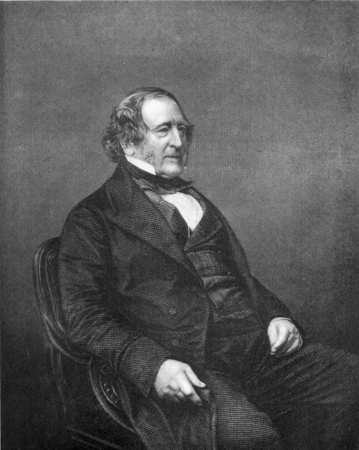
Lord Campbell
Gentlemen, it gives me great satisfaction to find that this case has been so fully laid before you. Everything has been done that could be accomplished for the purpose of assisting the jury in coming to a right conclusion. The prosecution has been taken up by the Government of the country, so that justice may be effectively administered. The Attorney-General, who is the first law officer of the Crown, has conducted the prosecution as the Minister of Public Justice. Again, I am much pleased to think that the prisoner appears to have had ample means to prepare for and conduct his defence. Witnesses very properly have been brought from all parts of the kingdom to assist in his defence; and he has had the advantage of having his case conducted by one of the most distinguished advocates at the English bar. Gentlemen, I most strongly recommend to you to attend to everything that fell so eloquently, so ably, and so impressively from that advocate, with the exception of his own private personal opinion. It is my duty to tell you that that ought to be no ingredient in your verdict. You are to try the prisoner upon the evidence before you, according as that evidence may be laid before you upon the one side and on the other, and by that alone, and not by any opinion of his advocate. I feel also bound to say that it would have been better if his advocate had abstained from some of the observations which he made in his address to you, in which he laid great stress upon his own conviction of the prisoner’s innocence of the crime imputed to him and of his apprehension that if you returned a verdict of guilty you one day would have to regret your verdict. The fact of the prisoner saying “Not guilty” is a mere form; it goes for nothing, and it may lead to the most disastrous consequences if that formal answer is to be dwelt upon with too much importance, as it may lead a jury to believe that a prisoner is not guilty because his advocate expresses his perfect conviction of his innocence. And, upon the other hand, if the advocate withholds an opinion, the jury may suppose that he is conscious of his client’s guilt, whereas it is the duty of the advocate to press his argument upon the jury, and not his opinion.
Lord Campbell
Gentlemen, I will now in a few words give you the allegations upon the one side and on the other. On the part of the prosecution it is alleged that the deceased, John Parsons Cook, was first tampered with by antimony, that he was then killed by strychnia, and that his symptoms were the symptoms of poison by strychnia. It is then alleged that the prisoner at the bar had a motive for making away with him; that he had an opportunity of administering the poison; that suspicion fell upon no one else; and that on two days, when the poison was supposed to have been administered, he actually purchased strychnia, the poison employed; and that, as they allege, his conduct before that transaction, before the deed, while it was going on, and afterwards, was that of a guilty, and not of an innocent, man. On the other side it is contended (and you are to say whether or not truly contended) that the prisoner at the bar was really the victim of prejudice; that he had no interest in the death of the deceased; and, on the contrary, that the death of the deceased was to his prejudice; further, that Cook did not die from poison by strychnia, but from natural disease; that his symptoms were those of natural disease, and not of poison by strychnia; and, further, it is contended that no part of the evidence which has been given shows anything which is at all consistent with the guilt of the prisoner. Gentlemen, it is for you to determine between the allegations on the one side and the other according to the evidence. A most anxious task is imposed upon you, knowing that the life of the prisoner is at stake; and, if you find him guilty, he must expiate his crime by an ignominious death. It is of the last importance that you should be convinced of his innocence or his guilt; and, if you are not convinced of his guilt, you will rescue him from the fate with which he is threatened. On the other hand, when you have heard the statements which were given in evidence—if you are satisfied of his guilt—it will be your duty to return a verdict of guilty; for if the poisoner were to escape with impunity, there would be no safety for mankind, and society would fall to pieces. Gentlemen, the burthen of proving the guilt rests on the prosecution; and unless that is fully sustained, and you are not convinced upon the evidence that he is guilty, then it will be your duty to acquit the prisoner; but in a case of this kind you cannot expect that witnesses should be called to state that they saw the deadly poison administered by the prisoner or mixed up by the prisoner openly before them. Circumstantial evidence as to that is all that can be reasonably expected; and if there are a series of circumstances leading to the conclusion of guilt, then, gentlemen, a verdict of guilty may satisfactorily be pronounced. With respect to the alleged motive, it is of great importance to see whether there was a motive for committing such a crime, or whether there was not, or whether there is an improbability of its having been committed so strong as not to be overpowered by positive evidence. But, gentlemen, if there be any motive which can be assigned, I am bound to tell you that the adequacy of that motive is of little importance. We know from the experience of criminal Courts that atrocious crimes of this sort have been committed from very slight motives, not merely from malice and revenge, but to gain a small pecuniary advantage and to drive off for a time pressing difficulties. It seems to me, gentlemen, you will have to consider well whether the symptoms of Cook’s death are consistent with a poisoning by strychnia. If they are not, if you believe that death arose from natural causes, the prisoner is at once entitled to a verdict of not guilty at your hands; but if those symptoms are consistent with a poisoning by strychnia, then you will have another and an important question to consider, whether the evidence which has been adduced is sufficient to convince you that it was a death by strychnia, and by strychnia which the prisoner administered. In cases of the sort the evidence has often been divided into medical and moral evidence, the medical being that of the scientific men, and the moral the circumstantial facts which are calculated to prove the truth of the charge against the party accused. Gentlemen, they cannot be finally separated in the minds of the jury, because it is by combination of the two species of evidence that their verdict ought to be found. In this case you will look at the medical evidence to see whether the deceased, in your opinion, did die by strychnia or by natural disease; and you will look at what is called the moral evidence, and consider whether that shows that the prisoner not only had the opportunity, but that he actually availed himself of that opportunity, to administer to the deceased the deadly poison of which he died.
Now, gentlemen, with these preliminary observations I will proceed to read over to you the evidence which has been given in this long trial; and I must implore you earnestly that, in any observations I may make upon its effect, you will be guided only by your own judgment. To assist you from time to time I may make observations, but you will not be in the slightest degree influenced by them unless so far as your own judgment concurs in them. The verdict must be yours, and in your hands the life of the prisoner must rest.
[His lordship then began with and took the jury through the story of Palmer’s financial transactions; next the evidence of Cook’s illness at Shrewsbury; and then that of Elizabeth Mills and Lavinia Barnes, and of Mr. Jones as to the illness at Rugeley; and passed to the evidence of Newton.]
Lord Campbell
Now, gentlemen, comes a witness of the greatest importance, Charles Newton. (His lordship read a portion of Mr. Newton’s evidence.) I may notice to you that Roberts swears, and is, I think, not contradicted, that he had sold strychnia, among other drugs, to Palmer; and you are called upon to observe the demeanour of Palmer at that time, and the way in which he tried to prevent Newton from observing that he had been obtaining this drug at the shop of Mr. Hawkins. (His lordship then read a further portion of the evidence of Mr. Newton.) Then the deposition of Newton was read, and it had better be read again. (The deposition of Mr. Newton, taken before the coroner, was then read, and his lordship concluded reading the evidence of the witness.) Now, gentlemen, this is the evidence of Newton, and most important it is for your consideration. It certainly must be recollected that he did not mention the furnishing of the strychnia to Palmer on Monday before the coroner, and that he did not mention it till the Tuesday morning, when he was coming up here. That certainly requires consideration at your hands; but then, gentlemen, you will observe that in his deposition, which has been read before you, although there is an omission, which is always to be borne in mind, there is no contradiction of anything that he has said. Well, then, you are to consider what is the probability of his inventing this wicked and most abominable lie. He had no ill-will towards the prisoner at the bar; he had nothing to gain by injuring him, much less by saying anything to affect his life. I see no motive that Mr. Newton could have for inventing a lie to take away the life of another person. No inducement could be held out to him from the Crown; he says himself that no inducement was held out to him, and that he at last disclosed it from a sense of justice. If you believe him, certainly the evidence is very strong against the prisoner at the bar. Now I will take you to the evidence of the next witness, whose evidence is closely connected with the witness Newton—who did furnish strychnia to the prisoner—I mean Joseph Roberts. (The learned judge read the examination-in-chief of Mr. Roberts.)
Lord Campbell
Now comes the cross-examination, which consists in this, and this only, “I did not make an entry of any of those things in our books; if articles are sold over the counter and paid for at the time, we do not enter them in our books.” Now, gentlemen, this is the evidence of Mr. Roberts, which is most important, for he is not cross-examined as to the veracity of his testimony, nor is it contradicted at all. It is not denied that on this Tuesday morning the prisoner at the bar got 6 grains of strychnia from Mr. Roberts. If you couple that with the evidence of Mr. Newton, believing that, then you will have positive evidence of strychnia being procured by the prisoner at the bar; that the symptoms of strychnia were exhibited in Mr. Cook, the deceased; and you have the evidence of Mr. Roberts, undenied and unquestioned, that on the Tuesday the 6 grains of strychnia were supplied. Now, gentlemen, if you believe both, a very serious case is adduced, supposing you should come to the conclusion that the symptoms of Mr. Cook were consistent with that poison. If you think the symptoms are accounted for by merely ordinary tetanus, of course the fact of strychnia being obtained by the prisoner at the bar is entitled to very little weight; but if you should come to the conclusion that the symptoms which Mr. Cook exhibited on the Monday night and Tuesday night are consistent with strychnia, then a fearful case is made out against him. Gentlemen, I have listened with the most anxious attention to know what explanation would be given respecting the strychnia that was purchased on the Tuesday morning. The learned counsel for the prisoner told us that we must believe nothing, that he would combat and disprove everything, and no doubt, according to his instructions, he very properly denied that Mr. Newton was to be believed; and, disbelieving Mr. Newton, you have no evidence of any strychnia being obtained on the Monday evening; but, disbelieving Mr. Newton and believing Mr. Roberts, you have evidence of 6 grains of strychnia having been obtained on the Tuesday morning, and no explanation is given of it. The learned counsel did not favour us with the theory which he had formed in his own mind respecting that strychnia, and how he considered it to be consistent with the view that he suggested. There is no evidence of the intention with which it was purchased; there is no evidence how it was applied, what became of it, or what was done with it.
Then I say, gentlemen, that it will not at all influence your verdict unless you come to the conclusion that the symptoms of Mr. Cook were consistent with a death by strychnia; but if you come to that conclusion I should shrink from my duty, and I should be unworthy to sit here, if I did not draw to your consideration the importance of the testimony and the inference it may afford of the death having been occasioned by strychnia, and that that was administered by the prisoner.
[The evidence as to the post-mortem was then read, and that of the postboy, of Cheshire, the postmaster, and several others, without comment of material importance. Passing to the scientific witnesses, his lordship said—“Now, gentlemen, you are called upon to form your opinion as to the opinion of scientific men respecting the appearance of the symptoms that Cook exhibited, and how far they can be accounted for by natural disease, and how far also, upon the evidence, they are consistent with strychnia. Whether they agree with traumatic or idiopathic tetanus, whatever it may be, or whether the symptoms correspond with a natural disease, and do not correspond with strychnia, is a matter that is of very great importance for you to consider.” Until his lordship reached Dr. Taylor the scientific evidence was read to the jury with no material comments.]
Lord Campbell
The next witness is Dr. Taylor. Now, gentlemen, here is something most important for your consideration. You see it is very properly relied on, on the part of the prisoner, that, though strychnia may be found in the body by analysis, none was found upon the analysis which was made by Dr. Taylor and Dr. Rees, for they, and they alone, experimented upon it, and they could find none. We know that experiments were made by those two individuals, and they say that, so far as their skill goes, there may be death by strychnia and yet that strychnia cannot be detected. But Dr. Taylor and Dr. Rees state experiments that they made where the death had been by strychnia which they themselves administered; and in at least two of those cases where there had been death by strychnia they could discover none. Now, it is possible that other chemists and other medical men might have discovered strychnia in those animals, and might have discovered strychnia in the body or in the jar which contained the stomach of Cook, but they found none in their analysis. They found none also in at least two cases where they killed animals by strychnia, and afterwards did all their skill enabled them to do for the purpose of discovering the strychnia. I thought at one time that these examinations were made with a view to show that, if the pills prepared by Mr. Bamford had been taken as he prepared them, mercury ought to have been found in the body of Mr. Cook; but I think that was not pressed, and I should think that it ought not to have any influence upon your verdict—there was no mercury found. There was mercury in the pills which Mr. Bamford prepared, and which Cook ought to have taken, but the simple fact of no mercury being found in those parts of Cook’s body that were examined ought not to have any influence upon your verdict; but that, of course, you will judge of for yourselves. Then the learned counsel, in cross-examination, read a passage from Orfila about a dog who had taken antimony, and some few minutes afterwards antimony was found in the bones, in the fat, and in the liver. (His lordship read the letter written by Dr. Taylor to Mr. Gardener.) You will bear in mind, gentlemen, that was written before the symptoms were known to Dr. Taylor and Dr. Rees, but they had been informed that prussic acid and strychnia and opium had been bought by Palmer on the Tuesday. They search for all these poisons and they find none; but they swear distinctly that they found antimony in the body, and therefore, in the absence of the symptoms, they do not impute the death to strychnia, but they say it may possibly have been produced by antimony, because the quantity they discovered in the body was no test of the quantity that had been administered to the deceased. Then a letter was read which Dr. Taylor wrote to the Lancet, and I must say that he would have done better to have abstained from taking any notice whatsoever of what was said about him, but you will say whether what he did write materially detracts from the credit which would otherwise be due to him. I think the passage in this letter in the Lancet, which was relied on, is the last passage which I will read to you. He explains what his evidence had been, and complains of the reports that had been spread abroad respecting him, and then he concludes his letter thus—“In concluding this letter I would observe that during a quarter of a century which I have now specially devoted to toxicological inquiries, I have never met with any cases like those suspected of poisoning at Rugeley. The mode in which they will affect the person accused is of minor importance compared with their probable influence on society. I have no hesitation in saying that the future security of life in this country will mainly depend on the judge, the jury, and the counsel who may have to dispose of the charges of murder which have arisen out of these investigations.” I again say that I think it would have been better if he had trusted to the credit which he had already acquired, instead of writing a letter to the Lancet; but it is for you to say that he, having been, as he says, misrepresented, and writing this letter to set himself right, whether that materially detracts from the credit which is due to him.
Then Dr. Rees follows, and he corroborates the evidence given by Dr. Taylor. Here, therefore, is Dr. Rees, whom no one can suppose to have an interest in the matter. I do not know what interest it can be supposed that Dr. Taylor had in the matter, for he was regularly employed in his profession; he knew nothing about Mr. Palmer until he was called on by Mr. Stevens to analyse the contents of the jar; he had no animosity against him, and no interest whatever in misrepresenting the matter.
Mr. Serjeant Shee—He said that the experiments with the two rabbits were made after the inquest.
Lord Campbell
Lord Campbell—Certainly; it cannot matter whether they were made before or after if they are witnesses of truth. It is the case that there was the death of the animals by strychnia, and that after death no strychnia could be found in the animals; and, if the experiments had been made this morning, the effect would have been the same. Dr. Taylor has been questioned about the indiscreet letter which he wrote to the Lancet and some indiscreet conversation which he had with the editor of the Illustrated Times; but with regard to Dr. Rees that imputation does not exist, and he concurs with Dr. Taylor in the evidence that the rabbits were killed by strychnia, and that, although they did everything in their power, according to their skill and knowledge, to discover the strychnia, as they did with regard to the contents of the jar, yet no strychnia could be found. You will judge from the vomiting that took place at Shrewsbury, and afterwards at Stafford, whether antimony may have been administered to Cook at Shrewsbury or Stafford. Antimony may not produce death; but it is part of the transaction, and deserves your deliberate consideration.
The Court then adjourned.
Twelfth Day, Tuesday, 27th May, 1856. The Court met at ten o’clock.
Lord Campbell
Lord Campbell—Gentlemen of the jury, at the adjournment of the Court yesterday evening I had finished the task of laying before you all the evidence on the part of the prosecution; and certainly that case, if not answered, does present for your consideration a serious case against the prisoner at the bar. It appears that in the middle of November he was involved in pecuniary difficulties of the most formidable nature; he had engagements to perform that he was unable to perform without some most extraordinary expedients; he had to make payments for which he was unprepared; there were actions brought against both himself and his mother upon the forged acceptances; he had no credit in any quarter upon which money could be raised. It so happened that at that time Cook, the deceased, by the winning of the race on the 13th November, became the master of at least £1000, and there is evidence from which an inference may be drawn that the prisoner formed the design of appropriating that money to his own use, and that he is prepared to do whatever was necessary to accomplish that object. There is some evidence that he did appropriate that money to the payment of debts for which he alone was liable. There is evidence from which it may be inferred that he drew a cheque in the name of Cook, which was a forgery, upon which to obtain payment of part of the money which was due to Cook; and there is further evidence that he employed Herring to collect money on the Monday and to appropriate it to his own use. What effect would have been produced by the survival of Cook, under such circumstances, you are to consider. However, it appears that from Cook’s death he contemplated the advantage of obtaining possession of the horse “Polestar,” which had belonged to Cook; and you have evidence of his having fabricated a document which was to declare that certain bills of exchange with which it appears that Cook had no concern were negotiated for Cook’s advantage, and that the prisoner at the bar had derived no benefit from them. Gentlemen, that was brought forward after Cook’s death, and if Cook had survived that fraud must have been exposed, and might have been punished. Then, gentlemen, with respect to the joint liability of Cook and Palmer, which, it is said, would now be thrown entirely upon Palmer, that was rather a distant object; and if Palmer had got possession of all Cook’s property by the means that he resorted to, he would not have been a sufferer by his death. Then, gentlemen, as to the important question whether Cook must be supposed to have died by natural disease or by poison. You have the evidence of Sir Benjamin Brodie and other most skilful and honourable men, who say that, in their opinion, he did not die from natural disease; they know no natural disease in the whole catalogue of diseases which attack the human frame that will account for those symptoms. Further, gentlemen, the witnesses go on to say that they believe that the symptoms that were exhibited by Cook were the symptoms of strychnia, that they were what would be expected from strychnia, and that, comparing those symptoms with natural tetanus, they do not correspond with it, but they do correspond with the symptoms brought on by a man being poisoned by the administration of strychnia. Then, gentlemen, with respect to the consideration that no strychnia was found in the body, that is for you to consider, and no doubt you will pay great attention to it; but there is no point of law according to which the poison must be found in the body of the deceased; and all that we know respecting the poison not being in the body of Cook is that in that part of the body that was analysed by Drs. Taylor and Rees they found no strychnia. But witnesses of great reputation have said, Dr. Christison among the number, that, under certain circumstances, where there has been poison by strychnia, they would not expect the strychnia should be detected; and you have the evidence of Dr. Taylor and Dr. Rees, who made the examination, that they having experimented upon animals killed by strychnia which they themselves administered, and by resorting to the same means that they had employed in examining the body of Cook, no strychnia could be found.
Then, gentlemen, with regard to the length of time that occurred between the alleged administration of the strychnia and the time that the symptoms appeared, the evidence seems to me to lead to this conclusion, that, where it is administered to animals with a view of making experiments and with a view of observing its operations as quickly as possible, it generally operates more rapidly than in the human frame when it is put in the shape of pills, and that will depend upon the manner in which those pills are compounded, and likewise on the state of the health and body of the person to whom they are to be administered, and whether there may or may not have been any previous tampering with the health of that person. Instances are referred to where, even in the human body, a greater space of time has elapsed than in this case between the administration of the poison and the symptoms which were exhibited.
Mr. Serjeant Shee—I think that is not so upon the evidence, my lord.
Lord Campbell
Lord Campbell—There are instances referred to in which it has been detected; there have been instances referred to in the course of this trial in which there has been as long an interval.
Mr. Serjeant Shee—I believe that is a mistake.
Lord Campbell—With regard to there being no blood in the heart, which seems to have been relied upon, it appears that the result is this, that if the death is produced by an obstruction of the respiratory organs, producing asphyxia, the blood is found in the heart; but if it be produced by a spasm upon the heart itself, the heart contracts, the blood is expelled, and no blood is found after death. Now, taking the evidence before us, there are two instances where that took place.
Then, gentlemen, we have to look to the evidence as it implicates the prisoner at the bar. You must consider the evidence to show that he must have tampered with the health of the deceased, by administering something to him in the brandy and water, in the broth, and in the other things which were administered to him at Rugeley. One part of the broth was taken by Elizabeth Mills, as she swears, and the consequence which followed, according to her evidence and the evidence of Lavinia Barnes, was that she was taken ill with a vomiting in the stomach as Cook the deceased had been.
Then, gentlemen, you have antimony found in the body of the deceased; antimony, which would show that tartar emetic, producing vomiting, had been administered, and it seems to be clearly proved that that substance was found in his body, from what source you are to say from the evidence before you.
Lord Campbell
Then, gentlemen, comes the more direct evidence that the prisoner at the bar, if you believe the witnesses, procured this very poison on the Monday and on the Tuesday—3 grains, I think, on the Monday, and 6 on the Tuesday. For what purpose was that obtained? The evidence of the witness who swears to the poison being obtained on the Monday is impeached, but no impeachment rests upon the evidence of the witness who swears to the poison being sold by him on the Tuesday to the prisoner at the bar. You have no account of that poison; what was the intention with which it was purchased, and what was the application of it, you are to infer. Then, gentlemen, it is impossible that you should not pay attention to the conduct of the prisoner at the bar, and there are some instances of his conduct which you will say whether they belong to what might be expected from an innocent or a guilty man. He was eager to have the body fastened down in the coffin. Then, with regard to the betting book, there is certainly evidence from which you may infer that he did get possession of the betting book, that he abstracted it and concealed it. Then, gentlemen, you must not omit his conduct in trying to bribe the postboy to overturn the carriage in which the jar was being conveyed, to be analysed in London, and from which evidence might be obtained of his guilt. Again, you find him tampering with the postmaster, and procuring from the postmaster the opening of a letter from Dr. Taylor, who had been examining the contents of the jar, to Mr. Gardner, the attorney employed upon the part of Mr. Stevens. And then, gentlemen, you have tampering with the coroner, and trying to induce him to procure a verdict from the coroner’s jury which would amount to an acquittal. These are serious matters for your consideration, but you, and you alone, will say what inference is to be drawn from them. If not answered, they certainly present a serious case for your consideration. It is for you to say whether the answer is satisfactory. Either you may be of opinion that the case on the part of the prosecution is insufficient, or you may be of opinion that the answer to it is satisfactory.
Then, gentlemen, that answer consists of two parts—first, of the medical evidence, and, secondly, of the evidence of facts. With regard to the medical evidence, I must say that there were examined on the part of the prisoner a number of gentlemen of high honour and solid integrity and proved scientific knowledge, who came here only to speak the truth and assist in the administration of justice. You may be of opinion that others came whose object was to procure an acquittal of the prisoner. Gentlemen, it is material, in the due administration of justice, that a witness should not be turned into an advocate, any more than an advocate should be turned into a witness. It is for you to say whether some of those who were called on the part of the prisoner did not belong to the category which I described as witnesses becoming advocates.
Gentlemen, the first witness on the part of the prisoner was Mr. Thomas Nunneley. (The learned judge read the evidence of Mr. Nunneley and the documents therein referred to.) You will recollect what he says, and you will form your opinion as to the weight that is to be given to it. He certainly seemed to me to give his evidence in a manner not quite becoming a witness in a Court of justice, but you will give all attention to the facts to which he refers in the evidence he gave. He differs very materially in his general opinion from several of the witnesses who were examined on the part of the prosecution. He speaks of there being an extraordinary rigidity of the body after death, when there has been a death of this description, with other symptoms, and he attaches considerable importance to the heart being empty, but you will say what weight ought to be attached to his opinion.
Lord Campbell
Mr. William Herapath is then called. (The examination-in-chief of Mr. Herapath was read.) He seems to differ from Mr. Nunneley with respect to the rigidity produced by this poison. Now, gentlemen, Mr. Herapath is a very skilful chemist, and I have no doubt he spoke sincerely what he thought, and what was his opinion? That when there has been death by strychnia, strychnia ought to be discovered; but it seems he intimated an opinion on this very case of Cook that there might have been strychnia, and that Dr. Taylor did not use the proper means to detect it. Now, the only evidence that we have in this case that there was not strychnia is the analysis by Dr. Taylor and Dr. Rees that they did not discover it. As I before pointed out to you, in two other cases in which there certainly had been poisoning by strychnia the result was the same—they could not discover it.
Then the next witness is Mr. Rogers. Now, this is a gentleman whom there seems no reason to doubt; there seems no reason to doubt the facts that he stated, and that he does sincerely entertain the opinion that he expresses; and, according to his evidence, where there has been strychnia mixed with impure matter, it may be expected that it would be detected by skilful experimentalists, and by using the proper tests. Then Dr. Letheby is called; he is the medical officer of health to the city of London and of the London Hospital. I doubt not that Dr. Letheby speaks sincerely, and according to his experience and opinion, but he does say truly that cases vary very much, and that there may be cases which he calls “exceptional,” alluding to the case of the lady at Romsey; and it may probably be the fair result that enough of this disease is not known to be aware of all its varieties, and that any peculiarity that may arise where there is strong probability of strychnia having been administered would not be anything like conclusive evidence to rebut that result.
Then Mr. Robert Gray is examined. Now, gentlemen, here you have a case of what is called idiopathic tetanus; but you are to say whether from this you can infer that the illness of Mr. Cook was idiopathic tetanus. The great weight of evidence seems to me to show that it was not idiopathic any more than traumatic tetanus; but that whatever form of disease it might be, it would not be idiopathic tetanus; and you will find that the symptoms vary most materially in their appearance from the case that is here detailed in the duration as well as the rest of the course of events.
Lord Campbell
The next witness that was called was Mr. Brown Ross. Now, gentlemen, I do not know for what purpose the case alluded to by Mr. Ross was brought before you, unless to lead to an inference that Mr. Cook’s was a case of tetanus of the same sort with this which is here described, because this was tetanus; and I suppose it was intended that you are to infer that Mr. Cook’s was of the same description; but whether you call it idiopathic or traumatic, it was a case of tetanus—was directly to be ascribed to wounds which were upon his body, and which are here described. No such wounds were upon the body of Mr. Cook; and other witnesses who were examined on the part of the defence say that this was not a case of tetanus at all; but then, even in this case that has been described, you see there were the symptoms so nearly approaching those of strychnia that strychnia was suspected, but there was no ground for it; and in the case described there was no ground for supposing strychnia could by possibility be the cause of death.
The next witness is a witness worthy of all praise for the sincerity which he exhibited. I mean Dr. Wrightson. Now, gentlemen, this witness, who, I have no doubt, is a most scientific and a very honourable man, speaks as a man of science, and, according to him, the poison would be found in the body; but he speaks with proper caution, and upon his evidence you ought to say whether, under particular circumstances, it might not be discoverable, or whether the person seeking for it might fail to employ the proper means for detecting it in the body.
Then comes Mr. Partridge, a most respectable gentleman, who says he has been many years in practice as a surgeon, and is professor of anatomy at King’s College. Now, gentlemen, you have here the opinion of a very respectable witness as to the different topics that he touches upon; and the most important one is that he thinks that the symptoms that were exhibited did not correspond with what he should expect from strychnia; but he speaks from his own experience, and you have it from the other witnesses that the symptoms vary considerably in different cases.
The next witness is Mr. John Gay. Now, gentlemen, this was a case, you see, of tetanus arising from the toe being smashed; and it seems to me, although, of course, you will form your own opinion upon it, bears no analogy whatever to the case of Cook, with regard to whom no such cause could be assigned. Again, gentlemen, he says, what is very material, that, in the event of a given state of tetanus, it would be extremely difficult, if not impossible, without collateral evidence, to ascribe the tetanic disease to any cause in the absence of any evidence as to the cause. But you will form your own opinion upon it. Therefore you are to look to collateral evidence; and if the collateral evidence would impute the symptoms of tetanic convulsions to any particular cause, according to this witness that cause may be assigned. That I say with a view to get what is called the moral evidence with regard to the conduct of a particular person, and with regard to what he may have done or what he may have had in his possession.
Lord Campbell
Now comes Dr. M‘Donald. You will observe that he gives an account of experiments he made for the prisoner, and you will see the lengths to which he goes in adopting a new form of disease of epilepsy with these complications. You are to say what weight you give to that evidence compared with the witnesses who have given evidence before you.
The next witness is Mr. John Bainbridge. The object of this witness’s evidence seems to be to induce you to believe that this was a case of epilepsy, and from the symptoms you will say whether you can come to that conclusion.
The next witness is Mr. Edward Steady. The case referred to by this witness seems to be a case of traumatic tetanus; and you will say, if it were idiopathic, whether the course of it in the slightest degree resembles the symptoms of Cook, the deceased.
The next witness is Dr. Robinson. Now, gentlemen, you have this respectable physician, who gives an account from which you are called to infer that Cook’s case was a case of epilepsy. He says he should only take it to be epilepsy in the absence of evidence of strychnia being administered. He says that all the symptoms described by Jones on the Tuesday night are consistent with strychnia; and, with regard to epilepsy, he says in no case where epilepsy had existed would it cause death without a loss of consciousness. Cook, you will remember, remained conscious to the last, and you will say whether, upon the evidence that is laid before you, there was or was not a bending of the body, which is characteristic of tetanus, and what the witnesses have described as being inconsistent with epilepsy.
Lord Campbell
The next witness is Dr. Richardson, who now brings in for the first time angina pectoris as a disease of which it may be presumed Cook died. Now, gentlemen, you have to attend to this case; the witness, who seems most highly respectable, says this case being detailed by him, the symptoms were consistent with strychnia, and that, if he had known as much of strychnia then as he does now, he would have made an analysis to see whether strychnia was in the body. The great question that I propounded for your consideration was whether Cook’s symptoms were consistent with strychnia, and, if they were not, then the conclusion would be in favour of the prisoner; but if they were consistent with strychnia, then you are not upon that alone to find a verdict of guilty against him; but you are to consider the other evidence and see whether the death arose from strychnia or not. Dr. Wrightson is recalled, and he says that, in his opinion, when strychnia is entirely absorbed in the system it is diffused equally throughout the entire system. Dr. Wrightson is a philosopher, and, as a man of science, he speaks with caution, and you have heard his evidence. He says that if the minimum dose were taken to destroy life, and then a long interval elapsed between the taking of the poison and death, the more complete would be the absorption, and the less chance there would be of finding it in the stomach.
Mr. Serjeant Shee—I think he said he would expect to find it in the spleen, the liver, and the blood.
Lord Campbell—Yes; “I should look for it elsewhere, in the spleen, the liver, and the blood.”
Then comes Mr. Oliver Pemberton. The evidence of this witness only goes to show that, in his opinion, an examination of the body at that time was not of much value, and did not afford the means of coming to a satisfactory opinion, differing in opinion, therefore, from others that had been called.
His lordship then dealt with the witnesses as to facts, and pointed out that, according to the trains, Palmer could not have arrived in Rugeley on the Monday night before ten o’clock.
Now, gentlemen, comes a very material witness, who, if he were to be believed, would be very important, particularly upon one part of the case. I mean Jeremiah Smith—and you, having heard the whole of his evidence, the examination and cross-examination, are to say what faith or reliance you can place upon his testimony. Now, gentlemen, this would show, if true, that the genuine and very identical pills that Bamford had made, and in the state in which he had prepared them, were taken by Cook before Palmer arrived from London at Rugeley, or, at any rate, before he came to the Talbot Arms. It is for you to say whether you can place reliance upon such testimony. You saw how he conducted himself in the witness-box, and how he at last denied that the signature to the instrument which he purported to have attested, and which he received from the prisoner at the bar, was in his handwriting. He said it was like it, but it was not his handwriting. Then it appears that he did receive £5, and you are to say whether it was not clearly for attesting that very assignment. The counterfoil of the cheque for £5, from William Palmer the prisoner, is shown him; and with that piece of paper he goes to the bank and receives the £5. Can you believe a man who so disgraces himself in the witness-box? It is for you to say what faith you can place in a witness who, by his own admission, engaged in such fraudulent proceedings. We are now upon veracity, and you are to say whether you can believe a witness who at last acknowledges that he had been applied to and had been engaged in procuring an insurance on the life of Walter Palmer, who had been a bankrupt six years before, and who had no means of living except by the allowance of his friends and an allowance made to him by the prisoner at the bar.
Lord Campbell
Again, he acknowledges that he was engaged in the proposal to insure the life of Bates for £10,000. Bates being at that time superintending the stables of the prisoner at the bar, living in lodgings at 6s. 6d. a week, apparently having no property, and nothing depending upon his life, his life was to be insured for £10,000. Smith gets himself appointed agent to an insurance office, and, with a knowledge of these facts, he proposes the insurance to be accepted by the office which he represents; and can you believe such a witness who acknowledges himself to have been engaged in such fraudulent proceedings, and who, now being examined upon his oath, denies the handwriting of his own attestation to that document? Gentlemen, of his credit you are to judge. His evidence would be material as to what took place on the Monday night, because it would show that the pills that Cook took that night were taken as they had been prepared by Bamford, and before the prisoner at the bar had had any opportunity to substitute others for them in the pill box. Such is the case with regard to what took place on the Tuesday. If it stood there, and if it were believed, it would be evidence in favour of the prisoner at the bar; and you are to say whether you believe it, or, if you disbelieve it, what effect it has upon the other testimony that has been brought forward.
Gentlemen, the case is now in your hands; and, unless upon the part of the prosecution a clear conviction has been brought to your minds of the guilt of the prisoner, it is your duty to acquit him. You are not to proceed even upon a strong suspicion; there must be the strongest conviction in your minds that he was guilty of this offence; and if there be any reasonable doubt remaining in your mind, you will give him the benefit of that doubt; but if you come to a clear conviction that he was guilty, you will not be deterred from doing your duty by any considerations such as have been suggested to you. You will remember the oath that you have taken, and you will act accordingly. Gentlemen, I have performed my task; you have now to discharge yours, and may God direct you to a right finding.
Mr. Serjeant Shee—Your lordship stated to the jury that the question for them to consider was whether the evidence that has been brought forward is consistent with the death of Cook by strychnia. I submit to your lordship that that is not the question which ought to be submitted to the jury.
Lord Campbell—Serjeant Shee, that is not the question that I have submitted to the jury; it is a question. I told them that unless they considered that the symptoms were consistent with death by strychnia they ought to acquit the prisoner.
Lord Campbell
Mr. Serjeant Shee—It is my duty, my lord, not to be deterred by any expression of displeasure at my stating it; I am accountable not only to your lordships, but I am accountable to a much higher tribunal; and I am bound to submit to you what occurs to me to be the proper question to be put to the jury in this case—it is your lordship’s duty to overrule it if you think proper. I submit to your lordships that the question, whether the symptoms of Cook’s disease were consistent with death by strychnia is a wrong question, unless it is followed by this, “and inconsistent with death by other and natural causes”—and that the question should be, whether the medical evidence establishes beyond all reasonable doubt the death of Cook by strychnia—it is my duty to submit that to your lordship.
Lord Campbell—Gentlemen of the jury, I did not submit to you that the question upon which your verdict alone was to turn was whether the symptoms of Cook were consistent with death by strychnia, but I said that that was a most material question for you; and I desired you to consider that question with a view to guide your judgment as to whether he died from natural disease, or whether he did not die by poison, by strychnia administered by the prisoner. Then I went on to say that if you were of opinion that the symptoms were consistent with death from strychnia, you should go on to consider the other evidence given in the case, whether strychnia had been administered to him; and whether strychnia had been administered to him by the prisoner at the bar; and those are the questions that I again put to you. If you come to the conclusion that those symptoms were consistent with the strychnia, do you believe from the evidence that it was strychnia, and do you believe that that strychnia was administered by the prisoner at the bar? Do not find a verdict of guilty unless you believe that the strychnia was administered to the deceased by the prisoner at the bar. But if you believe that, it is your duty to God and man to find a verdict of guilty.
The jury retired, and, after an absence of an hour and eighteen minutes, returned a verdict of guilty.
The prisoner was asked what he had to say why the Court should not pass sentence of death upon him according to law, and he made no answer.
Lord Campbell
Lord Campbell then said—William Palmer, after a long and impartial trial you have been convicted by a jury of your country of the crime of wilful murder. In that verdict my two learned brothers, who have so anxiously watched this trial, and myself entirely concur, and consider that verdict altogether satisfactory. The case is attended with such circumstances of aggravation that I do not dare to touch upon them. Whether it is the first and only offence of this sort which you have committed is certainly known only to God and your own conscience. It is seldom that such a familiarity with the means of death should be shown without long experience; but for this offence of which you have been found guilty your life is forfeited. You must prepare to die; and I trust that, as you can expect no mercy in this world, you will, by repentance of your crimes, seek to obtain mercy from Almighty God. The Act of Parliament under which you have been tried, and under which you have been brought to the bar of this Court at your own request, gives leave to the Court to direct that the sentence under such circumstances shall be executed either within the jurisdiction of the Central Criminal Court or in the county where the offence was committed. We think that, for the sake of example, the sentence ought to be executed in the county of Stafford. Now, I hope that this terrible example will deter others from committing such atrocious crimes, and that it will be seen that whatever art, or caution, or experience may accomplish, such an offence will be detected and punished. However destructive poisons may be, it is so ordained by Providence that there are means for the safety of His creatures for detecting and punishing those who administer them. I again implore you to repent and prepare for the awful change which awaits you. I will not seek to harrow up your feelings by any enumeration of the circumstances of this foul murder. I will content myself now with passing upon you the sentence of the law, which is, that you be taken hence to the gaol of Newgate, and thence removed to the gaol of the county of Stafford, the county in which the offence of which you are justly convicted was committed; and that you be taken thence to a place of execution, and be there hanged by the neck until you be dead; and that your body be afterwards buried within the precincts of the prison in which you shall be last confined after your conviction; and may the Lord have mercy upon your soul. Amen!
The prisoner was executed at eight o’clock on Saturday morning, 14th June, 1856, in front of Stafford gaol. He reiterated that he was “innocent of poisoning Cook by strychnia.”