THE TRIAL. (continued 5)
Reading edition
Serjeant Shee
I believe that is the true version of the matter, and that Cook believed it to be so. He breakfasted with Palmer the next morning; he was good friends with him the whole of the day, and went with him to Rugeley, and there remained on Palmer’s invitation. In consequence of the letter which Pratt wrote on the 13th, and which Palmer got on the 14th, in which they both had an interest, Cook wrote to Pratt to say that somebody would call on him with £200, and he wrote to Fisher to tell Fisher to do so. Did anybody at that time believe that there was any intention to drug and poison this man? Does not the explanation that Mrs. Brookes gave, which I must say was exceedingly creditable to her, the readiness with which she stated to me that her husband did not approve of her attending races, that it was disagreeable to him; and the dignity, if I may say so, with which she answered the question put to her by my learned friend—“Are you intimate with Palmer?” by this other question, “What do you mean by intimate with him? I am friendly,” seemed to me to entitle her to all due respect. And when she, being called for the Crown, tells you, “That night I heard in several directions of a great number of people who were purged and vomited; there was a general affection of the kind amongst strangers visiting Shrewsbury on that occasion”—I submit to you it was to the last degree improbable that anything of that kind occurred. About the tumbler which she saw in Palmer’s hand I cannot suggest any reason, because it is not in my instructions, but it might probably be accounted for in this way, when he came back from Rugeley and found all the people indisposed he would naturally look at the water to see if there was anything to account for its unwholesomeness. Mrs. Brookes said, and that is the point to which I wish to call your attention, that he was in a passage under a chandelier; that the waiter pointed to him when he showed her upstairs; that he spoke to her while holding up the glass to the light, and said, “Wait a minute, and I will come to you.” Nothing can be more natural than that; and I submit to you it is impossible to say that there is anything to justify a suspicion of poison in it. With regard to the money he gave to Fisher, I can suggest no other reason than that, just before being sick, he gave his money to Fisher, feeling that it was coming upon him, and that his stomach was revolting at the liberties he had taken with it. He had the good sense to place his money, when he was still very sick, in the hands of Fisher, and he afterwards went to bed. It may have been that he had been guilty of excess in eating and drinking, and it was necessary to send for the doctor, who, when he came, wished to send him an emetic. The young man knew so well what to do that he said, “Oh! I can make myself sick without an emetic; I will put my tooth-brush down my throat; I can be sick without your emetic.” He took a pill when it was recommended to him and a black draught, and the moment he laid his head on his pillow he was perfectly free from any alarm, and he got up the next morning perfectly well. Gentlemen, that is really too ludicrous to be worthy of a moment’s consideration. Now, let us go to certain other matters, and more particularly to the conduct of the prisoner himself. I would just mention that there was a person there of the name of Myatt in the room at the time they say the brandy and water was drugged. Why was he not called? The others came in just before going to bed, but Myatt had been there the whole evening, and was not a mere accidental visitor in the room. You will hear his version so far as it is necessary. They have now got back to Rugeley, and then the history of the slow poisoning continues. Cook and Palmer go back together, and probably they talk all the way about Pratt and their difficulties, and the way of getting out of them, and of the small way that the winnings of Shrewsbury will go to effect the object. They both see ruin staring them in the face unless the Prince of Wales office can be forced to pay the money due upon the policy of insurance, and they can remain free from all suspicion of insolvency or misconduct in the meantime. When they get to Rugeley, by sending up the £200 to Pratt, they provide for the temporary difficulty. They are on friendly terms, Palmer making use of Cook’s things, and probably both attaining their own objects, as it would appear that Palmer said directly Cook died that he had some interest in bills which were outstanding; and that might well have been, considering they were engaged in racing transactions; that they were joint owners of one horse; that they had the same trainer, betted for each other at races, and that they were confederates and friends on the turf, in that sort of relation to each other which gave them a joint interest in the same ventures. Cook sat at the table of Palmer on the 16th, and wrote up that night to Pratt. Cook goes to bed late on that evening, well enough, not so drunk as to prevent his asking the chambermaid to give him a longer candle, in order that he might read in bed. He seems to have had a little champagne, not so much as to have made him drunk, yet perhaps too much for a stomach weakened by the excess, if it was excess, at Shrewsbury, or by the vomiting which was occasioned by the illness there, and the hot water which he had taken. He gets up the next morning poorly; he eats nothing that day; ails enough for Mr. Bamford to be called in by Palmer, and Palmer is unremitting in his attention to him on that day and the Sunday following.
Serjeant Shee
Now, it is said that that very attentiveness is evidence of the prisoner’s guilt. What, as my friend here (Mr. Grove) says, what is a man to do? Here is a young fellow’s health in very considerable danger. Cook, having a joint interest in racing transactions with Palmer, thinks it convenient to stop at Rugeley, where he has no friend but Palmer. They are not flush of money, and Palmer has a house and an establishment on a moderate scale immediately opposite the inn in which Cook is staying. He is enabled to send such things over as can be got in a private house, not at hotel prices, but at a very trifling expense. He was on a visit to Palmer, and he knew nobody there but Palmer. He was ailing; and as it is very dull for a man who has no intellectual pursuits to be alone all day when out of health, Palmer goes over and talks to him, and attends to him, and gets him what comforts he can. That is what a man would do to a friend; it is precisely what a man would do. If he had not done it, but merely attended to him at night when he was taken ill on the Monday night, without visiting him during the day, it might have been said that he was neglecting him, and only attended to him when he wanted to give him another dose of poison. That is the way the Crown would have put it then! He is laboriously attentive to him under circumstances which can well be accounted for by the reason that he had actually, if not a sincere friendship for him, at least a friendly kind of liking for him, and an interest with him on betting and racing transactions, and could supply him with several things from his house at little or no expense. If Cook had been well he would probably have had his meals at Palmer’s house. He was ill, and Palmer sends Dr. Bamford to him. He saw him at eight o’clock on Sunday morning, and again at six or seven o’clock. Cook told him his bowels had been moved twice or thrice. That is what he told to Dr. Bamford; it may have been known to Palmer that it was oftener, and that the truth was he was slightly suffering under some symptoms of diarrhœa, as he afterwards stated in the letter to Jones. It was Cook himself who told Dr. Bamford about his bowels having been moved; and on the same day Palmer wrote a letter to Jones, intending to bring Jones there, he being about to go to London, and stated “Cook had been suffering from diarrhœa.” It was at Shrewsbury, where everybody else had diarrhœa. He took the pill and black draught, and their effects continued, probably to some extent when he was at Rugeley. It is absurd to pretend that the suggestion of diarrhœa could have any sinister object, as Jones must have ascertained the truth as soon as he arrived at Rugeley.
Serjeant Shee
I now beg to call your attention to the next important fact in this case. It seems to me to be, though I touch upon it briefly here, one of the very last importance, and one which ought to decide it in the prisoner’s favour. The supposition of the Crown is, that Palmer intended to dose Cook with antimony, to keep his stomach in a perpetual state of vomiting, in order the more easily to despatch him by strychnia; that he began the plot on the Wednesday at Shrewsbury and continued it at Rugeley, and that during the Sunday Cook was under the influence of that treatment—Sunday was the day Palmer attempted, as was said, to force the broth upon him. Now, being bent, as it is supposed, upon destroying Cook, there is one man in the world who would be the very last witness he would select as a witness of his proceedings. He was a medical man, in the prime of life, intimately acquainted with Cook, living in the same house with him, much attached to him, at all events sufficiently attached to him to come to him as soon as he had heard that he had had an attack of diarrhœa—Mr. Jones, of Lutterworth. Palmer, intending to go to London, and not wishing to leave Cook alone, wrote on the Sunday to Mr. Jones, telling him that Cook was then ill with diarrhœa, a statement which is not altogether inconsistent with the evidence of Dr. Bamford and what Cook stated, and begs of him to come over. I beg of you to pause here for a moment in order to appreciate the full importance of this fact; the more you think of it the more profound will be your conviction that it affords evidence irrefragable of Palmer’s innocence. The imputation upon Palmer is that he intended to kill Cook to possess himself of his winnings. Who was with Cook when the race was won? Who was by his side on Shrewsbury racecourse for the three minutes that he was speechless? Who saw him take out his betting-book and count his winnings? Who but Jones—Jones who was his bosom friend, his companion, his confidant, and who knew to the last farthing the amount of his gains? Jones was, of all men living, the most likely to be the recipient of Cook’s confidence, and the man bound by every consideration of honour, friendship, and affection to protect him, to vindicate his cause, and to avenge his death. Yet this was the man for whom Palmer sent, that he might converse with Cook, receive his confidence, minister to him in his illness, and even sleep in the same room with him! How, if Palmer is the murderer they represent him, are you to account for his summoning Jones to the bedside of the sick man? If Cook really suspected—as we are assured he did—that Palmer was poisoning him, Jones was the man to whom he would most willingly have unbosomed himself, and in whose faithful ear he would have most eagerly disburthened the perilous stuff that weighed upon his own brain. Jones, as well as Palmer, was a medical man, and it is not improbable that, in the course of his studies, the former may have noted in his class-book the very passages respecting the operation of strychnia which had attracted the attention of the latter. Is it conceivable that, if Palmer meant to slay Cook with poison in the dead of the night, he would have previously ensured the presence in his victim’s chamber of a medical witness, who would know from his frightful symptoms that the man was not dying a natural death? He brings a medical man into the room, and makes him lie within a few inches of the sick man’s bed, that he may be startled by his terrific shrieks, and gaze upon those agonising convulsions which indicate the fatal potency of poison! Can you believe it? He might have despatched him by means that would have defied detection, for Cook was taking morphia medicinally, and a grain or two more would have silently thrown him into an eternal sleep; but instead of doing so, he sends to Lutterworth for Jones. You have been told that this was done to cover appearances. Done to cover appearances! No, no, no! You cannot believe it—it is not in human nature—it cannot be true—you cannot find him guilty—you dare not find him guilty on the supposition of its truth—the country will not stand by you if you believe it to be true—you will be impeached before the whole world if you say that it is true—I believe in my conscience that it is false, because, consistently with the laws that govern human nature, it cannot possibly be true.
Serjeant Shee
Gentlemen, there are other facts to be adverted to before I sit down to which it is necessary your attention should be drawn. There was a great stir at the hotel at Rugeley after Mr. Jones had returned from London with Mr. Stevens, the executor. Mr. Stevens arrives at the inn with Mr. Jones, has been in conversation all the way down with Mr. Jones, and has heard from Mr. Jones all that Mr. Jones knows, and does not appear to have had anything communicated to him by Mr. Jones which could justify any suspicion on his part. Mr. Jones, when they arrive at Rugeley, introduces him to Palmer, and Palmer at once takes him up to the room of the dead man, and uncovers the body down to the thighs, and Mr. Stevens looks at the corpse and sees there are no convulsions about the body except the clenching of the hands. He sees there is no emaciation, no signs as he thinks of illness, and, wondering within himself, says, “How can you have died?” or something to that effect; “How grievous a thing it is that your young life should have passed away!” I think he said he did not look as if he were dead. After seeing the corpse they went down to dinner, and he asked Palmer to dine with him, and Jones, and Mr. Bradford, the husband of Mr. Cook’s sister. He has not been called; he could have told us if there was anything suspicious in the conduct of Palmer, anything that could justify such conduct on the part of Mr. Stevens. They have their dinner, and when their dinner is over, see what takes place. It is important you should know it, because I think you will see from the way it occurred that the conduct of Palmer was the conduct of a man certainly apprehensive of any sort of vexatious inquiry which might involve him in pecuniary troubles, and was therefore anxious to conciliate Mr. Stevens, still comporting himself like one who could firmly and freely maintain his equality with Mr. Stevens unabashed, with a clear brow and the appearance of an innocent man. (The learned serjeant read a portion of the dialogue which took place between Mr. Stevens and Palmer.) He said, “with a spasmodic convulsion of the throat,” which was perfectly apparent; he could not see his face, but there was a spasmodic convulsion of his throat. Who could believe such a testimony of guilt as that? He expects that Palmer is to be bound to look after everything of every kind that was in the hotel belonging to Cook, and because he could not find a trumpery book, which anybody might have taken away, thinking and probably having heard it was of very little use, which could not be of the slightest service in any way to Palmer for any purpose whatever, or to anybody, simply on that account, he is to indulge in this vexatious proceeding. The last time the book was seen was on the Monday. The last person who saw it was Elizabeth Mills, on the Monday, and on that day there were several people there with Cook—Saunders the trainer, and the jockeys; after his death the two servant-maids and the housekeeper, the three undertaker’s men, the two women who laid Cook out, and some other persons; the barber who shaved him might have taken the book, and having taken it could not return it; for here again is the effect of dishonesty as well as falsehood. Once done, you cannot repair it; without admitting it you cannot set it right again. I throw imputation on nobody; I simply say, that as many people had access to the room, it is not fair, it is not right under the circumstances when a man is charged in such a case of momentous importance without any assignable reason for his purloining the betting book, to fix it on him without any proof that he ever had it in his hands, when nothing like a proper search was made for it until some time after Cook’s death. I asked whether the drawers were not full of linen and clothes, the answer was that they were. It was not seen immediately after the death, nor was there any search made for it, nor was it set aside and taken care of in the room, so that it could not have been removed by Palmer with a guilty intention of purloining it. Let us go on for a moment with this dialogue—(the learned serjeant then read a passage from the dialogue as detailed in the evidence)—and at last, after goading and irritating the man for all this time, though Palmer was willing to make explanations and provoke inquiries into anything or circumstance which if inquired into would at once have led to a discussion of matters in a fair and gentleman-like manner, Stevens snubs him by asking him whether he intends to be at the post-mortem; and at last, when he says, “It is a matter of indifference to me,” goads the poor man into saying, “So it is to me.” That is the only word of irritation that Palmer—who kept his ground during the whole time and stood up to this man—that is the only word of irritation that he used. Mr. Stevens speaks to him in a very warm manner, yet Palmer manifests the composure of a gentleman, of a man of feeling and consideration to the father—as he called himself—but the stepfather of the young man, and that is to be turned into evidence of guilt.
There is another story made against him, that he was found searching in the pockets of Mr. Cook shortly after his death—it is the most absurd suggestion on their own showing. The facts were these. Mr. Jones, I think, told the servants to tell Palmer to come into the room. I think that was it—to tell Palmer to go into the room; and then I think Mr. Jones told another servant to follow him into the room. Elizabeth Mills is the witness to that. She says, “I went in, and I saw him looking about seeing if there was anything in one of the coats, and he also looked under the bolster of the bed, just as a gentleman might be looking for a watch; and he went on doing so after I got into the room.” It was quite clear she suspected nothing, and I submit it is not fair that any suspicion should attach to him on the subject.
Serjeant Shee
One other circumstance there is on which reliance has been placed; and although it has been said great reliance is not intended to be placed upon it, I cannot tell what effect it will produce on your minds. I am sure that when those who have promoted this prosecution first undertook it they intended to rely, as proof of damning guilt, on the manuscript extracts about strychnia in these medical books. I think it will be within your experience that in youth and early manhood the best protection that a man can have for his honour and integrity is the company and society of a wife whom he loves. If you find a man in early youth attached to a virtuous young woman, whom he loves with a sincere and heartfelt attachment, depend upon it he is of a gentle nature, and little prone to deeds of violence. They have put in these books to show that Palmer had a knowledge of strychnia poison, and they are the books which he used when a student attending lectures in London, as must have been known to his deceased wife. I find, in what I am in a condition to prove to be her own handwriting, proof positive that this was his student’s book, and that he then and long after loved that young woman in the way in which it is God’s will, under the sanction of His holy ordinance, young men should love their wives. His marriage was a marriage of affection; he loved her for herself and for her person; he loved her as ardently as he now loves her first-born, his only surviving child, a boy of seven years old, who waits with trembling anxiety for a sentence which will restore him to his father’s arms, or drive that father to an ignominious death upon the scaffold. He loved her with a pure, generous affection. There is proof positive in this letter, copied in her handwriting into his notebook, that such a man was William Palmer when only a few years younger than he is now—
“My dearest Annie,—I snatch a moment to write to your dear, dear little self. I need scarcely say the principal inducement I have to work is the desire of getting my studies finished, so as to be able to press your dear little form in my arms. With best, best love, believe me, dearest Annie, your own William.”
Now, this is not the sort of letter that is generally read in Courts of justice. It was no part of my instructions to read it to you, but that book was put in to prove that this man was a wicked, heartless, savage desperado, and I show you from it what he was when that letter was written—what his deceased wife knew him to be when she copied it—a young man who loved a young woman for her own sake—loved her with a pure and virtuous affection, such an affection as would in almost all natures be a sure antidote against guilt.
Such, gentlemen, is the man whom it is my duty to defend. Upon the evidence which is before you I cannot believe him guilty. Do not suppose for a moment that he is abandoned in this dreadful strait by his family and friends. An aged mother, who may have disapproved of some parts of his conduct, expects in an agony of grief your verdict. A dear sister can scarcely sustain herself under the suspense which presses upon her. A gallant and devoted brother stands by him to defend him, sparing neither time nor labour to save him from an awful doom. I call upon you to expand your minds to a capacity for estimating the high duty that you have to perform. You have to stem the torrent of prejudice; you have to vindicate the honour and character of your country; you have with firmness and courage to do your duty, and find a verdict for the Crown, if you believe that guilt is proved; but if you have a doubt upon the point, depend upon it the time will come when the innocence of this man will be made apparent, and when you will deeply regret any want of due and calm consideration of the case which it will be my duty to lay before you.
The Court then adjourned.
Note written by Palmer to his Counsel while in the dock at the Old Bailey
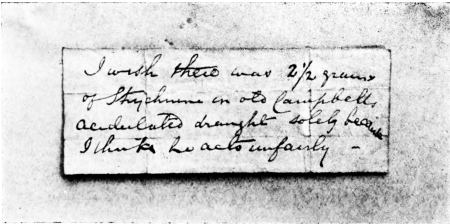
Eighth Day, 22nd May, 1856. The Court met at ten o’clock.
Evidence for the Defence.
T. Nunneley
Mr. Thomas Nunneley, examined by Mr. Grove—I am a Fellow of the College of Surgeons, Professor of Surgery at the Leeds School of Medicine, and a member of several foreign and English scientific societies. I have been in practice between twenty and thirty years. I have seen cases of both traumatic and idiopathic tetanus. One of the four cases of idiopathic tetanus I have seen did not commence with the symptoms of lockjaw, nor did lockjaw occur sufficiently to prevent swallowing during the whole period of illness. I have been present during the evidence given here as to the symptoms of Mr. Cook. I had previously read the portions of the depositions as to the scientific and medical part of the case. Judging from the symptoms as described, and confining myself to the evidence as to the scientific part of the case, my opinion is that Mr. Cook died from some convulsive disease. I found that upon the difference of the symptoms described in the deposition and on the evidence before the Court.
Lord Campbell—This is not satisfactory; we cannot ask witnesses what faith they give to the evidence of the witnesses as contrasted with the depositions. This witness’s opinion ought to be founded on the viva voce evidence of the witnesses given during the trial.
Examination resumed—The previous state of health of Mr. Cook had some effect on my judgment.
State your own grounds in your own way for that opinion?—If I take the evidence which has occurred in Court—
By Lord Campbell—The evidence of the symptoms of John Parsons Cook as stated by the witnesses?—Not merely the symptoms, but the general state of health.
But we have nothing to do with that. The witness should give his opinion on the symptoms described, and then state what influences the other facts may have had on his mind.
By Mr. Serjeant Shee—Do you remember the accounts that were given of what was said or supposed to be syphilitic sores?
The Attorney-General—But there was no such thing said.
Mr. Baron Alderson—Supposing a person had syphilitic sores, what would you say then? That is the proper way of putting it.
Lord Campbell—We must take it that medical men are not to be substituted for the jury.
T. Nunneley
Mr. Justice Creswell—If I were to suggest a mode of meeting the thing it would be this—let the gentleman describe what he assumes to be the state of the deceased’s health at the time, then the Attorney-General may say he is not justified in assuming.
Examination resumed—Will you do that having heard the evidence?—I assume him to have been a man of very delicate constitution; that for a long period he felt himself to be ill, for which he had been under medical treatment; that he had suffered from syphilis; had disease of the lungs; had an old-standing disease of the throat; led an irregular life; was subject to mental excitement and depression; that after death traces were found in his body which show this to have been the case; there was found an unusual appearance within the stomach; the throat was in an unnatural condition; the back of the tongue showed similar indications; the lungs were in an emphysematous condition, that is, the air cells dilated; in the lining of the aorta or large artery of the body there was an unnatural deposit; and there was a very unusual appearance in the membranes of the spinal marrow. These are the indications which are unnatural in the post-mortem examination. I should also state it is described by one of the witnesses that there was a loss of substance of the penis. The symptoms on the root of the tongue and the throat I ascribe to syphilitic inflammation of the throat. From these symptoms I have described I should infer that his health had not been good for long, and that his constitution was delicate. It was also stated that his father and mother had died young, and that the brother and sister were both delicate. That being the state of health of Mr. Cook, he would be liable to nervous irritation. Excitement or depression might bring it on. Exposure to wet and cold would have a greater effect than on a healthy person. It is a condition of the constitution when a convulsive disease is more likely to supervene.
What would you infer from the fact, supposing it to have occurred, that three days before death he suddenly woke up in the middle of the night in a state described as madness, for two or three minutes? I understand that he had three attacks on succeeding nights, each occurring about the same hour. Would you draw any inference from that circumstance?—Yes, that they were of a convulsive character, in the absence of other causes to account for it. Convulsive effects are extremely variable in their forms and degrees of violence. It is not possible to give a definite name to every convulsive attack. There are some forms of violent convulsions, such as hysteria, in which the patient retains his consciousness. It is stated that there are forms of convulsions, epileptic in their character, in which the patient retains his consciousness.
By Lord Campbell—Have you met with any?—No, not during a fit.
T. Nunneley
But it is during a state of fit we are inquiring?—I have not.
Examination resumed—I know by my reading as a medical man that that does occur sometimes. The degree of consciousness in epilepsy varies very much; in some attacks the consciousness is altogether lost. Convulsive attacks are sometimes accompanied by violent spasms and with rigidity of portions of the body. Convulsions arising from a convulsive disease, either from infancy or from other causes, but not exactly tetanus, sometimes assume something of the complexion of tetanic affection. Such convulsions might arise from any cause—worms in children, affections of the brain in adults, hysteria, administration of chloroform to some persons. Indigestible food will sometimes produce convulsions in adults. I agree with Dr. Copland, whose book was referred to yesterday, that these convulsions sometimes end immediately in death. Asphyxia is frequently the cause of death when a man dies in one of these convulsions. I have seen convulsions of the character I have described recurring at various intervals, sometimes in hours, in other cases days. The time also varies very much when a patient, suffering from a violent paroxysm of such convulsions, becomes easier; it may be hours or minutes. When death takes place in the paroxysm of such convulsions it sometimes happens in post-mortem examinations that there is no trace of organic disease in the body.
Have you known at all or frequently in persons, not further advanced in years than the age of twenty-eight, granules between the dura mater and the arachnoid?—They are not common to any age that I am aware of.
Do you know whether granules have been part of the symptoms of tetaniform convulsions?—I have seen three preparations in St. Thomas’s Hospital museum where granules are found in the membranes of the spinal cord, in which patients are said to have died of tetanus. In order to ascertain with satisfaction the nature and probable extent of the injury of such granules the spinal cord should be examined immediately after death. Not the most remote medical judgment could be formed if the examination was made two or three months after death. If an examination of the spinal cord is made so long after death, if there had been a large tumour or some similar change, it might have been discovered; but neither softening nor induration of the minute structure of the cord could be detected. The minute nervous structures change within two hours after death.
T. Nunneley
I have in the course of my experience had cases of traumatic tetanus. It generally begins by an attack of the jaw. I have had under my personal observation four cases of idiopathic tetanus. One of them was my own child. In three cases the symptoms commenced with lockjaw. In the fourth case the symptoms commenced in the body; the power of swallowing easily was retained to the last. Within the last twelve months I have made a post-mortem examination of two women who have died from the poison of strychnia. In both cases it was by chemical analysis that I ascertained the deaths had been caused by strychnia. In one case the post-mortem took place forty-two hours after death, in the other case thirty hours.
(The witness produced his report to the coroner on these two cases.)
I have not seen a fatal case, but several of taking too large a dose. One, a middle-aged man, took one-sixth of a grain of strychnia, given in solution. In a very few minutes the symptoms manifested themselves by the want of power of controlling the muscles, by twitching and rigidity, with some cramp, more violent in the legs than any part of the body. He was up and walking about. It was not a severe case. In six hours the spasms entirely disappeared. They were intermittent in character, every two or three seconds at first. The other case was similar with one-twelfth of a grain.
I have experimented on upwards of sixty animals—dogs, cats, mice, rats, guinea pigs, rabbits, frogs, and toads. After the ingestion of the poison the symptoms appear from two minutes to thirty, more generally about five or six. The symptoms in their order are—a desire to be quite still; hurried breathing; slavering at the mouth when given at the mouth; twitching of the ears; trembling of the muscles; inability to walk; convulsion of all the muscles of the body; the jaws generally being firmly closed during convulsions; these convulsions followed by a total want of power in the muscles, which, in the last attacks, were thrown into violent spasms with a galvanic-like shock running through them. Spasms come on if the animal is either touched or attempts to move. These spasms occur at various periods. The animals die at various periods up to three and a half hours. In every case before death the rigidity ceases, and the muscles are quite soft and powerless. The longest intervals between the violent convulsions in the animals to which strychnia has been administered has been about half an hour, but that is not common. After death the hearts of the animals have been invariably full on the right side, very generally the left ventricle firmly contracted, and the blood usually dark and often fluid. There is no particular appearance attached to the spine. I have attended to the evidence as to the symptoms of Mr. Cook on the Monday and Tuesday nights.
By Lord Campbell—What do you assume the symptoms to have been on the Saturday night?—A state of great excitement in a less severe form; that Mr. Cook described himself to have been very ill.
T. Nunneley
Examination resumed—What else?—In a condition that he considered himself mad for two minutes, caused, he stated, through some noise in the street.
Now, adverting to the symptoms described on these three occasions here in the Court, is it your opinion that they could have been produced by the poison of strychnia?—They did not resemble what I have seen to follow it. He had more power of voluntary motion—sitting up in bed, moving his hands about, freely swallowing, and asking to be rubbed and moved, and a greater length of time occurred from the taking of the pills supposed to contain strychnia and the occurrence of the symptoms, much greater than any period that has occurred in my experience.
Does any observation occur to you on the screaming?—The screaming foreran the vomiting. I have never seen an animal vomit after taking strychnia, nor scream as an expression of voluntary exercise. Where there is so much spasm there is an inability on the part of the patient to vomit. I have a case, which is related in the 10th volume of the Journal de Pharmacie, in which attempts were made to give emetics without success.
With reference to the post-mortem observations of animals poisoned by strychnia, could you form any opinion on the post-mortem examination of Mr. Cook whether he had been under the influence of poison?—They differ materially in the particulars I have mentioned. The heart is stated to be empty and contracted, the state of the lungs not congested, the state of the brain not congested.
In the case of the paroxysms of the animals what has been the course of the subsiding of the paroxysm?—Gradual. I have never known a case of a severe paroxysm return, and then a long interval of complete repose for several hours. I have known it for half an hour.
I have experimented on the bodies of animals poisoned by strychnia with a view of discovering the strychnia poison from a few hours up to the forty-third day, the body being perfectly putrid in the latter case. In no one case have I failed to discover the poison.
Suppose a person to have died under the immediate effects of strychnia poison, in the first paroxysm after its administration, and his stomach to have been taken out and put into a jar on the sixth day after death, in your opinion must strychnia have been found in the body on proper chemical analysis?—If it were there.
T. Nunneley
Adverting to the statement about the stomach being put in a jar, brought up to London, and then immediately submitted to examination, in your judgment was that in an unfavourable or favourable condition for ascertaining whether the strychnia was there?—It would give a little more trouble; I do not see anything else. It is not my opinion that the analysis may be defeated or confused by the existence in the stomach of any other substance which would produce the same colours.
Supposing death to have been caused by a dose of strychnia poison sufficient, but not more than sufficient, to destroy the animal, in your judgment would it be so decomposed by the process of absorption as that you would not be able to detect it by those tests in any portion of the system?—No.
By Lord Campbell—It is a question on which toxicologists have entertained a different opinion?—I believe they have.
Examination resumed—Have you studied the question sufficiently to be able to state reasons for thinking the minimum dose, after having done its work, continues in the system?—I believe the illustration given was that as food undergoes a change on being taken into the body, these substances also do.
By Lord Campbell—It has been said that the decomposition of food affords an analogy?—It has. I believe not. The change in food takes place during digestion, consequently these elements are not found in the blood, or, if the change does not take place there, they remain unchanged in the blood. These alkaloids are absorbed without digestion, and may be obtained unchanged from the blood.
Cross-examined by the Attorney-General—About half of the experiments on the sixty animals I spoke of were made in conjunction with Mr. Morley, the gentleman who was called for the prosecution. A few of these experiments were made in connection with this case, but the great bulk certainly not.
You have not told us what may be material, the general dose given?—The general dose given in the experiments has been from half a grain to two grains. I have seen a cat and a dog die from half a grain, not always. There are varying degrees of susceptibility both in animals of different species and in individuals of the same species.
You say that the symptoms generally appear in from two to thirty minutes; Mr. Morley states two minutes to an hour; will you undertake to say there have not been cases in which the first appearances have been delayed an hour?—I do.
Have you not known instances in which you have had to repeat the doses of poison?—When the dose has not been sufficient to kill, but to produce symptoms, there is a wide difference. I have given it three times. The quantity I gave was half a grain. That in the solid state would be a small dose to kill an old strong cat; a small dose will suffice in the fluid form. Where the half-grain dose has been given three times the reason was that the cat did not swallow the doses.
T. Nunneley
With regard to the symptoms you have described to us, can you tell me whether the result of your observations is that these symptoms occur uniformly, or at uniform periods of time, or whether they vary occasionally?—They certainly do not occur at uniform periods of time. I have not observed considerable variation in the order, but I have in the time.
When the convulsions have once set in have you found considerable difference as to the periods at which they take place?—Some difference, with greater or less intervals.
Have you also found that one animal will have a succession of attacks before it dies, and another will die after a much less amount of convulsion?—Yes. An animal seldom dies after one convulsion, generally four or five, and often a great many more. I have known one or two instances in which the animals have died after one convulsion.
From a dose which in the same quantity has not produced the same effect in other instances?—Yes.
Does the order in which the muscles of the body are convulsed vary also?—To some extent it does. The convulsions are generally simultaneous in the muscles of the trunk and those of the extremities. I think the limbs are generally affected first; they may be simultaneous; but the limbs are more easily observed.
Have you known any instance in which rigidity greater than is due to the ordinary rigor-mortis has occurred after death?—I do not think there is any difference. I have known instances in which they were very rigid, but I have known instances in which the muscles were flaccid. I may state I do not think there is any peculiar rigidity produced by strychnia.
With regard to the lady whose case we do not name, was it not the fact that, although the muscles of the body were flexible, the hands were curved and the feet arched and muscles contracted?—Not more than is usual from ordinary causes. I have said the hands were curved and the feet arched by muscular contraction.
Do you mean to say that when you spoke of the feet being decidedly arched that you meant no more than is due to the ordinary rigidity of death?—I do; that is what I mean by muscular contraction.
Do you mean to say that when you signed this, “The hands were incurved and the feet decidedly arched by muscular contraction,” you meant no more than is due to the ordinary rigidity of death?—I do, and stated so at the time, not in the report I have signed, but in conversation with the parties engaged.
You made a report which did not include the whole?—It is stated in the former part of the report that the other muscles of the body were so; that there was a distinction between the two portions of the body—a statement of fact, but nothing more.
T. Nunneley
Mr. Morley stated here the other day that in the experiments he made with you on animals killed with the poison, that after death there was an interval of flaccidity, after this rigidity commenced, more than if it had been occasioned by the usual rigor-mortis; you do not agree with him as to the statement of the fact?—I do not; it is a difference of opinion entirely.
You say you generally found the heart full?—Yes, the right side. The fact of the heart having been found empty in this case, amongst other things, leads me to the conclusion that it was not a death by strychnia poison.
Did you hear the evidence given here the other day of the post-mortem?—I did. I also heard this stated, “that the heart was contracted and empty.” I believe I was in Court when the gentleman who conducted it gave his evidence of the post-mortem examination of Mrs. Smyth, who died from the unfortunate administration of strychnia.
In those two cases does the fact of the heart having been found empty exercise any influence on your judgment?—Not unless I know how the post-mortem was made. If the post-mortem was commenced in the head, the explanation is given by Mr. Morley and myself in the case at Leeds. We had no doubt of the heart being full, the blood being fluid, but the head being first opened, and the large vessels cut, the consequence was that the blood by mere natural physical causes drains away.
Are you aware how the post-mortem was made in this particular case of Mr. Cook?—It is stated that the chest and abdomen were opened before the head.
What effect would that have?—If there were blood in the heart it ought to be there.
That would not make the difference. The head was not opened there in the first instance?—No; that is my explanation of it.
How do you account for the emptiness and contraction of the heart in Mr. Cook’s case?—The heart, if empty, is usually contracted. I cannot account, from the appearance of the body after death, for the emptiness of the heart, any more than it might be the usual effect of death. It varies very much, but, as a general rule in post-mortem examinations, we find, if the heart is empty, it is contracted.
If I understand you, the post-mortem appearance of Cook’s body, which you say differs materially from those you have seen after death from strychnia, were the emptiness of the heart, the state of the lungs, and the want of congestion in the brain. What do you say as to the state of the lungs?—The lungs are described as not being congested.
T. Nunneley
Do you attach any importance to the emphysema?—It is of two kinds. One consists in a dilatation of the cells, the other in a rupture by which the air, not being in the cells, passes amongst them.
I suppose you say it was not from the rupture of the cells here?—That I inferred from the description given.
Have you not found emphysema in the cases of the animals that have died?—Yes. It has always been from a rupture of the cells. It could be in no other way.
What is there in the statement of witnesses which makes you think there was emphysema of the other sort?—There was during life a diseased condition of the lungs.
I am speaking of the appearance of the lungs after death?—I must put the whole together.
Would it not have been desirable to know whether this emphysema was natural or whether it was from rupture? We heard the witnesses here who made the post-mortem examination?—If the question had been put to them.
But you were advising my friends throughout, while Dr. Harland was here, and you heard what he said. Did it occur to you it was proper to ask him what was the nature of those?—No, because I heard (which was sufficient to my mind) that disease had existed. The question was put, as to the disease, to Dr. Savage.
I am speaking of this emphysema?—It did not occur to me.
You have told us the various symptoms about this gentleman, from which you gather he was of a delicate constitution. To which do you ascribe these convulsions of which he died?—Not to any.
I understood you to say that the fact of his having syphilis was an important ingredient in your mind?—Yes, but you ask for convulsions.
You have no doubt he died of convulsions?—No.
You entered into a long detail of the various ailments under which this unfortunate man suffered, and you say that this would predispose him to convulsions. I ask you which of them?—The whole; the continuation of them.
Amongst others you mentioned excitement?—Yes, and depression of spirits.
What evidence is there, on which you rely, of his being a man subject to depression of spirits?—It is stated by Mr. Jones that he was subject to depression of spirits—mental depression. There was a good deal of mental depression at Rugeley.
Would you expect excitement to produce its effects recently in its existence, or after it was totally and entirely gone?—It may induce that state of brain in which convulsions will follow at some distance.
Did you find from the evidence that the brain was perfectly healthy?—No, not perfectly healthy. Mr. Bamford said it was not.
T. Nunneley
Do you mean, as against the reputed testimony, and the testimony here of Dr. Harland and Dr. Moncton, as well as Mr. Devonshire, to set up the testimony of that old gentleman, Mr. Bamford?—The evidence stated at the inquest itself is put in the depositions.
Do you mean to say, in your opinion, that excitement, producing disease of the brain, would bring on these convulsions?—I mean to say this, that in the condition of the brain, and the statement that has been made, I believe it to be quite probable that convulsions might come on and destroy a person, and leave no trace behind.
Do you believe that this man died of apoplexy?—I do not. You must bear in mind he had taken doses of morphia.
Do you ascribe his death to morphia?—No, except that it would assist in the convulsive attack, and it would affect the spinal marrow.
Brought about by the morphia?—No.
In your opinion was morphia right treatment or wrong?—I should think not very good in the state of excitement he was in then.
Do you mean that there has been anything to show any excitement at Rugeley?—You will not allow me to furnish an answer. There was no excitement at Rugeley, but morphia, when there is sickness, will sometimes disagree with a patient when there is an irritable state of the brain.
The stomach was irritated, I will allow, but where is the evidence that there was any excitement at Rugeley?—There is none.
Then why was morphia a wrong treatment?—Because it is after sickness, and there is evidence of there being an irritable state of the brain. From what he said himself, he must either have been delirious on the Sunday night, or he must have had some attack similar to what he had on the Monday night.
Do you mean the attack of the Sunday night was similar to that on the Monday night?—Less intensity, but I think very probably of the same character.
You do believe there were convulsions on the Sunday night, then?—No, I do not.
He died of convulsions?—Yes, but I say of the same character.
Then you do believe he had convulsions?—To a certain extent, but less in intensity. There was a great deal of mental and bodily excitement.
On the Monday night?—I have stated to you that he was in that condition which very often precedes convulsions.
Will you admit if a man so under the influence of morphia and he is suddenly disturbed by a noise, it is likely to have a depressing effect upon him?—I will; but there is no proof of a noise.
T. Nunneley
There is no proof, except his own statement, of any illness?—Precisely; that is part of my opinion—that he did not state what had occurred accurately.
Do you mean to say that he did not state that thing?—No; that he was mistaken. That is one of the symptoms. I believe the man to have been delirious then.
Now, be so good as to tell me what are the convulsions of which you gave some statement to my friend which will produce convulsions of a tetanic form?—Any irritation will produce it.
Ending in death?—It may end in death.
Will you tell me of any convulsions which you have known end in death accompanied with what my friend calls tetanic symptoms?—I have known them in children. I have never had such a case in an adult.
Has your reading furnished you with any?—The general statement of all writers is that such cases do occur.
Have you ever known or read of a case in which the patient was conscious to the last?—No, I have not. I have seen it stated so, but I have never met with it.
In epilepsy you have these tetanic symptoms?—Yes, but before death consciousness is gone.
You have had considerable experience in idiopathic tetanus, and some five or six, perhaps, of traumatic. (An extract from the evidence of Mr. Jones was read.) I have read to you the description of Cook’s symptoms as witnessed by Mr. Jones. I ask you to point out any distinction between those symptoms and the symptoms of tetanus?—Do you mean the one paroxysm or the disease which is called tetanus?
I am speaking of the paroxysm of tetanus?—It is very like.
By Lord Campbell—You say this is not tetanus at all?—It is not. I never saw a case of tetanus in which the rigidity continued at the time of death and afterwards.
Cross-examination resumed—I am asking you as to symptoms of the paroxysms. I understand you to say the symptoms of the paroxysms are not distinguishable from those of tetanus?—Some of them are at the moment of death.
Give me any of them?
By Lord Campbell—This is not tetanus, but, as far as they go, they coincide with the symptoms of tetanus at the moment of death?—Yes.
Cross-examination resumed—Observe, you have here consciousness to the last. That before the man dies he says, “Turn me over,” and as soon as they turn him over he dies. Tell me of any case you know of in which death has ensued from convulsions, where the death was not from tetanus, in which the patient was conscious?—I have already said I do not know of such a case.
Let me call your attention to strychnia tetanus. Would you call the symptoms tetanic?—They are called so very properly.
T. Nunneley
Do you agree with Sir Benjamin Brodie that while the paroxysms of tetanic convulsions last there is no difference between those which arise from strychnia and those which arise from tetanus properly so called, but the difference is in the course of them?—I think there is. I think that the hands are less violently contracted and affected in ordinary tetanus, and that the whole effect of the spasms is less in ordinary tetanus.
You would expect to find the hands more firmly and tightly closed in tetanus from strychnia than in ordinary tetanus?—I think it is so. There is another difference, that in tetanus the convulsions never entirely pass away.
That is one of the reasons Sir Benjamin Brodie gave for distinguishing the course?—In the case at Leeds it was the same.
I believe you felt perfectly prepared in that case, on the description of the symptoms, to come to the determination that it was a death from strychnia?—I thought it possible and probable. I did not come to a determined opinion. I expressed an opinion. I did not say I had no doubt as to the cause of death. We had ascertained at that time that there was strychnia.
After the opinion you expressed in that case, is it possible that you can represent this case of Mr. Cook as one of idiopathic tetanus?—I never did, and you have not heard from me that I infer that.
I have heard it said in this case that this may have been something arising from a syphilitic affection?—Idiopathic or traumatic tetanus was mentioned. I do not think it was a case of tetanus in any sense of the word.
Why not?—I have given the description. Because it differed from the course of tetanus from strychnia in the particulars I have already described.
Repeat them once more?—The very sudden acquisition of the convulsions after the first rousing of Mr. Jones; his power of talking.
Did you not know that Mrs. Smyth begged to have water thrown upon her, and talked throughout?—It did not occur to me.
Are you judging of the one incidental case, and coming here with conclusions founded on that?—I think it is an element, the time.
Then let me add the element, that the lady continues to the last conscious, and asks to have her legs stretched just before she died; does that shake your faith?—Yes.
Do you not know in that case her last words were to turn her over?—Not at the last moment. I do not dispute it if it is said so.
T. Nunneley
Were there not here the premonitory symptoms; the animals are affected about the jaws and the ears, and Mr. Cook has stiffness in his neck, and asks to have it rubbed?—It is a premonitory symptom.
Was it not a symptom of the convulsions, which are not distinguishable from tetanus?—I have said so. I have stated here that I believe in cases of poison from strychnia it is first developed in the legs and feet.
You have told us the animals began to feel twitching in the ears. This gentleman had, before the convulsions came on, stiffness in the muscles of the neck and jaw, and begged to have them rubbed?—That might be if it were anything else.
I ask you now, is not the difficulty of breathing one of the premonitory symptoms? He sat up in bed and complained of feeling suffocated?—Yes.
And felt a stiffness about the neck and asked to have it rubbed, and, as far as we know, this was the case in all the animals, though they could not ask to be rubbed. I ask you what were these but premonitory symptoms?—In no one single instance could the animal bear to be touched, and it evidently was most painful to it to be touched. I know that Mrs. Smyth asked to have her legs and arms straightened.
Let me ask you this, have you not often found that it was prior to the occurrence of the paroxysm, and not after the paroxysm?—No, I have seen a paroxysm brought on by it.
In all cases?—No, not in all cases. But in the other case, for two hours before she died, when she could speak, she begged them not to touch her.
Did she not ask to have her legs rubbed?—That was when the attack was slight, not during the fatal attack.
After the paroxysms had set in, did she not request to be rubbed?—She did before the convulsions came on; she liked to have her feet and legs rubbed.
Afterwards she could not bear it, because it caused a recurrence?—Yes.
That was in consequence of the twitchings, was it not?—I think not. It is stated by all the witnesses she begged she might not be touched.
But for that one thing, that the paroxysms came on so soon after the first premonitory symptom, is there one single point in which this differs from strychnia tetanus?—The power of swallowing so lately.
On what does it depend, the inability to swallow?—From the inability to move the jaw.
I ask you whether it is not a fact that, unlike as in natural tetanus, in tetanus from strychnia lockjaw is not the last symptom, and very often never sets in at all?—I have never seen an instance in which it does not make its appearance.
T. Nunneley
Is it the last?—I do not deny that it may be.
At what stage did it come on in the Leeds case?—Very early, more than two hours before death.
How long did the paroxysms continue before death took place?—Two hours and a half.
That was in a case in which very large doses of strychnia were administered?—We supposed four or five times repeatedly.
In the case of Leeds there were four animals killed afterwards from the contents of the stomach?—There were.
You state that you have succeeded in every case where you have tried in your experiments in finding the strychnia?—Yes.
Did not Mr. Morley differ from you in two cases?—In one he did. We divided the poison which we found in the stomach into two portions, and we adopted two different processes for extracting it, and by the one process we were both rather doubtful, but by the other we produced it.
Now, you thought you found it, and he thought you did not?—Not that I recollect.
Do not you know that Mr. Morley has been rather doubtful as to the results of these experiments?—No. Mr. Morley stated differently in his own examination.
In his examination here?—Yes; if you refer to it, except in one case, and that is the explanation I give of it.
Re-examined by Mr. Serjeant Shee—The Attorney-General directed your attention to your report on one of these cases that the hands were rigid and the feet incurved. In reports of this kind do you state only extraordinary appearances, or ordinary appearances as well?—Ordinary appearances also. It is a statement of a fact without anything more.
W. Herepath
Mr. William Herepath, examined by Mr. Grove—I am Professor of Chemistry and Toxicologist at the Bristol Medical School. I have been occupied in chemistry forty years and in toxicology probably thirty. I have experimented on the poison of strychnia. I have examined the contents of the stomach of a patient who died from strychnia. I discovered the strychnia in the contents of the stomach three days after death. I have experimented upon eight, nine, or ten animals. In the case of a cat, to which I gave one grain of strychnia in solid form, I could not get the animal to take it voluntarily, and I left it in meat at night. I found the animal dead next morning. The body was dreadfully contorted—extremely rigid, the fore limbs extended, the head turned round to the side, the eyes protruding and staring, the iris expanded so as to be almost invisible. I found in the urine which had been ejected strychnia, and also in the stomach. I gave the same quantity of strychnia to another cat. It remained very quiet for fifteen or sixteen minutes, with but few symptoms until thirty-five minutes. It merely seemed a little restless with its eyes, the breathing a little quickened, and at thirty-five minutes it had a terrible spasm, the four extremities and the head being drawn together. I watched it for three hours more. After this it had a second spasm. A frothing saliva was dripping from its mouth, and it forcibly ejected its urine. It had another spasm a few minutes after, when I thought the animal would die. It soon recovered itself, and then remained quiet, with the exception of a trembling all over. The slightest breath of air would affect it. It continued in this state for some time longer. During this three hours and a half, or nearly so, the animal was in a peculiar state. Touching it appeared to electrify it all through, even blowing upon it produced the same effect. Touching the basket, the slightest thing that could affect the animal, produced a sort of electric jump. I left it then, thinking it would recover, but in the morning I found it dead, in the same indurated and contracted condition in which the former animal was found. About thirty-six hours afterwards, by chemical examination, I found strychnia in the urine, the stomach, and upper intestines, in the liver, and in the blood of the heart. In my search for strychnia I took extraordinary means to get rid of the organic matter.
In all cases which you have seen where strychnia has been taken has the examination been successful?—Not only strychnia, but nux vomica, has been extracted. In one case the animal had been buried two months. I have detected strychnia in cases where it has been mixed purposely with putrid remains.
Are you of opinion, as a chemist, that where strychnia has been taken in a sufficient dose to poison, it can be detected, and ought to be detected?—Yes, up to the time the body is decomposed completely. Even where there is putrefaction—where the body has become a dry powder. I am of opinion that strychnia ought to have been detected if it had existed in the jar containing the stomach, even in the state it then was.
Cross-examined by the Attorney-General—Until lately my experiments for the purpose of finding strychnia have been principally in the stomach. In two cases I found it in the tissues of the animals. One was the second cat, the other a dog to which I gave the large dose of one grain. Judging from reports in newspapers, I have said in conversation that strychnia had been given, and that “If it was there, Professor Taylor ought to have found it.”
W. Herepath
Re-examined by Mr. Grove—What is the smallest quantity you have detected in the tissues of the stomach?—I am satisfied that you could discover the fifty-thousandth part of a grain that is unmixed with organic matter. I dissolved the tenth part of a grain in a gallon of water, that is 1 in 70,000. I can take the tenth part of a drop of the water and demonstrate the presence of strychnia.
What is the smallest portion of strychnia when mixed with organic matter you can detect?—I took about an eighth part of the liver of a dog, and from that I had enough to make four distinct experiments with the four tests.
So that you experimented on a thirty-second part of the liver?—Yes.
J. E. D. Rogers
Mr. Julian Edward Disbrowe Rogers, examined by Mr. Gray—I have been sixteen years Professor of Chemistry at St. George’s School of Medicine, in London. I made an experiment with one dog with a view of extracting strychnia from the body. I gave it two grains of pure strychnia between two pieces of meat. Three days after it was dead I removed the stomach and its contents, and took some of the blood. I analysed the blood ten days after its removal from the body, when it was putrid, and found strychnia by the colour tests. About a month or five weeks afterwards I analysed the stomach and its contents, and strychnia was separated in a large quantity. Having heard the evidence as to the stomach and its contents in this case being put in a jar and sent to London, in my judgment strychnia, if it had been administered, must have been found in the contents of the stomach.
Cross-examined by the Attorney-General—I have only made one experiment with strychnia on this dog.
Do you think it would make any difference if the contents were lost?—If there were no contents spread over the intestines, then that would make a difference. If they had been spilt and shaken, then it would make no difference.
But, supposing they were not there?—There would be the washings of the stomach. If the stomach was sent me with no contents, I would wash the stomach and proceed with that.
If you had tried on the tissues of the deceased’s body I suppose you would have been able to ascertain whether there had been any strychnia?—That is my opinion.
So that the time that has elapsed since Cook died would not matter. If you had an opportunity to operate on it, you would have found the strychnia?—If it had been there, I feel satisfied I should find it.
Lord Campbell—Do you mean then or now?—I do not see that the time would prevent it.
H. Letheby
Dr. Henry Letheby, examined by Mr. Kenealy—I am a Bachelor of Chemistry and Professor of Medicine in the London Hospital; also a medical officer of health to the city of London. I have for a considerable time studied poisons. I believe in every case of this kind tried in this Court during the last fourteen years I have been engaged on behalf of the Crown. I have been present during the examination of the medical witnesses at this trial and heard them describe certain symptoms attending the death of Mr. Cook. I have seen many deaths by strychnia in the lower animals. I have seen several cases of nux vomica in the human subject, one of which was fatal. The symptoms in the animals do not accord with the symptoms in this case. In the first place, I have never known such a long interval between the administration of the poison and the coming on of the symptoms. The longest interval has been three-quarters of an hour, and then the poison was given in a form not easy of solution, and when the stomach was full. I have seen the symptoms begin in five minutes after the poison was administered. A quarter of an hour would be the average. Another reason is that in all the animals I have seen, and the human subject also, when under strychnia, the system has been so irritable that the very slightest excitement, as an effort to move, a slight touch, a noise, or a breath of air, will set them off in convulsions. I do not think it at all probable that a person to whom a dose of strychnia had been given could rise out of bed and ring a bell violently. Any movement at all would excite the nervous system, and there would be spasms. It is not likely a person in that state of nervous irritation could bear to have his neck rubbed. Where poisoning by strychnia does not end fatally, the paroxysm is succeeded by other paroxysms, which gradually shade themselves off. They generally become less and less, over a period of some hours. My experience agrees with Dr. Christison, that it would last over a period of sixteen or eighteen hours before the man gets better. I do not hesitate to say that strychnia is of all poisons the most easy of detection. I have detected it in the stomach, in the blood, and in the tissues of animals in numerous instances. The longest period after death that I have examined a body has been one month. The animal was then in a state of decomposition, and I succeeded in detecting very minute portions of the strychnia. When the strychnia is pure it can be detected in a very small portion of a part, at least the twentieth part of a grain. When mixed up with other matter it is a little more difficult. I can detect the tenth part of a grain in a pint of any liquid that you put before me, whether the liquid was pure or putrefied.
You have succeeded in detecting it in animals which have been killed a month, and were in a state of decomposition. What is the dose you have given them?—I gave the animal, a rabbit, originally half a grain, which killed it, and I have the strychnia here within a fraction of what I gave. I lost about a tenth part of a grain in the course of the investigation.
H. Letheby
Supposing a person had taken strychnia eight or ten days before, and that he died of strychnia poison, should you be able positively to say that you could detect it?—I do say so positively. I have never failed. In the post-mortem examinations I have always found the right side of the heart full of blood. The reason for that is that the death takes place by the fixing of the muscles of the chest in spasm. In my opinion this is invariably so. At that time the blood is unable to pass through the lungs, and the heart cannot relieve itself of the blood that is flowing into it. It therefore becomes gorged. I have also observed that the lungs are congested, filled with blood.
Do you agree in the opinion of Dr. Taylor that where strychnia is administered as a sort of pill or bolus it kills from about six to eleven minutes?—It may do so. I do not say it would always. I agree with him that the jaws are spasmodically closed, and also that the slightest noise reproduces another convulsive paroxysm. I do not agree with Dr. Taylor that the colouring tests for the discovery of strychnia are fallacious. They always succeeded with me.
Dr. Taylor has given as a reason for the non-finding of the strychnia that it is absorbed into the blood and becomes changed?—I agree with its absorption, but I do not agree with its being changed.
Have you turned your attention to the theory that strychnia is decomposed after the poisoning?—I have examined the tissues of the body and I have found it; and my opinion is that it is not changed so as not to be discoverable.
Supposing the contents were put into a jar and jumbled up with the intestines and a portion of the stomach, would that prevent the discovery of strychnia?—It would not.
Supposing that all the contents of the stomach were lost, ought the mucous membrane, in the ordinary course of things, to exhibit traces of strychnia?—I think so.
I have also studied the poison of antimony.
Supposing a quantity of antimony were placed in some brandy and water, and it was drunk off at a sudden gulp, would the immediate effect of that be to burn the throat, or anything of that kind?—No. Not in the form of tartar emetic.
H. Letheby
Cross-examined by the Attorney-General—I am neither a member of the College of Physicians nor of the College of Surgeons. I do not now carry on business in the medical line, but have done so in general practice for not more than two or three years. I have destroyed about fifty animals by strychnia, some within the last two months. I have never given more than a grain. In recent cases I have always administered the poison in a solid form—sometimes made into a pill with bread, and at other times put on the tongue of the animal. In one case I gave it under very disadvantageous circumstances; the dog had had a very hearty meal, and it was kneaded up into a hard mass with some bread, and it took three-quarters of an hour before the action came on. There was one other case which took about half an hour, but the poison, half a grain, was not given in sufficient quantity. We gave it another dose, which acted in about ten minutes.
Dr. Nunneley describes the symptoms—first, a desire to be still, then a difficulty in breathing, a slobbering of the mouth, twitching of the ears, trembling of the muscles, and, after that, convulsions; did you observe all these?—I cannot say all of them in that order. There is an excitement manifested in the animal, an indisposition to touch, and trembling on being touched.
I am speaking of the symptoms before the convulsions. The touching, did that occasion a tremulous action of the muscles?—Yes, I have noticed that.
Have they come on in regular order?—No, I think not. There are some little variations.
After the convulsions have once commenced, is there an interval?—Yes. A breath, a sound, or a touch will cause a recurrence of the convulsive symptoms after they have been seized. This does not apply where the animal dies in the first paroxysm, and I have known many cases where an animal has so died.
You mentioned a distinctive feature in this case of Cook. You were surprised at his manifesting so much power as to be able to sit up in bed and ring the bell. Are you aware that that was at the commencement, before any of the convulsive symptoms had set in?—Yes, I apprehend that was at the onset or beginning of the paroxysm.
Do you know that he sat up in bed and rang the bell, and it was not till Palmer had been and had gone back and brought the pills that the convulsions came on?—Yes, I do; and I have noticed in animals that the mere touch sends them into convulsions, and they show an indisposition to move.
In the case of the lady who died near Romsey, did you hear what the maid said, that she discovered, when her mistress’ bell rang violently, that she had got out of bed and was sitting on the floor?—It struck me as inconsistent with what I have seen. I have no doubt that was a death from strychnia.
If that evidence be true, and it is a fact that she got up and rang her bell, does not that shake your faith?—No, it does not. You must compare it with what I have seen. Both are irreconcilable with what I have seen.
H. Letheby
Speaking of the Tuesday night, with the exception of the ringing of the bell, and that in this case it was an hour or an hour and a half after the supposed administration of the poison, can you point to anything to distinguish the symptoms and death of Mr. Cook from death by tetanus of strychnia?—No, I cannot. It is inconsistent with what I have seen, but it is not inconsistent with what I have heard in the case of Mrs. Smyth.
Is not one of the symptoms hard breathing?—It is a panting respiration. It is excitement of the breathing rather than difficulty. It is in the convulsions that there is a difficulty of breathing. If a man were to breathe hardly it is a position naturally assumed for him to sit up. Until the convulsion of the muscles comes on there is nothing to prevent the patient sitting up.
If I understand you, if I except the delay and the fact of his sitting up in bed and crying for help on the Tuesday, is there anything to distinguish the convulsions under which this man suffered and died from the convulsions of tetanus of strychnia?—It is not perfectly consistent with strychnia, because I say that the account which is given of Mrs. Smyth is what I cannot reconcile with what I have before observed.
With regard to the abrupt termination instead of the gradual subsidence?—I have observed the gradual subsidence in man as well as in animals.
In the case of the man—what dose had he taken?—Nearly a grain and a half.
This is a strongish dose?—Yes.
You might expect a recurrence of the paroxysm?—Certainly. The subsidence will not depend on the strength of the dose; it will depend on whether the individual is to recover or not. I have seen four or five instances of recoveries.
Is it not generally known that the effect of strychnia is very varied in different individuals?—No, I do not think so. There would be a little variation in time, but in the main features of the case there is no variation.
Do not you find this difference, that from the same dose in the same species you get no paroxysm, or you get a series of paroxysms ending in death?—Yes, that is true; but the attacks are the same for all that. The symptoms are the same.
What do you say about the Sunday night fit?—I was disposed to think it was a fit. I cannot tell you what it was; I have formed no opinion.
What do you ascribe Mr. Cook’s death to?—It is irreconcilable with everything I am acquainted with.
By Lord Campbell—Is it reconcilable with any known disease which you have ever seen or heard of?—No, my lord.
H. Letheby
Re-examined by Mr. Serjeant Shee—Do you mean to say it could not be the result of any variety of convulsions, however violent, though not classed under a particular description of convulsion?—We are learning new facts every day, and I do not conceive it to be impossible that some peculiarity of the spinal cord, unrecognisable except the examination be made immediately after death, may produce symptoms like these.
When you say it is irreconcilable with anything you have heard of, do you include anything you have heard of strychnia poison as well as anything else?—Certainly I do.
Is the vomiting of the pills just before death inconsistent with what you have known and observed of strychnia poison?—It is not consistent with anything I have observed.
Have you ascertained whether, if you touch an animal which is beginning those minor premonitory symptoms, but which as yet has had no paroxysms, this brings the paroxysms on?—Yes.
Was not the Romsey case exceptional from the manner in which the strychnia was administered and the quantity of the dose?—Yes, it was. It is quite consistent with all I am saying that the ringing of the bell by the lady the moment she felt anything of uneasiness would produce the paroxysm which ultimately was observed. In my judgment, it is not safe to argue from the symptoms of a case in which the paroxysm took place only a few moments after the ingestion of the poison, and it was in a fluid state, to what may be the probabilities in another case.
R. E. Gay
Mr. Robert Edward Gay, examined by Mr. Serjeant Shee—I am a member of the Royal College of Surgeons. In 1855 I attended a person named Foster suffering under tetanus. He had an inflammatory sore throat, muscular pains in the neck and the upper portion of the spinal vertebræ. He was feverish, and had the usual symptoms attending catarrh. On about the fourth day the muscular pains extended to the face. A difficulty of swallowing came on, the pains in the muscles covering the spinal vertebræ and in those of the lower jaw increased. In the evening of that day the jaw became completely locked; the pain came on in the muscles of the bowels, the same in the legs and the arms. He became very much convulsed throughout the entire muscular system. He had frequent and violent convulsions of the arms and hands, and afterwards of the legs. The difficulty of swallowing increased up to the ninth or tenth day. Not a particle of food, either solid or liquid, could be taken or introduced to the mouth. An attempt to swallow the smallest portion brought on the most violent convulsions. The convulsions were so strong throughout the whole system that I could compare him to nothing more than a piece of warped board in shape. The head was drawn back, the abdomen was forced forward, and the legs were frequently drawn upwards and backwards. The attempt of feeding with the spoon, the opening of the window, or placing the fingers on the pulse frequently brought on violent convulsions. He complained of great hunger. He was able to speak. He repeatedly cried out he was very hungry, what would he do if he could not eat? and he was kept alive till the fourteenth day by injections of a nutritive character. He screamed during these convulsions, and the noises he made were more like those of a dying man. About the twelfth day he became insensible. The convulsions, although very weak, continued till the fourteenth day, when he died. He was by business an omnibus conductor. He had been ill some few days—it might be a week. He had no other hurt or injury to his person of any kind which would account for these symptoms. His body was not examined after death.
By Lord Campbell—What do you call the disease?—I call it inflammatory sore throat from cold and exposure to the weather. The symptoms became tetanic in consequence of an extremely nervous and anxious disposition. He had a very large family, and was a very hard-working man. I did not hear the evidence of the witnesses who described the symptoms of Mr. Cook.
Cross-examined by the Attorney-General—That is what you call idiopathic tetanus?—Yes, decidedly so. I have had a vast number of cases of inflammatory sore throats and a great many anxious, nervous patients. That is the only case I have ever seen of idiopathic tetanus.
If I rightly apprehend your history of the symptoms, the disease was altogether progressive in its character, and, although there was an occasional cessation of the more painful symptoms, there never was a full cessation of the symptoms?—He was not suffering from tetanic affection. There was a twitching of the muscles going on, but there was not that violent convulsion. The lockjaw was the first of the more aggravated symptoms that presented itself, the muscular spasms about the trunk of the body progressing onwards to the extremities. He was conscious till the tenth day, when insensibility supervened while the convulsions were upon him. I consider the brain had been affected and congestion had taken place, and that produced insensibility.
After that was there some diminution in the severity of the convulsions?—Very great diminution, but they still continued.
Would that be likely to take place from the constant recurrence of the convulsions?—From the constant recurrence of the convulsions the brain would be congested.
You would expect to find a difference in that respect in a case where a man died very early in such a disease, and where it was spread over a longer period?—That would depend greatly on the violence of the convulsions.
By Lord Campbell—And the repetition?—And the repetition.
The Court then adjourned.
Ninth Day, Friday, 23rd May, 1856. The Court met at ten o’clock.
J. B. Ross
Mr. John Brown Ross, examined by Mr. Grove—I am house surgeon to the London Hospital. On 22nd March a labourer, aged thirty-seven, was brought to the hospital about half-past seven in the evening. He had had one paroxysm in the receiving room of our hospital before I saw him. He had a rapid but feeble pulse, breathing quickly though not laboriously. The jaws were closed and fixed, there was an expression of anxiety about the countenance, and the features were sunken. He was unable to swallow, the muscles of the abdomen and back were somewhat tense. After he had been in the ward about ten minutes he had another paroxysm and opisthotonos, which lasted about one minute. He was then quiet for a few minutes; he had then another, and died. He had only been in the hospital about half an hour. An inquest was held on the body, but no poison was found. I attribute the cause of death to tetanus. There were three wounds, two on the back of the right elbow, about the size of a shilling each, and one on the left elbow, about the size of a sixpence. The man told me he had had them about twelve or sixteen years. They were old, chronic, indurated ulcers, circular in outline, the edges thickened round, undermined, and covered with a dirty white coating without any granulations. I am unable to say what produced those ulcers. I have seen old, chronic syphilitic wounds in the legs similar to those in the elbow, but I cannot say that these were so. These wounds were the only things to account for tetanus. There was no other cause found.
Cross-examined by the Attorney-General—I learned from the man’s wife that a linseed meal poultice had been applied to this ulcer a day or two before. The jaws were completely fixed when he came, so as to render him incapable of swallowing anything. He said he had just been taken with strange symptoms about the jaws at dinner that morning about eleven o’clock. He was able to speak, though he could not open his jaw. That is the case in tetanus.
Were there also symptoms of rigidity when he was brought in about the abdominal and lumbar muscles; did you learn from him how long this rigidity had been coming on?—Not further than that the first symptoms of the illness he had felt were that morning. He did not say how long he had felt this rigidity about the neck. He was seen by the parish surgeon in the afternoon before coming to the hospital. I have no doubt that the disease had been coming on from the morning.
J. B. Ross
Though you cannot speak as to the precise character of these sores, were they ugly sores?—Yes; sores of a chronic character—ulcers. The two on the right elbow were perfectly running into one another. A piece of integument connected the two, so that they would be likely to run into one another eventually. By saying that those sores were undermined I mean that the wounds continued under the skin. There were no signs of healing, and they had the appearance of old, neglected sores.
Were they near the site of any particular nerve?—They were near the ulnar nerve, a very sensitive nerve connected with what we call the “funny bone.”
How soon was he seized with the first paroxysm after he came in?—He had one directly he came into the hospital, but I did not see it. Half an hour from that time he died.
Had he had any paroxysms before he came to the hospital?—I believe he had, all the afternoon.
That was not one continuous paroxysm?—No; there was a twitching of the muscles of the legs and arms.
What are the particular symptoms of the case to which you refer as indicative of death from tetanus?—From the tetanic symptoms and from having wounds.
Put aside for the moment the fact of his having the wounds that would lead to that inference; what were the symptoms that manifested themselves previous to, or concomitantly with, death which you would call tetanic?—The tetanic symptoms there are the lockjaw and the muscles of the abdomen and the back also being rigid; and he complained of pain in his stomach, just over the stomach. I did not hear the account given of the symptoms of Mr. Cook’s death.
Re-examined by Mr. Grove—Strychnia was suspected in this case before the body was examined. The nerves of the tongue are very delicate ones. There are very delicate nerves at the throat and fauces.
Were you here yesterday when a case was described of an injury in the throat—a sore throat that caused tetanus?—I was.
Are you of opinion that an irritation of the nerves of the throat would cause tetanus as well as the other nerves?—That was produced by exposure to cold; it was therefore idiopathic.
Would any injury to any delicate nerves be a cause of tetanus?—Decidedly.
F. Wrightson
Dr. Francis Wrightson, examined by Mr. Kenealy—I was a pupil of Liebig. I am an analytical chemist and teacher of chemistry at the School of Chemistry at Birmingham. I have studied and made experiments in various poisons, including strychnia. I have not found any extraordinary difficulties in the detection of strychnia. It is detected by the usual tests. I have detected strychnia pure, and I have also discovered it when mixed with impurity, such as bile, bilious matter from putrefying blood, after having separated it from the impurities. Strychnia can be discovered in the tissues. I have discovered it in the viscera of a cat poisoned by strychnia, also in the blood of a dog poisoned by strychnia, also in the urine of another dog poisoned by strychnia. I have heard the theory propounded by Dr. Taylor as to the decomposition of strychnia by the act of poisoning.
Are you of opinion strychnia undergoes decomposition in the act of poisoning?—I am of opinion that it does not. If it were decomposed in the act of poisoning I should say it would not be possible to discover it in the tissues. Portions of strychnia can be discovered in extremely minute quantities indeed. In the first case I mentioned of the detection of strychnia in the blood, 2 grains were given to the dog. One grain was given to the second dog, in which we detected it in the urine. Half a grain was attempted to be administered to the cat, but a considerable portion of it was spilt.
Assuming that a man was poisoned by strychnia, and that his stomach and a portion of his tissues were sent within eight, or nine, or ten days after death for analytical examination, do you say you could discover the poison of strychnia in his remains?—I should have no doubt whatever in saying so.
Cross-examined by the Attorney-General—Suppose the whole of this poison to be absorbed, where would you expect to find it?—In the blood.
In its progress to its final destination, the destruction of life, does it pass from the blood, or is it left by the blood in the solid tissues of the body before it produces that effect?—I cannot tell.
If it has passed from the stomach by absorption in the blood, the whole dose, into the circulation, do you say you would still expect to find any of it?—Decidedly so, because I believe it exists as strychnia in the blood.
Do you say you would still expect to find any of it in the stomach?—In order to be absorbed it must be dissolved, and in that portion of the fluid which surrounds the coats of the stomach I should expect to find it.
Suppose the whole to be absorbed?—Then I should not detect it.
Suppose the whole of it has been eliminated from the blood and passed from the system?—Certainly not.
Lord Campbell—You would expect to find it elsewhere, not in the stomach?—Yes. I would expect to find it in the blood and in the tissues.
F. Wrightson
Cross-examination resumed—My question only supposes the minimum of the dose that will destroy life to have been given; and, supposing that to have been absorbed into the circulation, and there deposited in the tissues, or part of it eliminated by the action of the kidneys, would you know where to search for it?—I should search for it both in the blood and in the tissues, and in the ejecta of the kidneys; and from my experiments I should expect to find it in each of them, in case the urine was not ejected during the time of poisoning.
Re-examined by Mr. Serjeant Shee—If a man had been killed by strychnia, administered an hour and a half before he died, the poison would certainly be detected in the stomach in the first instance.
Supposing it to have been administered in the shape of pills, would it by that time have been all absorbed and circulated in the system so as to get out of the stomach?—I cannot tell. If it were so I would find it in the blood, the liver, and the spleen.