THE TRIAL (continued 4)
Reading edition
The Lord Justice-Clerk—Do you say that, sir, after the judgment which the Court has pronounced? That, sir, is a most improper observation to address at the outset to the jury.
Lord Stonefield—It is a positive reflection on the Court.
Lord Hailes—It is a flat accusation that we have admitted improper evidence.
Lord Eskgrove—I never heard the like of this from any young counsel at the beginning of his career at this bar.
The Lord Justice-Clerk—With these admonitions, go on, sir; proceed, sir.
Mr. Clerk—Aweel, my Lords, if I go on, I beg to assail at the outset the evidence of these two corbies or infernal scoundrels, Ainslie and Brown.
The Lord Justice-Clerk—Take care, sir, what you say.
Mr. Clerk—Yes, my Lords, I say that they are both most infamous characters. Gentlemen, you should discard such vagabonds, and not rely on their evidence in any way; and if you knock out the vile brains of their evidence in this case, there is nothing else remaining on which you can convict my poor client, except his own very candid declarations which I have already explained to you. Gentlemen, these nefarious witnesses Ainslie and Brown, should have stood at this bar this night in place of my client, who was happy in his domestic privacy with his poor, honest, inoffending wife, whom you this day saw—and my heart bleeds for her. [Here there was some applause from the audience which was at once suppressed.] Gentlemen, Ainslie contradicts himself, and Brown is not to be believed. With respect to this said Mr. John Brown alias Humphry Moore, you had it out of his own mouth that he was a convicted felon in England, and I say to you that no convicted felon ought, by the good and glorious law of Scotland, to be received as a witness in this or any other case in the British dominions.
[Great applause from the audience.]
Macers—Silence in Court.
The Lord Justice-Clerk—Mr. Clerk, please restrict your reflections. The Court have admitted the witness.
Mr. Clerk—Yes, my Lords, I know that very well, but your Lordships should not have admitted him, and of that the jury will now judge.
The Lord Justice-Clerk—This is most indecent behaviour. You cannot be allowed to speak to the admissibility; to the credibility you may.
Lord Stonefield—This young man is again attacking the Court.
Mr. Clerk—No, my Lords, I am not attacking the Court; I am attacking that villain of a witness, who, I tell your Lordships, is not worth his value in hemp.
The Lord Justice-Clerk—The Court, sir, have already solemnly decided, as you know, on the objections raised by the Dean of Faculty, that in law the objections to these witnesses should be repelled, and they were repelled accordingly; therefore you should have nothing more to say to us on that point.
The Dean of Faculty—If it will satisfy Mr. Clerk, I can assure him that I will plead on this point to the jury, waiving all objections to the admissibility, which it may be rather irregular to plead after the decision of the Court.
The Lord Justice-Clerk—Dean of Faculty, I know you will attempt nothing that is improper.
Mr. Clerk—But, my Lords, the jury are to judge of the law as well as the facts.[23]
The Lord Justice-Clerk—Sir, I tell you that the jury have nothing to do with, the law, but to take it simpliciter from me.
Mr. Clerk—That I deny.
[Consternation in Court.]
Lord Hailes—Sir, will you deny the authority of this High Court?
Mr. Clerk—Gentlemen of the jury, notwithstanding of this interruption, I beg to tell you, with all confidence and all respect, that you are the judges of the law as well as the facts. You are the judges of the whole case.
The Lord Justice-Clerk—You are talking nonsense, sir.
Mr. Clerk—My Lord, you had better not snub me in this way. I never mean to speak nonsense.
The Lord Justice-Clerk—Proceed—gang on, sir.
Mr. Clerk—Gentlemen, I was telling you that this infernal witness was convicted of felony in England, and how dare he come here to be received as a witness in this case?
The Lord Advocate—He has, as I have shown you, received His Majesty’s free pardon.
Mr. Clerk—Yes, I see; but, gentlemen of the jury, I ask you, on your oaths, can His Majesty make a tainted scoundrel an honest man?
[Great applause in Court.]
The Lord Justice-Clerk—Macers, clear the Court if there is any more unruly din.
The Lord Advocate [interposing and addressing Mr. Clerk]—Sir, permit me to say, after this interruption, that the prerogative of mercy is the brightest jewel in His Majesty’s Crown.
Mr. Clerk—I hope His Majesty’s Crown will never be contaminated by any villains around it.
[Sensation in Court.]
The Lord Justice-Clerk [to the Lord Advocate]—Do you want his words noted down?
The Lord Advocate—Oh no, my Lord, not exactly yet. My young friend will soon cool in his effervescence for his client.
The Lord Justice-Clerk [to Mr. Clerk]—Go on, young man.
Mr. Clerk—Gentlemen of the jury, I was just saying to you, when this outbreak on the bench occurred, that you were the judges of the law and of the facts in this case.
The Lord Justice-Clerk—We cannot tolerate this, sir. It is an indignity to this High Court—a very gross indignity, deserving of the severest reprobation.
Mr. Clerk—My Lords, I know that your Lordships have determined this question; but the jury have not. They are judges both of fact and of the law, and are not bound by your Lordships’ determination, unless it agrees with their own opinion. Unless I am allowed to speak to the jury in this manner, I am determined not to speak a word more. I am willing to sit down if your Lordships command me. [Here Mr. Clerk sat down.]
The Lord Justice-Clerk—Go on, sir; go on to the length of your tether.
[Mr. Clerk then rose and resumed his address.]
Mr. Clerk—Yes, gentlemen, I stand up here as an independent Scottish advocate, and I tell you, a jury of my countrymen, that you are the judges of the law as well as of the facts.
The Lord Justice-Clerk—Beware of what you are about, sir.
[Here Mr. Clerk again sat down.]
The Lord Justice-Clerk—Are you done, sir, with your speech?
Mr. Clerk—No, my Lord, I am not.
The Lord Justice-Clerk—Then go on, sir, at your peril.
Lord Hailes—You had better go on, Mr. Clerk. Do go on.
Mr. Clerk—This has been too often repeated. I have met with no politeness from the Court. You have interrupted me, you have snubbed me rather too often, my Lord, in the line of my defence. I maintain that the jury are judges of the law as well as of the facts; and I am positively resolved that I will proceed no further unless I am allowed to speak in my own way.
The Lord Justice-Clerk—Then we must now call upon the Dean of Faculty to proceed with his address for the prisoner Brodie, which the Court will hear with the greatest attention. [Here the learned Dean shook his head, as if declining to do so.] Very well. The Court will proceed now and discharge its duty.
[His Lordship was then about to address the jury in his final charge.]
Mr. Clerk [starting to his feet and shaking his fist at the bench]—Hang my client if you daur, my Lord, without hearing me in his defence!
[These remarkable words produced the greatest sensation in Court; the judges retired to the robing-room to hold a consultation; but on their returning to Court, the Lord Justice-Clerk merely requested Mr. Clerk to proceed with his speech. Mr. Clerk then continued his address without further interruption.]
Mr. Clerk—I say, gentlemen, I adhere to all the objections stated on the proof, both to the admissibility and to the credibility of these witnesses.
On the other hand, it is obvious, that if they are to be listened to as good and unexceptionable witnesses, their evidence goes to prove the guilt of my client in the clearest and most unequivocal manner; so that the questions come to be, how far are they admissible at all? and how far are they credible? Is their evidence to be laid aside altogether? and if not, to what extent is it worthy of belief?
Gentlemen, before I was interrupted, I was going to observe, that in this branch of the evidence my cause is the same with that which is to be supported with so much greater abilities by the Dean of Faculty; and of consequence it would be unnecessary and even impertinent in me to take up your time in arguing at large upon the subject. I have followed the same conduct in the other particulars of the proof, where the pannels are in similar circumstances; and I have only to desire you to apply the same principles to both cases.
Gentlemen, I come now to the real evidence. Some of the witnesses deponed that Mr. Smith was taken up to Brodie’s buildings, and there some of the articles on the table were found, but nothing in this part of the evidence is inconsistent with the innocence of Smith, who might be better acquainted with Mr. Brodie’s shop and yard than the officers, without being a partner in the crimes of which he (Brodie) might be guilty.
The most material circumstance in the proof relates to the finding of the iron crow, the curling irons, and key, in the hole of a wall, and for that reason I reserve it for the last.
There are two capital defects in the evidence of this fact. First, a glaring contradiction concerning the place where the things were found; and, secondly, as glaring a contradiction in the account of what passed at finding them. Middleton says that they were found in Warriston’s Close; Murray, on the contrary, that they were found in Allan’s Close. Middleton told you expressly that the pannel put his hand into the hole in the wall and drew them out; but Murray said that this was impossible, because he had his hands tied behind him: and this witness farther added that he himself drew them out.
The Dean of Faculty (Hon. Henry Erskine). (After Kay.)
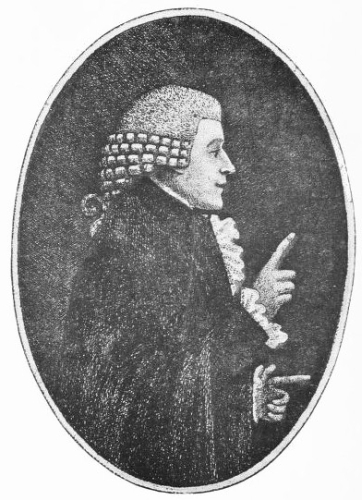
These are no common mistakes; and I ask, what reliance can be had on evidence where two such falsehoods appear within the narrow compass of a few questions? I am willing to grant that there are slight inaccuracies which rather tend to confirm the truth of a deposition than to render it suspected; but you cannot suppose errors like these concerning such marked and important circumstances, as make an impression on the memory equally indelible with any part of the story, and which in this instance constitute its leading features.
I say there must be a radical error here, either in the candour of the witnesses, or in the events which they have related. They are either perjured, or have been deceived, about the articles on your table; and in either case their testimony is good for nothing. It is plain that the iron crow was not found both in Warriston’s Close and in Allan’s Close; the prisoner was not both fettered and unfettered at the same time; and it matters not to me which of the witnesses has been deceived. Whoever it is, it cannot be determined on this trial that any of them spoke the truth; and of consequence the evidence of both must be laid out of consideration.
At all events, gentlemen, what have you more than two solitary witnesses to two contradictory facts, instead of two witnesses to one consistent event? This can never be reckoned good and legal evidence on a trial for life, where equity as well as expediency require the most scrupulous accuracy.
Gentlemen, I have now stated what appear to me to be the most material circumstances in the proof. I have commented on the depositions of the witnesses in so far as they may be thought to criminate my client; and without farther detaining you, I beg leave to conclude by repeating the proposition which I have endeavoured to maintain, that there has not been adduced on this trial sufficient legal evidence to warrant a verdict against Mr. Smith.
At three o’clock in the morning the Dean of Faculty rose to address the jury on behalf of William Brodie.
The Dean of Faculty’s Address to the Jury.
Dean of Faculty
The Dean of Faculty—Gentlemen of the jury, the present trial exhibits in the person of William Brodie, in whose behalf I now address you, a singular phenomenon in the moral world: a man descended of an ancient and honourable family, left by a respectable father in opulent circumstances, and very far from indigence and temptation; educated in the manners and habits of a gentleman; bred to a reputable occupation, at the head of which he has frequently stood; and in virtue of that situation been a member of the Town Council of this great city; who, for a long series of years, has maintained an irreproachable character in society, and has often filled offices of honour and trust among his fellow-citizens, the duties of which he has discharged with attention and fidelity, standing at the bar of this High Court, accused of having leagued himself with the meanest and most abandoned of mankind, in the commission of a crime not less marked with moral depravity on the part of the perpetrators, than fraught with injury and danger to the public.
God forbid, gentlemen, that I were capable of wishing to press on your minds these circumstances in my client’s once honourable and happy situation, with a view of creating in your minds an undue bias in his favour. Though your discernment were not, as I know it is, sufficient to secure you against the effect of such considerations, my feelings as a man, and a sense of my professional duty, would not allow me to resort to such arguments in opposition to justice, which is no respecter of persons.
Yet, gentlemen, there is a view in which I am entitled to call your attention to the former situation and circumstances of this unfortunate gentleman; for unfortunate I must call him, be the result of the present trial life or death. In deciding on evidence in support of a criminal charge, the former character of the prisoner, his probable temptations to commit the offence with which he is charged, must ever be a material consideration. A poor, forlorn wretch, without fortune, without friends, without education, without occupation, is he who is naturalised to support himself by private or open depredation on the public; and when such a person is accused, the minds of a jury, though they must presume his innocence, do not revolt at the charge as improbable. The situation of such men is charmingly described by an eloquent poet of this country—
The needy man who has known better days; One whom distress has spited at the world; Is he whom tempting fiends would pitch upon To do such deeds, as make the prosperous men Lift up their hands and wonder who could do them.[24]
My client was no such man. No circumstance in his situation has afforded a temptation to be guilty of such wrongs to risk his name, his life, for the acquisition of what his fortune, his profession, were fully adequate, honestly and fairly, to procure him.
In these circumstances you are called upon to examine the evidence in this case with the nicest accuracy. You are bound by more than common ties to require the fullest and most explicit proofs of such enormous guilt, so improbable, so unprecedented, before you find a verdict against a man who was once upon the same respectable footing with yourselves, and supposed to be governed by the same honourable principles.
But, gentlemen, while I mentioned the situation which Mr. Brodie once held in life, his family, his fortune, his friends, I must admit, however degrading to him the acknowledgment may be, that this unhappy man, instead of pursuing with industry the useful and reputable occupation by which his own fortune was acquired, and by which it might have been preserved, and with it his own peace, honour, and happiness, has for years past so far yielded himself to idleness and dissipation, and to what in the present age is too often the sad concomitant of such habits, an unhappy itch for gambling, as to lead him into the company of persons with whom, for any other purpose, he would have disdained to associate.
The unfortunate prisoner, Mr. Brodie, is by no means singular in his attachment to this vice; nor is it at all confined to the lower stations of life. People of the highest rank scruple not, in the course of their gambling, to mix with highwaymen and pickpockets, and to descend to practices of chicane and cunning which, in any other situation, they would themselves abhor. It was but the other day that a gentleman of Brighthelmstone, reputed worth three thousand pounds per annum, was detected in the very act of using loaded dice, and was obliged to fly the country for it; which is exactly Mr. Brodie’s situation.[25]
But the gaming table levels all distinctions. There the high and the low, the rich and the poor, meet together. There, I admit—indeed, I have thought it necessary to prove the fact, in order to account for so strange a connection, from the bare existence of which strong arguments of his guilt have this night been drawn—there, I say, I admit that this unhappy, this misguided man, learned to endure, and at last to court, the society of those abandoned, those profligate wretches, who have this day come forward, in the most suspicious circumstances, to swear him their accomplice in the felony charged in the indictment.
But though the prisoner at the bar acknowledges with contrition these habits of folly and dissipation, and the disgraceful connection in which, to that extent, it unhappily involved him, yet he trusts it will appear, from a full consideration of the evidence, that
The very head and front of his offending Has this extent; no more.
And he trusts to the candour and justice of you, gentlemen of the jury, that you will not allow this unfortunate connection to go further in your mind, as an ingredient of proof, than it justly ought; and far less to let suspicions supply the want of that legal evidence which the law of this free and happy country requires, in order to affect the life of any of its citizens, however dangerous to society the crimes charged may be, and however interested the public may be that they should be convicted.
Gentlemen, with these general observations in view, I intreat you to attend to the proof on which a verdict is asked from you against the life of this unfortunate man.
The whole evidence before you consists of three parts. In the first place, the evidence of Brown and Ainslie, who have acknowledged themselves guilty of the crime in question, and are the sole witnesses brought forward directly to fix the guilt on the prisoner; in the second place, in opposition to this there stands the direct proof of alibi, established by a number of unexceptionable witnesses; and lastly, the evidence arising from the various circumstances which are said to support and confirm the direct testimony of Brown and Ainslie, which, independent of such confirmation, is admitted to be deserving of little credit. Upon each of these parts I shall submit to you some remarks, trusting that you, gentlemen, and the honourable counsel on the other side of the bar, will correct me should I happen in any instance to mistake the import or nature of that proof which has been led in your hearing.
Upon the first part I have already, in the course of the trial, anticipated almost everything which relates to the evidence of Brown and Ainslie; I should therefore be ashamed to trouble you with more on that subject. I do not say that their being themselves accused of the crime in question should be a ground for totally rejecting their testimony, which the Court, proceeding on the present law and practice of Scotland, has allowed to be received. But this I will with confidence maintain, that the evidence of persons who, in the very outset of their testimony, confess the most enormous crimes, and thereby cover themselves with infamy as completely in the eye of reason as if they were convicted by sentence of a jury, can in no case be entitled to much credit, and when standing by itself is deserving of none at all.
But it is not on this alone that I impeach the testimony of these bad men; they stand in a situation different, very different, indeed, from other witnesses of that description—a situation to which I again entreat your best attention.
When Ainslie was first examined before the Sheriff, and for a long time afterwards, he persisted in maintaining the innocence of Mr. Brodie; nor was it till he learned that Brodie was apprehended, and till he was informed that to criminate him was the only means of saving his own life, that he uttered a syllable tending to infer the guilt of my client. This we offered to prove in the course of the trial, but a proof was refused by the Court.
The first testimony, therefore, which he gives in the matter is deliberately false. Is his after-information, or the evidence he has given this night, the better to be believed that it was wrung from him by the fear of death, or brought out of him by the hopes of life? It is vain to say that there is no proof that such means were used with him. There is real evidence that under these impressions he must have been when he delated Mr. Brodie. Well did he know that Mr. Brodie, from his unhappy connection with him and his associates, was suspected of being accessory to their guilt. He was not so blind as not to see that to the public prosecutor, whose duty it ever is to choose from various associates those whose situations make them the most striking examples of public justice, to accuse and convict such a person as Mr. Brodie was effectually to secure his own life.
It was a situation too powerful to be overcome even by much more virtue than the witness could boast of, and, unhappily for Mr. Brodie, his connection with the witness in scenes of another kind, while it suggested the accusation, procured it credit. I cannot ask you to believe without evidence that such a plot was laid, nor am I entitled to charge it. But surely witnesses in such circumstances should not lightly be believed. And doing so may lead to consequences of the most dreadful nature, as every man, unfortunate enough to have been innocently, perhaps, the companion of villains, may thus by falsehood and treachery be made their substitutes to the offended laws of their country. Ainslie’s evidence, therefore, in such a situation, is not only suspicious, but altogether incredible.
The evidence of Brown is, if possible, still more unworthy of credit than that of Ainslie. A more hardened and determined villain can hardly be figured. You saw, gentlemen, the manner in which he gave his evidence. He appeared more like a man rehearsing and expatiating upon the patriotic acts he had performed for the good of his country than a criminal unfolding the black history of his own iniquities. You have it in proof that he was not only accused but convicted of a former felony, and sentenced to be transported; that a presentment by the grand jury stands yet against him for another felony; and that he was banished for theft by a sentence of the Justices of Peace of Stirlingshire, proceeding on his own confession.
He has no doubt received His Majesty’s pardon. It has been obtained for him, at a very great expense, for the sole purpose of enabling him to be a witness in this cause. But though the Court has determined that this pardon, the crimes being committed in England, rehabilitates this man, and that his evidence is admissible; yet no pardon can restore his credibility, or render him an honest man. The pardon cannot alter the nature of the criminal; “can the Ethiopian change his skin, or the leopard his spots?” Is it possible that a King’s pardon can restore purity of heart, rectitude, and integrity? Can “a piece of parchment with a seal dangling at it,” a phrase employed on another occasion, perhaps with less force of application, turn wickedness into honesty, and transmute infamy into honour? The King has no such prerogative; this is the prerogative of the King of Kings alone, exerted only towards repenting offenders; and even with Him such change may well be accounted a miracle.
In the eye of reason, therefore, Brown is still a notorious convicted felon, an infamous, unrepenting villain, who, till the 28th July last, the date of the pardon, would not have been received as a witness even in a twopenny-halfpenny cause between man and man. And yet upon this evidence is now to depend the reputation and life of a once respected citizen! These things need only to be mentioned, gentlemen, in order to be fully felt, nor will I insult the understanding of so intelligent a jury by dwelling upon them for a moment longer.
But this, gentlemen, is not all. Mark the game which this man had to play, and in what manner he has played it. He had not, like Ainslie, only his accession to this offence to shake himself loose of; a sentence of transportation hung over his head. This sentence he has not obeyed; and the penal certification is in England, I suppose, as it is with us, capital. By accusing a person of such consequence as to make it worth the while of the servants of the Crown to make him King’s evidence, he not only freed himself from trial for the offences committed here, but secured a pardon for the offence of which he stood convicted, as it was necessary, to qualify him to be a witness, that his former conviction be done away, and all his former crimes washed off in the fountain of Royal favour. A bribe of such magnitude flesh and blood could not resist. Thus, gentlemen, in addition to the profligacy of character, to the load of infamy under which this man laboured, you see the most powerful engines which can set in motion the human soul employed to drag him forward to an accusation which he had not originally made, and which, but for this, his conscience, hardened as it is, might have prevented him from ever making.
The Lord Advocate was pleased to commend this witness, as having spoken out from a desire of doing justice and being of service to his country. Did his appearance this day indicate any such feelings? Do not the circumstances in which he brought forward this accusation show the baseness of his views? He has sworn that at first he did not accuse Mr. Brodie. No; it was not till his return from England that he took this course, when, finding that the sacrifice of mean victims was not leading to any steps being taken to procure him a pardon, and that the other unhappy prisoner at the bar had confessed his own guilt, but without accusing Mr. Brodie, he (Brown) gave the lie to his first declaration by criminating that gentleman; and the pardon, which has this day procured admission to his testimony, was obtained for him. The measures of the public prosecutor in this respect were highly proper, believing, as he no doubt did, the testimony of this man. But I leave it to you, gentlemen, to consider whether it is possible for any witness to stand in more suspicious circumstances; and whether, as several of the judges have told you, that had his conviction been in Scotland instead of England, they would have rejected his testimony, notwithstanding the pardon, you should not so lay aside his evidence altogether in justice to the prisoner, who ought not to suffer for a distinction which, however founded in law, is contrary to common sense or reason when applied to the credibility of the witness, of which you alone are the judges.
I come now, gentlemen, to the direct proof of alibi. And here I readily confess that a proof of alibi is generally resorted to only upon the most desperate occasions; and that such proof, when it is in contradiction to facts clearly substantiated by real evidence or parole testimony beyond all suspicion, must yield thereto. But, gentlemen, this is by no means the case here. The alibi is established by the most direct and complete proof, in opposition to which nothing direct appears in evidence, unless the testimony of two witnesses, entitled to no credit from their characters, and swearing in circumstances the most suspicious. There are, indeed, other circumstances proved; with regard to which I am to address you afterwards. But these, if the depositions of Brown and Ainslie be laid aside, must appear to you so light when weighed against this evidence of alibi that they must kick the beam. The alibi, gentlemen, is thus proved.
You have, in the first place, the evidence of Mr. Sheriff. This gentleman, no doubt, is brother-in-law to Mr. Brodie; and it may be said that this circumstance renders his evidence suspicious. But Mr. Sheriff, gentlemen, is well known to many of you as a man of character and reputation, as a person of unblemished conduct, in a rank of life equal to many of yourselves. And I appeal to you, gentlemen of honour as you are, whether any of you, judging of this witness, as you would wish to be judged of yourselves, would for a moment indulge the thought that even to save the life of his wife’s brother he would deliberately come forward to cast away his own soul? This gentleman deposes most expressly that he dined at Mr. Brodie’s house on Wednesday, the 5th of March, the day on which the Excise Office was broke into, in company with two ladies and another gentleman; that he staid there till about eight o’clock; that Mr. Brodie during all that time was never absent from his company; and that he even asked the witness to stay supper.
Here is a direct contradiction to the evidence of Brown, who swore that Brodie called at Smith’s in the afternoon of that Wednesday. Which of the two, gentlemen, are you to believe? But it is needless for me to ask the question. Were even the former circumstances urged against the credibility of this man’s evidence not sufficient, you have him here convicted of the grossest perjury, if Mr. Sheriff is to be believed; for that gentleman has expressly sworn that they dined at a quarter past three o’clock, and that Mr. Brodie never left the company while the witness staid, which was till near eight o’clock.
It was asked on the other side of the bar how Mr. Sheriff, at this distance of time, came to recollect so precisely that it was upon Wednesday, the 5th of March, he dined with Mr. Brodie? The answer is obvious. It was publicly known upon the Monday following, and the witness has sworn he knew it, that Mr. Brodie was accused of being concerned in the robbery of the Excise Office. Was it not then natural—nay, would not the contrary have been altogether incredible—that Mr. Sheriff, having only four days to look back, should be able to recollect in a matter that touched so deeply the character, and might affect the life, of so near a relation, that he dined with him that very day on which that felony was perpetrated? Which of you, gentlemen, could not at this time recollect where you dined last Saturday or Sunday, and the precise time at which you left the company?
If, therefore, Mr. Sheriff is to be believed, and why he should not no reason can be suggested, the prisoner could not be present, as Brown and Ainslie have deponed he was, prior to the time Ainslie left Smith’s to go to the Excise Office; which Ainslie has fixed at a quarter before eight; nor could he be with them at Smith’s at all, as Brown swears they all left it a quarter of an hour after Ainslie, and immediately joined him at the Excise Office.
But Jean Watt depones that Mr. Brodie came to her house at eight o’clock on the Wednesday evening, when the eight o’clock bell was ringing; her reason for recollecting these circumstances, too, is a very good one, it being the last time that ever Mr. Brodie slept in her house. Her evidence is corroborated by the servant-maid, who depones exactly to the same purpose. And there is a circumstance, gentlemen, in the deposition of this witness which well merits your attention. Upon being asked what bell was ringing, she said it was the bell of the Tron Church. Here the counsel on the other side of the bar appeared to hug themselves upon the mistake into which they supposed she had fallen, by mentioning a bell which, from the distance, she could not possibly hear. But the matter was cleared up in a moment, when, on being asked where the Tron Church was, she replied, in the Parliament Close. This, gentlemen, is the natural simplicity of truth; this proves her to be no tutored witness, brought forward to rehearse a tale made up beforehand, or to assign fictitious causes of knowledge.
Both these witnesses concur in deposing that Mr. Brodie staid the whole night until next morning at nine o’clock in Mrs. Watt’s house; and their evidence is corroborated by that of Helen Alison, who saw him coming down stairs at nine on the Thursday morning. The evidence of this good woman, Helen Alison, is accompanied with circumstances the most natural and striking, and is confirmed by James Murray, one of the sheriff-officers employed in the search on the Thursday morning, who swears to her having at that time mentioned Mr. Brodie’s having been at Jean Watt’s all the night of the Wednesday and morning of the Thursday preceding.
The whole of this evidence, taken together, affords a proof the most conclusive that Mr. Brodie could not be present at the robbery of the Excise Office. You find him in his own house till the hour of eight; from that hour till nine on the Thursday morning you find him in the house of Mrs. Watt. It is impossible then that he could have been at Smith’s a considerable time before the hour of eight, or that he could have been present at a robbery which took up an hour in the perpetration.
It was said, on the other side of the bar, that it was of no avail to prove an alibi which was merely confined to the city. This is strange doctrine, gentlemen, and perfectly new. That an alibi may be proved with greater certainty when the distance is greater than when it is small, I do not dispute; but does it follow that it may not be proved though the distance be ever so short? Suppose a felony to have been committed this day under that window, and that I should be accused of having been an actor in it. Could not I, gentlemen, bring sufficient evidence of an alibi, although within a few yards of the place where it was perpetrated? Could I not substantiate, by this numerous and respectable assembly, that I was here from nine in the morning till the present hour, employed in such a manner as to exclude the possibility of my being any way concerned in such felony? And could it be objected to such evidence that I had not proved myself absent from town, and that my alibi was confined to within a few feet of the place where the fact was committed?
It is to no purpose to say that the witnesses may not be accurate as to time, and that, making a small allowance for mistakes, the facts they swear to may be true, consistently with the evidence of Brown and Ainslie. For supposing Mr. Sheriff to have been mistaken as to the precise time he left the prisoner that night, he could not be mistaken as to his being constantly with him from the time of dinner till the time he left him, whatever it was; and this alone must defeat the testimony of Brown and Ainslie, who swear to the prisoner’s having been there in the afternoon long before the meeting, previous to their setting out for the Excise Office, which cannot possibly be true, if Mr. Sheriff’s evidence is to be believed.
Here, then, is the most unequivocal and positive proof that the prisoner, Mr. Brodie, could have no accession whatever to this robbery of the Excise Office, unless you, gentlemen, shall conclude that the whole of these witnesses, consistent as they are and corroborated by circumstances the most simple and natural, have perjured themselves wilfully and deliberately; while Brown and Ainslie, witnesses, from their character, unworthy of all belief and swearing in circumstances the most suspicious, are deponing in the utmost purity of truth and fairness.
Thus, then, gentlemen, the case would stand were it to be decided on the direct testimony of the witnesses on both sides weighed against each other. The circumstantiate proof, however, still remains to be considered, and I am free to confess that if it shall appear to you that these circumstances afford a chain of real evidence, either sufficiently independent of the direct depositions of Brown and Ainslie to prove the prisoner’s guilt, or so fully to confirm their testimony as to remove the cloud of suspicion that hangs upon it, as to convince you that they must be speaking the truth and the witnesses to the alibi the reverse, your verdict ought to be against the prisoner.
But I humbly maintain that not any of those circumstances nor all of them put together are sufficient to entitle the evidence of such witnesses to credit, when the life of a man is at stake, even if the proof of alibi were out of the question, and far less in the face of that proof of alibi, which, if the witnesses have not deliberately perjured themselves, excludes even the possibility of the prisoner’s guilt. For I hope to show that there is not one of those circumstances, suspicious as they may appear, that cannot rationally be accounted for without supposing the guilt of the prisoner, Mr. Brodie; nay, that some of them are totally inconsistent with the supposition of his having been guilty of this offence, whatever other errors his fatal connection with these miscreants may have led him into.
In considering the circumstantiate evidence, gentlemen, you are never to lose sight of the direct proof I had the honour just now of stating to you as to the alibi; and as each circumstance passes under your review, I entreat you to ask yourselves this question, whether it is so clear, so decisive, so totally irreconcilable with the possibility of the prisoner’s innocence as to make the suspicious testimony of those infamous witnesses outweigh the proof of alibi, founded on the depositions of persons liable to objections on no reasonable suspicion?
The first circumstance founded on is the prisoner’s connection with the perpetrators of this crime. I readily grant that it is clear from the evidence that Mr. Brodie was in habits of too great intimacy with these men. I acknowledge that he appears to have been too deeply engaged in courses of gambling and dissipation in their company and society. That his association with such characters was dishonourable to the reputation of my client, I do not deny.
But, gentlemen, this gambling connection is far from being any proof of his share of the guilt of the crime now charged against him and the other prisoner at the bar, though this circumstance, no doubt, gives possibility to a tale that, without it, would have been rejected at once as totally incredible. Had Mr. Brodie been in no way connected with Brown, Ainslie, and Smith, what could they have accused him in? When the hopes of life were held out to Brown and Ainslie, in order to procure a discovery of their confederates, however willing they might be to deceive the public prosecutor, they would have themselves seen that it was in vain to accuse a man as their associate who had never at any time been connected with them.
But though his having connected himself with them afforded a plausible colour to their charge, it does not follow that this connection affords either a proof or a presumption of Mr. Brodie’s guilt; it is to be considered rather as the cause of his being accused. Many other persons, otherwise very respectable, are known to have gamed in company with these very men, but would this have been sufficient to criminate them had Brown and Ainslie thought proper to give them also up as their confederates in this dark business? The folly of haunting, for any purpose whatever, the company of such men is great indeed, but to subject the party guilty to the consequence of every enormity of which such associates may accuse him, on their bare testimony alone, would be a punishment far beyond the offence, as such men would never fail to find some unhappy associate of better rank than themselves to substitute as a sacrifice to the public for crimes to which he had no accession.
The next circumstance founded on in corroboration of the evidence of Brown and Ainslie, is the alleged proof by the oath of Grahame Campbell that Mr. Brodie was present with the gang at the house of Smith on the night the Excise Office was broken into, and left it in their company. The veracity of this witness I mean not to dispute, but I maintain it to be impossible that, if she be speaking the truth, the facts she swears to could happen upon that night, or if she did, it must be fatal to the whole evidence given by Brown and Ainslie, as it contradicts them in the most essential particulars.
This witness indeed swears that one night—for she fixes no precise time—soon before Mr. Brodie left this place, he, Brown, and Ainslie met at Smith’s house before six o’clock; that they all left it about six; that between nine and ten they all returned; that they supped there, and remained about two hours. And she remembers particularly that Brown and Ainslie sat down to supper, but that Mr. Brodie stood all the time they ate their meal. But Brown and Ainslie expressly swore that, after coming out of the Excise Office, they did not see Mr. Brodie again that night, and that Brown did not meet with him till the Friday, when he for the first time got an opportunity of abusing him for having left his post. She differs from them also as to Mr. Brodie’s dress, which she says was, when he came, an old-fashioned black coat, whereas Brown says it was his ordinary black coat, and that he wore a white surtout above it. Both these opposite stories cannot be true, and consequently the young woman has deponed to what happened on a different night, and her evidence does not corroborate that of Brown and Ainslie; or, if she swears to that night, she swears to facts totally inconsistent with the truth of part of their evidence at least, and thereby destroys the credibility of the rest of it.
The Lord Advocate has told you that this witness must be mistaken with regard to their supping, because she has also said that they had ate some fresh herrings or cold fowl before setting out. I cannot, for my part, see how their having taken this collation early in the evening can be any reason for their not supping betwixt nine and ten. And, at any rate, though she could have mistaken the smaller circumstance of their eating or not eating after their return, it is utterly incredible that she should have recollected their all being at Smith’s together between nine and ten, and continuing together for two hours if, as Brown and Ainslie depone, they and Mr. Brodie never met that night after the time the two former went into the Excise Office.
The next circumstance founded on by the prosecutor is the departure of Mr. Brodie from this country, which is not only held out as a flight from justice, but as a flight applicable to this particular offence.
That the flight of a person accused of a crime may in some cases be a strong ingredient in a proof of his guilt, I readily acknowledge, but it is not necessarily so. If he has not been previously accused of that particular crime, and other reasons occur sufficient to account for his leaving his native country, the circumstance is at best equivocal.
In this case it cannot be denied that Mr. Brodie had strong reasons for taking this step separated from any consideration of guilt connected with this offence. His gambling connection with these men was too well known, and though nothing further could be proved against him, it must be a painful feeling for a man of any spirit to remain in that place where persons with whom he had been so intimate were taken up by public justice on charges of so heinous a nature. Joined to this, you find in evidence that a prosecution was depending before the magistrates of Edinburgh against my client for using loaded dice. I do not say, nor do I suppose that this prosecution was well founded, but the very report of such a charge, when added to the connection he had with these men, must have rendered his situation so disagreeable as to induce him to leave Edinburgh, at least for a time, or even to have resolved on settling in some foreign country, where his former folly and dissipation were unknown and where his professional skill might enable him to repair his shattered fortune. What were the real motives of Mr. Brodie it is not for man to judge, but, if his actions were equivocal, you are bound in charity, in justice, in humanity, to put the most favourable construction upon them.
Yet even when he abandoned this country, he does not appear to have conducted himself as one who never intended to return, or who was afraid of any consequences to himself, beyond the pain of enduring in his own country the loss of honest fame. He corresponds, as you find, with his friends in Edinburgh, and the whole tenor of his conduct seems to be such as might have been pursued by a person who intended only to retire out of view for a short time, till the clamour of a prejudiced public against him should cease. A flight under such circumstances and conducted in this manner can never be held as proof of guilt, or even as a circumstance sufficient to stamp credibility on the testimony of a witness base and profligate beyond all example, deponing under the strongest temptations to falsehood, unsupported by the direct testimony of any other witnesses, and directly contradicted by a proof of alibi, proved by a cloud of witnesses altogether free from suspicion.
With regard to the circumstance attending Mr. Brodie’s departure, his conduct in London, on shipboard, and on the Continent, the evidence adduced by the prosecutor is in the highest degree lame and inconclusive. Indeed it ought totally to be rejected as not the best the prosecutor had it in his power to bring; and as to his being brought back to this country, the evidence is very defective. The evidence of Mr. Longlands consists chiefly of hearsay. Those persons who apprehended Mr. Brodie, who conducted him back to this country, are not produced as witnesses. Mr. Walker, who is said to have protected him in London; the owners of the ship, who are said to have altered the destination of the vessel to aid his flight; none of them are brought forward. And as hearsay evidence is only competent where the principal witness is dead or cannot be had, neither of which is here the case, I submit to you, gentlemen, whether any part of this evidence ought to have been received or ought now to be regarded by a jury.
I come now to the evidence arising from the letters said to be written by my client. Gentlemen, urgent as his case may be, I do not wish to strain anything or to evade any part of the proof. I do not mean to contest that these letters are of the handwriting of Mr. Brodie, although this point has been but slenderly proved. My client has not himself denied them; I shall admit them to be his. Now these letters contain nothing which can bring home to him the present charge. They prove that he was avoiding his native land; that he was anxious for the fate of these abandoned men; that he was afraid they might accuse him; but he expressly supposes a false accusation—an accusation that might equally involve the innocent persons he was writing to. In one passage he expressly asserts his own innocence. Yet the letters are written in full confidence, and without any seeming intention to hide anything.
It is true, indeed, that in one of these letters he says that he had no accession to any of their depredations except the last, which is laid hold of as a direct acknowledgment of the crime. But, gentlemen, supposing the word depredation could not be otherwise explained, where is the evidence that the crime in question was the last of which these abandoned ruffians were guilty? and if there were such, it would not be conclusive. The word depredation is generic, and may as well apply to the depredations of the gaming-table as to acts of theft or house-breaking; and as there is but too much reason from the evidence, particularly the process at the instance of Hamilton for defrauding him by false dice, to believe that this unhappy man was not altogether free from accession to depredations that may at the gaming table have been committed by those persons against such as were unfortunate enough to fall into their hands, why should you, gentlemen, to reach the life of a fellow-citizen, construe so equivocal an acknowledgment, couched in so general terms, as applicable to a particular act of guilt; for the proof of which, against this prisoner, you have nothing but the most exceptionable of all human testimony, contradicted by the most direct proof of alibi.
But this is not all. The terms of this acknowledgment, as repeated in the last of these two scrolls, exclude even the possibility that the prisoner could refer, or mean to refer, to the breaking of the Excise Office as the depredation to which he had an accession; for he expressly says that he lost ten pounds by it; but how, in the nature of things, is it possible that if he had been concerned in that affair he could have thereby lost ten pounds, or any sum whatever, seeing Brown and Ainslie have both sworn that the money was fairly divided, and that each of the parties concerned received four pounds and some old shillings for his share? To what other act of depredation, and whether to any committed at the gaming table, these words refer, it is not for me to suggest nor are you, gentlemen, bound to inquire; though it would seem that depredations at the gaming table are the only attacks upon the property of our neighbour that can be attended with patrimonial loss.
It is enough to exclude these scrolls, and also the letters, from operating as evidence of the prisoner’s accession to the crime with which he is charged, that the only accession they acknowledge is inconsistent with the possibility of his guilt; and if he has been so far misguided as to have been concerned with those infamous persons in anything beyond that gambling connection, which he has all along admitted, it must have been some other offence not yet discovered, or not hitherto made the subject of prosecution; which, not being charged in the present indictment, could not have affected the prisoner, though a proof of it had come out in the course of his trial.
The only remaining circumstance brought in aid of the direct parole testimony is the different articles which have been found in the house of the prisoner or elsewhere, and which the prosecutor has attempted to connect with the commission of the act which is the subject of the libel. On this head I shall detain you but a moment, there not being the shadow of evidence to connect any one of them with the prisoner so as to afford a presumption, and far less evidence, of his guilt.
A dark lanthorn was found in his house, but there is not the appearance of evidence that it was used at the perpetration of the crime in question, or was ever out of Mr. Brodie’s own house. The utensil itself is perfectly innocent. The useful part of it was found in the cock-pen, and it is well known that cocks are chiefly fed by candle-light. There were keys and pick-locks found in his house, but it was proved that these are the ordinary implements of his trade, and not one of those have been sworn to as having been used by the villains, who best knew and described the whole mystery of the iniquity. Nay, the only instruments that were used on that occasion in opening the locks or forcing the doors were found at the bottom of Allan’s Close or Warriston’s Close by the officers of justice, led by the other prisoner Smith to the hole in which they were concealed; and not one of those articles, being two crows, a key, a pair of curling irons, a coulter of a plough, and two wedges, is proved to have been in any way connected with Mr. Brodie, the three first of which Brown and Ainslie admit were carried to the scene of action by Brown and Smith, while the two last were stolen by themselves from a field near Duddingston.
True, indeed, it is, that a pair of pistols, which these witnesses say were the property of the prisoner, Mr. Brodie, were found in a fireplace in his house; but it is proved by the same witness that these pistols had not been in the prisoner’s hands for a month before, when he had lent them to Smith; that they were in Smith’s possession on the night libelled; and the sheriff-officers have proven that it was Smith himself who dug out these pistols in Mr. Brodie’s house, which demonstrates that it was he who hid them there—a circumstance not very reconcilable with his considering Mr. Brodie as an accessory, as in that case he could not have chosen a more improper place to conceal them. In case of discovery, it would become the object of the earliest and most anxious search.
Gentlemen, these observations upon the proof on both sides I submit to your most careful and deliberate consideration. You have on the one side a direct and positive proof of alibi; which, if the witnesses are not foresworn, must preclude the possibility of the prisoner’s guilt; and that these witnesses have departed from the truth there is not the shadow of reason to suspect. On the other hand, the whole direct evidence against the prisoner is the testimony of two witnesses, who, besides being destitute of all right to be believed as witnesses in any case, have been brought to give evidence in the present in circumstances of the very strongest temptation to convict my unhappy client whether innocent or guilty, as, but for their having accused him, one or both of them must have stood at this bar in his place. It is for you, gentlemen, to consider, under all the circumstances of the case, to which of those contradictory proofs you will adhibit your belief.
In the hands of an upright and intelligent jury I leave this unfortunate gentleman, confident that whatever verdict you shall pronounce will be the result of your ripest judgment, tempered, in case of doubt, with that tenderness with which it becomes you to decide when the fame and life of a fellow-citizen are at stake.
At half-past four o’clock in the morning the Lord Justice-Clerk proceeded to charge the jury.
The Lord Justice-Clerk (Lord Braxfield). (From an Engraving by Beugo after the Portrait by Sir Henry Raeburn.)
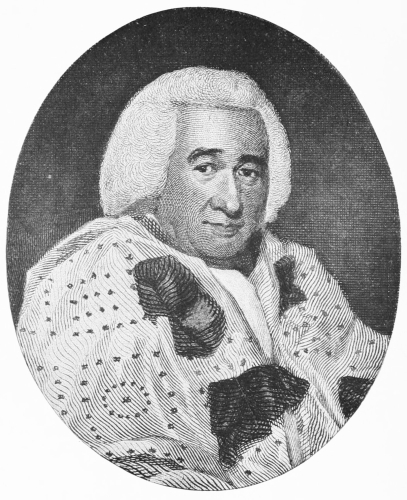
The Lord Justice-Clerk’s Charge to the Jury.
Lord Justice-Clerk
The Lord Justice-Clerk—Gentlemen of the jury, the crime which is charged against the prisoners at the bar is of a kind the most hurtful to society. The situation of the pannels, and particularly one of them, is also exceedingly distressful. Mr. Brodie’s father, whom I knew, was a very respectable man, and that the son of such a man—himself, too, educated to a respectable profession and who had long lived with reputation in it—should be arraigned at this bar for a crime so detestable, is what must affect us all, gentlemen, with sensations of horror. This unhappy situation seems to have arisen from a habitude of indulging vices which are too prevalent and fashionable, but it affords a striking example of the ruin which follows in their train.
That the Excise Office was broke into is not disputed. The question therefore is, who broke into it? Was it the pannels?
Now, to ascertain this point you have, in the first place, gentlemen, the evidence of Brown and Ainslie, and if they have sworn truth the prisoners must be guilty. To the admissibility of these witnesses there can be no objection. Were not evidence of this sort admissible, there would not be a possibility of detecting any crime of an occult nature. Had a corrupt bargain, indeed, been proved, by which they were induced to give their evidence, there might have been room for an objection to their admissibility. But no such bargain has even been alleged against the public prosecutor in the present case. And as to their being accomplices, this, gentlemen, is no objection at all. A proof by accomplices may display, it is true, a corruption of manners, which alone can render such proof necessary. But it is impossible to go into the idea that their testimony is therefore inadmissible.
Nor is there, in the present case, any reason to suppose that they were under improper temptations to give their evidence. Each of them was separately called upon by the Court, and it was explained to each of them that they ran no hazard unless from not speaking the truth, and that their being produced as witnesses secured them from all punishment, except what would follow upon their giving false evidence. Under such circumstances, you cannot suppose, gentlemen, that they would be guilty of perjury without any prospect of advantage to themselves, and merely to swear away the lives of these prisoners at the bar.
Their credibility, to be sure, rests with you, gentlemen; and if you find anything unnatural or contradictory in their evidence you will reject it. But there is nothing in it unnatural or contradictory. The principal objection was made against Brown, but his evidence is corroborated by that of Ainslie, and the evidence of Ainslie is again corroborated by that of Brown, and they are both corroborated by all the other circumstances deposed to. With regard to Smith, you have the best of all evidence against him, his own declarations, for it surely is not to be imagined that any man would criminate himself contrary to the truth. These declarations have been substantiated in your hearing, and where a corpus delicti is established, as in the present case, to which these declarations refer, there cannot be a doubt of their being the very best evidence, and therefore you can be under no difficulty of returning a verdict against him.
Gentlemen, to be sure these declarations are not legal evidence against Brodie. But they corroborate the evidence of Brown and Ainslie, who swear positively against him.
The evidence of Grahame Campbell likewise corroborates that of these witnesses. With regard to Mr. Brodie, she swears positively to his being present with them, dressed in an old-fashioned suit of black clothes. She seems, indeed, to be in a mistake about the prisoner’s having supped at Smith’s house that night, but the rest of her evidence is clear and explicit, and concurs precisely with what you have heard from the other witnesses.
The evidence of Brown and Ainslie likewise corresponds exactly with the deposition of James Bonar. Ainslie tells you that a man came running down the close, and it appears that when he opened the door Brodie set off with himself—and, indeed, to tell you the truth, I could not much blame him; and Mr. Bonar tells you that he went down the close at the very time when the robbery was going on, and that when he opened the door a man stepped out, of a description that exactly corresponds with the prisoner and the dress he had on that night.
It appears clear also, gentlemen, from the depositions of the sheriff-officers, that several articles were found upon the search in Brodie’s house, which Brown and Ainslie depose to have been used in the robbery of the Excise Office; a pair of pistols, a dark lanthorn, keys, pick-locks, &c., and many of these last such as never were employed by Mr. Brodie in the course of his business. So that no doubt can remain in your mind of the truth of the facts sworn to by these two men, which are all consistent with, and corroborated by the other evidence.
The crime with which these prisoners are charged, gentlemen, was committed on Wednesday, the 5th of March. Two persons were taken up for it, and Brodie absconded. It is established by the evidence that he went to London, was afterwards put on board a sloop at night, and carried to Flushing; and that, upon search being made for him, he was apprehended at Amsterdam and brought back to this country. Gentlemen, when a person who is accused of a crime flies from justice, it affords a strong presumption of guilt. An innocent man would not fly without just cause. The prosecution against him for using false dice could not be the reason of his flight. Nay, he tells you himself in his declaration that he absconded because Smith and Ainslie were taken up.
The papers found in the trunk, gentlemen, and the two scrolls, all which have been proved to be of Mr. Brodie’s handwriting, afford strong evidence against him. In one of the scrolls there is a fair and full confession of his direct accession to the robbery of the Excise Office. He says, “He never was directly concerned in any of their depredations, except the last fatal one.” This is even a confession of more than is charged against him, for it must mean that he was concerned, though not directly, in their other depredations. It is impossible, gentlemen, to mistake the meaning of this expression, or that it can apply to anything else than the breaking into the Excise Office.
With regard to the alibi, gentlemen, it is no doubt proved by the oath of Mr. Sheriff that he was in Brodie’s company from three o’clock of Wednesday, 5th March, till near eight at night, he having dined in Mr. Brodie’s house that day along with three ladies, and a gentleman whose name he does not recollect. But then this rests entirely upon his evidence, and though I do not mean to say that he has sworn falsely, yet he is not a witness omni exceptione major, above all exception, being the brother-in-law of Mr. Brodie. Besides that, gentlemen, allowing the evidence of Mr. Sheriff, he is still only a single witness, and even in civil cases a fact cannot be established by the evidence only of one witness, especially where it is not supported by any other circumstances. At any rate, the evidence is not inconsistent with the guilt of the pannel, for the Excise Office was broke into after eight o’clock, and Mr. Sheriff was in his own house in St. James’s Square about eight o’clock.
As to the evidence of Jean Watt, who swears that Brodie came to her house that night at eight o’clock, you are to consider, gentlemen, that although, to be sure, she is not his wife, yet she is his mistress; and love is often as deeply rooted between persons of that kidney as between lawful man and wife. And, as you see, gentlemen, that either she must be mistaken as to the hour or that the witnesses on the other side must be wrong, you are to determine with yourselves whether the witnesses for the prosecution brought forward by the Lord Advocate, who has no interest but to get at the truth, or this woman, and her servant-maid who concurs with her, are most entitled to belief. And you can have no doubt but that the presumption is greatly in favour of the witnesses for the Crown, who can be influenced by no motives but those of public justice.
This woman and her servant, Peggy Giles, have no doubt deposed that it was eight o’clock when Mr. Brodie came to their house; but, gentlemen, even supposing them to be swearing to what they think true, yet they still may be mistaken with regard to the precise time; and the mistake of an hour, or half-an-hour, would reconcile their evidences with the other proof you have heard. There is a bell rings at ten o’clock as well as at eight, and these witnesses may very probably have confounded the one with the other; for I have no doubt that Brodie did come to that house that night, and staid there till the next morning. Gentlemen, the law itself makes allowance for mistakes of this kind. Thus in the civil Court, in a competition between two arrestments, of which one, for instance, is at eight and another at nine o’clock, they are preferred parri passu, because the law supposes that the memories of witnesses may be so frail as not to distinguish short intervals of time with proper accuracy. So that you see, gentlemen, that even supposing these witnesses were willing to speak the truth, yet their evidence is completely reconcilable with the other depositions.
Upon the whole, gentlemen, taking all the circumstances of this case together, I can have no doubt in my own mind that Mr. Brodie was present at the breaking into the Excise Office; and as to the other man, Smith, as I have already said, there can be still less doubt as to him. If you are of the same opinion, gentlemen, you will return a verdict against both the prisoners; but if you are of a different opinion, and do not consider the evidence against Brodie sufficiently strong, you will separate the one from the other, and bring in a verdict accordingly.
At about six o’clock on Thursday morning, the Lord Justice-Clerk, having finished his charge to the jury, said that he hoped it would not be inconvenient for them to return their verdict at twelve o’clock that day; but, upon the suggestion of one of the jurymen, it was fixed to be returned at one o’clock.
The Court then pronounced the following interlocutor:—
The Lord Justice-Clerk and Lords Commissioners of Justiciary ordain the assize instantly to inclose in this place, and to return their verdict in the same place at one o’clock this afternoon, continue the diet against the pannels till that time, ordain the haill fifteen assizers and all concerned then to attend each under the pains of law, and the pannels in the meantime to be carried back to prison.
The Court then adjourned.