THE TRIAL (continued 3)
Reading edition
Declares that, accordingly, soon after this, and, as he thinks, about Christmas or near to it, Brown kept Tapp in his shop drinking, and the declarant and Ainslie, betwixt nine and ten o’clock at night, opened the door of the house with a false key and took out of his drawers eighteen guinea notes and a twenty-shilling one, a silver watch, some rings, and a miniature picture of a gentleman belonging to Tapp’s wife, which picture they broke for the sake of the gold with which it was backed.
Declares that in the month of August last, as he thinks, the declarant, in company with William Brodie and Andrew Ainslie, went to a shop in Leith, which they broke into by means of two pick-lock keys, one for the padlock and another for the stock-lock; that the declarant and Ainslie went into the shop and Brodie kept watch, to give an alarm in case of danger; that from this shop they carried off two pair of wallets full of tea, which were taken from four chests; that Ainslie was ill at this time, and Brodie being weakly, Ainslie and he could scarcely manage one of the wallets, which obliged him to put it into an old press bed (as the declarant took it to be) which they found standing in a shed in a field adjoining to the Bonnington Road to Leith; that it was proposed to lodge the tea in Brodie’s, but he afterwards objected to it, which was the reason that they never inquired after it more.
That about two months ago the declarant, in company with Andrew Ainslie, broke into the shop of Inglis, Horner & Company, and took therefrom a large assortment of valuable goods, composed of silks and cambricks; that the silks were mostly black, excepting two pieces, a piece of plain white sattin, a piece of variegated ditto, and a lead-coloured silk, in quantity about ten yards, which Brown gave to a girl, an acquaintance of his, of the name of Johnston; that the silks were all sent to England, except the silk before-mentioned, a piece of black silk of about two yards and a quarter, in two odd bits, which the declarant gave to his wife to make a cloak to her child, and about twelve yards and a half of thick tweel’d black silk for gentlemen’s vests and breeches, and two yards and a half of black florentine sattin, with about six yards of cambrick.
That Brodie suggested to the declarant the doing of Inglis & Horner’s shop, as the goods there were very rich and valuable, and a small bulk of them carried off would amount to a large sum; that Brodie and the declarant went frequently to try the pad and stock-lock of Inglis & Horner’s shop, and they did so most commonly on the Sunday forenoon, when the people were in church; that the padlock was of a difficult construction, and was opened at last by a key of the declarant’s own making; that Brodie made one that did it also, and he on one occasion went by himself with his key and unlocked the padlock, but could not lock it again, upon which he came to the declarant and told him what he had done, which he did also to Ainslie and Brown; that they were all very angry with him, and said that he had more than likely spoilt the place after all the trouble they had been about, but Brodie told them he hoped not, as he had fixed the padlock with a bit stick in a way that it would not be discovered, and, upon looking at the place afterwards, which they all did, they found the lock to be just as it was.
Declares that on Wednesday evening, the 5th instant, the declarant, along with William Brodie, John Brown, and Andrew Ainslie, between the hours of eight and ten o’clock at night, broke into the Excise Office and carried off from that about sixteen pounds, consisting of two five-pound notes, four guinea notes, one twenty-shilling note, and about seventeen shillings and sixpence in silver; that this money was divided among them, and Brodie received his share.
That Brodie first planned the Excise Office, and repeatedly carried the declarant there under pretence of calling for Mr. Corbett from Stirling, and other people, in order to learn the situation of the place, and, on one of these occasions, the declarant observed the key of the outer door hung upon a nail near by it, and, without taking it down, he clapped some potty upon it, and carried away the wards; that Brodie took a drawing of the wards of that key, which the declarant thinks he has in his possession; that Brodie told the declarant how to get into the cashier’s desk, and where the money lay, which was in two places, and in each of these places some money was found; that Brodie came to the knowledge of these circumstances, by being present, when Mr. Corbett, from Stirling, who is a connection of Brodie’s, drew money at the cashier’s office.
That, when they broke into the Excise Office, the outer door was opened by a key which the declarant had filed from the pattern before-mentioned; that the plan of accomplishing this business was as follows:—Ainslie was to keep on the outside of the office, hanging over the palisadoes in the entry with a whistle of ivory, which was purchased by Brodie the night before, with which, if the man belonging to the Excise Office came, he was to give one whistle, and if any serious alarm was perceived he was to give three whistles, and then make the best of his way to the Excise gardens in the Canongate in order to assist the declarant, Brodie, and Brown to get out at the back window of the hall, it being determined in case of surprise to bolt the outer door on the inside and make the best of their way by the window.
That Ainslie was armed only with a stick, which he left somewhere in the court, and which stick was purchased by the declarant; that Brodie had a brace of pistols, the declarant a brace and a half, and Brown a brace, which the declarant borrowed from Michael Henderson; that these arms were all loaded with double balls, as they were determined not to be taken, whatever should be the consequence.
That the declarant and Brown were told afterwards by Brodie and Ainslie that a person had come running down the court and gone in at the outer door and upstairs; that upon this Ainslie had given the alarm by a whistle, as was agreed upon, and made the best of his way, but none of them in the inside heard the whistle, at least neither Brown nor the declarant did, and Brodie said he did not; that when the door opened Brodie was standing behind it, and, upon the person’s running up stairs, Brodie made off; that the declarant and Brown, when in the cashier’s room, heard the outer door open, but, trusting to Brodie’s being at the door and staunch, they did not mind it; that the declarant and Brown, when coming out of the cashier’s office, heard a person coming hastily down stairs, which made them stop or they must have met him; that upon this the declarant said to Brown, “Here must be treachery; get out your pistols, and cock them,” which they did accordingly; that upon coming to the outer door they found it shut, the declarant and Brown having seen the person that came down stairs smash the door after him when he went away.
That the declarant and Brown went down into Young’s Street, where Brown gave the declarant a small crow, with some wedges, and a shirt, as also a large chissel; that the chissel and the shirt were given to Brodie afterwards, with the bank-notes, the declarant’s dark lanthorn, and two bottles, which they had carried off from the Excise Office, and took for wine; that the key with which the outer door was opened, the crow, and a pair of curling irons with which the outer door of the cashier’s room was opened, were all hid by the declarant in a wall between the Earthen Mound and the North Bridge.
That, in virtue of repeated observations, it was discovered that two men watched the Excise Office time about, and Ainslie and Brown found out that from eight to ten o’clock at night there was commonly no man in the Excise Office, which was the reason of the thing being done at that time.
That it was concerted by Brodie, in case of interruption, by the man coming into the office before the business was accomplished, to conceal themselves quietly until he was gone to rest, and then to secure him; and they were, if this happened, to personate smugglers who came in search of their property that had been seized, and the declarant had a wig of Brodie’s father’s in his pocket in order to disguise himself; that the wig and scarf and small wedges were left in the second arch from the south of the North Bridge; that the scarf was within the wig.
That Brodie, after having been in the Excise, where he had on black clothes, went home and changed them to his ordinary dress, of a marbled colour, and a round hat; and that Brodie told the declarant that his sister had remarked him changing his dress in such a hurry.
That there is in Brodie’s house a horse-pistol belonging to the declarant, as also a very large, remarkable key, which Ainslie and Brodie stole from the Abbey when there was a sale there; that Brodie has a parcel of keys of different sorts, which he has been altering, and among them is the key which he had made for Inglis & Horner’s padlock; that, in Brodie’s bedroom, there is a chest containing a false till, in which the declarant inclines to think some of Brodie’s false dice and other things leading to a detection of his guilt may be found.
That the College mace and Tapp’s watch were sent to Chesterfield, under the direction of William Ward, at William Cowley’s, “Bird in Hand,” Chesterfield, Derbyshire, to which place, and at which time, the rings taken from Tapp and the gold from the miniature picture were also sent; that a private letter was wrote by Brown, as he thinks, to one Tasker, formerly of this place, and whose real name is Murray, a man of bad character, which letter had no name at it but only a G. and S., and a stroke for each of the other letters in the declarant’s name; that the pocket-book taken from Tapp’s, with the money, was thrown by Ainslie and the declarant into a deep piece of water to the south of the Meadows.
That the goods taken from Inglis & Horner’s shop were sent to Chesterfield in trunks, one of which was purchased by the declarant and another by Ainslie; that the declarant knows the places where they were purchased, and will point them out.
That the first trunk went from this by the Berwick carriers three weeks ago on Wednesday next; that the goods were removed from a cellar, in which they were originally put, in Stevenlaw’s Close, taken for the purpose, notwithstanding of what was said by the declarant in his declaration of Saturday last; that Ainslie went and brought a porter from the street, who received the goods from the declarant and Ainslie half-way or more up Burnet’s Close, where Brown and Ainslie lodged, near the bottom; that the porter had no creel, but only ropes, with which he tied the trunk upon his back; and Ainslie followed him and saw him carry and deliver it to the Berwick carrier’s quarters, for which he received sixpence.
That the second parcel of the above goods were sent under the direction of Elizabeth Scott or Sprott, at William Cowley’s, “Bird in Hand,” Chesterfield, and the reason of putting this was because the initials of her name were upon the top of the trunk; that no letter was wrote to Tasker or Murray about the last parcel of goods, as the declarant’s wife was to have left this on Saturday last, and the declarant told her he had some goods for her to dispose of at Chesterfield; but she knew nothing how the goods were obtained, and is entirely innocent of any participation or knowledge of his crimes.
Declares that Brodie brought with him to the declarant’s house, a day before, as he thinks, the Excise Office was robbed, a coil of ropes, new, which he either had in his possession or must have bought, as also a strong chissel with a brass virral, and two pieces of wax taper; that the brass chissel is, as the declarant believes, now in Brodie’s shop or house.
That the coulter with which the inner door of the Excise Office was broke open, and two iron wedges, were taken from a plough by Brown and Ainslie near to Duddingston, as they said, the Friday before; and the declarant makes no doubt but a black dog, Rodney, might be with them, which used to follow the declarant and them; that the coulter and wedges were left in the cashier’s office, and were concealed in Salisbury Crags from the time the coulter was taken away to the time the Excise Office was broke. This he declares to be truth.
And further declares that the ropes brought by Brodie, as before mentioned, are in the declarant’s house, as also a vice and files and a spring-saw, with which the declarant used to make and alter keys; that the saw the declarant got from Brodie about five or six months ago; that the declarant, before this, bought a saw, with a pair of large pincers, at a hardware shop below Peter Forrester’s, on the High Street, and the declarant inclines to think that Brodie bought his saw at the same place; that in the declarant’s drawer, along with the said saw and files, there will also be found a keyhole saw, which was bought and given to the declarant by Brodie.
This he also declares to be truth; and declares that the declaration emitted by him on Saturday last, so far as is inconsistent with the present, is not true.
George Smith. Archd. Cockburn.
No. III.
At Edinburgh, 19th March, 1788.
The which day compeared, in presence of Archibald Cockburn, Esq., advocate, His Majesty’s Sheriff-depute of the shire of Edinburgh, George Smith, present prisoner in the Tolbooth of Edinburgh, who, being examined, declares,
That the small crow, the false key, and the curling tongs, now shown to him, are the same that were found by the declarant, William Middleton, A. Williamson, and J. Murray, in an old dyke on the 16th instant, and the label annexed to them is signed by the declarant as relative hereto, of this date.
Declares that the said crow was carried to the Excise Office for the purpose of opening the desks in the cashier’s room; that the said false key is the one that opened the outer door of the Excise Office, and the curling tongs were squared at the point by the declarant and taken to the Excise Office for the purpose of opening the spring latch of the outer door of the cashier’s room, which it did.
And, being shown a coulter and two wedges, declares that he believes they are the same that were used in forcing open the inner door of the cashier’s room in the Excise Office and were left there.
And, being also shown a spur, with the upper leather at it, declares that it belonged to William Brodie; and the declarant tore the end of the leather in order that it might appear, when found, to have dropped from the foot by its being torn by accident by the buckle; that Brodie brought the said spur to the declarant’s house, and from thence it was taken to the Excise Office, on purpose that it might be left there, to make it believed it had been done by some persons on horseback; that the spur was left in the Excise Office by John Brown, as the declarant was told by him upon the declarant’s questioning him if he had done it, and the label annexed to the spur is signed by the declarant as relative hereto, of this date.
And, being shown a parcel of ropes which the declarant is now told were found in his house, declares that the declarant has no doubt but that they are the same ropes which were brought to the declarant’s house by Brodie, and, after being knotted into a ladder, were carried to the Excise Office by the declarant, brought from thence by him, and unknotted again in the declarant’s house, in which case he now sees they are.
And, being shown a pick-lock, which the declarant is informed was found in William Brodie’s counting-room in the shop, declares that it is the same which William Brodie gave to the declarant in his own house before they went to the Excise Office, and which Brodie wanted to fasten with some nails, as the handle of it went round when the pick-lock was much pressed; declares that the declarant carried that pick-lock to the Excise Office, and, after they had left it, it was returned by the declarant to Brodie when under the arch of the North Bridge, where Brodie’s father’s wig, the scarf, and wedges were left, as mentioned in his declaration of the 10th instant; and the label annexed to the said pick-lock is signed by the declarant as relative hereto, of this date.
And being shown a black case, with a lid to it, the case full of potty, declares that it was found, as the declarant thinks, in Mr. Brodie’s drawers by the declarant and George Williamson on Monday, the 10th instant; that the declarant had often seen the said case, with potty in it, before in Brodie’s possession when in the declarant’s house, and the declarant approved of Brodie’s keeping the potty in a case, as the lid prevented an impression of a key when taken from being defaced; and the said case and potty having now a label annexed to it, the same is signed by the declarant as relative hereto, of this date.
And, being shown a five-pound note, declares it is the same five-pound note which the declarant carried to Drysdale’s and changed there, to purchase his wife a ticket in the Newcastle stage; that the declarant believes it to be one of the five-pound notes taken from the Excise Office, they being both of the Glasgow Bank, but the other five-pound note was not ornamented with the same colour with the one now shown to him; that the notes were pasted on the back by Brodie, and the one now produced is signed by the declarant on the back as relative hereto, of this date.
And being shown a parcel of keys, declares that they are the same which were pointed out by the declarant concealed in Salisbury Crags, on the 7th instant, to William Middleton, Alexander Williamson, and James Murray, and the label annexed to them is signed by the declarant as relative hereto, of this date. Declares that among this parcel there is the false key which opened the outer door of Inglis & Horner’s shop, to which the declarant now sees a label annexed, and which is signed by him as relative hereto, of this date.
And being shown a parcel of keys which were found by the declarant and George Williamson upon the 10th current, declares that the double clank among the said parcel was brought by the declarant from Sheffield, and given to Brodie, the reason of which was for fear it should be found in the declarant’s possession and thereby create suspicion, but it was not likely to be discovered in Brodie’s. Declares that the heads and stalks of two keys in the said parcel were cut from old keys by Brodie, and were intended to be finished for the purpose of opening the spring latch of the outer door of the cashier’s room in the Excise Office; that a false key in the said parcel, finished, was made by Brodie for the purpose of opening the door of the Chamberlain’s cash room of the city of Edinburgh; and to the said double clank, the heads and stalks of two keys for the Chamberlain’s room, the declarant sees labels annexed, of this date, and are signed by the declarant as relative hereto. The declarant and Brodie had frequently been at the door of the Chamberlain’s office, in order to take the impression of the keyhole; that Brodie showed the declarant the said key after it was made, and Brodie told the declarant that it did not answer.
And being shown two parcels of keys, with labels annexed to them, and two pieces of black stockings, declares that they are the property of the declarant, and were concealed by him in Salisbury Crags, and the labels annexed to them are signed by the declarant and Sheriff as relative hereto, of this date.
And being shown two trunks, declares that they are the same two trunks that were purchased by the declarant and Andrew Ainslie; that the round one was purchased by the declarant from a man opposite to Todrick’s Wynd, whom he saw this day in the office, for which the declarant paid three shillings, and the other was purchased by Ainslie from a man nearly opposite to Richardson’s, the smith, in the Cowgate; that the declarant first bargained for it himself, but the declarant afterwards sent Ainslie, who bought it for five shillings and sixpence, or six shillings.
That the goods taken from Inglis & Horner’s shop were put into the said two trunks, sent to the said Berwick carrier’s quarters, and to the Newcastle waggoner’s, as mentioned in his former declaration; that the direction on the round trunk is, as he believes, of the handwriting of Ainslie, and the direction upon the other of the handwriting of Brown, of which he is certain. All which is truth, &c.
George Smith. Ar. Cockburn.
No. IV.
At Edinburgh, 17th July, 1788.
The which day compeared, in presence of the Sheriff-Substitute of the shire of Edinburgh, George Smith, late grocer, Cowgate, now prisoner in the Tolbooth of Edinburgh, who being examined and interrogated, declares—
That on the 10th of March last the declarant was carried to Mr. Brodie’s yard and workshop by Alexander and George Williamson, in order to point out a place where it was supposed some false keys, which Mr. Brodie had, were hid.
That in the under workshop, and in the bottom of a vent which was used as a fireplace for melting the glue, the declarant, when digging for the false keys, found a little under ground a pair of pistols wrapped in a piece of green cloth, which the said Alexander and George Williamson took into custody, and lodged in the Sheriff-clerk’s office.
That the declarant saw the said pistols and piece of green cloth yesterday in the Sheriff-clerk’s office, and knew them to be the same that were found as above, and the reason of the declarant’s knowing them was, that he had these pistols in loan from Mr. Brodie for a considerable time; and the declarant had the said pistols with him when the Excise Office was broke into on the evening of the 5th of March last.
Declares that the same evening, after breaking into the Excise Office, the declarant delivered the pistols to Mr. Brodie, being afraid of taking them to the declarant’s house in case of a search. This he declares to be truth.
George Smith. John Stewart, Sh. Subst.
Declaration of William Brodie.
At Edinburgh, this 17th July, 1788.
The which day compeared, in presence of Archibald Cockburn, Esq., advocate, His Majesty’s Sheriff-depute of the sheriffdom of Edinburgh, William Brodie, wright and cabinetmaker in Edinburgh, who being examined and interrogated by the Sheriff, declares—
That he does not at present recollect the name of the vessel in which the declarant went from the river Thames to Holland in the month of April last; that is, in which he arrived at Holland in April last.
That, before he left the vessel, he gave some letters, at present he does not recollect the number, written by himself, to one Geddes, a passenger on board the vessel.
And being shown a letter directed to Michael Henderson, signed W. B., dated Thursday, the 10th of April last, declares that he cannot say that the letter was not wrote by him and given to Geddes.
And, being interrogated, if one of the letters given to Geddes was not directed to Mr. Matthew Sheriff, upholsterer in Edinburgh, and signed John Dixon, dated Flushing, Tuesday, the 8th of April, 1788?—Declares that the declarant cannot give any positive answer to that question, and he does not suppose he would have signed any letter at that time by the name of John Dixon, especially as he had wrote some letters at the same time, and given them to Geddes, signed by his initials W. B.
Declares that the declarant, when taken into custody at Amsterdam, on the 26th of June last, went by the name of John Dixon.
Declares that the declarant first became acquainted with George Smith in Michael Henderson’s a long while ago, when Smith was indisposed and bedfast there; that the declarant has been in George Smith’s house in the Cowgate. And being interrogated, declares that he cannot say positively whether he was in Smith’s house any day of the week before the declarant left Edinburgh, which, to the best of the declarant’s recollection, he did upon the 9th of March last, and upon a Sunday, as he thinks.
Declares that, having received a message that some person in the jail of Edinburgh wanted to see him, he went there and found it was either Smith or Ainslie who had been inquiring for him; but the declarant, when going there, was told by the keeper that neither Smith nor Ainslie could be seen; and that this was the night preceding his departure from Edinburgh.
Being interrogated, If reports had not been going of the Excise Office having been broke into the week before the declarant left Edinburgh, if he, the declarant, would have taken that step?—declares that it was not in consequence of that report that he left Edinburgh, but that the declarant, being acquainted with Smith and Ainslie, then in custody, did not know what they might be induced to say to his prejudice, was the cause of his going away.
Declares that the declarant has frequently been in company with John Brown, alias Humphry Moore (as is reported to be his real name), Andrew Ainslie, and George Smith, and drank with them.
And, being shown three letters, one dated Thursday, 10th April, 1788, directed to Mr. Michael Henderson, Grassmarket, signed W. B.; another dated Flushing, Tuesday, 8th April, 1788, directed to Mr. Matthew Sheriff, upholsterer in Edinburgh, and signed John Dixon; another, dated Thursday, 10th April, 1788, directed to Mrs. Anne Grant, Cant’s Close, Edinburgh, signed, W. B., and, desired to say whether or not the said three letters are holograph of the declarant?—declares that he does not incline to give any positive answer, the appearance of writing varies so much. This he declares to be truth.
Will. Brodie. Arch. Cockburn.
Copy of a Letter from William Brodie, under the name of John Dixon, to Mr. Matthew Sheriff, upholsterer in Edinburgh.
Flushing, Tuesday, 8th April, 1788, 12 o’clock forenoon.
My dear Friend,
Sunday, the 23rd ult., I went on board a ship cleared out for Leith, but by a private bargain with the captain was to be landed at Ostend. I have been on board ever since the 23rd. Most of the time we lay aground a little below Gravesend. Owing to thick weather and cross wind, we are obliged to land here; but this afternoon I will set off, by water, for Bruges, and then for Ostend (so I begin my travels where most gentlemen leave them off), where I shall remain, for some time at least, until I hear from Mr. Walker; and, indeed, I will require three weeks to recruit, for I have suffered more from my sore throat than sufficient to depress the spirits of most men. There was for twenty days I did not eat ten ounces of solid meat; but, thank God, I am now in a fair way. My stock is seven guineas, but by I reach to Ostend will be reduced to less than six. My wardrobe is all on my back, excepting two check shirts and two white ones, one of them an old rag I had from my cousin Milton, with an old hat (which I left behind), my coat, an old blue one, out at the arms and elbows, I also had from him, with an old striped waistcoat, and a pair of good boots. Perhaps my cousin judged right, that old things were best for my purpose. However, no reflections; he is my cousin, and a good prudent lad, and showed great anxiety for my safety; rather too anxious, for he would not let me take my black coat with me, nor Mr. Nairn’s great-coat, which makes me the worse off at present; but I could not extract one guinea from him, although he owes me twenty-four pounds for three years past. He turned me over to Mr. Walker, who supplied me with twelve guineas. He is a gentleman I owe much to. I wish I may ever have it in my power to show my gratitude to him and Mr. Nairn. Had Milton been in my place, and me in his, my purse, my credit, and my wardrobe, my all, should have been at his disposal. However, let not this go farther, lest it should have an appearance of reflection upon a worthy man. He cannot help his natural temper.
I would have wrote to Mr. Nairn, but for certain reasons I believe it is not proper at present. Please to communicate this to him. And I beg that everything may be sent to me that you, Mr. Nairn, and my sisters may think useful to me, either in wearing apparel, tools, or even a small assortment of brass and iron work. Please send my quadrant and spirit level; they lie in a triangular box in my old bedroom. My brass-cased measuring line, and three-foot rule, my silver stock buckle, it is in the locker of my chest, and my stocks, they will save my neckcloths. If my sister pleases to send me some hand towels, they will be serviceable to me, whether I keep a house or a room.
I most earnestly beg of Mr. Nairn that my remittances be as liberal as possible; for without money I can make but a poor shift; for, you must think, my days for hard labour is near expiring, although, with my constitution, I may be able to carry on business for many years, and perhaps with success.
I have not yet received the trunk with my shirts and stockings, but will write Mr. Walker to forward it to Ostend, where I will be under the necessity of buying some things. And I hope by the time I come to New York I will have some things waiting me there. Whether it is best to send them by the Clyde or Thames, you and Mr. Nairn will judge best. And I hope to have a long letter from each of you, and one from my sister Jeany; and your’s will include your wife’s. They may be put in with my things, and any other letters my friends are pleased to send. Direct for Mr. John Dixon, to the care of the Revd. Mr. Mason, at New York. I am not sure of settling there, but will make for it as soon as I can.
I have no more time, the boat just going off for Bruges or Ostend.
I am, Dear Sir, Yours for ever, John Dixon.
Wrote on the back thus—
Let my name and destination be a profound secret, for fear of bad consequences.
(Addressed) Mr. Matthew Sheriff, Upholsterer, Edinburgh.
Copies of two Letters, upon one sheet of paper, from William. Brodie to Mr. Michael Henderson.
Thursday, 10th April, 1788.
Dear Michael,
I embrace this opportunity of writing you, and I make no doubt but it will give you, Mrs. Henderson, and a few others satisfaction to hear that I am well.
Were I to write you all that has happened to me, and the hairbreadth escapes I made from a well-scented pack of bloodhounds, it would make a small volume.
I left Edinburgh Sunday, the 9th, and arrived in London Wednesday, the 12th, where I remained snug and safe in the house of an old female friend until Sunday, 23rd March (whose care for me I shall never forget, and only wish I may ever have it in my power to reward her sufficiently), within 500 yards of Bow Street. I did not keep the house all this time, but so altered, excepting the scar under my eye, I think you could not have rapt[14] to me. I saw Mr. Williamson twice; but, although countrymen commonly shake hands when they meet from home, yet I did not choose to make so free with him, notwithstanding he brought a letter to me; he is a clever man, and I give him credit for his conduct.
My female gave me great uneasiness by introducing a flash man to me, but she assured me he was a true man, and he proved himself so, notwithstanding the great reward, and was useful to me. I saw my picture[15] six hours before exhibited to public view, and my intelligence of what was doing at Bow Street Office was as good as ever I had in Edinburgh. I left London on Sunday, 23rd March, and from that day to this present moment, that I am now writing, have lived on board a ship, which life agrees vastly well with me. It is impossible for me at present to give you my address, but I beg you will write me, or dictate a letter to Thom, and let it be a very long one, giving me an account of what is likely to become of poor Ainslie, Smith, and his wife; I hope that neither you, nor any of your connections, has been innocently involved by those unfortunate men, or by that designing villain Brown; I make no doubt but he is now in high favour with Mr. Cockburn, for I can see some strokes of his pencil in my portrait. May God forgive him for all his crimes and falsehoods. I hope in a short time to be in Edinburgh, and confute personally many false aspersions made against me by him and others. Write me how the main went; how you came on in it; if my black cock fought and gained, &c., &c. As I can give you no directions how to write me, you’ll please seal your letter, give it to Robert Smith, and he will deliver it to my sister, who will take care that it be conveyed safe to me wherever I may happen to be at the time, for I will give such directions that everything that is sent to me shall be forwarded from place to place until it come to my hand. I have lived now eighteen days on board of ship, and in good health and spirits, although very bad when I came on board, having my tongue and throat in one ulcer, not a bit of skin upon either, and the medicines I took in my friend’s and by her direction (for she is one of experience), just beginning to operate; but I found it necessary, at all events, to remove, so I underwent a complete salivation on board ship. During all my trials since I left Edinburgh, my spirits nor my presence of mind never once forsook me, for which I have reason to be thankful. My best compliments to Mrs. Henderson, and I will order payment of the two guineas as soon as I have accounts from the gentleman I have intrusted with my affairs; let her not be anxious about it, for, if I live, it shall be paid.
Dear Michael,
I am very uneasy on account of Mrs. Grant and my three children by her; they will miss me more than any other in Scotland; may God, in His infinite goodness, stir up some friendly aid for their support, for it is not in my power at present to give them the smallest assistance; yet I think they will not absolutely starve in a Christian land where their father once had friends, and who was always liberal to the distressed.
I beg you will order the inclosed to be delivered into her own hand; and I will take it kind if Mrs. Henderson will send for her and give her good advice. I wish she may be enabled to keep what little furniture she has together.
I think she should endeavour to get her youngest daughter Jean sent to Aberdeen to her friends, where she will be well brought up, and I will order an yearly board to be paid for her, perhaps six pounds per annum; it will be an ease to Mrs. Grant, and better for the child. My eldest daughter Cecill should be put apprentice to the milliner or mantua-making business; but I wish she could learn a little writing and arithmetic first. I wish to God some of my friends would take some charge of Cecill; she is a fine, sensible girl, considering the little opportunity she has had for improvement. I have been now eighteen days on board, and I expect to land somewhere to-morrow. The ship rolls a good deal, and it is with some difficulty I get this wrote, and my paper being exhausted I shall conclude this epistle. Please make my compliments to Mr. Clark, and a few other friends, and in particular, to Mr. Balmano, and acquaint him I glimed the scrive[16] I had of him. He is a gentleman I have a great regard for. Pray do not forget writing me a long letter. I am,
Dear Michael, For ever your’s. W. B.
Pray do not show this scroll to any but your wife.
(Addressed) Mr. Michael Henderson, Grass-market, Stabler, Edinburgh.
Copy of a Letter or Unsigned Scroll, in the handwriting of William Brodie, and founded on in the Indictment, marked No. 1.
My dear Sir,
By short instructions sent me when I left London, which I think were drawn up in my cousin Milton’s hand, I was forbid writing to any one in Britain, Mr. Walker excepted, for a year or two; but this order, if necessary, I find it not easy for me to comply with, for I must correspond with my friends in whatever part of the globe I am, and I hope they will do so with me, and write them when an opportunity offers. I have gone through much, in every sense of the word.—J. D. and M.
I wrote Mr. Walker from this the 12th current. I received an answer the 18th, and wrote again the 23rd current, and upon receiving his next I hope to be enabled to embark in the first ship for America, to whatever port she is bound, which will probably be Charlestown, South Carolina, as there is a ship lying-to for that port; and notwithstanding the climate is very hot, and not so salutary to British constitutions, especially at the time I will arrive, which will be about the dog days. I will settle there if I think I can do better than at Philadelphia or New York. Longevity to me is now no object; but, at any rate, I will be at New York, and I hope to find there letters, and, if possible, some clothes and tools, otherwise I will be badly off indeed.
It grieves me to hear my creditors were so rigorous hasty, but well pleased on hearing the deed and conveyance had the proper effect. I hope all my creditors will be paid, and a reversion, which can be no object to the Crown. Were an application made to the Solicitor, and, if needful, a supplication in my name to his mother, and uncle the Treasurer, perhaps it might be a means either of quieting or getting easier through the threatened suit with the Crown; but this is only my idea.
At any rate, if my clothes and tools must go to sale, a proper assortment of tools, put into my best chest, might be put up in one lot, and my wearing apparel and linens in another lot. They are worth more to me than any one, and I think few in Edinburgh will bid for them if known they are designed for me; but if any one bids their value, in God’s name let them have them, otherwise I hope they will be bought for me. I wish it were possible for me to know, before I left this, if I might expect them at New York; if otherwise, I will be under an absolute necessity of laying out what little money may remain, after paying my passage and clearing my board and lodging here, to my last shilling, and buying a few necessaries, otherwise I will land almost naked; and, if possible, to reach a few tools, both of which, I am informed, are 50 per cent. dearer in America than here.
I received from Mr. Walker, in all, £12 16s., and he would pay something for three days I slept in Mr. Rose’s, though I am at present three guineas in debt to my landlord, and not a stiver in my pocket for four days past. This is the dearest place I was ever in.
I beg I may hear from you when at New York, and, if directed to Mr. John Dixon, to the care of the Reverend Dr. Mason, I will certainly receive it (as I know no other name there to desire you to direct it to), for I will certainly call there, whatever part I land or settle in, in expectation of letters, &c., and, in particular, a long letter from you, in which please answer the following questions without reserve. I am prepared to hear the worst:—How does my dear sisters keep their health? I hope the shock of my departure, and what followed, has not injured either of them in health. How did they stand it? Where does my sister Jeany live? I hope there is no alteration in Mr. Sheriff’s friends to my dear Jamie. If money is an object, it is all in his favour. How is Mr. and Mrs. Grant, and Mr. William, to whom I am for ever much obliged for settling my passage. It was a deep cut, but the more I am obliged to him and shall never forget it. He is a feeling and a generous gentleman.
I am sorry I cannot say so much of my cousin Milton, although he, too, was anxious for my off-going. How does my uncle and Mrs. Rintoull keep their health? From his conduct and repeated expressions, I never had much reason to expect anything from him, but now far less, although I be more needful. I believe few at my age ever went out more so. At present I am destitute of everything. I can put every article I have upon my back, and in my pocket. How does Mrs. Campbell and her son’s family?
Who were the most forward of my creditors to attach? How does my affairs turn out in the whole? If Robert Smith is employed, has he been active and attentive? He would need to be looked after, although he may be useful; and any news or alterations relating to my friends that may have happened.
What has been done, or likely to be done, with the two unfortunate men, Smith and Ainslie, and the greater villain, John Brown alias Humphry Moore? Was John Murray alias Jack Tasker brought from England?
Whatever these men may say, I had no hand in any of their depredations, excepting the last, which I shall ever repent, and the keeping such company, although I doubt not but all will be laid to me. But let me drop this dreadful subject.
[Signed with the following initials]:—
S. W., T. L., R. S., J. M., J. S.
Copy of a Letter or Unsigned Scroll, in the handwriting of William Brodie, founded on in the Indictment, marked No. 2.
Pray write me what is become of Anne Grant, and how is her children disposed of. Cecill is a sensible, clever girl, considering the little opportunity she has had of improving. My dear little Willie will be, if I can judge, a brave and hardy boy.
Jean is her mother’s picture, and too young to form any opinion of.
What has become of Jean Watt? She is a devil and a ——. I can form no opinion of Frank or his young brother; but pray write me how they are disposed of.
If you please, write me what is become of the two unhappy men, Smith, and his wife, and Ainslie. Are they yet? Is their trial come on? and the greater villain John Brown alias Humphry Moore? I shall ever repent keeping such company, and whatever they may alledge, I had no direct concern in any of their depredations, excepting the last fatal one, by which I lost ten pounds in cash; but I doubt not but all will be laid to my charge, and some that I never heard of.
[The following is written at the foot of the page:—]
I often went in a retregard. I have been all my life in a reteregard motion.
[What follows is written on the other side.]
Does Mr. Martin stand his bargain? Is any of my late property sold? Who is making out my accounts? Has Robert Smith been useful and active in my affairs? He is double and would need looking after.
Perhaps, in the course of making out and settling my accounts, some questions may occur that I may solve. If there is any such, please write them down, and I will answer them in course. Has any settlement taken place with Mr. Little? I am afraid my affairs will be a laborious task to you; but I hope all my creditors will be paid, and a reversion.
If all my moveables are not yet sold, I beg my clothes and linen, and a set of useful tools may be preserved for me; they are worth more to me than another.
I wrote more fully some time ago to Mr. Walker on this head, and also Mr. Sheriff, the 8th April; but I know not if he received it. Pray let me know if he did, and how he stands affected towards me. Whatever be his sentiments, I shall always esteem him and regard him as my brother, but I shall never write another friend until I hear from you, and have your opinion how they will take it.
Pray, did Captain Dent ever make any discovery who I was when he arrived at Leith.
[Signed with the following initials]:—
J. L., J. M., R. S., J. S.
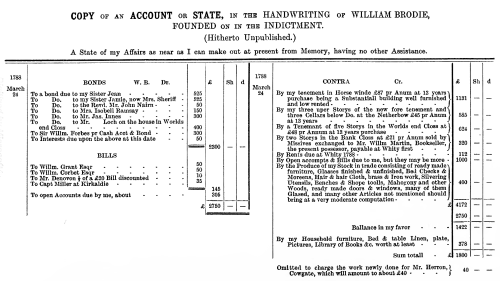
COPY OF AN ACCOUNT OR STATE, IN THE HANDWRITING OF WILLIAM BRODIE, FOUNDED ON IN THE INDICTMENT. (Hitherto Unpublished.)
A State of my Affairs as near as I can make out at present from Memory, having no other Assistance.

Copy of a Letter from Messrs. Lee, Strachan & Co., merchants in London, to Messrs. Emanuel Walker & Co., merchants in Philadelphia.
London, 1st May, 1788.
Messrs. Emanuel Walker & Co.
Sirs,
You will please to supply the bearer, Mr. John Dixon, with cash to the amount of fifty pounds sterling, taking his bill on Mr. William Walker, attorney in the Adelphi, London, for the same, which will be duly honoured, and oblige,
Sirs, Your most obedient Humble Servants, Lee, Strachan & Co.
Messrs. Emanuel Walker & Co., Philadelphia.
Evidence for Defence.
[The counsel for Mr. Brodie here observed that the object of the exculpatory proof was to show that, on Wednesday, the 5th of March last, the night on which the robbery of the Excise Office was committed, Mr. Brodie was otherwise employed the whole of that afternoon and evening, which, if established, excluded the possibility of his being concerned in that robbery.]
Matthew Sheriff
1. Matthew Sheriff, upholsterer in Edinburgh, called.
The Lord Advocate—My Lords, this gentleman is the brother-in-law of the prisoner, and therefore is certainly a very improper witness. I am at all times very averse to object to a witness adduced for a pannel, but I thought it my duty to mention the fact to your Lordships, and to leave it with you to determine whether or not this gentleman’s evidence ought to be received.
Mr. Wight, for William Brodie—My Lords, this is the first time I have ever heard that a brother-in-law is not a competent witness in a criminal trial. This gentleman being brother-in-law to the pannel, is a circumstance which may, and which perhaps ought, to be attended to, as affecting his credibility, if his testimony stands contradicted by other proofs; but it is surely no objection to his admissibility.
The Lord Justice-clerk—What do you mean to prove by this witness?
Mr. Wight—My Lord, I mean to prove that he was in company with the prisoner until about eight o’clock of that night on which the robbery is said to have been committed.
The Lord Justice-clerk—You may call him in. The circumstance of his being brother-in-law to the pannel will no doubt go a great length to discredit his testimony, in so far as it may be contradictory of other evidence; but this will fall to be considered by the jury when they come to judge of the proof brought by both parties.
[The witness was then called in and sworn.]
Witness—I know that the prisoner left Edinburgh in March last, and I think it was on the 9th of March, the Sunday after the Excise Office was broke into. I dined with him in his own house on the Wednesday preceding—the 5th of March. I think I went there to dinner about a quarter before three
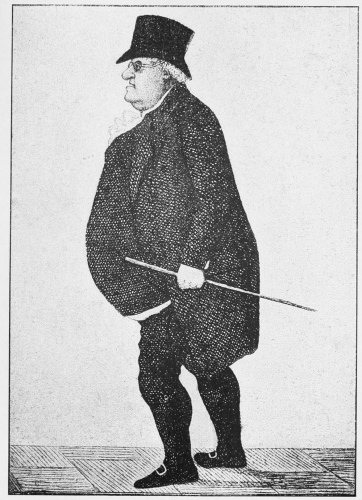
Charles Hay (afterwards Lord Newton). (After Kay.)
o’clock.[17] Mr. Brodie was then at home. I was in his house from dinner until within a few minutes of eight o’clock at night. There was present at dinner in company a stranger gentleman whose name I do not know, the prisoner’s two sisters, and an old lady, his aunt. We drank together from dinner to tea, which I think was brought in about six o’clock, and then the stranger gentleman went away. We sat in the same room all the while I was there. Mr. Brodie was dressed in lightish-coloured or grey clothes. Before I came away, Mr. Brodie pressed me to stay supper with him, but I declined his invitation, saying I was engaged. When I came away, I left Mr. Brodie in his own house. I went directly from his house to my own house in Bunker’s Hill.[18] Mr. Brodie dined with me next day (Thursday), and remained with me in my house from three o’clock until eleven o’clock at night.[19]
Cross-examined by the Lord Advocate—What was the gentleman’s name who was in company with you?
Witness—I do not know; I do not remember his name.
The Lord Advocate—Did you hear his name mentioned?
Witness—I may perhaps have heard him named while at table with him, but as he went away early in the evening, and as I had no reason at the time to pay any particular attention to his name, it has escaped me.
The Lord Advocate—When did you sit down to dinner?
Witness—We sat down to dinner about three o’clock.
The Lord Advocate—Are you sure Mr. Brodie did not leave the room from dinner until you parted with him?
Witness—I am certain Mr. Brodie did not leave the room.
The Lord Advocate—Did you, on your way home, hear any clock strike or bell ring? or how do you know that it was precisely a few minutes from eight o’clock when you left Mr. Brodie?
Witness—I do not remember to have heard any clock strike or bell ring on my way home, but I had a clock in my house and a watch in my pocket. I am sure that I reached my own house within a few minutes of eight, either before or after it, and I had occasion to remark the hour from Mr. Brodie being so immediately afterwards accused of having that night broke into the Excise Office, a thing which I did not then, and which I do not yet, believe.
Jean Watt
2. Jean Watt, residenter in Libberton’s Wynd, called in and sworn.
The Lord Advocate—I wish to know from this woman whether or not she is married. (To witness)—Are you married?[20]
Witness—No; I am not married.
[The examination was then allowed to proceed.]
I am well acquainted with the prisoner, William Brodie. I remember that on Wednesday, the 5th of March last, Mr. Brodie came to my house just at the time the eight o’clock bell was ringing, and he remained in it all night, and was not out from the time he came in until a little before nine o’clock next morning. We went early to bed, about ten o’clock, as Mr. Brodie complained that night of being much indisposed with a sore throat.
Cross-examined by the Lord Advocate—How do you recollect that it was Wednesday night more than any other night of that week?
Witness—On the following Monday I heard that Mr. Brodie was suspected of being concerned in the breaking into the Excise Office; that his house had been searched for him; and that he had gone away on the Sunday. This made me particularly recollect, and also because it was the last night Mr. Brodie slept in my house. He slept with me that night. I have a family of children to him. I saw him again on the Saturday night afterwards, but not till then; and he was in my house in the forenoon of the Tuesday preceding.
Peggy Giles
3. Peggy Giles, servant to Mr. Graham, publican at Mutton-hole, near Edinburgh, called in and sworn.
Witness—I was servant to Mrs. Watt, the preceding witness, last winter, and I remember that the prisoner, Mr. Brodie, came to my mistress’s house about eight o’clock at night of Wednesday, the 5th of March last, and that he slept there all night, and remained until about nine o’clock next morning. My mistress and Mr. Brodie supped together early, about half-an-hour after eight o’clock, on bread and beer and a piece of cheese, for which I was sent out soon after Mr. Brodie came in. I was out about ten minutes, and when I returned Mr. Brodie was still in the house. I remember when he came in to have heard the eight o’clock bell ringing.
Gentleman of the Jury—Was it the Magdalen Chapel bell you heard ringing? or what bell was it?
Witness—It was the Tron Church bell.
Cross-examined by the Lord Advocate—Are you sure of that?
Witness—I am very sure.
Mr. Wight—Pray, where does the Tron Church stand?
Witness--In the Parliament Close.[21]
The Lord Advocate—How do you know that Mr. Brodie slept all night in your mistress’s house?
Witness—He was in bed when I arose in the morning, and I gave him water to wash his hands before he went out.
The Lord Advocate—Did you see Brodie in your mistress’s house at any other time during that week?
Witness—He came back in the forenoon and again in the afternoon of the same day, that is of Thursday,[22] and likewise on the Saturday night following. Mr. Brodie was in use to sleep frequently at my mistress’s house.
Helen Alison
4. Helen Alison or Wallace, spouse to William Wallace, mason, in Libberton’s Wynd, called in and sworn.
Witness—I reside in Libberton’s Wynd, and I know the prisoner, Mr. Brodie. I heard of his leaving Edinburgh in March last, and I remember to have seen him come down Jean Watt’s stair a little before nine o’clock on the morning of the Thursday before he went off—the 6th of March. I was then standing at my own door at the foot of the stair; and I had Francis Brodie, the prisoner’s son, a boy of about seven years of age, by the hand. As his father, Mr. Brodie, passed he put a halfpenny into the child’s hand, and clapped him on the head. I said to the boy, “Poor thing, thou hast been too soon out, or you would have seen your daddie at home”; he said, “No, I have not been too soon out, for my daddie has been in the house all night.” After my husband got his breakfast, I went upstairs to Mrs. Watt, and I said to her in a joking way, “You will be in good humour to-day, as the good man has been with you all night.” She answered, “He has; but, poor man, he has not been well of a sore throat.” On the Monday following, I heard that there were messengers upstairs in Mrs. Watt’s, searching her house for Mr. Brodie; and when I went up and was told what was the matter, I said to one Murray, a sheriff-officer, then present, “Dear sirs, who would have thought this would have happened, when I saw Mr. Brodie come downstairs and give a bawbee to his own son on Thursday last?” To which the man answered, “Indeed, few would have thought it.”
Cross-examined by the Lord Advocate—How do you recollect that it was upon the Thursday you saw Mr. Brodie come down stairs? Can you give any reason for doing so?
Witness—Indeed, I can give a reason, but to be sure it is a very mean one to mention to your Lordships.
Lord Eskgrove—Tell us the reason, good woman.
Witness—I had purchased three pair of shoes on the Wednesday in the market; that is, a pair for each of my sons, and one for my husband. On Thursday morning I missed my husband’s shoes, and, thinking they were stolen, I was waiting for my husband at the door at the time he usually returned to breakfast, which was about nine o’clock, to see if he knew anything of them; and had it not been for this I would not have been at the door nor seen Mr. Brodie come downstairs.
James Murray
5. James Murray, sheriff-officer in Edinburgh, called in and sworn.
Examined by Mr. Wight—Do you remember having searched the house of Jean Watt, at the foot of Libberton’s Wynd, in the course of your pursuit after Mr. Brodie?
Witness—I do.
Mr. Wight—What day was that upon?
Witness—It was upon the Tuesday after he left Edinburgh I searched the house—the 11th of March; but finding nothing in it, I ordered Mrs. Watt to come up to the Sheriff, and I waited until she got ready.
Mr. Wight—Did you see any person in the house, except Mrs. Watt and her servant? and had you any conversation with her?
Witness—I saw Mrs. Wallace, who lives at the foot of the wynd, whom I saw among the witnesses just now, and she said, “Oh, Jean! who would have thought on Thursday morning, when Mr. Brodie came down this stair and clapped his son’s head, and put a halfpenny in his hand, that such a thing as this would be soon after here?” To which I answered, “Indeed, Mrs. Wallace, I dare say none would have thought it.”
James Laing
6. James Laing, writer in the Council Chamber, Edinburgh, called in and sworn.
Examined by Mr. Hay—Do you remember of any process being brought before the magistrates against Mr. Brodie some time before he left this place, for using false or loaded dice?
Witness—I do.
Mr. Hay—At whose instance was the process?
Witness—At the instance of one Hamilton, a chimney-sweep in Portsburgh.
Mr. Hay—When was this process?
Witness—I do not exactly remember; but steps have been taken in it within these six months.
Lord Eskgrove—I suppose this Mr. Hamilton is not a common sweep, but a master who keeps men and boys for the purpose?
Witness—He is a master, as your Lordship observes.
Cross-examined by the Lord Advocate—Do you know Mr. Brodie to be a gambler?
Witness—I never gambled with him.
Robert Smith
7. Robert Smith, wright in Edinburgh, sometime foreman to Mr. Brodie, called in and sworn.
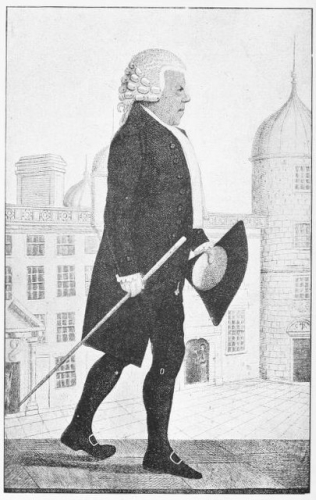
The Lord Advocate (Ilay Campbell). (Showing the old Parliament House.) (After Kay.)
Examined by Mr. Hay—Do you know that a spring-saw is a proper instrument for cutting off the natural spurs of game-cocks, in order to adopt artificial ones?
Witness—I do.
Mr. Hay—Did you ever see Mr. Brodie using a small spring-saw for that purpose?
Witness—Frequently.
Mr. Hay—Is a spring-saw a usual and necessary implement for all wrights and joiners, as well as smiths?
Witness—I have one myself, which I use for cutting off brass knobs and several other purposes.
Mr. Hay—Are old keys and pick-locks usual and necessary implements for wrights and smiths?
Witness—They are.
Mr. Hay—Do you know that a box of old keys was always lying open in the corner of Mr. Brodie’s workshop, to which you and the other men had access?
Witness—There was; and when a key of any of our customers was either broke or spoiled, we could often fit the lock from some of these keys.
[Here the witness was shown the keys libelled on.]
Witness—I never remember to have seen any keys of that kind before.
[Here it was proposed to show the witness a pick-lock, and to ask him whether or not joiners or cabinetmakers kept such an instrument, when the Lord Advocate admitted that it was not uncommon for a cabinetmaker to keep such articles as the above. There were several witnesses cited by Mr. Brodie to prove this fact.]
The exculpatory proof being closed a few minutes after one o’clock of the morning of the 28th day of August, the Lord Advocate then proceeded to address the jury.
The Lord Advocate’s Address to the Jury.
Lord Advocate
The Lord Advocate—Gentlemen of the jury, it is now my duty to offer some observations on the import of the evidence which has been led before you, and as you have already had a very long and fatiguing sederunt, I shall endeavour to state what occurs to me in as few words as possible. It is with the greatest concern that I address you in this case—a case that is attended with circumstances which must occasion to all of us the most painful sensations; but public justice requires that these feelings should be repressed.
Gentlemen, the crime with which these prisoners stand charged is of a most dangerous and heinous nature. It is a crime which, until of late, was but little known in this country, though now it seems to be every day growing more frequent, and the practice of it is almost reduced into a system. It is no longer than fourteen days ago that two men received their sentence at that bar for a crime of the same nature with this—the robbery of the Bank of Dundee—which appeared to have been conducted and perpetrated by an association in that town, similar to the association which took place, in the heart of this populous city, between the prisoners at the bar and the other two men whom you saw this day give evidence against them; and which, had it not been discovered, threatened the inhabitants of this city with the most dangerous consequences. That now charged against these prisoners, though of the most flagrant nature, is but one of many in which there is good ground to believe that this association has been concerned. And it is your province, gentlemen, if upon careful examination of the evidence you think these men guilty, to do that justice to your country which the public safety requires, by returning a verdict against them.
It is perhaps of no consequence to inquire into what was the former situation of the prisoners, because that is a circumstance which can have no weight with you in determining what verdict you are this night to return.
As for George Smith, he is a stranger in this country, of whom we know nothing more than what he has been pleased to inform us in his different declarations, of which a part has not been read for the reasons you heard mentioned; but from thence you will be led to conjecture that the parts which were not read contained very little to his advantage. This man, gentlemen, had the appearance of following a lawful employment and carrying on trade in a shop in this city; but I am afraid there is too good reason to conclude that the character of a grocer, which he assumed, was only meant as a cover to him that he might escape the observation of the public while he was pursuing objects of a very different nature. His counsel have attempted no defence, such as the alibi endeavoured to be proved by the other prisoner; no witnesses have been examined in his exculpation; and his different declarations, which though not legal evidence by themselves, yet when corroborated by the great variety of other evidence led this day, are so full and complete proofs of his guilt that I do not consider it necessary to add one word more as to him.
The other prisoner, Mr. Brodie, is in a different situation. He is known to us all; educated as a gentleman; bred to a respectable business; and removed from suspicion, as well from his supposed circumstances as from the rank he held amongst his fellow-citizens. He was far above the reach of want, and, consequently, of temptation; he had a lawful employment, which might have enabled him to hold his station in society with respectability and credit; he has been more than once officially at the head of his profession, and was a member of the City Council. If, therefore, he, too, is guilty, his situation, in place of alleviating his guilt, is a high aggravation of it. If he indeed prevailed upon himself to descend to the commission of the most detestable crimes, what excuse can be made for him? That he frequented bad company; that he had abandoned himself to gambling, and every species of dissipation; that he has by these means run himself into difficulties, is surely no apology for him.
But, gentlemen, I am not entitled to proceed without substantiating the crime libelled against him. I will go on to state the evidence; and if after a cool and dispassionate consideration, which you are bound to give, and which from the very great attention you have already bestowed, I can have no doubt you will give it; if you are not most thoroughly convinced in your minds that the prisoner is guilty, I do not desire that you should return a verdict against him. I can have no wish that is contrary to material justice.
It is totally unnecessary to go over the evidence tending to show that the Excise Office was actually robbed in the manner mentioned in the indictment, as I suppose that is a fact which will not be disputed, I will therefore recapitulate the heads of the evidence, so far as it appears to me to verify the charge.
Gentlemen, you have heard various objections stated by the prisoners’ counsel against the admissibility of the evidence of Brown and Ainslie, and therefore I will in the first place call your attention to the other evidence, against which no objection has or can be made, and which is, in my opinion, sufficient in itself to establish the guilt of the pannels; and I shall afterwards speak to the evidence of these two men.
The first circumstance which you have in evidence, and to which I call your attention, is the intimate connection between the prisoner Brodie and the other three, Smith, Ainslie, and Brown, who have all confessed themselves guilty of the crime charged; it is admitted by himself in his letters and declaration, and is confirmed by the evidence of Smith’s maid, who said that she had seen them often together in her master’s house; his being often in company with them, gambling with them in different houses, and particularly in Clark’s, a house which, from what we have heard of it this day, ought for the good of society to be razed to the ground or built up, as houses infected by the plague are in times of pestilence.
In the second place, gentlemen, the prisoner was in company with these men on the very night in which the robbery was committed. This is proved by the testimony of Smith’s maid, Grahame Campbell, a witness who it is not pretended had any temptation to perjure herself. She tells you that Brodie came to her master’s house that day in the dusk of the evening; that they were in the upper room all together, and had some cold fowl and herrings; that Brodie was then dressed in an old-fashioned black coat; that she mentioned this circumstance to her mistress; that he went out with Smith, Brown, and Ainslie; and that when he came back later in the evening, he had then changed his dress and had on light-coloured clothes. These are all circumstances highly suspicious, and they would have been likewise sworn to by Smith’s wife, if she had been allowed to be examined; but that is unnecessary, as the facts the witness has deponed to are all probable in themselves, and they are corroborated, to the extent I have mentioned, by the other evidence, and also by Smith’s declarations, which last I do not mean to found upon as evidence against Mr. Brodie, but it is a curious fact.
In the third place, gentlemen, you will observe that the Excise Office was robbed upon Wednesday, the 5th of March. On the Friday night following, information was given to the Procurator-Fiscal by Brown; on the Saturday, Smith and Ainslie were apprehended and committed to prison. And what happens? Brodie goes to the prison to visit them, but is denied access. Is it possible to suppose that a gentleman in Mr. Brodie’s situation would have done this had he been innocent? No, gentlemen, it is not to be supposed.
But attend to what follows. Early the next morning, Brodie sends for Robert Smith, his foreman, and asks him if he had heard any news concerning them; he tells Brodie that Smith, the pannel, and Ainslie were in prison, and so forth, and adds that he hoped his master was not concerned with them. Gentlemen, he knew that Smith and Ainslie were Mr. Brodie’s companions; and you cannot conceive that he would have presumed to put such a question to his master if he had not been convinced in his own mind of his master’s guilt. Mr. Brodie makes no answer to this question. Will it be said that a man conscious of his own innocence would have remained silent upon such an occasion? Gentlemen, I appeal to yourselves; how would any one of you have felt, or what answer would you have returned to a servant who dared put such a question to you?
Brodie at this time tells Smith that he is going out of town for a few days; but you have it in evidence that he left this country, and fled to Flushing. In order to account for this flight you are told a story of a prosecution against him, at the instance of a chimney-sweep, for using false or loaded dice. This is a very strange circumstance to bring in exculpation. I have no hesitation to say that it is the most ignominious defence I ever remember to have heard maintained by a prisoner at that bar; but you cannot believe that that prosecution was the occasion of his flight. He was in no greater danger from it then than he had been in for months before; no step had been taken in that process which could alarm him at this critical time; and it is mere mockery, it is altogether a joke, to pretend that from such a circumstance the prisoner at the bar could have taken up the resolution of banishing himself from his country for ever.
Besides, Mr. Brodie, in his declaration before the Sheriff, did not assign this as the cause of his flight. He said that, as he was intimate with Smith and Ainslie, he was afraid they would accuse him of being concerned with them in robbing the Excise Office. He did not so much as mention the defence now set up for him; but his counsel saw that it would be necessary to account for his conduct in some shape or other, and no other appearance of defence occurred but this process. It is impossible to believe this story; and indeed it is impossible to assign any cause for Mr. Brodie’s conduct consistent with his innocence of the crime charged against him.
I would, in the next place, gentlemen, have you to attend to the prisoner’s behaviour when he flies from this place to London. He secretes himself in London for several weeks; search is made for him, but he cannot be found; he admits in one of his letters that he knew that Mr. Williamson was in search of him, but he did not choose an interview; a vessel is freighted for him by some persons, contrary to the duty they owed to their country; she is cleared out for Leith; he goes on board of her in the middle of the night, with a wig on, in disguise, and under a borrowed name; he is carried to Flushing; he changes his name to John Dixon, and writes letters to people in Edinburgh under that false signature, explaining his whole future operations, in consequence of which letters he is traced and apprehended, just when he is on the point of going on board of a ship for New York. If he had been innocent; if he had had nothing else to fear than the story of the loaded dice, it is not possible that he could have conducted himself in this manner.
The letters he writes to Geddes are likewise very strong circumstances; but the other letters, or scrolls, found in his trunk are still stronger. You have had it clearly proven that all these letters are of his own handwriting, and in both of the scrolls he expressly acknowledges the crime for which he now stands at the bar. In one of them he says that he had no “direct” concern in any of the late depredations of Smith, Brown, and Ainslie, excepting “the last fatal one”; in the other the word “direct” is scored out, but in both of them he acknowledges his accession to the last act; by which he can mean no other than the robbery of the Excise Office; for it happened on the Wednesday evening, and Brown gave information of it on the Friday evening immediately after. It was, therefore, in all probability the last of the depredations of this dangerous combination; and Mr. Brodie’s having applied the expression “fatal” to it identifies it beyond all doubt.
Gentlemen, I beg leave now to bring under your consideration what happened in this city after Mr. Brodie absconded. You have it in evidence that his house was searched, and various articles of a very suspicious nature found. A pair of pistols, identified to have been used on the occasion of the robbery, is found under the earth, and the place where they were hid pointed out by the other prisoner Smith; also a dark lanthorn, the one half of it in one place and the other half of it in another. Gentlemen, if Mr. Brodie is really innocent, it appears to me passing strange that these articles should have been so concealed.
All these circumstances, gentlemen, are established by the most unexceptionable evidence; they are connected with and corroborated by each other; and they all point to this conclusion, independent altogether of the direct evidence of Brown and Ainslie, that Mr. Brodie is guilty of the crime charged. They cannot be accounted for upon any other supposition.
In the opposite scale, gentlemen, you have the proof of alibi attempted by the prisoner, which is exceedingly defective and inconclusive. Alibi is a defence seldom resorted to but in the most desperate circumstances, and little regard is in general paid to it, for this good reason that it resolves into an immediate falsification of the whole evidence brought in support of the charge. It is suspicious at all times, but it is peculiarly so when the alibi is confined to the same town in which the crime was committed, within a few minutes’ walk of the place, and is deponed to by witnesses at a great distance of time.
The first witness, gentlemen, brought by the prisoner to establish this defence is Matthew Sheriff, his own brother-in-law, by no means an unexceptionable witness. This gentleman depones that he dined with Mr. Brodie on Wednesday, the 5th of March, and that he was in company with him until eight o’clock that night. He is brought forward singly to prove a fact, which, if true, Mr. Brodie could be at no loss to establish by other unexceptionable evidence. There was another gentleman, he tells you, who dined in company with the pannel that day; and what appears to me to be a very odd circumstance, this gentleman is not called as a witness; nay, more, although Mr. Sheriff recollects a great variety of other circumstances, he does not remember this gentleman’s name. Why is this gentleman not brought forward on this occasion? Why are not some of the servants of the house, or any other person, called to support Mr. Sheriff’s testimony? Mr. Sheriff, then, is only a single witness, and from his near connection with the pannel, he gives his evidence under circumstances that are suspicious, and therefore no weight can be allowed to it.
But even supposing Mr, Sheriff’s testimony to be true, it is by no means inconsistent with the guilt of the prisoner, nor affects the credibility of the prosecutor’s evidence. Grahame Campbell depones that Brodie did not come to Smith’s house until about eight o’clock; and allowing him to have remained with Mr. Sheriff until near eight, the expedition against the Excise Office was not then begun; and you will recollect that Brodie was the last who made his appearance at Smith’s, and that he was expected by his associates a considerable time before he arrived.
Jean Watt is the next witness adduced by the prisoner, who, by her own evidence, appears to be a woman of an abandoned character. She has a family to Mr. Brodie, and was denominated by him, in one of his letters, by the appellation of “a devil.” This witness and her maid no doubt concur most minutely in a very extraordinary fact, which, if it can be believed, amounts to a falsification of the whole other evidence, viz., that Mr. Brodie came to Watt’s house just at eight o’clock, as the bell was ringing, and did not leave her house again till nine o’clock next morning. No doubt she swears pointedly to the night, and so does her servant; but although these two witnesses agree in the day, the hour, and even the minute of Mr. Brodie’s coming to Watt’s house on the 5th of March, yet, when they came to be cross-examined, they did not even agree in days; for Jean Watt said that she did not see Brodie from the Thursday morning, at nine o’clock, till the Saturday afternoon following, yet her maid said that he was twice in the house on the Thursday, both in the forenoon and afternoon; though Sheriff said that Brodie was in his house on the Thursday from three o’clock in the afternoon till eleven o’clock at night. They can give no reason for fixing the night of his visit at Watt’s house to be Wednesday night, except the subsequent flight of the prisoner; and therefore it may have been any other night in that week as well as the one condescended upon.
But, gentlemen, I have no occasion to dispute, and indeed, from the evidence of Helen Alison, I am inclined to believe that the prisoner went on the Wednesday night to Mrs. Watt’s house, and slept there that night; but I have heard nothing, allowing all the witnesses to have spoken what they believed to be true, that goes to prove that he went there until after the crime was committed. Gentlemen, the circumstance which fixes the hour in the memory of both Mrs. Watt and her servant is the ringing of a bell, and we all know that there is a bell that rings at ten o’clock as well as at eight. And it is very far from being improbable that they might both mistake the one bell for the other, either at the time, or afterwards, upon endeavouring to recollect the hour at which Brodie came to them.
Allowing, therefore, gentlemen, that all the witnesses adduced by the prisoner are to be believed, there appears to be nothing in their testimony contradictory to the evidence of the prisoner’s accession to the crime charged; and therefore I can have no doubt that, although the matter rested upon the evidence I have already stated, you could have no hesitation in pronouncing both the prisoners guilty.
But, gentlemen, when, in addition to that evidence, you take into your consideration the testimony of Ainslie and Brown, the two associates of the pannels, if any doubt did remain, it would necessarily be removed. The counsel for the prisoners, aware of this, have objected to the admissibility of both of them.
I admit that the credibility of these witnesses is liable to suspicion, and that if the proof rested upon their evidence alone, I would not call upon you to find the prisoners guilty upon it, but in so far as their evidence is corroborated by the general tenor of the other unexceptionable parts of the proof they are entitled to credit.
To Ainslie it has been objected that a corrupt bargain was made with him by the Sheriff, which, in other words, amounts to this, that he must be a false witness. If the prisoners’ counsel were serious in stating this objection, they ought certainly to have proved it; but, gentlemen, it proceeded entirely upon a mistake in point of fact—upon a supposition that Ainslie had not spoke out until Brodie was apprehended. Gentlemen, I hold Ainslie’s declaration in my hand, and which I offered to read, and which I would now read, if the forms of the Court would allow me, emitted a short while after the robbery was committed, and containing a full and complete disclosure of the whole transaction. But, gentlemen, you will not, you cannot, suspect that there was any such bargain; that there was anything in the present case out of the common course.
A similar objection was made by the counsel for the prisoner to the evidence of Brown, with this addition, that he had been convicted of felony at the Old Bailey. The last part of this objection, gentlemen, is completely answered by the pardon which, by the law of England, where that sentence was pronounced, completely rehabilitated him. Brown is then in even a more favourable situation than Ainslie, for, as he never was charged with the crime for which the prisoners are tried, nor any intention taken up to prosecute him for it, he had even less temptation than Ainslie to swear falsely.
There is therefore nothing in the objections stated to these witnesses, and accordingly the Court have found so. These men, gentlemen, have told you that Brodie was with them when the breaking into the Excise Office was originally planned that he met them at Smith’s house on the night when the robbery was committed, in which particular their evidence is corroborated by the testimony of Grahame Campbell; that he was with them at the commission of the crime, which is the time when he endeavours to prove an alibi; that some of the pistols carried to the Excise Office belonged to him, which pistols were afterwards found in his possession. They have likewise informed you that it was agreed upon that Brodie should be stationed within the door and Ainslie without, and this exactly corresponds with the testimony of James Bonar.
Brown and Ainslie are so consistent with each other and with the whole other evidence adduced, both real and circumstantial, that I am unable to discover a single discrepancy in the whole, excepting where Brown and Ainslie say that, after the robbery, they did not either of them see Brodie again that evening, but Smith’s maid said that they all met again in Smith’s house and supped there, and that Brodie supped along with them. This, however, does not appear to be a fact of any importance or that tends to discredit either of the witnesses, as it is evident that Smith’s maid has confounded the first and second meetings together.
But it is unnecessary for me to enlarge upon particulars which cannot have escaped your own observation, and I shall therefore conclude with remarking that you have in this case more direct evidence of the pannels’ guilt, corroborated by a greater variety of circumstances all coinciding in a most remarkable manner, than I remember to have met with in any other which has occurred to me in the course of my practice.
Gentlemen, I shall only further add that if the prisoner William Brodie, a person who from the nature of his employment had frequent opportunities of being introduced into the houses of others, has been guilty of the crime laid to his charge, and is allowed to escape punishment, the consequences to the inhabitants of this populous city may be of the most serious nature. But, gentlemen, the evidence is before you, and if, upon a fair and deliberate consideration of it, you are convinced of the pannels’ guilt, I can have no doubt that you will do justice to your country by returning a verdict accordingly.
Mr. John Clerk then rose to address the jury on behalf of George Smith.
Mr. John Clerk’s Address to the Jury.
John Clerk
Mr. Clerk—Gentlemen of the jury, it is now my duty to state the evidence to you for the pannel, Mr. Smith, and I shall trouble you with a very few observations only.
My unfortunate client is a very poor man; and although he was in a situation, before he was apprehended on suspicion of this crime, to support himself and his family upon the produce of his industry in his trade as a grocer, he has, in consequence of this unlucky affair, been reduced to absolute beggary, so that he has not been able to make those extraordinary exertions either in procuring evidence or counsel, which the more opulent prisoner has done. He is an Englishman, a stranger in this country, and in great straits for his life, and whatever is favourable in his character or conduct is unknown; while, on the other hand, everything that tended to blacken his character and fix guilt upon him has been brought forward. He has no one to say a good word for him, as that great villain, John Brown alias Humphry Moore, has, who, you will remember, was so highly complimented by their Lordships when he left that box. But, I, as his most inexperienced and imperfect counsel, will try and do the best I can for the poor man.
The Lord Justice-Clerk—Be short and concise, sir, at this time of the morning.
Mr. Clerk—Pray, your Lordship, let me proceed.
The Lord Justice-Clerk—Well then, proceed, young man.
Mr. Clerk—It is easy to account from this cause, gentlemen, for what my Lord Advocate observed concerning the obscurity of my client’s history before the robbery of the Excise Office; and I imagine that no argument against him can be drawn from it. I know that I speak to a jury who will lay nothing into the scale against him that does not arise from the evidence which has been adduced.
My Lord Advocate has told you, gentlemen, that the guilt of my unfortunate client is so clear as to admit of no doubt, and it is in consequence of that opinion, I suppose, that his Lordship has made so few observations upon it. I cannot, however, yield my assent to this proposition; and I shall endeavour to show you, on the contrary, gentlemen, from a statement of such parts of the proof as affect my client, that the fair and legal evidence against him is incomplete and will not warrant a verdict for the Crown.
The evidence may be reduced to three distinct branches—his own declarations, which have been read; the direct evidence of the witnesses adduced for the prosecutor to the commission of the crime; and the real evidence of circumstances.
With regard to the declarations, the Lord Advocate has told
John Clerk (afterwards Lord Eldin). (After Kay.)
you, gentlemen, that they contain a variety of particulars which have not been read, and have been omitted by the consent of the pannel; and from this, his Lordship observed, an inference might be drawn that the declarations contain many more particulars little to the credit of the pannel. Gentlemen, an inference more candid, or at least more charitable, might, in my opinion, be deduced from the circumstance. It is easy to conceive the state of mind in which the pannel must have been when apprehended. Connected with those infamous men who were supposed to have committed the crime, a partner in their most dissolute scenes, no wonder, gentlemen, that he was struck with terror when seized upon an accusation of being joined in their guilt.
After having resisted for some time the impressions arising from his confinement, his panic most naturally increased almost to a delirium; a fit of temporary frenzy, an insanity, seized him, and he accused himself of an atrocious crime as the only means of safety. But this accusation is rejected by his cooler judgment, and accordingly he pleaded not guilty at this bar. In accusing himself in such a manner, the greater variety of crimes he laid to his own charge, the greater is the improbability of their being true, for it was folly to balance the merit of confessing a crime eagerly inquired after by the guilt of other crimes which were out of head. And it was folly of such a sort as to prove that the pannel was incapable of rational conduct; and thus the credit of his declaration, in so far as it injured himself, is in charitable reasoning considerably diminished.
But, at all events, gentlemen, it is sufficiently known and acknowledged, and it was even admitted—at least, it was not denied by the Lord Advocate himself—that the extrajudicial declaration of a pannel is not legal evidence against him. It is undoubtedly a circumstance in evidence, but not of weight to convict unless it be adminicled by other proof. This will be admitted, on all hands, to be the law of Scotland, and I shall make no comment on it.
If, therefore, it is shown to your satisfaction that the parole and circumstantiate evidence is either contradictory, inconsistent, or incredible, you will lay very little stress on the extrajudicial confessions of the prisoner.
And this leads me to the second branch of the evidence, or the attempt at a direct proof of the accession of the pannel, Smith, to the crime charged.
The first witness after those to the declarations, whose deposition affects the pannel Smith, is M‘Lean, Mr. Drysdale’s waiter. He is the nineteenth witness. I need not enter into the particulars of his evidence, since all of you must recollect that he could say nothing more than that Smith bought a ticket in the mail-coach for his wife; gave him in payment a five-pound bank-note, battered on the back, and received the change. It does not appear from whence the pannel had the note which he gave to M‘Lean, nor whether it was among the money which was stolen from the Excise Office or not.
John Clerk, Mr. Drysdale’s cashier, the twentieth witness, could not even say so much as M‘Lean. It does not appear from either of these depositions whether the paper on the table was that which was presented to them or not, as the Court determined that it is not properly described in the indictment, and on that account it cannot be used in evidence against the pannel.
I may therefore leave these witnesses, gentlemen; and I am persuaded that none of you will think that they said anything which militates against my client in the smallest degree.
Grahame Campbell, the seventeenth witness, was examined as to a variety of particulars, but her whole deposition, in so far as it regards the pannel Smith, amounts to no more than that he was in company with Brodie, Ainslie, and Brown that evening on which the Excise Office was broken into; that they supped together, ate herrings or a fowl, whilst she was in a back cellar; and upon her coming out of this back cellar the company had left the house, and Smith, her master, had likewise gone out; but there is no evidence of their having gone out together, and although they had, it does not follow that they went to the Excise Office together.
It would be very hard if a man should be suspected of a robbery merely because he leaves his house about the time that the robbery is committed, and in this case—there is little more; for it was by no means extraordinary that Brown and Ainslie should be with Mr. Brodie in Mr. Smith’s house that night, as they were there every night, always playing at cards and dice, and amusing themselves in company together.
And further, gentlemen, although they had not been drawn together by constant habits and the love of similar amusements, a good reason was given why Brown and Ainslie were constantly at the house of Smith. You were informed that these two men dined and supped there every day, that is, were day boarders in his house.
Putting all this together, I may dismiss this witness with the same observation which I applied to the former ones. As far as I understand her evidence, she said nothing which has a tendency to criminate my client.
I come next to the testimony of Ainslie and Brown. Gentlemen, you have heard a variety of objections stated to the admissibility of their evidence—all of which has been over-ruled by the Court. But notwithstanding the judgment of their Lordships, I must adhere to these objections and maintain that they ought not to have been admitted as witnesses. Gentlemen, I think a great deal of most improper evidence has been received in this case for the Crown.