THE TRIAL (continued 2)
Reading edition
The Dean of Faculty—My Lords, it is not proper that the witness should be allowed to speak of facts that have no relation to the present trial.
The Lord Justice-Clerk—William Middleton, you are to confine yourself to such facts as relate to or are immediately connected with the breaking into the Excise Office, which is the charge brought against the prisoners.
Witness—Upon Sunday, the 16th of March last, the prisoner, George Smith, was carried at his own desire to the bottom of Warriston’s Close,[5] and I accompanied him, along with Alexander Williamson and James Murray, sheriff-officers. Smith there pointed out a hole in a wall where a false key, a pair of curling irons, and a small iron crow were hid, which, he said, had been used in breaking open the Excise Office; whether they were covered with earth or not I cannot say, as the prisoner himself put in his hand and brought them out. [Here a false key, a pair of curling irons, and a small iron crow were shown the witness.] These are the same articles that were so found. [The counsel for the pannels here repeated the objection against adducing the iron crow, the curling irons or toupee tongs, and dark lanthorn, as mentioned in the general objection and interlocutor before taken down.] I was present at the search that was made in Smith’s house; there was nothing found in it. I was likewise present on the day following at a search that was made in Brodie’s house and yard, when one part of a dark lanthorn was found in a necessary house, and another part in a pen where fowls or game-cocks had been kept. [Here the dark lanthorn libelled on was shown to the witness.] These are the two parts of the dark lanthorn which were so found. The prisoner, George Smith, informed me that the small crow was used in breaking into the Excise Office.
Cross-examined by the Dean of Faculty—Did Brown inform you, previous to your going to England, that the prisoner, William Brodie, had any concern in the robbery of the Excise Office?
Witness—He told me that there was a gentleman whom I knew, and whom I little suspected, concerned in it, but he did not mention his name.
Alexander Williamson
23. Alexander Williamson, sheriff-officer in Edinburgh, called and sworn.
Witness—I was present, along with George Williamson and James Murray, when there was a search made in the house of William Brodie, the prisoner, upon the 10th of March last, and in the course of the said search I saw a pair of pistols wrapped in a black stocking taken from under the earth in the fireplace of a shed in his yard. [Here the pistols libelled on were shown to the witness wrapped in a green cloth.] These are the pistols, and they were found in that green cloth. [The counsel for the pannels here repeated the objection against adducing the pistols, as mentioned in the general objection and interlocutor before taken down.]
Cross-examined by the Dean of Faculty—How came you to say that they were found in a black stocking?
Witness—I saw a black stocking on the table, and that misled me.
The Dean of Faculty—You are to speak from what you know, sir, and not from what you see on the table.
Witness—I am certain that it was in a green cloth they were found.
James Murray
24. James Murray, sheriff-officer in Edinburgh, called in and sworn.
Witness—I was employed, along with Alexander Williamson and some others, to search the prisoner’s (William Brodie) house upon the 10th of March last. In the course of the search we found a pair of pistols in a green cloth covered with earth in the fireplace of a shed. I think that it was myself that dug them out of the earth. [Here the pistols libelled on were shown to the witness.] These are the pistols that were so found. I afterwards saw one part of the dark lanthorn found in a necessary house, and another part of a dark lanthorn found in a pen where game-cocks had been kept. I accompanied the other prisoner, George Smith, upon the 16th of March, to the bottom of Allan’s Close,[6] and he there pointed out a hole in a wall, where, he said, there were some articles hid. I put in my hand and brought out a false key, a pair of curling irons, and a small crow. [Here the articles formerly produced were shown to the witness.] These are the same that were so found.
Cross-examined by Mr. John Clerk—You say that you put in your hand and brought out these articles; are you sure it was not George Smith who did so?
Witness—I put in my hand; George Smith could not, being handcuffed.
George Williamson
25. George Williamson, messenger-at-arms in Edinburgh, called in and sworn.
Witness—I was employed with others to search the house of the prisoner, William Brodie, on the 10th of March last, and found several keys of an uncommon construction in a room off Brodie’s shop. We likewise found a pair of pistols wrapped in a green cloth under the earth in the fireplace of a shed in the woodyard. These were discovered by Smith, the prisoner, poking with an iron. [Pistols shown to witness.] These are the same that were so found. We also found several pick-locks in Mr. Brodie’s house, all of which were lodged by me in the Sheriff-Clerk’s Office. [Here the pick-locks were shown to witness.] These are the same pick-locks that were so found. [The counsel for the pannels here repeated the objection against adducing the pick-locks, as mentioned in the general objection and interlocutor before taken down.] I was sent in quest of Mr. Brodie, who was supposed to have gone to London, by Mr. Scott, the Procurator-Fiscal, upon the 11th of March last. I left Edinburgh about eleven o’clock at night. When I arrived at Dunbar I got some accounts of him; Mr. Brodie had left that place in a post-chaise. At Newcastle I was informed that he had taken the “Flying Mercury” post-coach to York; and I was afterwards informed that he had continued in it till he came to London. When I arrived in London I was informed by the coachman that Mr. Brodie did not go with the coach to the stage office, but that he had quitted it at the foot of Old Street, Moorfields. I waited upon Sir Sampson Wright, and at his desire I called upon Mr. Walker, solicitor-at-law in the Adelphi, and inquired for Mr. Brodie. He told me he was bad, and that I could not see him. I said I had a letter for him and wanted only to deliver it; but Mr. Walker replied that it might perhaps be dangerous to allow me to see him.[7]
The Dean of Faculty—My Lords, without meaning any reflection on the witness, whom I know and believe to be a very good man and an active officer, the greatest part of what the witness says is “hearsay.” He tells your Lordships that he was told one thing at Dunbar; that he received another piece of information at Newcastle; that a coachman told him so-and-so in London, and that Mr. Walker said this, that, and the other thing. My Lords, this is exceedingly improper. I have been taught to understand that in criminal trials the best evidence that can be got ought always to be brought; and surely it will not be pretended that that has been done in the present case. In a question of this kind, hearsay evidence is not admissible. The witness has said that he was informed so-and-so by coachmen; why were not these coachmen called as evidences? He has given you an account of a conversation that passed between him and Mr. Walker; why is not Mr. Walker brought here to speak for himself?
The Lord Advocate—My Lords, it was thought a material circumstance to be proved that the prisoner, William Brodie, fled from this country; that he secreted himself in London; and the witness, who was sent in pursuit of him, was considered as a proper person to be examined as to the fact. In the course of informing the Court what he himself did he has necessarily mentioned what passed between himself and some other persons. This cannot be said to have been hearsay evidence, being what the witness himself knows.
My Lords, the Dean of Faculty has asked why the different post-boys and coachmen who drove the prisoner to London, why Mr. Walker and others were not all cited as witnesses? The bringing forward of such a variety of witnesses is not only unnecessary but expensive. By the forms of criminal procedure in this country a trial must be finished at one sederunt; but, my Lords, if the mode contended for by the Dean of Faculty had been pursued in the present case this trial could not have been finished in a month.
The Lord Justice-Clerk—George Williamson, you will confine yourself to what you know or did yourself, and do not speak of what you were told by others.
Witness—I searched for the prisoner in London, but could not find him. I also went out to Deal and Dover, but could receive no intelligence of him. Accounts were afterwards brought to this place that he had been apprehended in Holland and brought to London. I went to London for him. He was delivered over to me at Tothilfields Bridewell, and I conducted him to this place and lodged him in the Tolbooth.[8]
Andrew Ainslie
The Solicitor-General—The next witness is Andrew Ainslie.
The Dean of Faculty—Before this witness is called I rise to state to the Court an objection against his admissibility. This witness is alleged to have been guilty of the same crime of which the pannels at the bar now stand accused, and therefore the objection of his being a socius criminis might apply to him. But although by our former law the objection of a witness being socius criminis might render him inadmissible, yet I have no occasion, nor is it my intention, to insist on the present objection in that view, for I freely own that the practice of this Court has for some time past, and with great propriety, I think, over-ruled that objection.
But, my Lords, I contend that this witness is inadmissible from the particular circumstances attending his case. For, according to the information which I have received, when this witness was apprehended and committed to prison, in the month of March last, to stand trial for this crime, he never charged Mr. Brodie as having been in any measure accessory thereto. On Ainslie’s first examination he positively affirmed that Mr. Brodie had no sort of accession to the crime of which he is now accused, or was concerned in any other bad action whatever to his knowledge, unless playing at cards and dice should be reckoned such; and in the different declarations which he made before the Sheriff he still persisted in denying that my client had any concern in this robbery. But after Mr. Brodie was apprehended and brought from Holland Ainslie was again brought before the Sheriff, when he was informed that either he himself must be hanged or he must accuse Mr. Brodie. Further, I am now instructed to say that when this witness was carried before the Sheriff his life was offered to him on his becoming King’s evidence against Mr. Brodie, and accusing him of having been concerned in this robbery, and that, even notwithstanding this offer, he persisted in denying that Mr. Brodie was guilty of this crime, until John Brown alias Humphry Moore, another of the witnesses cited, and alleged also to have been a socius criminis, was allowed to see and converse with him in prison, when at length he came into the measures proposed. I mean to say nothing against the conduct of the Sheriff, which may have been very proper—with the motives which may have influenced a public officer to a particular line of conduct I have nothing to do—but I state it as an insuperable bar to the admissibility of this witness, that hopes were suggested to him of saving his own life by criminating my client. And I offer to prove, by the evidence of the Sheriff of Edinburgh himself, that a bargain of this nature was made with Ainslie, and that it was not till then he was prevailed upon to say that Mr. Brodie had any concern in this crime. No man could withstand such a temptation, and it is impossible that the Court can receive the testimony of a witness in such circumstances.
The Lord Advocate—My Lords, I hardly expected that such an objection would have been made at this time, as it has long been the universal practice to admit socii criminis as evidence, and at the last trial in this Court such a witness was received without even an objection being stated. All the arguments on the other side could only affect the credibility of the witness, which properly belongs to the jury, and not the admissibility, which alone is before the Court. It is indeed true, and I am even surprised that the honourable counsel had not appealed to the authority, that Sir George Mackenzie has laid it down that socii criminis could not be admitted as evidence; but upon what principle of law or reason Sir George formed that opinion I could never discover. Sir George Mackenzie, indeed, is an author by whom I never was much instructed. He is often contradictory, always perplexed, and in many instances unintelligible. But even supposing the law had so stood in his time, the Court and the practice have long since deviated from it.
My Lords, the fact as stated by the Dean of Faculty is
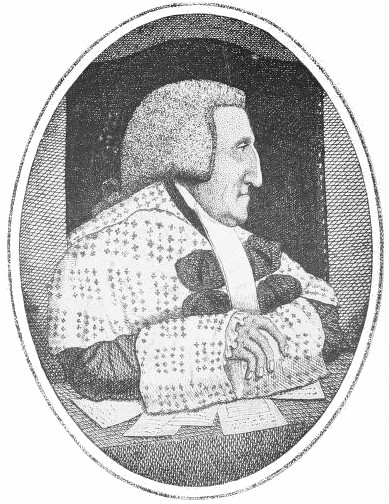
Lord Eskgrove. (After Kay.)
erroneous in every respect. For although Ainslie in his first declaration did not accuse Brodie or any other person, and denied all knowledge of the crime, yet in the second declaration which he emitted before the Sheriff on the 14th of March, which I now hold in my hand, and would read did the forms of the Court permit me to do so, he in the most express terms charges both Brodie and Smith as being equally concerned in the crime libelled. And, my Lords, it will not easily be believed—indeed, the thing is incredible—that so respectable an officer of the law as the Sheriff of Edinburgh would ever have entered into such stipulations with Ainslie. But even had such transaction taken place before any inferior judge or magistrate, still that cannot deprive the public prosecutor of the evidence of this witness, for it will not be said that any such transaction passed between him and the witness, and therefore the objection ought to be repelled, reserving the credibility of his evidence to the jury.
The Dean of Faculty—My Lords, I offer to prove my assertion.
The Lord Advocate—My Lords, I am willing, if the Dean of Faculty and the Court consent to it, to hold the second declaration, emitted long before Mr. Brodie was apprehended, as the evidence to be delivered by Ainslie on this occasion.
Lord Eskgrove—No transaction of any kind can possibly take place where life and death are concerned; and, therefore, even although the counsel on the other side consent to such a proposal, the Court would not allow it.
The Lord Justice-Clerk—Dean of Faculty, do you say that my Lord Advocate has made a corrupt bargain with the witness to accuse Mr. Brodie upon condition of receiving a pardon?
The Dean of Faculty—No, my Lord; but I repeat my offer to prove a bargain to that purpose with the Sheriff.
Lord Hailes—My Lords, the objection of socius criminis, if it ever was sustained in our law, has long since been obsolete. Nor can I understand how Sir George Mackenzie laid it down that socii criminis could not be admitted in evidence, since in his time we have instances of their having been actually received as witnesses. This assertion of Sir George Mackenzie’s is, like many others in the same work, founded neither on principle nor fact. But the Dean of Faculty’s objection amounts to a kind of reprobator against this witness. But even supposing that any credit could be given to the circumstances upon which this objection is principally founded, yet it could not affect the admissibility of this witness, as it is not pretended to be said that the alleged stipulation had taken place with the consent of the prosecutor for the Crown. I am therefore, upon the whole, for repelling the objection.
Lord Eskgrove—My Lords, there is no doubt that the objection of the witness being a socius criminis cannot be admitted in the present state of our law, whatever might have been done formerly. By the common practice, such witnesses are every day admitted; nor do I see how crimes of this nature could be discovered if a contrary practice were followed.
As to the special circumstances qualified by the Dean of Faculty, that a bargain was made by the Sheriff with Ainslie to procure him His Majesty’s pardon on condition of his accusing the pannel, I am likewise of opinion that these do not go to his admissibility. For your Lordships will observe that Ainslie cannot possibly be under any temptation now to accuse the pannel in consequence of that bargain. If I understand the law, my Lords, the calling any person as a witness on a trial is completely departing from any right to indict that person himself as being guilty of the crime concerning which he is called as a witness. Nor does it signify whether the pannel be convicted or not; it is clear that the witness can never be questioned for that crime; and Ainslie is quite safe from the consequences of his being accessory to the robbery of the Excise Office, if he was so. But, my Lords, it will be proper, before examining Mr. Ainslie, to inform him of his situation; and it will be proper, and the counsel for the pannels are entitled, to put such questions in initialibus of his evidence as will tend to satisfy your Lordships and the jury whether such a bargain had been entered into with him by the Sheriff or not, and how far he considers himself bound by it.
Lord Stonefield—My Lords, I am for repelling this objection.
Lord Swinton—My Lords, the objection made to the admitting of Andrew Ainslie is that he was an accomplice. I am clear to repel the objection in so far as it goes against the admissibility of the witness, but reserving it in full force, and leaving it to the conscience of the jury, in so far as it strikes against the credibility of the witness. In all my practice, ever since I knew this Court, although I have often heard the objection made, I never knew one instance in which it was sustained. If the jury were bound to believe every word a witness said, be his character what it may, there would be good reason for sustaining the objection, but where objections are reserved against the credibility of a witness, the jury are left at liberty to believe as much or as little of what he says as they see good cause for so doing.
The repelling of this objection, which is now the uniform practice, was founded upon good sense and reason, for as accomplices are best qualified to make discoveries, so, many crimes, were they excluded from being witnesses, would pass unpunished; and any hazard of their being guilty of perjury may be easily prevented by the Court’s informing them that the evidence they are to give cannot affect themselves.
The Lord Justice-Clerk—My Lords, were such an objection as this to be sustained, we would find very few instances, as one of your Lordships has very well observed, where a crime such as the present, of an occult and secret nature, could be brought to light. My Lords, as to the objection of the socius criminis, I will not say a single word upon it. I always thought, my Lords, that it contained in itself a complete answer, since the allegeance that the witness is a socius criminis implies that the pannel is guilty of the crime.
What is said by the Dean of Faculty about a supposed bargain betwixt the Sheriff of Edinburgh and Ainslie is by no means such an objection as affects his admissibility, although I will not say that his credibility may not be in some degree diminished by it; and the Dean of Faculty will be right in making his own use of it to the jury. Had the Dean of Faculty alleged that this bargain was corruptly made by my Lord Advocate, I could have understood him. But the Sheriff is only an inferior officer, and had no power to enter into any such transaction. Had he been ever so willing he could not have given Ainslie the smallest security that the terms and conditions of the bargain were to be fulfilled on the part of the Crown in consequence of Ainslie performing what was required of him. A higher authority was necessary, and none but the Lord Advocate himself could with any effect enter into an agreement with a witness to procure him His Majesty’s pardon for becoming King’s evidence. It is therefore not enough to say that offers were made him, whatever they were, by the Sheriff, and we must examine him, reserving all objections to his credibility.
The Court then pronounced the following interlocutor:—
The Lord Justice-Clerk and Lords Commissioners of Justiciary having considered the foregoing objections with the answers thereto, they repel the objections stated, and allow the witness to be examined, reserving the credibility of his evidence to the jury.
Robt. M‘Queen, I.P.D.
26. Andrew Ainslie, sometime shoemaker in Edinburgh, present prisoner in the Tolbooth of Canongate of Edinburgh, called in and sworn.
The Lord Justice-Clerk—Andrew Ainslie, you are called here as a witness to give evidence as to certain matters in which it is generally understood you yourself had a concern. You are informed by the Court that whether you had any such concern or not you are in no danger in telling the truth, for, being called here as a witness, you can never afterwards be tried for the crime with which the prisoners are charged. You are to pay no regard to the declarations you formerly emitted; these are now destroyed. And you will remember that by the great oath you have sworn you are bound to tell the truth, and if you say anything to the prejudice of the prisoners which is not true, or if you conceal any part of the truth with a view to favour them, you will be guilty of the crime of perjury, and liable to be tried and punished for it, and you will likewise commit a heinous sin in the sight of God, and thereby endanger the eternal salvation of your own soul.
Witness—I am acquainted with both William Brodie and George Smith, the prisoners at the bar, and also with John Brown alias Humphry Moore. I remember that the Excise Office was broke into upon Wednesday, the 5th of March last. I knew before that that it was to be broken into, but how long I cannot tell. Brown and the prisoners and I frequently talked of it before, and Brown and I went often to the Excise Office in the evenings in order to observe at what hour the people left it, and in consequence of repeated observations we discovered that the door was usually locked about eight o’clock, and that there were two men, an old and a younger man, who came night about to watch the office about ten o’clock. Afterwards Brown and I went out one afternoon to a house at Duddingston, where we drank a bottle of porter, and saw a woman whom I took to be the landlady. We then went to a field in the neighbourhood, from which we took the coulter of a plough and two iron wedges, which we carried to the Salisbury Crags and hid there. At this time there was a black dog in company with us. We had fixed on Wednesday, the 5th of March, for committing the said robbery, and we allowed the coulter to remain in Salisbury Crags until about six o’clock of the evening of that day, when Brown and I, it being then dusk, went out and brought the coulter of the plough to the house of the prisoner, George Smith, on purpose to use it in breaking into the Excise Office. We found Smith at home, and we expected Mr. Brodie to join us and to accompany us to the Excise Office. Brodie did not come until a good while after, when he joined us in the room above-stairs in Smith’s house. Mr. Brodie was at this time dressed in a light-coloured great-coat, with black clothes below (in which I had often seen him before), and a cocked hat. When he came in he had a pistol in his hand, and was singing a verse of what I understood to be a flash song. By a flash song I mean a highwayman’s song. We spoke together concerning the Excise Office; and it was settled upon that I should go before to the Excise Office and get within the rails and observe when the people went out. I went there accordingly a little before eight o’clock, carrying the coulter of the plough with me, and waited till I saw the porter come out with a light and lock the outer door. In a short while thereafter Smith came to me and asked if the people were all gone, and when I informed him that they were gone out Smith then went forward and opened the door with a key, which, I had heard him say, he had previously made for it, and went into the office. In about five minutes thereafter Brodie came down the close, and when I told him that Smith had gone in, but that Brown was not yet come, he went up the close again towards the street, and returned in a little with Brown, who said he had been dogging the old man who watched the office in order to see where he went, and that he had gone home. Brown then asked me whether or not I had “Great Samuel”—by which he meant the coulter. I told him I had, and gave it him through the rails, and he and Brodie then went down towards the door of the office and went in, as I supposed. I had no arms myself, excepting a stick, but Smith had three loaded pistols, Brown two, and Brodie one; at least, I saw Brodie, when he came into Smith’s house, have one in his hand. It had been previously settled amongst us, before leaving Smith’s house, that Brodie was to stand in the inside of the outer door, and that Brown and Smith were to go into the office. I was to remain without to watch, and in case of danger, to give an alarm to Brodie, which Brodie was to communicate to Brown and Smith. The signal of alarm agreed upon was to be given by me in this manner—A single whistle if one man appeared, so that they might be prepared to secure him; but if more than one man, or any appearance of danger, I was to give three whistles, in order that those within might make their escape by the door or by the back windows, as they thought best. I had an ivory whistle prepared for the purpose, which was given me by Mr. Brodie in Smith’s house in the afternoon. I took my station within the rail and leaned down, so that no person either going in or coming out could see me. Some short while after Brodie and Brown went into the office, a man came running down the close and went in also. I gave no alarm, for before I had time to think what I should do another man came immediately running out at the door and went up the court. In a very little afterwards, to my great surprise, a second man came out from the office. I got up and looked at him through the rails, and perceived that he was none of my three companions. I had not seen the other man who came out first so distinctly, owing to my lying down by the side of the parapet wall on which the rail is placed, in order that I might not be observed. I was afraid that we were discovered; and, as soon as the second man had gone up the close, I gave the alarm by three whistles as the agreed-on signal of retreat and ran up the close myself. I went down St. John’s Street and came round opposite to the back of the Excise Office, thinking to meet my companions coming out by the back way, having escaped from the windows. I remained there for some little time, and, not meeting with them, I then went directly to Smith’s house. Finding none of them there, and Mrs. Smith telling me that they were not yet come in, I went back to the Excise Office by the street, went down the close, saw the door open, and, finding everything quiet, I returned to Smith’s, where I saw him and Brown. They accused me of not having given the alarm as I promised, and said that when they came out they found that Brodie had gone from his place. I told them what I had observed, and that I had given the alarm. I remained in Smith’s only a few minutes, and I did not see Brodie again that night.[9] Brown and I then went over to the house of one Fraser in the New Town, and sent for Daniel Maclean, Mr. Drysdale’s waiter. We spent the evening with him there. There was one Price likewise in company with us, and we remained together till about two o’clock in the morning. It was near eight o’clock when I went first to the Excise Office, and it was about half-an-hour afterwards that I quitted my station. Brodie called next morning at our room—the room occupied by Brown and me. He came in laughing, and said that he had been with Smith, who had accused him of running away the previous evening. I told him that I also thought he had run off; but he said that he had stood true. Brodie had no great-coat on when he came to the Excise Office and spoke to me at the rails; he was dressed in black. When the whistle was given me by him in Smith’s house in the afternoon Brodie had on the white-coloured clothes which he usually wore. He afterwards changed them before we went to the Excise Office. Before I left Smith’s I saw Brodie have a pick-lock in his hands, and I think we all had it in our hands looking at it. Brodie was in his own hair. I did not observe him have a wig. We had prepared three crapes to disguise our faces; one of them was intended for Brown, another for Smith, and the remaining one for myself, but I did not see either Brown or Smith put a crape in their pockets that night. [Here the pistols libelled on were shown to the witness.] These pistols belonged to Mr. Brodie, and Smith had them with him at the Excise Office. They were given to him by me, and I had borrowed them from Mr. Brodie a month or two before for another purpose. That same evening Brown told me, as we went over to the New Town, that they had found sixteen pounds and some silver in the Excise Office; and on the Friday evening following, when I called at Smith’s house, in the room above stairs I found Smith and Brodie, and saw the money lying on a chair. I got a fourth share of it in small notes, and at the same time I got some gold from Mr. Brodie in payment of money he owed me. Brodie and Smith also each got a fourth share of it. There were two five-pound notes amongst the money that was on the chair, and I signified a desire to have one of them. I accordingly gave back some of the small notes I had received and some of the gold and got one of them in exchange. I afterwards gave the note to Smith, and saw him change it at Drysdale’s in the New Town the same evening, when he was purchasing a ticket for his wife in the mail-coach to Newcastle for the next day.[10] Brown and one Price were then present.
The Solicitor-General—Have you any particular mark by which you could know the said note again?
Witness—It was a Glasgow note, and battered on the back with paper.
[Here the Solicitor-General proposed to show the witness the bank-note libelled on.]
The Dean of Faculty—My Lords, here I must interrupt the witness. It is stated in the libel that a five-pound bank-note is to be produced in evidence against the pannels; but the witness says that the note given him to change was a Glasgow five-pound note, and the paper on your Lordship’s table is a promissory note for five pounds issued by John Robertson in name of Spiers, Murdoch & Company, a private banking company in Glasgow. This cannot in propriety of language be termed a bank-note. In Lombard Street, where such notes as that on the table are daily negotiated, they never think of calling them bank-notes. This term, my Lords, is exclusively appropriated to the notes issued by a bank constituted by a Royal Charter, such as the Bank of England, and the notes of a private banker are distinguished by the name of banker’s notes. Neither does such a note come under the description of money, as it is not a legal tender in payment. I hold in my hand this objection in writing, which, to save the time of the Court, I shall read, and I crave that it may be entered on the record.
The Solicitor-General—This objection appears to me to be so entirely frivolous as hardly to be worthy of an answer. The note in question is one issued by a very respectable banking company in Glasgow, and well known in this country by the name of the Glasgow Arms Bank. Such notes are commonly held to be bank-notes, and are so described in common language every day. Many instances might likewise be given of their being described in the same manner in criminal indictments, nor was it ever before objected that the description was insufficient. We need not go so far off as Lombard Street; there is no necessity for going further than the Parliament Close, where thousands of these notes are issued, known by no other name than that of bank-notes. The honourable counsel on the other side of the table, as well as myself, have received the greatest part of our fees in bank-notes of this kind, and both of us would have reason to complain, I believe, if what we received in that manner were not really bank-notes or considered as money.
The Dean of Faculty—My Lords, the common use of language, as well as the technical and legal description of the writing on the table, join in supporting this objection. That there is a distinction in common phrase between a bank-note and a banker’s note there can be no doubt. Every private company which is instituted with a view to the purposes of banking may indeed issue promissory notes, which meet with a voluntary credit from the country; but these are distinguished from the public banks instituted by the authority of Government, and where credit does not depend upon the goodwill of any individual, as every man must accept in payment their notes when tendered to him. These notes are alone properly termed bank-notes as the notes of a bank which is a public corporation, while the notes of a private company are termed banker’s notes, or those of an individual. Although the one may, in common discourse, be sometimes confounded with the other by those who are ignorant of the real distinction, there is no doubt that that distinction exists and is acknowledged by any one acquainted with the subject; and where they are best acquainted with it there the distinction is most explicitly acknowledged, as in Lombard Street, where no other term is known for the note of a private banker than a banker’s note. The inaccuracy of the description in the indictment is therefore evident, and can by no means be defended by the vulgar error which sometimes, I admit, is fallen into of confounding it with the note of a public bank.
My Lords, it will be allowed me that accuracy is at least as necessary for an indictment as to proceedings in the civil Courts; and your Lordships cannot have forgotten the late decision upon the application of the Bankrupt Act, when it was found that money belonging to creditors could not be lodged in the Bank of Dundee, in respect, the Act declares, that the bankrupt funds recovered should be lodged in a bank. And if the Bank of Dundee, my Lords, was held in that judgment not to be a bank under the meaning of the Act, with what propriety could your Lordships determine in a criminal case that their notes were bank-notes? No case can be figured more precisely in point; and if your Lordships approve of that decision, you will necessarily find that the note on the table is improperly described, and cannot be used in evidence.
I might safely admit, my Lords, that if this note had been described as a five-pound bank-note of a certain company, supposing it had been a bank-note of Sir William Forbes & Company, that this would have been a good description, for then it would have appeared by the indictment that the writing meant was a promissory note of that company. But from its being termed generally a bank-note, I could never suppose that it was not a note issued by one of the public banks, as that is the description that applies to no other species of document known in this country. For these reasons I hope your Lordships will not allow any questions concerning this paper to be put to the witness.
Lord Hailes—When I had the honour to serve the Crown as a depute-advocate, I learned from a most eminent judge, Lord Tinwald, Justice-Clerk, from whom I derived much instruction in the principles of law, that the note of a private banking company could not be termed in law a bank-note, nor could it be considered in any respect as money. On one occasion he obliged me to correct an indictment where I had fallen into the same error which I perceive here. The word bank-note, in legal acceptation, is applied exclusively to the notes issued by a bank instituted by Royal Charter, and I remember well the case alluded to by the Dean of Faculty, which was determined on the same principles. I am therefore clear for sustaining the objection.
Lord Eskgrove—My Lords, I am clearly of the opinion that has been given by my honourable brother. The promissory note of a private banking company is not held in the language of our law to be a bank-note, and therefore I am for sustaining the objection.
The Lord Justice-Clerk—I suppose there are none of your Lordships of a different opinion? The Lords therefore sustain the objection.
The Court then pronounced the following interlocutor:—
The Lord Justice-Clerk and Lords Commissioners of Justiciary having considered the objection, with the answers thereto, they sustain the objection to this piece of evidence libelled on, and refuse to allow the same to be produced.
Robt. M‘Queen, I.P.D.
[Here the witness was shown a false key, a pair of curling irons, a small iron crow, and the coulter of a plough.]
Witness—I know these articles; they were all used in the breaking into the Excise Office. The coulter we called “Great Samuel,” and the iron crow, “Little Samuel.” When I gave the coulter to Brown through the rails at the Excise Office he asked me if I had “Little Samuel,” and I said that I believed that Smith had it in his pocket.
Lord Hailes—Andrew Ainslie, you gave an account of this matter formerly before the Sheriff; but you have been very properly told by the Court that what you said there is now of no avail, and that your declarations are destroyed. You have this night, in presence of the Court and the jury, given evidence against the prisoners at the bar. Before you leave the Court, I desire you to consult your own breast whether or not you have said anything to the prejudice of these men that is not true. You have it still in your power to correct any mistakes you have made, but this opportunity will never recur to you. If, therefore, you are conscious of having said anything against the prisoners contrary to truth, and if you leave this house without informing the Court and the jury of you having done so, you will commit a most heinous offence against the Almighty God, and you will be guilty of perjury and of murder.
Cross-examined by the Dean of Faculty—At what hour went you first to the Excise Office on the night in which you say it was broke into?
Witness—I left Smith’s house about a quarter before eight o’clock; I went away before the rest.
The Dean of Faculty—What o’clock was it when you returned the last time to Smith’s that evening?
Witness—I cannot say, but I think it would be about an hour from the time I went first to the Excise Office.
The Dean of Faculty—How long were you at the Excise Office before Brodie came to you?
Witness—About a quarter of an hour; he came to the Excise Office just about eight o’clock.
The Dean of Faculty—You have said that you had resolved to break into the Excise Office a considerable while before you carried that design into execution, and you have told us that it was broke into upon a Wednesday night? Now, you will inform the Court and the gentlemen of the jury what your reason was for fixing upon that night more than any other?
Witness—Brown and I having seen, in consequence of frequent observations, that an old man watched night about with the other porter, and knowing that it was his turn to watch on Wednesday night, we therefore fixed upon that night for carrying our design into execution. We knew that there was usually nobody in the office from eight to ten o’clock for the purpose of watching it. I do not remember who it was that first proposed robbing the Excise Office.
John Brown
27. John Brown alias Humphry Moore, sometime residing in Edinburgh, present prisoner in the Tolbooth of Canongate of Edinburgh, called.
Mr. Wight, for the pannel, William Brodie—My Lords, before this witness, who is also a socius criminis, is called in, I have to object to his being received as a witness upon grounds which, I imagine, are insuperable. This man, my Lords, was convicted at the General Quarter Sessions for the county of Middlesex, by the verdict of a jury, of stealing twenty-one guineas and fourteen doubloons, in consequence of which he was adjudged to be transported beyond the seas for the term of seven years, in April, 1784, and this is instantly instructed by a copy of the said conviction, under the hand of the proper officer, now produced; and further, the witness, under the name of John Brown, was banished by the Justices of Peace for Stirlingshire from that county in September, 1787, upon his confessing a theft committed at Falkirk, as appears from a certified copy of the said sentence under the hand of the Clerk of the Peace of the said shire. I shall not take up your Lordships’ time in proving that a man thus infamous is altogether inadmissible as a witness in any cause, especially where life is concerned, and I have no doubt that your Lordships will sustain the objection.
The Solicitor-General—My Lords, in answer to this objection, I here produce His Majesty’s most gracious pardon in behalf of this witness, under the Great Seal of England, dated 28th July last, which, by the law of England, renders the witness habile and testable.
Mr. Wight—The production of this pardon, my Lords, will by no means answer the objection which I have stated. The infamy attending the commission of the crimes of which Brown has been convicted is not, cannot be, done away by the King’s pardon. He still remains a man unworthy of credit, in whom the gentlemen of the jury can place no confidence. His situation, in short, is just the same as it was before the granting of the pardon, unless that the pardon saves him from the punishment awarded against his crimes. This doctrine is delivered by Sir George Mackenzie in very strong terms, and it is the doctrine of common sense.
[During this time some desultory conversation took place about what was the felony for which Brown was sentenced, the Lord Advocate saying it was only swindling.[11]]
The Lord Advocate—My Lords, as to the sentence against Brown, supposed to have been pronounced by the Justices of Peace for Stirlingshire, it does not appear with certainty, nor do I know whether Brown, the witness, be the same person who was the subject of that sentence or not, as the certified copy of the sentence of banishment produced is against one John Brown from Ireland. I admit, my Lords, that if he had been tried by a proper Court and convicted in consequence of the verdict of a jury that the objection would have been a very good one; but the sentence of the Justices of Peace here produced cannot afford an objection which your Lordships can sustain in bar of his evidence. Granting him to be the same person, there is here no trial or verdict of a jury. It appears that a petition was presented for him to avoid the trouble of a trial, and the Clerk of Court has most improperly taken down an acknowledgment of his guilt. There was no occasion for his accusing himself, it was sufficient for him to state that he wished to avoid the consequences of a trial; and therefore, my Lords, this sentence can in no view of the matter be held to infer his actual guilt of the crime laid to his charge before the Justices. My Lords, I admit in the fullest manner the effect of the first sentence against Brown for the felony, but I maintain that it is completely taken off by the subsequent pardon.
I do not reckon myself obliged to answer to the general objection of socius criminis: that is fully answered by the practice and the uniform course of your Lordships’ decisions. A specialty was argued in the case of Ainslie; but this witness is in a situation very different. He never was charged with this crime, nor was he ever liable to the temptation which it was alleged, for the pannels, might have influenced the former witness.
My Lords, many daring robberies have been committed in this city, and, in spite of the utmost vigilance of the police, no discovery could be made of the perpetrators. At length, upon the Friday after the robbery of the Excise Office, Brown went to Mr. Middleton, a person employed by the Sheriff, and told him such circumstances as led to a discovery. From this, my Lords, I am bound to suppose that he had repented of what he had done, and I conceived it to be my duty not to prosecute him, but, on the contrary, to make use of his evidence as a means of discovery of the rest of his accomplices. After this, my Lords, it was found that he had been convicted at the Old Bailey. I then applied for advice to those whom I thought were best enabled to assist me concerning the law of England on this subject, and I learned, my Lords, that the proper method to be followed was to apply for a pardon. There is no occasion for making a mystery of the matter, it was the Recorder of London I did apply to. He is a gentleman necessarily more versant in these matters than any other man in the kingdom. By his advice, I applied for a pardon and accordingly obtained it.
But, my Lords, there was no occasion for a pardon in this case; the witness, in my opinion, would have been just as admissible without it. The sentence by which he was condemned is to us entirely a foreign sentence, and, therefore, upon the universally received principle of law, that statuta non obligant extra territorium statuentis, it can be of no force with us, unless from that politeness, termed comitas by the law, which civilised nations pay to the decrees of each other, and, accordingly, unless your Lordships shall, ex comitate, be disposed to give effect to the decree of a foreign Court, this objection is such as cannot even be listened to in the first instance, the crime said to be committed by Brown having been committed in England, and the sentence pronounced against him being the sentence of an English Court.
My Lords, your Lordships in another capacity, in the civil Court, do not as a matter of course give effect to foreign decrees. In every instance you must be satisfied that the decree is consistent with equity and justice before you interpone your authority. And this holds more particularly in such decrees as infer a penalty, in which case, indeed, some lawyers think, and my Lord Kames declares himself to be clearly of that opinion, that no weight whatever is attached to a foreign decree.
But, my Lords, even laying this out of the question, His Majesty’s most gracious pardon, which I hold in my hand, puts an end to all objection at once. There is not, indeed, a clearer point than that a pardon from the King takes away the effects of any former sentence, and makes the person pardoned precisely the same person he was before the sentence was pronounced against him.
This question must be judged of according to the law of England, and English authorities are express to this purpose. Thus Blackstone, B. iv. ch. 31, in fine says, “The effect of such pardon by the King is to make the offender a new man, to acquit him of all corporeal penalties and forfeitures annexed to that offence for which he obtains his pardon, and not so much to restore his former as to give him a new credit and capacity.” And another authority, my Lords, equally respectable—I mean Bacon’s Abridgment, p. 809—lays down exactly the same doctrine. This witness, therefore, is and must be admissible, notwithstanding the sentence pronounced against him. He has a new credit and capacity given him by this pardon, which enables him to be adduced as a witness, whatever may have been his character previous to obtaining it.
The authority of Sir George Mackenzie has, indeed, been stated as in opposition to this argument. But things have varied so much since his days, and his opinions are frequently so loose and confused, that no weight can be given to his opinion in opposition to such direct and recent authorities as I have quoted. It is perhaps no great authority, my Lords; but I hold a newspaper in my hand, from which it would appear that a case in England exactly in point was determined in July last in consistency with the authorities I have mentioned; and another case in the year 1782 was determined in the same manner.
As to the sentence of the Justices of Peace, I confess I was surprised, my Lords, that the counsel on the other side of the bar should have urged it, when in so late a case as that of Brown and Wilson, in the year 1774, your Lordships found that a sentence of the Justices of Peace was no bar against the admissibility of a witness, nor any sentence which proceeded without a jury. I therefore sit down, my Lords, in the full conviction that your Lordships will over-rule the objection against this witness.
The Dean of Faculty—My Lords, this case, so far as I know, has never yet been decided by your Lordships. The witness is in a new situation, and in one so extraordinary that it well deserves your Lordships’ serious consideration, whether he ought, in law or in common justice to the pannels, to be allowed to give evidence. My Lord Advocate is mistaken in saying that Brown was not under the same apprehension with Ainslie when he accused the pannels; for I cannot conceive that any man could have better ground than he to be afraid of the justice of his country; and certainly no man ever spoke under more strong and immediate fears of a halter.
When he made his confession he was under sentence of death, at least he knew well that he was liable to a capital conviction for not having transported himself conformable to the sentence at the Old Bailey. He knew that a pardon was necessary to preserve his life, and that it was impossible for him to remain in safety without it in this country. The game he played, therefore, was very evident—he did not accuse Mr. Brodie at first, and gave no information whatever but against the pannel Smith. My Lords, was it unnatural for a man of his complexion in such circumstances to have recourse to fiction? Accordingly, whenever Mr. Brodie was taken, a strong accusation against him was for the first time made by Brown, and this pardon was the immediate consequence. Let your Lordships reflect upon the whole of his conduct; let the jury take it into their most serious consideration; and I will aver that no evidence was ever offered under more suspicious circumstances.
The effect of the pardon, my Lords, is another point, and it is one which involves the most important consequences.
It is admitted on the other side of the bar, and, indeed, without their admission it is in evidence, that this man John Brown or Humphry Moore was sentenced to transportation by the Courts in England for a felony. It is not denied that a sentence of this nature precludes of itself the admissibility of that person as a witness against whom it is awarded, but it is said that this sentence is a foreign decree, to which we are not bound to pay any respect.
My Lords, are not the Courts of this country in the practice every day of paying respect to foreign decrees? It is true that the decrees of foreign Courts receive effect in this country only ex comitate. But it is nothing to me upon what principle the Courts here give effect to such decrees, if effect be really given. And that such respect is paid to foreign decrees, unless where they are contrary to our own law, is a position which no man will contest. To what purpose, then, is it stated, that this is the sentence of a foreign Court, unless it be stated at the same time that it is a sentence which your Lordships would not have pronounced in the same circumstances? The crime of which Brown was convicted is equally punishable in both parts of this island, and the effects of the sentence following upon the crime must, therefore, upon the universal principles by which all nations are now guided, be the same in both parts of the island also. The objection, then, that the decree is foreign, cannot be listened to by your Lordships without overturning those settled maxims by which your decisions, both in this Court and in another Court where all your Lordships sit, are constantly directed.
But His Majesty’s pardon, it is said—this pardon now produced to your Lordships, and obtained for the sole purpose of endeavouring to enable this man to be a witness—has now placed him in the same situation as if he had never been condemned.
My Lords, I have heard it said that the King could make a peer, but that he could not make a gentleman; I am sure that he cannot make a rogue an honest man. This pardon, therefore, at the utmost can only avert the punishment which follows from the sentence. It cannot remove the guilt of this man, though it may save his life. Can it, indeed, my Lords, be supposed that this amiable prerogative, lodged in the hands of the King for the wisest of purposes, and to be exerted by him as the father of his people, should have the effect to let loose persons upon society, as honest, respectable men, as men who may be witnesses, who may be jurymen, and may decide upon your lives or my life to-morrow, although these very persons were yesterday in the eye of the law and the eye of reason held as hardened villains from whom no man was safe, considered as wretches guilty of, and fitted to, perpetrate the most abominable crimes; and that although every man knows them to be the same as they were, and is equally afraid of, and would as little trust them as before they obtained a remission of their crimes?
My Lord Advocate has talked of their obtaining a new credit by the pardon. What is this, my Lords? Can it be a new credit to cheat and rob and plunder? Is this pardon to operate like a settlement in a banker’s books, when he opens a new credit upon the next page, after old scores are cleared off? My Lords, it is impossible. To suppose a pardon to have such effects is to suppose it the most unjustifiable of all things.
My Lords, I am willing to allow that this pardon should have every consequence beneficial to Mr. Brown; that he should derive all the benefit from it which the pardon itself expressly declares to be competent to him, and that no part of the punishment to which he was liable before this extension of His Majesty’s clemency can now be inflicted upon him. But this is very different from the proposition, that he is a good evidence in this or any other cause; it is no part of his punishment that he is not allowed to swear away the life of his neighbour; on the contrary, it is rather a favour to him. That he is intestable was never a punishment even before the pardon was granted; it is only a consequence of the sentence for a crime of an infamous nature which fixes an indelible character upon him, and describes him as a man whose testimony is worthy of no regard; and that character is no more removed by the pardon than the original truth and authenticity of the evidence upon which he was convicted is falsified by it; on the contrary, the pardon contains in itself the most unexceptionable evidence of the guilt and infamy of the person who is obliged to plead it.
Authorities have been quoted on the other side of the bar, but they are not the authorities of our law. The authority of Sir George Mackenzie is expressly in their teeth. This is the second time to-day, my Lords, that I have heard this respectable writer talked lightly of. I cannot but express my surprise at it. He was undoubtedly a man of the highest abilities, and he is our only criminal lawyer. I think he is the most intelligible and clear of all our writers, and I have read him with great profit. But his authority is to be held light in this matter, because his opinion is decisive in favour of this objection—an opinion which, though it were not delivered by such high authority in our law, is yet so much in unison with the common reason and common feelings of mankind that I should deem it to require no other support.
The sentence of the Justices of Peace of Stirlingshire, it has been said, forms no objection to the admissibility of this witness, because it was pronounced without a jury, as all their sentences are. My Lords, this is not the reason. Sorry I am to say that, by a decision of your Lordships, magistrates of burghs and Sheriffs of counties have been found entitled to whip and imprison British subjects without a jury. But will it be maintained that persons so punished will not be accounted infamous and their testimony rejected?
My Lords, the reason why the sentence of the Justices of Peace was held not to bar the admissibility of a witness was because they are not a Court of record, and your Lordships could not be legally certified of what was their judgment. Could this information have been legally obtained the infamia facti would have been sustained as sufficient without the infamia juris.
A man is equally infamous in either case if his punishment is merited. And why is infamia facti not always admitted in our law as a sufficient bar, but merely because all objections to witnesses must be instantly verified, which would produce an infinite number of trials within trials, and, besides, which is far worse, would be trying a man without a libel, without allowing him time to produce witnesses, and without a jury. But the infamia facti, if proved—and in this case the proof is beyond dispute—is equally strong to render a witness inadmissible as any infamia juris. For it is not merely the sentence of a Court which makes a man intestable, but the fact that he is a villain. And this is an additional proof that His Majesty’s pardon, which undoubtedly does not justify the act, though it saves the actor, cannot take away the infamy attendant upon the crime of which he stands convicted.
But the matter does not end here. My Lords, supposing that His Majesty really had this incomprehensible prerogative of changing, by a sheet of parchment, a corrupt and dishonest heart, and cleansing it from all its impurities, I still maintain that it has not been exercised. Where is the clause in this pardon restoring Brown to his character and integrity? You have heard the pardon read, and there is no clause in it to that effect. He is screened against punishment and every effect of a prosecution; but it would have required a very express clause indeed to give the pardon the additional force of removing the infamy of his sentence, and surely the warmest advocates for prerogative cannot be offended at its being said that the King must exercise that prerogative before its power can be felt.
My Lords, I shall trouble you with nothing farther upon this subject, which appears to me very clear. The sentence of the English Court is no more foreign than those to which the Courts of Scotland give effect every day. It is such a sentence as your Lordships would have pronounced had the crime been committed in this country. His Majesty’s pardon cannot, by our law, restore this man from the infamy annexed to this sentence, and common reason tells us that it is beyond the power of kings, because it is beyond the power of man, to reinstate a man in his original integrity by their fiat.
Lord Hailes—My Lords, the Dean of Faculty has done more for Sir George Mackenzie than I was ever able to do, though I studied him before the Dean of Faculty was born. Sir George Mackenzie’s work on the criminal law is a medley of opinions formed from the civilians, with what occurred in his own practice, and desultory observations upon them. He is exceedingly inaccurate. He mentions, for instance, an Act of Sederunt which has no existence, and in many other instances talks equally loosely.
With regard to the present objection, my Lords, it is clear that the decree is foreign. By the articles of the Union, our own laws and forms of procedure are secured to us, and we have as little connection with those of England as with the laws of Japan, being as little bound to obey them. At the same time there is always a comitas to foreign decrees, where not inconsistent with our own law. Here, however, there is no necessity to enter into this question, as the sentence in this case is superseded by the pardon. The sentence of the Justices of Peace weighs nothing with me. No such sentence ought ever to render a witness inadmissible, for Justices of Peace are always ready enough to banish a man who is accused from their own territory. I am therefore for repelling the objection.
Lord Eskgrove—My Lords, I think this a matter of very great importance. I am clearly of opinion that it is beyond the prerogative of the Crown to render a person capable of being a witness by granting him a pardon. I know no such prerogative.
But, my Lords, the decree here is a foreign decree, and in judging of it we must consider the law of the country where it was pronounced, and from the authorities, my Lords, which have been quoted, it appears that a pardon in England does take off the whole consequence of the sentence. And in my opinion it would be highly unjust that the English sentence should be allowed to militate against a person exactly as it would do in England and not at the same time to give the pardon the same effect which it would have in that country. The comitas due to the sentence of an English Court is also due to the pardon, or to the sentence which an English Court would pronounce in consequence of that pardon. I cannot figure a more grievous punishment than that of being held out as a person incapable of giving testimony in any cause; and if by the law of England all the consequences of a sentence are done away by His Majesty’s pardon, then this goes among the rest.
Had the crime been committed, or the sentence pronounced, in Scotland I would have had another opinion. I do not sit here, my Lords, to pass judgment upon authors long since dead. But the same opinion is delivered by Dirleton, which is given by Sir George Mackenzie; and his authority will not, I suppose, be questioned by any lawyer. And I hold it to be the law of Scotland, that a pardon does not restore the person pardoned, so as to free him from the infamy attending his crime. But as the law of England—the law of that country where the crime was committed, and the sentence pronounced—says otherwise, I am bound to repel the objection.
Lord Stonefield—My Lords, I am for repelling the objection. It was repelled in the case of Lord Castlehaven in the State trials.
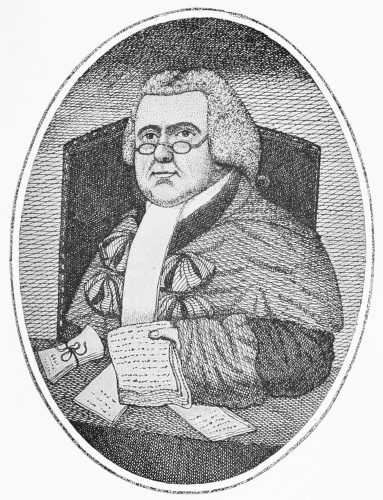
Lord Stonefield. (After Kay.)
Lord Swinton—My Lords, this is a question of so much delicacy and importance that I could have wished more time to have weighed what I have heard from the counsel than the forms of Court will admit of.
The question is—Whether His Majesty’s pardon did so far restore John Brown to the character and reputation he held before his conviction as to make his evidence admissible in the present trial?
In substance, my opinion concurs with that of my brethren, for repelling, in the circumstances of the present case, the objection to the admissibility of the witness, leaving his credit to the consciences and good sense of the jury.
Had John Brown’s conviction proceeded upon a jury trial in Scotland, I would have been of a different opinion. There are, in the first place, several texts in the civil law upon this topic, all clearly purporting that a remission, so far from restoring, even blemished, the reputation of him whom it relieved from punishment. Next, our municipal law is perfectly explicit to the same effect. The statutes of Robert I., among others therein debarred from giving evidence, mentions convicts redeemed from justice. This act is expressly quoted and laid down as law by Sir George Mackenzie, who is, at least, our most ancient author upon the criminal law, and there is no practice or decision to the contrary.
These observations, however, I do not apply to the present case, for here the conviction and sentence are from England. The infamy, therefore, disabling Brown to be a witness arising in the law of that country, and coming here, must bring its character and construction and effects along with it.
I observe that one of these effects was the restoring a criminal pardoned to the state and character that he held previous to the conviction. The authorities referred to by the Lord Advocate prove this, and, in addition to these, I shall only mention to your Lordships Mr. Justice Buller’s Treatise on Trials, a book of great authority, which lays down that if a person found guilty, on an indictment for perjury at common law, be pardoned by the King, he will be a good witness, because the King has power to take off every part of the punishment.
As to the sentence of the Justices of Peace of the county of Stirlingshire, banishing Brown by his own consent from that county, no stress can be laid on it, as it is now a settled point that no sentence of an inferior Court, proceeding without the verdict of a jury, is sufficient to set aside any person from being a witness.
The Lord Justice-Clerk—My Lords, I will not say a word about the sentence of the Justices of Peace, nor of what would have been the case had the crime been committed, or sentence pronounced, in Scotland. I would hold the decree in England pro veritate, and give it effect accordingly. But, my Lords, if the pardon frees this man from the penal consequences of his sentence, although I were to hold that it does not rehabilitate him in Scotland, still it leaves only the infamia facti, for the infamia juris is, eo ipso, done away. And, my Lords, nothing can set aside a witness unless infamia juris.
The Dean of Faculty argued this objection with great ingenuity, but he founded his whole argument on the proposition that an infamia facti, if it was capable of proof, was a sufficient objection to the admissibility of a witness; and, indeed, unless this proposition were true, his whole argument falls to the ground. But, my Lords, this proposition is evidently fallacious, and I need use no other instance than that of Ainslie, who, like every other King’s evidence, admitted in the very bosom of his deposition an infamia facti, in so far as he was concerned in the commission of the crime charged against the pannels, and yet it was not even pretended that this was an objection to his admissibility; and your Lordships every day allow the examination of witnesses in the same situation. I am therefore clear for repelling the objection.
The Court then pronounced the following interlocutor:—
The Lord Justice-Clerk and Lords Commissioners of Justiciary having considered the foregoing objections with the answers thereto, they repel the objections stated and allow the witness to be examined, reserving the credibility of his evidence to the jury.
Robt. M‘Queen, I.P.D.
[The witness was then called in and sworn.]
The Lord Justice-Clerk—John Brown, you are called here to give evidence regarding a matter in which it is generally supposed that you yourself had some concern. You are now informed by the Court that although you may have had such a concern you are in no danger to speak the truth, because, being adduced as a witness against the prisoners at the bar, you cannot be tried for the crime of which they are accused; and you will take notice that whatever you may have said against these men, in the different declarations which you emitted before the Sheriff, which are now destroyed, you are now bound by the great oath which you have sworn to tell the truth; and that if you say anything to the prejudice of these men that is not true or if you conceal any part of the truth, with a view to favour them, you will thereby be guilty of the crime of perjury, for which you will be liable to be tried by this Court, and severely punished, and you will commit a heinous offence in the sight of the Almighty God, and thereby endanger your immortal soul.
Witness—I am acquainted intimately with both the pannels, and have been frequently in company with them, and with Andrew Ainslie, then a shoemaker in Edinburgh. I have met Brodie often at Smith’s house and other places. I know that the General Excise Office in Chessels’s Buildings was broken into upon Wednesday, the 5th of March last; I was myself one of them that broke into it, and Andrew Ainslie and the two prisoners were along with me. George Smith and I were within the office, Brodie was at the door, and Andrew Ainslie was without, keeping watch. We had resolved three months before to break into it; and on the 30th of November last, the night on which the Free Masons made a public procession last winter, Smith, Ainslie, and I went to the Excise Office and unlocked the outer door with a false key. We went in together, and opened the inner door to the hall with a pair of toupee irons, but none of the keys we had would open the cashier’s door. Smith said a coulter would be a good thing to open it with. Thinking it too late to remain longer, we came out again; but we could not lock the outer door with the key, and therefore left it unlocked. Last spring Ainslie and I went to Duddingston, and drank a bottle of porter in a house there; afterwards we went into a field in the neighbourhood, in which there were two ploughs, and carried off the coulter of one of them, which we hid in Salisbury Crags. On the evening of the 5th of March last, which was two or three days afterwards, when it was about dusk, Ainslie and I went out to Salisbury Crags for the coulter, and brought it in with us to Smith’s house. Smith was at home, but Brodie was not yet come, although we expected him. The hour at which we had agreed to meet was seven, but Mr. Brodie did not come until near eight. The purpose of our meeting was to go and rob the Excise Office that night. We were in Smith’s room above-stairs when Brodie joined us, and we there drank some gin and “black cork,” and ate some herrings and chicken. By “black cork” I mean Bell’s beer. Mr. Brodie was then dressed in black; in the preceding part of the day I saw him in white or light-coloured clothes. I do not remember that he had a great-coat on when he came to us at Smith’s in the evening. When he entered the room he took a pistol from his pocket, and repeated the verse of a song of Macheath’s from a play, words like—“We’ll turn our lead into gold,” or such like.[12] After we were all met together, it was agreed upon that Ainslie should remain on the outside of the Excise Office, within the rails, with a whistle, to give the alarm in case of danger; that Brodie was to be stationed within the outer door for the same purpose; and that Smith and I should go into the cashier’s room. Accordingly, Ainslie left Smith’s first, and in some time after I followed. Brodie was not disguised, but Smith and I had crapes in our pocket, and Smith had likewise a wig, which, I believe, had once belonged to Brodie’s father. When I came to the mouth of the entry to Chessels’s Buildings, I met the old man who usually locked the door coming out, and went after him and saw him go home. My reason for so doing was to see that he had not gone on an errand and to return. When I came back to the court I met Brodie in the entry, who told me that Smith had gone into the office, and desired me to go in. I went down the close with him, saw Ainslie at his post, and received the coulter, or “Great Samuel,” from him, and carried it in with me to the office. I found the outer door open and Smith in the hall. The outer door of the cashier’s room was opened by Smith with a pair of curling irons, and I assisted him to force open the inner door of the cashier’s room with the coulter and a small iron crow. After we got in, Smith, who had a dark lanthorn with him, opened every press and desk in the room where he suspected there was any money; some by violence and others with keys which we found in the room. We continued there about half-an-hour, and found about sixteen pounds of money in a desk in the cashier’s room, which we carried away with us. It consisted of two five-pound notes, six guinea notes, and some silver. We heard some person come upstairs, and cocked our pistols, which were loaded with powder and ball. Smith said he supposed it was some of the clerks going into one of the rooms. We heard no whistle while we were in the office. When we came downstairs, Brodie and Ainslie were both gone. We left the outer door of the Excise Office unlocked, and carried the key away with us. We then came up to the Canongate, and went across it, and down another street a little below—Young’s Street. I stopped in the middle of the last street, pulled off my great-coat and gave it to Smith. I then returned, went down to the Excise Office door, where everything seemed to be quiet; afterwards I went to Smith’s house, where in a little I was joined by Smith, and soon afterwards by Ainslie. I did not remain there long, when Smith recommended it to me and Ainslie to go over to Fraser’s house in the New Town, that we might avoid suspicion; and we went accordingly. I knew at the time that Smith was making a key for the outer door of the Excise Office. [Here the witness was shown a key.] That is the key he so made, and with which he opened the door. We had three pair of pistols along with us, all of which were previously loaded by Smith with powder and ball. [Here the pistols libelled on were shown the witness.] These are a pair of them, but whether that pair was carried to the Excise Office by Smith or me I cannot say. I saw Mr. Brodie have a pistol in his hand in Smith’s house. When Brodie came to Smith’s first that night he brought with him some small keys, and a double pick-lock, which we all looked at. [Here the pick-lock libelled on was shown to the witness.] This is the same that was used on that occasion. On Friday, the 7th of March, I was sent for to Smith’s house. Brodie, Smith, and Ainslie were there, and the money which we got in the Excise Office was then equally divided between us. I got about four pounds from Brodie to my share. I saw all the money in Smith’s room above-stairs before it was divided, and there were two five-pound bank-notes amongst it. On the same Friday evening, I went with Smith and Ainslie to Drysdale’s, in the New Town, and saw Smith change one of the five-pound notes there, when purchasing a ticket for his wife in the mail-coach to Newcastle. I went to William Middleton on Friday night, the 7th of March last, and told him that I wished to make a discovery as to the late robberies; he carried me the same night to Mr. Scott, the Procurator-Fiscal, but I did not at that time mention anything of Brodie’s concern in them. The next day I was sent to England to trace some goods taken from Inglis & Horner’s shop. I returned on the 15th of March, and was the same day examined by the Sheriff. I was informed that Smith had emitted a declaration, informing of Brodie’s guilt, in consequence of which he (Brodie) had absconded, and then for the first time I mentioned that Mr. Brodie had been concerned with us.[13] Ainslie informed Smith and me that he had seen two men come up the close before he quitted his post at the Excise Office and went away. Smith carried the money which was found in the Excise Office away with him, and he afterwards gave it to Brodie, who made a fair division of it on the Friday. On the Thursday I did not see him.
Lord Hailes—John Brown, you have already been told by the Court that you ought to pay no regard to what was contained in your declarations before the Sheriff, and that, whatever you may have formerly said, you cannot now hurt yourself by speaking the truth. I intreat you to reflect on the evidence you have given this night, and if you are conscious of having said anything which you ought not to have said, that you may say so to the Court and to the jury. It is not as yet too late, but if you neglect the opportunity which you now have it will never recur to you again; and I earnestly desire you to beware of this, that if you have said anything this night to the prejudice of these men at the bar that is not true, and if you do not undeceive the Court and the jury before you leave this house, you will commit a most heinous sin against the God of heaven, in whose presence you now stand, and you will be guilty of perjury and of murder.
Cross-examined by the Dean of Faculty, for William Brodie—When you went first to Mr. Scott, the Procurator-Fiscal, did you say anything concerning the breaking of the Excise Office?
Witness—I did.
The Dean of Faculty—Who did you say was concerned with you?
Witness—George Smith. I did not mention either Brodie or Ainslie until I returned from England.
The Dean of Faculty—Are you sure that Mr. Brodie brought his pistols to Smith’s in the afternoon?
Witness—I am certain.
The Dean of Faculty—Did you not say that when he came to Smith’s before eight o’clock he had his pistol in his hand?
Witness—I did.
The Dean of Faculty—How could he have left them at Smith’s, then, in the afternoon?
Witness—I did not say he left them there; he brought them there, but carried them away with him again. I am certain as to the small pistols that Mr. Brodie carried in his breeches pocket.
The Dean of Faculty—Was Mr. Brodie present when the pistols were loaded?
Witness—He was.
The Dean of Faculty—When did Mr. Brodie first come to Smith’s that day, and how was he dressed?
Witness—He came in coloured clothes, between dinner and tea.
The Dean of Faculty—Might that be four o’clock?
Witness—I could not tell what o’clock it was.
The Dean of Faculty—Was it after three o’clock that afternoon?
Witness—I am not certain.
The Dean of Faculty—Was it after two o’clock?
Witness—Yes, I am certain it was.
The Dean of Faculty—Were these the pistols he brought with him? [The pistols produced.]
Witness—No, not these; I did not say these, but another pair, since the truth must be told. Do not think to trap me; you may make something of me by fair means, but not by foul. I do not understand the meaning of being thus teased by impertinent questions.
The Dean of Faculty—The more violent the gentleman is, so much the better for my client. The jury will take notice of the manner in which he gives his evidence.
Lord Eskgrove—My Lord Justice-Clerk, the witness should be told that he ought not to talk in that manner to the counsel.
The Lord Justice-Clerk [to witness]—Mr. Brown, you are going too far; it is the duty of these gentlemen to put any questions to you which they think proper, relating to the crime charged.
Witness—My Lord, in giving my evidence, I have said nothing but the truth, and I have rather softened the matter than otherwise, with regard to Mr. Brodie.
The Dean of Faculty—At what hour, sir, did you go to the Excise Office on the night you have mentioned, and when did you return to Smith’s?
Witness—As I was going down to the Excise Office the clock struck eight, and I was back again at Smith’s house about nine o’clock.
Cross-examined by Mr. John Clerk, for George Smith—Pray, sir, how do you know that to be the key with which Mr. Smith opened the door of the Excise Office? You said just now that you were not present when Smith opened the door; that he was in before you arrived.
Witness—I know very well that that was the key, because I knew he made it for that purpose.
Mr. John Clerk—But how do you know that he opened the door with that key on the 5th of March?
Witness—I know he made the key so far back as November last. I know the key very well; there is not a key in five hundred like it. You will not show me such a key in Edinburgh. There is no smith in this city could make such a key.
Mr. John Clerk—That is no answer to my question.
The Lord Justice-Clerk—It is enough to satisfy any sensible man.
Mr. John Clerk—It is for the jury, my Lord, to judge of that.
[To Witness]—You mentioned your having on a great-coat when you broke into the Excise Office; pray, sir, was that great-coat your own, or to whom did it belong?
Witness—It belonged to Michael Henderson, stabler in the Grassmarket, and I carried it home to him the following night.
Mr. John Clerk—Did you carry anything to Mr. Henderson along with it?
Witness—I did not.
The Lord Justice-Clerk—John Brown, you appear to be a clever fellow, and I hope you will now abandon your dissipated courses, and betake yourself to some honest employment.
Witness—My Lord, be assured my future life shall make amends for my past conduct.
The Lord Advocate—My Lord, the parole evidence on the part of the Crown being now closed, the declarations and other writings, which have been authenticated in the presence of your Lordships, fall now to be read to the jury, but as there are some parts of Smith’s declarations which relate to matters not immediately connected with the subject of the present trial, I do not desire that these parts of his declarations should be read by the Clerk of Court or communicated to the jury.
[After some conversation, this proposal, which did much honour to his Lordship, was agreed to, and such parts of the declarations as were not read in Court were pasted over with paper, that they might not be looked into through mistake by the jury after they were inclosed.]
Declarations of George Smith.
No. I.
At Edinburgh, 8th March, 1788.
The which day compeared, in presence of Archibald Cockburn, Esq., His Majesty’s Sheriff-depute of the shire of Edinburgh, George Smith, grocer in Edinburgh, who, being examined and interrogated by the Sheriff, declares,
That it is about a year and a half since the declarant came to Scotland; that he was never in it before; that he was born at Boxford, within four miles of Newburgh, Berkshire; that the declarant and his wife travelled the country of England as hawkers, with a horse and cart; that he brought a horse to this country but no cart; that, when he first came to Edinburgh, he put up at Michael Henderson’s, having heard his house mentioned by travellers in England as a traveller’s inn; that he was taken ill after his arrival in this country, and confined for about four months in Michael Henderson’s, which obliged him to send for his wife to this place; that he sent for goods from England, which he sold, as also his horse, in order to support himself.
That since he came to this country, he has frequented Clark’s in the Flesh Market Close, which is a gambling house, and in which house he was in use to meet with a variety of people, and among the rest Andrew Ainslie and John Brown; that the declarant first got acquainted both with Ainslie and Brown in Michael Henderson’s; that Ainslie gave himself out for a shoemaker, but the declarant cannot tell of what profession Brown is; that the club, as it was called, at Clark’s, as the declarant believes, has been doing little these three months past; that the declarant never played there to go very deep, and was never seen to win or lose above thirty shillings, having never taken more than that sum in his pocket alongst with him, but, upon recollection, thinks that he has won above thirty shillings; that the declarant inclines to believe that John Brown has rather been unfortunate at the club.
Declares and acknowledges that the declarant took a cellar in Stevenlaw’s Close from a woman whom he now sees in the office; that the declarant afterwards took Ainslie to the said woman and told her that this was the gentleman who was to possess her cellar; but he does not remember of calling him by the name of Campbell, or any other name; that the declarant gave the rent, which was ten shillings, to Ainslie, who gave it to the woman.
Declares that the declarant went with Ainslie to Mrs. Clark’s house in George’s Square, where Ainslie took a stable from that lady, but the declarant and Ainslie remained in the kitchen, and neither of them saw Mrs. Clark, as he thinks; that the declarant does not now recollect for what purpose Ainslie said it was he wanted to rent the stable; that the declarant saw Ainslie pay five shillings, or some such sum, as a month’s rent for the stable per advance.
And being interrogated, What was the purpose of the vice which stands in the cellar of his house?—Declares that he has had that for seven or eight years, and that he used it for putting tongues in buckles, or any thing of that sort, but he has not used it since he came to his present house; that his wife intended to have set out this day on a visit to her relations in England, and for that purpose the declarant took out for her a ticket in the mail-coach at Drysdale’s, where he exchanged a five-pound bank-note and paid for it.
Declares that the black dog now in the office belongs to a neighbour of his, but, from the declarant’s giving him now and then some bones to pick, he frequents the declarant’s house, and follows him and his wife; that the note he exchanged at Drysdale’s the declarant has had in his possession for above two months past; that he got it from a smuggler, and it was battered then as it is now. This he declares to be truth, and declares he cannot write.
Archibald Cockburn.
No. II.
At Edinburgh, 10th March, 1788.
The which day compeared, in presence of the Sheriff of Edinburgh, George Smith, formerly examined on Saturday, the 8th current, after having sent notice to the Sheriff that he wished to speak with him. Came to the office and told the Sheriff that he wished to have an opportunity of making a clean breast, and telling the truth, upon which the Sheriff informed him that, as he, the Sheriff, knew he stood in a very ticklish situation, it was his duty to let him know that whatever he told or discovered was not to be accepted of under any condition or promise whatever, or that his doing so would operate anything in his favour, and that therefore he was at perfect freedom, either to speak or hold his tongue, as he judged best. And that the said George Smith having declared that he wished to tell the truth, and communicate all the guilty scenes in which he had been concerned for some time past, since he came to the town of Edinburgh, he was desired to proceed.
Declares that, in the end of October, or beginning of November last, the declarant, in company with Andrew Ainslie and John Brown, whose real name is Humphry Moore, went to the College of Edinburgh about one o’clock in the morning. Having got access at the under gate, they opened the under door leading to the Library with a false key, which broke in the lock, and thereafter they broke open the door of the Library with an iron crow, and carried away the College mace.
Declares that the declarant has, almost since his first arrival in Edinburgh, been acquainted with Deacon William Brodie, and he saw him first at Michael Henderson’s, where he was introduced to the declarant by one Graham at the time the declarant was confined in that house; that Brodie, in the course of conversation, suggested to the declarant that several things could be done in this place, if prudently managed, to great advantage, and proposed to the declarant that they should lay their heads together for that purpose.
That, in consequence of this concert, the declarant and Brodie were in use to go about together, in order to find out the proper places where business could be done with success; that Brodie, in their walks, carried the declarant to the College Library, where, having observed the mace standing, Brodie said that they must have it; that Andrew Ainslie was afterwards sent by the declarant and Brodie to look at the Library, under pretence of calling for somebody, in order to see if the mace was always in the same place, as they suspected it might be one day in the Library and another somewhere else, which would have rendered an attempt upon the Library precarious; that Ainslie reported that the mace was in the same place that the declarant and Brodie had seen it, and, upon getting this report, the theft of the mace was committed as before mentioned.
Declares that, since the mace was stolen, as the declarant thinks, the declarant, along with Brown and Ainslie, laid a plan of breaking into John Tapp’s house and taking his money; that this business was suggested, and pressed, by Brown, the declarant rather being averse to it; that Brown told the declarant that he knew the key of Tapp’s shop opened the door of his house, and brought it to the declarant to look at, which, upon seeing, the declarant said there was nothing in it, meaning by that, that the lock to which it belonged could easily be opened.