Front matter (continued 5)
Reading edition
Tar was formerly derived from the slow burning of wood in a clay-lined pit. The branches, roots and other lumber refuse, cut in small sizes were heaped in a compact mound and covered with sods and earth. Smoldering fires soon induced a flow of smoky tar, thick as molasses, in the bottom of the pit. In due time the flow ceased, the fires went out, and charcoal was the result of this slow burning. Removing the charcoal, the tar became available for various purposes; boiled until it lost its liquid character, it became tough sticky pitch. This primitive pit method of extracting tar and making charcoal has been abandoned wherever intelligence governs the industry, and distillation processes have been installed.
The Shortleaf Pine
P. echinata, Mill.
The shortleaf pine ranks second to the longleaf in importance to the lumber industries of the East and South. It ranges from Staten Island, New York, to north Florida, and west through West Virginia, eastern Tennessee, southern Missouri, Louisiana and eastern Texas. It reaches its largest size and greatest abundance west of the Mississippi River, where great forests, practically untouched thirty years ago, have become the centre of the "yellow pine" industry, out of which vast fortunes have been made. The wood is preferred by builders, because it is less rich in resin, softer and therefore more easily worked. Young trees yield turpentine and pitch, and with the longleaf and the Cuban pine much forest growth has suffered destruction in the production of these commodities.
The slender tree equals the longleaf in height and bears its dark green leaves in clusters of twos and threes, scattered on short branches that form a narrow loose head. The pale green, stout branchlets are lightened by the silvery sheaths of the young leaves (see illustrations, pages 214-215) which are short only in comparison with the companion species, the longleaf. The cones are abundant; the seeds numerous, winged for flight, retaining their vitality longer than most pine seeds. The tree is less sensitive to injuries and has the propensity, unusual in the pine family, of throwing up suckers from the roots. In open competition, this pine will hold its own against the invasion of other trees, if only allowed to do so. Much of the deforested territory, let alone, will cover itself with a ripe crop of shortleaf pine lumber in a hundred years.
The Cuban Pine
P. Caribaea, Morelet
The Cuban pine stands third in the triumvirate of lumber pines of the South. This is the "swamp pine" or "slash pine," found in the coast regions from South Carolina throughout Florida, and along the Gulf Coast to the Pearl River in Louisiana. It is a beautiful pine—tall, with dense crown of dark green leaves, in twos and threes, eight to twelve inches long, falling at the end of their second season, before they lose their brightness. A large part of the turpentine of commerce has been derived from these coast forests, as well as lumber, which takes its place in the Northern market with the longleaf and the shortleaf.
Natural reforestation has taken place in the Southeast, and a large part of the turpentine exported by Georgia and South Carolina to-day, is from second-growth Cuban pine, on land from which the lumber companies have stripped the virgin growth.
The Loblolly Pine
P. Taeda, Linn.
The loblolly or old field pine chooses land generally sterile and otherwise worthless. It grows in swamps along the Atlantic coast, from New Jersey through the Carolinas, and follows the Gulf from Tampa Bay into Texas. Inland, it is found from the Carolinas to Arkansas and Louisiana. It has remarkable vitality of seed and seedlings, which do equally well on sterile uplands, on water-soaked ground, or where soil is light and sandy. It is very apt to take possession of land once cleared for agriculture. The young trees crowd together and grow with tremendous vigor the first years of their lives, successfully holding large tracts in pure forests. The limbs are short, thick, matted, forming a compact rounded head; the leaves slender, stiff, twisted, pale-green, six to nine inches long, in groups of threes. The wood is rich in resin, but differs greatly in quality with age and the fertility of the soil. "Rosemary pine" was heavy, hard, close-grained, with a thin rim of soft sap-wood. This famous lumber, preferred by shipbuilders of many countries for masts, grew in the virgin forest of the Carolinas. Giants were cut in the rich marsh lands back from the Sounds. But the small loblolly pine, grown on sandy soil, is but third-grade lumber, the sap-wood three times as thick as the heart-wood and exceedingly coarse-grained. One merit has recently been discovered in this lumber, that formerly blackened before it was seasoned, by the invasion of a fungous growth. It quickly absorbs creosote, which renders it immune from decay. It is used in the building of docks, cars, boats, and locally in house-building. Its wood makes a sharp, quick heat when dried. It is used in bakeries and brick kilns, and in charcoal-burning.
The Pitch Pine
P. rigida, Mill.
The pitch pine goes down to the very water's edge on the sand-dunes along the New-England Coast, and spreads on worthless land from New Brunswick to Georgia and west to Ontario and Kentucky. Occasionally in cultivation the tree is symmetrical, and grows to considerable size. In the most favorable situations, however, it rarely exceeds fifty feet in height, with gnarled rough branches, oftenest irregular in form and becoming painfully grotesque with age. The persistence of its clustered black cones adds to the tree's ugliness; and the tufted, scant foliage has a sickly yellowish-green color when new, and becomes darker and twisted the second year. The cones are armed with stout thorns and often remain on the trees ten or twelve years. The knots, particularly, are rich in resin—the delight of camping parties. "Pine-knots" and "candlewood" are household necessities in regions where these trees are the prevailing species of pine.
Starved as is its existence, the pitch pine springs up with amazing vigor after a fire. Suckers are sent up about the roots of the fire-killed trees, and the wind scatters the seeds broadcast for a new crop. The chief merit of the tree is that it grows on worthless land, and holds with its gnarled roots the shifting sand-dunes of the New-England Coast better than any other tree.
The Gray Pine
P. divaricata, Sudw.
The gray pine goes farther north than any other pine, following the McKenzie River to the Arctic Circle. From Nova Scotia to the Athabasca River, it covers barren ground, reaching its greatest height, seventy feet, in pure forests north of Lake Superior. In Michigan it forms the "jack-pine plains" of the Lower Peninsula. As a rule it is a crouching, sprawling tree, its twigs covered with scant short dingy leaves in twos, averaging an inch in length. The wood is a great boon to the regions this tree inhabits. It is light, soft, weak, and close-grained; used for posts, railroad ties, building material and fuel. Its seeds germinate better from cones that have been scorched by fire.
The Digger Pine
P. Sabiniana, Dougl.
The digger pine is a western California tree of the semi-arid foothill country. Gray-green, sparse foliage on the gnarled branches gives the tree a forlorn starved look, as it stands or crouches, singly or in scattered groups, along the gravelly sun-baked slopes. The great cones, six to ten inches long, fairly loading the branches, express most emphatically the vigor of the tree. The thickened scales protrude at a wide angle from the central core, and each bears a strong beak, triangular, flattened like a shark's tooth, but curved. The rich oily nuts, as big as lima beans, furnish a nourishing food to the Indians. The Digger tribe harvested these nuts, and the pioneer gave the tree the tribal name.
The Western Pitch Pine
P. Coulteri, D. Don.
The Western pitch pine, most abundant in the San Bernardino and San Jacinto Mountains, at elevations of about a mile above the sea, has cones not unlike those of the digger pine, in the armament of their scales. These are notable by being the heaviest fruits borne by any pine tree. Occasionally they exceed fifteen inches in length and weigh eight pounds. The seeds are one-half an inch in length, not counting the thin wing, which is often an inch long.
The leaves of this "big-cone" pine match the cones. They are stout, stiff, dark blue-green, six to sixteen inches long, three in a bundle, which has a sheath an inch or more in length. Crowded on the ends of the branches, these leaves would entitle this tree to qualify as a "foxtail" pine, except for the fact that the foliage persists into the third and fourth year, which clothes the branches far back toward the trunk and gives the tree a luxuriant crown. The dry slopes and ridges of the Coast Ranges of California are beautified by small groves and scattered specimens of this striking and picturesque pine, so unlike its neighbors. Its wood is used only for fuel. In European countries this is a popular ornamental pine, planted chiefly for its great golden-brown cones.
The Knob-cone Pine
P. attenuata, Lemm.
The knob-cone pine inhabits the Coast Ranges from the San Bernardino Mountains northward on the western slopes of the Sierra Nevada and Cascade Mountains, into southwestern Oregon, where it forms pure forests over large areas, its altitude limit being four thousand feet. It is a tall slim tree of the hot dry fire-swept foothills, and it comes again with absolute certainty after forest fires. The clustered cones, three to six inches long, are amazingly hard and do not open at maturity, but wait for the death of the tree. Leaves three to seven inches long, in clusters of three, firm, rigid, pale yellow or bluish green, cover the tree with a sparse thin foliage-mass; but the branches, new and old, are covered with cones, many of which are being swallowed up by the growth of wood on trunk and limb. Thirty or forty years these cones may hang, their seeds never released and never losing their vitality, until fire destroys the tree. Then the scales open and the winged seeds are scattered broadcast. They germinate and cover the deforested slopes with a crop of knob-cone pine saplings that soon claim all standing room and cover the scars of fire completely.
The Monterey Pine
P. radiata, D. Don.
The Monterey pine, like its companion, the Torrey pine, is restricted to a very narrow area. They grow together on Santa Rosa Island. At Point Pinos, south of Monterey Bay, this tree stands a hundred feet in height, with trunks occasionally five to six feet in diameter, its branches spreading into a round luxuriant, though narrow, head. From Pescadero to San Simeon Bay, in a narrow belt a few miles wide, and on the neighboring islands, this tree finds its limited natural range; but the horticulturist has noted the silvery sheen of its young growth and the rich bright green that never dulls in its foliage. Its quick growth and handsome form in cultivation make it the most desirable pine for park and shade planting in California. Indeed it is a favorite park tree north to Vancouver along the Coast. It has been introduced into Europe and is occasionally met in parks in the Southeastern states.
The Western Yellow Pine
P. ponderosa, Laws.
The Western yellow pine forms on the Colorado Plateau the most extensive pine forests of the American continent. Mountain slopes, high mesas, dry canyon sides, even swamps, if they occur at elevations above twenty-five hundred feet, furnish suitable habitats for this amazing species, in some of its varying forms. From British Columbia and the Black Hills it follows the mountains through the Coast Ranges, Sierras, and the Great Continental Divide, to the highlands of Texas and into Mexico, forming the most extensive pine forests in the world. All sorts of construction work draw upon this wonderful natural supply of timber, from the droughty western counties of the Dakotas, Nebraska and Texas, to the Pacific Coast.
The typical tree has thick plates of cinnamon-red bark, a massive trunk, five to eight feet in diameter, one hundred to two hundred feet high, with many short, thick, forked branches in a spire-like head. In arid regions the trunk is shorter and the head becomes broad and round-topped. Near the timber line and in swamps, the trees are stunted and the bark is nearly black.
The leaves of this pine tree are two or three in a bundle, stout, dark yellow-green, five to eleven inches long, deciduous during their third season. Their color has given the name to the species, for the wood is not yellow, but light red, with nearly white sap-wood.
On the way to the Yosemite, the traveler meets the yellow pine—splendid tracts of it—with the giant sugar pine, in open park-like areas, where each individual tree has room to manifest the noble strength of its tall shaft.
The flowers appear in May, brightening the even color of the shiny leaves with their pink or brown staminate clusters two or three inches wide. The crimson pistillate cones hide at the ends of the branches, lengthening into fruits three to ten inches in length, and half as wide. Strong, recurving tips, armed with slender prickles, are seen in the scales of the reddish-brown cones that fall soon after they spread and liberate the winged seeds. These are produced in abundance, are scattered widely by the wind, and accomplish the renewal of these mountain forests.
The bark is usually very thick at the bases of the trunks, reaching eighteen inches on the oldest trees. With this cloak wrapped about its living cambium, the yellow pine is able, better than most trees, to survive a sweeping forest fire.
Botanists have found P. ponderosa extremely variable, and they quarrel among themselves about species and variety, for the tree endures many climates, adapts itself to varying conditions and develops a type for each habitat and region. In old lake basins on the Sierra slopes, "variety Jeffreyi, Vasey," is the name given to the gigantic yellow pine, which there finds food and moisture in abundance and reaches its finest proportions and its greatest lumber value.
In the Rocky Mountains, "variety scopulorum, Engelm.," is the type. "But all its forms can be traced to a common origin and so the parent species stands; and despite man's devastating axe the yellow pine flourishes in the drenching rains and fog of the northern coast at the level of the sea, in the snow-laden blasts of the mountains, in the white glaring sunshine of the interior plateaus and plains, and on the borders of mirage-haunted deserts, volcanoes, and lava beds,—waving its bright plumes in the hot winds undaunted, blooming every year for centuries, and tossing big ripe cones among the cinders and ashes of nature's hearths." (John Muir.)
The Scrub Pine
P. contorta, Loud.
The scrub pine is the humble parent of one of the splendid Western lumber pines, whose description comes under its varietal name. Down the coast of Alaska, usually in sphagnum bogs, on sand-dunes, in tide-pools and deep swamps to Cape Mendocino, the indomitable, altogether-admirable scrub pine holds its own against cold, salt air and biting arctic blasts. No matter how stunted, gnarly and round-shouldered these trees are, one thing they do, often when only a few inches high: they bear cones, and keep them for years; and each season add more. Up from the sea the scrub pine climbs, ascending the Coast Ranges and western slopes of the Cascade Mountains, changing its habit to a tree twenty to thirty feet tall with thick branches and dark red-brown bark, checked into oblong plates. Gummy exudations of this pitch pine make it peculiarly liable to running fires. Thousands of acres are destroyed every summer, but they seize the land again and soon cover it with the young growth. This happens because the burned trees drop their cones, which open and set free the seeds which have never lost their vitality.
In all the vast region over which this vagrant tree swarms, it furnishes firewood and shelter. The pioneer blesses it, and a great multitude of wild things, both plant and animal, maintain their lives in comfort and security because of its protection.
The lodge-pole pine or tamarack pine is but a variety (Murrayana) of P. contorta, that grows in forests on both slopes of the Rocky Mountains of Montana and Wyoming, at elevations of from seven to eight thousand feet, and stretches away into British Columbia and Alaska, and southward to the San Jacinto Range. Between eight thousand and nine thousand five hundred feet in altitude, along the Sierra Nevada in California, it reaches its greatest size and beauty, and forms extensive dense forests. The young trees have very slender trunks, and often stand crowded together like wheat on the prairie. An average forest specimen is five inches in diameter, when thirty or forty feet in height. No wonder the Indian in Wyoming and Colorado called it "the lodge-pole pine," for their supple trunks fitted these trees, while yet saplings, to support the lodge he built.
Richer, moister ground nourishes this fortunate offspring of the scrub pine. The two-leaved foliage, usually about two inches long, wears a cheerful yellow-green, while the parent tree is dark and sombre, with leaves an inch in length. The hard, strong, brown wood of contorta contrasts strikingly with that of its variety, which is light yellow or nearly white—soft, weak, straight-grained and easily worked. Its abundance in regions where other timber is scarce, brings it into general use for construction work. It also furnishes railroad ties, mine timbers and fuel, with the minimum of labor, since trunks of proper sizes can easily be selected.
The Indians, whose food supply was always precarious, gathered branches and made a soft pulp of the inner bark, scraped out in the growing season. This they baked, after shaping it into huge cakes, in pit ovens built of stones, and heated for hours by burning in them loads of firewood. When the embers were burned out, the oven was cleaned and the cakes put in. Later they were smoked with a damp fire of moss, which preserved them indefinitely. "Hard bread" of this type provisioned the Indian's canoe on long trips. Inedible until boiled, it was a staple winter food at home and on long expeditions, among various tribes of the Northwest.
The Red Pine
P. resinosa, Ait.
The red pine, also called the "Norway pine" for no particular reason, is something of an anomaly. Its wood is soft like that of the white pine with which it grows, and though resinosa means "full of resin," it is not so rich as several other pitch pines. Its paired leaves and red bark reveal its kinship with the Scotch pine, a European species, very common in cultivation in America.
Seemingly intermediate between soft and hard pines, P. resinosa appeals to lumbermen and landscape gardeners because it embodies the good points of both classes. No handsomer species grows in the forests, from New Brunswick to Minnesota and south into Pennsylvania. The sturdy red trunk makes a bright color contrast with the broad symmetrical pyramid of boughs clothed in abundant foliage. The paired, needle-like leaves, dark green and shining, are six inches in length. The flowers are abundant and bright red, more showy than is ordinary in the pine family. Brown cones one to three inches long with thin unarmed scales, discharge their winged seeds in early autumn, but cling to the branches until the following summer.
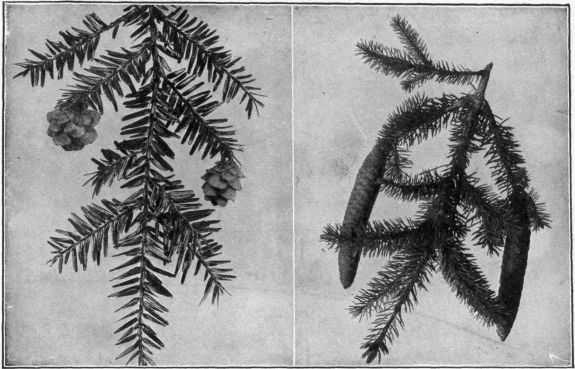
See page 248
LEAVES AND CONES OF HEMLOCK (left) AND OF NORWAY SPRUCE (right)
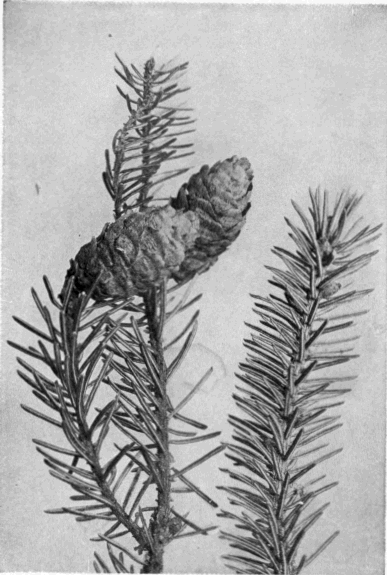
See page 248
THE SPINY FOLIAGE AND FAST-CLINGING CONES OF THE BLACK SPRUCE
The wood of red pine is pale red, light in weight, close-grained with yellowish or nearly white sap-wood. Logs a hundred feet and more in length used to be shipped out of Canadian woods to England. Singularly free from large knots and other blemishes, they made huge spars and masts of vessels, as well as piles for dockyards, bridges, etc. Other woods have proved more durable, and the largest red pine timber has been harvested. So its importance in the lumber trade has declined.
But in cultivation the red pine holds its own for its quick growth, its hardiness, its lusty vigor and its beauty of color contrasts. It grows on sterile ground exposed to the sea, forming groves of great beauty where other pines would languish and die. For shelter belts, inland, it is equally dependable, and as specimen trees in parks and gardens it has few equals. At no season of the year does it lose its fresh look of health. Young trees come readily from seed, and throughout their lives they are unusually free from injuries by insects and fungi.
THE SPRUCES
The distinguishing mark of spruce trees is the woody or horny projection on which the leaf is set. Look at the twigs of a tree which you think may be a fir or a spruce. Wherever the leaves have fallen, the spruce twig is roughened by these spirally arranged leaf-brackets. Leaf-scars on a fir twig are level with the bark, leaving the twig smooth. Spruce twigs are always roughened, as described above.
Most spruce trees have distinctly four-angled leaves, sharp-pointed and distributed spirally around the shoot, not two-ranked like fir leaves. They are all pyramidal trees with flowers and fruits of the coniferous type. The cones are always pendent and there is an annual crop. The wood is soft, not conspicuously resinous, straight-grained and valuable as lumber.
The genus picea comprises eighteen species, seven of which belong to American forests. These include some of the most beautiful of coniferous trees.
The Norway Spruce
Picea excelsa, Link.
The Norway spruce (see illustration, page 246) is the commonest species in cultivation. It is extensively planted for wind-breaks, hedges and shelter belts, where its long lower arms rest on the ground and the upper limbs shingle over the lower ones, forming a thick leafy shelter against drifting snow and winds.
The Black Spruce
P. Mariana, B. S. & P.
The black spruce is a ragged, unkempt dingy tree, with short drooping branches, downy twigs, and stiff dark blue-green foliage, scarcely half an inch long. Its cones, least in size of all the spruce tribe, are about one inch long and they remain on the branches for years (See illustration, page 247).
Rarely higher than fifty feet, these scraggly undersized spruces are ignored by horticulturists and lumbermen, but the wood-pulp man has taken them eagerly. The soft weak yellow wood, converted into paper, needs very little bleaching. From the far North the species covers large areas throughout Canada, choosing cold bogs and swamp borders, or well-drained bottom lands. In the United States it extends south along the mountains to Virginia and to central Wisconsin and Michigan.
The Red Spruce
P. rubens, Sarg.
The red spruce forms considerable forests from Newfoundland to North Carolina, following the mountains and growing best in well-drained upland soil. This Eastern spruce is more deserving of cultivation than the one just described, for its leaves, dark yellow-green and shining, make the tree cheerful-looking. The slender downy twigs are bright red, and there is a warm reddish tone in the brown bark. The winter buds are ruddy; the flowers purple; and the glossy cones, one to two inches long, change from purple to pale reddish brown before they mature and drop to pieces. Even in crowded forests this spruce keeps its lower limbs and looks hale and fresh by the prompt casting of its early ripening cones.
The pale red wood is peculiarly adapted for sounding-boards of musical instruments. It has been used locally in buildings, but of late the wood-pulp mills get most of this timber.
The Engelmann Spruce
P. Engelmanni, Engelm.
The Engelmann spruce is the white spruce of the Rocky Mountains and the Cascade Range of Washington and Oregon, which forms great forests on high mountain slopes from Montana and Idaho to New Mexico and Arizona. Always in damp places, this thin-barked beautiful tree is safest, from fire. The leaves are blue-green, soft and flexible but with sharp callous tips. The cones are about two inches long, their thin scales narrowing to the blunt tips. Each year a crop of seeds is cast and the cones fall. Running fires destroy the seed crop with the standing trees, making renewal of the species impossible in the burnt-over tracts. For this reason, this beautiful spruce tree is oftenest found on the higher altitudes, or where wet ground and banks of snow defend it from its arch enemy. The tree is satisfactory in cultivation, but never equal to the wild-forest specimens. The wood is used locally for building purposes, for fuel and charcoal.
The Blue Spruce
P. Parryana, Sarg.
The blue spruce well known in Eastern lawns as the "Colorado blue spruce," is a crisp-looking, handsome tree, broadly pyramidal, with rigid branches and stout horny-pointed leaves, blue-green to silvery white, exceeding an inch in length. At home on the mountains of Colorado, Utah and Wyoming, it reaches a hundred to a hundred and fifty feet in height and a trunk diameter of three feet, and becomes thin and ragged at maturity. The same fate overtakes the trim little lawn trees, so perfect in color and symmetry for a few years.
Tideland Spruce
P. Sitchensis, Carr.
The tideland spruce is the most important lumber tree in Alaska. It inhabits the coast region from Cape Mendocino, in California, northward; and is abundant on wet, sandy and swampy soil. The conspicuous traits of this tree are its strongly buttressed trunk, one hundred to two hundred feet tall, often greatly swollen at the base; the graceful sweep of its wide low-spreading lower limbs; and the constant play of light and shadows in the tree-top, due to the lustrous sheen on the bright foliage. It is a magnificent tree, one of the largest and most beautiful of the Western conifers, indomitable in that it climbs from the sea-level to altitudes three thousand feet above, and follows the coast farther north than any other conifer.
THE FIRS
In a forest of evergreens the spire form, needle leaves, and some other traits belong to several families. To distinguish the firs from the spruces, which they closely resemble in form and foliage, notice the position of the cones. All fir trees hold their ripe cones erect. No other family with large cones has this striking characteristic. All the rest of the conifers have pendent cones, except the small-fruited cypresses and arbor-vitaes.
All fir trees belong to the genus abies, whose twenty-five species are distributed from the Far North to the highlands of tropical regions in both the Eastern and Western Hemispheres. All are tall pyramidal trees, with wide-spreading horizontal limbs bearing thick foliage masses, and with bark that contains vesicles full of resinous balsam. The branches grow in whorls and spread like fern fronds, covered for eight or nine years with the persistent leaves. Circular scars are left on the smooth branches when they fall.
The leaves are the distinguishing character of the genus when cones are lacking. They are usually flat, two-ranked on the twig, without stems, and blunt, or even notched at the tip. For these typical leaves one must look on the lower sterile branches of the tree, and back of the growing shoots, where leaves are apt to be crowded and immature. The cones are borne near the tops of the trees, and on these branches the leaves are often crowded and not two-ranked as they are below. The flowers of fir trees are abundant and showy, the staminate clusters appearing on the under sides of the platforms of foliage; the pistillate held erect on platforms higher up on the tree's spire. Always the flowers are borne on the shoots of the previous season. The cone fruits are cylindrical or ovoid, ripening in a single season and discharging their seeds at maturity. The stout tapering axis of the cone persists after seeds and scales have fallen.
The bark of fir trees is thin, smooth, and pale, with abundant resin vesicles, until the trees are well grown. As age advances the bark thickens and becomes deeply furrowed. The wood is generally pale, coarse-grained, and brittle.
The Balsam Fir
Abies balsamea, Mill.
The balsam fir is probably best known as the typical Christmas tree of the Northeastern states and the source of Canada balsam, used in laboratories and in medicine. Fresh leaves stuff the balsam pillows of summer visitors to the North Woods. In the lumber trade and in horticulture this fir tree cuts a sorry figure, for its wood is weak, coarse, and not durable, and in cultivation it is short-lived, and early loses its lower limbs.
Throughout New England, northward to Labrador, and southward along the mountains to southwestern Virginia, this tree may be known at a glance by its two-ranked, pale-lined leaves, lustrous and dark green above, one half to one and one half inches long, sometimes notched on twigs near the top of the tree. Rich dark purple cones, two to four inches long, with thin plain-margined, broad scales, stand erect, glistening with drops of balsam, on branches near the top of the tree. The same balsam exudes from bruises in the smooth bark. By piercing the white blisters and systematically wounding branch and trunk, the limpid balsam is made to flow freely, and is collected as a commercial enterprise in some parts of Canada. "Oil of fir" also is obtained from the bark.
The Balsam Fir
A. Fraseri, Poir.
This balsam fir, much more luxuriant in foliage, and worthier of cultivation as an ornamental tree, is native to the Appalachian Mountains of southwestern Virginia, Tennessee and North Carolina. The purple cones are ornamented by pale yellow cut-toothed bracts that turn back over the edge of the plain scale. Limited in range, but forming forests between the limits of four and six thousand feet in altitude, this tree is confined to local uses as lumber and fuel.
All the other firs of America are Western, and among these are some of the tree giants of the world.
The Red Fir
A. magnifica, A. Murr.
The magnificent red fir is called by John Muir "the noblest of its race." In its splendid shaft that reaches two hundred and fifty feet in height, and a trunk diameter of seven feet, there is a symmetry and perfection of finish throughout that is achieved by no other tree. One above another in graduated lengths the branches spread in level collars, the oldest drooping on the ground, the rest horizontal, their framework always five main branches that carry luxuriant flat plumes of silvery needles. Each leaf is almost equally four-sided, ribbed above and below, with pale lines on all sides, so wide as to make the new growth silvery throughout the season. Later these leaves become blue-green, and persist for about ten years. Only on the lower side of the branch are the leaves two-ranked.
The bark of this fir tree is covered with dark brown scales, deeply divided into broad rounded ridges, broken by cross fissures when old. Out toward the tips of the branches the bark is silvery white. In mid-June the flowers appear, the staminate in profuse clusters against the silvery leaf-linings, bright red, on the under sides of the platforms. It is a blind or stupid person who can travel in fir woods and fail to notice this wonderful flower pageant, that may be viewed by merely looking upward. The pistillate flowers, greenish yellow, tipped with pink, are out of sight as a rule, among the needles in the tree-tops. They ripen into tall cylindrical cones, six to eight inches long and half as wide, that fall to pieces at maturity, discharging their broad thin scales with the purple iridescent winged seeds.
Pure forests of this splendid fir tree are found in southern Oregon among the Cascade Mountains, between five and seven thousand feet above the sea. It is the commonest species in the forest belt of the Sierra Nevada, between elevations of six thousand and nine thousand feet. From northern California, it follows the western slope of the Sierra Nevada, climbing to ten thousand feet in its southernmost range. A variety, Shastensis, Lemm., is the red fir with bright yellow fringed bracts on its stout cones. This ornament upon its fruits seems to be the chief distinguishing character of the form which occurs with the parent species on the mountains in Oregon and northern California, and recurs in the southern Sierra Nevada.
The best defense of this superb red fir is the comparative worthlessness of its soft, weak wood. Coarse lumber for cheap buildings, packing cases and fuel makes the only demands upon it. In European parks it is successfully grown as an ornamental tree, and has proved hardy in eastern Massachusetts.
The Noble Fir
A. nobilis, Lindl.
The noble fir or red fir is another giant of the Northwest. On the western slopes of the Cascade Mountains of Washington and Oregon it reaches occasionally two hundred and fifty feet in height, differing from magnifica in being round-topped instead of pyramidal before maturity. Its red-brown wood, furrowed bark and the red staminate flowers justify its name. The twigs are red and velvety for four or five years. The leaves are deeply grooved above, rounded and obscurely ribbed on the lower surface, blue-green, often silvery through their first season, crowded and curved so that the tips point away from the end of the branch.
The oblong cylindrical cones, four to five inches long, are velvety, their scales covered by bracts, shaped and notched like a scallop shell, with a forward-pointing spine, exceeding the bract in length. Forests of this tree at elevations of twenty-five hundred to five thousand feet are found in Washington and northern Oregon, from which limited quantities of the brownish-red wood enter the lumber trade under the name of "larch."
The White Fir
A. grandis, Lindl.
The white fir is a striking figure, from its silvery lined, dark green foliage, its slender pyramidal form that reaches three hundred feet in height, and the vivid green of its mature cones that are destitute of ornament and slenderly cylindrical. From Vancouver Island southward to Mendocino County in California, this tree is common from the sea level to an elevation of four thousand feet. Eastward it extends into Idaho, climbing to seven thousand feet, but choosing always moist soil in the neighborhood of streams. Various uses, woodenwares, packing cases, and fuel consume its soft, coarse wood to a limited extent. The delicate grace of its sweeping down-curving branches makes it one of the most beautiful of our Western firs. It grows rapidly, and is a favorite in European parks.
The White Fir
A. concolor, Lindl. and Gord.
This white fir is a giant of the Sierras, but a tree of medium height in the Rocky Mountains. Its leaves are often two to three inches long, very unusual for a fir tree, curving to an erect position, pale blue or silvery at first, becoming dull green at the end of two or three years.
On the California Sierras, this silver fir tree lifts its narrow spire two hundred and fifty feet toward the sky and waves great frondlike masses of foliage on pale gray branches. As a much smaller tree, it is found in the arid regions of the Great Basin and of southern New Mexico and Arizona, territory which no other fir tree invades. In gardens of Europe and of our Eastern states this is a favorite fir tree, often known as the "blue fir" and the "silver fir" from its pale bark and foliage, whose blue cast is not always permanent. Eastern nurseries obtain their best trees from seeds gathered in the Rocky Mountains.
THE DOUGLAS SPRUCE
The Douglas spruce (Pseudotsuga mucronata, Sudw.), ranks with the giant arbor-vitaes, firs, and sequoias in the forests of the Pacific Coast. Thousands of square miles of pure forest of this species occur in Oregon, Washington, and British Columbia. Here the trees stand even, like wheat in a grain field, the tallest reach four hundred feet, the redwood its only rival. Nowhere but in the redwood forests is there such a heavy stand of timber on this continent. No forest tree except sequoias equals the Douglas spruce in massiveness of trunk and yield of straight-grained lumber.
The genus pseudotsuga stands botanically in a position intermediate between firs and hemlocks. Our tree giant is as often called the Douglas fir as Douglas spruce. The lumberman sells the output of his mills under the trade name, "Oregon pine." This is perhaps the best known lumber in all the Western country. It has a great reputation abroad, where timbers of the largest size are used for masts, spars, piles for wharves and bridges, and for whatever uses heavy timbers are needed. The wood is stronger in proportion to its weight than that of any other large conifer in the country. It is tough, durable, and elastic. Its only faults are its extreme hardness and liability to warp when cut into boards. These faults are noted only by carpenters who use the wood for interior finish of houses. "Red pine" it is called in regions of the Great Basin, where the trees grow smaller than on the Coast, and are put to general lumber purposes. It is variable in quality, but always pale yellow, striped with red, and handsomely wavy when quarter-sawed; distractingly so in the "slash grain," oftenest seen in the interior finish of the typical California bungalow.
The living tree is a superb, broad-based pyramid, bearing a load of crowded drooping branches, where it has a chance to assume its normal habit. A delicate lace-like drooping spray of yellowish or bluish green leaves, flat, spreading at right angles from the twig, gives the Douglas spruce its hale, abundant vigor. The dark red staminate flowers glow in late winter against the yellow foliage mass of the new leaves; but even the flowers are not so showy as the drooping cones, two to four inches long, their plain scales adorned with bracts, notched and bearing a whip that extends half an inch beyond the scales. Blue-green, shading to purple, with red-lipped scales and bright green bracts, these cones are truly the handsomest ornaments worn by any tree.
Finally, this paragon of conifers surprises Eastern nurserymen by outstripping other seedlings in vigor and quickness of growth. Rocky Mountain seed does best. The Oregon trees furnish seed to European nurseries and seedlings from Europe grow quickly into superb ornamental trees.
THE HEMLOCKS
Unlike any other conifer, the hemlock mounts its evergreen leaves on short petioles, jointed to projecting, horny brackets on the twig. At any season this character determines the family name of a group of exceptionally graceful pyramidal conifers. The Eastern hemlocks have their leaves arranged in a flat spray, silvery white underneath, by pale lines on the underside of the flat blunt-pointed blade (See illustration, page 246). An abundance of pendent cones is borne annually. The wood of hemlocks is comparatively worthless but the bark is rich in tannin, and so the tree is important in the leather trade.
The Hemlock
Tsuga Canadensis, Carr.
The hemlock lifts its dark green, feathery spray above the sturdy trunk into a splendid broad pyramid. In all rocky uplands from Nova Scotia to Alabama and west to Minnesota, the drooping lower branches sweep the ground, and the tree is often half buried in snow. But in spring every twig is dancing and waving yellow plumes of new foliage, the picture of cheerfulness as the sunlight sifts through the tree-tops. In May the new blossoms sprinkle all the leafy twigs—the staminate, yellow; the pistillate, pale violet. Looking up from below, one sees a charming iridescent effect when the blossoms add their color to the shimmering silver which lines the various platforms of foliage. The little red-brown cones cling to the twigs all winter, slowly parting their scales to release the winged seeds. Squirrels climb the trees in the fall and cut off these cones to store away for winter use.
"Peelers" go into the woods in May, when the new growth is well started and the bark will peel readily. They fell and strip hemlock trunks and remove the bark in sheets, which are piled to dry and be measured like cordwood, and later shipped to the tanneries. The cross-grained coarse wood is left to rot and feed forest fires. Locally, it is useful for the timbers of houses and barns, because it is rigid and never lets go its hold upon a nail or spike.
The Western Hemlock
T. heterophylla, Sarg.
The Western hemlock is a giant that dominates other trees in the Western mountain forests, famous for their giants of many different names. It is a noble pyramidal tree that reaches two hundred feet in height and a maximum trunk diameter of ten feet. Its heavy horizontal branches droop and hold out feathery tips as light and graceful in the adult monarch as in the sapling of a few years' growth. The characteristic hemlock foliage, lustrous green above and pale below, is two-ranked by the twisting of the slender petioles.
From southeastern Alaska, eastward into Montana and Idaho, and southward to Cape Mendocino in California, this tree climbs from the lowlands to an altitude that exceeds a mile. Wherever there are rich river valleys and the air is humid, this hemlock is superb, the delight of artists and lumbermen. At its highest range it becomes stunted, but always produces its oval, pointed cones in abundance.
Its wood, the strongest and most durable in the hemlock family, is chiefly used in buildings, and the bark for tanning.
The Mountain Hemlock
T. Martensiana, Sarg.
The mountain hemlock of the West is called by John Muir "the loveliest evergreen in America." Sargent endorses this judgment with emphasis. It grows at high altitudes, fringing upland meadows, watered by glaciers, with groves of the most exquisite beauty. The sweeping, downward-drooping branches, clothed with abundant pea-green foliage, silver-lined, resist wind storms and snow burdens by the wonderful pliancy of their fibres. In early autumn the trees are bent over so as to form arches. Young forests are thus buried out of sight for six months of the year. With the melting of the snow they right themselves gradually, and among the new leaves appear the flowers, dark purple cones and staminate star-flowers, blue as forget-me-nots. Three-angled leaves, whorled on the twig, and cones two to three inches long, set this hemlock apart from its related species, but the leaf-stalk settles once for all the question of its family name.
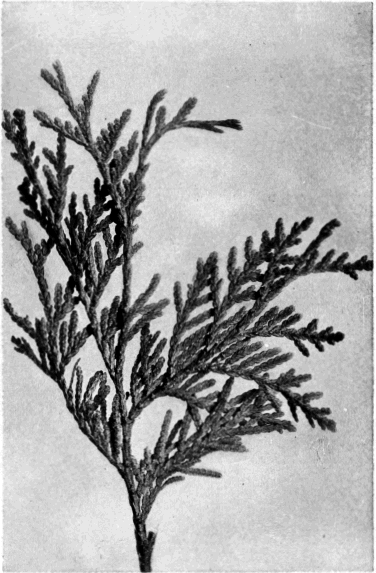
See page 268
THE FLAT, FROND LIKE SPRAY OF THE ORNAMENTAL ARBOR VITAE
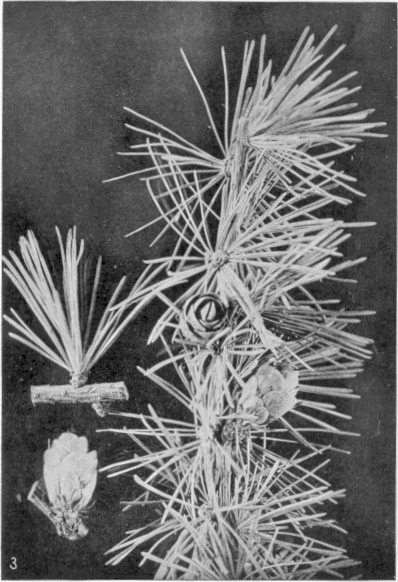
See page 278
FRUIT AND LEAVES OF THE AMERICAN LARCH
THE SEQUOIAS
Nowhere else in the world are conifers found in such extensive forests and in such superlative vigor and stupendous size as in the states that border the Pacific Ocean. California is particularly the paradise of the conifers. All of the species that make the forests of the Northwest the wonder of travelers and the pride of the states are found in equally prodigal size and extent in California. To these forests are added groves of sequoias—the Big Tree and the redwood, the former found nowhere outside of California, the latter reaching into Oregon. Once the sequoias had a wide distribution in the Old and the New World. With magnolias and many other luxuriant trees found in warm climates, five species of sequoia extended over the North Temperate zone in both hemispheres, reaching even to the Arctic Circle. The glacial period transformed the climate of the world and destroyed these luxuriant northern forests under a grinding continuous glacier. The rocks of the tertiary and cretaceous periods preserved in fossils the story of these pre-glacial forests. Two of the species of sequoia escaped destruction in tracts the ice sheet did not overwhelm. For ten thousand years, perhaps, the sequoia has held its own in the California groves. Indeed, both species are able to extend their present range if nature is unhindered. The three enemies that threaten sequoia groves are the axe of the lumberman, the forest fire kindled by the waste about sawmills, and the grazing flocks that destroy seedling trees.
The Big Tree
Sequoia Wellingtonia, Seem.
The Big Tree is the most gigantic tree on the face of the earth, the mightiest living creature in existence. Among the giant sugar pines and red firs it lifts a wonderfully regular, rounded dome so far above the aspiring arrow-tips of its neighbors as to make the best of them look like mere saplings. The massive trunk, clothed with red-brown or purplish bark, is fluted by furrows often more than a foot in depth. The trunk is usually bare of limbs for a hundred or two hundred feet, clearing the forest cover completely before throwing out its angular stout arms. These branch at last into rounded masses of leafy twigs, whose density and brilliant color express the beauty and vigor of eternal youth in a tree which counts its age by thousands of years already.
To see this Big Tree in blossom one must visit the high Sierras while the snow is eight to ten feet deep upon the buttressed base of the huge trunk. It is worth a journey, and that with some hardship in it, to see these trees with all their leafy spray, gold-lined with the multitude of little staminate flowers that sift pollen gold-dust over everything, and fill the air with it. The pistillate flowers, minute, pale green, crowd along the ends of the leafy sprays, their cone scales spread to receive the vitalizing dust brought by the wind.
When spring arrives and starts the flower procession among the lower tree-tops, the spray of the Big Tree is covered with green cones that mature at the end of the second season. They are woody, two to three inches long, and spread their scales wide at a given signal, showering the surrounding woods with the abundant harvest of their minute winged seeds. Each scale bears six to eight of them, each with a circular wing that fits it for a long journey. The cones hang empty on the trees for years.
The leaves of the Big Tree are of the close, twig-hugging, scaly type, never exceeding a half inch in length on the most exuberant-growing shoots. For the most part they are from one fourth to one eighth of an inch in length, sharp pointed, ridged, curved to clasp the stem, and shingled over the leaves above.
John Muir believes there is no absolute limit to the existence of any tree. Accident alone, he thinks, not the wearing out of vital organs, accounts for their death. The fungi that kill the silver fir inevitably before it is three hundred years old touch no limb of the Big Tree with decay. A sequoia must be blown down, undermined, burned down, or shattered by lightning. Old age and disease pass these trees by. Their heads, rising far above the spires of fir and spruce, seem not to court the lightning flash as the lower, pointed trunks do; and yet no aged sequoia can be found whose head has not suffered losses by Jove's thunderbolts. Cheerfully the tree lets go a fraction of its mighty top, and sets about the repair of the damage, with greatly accelerated energy, as if here was an opportunity to expend the tree's pent-up vitality. It is strange to see horizontal branches of great age and size strike upward to form a part of a new, symmetrical dome to replace the head struck off or mangled by lightning. With all the signs of damage lightning has done to these tree giants of the Sierras, but one instance of outright killing of a tree is on record.
The wood of the Big Tree is red and soft, coarse, light, and weak—unfit for must lumber uses. It ought, by all ordinary standards, to be counted scarcely worth the cutting; but the vast quantity yielded by a single tree pays the lumberman huge profits, though he wastes thousands of feet by blasting the mighty shaft into chunks manageable in the sawmill. Shingles, shakes, and fencing consume more of the lumber than general construction—ignoble uses for this noblest of all trees.
The best groves of Big Trees now under government protection are in the grand Sequoia National Park. Near the Yosemite is the famous Mariposa Grove that contains the "grizzly giant" and other specimen trees of great age and size. More than half of the Big Trees are in the hands of speculators and lumber companies. Exploitation of nature's best treasure is as old as the human race. The idea of conservation is still in its infancy.
The ruin by the lumbering interests of a sequoia grove means the drying up of streams and the defeat of irrigation projects in the valleys below. Big Trees inhabit only areas on the western slopes of the Sierras. Wherever they grow their roots have made of the deep soil a sponge that holds the drainage of melting snowbanks and doles it out through streams that flow thence to famishing, hot, wind-swept plains and valleys. When the trees are gone, turbulent, short-lived spring floods exhaust the water supply and do untold damage in the lowlands.
Big Trees have not succeeded in cultivation in our Eastern states, but for many years have been favorites in European gardens and parks. In the native groves the seedlings do not show the virility of the redwoods, though to the south the range of the species is being gradually extended. No tree is more prodigal in seed production and more indifferent, when mature, to the ills that beset ordinary forest trees; yet government protection must be strengthened, private claims must be bought, and scientific forestry maintained in order to prevent the extinction of the species, with the destruction of trees that are, as they stand to-day, the greatest living monuments in the world of plants.
The Redwood
S. sempervirens, Endl.
The redwood comes down to the sea on the western slopes of the Coast Range, from southern Oregon to Monterey County in California, tempting the lumberman by the wonderful wealth and accessibility of these groves of giant trees. The wood is soft, satiny, red, like the thick, fibrous, furrowed bark that clothes the tall, fluted trunks.
Redwoods are taller than Big Trees, have slenderer trunks and branches and a more light and graceful leaf-spray. The head is pyramidal in young trees, later becoming irregular and narrow, and exceedingly small in forests by the crowding of the trees and the death of lower branches. The leaves on the terminal shoots spread into a flat spray, two-ranked, like those of a balsam fir. Each blade is flat, tapering to both ends, and from one fourth to one half an inch in length. Awl-shaped and much shorter leaves are scattered on year-old twigs, back of the new shoots, resembling the foliage of the Big Tree.
The cones are small and almost globular, maturing in a single season, scarcely an inch long, with three to five winged seeds under each scale. Seedling redwoods come quickly from this yearly sowing, and thrive under the forest cover, unless fire or the trampling feet of grazing flocks destroy them. After the lumberman, the virile redwood sends up shoots around the bleeding stumps, thus reinforcing the seedling tree and promising the renewal of the forest groves in the centuries to come.
Redwood lumber is the most important building material on the Pacific Coast. The hardest and choicest wood comes in limited quantities from the stumps which furnish curly and bird's-eye wood, used by the makers of bric-à-brac and high-priced cabinet work. Shingles, siding, and interior finish of houses consume quantities of the yearly output of the mills. Demand for fence posts, railway ties and cooperage increases. Quantities of lumber are shipped east to take the place of white pine no longer obtainable.
In cultivation the redwood is a graceful, quick-growing, beautiful evergreen, successful in the Southeastern states, and often met in European parks and gardens. Weeping forms are very popular abroad.
Government and state protection has made sure the safeguarding for coming generations of some groves of redwoods, containing trees whose size and age rival those of the most ancient Big Trees. But the fact that the redwood, restricted on the map to such a limited territory, is the most important timber tree on the Coast, is a blot upon our vaunted Democracy, which has allowed the cunning of a few small minds to defeat the best interests of the whole people and rob them of forest treasure which might yield its benefits continuously, if properly managed. Government purchase of all sequoia-bearing land, followed by rational methods of harvesting the mature lumber and conserving the young growth, is the ideal solution of the problem. Such a plan would assure the saving of the monumental giants.
THE ARBOR-VITAES
Minute, scale-like leaves, four-ranked, closely overlapping, so as to conceal the wiry twig, mark the genus thuya, which is represented in America by two species of slender, pyramidal evergreen trees, whose intricately branched limbs terminate in a flat, open spray (see illustration, page 262). "Tree of Life" is the English translation, but the Latin name everywhere is heard.
Eastern Arbor-vitae
Thuya occidentalis, Linn.
The Eastern arbor-vitae, called also the white cedar, is found in impenetrable pure forest growth, from Nova Scotia and New Brunswick northwestward to the mouth of the Saskatchewan River, always in swampy regions, or along the rocky banks of streams. In the East it follows the mountains to Tennessee, and from Lake Winnipeg it extends south to middle Minnesota and northern Illinois. In cultivation it is oftenest seen as an individual lawn and park tree, or in hedges on boundary lines. It submits comfortably to severe pruning, is easily transplanted, and comes readily from seed. Plantations grow rapidly into fence posts and telegraph poles. The wood is durable in wet ground, but very soft, coarse, and brittle.
The Red Cedar
T. plicata, D. Don.
The red cedar or canoe cedar is the giant arbor-vitae of the coast region from British Columbia to northern California and east over the mountain ranges into Idaho and northern Montana. Its buttressed trunk is a fluted column one hundred and fifty to two hundred feet high in western Washington and Oregon, along the banks of mountain streams and in the rich bottom land farther seaward. The leaves in a flat spray at once distinguish this tree from any other conifer, for they are pointed, scale-like, closely overlapping each other in alternate pairs.
The clustered cones, with their six or eight seed-bearing scales, seem absurdly small fruits on so huge a tree. None exceeds one half an inch in height, but their number makes up for size deficiency and the seed crop is tremendous.
The Alaskan Indian chooses the tall bole of a red cedar for his totem pole, and from the massive butt hollows out the war canoe and "dug-out" which solve his problems of transportation in summer. Durability is the chief merit of this soft, brittle wood, which is easily worked with the Indian's crude tools. The bark of the tree furnishes the walls of the Indian huts and its inner fibre is the raw material of his cordage—the harness for his dog team, his nets and lines for fishing; and it is the basis of the squaw's basket-weaving industry.
This is the best arbor-vitae for ornamental planting. Its success in Europe is very striking, and from European nurseries it has been successfully re-introduced into the United States, where it is hardy and vigorous. But it fails when taken directly into the North Atlantic states. It must come in via Europe, as nearly all West Coast trees have to do in order to succeed.
THE INCENSE CEDAR
One tree, so magnificent in proportions that it ranks among the giants in our Western forests, stands as the sole American representative of its genus. Its nearest relatives are the arbor-vitaes, sequoias, and the bald cypress of the South.
The incense cedar (Librocedrus Decurrens, Torr.) has its name from its resinous, aromatic sap. The tree, when it grows apart from others, forms a perfect tapering pyramid, with flat, plume-like sprays that sweep downward and outward with wonderful lightness and grace. The leaves are scale-like, closely appressed to the wiry twigs, in four ranks, bright green, tinged with gold in late winter, by the abundance of the yellow staminate flowers. The cones are small, narrowly pointed, made of few paired scales, each bearing two seeds. The bark is cinnamon-red in color. The trees occur scattered among other species in open forests from three thousand to six thousand feet above the sea, reaching a height of two hundred feet and a trunk diameter of twelve feet on the Sierra Nevada glacial moraines.
The lumber resembles that of arbor-vitae, and is used for the same purposes. In cultivation the tree is hardy and thrives in parks in the neighborhood of New York. In Europe it has long been a favorite.
THE CYPRESSES
Three genera of pyramidal conifers, with light, graceful leaf-spray, and small woody cones, held erect, compose the group known as cypresses. All have found places in horticulture, for not one of them but has value for ornamental planting. Some species have considerable lumber value.
The Monterey Cypress
Cupressus macrocarpa, Cord.
The Monterey cypress is now restricted to certain ocean-facing bluffs about Monterey Bay in California. These trees are derelicts of their species. Wind-beaten into grotesqueness of form, unmatched in any other tree near the sea-level, their matted and gnarled branches make a flat and very irregular top above a short, thick, often bent and leaning trunk. Clusters of globular cones stud the twigs behind the leafy spray composed of thread-like wiry twigs, entirely covered with scaly, four-ranked leaves.
In cultivation this cypress grows into a luxuriant, pyramidal tree, often broadening and losing its symmetry, but redeeming it by the grace of its plume-like, outstretched branches. One by one the native cypresses on the crumbling bluffs will go down into Monterey Bay, for the undermining process is eating out their foundations. Wind and wave are slowly but surely sealing their doom. But the species is saved to a much wider territory.
The European Cypress
C. sempervirens, Linn.
A tall, narrow pyramid of sombre green, the European cypress is found in cemeteries in south Europe and everywhere, planted for ornament. This is the classic cypress, a conventional feature of Italian gardens, the evergreen most frequently mentioned in classical literature. Slow-growing and noted for its longevity, it was the symbol of immortality. It is hardy in the South-Atlantic and Pacific-Coast states, and is a favorite evergreen for hedges in the Southwest.
Three other members of the genus occur on mountain foothills—one in Arizona, two in California—all easily recognized by their scale-like leaves and button-like woody cones, which require two years to mature.
The White Cedar
Chamaecyparis Thyoides, Britt.
The genus chamaecyparis includes three American species, of tall, narrow pyramidal habit and flat leaf-spray like that of the arbor-vitae. Annual erect globular cones of few, woody scales, produce one to five seeds under each.
This white cedar is the swamp-loving variety of the Atlantic seaboard—its range stretches from Maine to Mississippi. The durability of its white wood gives it considerable importance as a lumber tree. It is particularly dependable when placed in contact with water and exposed to weather. Cedar shingles, fence posts, railroad ties, buckets, and other cooperage consume quantities each year. The trees are important ornamental evergreens, planted for their graceful spray and their dull blue-green leaves. Their maximum height is eighty feet.
The Lawson Cypress
C. Lawsoniana, A. Murr.
The Lawson cypress lifts its splendid spire to a height of two hundred feet, on the coast mountains of Oregon and California, forming a nearly continuous forest belt twenty miles long, between Point Gregory and the mouth of the Coquille River. Spire-like, with short, horizontal branches, this species bears a leaf-spray of feathery lightness, bright green, from the multitude of minute paired leaf-scales, and adorned with the clustered pea-sized cones, which are blue-green and very pale until they ripen.
The wood of this giant cypress is used in house-finishing and in boat-building; for flooring, fencing, and for railroad ties.
The Bald Cypress
Taxodium distichum, Rich.
The bald cypress is the one member of the cypress group that sheds its foliage each autumn, following the example of the tamarack. In the Far South, river swamps are often covered with a growth of these cypresses whose trunks are strangely swollen at the base, and often hollow. The flaring buttresses are prolonged into the main roots, which form humps that rise out of the water at some distance from the tree. These "cypress knees" are not yet explained, though authorities suspect that they have something to do with the aëration of the root system.
Inundated nine or ten months of the year, these cypress swamps are often dry the remaining time, and it is a surprise to Southerners to find these trees comfortable and beautiful in Northern parks. Cleveland and New York parks have splendid examples.
The leaves of the bald cypress are of two types. They are scale-like only on stems that bear the globular cones. On other shoots they form a flat spray, each leaf one-half to three-fourths of an inch long, pea-green in the Southern swamps, bright yellow-green on both sides in dry ground, turning orange-brown before they fall. The twigs that bear these two-ranked leaves are also deciduous, a unique distinction of this genus.
Cypress wood is soft, light brown, durable, and easily worked. Quantities of it are shipped north and used in the manufacture of doors and interior finishing of houses, for fencing, railroad ties, cooperage, and shingles.
THE JUNIPERS
The sign by which the junipers are most easily distinguished from other evergreens, is the juicy berries instead of cones. In some species these are red, but they are mostly blue or blue-black. Before they mature it is easy to see the stages by which the cone-scales thicken and coalesce, instead of hardening and remaining separate, as in the typical fruit of conifers.
Juniper leaves are of two types: scale-like in opposite pairs, pressed close to the twig, as in the cypresses; and stiff, spiny, usually channelled leaves, which stand out free from the twig in whorls of threes.
The wood is red, fragrant, durable, and light.
The Dwarf Juniper
Juniperus communis, Linn.
The dwarf juniper departs from the pyramidal pattern and forms a loose, open head above a short, stout trunk. The slender branchlets are clothed with boat-shaped leaves which spread nearly at right angles from the twigs in whorls of three. Each one is pointed and hollowed, dark green outside, snowy white inside, which is really the upper side of the leaf. It requires three years to mature the bright blue berries, and they hang on the tree two or three years longer. Each fruit contains two or three seeds, and these require three years to germinate.
It is plain to see that time is no object to this slow-growing dwarf juniper, found in both the Eastern and Western Hemispheres, covering vast stretches of waste land. From Greenland to Alaska it is found and south along the highlands into Pennsylvania, New Mexico, and California. Its hardiness gives it importance as a cover for waste land on seashores and for hedges and wind-breaks in any exposed situation. It is a tree reaching thirty feet in height on the limestone hills of southern Illinois. In other situations it is usually a sprawling shrubby thing, the cringing parent of a race of dwarf junipers, known in many and various horticultural forms.
The Western Juniper
J. occidentalis, Hook.
The giant of its race is the Western juniper, one of the patriarchial trees of America, ranking in age with the sequoias. Never a tall tree, it yet attains a trunk diameter of ten feet, and an age that surely exceeds two thousand years. At elevations of seven to ten thousand feet this valiant red cedar is found clinging to the granite domes and bare glacial pavements where soil and moisture seem absolutely non-existent. Sunshine and thin air are abundant, however, and elbow room. Upon these commodities the tree subsists, crouching, stubbornly clinging, while a single root offers foothold, its gnarled branches picturesque and beautiful in their tufts of gray-green leaves. Avalanches have beheaded the oldest of these giants, but their denuded trunks throw out wisps of new foliage with each returning spring. When they succumb, their trunks last almost as long as the granite boulders among which they are cast by the wind or the ice-burden that tore them loose.
The stringy bark is woven into cloth and matting by the Indians, and the fine-grained, hard, red wood finds no better use than for the mountaineer's fencing and fuel.
The Eastern Red Cedar
J. Virginiana, Linn.
The Eastern red cedar is a handsome, narrow pyramid in its youth, often becoming broad and irregular, or round-topped above a buttressed, twisted trunk, as it grows old. The scale-like leaves are four-ranked, blue-green when young, spreading, and sometimes three fourths of an inch long, on vigorous new shoots. The dark blue berries are covered with a pale bloom and have a resinous, sweet flesh. This juniper is familiar in abandoned farms and ragged fence-rows, becoming rusty brown in foliage to match the stringy red bark in winter time. The durable red wood is used for posts and railroad ties, for cedar chests and pencils. The tree is profitably planted by railroad companies, as cedar ties are unsurpassed. In cultivation the tree forms an interesting, symmetrical specimen, adapted to formal gardens. (See illustration, page 230.)
The Red Juniper
J. Barbadensis, Linn.
The red juniper, much more luxuriant than its close relative of the North, is the handsomest juniper in cultivation. Its pyramid is robbed of a rigid formal expression by the drooping of its fern-like leaf-spray. The berries are silvery white and abundant. The wood is used principally for pencils. This species grows in the Gulf states.
THE LARCHES, OR TAMARACKS
The notable characteristic of the small genus, larix, is that the narrow leaves are shed in the autumn. Here is a tall pyramidal conifer which is not evergreen. It bears an annual crop of small woody cones, held erect on the branches, and the leaves are borne in crowded clusters on short lateral spurs, except upon the terminal shoots, where the leaves are scattered remotely but follow the spiral plan. Larch wood is hard, heavy, resinous, and almost indestructible. The tall shafts are ideal for telegraph poles and posts.
The Tamarack
Larix Americana, Michx.
The tamarack or American larch (see illustration, page 263) goes farther north than any other tree, except dwarf willows and birches. Above these stunted, broad-leaved trees pure forests of tamarack rise, covering Northern swamps from Newfoundland and Labrador to Hudson Bay and west across the Rocky Mountains, the trees dwindling in size as they approach the arctic tundras, the limit of tree growth. The wood of these bravest of all conifers is a God-send over vast territories where other supply of timber is wanting. The tough roots of the larch tree supply threads with which the Indian sews his birch canoe.
In cultivation the American species is too sparse of limb and foliage to compete with the more luxuriant European larch, yet it is often planted. Its fresh spring foliage is lightened by the pale yellow of the globular staminate flowers and warmed by the rosy tips of the cone flowers. In early autumn the plain, thin-scaled cones, erect and bright chestnut-brown, shed their small seeds while the yellow leaves are dropping, and the bare limbs carry the empty cones until the following year.
The Western Larch
L. occidentalis, Nutt.
The Western larch is the finest tree in its genus, reaching six feet in trunk diameter and two hundred feet in height, in the Cascade forests from British Columbia to southern Oregon and across the ranges to western Montana. This tree has the unusual distinction of exceeding all conifers in the value of its wood, which is heavy, hard, strong, dense, durable, of a fine red that takes a brilliant polish. It is used for furniture and for the interior finish of houses. Quantities of it supply the demand for posts and railroad ties, in which use it lasts indefinitely, compared with other timber.
PART IX
THE PALMS
Palms are tropical plants related to lilies on one hand and grasses on the other. One hundred genera and about one thousand species compose a family in which tree forms rarely occur. A few genera grow wild in the warmest sections of this country, and exotics are familiar in cultivation, wherever they are hardy. The leaves are parallel-veined, fan-shaped, or feather-like, on long stalks that sheath the trunk, splitting with its growth. The flowers are lily-like, on the plan of three, and the fruits are clustered berries, or drupes.
Sago, tapioca, cocoanuts, and dates are foods derived from members of this wonderful family. The fibres of the leaves supply thread for weaving cloth and cordage to the natives of the tropics, where houses are built and furnished throughout from the native palms.
The royal palm, crowned with a rosette of feather-like leaves, each ten to twelve feet long, above the smooth, tall stems, is a favorite avenue tree in tropical cities. In Florida it grows wild in the extreme southwest, but is planted on the streets of Miami and Palm Beach. Its maximum height is one hundred feet.
In California the favorite avenue palm of this feather-leaved type is the Canary Island palm, whose stout trunk, covered with interlacing leaf-bases, wears a crown of plumes that reach fifteen feet in length and touch the ground with their drooping tips. Huge clusters of bright yellow, dry, olive-shaped berries ripen in midsummer.
The date palm of commerce, once confined to the tropical deserts of Asia Minor and North Africa, has been successfully established by the Government in hot, dry localities of the Southwest. Fruit equal to any grown in plantations of the Old World is marketed now from the Imperial and Coachella valleys in California, and from orchards near Phoenix, Arizona. Dry air and a summer temperature far above the hundred degree mark is necessary to insure the proper sugar content and flavor in these fruits, which are borne in huge clusters and ripen slowly, one by one.
Fan-shaped leaves plaited on the ends of long stalks that are usually spiny-edged are borne by the stocky Florida palmettos and the tall desert palm of California, planted widely in cities of the Southwest and in Europe. Several genera of this fan-leaved type are represented in palm gardens, and in the general horticulture of warm regions of this country.
THE END
GENERAL INDEX
Abies balsamea
,
258
Abies concolor
,
257
Abies Fraseri
,
253
Abies grandis
,
256
Abies magnifica
,
254
Abies nobilis
,
256
Acacia dealbata
,
187
Acacia Melanoxylon
,
186
Acacia
, Palo verde,
190
Acacias, The,
184-187
Acer circinatum
,
197
Acer glabrum
,
199
Acer macrophyllum
,
197
Acer nigrum
,
195
Acer Negundo
,
199
Acer Pennsylvanicum
,
198
Acer pseudo-platanus
,
200
Acer rubrum
,
195
Acer saccharinum
,
196
Acer saccharum
,
194
Acer spicatum
,
198
Aesculus Californica
,
68
Aesculus glabra
,
67
Aesculus Hippocastanum
,
65
Aesculus octandra
,
67
"Ague tree",
131
Alder, Black,
91
Alder, Oregon,
93
Alder, Red,
93
Alder, Seaside,
92
Alders, The,
91-93
Alligator pear,
129
Almond,
152
Alnus glutinosa
,
91
Alnus maritima
,
92
Alnus Oregona
,
93
Amelanchier alnifolia
,
160
Amelanchier Canadensis
,
159
American beech,
42
American elm,
210
American holly,
145
American hornbeam,
85
American larch,
278
American linden,
70
Annual rings,
12
Anona cherimolia
,
171
Anona glabra
,
170
Apples, The,
147-149
Arbor-vitaes, The,
268-270
Arboreta,
xiv
Arbutus Menziesii
,
121
Arnold arboretum,
xiv
Ash, Black,
204
Ash, Blue,
206
Ash, European,
208
Ash, Green,
206
Ash, Oregon,
207
Ash, Red,
205
Ash, White,
202
Ashes, Mountain,
116-118
Ashes, The,
201-209
Asimina triloba
,
168
Aspen,
78
Assam rubber tree,
166
Autumn leaves,
19
Avocado,
129
Bald cypress,
273
Balm of Gilead,
79
Balsam fir,
253
Balsam poplar,
79
"Banana tree, Wild",
169
Banyan tree,
166
Bark, xv,
23
Basket oak,
55
Basswood, Downy,
72
Basswood, White,
71
Basswoods, The,
68-74
Bay, Red,
129
Bay, Rose,
119
Bay, Swamp,
105
Bee tree,
71
Beech, American,
42
"Beech, Blue",
85
"Beech, Water",
85
"Beetle-wood",
86
Betula lenta
,
90
Betula lutea
,
89
Betula nigra
,
90
Betula papyrifera
,
88
Betula populifolia
,
89
"Big-cone" pine,
240
Big shellbark,
38
Big Tree,
263
Birch, Canoe,
88
Birch, Cherry,
90
Birch, Paper,
88
Birch, Red,
90
Birch, River,
90
Birch, White,
89
Birch, Yellow,
89
Birches, The,
87-91
Bird cherry,
153
"Bird's-eye" maplewood,
15
Black acacia,
186
Black alder,
91
Black ash,
204
Black cherry, Wild,
153
Black cottonwood,
80
Black dwarf sumach,
140
Black gum,
96
Black haw
,
115
,
158
Black locust,
178
Black maple,
195
Black mulberry,
165
Black oak,
58
Black oak group,
58-65
Black poplar,
77
Black spruce,
248
Black walnut,
31
Blackwood-tree,
186
Blue ash,
206
"Blue beech",
85
Blue fir,
257
Blue spruce,
250
Box elder,
199
Buckeye, California,
68
Buckeye, Ohio,
67
Buckeye, Sweet,
67
Buds,
3
,
23
Bur oak,
51
Burning bush,
136
Butternut,
30
Buttonwoods, The,
93-95
California walnut,
29
California white oak,
57
Cambium,
9
,
21
Campbell's magnolia,
103
Camperdown elm,
216
Canada plum,
151
Canary island palm,
280
Canoe birch,
88
Canoe cedar,
269
Carica papaya
,
169
Carolina poplar,
78
Carpinus Carolinianum
,
85
Castanea dentata
,
44
Castanea pumila
,
44-46
Cedar, Canoe,
269
Cedar, Eastern red,
276
Cedar, Incense,
270
Cedar, Red,
269
Cedar, White,
272
Celtis Australis
,
162
Celtis occidentalis
,
161
Cercidium Torreyanum
,
190
Cercis Canadensis
,
182
Chamaecyparis Lawsoniana
,
273
Chamaecyparis Thyoides
,
272
Chemistry of trees,
5-8
Cherimoya,
171
Cherries, The,
152-155
Cherry birch,
90
Chestnut oak,
53
Chestnuts, The,
44-47
Chinquapin,
44-46
Chionanthus Virginica
,
126
Chlorophyll, Breaking down of the,
18
Choke cherry,
154
Cladrastis lutea
,
183
Clammy locust,
179
Cockspur thorn,
156
Coffee tree, Kentucky,
181
Colorado blue spruce,
250
Common lime,
72
Cone-bearing evergreens,
217-279
Conifers,
217-279
Coral-bean,
192
"Cork elm",
215
Cornel,
113
Cornus Florida
,
111
Cornus mas
,
113
Cornus Nuttallii
,
113
Cotinus
,
142
Cotton gum,
97
Cottonwood,
77
Cottonwood, Black,
80
Cottonwood, Lance-leaved,
80
Cottonwood, Mexican,
80
Cottonwood, Narrow-leaved,
80
Cottonwood, Swamp,
81
Crab, Prairie,
148
Crab, Wild,
148
Crataegus coccinea
,
158
Crataegus Crus-galli
,
156
Crataegus Douglasii
,
158
Crataegus mollis
,
157
Crataegus oxyacantha
,
155
Crataegus pruinosa
,
157
Cuban pine,
236
Cucumber tree,
107
Cucumber tree, Large-leaved,
106
Cupressus macrocarpa
,
271
Cupressus sempervirens
,
272
"Curly maplewood",
15
Custard-apple,
168
,
170
Cypresses, The,
271-274
Date palm,
281
Digger pine,
239
Diospyros
Virginiana
,
172
Dogwood, European,
113
Dogwood, Flowering,
111
Dogwood, Jamaica,
190
Dogwood, Western,
113
Dogwoods, The,
111-114
Douglas spruce,
258
Downy basswood,
72
Dwarf juniper,
275
Dwarf maple,
199
Dwarf sumach,
140
Eastern arbor-vitae,
268
Eastern mountain ash,
116
Eastern red cedar,
276
Eastern service berry,
159
Ebony, Texas,
191
Elder, Box,
199
Elder-leaved mountain ash,
117
Elm, American,
210
Elm, Camperdown,
216
"Elm, Cork",
215
Elm, English,
215
Elm, Hickory,
214
Elm, Moose,
213
Elm, Mountain,
215
Elm, Red,
213
Elm, Rock,
214
Elm, Scotch,
216
Elm, Slippery,
213
Elm, Small-leaved,
215
Elm, White,
210
Elm, Winged,
215
Elm, Wych,
216
Elms, The,
210-216
"Encina",
64
Engelmann spruce,
250
English elm,
215
English hawthorn,
155
English walnut,
33
Euonymus atropurpureus
,
136
European ash,
208
European cypress,
272
European dogwood,
113
European holly,
144
European mountain ash,
117
European nettle tree,
162
Evergreens, Cone-bearing,
217-279
Evergreens, Leaves of,
20
Fagus Americanus
,
42
Fibres of wood,
13
Ficus aurea
,
167
Ficus elasticus
,
166
"Fiddleback" ash,
209
Figs, The,
165-167
Fir, Balsam,
253
Fir, Blue,
257
Fir, Noble,
256
Fir, Red,
254
Fir, Red (
A. nobilis
),
256
Fir, Silver,
257
Fir, White,
256
Fir, White (
A. concolor
),
257
Firs, The,
251-257
Flowering dogwood,
111
"Foxtail" pines, The,
229
Fraxinus Americana
,
202
Fraxinus excelsior
,
208
Fraxinus nigra
,
204
Fraxinus Oregona
,
207
Fraxinus ornus
,
209
Fraxinus Pennsylvanica
,
205
Fraxinus Pennsylvanica
(
lanceolata
),
206
Fraxinus quadrangulata
,
206
Frijolito,
192
Fringe tree,
126
Gerarde,
73
Gleditsia triacanthos
,
180
Golden fig,
167
Grain of wood,
13
Gray pine,
238
Great laurel,
119
Great laurel magnolia,
104
Green ash,
206
"Grete Herball",
73
Gum, Cotton,
97
Gum, Sour or Black,
96
Gum, Sweet,
97
Gum trees, The,
95-100
Gymnocladus dioicus
,
181
Gymnosperms,
217-279
Hackberries, The,
160-162
Hamamelis Virginiana
,
134
"Hard-tack",
86
Haw, Black,
115
,
158
Haw, Red,
157
Haw, Scarlet,
157-158
Hawthorns, The,
155-159
Hazel, Witch,
133
Heath family,
118
Hemlocks, The,
259-262
Hicoria alba
,
40
Hicoria glabra
,
41
Hicoria lacinata
,
38
Hicoria ovata
,
37
Hicoria Pecan
,
38
Hickories, The,
36-41
Hickory elm,
214
Hollies, The,
143-146
Holly, American,
145
Holly, European,
144
Honey locust,
179
Honey pod,
188
Hop hornbeam,
86
Hornbeam, American,
85
Hornbeam, Hop,
86
Horse bean,
191
Horse-chestnut foliage,
17
Horse-chestnuts, The,
65-68
"Horse sugar",
125
Icthyomethia Piscipula
,
190
Ilex aquifolium
,
144
Ilex Opaca
,
145
Ilex vomitoria
,
145
Incense cedar,
270
"Iron oak",
52
"Ironwood,"
see also
Hornbeam
Ironwood, Knowlton's,
87
Jack pine,
238
Jamaica dogwood,
190
Japanese persimmon,
175
Japanese walnut,
33
"Judas-tree",
183
Juglans, Californica
,
29
Juglans cinerea
,
30
Juglans cordiformis
,
33
Juglans nigra
,
31
Juglans regia
,
33
Juglans rupestris
,
29
Juglans Sieboldiana
,
33
June-berry,
159
Junipers, The,
274-277
Juniperus
Barbadensis
,
277
Juniperus communis
,
275
Juniperus occidentalis
,
276
Juniperus Virginiana
,
276
Kaki,
175
Kalm, Peter,
xx
Kalmia latifolia
,
120
Kentucky coffee tree,
181
Knob-cone pine,
240
Knowlton's ironwood,
87
Lance-leaved Cottonwood,
80
"
Langues de femmes
",
81
Larches, The,
277-279
Large-leaved cucumber tree,
106
Larix Americana
,
278
Larix occidentalis
,
279
Laurel family,
127-133
Laurel, Great,
119
Laurel, Mountain,
120
Laurel oak,
63
Laurus nobilis
,
129
Lawson cypress,
273
Leaves,
4
,
16-20
"Lever-wood",
86
Librocedus Decurrens
,
270
Lime, Common,
72
"Lime Trees,"
see
Lindens
Linden, American,
70
Lindens, The,
68-74
Linnaeus, xviii,
73
Liquidamber styraciflua
,
97
Liriodendron tulipifera
,
109
Live oak,
56
Live oak (
Q. aquifolia
),
64
Loblolly pine,
236
Locusts, The,
177-184
Lodge-pole pine,
245
Lombardy poplar,
77
Longleaf pine,
232
Madroña,
121
Magnolia acuminata
,
107
Magnolia, Campbell's,
103
Magnolia foetida
,
104
Magnolia Glauca
,
105
Magnolia, Great laurel,
104
Magnolia macrophylla
,
106
Magnolia, Starry,
103
Magnolia stellata
,
103
Magnolia tripetala
,
108
Magnolia yulan
,
102
Magnolias, The,
101-111
Malus coronaria
,
148
Malus ioensis
,
148
Maple, "Bird's eye" and "Curly",
15
Maple, Black,
195
Maple, Dwarf,
199
Maple, Mountain,
198
Maple, Norway,
200
Maple, Oregon,
197
Maple, Red,
195
Maple, Silver,
196
Maple, Soft,
196
Maple, Striped,
198
Maple, Sugar,
194
Maple, Sycamore,
200
Maple, Vine,
197
Maple, Wier's weeping,
196
Maples, The,
193-201
Melon papaw,
169
Mesquite,
188
Mexican cottonwood,
80
Mississippi Valley chestnut oak,
54
Mockernut,
40
Mohrodendron diptera
,
124
Mohrodendron tetraptera
,
123
Monterey cypress,
271
Monterey pine,
241
Moose elm,
213
Morus alba
,
164
Morus nigra
,
165
Morus rubra
,
163
Mountain ashes,
116-118
Mountain elm,
215
Mountain hemlock,
261
Mountain laurel,
120
Mountain maple,
198
Mountain pine,
224
Mountain sumach,
140
Muir, John,
xvi
Mulberries, The,
163-165
Names of trees,
xvii-xxiii
Nannyberry, Rusty,
115
Narrow-leaved cottonwood,
80
"Necklace-bearing" poplar,
78
Nettle tree, European,
162
Noble fir,
256
Nomenclature of trees,
xvii-xxiii
Norway maple,
200
Norway pine,
246
Norway spruce,
248
Nut pines,
230-232
Nut trees, The,
28-74
Nyssa aquatica
,
97
Nyssa sylvatica
,
96
Oak, Basket,
55
Oak, Black,
58
Oak, Bur,
51
Oak, California white,
57
Oak, Chestnut,
53
Oak, "Iron",
52
Oak, Live,
56
Oak, Live (
Q. agrifolia
),
64
Oak, Mississippi Valley chestnut,
54
Oak, Pacific post,
57
Oak, Pin,
60
Oak, Post,
52
Oak, Red,
61
Oak, "Rock chestnut",
53
Oak, Scarlet,
59
Oak, Single or Laurel,
63
Oak, Swamp white,
54
Oak, White,
49
Oak, Willow,
62
Oak, "Yellow",
54
Oaks, Black,
58-65
Oaks, The,
46-65
Oaks, White,
49-58
Ohio buckeye,
67
Oilnut,
30
Old field pine,
236
One-leaved nut pine,
231
Oregon alder,
93
Oregon ash,
207
Oregon maple,
197
Oriental plane,
95
Osage orange,
99
Ostrya Knowletoni
,
87
Ostrya Virginiana
,
86
Oxydendrum arboreum
,
122
Pacific post oak,
57
Palms, The,
280
Palo verde acacia,
190
Papaws, The,
167-170
Paper birch,
88
Parkinsonia aculeata
,
191
Pecan,
38
"Pepperidge",
96
Persea Borbonia
,
129
Persea gratissima
,
129
Persimmons, The,
172-175
Picea Engelmanni
,
250
Picea excelsa
,
248
Picea Mariana
,
248
Picea Parryana
,
250
Picea rubens
,
249
Picea Sitchensis
,
251
Pie cherry,
152
Pignut,
41
Pin cherry,
153
Pin oak,
60
Pine, "Big-cone",
240
Pine, Cuban,
236
Pine, Digger,
239
Pine, Gray,
238
Pine, Jack,
238
Pine, Knob-cone,
240
Pine, Loblolly,
236
Pine, Lodge-pole,
245
Pine, Longleaf,
232
Pine, Monterey,
241
Pine, Mountain,
224
Pine, Norway,
246
Pine, Old field,
236
Pine, One-leaved nut,
231
Pine, Pitch,
237
Pine, Prickle-cone,
229
Pine, Red,
246
"Pine, Red",
258
Pine, Rocky Mountain white,
228
Pine, Rosemary,
237
Pine, Scrub,
244
Pine, Shortleaf,
235
Pine, Slash,
236
Pine, "Southern",
233
Pine, Sugar,
225
Pine, Swamp,
236
Pine, Tamarack,
245
Pine, Western pitch,
239
Pine, Western yellow,
242
Pine, White,
222
Pine, White bark,
228
Pines, "Foxtail",
229
Pines, Nut,
230-232
Pines, The,
220-247
Piñon,
230
Pinus albicaulis
,
228
Pinus aristata
,
229
Pinus attenuata
,
240
Pinus Balfouriana
,
229
Pinus Caribaea
,
236
Pinus cembroides
,
230
Pinus contorta
,
244
Pinus Coulteri
,
239
Pinus divaricata
,
238
Pinus echinata
,
235
Pinus edulis
,
230
Pinus flexilis
,
228
Pinus Lambertiana
,
225
Pinus monophylla
,
231
Pinus Monticola
,
224
Pinus palustris
,
232
Pinus ponderosa
,
242
Pinus quadrifolia
,
230
Pinus radiata
,
241
Pinus resinosa
,
246
Pinus rigida
,
237
Pinus Sabiniana
,
239
Pinus Strobus
,
222
Pinus Taeda
,
236
Pitch pine,
237
Pitch pine, Western,
239
Pitch pines, The,
232
Plane, Oriental,
95
Platanus occidentalis
,
93
Platanus orientalis
,
95
Plums, The,
149-152
"Pod-bearers," The,
176-192
Poison sumach,
141
Pond apples, The,
170-172
Poplar, Balsam, 79 Poplar, Black,
77
Poplar, Carolina,
78
Poplar, Lombardy,
77
Poplar, "Necklace-bearing",
78
Poplar, Silver-leaved,
76
Poplar, White,
76
Poplars, The,
75-81
Populus acuminata
,
80
Populus alba
,
76
Populus angustifolia
,
80
Populus balsamifera
,
79
Populus deltoidea
,
77
Populus heterophylla
,
81
Populus Mexicana
,
80
Populus nigra
,
77
Populus tremuloides
,
78
Populus trichocarpa
,
80
Post oak,
52
Prairie crab,
148
Prickle-cone pine,
229
Prickwood,
137
Prosopis pubescens
,
189
Prosopis Tuliflora
,
188
Prunus Americanus
,
150
Prunus avium
,
152
Prunus cerasus
,
152
Prunus nigra
,
151
Prunus Pennsylvanica
,
153
Prunus pseudo-Cerasus
,
152
Prunus serotina
,
153
Prunus Virginiana
,
154
Pseudotsuga mucronata
,
258
Pussy willow,
84
Quaking asp,
78
Quercus acuminata
,
54
Quercus agrifolia
,
64
Quercus alba
,
49
Quercus chrysolepis
,
63
Quercus coccinea
,
59
Quercus Garryana
,
57
Quercus lobata
,
57
Quercus macrocarpa
,
51
Quercus Michauxii
,
55
Quercus minor
,
52
Quercus palustris
,
60
Quercus Phellos
,
62
Quercus platanoides
,
54
Quercus prinus
,
53
Quercus rubra
,
61
Quercus velutina
,
58
Quercus Virginiana
,
56
Ram's horn ash,
209
Red alder,
93
Red ash,
205
Red bay,
129
Red birch,
90
Red cedar,
269
Red cedar, Eastern,
276
Red elm,
213
Red fir,
254
Red fir (
A. nobilis
),
256
Red
haw,
157
Red juniper,
277
Red maple,
195
Red mulberry,
163
Red oak,
61
Red pine,
246
"Red pine",
258
Red plum, Wild,
150
Red spruce,
249
Redbud,
182
Redwood,
266
Retama,
191
Rhododendron,
118
Rhododendron maximum
,
119
Rhus copallina
,
140
Rhus glabra
,
141
Rhus hirta
,
138
Rhus Vernix
,
141
Rings, The Annual,
12
River birch,
90
Robinia Pseudacacia
,
178
Robinia viscosa
,
179
"Rock chestnut" oak,
53
Rock elm,
214
Rocky Mountain white pine,
228
Rose bay,
119
Rosemary pine,
237
Rowan tree,
117
Royal palm,
280
Rubber plant,
166
Rum cherry,
153
Rusty nannyberry,
115
Salix Babylonica
,
83
Salix discolor
,
84
Sap,
6
Sargent, Professor, xxi Sassafras,
130
Scarlet haw,
157
Scarlet oak,
59
Scientific names, xvii Scotch elm,
216
Screw-bean,
189
Screw-pod,
189
Scrub pine,
244
Seaside alder,
92
Sequoia sempervirens
, 266
Sequoia Wellingtonia
,
263
Sequoias, The,
262-268
Service-berries, The,
159-160
Shad-bush,
159
Shagbark,
37
Shaw botanical garden, xiv Sheepberry,
114
Shellbark,
37
Shellbark, Big,
38
Shingle oak,
63
Shortleaf pine,
235
"Silva of North America",
xxi
Silver bell trees,
123
Silver fir,
257
Silver-leaved poplar,
76
Silver maple,
196
Silver wattle,
187
Slash pine,
236
Slippery elm,
213
Small-leaved elm,
215
Smoke tree,
142
Smooth sumach,
141
Snowdrop tree,
124
"Snowdrop tree",
123
Soft maple,
196
Soft pines,
222-229
Sophora secundiflora
,
192
Sorbus Americana
,
116
Sorbus Aucuparia
,
117
Sorbus sambucifolia
,
117
Sorrel tree,
122
Sour gum,
96
Sour-wood,
122
"Southern" pine,
233
Southwestern walnut,
29
"
Species plantarum
",
xix
Spruce, Black,
248
Spruce, Blue,
250
Spruce, Douglas,
258
Spruce, Engelmann,
250
Spruce, Norway,
248
Spruce, Red,
249
Spruce, Tideland,
251
Spruces, The,
247-251
Staghorn sumach,
138
Starch,
7
Starry magnolia,
103
Striped mapl,
198
Sugar maple,
194
Sugar pine,
225
Sumach, Black dwarf,
140
Sumach, Dwarf,
140
Sumach, Mountain,
140
Sumach, Poison,
141
Sumach, Smooth,
141
Sumach, Staghorn,
138
Sumachs, The,
137-142
Swamp bay,
105
Swamp Cottonwood,
81
Swamp pine,
236
Swamp white oak,
54
Sweet buckeye,
67
Sweet cherry,
152
Sweet gum,
97
Sweet leaf,
124
Sycamore maple,
200
Sycamores, The,
93-95
Symplocos tinctoria
,
125
Tamarack pine,
245
Tamaracks, The,
277-279
"Tassel trees",
186
Taxodium distichum
,
273
Texas ebony,
191
Thuya occidentalis
,
268
Thuya plicata
,
269
Tideland spruce,,
251
Tilia Americana
,
70
Tilia heterophylla
,
71
Tilia pubescens
,
72
Tilia vulgaris
,
72
Toxylon pomiferum
,
99
Transpiration,
23
Trees, Bark of,
xv
,
23
Trees, Breathing of,
22
Trees, Buds of,
3
,
23
Trees, Chemistry of.,
5-8
Trees, Food of,
6
Trees, Growth of,
9-16
Trees, How to know the,
xiv-xvi
Trees in winter,
20-27
Trees, Leaves of,
4
,
16-20
Trees, Life of,
3-27
Trees, Names of,
xii
,
xvii-xxiii
Trees, Opposite-leaved,
xv
Trees, Sap of,
6
Trembling aspen,
78
Tsuga Canadensis
,
260
Tsuga heterophylla
,
261
Tsuga Martensiana
,
231
Tulip tree,
109
"Tupelo",
96
Ulmus alata
,
215
Ulmus Americana
,
210
Ulmus campestris
,
215
Ulmus fulva
,
213
Ulmus montana
,
216
Ulmus Thomasi
,
214
Umbrella tree,
108
Viburnum lentago
,
114
Viburnum prunifolium
,
115
Viburnum rufidulum
,
115
Viburnums, The,
114
Vine maple,
197
"Virgilia",
183
Wahoo,
137
"Wahoo",
215
Walnut, Black,
31
Walnut, California,
29
Walnut, English,
33
Walnut, Japanese,
33
Walnut, Southwestern,
29
Walnut, White,
30
Walnuts, The,
28-35
"Water Beech",
85
Wattles, The,
184-187
Weeping maple, Wier's,
196
Weeping willow,
83
Western dogwood,
113
Western hemlock,
261
Western juniper,
276
Western larch,
279
Western pitch pine,
239
Western service-berry,
160
Western yellow pine,
242
White ash,
202
White-bark pine,
228
White basswood,
71
White birch,
89
White cedar,
272
White elm,
210
White fir,
256
White fir (
A. concolor
),
257
White mulberry,
164
White oak,
49
White oak group,
49-58
White pine,
222
White pine, Rocky Mountain,
228
White poplar,
76
White walnut,
30
Wier's weeping maple,
196
"Wild banana tree",
169
Wild black cherry,
153
Wild cherry,
153
Wild crab,
148
Wild red plum,
150
Willow oak,
62
Willow, Pussy,
84
Willow, Weeping,
83
Willows, The,
81-84
Winged elm,
215
Winter, Trees in,
20-27
"Winter berries",
143
Witch hazel,
133
Wood,
12-16
Wych elm,
210
Yaupon,
145
Yellow birch,
89
Yellow locust,
178
"Yellow oak",
54
Yellow pine, Western,
242
Yellow plum,
150
Yellow-wood,
183
Yulan magnolia,
102
Zigia flexicaulis
,
191
Transcriber's Notes
Although current usage would display the numbers in chemical formulæ as subscripts (ex., Pages 7-8: H2O, CO2 and C6H10O5), they are displayed here as printed.
Original gramatical constructions left as is (ex. P. 83, "…the light seeds, each a minute speck, floats away…").
In order to match the most commonly used spelling, the instances where Arbor-vitae was printed with an æ ligature were converted to the individual letters.
Typographical Corrections
Page Correction
67 Raffinesque ⇒ Rafinesque
89 uniniviting ⇒ uninviting
156 hawthrons ⇒ hawthorns
284 Black haw, 115-158 ⇒ Black haw, 115, 158
285 Diospyrus ⇒ Diospyros
286 Bardadensis ⇒ Barbadensis
289 Rew Haw ⇒ Red haw