Front matter (continued 4)
Reading edition
But after the frosts and well on into the winter the persimmons grow more sweet, juicy, and delicious, and lose all their bitterness and astringency. To find a few of these sugary morsels in the depths of the woods at the end of a long day's hunting is a reward that offsets all disappointments of an empty bag. No fruit could be more utterly satisfying to a dry-mouthed, leg-weary, hungry boy.
The opossum is the chief competitor of the local negro in harvesting the persimmon crop. Individual trees differ in the excellence of their fruit. These special trees are "spotted" months before the crop is fit to eat. It would seem as if the opossums camp under the best persimmon trees and take an unfair advantage, because they are nocturnal beasts and have nothing to do but watch and wait. One thing solaces the negro, when he sees the harvest diminish through the unusual industry and appetite of his bright-eyed, rat-tailed rival. He knows what brush-pile or hollow tree shelters the opossom, while he sleeps by day. Every persimmon the opossom steals helps to make him fat and tender for the darkey's Thanksgiving feast, so it is only a question of patience and strategy to recoup his losses by feasting on his fat 'possum neighbor, and to boast to the friends who join him at the feast, of the contest of wits at which he came off victorious.
In summer time a persimmon tree is handsome in its oval pointed leaves, often six inches long, with pale linings. The flowers that appear in axillary clusters on the sterile trees are small, yellowish green and inconspicuous. On the fertile trees the flowers are solitary and axillary. The fruit is technically a berry, containing one to eight seeds.
The following first impressions of persimmons in Virginia woods are from the pen of a traveler in the early part of the seventeenth century, whom Pocahontas might have introduced to a fruit well known to the Indians:
"They have a plumb which they call pessemmins, like to a medler, in England, but of a deeper tawnie cullour; they grow on a most high tree. When they are not fully ripe, they are harsh and choakie, and furre in a man's mouth like allam, howbeit, being taken fully ripe, yt is a reasonable pleasant fruiet, somewhat lushious. I have seen our people put them into their baked and sodden puddings; there be whose tast allows them to be as pretious as the English apricock; I confess it is a good kind of horse plumb."
"'Simmon beer" and brandy are made from the fruit, and its seeds are roasted to use when coffee is scarce. The inner bark of the tree has tonic properties, and the country folk use it for the allaying of intermittent fevers. The wood is used in turnery, for shoe lasts, plane stocks and shuttles. It is a peculiarity of the persimmon tree that almost one hundred layers of pale sap-wood, the growth of as many years, lie outside of the black heart-wood, upon which the reputation of ebony rests.
The Japanese Persimmon
Kaki
The native persimmon of Japan has been developed into an important horticultural fruit. China also has species that are fruit trees of merit. In the fruit stalls of all American cities, the Japanese persimmon is found in its season, the smooth, orange-red skin, easily mistaken for that of a tomato as the fruits lie in their boxes. The pointed cones differ in form, however, and the soft mellow flesh, with its melon-like seeds and leathery calyx at base, mark this fruit as still a novelty in the East.
In southern California no garden is complete without a Japanese persimmon tree to give beauty by its cheerful, leathery, green leaves and its rich-colored fruits. But the beginner will establish a grave personal prejudice against this fruit unless he wait until it is dead ripe, for it has the astringent qualities of its genus. No fruit is more delicate in flavor than a thoroughly ripe kaki, so soft that it must be eaten with a spoon.
The Department of Agriculture at Washington has established a number of varieties of these oriental fruit trees in the warmer parts of the United States. Our native persimmons are being used as stock upon which to graft the exotics. A distinct addition to the fruits of this country has thus been made and the public is fast learning to enjoy the luscious, wholesome Japanese persimmons.
PART VI
THE POD-BEARING TREES
The Locusts—The Acacias or Wattles—Other Pod-bearers
Whenever we see blossoms of the sweet-pea type on a tree or pods of the same type as the pea's swinging from the twigs, we may be sure that we are looking at a member of the pod-bearing family, leguminosae, to which herbaceous and woody plants both belong. The family is one of the largest and most important in the plant kingdom, and its representatives are distributed to the uttermost parts of the earth. Four hundred and fifty genera contain the seven thousand species already described by botanists. Varieties without number belong to the cultivated members of the family, and new forms are being produced by horticulturists all the time. This great group of plants has fed the human race, directly and indirectly, since the First Man appeared on earth. Clovers, alfalfas, lentils, peas, beans yield foodstuffs rich in all the elements that build flesh and bone and nerve tissues. They take the place of meat in vegetarian dietaries.
Besides foods, the pod-bearers yield rubber, dyestuffs, balsams, oils, medicinal substances, and valuable timber. A long list of ornamental plants, beautiful in foliage and flowers, occurs among them, chiefly of shrub and tree form.
Last, but not least, among their merits stands the fact that leguminous plants are the only ones that actually enrich the soil they grow in, whereas the rest of the plant creation feed upon the soil, and so rob it of its plant food and leave it poorer than before.
Pod-bearers have the power to take the nitrogen out of the air, and store it in their roots and stems. The decay of these parts restores to the soil the particular plant food that is most commonly lacking and most costly to replace. Farmers know that after wheat and corn have robbed the soil of nitrogen, a crop of clover or cow peas, plowed under when green and luxuriant, is the best restorer of fertility. It enriches by adding valuable chemical elements, and also improves the texture of the soil, increasing its moisture-holding properties, which commercial fertilizers do not.
Seventeen genera of leguminous plants have tree representatives within the United States. These include about thirty species. Valuable timber trees are in this group. All but one, the yellow-wood, have compound leaves, of many leaflets, often fernlike in their delicacy of structure, and intricacy of pattern. With few exceptions the flowers are pretty and fragrant in showy clusters. The ripening pods of many species add a striking, decorative quality to the tree from midsummer on through the season. Thorns give distinction and usefulness to certain of these trees, making them available for ornamental hedges.
THE LOCUSTS
Three representatives of the genus robinia are among our native forest trees. They are known in early summer by their showy, pea-like blossoms in full clusters, and their compound leaves, that have the habit of drooping and folding shut their paired leaflets when night comes on, or when rain begins to fall. The pods are thin and small, splitting early, but hanging late on the twigs.
The Black Locust
Robinia Pseudacacia, Linn.
The black or yellow locust is a beautiful tree in its youth, with smooth dark rind and slender trunk, holding up a loose roundish head of dark green foliage. Each leaf is eight to fourteen inches long, of nine to nineteen leaflets, silvery when they unfold, and always paler beneath. In late May, the tree-top bursts into bloom that is often so profuse as to whiten the whole mass of the dainty foliage. The nectar-laden, white flowers have the characteristic "butterfly" form, the banner, wings, and keel of the type pease-blossom. (See illustration, page 198). The bees lead the insect host that swarms about them as long as a locust flower remains to offer sweets to the probing tongues. Cross-fertilization is the advantage the tree gains for all it gives. The crop of seeds is sure.
The angled twigs of the black locust break easily in windy weather. The rapid growth of the limbs spreads the narrow head, and its symmetry is soon destroyed, unless the tree grows in a sheltered situation. An old locust is usually an ugly, broken specimen, ragged-looking for three-fourths of the year. The twigs look dead, because their winter buds are buried out of sight! The bark is dull, deeply cut into irregular, interlacing furrows, roughened by scales and shreds on the ridges. In winter the pods chatter querulously, as the wind plays among the tree tops.
The black locust is found from Pennsylvania to Iowa, and south from Georgia to Oklahoma. The lumber is coarse-grained, heavy, hard, and exceptionally durable in contact with the soil or water. This makes it especially adaptable for fence posts and boat bottoms. Crystals, called raphides, in the wood cells, take the edges off tools used in working locust lumber. Yet it is sought by manufacturers of mill cogs and wheel hubs, and railroad companies plant the trees for ties.
The locust-borer has ruined plantations of this tree of late years, and trees in the woods have become infested except in mountainous regions not yet reached by the pest. Trees become distorted with warty excrescences and the lumber is riddled with burrows made by the larvae. Until the entomologist finds a remedy in some natural parasite of the locust-borer, the outlook for locust culture seems dark enough. No insecticide can reach an enemy that hides in the trunk of the tree it destroys.
The Clammy Locust
R. viscosa, Vent.
The clammy locust has beautifully shaded pink flowers in clusters, each blossom accented by the dark red, shiny calyx, and the glandular exudation of wax, that covers all new growth. A favorite ornamental locust, this little tree has been widely distributed in this and other temperate countries of the globe. Its leaves are delicately feathery, with the dew-like gum brightening them, as it does also the hairy, curling pods that flush as they ripen. In winter the twigs are ruddy. The trees grow wild on the mountains of the Carolinas and nowhere else.
The Honey Locust
Gleditsia triacanthos, Linn.
The honey locust is a tall handsome flat-topped tree, with stiff horizontal, often drooping branches, ending in slim brown polished twigs, with three-branched thorns, stout and very sharp, set a little distance above the leaf scar of the previous season. Occasionally a thornless tree occurs.
Inconspicuous greenish flowers, regular, bell-shaped, appear in elongated clusters, the fertile and sterile clusters distinct, but on the same tree. The leaves are almost full-grown when the blossoms appear. Their feathery, fernlike aspect is the tree's greatest charm in early June. When the pods replace the flowers they attract attention and admiration as their velvety surfaces change from pale green to rose and they curve, as they lengthen, into all sorts of graceful and fantastic forms. The sweet, gummy pulp of the honey locust pods is considered edible by boys, who brave the thorns to get them. As the autumn approaches, the pulp turns bitter, and dries around the shiny black seeds. The purple pods cling and rattle in the wind long after the yellow leaves have fallen. One by one, they are torn off, their S-curves tempting every vagrant breeze to give them a lift. On the crusty surface of snowbanks and icy ponds, they are whirled along, and finally lodge, to rot and liberate the seeds. It takes much soaking to prepare the adamantine seeds for sprouting. The planter scalds his seed to hasten the process. Nature soaks, freezes, and thaws them, and thus the range of the honey locust is extended.
In the wild, this tree is found from Ontario to Nebraska, and south to Alabama and Texas. It chooses rich bottom lands, but is found also on dry gravelly slopes of the Alleghany Mountains. Trunks six feet in diameter are still in existence, preserved from the early forests of the Wabash Basin in Indiana. They tower nearly one hundred and fifty feet above the ground, and their branches are a formidable array of thorns (see illustration, page 198), that have grown into proportions unmatched in trees of slender build and fewer years. Such a veteran honey locust is one of the most picturesque figures in a winter landscape.
Honey locust wood is hard, coarse-grained, heavy, and durable in contact with water and soil. It is made into wheel-hubs, fence-posts, and fuel. In all temperate countries this species has been used as a shade and ornamental tree and as a hedge plant.
The Kentucky Coffee Tree
Gymnocladus dioicus, K. Koch
The Kentucky coffee tree is the one clumsy, coarse member of a family that abounds in graceful, dainty species. Its head is small and unsymmetrical, above a trunk that often rises free from limbs for fifty feet above ground. The branches are stiff and large, bare until late spring, when the buds expand and the shoots are thrown out. The leaves are twice compound, often a yard in length and half as wide; the leaflets, six to fourteen on each of the five to nine divisions of the main rib. No other locust can boast a leaf numbering more than one hundred leaflets, each averaging two inches in length. When the tree turns to gold in autumn, it is a sight to draw all eyes.
The flower spray is large, but the flowers are small, imperfect, salver-form, purplish green—the fertile ones forming thick, clumsy pods that dangle in clusters, and seem to weigh down the stiff branchlets. The fresh pulp used to be made into a decoction used in homeopathic practice. The ripe seeds were used in Revolutionary times as a substitute for coffee. How the pioneer ever crushed them is a puzzle to all who have tried to break one with a nut-cracker. In China the fresh pulp of the pods of a sister species is used as we use soap.
The wood is not hard, but in other respects it resembles other locust lumber. It is sometimes used in cabinet work, being a rich, reddish brown, with pale sap-wood.
The range of the coffee tree extends from New York to Nebraska, and south through Pennsylvania, Tennessee and Oklahoma, with bottom lands as the tree's preference. Nowhere is this species common. Occasionally, it is planted as a street tree, in this country and abroad.
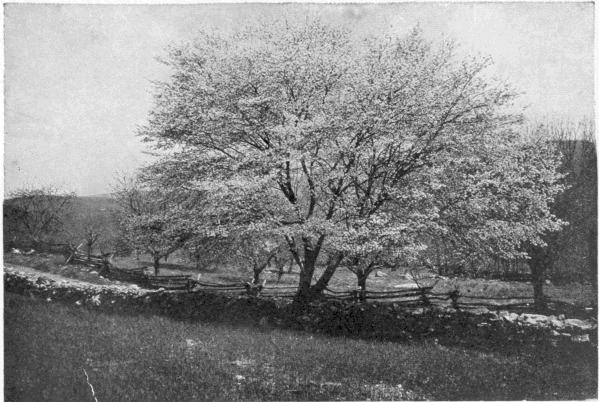
See page 159
SERVICE-BERRY IN BLOSSOM The flowers appear in April, before the leaves
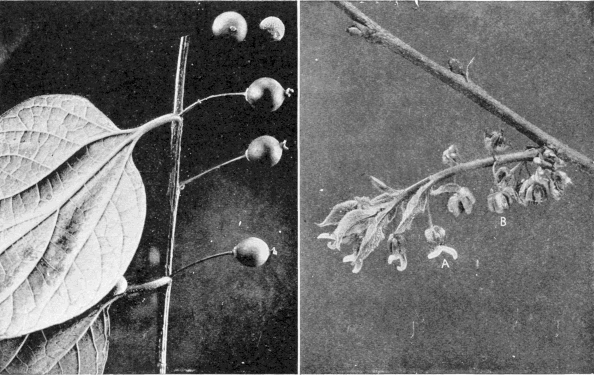
See page 161
THE HACKBERRY Leaves, berries, and (A) pistillate and (B) staminate flowers
The Redbud
Cercis Canadensis, Linn.
The redbud covers its delicate angled, thornless branchlets with a profusion of rosy-purple blossoms, typically pea-like, before the leaves appear. The unusual color, so abundant where little redbuds form thickets on the out-skirts of a woodland, leads to a very general recognition of this tree among people who go into the April woods for early violets. It vies with the white banner of the shad-bush, in doing honor to the spring. Later, the broad heart-shaped leaves cover and adorn the tree, concealing the dainty tapering pods that turn to purple as the polished leaf blades, unmarred by insect or wind, change from green to clear yellow before falling.
Tradition has given this charming little locust tree the name, "Judas-tree," from its European cousin, rumored to have been the one upon which the choice of Judas fell when he went out and hanged himself. It is an unearned stigma, better forgotten, for it does prejudice the planter against a tree that should be on every lawn, preferably showing its rosy flowers against a bank of evergreens.
Its natural range extends from New Jersey to Florida and west from Ontario to Nebraska and southward. The largest specimens reach fifty feet in height in Texas and Arkansas, in river bottom lands, and in the Southwest the tree is an abundant undergrowth—making a beautiful woodland picture in early spring.
The Yellow-wood
Cladrastis lutea, K. Koch.
The yellow-wood was named by the wife of a pioneer, surely, for she soaked the chips and got from them a clear yellow dye, highly prized for the permanent color it gave to her homespun cotton and woolen cloth that must have gone colorless, but for dyestuffs discoverable in the woods.
The satiny grain of the wood, and its close hard texture, commended it to the woodsman, who used it for gun stocks. But the tree is too small to be important for the lumber it yields.
In winter the smooth pale bark of the "Virgilia," as the nurseryman calls it, reminds one of the rind of the beech. The broad rounded head, often borne on three or more spreading stems, is formed of drooping graceful branches, ending in brittle twigs. Summer clothes these twigs with a light airy covering of compound leaves, of seven to eleven broadly oval leaflets, on a stalk less than a foot in length. In autumn, the foliage turns yellow.
White flowers, pea-like, delicate, fragrant, in clusters a foot long, and so loose that the flowers seem to drip from the twig ends, drape the tree in white about the middle of June, when the young leaves show many tints of green to form a background for the blossoms.
This is the supreme moment of the year for one of the most charming of trees, in any park that cherishes one of these virgilias. In the wilds of eastern Tennessee, northern Alabama, and central Kentucky the species is found in scattered places. But the wild trees have scant food and they show it. The full beauty of the species is seen only in cultivation, as one sees it in the Arnold Arboretum, and in private gardens near Boston. Even the little pods, thin, satiny pointed, add a harmonious note of beauty; their silvery fawn color blending with the quiet Quaker drab worn by the tree all winter. Fortunately, this hardy beautiful park tree is easily raised from seeds and from root cuttings. It thrives on soil of many different kinds. It has no bad habits, no superior, and few equals among flowering trees.
THE ACACIAS, OR WATTLES
Australia has contributed to southern California's tree flora a large number of forms of the acacia tribe, shrubs and trees of great variety and beauty of flowers and evergreen foliage. They are hardy and perfectly at home, and are planted in such profusion as to be the commonest of all street and ornamental trees. The leaves are set on a branching pinnate stem, making them "twice compound" of many tiny leaflets, fascicled on the sides of the twigs, alternate on the terminal shoots of the season. The lacy, fern-like foliage of most acacias would justify the planting of them for this trait alone. But the abundant mass of bloom usually overwhelms the tree-tops, obscuring the foliage with a veil of golden mesh. Sometimes white, but oftenest yellow, the individual flowers are very small; but they crowd in button-like heads or elongated spikes, set close in axillary clusters. In their native woods these trees flower much less freely than in the land of their adoption. The curling pods are in most species and varieties ornamental, as they pass through many color changes before they finally discharge their seeds.
Acacias compose a genus of four hundred species, and an untold and constantly increasing number of cultivated varieties. The continent of Australia has the greatest representation of native species. Others belong to Africa—tropical, northern, and southern regions. Asia, in its warmer southern territory, and in southwestern China, has many native acacias. Tropical and temperate South America, the West Indies, Central America, Mexico, the southwestern region of the United States, and the islands of the South Pacific, all have representatives of this wonderful and far-scattered genus. There is no country interested in horticulture that does not grow acacias as ornamental shrubs and trees, even if they must be grown under glass the year round. In southern England the acacias, grown in open ground, and known as "tassel trees," attain good size.
Valuable lumber, tanbarks, dyes, perfumes, and drugs are yielded by acacias. Gum Arabic is the dried sap of several oriental species, particularly, Acacia Arabica, Linn. of Egypt and southern Asia.
As a rule, acacias have slender branches armed with spines. Often these are too small to attract notice, or to make the species useful as a hedge plant. All spines are modifications of the stipules at the base of leaf or leaflet. Thorns, however, are modified twigs, strong, stiff and sharp, often branched. The honey locust shows true thorns, not spines or prickles. The armament of canes of blackberry is only skin deep. This means of defence is best called "prickles."
The Black Acacia
Acacia melanoxylon
The black acacia, called at home in Australian woods, the "blackwood-tree," for its black heart-wood, is a familiar street and shade tree in California. In narrow parkings it is likely to surprise the planter by outgrowing in a few years the space allotted to it, and upheaving both cement walk and curb, by the irresistible force of its thick roots. It is one of the large timber acacias, and even in the cool climate of England reaches fifty feet.
In suitable situations in California it grows much higher, and its compact conical head of dense evergreen foliage, gives abundant shade at all seasons. The flowers are white or cream-colored, lightening the yellow-green of the new shoots and the dull, opaque of the older leaves, with abundant clusters in earliest spring. The succeeding fruits are curling thin pods that hang in brownish sheaves, giving the tree a rusty look. Each seed is rimmed with a frill of terra cotta hue that serves as a wing for its flight, when detached by the wind. The roots send up suckers and the seeds are quick to grow. So any one can have black acacias with little trouble or expense. Its shedding of leaves and pods makes much litter, however, a trait sometimes overlooked which seriously diminishes its desirability as a street and shade tree.
The Silver Wattle
A. dealbata
The silver wattle of nursery catalogues is named for its abundant, silvery-pubescent, feathery foliage. Its flowers—fluffy golden balls, small but abundant—make this a wonderfully showy tree.
Sea-green and turquoise-blue leaves, with abundant canary-yellow bloom, are traits of many different acacias in cultivation, all of which are rapid growers, and soon repay the planter who wants quick results. From being mere ornaments they rise to the stature of shade trees, and merely multiply the charms that made them admired when young. Varieties with sharp spines are employed as hedge plants. Curious leaf forms and unusual, edgewise position of the foliage, make us wonder at some of the glorious "golden wattles" and "knife-leaved acacias," that bring us glimpses of the forests of Australia and other strange far countries.
OTHER POD-BEARERS
The Mesquite
Prosopis juliflora, DC.
The mesquite or honey pod is one of the wonderful plants of the arid and semi-arid regions from Colorado and Utah to Texas and southern California. At best it is a tree sixty feet high along the rivers of Arizona. In the higher and more desert stretches it is stunted to a sprawling shrub, with numerous stems but a few feet high. Its leaves are like those of our honey locust but very much smaller, and the tree furnishes little shade. The bark of the trunk is thick, dark reddish brown, shallowly fissured between scaly ridges. In winter the tree looks dead enough, but the young shoots clothed with tender green bring it to life in early spring, and the greenish fragrant flowers, thickly set in finger-like clusters, appear in successive crops from May to July. These are succeeded by pods four to nine inches long in drooping clusters, each containing ten to twenty beans.
Not its beauty of leaf and blossom but its usefulness is what makes this tree almost an object of worship to desert dwellers, red men and white. The long fat pods supply Mexicans and Indians with a nutritious food, green or ripe. Cattle feed upon the young shoots and thrive, when other forage is scant or utterly lacking. The fuel problem of the desert is solved by the mesquite in a way that is a great surprise to the newcomer. His sophisticated neighbor takes him on a wood-gathering expedition. Stopping where a shrubby mesquite sprawls, he hitches his team to a chain or rope that lays hold of the trunk, and hauls the plant out by its roots. And what roots the mesquite has developed in its search for water! There is a central tap root that goes down, down, sometimes sixty feet or more. Secondary roots branch out in all directions, interlock, thicken, and form a labyrinth of woody substance, in quantity and quality that makes the timber above ground a negligible quantity. This wood is cut into building and fencing materials—two great needs in the desert. The waste makes good fuel, and every scrap is precious. Posts, railroad ties, frames for the adobe houses, furniture, fellies of wheels, paving blocks, and charcoal are made of this wonderful tree's root system. A gum resembling gum-arabic exudes from the stems.
The Screw-bean
P. pubescens, Benth.
The screw-bean or screw-pod mesquite is a small slender-trunked tree with sharp spines at the bases of the hoary foliage. The marked distinction between this species and the preceding one is in the fruit, which makes from twelve to twenty turns as it matures, and forms when ripe a narrow straight spiral, one to two inches long; but when drawn out like a coiled spring the pod is shown to be more than a foot in length. These sweet nutritious pods are a most useful fodder for range cattle, and the wood is used for fencing and fuel. This tree grows from southern Utah and Nevada through New Mexico and Arizona into San Diego County, California, western Texas and northern Mexico.
The Palo Verde Acacia
Cercidium Torreyanum, Sarg.
The palo verde is another green-barked acacia whose leaves are almost obsolete. Miniature honey-locust leaves an inch long unfold, a few here and there in March and April, but they are gone before they fully mature, and the leaf function is carried on entirely by the vivid green branches. Clustered flowers, like little yellow roses, cover the branches in April, and the pointed pods ripen and fall in July.
In the Colorado desert of southern California, in the valley of the lower Gila River in Arizona, on the sides of low canyons and on desert sandhills into Mexico, this small tree, with its multitude of leafless, ascending branches, is one of the brightest features on a hopelessly dun-colored landscape.
The Jamaica Dogwood
Icthyomethia Piscipula, A. S. Hitch.
The Jamaica dogwood is a West Indian tree that grows also in southern Florida and Mexico. It is one of the commonest tropical trees on the Florida West Coast from the shores of Bay Biscayne to the Southern Keys. The leaves are four to nine inches long, with leaflets three to four inches in length, deciduous, vivid green, making a tree fifty feet high an object of tropical luxuriance. Its beauty is greatly enhanced in May by the opening of the pink, pea-like blossoms that hang in drooping clusters a foot or more in length. The necklace-like pods are frilled on four sides with thin papery wings.
The wood of this tree is very durable in contact with water, besides being heavy, close-grained, and hard. It is locally used in boat-building, and for fuel and charcoal. All parts of the tree, but especially the bark of the roots, contain an acid drug of sleep-inducing properties. In the West Indies the powdered leaves, young branches, and the bark of the roots have long been used by the natives to stupefy fish they try to capture.
The Horse Bean
Parkinsonia aculeata, Linn.
The horse bean or retama, native to the valleys of the lower Rio Grande and Colorado River, is a small graceful pod-bearing tree of drooping branches set with strong spines, long leaf-stems, branching and set with many pairs of tiny leaflets.
The bright yellow, fragrant flowers are almost perennial. In Texas the tree is out of bloom only in midwinter. In the tropics, it is ever-blooming. The fruit hangs in graceful racemes, dark orange-brown in color, and compressed between the remote beans. As a hedge and ornamental garden plant, this tree has no equal in the Southwest. It is met with in cultivation in most warm countries.
The Texas Ebony
Zigia flexicaulis, Sudw.
The Texas ebony is a beautiful, acacia-like tree of southern Texas and Mexico. One of the commonest and most beautiful trees on the bluffs along the coast, south of the Rio Grande. Its leaves are feathery, fern-like, its flowers in creamy clusters, its pods thick, almost as large as those of the honey locust. The seeds are palatable and nutritious, green or ripe. Immature, the pods are cooked like string beans; ripe, they are roasted, and the pods themselves are ground and used as a substitute for coffee.
The wood is valuable in fine cabinet work, and because it is almost indestructible in contact with the ground, it is largely used for fence posts. It makes superior fuel. Besides being more valuable than any other tree of the Rio Grande Valley, though it rarely exceeds thirty feet in height, it is worthy of the attention of gardeners as well as foresters in all warm temperate countries. Prof. Sargent calls it the finest ornamental tree native to Texas.
The Frijolito
Sophora secundiflora, DC.
The frijolito or coral-bean is a small, slender narrow-headed tree, with persistent, locust-like leaves, fragrant violet-blue flowers, and small one-sided racemes. The pods are silky white, pencil-like, constricted between the bright scarlet seeds. The tree grows wild in canyons in southern Texas and New Mexico, forming thickets or small groves in low moist limestone soil and stream borders. It is a close relative of the famous pagoda tree of Japan, S. Japonica, universally cultivated; and it deserves to be a garden tree throughout the Southern states.
PART VII
DECIDUOUS TREES WITH WINGED SEEDS
The Maples—The Ashes—The Elms
THE MAPLES
A single genus, acer, includes from sixty to seventy species, widely distributed over the Northern Hemisphere. A single species goes south of the equator, to the mountains of Java. All produce pale close-grained, fairly hard wood, valued in turnery and for the interior finish of houses. The clear sap of some American species is made into maple sugar.
The signs by which we may know a member of the maple family are two: opposite, simple leaves, palmately veined and lobed; and fruits in the form of paired samaras, compressed and drawn out into large thin wings. No amount of improvement changes these family traits. No other tree has both leaves and fruits like a maple's.
The distribution of genus acer is interesting. The original home of the family is in the Far East. In China and Japan we may reckon up about thirty indigo maples, while only nine are native to North America. Of these, five are in the eastern half of the continent, three in the West, and one grows indifferently on both sides of the Great Divide.
The Sugar Maple
Acer saccharum, Marsh.
The sugar maple (see illustration, page 198-199) is economically the most important member of its family in this country. As an avenue and shade tree it is unsurpassed. It is the great timber maple, whose curly and bird's-eye wood is loved by the cabinet-maker; and whose sap boiled down, yields maple sugar—a delicious sweet, with the distinctive flavor beloved by all good Americans. In October the sugar maple paints the landscape with yellow and orange and red. Its firm broad leaves, shallowly cleft into five lobes, are variously toothed besides. The flowers open late, hanging on the season's shoots in hairy yellow clusters. The key fruits are smooth and plump, with wings only slightly diverging. They are shed in midsummer.
Hard maple wood outranks all other maple lumber, though the curly grain and the bird's-eye are accidental forms rarely found. Flooring makes special demands upon this wood. Much is used in furniture factories; and small wares—shoe lasts, shoe pegs and the like—consume a great deal. As fuel, hard maple is outranked only by hickory. Its ashes are rich in potash and are in great demand as fertilizer in orchards and gardens.
The living tree, in the park, on the street, casting its shade about the home, or glowing red among the trees of the woods, is more valuable than its lumber. Slow-growing, strong to resist damage by storm, clean in habit and beautiful the year round—this is our splendid rock maple. Rich, indeed, is the city whose early inhabitants chose it as the permanent street tree.
The Black Maple
A. nigrum, Michx.
The black maple is so like the sugar maple that they are easily confused, but its stout branchlets are orange-colored, the leaves are smooth and green on both sides, scantly toothed, and they droop as if their stems were too weak to hold up the blades. The keys spread more widely than those of the sugar maple.
The black maple is the sugar maple of South Dakota and Iowa. It becomes rarer as one goes east. It is an admirable lumber tree, as well as a noble street and shade tree.
Two soft maples are found in the eastern part of the country, their sap less sweet, their wood softer than the hard maples, and their fitness for street planting correspondingly less.
The Red Maple
A. rubrum, Linn.
The red maple is a lover of swamps. It thrives, however, on hillsides, if the soil be moist; and is planted widely in parks and along village streets. In beauty it excels all other maples. In early spring its swelling buds glow like garnets on the brown twigs (see illustrations, pages 198-199). The opening flowers have red petals, and the first leaves, which accompany the early bloom, are red. In May the dainty flat keys, in clusters on their long, flexible stems, are as red as a cock's comb, and beautiful against the bright green of the new foliage. In early September in New England, a splash of red in the woods, across a swamp, is sure to be a scarlet maple that suddenly declares its name. Against the green of a hemlock forest these maples show their color like a splash of blood. The tree is gorgeous.
In winter the lover of the woods, re-visiting the scenes of his summer rambles, knows the scarlet maple by the knotty, full-budded twigs which gleam like red-hot needles set with coral beads, against the clean-limbed, gray-trunked tree. The red maple never quite forgets its name.
As a street tree, it makes rapid progress when it once becomes established, though it is apt to stand still for a time after being transplanted. Its branches are short, numerous, and erect, making a round head, admirably adapted to the resistance of heavy winds. It is particularly suited to use in narrow streets.
The Soft Maple
A. saccharinum, Linn.
The soft maple or silver maple (see illustration, page 199) has a white-lined leaf, cleft almost to the midrib and each division again deeply cut. It is quick and ready to grow, and has been widely planted as a street tree, especially in prairie regions of uncertain rainfall. It is one of the poorest of trees for street planting, because it has a sprawling habit and weak brittle wood. The heavy limbs have great horizontal spread, and are easily broken by ice and windstorms. When planted on streets, they require constant cutting back to make them even safe. Thick crops of suckers rise from the stubs of branches, but the top thus formed is neither beautiful nor useful.
Wier's weeping maple, a cut-leaved, drooping variety of this silver maple, is often seen as a lawn tree, imitating the habit of the weeping willow.
The Oregon Maple
A. macrophyllum, Pursh.
The Oregon maple grows from southern Alaska to Lower California, along the banks of streams. The great leaves, often a foot in diameter, on blades of equal length, are the distinguishing marks of this stout-limbed tree, that grows in favorable soil to a height of a hundred feet. In southern Oregon it forms pure forest, its huge limbs forming magnificent, interlacing arches that shut out the sun and make a wonderful cover for ferns and mosses far below. The wood of this tree is the best hard-wood lumber on the West Coast.
The Vine Maple
A. circinatum, Pursh.
The vine maple reminds one of the lianas of tropical woods, for it has not sufficient stiffness to stand erect. It grows in the bottom lands and up the mountain sides, but always following watercourses, from British Columbia to northern California. Its vine-like stems spring up in clusters from the ground, spreading in wide curves, and these send out long, slender twigs which root when they touch the ground, thus forming impenetrable thickets, often many acres in extent.
The leaf is almost circular and cut into narrow equal lobes around the margin; green in midsummer, it changes to red and gold in autumn, and the woodsman, almost worn out with the labor of getting through the maze these trees form, must delight, when he stops to rest, in the autumn glory of this wonderful ground cover.
These little maples lend a wonderful charm to the edges of forest highways in the Eastern states. Like the hornbeams, hazel bushes, and ground hemlock, they are lovers of the shade; and they fringe the forest with a shrubbery border.
The Striped Maple
A. Pennsylvanicum, Linn.
The striped maple is quickly recognized by the pale white lines that streak in delicate patterns the smooth green bark of the branches. The leaves are large and finely saw-toothed, with three triangular lobes at the top. The yellowish bell-flowers hang in drooping clusters, followed by the smooth green keys, in midsummer. This tree is called "Moosewood," for moose browse upon it.
The shrubbery border of parks is lightened in autumn by the yellow foliage of this little tree, and in winter the bark is very attractive. "Whistlewood" is the name the boys know this tree by, for in spring the bark slips easily, and they cut branches of suitable size for whistles.
The Mountain Maple
A. spicatum, Lam.
The mountain maple is a dainty shrub with ruddy stems, large, three-lobed leaves, erect clusters of yellow flowers and tiny brown keys. It follows the mountains from New England to northern Georgia, and from the Great Lakes extends to the Saskatchewan.
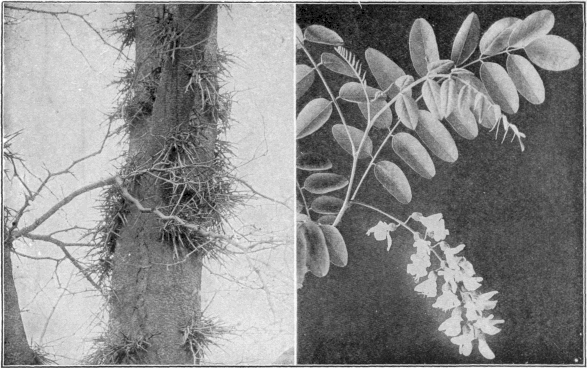
See page 178
THE THORNY TRUNK OF THE HONEY LOCUST, AND THE FOLIAGE AND FLOWERS OF THE BLACK LOCUST
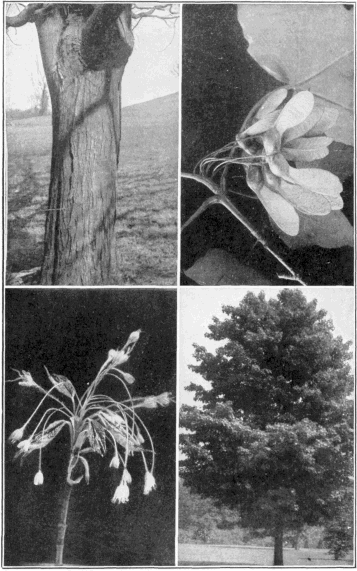
See page 194
SUGAR MAPLE Maple sugar is made in February; the trees bloom in May; their seeds ripen in October
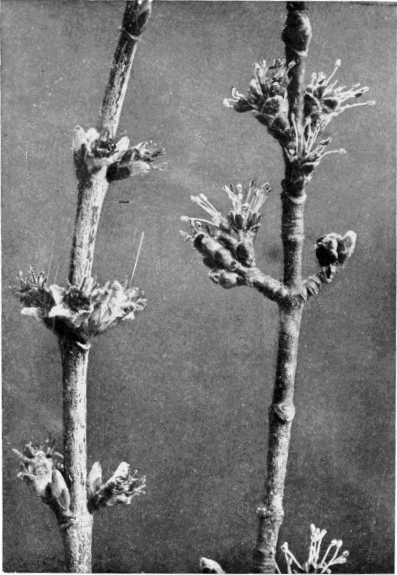
See page 195
THE RED MAPLE'S PISTILLATE (left) AND STAMINATE (right) FLOWERS
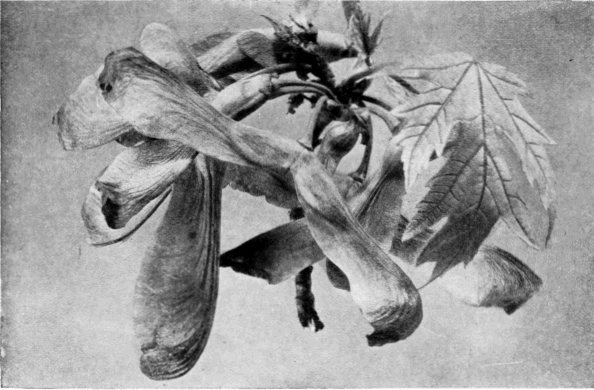
See page 196
SEED KEYS AND NEW FOLIAGE OF THE SOFT OR SILVER MAPLE
The Dwarf Maple
A. glabrum, Torr.
The dwarf maple ranges plentifully from Canada to Arizona and New Mexico. Its leaves, typically three-lobed and cut-toothed, vary to a compound form of three coarse-toothed leaflets. The winged keys are ruddy in midsummer, lending an attractive dash of color to the woods that border high mountain streams.
Very common in cultivation are the Japanese maples—miniature trees, bred and cultivated for centuries, wonderful in the variations in form and coloring of their leaves. Tiny maple trees in pots are often very old. Some leaves are mere skeletons.
The Japanese people are worshippers of beauty and they delight particularly in garden shows. In the autumn, when the maples have reached perfection, the populace turns out in holiday attire to celebrate a grand national fête. A sort of æsthetic jubilee it is, like the spring jubilee of the cherry blossom. To each careful gardener who has patiently toiled to bring his maples to perfection, it is sufficient reward that the people make this annual pilgrimage to view them.
The Box Elder
A. Negundo, Linn.
The box elder is the one maple whose leaves are always cleft to the stem, making it compound of irregularly toothed leaflets. The clusters of flattened keys, which hang all winter on the trees, declare the kinship of this tree to the maples.
Fast-growing, hardy, willing to grow in treeless regions, this tree has spread from its eastern range throughout the plains, where shelter belts were the first needs of the settlers. Pretty at first, these box elders are soon broken down and unsightly. They should be used only as temporary trees, alternating with elms, hard maples, and ashes. Where they are neglected, or continue to be planted, the character of the town or the premises must be cheap and ugly.
The Norway Maple
A. platanoides, Linn.
The Norway maple is counted the best maple we have for street planting. Broad, thin leaves, three-lobed by wide sinuses, cover with a thick thatch the rounded head of the tree. Green on both sides, thin and smooth, these leaves seem to withstand remarkably the smoke, soot, and dust of cities, and also the attacks of insects. The keys are large, wide-winged, set opposite, the nutlets meeting in a straight line. These pale green key clusters are very handsome among the green leaves in summer—the tree's chief ornament until the foliage mass turns yellow in autumn. A peculiarity of the Norway maple is the milky juice that starts from a broken leaf-stem.
The Sycamore Maple
A. pseudo-platanus, Linn.
The sycamore maple is another European immigrant, whose broad leaf is thick and leathery in texture, and pale underneath. Its late-opening flowers are borne in long racemes, followed by the small key fruits which cling to the twigs over winter, making the tree look dingy and untidy. This tree has not the hardiness nor the compact form of the Norway maple, and it is subject to the attack of borers.
It is the "sycamore" of Europe, famed as a lumber and an avenue tree abroad, but with us it proves short-lived, and we have no reason for choosing it. The copious seed production of the far preferable Norway maple puts it within the reach of all.
THE ASHES
Few large trees in our American woods have their leaves set opposite upon the twig. Still fewer of the trees with compound leaves show this arrangement. Consult the first broad-leaved tree you meet, and the chances are that its leaves are set alternately upon the twigs. There is a multitude of families in this class; but if the leaves are paired and set opposite, we narrow the families to a very few. Are the leaves simple? Then the tree may be a maple or a dogwood, or a viburnum. Are the leaves opposite and compound? Then you have one of two families. Are the leaflets clustered on the end of the leaf-stalk? Then the tree is a buckeye or a horse chestnut—members of the buckeye family. Are the leaflets set along the sides of the central stem? Then the tree is an ash. A few exceptions may be discovered, but the rule holds in the general forest area of North America.
Ash trees have lance-shaped, winged seeds, borne in profuse clusters, and often held well into the winter. But there is no season when the leaf arrangement cannot be at once determined by the leaf scars, prominent upon the twigs; and under the tree there will always be remnants of the cast-off foliage, to show that it is compound.
Ash trees are usually large and stately when full grown, with trunks clothed in smooth bark, checked into small, often diamond-shaped plates. This gives the trees a trim, handsome appearance in the winter woods. As shade trees, ashes are very desirable, and they are valuable for their timber.
The near relatives of ashes surprise us. They belong to the olive family, whose type is the olive tree of the Mediterranean region, now extensively cultivated in California for its fruit. Privets, lilacs, and forsythias, favorites in the gardens of all countries that have temperate climates, are cousins to the ash tree. One of its most charming relatives is the little fringe tree of our own woods. Thirty species of ash are known; half of that number inhabit North America. There are ash trees in every section of our country except the extremes of latitude and altitude. Tropical ash trees are native to Cuba, North Africa, and the Orient.
The White Ash
Fraxinus Americana, Linn.
The white ash is one of the noblest trees in the American forest, the peer of the loftiest oak or walnut. When young it is slim and graceful, but it grows sturdier as it approaches maturity, lifting stout, spreading branches above a tall, massive trunk. In the forest the head is narrow, but in the open the dome of a white ash is as broad and symmetrical as that of a white oak. A gray rind covers the young branches and the bark is gray. The foliage has white lining and each of the seven leaflets has a short stalk. These are all characters that distinguish the white ash from other species and enable one to name it at a glance. In the South the white ash is undersized and the wood is of poor quality. In the Northeastern and Central states it is one of the most important and largest of our timber trees, with wood more valuable than any other ash. Its uses are manifold: it is staple in the manufacture of agricultural implements, carriages, furniture, and in the interior finish of buildings. Tool handles and oars are made of white ash and it is superior as fuel. The reddish-brown heart-wood, with paler sap-wood, is tough, elastic, hard, and heavy. It is not durable in soil and becomes brittle with age.
Ash trees are late in coming into leaf. When all the forest is green and full of blossoms, the ash trees are still naked. Not until May do the rusty yellow winter buds of the white ash swell and throw out on separate trees their staminate and pistillate flower clusters from the axils of last year's foliage. (See illustration, page 214.) Then the leaves unfold; downy at first, becoming bright and shiny above, but always with pale linings. On fertile trees the inconspicuous flowers mature into pointed fruits, one to two inches long. The wing is twice the length of the seed and is rounded to a blunt point. The seed itself is round and pointed, on branching stalks that form clusters from six to eight inches long.
As a street tree the white ash deserves much more general favor in cities than it has yet achieved, for it is straight and symmetrical, and its light foliage grows in irregular, wavy masses, through which some sunlight can always sift and let grass grow under the tree. This tree is a rapid grower, perfectly hardy in most sections of the country, and has no serious insect enemies. The foliage turns to brownish purple and yellow in the autumn.
The Black Ash
F. nigra, Marsh.
The black ash is a lover of marshes, found from Newfoundland to Manitoba, and from Virginia to Arkansas. Its blue-black winter buds, the sombre green of its foliage, and the dark hues of its bark and wood have justified the popular name of this handsome, slender tree. The leaflets, oval and long-pointed, are sessile on the hairy leaf stalk, except the terminal one. At maturity the leaves are a foot or more in length, of seven to eleven leaflets, that turn brown and fall early in autumn. The keys of the black ash are borne in open panicles, eight to ten inches long; each has a short, flat seed, with a broad blade, thin, rounded, and notched instead of pointed, at the extremity.
The wood of black ash has the tough, heavy coarse-grained qualities of the white ash, but differs in being very durable and in being easily split into thin layers—each a year's growth. The Indians taught the early settlers to weave baskets out of black ash splints. These splints are easily separated by bending the split wood over a block. The strain breaks loose the tissue that forms the spring wood, and separates the bands of tough, dense summer wood into strips suitable for basket weaving. Black ash is used for chair seats, barrel hoops, furniture, and cabinet-work. The saplings are oftenest chosen for hop and bean poles.
As a lawn tree, the black ash has little to recommend it for it often dies of thirst in the loam of a garden. At best it is short-lived. Planted in swampy ground, the tree spreads by seeds, and suckers from the roots, soon forming extensive thickets, and drinking up the moisture at a marvelous rate.
The Red Ash
F. Pennsylvanica, Marsh.
The red ash follows the courses of streams and lake margins from New Brunswick to the Black Hills and south into Florida, Alabama, and Nebraska. This tree is much planted for shade and ornament in New England, and in other Eastern sections. The tree is small, spreading into a compact though irregular head of twiggy, slender branches. The yellow-green foliage, a foot long, of seven to nine short, stalked, lustrous leaflets, is lightened by a pale pubescence on petioles and leaf-linings. The same velvety down covers the new shoots. Summer and winter this sign never fails.
Red ash seeds are extremely long and slender, and have the most graceful outlines of all the darts that various ash trees bear. The heavy, round body has a wing twice its length by which the wind carries the seeds far away. Very gradually an ash tree launches its seeds. It is easy to understand why the family is so scattered through any woods, for the wind is the sower. The reddish bark of the twigs and trunk of this tree seems to be the justification for its name. Its brown wood is inferior to white ash.
The Green Ash
F. Pennsylvanica, Variety lanceolata, Sarg.
The green ash has narrower, shorter leaves than the parent species and usually more sharply saw-toothed margins. Instead of having pale linings, the leaflets are bright green on both surfaces. This is the ash tree of the almost treeless prairies from Dakota southward, where it not only lives, but flourishes as well as in its native habitat, the rich soil of stream banks farther east. Its range crosses the Rocky Mountains and reaches the slopes of the Wasatch Mountains in Utah. East of the Alleghanies the tree is little known. It is in the West that it is the dominant ash. It is one of the few important agencies which have turned the "Great American Desert" into a land of shady roads and comfortable, protected homesteads.
The Blue Ash
F. quadrangulata, Michx.
The blue ash has four-angled twigs, often winged at the corners with a thin plate of bark. The sap contains a substance that gives a blue dye when the inner bark is macerated in water. The tree reaches one hundred and twenty feet in height, above a slender trunk, and has small spreading branches that terminate in stout twigs, characteristically angled.
The tree is occasionally cultivated in parks and gardens in the Eastern states where it is a distinct addition to the list of handsome shade trees. It is hardy, quick of growth, and unusually free from the ills that beset trees. In the forests it reaches its best estate on the limestone hills of the Big Smoky Mountains. Its wood ranks with the best white ash and exceeds it in one particular; it is the most durable ash wood when exposed alternately to wet and dry conditions. It is used for vehicles, for flooring and for handles of tools especially pitchforks.
The Oregon Ash
F. Oregona, Nutt.
The Oregon ash follows the coast south from Puget Sound to San Francisco Bay, and from the western foothills of the Sierra Nevada to those of the mountains of southern California. In southwestern Oregon the tree reaches the height of eighty feet, with a trunk three to four feet in diameter. The stout branches form a broad crown where there is room, and the luxuriant foliage is wonderfully light in color, pale green above, with silvery pubescent leaf-linings. Of the five to seven leaflets, all are sessile or short-stalked, except the terminal one, which has a stem an inch long. All are oval and abruptly pointed, thick and firm in texture, turning yellow or russet brown in autumn. The lumber is counted equal to white ash and is one of the most valuable of deciduous timber trees in the western coast states.
A number of little ash trees, distinct in species from those described already, are native to limited sections of the country. All have the family traits by which they are readily recognized, if seed form, leaf form, and leaf arrangement are kept in mind. In the corner where Colorado, Nevada, and Utah meet, is an ash with its leaf reduced to a single leaflet, but the seeds are profusely borne to declare the tree's name to any one who visits its restricted territory. In rich soil, three leaflets are occasionally developed.
The European Ash
F. Excelsior, Linn.
The European ash is the large timber ash from the Atlantic Coast of Europe to western Asia. The earliest writers have ranked its wood next to oak in usefulness. It was known as "the husbandman's tree." Its uses were listed at interminable length, for "ploughs, axle-trees, wheel-rings, harrows, balls … oars, blocks for pulleys, tenons and mortises, poles, spars, handles, and stocks for tools, spade trees, carts, ladders…. In short, so good and profitable is this tree that every prudent Lord of a Manor should employ one acre of ground with Ash to every twenty acres of other land, since in as many years it would be more worth than the land itself."
The saplings, cut when three to six years old, made excellent fork and spade handles on account of the toughness and pliability of their fibre. Crates for china were made of the branches. Steamed and bent, this wood lent itself to the making of hoops for barrels and kegs. The cutting off of the main trunk set the roots to sending up a forest of young shoots, ready for cutting again when they reached the size for walking-sticks and whip-stocks.
Quite independent of its lumber value, but possibly correlated with it, was the great reputation the ash tree achieved in the myths and superstitions of widely separated peoples. In south Europe, tradition declared that a race of brazen men sprung from the ash tree. In the North, the Norse mythology made Igdrasil, the ash, the "World tree," from whose roots the whole race of men sprung. The roots of this mythological tree penetrated the earth to its lowest depths and its giant top supported the heavens. Wisdom and knowledge gushed from its base as from a fountain, and underneath were the abodes of the gods, giants, and the Fates. Superstitions of all kinds have come down with the language of different peoples, making the history of the ash tree a most interesting study.
A Chinese ash yields a valuable white wax which exudes from the bark of the twigs. F. ornus, Linn., native to south Europe and Asia Minor, exudes a waxy secretion from bark and leaves. This is the manna of commerce. Last but not least of the products of the ash tree are the curious and beautiful contortions of the grain found in "burls" on the trunks of old trees of many species. These warty excrescences are eagerly bought by special agents for cabinet-makers. Woodwork from these abnormal growths shows exquisitely waved lines when polished, as delicate as those in a banded agate. Fancy boxes, bowls, and other articles brought fancy prices when made of "ram's horn" or "fiddleback" ash, which often went under the trade name of green ebony. The black ash in America is particularly subject to contortions of the grain.
THE ELMS
Elms of sixteen distinct species are native to boreal and temperate regions of the Northern Hemisphere, with this single exception: western North America is without a representative. Europe has three species, two of which extend their range into eastern Asia and northern Africa. Southern and central Asia have their own species. Five are native to our Eastern states. Two European species are in cultivation in the North Atlantic states, especially in the neighborhood of Boston, where they are as familiar as the native species, in street planting.
Elm trees are valuable for shade and for lumber; their wood is hard, heavy, tough, pale in color, often difficult to split. The trees are distinguished from others by their simple, unsymmetrical, strong-ribbed leaves, saw-toothed, short-stalked, always unequal and often oblique at the base of the blade. The flowers, usually perfect, are inconspicuous, and the seeds are flat, entirely surrounded by a thin papery wing, that forms two hooks at the tip. Wind-carried, these seeds have had much to do with the wide distribution of elms.
The White Elm
Ulmus Americana, Linn.
The white or American elm is widely known as a tall, graceful wide-spreading tree, usually of symmetrical, vase shape, with slender limbs and drooping twigs. (See illustration, page 215.) It has the rough furrowed bark characteristic of the genus, dark or light gray, with paler branches and red-brown twigs. The leaves are alternate, two to six inches long, broadest near the abruptly pointed apex. Distinctly one-sided at the tapering base, the leaves have a fashion of arranging themselves in a flat spray so as to present almost a continuous leaf area to the sun. One spray overlaps another, and leaves varying in size fit in to fill every little corner to which sunlight comes. This "leaf mosaic" is not confined to elms alone. It is especially noticeable on the southern border of any dense wood.
Winter offers the best opportunity for the study of tree forms. Our common elm shows at least five different patterns. The first is the "vase form," the commonest and most beautiful. This is best realized by old trees which have had plenty of room. In it the branches spread gradually upward at first but at a considerable height sweep boldly out forming a broad, rounded, or flattened head. Second is the "plume form," in which two or three main limbs rise to a great height before branching, and then break into feathery spray. Trees crowded in woods are likely to take this form. Third, the "oak tree form" shows a horizontal habit of branching, and an angularity of limbs usually more noticeable among oaks. Fourth, the "weeping willow form," where trees have short trunks, from which the branches curve rapidly outward and end in long, drooping branchlets. Fifth is the "feathered elm," marked by a fringe of short twigs which outline the trunk and limbs. This "feathering" is caused by the late development of latent buds. It may occur in any of the tree types just mentioned, but it is more noticeable in individuals of the plume form.
The American elm is very familiar for it grows everywhere east of the Rocky Mountains. Not to know this tree is a mark of indifference and ignorance. No village of any pride but plants it freely as a street tree. It is hardy and cheerful, reflecting the indomitable spirit of the pioneer, whom it accompanied by seed and sapling from the Eastern states into the treeless territories of the Middle West. With him the tree seized the land and made it yield a living. Elms, which have outlived the cottonwoods and willows, are not so large yet as the patriarchal trees in old New-England villages, yet time alone is needed to match, in the valley of the Missouri, the elms in the valley of the Connecticut.
I think, with due appreciation of its summer luxuriance of foliage, and the grace and strength of the elm's framework in winter, that the moment of greatest charm in the life of a roadside elm comes in the first warm days of late March. The brown buds on the sides of the twigs are swelling and a flush of purple overspreads the tree, while snow still covers the ground. A tremendous "fall of leaves" ensues, for the tiny bud scales that enclose the elm flowers are but leaves in miniature. The elms are in blossom! Each flower of each cluster has a calyx with scalloped edges, and a fringe of four to nine stamens hanging far out and surrounding the central solitary ovary. The color is in the yellow anthers and the dark red calyx lobes.
Speedily, the stamens shrivel and pale green pendants, which are the seeds, cluster upon the twigs. Winged for flight, these ripen and are scattered before the leaves are fairly open, and the growth of the season's shoots begins. Only the pussy willow, the quaking asp, and the earliest maples bloom as early as the elm. How much they have missed, who never saw an elm tree in blossom!
The hubs of the "one-hoss shay" were of "ellum," its interlacing fibres peculiarly fitting this wood for indestructibility. Saddle trees, boat timbers, cooperage, and flooring employ it in quantities. It is also used for flumes and piles, for it resists decay on exposure to water.
The Slippery Elm
U. fulva, Michx.
The slippery elm is also known as the red elm and moose elm, because its wood is red and moose are fond of browsing its young shoots. In regions where moose are rarely seen, it is the small boy who browses and often utterly destroys every specimen of this valuable tree. Under the bark of young shoots a sweet substance is found, which gives the tree its common name. What man lives who in the heydey of youth has not had the spring craze for slippery elm bark, as surely as he had the fever for kite-flying and playing marbles? The trees in every fence row show the wounds of jack-knives; stripping the bark, the boys scrape from its inner surface the thick, fragrant mucilaginous cambium—a delectable substance that allays both hunger and thirst. Fortunately the bark of the limbs supplies the demand; many a veteran tree still suffers the pollarding process, serving one generation of schoolboys after another.
The inner bark, dried and ground and mixed with milk, forms a valuable food for invalids. Poultices of slippery elm bark relieve throat and chest ailments. Fevers and acute inflammatory disorders are treated with the same bark, which has passed from the list of mere home remedies to an established place on the apothecary's shelf.
How shall we tell a slippery elm tree from the American elm? By its leaf in summer. The roughness of the foliage is one of its striking characteristics. Crumple a leaf, and its surfaces grate harshly, for they are covered with stiff, tubercular hairs. The leaves are larger, often reaching seven inches in length. There is a reddish or tawny pubescence on all young shoots, and especially on the bud scales in winter. The tree itself, in winter or summer, is much more coarse than its cousin. It is also unsymmetrical in habit, each limb striking out for itself. Very often one meets a tree quite as one-sided in form as its leaf, and this without any apparent reason. But given a chance to grow without mutilation, the slippery elm attains a height of seventy feet, forming a broad, open head, in comparatively few years. It is well worth planting for its lumber and for shade.
The Rock Elm
U. Thomasi, Sarg.
The rock elm or cork elm chooses dry, gravelly upland and low heavy clay soil, on rocky slopes and river cliffs, from Ontario and New Hampshire westward through northern New York, southern Michigan to Nebraska and Missouri. It is more abundant and of largest size in Ontario and in the southern peninsula of Michigan.
Its leaf is small, thick, and firm, dark green, and turns to brilliant yellow in the autumn. Its flowers and fruits are borne in racemes. At any season, one knows this cork elm by the shaggy bark on its stout limbs that make the tree resemble a bur oak. "Rock elm" and "hickory elm" are names that refer to the hardness of the wood. The wheelwright counts it the best of all elms. Compact, with interlacing fibres, there are spring, strength, and toughness in this wood which adapt it for bridge timbers, heavy agricultural implements, wheel stocks, sills, and axe-handles. The name "cork elm" refers to the corky bark which runs out in winged ridges, even to the twigs.
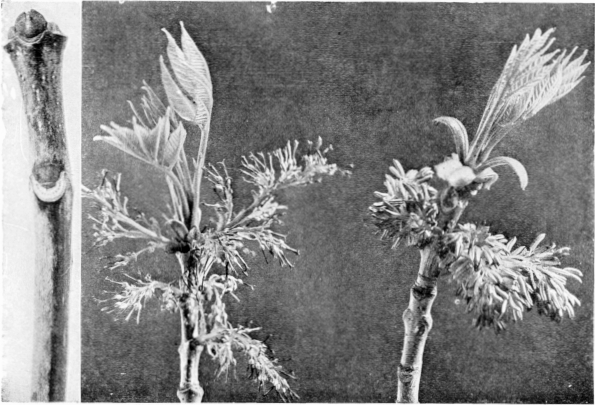
See page 202
THE WHITE ASH
Winter buds Pistillate flowers Staminate flower
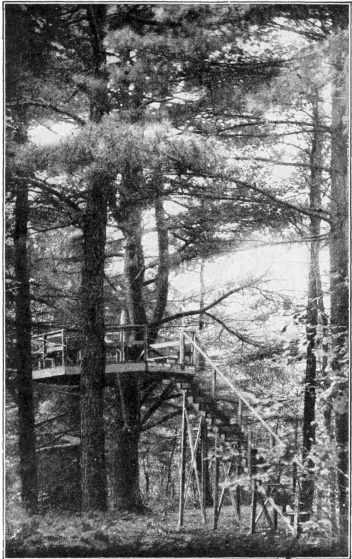
See page 222
A GROUP OF WHITE PINES
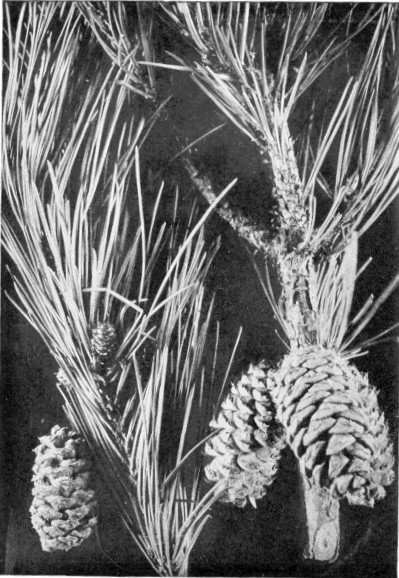
See page 235
LEAVES AND CONES OF THE SHORTLEAF PINE
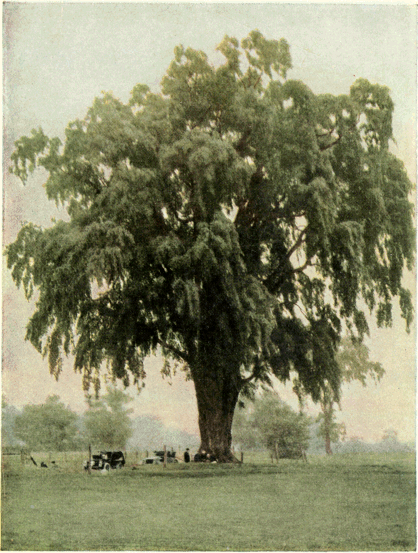
See page 210
AMERICAN ELM
The Winged Elm
U. alata, Michx.
The winged elm, or wahoo, is dainty and small, its leaves and the two thin corky blades that arise on each twig befitting the smallest elm tree in the family. Despite its corky wings, it has none of the ruggedness of the cork elm, but is a pretty round-headed tree. It is distributed from Virginia to Florida and west to Illinois and Texas. "Mountain elm" and "small-leaved elm" are local names. "Wahoo" is local also, belonging chiefly to the South. Even the little seed of this tree is long and slender, its wing prolonged into two incurving hooks.
The English Elm
U. campestris, Linn.
The English elm is often seen in the Eastern states, planted with the American elm in parks and streets, where the two species contrast strikingly. The English tree looks stocky, the American airily graceful. One stands heavily upon its heels, the other on tiptoe. One has a compact, pyramidal or oblong head, the other a loose open one. In October the superb English elms on Boston Common are still bright green, while their American cousins have passed into "the sere and yellow leaf."
The Scotch Elm
U. montana, Linn.
The Scotch or wych elm is planted freely in parks and private grounds. It is a medium-sized tree of rather more strict habit of growth than the American elm. Before the leaves open the tree often looks bright green from a distance. This appearance is due to the winged seeds which are exceptionally large and crowd the twig in great rosettes.
One horticultural variety of this species is the weeping form known as the Camperdown elm, which arches its limbs downward on all sides, forming when full-grown a natural arbor. One often sees this tree planted on lawns of limited extent, and so near the street as to render utterly absurd its invitation to privacy. To serve that reasonable and delightful end, the tree should be planted in a retired corner of one's grounds, where an afternoon siesta may be enjoyed undisturbed.
PART VIII
THE CONE-BEARING EVERGREENS
The Pines—The Spruces—The Firs—The Douglas Spruce—The Hemlocks—The Sequoias—The Arbor-vitaes—The Incense Cedar—The Cypresses—The Junipers—The Larches, or Tamaracks
The cone-bearers, or conifers, are a distinct race that we commonly call evergreens. They include pines, hemlocks, spruces, firs, sequoias, cypresses, cedars, and junipers. Besides these, the tamaracks and the bald cypress must be included, although their leaves are shed in the autumn. The term "evergreen" applies equally well to magnolias, laurels, and many oaks. Birches and alders and magnolias bear cone-like fruits. Notwithstanding such exceptions, the cone-bearing trees are mostly evergreen, and their family traits are so strongly marked that even the beginner in tree study eliminates the exceptional instances early in his studies.
The pines and their relatives in the coniferous group are an ancient race, composed of proud old "first families." Along the shores of the Silurian seas they stood up, straight and tall, their only companions that stood erect, the giant horse-tails and tree ferns. This was long before modern tree families had any existence. There were no broad-leaved trees. In the coal measures are found the mummied remains of these prehistoric conifers. The cycads in the Everglades of Florida are some of their surviving representatives. These are facing extinction, and the conifers, too, are declining. They had reached their prime as a race when the broad-leaved trees appeared upon the earth. The vigor of the new race enabled it to seize the richest, well-watered regions. They drove the conifers to seek the swamps, the exposed seacoasts, the barren and rocky mountain slopes. Man has ruthlessly destroyed for timber the coniferous forests of this country and much of the territory denuded by the axe is either devoted to agriculture or has been seized by broad-leaved species of trees, more tenacious of life and with seeds more quick and sure to germinate than those of the conifers. The time is not far distant, geologically speaking, when this ancient and declining family of trees will exist only as man fosters it by cultivation.
The conifers have resinous wood, with stiff, needle-like or scale-like leaves, and inconspicuous flowers of two sorts, borne in clusters like catkins. The pistillate catkin matures into a woody cone made of overlapping scales attached to a central stem. On each scale are borne one or more winged seeds.
The one character which is constant in the whole coniferous group and sets it apart from the rest of the plant kingdom, is expressed in the name Gymnosperm, applied to this botanical grand division. It means "naked seed." There is no ovary in the flower. The naked ovules are borne on the scales of the fertile spike or catkin, which is held apart and erect in blossoming time. They are pollinated by the wind, which sifts them with golden pollen dust, abundant in the staminate catkins clustered on the same tree. Contact of pollen grains and naked ovules is followed by their coalescence—the "setting of seeds."
The distinguishing trait of the higher plants that form the grand division known as Angiosperms, is that the ovules are borne in a closed ovary, and the pollen lodges on the end of a stigma. "Pollen tubes" grow down through the long style, finally reach the hidden ovule, and seed is set. This complicated process is found in the majority of flowers one studies in botany classes. Gymnosperms, and the still lower groups of flowerless ferns and mosses, are merely glanced at by amateur botanists. The more primitive plant forms are too difficult for beginners.
The habit of the conifers is a character upon which we may depend. With rare exceptions, there is a central shaft, "the leader," and short horizontal branches in whorls forming platforms. The side branches, also whorled, are generally flattened into a horizontal spray. The leaves are narrow, needle-like, or scale-like, and waxy or resinous. The tough fibre of the wood enables the conifers to resist damage by wind and by ice. Snowflakes sift to the ground instead of accumulating upon the branches and breaking them by their cumulative weight. The wind, which pollinated the fertile flowers of coniferous forests long before nectar-gathering insects came upon the earth, is the harvester of their seeds. It scatters them far and wide; each seed has a wing that adapts it to long journeys in front of a gale.
The resinous sap that courses through the veins of coniferous wood seals up the bark, leaves, and cones against the invasion of enemies, and acts as an antiseptic dressing for wounds. Without these special adaptations to a life of hardship, the conifers would never have held their own as they have done. They inhabit regions where conditions discourage all but a few of the broad-leaved trees.
THE PINES
In a forest of needle-leaved evergreens it is perfectly easy to distinguish the pines by their leaves. Look along the twigs and you will find the needles arranged in bundles, with a papery, enclosing sheath at the base. Follow farther back and these sheaths are missing, but on long stretches between the growing tip and the leafless part of the branch the characteristic sheathed needle-bundles declare this evergreen to be a pine. No other conifer has this trait, no pine grows but shows it every day in the year.
One half of the eighty known species of pines grow in North America. Pure forests of great extent are found in the Southern states, in the Great Lakes region, and on the mountain slopes in the western and northern parts of the continent. Smaller areas occur in the Eastern states. Very soon these forests must be spoken of in the past tense, for a century of destructive lumbering has almost cleared the Northeast of pine timber, and though the exploitation of the pine forests of the South and about the Great Lakes came later, as population increased in the Middle West, the work has progressed much more rapidly. The idea of forest conservation, crystallized into federal law by popular demand, has come too late to save from wasteful exploitation the superb pine forests west of the Rockies. Yet thousands of acres of forests are now under government control and here a great object lesson in rational methods of forest maintenance is being given. The pineries of the future depend upon the success of methods there employed.
The uses of pines are not all counted in terms of the lumberman. There are pines for every situation, soil, and climate. On low seaboard plains they come down to the highwater mark. They wade into inundated swamps and climb to the timber line on arid, rocky mountain-sides. The bravest species go out into the desert. Almost as brave are those which survive the smoke and dust of cities like Pittsburg and St. Louis, though theirs is a losing fight with sulphurous fumes and cramped root space in the smoky town. As shelter belts, as wind-breaks, as shade and ornamental trees, there are pines in cultivation in all parts of the country, their winter usefulness and beauty making them universally the choice of home-makers, rich and poor.
By-products of pine wood are chiefly turpentine, pitch, resin, and oil, derived from the resinous sap. "Naval stores" these products are called, for their consumption is greatest in shipyards. Turpentine is extensively used in the arts and industries. If the Southern pine forests are allowed to dwindle, the deficit in lumber will not affect world commerce as disastrously as the cutting off of the naval stores production.
The lumberman's division of the pines is a convenient one. "Soft pines" have soft, light wood, not heavily impregnated with resin. It is the delight of wood-workers. "Hard pines" have heavy, dark-colored wood, full of resin, which is a nuisance to the carpenter, because it "gums up" his tools. The one little sign enables us to distinguish hard and soft pines without examination of the wood. Soft pines shed the papery sheath of their leaf bundles before the leaves themselves begin to fall. Hard pines retain the leaf sheath until the leaves are shed. A glance at any leafy pine branch will enable us to determine to which of the two classes a given tree belongs.
The Soft Pines
The outward and visible sign of a soft pine is the loose, deciduous sheath of its leaf bundles. The scales of its cones are usually unarmed with horns or prickles. The wood is soft, light colored, close-grained. The number of leaves in a bundle is the principal key to the species.
The White Pine
Pinus Strobus, Linn.
The white pine (see illustrations, pages 214-215) is the only pine east of the Rocky Mountains that bears its leaves in bundles of five. This semi-decimal plan is found in three western soft pines and two western hard pines; but in the East, a native tree with needles in fives, leaves no doubt as to its name. From a distance this plan of five can be seen in the five branches that form a platform each year around the central shaft.
Study a sapling pine and you see in its vigorous young growth the fulfillment of nature's plan, before storms have broken any of the branches and changed the mathematics of the pattern. Stroke the flexible, soft leaves that sway graceful and lithe in the wind. If it is spring, note that the terminal bud has pushed out, and around it five-clustered buds are forming a circle of shoots. In autumn, after the season's growth is finished, each twig ends in a single bud, with a whorl of five buds around it. From the ground upward, count the platforms of branches. Each whorl of five marks a year in the tree's growth. The terminal bud carries the height a foot or two upward, and its surrounding five buds grow in the horizontal plane, forming the last and smallest platform of leafy shoots. Each branch is a year younger than the shoot that bears it. Note throughout this little tree the plan of five, from leaf cluster to largest branch.
Now go to the largest white pine in your neighborhood, study the plan of five in this tree, and find out the reason for any failures. Notice the conflict between the branches in the close platforms. Find branches where this conflict is in progress. Pick out the winner. Read the age of the tree by the platforms of branches on the trunk.
No evergreen is more beautiful than a white pine grown in rich soil in a situation sufficiently sheltered to defend its supple branches from breakage by severe winds. Its soft, plume-like twigs are dark blue-green, with pale lines lining each individual leaf. The young shoots are yellowish green, and they lighten in a wonderful manner the sombre coloring of the older foliage. At the bases of the new shoots cluster the staminate catkins, in early June. Yellow and becoming loose and pendulous as the wind shakes them, they are soon empty of their abundant pollen, which drifts like gold dust and fills the air. Among the youngest leaves, toward the end of the shoot, the purplish rosy lips of the erect pistillate cone-flowers catch the dust from neighbor trees, and their naked ovules absorb it and set seed. Close shut are the lips again, against any other invasion, while these ovules mature. We shall find them standing erect until autumn, but next season they hang down with their added weight, and at the end of the second summer the scales change from green to brown, open and give their ripe winged seeds to the wind for distribution. Because the tree is biennial-fruited, it always carries two sizes of cones. The large ones are one year older than the small ones. Ripe cones are five to ten inches long, with thin, broad, unarmed scales, squarish at the tips.
The most hopeful phase of the white pine problem to-day is the fact that new forests are coming up naturally where the early lumbering deforested great tracts in the Eastern states. Careful forestry improves upon nature's method, and so the pines are being restored on land unfit for agricultural crops. White pine is one of the most profitable timber crops to plant at the present time.
The Mountain Pine
P. monticola, D. Don.
The mountain pine is scattered through mountain forests from the Columbia River Basin in British Columbia to Vancouver Island, along the western slopes of the Rocky Mountains to northern Montana and Idaho, and south along the Sierra Nevada and Cascade ranges in Washington and Oregon, well into California. From the bottom lands of streams, where it is most abundant and reaches a height of one hundred to one hundred and fifty feet, and a trunk diameter of five to eight feet, it climbs to elevations of eight to ten thousand feet on the California Sierras. The bark of young trees and on the branches of old ones is smooth and pale-gray. The leaves, five in the bundles, range from one to four inches in length, stiff, blue-green, whitened by two to six stripes on the inner side. The cones are twelve to eighteen inches long, with thickened, pointed scales ending in an abrupt beak. The larger cone, denser, stiffer foliage, and the white bark make this white pine of the western mountains a great contrast to the Eastern white pine.
Unlike many trees whose size diminishes with increase in altitude, this white pine grows to majestic size at altitudes of nearly two miles, its noble figure more striking and impressive because of the dwindling size of its companions on the mountain-sides. The lumberman looks with despair upon these giant white pines, quite out of his reach.
In the Arnold Arboretum in Boston a fine seedling specimen of this western silver pine fruited when but twelve feet high, and proves vigorous and altogether happy in this absolutely changed climatic environment. In Europe the same success attends the cultivation of these trees, which have become very popular in parks and private grounds. Their introduction into our Eastern states can now be assured of success.
The Sugar Pine
P. Lambertiana, Dougl.
The sugar pine (see illustration, page 231) belongs in the class with those tree giants, the sequoias, with which it grows in the mountain forests of Oregon and California. John Muir calls it "the largest, noblest, and most beautiful of all the pine trees in the world." Trees two hundred feet high, with trunk diameter of six to eight feet, are not uncommon. The maximum given by Sargent is twelve feet across the stump. The head of a sugar pine is rounded and broad, with pendulous branches, tufted with stout, dark green leaves, three to four inches long. The cones are the largest known, reaching eighteen inches in length, rarely longer. The black or dark brown seeds are one to five inches long, including the flat, blunt wings. Indians, bears, and squirrels gather the abundant harvest of these cones, which are rich in nutriment and pleasant to the taste. Crystals of sugar form white masses like rock candy, but with a taste of maple sugar, wherever a break in the bark of a sugar pine permits the escape of the sweet sap. This gives the tree its name. No other pine has sap with such a noticeable sugar content.
Fortunately, these gigantic soft pines belong to the high Sierras and do not go down to the sea, where lumbermen could sacrifice them without effort. Nature has fenced them in by many barriers, and the government, by reservation in national parks, insures the preservation of some of the finest sugar pine groves, for the use and inspiration of all the people.
A visit to Yosemite is the experience of a lifetime to any American. Here grow the most gigantic trees in the world, and the sugar pines are nobler even than the giant "big trees," for the latter are often decrepit, while the sugar pines are hale and youthful by comparison. Leaving behind the scrawny gray digger pines on the foothills, the traveler enters the belt of the yellow pines, on the higher elevations, and passing these he comes to the grand sugar pines along the highest level of the stage road that leads into the National Park. The road is no wider than the broad stumps of sugar pines, scattered here and there. The standing trees amaze one with their height and girth.
It is impossible to shake off the impression that some magic has put magnifiers in our eyes; for trees, beetling cliffs, and rushing cataracts are bigger than their counterparts in other regions of the world far-famed for their scenery. The sugar pine trunks seem like great builded columns, too large for any real tree to grow, and the "big trees" in the Mariposa Grove intensify this impression of unreality. In a day or two the traveler becomes accustomed to his surroundings. He goes out of the Park and down into the world of men and affairs, his soul enlarged, his life enriched by an experience he can never quite forget. He is a bigger, better man for his brief association with Nature in her noblest manifestations.
The wood of the sugar pine is soft, golden, satiny, fragrant, inviting the woodworker through every one of his senses. A single tree often yields five thousand dollars' worth of marketable lumber, the finest, straight-grained soft pine in the world.
The shame of the century is the wanton destruction of sugar pine trees by vagrant shingle-makers and thieving mill-owners, who despoiled the grandest trunks of their choicest wood, wastefully leaving the bulk to cumber the ground and invite forest fires. Late and slowly, but surely also is the popular mind awakening to the fact that forests belong to the nation and should be conserved and maintained for the whole people—not wasted for the temporary enrichment of private owners, as forest wealth has been squandered in past years.
Rocky Mountain White Pine
P. flexilis, James
The Rocky Mountain white pine inhabits mountain slopes from Alberta to Mexico, including the Sierra Nevada range. In northern New Mexico and Arizona it occasionally reaches eighty feet in height, but ordinarily does not exceed fifty. Its rounded dome, as broad as an oak, bravely dares the wind on exposed cliffs, and crouches as a stunted shrub at altitudes of twelve thousand feet. The "limber pine" it is called, from the toughness of its fibre, which alone enables its long limbs to sustain the whipping they get. The leaves form thick, beautiful dark-green tufts, which are not shed until the fifth or sixth year. The cones are three to ten inches long, purplish; scales rounded, abruptly beaked at the apex; narrow wings entirely surround the seeds, which fall in September.
This is the lumber pine of the semi-arid ranges of "The Great American Desert"; the main dependence of builders, too, on the eastern slopes of the Rockies in Montana.
The White-bark Pine
P. albicaulis, Engelm.
The white-bark pine is a rippled, gnarled, squatting tree, whose matted branches, cumbered with needles and snow, make a platform on which the hardy mountain-climber may walk with safety in midwinter. It offers him a springy mattress for his bed, as well. The trunk is covered with snowy bark that glistens like the ice-mantle that lies on the treeless mountain-side just above the timber line.
From a twelve-thousand-foot elevation on the Rocky Mountains, in British Columbia and south to the Yellowstone, the tree clambers down to the five-thousand-foot line, where it sometimes attains forty feet in height; its dark green, rigid leaves persist from five to eight years, always five in a bundle, and never more than two and a half inches long. The cones, horny-tipped, dark purple, one to three inches long, are ripe in August; the large sweet seeds are gathered and eaten by Indians. In California the tree's range extends into the San Bernardino Mountains.
THE TWO "FOXTAIL" PINES
Two Western pines are distinguished by the common name "foxtail pine," because the leaves are crowded on the ends of bare branchlets. P. Balfouriana, M. Murr., has stiff, stout dark green leaves with pale linings. The tree is wonderfully picturesque when old, with an open irregular pyramid, on the higher foothills of the California mountains, or crouching as an aged straggling shrub at the timber-line. Its cones are elongated, the scales thickened and minutely spiny at tip.
The second five-leaved foxtail pine is P. aristata, Engelm., also called the "prickle-cone pine," from the curving spines that arm the scales of the purplish brown fruits. This is a bushy tree, with sprawling lower branches and upper ones that stand erect and are usually much longer, giving the tree a strange irregularity of form. The leaves are short and crowded in terminal brushes. From a stocky tree forty feet high, to a shrub at the timber line, this tree is found near the limit of tree growth, from the outer ranges of the mountains of Colorado to those of southern Utah, Nevada, northern Arizona and southeastern California. In Eastern parks it is occasionally seen as a shrubby pine with unusually interesting, artistic cones.
THE NUT PINES
The nut pines, four in number, supply Indians and Mexicans of the Southwest with a store of food in the autumn, for the seeds are large and rich in oils and they have keeping qualities that permit their hoarding for winter. The four-leaved P. quadrifolia, Sudw., scattered over the mountains of southern and Lower California, has four leaves in a cluster, as a rule. A desert tree, its foliage is pale gray-green, harmonizing with the arid mesas and low mountain slopes, where it is found. The cones are small with few scales, but the nut is five-eighths of an inch long and very rich.
P. cembroides, Zucc., with two to three leaves, is the "piñon," that covers the upper slopes of Arizona mountains with open forests fifteen to twenty feet high. The leaves are one to two inches long, dark green with pale lines, the branchlets orange-colored and matted with hairs. The large nuts are very oily, and so abundant in the mountains of northern Mexico that they are sold in large quantities in every town.
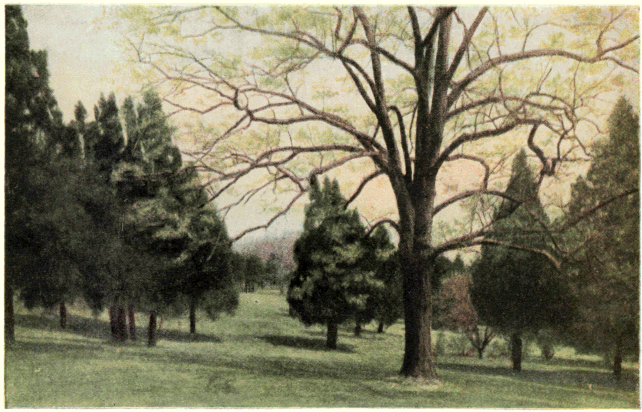
See page 276
EASTERN RED CEDARS AND HICKORY
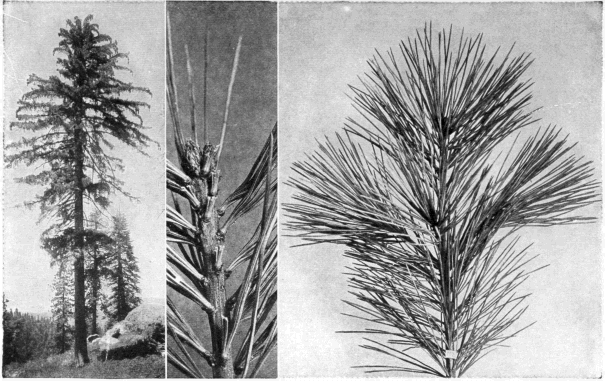
See page 225
THE SUGAR PINE "The largest, noblest, and most beautiful of all pine trees in the world"
The piñon (P. edulis, Engelm.) ranges from the eastern foothills of the Colorado Rockies to western Texas and westward to the eastern borders of Utah, southwestern Wyoming, central Arizona and on into Mexico, often forming extensive open forests, and reaching an elevation of seven thousand feet. Short, stiff leaves in clusters of two or three, dark green, ridged, stout, often persist for eight or nine years. The tree is a broad compact pyramid; in age, dense, round-topped, with stout branchlets and abundant globose cones. Each scale covers two seeds, wingless, about the size of honey locust seeds, oily, sweet, nutritious and of delicious flavor. This is the pine nut par excellence, whose newest market is among confectioners and fancy grocers throughout the states.
The one-leaved nut pine (P. monophylla, Torr.), spreads like an old apple tree, and forms a low, round-topped, picturesque head, its lower limbs drooping to the ground. The reduction of the leaves in the clusters to lowest terms, gives the tree a starved look, and the eighteen or twenty rows of pale stomates on each leaf give the tree-top a ghostly pallor. The vigor of the tree is expressed in its abundant fruit, short, oblong, one to two inches in length, with rich plump brown seeds upon which the Indians of Nevada and California have long depended. The wood supplies fuel and charcoal for smelters; and this stunted tree, rarely over twenty feet in height, forms nut orchards for the aborigines and the scattered population of whatever race, between altitudes of five and seven thousand feet. From the western slopes of the Wasatch Mountains of Utah, it ranges to the eastern slopes of the southern Sierra Nevada, to their western slopes at the head waters of King's River, and southward to northern Arizona and to the mountains of southern California.
John Muir says:
"It is the commonest tree of the short mountain ranges of the Great Basin. Tens of thousands of acres are covered with it, forming bountiful orchards for the red man. Being so low and accessible, the cones are easily beaten off with poles, and the nuts are procured by roasting until the scales open. To the tribes of the desert and sage plains these seeds are the staff of life. They are eaten either raw or parched, or in the form of mush, or cakes, after being pounded into meal. The time of nut harvest is the merriest time of the year. An industrious, squirrelish family can gather fifty or sixty bushels in a single month before the snow comes, and then their bread for the winter is sure."
THE PITCH PINES
Pitch pines have usually heavy coarse-grained, dark-colored wood, rich in resin—a nuisance to the carpenter. The leaf-bundles have persistent sheaths. The cone scales are thick and usually armed. "Hard pine" is a carpenter's synonym. The group includes some of the most valuable timber trees in American forests.
The Longleaf Pine
P. palustris, Mill.
The longleaf pine is preëminent in importance in the lumber trade and in the production of naval stores. It stretches in a belt about one hundred and twenty-five miles wide, somewhat back from the coast, all the way from Virginia to Tampa Bay and west to the Mississippi River. Isolated forests are scattered in northern Alabama, Louisiana, and Texas.
The trees are tall, often exceeding one hundred feet in height; with trunks slender in proportion, rarely reaching three feet in diameter. The narrow, irregular head is formed of short stout twisted limbs on the upper third of the trunk. The leaves are from twelve to eighteen inches long, forming dense tufts at the ends of the branches. Being flexible they droop and sway on the ends of erect branches like shining fountains, their emerald lightened by the silvery sheaths that invest each group of three.
Sapling longleaf pines have recently entered the market for Christmas greens in Northern cities. This threatens the renewal of longleaf forests that have fallen to the axe of the lumberman. Unless Federal restriction comes to the rescue, there is little hope of saving this young growth, for nothing can exceed in beauty a three-foot sapling of longleaf pine as a Christmas decoration.
The lumber of this species is the "Southern pine" of the builder. Heavy, strong, yellowish brown, durable, it has a tremendous vogue for flooring and the interior finish of buildings. It is used in the construction of railway cars. Its durability in contact with water accounts for its use in bridge-building, and for masts and spars of vessels. A great deal of this lumber is exported for use in European shipyards. It has replaced the dwindling supply of white pine for building purposes throughout the North, and the strong demand for it has been followed by lumbering of the most destructive and wasteful type, because the forests are owned privately.
In the early days the American colonists in Virginia tapped the longleaf pine, collected the resin from the bleeding wounds, and boiled it down for pitch and tar. These crude beginnings established an industry now known as the "orcharding" of the longleaf pine. After a century of wastefulness and wanton destruction of the trees, it has become patent to all that scientific methods must be resorted to in the production of turpentine and other products derived from the living trees. Otherwise the dwindling industry will soon come to an end.
Resin is the sap of the tree. The first problem is to draw it in a manner least wasteful of the product, and least dangerous to the life of the tree. The second process is the melting of the collected resin in a still and the drawing off of the volatile turpentine. What is left solidifies and is known as rosin.
"Boxing" the trees was the cutting of a grooved incision low on the trunk, with a hollow at the base of the vertical trough to hold the discharge of the bleeding sap-wood. Resin-gatherers visited the tapped trees and emptied the pockets into buckets by means of a ladle. They also scraped away the hardened sap and widened the wounds to induce the flow from new tissues. This method cost the life of the tree in two or three years, and it became a prey to disease and a menace to the whole forest, as fuel for fires accidentally started. Nowadays, all reasonable owners of longleaf pine have discarded the old-fashioned boxing and installed methods approved by the Department of Forestry.