Front matter (continued 2)
Reading edition
Each leaf tapers at both ends, its length three or four times its width. Strong-ribbed and sharp-toothed, and wavy on the midrib, dark, polished, like leather, these units form a wonderful dome, lightened in midsummer by the pencil-like plumes of the staminate flowers, with the fertile ones at their bases. As autumn comes on the leaf crown turns to gold, and the mature fruits are still green spiny balls. The first frost and the time to drop the nuts are dates that every schoolboy knows come close together.
When a chestnut tree falls by the axe, the roots restore the loss by sending up sprouts around the stump. The mouldering pile nourishes a circle of young trees, full of vigor, because they have the large tree's roots gathering food for them. No wonder their growth is rapid.
Besides this mode of reproduction, chestnut trees, growing here and there throughout a mixed forest, are the offspring of trees whose nuts were put away, or dropped and lost by squirrels. When spring relieves the danger of famine, many of the rodent class abandon their winter stores before they are all devoured. Such caches add many nut trees to our native woods.
THE OAKS
This is the great family of the cup-bearers, whose fruit, the acorn, is borne in a scaly cup that never breaks into quarters, as does the husk that holds a chestnut, beechnut, or hickory nut. All oak trees bear acorns as soon as they come to fruiting age. This is the sign by which they are known the world over. Seldom is a full-grown oak without its little insignia, for the cups cling after the nut falls, and one grand division of the family requires two seasons to mature its fruit. For this reason, half-grown acorns are seen on the twigs after the ripe ones fall.
We cannot say of oak trees that they all have sturdy trunks, rough bark, and gnarled limbs, for not all of them have these characteristics. But there is a certain likeness in oak leaves. They are simple, five-ranked, generally oval, and the margins are generally cut into lobes by deep or shallow bays. Most oak leaves have leathery texture, strong veins, and short petioles. They are leaves that out-last the summer, and sometimes persist until spring growth unseats the stalks; sometimes, as in the "live oaks," they hang on three to five years.
The twigs of oak trees are more or less distinctly five-angled, and the winter buds cluster at the ends. This insures a group of young shoots, crowded with leaves, on the ends of branches, and a dense outer dome of foliage on the tree.
Nearly three hundred distinct species of oaks are recognized by botanists, and the list is growing. New species are in the making. For instance, a white oak and a bur oak grow near enough for the wind to "cross-fertilize" their pistillate flowers. The acorns of such mixed parentage produce trees that differ from both parents, yet reveal characteristics of both. They are "hybrids," and may be called new varieties of either parent. Other species of oak are intercrossing by the same process—the interchange of pollen at the time of blossoming. This proves that the oak family is young, compared with many other families, whose members are too distantly related to intercross.
Though geologically young, the oak family is one of the most important, furnishing timber of superior strength and durability for bridge-building, ship-building, and other construction work. Tanning has depended largely upon oak bark. As fuel, all oak trees are valuable.
Fifty species of oak are native to North American forests. Twice as many grow east of the Rocky Mountains as west of the Great Divide. No species naturally passes this barrier. The temperate zone species extend southward into tropical regions, by keeping to high altitudes. Thus we find American oaks in the Andes and Colombia; Asiatic species occur in the Indian Archipelago. No Old World species is native to America. Each continent has its own.
East of the Rocky Mountains the oaks hold a place of preëminence among broad-leaved trees. They are trees of large size, and they often attain great age. They are beautiful trees, and therefore highly valued for ornamental planting. This has led to the introduction of oaks from other countries. We have set European, Japanese, and Siberian oaks in our finest parks. Europe has borrowed from our woods the red oak and many others. All countries are richer by this horticultural exchange of trees.
Our native oaks fall into two groups: the annual-fruiting and the biennial-fruiting species. The first group matures its acorns in a single season; the second requires two seasons. It happens that annuals have leaves with rounded lobes, while biennials have leaves with lobes that end in angles and bristly tips. The bark of the annual trees is generally pale; that of the biennials, dark. Hence the white oak group and the black oak group may be easily distinguished at a glance, by the bark, the leaf, and the acorn crop.
THE WHITE OAK GROUP
The White Oak
Quercus alba, Linn.
The white oak has no rival for first place in the esteem of tree-lover and lumberman. Its broad, rounded dome, sturdy trunk, and strong arms (see illustration, 38), and its wide-ranging roots enable a solitary tree to resist storms that destroy or maim other kinds. Strength and tenacity in the fibre of root and branch make it possible for individuals to live to a great age, far beyond the two centuries required to bring it to maturity. Such trees stir within us a feeling of reverence and patriotism. They are patriarchs whose struggles typify the pioneer's indomitable resistance to forces that destroyed all but the strong.
White oak trees in the forest grow tall, lose their lower branches early, and lift but a small head to the sun. The logs, quarter-sawed, reveal the broad, gleaming "mirrors" that make a white oak table beautiful. The botanist calls these the medullary rays—thin, irregular plates of tissue-building cells, that extend out from the central pith, sometimes quite to the sap-wood, crowding between the wood fibres, which in the heart-wood are no longer alive. A slab will show only an edge of these mirrors. But any section from bark to pith will reveal them.
The pale brown wood of the white oak distinctly shows the narrow rings of annual growth. Each season begins with a coarse, porous band of "spring wood," followed by a narrower band of fine, close-grained "summer wood." White oak is streaked with irregular, dark lines. These are the porous lines of spring wood, discolored by foreign matter. Count them, allow a year for each, and you know how long one white oak tree required to make an inch of wood.
The supreme moment in the white oak's year comes in spring, when the gray old tree wakes, the buds swell and cast off their brown scales, and the young leaves appear. The tree is veiled, not with a garment of green, but with a mist of rose and silver, each twig hung with soft limp velvety leaves, red-lined, and covered with a close mat of silky hairs. It is a spectacle that seems unreal, because it is so lovely and gone so soon. The protecting hairs and pigments disappear, and the green leafage takes its place, brightened by the yellow tassels of the stamen flowers, and the growing season is on.
In autumn the pale-lined leaves of the white oak turn slowly to sombre violet and dull purplish tones. Clinging there, after the acorns have all fallen and been gathered by squirrels, the foliage fades into the gray of the bark and may persist until spring growth sets in.
The Bur Oak
Q. macrocarpa, Michx.
The bur oak (see illustration, page 39) is called the mossy-cup on account of the loose, fringed scales about the rim of the cup that holds the large acorn—largest in the whole oak family. Often the nut is completely enclosed by the cup; often it is small. This variable fruit is sweet, and it is the winter store of many furry wood-folk.
The leaf has the rounded lobing of the family, with the special peculiarity of being almost cut in two by a pair of deep and wide opposite sinuses, between the broad middle, and the narrow, tapering base. Not all leaves show this odd form, but it is the prevailing pattern. The dark green blade has a pale, fuzzy lining, that lasts until the leaves turn brown and yellow.
The bur oak is a rugged, ragged tree, compared with the white oak. Its irregular form is picturesque, its wayward limbs are clothed in a loose garment of untidy, half-shed bark. The twigs are roughened with broad, corky wings. The trunk is brownish, with loosened flakes of gray, separated by shallow fissures.
The wood is classed with white oak, though darker in color. It has the same ornamental mirrors, dear to the heart of the cabinet-maker. It serves all the purposes for which a tough, strong, durable wood is needed.
The range of the species is from Nova Scotia to Montana, and it grows in large tracts from Winnipeg to Texas, doing well in the arid soil of western Nebraska and Dakota. Suckers from the roots spread these trees till they form the "oak openings" of the bluffs of the Missouri and other streams of Iowa and Minnesota. In Kansas it is the commonest oak tree. The largest trees of this species grow in rich bottom lands in the Ohio Valley.
The Post Oak
Q. minor, Sarg.
The post oak has wood that is noted for its durability when placed in contact with the soil. It is in demand for fence posts, railroad ties, and for casks and boat timbers. "Iron oak" is a name that refers to the qualities of the wood. "Knees" of post oak used to be especially in demand.
In the Mississippi Basin this tree attains its largest size and greatest abundance on gravelly uplands. It is the commonest oak of central Texas, on the sandy plains and limestone hills. Farther north, it is more rare and smaller, becoming an undersized oak in New York and westward to Kansas.
In winter the post oak keeps its cloak of harsh-feeling, thick, coarse-veined leaves. Tough fibres fasten them to the twigs. In summer the foliage mass is almost black, with gray leaf-linings. The lobes and sinuses are large and squarish, the blades four or five inches long. The limbs, tortuous, horizontal, form a dense head.
The Chestnut Oak
Q. Prinus, Linn.
The chestnut oak has many nicknames and all are descriptive. Its leaves are similar in outline and size to those of the chestnut. The margin is coarsely toothed, not lobed, like the typical oak leaf. "Tanbark oak" refers to the rich store of tannin in the bark, which makes this species the victim of the bark-peeler for the tanneries wherever it grows. "Rock chestnut oak" is a title that lumbermen have given to the oak with exceptionally hard wood, heavy and durable in soil, adapted for railroad ties, posts, and the like.
Unlike other white oaks, the bark of this tree is dark in color and deeply fissured. Without a look at the leaves, one might call it a black oak.
The centre of distribution for this species seems to be the foothill country of the Appalachian Mountains, in Tennessee and North Carolina. Here it predominates, and grows to its largest size. From Maine to Georgia it chooses rocky, dry uplands, grows vigorously and rapidly, and its acorns often sprout before falling from the cup!
The chestnut oak is one of the most desirable kinds of trees to plant in parks. It is symmetrical, with handsome bark and foliage. The leaves turn yellow and keep their fine texture through the season. The acorn is one of the handsomest and largest, and squirrels are delighted with its sweet kernel.
The Mississippi Valley Chestnut Oak
Q. acuminata, Sarg.
In the Mississippi Valley the chestnut oak is Q. acuminata, Sarg., with a more slender and more finely-toothed leaf that bears a very close resemblance to that of the chestnut. The foliage mass is brilliant, yellow-green, each leaf with a pale lining, and hung on a flexible stem. "Yellow oak" is another name, earned again when in autumn the leaves turn to orange shades mingled with red.
On the Wabash River banks these trees surpass one hundred feet in height and three feet in diameter. The base of the trunk is often buttressed. Back from the rich bottom lands, on limestone and flinty ridges, where water is scarce, these trees are stunted. In parks they are handsome, and very desirable. The bark is silvery white, tinged with brown, and rarely exceeds one half an inch in thickness.
The Swamp White Oak
Q. platanoides, Sudw.
The swamp white oak loves to stand in wet ground, sometimes even in actual swamps. Its small branches shed their bark like the buttonwood, the flakes curling back and showing the bright green under layer. On the trunk the bark is thick, and broken irregularly into broad, flat ridges coated with close, gray-brown scales often tinged with red.
In its youth the swamp white oak is comely and symmetrical, its untidy moulting habit concealed by the abundant foliage. One botanist calls this species bicolor, because the polished yellow-green upper surfaces contrast so pleasantly with the white scurf that lines each leaf throughout the summer. Yellow is the autumn color. Never a hint of red warms this oak of the swamps, even when planted as a street or park tree in well-drained ground.
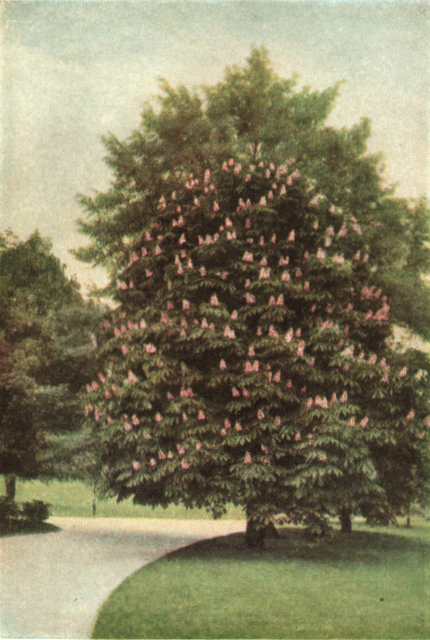
See page 65
HORSE-CHESTNUT IN BLOSSOM
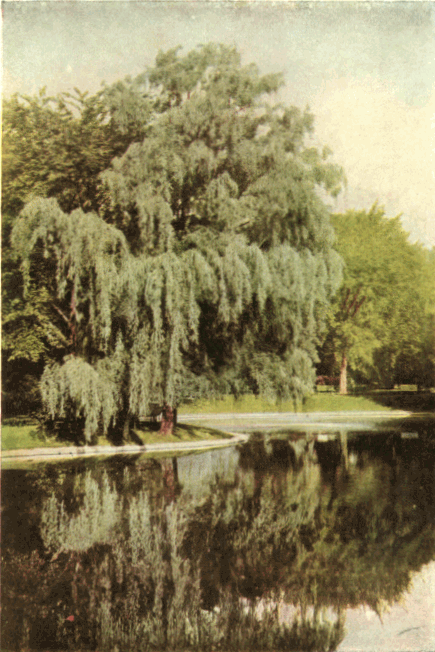
See page 83
WEEPING WILLOW
The Basket Oak
Q. Michauxii, Nutt.
The basket oak is so like the preceding species as to be listed by some botanists as the southern form of Q. platanoides. They meet on a vague line that crosses Maryland, Kentucky, and Tennessee. Both have large leaves silver-lined, with undulating border, of the chestnut oak pattern. Both are trees of the waterside, tall, with round heads of gnarled limbs. The red-tinged white bark sets the basket oak apart from all others. Its head is broader and its trunk stouter than in the other species. The paired acorns are almost without stalks, the nuts large, the kernels sweet. In autumn, farmers turn their hogs into the woods to fatten on this oak-mast. The edibility of these nuts may account for the common name, "cow oak."
The wood splits readily into thin, tough plates of the summer wood. This is because the layer formed in spring is very porous. Bushel baskets, china crates, and similar woven wares are made of these oak splints. The wood is also used in cooperage and implement construction, and it makes excellent firewood.
The Live Oak
Q. Virginiana, Mill.
The live oak with its small oval leaves, without a cleft in the plain margins, looks like anything but an oak to the Northerner who walks along a street planted with this evergreen in Richmond or New Orleans. It is not especially good for street use, though often chosen. It develops a broad, rounded dome, by the lengthening of the irregular limbs in a horizontal direction. The trunk becomes massive and buttressed to support the burden.
The "knees" of this oak were in keenest demand for ship-building before steel took the place of wood. In all lines of construction, this lumber ranks with the best white oak. The short trunk is the disadvantage, from the lumberman's viewpoint. Its beauty, when polished, would make it the wood par excellence for elegant furniture, except that it is difficult to work, and it splits easily.
The Spanish moss that drapes the limbs of live oaks in the South gives them a greenish pallor and an unkempt appearance that seems more interesting than beautiful to many observers. It is only when the sight is familiar, I think, that it is pleasing. Northern trees are so clean-limbed and so regular about shedding their leaves when they fade, that these patient hosts, loaded down with the pendent skeins of the tillandsia, seem to be imposed upon. In fact, the "moss" is not a parasite, sapping the life of the tree, but a lodger, that finds its own food supply without help.
California White Oak
Q. lobata, Née.
The California white oak far exceeds the Eastern white oak in the spread of its mighty arms. The dome is often two hundred feet in breadth and the trunk reaches ten feet in diameter. Such specimens are often low in proportion, the trunk breaking into its grand divisions within twenty feet of the ground. The ultimate spray is made of slender, supple twigs, on which the many-lobed leaves taper to the short stalks. Dark green above, the blades are lined with pale pubescence. The acorns are slender, pointed, and often exceed two inches in length. Their cups are comparatively shallow, and they fall out when ripe.
The bare framework of one of these giant oaks shows a wonderful maze of gnarled branches, whose grotesque angularities are multiplied with added years and complicated by damage and repair.
It is hard to say whether the grace and nobility of the verdure-clad tree, or the tortuous branching system revealed in winter, appeals more strongly to the admiration of the stranger and the pride of the native Californian, who delights in this noble oak at all seasons. Its comparatively worthless wood has spared the trees to adorn the park-like landscapes of the wide middle valleys of the state.
Pacific Post Oak
Q. Garryana, Hook.
The Pacific post oak is the only oak in British Columbia, whence it follows down the valleys of the Coast Range to the Santa Cruz Mountains. It is a tree nearly one hundred feet high, with a broad, compact head, in western Washington and Oregon. Dark green, lustrous leaves, with paler linings, attain almost a leathery texture when full grown. They are four to six inches long and coarsely lobed. In autumn they sometimes turn bright scarlet.
The wood is hard, strong, tough, and close-grained. It is employed in the manufacture of wagons and furniture, and in ship-building and cooperage. It is a superior fuel.
THE BLACK OAK GROUP
A large group of our native oaks require two seasons to mature their acorns; have dark-colored bark and foliage, have leaves whose lobes are sharp-angled and taper to bristly points and tough acorn shells lined with a silky-hairy coat.
The Black Oak
Q. velutina, Lam.
The black oak of the vast region east of the Rocky Mountains is the type or pattern species. Its leathery, dark green leaves are divided by curving sinuses into squarish lobes, each ending in one or more bristly tips. The lobes are paired, and each has a strong vein from the midrib. Underneath, the leaf is always scurfy, even when the ripening turns its color from bronze to brown, yellow or dull red.
Under the deep-furrowed, brown surface bark is a yellow layer, rich in tannin, and a dyestuff called quercitron. This makes the tree valuable for its bark. The wood is coarse-grained, hard, difficult to work, and chiefly employed as fuel.
A distinguishing trait of the bare tree is the large fuzzy winter bud. The unfolding leaves in spring are bright red above, with a silvery lining.
The autumn acorn crop may be heavy or light. Trees have their "off years," for various reasons. But always, as leaves and fruit fall and bare the twigs, one sees, among the winter buds, the half-grown acorns waiting for their second season of growth.
The pointed nut soon loosens, for the cup though deep has straight sides. The kernel is yellow and bitter.
The Scarlet Oak
Q. coccinea, Moench.
The scarlet oak is like a flaming torch set among the dull browns and yellows in our autumnal woods. In spring the opening leaves are red; so are the tasselled catkins and the forked pistils, that turn into the acorns later on. This is a favorite ornamental tree in Europe and our own country. Its points of beauty are not all in its colors.
The tree is slender, delicate in branch, twig, and leaf—quite out of the sturdy, picturesque class in which most oaks belong. The leaf is thin, silky smooth, its lobes separated by sinuses so deep that it is a mere skeleton compared with the black oak's. The trimness of the leaf is matched by the neat acorn, whose scaly cup has none of the looseness seen in the burly black oak. The scales are smooth, tight-fitting, and they curl in at the rim.
There is lightness and grace in a scarlet oak, for its twigs are slim and supple as a willow's, and the leaves flutter on long, flexible stems. Above the drifts of the first snowfall, the brilliance of the scarlet foliage makes a picture long to be remembered against the blue of a clear autumnal sky.
The largest trees of this species grow in the fertile uplands in the Ohio Valley. But the most brilliant hues are seen in trees of smaller size, that grow in New England woods. In the comparatively dull-hued autumn woods of Iowa and Nebraska the scarlet oak is the most vivid and most admired tree.
The Pin Oak
Q. palustris, Linn.
The pin oak earns its name by the sharp, short, spur-like twigs that cluster on the branches, crowding each other to death and then persisting to give the tree a bristly appearance. The tree in winter bears small resemblance to other oaks. The trunk is slender, the shaft carried up to the top, as straight as a pine's. The branches are very numerous and regular, striking out at right angles from the stem, the lower tier shorter than those directly above them, and drooping often to the ground.
On the winter twigs, among the characteristic "pins," are the half-grown acorns that proclaim the tree an oak beyond a doubt, and a black oak, requiring a second summer for the maturing of its fruit. It is likely that there will be found on older twigs a few of the full-grown acorns, or perhaps only the trim, shallow saucers from which the shiny, striped, brown acorns have fallen. Hunt among the dead leaves and these little acorns will be discovered for, though pretty to look at, they are bitter and squirrels leave them where they fall.
The leaves match the slender twigs in delicacy of pattern. Thin, deeply cut, shining, with pale linings, they flutter on slender stems, smaller but often matching the leaves of the scarlet oak in pattern. Sometimes they are more like the red oak in outline. In autumn they turn red and are a glory in the woods.
One trait has made this tree a favorite for shade and ornament. It has a shock of fibrous roots, and for this reason is easily transplanted. It grows rapidly in any moist, rich soil. It keeps its leaves clean and beautiful throughout the season. Washington, D. C., has its streets planted to native trees, one species lining the sides of a single street or avenue for miles. The pin oaks are superb on the thoroughfare that reaches from the Capitol to the Navy Yard. They retain the beauty of their youth because each tree has been given a chance to grow to its best estate. In spring the opening leaves and pistillate flowers are red, giving the silvery green tree-top a warm flush that cheers the passerby. In European countries this oak is a prime favorite for public and private parks.
The Red Oak
Q. rubra, Linn.
The red oak grows rapidly, like the pin oak, and is a great favorite in parks overseas, where it takes on the rich autumnal red shades that give it its name at home. Such color is unknown in native woods in England.
The head of this oak is usually narrow and rounded; the branches, short and stout, are inclined to go their own way, giving the tree more of picturesqueness than of symmetry, as age advances. Sometimes the dome is broad and rounded like that of a white oak, and in the woods, where competition is keen, the trunk may reach one hundred and fifty feet in height.
The red oak leaf is large, smooth, rather thin, its oval broken by triangular sinuses and forward-aiming lobes, that end in bristly points. The blade is broadest between the apex and the middle, where the two largest lobes are. No oak has leaves more variable than this.
Under the dark brown, close-knit bark of a full-grown red oak tree is a reddish layer that shows in the furrows. The twigs and leaf-stems are red. A flush of pink covers the opening leaves, and they are lined with white down which is soon shed.
The bloom is very abundant and conspicuous, the fringe-like pollen-bearing aments four or five inches long, drooping from the twigs in clusters, when the leaves are half-grown in May.
The acorns of the red oak are large, and set in shallow saucers, with incurving rims. Few creatures taste their bitter white kernels.
The Willow Oak
Q. Phellos, Linn.
The willow oak has long, narrow, pointed leaves that suggest a willow, and not at all an oak. The supple twigs, too, are willow-like, and the tree is a lover of the waterside. But there is the acorn, seated in a shallow, scaly cup, like a pin oak's. There is no denying the tree's family connections.
A southern tree, deservedly popular in cities for shade and ornamental planting, it is nevertheless hardy in Philadelphia and New York; and a good little specimen seems to thrive in Boston, in the Arnold Arboretum. As a lumber tree, the species is unimportant.
The Shingle, or Laurel, Oak
Q. imbricaria, Michx.
The shingle or laurel oak may be met in any woodland from Pennsylvania to Nebraska, and south to Georgia and Arkansas. It may be large or small; a well-grown specimen reaches sixty feet, with a broad, pyramidal, open head.
The chief beauty of the tree, at any season, is the foliage mass—dark, lustrous, pale lined, the margin usually unbroken by any indentations. In autumn the yellow, channelled midribs turn red, and all the blades to purplish crimson, and this color stays a long time. It is a wonderful sight to see the evening sunlight streaming through the loose, open head of a laurel oak. No wonder people plant it for shade and for the beauty it adds to home grounds and public parks.
The Mountain Live Oak
Q. chrysolepis, Liebm.
The mountain live oak cannot be seen without climbing the western slopes of the mountains from Oregon to Lower California, and eastward into New Mexico and Arizona. On levels where avalanches deposit detritus from the higher slopes, sufficient fertility and moisture are found to maintain groves of these oaks, wide-domed, with massive, horizontal branches from short, buttressed trunks—the Western counterpart of the live oak of the South, but lacking the familiar drapery of pale green moss.
The leaves are leathery, polished, oval blades, one or two inches in length, with unbroken margins, abundant on intricately divided, supple twigs, that droop with their burden and respond to the lightest breeze. The leaves persist until the bronze-green new foliage expands to replace the old, and keep the tree-tops evergreen.
The acorns are large, and their thick, shallow saucers are covered with yellow fuzz. For this character, the tree is called the gold-cup oak. In June, the copious bloom is yellow. Even at an altitude of eight thousand feet the familiar gold-cup acorns are borne on shrubby oaks not more than a foot high!
The maximum height of the species is sixty feet. The wood is the most valuable oak of the West Coast. It is used for wagons and agricultural implements.
The Live Oak
Q. agrifolia, Née.
The live oak (Q. agrifolia, Née.) called also "Encina," is the huge-limbed, holly-leaved live oak of the lowlands, that reaches its greatest abundance and maximum stature in the valleys south of San Francisco Bay. The giant oaks of the University campus at Berkeley stretch out ponderous arms, in wayward fashion, that reach far from the stocky trunk and often rest their mighty elbows on the ground. The pointed acorns, usually exceeding an inch in length, are collected by woodpeckers, and tucked away for further reference in holes they make in the bark of the same oaks.
From the mountain slopes to the sea, and from Mendocino County to Lower California, groves of this semi-prostrate giant are found, furnishing abundant supply of fuel, but no lumber of any consequence, because the trunks are so short and the limbs so crooked.
THE HORSE-CHESTNUTS, OR BUCKEYES
The Horse-chestnut
Aesculus Hippocastanum, Linn.
At the head of this family stands a stately tree, native of the mountains of northern Greece and Asia Minor, which was introduced into European parks and planted there as an avenue tree when landscape gardening came into vogue. By way of England it came to America, and in Eastern villages one often sees a giant horse-chestnut, perhaps the sole remnant of the street planting of an earlier day.
Longfellow's "spreading chestnut tree" was a horse-chestnut. And the boys who watched the smith at his work doubtless filled their pockets with the shiny brown nuts and played the game of "conquerors" every autumn as regularly as they flew their kites in spring. What boy has not tied a chestnut to each end of a string, whirled them round and round at a bewildering rate of speed and finally let them fly to catch on telegraph wires, where they dangle for months and bother tidy folks?
The glory of the horse-chestnut comes at blooming time, when the upturning branches, like arms of candelabra, are each tipped with a white blossom-cluster, pointed like a candle flame. (See illustration, page 54.) Each flower of the pyramid has its throat-dashes of yellow and red, and the curving yellow stamens are thrust far out of the dainty ruffled border of the corolla.
Bees and wasps make music in the tree-top, sucking the nectar out of the flowers. Unhappily for us humans, caterpillars of the leopard and tussock moths feed upon the tender tissues of this tree, defacing the foliage and making the whole tree unsightly by their presence.
Sidewalks under horse-chestnut trees are always littered with something the tree is dropping. In early spring the shiny, wax-covered leaf buds cast off and they stick to slate and cement most tenaciously. Scarcely have the folded leaflets spread, tent-like, before some of them, damaged by wind or late frosts or insects' injury, begin to curl and drop, and as the leaves attain full size, they crowd, and this causes continual shedding. In early autumn the leaflets begin to be cast, the seven fingers gradually loosening from the end of the leaf-stalk; then comes a day when all of the foliage mass lets go, and one may wade knee deep under the tree in the dead leaves. The tree is still ugly from clinging leaf-stems and the slow breaking of the prickly husks that enclose the nuts.
With all these faults, the horse-chestnut holds its popularity in the suburbs of great cities, for it lives despite smoke and soot. Bushey Park in London has five rows of these trees on either side of a wide avenue. When they are in bloom the fact is announced in the newspapers and all London turns out to see the sight. Paris uses the tree extensively; nearly twenty thousand of them line her streets, and thrive despite the poverty of the soil.
The American buckeyes are less sturdy in form and less showy in flower than the European species, but they have the horse-shoe print with the nails in it where the leaf-stalk meets the twig. The brown nuts, with the dull white patch which fastens them in the husk, justifies the name "buckeye." One nibble at the nut will prove to any one that, as a fruit, it is too bitter for even horses. Bitter, astringent bark is characteristic of the family.
The Ohio Buckeye
Ae. glabra, Willd.
The Ohio buckeye has five yellow-green leaflets, smooth when full grown, pale, greenish yellow flowers, not at all conspicuous, and bitter nuts in spiny husks. The whole tree exhales a strong, disagreeable odor. The wood is peculiarly adapted to the making of artificial limbs.
The great abundance of this little tree in the Ohio Valley accounts for Ohio being called the "Buckeye State."
The Sweet Buckeye
Ae. octandra, Marsh.
The sweet buckeye is a handsome, large tree with greenish yellow, tubular flowers and leaves of five slender, elliptical leaflets. Cattle will eat the nuts and paste made from them is preferred by bookbinders; it holds well, and book-loving insects will not attack it. These trees grow on mountain slopes of the Alleghanies from western Pennsylvania southward, and west to Iowa and Texas.
The California Buckeye
Ae. californica, Nutt.
The California buckeye spreads wide branches from a squat trunk, and clothes its sturdy twigs with unmistakable horse-chestnut leaves and pyramids of white flowers. Sometimes these are tinted with rose, and the tree is very beautiful. The brown nuts are irregular in shape and enclosed in somewhat pear-shaped, two-valved husks.
This western buckeye follows the borders of streams from the Sacramento Valley southward; they are largest north of San Francisco Bay, in the canyons of the Coast Range.
Shrubby, red-flowered buckeyes, often seen in gardens and in the shrubbery borders of parks, are horticultural crosses between the European horse-chestnut and a shrubby, red-flowered native buckeye that occurs in the lower Mississippi Valley.
THE LINDENS, OR BASSWOODS
This tropical family, with about thirty-five genera, has a single tree genus, tilia, in North America. This genus has eighteen or twenty species, all told, with representatives in all temperate regions of the Northern Hemisphere, with the exception of Central America, Central Asia, and the Himalayas.
Tilia wood is soft, pale-colored, light, of even grain, adaptable for wood-carving, sounding-boards of pianos, woodenwares of all kinds, and for the manufacture of paper. The inner bark is tough and fibrous. It has been used since the human race was young, in the making of ropes, fish nets, and like necessities. It was a favorite tying material in nurseries and greenhouses until the more adaptable raffia came in to take its place. The bark of young trees is stripped in spring to make the shoes of the Russian peasantry. An infusion of basswood flowers has long been a home remedy for indigestion, nervousness, coughs, and hoarseness. Experiments in Germany have successfully extracted a table oil from the seed-balls. A nutritious paste resembling chocolate has been made from its nuts, which are delicious when fresh. In winter the buds, as well as the tiny nuts, stand between the lost trapper and starvation. The flowers yield large quantities of nectar, and honey made near linden forests is unsurpassed in delicacy of flavor.
About the time of Louis XIV, the French fashion arose of planting avenues to lindens, where horse-chestnuts had formerly been the favorite tree. The fashion spread to England of bordering with "lime trees" approaches to the homes of the gentry. "Pleached alleys" were made with these fast-growing trees that submitted so successfully to severe pruning and training. All sorts of grotesque figures were carved out of the growing lime trees in the days before topiary work in gardens submitted to the rules of landscape art, and slower growing trees were chosen for such purposes.
In cultivation, lindens have the virtues of swift growth, superb framework, clean, smooth bark, and late, profuse, beautiful and fragrant bloom, which is followed by interesting seed clusters, winged with a pale blade that lightens the foliage mass. One fault is the early dropping of the leaves, which are usually marred by the wind soon after they reach mature size. Propagation is easy from cuttings and from seed.
The American Linden, or Basswood
Tilia Americana, Linn.
The American linden or basswood is a stately spreading tree reaching one hundred and twenty feet in height and a trunk diameter of four feet. The bark is brown, furrowed, and scaly, the branches gray and smooth, the twigs ruddy. The alternate leaves are obliquely heart-shaped, saw-toothed, with prominent veins that branch at the base, only on the side next to the petiole. (See illustration, page 86.) Occasionally the leaf blades are eight inches long. A dense shade is cast by a linden tree in midsummer.
The blossoms, cream-white and clustered on pale green, leaf-like blades, open by hundreds in June and July, actually dripping with nectar, and illuminating the platforms of green leaves. A bird flying overhead looks down upon a tree covered with broad leaf blades overlapping like shingles on a roof. It must look underneath to see the flowers that delight us as we look up into the tree-top from our station on the ground.
In midsummer the linden foliage becomes coarse and wind-whipped; the soft leaf-substance is attacked by insects that feed upon it; plant lice deface them with patches of honey-dew, and the sticky surfaces catch dust and soot. Riddled and torn, they drop in desultory fashion, their faded yellow not at all like the satisfying gold of beech and hickory leaves.
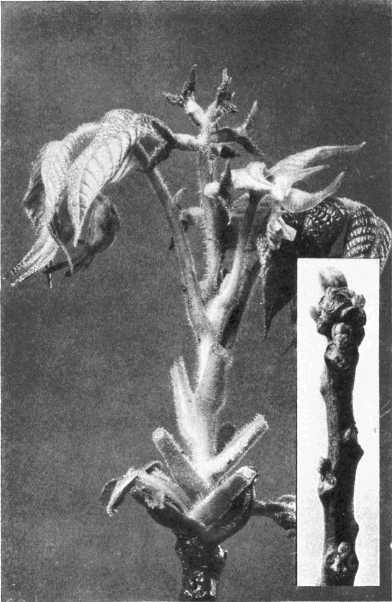
See page 31
THE BLACK WALNUT The young shoots are velvety and aromatic. The pistillate flowers, in groups of 3 to 5, are on terminal spikes
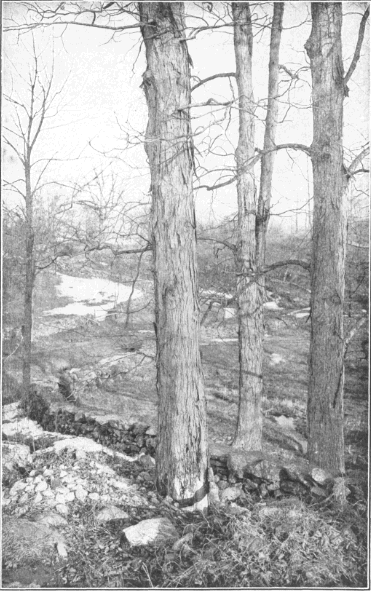
See page 37
SHAGBARK HICKORY IS KNOWN AND NAMED BY ITS LOOSE, STRIPPING BARK
The flight of basswood seeds on their wing-like blades goes on throughout the winter. This alone would account for the fact that basswoods greatly outnumbered all other trees in the virgin forests of the Ohio Valley. The seeds are not the tree's sole dependence. Suckers grow up about the stump of a tree the lumberman has taken, or the lightning has stricken. Any twig is likely to strike root, and any cutting made from a root as well.
The finest specimen I know grew from a walking-stick cut in the woods and thrust into the ground, by a mere chance, when the rambler reached home. It is the roof tree of a mansion, tall enough to waft its fragrance into the third-story windows, and to reach high above the chimney pots.
The range of this tree extends from New Brunswick to Dakota and south to Virginia and Texas. Its wood is used for carriage bodies, furniture, cooperage, paper pulp, charcoal, and fuel.
The Bee Tree, or White Basswood
T. heterophylla, Vent.
The bee tree or white basswood of the South has narrower leaves than the species just described, and they vary in form and size; but always have linings of fine, silvery down, and the fruits are fuzzy. A wonderful, dazzling play of white, pale green, and deeper shades is seen when one of these trees flutters its leaf mass against a background, sombre with hemlocks and an undergrowth of rhododendron. The favorite haunts of this species are the sides of mountain streams. Wild bees store their hoard of honey in the hollow trunks of old trees; and it is the favorite holiday of many country folk to locate these natural hives and despoil them. In order to do this the tree must come down, and the revenge of the outraged swarm is sometimes a high price to pay for the stolen sweets.
This linden is found from Ithaca, New York, southward along the Appalachian Mountains to northern Alabama, and westward into Illinois and Tennessee. It is best and most abundant in the mountains of eastern Tennessee and North Carolina, at a considerable altitude.
The Downy Basswood
T. pubescens, Ait.
The downy basswood has leaves that are green on both sides, but its young shoots and leaf-linings are coated with rusty hairs. It is a miniature throughout of the American basswood, except that the blade that bears the flower-cluster is rounded at its base, while the others taper narrowly to the short stem. This species occurs on Long Island, and is sparingly seen along the coast from the Carolinas to Texas.
The Common Lime
T. vulgaris
"Unter den Linden," the famous avenue in Berlin, is planted with the small-leaved common lime of Europe, beside which the American basswood is a coarse-looking tree. Very disappointing docked trees they are, along this thoroughfare; for city streets are never places where a tree can reach its best estate. In the rural sections of France and Germany this tree reaches noble stature and great age.
Linnaeus, the Swedish botanist, had his name from a fine linden tree, when his peasant father rose to the dignity of a surname. "Linn" is the Swedish word for linden. "Carl Linne," meaning "Charles of the linden tree," it was at first when he played as a boy in the shadow of its great branches. "Carolus Linnaeus" he became when he was appointed professor of the university at Upsala, and through all time since.
Gerarde discourses quaintly upon the linden tree in his "Grete Herball" published in England in 1597. "The male tree," he says, "is to me unknown." We smile at his notion that there are male and female trees in this family, but we wonder at the accuracy of observation evinced by one who lived and wrote before the science of botany had any existence. Evidently Master Gerarde had a good pair of eyes, and he has well expressed the things he saw. I quote a paragraph:
"The female line, or linden tree waxeth very great and thicke, spreading forth its branches wide and fare abroad, being a tree which yieldeth a most pleasant shadow, under and within whose boughs may be made brave summer houses and banqueting arbors, because the more that it is surcharged with weight of timber and such like, the better it doth flourish. The bark is brownish, very smooth and plaine on the outside, but that which is next to the timber is white, moist and tough, serving very well for ropes, trases and halters. The timber is whitish, plaine, and without knots; yea, very soft and gentle in the cutting and handling. The leaves are smooth, greene, shining and large, somewhat snipt or toothed about the edges: the floures are little, whitish, of a good savour, and very many in number; growing clustered together from out of the middle of the leaf: out of which proceedeth a small whitish long narrow leafe: after the floures succeed cornered sharp pointed nuts, of the bignesse of hasell nuts. This tree seemeth to be a kinde of elme, and the people of Essex (whereas great plenty groweth by the waysides) do call it broad-leafed elme."
PART III
THE WATER-LOVING TREES
The Poplars—The Willows—The Hornbeams—The Birches—The Alders—The Sycamores, or Buttonwoods—The Gum Trees—The Osage Orange
THE POPLARS
The poplars are plebeian trees, but they have a place to fill and they fill it with credit. They are the hardy, rude pioneers that go before and prepare the way for nobler trees. Let a fire sweep a path through the forest, and the poplar is likely to be the first tree to fill the breach. The trees produce abundant seed, very much like that of willows, and the wind sows it far and wide. The young trees love the sun, and serve as nurse trees to more valuable hardwoods and conifers, that must have shade until they become established. By the time the more valuable species are able to take care of themselves, the poplars have come to maturity and disappeared, for they are quick-growing, short-lived trees. The wind plays havoc with their brittle branches. Seldom has a good-sized poplar tree any claim to beauty.
Tenacity of life, if not of fibre, belongs to the poplar tribe. Twigs strike root and the roots send up suckers from underground: cutting off these suckers only encourages them to fresh activity. The only way to get rid of the young growth that springs up about an old tree is to use the grubbing-hoe thoroughly and patiently.
Poplar blossoms, borne in catkins, show the close relationship between this genus and the willows. The leaves, however, are always broad and leathery, and set on long stems. Twenty-five species are known, twelve of which are American.
The White Poplar
Populus alba, Linn.
The white poplar is sometimes called the silver-leaved poplar because its dark, glossy leaves are lined with cottony nap. This sprightly contrast of light and shade in the foliage is most unusual, and very attractive in early spring; but the leaf-linings collect soot and dust, and this they carry to the end of the season—a fact which should not be forgotten by those considering the advisability of planting this tree in a city where much soft coal is burned.
The white bark of this European poplar reminds us of the birch family, though it has no silky fringe shedding from the surface. The leaves often imitate the maple in the divisions of their margins, justifying the name "maple-leaved poplar."
As a dooryard tree this species has a wider popularity than it deserves. The wind breaks the brittle branches, and when these accidents threaten its life, the tree sends up suckers which form a grove about the parent trunk, and defy all efforts to eradicate them, until the grubbing-hoe and axe have been resorted to.
The Black Poplar
P. nigra, Linn.
The Lombardy poplar, a variety of the black poplar of Europe, is a familiar tree figure along roadsides, and often marks boundary lines between farms. Each tree is an exclamation point, its branches short and numerous, rising toward the zenith. The roundish leaves that twinkle on these aspiring branches make the tree pretty and interesting when young—just the thing to accent a group of round-headed trees in a park. But not many years are attained before the top becomes choked with the multitude of its branches. The tree cannot shed this dead wood and the beauty of its youth is departed. The trunk grows coarse, warty, and buttressed at the base. Suckers are thrown up from the roots. There is little left to challenge admiration. Since the tree gives practically no shade, we must believe that the first planters were attracted by its odd shape and its readiness to grow, rather than by any belief in its fitness for avenue and highway planting.
The Cottonwood
P. deltoidea, Marsh.
The cottonwood justifies its existence, if ever a tree did. On our Western plains, where the watercourses are sluggish and few and often run dry in midsummer, few trees grow; and the settler and traveler is grateful for the cottonwoods. The pioneer on the Western prairie planted it for shade and for wind-breaks about his first home. Many of these trees attain great age and in protected situations are magnificent though unsymmetrical trees, shaking out each spring a new head of bright green, glossy foliage, each leaf responsive to the lightest breeze.
"Necklace-bearing poplar," it has been called, from the fact that children find pleasure in stringing for beads the green, half-grown pods containing the minute seeds. They also delight in gathering the long, red caterpillar-like catkins of the staminate flowers, the pollen bearers, from the sterile trees. A fertile tree is sometimes counted a nuisance in a dooryard because its pods set free a great mass of cotton that collects in window screens, to the annoyance of housewives. But this seed time is soon over.
Just these merits of quick growth, prettiness, and tenacity of life, belong to the Carolina Poplar, a variety of native cottonwood that lines the streets of the typical suburban tract opened near any American city. The leaves are large and shine with a varnish which protects them from dust and smoke. But the wind breaks the branches, destroys the symmetry of the tree's head, and in a few years the suburban community takes on a cheap and ugly look. The wise promoter will alternate slow-growing maples and elms with the poplars so that these permanent trees will be ready to take their places in a few years.
The Aspen
P. tremuloides, Michx.
The trembling aspen, or quaking asp, is the prettiest tree of all the poplar tribe. Its bark is gray and smooth, often greenish and nearly white. An aspen copse is one of the loveliest things in the spring landscape. In March the bare, angular limbs show green under their bark, one of the first prophecies of spring; then the buds cast their brown scales and fuzzy gray catkins are revealed. There are few shades of olive and rose, few textures of silk and velvet that are not duplicated as the catkins lengthen and dance like chenille fringe from every twig. With the flowers, the new leaves open; each blade limp, silky, as it unrolls, more like the finest white flannel than anything else. (See illustrations, pages 86-87.) Soon the leaves shed all of this hairy, protective coat, passing through various tones of pink and silver on their way to their lustrous, bright green maturity. Their stems are flattened in a plane at right angles with the blade. Being long and pliant besides, they catch the breeze on blade or stem, and so the foliage is never still on the quietest of summer days. "Popple" leaves twinkle and dance and catch the sunlight like ripples on the surface of a stream, while the foliage of oaks and other trees near by may be practically motionless.
The Balsam Poplar
P. balsamifera, Linn.
The balsam poplar is the balm of Gilead of the early settlers, the Tacamahac of the Northern Indians. They squeezed the fragrant wax from the winter buds and used it to seal up the seams in their birch-bark canoes. The bees taught the Indian the uses of this glutinous secretion, which the tree used to seal the bud-scales and thus keep out water. When growth starts with the stirring of the sap, this wax softens; then the bees collect and store it against a day of need. Whether their homes be hollow trees or patent hives, weather-cracks are carefully sealed up with this waterproof gum, which the bee-keeper knows as "propolis."
Forests of balm of Gilead cover much of the vast British possessions north of the United States, and reach to the ultimate islands of the Aleutian group. They dip down into the states as far as Nebraska and Nevada. In cultivation, the species has proved itself a tree of excellent habit, easily propagated and transplanted, and of rapid growth. It has all the good points of the Carolina poplar and lacks its besetting sin of becoming so soon an unsightly cripple.
Narrow-leaved Cottonwood
P. angustifolia, James.
Lance-leaved Cottonwood
P. acuminata, Rydb.
Mexican Cottonwood
P. Mexicana, Wesm.
These three cottonwoods line the banks of mountain streams at high elevations in the great system of mountain chains that stretch from British Columbia southward. The dancing foliage, bright green in summer, golden in autumn, lends a charming color note to the dun stretches of arid plain and the sombre green of pine forests. These trees furnish the settler fuel, shade, and wind-breaks while he is converting his "homestead" into a home.
Black Cottonwood
P. trichocarpa, Hook.
Farther west, covering the mountain slopes from Alaska to Mexico, and liking even better the moist, rich lowlands, is the black cottonwood, the giant of the genus, reaching two hundred feet in height, and seven to eight feet in trunk diameter. Tall and stately, it lifts its broad rounded crown upon heavy upright limbs. In the Yosemite the dark, rich green of these poplar groves along the Merced River makes a rich, velvet margin, glorious when it turns to gold in autumn.
Swamp Cottonwood
P. heterophylla, Linn.
The swamp cottonwood of the South has leaves of variable but distinctly poplar form, always large, broadly ovate, with slim round petioles. The white down of the unfolding leaves often persists into midsummer. On account of the fluttering leaves the trees were called, by the early Acadians, "Langues de femmes" a mild calumny traceable to the herbalist, Gerarde, who compares them to "women's tongues, which seldom cease wagging."
The wood of poplars, soft, weak, and of slight value for fuel or lumber, has within two decades come into a position of great economic importance. Wood pulp is made of it, and out of wood pulp a thousand articles, from toys to wheels of locomotives, are made. A state forester declared: "If I could replace the maples in the state forest by poplars to-day, I would do it gladly. It would be worth thousands of dollars to the state."
THE WILLOWS
Along the watercourses the willow family finds its most congenial habitat. It is a very large family, numbering more than one hundred and seventy species, which are, however, mostly shrubs rather than trees. America has seventy species of willows, and new forms are constantly being discovered, which are the results of the crossing of closely related species. These "natural hybrids" have greatly confused the botany of the willow family.
Not more than half a dozen American willows ever attain the height of good-sized trees, and many of these are more commonly found in the tangled shrubbery of river banks, or covering long semi-arid strips of ground far to the north, or on mountain sides where their growth is stunted. Little trees, six inches high, bearing the characteristic catkins and narrow leaves of the willow, are found on the arctic tundras.
The wood of willows is pale in color, soft in texture, and of very little use as lumber or fuel, except in localities where trees are scarce. The Indian depended upon the inner bark of the withy willow for material for his fish nets and lines, and farmers in the pioneer days took the tough, supple stems, when spring made the sap run freely, for the binding together of the rails of their fences. Knotted tight and seasoned, these twigs hardened and lasted for years.
In Europe the white willow has long been used for the making of wooden shoes, artificial limbs, and carriage bodies. Its wood makes the finest charcoal for gunpowder. Willow wares, such as baskets and wicker furniture, are as old as civilization, and that in its primitive stages. It is a common sight in Europe to see groves of trees from which the long twigs have been taken yearly for these uses. The stumps are called "pollards" and the trees "pollarded willows" whose discouraging task has been to grow a yearly crop of withes for the basket-makers; yet each spring finds them bristling with the new growth.
The hosts of Cæsar invading England in the First Century found the Britons defending themselves behind willow-woven shields, and living in huts of wattled willows, smeared with mud. From that time to the present the uses of these long shoots have multiplied.
The roots of willows are fibrous and tough as the shoots. For this reason they serve a useful purpose in binding the banks of streams, especially where these are liable to flood. Nature seems to have designed these trees for just this purpose, for a twig lying upon the ground strikes root at every joint if the soil it falls on is sufficiently moist. The wind breaks off twigs and the water carries them down stream where they lodge on banks and sand bars, and these are soon covered with billows of green.
Willows start growth early in spring, putting out their catkins, the two sexes on different trees, before the opening of the leaves. Before the foliage is full grown, the light seeds, each a minute speck, floats away in a wisp of silky down. Its vitality lasts but a day, so it must fall on wet ground at once in order to grow. But the willow family is quite independent of its seeds in the matter of propagation. Chop the roots and twigs into bits and each will grow. Chop a young willow tree into sticks and fence posts and each one, if it is stuck green into the ground, covers itself with a head of leafy twigs before the season is over.
Weeping Willow
Salix Babylonica
The weeping willow, much planted in cemeteries and parks, came originally from Asia and is remarkable for its narrow leaves that seem fairly to drip from the pendulous twigs. (See illustration, page 55.) The foliage has a wonderful lightness and cheerfulness of expression, despite its weeping habit.
The Pussy Willow
S. discolor, Muehl.
The pussy willow is the familiar bog willow, whose gray, silky catkins appear in earliest spring. A walk in the woods in late February often brings us the charming surprise of a meeting with this little tree, just when its gray pussies are pushing out from their brown scales. We cut the twigs and bring them home and watch the wonderful color changes that mark the full development of the flowers. Turning them in the light, one sees under the sheen of silky hairs the varied and evanescent hues that glow in a Hungarian opal. In midsummer a pussy willow tree is lost among the shrubby growth in any woods. It is only because it leads the procession of the spring flowers that every one knows and loves it. (See illustrations, pages 86-87.)
THE HORNBEAMS
Two genera of little trees in the same family with the birches are frequently met in the woods, often modestly hiding under the larger trees. One is the solitary representative of its genus: the other has a sister species.
The hornbeams grow very slowly and their wood is close-grained, heavy, and hard. In flexibility, strength, and ability to stand strain, it rivals steel. Before metals so generally became competitors of woods in construction work, hornbeam was the only wood for rake teeth, levers, mallets, and especially for the beams of ox yokes. It outwore the stoutest oak, the toughest elm. Springiness adapted it for fork handles and the like. Bowls and dishes of hornbeam lasted forever, and would never leak nor crack. "Ironwood" is the name used wherever the wood was worked.
American Hornbeam
Carpinus Carolinianum, Walt.
The American hornbeam has bluish gray bark, very fine in texture, from which the name "blue beech," is common in some localities. "Water beech" points out the tree's preference for rich swamp land.
The trunk and limbs are strangely swollen, sometimes like a fluted column, oftener irregularly, the swelling under the bark suggesting the muscular development of a gymnast's arm.
In favorable places the hornbeams grow into regular oval heads, their branches dividing into a multitude of wiry, supple twigs. Crowded under oaks and other forest growth, they crouch and writhe; and their heads flatten into tangled masses of foliage.
The delicate leaves, strong-ribbed, oval, pointed, turn to red and orange in autumn. (See illustration, page 87.) The paired nutlets are provided with a parachute each, so that the wind can sow them broadcast. This wing is leafy in texture, shaped like a maple leaf, and curved into the shape of a boat. After they have broken apart, the nutlets hang by threads, tough as hornbeam fibres always are. At last, away they sail, to start new trees if they fall in moist soil.
The European hornbeam was a favorite tree for making the "pleached alleys," of which old-world garden-lovers were proud. A row of trees on each side of a promenade were pruned and trained to cover an arching framework, and to interlace their supple branches so that at length no other framework was needed, and one walked through a tunnel of green so closely interlaced as to make walls and roof that shut out light and wind and rain! Hedges, fences, and many fancies of the gardener were worked out with this hornbeam, so willingly did it lend itself to cutting and moulding into curious forms.
Hop Hornbeam
Ostrya Virginiana, Willd.
The hop hornbeam has habits like the other ironwood and an equal reputation for the hardness of its wood. The tree, however, wears scaly, shaggy brown bark, suggesting in its manner of scaling off the shagbark hickory. Its nutlets are packed separate in loose papery bags, and together form a loose, cone-like cluster, like the fruit of a hop vine. The wind scatters these buoyant little bags, that travel far.
This tree often twists in growing, and the trunk shows spiral furrows. "Hard-tack," "beetle-wood," "lever-wood"—all take us back to the pioneer who put this wood to such good uses, and who was glad to have these little trees growing in his wood-lot. In hickories, even, he had not the equal of them for strength and hardness.
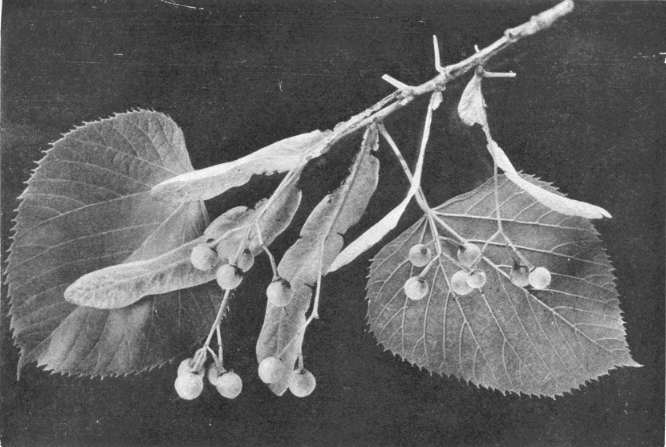
See page 70
THE AMERICAN LINDEN The broad leaves are unsymmetrical. Dry seed-balls are scattered by winter winds, the leathery bracts serving as wings
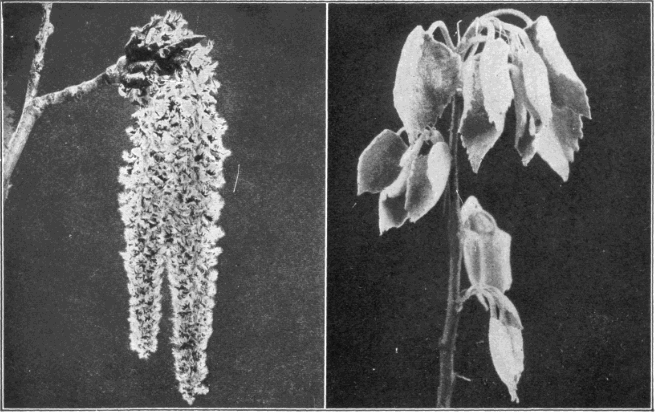
See page page 78
TREMBLING ASPEN Catkins and newly opened, flannel-like leaves
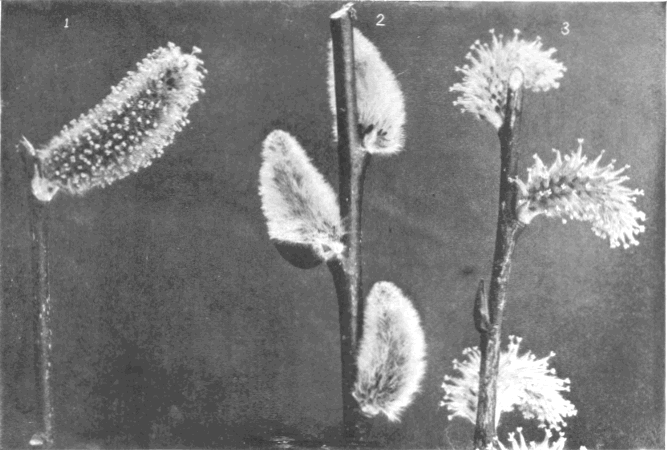
See page 84
THE PUSSY WILLOW 1—Mature staminate flower. 2—Immature staminate flowers. 3—Mature pistillate flowers
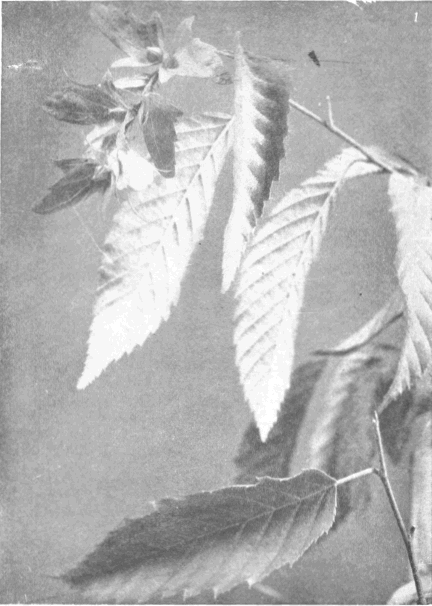
See page 85
THE AMERICAN HORNBEAM A fruiting branch showing the thin beech-like leaves and the seeds on their leafy triangular bracts
Knowlton's Ironwood
O. Knowltoni, Cov.
Knowlton's ironwood is found nowhere but in a thick grove on the southern slope of the canyon of the Colorado in Arizona, about seventy miles north of Flagstaff. Here these trees are numerous, crouching under oaks, their twisted branches ending in drooping twigs, bearing the characteristic pale green hops in autumn, small oval leaves, and the catkin flowers in spring. Such a restricted distribution for a distinct species of trees is unmatched in the annals of botany.
THE BIRCHES
Grace and gentility of appearance are attributes of this most interesting, attractive, and valuable family of trees. Shabby gentility, one may insist, thinking of the untidy, frayed-out edges that adorn the silky outer bark of almost every birch tree in the woods. (See illustration, page 102.) Not one of them, however, but lends a note of cheerfulness to the landscape. There is beauty and daintiness in leaf, flower, and winged seed, and despite the inferiority of most birch wood, the history of the family is a long story of usefulness to the human race.
About thirty species of birches grow in the Northern Hemisphere, ten of them are North American. The white birch of Europe extends across the northern half of Asia, and is cultivated in delicate cut-leaved and weeping forms, as a lawn and park tree in this country.
The Canoe Birch
Betula papyrifera, Marsh.
The canoe birch or paper birch is the noblest member of the family. (See cover of book.) Ernest Thompson Seton calls it "The White Queen of the Woods—the source of food, drink, transport, and lodging to those who dwell in the forest—the most bountiful provider of all the trees." Then he enumerates the sweet syrup yielded by its sap; the meal made by drying and grinding the inner bark; the buds and catkins upon which the partridge feeds; and the outer bark, which is its best gift to primitive man.
"The broad sheets of this vegetable rawhide, ripped off when the weather is warm, and especially when the sap is moving, are tough, light, strong, pliant, absolutely waterproof, almost imperishable in the weather; free from insects, assailable only by fire. It roofs the settler's shack and the forest Indian's wigwam. It supplies cups, pails, pots, pans, spoons, boxes; under its protecting power the matches are safe and dry; split very thin, as is easily done, it is the writing paper of the woods, flat, light, smooth, waterproof, tinted, and scented; but the crowning glory of the birch is this—it furnishes the indispensable substance for the bark canoe, whose making is the highest industrial exploit of the Indian life."
From the Atlantic to the Pacific, and from our northern tier of states to the arctic seas, woodsmen, red and white, have found this white-barked tree ready to their hand, their sure defense against death by cold and by starvation. The weather is never so wet but that shreds of birch bark burn merrily to start a campfire, and the timber of the trunk burns readily green or dry.
The White Birch
B. populifolia, Marsh.
The white birch is a small, short-lived tree that grows in swampy ground, its bark chalky white or grayish, with triangular rough patches of black, where branches are or have been. (The canoe birch has a clean bole, chalky white, with none of these ugly black patches.)
A vagabond tree it is, with thin pointed leaves and long pencil-like catkins and seed cones. The chief contributions of the poplar-leaved birch to the well-being of men are that it clothes with beauty the most uninviting situations, and that it comes again, after fire or other general slaughter, promptly and abundantly, from stump and scattered seed.
The Yellow Birch
B. lutea, Michx.
The yellow birch shows gleams of yellow under every rent in its gray, silky, frayed-out surface. Here is a timber tree of considerable size and value: its hard wood furnishes the frames of northern sledges; the knots and burs make good mallets; the curiously knotted roots show a curly grain, valuable to the cabinet-maker. From New England to Minnesota, and south along the Appalachian range, this tree is found, always telling its name by the color of its shaggy bark.
The Red Birch
B. nigra, Linn.
Red birch or river birch wears its name in its chocolate-hued or terra-cotta bark, whose scaly surface flaunts a series of tattered fringes to the very twig ends. Tall and graceful fountains of living green, these birches lean over stream borders from Minnesota and New York to the Gulf of Mexico, and reach westward to the foothills of the Rockies. Close-grained and strong, the pale brown wood is used for furniture, shoe lasts, and a multitude of woodenwares. In the bayous of the lower Mississippi, where its roots and the base of the trunk are inundated for half the year, the tree reaches its greatest size. The cones stand erect and shed their heart-shaped, winged seeds in June—an exception to the autumn-fruiting of all other birches.
The Cherry Birch
B. lenta, Linn.
The cherry birch has dark, irregularly checked bark like the wild cherry, but the oval, pointed leaf, the catkin flowers, and the cone fruits of its family. Birch beer is made of its aromatic sap and wintergreen oil is extracted from the leaves. Indians shred the inner bark and dry it in the spring when it is rich in starch and sugar. These shreds, like vermicelli, are boiled with fish and form a nourishing dish. The wood is heavy, hard, and close-grained, valuable for the manufacture of furniture and implements, especially wheel hubs, and for fuel. It is one of the handsomest, most symmetrical, and most luxuriant of all our birch trees, and a worthy addition to any park.
THE ALDERS
Closely related to the hornbeams and birches is a genus of small water-loving trees that grow rapidly and serve definite, special uses in the Old and New World. The genus alnus includes twenty species, nine of which grow in North America; six of these reach the height of trees.
The Black Alder
Alnus glutinosa, Gaertn.
Of the alders, the black alders of Europe is the largest and most important timber tree. Its range includes western Asia and northern Africa. It was introduced successfully into our Northeastern states in colonial times and has become naturalized in many localities. These trees sometimes reach seventy feet in height and a trunk diameter of three feet. Their dark green foliage, glutinous when the leaves unfold in the spring, ranks these giant alders among the beautiful and picturesque trees.
The lumberman esteems alder wood only for special purposes. It grows in water and its wood resists decay better than any other kind when saturated through indefinite periods. In the old days it was the wood for the boat-builder. The piles of the Rialto in Venice and along the canals of Amsterdam and other Dutch cities are of black alder. Water pipes and troughs, pumps, barrel staves, kneading troughs, sabots and clogs were made of alder wood. The bark and cones are rich in tannin and a yellow dye used in making ink. Willow and alder make the best charcoal for gunpowder. Warty excrescences on old trees and twisted roots furnished the inlayer with small but beautifully veined and very hard pieces, beautiful in veneer work when polished. In America the black alder is often met in horticultural varieties. The daintiest are the cut-leaved forms, of which imperialis, with leaves fingered like a white oak, is a good example.
One of the best uses to which alders are put in Europe is planting in hedges along borders of streams, where their closely interlacing roots hold the banks from crumbling and keep the current clear in midstream. No English landscape is more beautiful than one through which a little river winds, its banks and the boggy spots tributary to it softened by billows of living green. "He who would see the alder in perfection must follow the banks of the Mole and Surrey through the sweet vales of Dorking and Wickleham."
Seaside Alder
A. maritima, Nutt.
The seaside alder shares with the witch hazel the peculiar distinction of bearing its flowers and ripening its fruit simultaneously in the fall of the year. The alder comes first, hanging out its golden catkins in clusters on the ends of the season's shoots in August and September. Nothing is left of them when the witch hazel scatters its dainty stars along the twigs in October and November. The seaside alder follows stream borders near but not actually on the seacoast, through eastern Delaware and Maryland, but ranges comfortably on drier soil as far west as Oklahoma and is hardy in gardens and parks as far north as Boston, where it blooms profusely and is much admired for both flowers and glossy foliage through the late summer.
Oregon Alder
A. Oregona, Nutt.
The Oregon or red alder reaches eighty feet in height and its trunk may exceed three feet in diameter. This Western tree exceeds the Old World alder in size. The smooth, pale-gray bark reminds us of the beech and sets this tree apart from the white alder whose bark is brown and deeply furrowed. The flowers and cone fruits are very large. The ovate leaves are cut-toothed and often lobed. This is the alder of the West Coast, largest where it comes down to the sea near the shores of Puget Sound, but climbing the mountains and canyon sides wherever there is water, from Sitka to Santa Barbara. The reddish brown wood is light, easily worked, and beautifully satiny when polished. In Washington and Oregon it is largely used in the manufacture of furniture. The Indian dug-outs are made of the butts of large trees.
THE SYCAMORES, OR BUTTONWOODS
The Buttonwood
Platanus occidentalis, Linn.
Our eastern buttonwood is a tree to which, in America, we supply the name sycamore. Its European counterpart is the plane tree of the Old World. It is one of the easiest trees to recognize, for its most prominent trait is fairly shouted at us from a distance, whenever one of these trees comes within the range of our vision. The smooth bark that covers the branches is thin, very brittle, and has the habit of flaking off in irregular plates, leaving white patches under these plates that contrast sharply with the dingy olive of the unshed areas. On old trunks the bark is reddish brown and breaks into small, irregular plates; but above, and out among the branches, the tree looks downright untidy, and as though it had been splashed with whitewash by some careless painter. (See illustrations, pages 102-103.)
White birches grow in copses in low ground, a whole regiment of their white stems slanting upward. But the ghostly sycamore is apt to stand alone along the river-courses, scattered among other water-loving trees. The tree is wayward in its branching habit, its twigs irregular and angular. When the leaves are gone, it is a distressed-looking object, dangling its seed-balls in the wind until the central, bony cob is bare, the seeds having all sailed away on their hairy parachutes.
In the warmer South our buttonwood is a stalwart, large-limbed tree of colossal trunk, that shelters oaks and maples under its protecting arms. And there are some large specimens on Long Island.
The buttonwood leaf in a general way resembles a maple's, being as broad as long, with three main lobes at the top. The leaf stem forms a tent over the bud formed in summer and containing the leafy shoot of the next year. The leaf scar, therefore, is a circle and the leaf base a hollow cone. At first a sheathing stipule, like a little leafy ruffle, grows at the base of each leaf, but this is shed before midsummer.
Oriental Plane
P. Orientalis, Linn.
The oriental plane is almost as familiar a tree as our native species, for it is planted as a street tree in every city and village, and is a favorite shade and lawn tree besides. The city of Washington has set the example and so has Philadelphia. One third of the street trees of Paris are plane trees.
The chief merits of this tree immigrant are its perfect hardiness, its fine, symmetrical, compact pyramid, its freedom from injury by smoke and dust, and its rapid growth in the poor soil of the parkings of city and village. In leaf and fruit and bark-shedding habit, it is easily recognized as a sycamore, though in this species more than one ball dangles from each stem.
The exactions of city life limit the number of tree species that will do well. Our native sycamore patiently endures the foul breath of factory chimneys, and helps, in the smallest, downtown city parks, to make green oases in burning deserts of brick and stone pavements. But it is subject to the ravages of insect and fungous enemies to a greater extent than the oriental species.
THE GUM TREES
Southern people talk more about "gum trees" than people in the North. Two of our three native species of Nyssa belong solely to southern swamps, and the third, which comes north to Canada, is oftener called by other names. All these trees are picturesque, with twiggy, contorted branches; tough, cross-grained wood; alternate, simple, leathery, but deciduous leaves, beautiful at all seasons; minute flowers and fleshy, berry-like fruits.
The Sour, or Black, Gum
Nyssa sylvatica, Marsh.
The sour or black gum of the South has a wide range, being hardy to southern Ontario and Maine. To the New Englander this is the "pepperidge"; the Indians called it "tupelo"; but the woodsman, North and South, calls it the gum tree, as a rule. "Black gum" refers to its dark gray, rough bark, which is broken into many-sided plates. By this, it is easily distinguished from the "red gum" or liquid amber, which grows in the same situations, but is not related to it. "Sour gum" refers to the acid, blue-black berries, one to three in a cluster, ripe in October.
We shall know this tree by its tall, slender trunk, clothed with short, ridged, full-twigged, horizontal branches. With no claim to symmetry, the black gum is a striking and picturesque figure in winter. It is beautiful in summer, covered with the dark polished leaves, two to four inches long. In autumn patches of red appear as the leaves begin to drop. This is the tupelo's signal that winter is coming. Soon the tree is a pillar of fire against yellowing ashes and hickories. The reds of the swamp maple and scarlet oak are brighter, but no tree has a richer color than this one. A spray brought in to decorate the mantelpiece lasts till Christmas holly displaces it. The leaves, being leathery, do not curl and dry, as do thin maple leaves, in the warm air of the house.
The Cotton Gum
N. aquatica, Marsh.
The cotton gum is draped in cottony white down as the new shoots start and the leaves unfold in spring. In midsummer this down persists in the leaf-linings, lightening the dark green of the tree-tops. The dark blue fruits of this species have no culinary value. The wood is used for crating material. The tree reaches its maximum height—one hundred feet—in the cypress swamps of Louisiana and Texas, its abundant, corky roots adapting it to its habitat.
The Sweet Gum
Liquidamber styraciflua, Linn.
The sweet gum is a tall tree with a straight trunk, four to five feet in diameter, with slender branches covered with corky bark thrown out in wing-like ridges. At first the head is regular and pyramidal, but in old age it becomes irregularly oblong and comparatively narrow. The bark is reddish brown, deeply furrowed between rough scaly plates, marked by hard, warty excrescences.
The leaves are lobed like a maple's, but more regularly, so as to form a five-pointed star. Brilliant green in summer, they become streaked with crimson and yellow. Wherever these gum trees grow, the autumn landscape is painted with the changeful splendor of the most gorgeous sunset. "The tree is not a flame, it is a conflagration!" Often along a country road the rail fence is hidden by an undergrowth of young gum trees. Their polished star leaves may pass from green into dull crimsons and then into lilacs and so to brown, or they may flame into scarlets and orange instead. Always, the foliage of the sweet gum falls before it loses its wonderful colors.
The flowers of the sweet gum are knobby little bunches; the swinging balls covered with curving horns contain the winged seeds, small but shaped like the key of the maple. One recognizes the gum tree in winter by these swinging seed-balls, an inch in diameter, like the balls of the buttonwood, except that those are smooth. (See illustrations, pages 102-103.) The best distinguishing mark of sweet gums in winter are the corky ridges on the branches, and the star-shaped leaves under the trees. Sweet gum sap is resinous and fragrant. Chip through the bark, and an aromatic gum soon accumulates in the wound. The farther South one goes, the more copious is the exudation. In Mexico a Spanish explorer described, in 1651, "large trees that exude a gum like liquid amber." This is the "copalm balm" gathered and shipped each year to Europe from New Orleans and from Mexican ports. The fragrant gum, storax or styrax, derived from forests of the oriental sweet gum in Asia Minor, is used as incense in temples of various oriental religions. It blends with frankincense and myrrh in the censers of Greek and Roman Catholic churches. It is used in medicines also, and as a dry gum is the standard glove perfume in France.
Beautiful and interesting in every stage of growth, our native sweet gums are planted largely in the parks of Europe and are earning recognition at home, through the efforts of tree-lovers who would make the most of native species in ornamental planting.
The name, gum tree, is applied to our tupelos, and to the great tribe of Australian eucalyptus trees, now largely planted in the Southwest.
The Osage Orange
Toxylon pomiferum, Raff.
Related to figs and mulberries, but solitary in the genus toxylon, is the osage orange, a handsome round-headed tree, native of eastern North America, whose fleshy roots and milky, bitter, rubbery sap reveal its family connections with the tropical rubber plants. (See illustration, page 119.) The fruits are great yellow-green globes, four to five inches in diameter, covered on the outside by crowded, one-seeded berries. This compound fruit reveals the tree's relationship to both figs and mulberries.
The aborigines, especially of the Osage tribe, in the middle Mississippi Valley, cherished these trees for their orange-yellow wood, which is hard, heavy, flexible, and strong—the best bow-wood to be found east of the Rocky Mountains. When the settlers came the sharp thorns with which the branches are effectually armed appealed strongly to the busy farmers and the tree was widely planted for hedges. Nurserymen produced them by thousands, from cuttings of root and branch. These trees made rapid growth and seemed most promising as a solution of the fencing problem, but they did not prove hardy in Iowa and neighboring states. Even now remnants of those old winter-killed hedges may be found on farm boundaries, individual trees having been able to survive.
The native osage orange timber is about all gone, for the rich bottom lands where it once grew most abundantly in Oklahoma and Texas have been converted into farm land. However, the growing of osage orange timber for posts is on the increase. Systematically maintained, plantations pay well. The wood is exceptionally durable in soil. Good prices are paid for posts in local markets. Twenty-five posts can be grown to the rod in rows of a plantation; they grow rapidly and send up new shoots from the roots.
The brilliant, leathery leaves and conspicuous green fruits make this native bow-wood a very striking lawn tree. It holds its foliage well into the autumn and turns at length into a mass of gold. It harbors few insects, has handsome bark, and is altogether a distinguished, foreign-looking tree.
Experiments of feeding osage orange leaves to silkworms have been successfully made at different times, but nowhere in America has silk culture succeeded. Since the white mulberry is hardy here and its foliage is the basis of the silk-growing industry in the Old World, it is futile to look for substitutes in the osage orange or any other tree.
PART IV
TREES WITH SHOWY FLOWERS AND FRUITS
The Magnolias—The Dogwoods—The Viburnums—The Mountain Ashes—The Rhododendron—The Mountain Laurel—The Madroña—The Sorrel Tree—The Silver Bell Trees—The Sweet Leaf—The Fringe Tree—The Laurel Family—The Witch Hazel—The Burning Bush—The Sumachs—The Smoke Tree—The Hollies
THE MAGNOLIAS
Four of the ten genera in the magnolia family are represented in North America. Of these, two are trees. All are known by their large, simple, alternate leaves, with margins entire; their showy, solitary, terminal flowers, perfect and with all parts distinct; and their cone-like fruits, compounded of many one- or two-seeded follicles, shingling over each other upon a central spike. The wood is soft and light throughout the family, and the roots are fleshy. The sap is watery and the bark is bitter and aromatic.
The genus magnolia, named by Linnaeus in honor of Pierre Magnol, a French botanist, includes twenty species; twelve are native to eastern and southern Asia, two to Mexico, and six to eastern North America. They are of peculiar interest to horticulturists and to the general public, because they have the largest flowers of any trees in cultivation. A white blossom from six inches to a foot across is bound to attract attention and admiration when set off by a whorl of lustrous evergreen leaves. The petals of most magnolia blossoms are notably thick and waxy in texture and deliciously fragrant. Last but not least are the cone-like fruits, which flush from pale green to rose as they ripen against the dark, leathery foliage; at maturity their follicles open in a peculiar fashion and hang out their bright red seeds on slender elastic threads. Foliage, flowers, or cones alone would make magnolias superb as ornamental trees. All these qualities combined have given them a preëminent place in every country where ornamental planting is done. North America is fortunate in having so large a number of species that assume tree form.
When you see a magnolia in the North blossoming before the leaves, you may be sure it is an exotic species, and if the flowers are colored you may be equally sure that it is a hybrid between two oriental species, and belongs to the group of which the type is M. Soulangeana. The owner may be a magnolia enthusiast, able to show you on his premises both parents of this interesting and beautiful hybrid.
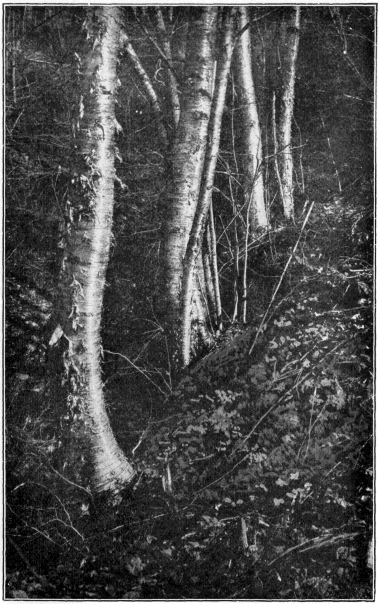
See page 87
THE TATTERED, SILKY BARK OF THE BIRCHES
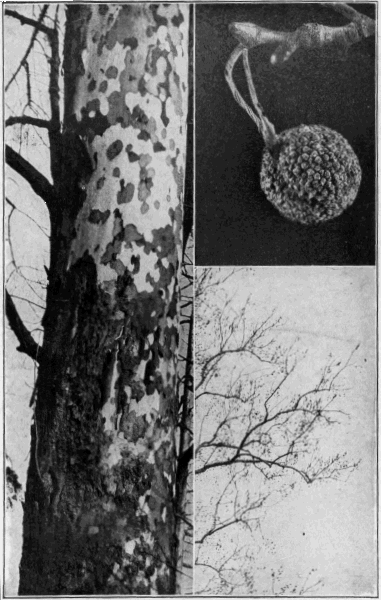
See page 93
BLOTCHED BARK OF THE SYCAMORE, AND THE SEED-BALLS THAT HANG ON ALL WINTER
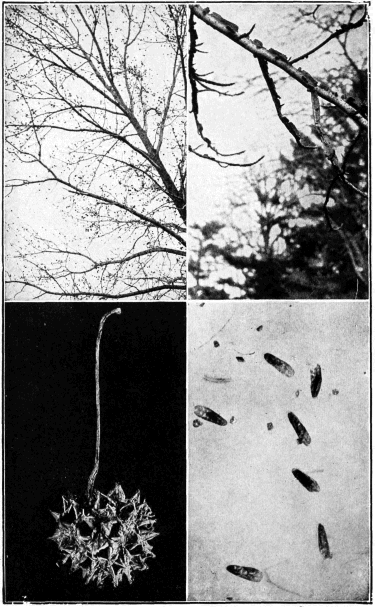
See page 97
THE WARTY, RIDGED BARK, THE SWINGING SEED-BALLS, AND THE WINGED SEEDS OF THE SWEET GUM
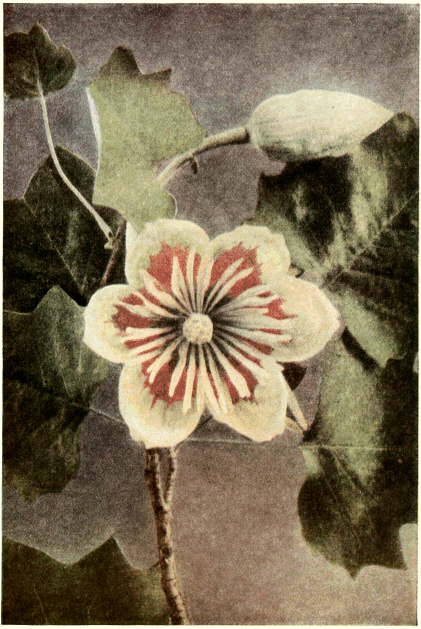
See page 109
TULIP TREE, FLOWER AND LEAVES
Yulan Magnolia
Magnolia Yulan
The Yulan magnolia, for centuries a favorite in Japanese gardens, covers itself before the leaves appear with pure white, fragrant flowers, bell-shaped and fully six inches across. In our Eastern gardens it is quite as much at home, and though young trees are oftenest seen, the older specimens are as large as any native magnolia. This is one parent. The other is but a shrub, the purple magnolia, M. obovata, that must be protected against the rigors of our Northern winters. It blooms in May or June, and its purple flowers, with rosy linings, are relatively small and almost scentless. The children of this parentage get their tints of pink and rose and crimson from this purple magnolia shrub.
Splendid, hardy, fragrant, big-flowered varieties have arisen from this cross. All are small trees, suitable for planting in city yards, where they are decorative throughout the season.
Starry Magnolia
M. stellata
The starry magnolia blooms in March or April, covering itself with star-shaped white flowers made of strap-like petals that form a flat whorl instead of a cup. This is the earliest magnolia and wonderfully precocious, blooming when scarcely two feet high.
The Southern states can grow the splendid Campbell's magnolia, which is in its glory in the high mountain valleys of the Himalayas, where it reaches one hundred feet in height. The fragrant flower-cups, from six to ten inches in diameter, shade from pink to crimson. It is rare in cultivation because it is not easy to grow, and northern horticulturists fail utterly to grow it outdoors; but the fact that it is the most beautiful of all exotic species must encourage its culture in the South, and difficulties will be overcome when the tree's peculiar needs are fully understood.
The Great Laurel Magnolia
M. foetida, Sarg.
The great laurel magnolia is oftenest seen in cultivation as a small tree of pyramidal or conical habit, with stiff, ascending branches, bearing a lustrous mass of leathery oval leaves, five to eight inches long, lined with dull green, or with rusty down, persistent until the second spring. When small these magnolia trees are as conventional as the rubber plants in hotel lobbies, whose foliage resembles theirs. But in the forests of Louisiana, where this tree reaches its greatest perfection, it earns the characterization that Sargent gave it, "the most splendid ornamental tree in the American forests." With a trunk four feet thick, and its head lifted from fifty to eighty feet above the ground and with each leaf cluster holding up a great white flower, waxy as a camellia, seven to eight inches across, the tree is indeed superb. William Bartram likened these flowers to great white roses, distinctly visible from a distance of a mile.
The purple heart of the flower, made by a spot of color at the base of each petal, and the overpowering odor, rather sickening as the flowers fade, lure insects to the nectar store at the bottom of the flower-cup. This odor, disagreeable to many people, is the one objection to this flower when brought indoors. A drawback that florists discover is that the slightest bruise of the waxy petals produces a brownish discoloration, which prevents the shipment of these flowers. The splendid foliage, however, travels perfectly, and a new and growing industry is the gathering of magnolia branches in Southern woods for Christmas decoration. These branches are offered in all Northern cities, and this demand threatens the extinction of the tree, which until comparatively recent years has enjoyed immunity because of the worthlessness of its soft wood.
The tree's natural range is from the North Carolina coast to Tampa Bay, and west along the Gulf Coast to Texas and southern Arkansas. As an ornamental tree, it is safely planted in Philadelphia, but its life is precarious farther north. It is widely grown in southern California as a street tree, notably in Pasadena and in parks and gardens for its blossoms, foliage, and fuzzy, horny cones.
The Swamp Bay
M. glauca, Linn.
The swamp bay has lustrous, bright green leaves with silvery linings. In Florida and across to Texas and Arkansas it grows into a superb evergreen tree, fifty to seventy-five feet in height. Northward along the Atlantic Coast its growth is stunted as the climate becomes more rigorous, until it reaches Massachusetts and Long Island, where it becomes a many-stemmed shrub, whose beautiful leaves fall in the autumn. On the streets of cities near the New Jersey swamps the flowers of the swamp bay are offered for sale in May. The buds are almost globular, and each one is surrounded by a cluster of new leaves. To spring back these waxy white petals, that are marred by a touch, is criminal; but it is the common practice with boys who hawk these flowers on the streets. Most of the charm is gone from flowers thus defiled by dingy fingers.
The finest flowers are borne on strong young shoots. The florists collect and handle them with extreme care. Much of the swamp land now useless along the Atlantic seaboard could be profitably planted to this magnolia, for the florist trade alone. The flowers bloom slowly through a period of several weeks. The enterprising owner of tracts planted to swamp bay could reap two harvests a year, almost from the first season: the flowers in spring and the leafy shoots for holiday decorations. In the South the leaves are evergreen.
The Large-leaved Cucumber Tree
M. macrophylla, Michx.
The large-leaved cucumber tree exceeds all other magnolias in the size of its leaves and flowers. In fact, no tree outside the tropics can match it, for its blades are almost a yard in length. The flowers are great white bowls, sometimes a foot across, made of six white waxy petals, much broader than the three protecting sepals outside. The inner petals have purple spots at the base. The fruits are almost globular, two to three inches long, turning red as they mature, equally showy when the scarlet seeds dangle from the open follicles.
These trees are at home in fertile valleys among the foothills of the Alleghanies, from North Carolina to middle Florida, and west to central Arkansas. Their range is not continuous. They occur in scattered groups that have come from seed.
The horticulturist has greatly aided nature in the spread of this tree in this country and in Europe, where its flowers and leaves attract universal attention. The mistake usually made is to plant it in the middle of a lawn where the wind lashes the broad leaves into ribbons before they have reached their full size. Every twig or leaf that touches a petal mars it with a brown bruise. The only way to enjoy one of these remarkable trees is to plant it in the most sheltered situation, where the sunshine will reach it and the breezes will not. Then the silver-lined foliage and the superb white blossoms can come to perfection and the sight is worth going miles to see.
The Cucumber Tree
M. acuminata, Linn.
The cucumber tree is the hardiest of our native magnolias, tropical-looking by reason of its heart-shaped leaves, six to ten inches long. Its chosen habitat is rocky uplands, where the fleshy roots can find moist soil. It ranges from western New York to Illinois, Kentucky, and Arkansas, and follows the mountain foothills through Pennsylvania and Tennessee into Alabama and Mississippi.
The flowers are like tulips, and though large can scarcely be seen among the new leaves, because they are all yellowish green in color. The petals are leaf-like and the flowers have no fragrance to make up for their lack of beauty. Imperfect pollination results in distorted, fleshy cones that resemble cucumbers that have twisted and shrunken in spots as they grew. These fruits turn from pink to red as they mature, redeeming their ugly shape by their vivid color as the leaves turn yellow. In September, the scarlet seeds hang out and the wind whips them until they dangle several inches below the fruit. One by one they drop and new cucumber trees come up from this planting.
The wood of the cucumber tree is light, close-textured, weak, and pale brown in color. It has only local use in cabinet-making and for flooring. The tree is far more valuable in horticulture. It is a splendid stock on which to graft less hardy magnolias. It is a superb avenue and shade tree for Northern cities, and in this capacity it is as yet little known. It grows vigorously from seed, and stands transplanting, if care is used that the brittle roots are not mutilated nor dried.
The Umbrella Tree
M. tripetala, Linn.
The umbrella tree has an umbrella-like whorl of leaves surrounding the flower whose white cup stands above three recurving white sepals. The whole tree suggests an umbrella, so closely thatched is its dome of thin, bright green leaves.
The stout contorted branches and twigs lack symmetry, from the forking habit. Side twigs strike out at right angles from an erect branch, then turn up into a position parallel with the parent branch, and bear terminal flowers, which induce another branching system the following year. Despite its angularity this is the trimmest and one of the handsomest of our native magnolias, and it has the merit of hardiness even in New England, where it attains large size. Its native range extends from Pennsylvania near the coast, along the Atlantic seaboard, and westward to southern Alabama and Arkansas. It loves swamp borders and the banks of mountain streams, but behaves well in the moderately rich soil of parks and gardens.
The Tulip Tree
Liriodendron tulipifera, Linn.
The tulip tree is a cousin, rather than a sister, to the foregoing magnolias. It stands alone in its genus in America, but has a sister species that grows in the Chinese interior. A tall, stately forest tree, it reached two hundred feet in height, and a trunk diameter of ten feet, in the lower Ohio Valley, when it was covered with virgin forest. This species still holds its own as a valuable lumber tree on mountain slopes of North Carolina and Tennessee. Smaller, but still stately and beautiful, it is found in woods from Vermont to Florida and west to Illinois, Arkansas, and Mississippi.
In Europe the tulip tree has been a favorite since its discovery and exportation by the American colonists. More and more it is coming to be appreciated at home as a lawn and shade tree, for there is no time in the year when it is not full of interest and beauty, and no time in its life when it is not a distinct and beautiful addition to any plantation.
In the dead of winter young tulip trees are singularly straight and symmetrical compared with saplings of other trees. There is usually a grove of them, planted by some older tree that towers overhead, and still holds up its shiny cones, that take months to give up their winged seeds. The close, thick, intricately furrowed bark of the parent tree contrasts sharply with the smooth rind of its branches and the stems of the saplings. Tulip trees are trim as beeches until the trunks are old.
The winter twigs are set with oblong blunt leaf-buds. The terminal one contains the flower, when the tree is old enough to bloom. (See illustration, page 103.) In spring the terminal buds of saplings best show the peculiarity of the tree's vernation. Two green leaves with palms together form a flat bag that encloses the new shoot. Hold this bag up to the light and you see, as a shadow within, a curved petiole and leaf. The bag opens along its edge seam, the leaf-stem straightens, lifting the blade which is folded on the midrib. At the base of the petiole stands a smaller flat green bag. As the leaf grows to maturity the basal palms of its protecting bag shrivel and fall away, leaving the ring scar around the leaf base.