Front matter (continued 3)
Reading edition
Now the growing shoot has carried up the second bag, which opens and another leaf expands, sheds its leafy stipules, and a third follows. The studies of this unique vernation delight children and grown-ups. It is absolutely unmatched in the world of trees.
The leathery blades of the tulip tree are from four to six inches broad and long, with basal lobes, like those of a maple leaf, and the end chopped off square. Occasionally there is a notch, made by the two end lobes projecting a trifle beyond the midrib. The leaves are singularly free from damage, keeping their dark lustrous beauty through the summer, and turning to clear yellow before they fall.
The winged seeds fall first from the top of the erect cones, the wind whirling them far, because the flat blades are long and the seed-cases light—many of them empty in fact. Far into winter a tulip tree seems to be blossoming, because its bare branches are tipped with the remnants of the seed cones, faded and shining almost white against the dark branches.
Tulip wood is soft and weak, pale brown, and light in weight. It is easily worked and is used locally for house and boat-building. Wood pulp consumes much of the yearly harvest. It is known as "poplar," whose wood it resembles. Ordinary postal cards are made of it. The bark yields a drug used as a heart stimulant.
THE DOGWOODS
Foliage of exceptional beauty is the distinguishing trait of the trees in the cornel family, from the standpoint of the landscape gardener and the lover of the woods. Showy flowers and fruit belong to some of the species; extremely hard, close-textured wood belongs to all; and this means slow growth, which is a limitation in the eyes of the planter who wishes quick results. But he who plants a cornel tree and watches it season after season, finds it one of the most interesting of nature studies through the whole round of the year.
The dogwoods are slender-twigged trees of small size, with simple, entire leaves, strongly ribbed, and with one exception, set opposite upon the twigs. Fifty species are distributed over the Northern Hemisphere; one crosses the equator into Peru. Four of the seventeen species found in the United States are trees; the rest are shrubs, one of them the low-growing bunchberry of our Northern woods.
The Flowering Dogwood
Cornus florida, Linn.
The flowering dogwood (see illustration, page 134) is a little tree whose round, bushy, flat-topped head is made of short, horizontal branches. The twigs hold erect in the winter a multitude of buds, large, squat, enclosed in four scales, like the husk of a hickory nut. All the delicate tints that the water-colorist delights in are found in these buds and the twigs that bear them. When spring comes, these scales loosen, expand, turn green, then fade into pure white—forming the four banners, ordinarily called petals—of the bloom of the dogwood. The true flowers are small and clustered in the centre. These white expanses are merely modified bud scales, the botanist will tell you, and the notch at the end is where the horny winter scale broke away, while its base was growing into the large white palm.
From March till May one finds the dogwood clothed in white (see illustration, page 118), and the glossy leaves passing through changing hues from rose to green. The wayward arrangement of the blossoms on the branch is the delight of artists. Lured by the white signals, bees and other nectar-loving insects come to the flowers, cross-fertilizing them while they supply their own needs. In midsummer the pale green clusters of berries replace the flowers, and when in autumn the foliage, still glossy and smooth, changes to crimson and scarlet, the berries are brighter still, until the birds have taken every one.
The bark of the dogwood is checkered like alligator skin but with deep furrows that make it very rough. The wood is used for wood engraving blocks, for tool handles, hubs, and cogs. But it is becoming very scarce. The deplorable destruction of the dogwoods comes not so much from the lumberman as from the irresponsible people who tear the trees to pieces in blossoming time. The wanton mutilation of the dogwoods in natural woodlands belonging to cities can be curbed only by policing the tracts. The saving of every flowering dogwood tree is a duty owed to his community by every wood-lot owner within the range of this hardy, handsome tree. Though exterminated over much of its range, it is able and willing to grow in any state east of the Mississippi River. It is one of the most deservedly popular trees planted for ornament in this country and in Europe.
Western Dogwood
C. Nuttallii, Aud.
The Pacific Coast outdoes the rest of the country in the size of its forest trees. Superlatives in vegetation abound where the breath of the Japan current tempers the air. The Western dogwood often reaches one hundred feet in height in the forests near Seattle. Its flowers have six, instead of four, of the petal-like, white bracts, each narrower and pointed, and without the terminal notch. The tree in blossom is more magnificent than the eastern species, for the flowers are often twice as large, and the spectacle of one of these trees, after the leaves turn to scarlet in autumn, and it leans against the sombre evergreens that cover the mountain-side, is always startling, even in a country where surprises are the rule.
European Dogwood
C. mas.
The European dogwood or cornel is often planted in the Eastern states as an ornamental tree, but not for its flowers alone, though these tiny, button-like clusters cover the bare branches in earliest spring. The showy fruits look like scarlet olives hanging among the glossy foliage in late summer. These fruits are edible, and in Europe are used in preserves and cordials.
THE VIBURNUMS
The honeysuckle family, which includes a multitude of ornamental shrubs, furnishes two genera with three representatives. Handsome foliage, showy flowers, and attractive fruits justify the popularity of this family in gardens and parks.
The viburnums are distributed over the Northern Hemisphere and extend into the tropics. There are about one hundred species, including the old-fashioned snowball bush, perhaps the best-known species in this country. Discriminating gardeners have replaced it by the Japanese snowball, because the latter has much more handsome foliage and perfect flowers, instead of the barren flower cluster that has nothing to show for itself once the bloom is past. This new species wears the autumn decoration of bright red berries well into the winter.
The Sheepberry
Viburnum lentago, Linn.
In our native woods the sheepberry is a small round-headed tree, with slim, drooping branches and oval leaves, finely cut-toothed and tapering to wavy-winged petioles. In autumn these leathery leaves change to orange and red, their shiny surfaces contrasting with the dull lining, pitted with black dots. The fruit, a loose cluster of dark blue berries, on branching red stems, is an attractive color contrast, and the birds flutter in the trees until they have eaten the last one. The fragrant white flowers light up the tree from April to June with their flat clusters three to five inches across. The opposite arrangement of the leaves and that short-winged petiole identify the little tree, whether it grows by the swamp borders, along the streams, or in parks and gardens. At any season it is good to look upon. Its range covers the eastern half of the country, extending almost to the Gulf of Mexico and west into Wyoming.
The Rusty Nannyberry
V. rufidulum, Raff.
The rusty nannyberry is easily distinguished by the rusty hairs that clothe its new shoots and the stems and veins of the leaves. White flower clusters are succeeded by bright blue berries of unusual size and brilliance, ripe in October, on red-stemmed pedicles. The handsome polished leaves are rounded at the tips. The wood of this little tree has a very unpleasant odor, but this trait has no bearing upon its merits as a garden ornament. It is found wild from Virginia to Illinois and southward. In cultivation it is hardy in the latitude of Boston.
The Black Haw
V. prunifolium, Linn.
The black haw has the characteristic flowers and fruit of its genus, but is smaller throughout than the other two, and its branches are stout. In European parks and gardens it is known as the "stagbush." Its fruit turns dark when dead ripe, and persists well into the winter. In the wilds, this little viburnum is found from southern New England to Michigan, and south to Georgia and Texas.
THE MOUNTAIN ASHES
The handsome foliage and showy flower clusters make the mountain ashes a favorite group of little trees for border shrubberies and other ornamental planting. The foliage is almost fern-like in delicacy and it spreads in a whorl below the flower clusters in spring and the scarlet berry clusters in autumn. Far into the winter after the foliage has dropped the berries persist, supplying the birds with food, especially in snowy winters, when their need is greatest, and brightening the dull thickets of bare twigs on dreary days.
Eastern Mountain Ash
Sorbus Americana, Marsh.
The common eastern mountain ash reaches thirty feet in height—a slender, pyramidal tree, with spreading branches and delicate leaves of from thirteen to seventeen leaflets. The flat-topped cluster of creamy white flowers (see illustration, page 135) appears in May and June, above the dark yellow-green foliage; and the scarlet berries, ripe in September when the leaves have turned yellow, may persist until spring. Along the borders of swamps and climbing rocky bluffs, often scattered in plum thickets, these trees are handsome at any season. Along the mountains of Tennessee and North Carolina home remedies are made out of the berries. From Newfoundland to Manitoba and southward the tree grows wild and is planted for ornament in home grounds.
Elder-leaved Mountain Ash
S. sambucifolia, Roem.
The elder-leaved mountain ash overlaps the first species, and is even more daring as a climber. It ranges from Labrador to Alaska, follows the Rocky Mountains to Colorado, and in the Eastern states goes no farther south than Pennsylvania. Its leaves are graceful and drooping like the elder. The flowers and fruits are large; the whole tree tropical looking, its open, pyramidal head giving each leaf a chance at the sun.
European Mountain Ash
S. Aucuparia, Linn.
Most common in cultivation is the European mountain ash called in England the rowan tree. This trim round-headed species is very neat and conventional compared with its wild cousins, but in the craggy highlands of Scotland and Wales it much resembles our mountain ashes.
Old superstitions cluster around the rowan tree in all rural sections. These are preserved in the folk-lore and the literature of many countries. Rowans were planted by cottage doors and at the gates of church yards, being considered effectual in exorcising evil spirits. Leafy twigs hung over the thresholds, crosses made of "Roan" wood given out on festival days, were worn as charms or amulets. Milkmaids, especially, depended upon these for the defeat of the "black elves" who constantly tried to make their cows go dry, and unless prevented got into the churns—and then the butter would never come!
The farther north a tree can grow, the more likely it is to have close relatives in the Old World. One mountain ash of Japan is hardly distinguishable from our western species, and some authorities believe that our two native species are but varieties of the rowan tree of Europe.
THE RHODODENDRON
The heath family, of about sixty-seven genera, distributed over the temperate and tropical countries of the earth, has twenty-one genera in the United States, seven of which have tree representatives. Azaleas, the multitude of the heathers, the huckleberries, the madroñas, call to mind flower shows we have seen—under glass, in gardens, in parks, and among mountain fastnesses brightened by the loveliness of the mountain laurel, azalea, and rhododendron. In this wonderful family the leaves are simple and mostly evergreen. Rarely are the fruits of any importance. It is the flowers in masses that give the chief distinction to a family with over a thousand species, which have been the subjects of study and cultivation through centuries. The type of the family is the Scotch heather, immortalized in song and story. In London the Christmas season is marked by the sale of half a million little potted plants of heather! Each is about a foot in height and bears a thousand tiny bells, rosy, with white lips. This is the poor man's Christmas flower. It costs a shilling and lasts a month or more.
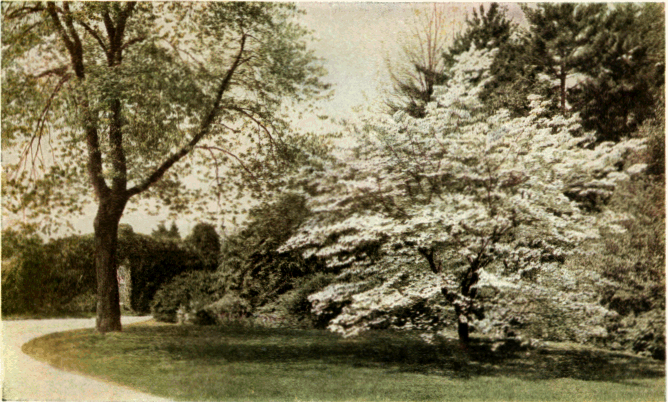
See page 111
FLOWERING DOGWOOD
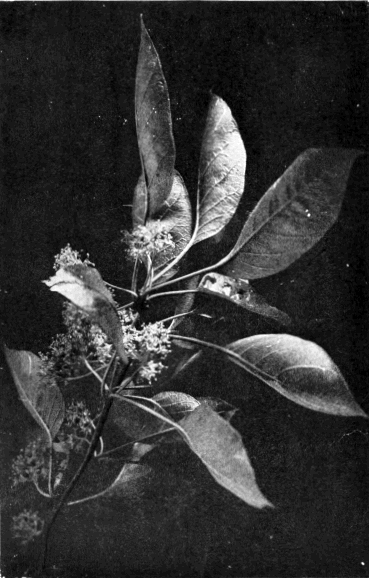
See page 99
THE OSAGE ORANGE Flowers appear in June, after the lustrous leaves
Trees are scarce in the heath family. Shrubs are in the majority. The azaleas, which the Belgian gardeners have brought to such perfection and developed in such a great number of varieties, are among the best known of the heaths. The profuse blossoms in potted azaleas entirely extinguish the foliage, and the flowers are almost as lasting as if they were artificial.
The genus rhododendron in American woods is represented by a mountain shrub and a tree. Both are evergreen and both are widely planted for ornament during the entire season. Carloads of these wonderful plants are shipped from the mountain slopes of the Alleghanies for mass planting on rocky ground, and to cover embankments along the drives in great estates. Because of the altitude of their native habitat, they are hardy in New England, and even as far as the Great Lakes. In time of bloom, these masses are the great flower show of the countryside, and in winter nothing is more beautiful than the evergreen foliage of rhododendrons, lifted out of the snow.
Great Laurel or Rose Bay
Rhododendron maximum, Linn.
Among the Alleghany Mountains, from Virginia southward, the great laurel rises to a height of forty feet, and interlaces its boughs with those of Fraser's magnolia and the mountain hemlock in the dense forest cover. Thickets of rhododendron trees are common, and though its stature is reduced, it follows the highlands into New York, and is one of the most striking and beautiful shrubs in the Pennsylvania mountains. Scattered and becoming more rare and more stunted, it reaches Lake Erie and on into New Brunswick. The leaves crown each of the stiff branches with an umbrella-like whorl, that stands guard in winter time about a large scaly bud. In spring the scales fall and a cone-like flower cluster rises. Each blossom is white, marked with yellow or orange spots, in the bell-like corolla's throat; or the flowers may be pale rose, with deeper tones in the unopened buds. A great tree in blossom, with its flower clusters lighting up the umbrella-like whorls of glossy, evergreen leaves, illuminates the woods, and makes every other tree look commonplace beside it.
In late summer, green capsules, each with a curving style at the top, cluster where the flowers stood, but these are scarcely ornamental. The evergreen leaves and the buds, full of promise for June blossoming, are the beautiful features of rhododendrons in winter.
The wonderful array of color and profusion of bloom, seen in an exhibit of rhododendrons and azaleas, is the most convincing proof of what crossing and careful selection can do in developing races of flowering plants. The ancestry of all these tub-plants is a matter of record, and goes back to a few comparatively insignificant wild species, competing with all the rest of the native flora for a livelihood.
THE MOUNTAIN LAUREL
The mountain laurel (Kalmia latifolia, Linn.) grows from Nova Scotia to Lake Erie and southward through New England and New York, and along the Alleghanies to northern Georgia. Hardier than the rhododendrons, smaller in blossoms and in foliage, the laurel is in many points its superior in beauty. In June and July the polished evergreen foliage of the kalmia bushes is almost overwhelmed by the masses of its exquisite pink blossoms, beside which the bloom of rhododendrons looks coarse and crude in coloring. Coral-red fluted buds with pointed tips show the richest color, making with the yellow-green of the new leaves one of the most exquisite color combinations in any spring shrubbery. The largest buds open first, spreading into wide five-lobed corollas, with two pockets in the base of each forming a circle of ten pockets. Ten stamens stand about the free central pistil, and the anther of each is hid in a pocket of the corolla—the slender filament bent backward. This is a curious contrivance for insuring cross-fertilization through the help of the bees. (See "Flowers Worth Knowing.")
Linnaeus commemorated in the name of this genus the devoted and arduous labors of Peter Kalm, the Swedish botanist, who sent back to his master at the university of Upsala specimens of the wonderful and varied flora found in his travels in eastern North America. Most of the names accredited to Linnaeus were given to plants he never saw except as dried herbarium specimens from the New World.
THE MADROÑA
The madroña (Arbutus Menziesii, Pursh.), another member of the Heath family, is one of the superbly beautiful trees in the forests that stretch from British Columbia southward into California. South of the bay of San Francisco and on the dry eastern slopes of California mountains it is stunted to a shrub, but on the high, well-drained slopes through the coast region and in the redwood forests of northern California it is a tree that reaches a hundred feet in height.
John Muir writes: "The madroña, clad in thin, smooth, red and yellow bark, with big, glossy leaves, seems in the dark coniferous forests of Washington and Vancouver Island like some lost wanderer from the magnolia groves in the South." All the year around this is one of the most beautiful of American trees. It bears large conical clusters of white flowers above the vivid green of its leathery leaves, that are wonderfully lightened by silvery linings. In autumn the red-brown of the branches is enriched and intensified by the luxuriant clusters of scarlet berries against the red and orange of the two-year-old leaves. Among the giant redwoods this tree commands the highest admiration.
THE SORREL TREE
The sorrel tree, or sour-wood (Oxydendrum arboreum, DC.) belongs among the heaths. Its vivid scarlet autumn foliage is its chief claim to the admiration of gardeners. In spring the little tree is beautiful in its bronze-green foliage, and in late July and August it bears long branching racemes of tiny bell-shaped white flowers. This multitude of little bells suggests the tree's relationship to the blossoming heather we see in florists' shops.
The leaves give the tree its two common names: they have a sour taste, resembling that of the herbaceous sorrels. The twigs, even in the dead of winter, yield this refreshing acid sap, that flows through the veins of the membranous leaves in summer. Many a hunter, temporarily lost in Southern woods, quenches his thirst by nibbling young shoots of the sour-wood.
After the flower comes a downy capsule, five-celled, with numerous pointed seeds. The leaves are not unlike those of a plum tree except that they attain a length of five to seven inches. In the woods from Pennsylvania, Ohio, and Indiana, southward to Florida, Alabama, Louisiana, and Arkansas this tree ranges, and we often see it in cultivation as far north as Boston. It grows to its largest size on the western slopes of the Big Smoky Mountains in Tennessee, attaining here a height of sixty feet. In cultivation it is one of the little, slender-stemmed, dainty trees, beautiful at any season. It is the sole representative of its genus in the world, so far as botanists know.
THE SILVER BELL TREES
The silver bell tree (Mohrodendron tetraptera, Britt.) earns its name in May when among the green leaves the clustered bell flowers gradually pale from green to white, with rosy tints that seem to come from the ruddy flower-stems. A "snowdrop tree" may be eighty feet in height, in the mountains of east Tennessee and western North Carolina, but ordinarily we see it in gardens and parks as a delicate, slender-branched tree, that stands out from every other species in the border as the loveliest thing that blooms there.
Not a moment in spring lacks interest if one has a little mohrodendron tree to watch. For weeks the ruddy twigs grow ruddier by the opening of leaf and flower buds; then comes the slow fading of the flowers, when sun and rain seem to work together to bleach them into utter purity of color and texture. Gradually the white bells fade and a queer little green, tapering seed-case enlarges and ripens. Through the late summer these pale green fruits are exceedingly ornamental as the leaves turn to pale yellow.
In cultivation, the silver bell tree is hardy in the New England states, but in its native woods it grows north no farther than West Virginia and Illinois. It is easily transplanted and pruned to bush form, if one desires to keep the blossoming down where the perfection of the flowers can be enjoyed at close range.
Snowdrop Tree
M. diptera, Britt.
A second species called the snowdrop tree skirts the swamps along the South Atlantic and Gulf coast and follows the Mississippi bayous to southern Arkansas. It is smaller in stature than the silver bell tree, but has larger leaves and more showy flowers. The botanical names record the chief specific difference between the two species: this one has but two wings on its seed-cases, while the other has four. This species is hardy no farther north than Philadelphia. The flowers have their bells cleft almost to the base, whereas the bell of the other species is merely notched at the top.
THE SWEET LEAF
Two genera of trees in this country are temperate zone representatives of a tropical family which furnishes benzoine, torax, and other valuable balsams of commerce. It is easy to see that these trees are strangers from warm countries, for many of their traits are singularly unfamiliar.
The Sweet Leaf
Symplocos tinctoria, L'Her.
The sweet leaf is our sole representative of a large genus of trees native to the forests of Australia and the tropics in Asia and South America. They yield important drugs and dyestuffs, particularly in British India. But the sweet leaf is a small tree, rarely over twenty feet in height, with ashy gray bark, warty and narrowly fissured. In earliest spring its twigs are clothed with yellow or white blossoms that come in a procession and cover the tree from March until May, preceding the leaves, and breathing a wonderful fragrance into the air. The leaves are small, leathery, dark green, lustrous above, deciduous in the regions of colder winters, persistent from one to two years in the warmer part of its range. The flowers are succeeded by brown berries that ripen in summer, or early autumn. The flesh is dry about the single seed.
Horses and cattle greedily browse upon the foliage, which has a distinctly sweet taste. The bark and leaves both yield a yellow dye, and the roots a tonic from their bitter, aromatic sap.
"Horse sugar" is another local name for this little tree, which is found sparingly from Delaware to Florida, west to the Blue Ridge Mountains, and in the Gulf states to Louisiana and northward into Arkansas and to eastern Texas. It is a shade-loving tree, usually found under the forest cover of taller species, skirting the borders of cypress swamps, and climbing to elevations of nearly three thousand feet on the slopes of the Blue Ridge.
A wonderful new species of symplocos has come into cultivation from Japan and will enjoy a constantly increasing popularity. Its fragrant white blossoms, before the leaves, make the tree look like a hawthorn; but its unique distinction is that the racemed flowers give place to berries of a brilliant turquoise blue, which make this shrubby tree a most striking and beautiful object in the autumn when the leaves are turning yellow.
THE FRINGE TREE
Native to the middle and southern portions of the United States is a slender little tree (Chionanthus Virginica, Linn.), whose sister species inhabits northern and central China. Both of them cover their branches with delicate, fragrant white flowers, in loose drooping panicles, when the leaves are about one third grown. Each flower has four slender curving petals an inch long, but exceedingly narrow. In May and June the tree is decked with a bridal veil of white that makes it one of the most ethereal and the most elegant of lawn and park trees at this supreme moment of the year. Later the leaves broaden and reach six to eight inches in length, tapering narrowly to the short petioles. Thick and dark green, with plain margins, and conspicuously looped venation near the edges, these leaves suggest a young magnolia tree. Blue fruits the size of plums succeed the flowers in September, denying the magnolia theory and shading to black before they fall. The flesh is dry and seeds solitary under the thick skin of the drupe.
As in many other instances, European gardeners have led in the appreciation of this American ornamental tree. However, New England has planted it freely in parks and gardens, and popularity will follow wherever it becomes known. Its natural distribution is from southern Pennsylvania to Florida, and west to Arkansas and Texas. In cultivation it is hardy and flourishes far north of its natural range. No garden that can have a fringe tree should be without it. Fortunately its wood is negligible in quantity, and the temptation to chop down these trees does not come to the ignorant man with an axe. Whoever goes to the woods in May is rewarded for many miles of tramping if he comes upon a "snow-flower tree" in the height of its blooming season, led perhaps by its delicate fragrance when the little tree is overshadowed by the deep green of the forest cover. It is an experience that will not be forgotten soon.
THE LAUREL FAMILY
The laurel family, a large group of aromatic trees and shrubs found chiefly in the tropics, includes with our sassafras, laurels, and bays the cinnamon and camphor trees.
California Laurel
Umbellaria Californica, Nutt.
The California laurel climbs the western slopes of the Sierra Nevada from the forests of southwestern Oregon to the San Bernardino range near Los Angeles. "Up North" it is called pepperwood. It is a lover of wet soil, so it keeps near streams. With the broad-leaved maple it gives character to the deciduous growth near the northern boundaries of California, where it reaches eighty to ninety feet in height, and a trunk diameter of four to five feet. Sometimes it is tall, but usually it divides near the ground into several large diverging stems, forming a broad round head. In southern California, and at high elevations, it oftenest occurs as a low shrub.
The willow-like leaves, lustrous and evergreen, last often through the sixth season. Unfolding in winter or early spring, they continue to appear as the branches lengthen until late in the autumn, turning to beautiful yellow or orange and falling one by one. Beginning during the second season, they continue to drop, as new shoots loosen their hold. These leaves are rich in an aromatic oil which causes them to burn readily when piled green upon a campfire. Plum-like purple fruits succeed the small white fragrant flowers, borne in clusters in the axils of the leaves. The seeds germinate before the fruit begins to decay. Indeed the plantlet has attained considerable size before the acid flesh shows any signs of change.
This tree is a superb addition to the parks and gardens of the Pacific Coast. It is strikingly handsome in a land of handsome trees, native and exotic. Its wood is the most beautiful and valuable produced in the forests of Pacific North America for the interior finish of houses and for furniture. It is heavy, hard, strong, fine-grained, light brown, of a rich tone, with paler sap-wood, that includes the annual growth of thirty or forty seasons. The leaves yield by distillation a pungent, aromatic, volatile oil, and the fruit a fatty acid commercially valuable.
The Red Bay
Persea Borbonia, Streng.
Another laurel native to stream and swamp borders, from Virginia to Texas and north to Arkansas, is the red bay, whose bark, thick, red, and furrowed into scaly ridges on the trunk, becomes smooth and green on the branches. The evergreen leaves are narrowly oval, three to four inches long, bright green, polished, with pale linings. The white flowers are very minute bells borne in axillary clusters, succeeded in autumn by blue or black shiny berries, one half inch long, one-seeded, making a pretty contrast with the clear yellow of the year-old leaves and the bright green of the new ones.
This native laurel, lover of rich, moist soil, deserves the place in cultivation more commonly granted its European cousin, Laurus nobilis, Linn., the familiar tub laurel of hotel verandas in the Northern states, and much grown out of doors in southern California and in milder climates east. The tree is occasionally sixty to seventy feet high, with trunk two to three feet in diameter. Such specimens furnish the cabinet-maker and carpenter with a beautiful, bright red, close-grained wood for fine interior finish and furniture. Formerly it was used in the construction of river boats, but the timber supply is now very limited.
The Avocado
P. gratissima, Gaertn.
In Florida and southern California the avocado or alligator pear is being extensively cultivated. This laurel grows wild in the West Indies, Brazil, Peru, and Mexico. Its berry attains the size of a large pear. It has been developed in several commercial varieties, all having smooth green or purple skin, and soft oily pulp like marrow surrounding a single gigantic seed. It is usually cut in two like a melon and eaten raw as a salad dressed with vinegar, salt, and pepper. Once a stranger acquires the taste, he is extremely fond of this new salad fruit. The growing of the trees is easy and very profitable. At present the fruits are in great demand in city markets, and the prices are too high for any but the rich to enjoy this luxury.
Where a market is difficult to reach, the abundant oil is expressed from these fruits and used for illumination and the manufacture of soap. The seeds yield an indelible ink.
It is interesting to the student of trees to note how many tropical families have representation in North America, due to the fact that Florida extends into the tropics, and the West Indies seem to form a sort of bridge over which Central American and South American species have reached the Floridian Keys and the mainland.
The Sassafras
Sassafras, Karst.
The sole remnant of an ancient genus is the aromatic sassafras familiar as a roadside tree that flames in autumn with the star gum and the swamp maples. In the deep woods it reaches a height of more than a hundred feet and is an important lumber tree. In the arctic regions and in the rocky strata of our western mountains, fossil leaves of sassafras are preserved, and the same traces are found in Europe, giving to the geologist proofs that the genus once had a much wider range than now. But no living representative of the genus was known outside of eastern North America, until the report of a recently discovered sassafras in China.
The Indians in Florida named the sassafras to the inquiring colonists who came with Columbus. They explained its curative properties, and its reputation traveled up the Atlantic seaboard. The first cargo of home products shipped by the colonists back to England from Massachusetts contained a large consignment of sassafras roots. To-day we look for an exhibit of sassafras bark in drug-store windows in spring. People buy it and make sassafras tea which they drink "to clear the blood." "In the Southwestern states the dried leaves are much used as an ingredient in soups, for which they are well adapted by the abundance of mucilage they contain. For this purpose the mature green leaves are dried, powdered (the stringy portions being separated), sifted and preserved for use. This preparation mixed with soups gives them a ropy consistence and a peculiar flavor, much relished by those accustomed to it. To such soups are given the names gombo file and gombo zab." (Seton.)
Emerson says that in New England a decoction of sassafras bark gave to the housewife's homespun woolen cloth a permanent orange dye. The name "Ague Tree" originated with the use of sassafras bark tea as a stimulant that warmed and brought out the perspiration freely for victims of the malarial "ague," or "chills and fever."
Sassafras wood is dull orange-yellow, soft, weak, light, brittle, and coarse-grained, but it is amazingly durable in contact with the soil, as the pioneers learned when they used it to make posts and fence rails. It is largely used also in cooperage, and in the building of light boats. Oil of sassafras distilled from the bark of the roots is used for perfuming soaps and flavoring medicines.
With all its practical uses listed above, we must all have learned to know the tree if it grows in our neighborhood, and if we observe it closely, month by month throughout the year, we shall all agree that its beauty justifies its selection for planting in our home grounds, and surpasses all its medicinal and other commercial offerings to the world.
In winter the sassafras tree is most picturesque by reason of the short, stout, twisted branches that spread almost at right angles from the central shaft, and form a narrow, usually flat, often unsymmetrical head. The bark is rough, reddish brown, deeply and irregularly divided into broad scaly plates or ridges. The branches end in slim, pale yellow-green twigs that are set with pointed, bright green buds, giving the tree an appearance of being thoroughly alive while others, bare of leaves, look dead in winter.
What country boy or girl has not lingered on the way home from school to nibble the dainty green buds of the sassafras, or to dig at the roots with his jack-knife for a sliver of aromatic bark?
As spring comes on the bare twigs are covered with a delicate green of the opening leaves, brightened by clusters of yellow flowers (see illustration, page 150) whose starry calyxes are alike on all of the trees; but only on the fertile trees are the flowers succeeded by the blue berries, softening on their scarlet pedicels, if only the birds can wait until they are ripe.
Midsummer is the time to hunt for "mittens" and to note how many different forms of leaves belong on the same sassafras tree. First, there is the simple ovate leaf; second, a larger blade oval in form but with one side extended and lobed to form a thumb, making the whole leaf look like the pattern of a mitten cut out by an unskilled hand; third, a symmetrical, three-lobed leaf, the pattern of a narrow mitten with a large thumb on each side. Not infrequently do all these forms occur on a single twig. Only the mulberry, among our native trees, shows such a variety of leaf forms as the sassafras. There is quite as great variation in the size of the leaves. One law seems to prevail among sassafras trees: more of the oval leaves than the lobed ones are found on mature trees. It is the roadside sapling, with its foliage within easy reach, that delights boys and girls with its wonderful variety of leaf patterns. Here the size of the leaves greatly surpasses that of the foliage on full-grown trees, and the autumnal colors are more glorious in the roadside thickets than in the tree-tops far above them.
Sassafras trees grow readily from seed in any loose, moist soil. A single tree spreads by a multitude of fleshy root-stalks, and these natural root-cuttings bear transplanting as easily as a poplar. Every garden border should have one specimen at least to add its flame to the conflagration of autumn foliage and the charming contrast of its blue berries on their coral stalks.
THE WITCH HAZEL
Eighteen genera compose the sub-tropical family in which hamamelis is the type. Two or three Asiatic species and one American are known.
The witch hazel (Hamamelis Virginiana, Linn.) is a stout, many-stemmed shrub or a small tree, with rough unsymmetrical leaves, strongly veined, coarsely toothed, and roughly diamond-shaped. The twigs, when bare, are set with hairy sickle-shaped buds. Nowhere in summer would an undergrowth of witch hazel trees attract attention. But in autumn, when other trees have reached a state of utter rest, the witch hazel wakes and bursts into bloom. Among the dead leaves which stubbornly cling as they yellow, and often persist until spring, the tiny buds, the size of a pin-head, open into starry blossoms with petals like gold threads. The witch hazel thicket is veiled with these gold-mesh flowers, as ethereal as the haunting perfume which they exhale. Frost crisps the delicate petals but they curl, up like shavings and stay till spring. At no time is the weather cold enough to destroy this November flower show.
Among the blossoms are the pods in clusters, gaping wide if the seeds are shed; closed tight, with little monkey faces, if not yet open. The harvest of witch hazel seeds is worth going far to see. Damp weather delays this most interesting little game. Dry frosty weather is ideal for it.
Go into a witch hazel thicket on some fine morning in early November and sit down on the drift of dead leaves that carpet the woods floor. The silence is broken now and then by a sharp report like a bullet striking against the bark of a near-by trunk, or skipping among the leaves. Perhaps a twinge on the ear shows that you have been a target for some tiny projectile, sent to its mark with force enough to hurt.
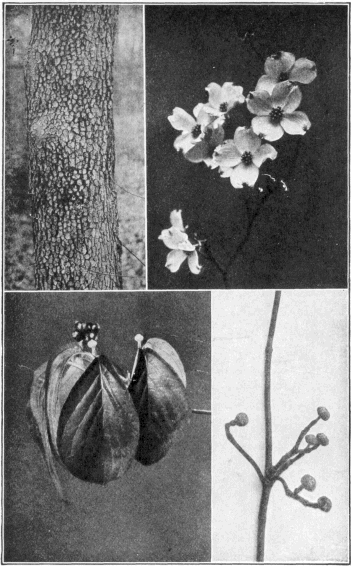
See page 111
BARK, BLOSSOM, FRUIT, AND WINTER FLOWER BUDS OF THE FLOWERING DOGWOOD
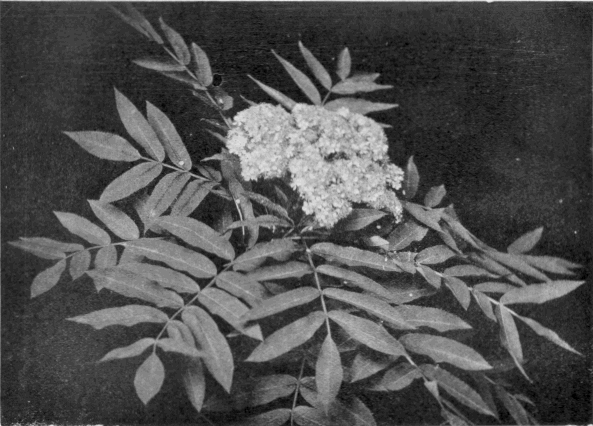
See page 116
THE MOUNTAIN ASH The flat, crowded cluster of tiny white flowers is set in a whorl of dark-green leaves in May or June
The fusillade comes from the ripened pods, which have a remarkable ability to throw their seeds, and thus do for the parent tree what the winged seeds of other trees accomplish. The lining of the two-celled pod is believed to shorten and produce a spring that drives the seeds forth with surprising force when they are loosened from their attachment. This occurs when the lips part. Frost and sun seem to decide just when to spring the trap and let fly the little black seeds.
A young botanist went into the woods to find out just how far a witch hazel tree can throw its seeds. She chose an isolated tree and spread white muslin under it for many yards in four directions. The most remote of the many seeds she caught that day fell eighteen feet from the base of the tree.
The Indians in America were the first people to use the bark of the witch hazel for curing inflammations. An infusion of the twigs and roots is now made by boiling them for twenty-four hours in water to which alcohol has been added. "Witch hazel extract," distilled from this mixture, is the most popular preparation to use for bruises and sprains, and to allay the pain of burns. Druggists and chemists have failed to discover any medicinal properties in bark or leaf, but the public has faith in it. The alcohol is probably the effective agent.
Witch hazel comes honestly by its name. The English "witch hazel" is a species of elm to which superstitious miners went to get forked twigs to use as divining rods. No one in the countryside would dream of sinking a shaft for coal without the use of this forked twig. In any old and isolated country district in America there is usually a man whose reputation is based in his skilful use of a forked witch hazel twig. Sent for before a well is dug, he slowly walks over the ground, holding the twig erect by its two supple forks, one in each hand. When he passes over the spot where the hidden springs of water are, the twig goes down, without any volition of the "water-witch." At least, so he says, and if water is struck by digging, his claims are vindicated and scoffers hide their heads.
THE BURNING BUSH
American gardeners cherish with regard that amounts almost to affection any shrub or tree which will lend color, especially brilliant color, to the winter landscape. Thus the holly, the Japanese barberry, many of the haws, the mountain ash, and the rugosa rose will be found in the shrubbery borders of many gardens, supplying the birds with food when the ground is covered with snow, and sprinkling the brightness of their red berries against the monotony of dull green conifers.
The burning bush (Euonymus atropurpureus, Jacq.) lends its scarlet fruits to the vivid colors that paint any winter landscape. They hang on slender stalks, clustered where the leaves were attached. Four flattish lobes, deeply separated by constrictions, form each of these strange-looking fruits. In October each is pale purplish in color and one half an inch across. Now the husk parts and curls back, revealing the seeds, each of the four enveloped in a loose scarlet wrinkled coat. Until midwinter the little tree is indeed a burning bush, glowing brighter as the advancing season opens wider the purple husks, and the little swinging Maltese cross, made by the four scarlet berries, is the only thing one sees, looking up from below. Birds take the berries, though they are bitter and poisonous.
In spring the slender branchlets of this little tree are covered with opposite, pointed leaves, two to five inches long, and in their axils are borne purplish flowers, with four spreading recurving petals. In the centre of each is supported a square platform upon which are the spreading anthers and styles. It does not require much botanical knowledge to see a family relationship between this tree and the woody vine we call "bitter-sweet"; the flowers and fruits are alike in many features.
In Oklahoma and Arkansas and eastern Texas the burning bush becomes a good-sized tree and its hard, close-grained wood is peculiarly adapted to making spindles, knitting needles, skewers, and toothpicks. "Prickwood" is the English name. Chinese and Japanese species have been added to our list of flowering trees and vines. Two shrubby species of Euonymus belong to the flora of North America, but the bulk of the large family is tropical.
Our dainty little American tree skirts the edges of deep woods from New York to Montana, and southward to the Gulf. In cultivation it extends throughout New England. "Wahoo," the common name in the South, is probably of Indian origin.
THE SUMACHS
The sumach family contains more than fifty genera, confined for the most part to the warmer regions of the globe. Two fruit trees within this family are the mango and the pistachio nut tree. Commercially important also is the turpentine tree of southern Europe. The Japanese lacquer tree yields the black varnish used in all lacquered wares. The cultivated sumachs of southern Europe are important in the tanning industry, their leaves containing from twenty-five to thirty per cent. of tannic acid.
In the flora of the United States three genera of the family have tree representatives. The genus Rhus, with a total of one hundred and twenty species, stands first. Most of these belong to South Africa; sixteen to North America where their distribution covers practically the entire continent. Of these, four attain the habit of small trees.
Fleshy roots, pithy branchlets, and milky, or sometimes caustic or watery juice, belong to the sumachs, which are oftenest seen as roadside thickets or fringing the borders of woods. The foliage is fernlike, odd-pinnate, rarely simple. The flowers are conspicuous by their crowding into terminal or axillary panicles, followed by bony fruits, densely crowded like the flowers.
The Staghorn Sumach
Rhus hirta, Sudw.
The staghorn sumach is named for the densely hairy, forking branchlets, which look much like the horns of a stag "in the velvet." The foliage and fruit are also densely clothed with stiff pale hairs, usually red or bright yellow.
The leaves reach two feet in length, with twenty or thirty oblong, often sickle-shaped leaflets, set opposite on the stem, and terminating in a single odd leaflet. Bright yellow-green until half grown, dark green and dull above when mature, often nearly white on the under surface, these leaves turn in autumn to bright scarlet, shading into purple, crimson, and orange. No sunset was ever more changeful and glorious than a patch of staghorn sumach that covers the ugliness of a railroad siding in October. After the leaves have fallen, the dull red fuzzy fruits persist, offering food to belated bird migrants and gradually fading to browns before spring.
The maximum height of this largest of northern sumachs is thirty-five feet. The wood of such large specimens is sometimes used for walking-sticks and for tabourets and such fancy work as inlaying. Coarse, soft, and brittle, it is satiny when polished, and attractively streaked with orange and green. The young shoots are cut and their pith contents removed to make pipes for drawing maple sap from the trees in sugaring time.
But the best use of the tree is for ornamental planting. In summer, the ugliness of the most unsightly bank is covered where this tree is allowed to run wild and throw up its root suckers unchecked. The mass effect of its fernlike foliage in spring is superb, when the green is lightened by the fine clusters of pink blossoms. No tree carries its autumn foliage longer nor blazes with greater splendor in the soft sunshine of the late year. The hairy staghorn branches, bared of leaves, hold aloft their fruits like lighted candelabra far into the waning winter. For screens and border shrubs this sumach may become objectionable, by reason of its habit of spreading by suckers as well as seed.
Its choice of situations is broken uplands and dry, gravelly banks. Its range extends from New Brunswick to Minnesota and southward through the Northern states, and along the mountains to the Gulf states. In cultivation, it is found in the Middle West and on the Atlantic seaboard, and is a favorite in central and northern Europe.
The Dwarf Sumach
R. copallina, Linn.
The black dwarf, or mountain sumach, is smaller, with softer, closer velvet coating its twigs and lining its leaves, than the burly staghorn sumach wears. It grows all over the eastern half of the United States, even to the foothills of the Rocky Mountains, and rises to thirty feet in height above a short, stout trunk in the mountains of Tennessee and North Carolina. Its leaves are the most beautiful in the sumach family. They are six to eight inches long, the central stalk bearing nine to twenty-one dark green leaflets, lustrous above, lined with silvery pubescence. A striking peculiarity is that the central leaf-stem is winged on each side with a leafy frill between the pairs of leaflets. In autumn, the foliage mass changes to varying shades of scarlet and crimson. The flower clusters are copious and loose, and the heavy fruits nod from their great weight and show the most beautiful shades, ranging from yellow to dull red. Sterile soil is often covered by extensive growths of this charming shrubby tree which spreads by underground root-stocks. It is the latest of all the sumachs to bloom.
In the South the leaves are sometimes gathered in summer to be dried and pulverized for use in tanning leather. A yellow dyestuff is also extracted from them. It is a favorite sumach for ornamental planting in this country and in Europe.
The Poison Sumach
R. Vernix, Linn.
The poison sumach is a small tree with slender drooping branches, smooth, reddish brown, dotted on the twigs with orange-colored breathing holes, becoming orange-brown and gray as the bark thickens. The trunk is often somewhat fluted under a smooth gray rind. This is one of the most brilliant and beautiful of all the sumachs, but unfortunately it is deadly poisonous, more to be dreaded than the poison ivy of our woods, and the poisonwood of Florida, both of which are near relatives. By certain traits we may always know, with absolute certainty, a poison sumach when we find it. Look at the berries. If they droop and are grayish white, avoid touching the tree, no matter how alluring the wonderful scarlet foliage is. Poison sumachs grow only in the swamps. We should suspect any sumach that stands with its feet in the water, whether it bears flowers and fruit or not. The temptation is strongest when one is in the woods gathering brilliant foliage for decoration of the home for the holidays. The bitter poisonous juice that exudes from broken stems turns black almost at once. This warning comes late, however, for as it dries upon the hands it poisons the skin. Handled with care, this juice becomes a black, lustrous, durable varnish, but it is not in general use.
The Smooth Sumach
R. glabra, Linn.
The smooth sumach (see illustrations, pages 150-151) is quite as familiar as the staghorn, as a roadside shrub. It forms thickets in exactly the same way, and its foliage, flowers and fruit make it most desirable for decorative planting, especially for glorious autumnal effects. The stems are smooth and coated with a pale bluish bloom. This is the distinguishing mark, at any season, of the sumach that often equals the other species in height, but does not belong in this book, for the reason that it never attains the stature of a tree.
THE SMOKE TREE
A favorite tree in American and European gardens is the smoke tree (Cotinus), a genus which has native representatives in both continents. The European C. Cotinus, Sarg., was brought to this country by early horticulturists and in some respects it is superior to our native C. Americanus, Nutt. Cultivation for centuries has given the immigrant species greater vigor and hardiness, which produces more exuberant growth throughout. Bring in a sapling of the native tree and it looks a starveling by comparison.
The glory of the smoke tree is the utter failure of its clustered flowers to set seed. Branching terminal panicles of minute flowers are held high above the dark green simple leaves. As they change in autumn to brilliant shades of orange and scarlet, the seed clusters are held aloft. The seeds are few but the panicles have expanded and show a peculiar feathery development of the bracts that take the place of the fruits. The clusters take on tones of pink and lavender and in the aggregate they form a great cloud made up of graceful, delicate plumes. At a little distance the tree appears as if a great cloud of rosy smoke rested upon its gorgeous foliage. Or the haze may be so pale as to look like mist. This wonderful development of the flower cluster is unique among garden shrubs and it places Cotinus in a class by itself. No garden with a shrubbery border is complete without a smoke tree, which is interesting and beautiful at any season.
In its native haunts our American smoke tree is found in small isolated groves or thickets, along the sides of rocky ravines or dry barren hillsides in Missouri, Oklahoma, and Texas, and in eastern Tennessee and northern Alabama.
THE HOLLIES
The holly family, of five genera, is distributed from the north to the south temperate zones, with representation in every continent. It includes trees and shrubs of one hundred and seventy-five species, seventy of which grow in northern Brazil. The dried and powdered leaves of two holly trees of Paraguay are commercially known as maté, or Paraguay tea, to which the people of South America are addicted, as we are to the tea of China. "Yerba maté" has a remarkable, stimulating effect upon the human system, fortifying it for incredible exertions and endurance. Indulged in to excess, it has much the effect of alcohol.
China and Japan have thirty different species of holly. America has fourteen, four of which assume tree form; the rest are shrubby "winterberries."
European Holly
Ilex aquifolium, Linn.
The holly of Europe is perhaps the most popular ornamental tree in the world, cultivated in Europe through centuries, and now coming to be a favorite garden plant wherever hardy in the United States. Some indication of its popularity abroad is found in the fact that one hundred and fifty-three distinct horticultural varieties are in cultivation. The Englishman makes hedges of it, and depends upon it to give life and color to his lawn and flower borders in the winter. The fellfare or fieldfare, a little thrush, feeds upon the tempting red berries in winter; but even when these dashes of color are all gone, the brilliance of the spiny-margined leaves enlivens any landscape.
Americans know the European holly chiefly through importations of the cut branches offered in the markets for Christmas decoration. The leaf is small, brilliantly polished, and very deeply indented between long, spiny tips, giving it a far more decorative quality than the native evergreen holly of the South.
Many varieties of the European holly are found in American gardens, particularly near eastern cities. North of Washington they must be tied up in straw for the winter, and in the latitude of Boston it is a struggle to keep them alive. From southern California to Vancouver, no such precautions are necessary, and the little trees deserve a much wider popularity than they yet enjoy. Grown commercially, they are the finest of Christmas greens.
American Holly
I. Opaca, Ait.
The American holly also yields its branches for Christmas greens. In the remotest village in the North one may now buy at any grocery store a sprig of red-berried holly to usher in the holiday season. The tree is a small one at best, slow-growing, pyramidal, twenty to forty feet in height, with short, horizontal branches and tough, close-grained white wood. It is rare to find so close an imitation of ivory, in color and texture, as holly wood supplies. It is the delight of the wood engraver, who uses it for his blocks. Scroll work and turnery employ it. It is used for tool handles, walking-sticks, and whip-stocks. Veneer of holly is used in inlay work.
In southern woods and barren fallow fields where hollies grow, collectors, without discrimination, cut many trees each autumn, strip them of their branches, and leave the trunks to rot upon the ground. The increasing demand for Christmas holly seriously threatens the present supply, for no methods are being practised for its renewal. It will not be long before the wood engraver will have to buy his blocks by the pound, as he does the eastern boxwood.
The range of this holly tree extends from southern Maine to Florida, throughout the Gulf states, and north into Indiana and Missouri.
The Yaupon
I. vomitoria, Ait.
The yaupon is a shrubby tree of spreading habit, with very small, oval, evergreen leaves and red berries. It grows from Virginia to Florida and west to Texas and Arkansas. A nauseating beverage, made by boiling its leaves, was the famous "black drink" of the Indians. A yearly ceremonial, in which the whole tribe took part, was the persistent drinking of this tea for several days, the object being a thorough cleansing of the system.
PART V
WILD RELATIVES OF OUR ORCHARD TREES
The Apples—The Plums—The Cherries—The Hawthorns—The Service-berries—The Hackberries—The Mulberries—The Figs—The Papaws—The Pond Apples—The Persimmons
THE APPLES
The chance apple tree beside the road, with fruit too gnarly to eat, is common on roadsides throughout New England. Occasionally one of these trees bears edible fruit, but this is not the rule. Perhaps the seed thus planted was from the core of a very delicious apple, nibbled close, and thrown away with regret. But trees thus planted are seedlings and seedling apple trees "revert" to the ancient parent of the race, the wild apple of eastern Asia. Horticulture began long ago to improve these wild trees, and through the centuries improvement and variation have stocked the orchards of all temperate countries with the multitude of varieties we know. A visit in October to Nova Scotia or to the Yakima Valley in Washington, is an eye-opener. Thousands of acres of the choicest varieties of this most satisfying of all fruits show the debt we owe to patient scientists, whose work has so enriched the food supply of the world.
The pear, the quince, and the curious medlar, with its core exposed at the blossom end—all relatives of the apple—trace their lineage to European and Asiatic wild ancestors. The Siberian crab, native of northern Asia, is the parent of our hard-fleshed, slender-stemmed garden crabapples. Japan has given us some wonderful apple trees, with fruit no larger than cherries, cultivated solely for their flowers. The ornamental flora of America has been greatly enriched by these varieties.
Four native apples are found in American woods. Horticulturists have produced new varieties by crossing some of these sturdy natives with cultivated apples, or their seedling offspring.
The Prairie Crab
Malus Ioënsis, Britt.
The prairie crabapple is the woolly twigged, pink-blossomed wild crab of the woods, from Minnesota and Wisconsin to Oklahoma, Texas, and Louisiana. It has crossed with the roadside "wilding" trees and produced a hybrid known to horticulture as the Soulard apple, from its discoverer. These wild trees bear fruit that is distinctly an improvement upon that of either parent. It is regarded as a distinctly promising apple for the coldest of the prairie states, and has already become the parent of several improved varieties.
The Wild Crab
M. coronaria. Mill.
Throughout the wooded regions, from the Great Lakes to Texas and Alabama, the wild crabapple brightens the spring landscape with its rose-colored, spicy-scented blossoms. The little trees huddle together, their flat tops often matted and reaching out sidewise from under the shade of the other forest trees. The twigs are crabbed indeed in winter, but they silver over with the young foliage in April. The coral flower buds sprinkle the new leaves, and through May a great burst of rose-colored bloom overspreads the tree-tops. It is not sweetness merely that these flowers exhale, but an exquisite, spicy, stimulating fragrance, by which one always remembers them.
The pioneers made jellies and preserves out of the little green apples (see illustrations, pages 150-151), which lost some of their acrid quality by hanging on until after a good frost. There are those who still gather these fruits as their parents and grandparents did. In their opinion the wild tang and the indescribable piquancy of flavor in jellies made from this fruit are unmatched by those of any other fruit that grows.
THE PLUMS
The genus prunus belongs to the rose family and includes shrubs and trees with stone fruits. Of the over one hundred species, thirty are native to North America; but ten of them assume tree form, and all but one are small trees. Related to them are the garden cherries and plums, native to other countries, and the peach, the apricot, and the almond, found in this country only in horticultural varieties. The wood of prunus is close-grained, solid, and durable, and a few of the species are important timber trees. The simplest way to identify a member of the genus is to break a twig at any season of the year and taste the sap. If it is bitter and astringent with hydrocyanic acid (the flavor we get in fresh peach-pits and bitter almonds), we may be sure we have run the tree down to the genus prunus.
The Wild Red Plum
Prunus Americanus, Marsh.
The wild red or yellow plum forms dense thickets in moist woods and along river banks from New York to Texas and Colorado. Its leafless, gnarled, and thorny twigs are covered in spring with dense clusters of white bloom, honey-sweet in fragrance, a carnival of pleasure and profit to bees and other insects. In hot weather this nectar often ferments and sours before the blossoms fall. The abundant dry pollen is scattered by the wind. The plum crop depends more upon wind than upon insects, for the pollination period is very brief.
After the frost in early autumn, the pioneers of the prairie used always to make a holiday in the woods and bring home by wagon-loads the spicy, acid plums which crowded the branches and fairly lit up the thicket with the orange and red color of their puckery, thick skins. In a land where fruit orchards were newly planted, "plum butter" made from the fruit of nature's orchards was gratefully acceptable through the long winters. Even when home-grown sorghum molasses was the only available sweetening, the healthy appetites of prairie boys and girls accepted this "spread" on the bread and butter of noon-day school lunches, as a matter of course.
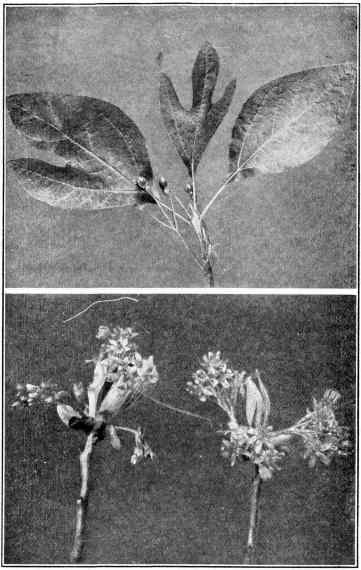
See page 130
FLOWERS, FRUIT, AND ODD LEAF PATTERNS OF THE SASSAFRAS TREE
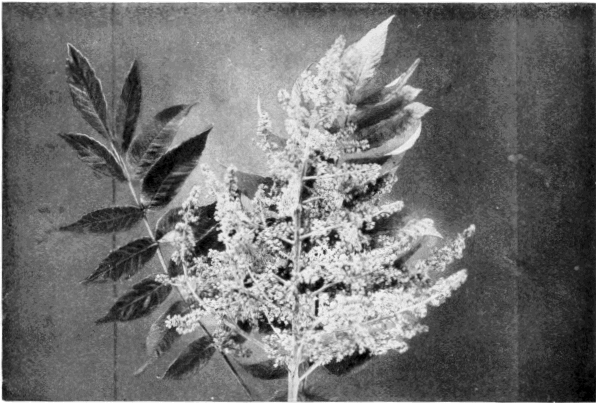
See page 141
FOLIAGE AND FLOWER CLUSTER OF THE SMOOTH SUMACH
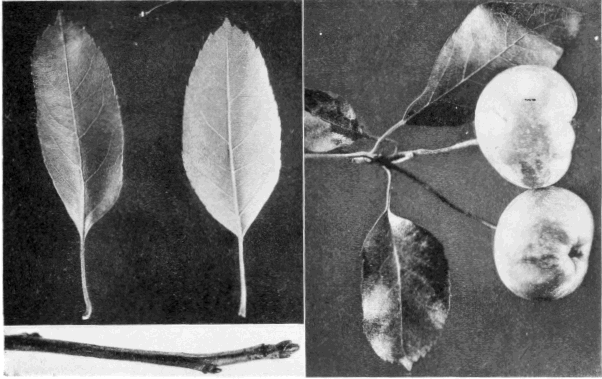
See page 148
BUDS, LEAVES, AND FRUIT OF THE WILD CRABAPPLE
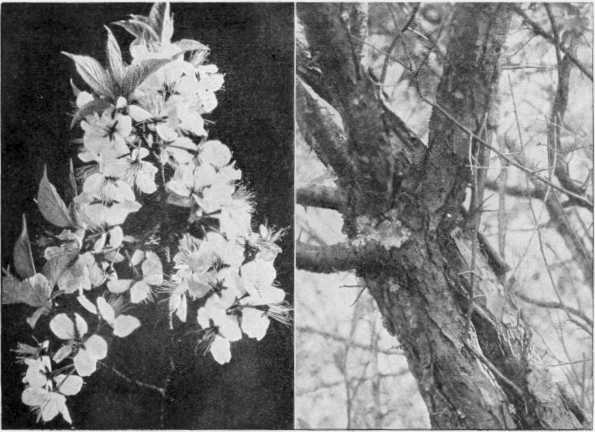
See page 151
THE CANADA PLUM Its white, fragrant flowers turn pink in fading; and its stiff, zigzag branches are beset with spiny stubs
The Canada Plum
P. nigra., Ait.
The Canada plum (see illustration, page 151) whose range dips down into the northern tier of states, is so near like the previous species as to be called by Waugh a mere variety. Its leaves are broad and large, and the flowers and fruit larger. A peculiarity of blossoming time is that the petals turn pink before they fall. This tree furnished the settler with a relish for his hard fare, and the horticulturist a hardy stock on which to graft scions of tenderer and better varieties of plums. It is a tree well worth bringing in from the woods to set in a bare fence-corner that will be beautified by the blossoms in spring, and in late summer by the bright orange-colored fruit against the ruddy foliage.
Exotic plums have greatly enriched our horticulture, giving us fruits that vie with the peach in size and lusciousness. In New-England gardens, the damsons, green gages and big red plums are imported varieties of the woolly twigged, thick-leaved European, P. domestica, which refused utterly to feel at home on its own roots in the great middle prairies of the country. These European plums have found a congenial home in the mild climate of the West Coast.
Japan has furnished to the Middle West and South a hardy, prolific species, P. triflora, generally immune to the black knot, a fungous disease which attacks native plums. Crosses between the Japanese and American native plums promise well. California now ranks first in prune raising as an industry, with France a close second. Prunes are the dried fruit of certain sweet, fleshy kinds of plums. Many cultivated varieties of Japanese plums have enriched the horticulture of our West Coast.
The almond, now grown commercially in California, is the one member of the genus prunus whose flesh is dry and woody, and whose pit is a commercial nut.
THE CHERRIES
Small-fruited members of the genus prunus, wild and cultivated, are grouped under the popular name, cherries, by common consent. The pie cherry of New-England gardens is prunus cerasus, Linn. It often runs wild from gardens, forming roadside thickets, with small sour red fruits, as nearly worthless as at home in the wilds of Europe and Asia. This tree has, through cultivation, given rise to two groups of sour cherries cultivated in America. The early, light-red varieties, with uncolored juice, of which the Early Richmond is a familiar type, and the late, dark-red varieties, with colored juice, of which the English Morello is the type.
The sweet cherry of Europe (P. Avium, Linn.) has given us our cultivated sweet cherries, whose fruit is more or less heart-shaped.
Japan celebrates each spring the festival of cherry blossom time, a great national fête, when the gardens burst suddenly into the marvelous bloom of Sakura, the cherry tree, symbol of happiness, in which people of all classes delight. The native species (P. pseudo-Cerasus), has been cultivated by Japanese artist-gardeners in the one direction of beauty for centuries. Not in flowers alone, but in leaf, in branching habit, and even in bark, beauty has been the ideal toward which patience and skill have striven successfully. "Spring is the season of the eye," says the Japanese poet. Of all their national flower holidays, cherry blossom time, in the third month, is the climax.
The Wild Cherry
Prunus Pennsylvanica, Linn.
The wild red, bird, or pin cherry grows in rocky woods, forming thickets and valuable nurse trees to hardwoods, from Newfoundland to Georgia, and west to the Rocky Mountains. The birds enjoy the ruddy little fruits and hold high carnival in June among the shining leaves. Many an ugly ravine is clothed with verdure and whitened with nectar-laden flowers by this comparatively worthless, short-lived tree; and in many burnt-over districts, the bird-sown pits strike root, and the young trees render a distinct service to forestry by this young growth, which is gone by the time the pines and hardwoods it has nursed require the ground for their spreading roots.
The Wild Black Cherry
P. serotina, Ehrh.
The wild black cherry or rum cherry (see illustration, page 166), is the substantial lumber tree of the genus, whose ponderous trunk furnishes cherry wood, vying with mahogany and rosewood in the esteem of the cabinet-maker, who uses cherry for veneer oftener than for solid furniture.
The drug trade depends upon this tree for a tonic derived from its bark, roots, and fruit. Cherry brandies, cordials, and cherry bounce, that good old-fashioned home-brewed beverage, are made from the heavy-clustered fruits that hang until late summer, turning black and losing their astringency when dead ripe.
From Ontario to Dakota, and south to Florida and Texas, this tree is found, reaching its best estate in moist, rich soil, but climbing mountain canyons at elevations of from five to seven thousand feet. A worthy shade and park tree, the black cherry is charmingly unconventional, carrying its mass of drooping foliage with the grace of a willow, its satiny brown bark curling at the edges of irregular plates like that of the cherry birch.
The Choke Cherry
P. Virginiana, Linn.
The choke cherry is a miniature tree no higher than a thrifty lilac bush, from the Eastern states to the Mississippi, but between Nebraska and northern Texas it reaches thirty-five feet in height. The trunk is always short, often crooked or leaning, and never exceeds one foot in diameter. Its shiny bark, long racemed flowers and fruit, and the pungent odor of its leaves and bark might lead one to confuse it with a black cherry sapling. But there is a marked difference between the two species. The choke cherry's odor is not only pungent, but rank and disagreeable besides. The leaf of the choke cherry is a wide and abruptly pointed oval. The fruit until dead ripe is red or yellow, and so puckery, harsh, and bitter that children, who eat the black cherries eagerly, cannot be persuaded to taste choke cherries a second time.
Birds are not so fastidious; they often strip the trees before the berries darken. It is probably by these unconscious agents of seed distribution that choke-cherry pits are scattered. From the Arctic Circle to the Gulf of Mexico, and from the Atlantic to the Rocky Mountains this worthless little choke cherry is found in all wooded regions.
THE HAWTHORNS
In the same rose family with apples, plums, cherries, and service-berries is listed the genus Crataegus, a shrubby race of trees, undersized as a rule, with stiff, zigzag branches set with thorns. Over one hundred species have been described by Charles Sargent in his "Manual of Trees of North America," published in 1905.
The centre of distribution for the hawthorn is undoubtedly the eastern United States. From Newfoundland the woods are full of them. A few species belong to the Rocky Mountain region, a few to the states farther west. Europe and Asia each has a few native hawthorns.
The English Hawthorn
Crataegus oxyacantha, Linn.
The English hawthorn is the best-known species in the world. When it first came into cultivation, no man knows. Englishmen will tell you it has always formed the hedge-rows of the countryside. This is the "blossoming May." The sweetness of its flowers, snowy white, or pink, or rose-colored, turns rural England into a garden, while linnets and skylarks fill the green lanes with music.
American "forests primeval" were swept with the woodman's axe before the hawthorns had their chance to assert themselves sufficiently to attract the attention of botanists and horticulturists. The showy flowers and fruits, the vivid coloring of autumn foliage, and the striking picturesqueness of the bare tree, with its rigid branches armed with menacing thorns, give most of these little trees attractiveness at any season. They grow in any soil and in any situation, and show the most remarkable improvement when cultivated. Their roots thrive in heavy clay. When young the little trees may be easily transplanted from the wild. They come readily from seed, though in most species the seed takes two years to germinate.
With few exceptions, the flowers of our hawthorns are pure white, perfect, their parts in multiples of five—a family trait. Each flower is a miniature white rose. Rounded corymbs of these flowers on short side twigs cover the tree with a robe of white after the leaves appear. In autumn little fleshy fruits that look like apples, cluster on the twigs. Inside the thick skin, the flesh is mealy and sweetish around a few hard nutlets that contain the seed. As a rule, the fruits are red. In a few species they are orange; in still fewer, yellow, blue, or black.
It is not practicable to describe the many varieties of our native hawthorns in a volume of the scope of this one. A few of the most distinctive species only can be included, but no one will ever confuse a hawthorn with any other tree.
The Cockspur Thorn
C. Crus-galli, Linn.
The cockspur thorn is a small, handsome tree, fifteen to twenty feet high, with stiff branches in a broad round head. The thorns on the sides of the twig are three to four inches long, sometimes when old becoming branched, and reaching a length of six or eight inches. Stout and brown or gray, they often curve, striking downward as a rule, on the horizontal branches. The leaves, thick, leathery, lustrous, dark green above, pale beneath, one to four inches long, taper to a short stout stalk, seeming to stand on tiptoe, as if to keep out of the way of the thorns. From the ground up, the tree is clothed in bark that is bright and polished, shading from reddish brown to gray. The flowers come late, in showy clusters; and the fruit gleams red against the reddening leaves. As winter comes on the leaves fall and the branches are brightened by the fruit clusters which are not taken by the birds (see illustration, page 167). All the year long the cockspur thorn is a beautiful, ornamental tree and a competent hedge plant, popular alike in Europe and America.
The Scarlet Haw
C. pruinosa, K. Koch.
The scarlet haw found from Vermont to Georgia, and west to Missouri, prefers limestone soil of mountain slopes, and is more picturesque than beautiful. The foliage is distinctive; it is dark, blue-green, smooth, and leathery, pale beneath, and turns in autumn to brilliant orange. In summer the pale fruit wears a pale bloom but at maturity it is dark purplish red and shiny.
The Red Haw
C. mollis, Scheele
The red haw is the type of a large group, ample in size, fine in form and coloring, of fruit and foliage. This tree reaches forty feet in height, its round head rising above the tall trunk, with stout branchlets and stubby, shiny thorns.
The twigs are coated with pale hairs, the young leaves, and ultimately the leaf-linings and petioles are hairy, and the fruits are downy, marked with dark dots.
The only fault the landscape gardener can find with this red haw, is that its abundant fruit, ripe in late summer, falls in September. The species is found from Ohio to Dakota, Nebraska, and Kansas.
The Scarlet Haw
C. coccinea, Linn.
The scarlet haw, native of the Northeastern states, is one of the oldest native thorns in cultivation. It is a favorite in New England gardens, because of its abundant bloom, deep crimson fruit and vivid autumn foliage. It is a shrubby, round-headed tree, with stout ascending branches, set with thorns an inch or more in length.
The Black Haw
C. Douglasii, Lindl.
In the West the black haw is a round-headed, native tree found from Puget Sound southward through California and eastward to Colorado and New Mexico. It is a round-headed tree reaching forty feet in height, in moist soil. Its distinguishing feature is the black fruit, ripe in August and September, lustrous, thin-fleshed, sweet, one-half an inch long. The thorns are stout and sharp, rarely exceeding one inch in length. The leathery dark-green leaves, one to four inches long, commend this black-fruited thorn of the West to the Eastern horticulturists. It has proved hardy in gardens to the Atlantic seaboard and in Nova Scotia.
THE SERVICE-BERRIES
A small genus of pretty, slender trees related to apples, and in the rose family, has representatives in every continent of the Northern Hemisphere, and also in North Africa. Their natural range is greatly extended by the efforts of horticulturists, for the trees are among the best flowering species.
The Service-berry
Amelanchier Canadensis, T. & G.
The Eastern service-berry, June-berry, or shad-bush, is often seen in parks and on lawns; its delicate, purple-brown branches covered in April, before the oval leaves appear, with loose, drooping clusters of white flowers. (See illustration, page 182.) Under each is a pair of red silky bracts and the infant leaves are red and silky, all adding their warmth of color when the tree is white with bloom. The blossoms pass quickly, just about the time the shad run up the rivers to spawn. We may easily trace this common name to the early American colonists who frugally fished the streams when the shad were running, and noted the charming little trees lighting up the river banks with their delicate blossoms, when all the woods around them were still asleep. In June the juicy red berries call the birds to a feast. Then the little tree quite loses its identity, for the forest is roofed with green, and June-berries are quite overshadowed by more self-assertive species.
The borders of woods in rich upland soil, from Newfoundland to the Dakotas and south to the Gulf, are the habitat and range of this charming little tree.
The Western Service-berry
A. alnifolia, Nutt.
The Western service-berry grows over a vast territory which extends from the Yukon River south through the Coast Ranges to northern California and eastward to Manitoba and northern Michigan. In the rich bottom lands of the lower Columbia River, and on the prairies about Puget Sound, it reaches twenty feet in height, and its nutritious, pungent fruits are gathered in quantities and dried for winter food by the Indians. Indeed, the horticulturists consider this large juicy fine-flavored, black berry quite worthy of cultivation, as it grows in the wild to one inch in diameter—the average size of wild plums.
THE HACKBERRIES
Fifty or sixty tropical and temperate-zone species of hackberries include two North American trees which have considerable value for shade and ornamental planting. One hardy Japanese species has been introduced; three exotic species are in cultivation in the South. One is from South Africa, a second from the Mediterranean basin, and a third from the Orient.
It is easy to mistake the hackberry for an elm; the habits of the two trees lead the casual observer astray. The leaf is elm-like, though smaller and brighter green than the foliage of the American elm. A peculiarity of the foliage is the apparent division of the petiole into three main ribs, instead of a single midrib. At base, the leaves are always unsymmetrical. The bark is broken into thick ridges set with warts, separated by deep fissures.
The absence of terminal buds induces a forking habit, which makes the branches of a hackberry tree gnarled and picturesque. The hackberry is not familiarly known by the inhabitants of the regions where it grows, else it would more commonly be transplanted to adorn private grounds and to shade village streets.
The Hackberry
Celtis occidentalis, Linn.
The hackberry reaches one hundred and twenty-five feet in height in moist soil along stream borders or in marshes. It is distributed from Nova Scotia to Puget Sound, and south to Florida, Tennessee, Missouri, Texas, and New Mexico. The beauty of its graceful crown is sometimes marred by a fungus which produces a thick tufting of twigs on the ends of branches. The name, "witches' brooms" has been given to these tufts. Growths of similar appearance and the same name are produced by insect injury on some other trees.
The fruit of the hackberry is an oblong, thin-fleshed sweet berry, purple in color, one fourth to one half inch long. It dries about the solitary seed and hangs on the tree all winter, to the great satisfaction of the birds. (See illustration, page 183.)
Emerson says: "The wood is used for the shafts and axle-trees of carriages, the naves of wheels, and for musical instruments. The root is used for dyeing yellow, the bark for tanning, and an oil is expressed from the stones of the fruit."
The best use we can make of the hackberry tree is to plant it for shade and ornament. It is easily transplanted, for the roots are shallow and fibrous, so that well-grown trees may be moved in winter time. The autumn yellow of the foliage is wonderfully cheerful, and the warty bark, checked into small thick plates, is interesting at any season.
European Nettle Tree
C. Australis
The European nettle tree is supposed to have been the famous "lotus" of classical literature. Homer tells of the lotus-eaters who, when they tasted the sweet fruit, straightway forgot their native land or could not be persuaded to return. This innocent tree, against which the charge has never been proved, bears a better reputation for the qualities of its wood. It is as hard as box or holly, and as beautiful as satin-wood when polished. Figures of saints and other images are carved out of it. Hay-forks are made of its supple limbs. Rocky worthless land is set apart by law in some countries for the growing of these trees. Suckers from the roots make admirable ramrods, coach-whip stocks and walking-sticks. Shafts and axle-trees of carriages are made of the larger shoots; oars and hoops are supplied from these coppiced trees. From northern Africa, throughout Europe, and on to India, the tree is planted for shade, and its foliage is used as fodder for cattle.
THE MULBERRIES
The mulberry family includes fifty-five genera and nearly a thousand species of temperate-zone and tropical plants. The genus ficus alone includes six hundred species. Hemp, important for its fibrous, inner bark, and the hop vine are well known herbaceous members of the mulberry family, which stands botanically between the elms and the nettles—strange company, it would seem, but justified by fundamental characteristics. Three genera of this family have tree forms in America—the mulberry, the Osage orange, and the fig. Two native mulberries and three exotic species are widely cultivated for their fruit, their wood, and as ornamental trees. Weeping mulberries are among the most popular horticultural forms.
The Red Mulberry
Morus rubra, Linn.
The red mulberry grows to be a large dense, round-headed tree, with thick fibrous roots and milky sap. Its alternate leaves, three to five inches long, are variable in form, often irregularly lobed, very veiny, usually rough, blue-green above, pale and pubescent beneath, turning yellow in early autumn. The inconspicuous flower spikes are succeeded by fleshy aggregate fruits like a blackberry, sweet, juicy, dark purple or red, each individual fruit single-seeded. Birds and boys alike throng the trees through the long period during which these berries ripen. They are hardly worthy to rank with the cultivated mulberries as a fruit tree. But planted in poultry yards and hog pastures the dropping fruits are eagerly devoured by the occupants of these enclosures.
The chief value of the tree lies in the durability of its orange-yellow wood, which, though coarse-grained, soft and weak, is very durable in the soil and in contact with water. Hence it has always commended itself to fence- and boat-builder. It is sometimes planted for ornament, but its dropping fruit is a strong objection to it as a street or lawn tree.
One of the mulberry's chief characteristics is its tenacity to life. Its seeds readily germinate and cuttings, whether from roots or twigs, strike root quickly. Indians discovered that rope could be made out of the bast fibre of mulberry bark. They even wove a coarse cloth out of the same material. The early settlers of Virginia, who found the red mulberry growing there in great abundance, dreamed in vain of silk culture as an industry based upon this native tree. Their hopes were not realized. Silk culture has never yet become a New-World industry.
The White Mulberry
M. alba, Linn.
The white mulberry is a native of northern China and Japan. From this region it has been extensively introduced into all warm temperate climates. Its white berries are of negligible character. It is the leaves that give this oriental mulberry a unique position in the economic world. They are the chosen food of silkworms. No substitute has ever robbed this tree of its preëminence, maintained for many centuries in its one field of usefulness.
The hardy Russian mulberries are derived from M. alba. These have done much to enrich the horticulture of our Northern states, but the parent tree, though it thrives in the eastern United States and in the South, has not been the means of establishing silk culture on a paying basis in this country.
The Black Mulberry
M. nigra, Linn.
The black mulberry, probably a native of Persia, has large, dark red, juicy fruits, for which it is extensively cultivated in Europe. In this country it is hardy only in the Southern and the Pacific Coast states. It is the best fruit tree of its family, yet no mulberry is able to take rank among profitable fruit trees. The fruits are too sweet and soft, and they lack piquancy of flavor. They ripen a few at a time and are gathered by shaking the trees.
The dark green foliage of the black mulberry gives ample shade throughout the season. Planted in the garden or in the border of the lawn where no walk will be defaced by the dropping fruits, the mulberry is a particularly desirable tree because it attracts some of our most desirable song-birds to build on the premises. Given a mulberry tree and a bird-bath near by, and the smallest city lot becomes a bird sanctuary through the summer and a wayside inn for transients during the two migratory seasons.
THE FIGS
The genus ficus belongs to all tropical countries, and this remarkable range accounts for the six hundred different species botanists have identified. The rubber plant, popular in this country as a pot and tub plant, is one of the best-known species. In its East Indian forest home it is the "Assam Rubber Tree." It may begin life as an air plant, fixing its roots in the crotch of another tree, in which a chance seed has lodged. A shock of aërial roots strikes downward and reaches the ground. After this the tree depends upon food drawn from the earth. The supporting host tree is no longer needed. The young rubber tree has by this time a trunk stiff enough to stand alone.
Assam rubber, which ranks in the market with the best Brazilian crude rubber, comes from the sap of this wild fig tree, Ficus elasticus. Clip off a twig of your leathery-leaved rubber plant and note the sticky white sap that exudes. In the highest priced automobile tires you find the manufactured product.
Dried figs have always been an important commercial fruit. These imported figs are from trees that are horticultural varieties of a wild Asiatic species, Ficus Carica. Smyrna figs are best for drying. They form a delicious, wholesome sweet, which has high food value and is more wholesome than candy for children. Tons of this dried fruit are imported each year from the countries east of the Mediterranean Sea. Now California is growing Smyrna figs successfully.
The banyan tree of India is famous, striking its aërial rootlets downward until they reach the ground and take root, and thus help support the giant, horizontal limbs. These amazing trees, members of the genus ficus, sometimes extend to cover an acre or more of ground. To walk under one is like entering the darkness of a forest of young trees. By the clearing away of most of these aërial branches, a great arbor is made for the comfort of people in regions where the sun's rays are overpowering in the middle of the day.
Our own fig trees in North America are but sprawling parasitic trees, unable to stand alone. They are found only in the south of Florida, and therefore are generally unknown.
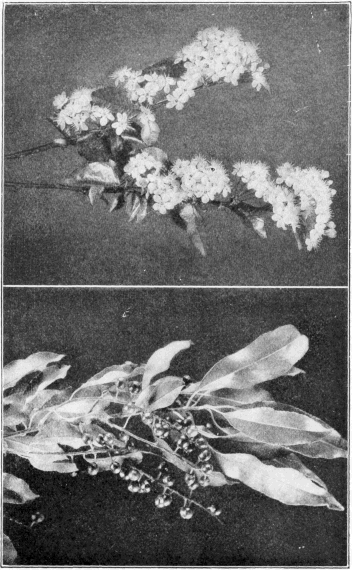
See page 153
FLOWERS AND FRUIT OF THE WILD BLACK CHERRY
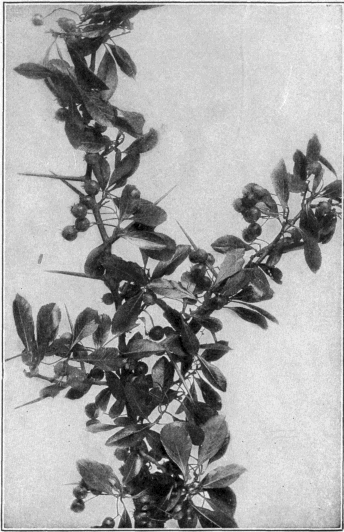
See page 156
A FRUITING BRANCH OF THE COCKSPUR THORN
The Golden Fig
Ficus aurea, Nutt.
The golden fig climbs up other trees and strangles its host with its coiling stems and aërial roots. One far-famed specimen has grown and spread like a banyan tree, its trunk and head supported by secondary stems that have struck downward from the branches. Smooth as a beech in bark, crowned with glossy, beautiful foliage, like the rubber plants, this parasitic fig is a splendid tropical tree, but the host that supports all this luxuriance is sacrificed utterly. The little yellow figs that snuggle in the axils of the leaves turn purple, sweet, and juicy as they ripen. They are sometimes used in making preserves. An interesting characteristic of the wood of the golden fig is its wonderful lightness. Bulk for bulk, it is only one fourth as heavy as water.
THE PAPAWS
Two of the forty-eight genera of the tropical custard-apple family are represented by a solitary species each in the warmer parts of the United States. Important fruit and ornamental trees in the tropics of the Old World are included in this family, but their New-World representatives are not the most valuable. However, they have a sufficient number of family traits to look foreign and interesting among our more commonplace forest trees; and because their distribution is limited they are not generally recognized in gardens, where they are planted more for curiosity than for ornament.
The Papaw
Asimina triloba, Dunal.
The papaw has the family name, custard-apple, from its unusual fruit, whose flesh is soft and yellow, like custard. The shape suggests that of a banana. The fruits hang in clusters and their pulp is enclosed in thick dark brown skin, wrinkled, sometimes shapeless, three to five inches long. Dead ripe, the flesh becomes almost transparent, fragrant, sweet, rather insipid, surrounding flat, wrinkled seeds an inch long. The fruit is gathered and sold in local markets from forests of these papaws which grow under taller trees in the alluvial bottom lands of the Mississippi Valley. In summer the leaves are tropical-looking, having single blades eight to twelve inches long, four to five inches broad, on short, thick stalks. These leaves are set alternately upon the twig, and cluster in whorls on the ends of branches. The flowers appear with the leaves and would escape notice but for their abundance and the unusual color of their three large membranous petals. At first these axillary blossoms are as green as the leaves; gradually the dark pigment overcomes the green, and the color passes through shades of brownish green to dark rich wine-red. The full-grown foliage by midsummer has become very thin in texture, and lined with pale bloom. The tree throughout exhales a sickish, disagreeable odor. The fruit is improved in flavor by hanging until it gets a nip of frost.
This "wild banana tree" is the favorite fruit tree of the negroes in the Black Belt. Its hardiness is surprising. From the Southern states, it ranges north into Kansas, Michigan, New York, and New Jersey.
The Melon Papaw
Carica Papaya, Linn.
The melon papaw does not belong to the custard-apple family, but it grows in southern Florida and throughout the West Indies, and has the name of our little "wild banana tree," so it may as well have mention here, as it is the sole representative of the true Papaw family, and it is universally cultivated for its fruit in the warm regions of the world. By selection the fruit has been improved until it ranks as one of the most wholesome and important of all the fruits in the tropics. In Florida the papaw grows on the rich hummocks along the Indian River, and on the West Coast southward from Bay Biscayne. It is very common on all the West Indian Islands. It grows like a palm, with tall stem crowned by huge simple leaves, one to two feet across, deeply lobed into three main divisions, and each lobe irregularly cut by narrow sinuses. The veins are very thick and yellow, and the hollow leaf-stalks lengthen to three or four feet. The bark of this tree is silvery white—a striking contrast with the lustrous head of foliage. The flowers are waxy, tubular, fragrant, turning their yellow petals backward in a whorl. On fertile trees the fruits mature into great melons, sometimes as large as a man's head; but these are the cultivated varieties. Wild papaws rarely exceed four inches long, and usually they are smaller. When full grown the fruit turns to bright orange-yellow. The succulent pulp separates easily from the round seeds.
In the West Indies, the trees often branch and attain much greater size than in Florida, where fifteen feet is the maximum, in the wilds.
The leaves of this papaw contain, in their abundant sap, a solvent, papain, which has the property of destroying the connective tissue in meats. They are bruised by the natives and tough meat, wrapped closely in them, becomes tender in a few hours. The fruits are eaten raw and made into preserves. Negroes use the leaves also as a substitute for soap in the washing of clothes.
THE POND APPLES
The pond apple (Anona glabra, Linn.) is our only representative of its genus that reaches tree form and size, and it is the second of our native custard-apples. It comes to us via the West Indies, and reaches no farther north than the swamps of southern Florida. It is a familiar tree on the Bahama Islands. Thirty to forty feet high, the broad head rises from a short trunk, less than two feet in diameter, but very thick compared with the wide-spreading, contorted branches and slender branchlets. It is often buttressed at the base. The leaves are oval and pointed, rarely more than four inches long, bright green, leathery, paler on the lower surface, plain-margined. The flowers in April form pointed, triangular boxes by the touching of the tips of the yellowish white petals, whose inner surfaces near the base have a bright red spot.
The fruit, which ripens in November, is somewhat heart-shaped, four to six inches long, compound like a mulberry. The smooth custard-like flesh forms a luscious mass between the fibrous core and the surface, studded with the hard seeds. Fragrant and sweet, these wild pond apples have small merit as fruit. Little effort has been made to improve the species horticulturally. Its rival species in the West Indies have a tremendous lead which they are likely to keep.
The Cherimoya
Anona Cherimolia, Mill.
The cherimoya, native of the highlands of Central America, has long been cultivated, and its fruit has been classed, with the pineapple and the mangosteen, as one of the three finest fruits in the world. Certainly it deserves high rank among the fruits of the tropics. This also has been introduced into cultivation in southern Florida, but its culture has assumed much more importance in California, where it seems to feel quite at home.
The tree is a handsome one, with broad velvety bright green leaves, deciduous during the winter months. It grows wherever the orange is hardy, and its fruit, heart-shaped or oval, green or brown, is about the size of a navel orange. Conical protuberances cover the surface and enclose a mass of white, custard-like pulp, with the flavor of the pineapple, in which are imbedded twenty or thirty brown seeds. A taste for this tropical pond apple is as easily acquired as for the pineapple, which has become universally popular. Every garden in the Orange Belt should have a cherimoya tree for ornament and for its fruit.
THE PERSIMMONS
The persimmon tree of the Southern woods belongs to the ebony family, which contains some important fruit and lumber trees, chiefly confined to the genus diospyros, which has two representatives among the trees of North America. Doubtless a climate of longer summers would enable our persimmon trees to produce wood as hard as the ebony of commerce, whose black heart-wood and thick belt of soft yellow sap-wood are the products of five different tropical species of the genus—two from India, one from Africa, one from Malaysia and one from Mauritius. The beautiful, variegated wood called coromandel is produced by a species of ebony that grows in Ceylon.
Fossil remains of persimmon trees are found in the miocene rocks of Greenland and Alaska, and in the later cretaceous beds uncovered in Nebraska. These prove that diospyros once had a much wider range than now, extending through temperate to arctic regions, whereas now our two persimmons and the Chinese and Japanese species, are the only representatives outside the tropics.
The Persimmon
Diospyros Virginiana, Linn.
The persimmon will never be forgotten by the Northerner who chances to visit his Virginia cousins in the early autumn. Strolling through the woods he notes among other unfamiliar trees a tall shaft covered with black bark, deeply checked into squarish plates. The handsome round head, held well aloft, bears a shock of angular twigs and among the glossy, orange-red leaves hang fruits the size and shape of his Northern crabapples. The rich orange-red makes it extremely attractive, and the enthusiasm with which the entire population regards the approaching persimmon harvest focuses his interest likewise upon this unknown Southern fruit. He is eager to taste it without delay, and usually there is no one to object. Forthwith he climbs the tree, or beats a branch with a long pole until a good specimen is obtained. Its thin skin covers the mellow flesh—but the first bite is not followed by a second. The fruit is so puckery that it almost strangles one.